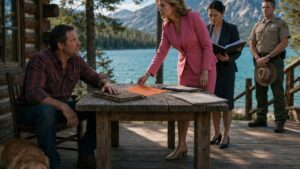
They Tried to Tow His Old Bronco, So He Made the Whole Neighborhood Depend on His Decision
Chapter 1: The Yellow Notice Beneath the Windshield Wiper
The yellow sheet under the Bronco’s windshield wiper was too bright to belong there.
Gary Allen saw it before he reached the bottom porch step. Against the dark green paint, the laminated paper looked less like a notice than a warning flag planted by someone who expected obedience.
He stopped with his coffee halfway to his mouth.
The Bronco sat where it had sat for six years, angled beside the gravel drive with its nose toward County Road 12. Its paint was not perfect, but it was honest—deep green over steel Gary and his father had repaired panel by panel. The chrome bumper held a faint crease Nicholas Adams had always promised to straighten when they had time.
Gary crossed the yard slowly.
The first line was printed in bold:
COMMUNITY AESTHETIC VIOLATION.
Below it, the Westridge Estates emblem appeared above a list of alleged problems: visible commercial vehicle, improper outdoor storage, incompatible exterior condition. The final paragraph gave him seventy-two hours to remove the Bronco or face towing and associated fees.
Gary read it twice.
Then he looked past the Bronco toward the road.
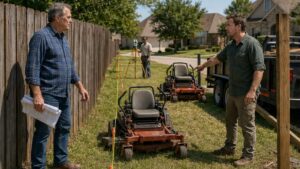
Westridge Estates began across the asphalt, where a stone monument announced the subdivision in brass letters. Beyond it stood rows of beige houses, clipped hedges, white fencing, and identical black mailboxes. Gary’s twelve acres lay on the other side: pasture, workshop, gravel, pecan trees, and the weathered house Nicholas had bought before the first subdivision survey stake ever touched the ground.
The association line ended at the pavement.
Everyone who had ever served on the board knew it.
Gary lifted the wiper and removed the notice carefully. Clear tape clung to the glass. Whoever had attached it had pressed hard enough to trap air bubbles beneath the laminate.
They had not mailed it.
They had walked—or driven—onto his land.
He turned toward the grass between the road and the workshop. Two fresh tire tracks ran through the dew, curving from the subdivision’s service lane, crossing the shallow ditch, and ending beside the Bronco.
One track continued toward the mailbox.
The cedar post leaned at an angle it had not held the night before. Splintered wood showed pale beneath the stain.
Gary set his coffee on the Bronco’s hood.
He crouched beside the track and pressed two fingers into the mud. Still damp. Wide tread, probably an SUV. A small shard of red plastic lay near the bent post.
For several seconds, he let himself imagine carrying the notice across the road, entering the clubhouse, and placing it directly in front of Janet Hall while the morning committee drank coffee from matching paper cups.
Instead, he put the plastic shard in his pocket.
Inside the workshop, the air smelled of machine oil, old leather, and metal dust. Gary laid the notice on his workbench beside a carburetor he had disassembled the previous evening.
The yellow paper covered one corner of a framed photograph.
Nicholas stood in that photograph with one boot on the Bronco’s running board, younger and broader through the shoulders, grinning as though the rusted shell behind him were already finished. Gary stood beside him in a stained engineering-company shirt, looking tired and amused.
Gary turned the frame facedown.
He opened the steel filing cabinet beneath the bench and pulled out a folder labeled PARCEL 12-417B. The deed sat inside a plastic sleeve with tax maps, survey notes, and a boundary description written in language dry enough to outlast every board president in Westridge.
He traced the eastern line with his finger.
County Road 12.
No covenant attachment. No HOA incorporation. No architectural-control agreement.
The small satisfaction lasted less than a minute.
His phone vibrated on the bench.
Unknown number.
“Gary Allen?”
“Yes.”
“This is County Line Recovery. I’m calling to confirm access for a vehicle collection scheduled tomorrow morning.”
Gary stared at the yellow notice.
“What vehicle?”
“A green Ford Bronco. We were given authorization by Westridge Estates.”
“You were given authorization to enter my property?”
A pause followed. Papers shifted on the other end.
“We were told the vehicle is in violation and located along the community access frontage.”
“It is located on parcel 12-417B.”
Another pause.
“Sir, I’m only confirming the appointment.”
“Who signed the request?”
“I’d have to check.”
“Check before you put a truck on my land.”
The caller’s tone changed, becoming more formal. “You’ll need to address the dispute with the association. We have a pickup window between eight and ten.”
The call ended.
Gary remained beside the bench with the phone in his hand.
The association had gone beyond a threatening sheet of paper. Someone had contacted a towing company, represented his property as theirs, and created an official pickup order.
He photographed the notice, the tape residue, the tracks, the damaged mailbox, and the red shard. Then he sent the images to Jason Rivera with a single sentence:
Call me when you see this.
Jason replied within three minutes.
Do not contact the board yet.
Gary looked toward the workshop doors. Through the glass, the Bronco sat in the morning sun, the empty space beneath its wiper more troubling than the notice had been.
He had ignored three previous HOA letters over the past year. One complained about workshop noise during permitted hours. Another asked him to screen the parts racks from road view. The third offered to “coordinate voluntary compliance” with Westridge’s appearance standards.
He had thrown each one into the bottom drawer.
They had no authority, so he had seen no reason to answer.
Facts did not need defending.
That was what he had told himself.
Now a tow truck was coming.
Gary slipped the original deed into a county file, placed the yellow notice on top, and closed the folder. His hand rested there a moment longer than necessary.
On the workbench, the facedown photograph reflected a strip of fluorescent light.
He did not turn it over.
At seven forty the next morning, he would be standing beside the Bronco with the deed in his hand.
At eight, County Line Recovery was scheduled to take it.
Chapter 2: The Tow Truck Stopped at the Property Line
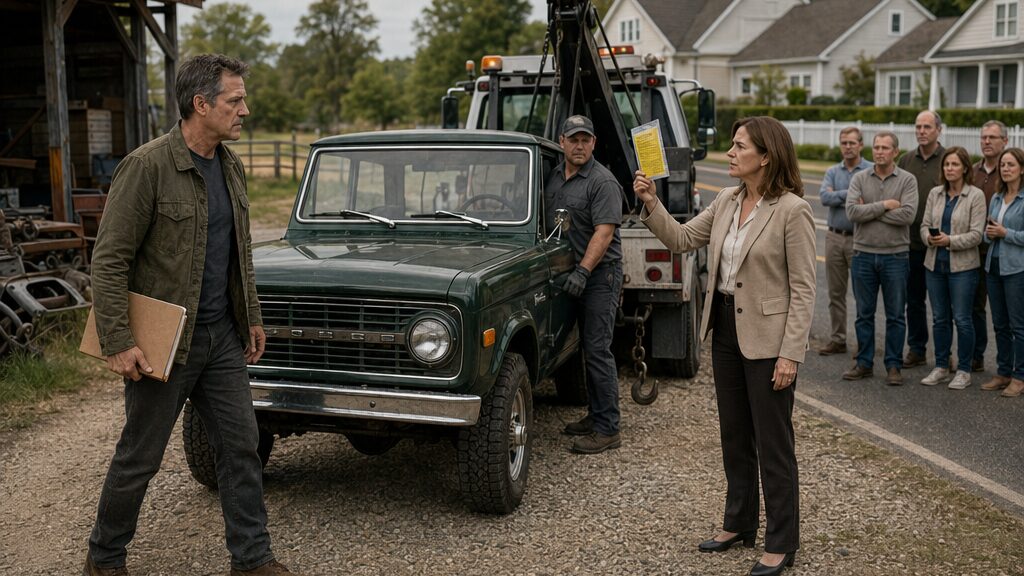
The tow truck’s steel hook was already dropping when Gary stepped out of the workshop.
It descended with a hydraulic whine, swinging above the gravel like a pendulum. The driver had backed halfway onto Gary’s frontage, positioning the truck nose-out toward County Road 12.
Janet Hall stood near the Bronco with a folder tucked beneath one arm.
She had brought an audience.
Six Westridge residents watched from the roadside, some in exercise clothes, others holding travel mugs. Amanda Torres stood behind them with her arms folded, her expression tight rather than triumphant.
Gary walked toward the truck carrying the county file.
“Stop the lift,” he said.
The driver looked toward Janet.
Janet opened her folder. “Mr. Allen, you were provided formal notice and an opportunity to correct the violation.”
“This truck is on my parcel.”
“The vehicle is adjacent to a designated community-access corridor.”
“It is not in the corridor.”
Janet’s mouth tightened. “The association has maintenance and safety authority over that frontage.”
Gary looked at the driver. “Have you verified the parcel number?”
“I have a work order.”
“That wasn’t my question.”
Janet raised the yellow copy of the notice and began reading from it, her voice pitched for the residents behind her.
“Outdoor storage of unregistered or visually deteriorated vehicles is inconsistent with the established residential character—”
“The Bronco is registered.”
“That does not address its condition.”
Gary glanced at the vehicle. The paint reflected the tow boom, the white fence across the road, and Janet’s shoes. Its tires were clean. Its plates were current. One headlight ring still needed polishing.
“What condition would satisfy you?”
“This is not personal.”
“No,” Gary said. “It’s a jurisdiction question.”
He placed the county file on the Bronco’s hood and opened it. The yellow notice went on the left. The original deed went on the right.
A breeze lifted one corner of the notice. Gary held it down with two fingers.
The driver approached, keeping clear of the disagreement. “Sir, if you interfere with the equipment—”
Gary crouched beside the rear axle. The tow hook had been lowered close enough for its chain to brush the gravel. He lifted it by the steel shaft and carried it three feet away from the Bronco, setting it down gently.
Then he stood.
“Who accepted liability for entering land outside the association boundary?”
The driver frowned. “What?”
“The work order should identify the party authorizing entry. I need the name of the person who accepted liability if your truck damages the vehicle or trespasses on parcel 12-417B.”
Janet stepped closer. “The association has an easement.”
“An easement for what?”
“Emergency access and maintenance.”
“Does it say vehicle enforcement?”
“It grants the association continuing access.”
Gary looked at her for a moment.
That was more than she had said in any of the letters.
Behind Janet, one resident lowered his phone. Amanda turned toward her.
“Continuing access?” Amanda asked. “I thought this was based on the appearance policy.”
“It is based on multiple authorities,” Janet said.
Gary addressed the driver. “Enter the parcel number.”
The driver hesitated, then returned to the cab. He typed into a mounted screen, glanced at the work order, and typed again.
The hydraulic system idled behind him.
Gary could feel the residents waiting for something louder—a threat, an insult, a performance worthy of the gathering Janet had created.
He gave them nothing.
The driver climbed down holding his phone.
“This address isn’t inside Westridge Estates.”
Janet’s face changed only slightly. “The frontage is covered by agreement.”
“The registered owner is Gary Allen,” the driver continued. “The requesting party isn’t listed as owner, lienholder, law enforcement, or property manager for this parcel.”
“I gave you the easement documentation.”
“You gave dispatch a community violation notice.”
“The easement supports enforcement access.”
The driver rubbed his jaw. “Not for me it doesn’t.”
Janet lowered her voice. “Your company confirmed the pickup.”
“Dispatch confirmed a request. I’m not taking a titled vehicle off privately owned land based on this.”
A resident near the road whispered something. Someone else shifted backward, as though distance from Janet might also create distance from the decision.
The hook remained on the gravel between Gary and the truck.
For the first time that morning, Gary felt the pressure in his chest loosen.
It was not satisfaction exactly. Satisfaction would have required Janet to look embarrassed, and she did not. She looked cornered, which was different and perhaps more dangerous.
The driver raised the equipment and backed toward the road.
Before leaving, he handed Gary a copy of the work order. The authorization line read Westridge Estates Community Association. Beneath it was Janet Hall’s name.
“You’ll want to keep that,” he said.
Gary folded the paper once and placed it in the county file.
Janet watched the truck disappear.
“This does not resolve the violation,” she said.
“There is no violation.”
“The county will determine that.”
“Then ask the county.”
“I already have.”
Amanda looked at Janet again. “You said legal counsel approved the tow.”
Janet closed her folder. “Counsel approved enforcement.”
“That isn’t what he just said.”
Janet’s gaze moved across the watching residents. “The board has a duty to protect property values, maintain emergency access, and respond to unsafe conditions. Mr. Allen has ignored every attempt at cooperation.”
Gary almost answered.
She was not entirely wrong about that.
He had ignored the letters. He had refused the offered meeting. When Amanda had once stopped near his mailbox and asked whether the stacked body panels were temporary, he had said, “They’re on my land,” and walked away.
He had believed explanation invited negotiation, and negotiation implied authority.
Now the silence was being used as evidence.
Janet pointed toward the workshop. “Commercial repair activity, vehicle storage, fuel containers, uncontrolled access. You may be outside the covenant boundary, but your property directly affects this community.”
“And that makes it yours?”
“No. It makes it relevant.”
For one brief moment, her answer carried something other than dominance. Fear, perhaps. Or exhaustion.
Then it was gone.
“You will receive county enforcement documents,” she said. “The board will pursue every remedy available.”
She turned and crossed the road with the residents following unevenly behind her.
Amanda remained.
Her eyes settled on the deed lying beside the yellow notice.
“Is that the original?”
“Yes.”
“And the association line really stops at the road?”
“Yes.”
Amanda looked toward the departing group. “Then why did she say counsel approved it?”
Gary closed the file.
“You should ask her.”
Amanda’s expression hardened. “That’s what you always do.”
“What?”
“Give half an answer and act like the rest is beneath you.”
She walked back toward Westridge before he could respond.
Inside the workshop, Gary set the tow order beside the carburetor. The failed removal should have felt like a clean victory. Instead, Amanda’s words followed him through the building.
His phone rang at ten twelve.
Jason did not begin with a greeting.
“I found the board request.”
Gary straightened. “What request?”
“An email Janet sent to the towing company and copied to two board members. She asked for removal before outside legal review because, in her words, delay would weaken the association’s enforcement position.”
Gary looked through the open doors at the Bronco.
“So she knew it wasn’t settled.”
“She knew counsel had not confirmed jurisdiction.”
“Send it to me.”
“I will. But there’s another phrase you need to see.”
“What phrase?”
Jason was quiet for a second.
“She told them the vehicle had to be removed before the easement issue was examined.”
Chapter 3: The Map Beneath the County Records
The county clerk unfolded the map as though she were opening something that had been waiting years for the right pair of hands.
Its paper was thick, yellowed at the folds, and wider than the counter. Blue survey lines crossed old property boundaries. Red pencil marked the later subdivision roads.
In the lower corner, beside Gary’s parcel number, Nicholas Adams had written three words in block letters:
KEEP ACCESS PRIVATE.
Gary recognized the handwriting instantly.
His father’s A always leaned forward. His R looked like a bent nail.
“Where did this come from?” Gary asked.
“Archived easement packet,” the clerk said. “Recorded when the Westridge development application was approved.”
Jason stood beside him, reading the index sheet. “There should be a renewal instrument.”
The clerk pulled another folder from the cart.
Gary kept his eyes on the map.
A narrow strip ran from County Road 12 across the northern edge of his pasture and connected with a service lane behind Westridge Estates. Another dashed line followed nearly the same route underground.
“What’s the dashed line?”
“Water main,” Jason said. “Subdivision feed from the county connection.”
Gary looked at him. “Under my land?”
“Under an easement across your land.”
The clerk slid the renewal document toward them.
The original agreement granted Westridge emergency passage for fire, ambulance, evacuation, and maintenance of the buried line. It did not transfer ownership. It did not authorize parking, inspections, aesthetic enforcement, or vehicle removal.
The term was twenty years.
Jason found the effective date and counted backward under his breath.
Then he tapped the page.
“Eleven days.”
Gary did not move.
“The easement expires in eleven days?”
“Unless renewed.”
“Automatically?”
Jason read the clause again. “No. Renewal requires written agreement from the parcel owner.”
The clerk glanced between them and stepped away to answer a phone at the far desk.
Gary studied the red lines of Westridge Estates. Rows of lots had been drawn over what had once been hay field. The service lane curved behind thirty-two houses before reaching his pasture.
All those houses had been built with the assumption that the line across his land would remain available.
Janet had authorized a tow from property the subdivision might soon need permission to cross.
A slow, hard sense of possibility took shape in him.
“What happens if I don’t renew?”
Jason closed the folder halfway. “The private access right ends.”
“And the water line?”
“The physical line remains. Their legal right to enter for maintenance becomes disputed. The county utility may have separate statutory authority in an emergency, but Westridge’s agreement would be gone.”
“So they would have to negotiate.”
“Yes.”
Gary looked again at Nicholas’s note.
KEEP ACCESS PRIVATE.
His father had never mentioned an expiration date. Or perhaps he had, during one of the hospital visits when medication blurred the edges of every practical conversation. Nicholas had continued talking about fuel pumps, roof drainage, insurance renewals, and museum cases as though illness were an inconvenient appointment he planned to cancel.
Gary had nodded and taken notes he never reviewed.
“Janet knows this,” he said.
“She knows an easement exists. Whether she understands the expiration clause is another question.”
“She used it to justify the tow.”
“She stretched it past recognition.”
Gary folded his arms. “Then I let it expire.”
Jason watched him without answering.
“What?”
“There are thirty-two homes behind that secondary route.”
“They have a main entrance.”
“They also have a failed secondary gate.”
Gary turned. “Failed?”
“Last year an ambulance was delayed when a delivery truck blocked the main entrance. The association’s insurer asked for proof of reliable emergency access. I found it in the board correspondence.”
That explained something in Janet’s face when she had spoken about safety.
It did not excuse the tow order.
But it changed the shape of the leverage.
Gary looked toward the map again. The access strip crossed the pasture near an old equipment shed, then passed behind the workshop. He had driven the Bronco along it with Nicholas before Westridge’s first houses were finished. Back then, there had been no white fences, no clubhouse, only graders and drainage pipes.
“If I renew,” he said, “they keep acting like it belongs to them.”
“Not if the terms change.”
“And if I don’t?”
Jason’s voice remained even. “You may be legally entitled to refuse. That doesn’t mean the consequences stop at Janet Hall.”
Gary disliked the sentence because it sounded like something Nicholas would have said.
The clerk returned with a smaller archival envelope.
“This was attached to the original packet,” she said. “Photographic reference for existing access.”
She removed a faded photograph.
The green Bronco stood beside the pasture gate before restoration, its hood mottled with rust. Nicholas leaned against the front fender, smiling at whoever held the camera. Gary stood behind him with one hand on the open driver’s door.
On the back, Nicholas had written:
First car through the museum gate someday.
Gary’s fingers tightened around the photograph.
Jason read the line but said nothing.
They carried the records to his office two blocks from the courthouse. Jason’s conference room overlooked the parking lot and a row of government buildings built from the same brown brick. He spread copies across the table: deed, easement, tow request, board emails, subdivision plat, utility diagram.
The documents gave Gary exactly what he had wanted that morning.
Control.
Yet the feeling was wrong.
He could demand public acknowledgment. He could require maintenance payments, insurance coverage, surveyed boundaries, and a prohibition against any association activity on the rest of his parcel.
Or he could refuse renewal and make Janet explain to every household why their emergency route had disappeared after she tried to tow a vehicle that was never hers to regulate.
The second option produced a sharp, private satisfaction.
Jason seemed to see it.
“Don’t decide while you’re angry.”
“I’m not angry.”
“You brought the original deed to a tow truck.”
“That was preparation.”
“You moved the hook yourself.”
“It was near the axle.”
Jason sat back. “Your father used to make the same distinction.”
Gary looked down at the old photograph.
“Don’t use him to manage me.”
“I’m not managing you.”
“That’s what this sounds like.”
“I’m telling you the strongest legal position is not always the strongest ending.”
Gary slid the photograph into the county file.
“There isn’t an ending yet.”
Jason turned to his computer. “No. There’s also a zoning problem.”
“What zoning problem?”
“Possibly none. But Janet’s email refers to anticipated commercial activation on your parcel.”
Gary kept his face still.
Jason noticed.
“What haven’t you told me?”
“Nothing relevant.”
“Gary.”
The word landed with the weight of long familiarity.
Gary walked to the window. In the parking lot below, a county maintenance truck backed into a space while its warning light flashed silently.
Eight months earlier, he had submitted an application he never expected anyone in Westridge to see. He had paid review fees, answered fire-code questions, commissioned a traffic study, and secured approval for a small vintage motor museum with weekend hours.
Then Nicholas had worsened.
The permit arrived three days after the funeral.
Gary had placed it in a drawer and never activated it.
Jason searched the county zoning portal. His eyes moved across the screen.
“Heartland Motor Museum,” he read.
Gary said nothing.
“Display building, educational workshop, agricultural-tourism designation, exterior sign approval.” Jason looked up. “This isn’t preliminary.”
“It was.”
“It’s approved.”
“It’s dormant.”
“Until you activate it.”
Gary turned from the window. “I wasn’t going to.”
Jason clicked into the permit history.
The room went quiet except for the computer fan.
Then Jason leaned closer to the screen.
“This was approved eight months ago,” he said. “Before the latest HOA letters. Before the notice. Before the tow request.”
“Yes.”
“So Janet can’t credibly call it retaliatory.”
“That doesn’t mean I should open it.”
Jason’s gaze moved from the screen to the photograph inside the open file.
“Why didn’t you?”
Chapter 4: The Museum His Father Never Saw
A sheet of heavy paper slid from the back of Nicholas’s old tool cabinet and landed faceup at Gary’s boots.
He had pulled the cabinet away from the workshop wall looking for the museum file. Instead, he found a sign design covered in dust.
HEARTLAND MOTOR MUSEUM.
The letters were drawn in Nicholas’s square handwriting, each one measured against penciled grid lines. Beneath the name was a simple outline of the Bronco, its hood raised as if waiting for someone to look inside.
Gary stood over it without bending down.
The design was not the one the county had approved. It was older, rougher, made before they hired anyone to prepare permit drawings. Nicholas had written notes along the margins.
Saturday workshops.
School groups by appointment.
Scholarship fund from admission.
No velvet ropes around the Bronco.
Gary picked up the sheet.
A thin metal plate fell from behind it and struck the concrete with a sharp ring. He recognized the brushed aluminum before he turned it over.
1968 FORD BRONCO
RESTORED BY NICHOLAS ADAMS AND GARY ALLEN
The final line had been left blank.
Gary ran his thumb across the unfinished space.
He remembered Nicholas sitting at the workbench with a lettering guide, insisting that every display needed a story and every story needed a date. Gary had been answering emails from the hospital billing office while pretending to listen.
“We can finish the plaque after the inspection,” Nicholas had said.
Gary had replied, “We can finish all of it when you’re home.”
Nicholas had not come home.
Gary placed the sign design and plaque on the bench. The yellow HOA notice lay several feet away beside the carburetor. One piece of paper represented what strangers thought the Bronco was. The other represented what Gary had refused to let it become.
His phone buzzed.
Jason had sent the agenda for the emergency Westridge board meeting scheduled that evening. The final item read:
Discussion of anticipated retaliatory commercial use adjacent to residential property.
Gary called him.
“They know about the museum.”
“It’s in the zoning portal,” Jason said. “Once Janet mentioned enforcement, someone probably searched your parcel.”
“She’s calling it retaliation.”
“She can call it whatever she wants. The filing date is eight months old.”
“That won’t matter in a room full of people who think I kept a junkyard quiet until I got angry.”
Jason paused. “Then perhaps you should attend.”
Gary looked toward the open workshop doors.
“I’m not a member.”
“The meeting concerns your property.”
“They can read the record.”
“They have been reading Janet’s version of it.”
Gary’s first instinct was to refuse. He had no interest in standing beneath fluorescent clubhouse lights while strangers asked why he stored fenders behind his own building or how late he used an impact wrench.
But Amanda’s words returned to him.
Give half an answer and act like the rest is beneath you.
“I’ll be there,” he said.
The Westridge clubhouse smelled of coffee, carpet cleaner, and the artificial cinnamon plug-in near the entrance. More than forty residents filled the folding chairs. Janet sat at the center of a long table with Amanda on one side and three board members on the other.
Gary remained near the back wall.
Janet began with insurance correspondence.
She spoke without theatrics, which made her argument more effective. The subdivision’s carrier had warned that unreliable secondary emergency access could raise premiums or affect renewal. Last year, an ambulance had lost seven minutes when a delivery truck blocked the main entrance and the secondary gate failed to open.
Several residents murmured.
Gary looked at Amanda. She was watching Janet, not him.
“The association has therefore taken reasonable steps,” Janet continued, “to secure all access areas and address conditions that may interfere with safe passage.”
Gary understood then that Janet’s fear was not invented. It had simply been stretched until it covered his land, his vehicle, and any fact she found inconvenient.
Amanda raised a hand.
“The insurance letter says access must remain passable. It does not mention Mr. Allen’s Bronco.”
Janet’s jaw tightened. “The vehicle is part of a larger pattern of uncontrolled use.”
“Was the tow reviewed by counsel?”
“We acted under our existing agreement.”
“That wasn’t my question.”
The room shifted.
Janet turned a page. “Outside counsel had not completed review before the scheduled enforcement date.”
A low murmur moved through the chairs.
Gary saw Amanda’s face change. Not shock—confirmation.
“You told us it was approved,” Amanda said.
“I told the board enforcement was supportable.”
“You told us counsel had cleared it.”
Janet looked toward Gary for the first time. “Mr. Allen’s refusal to communicate left the board with limited information.”
Gary pushed away from the wall.
Every face turned toward him.
He could have placed the deed on the table. He could have read the easement language aloud and watched Janet lose control of the room.
Instead, he said, “You had my parcel number.”
Janet’s expression held. “And no response to three letters.”
“Silence did not move the boundary.”
“No, but it prevented cooperation.”
Gary had no clean answer to that.
A resident in the front row asked about the museum permit. Another asked whether events would bring traffic. Someone mentioned floodlights. A parent near the aisle said her child’s bedroom faced Gary’s pasture and that sudden evening activity would make sleep difficult.
Gary felt the room turning his private plan into a threat before he had even decided to revive it.
He lifted the old sign design from his folder.
“This was not filed because of the notice,” he said. “My father and I planned it before he died.”
The room quieted.
He showed them the permit date but not the handwritten notes.
“It was supposed to be small. Weekend hours. School visits. Restoration workshops.”
“Then why didn’t you open it?” Janet asked.
The question struck harder because it was the same one Jason had asked.
Gary looked at the unfinished plaque inside the folder.
“I stopped.”
“Why?”
He closed the folder.
“That isn’t relevant to your authority.”
The silence that followed felt like a door shutting, and Gary knew he had closed it himself.
Janet recovered first.
“Whatever the original intention, activating a commercial attraction now would plainly affect Westridge residents.”
“It is approved county use.”
“We will challenge the activation.”
Amanda turned toward her. “On what grounds?”
“Traffic, lighting, emergency access, and retaliatory purpose.”
“Retaliatory purpose isn’t zoning.”
“It supports injunctive relief.”
The board moved into closed discussion for twelve minutes. Gary waited in the hall, staring at a framed photograph of the subdivision groundbreaking. In the background, beyond the ceremonial shovels, Nicholas’s pasture fence was visible.
When the doors opened, Janet read the motion.
Westridge Estates would petition for a temporary injunction preventing museum activation until the county reviewed traffic, lighting, and access impacts. The vote passed four to one.
Amanda cast the only opposing vote.
Janet closed the meeting.
“You may have old permits,” she told Gary, “but you will not turn this neighborhood into a stage for retaliation.”
Gary held her gaze.
For the first time, he was no longer certain whether opening the museum would prove her wrong or prove her right.
Jason called before Gary reached his truck.
“They filed electronically,” he said. “The hearing request is already in.”
“How soon?”
“Tuesday, if the judge signs the expedited schedule.”
“That gives me four days.”
“To do what?”
Gary looked back through the clubhouse windows. Janet stood inside gathering papers while Amanda argued with two board members.
He thought of Nicholas’s unfinished plaque.
“Activate the permit before they can stop it.”
Chapter 5: The Sign Rose Before the Hearing
The first concrete truck arrived at five forty-three Friday morning, its headlights sweeping across the Bronco as it turned onto Gary’s gravel drive.
Gary stood near the workshop with a thermos in one hand and the museum activation notice in the other.
He had filed it online at 12:07 a.m.
By dawn, the county portal showed the permit as active.
The construction crew began removing topsoil from the approved display area beside the frontage. Steel forms appeared. Gravel compactors shook the ground hard enough to rattle sockets in the workshop drawers.
Across County Road 12, porch lights came on one by one.
Gary watched curtains move inside Westridge homes.
The work was lawful. The plans had passed traffic review, drainage review, fire review, and sign review eight months earlier. He repeated those facts as the concrete chute swung into place.
They did not answer the question underneath them.
Was he finishing the museum because Nicholas had wanted it, or because Janet had told him he could not?
Jason arrived just after seven carrying two coffees and a printed copy of the injunction petition.
“You move quickly when offended.”
“I moved slowly for eight months.”
“That is not the same thing.”
Gary took the petition.
Janet’s filing described the museum as a sudden commercial escalation designed to intimidate residents and interfere with emergency access. It included photographs of stacked body panels, oil drums, and the Bronco before its last paint correction. One image had been taken from inside Gary’s property line.
He tapped the photograph.
“She came onto the land again.”
“Or someone did.”
The concrete crew worked behind them, boots sinking into the wet edge of the pad.
Jason pointed toward the activation notice. “The county may uphold the permit. The judge may still impose temporary operating limits while the access dispute is reviewed.”
“I’m not opening before the hearing.”
“You are pouring concrete before it.”
“The permit requires the pad.”
Jason studied him. “And the sign?”
Gary looked toward the flatbed parked near the barn. Wrapped steel sections lay strapped beneath canvas.
“It was fabricated months ago.”
“You never installed it.”
“No.”
“What changed?”
Gary folded the petition.
“They tried to take the Bronco.”
“That answers what angered you. It doesn’t answer what changed.”
Gary turned away.
By noon, the pad shone pale and wet beneath the sun. The Bronco remained on gravel while the concrete cured, but its future position was obvious. The display area was broad enough for six vehicles, with a walkway leading toward the planned museum entrance.
The zoning inspector arrived at one fifteen.
Janet arrived three minutes later.
She parked on the Westridge side and crossed the road carrying a binder. Amanda followed at a distance.
The inspector checked setbacks, drainage stakes, permit numbers, and the approved construction sequence. Janet raised each objection carefully.
The museum had not operated within the activation window.
The inspector showed her the extension approval.
The sign would face residential property.
The inspector showed her the approved orientation and shielding requirement.
The concrete pad expanded commercial use.
The inspector pointed to the stamped site plan.
Finally, Janet said, “The applicant’s motive has changed.”
The inspector closed his clipboard. “I inspect land use, not motive.”
Amanda looked down, hiding what might have been relief.
Janet’s voice cooled. “Then you are validating this.”
“I am validating the permit.”
He signed the field inspection sheet and handed Gary a copy.
It was the first clear victory that belonged to Gary rather than to a towing driver or an old deed. He should have felt lighter.
Instead, he noticed the parent standing across the road beside a white fence, holding the hand of a young child. The child wore oversized headphones.
The parent waited until Janet and the inspector left before approaching.
“Mr. Allen?”
Gary nodded.
“My child’s room is there.” She pointed to the second floor of a house across from the pasture. “The application says illuminated signage until ten.”
“That is the maximum permitted time.”
“She has sensory issues. Light changes and bass carry straight across.”
“We’re not planning concerts.”
“I know.” The parent glanced toward the steel sections beneath the canvas. “But everyone keeps talking like the only two choices are the HOA controlling you or you proving you can do anything you want.”
Gary said nothing.
Her eyes moved to the Bronco.
“It is a beautiful truck,” she said. “I never thought it was junk.”
Then she returned across the road.
By Monday, the concrete had cured enough to receive the vehicle display. Gary drove the Bronco onto the pad himself.
The tires crossed from gravel to concrete with a soft change in sound.
For an instant, he saw Nicholas in the passenger seat, one elbow against the open window, criticizing the approach angle.
Straighten it before people see.
Gary corrected the wheel by two inches.
At ten, the crane arrived.
The sign rose in three sections: two dark steel posts, a horizontal frame, and the gold-lettered face. Workers guided it with ropes while the crane boom lifted it above the pasture.
HEARTLAND MOTOR MUSEUM.
The letters caught the daylight before the electrical connection was made.
Cars slowed on County Road 12. Residents gathered near the Westridge monument. Some raised phones. Janet stood with her arms crossed near the clubhouse drive.
Gary remained beside the Bronco.
This was the image the yellow notice had promised without understanding: the alleged eyesore beneath an approved museum sign, no longer removable by a board vote.
The satisfaction came.
It was real.
Then the electrician tested the lighting.
Warm gold spread across the letters even in daylight. The sign faced the road, but from the parent’s upstairs window it would still be visible above the fence.
“Can the west side be dimmed separately?” Gary asked.
The electrician looked up. “It can. That wasn’t in the original controls.”
“Add it.”
“It’ll cost extra.”
“Add it.”
Jason, standing nearby, heard him.
“That sounds almost cooperative.”
“Don’t make me regret it.”
The electrician shut the lights off.
A county envelope arrived by courier that afternoon. The hearing remained scheduled for Tuesday. Attached was a notice from the fire marshal ordering a practical test of both Westridge emergency routes before the proceeding.
Gary read it twice.
The test would begin at eight in the morning.
The hearing would begin at ten thirty.
At sunset, Amanda crossed the road alone.
She stopped at the edge of the new concrete pad. “The sign is larger than I expected.”
“It matches the permit.”
“I know.”
She looked at the Bronco beneath it.
“Janet told the board the insurer might refuse renewal if the secondary route isn’t guaranteed.”
“She told the truth about that part.”
Amanda seemed surprised by the answer.
“She also told us your easement gave the association authority over the whole frontage,” she said.
“It doesn’t.”
“I found the legal warning.”
Gary turned toward her.
“What warning?”
“An email from outside counsel. Sent two days before the tow request. It says the easement is limited to emergency passage and utility maintenance. It specifically says the association should not take enforcement action on your parcel.”
“Did Janet receive it?”
“She replied to it.”
The noise of an impact driver stopped near the sign base.
Amanda lowered her voice.
“She removed the email from the packet she gave the board.”
Gary looked across the road. Janet’s house stood beyond two rows of roofs, not directly facing the sign after all, though the gold letters would be visible from the upper street.
“What are you going to do?” Amanda asked.
Gary folded the fire marshal’s notice and placed it in his pocket.
“Tomorrow I’m going to watch your emergency gate fail.”
Her expression tightened.
“You sound certain.”
“I inspected its hinge from the road last winter.”
“And if it does fail?”
Gary looked toward the pasture route crossing his land.
Before he could answer, a county vehicle turned into his driveway. The fire marshal stepped out and handed him a route diagram.
“We’ll test the subdivision gate first,” the marshal said. “If it doesn’t pass, we need to know whether you’ll voluntarily open this one.”
Gary studied the line drawn across his pasture.
The choice he had treated as leverage was now scheduled for eight o’clock in front of every resident who had a reason to fear losing it.
Chapter 6: The Road Everyone Pretended Was Theirs
The subdivision’s secondary gate opened six inches and stopped.
The fire engine idled behind it, red lights washing across the white fence and the faces of the residents gathered along the service lane. The motor inside the gate housing strained with a metallic hum.
Nothing moved.
A firefighter tried the manual release. The lock had rusted inside its casing.
The fire marshal looked at his watch.
“Again.”
The gate shuddered, bent slightly at the center, and held.
Gary stood on his side of the pasture fence with the Bronco running beside him. He could smell exhaust, dry grass, and the faint electrical burn from the failed gate motor.
Janet was speaking to a maintenance contractor near the control box.
“This passed inspection last quarter.”
The contractor shook his head. “It cycled. That’s not the same as a loaded emergency test.”
The marshal walked toward Gary.
“The main entrance is open,” Janet called after him. “This is a redundant route.”
“It is a required secondary route,” the marshal said.
He stopped at Gary’s fence.
“Mr. Allen, will you open your access?”
Gary looked past him toward the gathered residents.
The parent with the noise-sensitive child stood near the back. Amanda was beside two board members. People who had watched the tow truck arrive were now watching the fire engine lose time.
Gary could say no.
The easement had not yet expired, but its use required notice except during an actual emergency. This was a test. He could insist on written compliance, proof of insurance, or a county order.
Janet had used the access agreement as an excuse to enter his frontage.
The yellow notice was still in his workshop.
The Bronco’s engine settled into a low idle.
Gary climbed inside.
He drove along the fence line to the old pasture gate, got out, and removed the chain. The hinges complained as he pulled it open.
“Follow me,” he told the marshal.
The Bronco led the fire engine across the narrow gravel route Nicholas had maintained for years. Dust lifted behind the tires. The road curved past the equipment shed, crossed the northern pasture, and emerged beside County Road 12.
Gary watched the engine’s mirrors clear the final post with less than a foot to spare.
The entire run took three minutes and twelve seconds.
When he stopped near the workshop, the fire marshal stepped down.
“Route is usable,” he said. “Needs shoulder clearing and a stronger culvert marker, but it passes.”
Janet approached.
“This confirms the association’s continuing access right.”
Gary looked at her.
“No. It confirms the road works.”
“The easement exists.”
“For five more days.”
Several residents heard him.
The words moved through them faster than any explanation could have.
Janet’s face hardened. “You would threaten emergency access over a vehicle dispute?”
“I opened the gate.”
“Today.”
“Yes.”
“And next week?”
“That depends on the agreement.”
“You cannot hold public safety hostage.”
Gary felt anger rise, hot and immediate.
He could have answered that she had held his property rights hostage to her insurance problem. He could have taken Amanda’s email from his pocket and read Janet’s reply aloud beside the fire engine.
Instead, he looked toward the parent and child.
The child was watching the Bronco, one hand pressed against the side of her headphones.
Gary lowered his voice.
“That is why we are going to the hearing.”
The county hearing room was nearly full by ten fifteen. Gary sat beside Jason at one table. Janet and the association’s attorney sat at the other. Amanda occupied the first row behind them with three board members.
The fire marshal’s report had already been filed.
So had Amanda’s email.
Janet’s attorney began by arguing that Gary’s museum activation changed conditions around a critical emergency route. The association requested temporary operating restrictions and recognition of continued access while renewal negotiations proceeded.
Jason responded with the deed, the permit dates, the failed tow order, and the exact limits of the easement.
The hearing officer asked Janet whether the board had received outside counsel’s warning before authorizing the tow.
Janet adjusted the papers in front of her.
“I received preliminary advice.”
“Did that advice state that the association lacked aesthetic-enforcement authority over Mr. Allen’s parcel?”
“It questioned the scope.”
Amanda stood from the audience.
The hearing officer told her to wait until called.
She held up a printed page. “It did not question it.”
Janet turned.
For the first time since the conflict began, genuine alarm crossed her face.
Amanda was called forward and sworn in. She explained that she had found the email in the association’s archived account while reviewing legal invoices. Janet had omitted it from the board packet and summarized counsel’s opinion as supportive.
“I voted for enforcement based on that summary,” Amanda said. “I would not have voted for the tow if I had seen the actual warning.”
The room remained silent when she returned to her seat.
The hearing officer looked at Janet.
“Why was the email withheld?”
Janet’s hands rested flat on the table. “Because the board was already facing an insurance deadline. We had no reliable secondary route, no response from Mr. Allen, and expanding commercial activity beside the access corridor.”
“That does not answer the question.”
Janet glanced toward the residents.
“If I had told them our only emergency route depended on a landowner who would not return a letter, there would have been panic and demands I could not satisfy.”
Gary heard the exhaustion beneath the answer.
She had wanted certainty. When she could not obtain it, she had manufactured authority.
The hearing officer turned to Gary.
“Mr. Allen, do you intend to renew the easement?”
Every head in the room shifted toward him.
Jason had prepared three options.
Refusal.
Short-term extension.
Long-term renewal with revised boundaries and maintenance obligations.
Gary had read them all the night before. He had imagined choosing refusal and watching Janet explain the consequences. He had imagined installing a gate with his own lock and requiring every access request to pass through him.
It would have been legal.
It would also have made him the same kind of gatekeeper he resented.
He stood.
“My father signed the original easement when Westridge was built,” he said. “He believed an emergency road should remain available because roads do not care who owns the houses at the other end.”
Janet looked at him, but he kept his attention on the hearing officer.
“He also believed agreements should say what they mean. This one grants passage. It does not grant control over my frontage, my vehicles, my workshop, or my permits.”
The yellow notice lay inside his folder. Gary removed it and placed it on the table.
“I ignored the association’s letters because I believed silence was enough when the law was clear. That was a mistake. It gave people room to replace facts with assumptions.”
Jason glanced at him.
Gary continued.
“I will renew the easement for fifteen years under revised terms.”
A murmur moved through the room.
“The association must acknowledge in writing that my parcel is outside HOA jurisdiction. No board member, contractor, or agent may enter beyond the surveyed access strip except for an actual emergency or scheduled maintenance. Westridge will pay for road maintenance, gate upgrades, insurance coverage, and independent annual inspection.”
Janet’s attorney began taking notes.
Gary looked toward Amanda.
“A portion of the annual access payment will fund a technical scholarship through the museum.”
Janet leaned toward her microphone.
“And if the board refuses?”
Gary met her eyes.
“Then the easement expires, and the county can decide what lawful emergency arrangements remain available.”
The hearing officer asked whether the museum lighting and event conditions were negotiable.
Gary thought of the parent at the fence.
“I will accept shielded lighting, reduced overnight illumination, posted event hours, and traffic control during public openings. Those terms will be enforced by the county permit, not by the HOA.”
The distinction settled over the room.
He was not surrendering his land.
He was accepting its consequences.
The hearing officer denied the request to suspend permit activation. She ordered both parties into immediate easement mediation and referred the tow authorization to the association’s board for formal review.
Outside the hearing room, residents gathered in small groups.
Janet approached Gary alone.
“You planned that speech.”
“No.”
“You expect the board to publicly admit it had no authority.”
“I expect the agreement to state the truth.”
“And you expect me to sign it.”
“If you remain president.”
Her expression tightened.
For a moment, Gary thought she would walk away.
Instead, she said, “The scholarship condition is unnecessary.”
“It is not for you.”
“Then who is it for?”
Gary looked through the courthouse glass toward the parking lot. The Bronco waited beneath a line of trees.
“For what the museum was supposed to be.”
Janet followed his gaze but asked nothing more.
Jason came through the doors carrying a draft document.
“The board has forty-eight hours to respond,” he said.
Amanda stepped out behind him.
“They’ll respond tonight,” she said. “I’m calling a special meeting.”
Janet turned toward her.
Amanda did not look away.
“The first motion will be whether the board accepts the revised easement,” she said. “The second will be whether we formally acknowledge that the tow was unauthorized.”
Gary took the draft from Jason.
For the first time, the board’s decision depended not on what Gary had kept silent, but on whether Westridge was willing to put the truth in writing.
Chapter 7: The First Car Through the Museum Gates
Gary removed the yellow notice from beneath the Bronco’s windshield wiper one final time.
The paper had softened at the folds despite its laminate. One corner still carried a gray smear from the morning he found the tire tracks beside the mailbox. He held it against the light coming through the museum doors, then placed it inside a narrow glass display case beside the unfinished aluminum plaque.
Outside, volunteers arranged folding chairs along the concrete pad. A coffee vendor tested a generator near the barn. Restored cars waited in two clean rows beyond the gate, their chrome catching pieces of the morning sun.
The museum was due to open in less than an hour.
Gary adjusted the plaque until it sat straight.
1968 FORD BRONCO
RESTORED BY NICHOLAS ADAMS AND GARY ALLEN
The blank final line remained.
He had considered engraving an opening date. He had considered adding Nicholas’s years. Both choices had felt too final.
The Bronco stood behind him beneath the museum sign, polished but not perfected. Gary had left the crease in the rear bumper. Nicholas’s unfinished repair remained visible to anyone who looked closely.
A car door closed outside.
Gary expected Jason or Amanda. Instead, Janet Hall entered alone carrying a document folder.
She had dressed as though attending a board meeting rather than a museum opening. Her posture was composed, but the skin beneath her eyes showed a sleeplessness she had not managed to conceal.
“You are early,” Gary said.
“I did not want an audience.”
She placed the folder on the display counter.
Inside were three signed documents: the revised easement agreement, a formal acknowledgment that Gary’s parcel lay outside Westridge Estates jurisdiction, and the board’s written finding that the tow authorization had exceeded association authority.
Amanda had told Gary the votes passed late the previous evening. The easement received unanimous approval. The acknowledgment passed four to one.
The finding on the tow passed three to two.
Janet’s signature appeared beneath all three.
Gary read each page without hurrying.
“The board accepted the maintenance schedule?” he asked.
“Yes.”
“And the independent gate inspection?”
“Yes.”
“The access strip survey?”
“Already ordered.”
He turned to the final page. The association’s annual payment was divided between road upkeep, liability coverage, and a technical scholarship administered through the museum.
Janet followed his eyes.
“Several residents objected to paying for a scholarship.”
“I expected that.”
“Amanda reminded them that replacing the access route would cost considerably more.”
“That sounds like Amanda.”
Janet’s gaze moved toward the Bronco.
“I will not make a public apology today.”
Gary closed the folder. “I did not ask you to.”
“You asked for formal accountability.”
“That is on the page.”
She looked at him then, searching for mockery and apparently finding none.
“The board will issue the statement to residents,” she said. “It will acknowledge that the enforcement action was unauthorized and that counsel’s warning was not fully disclosed.”
“Will it say who withheld it?”
“The minutes will.”
“That is enough.”
Janet’s shoulders lowered slightly.
Through the open doors came the sound of a wrench striking pavement, followed by a volunteer’s apology. The ordinary noise made the silence between them less ceremonial.
Janet walked closer to the display case.
“You kept the notice.”
“Yes.”
“As evidence?”
“At first.”
“And now?”
Gary looked at the yellow paper beside the plaque.
“Context.”
She read Nicholas’s name.
“Your father owned this land before Westridge.”
“He bought it when the road was two lanes and the pasture ran almost to the creek.”
“Did he agree to the original easement?”
“Yes.”
Janet nodded as though confirming something she had already learned from the records.
“I believed that agreement made the association responsible for the whole corridor,” she said.
“Counsel told you otherwise.”
“Yes.”
The admission came without defense.
Gary waited.
She rested two fingertips against the edge of the display case. “After the ambulance delay, people called me for weeks. They wanted to know why the gate failed, why the delivery truck had been allowed to block the entrance, why we were paying dues if the board could not keep one road clear.”
“So you decided uncertainty was the problem.”
“I decided control was the solution.”
Outside, the museum sign clicked on for its daylight test. Warm gold filled the upper windows, softer than it had during installation.
Gary had added separate dimmers and shielding to the west face. The lights would shut off at eight thirty except during two approved annual events.
Janet noticed the reduced glow.
“You changed it.”
“The permitted hours were a maximum.”
“The parent across the road will appreciate that.”
“She asked reasonably.”
Janet gave a small, tired breath that was almost a laugh. “I did not.”
“No.”
They stood with the truth between them.
Gary had imagined this moment often during the previous two weeks. In some versions, Janet apologized before a crowd. In others, she resigned. Once, in the angriest version, she watched residents celebrate beneath a sign aimed directly at her house.
None of those scenes had survived contact with the actual work.
The sign did not face Janet’s front window. The easement did not belong to the HOA, but the road still mattered to families. Gary had been right about the boundary and wrong to believe that silence had no consequences.
Janet picked up her empty folder.
“I assume you want me gone before the gates open.”
“You can stay.”
Her expression sharpened with suspicion.
“As a resident,” Gary said. “Not as the authority over this parcel.”
“I understand the distinction.”
“I hope so.”
She walked toward the doors, then paused.
“The board will hold an election next month,” she said. “I will not run for president.”
Gary did not ask whether she had chosen that or whether the votes had chosen it for her.
Janet looked back at the Bronco.
“It was never ugly,” she said. “That was not really the point.”
“I know.”
She left before the first visitors arrived.
At nine, Gary opened the gates.
The cars-and-coffee crowd entered gradually rather than in a rush. Families stopped at the sign. Older men bent near engine bays with their hands clasped behind their backs. Children moved between vehicles under the watch of volunteers. The coffee vendor’s generator settled into a low hum, and music played quietly enough that conversation remained louder.
Amanda arrived carrying a box of scholarship applications.
“You let Janet stay?” she asked.
“She chose not to.”
Amanda placed the box on the counter. “She signed everything.”
“I saw.”
“She argued over the wording for two hours.”
“But she signed it.”
Amanda looked toward the glass case. “Is that the notice?”
“Yes.”
“You should frame the tow order too.”
“This is a museum, not a trial exhibit.”
“Sometimes the difference is labeling.”
Gary almost smiled.
Jason came through the doors behind a group of visitors. He wore no tie and carried a paper cup.
“The road agreement was recorded at eight fourteen,” he said. “The association has access. You have boundaries. The county has inspection authority. No one has to improvise next time.”
“That sounds disappointingly functional.”
“I do my best.”
Near noon, the fire marshal drove through the pasture route with the new gate code and timed the crossing. Fresh reflective markers stood beside the culvert. The road remained Gary’s, but its purpose no longer depended on a vague twenty-year-old document or one person’s assumptions.
At the front of the museum, a small table displayed information about the technical scholarship. Its first recipient had already been selected through the county vocational program: a teenager who wanted to study diesel technology and had been rebuilding a lawn-mower engine behind an apartment building because there was nowhere else to work.
The teenager arrived with a guardian and stopped several feet from the Bronco.
Gary recognized the look immediately.
Not admiration alone. Measurement.
The teenager studied the suspension, the body seams, the tire clearance, and the crease in the bumper.
“You left that dent,” the teenager said.
“My father did.”
“Couldn’t you fix it?”
“Yes.”
The teenager waited for more.
Gary touched the bumper lightly.
“We ran out of time.”
The answer no longer felt like an accusation against himself.
He led the teenager to the exhibit case and showed the unfinished plaque. Then he opened the scholarship folder and explained that recipients would receive tuition assistance and access to the museum workshop on designated Saturdays.
“People can actually work here?” the teenager asked.
“That was always the plan.”
The first visitors gathered near the Bronco as the opening remarks approached. Gary had prepared several pages but left them folded in his pocket.
He stood beside the vehicle instead.
“My father believed old machines were useful because they made mistakes visible,” he said. “A worn bearing tells you where pressure was carried. A bad weld tells you where someone hurried. A dent tells you where the work stopped.”
No one moved.
“This museum stopped before it opened. That was partly grief and partly stubbornness. I thought keeping the doors closed protected what my father and I had planned. It did not. It only kept anyone else from understanding it.”
His eyes found Amanda, Jason, the parent across the road, and several Westridge residents who had watched the tow truck lower its hook.
“The road behind this building will remain available for emergencies under a new agreement. The museum will keep county-approved hours. The sign will dim at night. The property will remain outside HOA control.”
The final sentence carried no applause line, and Gary did not wait for one.
“This place is open because those things can all be true at the same time.”
He stepped away from the crowd.
The coffee vendor restarted the music. Conversations resumed. Visitors moved toward the exhibits, and the tension Gary had carried for weeks dissolved into ordinary motion.
The teenager remained beside the Bronco.
“Does it run?” the teenager asked.
Gary looked at the green hood, the repaired fenders, and the windshield where the yellow notice had once waited for him.
“It does.”
“Can you start it?”
Gary opened the driver’s door.
The familiar smell of vinyl, oil, and sun-warmed metal rose from the cab. He slid behind the wheel and reached across to unlock the passenger side.
The teenager climbed in carefully.
Gary placed the key in the ignition but did not turn it at once. In the rearview mirror, the museum doors stood open. Beyond them were the new access markers, the subdivision roofs, and the road Nicholas had insisted should remain private without becoming useless.
The unfinished plaque caught a line of sunlight inside the display case.
Gary turned the key.
The engine cranked once, caught, and settled into a deep, steady idle.
The teenager grinned.
Outside, people turned toward the sound. No one ordered it removed. No one mistook its silence for neglect or its noise for defiance.
Gary rested one hand on the wheel.
For the first time since Nicholas died, the Bronco was not carrying an unfinished promise.
It was carrying someone forward.
The story has ended.