The HOA Sold Forty-Seven Strangers Access to His Dock—Then the Real Boundary Came to Light
Chapter 1: The Stranger Who Had Already Paid for Michael’s Dock
The stranger was halfway down Michael Lewis’s dock before Michael saw the paper in his hand.
“Afternoon,” the man called, stepping around a coil of rope as though he had been there before. “You know if the power pedestal’s working on Slip B?”
Michael lowered the cordless drill he had been using to tighten a loose deck board.
“There isn’t a Slip B.”
The stranger stopped. He was in his late thirties, sunburned across the nose, with a plastic marina wristband around one arm. Beyond the dock, a white fishing boat rocked beside a public launch trailer. A woman and two children waited near it, surrounded by coolers and folded life jackets.
The man lifted the sheet.
“That’s what I reserved.”
Michael looked past him toward the black iron gate at the top of the shoreline path. It stood open because he had been carrying lumber from the garage. A small brass plaque beside it read LEWIS PROPERTY. The plaque was old enough that the grooves had gone dark.
“Who let you through?”
“Nobody. The gate was open.”
Michael set the drill down.
The man extended the paper with the wary impatience of someone expecting an argument from a clerk. At the top was a logo Michael recognized from signs near the community marina: Lake Haven Waterfront Services. Beneath it, in bold letters, were the dates for the coming holiday weekend.
Three nights. Eighty-five dollars per night.
Assigned berth: SLIP B.
The confirmation included directions through the Lake Haven HOA entrance, instructions to display a parking permit, and a sentence promising “exclusive dock access.”
Michael read it twice.
“This is your address,” the man said. “Or close enough. The map pin brought me right here.”
“What’s your name?”
“Brandon Perez.”
“I’m Michael Lewis. I own this dock.”
Brandon gave a short laugh that faded when Michael did not join him.
“I paid the association’s booking company.”
“I’m not the association.”
“Then why is their slip attached to your dock?”
“It isn’t their slip.”
Michael turned and looked toward the outer berth. His father had built it twenty years earlier, extending the dock along the edge of the forty-foot shoreline strip described in the deed. There had never been lettering on the pilings. No numbered spaces. No rental cleats. Nothing to distinguish one side from the other.
Yet a fresh blue sticker had been fixed to the outer post.
B.
Michael walked to it and scraped one corner with his thumbnail. The adhesive was still clean beneath the dust.
“When was this put here?” he asked.
Brandon came closer. “How would I know?”
Michael pulled out his phone and photographed the sticker, the confirmation and the position of the berth. He then walked back up the dock, counting his steps until he reached the first iron survey pin near the path.
A faint groove crossed the concrete edging there. His father had once traced the property line in red contractor’s pencil, refreshing it whenever rain and foot traffic wore it down. Most of the mark had faded, but several inches remained beneath the gatepost.
Michael followed the imaginary line with his eyes. It ran from the survey pin past the gate, across the narrow strip of grass and out into the water. The whole dock sat inside it.
Brandon watched him.
“So what happens now?”
“You don’t tie up here.”
“I have a receipt.”
“I believe you.”
“That doesn’t help me.”
“No,” Michael said. “It doesn’t.”
The children near the boat had begun pulling towels from a duffel bag. The woman looked toward Brandon, then at Michael, reading the tension from their posture.
Brandon lowered his voice.
“This trip is for my daughter. She starts treatment again next month. We booked early because she wanted one normal weekend on the lake.”
Michael looked toward the girl. She was sitting on the trailer fender, kicking one sandal against the tire.
He felt the first pressure to solve a problem he had not created.
It was an old pressure. His father had yielded to it constantly—loaning tools, opening gates, allowing neighbors to cross the property when the community pier was crowded. Michael had watched small favors become fixed expectations until his father could no longer sit on his own porch without someone calling his name from the path.
Still, Brandon’s family was standing in the sun with a paid confirmation.
Michael pointed toward the public launch.
“You can put the boat in there today. There are two transient spaces at the county marina on the other side of the cove. I can give you the number.”
“I already paid for this one.”
“I understand.”
“Do you?”
Michael met his eyes. “Enough to know you shouldn’t have been sold it.”
Brandon’s expression shifted. The anger remained, but it had lost its target.
He turned the confirmation over. On the back was a small calendar with several weekends marked unavailable.
“Look at this,” he said.
Michael took the page again.
Every Friday through Sunday for the next six weeks was blocked out. A note at the bottom advised customers to join a waiting list because “Lake Haven private slips fill quickly.”
“How many people booked?” Michael asked.
“The woman on the phone said they had forty-seven reservations over the holiday weekend. Not all this slip, I guess. Maybe the whole marina.”
Michael looked down the shoreline. The HOA’s aging community pier stood two hundred yards away, with four narrow spaces and a weathered fuel shed. His dock had two berths. Even counting everything, the numbers did not make sense unless boats were rotating through by the day.
Or unless the association had been selling access to more than it owned.
Brandon folded the paper along its original crease.
“I’m not leaving until somebody tells me where my money went.”
“I’m going to find out.”
Michael called the number printed beneath the HOA logo. A recorded voice thanked him for contacting Lake Haven Waterfront Services and offered menu options for new bookings, cancellations and after-hours emergencies.
He chose the emergency line.
The call went to voicemail.
He then called Paul Clark.
Paul answered on the fourth ring with music and conversation behind him.
“Michael. Everything all right?”
“There’s a man standing on my dock with a paid reservation.”
Silence lasted just long enough to be noticed.
Then Paul said, “Is it Perez? He’s early.”
Michael looked at Brandon.
“You knew he was coming?”
“It’s part of the weekend program.”
“What weekend program?”
“The marina rentals.”
“This isn’t the marina. It’s my dock.”
Paul sighed, not like a man surprised, but like a man being forced to repeat something obvious.
“Michael, your father let the association use that access for years.”
“He let residents cross when the community pier was being repaired.”
“That became customary use.”
“Customary use is not permission to sell my berth to strangers.”
“You haven’t used the outer side since you moved back.”
“That isn’t relevant.”
“It is when everyone else is carrying the cost of the waterfront.”
Michael’s hand tightened around the phone. Brandon stood close enough to hear Paul’s tone, though not every word.
“How long have you been charging people?” Michael asked.
Paul lowered his voice.
“We’ve rented those spaces for years.”
Chapter 2: The Forty-Foot Line Nobody Wanted to Read
The old HOA map was waiting in Michael’s email before Paul ended the call.
It showed the lake in pale blue, the roads in gray and the community amenities in green. The tennis courts were green. The playground was green. The narrow shoreline path crossing Michael’s property was green.
So was his dock.
A label beside it read COMMUNITY WATER ACCESS.
Michael enlarged the file until the pixels blurred. There was no survey number, no deed reference and no notation explaining who had prepared it. In one corner, nearly hidden beneath the association logo, was a date from eight years earlier.
Three years after his father’s death.
Paul’s message beneath it contained only one sentence.
This is the map residents have relied upon.
Michael printed it and placed it beside his deed on the kitchen table.
The deed was less attractive. Twelve dense pages, county stamps, legal descriptions and bearings measured in degrees and minutes. It offered no green shading, no friendly icons. It described the western line of the parcel from an iron pin near Lake Haven Drive to a point extending forty feet along the shoreline.
Michael found the survey his father had ordered when the dock was rebuilt. On that page, the boundary had been drawn in red pencil. The dock, path and gate all sat within it.
The HOA map moved the same line nearly thirty feet toward the house.
At nine the next morning, Michael carried both documents into the county records office.
The clerk studied the association map without touching it.
“This isn’t recorded,” she said.
“I know.”
“It may be a planning illustration.”
“They’re using it to rent my dock.”
That made her look up.
She entered the parcel number, then turned her monitor so he could see the scanned plats. The legal boundary matched Michael’s survey. No public access easement crossed the dock. A utility easement ran beneath part of the lawn, but it granted no recreational rights.
“What about an HOA easement?” Michael asked.
“If there were one tied to the parcel, it should appear here or in the covenants.”
She printed the index page and circled the relevant entries.
“This doesn’t decide every dispute,” she said. “But I don’t see anything giving the association title to your dock.”
By ten-thirty, Michael was sitting across from Laura Hernandez in an office above a pharmacy near the courthouse.
Laura had handled the probate work after his father died. She remembered details Michael had forgotten: which tax bill had arrived late, which neighbor had brought food to the house, which association officer had called twice about keeping the shoreline path open.
She read the deed, survey, insurance endorsement and HOA map without commenting. Then she placed the map on top.
“This document has no legal weight by itself.”
“So I can close the gate.”
“You can secure your property. That isn’t the same as saying there will be no consequences.”
“They’re selling access.”
“Yes.”
“Without permission.”
“Current written permission, none that I see.”
Michael heard the qualification.
“What does current mean?”
Laura leaned back.
“Your father allowed residents to cross, didn’t he?”
“During repairs.”
“Only during repairs?”
“He didn’t charge anyone.”
“That wasn’t my question.”
Michael looked through the office window toward the courthouse parking lot.
His father had kept a key on a hook by the back door. Neighbors knew where it was. Children carried fishing rods down the path in summer. Retired men sometimes sat at the end of the dock before dawn.
Michael had never liked it, but dislike was not the same as objection. After his father died, the traffic thinned. When Michael moved back two years later, he changed the house locks but not the gate lock. He stopped attending board meetings, stopped reading newsletters and let HOA envelopes collect unopened until he paid the dues online.
“I knew people still crossed sometimes,” he said.
“Did you tell the association to stop?”
“No.”
“Did you tell them they could continue?”
“No.”
Laura folded her hands.
“Then we may be dealing with an informal license, not an easement. Informal permission can usually be revoked. But the history matters, especially if the association claims reliance.”
“They charged outsiders.”
“That is a different use and likely far beyond anything your father permitted.”
“Likely?”
“I don’t give absolute answers before I have all the records.”
Michael slid Paul’s message across the desk.
Laura read the line about resident reliance.
“He’s choosing that word carefully,” she said.
“Because he knows he’s wrong?”
“Because somebody has already advised him.”
That afternoon, Michael went to the HOA clubhouse.
Paul was standing beside a wall display of community photographs, speaking with the treasurer. He wore the same blue polo he wore at every summer function, embroidered with LAKE HAVEN BOARD in white thread.
Michael laid the county plat and HOA map on the conference table.
“Show me where the association got this boundary.”
Paul glanced at the papers.
“We’ve used that map for years.”
“That isn’t an answer.”
“It came from a prior board.”
“Which one?”
“I’d have to check.”
“The county has no recreational easement across my parcel.”
Paul’s jaw moved slightly before he spoke.
“This community has maintained the shoreline path, lighting and water access for decades. Your father understood that.”
“My father allowed neighbors through while the pier was repaired.”
“He understood shared responsibility.”
“And you understood that meant selling my dock for eighty-five dollars a night?”
The treasurer looked down at the table.
Paul lowered his voice.
“The revenue supports waterfront maintenance.”
“You didn’t ask me.”
“You weren’t available.”
“I live two hundred yards from here.”
“You don’t attend meetings. You don’t answer committee emails. You’ve made it clear you want nothing to do with the association except when you need the roads plowed.”
Michael felt the accuracy of it before the unfairness.
“That still doesn’t transfer my property.”
“No one transferred anything. We continued an established use.”
“With strangers.”
“With insured guests booked through a professional operator.”
“My insurer doesn’t know about them.”
Paul’s expression changed for the first time.
Michael saw it and understood that Paul had not considered the question—or had hoped Michael never would.
“I’m suspending access,” Michael said.
Paul placed both palms on the table.
“You close that gate before the holiday weekend, and you will create a disaster for families who paid in good faith.”
“You created that.”
“Maybe. But you’ll be the man standing at the gate.”
Michael gathered the documents.
As he reached the door, Cynthia Wilson was coming in with a canvas file bag. She had lived across the cove since before Michael was born and had served as board secretary under three presidents.
“I heard about Brandon Perez,” she said.
“Then you heard the HOA rented my dock.”
“I heard more than that.”
She removed a yellowed folder from the bag.
Inside were handwritten meeting notes, their edges softened from years of handling. Near the bottom of one page was a sentence underlined twice:
Mr. Lewis agrees to keep the lakeside path open for resident access until community facilities are restored.
Beneath it was his father’s signature.
Cynthia held the page between them.
“Before you lock anything,” she said, “you need to understand what he promised.”
Chapter 3: What His Father Promised Without Writing Down
“Keep the path open,” Cynthia read again, pressing one finger beneath the sentence. “Those were his words.”
They sat on her screened porch while a ceiling fan clicked overhead. Michael had declined coffee, then accepted a glass of water because his mouth had gone dry.
The notes lay between them.
“Until community facilities are restored,” he said.
Cynthia nodded. “That’s there too.”
“The pier was repaired the next spring.”
“Partly.”
“It reopened.”
“With two spaces instead of six. Your father kept allowing people through.”
“Allowing isn’t promising forever.”
“No. But people stopped treating it as temporary.”
Michael pushed the notes back.
“That isn’t my fault.”
Cynthia’s eyes narrowed.
“It isn’t entirely your fault.”
The distinction irritated him more than an accusation would have.
She turned several pages. The early entries described storm damage to the community pier, emergency repair bids and volunteers clearing debris. His father had offered access to the shoreline path so residents could launch kayaks and reach deeper water without climbing over broken pilings.
The names in the notes were familiar. Retirees. Families. Teenagers who had grown up and moved away.
No fees appeared. No contractor. No numbered slips.
Then, three years later, one sentence noted that resident access would “continue by mutual understanding.”
“Whose mutual understanding?” Michael asked.
“Your father’s and the board’s.”
“Where is the agreement?”
“There wasn’t one.”
“Then it wasn’t an easement.”
“I didn’t say it was.”
“You brought me here to make it sound like one.”
“I brought you here because Paul will make it sound like one, and because you’re angry enough to pretend none of this history exists.”
Michael stood and walked to the screen door.
Across the road, the lake flashed between houses. Somewhere beyond the trees, a powerboat accelerated, its engine rising before fading into the cove.
“My father said yes to everyone,” he said.
“He liked being useful.”
“It exhausted him.”
Cynthia was silent.
Michael turned.
“When he got sick, people still called about the gate. They asked him to move his truck. They asked whether their grandchildren could fish. One man came to the house while he was sleeping after treatment and knocked until I answered.”
“I remember.”
“Do you? Because everyone remembers how generous he was. Nobody remembers what it cost him.”
Cynthia folded the notes carefully.
“I brought meals to that house twice a week.”
“I know.”
“I sat with him while you drove to the hospital pharmacy.”
“I know.”
“Then don’t speak as though the whole neighborhood took from him.”
Michael looked away.
The screen door’s spring gave a faint metallic hum in the heat.
Cynthia’s voice softened.
“He could have said no. He didn’t. That was part generosity and part pride. He wanted to remain the man people depended on.”
The words landed because Michael had never allowed himself to think of his father’s kindness as a flaw.
Cynthia placed the folder into the canvas bag.
“But he never agreed to outsiders,” she said. “And he never agreed to money.”
Michael turned back.
“You’re sure?”
She pulled out a second set of notes, these typed rather than handwritten.
“When Paul proposed weekend guest permits, I objected. Residents bringing relatives was one thing. Public bookings were another.”
The page listed attendance at a board meeting four summers earlier. Beside Paul’s proposal was a notation: pilot program, residents’ sponsored guests only.
“Did my father know about this?”
“He had been gone six years.”
“Did anyone ask me?”
Cynthia studied him.
“We sent notices.”
“I don’t remember them.”
“That doesn’t mean they weren’t sent.”
She went inside and returned with three envelopes. Each bore Michael’s address. Two had been returned to the association because his forwarding order expired while he was working out of state. The third had no return marking.
The subject line showed through the envelope window:
WATERFRONT ACCESS PROGRAM EXPANSION.
Michael recognized the month. He had been back in Lake Haven then, living in his father’s house and refusing to open anything bearing the HOA logo.
“I thought it was another committee request,” he said.
“It included a comment form.”
“So my failure to object became permission?”
“No. But your silence made it easier for Paul to claim there was no opposition.”
Michael picked up the third envelope. It was still sealed.
For two years he had told himself that ignoring the association protected his time. Now the unopened paper felt less like a shield than an empty chair at a meeting where decisions had been made about his land.
“Why didn’t you come to me?” he asked.
“I did once.”
“When?”
“The week after the pilot was approved. You told me you were done discussing anything connected to your father.”
Michael remembered the conversation only in fragments: Cynthia at the gate, a folder under her arm, his hand still on the latch. He had been sorting medical bills that day. He had told her the dock was not his concern unless someone damaged it.
She had apparently believed him.
“What changed from sponsored guests to public rentals?” he asked.
“Paul said the contractor could manage insurance and scheduling. He presented it as administrative cleanup.”
“And you let him?”
“I was no longer secretary. I spoke against it. Then I stopped attending because every meeting became the same argument.”
Michael almost laughed at the symmetry. They had both withdrawn and left Paul with the room.
Cynthia drove with him to the old dock storage room, a low structure built into the slope above the water. Inside, the air smelled of cedar shavings, fuel and damp rope.
Michael found the original paint can on a shelf, its label hardened beneath drips of faded red. His father had used it to mark the boundary after the survey pins were installed.
Outside, they scraped leaves from the concrete edge. A faint red line emerged, running exactly where the survey showed.
Cynthia stood on one side. Michael stood on the other.
“He meant the path,” she said. “Not the whole shore. Not the berth.”
Michael followed the line toward the lake.
For the first time, the old arrangement looked neither like theft nor generosity. It looked like a boundary people had crossed carefully at first, then casually, then commercially, until almost no one remembered it had existed.
His phone rang.
Laura.
“I found something in the association’s insurance correspondence,” she said. “Two years ago, their carrier questioned whether the dock was common property.”
Michael stepped away from Cynthia.
“What happened?”
“The board hired a surveyor to review it. The surveyor warned them that the dock appeared to be inside your parcel and recommended written permission before any commercial use.”
“Who received the warning?”
Laura paused.
“Paul did. He signed for it personally.”
Chapter 4: The Money Behind the Summer Reservations
The contractor’s report used the phrase immediate stabilization three times before the second page.
Michael read it in Laura’s office on Sunday morning while she highlighted a photograph of the community seawall. A horizontal crack ran behind the fuel shed, narrow at one end and wide enough for two fingers at the other. Beneath the image, the engineer estimated that another season of wake damage could shift a twelve-foot section toward the lake.
“Paul received this in March,” Laura said.
Michael looked at the cost estimate.
“Two hundred and eighteen thousand dollars.”
“That was the first bid. The revised number is higher.”
“And the reserve fund?”
“According to the last statement available to residents, one hundred and sixty-four thousand.”
“So they were short.”
Laura slid another page toward him.
“They were not at one hundred and sixty-four.”
The bank summary showed less than forty-one thousand dollars.
Michael stared at the figure.
“That can’t be right.”
“It can if the public financial packet hasn’t been updated.”
“The HOA sends a budget every year.”
“A budget is not a bank statement.”
He thought of the unopened envelopes, the newsletters he had deleted without reading. Paul had spoken often about rising insurance costs and delayed repairs. Michael had assumed it was the ordinary language of association management—warnings designed to justify dues.
“How did you get this?”
“The treasurer sent it after I reminded the board that a property dispute involving commercial guests could trigger discovery.”
Michael looked up.
“You threatened them.”
“I described procedure.”
Laura set the survey warning beside the bank summary. Paul’s signature appeared at the bottom of both documents, one acknowledging receipt of the boundary concern, the other approving a transfer from the reserve account.
Michael rubbed a thumb across the edge of the table.
“He knew the dock might be mine.”
“Yes.”
“And kept renting it.”
“Yes.”
“Why?”
“That is what we still need to establish.”
The HOA records room occupied a windowless space behind the clubhouse kitchen. Paul was waiting there when Michael and Laura arrived Monday afternoon. The treasurer sat at the end of a folding table with two cardboard boxes between his shoes.
Paul did not offer anyone a seat.
“You have no authority to audit association records without a formal request,” he said.
Laura held up a signed letter.
“This is the formal request.”
“You represent Michael, not the membership.”
“I represent a property owner whose land may have been used to generate unreported revenue.”
Paul glanced toward the treasurer.
“The revenue was reported.”
“Then show us.”
The treasurer bent down and lifted one box onto the table.
Paul put a hand on the lid.
“We should have counsel present.”
Laura’s voice remained even.
“You may call counsel. Until then, Michael can inspect records related to activity conducted on his parcel.”
For several seconds, nobody moved.
Then the treasurer said, “Paul, they’re going to see it eventually.”
The hand came off the box.
Inside were monthly booking reports from Lake Haven Waterfront Services. Most listed the HOA marina’s four spaces. Beginning three summers earlier, a new category appeared.
Overflow waterfront.
The income rose sharply after that. Six thousand dollars the first season. Nearly fourteen thousand the next. More than nine thousand already collected in the current summer.
Michael traced the entries.
“These are my berths.”
Paul said nothing.
Laura opened a second file. Transfers moved the booking revenue into an account labeled Waterfront Operations, then out again toward engineering fees, emergency stonework and insurance premiums.
Michael expected to find checks payable to Paul. There were none.
Instead, there was a payment to stabilize the failing seawall after a spring storm, another to replace wiring at the fuel shed, and a deposit for the repair contract the HOA could not otherwise afford.
The anger in him did not disappear. It became heavier.
“You used my property to hide the reserve shortage,” he said.
Paul folded his arms.
“I used waterfront revenue for waterfront expenses.”
“Revenue you had no right to collect.”
“Revenue that prevented a four-thousand-dollar special assessment.”
The treasurer looked at the floor.
Paul stepped closer to the table.
“You know what happens when we announce an assessment like that? Retirees panic. Families put houses on the market. Everyone says the board failed. Meanwhile, the seawall keeps moving.”
“So you lied.”
“I bought time.”
“With my dock.”
“With an underused asset attached to a community access route your father kept open for fifteen years.”
Laura tapped the survey warning.
“You were told to obtain written permission.”
“I was told the boundary was uncertain.”
“You were told the dock appeared to be private.”
“Appeared.”
“And you expanded the program anyway.”
Paul’s composure slipped.
“Because the contractor was already managing reservations. Because the insurer wanted controlled access. Because the reserve was collapsing and no one wanted dues raised. Every resident says they want transparency until transparency costs them money.”
Michael looked at the booking reports again.
“What did you tell the rest of the board?”
“That guest permits supported marina operations.”
“Did they know outsiders were booking my berth?”
Paul did not answer.
The treasurer did.
“No.”
The word sat in the small room.
Paul turned toward him. “They approved the program.”
“They approved sponsored guests,” the treasurer said. “You changed the contractor settings after the first season.”
Michael felt something settle into place. Paul’s motive was not greed. That made his choice no less deliberate.
“How many active reservations?” Laura asked.
The treasurer opened a spreadsheet.
“Forty-seven for the holiday period.”
“Forty-seven boats?”
“Forty-seven reservations. Some are daytime use. Some are overnight. Six are assigned to the Lewis dock.”
Michael looked at Paul.
“Cancel them.”
“We can’t.”
“You can.”
“The contractor’s terms require seven days’ notice for mass cancellation.”
“There are five days.”
“They’ll charge the HOA processing fees and issue refunds from our operating account.”
“Then do it.”
Paul shook his head.
“There isn’t enough cash.”
The room went still again.
Michael looked from the bank records to the seawall photographs. The reserve shortage, the repairs, the paid families—all of it had been tied together without his knowledge.
Laura closed the folder.
“Continuing after notice will make the liability worse.”
Paul’s face hardened.
“If Michael blocks access, he’ll be named in every complaint. He may own the ground, but he knows those families paid in good faith.”
Michael heard the calculation beneath the words. Paul was no longer defending authority. He was transferring pressure.
Outside, they walked down to the seawall.
The crack was worse in person. Water pulsed through a seam near the base each time a wake reached shore. A strip of yellow paint marked the engineer’s proposed repair zone, running nearly parallel to the old red boundary line on Michael’s property.
One line showed where ownership ended.
The other showed where neglect had become danger.
Laura stood beside him.
“You are entitled to close the gate.”
“That’s not what you’re asking.”
“I’m asking what outcome you want.”
“I want them off my property.”
“And after Saturday?”
Michael watched water push dark grit through the crack.
“If I leave it open, Paul keeps going.”
“Yes.”
“If I close it, families arrive with nowhere to put their boats.”
“Yes.”
He hated her for making both statements sound equally true.
By Thursday afternoon, the contractor had still not canceled the reservations. Michael sent written notice revoking every form of access and instructed Laura to notify the insurer and county sheriff’s office.
At six, Paul called.
Michael answered from the dock, standing beside the faded red line.
“You’re making a mistake,” Paul said.
“No. I made the mistake two years ago when I ignored the notices.”
“Then help fix it without turning the whole community against you.”
“Cancel the bookings.”
“I told you what that would do.”
“Tell residents the truth.”
Paul’s breathing came through the phone.
“The weekend will proceed.”
Michael looked at the gate.
“No,” he said. “It won’t.”
Chapter 5: Forty-Seven Reservations Against One Locked Gate
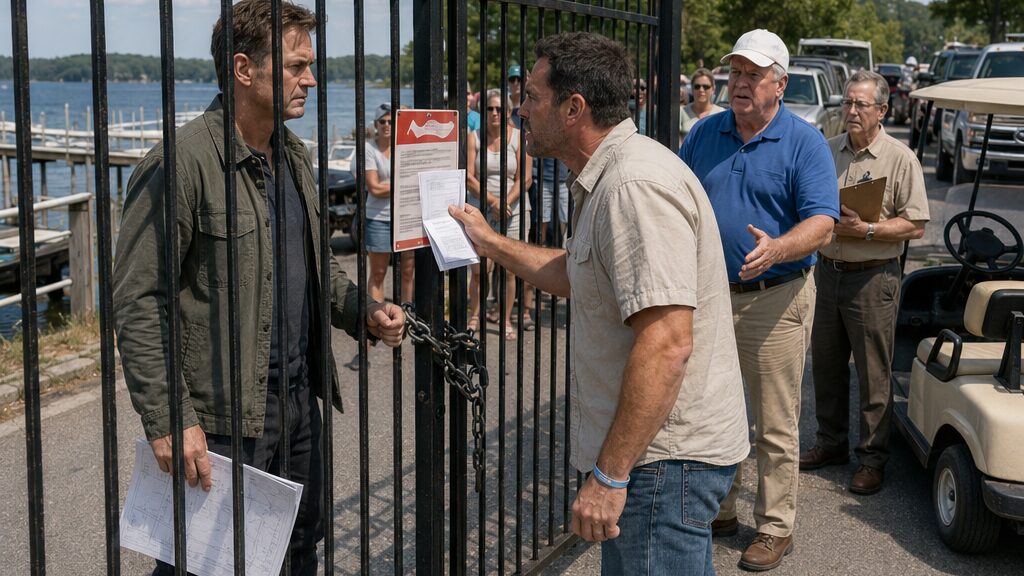
Michael drove the final screw through the private-property sign just as the first boat trailer turned onto Lake Haven Drive.
It was barely six on Friday morning.
The truck slowed near his gate, its driver leaning forward to read the red-and-white notice. Behind it, a fishing boat rose above the cab, wrapped in a travel cover. The driver checked his phone, glanced at Michael and continued toward the community marina.
Michael tightened the last screw.
NO ENTRY
PRIVATE PROPERTY
NO COMMERCIAL ACCESS AUTHORIZED
Laura had approved the wording. The insurer had approved the lock. The sheriff’s office had logged the notice but warned that a deputy would intervene only if the dispute became unsafe.
Michael closed the black gate and looped a hardened steel chain through both panels.
By seven, three more trailers had passed.
At eight-fifteen, the first person stopped.
A man in sandals walked back from the marina carrying a confirmation on his phone. He pointed toward the dock.
“They told me overflow parking is through here.”
“It isn’t.”
“The directions say it is.”
“They’re wrong.”
The man’s face tightened.
“I paid for day access.”
“You need to contact the company that charged you.”
“They’re not answering.”
“I’m sorry.”
“That’s convenient.”
The man left after photographing Michael, the sign and the gate.
By ten, the roadside shoulder had begun filling with trucks and trailers. The community marina’s four spaces were occupied. Two boats circled beyond the pier, their engines idling. Families stood in clusters under the trees, studying confirmations and comparing directions.
Michael remained inside the gate with copies of his deed, survey and notice in a clear plastic folder.
He had thought documents would calm people.
Instead, the gate made him the only visible person to blame.
A woman holding a toddler demanded to know where she was supposed to park. A retired couple said they had used the dock the previous summer without trouble. One man accused Michael of waiting until the holiday to increase the pressure on the HOA.
That accusation hurt because it was partly true.
He could have acted on Monday. He had waited for Paul to cancel the reservations. When Paul refused, Michael chose the moment when closure could no longer be ignored.
Near noon, Brandon Perez arrived.
His daughter sat in the passenger seat with a baseball cap pulled low. The white fishing boat trailed behind them. Brandon parked on the shoulder and walked directly to the gate.
“You locked it.”
“Yes.”
“You said you were going to find out what happened.”
“I did.”
Brandon took the folded confirmation from his pocket.
“Then tell me.”
Michael slid the survey through the bars.
“The dock is inside my parcel. The HOA never had written permission to rent it. Their own surveyor warned them two years ago.”
Brandon studied the page, then looked at the sign.
“What about my money?”
“The contractor has it or transferred it to the association.”
“You don’t?”
“No.”
Brandon pressed the Slip B confirmation against the bars, directly opposite the private-property notice.
“This says exclusive access.”
“I didn’t issue it.”
“It has your address.”
“I didn’t authorize it.”
“Do you hear yourself? Every answer is about what you didn’t do.”
The people nearest them turned to listen.
Michael kept his voice low.
“What would you have me do?”
“Not make my kid learn about property law in a truck after we drove six hours.”
Michael looked past him. The girl watched through the windshield, her face unreadable behind the glass.
“If I open the gate,” Michael said, “my insurer may deny coverage. If someone gets hurt, I’m responsible for a commercial activity I never approved.”
Brandon’s hand dropped.
“That doesn’t make this right.”
“No.”
The answer seemed to surprise him.
A golf cart approached from the marina road.
Paul was driving. He wore the blue board polo and a white cap, as if arriving to supervise a community picnic. The treasurer sat beside him, holding a clipboard.
The crowd moved toward them.
Questions rose at once.
Why were the slips closed?
Who had the money?
Where were the refunds?
Why had the contractor stopped answering?
Paul climbed out and lifted both hands.
“We’re working through an unexpected access dispute.”
Michael heard the phrase and stepped toward the gate.
“This is not unexpected.”
Paul looked at him.
“Michael, open the gate so we can get people off the roadway.”
“You can use the community marina.”
“It’s full.”
“Then cancel the reservations.”
“That process is underway.”
The treasurer’s expression said otherwise.
A man near the golf cart raised his phone.
“Did you sell us private property?”
Paul turned toward him.
“The association has longstanding access rights.”
Michael held the official survey above the gate.
“No recorded easement crosses this parcel. The HOA was warned before these bookings were sold.”
The crowd’s attention shifted.
Paul stepped closer.
“Your father granted access.”
“To residents. Temporarily. Not paid customers.”
“You allowed the use to continue.”
“I failed to stop it. That is not the same as giving you authority to sell it.”
For the first time, Michael said the failure aloud where everyone could hear.
The admission altered the crowd’s mood. It did not make them friendly, but it disrupted the simple picture of a spiteful owner hiding behind a sign.
The treasurer opened his clipboard.
“We have a list of reservations,” he said. “We’re trying to verify payment records.”
Paul stared at him.
“Not here.”
“Where else?” the treasurer asked.
Voices rose again.
A family at the back of the line had driven overnight from another state. Their truck was overheating, and the nearest public storage lot had no room for the boat. The father stood beside the hood while steam feathered from the grille. Two children sat on a cooler in the ditch.
Michael looked at the locked gate, then at the wide gravel area inside it. His father had once used that space for lumber deliveries. It was above the shoreline, separate from the dock and large enough to stage several trailers.
Laura’s warning returned to him: secure the property, document every exception, do not create implied access through casual permission.
He called her.
“I can let them use the gravel area without opening the shoreline gate.”
“You would need a written temporary license,” she said. “No water access. No overnight storage. Waiver signed by each driver.”
“There are dozens of people here.”
“Then make it orderly.”
Michael hung up and faced the crowd.
“I am not opening the dock,” he said.
Several people objected immediately.
He raised his voice only enough to carry.
“But I will open the roadside staging area for anyone who needs a safe place to turn around, cool an engine or wait while claims are documented. No launch access. No implied reservation rights. Every person who enters signs a temporary-use form.”
Paul stepped toward him.
“You can’t set up a claims process for the association.”
“I’m not doing it for the association.”
“Then why?”
Michael looked at Brandon’s confirmation, still held against the gate.
“Because somebody needs a record of what was sold.”
The treasurer lifted the clipboard.
“I’ll help.”
Paul turned sharply. “You will not.”
The treasurer removed his board badge and set it on the golf cart seat.
“I already did enough by staying quiet.”
Michael unlocked the outer section of the gate leading only to the gravel staging area. He kept the chain secured across the path to the dock.
Brandon was the first to enter. He signed the temporary form, then placed his Slip B confirmation on the folding table Michael carried from the garage.
One by one, other reservation holders followed.
By early afternoon, forty-seven printed claims lay across the table beneath the survey map, each one showing a promise the landowner had never made.
Chapter 6: Winning the Boundary and Losing the Neighborhood
The first demand at the emergency meeting was that Paul resign.
The second was that Michael be excluded from any decision involving waterfront access.
Both motions came before anyone had finished reading the attorney’s summary.
The HOA clubhouse was packed beyond its posted capacity. Residents stood along the walls, crowded the doorway and watched through the open windows from the patio. On the front screen, Laura had projected Michael’s recorded survey. The red boundary line cut through the map with embarrassing clarity.
Beneath the screen, forty-seven booking claims were arranged across two tables.
Paul sat at one end of the board row without his usual white cap. Michael sat in the front audience section beside Laura, close enough to hear neighbors whisper his name.
A resident near the aisle spoke first.
“Paul sold something he didn’t own. Michael knew people were using it and waited until the busiest weekend to shut it down. Why should either of them control what happens next?”
Applause broke out from part of the room.
Michael looked at Laura.
She did not rescue him.
The board member acting as chair called Brandon forward. He had agreed to speak because his confirmation had triggered the investigation, though he was not an HOA member.
Brandon stood beside the tables and held up the Slip B ticket.
“This was sold to me as a private reserved berth,” he said. “I paid the contractor. I followed the directions. I arrived with my family and found a locked gate.”
Several residents murmured apologies.
Brandon looked toward Paul.
“You had no authority to sell it.”
Then he looked at Michael.
“And you were legally right to close it.”
Michael felt the room pause around the sentence.
“But you also knew by Monday that families were coming,” Brandon continued. “We learned the truth from a sign on Saturday morning. You didn’t create the fraud. But you chose how we found out.”
The words were not angry. That made them harder to resist.
Michael stood.
“I expected the association to cancel the bookings.”
Paul gave a bitter laugh.
Michael turned toward him.
“That was my mistake. I kept waiting for the people who caused the problem to handle the consequences.”
The room quieted.
He faced the residents.
“I also ignored notices about waterfront access for two years. I believed that if I did not participate, I could not be made responsible for what the board decided. That was wrong.”
Cynthia sat in the second row. Her expression did not soften, but she gave one small nod.
Michael continued.
“My father allowed residents to cross his property when the community pier was damaged. He kept allowing it after repairs. I knew some access continued. I did not know the dock was being rented to the public, and I never consented to that. But silence left room for people to claim more than I intended.”
A man near the back called out, “So open it now.”
“No.”
The answer came without hesitation.
A wave of frustration moved through the room.
Michael pointed to the survey.
“The dock remains private property. The commercial program is over.”
“And the seawall?” someone asked.
The engineer’s photographs appeared on the next slide. The crack looked almost black against the concrete.
The treasurer rose from the board table.
“The waterfront reserve has forty-one thousand dollars,” he said.
The reaction was immediate.
People demanded the current bank statement. Others asked why annual reports showed more. One resident said her household could not absorb a large assessment. Another accused the board of hiding insolvency.
Paul finally stood.
“The reserve was used for emergency work,” he said. “Every dollar went toward association property.”
“You concealed the shortage,” the chair said.
“I delayed a financial shock.”
“You lied about the balance.”
“I avoided sending four-thousand-dollar invoices to families already struggling.”
For a moment, the room saw the problem as he had seen it: aging infrastructure, frightened homeowners, a board president trying to keep control by stretching a temporary arrangement past every legal and moral limit.
Then Laura displayed the survey warning with Paul’s signed receipt.
“You were advised to obtain written permission before commercial use,” she said.
Paul’s shoulders lowered.
“I thought Michael would refuse.”
Michael heard no apology in the statement, only the fear beneath it.
“So you decided not to ask,” he said.
Paul looked at him.
“Yes.”
That choice settled the room more effectively than any accusation.
The meeting moved toward consequences. The board suspended the booking program, authorized an independent financial review and removed Paul from control of the waterfront account pending a membership vote. The contractor would be required to preserve payment records and begin refund processing.
It felt, for several minutes, like victory.
Then Laura’s phone vibrated.
She read the message and asked the chair for the floor.
“Michael’s insurer has completed its preliminary review.”
Michael turned toward her.
“They will maintain existing coverage only if all third-party access ends immediately,” she said. “Any future resident use will be excluded unless governed by a written risk-management agreement, controlled entry, indemnification and documented supervision.”
The room erupted again.
“No fishing access?”
“What about kayaks?”
“My family has used that path for twenty years.”
Cynthia rose.
“Then twenty years of casual use have finally produced the bill we avoided writing.”
The statement quieted some of the room, but not enough.
A resident near Michael accused him of engineering the insurance review to end access permanently. Another said the gate scene proved he wanted the community punished. The chair tried to restore order.
Michael looked at the red boundary line on the screen.
For days, he had treated it as proof that the problem ended where his property began. Now it looked incomplete. The line showed who had authority. It did not show what authority should be used for.
Laura leaned toward him.
“You do not have to solve this tonight.”
That was the kind of permission Michael had accepted too often.
He stood again.
“I will not grant an easement,” he said.
The room responded before he finished.
“But I will review a revocable residents-only access agreement.”
The objections changed character. They became questions.
Who would supervise?
Would guests be allowed?
What hours?
Who paid for insurance?
Could the agreement be withdrawn?
Michael waited until the chair restored order.
“I don’t have those answers yet. I know what the agreement cannot be. No public rentals. No contractor bookings. No assumption that permission becomes ownership. No access without insurance.”
A resident in the front row said, “And who decides?”
Michael looked at the survey, then at the forty-seven claims.
“I do, because it is my property.”
The room stiffened.
He continued before anyone could respond.
“But I will draft the terms with Laura, the insurer and a resident committee. The board will not be allowed to expand them without written consent.”
Cynthia stood beside him.
“I’ll serve on the committee.”
Brandon, from the visitor section, lifted the Slip B confirmation.
“I’ll send you every claim contact I collected.”
The treasurer added, “I’ll provide the payment records.”
Paul remained seated.
Michael looked at him, waiting for resistance.
Paul stared at the old survey warning on the screen.
For the first time since the conflict began, he said nothing.
After the meeting, Michael and Laura stood outside the clubhouse while residents continued arguing in the parking lot.
“You understand what you just volunteered for,” she said.
“Yes.”
“You dislike committees.”
“Yes.”
“You dislike being called after dinner.”
“Yes.”
Laura almost smiled.
“Then why offer?”
Michael looked toward the dark line of trees hiding the lake.
“Because I left the room once already.”
He took the folded survey from beneath his arm.
“Tomorrow, we write a boundary people can actually understand.”
Chapter 7: A Boundary Written Clearly Enough to Share
Paul arrived at the final meeting without his board polo.
He wore a plain gray shirt with the sleeves rolled once at the wrists, and he carried no binder except a thin manila folder. When he reached the conference table, he placed one document in front of Michael.
It was the surveyor’s warning letter.
The original.
Michael recognized Paul’s signature at the bottom, pressed hard enough to leave an impression on the next page. Above it, the surveyor had written that the Lewis dock appeared to fall entirely within the recorded parcel and that no commercial use should continue without written authorization from the owner.
Paul took the chair opposite him.
“I kept this out of the board packet,” he said.
No one spoke.
Laura sat at Michael’s right with the latest draft of the access agreement. Cynthia and the treasurer sat farther down the table. Two board members represented the association, along with its newly retained counsel. The large windows behind them looked toward the community pier, where repair crews had replaced the most unstable stones along the seawall.
Michael touched the edge of the warning letter.
“Why bring it now?”
“Because the copies make it look like I overlooked it.” Paul looked at the signature. “I didn’t.”
The admission was quieter than Michael expected.
Paul continued.
“The reserve projection came in the same week. The seawall estimate was already beyond what we could cover. I told myself we would run the booking program for one season, close the gap, then ask you before expanding it.”
“You never asked.”
“No.”
“You added public reservations.”
“Yes.”
“And changed the financial reports.”
“I moved the waterfront income into operating categories. The expenses were real.”
“So was the concealment.”
Paul nodded.
The lack of resistance left Michael with nowhere to push.
The association’s counsel opened a folder.
“The board has accepted the independent review’s preliminary findings. All public dock rentals are terminated. Paul has resigned from financial oversight and will not seek another officer position this term.”
Paul looked toward the repaired seawall rather than at anyone in the room.
The treasurer placed a refund summary on the table. Lake Haven Waterfront Services had agreed to return the processing fees it still held and reimburse part of the disputed revenue after Laura raised questions about its failure to verify ownership. The association would cover the remaining customer balances from its operating account, then restore that money through a separately disclosed assessment.
“All forty-seven claims?” Michael asked.
“All verified claims,” the treasurer said. “Including Brandon Perez.”
The first payment batch had already been issued. Brandon had sent Michael a brief message that morning.
Refund received. My daughter says the public marina’s fishing was better anyway.
Michael had read it twice before replying.
I’m glad she had a good day.
The settlement of the old program should have made the rest simple. It did not.
Laura slid the proposed access map into the center of the table. The forty-foot property line appeared in solid red. The community path stopped at a gate inside Michael’s parcel. A narrow permitted corridor continued toward the water in blue.
The association’s counsel pointed to the blue strip.
“We still believe permanent easement language would provide stability.”
“No,” Michael said.
“A recorded easement would protect residents from future ownership changes.”
“It would also transfer a permanent interest in my property.”
“It would define one.”
“It would create one.”
The counsel glanced at Laura, who did not intervene.
Michael continued.
“My father gave permission because the community pier was damaged. That permission became custom. Custom became assumption. Assumption became a business. I’m not recording another ambiguity that outlives the people who understand it.”
One board member leaned forward.
“Then residents have no certainty.”
“They have written permission under stated conditions.”
“Permission you can revoke.”
“Yes.”
The word settled over the table.
Cynthia folded her hands.
“That is what permission means.”
The board member turned to her.
“You’re comfortable with one owner having that power?”
“No,” Cynthia said. “I’m comfortable with us finally admitting he already has it.”
Michael looked at the new map.
The blue access corridor was narrower than the old informal path. Use would be limited to current residents and their accompanied household guests. No paid reservations. No overnight docking. No fuel transfer. No contractor could administer access without a separate signed agreement.
Hours would run from six in the morning until eight in the evening during summer. A coded lock would record entries. The HOA would pay the additional insurance premium, maintain the path and provide a trained volunteer monitor during high-use weekends.
The license would renew annually unless either party gave sixty days’ notice.
It was more administration than Michael wanted.
It was also the first version of access that did not depend on somebody remembering what his father had meant.
The association’s counsel tapped one paragraph.
“The property liaison requirement remains a concern.”
Michael read it again, though he knew every word.
The liaison would review access incidents, approve maintenance work inside the boundary and meet quarterly with the waterfront committee. Laura had included it because the insurer required a designated owner representative.
Cynthia said, “It has to be you.”
“I know.”
“You could appoint someone.”
“The insurer wants the owner.”
Paul finally looked at Michael.
“You wanted to be left alone.”
“I still do.”
“Then why agree to this?”
Michael considered the question.
Three weeks earlier, he would have answered with the deed. The dock was his. The line was clear. The gate could remain closed.
Now he saw Brandon’s ticket pressed against the bars. He saw the children waiting beside the overheated truck. He saw his father’s signature beneath the promise to keep the path open, and the unopened envelope Michael had mistaken for freedom.
“I’m agreeing because the community need is real,” he said. “That doesn’t make what you did acceptable.”
“I know.”
“And I’m not taking over your role.”
“I know that too.”
Paul’s hands rested flat on the table.
“I thought if the assessment happened while I was president, everyone would know I had failed.”
The board members shifted, but he kept speaking.
“The reserve looked healthy when I took office. Then the insurance increased, the electrical repairs came due, and the seawall estimate doubled. Every meeting, residents asked me to hold dues steady. They thanked me when I did.”
“So you kept finding ways to delay the truth,” Laura said.
Paul nodded.
“The dock revenue worked. At first.”
Michael looked at the warning letter between them.
“You could have brought this to me.”
“I thought you would say no.”
“I might have.”
“That was the part I couldn’t accept.”
There it was—not greed, not confusion, but the choice beneath both. Paul had decided that his fear of refusal entitled him to avoid asking.
Michael folded the warning letter and returned it to the folder.
“The agreement says no expansion without my written consent.”
Paul gave a tired half-smile.
“I noticed.”
The vote took place before noon.
The board approved the revocable residents-only license, the refund plan, the independent audit recommendations and a disclosed assessment dedicated to seawall restoration. Paul voted in favor, though his vote was not needed.
When the documents were signed, Laura placed the old Slip B confirmation beside the new access map.
On one page, a contractor had promised a stranger exclusive use of property it did not control.
On the other, a red boundary line enclosed a blue corridor with hours, duties and limits printed clearly enough that no one could pretend not to see them.
Michael kept both copies.
The first resident-use morning came the following Saturday.
At six, he walked down the path with a ring of new keys. The repaired community pier caught the early light across the cove. Cynthia waited outside the gate with two neighbors carrying fishing rods. The volunteer monitor checked their names against the resident list.
Nobody touched the latch until Michael reached it.
He entered the code, opened the gate and stepped aside.
Cynthia paused beside the faded red paint at the edge of the concrete.
“Your father would have liked this,” she said.
Michael looked toward the dock.
“He would have left it open all day.”
“He probably would.”
“That was part of the problem.”
Cynthia smiled, not because he had made a joke, but because he had finally said it without anger.
The residents walked down to the water.
Michael spent the morning checking the path, answering one insurance question and reminding a guest that the outer berth remained closed. The work irritated him in small, familiar ways. People asked things they could have read. Someone misplaced the gate code within an hour. A fisherman complained about the no-fuel rule.
At eight that evening, Michael returned.
The dock was empty. The ropes hung where they belonged. No numbered sticker marked the outer post. The lake moved quietly beneath the boards.
He closed the gate and turned the key.
The click did not sound like exclusion.
It sounded like a promise with an ending.
The story has ended.