The Dial
Part I — The Cabin Problem
By the third time General Elias Voss snapped that the cabin air was wrong, everyone on the aircraft had stopped pretending it was a small thing.
“It’s too cold.”
Three minutes later: “Now it’s stale.”
Then, with a sudden flare of anger that made the young signals officer by the comms rack look down at her own hands, “Who set this compartment to feel like a morgue?”
Captain Mara Quill was already halfway out of the engineering bay.
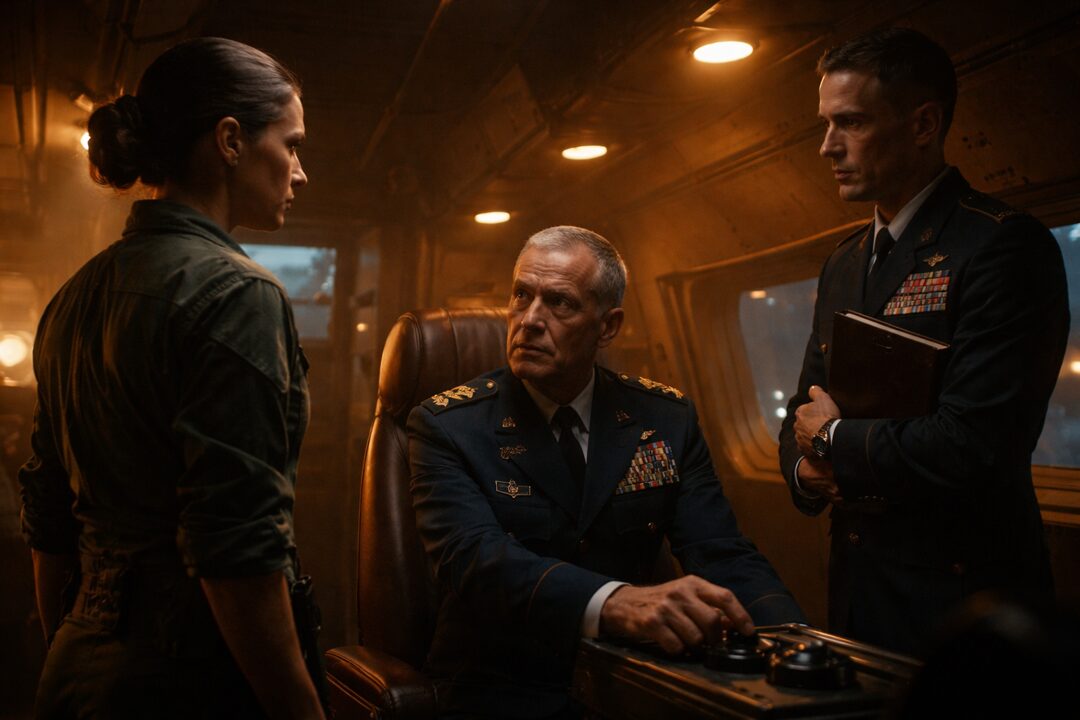
The command aircraft hummed around her, a long steel throat cutting across black air above a border that had spent nine years swallowing towns and names. The night outside the portholes was blank. Inside, every light had been dimmed to operational amber, which made rank bars gleam and faces look older than they were.
General Voss stood near the mid-cabin conference console in full dress uniform, silver hair clipped close, broad shoulders still imposing despite the slight bend age had put in his back. He looked exactly like the photographs in military schools and newspaper archives. The winter lion. The man who had held the northern line.
He also looked like a man about to declare war on a thermostat.
Colonel Daniel Sayegh was at his elbow, calm in the polished way of someone who had spent years smoothing public disasters before they could become public at all.
“Captain Quill,” Sayegh said, without turning fully toward her, “the general is uncomfortable.”
Mara kept her eyes on the environmental panel mounted beneath the bulkhead screen. “I can see that, Colonel.”
The readout held steady.
Compartment temperature nominal. Air cycling nominal. Humidity low, but not enough to matter. Every system line glowed green.
“The compartment is at twenty-one degrees,” she said.
Voss swung toward her. “Then your instruments are wrong.”
His voice still had that field-command edge to it, the strange force that could make a sentence sound like a map had just changed because he’d said so.
Mara had heard it before. Not in person. In old footage. In the clipped archival recordings they played on Remembrance Day. In the interview that had once sat open on her brother’s laptop until their mother finally closed it.
“The instruments are not wrong, sir.”
“Then I am?” Voss asked.
No one in the cabin breathed.
Mara had spent eleven years in uniform and learned that there were questions which were not questions. She also knew a trapped system when she saw one.
“I’m saying the controls are functioning as designed.”
Voss stared at her for a beat too long. Then he looked back toward the forward cockpit, as if beyond the sealed door there might be a better class of physics.
“Have them alter the flow rate.”
Sayegh gave Mara the smallest possible nod. Do it.
She pressed the panel. The flow rate shifted by two percent—enough to satisfy procedure, not enough to make a human being feel any different. Voss stood waiting, jaw tight.
Nothing happened.
His hand moved to the arm of the leather command seat beside him and gripped it hard, fingers flexing over the edge as though he expected to find a lever there.
Not for the first time, Mara noticed that gesture.
“Still wrong,” he said.
Lieutenant Hana Vale, headset pressed to one ear at the comms station, turned a fraction in her chair. Her eyes met Mara’s for half a second, full of that young-officer disbelief that arrived just before fear learned to dress itself as professionalism.
The aircraft lurched lightly in a crosscurrent. Voss looked up at once.
“What was that?”
“Minor air shear,” Mara said.
“We are too far east.”
“We are on the approved corridor, sir.”
“We were not on this corridor in winter.”
It landed in the cabin like a dropped tool. No one answered.
Sayegh stepped in smoothly. “Current route reflects the ceasefire deconfliction map, General.”
“Maps,” Voss muttered. “Maps are what men trust when they’ve forgotten weather.”
Then, with renewed irritation: “And someone fix this air.”
Mara went back to the panel because that was still easier than saying what she had begun to suspect: the problem was not the cabin.
Behind her, Hana’s console chirped with an incoming secure packet. She glanced at it, straightened, and said softly, “Colonel. Update from the capital. The press line outside the hearing hall has doubled. Opposition delegates are pushing to reopen testimony scope.”
Sayegh’s face did not move. “Hold that.”
Voss did not turn. “They will not reopen anything.”
Another chime. Hana read, then hesitated.
“What is it?” Sayegh asked.
“There’s renewed mention of Dren Hollow, sir.”
The air in the compartment seemed to contract.
Mara kept her hand on the panel, though there was nothing left to adjust.
Dren Hollow.
Most people under thirty only knew the official version: winter encirclement, impossible weather, field hospital threatened, General Voss holding the corridor long enough to save the wounded. It was taught as an example of command nerve under collapse.
The unofficial version lived in widows’ kitchens and among the few surviving medics who still drank too much in back rooms whenever the anniversary came around.
In the unofficial version, the corridor should have been abandoned six hours earlier.
In the unofficial version, men froze where they lay because command mistook refusal for resolve.
In the unofficial version, Mara’s brother Owen died trying to move patients who never should have still been there.
Voss said, very quietly, “Who is pushing it?”
“A bloc from the northern delegation. And two foreign correspondents.”
“Denied,” he said.
Sayegh did not bother to point out that nothing in the capital would obey the word denied just because Elias Voss still spoke it.
Mara checked the panel again for something to do with her hands. Green. All green.
Behind her, Voss gave a sharp breath, then another.
“It’s freezing again.”
“It isn’t,” she said before she could stop herself.
The cabin went still.
Sayegh turned. Not sharply. That would have been easier to answer. His restraint was worse.
Mara forced her voice flat. “Sir.”
Voss looked at her with pale eyes that had once, in every portrait, seemed carved from certainty. Up close, tonight, they looked frayed around the edges.
“It isn’t freezing?” he repeated.
“No, sir.”
“Then why,” he said, “can’t I feel my hands?”
That landed differently.
Not anger. Not command. Something lower and more dangerous.
Hana looked down at her screen. Sayegh said, “General, perhaps you should sit.”
“I know how to sit, Colonel.”
Yet he did. Not with the smooth dignity of a man preserving appearances, but abruptly, almost heavily, as if his knees had issued their own order. His hand went again to the side of the seat, searching that same blank strip of leather and metal.
Searching for what?
Mara stared at the readout.
Then at his hand.
Then at the old auxiliary fittings cabinet recessed below the equipment locker, where obsolete manual dials, covers, and spare panel hardware sat tagged for scrapping on the next maintenance cycle.
A stupid idea touched the edge of her mind.
She hated it immediately.
The aircraft rolled on through the dark, carrying a legend toward a hearing that might end a war or split open its most useful lie.
And the general of the hour sat in a cabin with perfect temperature control, trying to find a lever that wasn’t there.
Part II — Green Lights
By the time the secure call from the capital came through, Voss had complained about the air four more times and the route twice.
Mara stopped pretending she was troubleshooting. She ran the diagnostics anyway because systems deserved proof even when people didn’t.
Everything remained green.
She crouched in the engineering alcove with a tablet balanced on one knee while the aircraft’s environmental feed scrolled past in clean numbers. Intake, circulation, pressure balancing, cabin segmentation. Perfect. The machine was behaving like a machine.
The problem was the passenger.
That should have made things simple. It didn’t.
Hana leaned into the alcove entrance, voice low. “The hearing counsel wants him linked in now. Preliminary verification.”
“Does he know?”
“He knows there’s a call.” Hana glanced back toward the cabin. “He doesn’t know they’re asking whether he’ll stick to the prepared timeline.”
Prepared timeline. That was one phrase for it.
The official statement had been circulating for days: strategic delays, impossible weather, heroic sacrifice, regrettable losses, necessary decisions. It was the kind of language institutions used when they wanted pain to sound both honorable and unavoidable.
Mara’s brother had died under a paragraph like that.
She set the tablet down too hard.
Hana watched her. “You knew someone there.”
It wasn’t a question. Everyone in the service eventually learned the look of somebody hearing a certain operation named and going briefly elsewhere inside themselves.
“My brother,” Mara said.
Hana’s mouth tightened. “I’m sorry.”
Mara gave a thin shrug. Sorry was a civilian word. Useful, sometimes. Not now.
From the cabin, Voss’s voice cut through the hum. “Colonel, if that line is not secure enough, I won’t take it. And if someone would stop this draft—”
“There is no draft, sir,” Mara said under her breath.
Hana heard it and almost smiled. Almost.
“Why do they all act like this?” she whispered.
“Like what?”
“Like he’s made of glass.”
Mara looked past her into the main compartment. Sayegh stood beside Voss’s chair, one hand resting lightly on the back as if proximity alone could stabilize him. It was not fear in Sayegh’s posture. Not exactly. It was management. The whole aircraft felt managed.
“Because,” Mara said, “if glass breaks high enough up, it cuts everyone underneath.”
She stood and went back out.
Voss had the secure handset in one hand and was glaring at the ceiling vents as though they were personally insulting him. Sayegh murmured, “General, the minister is on the line.”
“Then perhaps the minister would like to sit in this refrigerated tomb.”
Mara should have been numb to him by now. Instead the irritation kept sharpening because beneath it she could feel something else moving in the compartment, something worse than arrogance.
When Voss took the call, he tried to begin with command.
“No expansion of scope,” he said. “No off-record witnesses. And no—”
He stopped. His head turned toward the vent over the conference screen.
“For God’s sake.”
The voice on the other end of the secure line was loud enough to hiss through the receiver. Sayegh stiffened.
“Sir,” he said softly, “perhaps if we continue—”
Voss shoved the handset at him. “Then continue.”
Sayegh caught it, instantly composed. “Minister, one moment. The connection—”
“The connection is fine,” Mara said.
No one acknowledged that.
Voss rose again. “Pilot should climb four hundred meters. We’re taking lateral shove from the ridge.”
“We’re nowhere near the ridge, sir,” Hana said before she could stop herself.
Sayegh’s eyes flicked toward her.
Voss stared. Hana went white but held her chair.
“That terrain,” Voss said, quieter now, “eats aircraft that trust charts.”
Mara looked at his hand.
It was shaking.
Not much. Enough.
He pressed it flat against the armrest, then began feeling along the seam of the metal fitting by the seat. Searching. Again. Thumb sliding, fingertips tapping once, twice.
Like a man checking for a switch that should be there because once, years ago, it had been.
The stupid idea came back.
It wasn’t entirely stupid. That was the problem.
She crossed to the old fittings cabinet, keyed it open, and crouched.
Inside sat a shallow tray of obsolete hardware: detached indicator caps, wiring covers, one cracked gauge face, two rotary dials from an older environmental panel model. One black. One brushed silver.
The black one looked good enough from a distance.
Mara lifted it. The spindle behind it was snapped off clean. Useless.
“Captain.”
Sayegh’s voice behind her.
She turned, dial hidden in her palm.
He had ended the secure call but not the damage. Something tight had entered his face.
“Your officer claims the route is compromised,” he said, meaning Voss without needing to.
“His claim is incorrect.”
“Then make the cabin calmer.”
The phrasing annoyed her more than an order would have. As if calm were another engineering metric she could coax out of a panel.
“The cabin is calm,” she said. “One person isn’t.”
Sayegh’s eyes sharpened. “Be careful.”
Mara nearly said, I am.
Instead she asked, “What happens if he goes into that hearing like this?”
He held her gaze for one beat too long. Long enough to become an answer.
“He will not,” Sayegh said.
Then he moved away.
There it was. The truth, in the space around the words: not he cannot, but he will not. Because too much had been built around the image of Elias Voss still standing upright inside history. The hearing needed a symbol. The state needed a symbol. Men like Sayegh had probably spent years protecting the general from anything that might interrupt the machinery of that symbol.
A larger fake dial, Mara thought suddenly.
She looked down at the broken one in her hand.
From the cabin, Voss snapped again, “Captain. The heat.”
Her brother had once written from the north in a message their mother saved until the paper creased white at the folds: Funny thing about command. Everyone wants certainty from someone who’s also freezing.
Owen had always written like he was smiling.
Mara stood, the old dial cold in her palm.
Then she walked to the side panel beside Voss’s seat and studied the unused maintenance plate screwed there over a decommissioned manual override port from an older refit.
The spacing was close enough.
Close enough was how half the military survived.
“Lieutenant Vale,” she said. “Pass me the short driver from the comms toolkit.”
Hana blinked. “For what?”
“An adjustment.”
Voss turned sharply. “Finally.”
Mara did not look at him.
If this was mercy, it was a crooked one.
If it was manipulation, the aircraft was already full of it.
Either way, she was done watching green lights fail to solve a human problem.
Part III — The Spare Dial
It took under three minutes.
That was the absurd part. The thing that would matter most on the flight looked ridiculous while she was doing it.
Mara popped the maintenance plate, exposing a dead cavity and two capped old mount points from a previous configuration. The spare dial fit the hole badly but convincingly enough once she tightened it. From two feet away it looked intentional. From Voss’s seat it looked real.
Sayegh saw what she was doing halfway through and came toward her fast.
“Captain.”
“It will keep him occupied.”
“If this is some kind of joke—”
“It isn’t.” She kept working. “You want him steady for the hearing. So do I.”
Hana stood frozen by the comms rack, watching like someone witnessing a minor crime inside a chapel.
Mara tightened the last screw, wiped her thumb across the dial face, and stepped back.
Black. Simple. Plausible.
She turned to Voss.
“Sir. We’ve had lag in the automatic balancing loop. This will let you regulate local flow manually until we reset at landing.”
Voss looked from her to the dial.
“Manual control?”
“Yes, sir.”
“For this compartment?”
“Yes.”
He stared at it for a second. At her. Back to it.
Then he sat.
His hand went to the dial immediately, almost greedily, though his face stayed stern. He turned it a fraction clockwise.
Nothing in the cabin changed.
Everything in him did.
Not at once. But enough to make Hana lower her shoulders. Enough to make Sayegh stop moving. Enough that the next breath Voss took came all the way in.
He adjusted the dial once more, then rested his hand against it as if confirming it was there.
“Better,” he said.
Mara felt the hair rise on her arms.
No one spoke. The aircraft continued its long cut through the dark.
Two minutes passed. Then five.
No complaint.
Hana’s console chirped again. She answered this time without glancing nervously toward the command seat. The pilots sent through a route check; Sayegh replied. The normal machinery of the mission reassembled itself around the silence.
Voss turned the dial another notch. “There.”
The air did not change.
But his voice had.
Some of the abrasion was gone. In its place was something stranger than comfort: not peace, exactly, but containment. As if the pressure inside him had found a wall to lean against.
Mara should have felt satisfaction. Instead she felt she had stepped into a room she did not understand and quietly moved an object that mattered.
Sayegh came beside her. “You improvised boldly.”
“You wanted results.”
He looked at Voss, then back at her. “Results are not always the same thing as wisdom.”
“Neither is staging.”
That landed. Barely. Sayegh’s mouth tightened, but he had no time to answer because Voss spoke without looking up.
“Captain Quill.”
She crossed back to him. “Sir?”
“Sit for a moment.”
It was not a request she could refuse without making it visible. She took the jump seat opposite his chair, every muscle prepared.
Up close, his face looked less monumental than tired. The fraying she had glimpsed around his eyes had deepened. He kept one hand on the dial.
“You’re an engineer,” he said.
“Yes, sir.”
“You trust instruments.”
“I trust systems when they’re telling the truth.”
A faint sound. Not quite a laugh.
“And men?”
“Less efficiently.”
That almost earned a smile from him.
Sayegh, still within earshot, said carefully, “General, we should review the opening statement before descent.”
“In a minute.”
Then, to Mara: “In Dren Hollow, the medics kept asking for revised weather. They thought if the numbers changed, the outcome would.” He looked down at his own hand on the dial. “Numbers comfort people.”
The compartment seemed to narrow around the sentence.
Mara said nothing.
He went on, voice lower now. “There was a young medic there. Kept asking me whether we should pull back before the corridor iced over. I told him no. Then I told him not yet. Then I told him we still had time.” His eyes did not leave the dial. “It is a terrible thing to keep giving orders after the world has stopped obeying them.”
Her heartbeat changed.
She saw Owen not as he died—she had never been given that image—but as he had looked the last time she saw him alive, grinning in the station car park with a duffel over one shoulder, saying he’d be back before winter really bit.
“What happened to the medic?” she heard herself ask.
Voss’s jaw worked once. “I don’t know.”
Mara looked at his hand. Broad. Scarred. Steady now because it had a false thing to hold.
You know enough, she thought.
But not enough was the curse of the dead. Not enough details. Not enough body recovered. Not enough truth to put under the weight of grief.
Voss turned the dial half a notch counterclockwise. “Funny,” he said. “I could not breathe ten minutes ago.”
Sayegh stepped in then, too quickly. “General, the draft statement.”
Voss leaned back. “Always the draft statement.”
“It will help.”
“That is what everyone says before they place words in my mouth.”
Sayegh’s voice stayed even. “I am trying to protect the hearing.”
“From whom?”
Neither man answered.
Mara stood. “Sir, I need to check the forward exchange valve.”
He nodded absently, still touching the dial.
She moved away before the mask on her face broke.
In the service corridor, just out of sight, she braced one hand against the bulkhead and let herself breathe once, hard.
Hana appeared a second later. “Did that just work?”
Mara laughed under her breath. It came out tired and wrong. “Apparently.”
“That’s insane.”
“Yes.”
Hana lowered her voice. “What did he say to you?”
“Enough.”
Enough to shift the story.
The general had not sounded like a tyrant in that moment. Or a hero. He had sounded like a man still trapped in a winter that had happened years ago, still issuing commands into weather that had already chosen.
That did not absolve him.
It only made him harder to hate cleanly.
Hana watched her face and said, “I don’t know if that made him smaller or sadder.”
Mara looked back toward the cabin where Elias Voss sat with his hand on a dead dial like it had given him back the edge of his own skin.
“Both,” she said.
Part IV — The Larger Lie
Sayegh confronted her outside the galley, where the aircraft noise swallowed anything that wasn’t meant to travel.
He did not open with accusation. That would have made him simpler.
“You knew it would work,” he said.
Mara was rinsing grease from her thumb with a sanitizer wipe. “I suspected.”
“It is not connected.”
“No.”
“And yet you told him it was.”
“Yes.”
Sayegh stood with one hand on the counter rail, immaculate even after hours in the air, though his collar had loosened a fraction. Up close, the polish had cracks in it. Fatigue, certainly. Maybe worse.
“You realize,” he said, “that if he notices before we land—”
“He won’t.”
The certainty in her voice seemed to irritate him more than the act itself.
“You sound proud.”
“I sound correct.”
That almost made him angry. Almost.
Instead he said, “Do you think this aircraft runs on truth, Captain?”
“No,” Mara said. “I think it runs on fuel and denial.”
For the first time all night, Sayegh looked honestly tired.
“You think I don’t know what this is?” he asked quietly. “You think I haven’t spent six years adjusting the air around him?”
Mara said nothing.
He looked past her, through the bulkhead, toward the compartment where Voss sat calmer now than he had since takeoff. “Do you know how many meetings I’ve redirected? How many reporters I’ve cut off? How many anniversary events I’ve shortened because winter rooms make him sweat? How many summaries I’ve softened because one badly timed phrase can send him back twenty years?”
There it was. Not a defense. A confession in administrative clothing.
“The state needs him coherent,” Sayegh said. “Not because he is innocent. Not because he is perfect. Because symbols hold when institutions don’t.”
“And if the symbol is false?”
He gave her a bleak look. “Name one that isn’t.”
She thought of Owen’s photograph in dress blues on her mother’s mantel. Of the bronze letters at memorial sites. Of classroom recordings and edited histories. Of families fed the word sacrifice when what they wanted was sequence, detail, accountability.
“That’s convenient,” she said.
“No. Convenient would have been if Dren Hollow had remained buried.”
The name between them made the corridor feel smaller.
Mara folded the wipe and set it down carefully. “You were there.”
“I arrived six hours after the hospital went up.”
“Late enough to keep your hands clean.”
His face changed then—not with outrage, but with pain so practiced it looked nearly formal.
“No one’s hands came out clean,” he said.
For a second she thought he might stop there. Instead he went on.
“He has been living in the aftermath ever since. You think the complaints are vanity. They aren’t. They’re structure. If he can correct the room, then perhaps the room is not the one that killed people.” He glanced toward the cabin. “You installed a dial. I have spent years being one.”
Mara felt something inside her settle cold.
Because that was it. Not just him, not just the aircraft. The whole machinery around Voss existed to give him the right amount of resistance and the right amount of reassurance so the symbol could continue moving forward.
Not truth. Regulation.
Not reckoning. Balance.
A larger fake dial.
“What happens,” she asked, “if he tells the truth tomorrow?”
Sayegh held her gaze. “The ceasefire may survive. Or it may fracture. Families of the dead may feel vindicated. Or newly used. Careerists will feast. Foreign press will rename everything. Half the country will call it courage. The other half will call it betrayal.” He paused. “And none of it will bring your brother back.”
He knew.
Not from sentiment. From files, probably. Quiet personnel cross-referencing done long ago and never spoken aloud.
“You knew who I was,” Mara said.
“I knew your service record before we took off.”
“And you still let me near him.”
“I let the best engineer on the aircraft near a failing situation.”
She almost laughed. “That is a coward’s answer.”
“Of course it is,” he said. “Cowardice is not always refusing danger. Sometimes it is managing it just well enough that no one has to look directly at the truth.”
From the comms station, Hana called, “Colonel. Descent window revised. We’ll be over the capital in twenty-two minutes.”
Sayegh straightened as if his private humanity had to be zipped shut again.
“One thing more,” he said. “When he asks for certainty, do not give him anything sharper than he can carry. A man can break from too much truth as easily as from too little.”
He walked away before Mara could answer.
She stayed in the corridor, pulse unsteady, listening to the aircraft.
In the cabin, Voss said something low to Hana. The younger officer answered. There was no strain in her voice now. The dial had not simply soothed him. It had returned the entire plane to function.
That was the sick genius of it.
A useless object restoring order because people could move again once one man believed he had a hand on the room.
Mara closed her eyes.
She remembered Owen at nineteen, sitting on the kitchen counter and teasing their mother for labeling freezer containers by date and contents and probable emotional significance. Control is just fear with better stationery, he’d said, and their mother had thrown a dish towel at him.
She had laughed then.
She did not laugh now.
When she went back into the cabin, Voss was looking out the porthole at the dark.
Without turning, he asked, “Captain Quill. Were you serving when Hollow happened?”
“No, sir.”
“Lucky.”
The word sat there.
Not lucky, she thought.
Just later.
He rested two fingers lightly on the dial. “People think command is deciding. It isn’t. It’s deciding after the choice has already started punishing someone.” He looked at her then. “You ever lose family in the war, Captain?”
Sayegh’s head came up sharply from the statement folder in his lap.
Hana’s eyes flicked between them.
Mara could have lied.
It would have been cleaner.
“Yes,” she said.
Voss held her gaze. Something in his face tightened—not recognition, not yet, just the shape of an old exhaustion finding an edge.
“I’m sorry,” he said.
It was plain. Unadorned. No rank in it.
That made it worse.
Mara nodded once and moved back to the systems panel because if she stayed in front of him, she might say her brother’s name like a weapon.
Instead she checked a readout that did not need checking, while the aircraft dropped through invisible layers of cold air toward a city full of flags, cameras, and men waiting to hear whether a hero would protect their story or break it.
Part V — What the Dial Could Not Do
At twelve minutes to landing, the capital came into view as a spill of amber light under cloud.
Hana relayed final coordination from the reception field. Security corridor ready. Press contained, mostly. Hearing chamber assembled. Opposition counsel confirmed. Minister present.
Each update narrowed the compartment further.
Sayegh placed the prepared statement in a leather folio and held it out. Voss did not take it.
“You should review it,” Sayegh said.
“I remember the words.”
“That is not the same thing as using them.”
Voss’s hand remained on the dial.
Then he said, without looking at either of them, “Captain Quill.”
Mara stepped forward.
“How cold was it really, out there?”
No one moved.
Hana stared at her console with saintly discipline. Sayegh stood motionless, the folio still extended between his hands like an offering no one wanted.
Mara looked at Voss.
This, she thought, was the question under everything. Not what the room felt like. Not what the statement said. Not whether the corridor should have held. Only this: how much truth can a man survive if he has built his entire shape against it?
“It was cold enough,” she said carefully, “that wanting facts wouldn’t have warmed anybody.”
Voss’s eyes narrowed. “That is not an answer.”
“No, sir.”
“Then give me one.”
Her brother’s face came back in a single bright fragment: laughing through chapped lips, snow caught in his lashes from a winter training march years before Hollow. You always answer like a mechanic, he’d told her once. Like there’s only one right fit for the question.
Tonight there wasn’t.
“It was colder,” she said, “for the people who kept waiting for an order to change.”
Something flickered across his face.
Sayegh cut in. “General, we are at final approach. It is time.”
Voss ignored him. “Who did you lose?”
The aircraft wheels were still minutes from ground, but the room had already reached impact.
Mara could have refused.
Could have saluted the chain of command and let the question pass unanswered into the machinery that had protected him for years.
Instead she said, “My brother. Owen Quill. Medical evacuation unit attached to Dren Hollow.”
Silence.
Hana stopped breathing.
Sayegh closed his eyes once.
Voss looked at Mara as if the name had crossed a distance no aircraft could measure. He did not say he remembered. He did not say he didn’t. The truth of war was that too many names went through one man’s hands for memory to be a clean form of honor.
But he knew the unit.
She saw that knowledge hit.
“I see,” he said.
It was a terrible phrase. Small. Human. Useless.
Mara almost hated him for saying it. Almost hated herself more for understanding there was no sentence better suited to that moment.
The aircraft thudded lightly through a pocket of air. A landing alert chimed.
Sayegh stepped forward, voice low and urgent now. “General. Listen to me. Whatever this moment is, it does not belong in that chamber. The country needs steadiness. The coalition needs continuity. There are forms for remorse later.”
Voss looked at him. “Forms.”
“It is not cowardice to prevent chaos.”
“No,” Voss said. “Just a profession.”
Sayegh’s face tightened. “If you abandon the statement, they will say the war was built on lies.”
Voss’s hand turned the dial once, slowly.
Then Mara heard herself say, “It was never connected.”
No one moved.
The words simply entered the cabin and made everything in it rearrange.
Voss looked down at the dial under his hand.
Mara stepped closer. Her voice came out steady, though her pulse was loud enough to feel in her teeth.
“It doesn’t control anything, sir. The air never changed. Your hand did.”
Sayegh whispered, “Captain—”
But it was done.
Voss stared at the dial.
At the black face, the clean mounting, the little lie made of screws and nerve and desperation.
For one long second, Mara thought he might rage. Rip it out. Strip her on the spot. Become again the man in the first hour of the flight who thought discomfort could be conquered by command volume.
Instead he let out a breath that sounded almost like a laugh and not at all like one.
“So,” he said. “A placebo.”
“No, sir,” Mara said. “A handhold.”
That landed somewhere deep.
He looked up at her then, and the humiliation in his face was real. So was the understanding. So, unexpectedly, was the mercy she had not meant to offer.
Beyond the porthole, runway lights had appeared in precise white lines.
“He gave them to me for years,” Voss said quietly, not to Mara alone. “Didn’t you, Daniel?”
Sayegh did not answer.
Voss looked at the folio in his hands, then at the comms lights, the orderly compartment, the officers who had shaped themselves around his instability all night long.
“A whole machine,” he said. “Built to keep one old man from touching the edge of his own history.”
“Built,” Sayegh said, finally losing polish, “to get you to the place where your presence can still prevent more graves.”
Voss nodded once. “Perhaps.”
The landing gear locked with a heavy mechanical clunk beneath them.
Mara did not know what she wanted now. Punishment, maybe. Truth, certainly. Not forgiveness. Never that neat.
Voss took his hand off the dial.
It was the first time since she had installed it that he had done so willingly.
He stood. The movement cost him. She could see that. Age, yes. Also something else—a man rising without the support of the illusion he had leaned on for the last hour.
Sayegh held out the folio again.
Voss looked at it, then pushed it gently back.
“No,” he said.
“General.”
“No.”
The aircraft hit the runway with a long screaming kiss of rubber and weight. The cabin shook. Everyone braced. Engines reversed, roaring around them, a violence that was at least honest.
Voss remained standing through it, one hand on the back of the seat, not the dial.
When the aircraft slowed, when the lights beyond the porthole stopped streaking and became fixed points again, he looked at Mara.
Not for absolution. Not even for permission.
Just once, as if to mark that she had been the one to take the false thing away.
Then he turned to Sayegh.
“You may come with me,” he said. “But leave the statement.”
Part VI — After the Hatch
They opened the hatch to floodlights, cold air, and a corridor of waiting uniforms.
The rest happened mostly beyond Mara’s sight.
She remained aboard for post-flight checks because machines still needed tending even when history was walking down the stairs. From the engineering panel she saw the motorcade lights gather on the tarmac below. She saw Voss descend without the folio in his hand. She saw Sayegh go after him, face set in the expression of a man who had just discovered loyalty had edges he could not manage.
Hana came to stand beside her at the porthole.
“Do you think he’ll do it?” she asked.
Mara watched the old general cross the strip of light toward the armored car waiting to take him to the hearing chamber.
“He already did,” she said.
By dawn, the first fragments began to return through secure channels and half-censored internal feeds.
No dramatic collapse. No shouting. No grand confession performed for cameras.
Just a refusal.
General Elias Voss had declined the prepared statement.
He had corrected the timeline of Dren Hollow.
He had said the delay was not only weather.
He had said command certainty had outlived command reality.
He had called the failure by its name.
That was all. It was enough.
The capital would spend months deciding whether to call it courage, betrayal, senility, honesty, treason, fatigue, grace, weakness, duty, or theater. Families of the dead would hear in it whatever their grief had room for. Commentators would gnaw the bones clean. Men like Sayegh would spend years dealing with what followed.
None of that changed what Mara understood by morning: a man had reached for a false dial, learned it was false, and chosen not to keep turning it.
After final shutdown, the aircraft felt different. Not absolved. Just emptier in a truer way.
Mara returned to the command seat before the maintenance team boarded. The black dial sat where she had fixed it, ordinary and almost laughable. Two screws. Dead spindle. Nothing inside.
She put a driver to the mounting and loosened it carefully.
Hana, gathering signal logs at the comms station, glanced over. “Keeping evidence?”
“Removing junk hardware,” Mara said.
Hana watched her a moment longer. “Do you hate him less now?”
Mara held the dial in her hand.
It was lighter than it looked.
“No,” she said after a while. Then, because the simpler answer was too simple: “Not in any useful way.”
Hana nodded as if that made sense. Maybe by now it did.
Mara slipped the dial into her breast pocket.
Not a trophy. Not a joke. Not forgiveness.
Just an object that had done nothing and altered everything.
When she finally stepped down onto the tarmac, the dawn air bit at her face. For one strange second she thought of Voss asking how cold it had really been, and of Owen writing that certainty was just another kind of winter if you stayed in it too long.
The motorcade was gone. The hearing hall stood somewhere beyond the city haze, already full of voices deciding what the old man’s honesty meant.
Mara looked east, where the sky was beginning to lighten over the line that had once been a front.
The war was not erased. The dead were not returned. The story of any of it would not stay clean.
But something honest had entered the record at last.
She put a hand over the pocket where the dial rested, as if confirming it was there.
Then she walked across the cold concrete toward the waiting day.