She Cut Down His Mother’s Sunflowers, Then the HOA Learned What Its Silence Had Cost
Chapter 1: The Flowers Above the White Fence
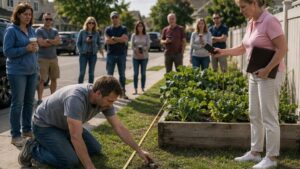
Donna Mitchell had stretched a yellow measuring tape against the tallest sunflower by the time Brian Hall turned into his driveway.
She stood on the narrow strip of lawn between his garden bed and the white fence, one hand holding the tape at the soil, the other reaching above her shoulder. The metal blade bent against the thick green stalk. Her sunglasses reflected the hood of his truck as he stopped halfway into the drive.
Brian left the engine running.
The sunflower towered over Donna by nearly two feet, its dark center tilted toward the late-afternoon sun. Three bees moved lazily across its face. Behind it, another dozen blooms rose at uneven heights, their leaves overlapping until the front garden looked less planted than occupied.
Donna glanced at the tape.
“Eight feet, four inches.”
Brian switched off the engine.
She let the tape snap into its case. “That’s not reasonable.”
He climbed out with a canvas tool bag in one hand. Fine cabinet dust clung to his work shirt and the knees of his jeans. He had spent the day fitting pantry doors in a house across town, correcting gaps no homeowner would have noticed until someone pointed them out. Now Donna stood in his mother’s garden as if she had found a structural defect.
“You’re on my property,” he said.
“One step over the line.”
“The line is the fence.”
“The bed extends toward the sidewalk.”
“It doesn’t extend into the sidewalk.”
Donna looked at the sunflowers rather than at him. She had chaired the landscape committee for six years and carried that title the way some people carried a badge. Nothing about her clothes was official—white walking shoes, pressed khaki shorts, pale green polo—but she had a clipboard tucked beneath one arm.
“These block the corner view from my kitchen,” she said. “And from the sidewalk, drivers can’t see children coming around the bend.”
Brian looked toward the street. Their road curved gently thirty yards beyond his house. The sunflowers stood well inside the property, behind a low bed of salvia and black-eyed Susans. No child could have hidden behind them without first climbing into the garden.
“They don’t block the road.”
“They block sightlines.”
“For your kitchen.”
“For more than my kitchen.”
Brian set his tool bag beside the garage. The front pocket sagged open, revealing a scarred block plane Ashley had given him when he was nineteen. He closed the zipper.
Donna lifted the clipboard. “I’ve had three complaints.”
“From who?”
“I don’t disclose residents’ names.”
“You mean you complained three times.”
Her mouth tightened. “You don’t have to make everything personal.”
He almost laughed. Instead, he looked at the tallest flower.
His mother had planted that row eleven weeks before she died. She had been too weak to kneel, so she sat on an overturned bucket while Brian loosened the soil. She pressed the seeds into his palm one at a time, insisting on spacing them herself with the handle of a wooden spoon.
Not too straight, she had told him. Things trying to look perfect usually aren’t alive.
Donna pulled a folded paper from beneath the clipboard.
“This was mailed twelve days ago.”
She handed it to him. The envelope bore the green logo of Cedar Glen Homeowners Association and his address in a windowed rectangle. The top edge was still sealed.
Brian recognized it.
It had been sitting on the entry table beneath a hardware-store receipt and two catalogs. He had moved it twice without opening it.
“You received it,” Donna said.
“I received an envelope.”
“It’s a formal landscape violation.”
“You read my mail?”
“I received a committee copy.”
Brian turned the envelope over. The flap was unbroken. His name looked too clean through the plastic window.
Donna continued, “The rules limit ornamental growth near front-yard boundaries where visibility may be affected.”
“Where does it say eight feet is prohibited?”
“It doesn’t need to list every possible height.”
“So there’s no height rule.”
“There’s a reasonableness standard.”
“Whose reason?”
“The committee evaluates conditions.”
“You evaluate them?”
“With management.”
The bees moved from one flower to another. Somewhere inside the house, the refrigerator motor kicked on through an open kitchen window.
Brian slipped the envelope into his back pocket.
Donna’s voice softened by a degree. “You could cut them to the fence line and avoid all of this.”
“No.”
“You haven’t even read the notice.”
“I heard you.”
“That isn’t the same thing.”
He walked toward the porch.
Donna stepped away from the garden but did not leave. “Brian.”
He stopped.
“They’re annuals. They’ll die in a few weeks anyway.”
The sentence landed more sharply than it should have. Perhaps because she said it as reassurance. Perhaps because his mother had said nearly the same thing the day they planted them.
Nothing lasts because you demand it, she had told him. You take care of it while it’s here.
Brian turned.
“My mother planted them.”
Donna’s expression changed, though not enough to become sympathy. She looked at the flowers again, then at the closed house behind him.
“I know Ashley planted flowers.”
“She planted these before she died.”
A breeze moved through the bed. The sunflower heads nodded at different speeds, heavy and slow.
Donna removed her sunglasses. Her eyes were tired, the skin beneath them slightly swollen. For one second Brian thought she might fold the clipboard, apologize for measuring something she had no right to touch, and walk back through her gate.
Instead she said, “I’m sorry about your mother. But grief doesn’t suspend community standards.”
Brian felt the old urge to end the conversation before it reached anything he could not contain. It was the same urge that had kept him from the HOA meeting in spring, when Christine Baker had left two voicemails about renewing “special landscape permissions.” It was the urge that made him keep Ashley’s gardening gloves on the mudroom hook long after the leather had hardened.
He picked up his tool bag.
Donna put her sunglasses back on. “You have until Friday to respond.”
“To you?”
“To management.”
“And if I don’t?”
“The committee will recommend corrective action.”
“What does that mean?”
“It means the issue will be resolved.”
The phrase was smooth from use. Donna said it without threat, which made it sound more like one.
Brian climbed the porch steps. “Stay out of the garden.”
“You should read the notice.”
He opened the front door.
“Brian, ignoring it won’t make the rules disappear.”
He went inside and closed the door without answering.
Through the narrow sidelight window, he watched Donna return to the flower bed. She did not cross the fence line this time. She stood on the sidewalk, raised her phone, and photographed the sunflowers from several angles: the tallest stalk, the corner of the fence, the view toward the curve in the road.
Then she typed with both thumbs.
A moment later, the phone on Brian’s kitchen counter vibrated.
An email notification appeared from Cedar Glen Management.
SUBJECT: LANDSCAPE CONDITION—DOCUMENTATION RECEIVED.
Brian looked at the sealed violation notice still protruding from his back pocket.
Outside, Donna took one final photograph and sent it.
Chapter 2: The Morning Half the Garden Vanished
Brian stepped onto the porch with a mug of coffee and stopped before his second foot reached the top stair.
Something yellow lay across the walkway.
At first he thought it was one fallen bloom. Then he saw another near the birdbath, face down in the mulch. Beyond it, thick green stalks ended in pale, wet cuts three feet above the ground.
Half the garden had been severed.
The coffee tipped over the rim and burned the side of his hand. He did not feel it until the mug struck the porch rail with a dull ceramic knock.
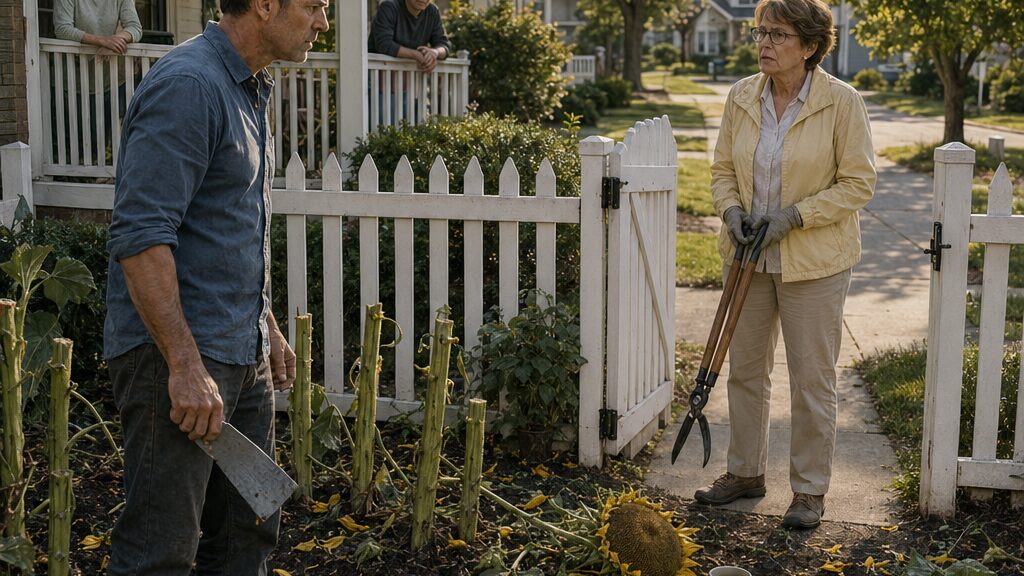
The tallest sunflower was gone. Its head lay near the fence, petals bent beneath its own weight. A line of cut stems ran through the bed with deliberate consistency, each reduced to roughly the height of the white pickets. Leaves had been trampled into the soil. One of Ashley’s small metal plant markers had been crushed flat.
Brian set the mug down.
He descended the stairs slowly, as if speed might make the scene final.
The cuts were fresh. White sap gathered along the edges. The smell was green and bitter, the same smell that had filled the yard when Ashley showed him how to remove damaged leaves without tearing the stalk.
Use the joint, not your temper, she had said, guiding his hand.
He stepped between the fallen heads.
A low mechanical scrape came from the other side of the fence.
Donna opened her gate carrying long-handled pruning shears.
She wore gardening gloves and a yellow windbreaker despite the warmth. A small coil of green twine hung from one pocket. She looked first at Brian, then at the cut garden, as though checking whether he had noticed the improvement.
“You’re up,” she said.
Brian stared at the shears.
Donna rested them against her leg. “I asked the contractor to leave the remaining row until we knew whether you wanted to save seeds.”
“Who came into my yard?”
“The maintenance contractor.”
“Who told him to?”
“I supervised.”
“That isn’t what I asked.”
Her jaw shifted. “Management said the violation needed to be resolved.”
Brian moved closer to the fence. His hands were empty, but Donna stepped back half a pace.
“Who authorized entry?”
“I just told you.”
“No. You told me what you decided their words meant.”
Donna’s shoulders stiffened. “You had notice.”
“Who authorized entry?”
“The committee has corrective authority.”
“Show me.”
“This isn’t a courtroom.”
“Then it should be easy.”
She looked toward the street. A curtain moved in the house across from them.
Donna lowered her voice. “You ignored the notice. You refused to discuss alternatives. The growth was obstructive, and management expected action.”
“Expected from who?”
“From the committee.”
“Written where?”
Her grip tightened on the shears.
Brian stepped over a fallen sunflower head. Its stem dragged through the mulch behind his shoe.
Donna said, “You’re welcome to be angry, but the property looks better now. You can actually see the house.”
The words seemed to empty the morning of sound.
Brian looked at her.
She gave a small, defensive motion toward the garden. “The remaining plants are intact. No one removed the bed.”
“You cut down the part my mother planted.”
“They were all planted in the same area.”
“She put those seeds in the ground.”
“And I am sorry they had sentimental value, but you cannot expect the entire neighborhood to operate around private grief.”
Brian bent and lifted the tallest flower. The head was heavier than he remembered. Several petals loosened and fell across his wrist.
He carried it to the porch and laid it beside the coffee mug.
Then he took out his phone.
Donna watched him unlock it. “Who are you calling?”
“Christine Baker.”
“There’s no need to turn this into something larger.”
He selected the management office number from the email footer.
Donna moved closer to the fence again. “Brian, the work is finished.”
“That’s the problem.”
Christine answered on the fourth ring with a brisk, practiced greeting.
“This is Brian Hall,” he said. “Did you authorize Donna Mitchell or a contractor to enter my property this morning?”
A pause followed. Keyboard clicks sounded in the background.
“Mr. Hall, I’m aware there was an unresolved landscape issue.”
“That wasn’t my question.”
“I would need to review the work order.”
“There was a work order?”
Another pause.
Donna looked away.
Christine said, “The association did not issue a management work order for your lot.”
Brian kept his eyes on Donna. “Did you authorize anyone to cut the sunflowers?”
“No. I advised the landscape committee that the reported condition required resolution in accordance with governing standards.”
“Did you tell them they could enter?”
“I did not provide specific entry instructions.”
“Did you tell them they could not?”
Christine’s silence answered before her voice did.
“Mr. Hall, volunteer committees are expected to act within their assigned scope.”
“What is their scope?”
“That would be outlined in the committee charter.”
“Send it to me.”
“I can send the current version.”
“The version Donna had yesterday.”
Donna opened her mouth, but Brian lifted one finger without looking away from her.
Christine said, “I’ll need to check the archive.”
“And the message you sent her.”
“That may be internal correspondence.”
“It became my correspondence when she used it to cut down my garden.”
Christine exhaled. “I understand you’re upset.”
Brian looked at the severed stalks. “No, you understand I called.”
He ended the call.
Donna’s face had lost some of its certainty, but not all of it.
“You heard her,” she said. “The condition required resolution.”
“I heard her say she didn’t authorize you.”
“She didn’t deny the committee’s responsibility.”
“She denied the work order.”
“The distinction is administrative.”
“The distinction is my property.”
Donna removed one glove finger by finger. Her bare hand trembled slightly. “Last year, management ignored a hedge at the north entrance until a cyclist was hit. Everyone complained afterward that nobody had acted. I am not going to be blamed again for waiting while a hazard grows.”
Brian glanced toward the road. “These were not at the north entrance.”
“No. They were outside my window, blocking a corner, after twelve days without a response.”
There it was—not only rules, not only safety. Her window.
Brian picked up the flattened plant marker. Ashley Hall—Mammoth Gold, she had engraved with a cheap battery tool, the letters uneven.
“You knew what these were.”
“I knew what they meant to you.”
“That wasn’t enough?”
Donna looked toward her own house. Through the kitchen window, a figure moved behind the blinds and disappeared.
Her answer came quietly. “Meaning can’t be the only standard.”
Brian slipped the marker into his pocket.
“No,” he said. “But permission still has to be one.”
By noon, he had photographed every cut stem, footprint, crushed marker, and section of disturbed mulch. Ronald Wright came from three houses down and stood at the edge of the bed without speaking for nearly a minute.
Ronald finally removed his cap.
“Ashley would have made coffee before she decided who to be angry at.”
Brian looked at the cold mug on the porch.
“She would have been angry,” he said.
“Oh, absolutely.”
Ronald crouched beside one stalk, studying the cut. “Contractor used bypass loppers. Donna did some herself with those shears. Different angles.”
“You can tell?”
“I spent forty years being paid to notice bad cuts.”
Brian almost asked Ronald to stay. Instead he said, “I need copies of anything the old board approved for this garden.”
Ronald nodded once. “I’ll look.”
At 4:17 that afternoon, an emergency message arrived from the HOA president.
The subject line read: CLARIFICATION REGARDING VOLUNTEER MAINTENANCE ACTIVITY.
The message described the destruction as “an unfortunate escalation during volunteer maintenance intended to address an outstanding landscape condition.” It asked residents to avoid speculation while the board reviewed procedure.
Brian read the phrase twice.
Volunteer maintenance.
Not unauthorized entry. Not cutting. Not his mother’s flowers.
By the third reading, he understood what the email was doing.
The board had not decided whether Donna was wrong.
It had decided what to call what she had done.
Chapter 3: The Rule Nobody Would Put in Writing
Christine Baker slid a single sheet of paper across the conference table and kept two fingers resting on its corner.
“The variance expired fourteen months ago.”
Brian did not touch it.
The HOA office occupied a converted model home near the subdivision entrance. The room still had crown molding and staged bookshelves, but the dining table had been replaced by gray laminate furniture. A framed print above Christine’s shoulder showed a row of identical front porches beneath the words COMMUNITY BEGINS WITH CONSISTENCY.
Brian read the date at the top of the document.
Ashley Hall—Seasonal Landscape Height Variance.
Approved for one planting cycle. Subject to annual review.
“You said there was no height limit,” Christine said.
“I said Donna couldn’t enter my yard.”
“These are separate issues.”
“They became the same issue when she cut the plants.”
Christine folded her hands. “The association is not defending unauthorized entry.”
“Your email called it maintenance.”
“The president’s email was intended to prevent misinformation.”
“What was inaccurate?”
“That the board ordered the flowers removed.”
“I didn’t say the board ordered it.”
“Several residents have.”
“Because Donna told people management expected action.”
Christine’s eyes flicked toward a folder beside her laptop. “Donna received general direction to seek resolution. She exceeded what management intended.”
“What did management intend?”
“Compliance.”
“How?”
“Through communication.”
“I didn’t answer.”
“That contributed to the escalation.”
Brian finally pulled the variance toward him. The paper was a photocopy. Ashley’s signature appeared at the bottom in the careful hand she used after tremors made ordinary writing difficult.
“What happened when this expired?”
“A renewal packet was mailed.”
“When?”
Christine opened the folder and removed a postal record.
Brian saw the delivery date before she turned it around.
March 18.
He stared at it.
On March 18, Ashley had been in a hospital room with a plastic oxygen tube beneath her nose, arguing with a nurse who wanted her to eat gelatin. Brian had slept in a vinyl chair the night before and driven home only to shower and feed the cat. He remembered carrying a bundle of mail inside without sorting it. He remembered setting it on the kitchen counter beside a pharmacy bag.
He did not remember opening any of it.
“The notice was delivered and not returned,” Christine said. “A second notice went out thirty days later.”
Ashley died on April 11.
Brian looked down at the variance.
“So you knew she was sick.”
“I personally did not. The association had no medical information.”
“The whole street knew.”
“The management company cannot administer rules based on neighborhood knowledge.”
“But Donna can administer them based on what she sees from her kitchen?”
Christine’s lips pressed together. “I understand how this appears.”
“No. You understand how it reads in a claim.”
Her expression cooled. “Mr. Hall, if your goal is restoration, we should discuss a new application. If your goal is assigning fault, counsel may need to be involved.”
Brian leaned back.
There it was: the clean division she wanted. The plants could be paperwork, or the damage could be conflict. Not both.
“What did the original board approve?” he asked.
“The document is in front of you.”
“It says seasonal variance. What was the reason?”
Christine opened another file. “Memorial planting associated with homeowner hardship.”
“What hardship?”
“The records do not specify.”
“Who requested annual review?”
“The landscape committee at that time.”
“Who chaired it?”
“I would need to check.”
“Was Donna on it?”
Christine hesitated. “As an alternate member.”
Brian took out his phone and photographed the variance.
Christine’s voice sharpened. “Association documents are available through formal request.”
“This one has my mother’s name on it.”
“It remains an association record.”
He lowered the phone. “Then send me the full file.”
“I can send what is subject to owner inspection.”
“Including the messages between you and Donna.”
“We have already discussed that.”
“No. You’ve discussed why you don’t want to provide them.”
Christine closed the folder. “You also declined two meeting invitations.”
Brian felt the accusation because it was true.
One invitation had arrived six weeks after the funeral. The other came in early summer after Donna complained about “unmanaged growth.” He had deleted both without reading beyond the subject line. Each seemed to demand that he explain why the garden deserved to remain. He could not bear the idea of sitting beneath fluorescent lights while strangers weighed Ashley’s last season against a landscaping chart.
“I didn’t authorize anyone to enter,” he said.
“No one is saying you did.”
“You’re saying my silence made it understandable.”
“I’m saying silence leaves unresolved conditions unresolved.”
“And vague instructions let everyone choose what they mean.”
Christine glanced at the framed print behind him, then back at the table. “The association will review the incident. In the meantime, the remaining plants are still subject to compliance.”
Brian looked at her.
“You’re issuing another violation?”
“I’m advising you that the expired variance does not automatically revive because of Donna’s conduct.”
The moral certainty he had carried into the office shifted under him. Donna had no right to cut the flowers. Christine had not ordered her to do it. But beneath those truths lay the envelope he had not opened, the meetings he had refused, the application Ashley had not renewed.
His anger remained. It simply no longer stood alone.
“What happens if I apply now?” he asked.
“The architectural and landscape committee reviews height, location, maintenance, and sightline impact.”
“Donna’s committee.”
“She would be expected to recuse herself.”
“Expected?”
Christine’s gaze dropped for the briefest moment.
Brian folded the variance along its existing crease and stood.
“I want the committee charter, the complete garden file, all notices, and the correspondence about my property.”
“I’ll provide the standard records-request form.”
“You already have my request.”
“That is not the process.”
He looked at the identical porches in the framed print.
“Then send me the process too.”
At home, the kitchen table disappeared beneath boxes.
Brian brought them down from the hall closet one at a time: Ashley’s tax records, medical statements, seed catalogs, condolence cards, board newsletters she had marked in blue pen. He opened every envelope that was not sealed with his own name.
The work was slower than he expected. His mother had saved everything but organized according to meanings only she understood. A packet labeled WATER contained irrigation diagrams, two recipes, and a photograph of Brian at twelve holding a broken sprinkler head. A folder marked FRONT included porch paint samples and three years of HOA minutes.
Near sunset, he found the gardening file.
A pressed sunflower lay inside the cover.
The petals had faded to brown-gold and left a faint oily shape on the paper beneath. Brian lifted it carefully by the stem. For a moment he saw Ashley at the kitchen sink, turning flowers in a chipped blue vase so the fullest one faced the room.
The file contained the temporary variance, a hand-drawn planting map, and a copy of a letter to the board.
Thank you for allowing the memorial row to remain at natural height through the season, Ashley had written. I understand the concern regarding future maintenance and am willing to revise the planting plan as needed.
Brian read the sentence twice.
Willing to revise.
Not preserve. Not protect at any cost.
His phone rang.
Ronald’s name appeared on the screen.
“I found something,” Ronald said without greeting. Paper rustled behind his voice. “Meeting minutes from three summers back. Not in the official packet they gave residents. My own copy.”
“What do they say?”
“They approved Ashley’s variance. Then, two months later, the board revisited it after neighbors signed a support letter.”
Brian sat down.
“Revisited how?”
“There’s a motion recorded to designate the front bed as a permanent memorial planting, subject to a maintenance plan.”
“Was it approved?”
“That’s the problem. The minutes say the motion carried four to one.”
Brian looked at the temporary variance on his table.
“Then why isn’t it in the file?”
“I don’t know.”
“Is there a signed decision?”
“Not with my copy.”
“Who was supposed to record it?”
A longer rustle came through the phone.
“The management liaison,” Ronald said. “Different company then. But listen to the last note: ‘Final designation to be incorporated into property record upon receipt of revised planting diagram.’”
Brian looked at Ashley’s hand-drawn map.
A revised planting diagram lay directly beneath the pressed sunflower.
“Ronald,” he said, “I think I have it.”
He unfolded the map fully.
In the lower corner, in Ashley’s handwriting, was a date three days after the board vote.
But there was no received stamp, no email printout, no proof she had ever submitted it.
Brian stared at the document while Ronald waited on the line.
The board had approved something permanent.
His mother had prepared what they asked for.
And somewhere between her kitchen table and the association’s records, the exception had disappeared.
Chapter 4: What Brian Refused to Read
Brian found the envelope with his own name beneath Ashley’s gardening notebook.
It was not yellowed or dusty. It had been protected by the notebook’s broad green cover, as if someone had placed it there deliberately and expected him to return. The handwriting on the front was Ashley’s, uneven from the tremor in her right hand.
Brian sat at the kitchen table without opening it.
Around him, the records from the previous night remained in careful stacks: board minutes, seed catalogs, the temporary variance, the hand-drawn planting diagram Ronald believed had completed the permanent exception. Morning light fell across the pressed sunflower inside the folder, flattening its faded petals against the paper.
The envelope was the only thing he had not touched.
He knew why.
Opening association mail had felt unbearable. Opening something from his mother felt worse.
He slid a finger beneath the flap.
Inside was the revised garden diagram, a short note, and three seed envelopes. Ashley had labeled each in blue ink: Mammoth Gold, Autumn Beauty, Lemon Queen.
The note began without greeting.
Brian—
The board wants the tall row moved six feet inward next season. That is reasonable if we keep the front section low. Please file the enclosed plan when you can. I may not have another spring to argue with them.
He stopped reading.
The refrigerator motor started, filling the room with a low hum. Brian stared at the sentence until the words separated from their meaning.
He continued.
You promised to keep them growing. I did not mean keep everything exactly as I left it. A garden that cannot change is only a photograph with roots.
Beneath that, in smaller writing:
Keep them growing, not frozen.
Brian placed both hands flat on the table.
For months he had remembered only the promise. He had carried the phrase as if Ashley had given him a direct instruction: preserve the height, preserve the rows, preserve every detail she had chosen during her last summer. Any alteration had seemed like surrender.
But the revised diagram showed shorter varieties near the sidewalk and the tallest row set back toward the porch. Ashley had marked a narrow path between them so children could walk through without stepping into the mulch. In one corner she had written, Share seed heads in October.
She had not been defending a monument.
She had been planning the next season.
A knock sounded at the back door.
Ronald stood outside holding a banker’s box and two paper cups. Brian let him in.
“You look like you found something,” Ronald said.
Brian handed him the note.
Ronald read it standing beside the table. His eyes moved slowly, stopping at the final line.
“She always did make instructions sound like criticism,” he said.
Brian gave a short breath that was almost a laugh.
Ronald set down the note. “This helps.”
“It proves she prepared the revised plan. It doesn’t prove she submitted it.”
“No.”
“And it proves I had it.”
Ronald looked at him.
“I was supposed to file it,” Brian said. “She put my name on the envelope.”
“You were taking care of her.”
“I was avoiding everything that sounded like after.”
“That isn’t the same as causing what Donna did.”
“No. But it isn’t nothing.”
Ronald pulled out a chair. “You’re allowed to have failed at paperwork while your mother was dying.”
Brian folded the seed envelopes into a straight line. “The HOA is going to use it.”
“They already are.”
A new email had arrived before dawn. Donna had submitted a written incident statement describing Brian’s property as “chronically unresponsive to compliance outreach.” She claimed the cutting had occurred only after “repeated attempts at voluntary correction failed.”
Attached was a demand that Brian reimburse the maintenance contractor for the morning’s work.
Ronald read the statement twice.
“She’s charging you for it?”
“She calls it necessary abatement.”
“She had no work order.”
“She says the committee acted under implied authority.”
Ronald’s jaw shifted. “That phrase came from someone.”
Brian looked toward the stacks of records. “Christine.”
They spent the next two hours in Ronald’s garage, where old landscape plans hung from hooks above a workbench crowded with sharpeners, irrigation parts, and coffee cans filled with screws. Ronald had kept more board material than the current management office, though none of it counted as official unless the association confirmed it.
He found committee rosters, archived newsletters, and an email from four years earlier warning volunteers not to enter homeowner lots without written authorization.
Donna’s name appeared on the distribution list.
Brian held the printout beneath the fluorescent light.
“So she knew.”
“She was warned,” Ronald said. “Whether she read it is another question.”
Brian thought of the sealed violation notice in his own pocket two days earlier.
The distinction did not comfort him.
At noon, they carried the records to the HOA office. Christine met them in the small records room behind reception. Metal shelves crowded the walls, packed with numbered boxes and binders that smelled faintly of paper dust and air freshener.
“You cannot conduct an unsupervised search,” she said.
“We’re not asking to,” Brian replied.
Christine looked at Ronald’s banker’s box. “Those are not association-certified records.”
“They’re copies of association records,” Ronald said.
“They may be incomplete.”
“That’s why we’re here.”
Christine signed them into the room and brought out the archive for Brian’s property. The file was thinner than the one on his kitchen table.
The revised diagram was not inside.
Neither was the board motion Ronald had found.
Brian placed copies side by side on the records table. “These existed.”
Christine examined them without touching.
“The minutes appear authentic,” she said.
“They say the motion carried.”
“They also say final designation depended on receipt of the revised plan.”
Brian set Ashley’s diagram beside the minutes. “Here it is.”
“That shows it was created. Not received.”
“You have no incoming log from that year?”
“The previous company used a different system.”
“Was the property record transferred?”
“What existed was transferred.”
Ronald leaned against a shelf. “That answer is doing a lot of work.”
Christine ignored him.
Brian said, “Donna received a written warning about entering lots.”
Christine’s gaze moved to the copied email.
“That was a general reminder.”
“Sent after she crossed into another owner’s yard.”
Christine’s expression changed.
Brian saw it and waited.
Ronald straightened. “There was another incident?”
“It did not result in damage,” Christine said.
“What happened?” Brian asked.
“A committee inspection exceeded the sidewalk boundary.”
“Donna?”
Christine closed the archive binder. “The matter was addressed internally.”
“How?”
“She was reminded of procedure.”
“And kept as committee chair.”
“The board believed her service remained valuable.”
Brian heard the same logic under every answer: useful people were permitted more ambiguity than the people they acted against.
His phone buzzed on the table.
A new message from Donna had copied the board and management.
SUBJECT: OWNER NEGLIGENCE CONTRIBUTING TO LANDSCAPE DISPUTE.
Brian opened it.
Donna argued that his refusal to respond had created “an urgent condition requiring volunteer intervention.” She attached photographs of the unopened notice lying on his porch table, visible through the front window from the day she measured the flowers.
The photograph was taken from his property line.
Maybe beyond it.
Christine read over his shoulder.
“This is becoming unproductive,” she said.
“No,” Brian replied. “It’s becoming documented.”
She looked at him for several seconds, then lowered her voice.
“Donna should not have entered your lot.”
It was the first direct statement Christine had made.
Brian waited.
Christine glanced toward the open records-room door, then closed it.
“She had been told before,” Christine continued. “More than once. Management advised the board that committee members needed written boundaries. The board postponed revising the charter because enforcement was already understaffed.”
“And you left her in charge.”
“I do not appoint committee chairs.”
“You sent her the message saying the condition needed resolution.”
Christine’s face tightened. “Because if I wrote that management was directing action, liability shifted to the company. If I wrote that no action should be taken, the board would say I obstructed enforcement.”
“So you wrote something that meant whatever the reader wanted.”
“I wrote something that kept the issue with the committee.”
Brian looked at the thin file, Ashley’s missing plan, and the general warning no one had enforced.
“Why was Donna still allowed to lead enforcement?” he asked.
Christine did not answer immediately.
When she did, her voice was almost flat.
“Because she was willing to do what everyone else wanted done without asking them to sign their names to it.”
Chapter 5: The Committee That Needed No Signature
The settlement valued Ashley’s sunflower garden at three hundred and eighty-six dollars.
The number appeared halfway down the first page under REPLACEMENT LANDSCAPING MATERIALS. Beneath it, the HOA offered one hundred fifty dollars for labor and no amount for the damaged plant markers, disturbed soil, or removal of the remaining stalks.
In exchange, Brian would release the association, management company, committee members, contractor, and “all affiliated volunteers” from every claim connected to the incident.
The county mediation clerk slid the document toward him.
“This is an informal conference,” she said. “Nothing requires you to accept today.”
Brian sat on one side of the narrow room with Ronald behind him. Across the table, Christine arranged three pens in front of her. Donna sat beside the HOA president, hands clasped around a leather folder.
Photographs of the garden had been placed between them: one image from before the cutting, the sunflowers rising above the white fence; another from that morning, the heads scattered in mulch.
Donna avoided looking at either.
Brian tapped the replacement figure. “What did you use to calculate this?”
Christine answered. “Comparable nursery stock.”
“They were grown from seed.”
“The calculation reflects mature ornamental plants.”
“They weren’t shrubs.”
“No,” Christine said, “but reimbursement schedules use standard categories.”
“And the fact that my mother planted them?”
The HOA president shifted in his chair. “We cannot assign monetary value to sentiment.”
“I didn’t ask you to.”
Brian turned the page.
The settlement also required him to submit a new landscaping plan within ten days and bring the remaining plants into compliance while the application was reviewed.
“If I sign this,” he said, “I release you for entering my yard, then I remove what is left.”
“The agreement provides a path forward,” Christine said.
“For who?”
“For the community.”
Donna finally looked at him. “There are other homeowners affected by inconsistent enforcement.”
Brian met her eyes. “Were they affected when you cut my flowers?”
“They were affected when the rules stopped meaning anything.”
The mediation clerk raised one hand. “Let’s keep this directed toward resolution.”
Brian leaned back. “Then tell me what Donna was authorized to do.”
The room went still.
The HOA president looked at Christine.
Christine said, “The committee was asked to seek voluntary compliance.”
Donna opened her folder. “That is not what your message conveyed.”
She removed a printed email and placed it on the table.
The message was short.
Donna—this condition has remained unresolved beyond the response period. The board expects the landscape committee to see that it is resolved promptly. Please coordinate as appropriate and advise when complete.
Christine read it without expression.
Donna pointed to the final sentence. “Coordinate as appropriate.”
“With the owner,” Christine said. “Or through management.”
“You knew he wasn’t responding.”
“That did not authorize entry.”
“You knew the board was demanding closure.”
“That did not authorize cutting.”
Donna’s composure cracked slightly. “Then what was I supposed to do?”
“Escalate it back.”
“And wait another month?”
“Yes, if necessary.”
Donna gave a small, humorless laugh. “That is exactly what happened at the north entrance. Everyone waited. A cyclist was injured, and afterward the board wanted to know why the landscape committee had failed.”
The HOA president looked down at the table.
Donna continued, her voice tighter now. “My husband was the one who called the ambulance. He stood in the road waving cars around that boy while management told us they had never received the complaint. I saved every email after that. Every one.”
Brian had known about the accident, but not her husband’s role.
Donna pressed her palm over the printed message. “When Christine wrote that the board expected resolution, I believed she wanted someone willing to act.”
The sentence settled into the room.
Not someone authorized.
Someone willing.
Brian looked at Christine. “Did you?”
Christine’s lips parted, but the HOA president interrupted.
“This is not productive speculation.”
“It isn’t speculation,” Brian said. “It is your operating system.”
The president frowned. “Excuse me?”
“You tell volunteers something needs to be done. You avoid specifying how. If it works, the committee gets praised. If it goes wrong, you say no one was authorized.”
Christine’s pens were no longer aligned. One had rolled toward the photographs.
The mediation clerk said, “The issue before us is whether there is a settlement both sides can accept.”
Brian lifted the release.
“This settles the price of plants. It does not settle how someone entered my property.”
“We can add a written acknowledgment,” the president said.
“Of what?”
“That procedure was not followed.”
“Whose procedure?”
The president glanced at Christine again.
Brian turned to Donna. “Did you tell the contractor you had permission?”
Donna’s face went pale.
“I told him I was committee chair.”
“That wasn’t my question.”
“He asked whether management knew.”
“What did you say?”
“I said the work had been requested.”
“By who?”
She looked at Christine.
Christine’s voice sharpened. “I did not request cutting.”
Donna looked back at Brian. “I understood the message.”
“That is not an answer.”
“No,” Donna said. “I did not have a signed work order.”
The admission brought no satisfaction. Brian had imagined proof would feel like something opening. Instead the room seemed smaller.
The mediation clerk folded her hands. “Mr. Hall, what resolution are you seeking?”
Until that moment, Brian would have answered restoration.
But the original flowers were already drying in bundles inside his garage. No ruling could return them to the soil. No reimbursement could reconstruct the morning before he stepped onto the porch.
He glanced at the photograph of the intact garden.
“I want the association to pay the actual restoration cost,” he said. “Not a nursery schedule.”
Christine nodded cautiously.
“I want a written rule that no committee member or contractor enters an owner’s lot without express authorization, except for a documented emergency.”
The HOA president began writing.
“I want the memorial designation reviewed using the board vote and my mother’s plan.”
“That plan was never proven received,” Christine said.
“I said reviewed.”
Brian turned to Donna.
“And I want her removed from enforcement authority.”
Donna’s chin lifted. “That sounds punitive.”
“It is protective.”
“You ignored every attempt to resolve the issue.”
“Yes.”
The room quieted.
Brian continued before anyone could use the admission for him.
“I ignored the renewal notice. I refused meetings. I made it easier for you to call the garden neglected because I would not talk about it. That was my mistake.”
Donna watched him without blinking.
“It did not give you permission,” he said.
“No,” she replied after a moment. “It didn’t.”
The HOA president cleared his throat. “We may be able to discuss temporary suspension pending committee review.”
“No,” Brian said. “Not temporary language while everyone waits for this to become inconvenient.”
Christine closed the settlement packet.
“If you reject the offer,” she said, “the association reserves the right to enforce the expired variance against the remaining plants.”
Ronald shifted behind him.
The threat was quiet, almost administrative. That made it more effective.
Brian looked at the photographs again. One showed the garden as Ashley had left it. The other showed what Donna had done. Neither showed what came next.
“What is the compliance deadline?” he asked.
“Ten days,” Christine said.
“And the next board hearing?”
“Three weeks.”
“Then I’m requesting a hearing.”
The HOA president looked up. “On what grounds?”
“Unauthorized entry, committee authority, management communication, the memorial designation, and a revised garden plan.”
“You cannot combine every grievance into one hearing.”
“They were combined in my yard.”
Brian opened the folder he had brought and removed Ashley’s revised diagram. Beside it, he placed a new plan he had drawn the night before.
The tallest flowers were moved inward. Lower varieties bordered the sidewalk. A clear sightline remained at the corner. The memorial row stayed.
Donna leaned forward despite herself.
Brian noticed.
“I’m not asking to rebuild it exactly as it was,” he said. “I’m asking to rebuild it honestly.”
The mediation clerk looked from the plan to the unsigned settlement.
“Then today’s conference is concluded without agreement.”
Brian stood.
Christine gathered the release papers. “The enforcement notice remains active.”
“So does my hearing request.”
Outside the county building, Ronald caught up with him near the parking lot.
“You just gave them your weak point,” he said.
“They already had it.”
“You admitted the missed notice in front of everyone.”
“It was true.”
Ronald studied him. “Ashley would have liked the new plan.”
Brian folded it under his arm. “I don’t know if the board will.”
His phone vibrated.
An automated confirmation from Cedar Glen appeared on the screen.
PUBLIC BOARD HEARING REQUEST ACCEPTED.
Attached to it was Brian’s restoration proposal, now marked for distribution to all homeowners.
The dispute was no longer contained in private emails or management rooms.
At the bottom of the notice, beneath the hearing date, the board had added one final item:
Proposed enforcement of remaining noncompliant vegetation pending decision.
Brian had forced the issue into public view.
The HOA had answered by putting the last living sunflowers on the clock.
Chapter 6: He Would Not Ask Them to Remember
Donna placed the pruning shears on the evidence table before the hearing began.
The metal blades had been cleaned, but a thin green stain remained near the hinge. They lay beside Brian’s photographs and Ashley’s temporary variance under the clubhouse’s fluorescent lights.
Every chair in the room was occupied.
Nearby homeowners lined the back wall. The two board members sat beside the HOA president at a folding table. Christine occupied a smaller desk near the projector, where Brian’s revised garden plan waited on the screen.
Brian stood alone at the front with one dried sunflower head and three seed envelopes in a shallow wooden tray he had made the previous night.
The HOA president called the meeting to order.
“This hearing concerns an owner landscape violation, a disputed committee action, and proposed policy revisions.”
Disputed committee action.
Brian looked at the shears.
Donna sat in the first row, hands folded tightly in her lap. Without the clipboard, sunglasses, or committee binder, she looked smaller. Not harmless. Merely human.
The president began with the expired variance.
“The association recognizes that Ashley Hall received a seasonal exception,” he said. “A later board motion appears to have contemplated permanent memorial status, but the record is incomplete.”
Ronald shifted in the back row. Brian had asked him not to speak unless the board questioned the authenticity of his copies.
The president continued. “Mr. Hall did not renew the temporary variance and did not respond to multiple communications.”
A murmur moved through the room.
Brian waited.
One board member asked, “Do you dispute that?”
“No.”
The answer quieted the room faster than denial would have.
“I received the notices,” Brian said. “I did not open the first one. I declined two meetings. My mother was dying when the renewal arrived, and after she died, anything involving the garden felt like a request to explain her to strangers.”
Donna looked down.
Brian lifted Ashley’s note.
“That was not a valid way to manage property in an HOA. It was grief, and it became avoidance. I accept that.”
Christine watched him carefully, perhaps waiting for him to turn the admission into an accusation.
He did not.
The second board member pointed toward the dried sunflower. “Then why should the association restore a variance that lapsed?”
“Because lapse and entry are separate questions. Because the board approved memorial status, even if the record was mishandled. And because I’m not asking you to approve the old garden unchanged.”
He moved to the projector.
The revised plan appeared: a lower front border, a wider path, taller varieties set back toward the porch.
“This meets the stated sightline concern,” Brian said. “It includes annual maintenance dates, height ranges, and a renewal process. The tallest row remains, but it no longer runs along the fence.”
Donna raised her eyes to the screen.
The HOA president asked, “You are withdrawing the request for full-height restoration at the original location?”
“Yes.”
Several homeowners turned toward one another.
Brian heard their surprise. They had expected him to demand a monument. Perhaps he had expected that too, until he read Ashley’s letter.
He held it up.
“My mother wrote, ‘Keep them growing, not frozen.’ I misunderstood what she asked me to preserve.”
The room stayed quiet.
Brian placed the note beside the dried sunflower.
“I am not asking anyone here to remember her the way I do. I am asking the association to recognize its own vote, approve a workable plan, and prevent volunteers from entering private lots without written authority.”
The HOA president nodded toward Donna. “Ms. Mitchell, you may respond.”
Donna stood.
For a moment she looked toward the neighbors gathered behind her. Then she faced the board.
“I believed the condition had become a safety issue and that management expected action,” she said. “Mr. Hall had ignored the violation period. The committee had been criticized before for failing to act promptly.”
The president asked, “Did you possess written authorization to enter the lot?”
“No.”
“Did you instruct the contractor that the work was association-approved?”
Donna looked at the shears.
“I told him management knew the condition needed resolution.”
“That was not the question.”
“No,” she said. “I did not have a written approval.”
A homeowner near the wall whispered something. The president called for silence.
Donna’s voice remained steady, but her hands had tightened around the chair back.
“My husband has been declining for several years,” she said. “He becomes confused when things in the house change. Schedules, labels, rules—those are how I keep our days manageable. I may have carried that need into committee work.”
Brian had not expected the admission.
Donna looked at him briefly.
“That explains why disorder feels larger to me than it may be,” she said. “It does not excuse entering your property.”
The sentence did not become an apology. It stopped short of one.
Still, it altered the room.
Christine rose next.
“Management did not authorize cutting,” she said. “However, the correspondence used was insufficiently specific. The company accepts that its language contributed to confusion about the committee’s scope.”
“Confusion?” Brian asked.
The HOA president frowned. “Mr. Hall, you’ll have an opportunity—”
“No. I want that word clear.”
Christine looked at him.
“You knew Donna had crossed property boundaries before,” he said.
A ripple moved through the homeowners.
Christine’s face went still.
The president asked, “Is that accurate?”
“There had been a prior inspection issue,” Christine said. “No property damage resulted.”
“And management recommended a written no-entry policy,” Brian said.
Christine did not deny it.
“Why wasn’t it adopted?” a board member asked.
The HOA president answered this time. “The revision was deferred pending a broader committee-charter review.”
“How long ago?” the board member asked.
Christine said, “Eleven months.”
The board member removed his glasses.
At that moment, a woman in a gray suit entered from the side door and handed the president a single-page memorandum. Brian recognized her as the association’s insurance representative from the attendee list.
The president read silently.
His expression changed.
“What is it?” the second board member asked.
The insurance representative spoke from beside the table.
“Unauthorized entry creates a larger exposure than the landscape condition itself. The contractor’s involvement may also fall outside the association’s coverage if no work order existed.”
The room went completely still.
The president reread the memorandum. “Larger in what sense?”
“In liability, precedent, and coverage.”
Christine’s face had lost color.
The insurance representative continued, “A violation notice does not grant physical access. Committee custom does not replace owner consent. If the board fails to clarify that now, future enforcement actions may not be defensible.”
Brian looked at the shears beside the seed envelopes.
For the first time, the association’s language had nowhere vague to go.
The president called a fifteen-minute recess.
Homeowners gathered in clusters, speaking quietly. Ronald approached Brian but stopped at arm’s length.
“You did fine,” he said.
“I’m not finished.”
“No. That’s why you did fine.”
Across the room, Donna sat alone. Christine spoke with the insurance representative near the exit. Neither looked toward Brian.
When the board returned, the president read four motions.
The first suspended Donna from all enforcement and landscape-committee authority pending formal review.
The second directed management to reimburse documented restoration costs, including soil repair and professional planting, less any amount attributable to Brian’s own deferred maintenance.
The third ordered a written no-entry policy requiring express owner consent or documented emergency authority before any volunteer or contractor entered a private lot.
The fourth reopened the memorial-garden designation using Ashley’s board-approved motion and Brian’s revised plan.
The motions passed.
Not unanimously.
One board member opposed restoring permanent status without proof that Ashley’s diagram had been received. Another argued that Donna’s suspension should be temporary. There was no applause when the votes ended, only chairs shifting and papers being gathered.
Brian preferred it that way.
The HOA president looked at him. “The remaining plants will not be enforced against while the revised plan is under review.”
Brian nodded.
Donna stood and lifted the pruning shears from the table.
Then she paused.
“Those belong to me,” she said, though no one had challenged her.
Brian looked at them.
“They should,” he replied.
She held his gaze for a second, then carried them out.
Outside the clubhouse, the air smelled of cut grass and warm pavement. Ronald walked beside Brian toward the parking lot.
“You got the vote,” Ronald said.
“I got a process.”
“That’s less satisfying.”
“It might last longer.”
Brian carried the shallow tray with the dried sunflower and Ashley’s seed envelopes. The head had begun to shed. Two small black seeds rested in the bottom.
Behind them, the clubhouse door opened. Donna emerged alone and crossed toward her car without looking in their direction.
The flowers she had cut were still gone. The board’s motions did not make the garden whole. They did something less dramatic and more useful: they placed responsibility where silence had hidden it.
Brian opened his truck door.
On the passenger seat lay the revised plan, now stamped RECEIVED by the HOA.
For the first time, Ashley’s garden had a future recorded in someone else’s files.
Chapter 7: The First New Flower Faced the Street
The pruning shears were waiting outside Brian’s gate.
They had been cleaned so thoroughly that the blades reflected the morning sky. Someone had wrapped the handles in brown paper and tied them with plain garden twine. No note showed on the package, but Brian recognized the worn notch near the hinge.
He did not touch them at first.
Beyond the gate, the restored garden was beginning its second bloom. Low Lemon Queen sunflowers bordered the sidewalk, their pale faces no higher than the white fence. Autumn Beauty filled the middle bed with rust, amber, and dark red petals. The tallest Mammoth Gold plants stood six feet farther back, near the porch, where Ashley had drawn them on her revised plan.
One of them had already grown past the approved height.
Its stalk rose above the porch rail and leaned slightly toward the street, the unopened head turning east.
Brian looked from the flower to the shears.
Six months had passed since the hearing. The HOA had reimbursed the soil repair, professional planting, and part of the irrigation replacement. Brian had paid the balance himself because the original lines had been older than he wanted to admit. The memorial designation now appeared in the property record with the revised diagram attached. Every committee member had signed the new entry policy.
No volunteer had entered anyone’s yard since.
Donna no longer chaired the landscape committee. She attended meetings without speaking unless asked a direct question. On most mornings, Brian saw her through her kitchen window organizing medication bottles beside a calendar covered with colored labels. Sometimes her husband stood behind her, looking toward the garden without seeming to recognize it.
The brown paper shifted in a light breeze.
Brian opened the gate and carried the package to the porch. A white envelope had been taped beneath it.
Inside was a check.
The amount matched the insurance deductible the HOA had assigned to him after subtracting what it called deferred maintenance. The memo line read simply: Remaining restoration cost.
The signature belonged to Donna Mitchell.
There was no apology.
Brian set the check beside his coffee and unwrapped the shears. The handles had been oiled. The blades opened smoothly.
He remembered Donna holding them across the fence, explaining that the house looked better once the flowers were gone. He remembered the severed heads in the mulch and the crushed plant marker in his pocket.
The tool itself had done nothing.
That did not mean he wanted it.
A truck door closed near the curb.
Ronald came through the open gate carrying a flat of seedlings.
“You planning another incident?” he asked, nodding at the shears.
“They were left here.”
Ronald examined the brown paper and the empty envelope. “Donna?”
Brian handed him the check.
Ronald read the memo line. “That is about as close as she knows how to get.”
“It isn’t close.”
“No.”
Brian expected Ronald to tell him to accept the gesture. Instead, the older man placed the check back on the table.
“What are you going to do?”
Brian closed the shears.
“Return these.”
“And the check?”
He looked toward Donna’s house. Her kitchen blinds were partly open. A figure moved behind them, then disappeared.
“The check pays for damage she caused.”
Ronald nodded.
“The shears ask me to carry something for her.”
Ronald set down the seedlings. “Then don’t.”
Brian found a clean shipping box in the garage. He placed the wrapped shears inside, sealed it, and wrote Donna’s address across the top. He did not add a message.
The check remained on the porch table.
By noon, children from two nearby houses had stopped beside the garden path. The revised plan included a narrow opening through the lower flowers, just as Ashley had drawn it. Brian had resisted that part at first. A path invited people in.
Now a child crouched beside a seed head while another counted bees.
“Can we take one when they dry?” the older child asked.
Brian looked at the envelopes Ashley had labeled in blue ink, now stored in a weatherproof box beneath the porch bench.
“One each,” he said. “And you have to plant them.”
The children agreed before he finished the sentence.
Ronald smiled without looking at him.
A small aluminum plaque stood near the path. It did not contain Ashley’s life story or a claim that the garden was sacred. It read:
ASHLEY HALL MEMORIAL GARDEN
PLEASE LET IT GROW. PLEASE HELP IT CHANGE.
Brian had written the second line himself.
That afternoon, an email arrived from Christine.
The board had completed its six-month review. The no-entry policy had been incorporated into the governing procedures rather than left as a temporary resolution. Contractor work now required a numbered authorization visible to the affected owner. Memorial plantings had their own application category, with maintenance plans reviewed every three years instead of annually.
Christine’s message ended with one sentence that did not sound like her usual language.
Clear instructions protect residents, volunteers, and management better than implied expectations.
Brian read it twice.
He did not mistake it for absolution. But it was an admission written into procedure, where it might outlast everyone involved.
Near sunset, he carried the box containing the shears next door.
Donna answered after the second knock. She looked older than she had at the hearing. Her hair was loosely tied back, and a dish towel hung over one shoulder.
Brian held out the box.
“I can’t keep these.”
Her eyes moved to his name written over the reused shipping label.
“They’re good shears.”
“I know.”
“I had them sharpened.”
“I noticed.”
She did not take the box immediately. From inside the house came the sound of a cabinet opening and closing, then opening again.
Donna glanced over her shoulder.
“He thinks the coffee cups belong in the pantry now,” she said.
Brian waited.
She accepted the box.
“The check is not an apology,” she said.
“I know.”
“I didn’t know how to write one that wouldn’t sound like I was trying to reduce what happened.”
“So you wrote a check.”
“I knew what that meant.”
Brian looked past her toward the kitchen. Colored labels covered the cabinet doors. CUPS. PLATES. MEDICINE. KEYS.
Rules, he thought. Not because she loved authority. Because she was afraid of what happened without it.
That knowledge softened nothing about the cut flowers. It only made the harm belong to a person instead of a shape.
“I deposited it,” he said.
Donna nodded once.
“The tall row is farther back now,” she said.
“Yes.”
“It works.”
Brian almost thanked her, then decided against it.
Donna looked toward his garden. “One is already over the approved height.”
“I saw it.”
Her mouth tightened from habit, but she said nothing else.
Brian returned home.
The following morning, he stood beneath the overgrown sunflower with a measuring tape. Eight feet, one inch.
The approved plan allowed seven and a half.
For several minutes he studied the thick stalk and the unopened head. The old Brian would have treated the excess as proof that the rule was cruel. The version Donna expected might have cut it immediately to prove cooperation.
Instead, he took a photograph.
At the kitchen table, he opened the HOA portal, selected Memorial Garden Adjustment, and attached the image. He explained that the plant had exceeded its projected height despite proper spacing and requested permission to let it complete the season before removal.
Then he submitted the form.
The confirmation appeared at once.
REQUEST RECEIVED.
Brian printed it and placed it in Ashley’s garde