The Neighbor Who Called the Police on a Barbecue Knew Exactly What the Smoke Was Funding
Chapter 1: The Smoke Crossed the Fence Again
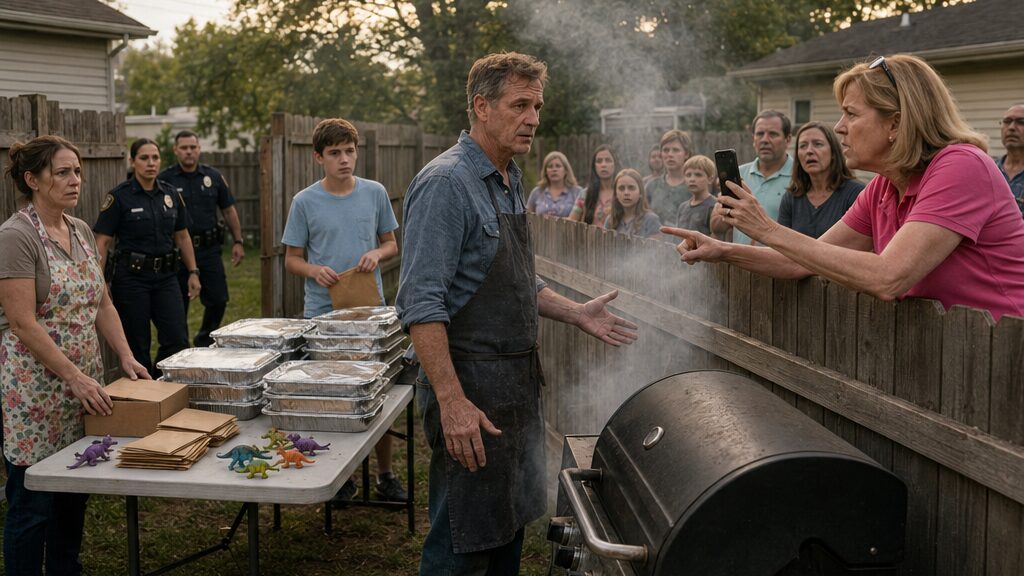
Carol Roberts’s hand appeared through the smoke before Jonathan Green saw her face.
One finger pointed over the cedar fence, rigid and pale against the gray drift rolling from his grill. Beyond it, her phone was already raised.
“This is the third weekend in a row,” she said. “You were warned.”
Jonathan lowered the metal spatula. Fat hissed on the grates beneath six rows of burgers, and a fresh ribbon of smoke curled toward Carol’s yard.
“Wind shifted,” he said. “I’m closing the lid.”
“You said that last Saturday.”
Children at the folding table went quiet. Tyler Jackson stopped arranging the small plastic dinosaurs he had painted green, orange, and blue. Each dinosaur stood beside a brown donation envelope, marking meal orders for different delivery routes.
Sandra Davis looked up from the cooler. “Carol, we’ll move the grill farther from the fence.”
“You are already too close to the property line.” Carol angled her phone toward the grill, then toward the residents sitting under two pop-up canopies. “And this is not an approved event.”
Jonathan shut the lid. The smoke thinned, but Carol kept recording.
“It’s twelve people,” he said.
“It’s a commercial cooking operation in a residential lot.”
“No one is being paid.”
“That doesn’t make it safe.”
Jonathan could feel the attention shifting from Carol to him. A few neighbors lowered their paper plates. One elderly resident pulled her cardigan tighter despite the heat.
He wanted to tell Carol that the grill would be cold in forty minutes. That the eighty-four burgers were already assigned. That by five o’clock, Tyler and Sandra would be carrying foil containers to people who no longer drove, cooked easily, or had family nearby.
Instead, he said, “We’re almost done.”
Carol’s mouth tightened.
“That is what you said the first weekend.”
She disappeared below the fence line. A moment later her voice carried through the slats.
“I’m calling the police.”
Tyler looked at Jonathan. “Can she do that?”
“She can call whoever she wants.”
“Should we move the envelopes?”
Jonathan glanced at the table. The donation envelopes were labeled only with route numbers, but several held cash. “Put them in the cooler until this is sorted out.”
The children gathered them quickly, sliding the painted dinosaurs into a cardboard box. Their movements made the whole gathering look guiltier than it was.
Sandra came beside him. Her floral apron was dusted with flour from the rolls.
“You could explain it to her,” she said quietly.
“She knows we’re serving meals.”
“She knows we’re cooking. That isn’t the same thing.”
Jonathan checked the thermometer through the grill lid. “The burgers don’t care what she calls it.”
Sandra gave him a hard look. “People do.”
Twenty minutes later, two police officers entered through Jonathan’s side gate.
The first was a broad-shouldered man who scanned the yard before speaking. The second, Kimberly Adams, kept one hand near her belt and looked from the canopies to the coolers.
“We received a complaint about excessive smoke and an unauthorized gathering,” the male officer said.
Jonathan stepped away from the grill and kept both hands visible.
“You can inspect anything you need.”
Carol reappeared at the fence. She had moved to a narrow gap beside the gate where she could see the officers clearly.
“He has been doing this every weekend,” she said. “The smoke comes directly into my home. The HOA has rules against nuisance conditions.”
Kimberly turned toward her. “We’ll speak with everyone.”
“There should be a fine,” Carol said. “At minimum.”
The male officer walked toward the grill. Tyler stood beside the cooler with both hands on the lid.
“What’s in there?” the officer asked.
“Donations,” Tyler said too quickly.
Sandra closed her eyes for half a second.
The officer looked at Jonathan.
“For meal deliveries,” Jonathan said. “You’re welcome to check.”
Kimberly’s gaze moved to the cardboard box on the table. One plastic dinosaur had fallen out and lay on its side beside a stack of foil pans.
She picked it up.
“My daughter has one of these,” she said.
Tyler shifted his weight. “I painted those.”
Kimberly turned the dinosaur over. On its underside, Tyler had written a route number in black marker.
“Route Seven,” she read. Then she looked toward Sandra. “Is this the weekend meal fundraiser?”
Sandra nodded. “The clubhouse kitchen was closed, so we’ve been cooking here.”
Kimberly’s expression changed.
“My family donated online last week,” she said. “For the senior meal deliveries.”
Carol’s phone lowered by an inch.
The male officer opened the grill. Heat rolled upward. He inspected the food, the propane connection, and the space between the grill and the fence.
“This isn’t a criminal matter,” he said. “I don’t see an immediate hazard.”
Carol stepped closer to the gate opening. “The HOA restriction still applies.”
“That’s civil,” Kimberly said. “We can document the complaint, but we’re not issuing a citation for a lawful gathering based on what we see here.”
A murmur moved through the residents. Tyler’s shoulders loosened.
Sandra opened the cooler and began returning the envelopes to the table. One of the children set the dinosaurs upright again.
Jonathan should have felt relieved. Instead, he watched Kimberly look around the yard a second time.
“Do you have the temporary cooking approval?” she asked.
“Yes,” he said.
The answer came too fast.
He went inside through the patio door and opened the kitchen drawer where he kept the event paperwork. Fire extinguisher inspection. Food-handler certificates. The first two Saturday approvals. A printed email from the property manager.
But not the extension for that day.
He checked the folder twice.
The email he remembered was there, but its final line read: Pending board confirmation.
When he returned outside, Kimberly was speaking to Carol. Sandra saw his empty hands.
“You found it?” she asked.
Jonathan held out the email.
“This is what I have.”
Kimberly read it. “This says pending.”
“The property manager told me the board had no objection.”
“In writing?”
Jonathan did not answer.
Carol gave a short, humorless breath. “There was never an approval.”
Kimberly returned the page to him. “We still aren’t citing you. But you should stop cooking until you confirm this.”
The burgers under the closed lid continued to hiss.
Jonathan looked at the foil pans, the waiting residents, and the cooler filled with route envelopes. Sixty meals had already been paid for. Twenty-four more depended on what was still on the grill.
“I’ll finish what’s already cooking,” he said. “Then we shut it down.”
The male officer glanced at the thermometer and nodded. “Keep the lid closed.”
Kimberly handed Carol an incident number and told her the report would note that no immediate public-safety violation had been found.
Carol accepted the paper, but she did not look embarrassed anymore. She looked prepared.
“I’ve already sent photographs, dates, and witness statements to the board,” she said. “They’ll decide whether this was authorized.”
Jonathan looked at the phone in her hand.
The smoke had nearly disappeared, but whatever Carol had sent was already beyond the fence.
Chapter 2: The Morning Notice on Jonathan’s Door
The red-bordered notice was taped across Jonathan’s front door at eye level.
He saw it before he unlocked the dead bolt Sunday morning, its paper glowing through the narrow pane of glass.
EMERGENCY CEASE-AND-DESIST ORDER.
Below the heading, someone had written the police incident number from the day before.
Jonathan stepped onto the porch in his socks and pulled the notice free. The tape tore a strip of paint from the doorframe.
Effective immediately, all food preparation, fundraising activity, assembly, and distribution connected to the neighborhood meal program were suspended pending review.
A second paragraph warned that continued operation could result in daily fines, reimbursement of legal costs, and referral to the association’s insurer.
The dark apron he had worn the day before hung on a peg inside the entryway. Even from the porch, he could smell smoke in it.
His phone rang.
Sandra.
“They froze the program account,” she said when he answered.
Jonathan looked down at the notice. “How?”
“Christopher authorized it last night. The payment app is linked to the HOA nonprofit account.”
“There’s food in three refrigerators.”
“I know.”
“And twenty-eight deliveries today.”
“I know that too.”
He went inside and pulled on his shoes.
The HOA office occupied one end of the clubhouse, separated from the locked kitchen by a short hallway. The property manager was already there when Jonathan arrived, though the office did not officially open on Sundays.
She had the same notice on her desk.
“You told me there was no objection,” Jonathan said.
“I told you no board member had objected when I sent the email.”
“You said we could proceed.”
“I said I expected the extension to pass.”
Jonathan placed the printed email on her desk. “That is not what this sounded like.”
She read it without picking it up. “The final approval never came.”
“Why didn’t you tell me?”
“I assumed Christopher did.”
“He didn’t.”
The manager rubbed her forehead. “After the insurer’s letter, the board stopped approving any cooking outside the clubhouse. Then the kitchen failed inspection.”
“Six weeks ago.”
“Yes.”
“And nobody notified the residents receiving meals that the program had lost its kitchen.”
“That program was supposed to pause.”
Jonathan stared at her.
“Pause for how long?”
“Until the ventilation repairs were completed.”
“There is no repair date.”
She said nothing.
The kitchen door stood twenty feet away with a yellow seal across it. Through its narrow window, Jonathan could see stainless-steel counters, an unused stove, and the bottom edge of the ventilation hood.
The manager slid a folder toward him.
“This is the incident file. Carol submitted photographs from three Saturdays, a statement about smoke entering her home, and a request for emergency enforcement.”
Jonathan opened it.
The top photograph showed smoke crossing the fence. The next showed residents seated under canopies. The third showed the grill with the lid open and a child standing nearby.
The angles made the yard look crowded and uncontrolled.
“Did she mention the fundraiser?” he asked.
“Not in the complaint.”
The property manager turned the folder so he could see the board’s response.
Christopher Hall had authorized suspension at 9:42 the previous night.
Jonathan’s phone vibrated again. Sandra had sent a photograph of stacked meat trays, produce boxes, and dairy cartons.
Use by Tuesday, her message read.
He closed the file.
“We’re delivering what is already cooked.”
“The order says all distribution.”
“The order cannot make food disappear.”
“It can make you personally responsible if you continue.”
Jonathan left without answering.
Sandra’s kitchen smelled of onions, foil, and cold storage. Every counter held labeled containers. Tyler stood at the table with a route sheet and a pen.
“How many can go out without reheating?” Jonathan asked.
“Eighteen,” Sandra said. “Another ten can be assembled from yesterday’s sides.”
“That covers today.”
“It covers part of today.”
“We divide portions.”
“No.”
Jonathan looked at her.
Sandra folded her arms. “We are not cutting meals for people who already receive less than they need.”
“Then we add bread and fruit.”
“With what money?”
He opened a cabinet and found paper bags. “I’ll handle it.”
“That sentence is becoming a problem.”
Tyler stopped writing.
Sandra lowered her voice. “There are forty-three regular recipients now, Jonathan. Eleven live alone. Seven have no weekend caregiver. You kept telling everyone the program could manage.”
“It has managed.”
“Because you keep filling the holes without telling anyone there are holes.”
He began packing the cold meals. “We can argue after the route.”
They delivered through the early afternoon.
At the fourth stop, an elderly resident met Jonathan at the door with exact change folded inside an envelope.
“This is more than your suggested donation,” he said.
“Put it toward someone else.”
“The program is temporarily suspended.”
Her hand remained extended. “Then temporarily put it toward someone else.”
He accepted the envelope.
At another house, no one answered until Sandra called through the door. A voice finally came from inside, weak but alert. They waited until the resident reached the porch.
By the time they returned, the remaining food filled Sandra’s refrigerator and a borrowed cooler in the garage.
Tyler counted route sheets at the table.
“Thirty-nine delivered,” he said. “Four postponed.”
Sandra looked at Jonathan. “And next Saturday?”
He did not answer.
She gathered the invoices from the fundraiser box and began sorting them by date. Restaurant supply store. Propane refills. Foil containers. Produce market. Printing costs.
Jonathan reached for the pile.
“I’ll take those.”
Sandra pulled them closer.
“These are program records.”
“They’re mixed up.”
“With what?”
“Personal purchases.”
“That’s exactly why I need to sort them.”
He turned toward the sink. Behind him, paper slid across the table.
Then the room went quiet.
Sandra had found three credit card receipts folded beneath the supplier invoices. Jonathan recognized the last four digits before she spoke.
“These aren’t from the program card.”
He kept his back to her.
“How many months?” she asked.
Jonathan looked at the dark window above the sink, where his reflection stood without an answer.
Chapter 3: The Program Jonathan Refused to Explain
Sandra placed the receipts across Jonathan’s workbench in a straight line.
The garage door was open, but the grill racks stored against the wall remained cold and clean. Without smoke or voices, the space looked less like a temporary kitchen than evidence after an event.
“January,” Sandra said, touching the first receipt. “February. March. April.”
Jonathan set down the toolbox he had been carrying.
“You went through everything.”
“I stopped when the total passed four thousand dollars.”
“It was spread out.”
“That does not make it smaller.”
Tyler stood near the garage entrance with the cardboard box of dinosaurs. He had come to return them, but neither adult had asked him to leave.
Sandra lifted another receipt. “Propane, meat, foil pans, printer ink, refrigerator repair. You paid for all of it?”
“Some of it.”
“Most of it.”
“The donations covered the rest.”
“Why didn’t you tell me?”
Jonathan picked up one of the grill racks and inspected a dark spot near the corner. “Because the program needed food, not a meeting about food.”
Sandra stepped between him and the storage hooks.
“You made the program look solvent.”
“It stayed open.”
“You made the rest of us think the fundraiser was keeping up.”
“It almost was.”
“No. You were keeping up.”
Tyler lowered the dinosaur box onto the floor.
Jonathan took a rag from the bench and rubbed the grill rack, though the mark did not move.
Sandra’s voice softened, which made it harder to ignore.
“Were you planning to tell us when you ran out of money?”
“I wasn’t going to run out.”
“You’re retired.”
“I know what I am.”
The words came out sharper than he intended.
Tyler looked toward the driveway.
Jonathan set the rack down.
“I had savings.”
“For what?”
“That’s my business.”
Sandra stared at him for a long moment.
“That answer is why we’re here.”
They left for the postponed deliveries before the argument could settle. Sandra drove. Jonathan sat beside her with two insulated bags at his feet.
At the first house, the resident apologized for missing the previous day’s delivery. Her home health aide had changed schedules without warning.
At the second, an elderly man asked whether the police had shut them down.
“No,” Jonathan said. “The HOA suspended the operation.”
The man frowned. “Difference being?”
Jonathan handed him the meal.
“Paperwork.”
The third stop was a small brick house near the far entrance of the subdivision. The resident opened the door slowly, leaning on a walker.
“I saw the police cars Saturday,” she said.
“It was resolved.”
“That usually means it wasn’t.”
Sandra gave Jonathan a sideways glance.
The resident took the bag but did not close the door.
“You know what I like most about these?” she asked.
“The meatloaf?”
“The knock.”
Jonathan waited.
“My daughter calls,” she said. “The pharmacy delivers. The mail comes. But you and that boy knock, and then you stand there long enough to notice whether I answer.”
She looked into the bag.
“Food matters. The knock matters too.”
Back in the car, Sandra did not start the engine immediately.
Jonathan looked out the windshield.
“She was one of Carol’s witnesses after the first cookout,” Sandra said.
He turned toward her.
“She complained about traffic.”
“I know.”
“And she still needs the meals.”
“I know that too.”
Sandra started the car. “That is what you keep doing. You know everything alone.”
At Jonathan’s garage, Tyler had arranged the dinosaurs on the workbench by route number. He was entering donations into a spreadsheet on an old laptop.
“I can make a public ledger,” he said. “Not names. Just totals.”
Sandra looked at Jonathan. “That should have existed months ago.”
“We had a ledger.”
“In your notebook.”
“It worked.”
“For you.”
Jonathan sat on the wooden stool beside the cold grill racks.
Years earlier, when the program’s founder had been in the hospital, she had made him promise that weekend meals would not disappear just because the committee changed or the board lost interest. She had said it lightly, as though asking him to check a loose hinge.
He had promised because he knew how to fix things.
A fan motor. A gas valve. A refrigerator seal. A delivery route. A budget shortfall.
He had not understood then that a promise could become another machine no one else knew how to operate.
“She asked me to keep it going,” he said.
Sandra did not need to ask who.
“She did not ask you to hide the cost.”
“She knew what happened when committees took over.”
“She also trusted people.”
“She trusted work.”
“No,” Sandra said. “She trusted you. You turned that into the same thing.”
Jonathan looked at the receipts.
Tyler closed the laptop halfway. “Do we still deliver Saturday?”
Sandra answered before Jonathan could.
“Not unless the accounts are open, the food source is approved, and somebody besides him has access to everything.”
Jonathan stood.
“We don’t have time to rebuild the program before Saturday.”
“Then it doesn’t operate Saturday.”
“There are forty-three people.”
“And there will still be forty-three people if you collapse, get fined, or lose your house trying to feed them.”
“I’m not losing my house.”
Sandra picked up the emergency order from the bench.
“It says legal costs can be assessed personally.”
“That doesn’t mean they will.”
“It means you are not the only person allowed to decide whether that risk is acceptable.”
Jonathan felt the old refusal rising in him—the instinct to stop explaining and return to work. It had served him for decades. Machines did not need reassurance. Problems did not care whether he felt understood.
But Sandra was not asking for reassurance.
She was asking for access.
He opened the metal cabinet beneath the workbench and removed a black notebook. Inside were donation totals, purchase records, delivery lists, and handwritten balances.
Sandra took it carefully.
“This is all of it?”
“All the program money.”
“And the personal expenses?”
“Not all.”
Her expression hardened again.
“I’ll find the rest.”
Before he could respond, Tyler’s laptop chimed.
An email had arrived from the HOA.
Sandra opened it.
The subject line read: NOTICE OF PUBLIC COMPLIANCE HEARING.
Christopher Hall had scheduled the hearing for Friday evening. The board would consider daily fines, reimbursement of legal expenses, suspension of all related fundraising, and recovery of any costs arising from the police response or insurance review.
Attached was a preliminary estimate.
Tyler read the total aloud.
Jonathan did not correct him.
For the first time, the cost of keeping his promise was written in a number large enough for everyone to see.
Chapter 4: Carol’s Evidence Was Not Entirely False
Carol was waiting beside the fence with a photograph in her hand.
Not her phone. Not another printed complaint. A glossy insurance photograph, its edges bent white from being handled too often.
“You should see this before Friday,” she said.
Jonathan had come outside to move the empty propane cylinders into his garage. He left them where they stood.
Carol opened the gate between their yards without waiting for an invitation. She crossed her patio and led him toward a tall storage cabinet pressed against the rear wall of her house.
When she pulled it aside, a blackened patch of siding appeared near the foundation.
The damage had been painted over once, badly. Brown smoke stains still climbed toward the window above it.
“That wasn’t your grill,” Jonathan said.
“No.”
Carol held the photograph beside the wall. In the picture, flames rose from a metal pan beneath the clubhouse pavilion. Smoke had darkened the siding of a nearby storage building. Residents stood at a distance while someone aimed a small extinguisher in the wrong direction.
“The Labor Day cookout,” she said. “Four years ago.”
Jonathan remembered the event, though he had arrived after the fire department. The board had called it a minor grease flare-up.
“The insurer didn’t call it minor,” Carol said. “They nearly dropped us.”
“You submitted this picture as evidence against me.”
“I submitted the restriction that came after it.”
“You submitted the photograph.”
“It shows why the restriction exists.”
“It shows a different fire in a different place.”
Carol’s jaw tightened. “It shows what happens when people decide good intentions are enough.”
Jonathan took the photograph from her. The date was printed in the corner. Four years old.
At the hearing, anyone glancing at it could assume the black smoke came from his backyard.
“You let the board think this was current.”
“I told them it was from the prior incident.”
“In the caption?”
She looked away.
Jonathan handed it back.
“That is not the same thing as telling them.”
Carol slid the photograph into a clear sleeve. “Your propane grill was operating without written approval. That part is current.”
“So was the fundraiser.”
“That does not make the grill safer.”
“No. But it changes why people were there.”
Carol opened her back door.
“Come inside.”
Jonathan did not move.
“Why?”
“Because there is something you keep refusing to consider.”
Her living room was darker than he expected. Heavy curtains covered the windows facing his yard. Near the adjoining wall, a compact respiratory machine sat on a side table beside coiled tubing and a plastic mask.
A low mechanical hum filled the room.
Jonathan looked toward the hallway.
“My husband sleeps in the room next to the fence,” Carol said. “When the smoke comes through that window, I close it. Then the room gets hot. The machine throws an alert if the airflow drops.”
Jonathan had known her husband was ill. He had not known about the equipment.
“You could have told me,” he said.
“I did tell you the smoke was entering the house.”
“You said it ruined your afternoon.”
“Because I was not going to discuss his medical condition across a fence in front of half the neighborhood.”
The answer struck closer than Jonathan wanted.
He had spent three days resenting her for withholding context while defending his own right to do the same.
Carol folded her arms.
“The first Saturday, I thought it was one event. The second, I asked you to stop. The third, you had more people, more food, and children carrying cash envelopes.”
“The grill was farther from the house.”
“Not far enough.”
“I checked the setback.”
“The insurance restriction requires board approval, not only distance.”
Jonathan looked back at the machine.
A thin layer of dust had collected around the cord where it entered the wall. The room smelled faintly of disinfectant and stale fabric, not smoke.
“I would have moved the grill to the driveway,” he said.
“And blocked the fire lane.”
“To the common lawn.”
“Without a permit.”
He almost answered, then stopped.
Carol noticed.
“That is the problem,” she said. “Every solution you offer becomes another exception you expect someone else to approve after you have already acted.”
Jonathan stepped toward the door.
“You still used an old photograph.”
“Yes.”
“And omitted the fundraiser.”
Carol’s fingers tightened around the sleeve.
“You operated without authorization.”
“I’m not denying that.”
“You did until the police asked for the paper.”
The words landed cleanly because they were true.
Jonathan left without another reply.
At the HOA records room that afternoon, the property manager gave him the insurance file under supervision. The binder contained the fire report, correspondence from the carrier, and a special restriction added to the association’s policy.
Any outdoor cooking event involving more than ten participants required written board approval, a fire extinguisher, a designated safety monitor, and notice to adjacent residents.
Jonathan had satisfied three of the four requirements. The approval was the missing piece.
Behind the restriction was a renewal warning dated six weeks earlier—the same week the clubhouse kitchen had been sealed. The insurer had requested a complete review of all cooking operations before renewing the policy.
Christopher’s handwritten note appeared at the top:
No exceptions until review complete.
Jonathan read it twice.
The property manager stood near the door. “I should have shown you that.”
“Yes.”
“I believed the board would approve a temporary extension because of the meal program.”
“You believed.”
“I was trying to help.”
Jonathan closed the binder.
“So was I.”
On his way out, he found Carol waiting in the hallway.
She had not followed him by accident. Her purse was over one shoulder, and the old fire photograph was still inside its clear sleeve.
“You wanted me to find the restriction,” he said.
“I wanted you to understand why I filed the complaint.”
“I understand the restriction.”
“That is not the same thing.”
“No,” Jonathan said. “It isn’t.”
For the first time since Saturday, he could see the shape of her fear without agreeing with what she had done with it.
He had treated the smoke as a temporary inconvenience because the meals were necessary. Carol had treated the meals as irrelevant because the risk felt immediate.
Both had hidden the part that made them harder to condemn.
Jonathan opened the exit door, but Carol spoke before he stepped through.
“I knew what the barbecue was funding.”
He turned.
Carol’s face did not soften.
“I knew before I called the police,” she said.
Chapter 5: The Reason Carol Needed Him Stopped
Carol unlocked the clubhouse kitchen herself.
The yellow inspection seal stretched across the door. She did not break it. She opened the narrow service entrance beside it and led Jonathan into the darkened serving area, where they could see the kitchen through an interior window.
The stainless-steel counters were clean. The stove looked ready. Only the ventilation hood betrayed the closure, its grease filters removed and one access panel hanging open.
“You’re not supposed to have this key,” Jonathan said.
“I’m chair of compliance.”
“That does not answer the question.”
Carol switched on the serving-area lights.
“Christopher gave it to me after the insurer’s inspection.”
“Why?”
“To inventory the equipment and keep people out.”
Jonathan looked through the glass. The room that had once held six volunteers, stacks of meal trays, and a radio playing too softly now resembled a display sealed behind a museum window.
“You said you knew about the fundraiser,” he said.
“I knew what Sandra posted. I knew you were selling meals to support deliveries.”
“That is the fundraiser.”
“I did not know how much of the program was running through your house.”
“You could have asked.”
“I did.”
“You demanded that I stop.”
“Because I had already asked the board what would happen if there was another claim.”
Carol took an envelope from her purse and handed it to him.
Inside was a preliminary insurance renewal estimate. The annual premium had increased by nearly forty percent. A separate line listed a possible special assessment if the association could not absorb the difference.
Jonathan read the projected amount per home.
“For some residents, that is a month’s groceries,” Carol said.
“For some residents, our meals are their groceries.”
“I know.”
“Do you?”
Her voice rose, then steadied.
“Yes.”
Jonathan looked at her.
Carol placed both hands on the serving counter. “I delivered for the program before you did.”
He had not known that.
“Before my husband got sick,” she continued. “Before the fire. Before every committee meeting became a discussion about exposure and premiums and whether helping people created obligations the association could not afford.”
She pointed through the window toward the disabled hood.
“The board did not close this kitchen only because of the inspection. Christopher wanted the program paused before renewal. Quietly.”
Jonathan held the estimate at his side.
“How quietly?”
“No announcement. No vote on cancellation. Just no repair authorization until after the policy renewed.”
“And after that?”
Carol looked at the floor.
“There would be another review.”
“That means never.”
“It means they were afraid.”
“It means they expected the recipients to disappear as a problem.”
Carol’s face tightened. “You think I don’t understand that?”
“You called the police on the only operation still feeding them.”
“I called because Christopher would not enforce his own restriction, the manager kept making verbal promises, and you kept cooking as if a charitable purpose gave you immunity.”
“It did not.”
“No. But everyone acted as if saying that made me cruel.”
Jonathan set the renewal estimate on the counter.
“You omitted the fundraiser because you wanted the board to react before anyone defended it.”
“I wanted them to see the violation.”
“You wanted them to see only the violation.”
Carol did not deny it.
The empty room seemed to sharpen every sound: the hum of emergency lighting, the tick of cooling metal, a car door closing in the parking lot outside.
Jonathan looked again at the hood.
“How much would the repair cost?”
“Less than the insurance increase.”
“Then why was it not approved?”
“Because the board was told repair might imply ongoing food-service liability.”
“So they chose no service.”
“They chose delay.”
“You keep giving softer names to the same decisions.”
Carol picked up the estimate.
“And you keep giving noble names to decisions you make alone.”
Jonathan turned toward her.
She continued before he could respond.
“You spent your own money without telling Sandra. You operated after the extension expired. You put volunteers in the position of defending records they had never seen.”
“I kept the program running.”
“You made it dependent on your silence.”
The sentence echoed too closely with Sandra’s accusation.
Jonathan looked through the glass at the stove. For years, he had believed the program survived because someone had been willing to act while committees delayed. He had never considered that every private rescue taught the board it could continue delaying.
“What do you want?” he asked.
“A pause until there is a lawful plan.”
“A pause means missed meals.”
“Then create a plan before Friday.”
“You expect the board to approve one in a single meeting?”
“No.” Carol’s voice lowered. “I expect them to cancel the program and blame you for forcing their hand.”
Jonathan studied her.
“Why tell me?”
“Because I wanted the grill stopped. I did not want the program buried.”
A vibration sounded from his pocket.
Then another.
Carol’s phone began vibrating too.
Jonathan checked the screen.
A neighborhood social-media post filled it. Tyler had uploaded a photograph from Saturday showing Carol pointing over the fence while the police stood near the grill.
The caption read:
HOA COMPLIANCE CHAIR KNEW THIS WAS A CHARITY FUNDRAISER AND CALLED POLICE ANYWAY.
Below it, comments multiplied faster than Jonathan could read.
Some demanded Carol’s resignation. Others posted her address within the subdivision. Someone had shared a photograph of her husband’s respiratory equipment through the living-room window.
Jonathan’s stomach tightened.
“Tyler,” he said.
Carol saw the image on her own phone. The color drained from her face.
“I never gave anyone permission to photograph inside my house.”
Jonathan called Sandra.
She answered immediately.
“I just saw it,” she said.
“Take it down.”
“I’m trying. He says people need to know what she did.”
“Tell him to remove it now.”
Carol moved toward the clubhouse exit.
Jonathan blocked the doorway with one arm—not touching her, only slowing her.
“Do not go outside yet.”
“Get out of my way.”
“There are cars pulling in.”
Through the front windows, headlights swept across the parking lot. Two vehicles stopped near the entrance. A third turned in behind them.
The post had listed the time and location of Friday’s hearing. Residents were already arriving a day early, believing a meeting was underway.
Voices rose outside.
“Carol!”
Someone struck the locked front door.
Carol’s breathing shortened. She reached into her purse for her keys, dropped them, and bent to retrieve them with unsteady fingers.
Jonathan called the property manager and told her to contact Christopher. Then he called Tyler directly.
The teenager answered on the fourth ring.
“Mr. Green, I can explain—”
“Delete the post.”
“But it’s true.”
“Part of it is true. You included her house.”
“I didn’t post the address.”
“Someone else did because you gave them a target.”
“She called the police on us.”
“And now you are sending strangers to a locked building.”
“They’re neighbors.”
“They are angry people with phones. Delete it.”
Silence.
Jonathan looked through the glass doors. A resident held up a handmade sign. Another was filming Carol’s car.
“Now, Tyler.”
The post disappeared two minutes later, but screenshots were already spreading.
Christopher arrived through a side entrance with the property manager. He took in the gathering outside, Carol’s pale expression, and Jonathan standing beside the sealed kitchen.
“What happened?” he asked.
Carol answered before Jonathan could.
“What you delayed finally became public.”
Christopher looked at the phones raised beyond the glass.
The hearing was still twenty-four hours away, but the audience had already formed.
Chapter 6: The Hearing Where Silence Became Evidence
Christopher Hall read the maximum fine before he allowed Jonathan to speak.
“Daily penalties of up to five hundred dollars, recovery of association legal expenses, reimbursement of insurance-review costs, and suspension of fundraising activity conducted under the HOA’s nonprofit account.”
The meeting room was full enough that residents stood along the rear wall. Others watched through the open doorway. Phones were visible despite Christopher’s request that no one record.
Jonathan sat at the front table with four items arranged before him: the expired temporary approval, the black account notebook, a stack of personal receipts, and his smoke-marked apron folded into a square.
Sandra sat to his right. Tyler remained beside her, his phone turned face down.
Carol sat across the aisle with no papers in front of her.
Christopher adjusted the microphone.
“Mr. Green, you may respond.”
Jonathan stood.
The room quieted in layers rather than all at once.
He looked at the residents who had eaten at the fundraiser, those who had complained about parking, volunteers, board members, and people who had come because of Tyler’s post.
“The permit expired,” he said.
A murmur moved through the room.
Jonathan continued.
“I knew I did not have final written approval. I had an email saying the extension was pending, and I chose to treat that as permission because the property manager told me no one had objected.”
Christopher leaned toward the microphone. “For clarity, are you admitting the violation?”
“Yes.”
Sandra glanced at him, but he kept his eyes on the board.
“I had a fire extinguisher. I followed the setback. I notified the adjacent property. None of that replaces the missing approval.”
Carol looked up.
A resident in the back called, “But it was a fundraiser.”
Jonathan turned toward the voice.
“That explains why I did it. It does not change what I did.”
The room settled.
Christopher’s expression shifted slightly, as if the defense he had prepared against was no longer available.
Jonathan placed one hand on the receipts.
“The program has also been operating with incomplete financial records.”
Sandra opened the notebook to the marked pages.
“These show donations,” she said. “The receipts beside them show expenses Mr. Green paid personally and did not report to the volunteers.”
“How much?” one board member asked.
Jonathan gave the total.
The figure drew a sharper reaction than the permit admission.
Christopher frowned. “Why was the board not informed?”
“Because I did not ask the board to repay me.”
“That is not the point.”
“I understand that now.”
Jonathan looked at Sandra.
She did not rescue him from the silence.
“I believed keeping the program alive mattered more than explaining how close it was to failing,” he said. “That made the program dependent on decisions no one else could review.”
The words felt unnatural in his mouth—not false, only overdue.
Christopher turned to Sandra. “Can the program continue without Mr. Green’s personal funding?”
“No,” she said. “Not under the current structure.”
Several residents began speaking at once.
Christopher struck the table lightly with the gavel.
Sandra waited until the room quieted.
“And it should not,” she added. “Forty-three residents receive weekend deliveries. Eleven live alone. The association benefited from that work while treating it as an informal favor. If the program continues, it needs published accounts, approved facilities, assigned safety roles, and a budget residents can see.”
Jonathan watched Christopher absorb the word budget.
It changed the shape of the room. A charity could be praised. A budget had to be owned.
The property manager distributed copies of Kimberly Adams’s incident report. It stated that officers had found no immediate criminal or public-safety violation, that the event appeared orderly, and that the dispute concerned HOA authorization.
No one cheered.
The report cleared one accusation and left the harder questions intact.
Christopher turned to Carol.
“Mrs. Roberts, your complaint included a photograph from the prior grease fire.”
“Yes.”
“Was it identified as historical?”
“In the attached insurance reference.”
“Not in the image caption.”
“No.”
“And did you know Saturday’s gathering was connected to the meal program?”
Carol looked toward Jonathan before answering.
“Yes.”
A wave of whispers spread through the room.
Christopher raised the gavel again, but Carol continued without waiting.
“I omitted that because I believed the board would excuse the violation if the charitable purpose appeared first.”
A resident near the door said, “So you manipulated them.”
Carol’s shoulders stiffened.
“I presented the safety issue.”
“You called the police on people feeding seniors.”
“I called the police because smoke was entering a room containing respiratory equipment, and because repeated requests to stop had failed.”
The room changed again.
Carol described the old fire, the insurance warning, and her husband’s machine. She did not ask for sympathy. She did not apologize for wanting the smoke stopped.
Then she said, “I was wrong to omit the fundraiser and wrong to submit the old photograph without making its date obvious.”
Christopher stared at her.
Carol met his gaze.
“The board was also wrong to leave the clubhouse kitchen closed without notifying the residents who depended on it.”
Silence followed, heavier than the earlier outrage.
Christopher turned to the property manager. “Were repair requests submitted?”
She opened a folder.
“Three.”
“Dates?”
She read them.
The first predated Jonathan’s backyard fundraisers. The second had no recorded board response. The third had been deferred until after insurance renewal.
Jonathan placed copies of the requests beside his permit.
The story in front of the board was no longer one man ignoring a rule or one neighbor abusing authority. It was a chain of private decisions, each made easier because someone else had carried the consequence.
Christopher removed his glasses.
“The association cannot approve continued operations tonight,” he said.
Sandra stood.
“Then the program ends tonight.”
Residents began protesting.
She held up one hand.
“No more hidden credit cards. No more verbal approvals. No more asking Jonathan to break rules because no one wants to vote on the cost.”
Jonathan felt the room turn toward him.
For once, he did not fill the silence.
Sandra continued.
“If residents want the meals, they must fund them. If the board wants the service, it must provide a legal place to operate. If volunteers want to help, they must take assigned responsibility.”
Christopher looked at the two other board members.
“What exactly are you requesting?”
Jonathan opened the final folder beneath his apron.
“A temporary resident-run permit,” he said. “Thirty days.”
He distributed the proposal.
It included a shared-cost schedule, public donation ledger, certified food-handling roster, fire-safety monitor, portable smoke-control hood, air-quality readings at the adjacent property line, and an automatic shutdown procedure if wind carried smoke toward Carol’s home.
A second page contained bids for repairing the clubhouse ventilation system.
A third showed resident pledges gathered that afternoon—not donations to Jonathan, but commitments to the program’s operating fund.
Christopher read the first page.
“You prepared this since yesterday?”
“Parts of it existed before yesterday,” Jonathan said. “I kept trying to solve them separately.”
Carol studied the air-monitoring section.
“This requires a reading every thirty minutes,” she said.
“Yes.”
“And the monitor stays with compliance?”
“With whichever resident is assigned safety duty.”
“Not you?”
“No.”
Sandra looked at him then.
It was a small thing, but she heard what it cost him.
Christopher leaned back.
“The insurer has not reviewed this.”
“The county fire-safety inspector will review the equipment Monday,” Jonathan said. “The permit begins only if the inspector signs it and the insurer issues written acknowledgment.”
“And if either refuses?”
“The program uses catered meals until the kitchen is repaired.”
“Paid for how?”
Jonathan tapped the pledge sheet.
“Not by one person.”
Christopher turned the pages slowly.
Outside the meeting room, more residents crowded the hallway. The anger that had brought them there had no single target left.
Only a price.
Only rules.
Only the question of whether they wanted the program enough to share both.
Jonathan unfolded the smoke-marked apron and set it beside the proposal.
“I will cook,” he said. “I will not own the program.”
Christopher looked from the apron to the ledger, then toward the residents waiting for an answer.
The board had spent weeks avoiding a decision.
Now Jonathan had placed one directly in front of them.
Chapter 7: When the Smoke Belonged to Everyone
Jonathan arrived to find someone else already lighting the grill.
Tyler stood beneath the new portable hood with one hand on the ignition switch and the other shielding the flame from the morning breeze. Sandra watched from the prep table, reading aloud from the laminated startup checklist.
“Propane connection?”
“Secure.”
“Extinguisher?”
“Mounted.”
“Air monitor?”
“Not here yet.”
Tyler released the ignition. The burner clicked off before the flame caught.
Jonathan stopped at the edge of the common lawn.
For years, every failed light, loose fitting, missing tool, and uncertain volunteer had drawn him forward before anyone asked. His hands had already started toward the grill when Sandra noticed him.
“You’re early,” she said.
“I thought you might need help.”
“We do.”
She pointed toward three unopened boxes beside the clubhouse doors.
“Serving trays need assembling. The grill belongs to the safety team until the monitor arrives.”
Jonathan looked at Tyler, who was checking the propane coupling again.
“He turned the valve too quickly.”
“I heard that,” Tyler said.
“Then you know not to do it twice.”
Tyler smiled without looking up. “Yes, sir.”
Jonathan carried the boxes to the serving table.
The common lawn had changed during the three weeks since the hearing. A metal cooking station stood on a poured concrete pad, farther from every home than Jonathan’s backyard had been. The portable hood rose above it on locking wheels, its exhaust directed straight upward. White lines marked the cooking boundary. A fire extinguisher, first-aid kit, and shutdown chart hung from a freestanding panel.
Beyond the lawn, the clubhouse kitchen doors stood open.
The ventilation system had passed inspection two days earlier, though the board had limited indoor cooking until the insurer completed a final review. For now, volunteers could prepare cold sides inside and use the outdoor station under the temporary permit.
Nothing about the setup was elegant.
Everything had a name, an assigned person, and a signature line.
Christopher stood near the entrance with a clipboard, checking volunteers against the roster. The property manager taped the current permit inside a clear display case. Two residents counted cash donations at a separate table while Tyler’s laptop showed a public total on its screen.
No money disappeared into Jonathan’s notebook.
No missing expense waited for him to cover it.
He opened the first tray box.
His smoke-marked apron remained folded in the passenger seat of his truck.
Sandra had issued clean gray aprons with the program’s new safety rules printed on cards tucked into each pocket. Jonathan had taken one, then left it in the package.
He told himself he had forgotten.
Carol crossed the lawn carrying a black case.
Conversation softened around her, though it did not stop. Some residents still looked away when she passed. Others watched too openly.
She set the case beside the cooking station and removed the required air-quality monitor.
Tyler glanced at Sandra.
Sandra nodded toward the checklist.
“Assigned monitor operator?”
“Carol Roberts,” Tyler read.
Carol calibrated the device without responding. She placed one sensor at the cooking boundary and carried the second toward the edge of her property.
Jonathan watched her secure it to a small stand near the fence line.
When she returned, she handed the readings to Christopher.
“Both within baseline,” she said.
Christopher initialed the form.
Carol looked at Jonathan. “The wind is from the south. If it turns west, we pause.”
“That’s the procedure.”
“I know.”
Neither offered anything more.
Sandra gave Tyler permission to restart the ignition sequence. This time, he opened the valve slowly. The burner caught with a low blue flame.
Jonathan heard himself inhale.
Tyler adjusted the heat, waited for the hood indicator to turn green, then placed the first row of burgers on the grates.
Smoke rose into the metal intake and disappeared through the vertical vent.
It did not cross a fence.
A child carried the painted dinosaurs from the donation table and arranged them beside the route envelopes. The figures had been relabeled with removable tags so they could be used each week. Green for the north route, orange for the houses near the main road, blue for residents requiring a door check.
One of the dinosaurs tipped over.
Jonathan reached for it at the same moment as the child.
He stopped and let her set it upright.
By noon, the serving line stretched halfway across the lawn. Residents moved between assigned stations with the awkwardness of people learning work they had once assumed simply happened.
The meat ran low sooner than expected.
Sandra checked the inventory sheet. “Two trays missing.”
Jonathan knew immediately where they were. The supplier had packed them in the cooler marked for indoor storage.
He took one step toward the clubhouse.
Sandra held up the checklist.
“Runner?”
A volunteer near the doorway raised his hand and went inside.
Jonathan returned to the trays.
Ten minutes later, Carol’s monitor sounded.
The alert was not loud, but everyone near the cooking station froze.
A gust had shifted the smoke sideways beneath the hood. The boundary reading climbed above the temporary threshold.
Tyler reached for the lid.
“Close it,” Carol said.
He lowered the grill lid. Sandra called the shutdown procedure. The flame went out. Christopher marked the time.
Residents in line murmured. One man looked toward Jonathan.
“We can move the sensor,” he said. “It’s only one reading.”
“No,” Jonathan replied.
The answer came without effort.
Carol watched him.
For twelve minutes, the grill remained cold while the wind moved through the trees. Sandra redirected the line to cold sandwiches prepared inside. Tyler checked the hood wheels and discovered that one locking caster had shifted half an inch, turning the intake away from the grill.
Jonathan knelt beside him but did not touch the wheel.
“What do you see?” he asked.
“The rear lock isn’t seated.”
“And?”
“The hood turned when the wind hit it.”
“What fixes it?”
Tyler reset the caster, checked the other locks, and called Christopher over for verification.
The next reading returned to baseline.
Carol signed the restart form.
“That worked,” she said.
Tyler looked relieved. “The shutdown?”
“The rules.”
Her eyes moved briefly toward Jonathan.
He understood the distinction.
The original cookout had survived because Jonathan had kept working despite missing approval. This one survived because everyone stopped when the procedure required it.
Sandra handed him a clean gray apron.
“Serving station is short.”
Jonathan unfolded it.
The fabric felt stiff and unfamiliar. He tied it behind his waist and took a place beside a volunteer filling foil containers.
He did not touch the grill again.
Near the end of the afternoon, Carol approached the serving table with an empty route envelope.
“My husband wants to make a donation,” she said.
Jonathan took the envelope, then pointed toward the two residents managing the ledger.
“They’ll record it.”
Carol followed his gesture.
“You don’t handle the money?”
“Not by myself.”
She nodded once and carried the envelope to the proper table.
No apology passed between them. No friendship returned. But when the wind shifted again, Carol checked the monitor before looking toward the grill, and Jonathan waited for her reading without resentment.
Tyler called the next order.
“Route Seven.”
A child lifted the green dinosaur and carried two meals toward the delivery table.
Jonathan looked above the cooking station.
A thin column of smoke rose through the approved hood, straight into the open air. Beneath it, volunteers worked from shared lists, shared funds, and rules no one had to pretend were someone else’s responsibility.
Another order was called before he could step forward.
Someone else answered.
Jonathan stayed where he was and sealed the meal tray in front of him.
The story has ended.