The Dog They Turned Into a Legend
Part I — The Trench Built for Applause
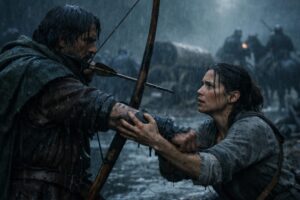
By the time the cameras were ready, the trench had already been made too beautiful.
Too straight. Too theatrical. Too clean in its ruin.
The prop men had packed the dirt walls with care. The fake blasted timber leaned at just the right angle. Smoke crept low across the set in pale ribbons, lit from behind to look tragic instead of filthy. Extras in fresh uniforms crouched where a week ago there had been carpenters and painters. Someone had even scattered a broken helmet near the lip of the trench, as if grief could be placed for effect.
Rin stepped onto the packed earth and stopped so hard the leash snapped taut in Lee Mercer’s hand.
Not balking. Not confusion. Something older than that.
The dog’s ears went high. His body lowered. His whole frame became one hard line of listening.
Across the set, a special-effects man tested a powder charge. A dry pop cracked the air.
Rin did not flinch.
He stared at the trench wall as if something inside it had called his name.
“Can he do it or not?” the director shouted from behind the camera.
Lee didn’t answer. He had seen that look only twice before—once in a shelled communications cut where the earth still steamed, and once in his room at three in the morning when rain hit the window the wrong way.
“Mercer,” the director barked, louder now. “I asked you a question.”
Rin moved before Lee could stop him.
He slipped free, dropped into the trench, and began navigating it with a terrible precision no one had taught him for this set. He leaped the splintered beam. Flattened under the hanging wire. Twisted past a mound of dirt the effects men had built to resemble a cave-in. Then he stopped at the far end, paws braced, head lowered, looking into a dark cut in the wall as if he expected something alive to answer back.
The set went quiet.
Even the director lowered his megaphone.
Rin gave one sharp bark. Then another. Then he began digging.
Not performing. Not hitting marks.
Remembering.
Lee felt the old cold start at the base of his neck.
He crossed the trench in three strides and dropped to one knee beside the dog. Rin was trembling now, but he kept digging, frantic, desperate, his claws tearing at the packed false earth.
“Easy,” Lee said softly.
The dog didn’t hear him.
Lee lifted one burned hand and gave the signal he used only in private: two fingers low, palm in, the old field sign for come through it. Then he leaned close enough for the dog to catch his breath.
“Steady now,” he whispered. “Find me.”
Rin froze.
His head turned.
For a second the whole set held its breath with them.
Then the dog backed out of the trench wall, pressed his body hard against Lee’s side, and sat, shaking.
No one spoke until a woman in a dark tailored suit stepped down from the platform behind the camera. She had a pencil tucked behind one ear and a notebook in one hand. She looked at the dog, then at Lee, then back at the trench as though she had just seen a trick no one else understood.
“What was that?” she asked.
Lee rose without answering. “He’s done for the day.”
The director made an irritated sound. “Done? We haven’t shot a foot of film.”
“You wanted realism,” Lee said. “That’s the closest you’re going to get.”
He clipped the leash back on. Rin stayed pressed against his leg, alert eyes still fixed on the trench.
The woman stepped closer. Her face was composed, but her attention was not casual. “You’re Mercer.”
He looked at her.
“Evelyn Vale,” she said. “Scenario department. Publicity when they need me. I’ve seen the reels from your last picture.”
“That was not my picture.”
“No,” she said. “It was his.”
She meant the dog.
Rin was breathing more slowly now, though his shoulders were still tight beneath the thick sable fur. A small white scar showed through along one flank where the coat parted. Most people never noticed it. Evelyn did.
“How many commands does he know?” she asked.
Lee started to move past her. “Enough.”
“Does he always do that?”
“No.”
“But he can.”
Lee stopped then. Turned back. “Miss Vale, if you’re trying to decide whether he’s useful, decide quick. He isn’t a machine.”
Her gaze didn’t leave his face. “No,” she said. “That’s exactly why people will watch him.”
On the platform, the director was already shouting for the trench to be reset, muttering about temperamental animals and wasted light.
Evelyn ignored him.
“There’s a new war picture starting next month,” she said. “Bigger than this one. Better money. Better billing. I can put you in front of the men who decide those things.”
Lee looked down at Rin.
The dog was steady now. Waiting.
The hardest thing about California, Lee had learned, was that desperation could look exactly like opportunity.
“I’m not interested in bigger,” he said.
Evelyn glanced at the frayed cuff of his coat. At the polished but cracked boots. At the dog collar mended with thread. She missed nothing.
“That may be true,” she said. “But overdue rent usually is.”
Then she handed him a card and walked back toward the camera, leaving him with the dog, the trench, and the smell of powder that had followed them out of Europe and onto a set built for applause.
Part II — The Command He Only Used in Private
Lee kept the card for three days before he used it.
Not because he trusted her.
Because the landlady had started knocking twice each evening instead of once, and because Rin had nearly torn into a butcher’s back alley after a pair of boys followed them home calling him “that picture dog” and trying to throw a loop of rope around his neck.
By then the dog was becoming visible in a way Lee had never intended. Too striking to disappear. Too intelligent to be passed off as ordinary.
California liked marvels. It liked making them belong to everyone.
Lee did not.
He and Rin lived in a narrow room over a feed shop near the edge of Los Angeles, where the train noise covered Lee’s bad nights and the dog could brace against the bed whenever the dark went wrong. The room held one iron cot, one washstand, a tin basin, a trunk from Army days, and a torn blanket that Rin refused to sleep without. Lee had found the pup in a trench half-filled with broken signal wire and dead earth. He had found the blanket later, in a quartermaster bin, and the dog had adopted it with the seriousness of a man taking an oath.
Training began before dawn because it had to.
Not for pictures. For survival.
Lee taught Rin to wait through streetcars, to ignore children unless invited, to back from slammed doors, to come at a lifted finger instead of a shouted name. He built little courses in the yard behind the feed shop from crates, boards, and old barrels. Not tricks. Patterns. Stability. Trust disguised as work.
“Over.”
Rin leaped.
“Down.”
Rin flattened.
Lee gave the private signal—two fingers low, palm inward.
“Find me.”
Rin crossed the course, weaving through obstacles, not to the reward tin but straight to Lee’s leg, leaning there just long enough to prove he was choosing him.
That was the part no audience ever saw. The part that mattered.
When Lee finally stepped onto the larger studio lot with Evelyn’s card in his pocket, he made his terms plain before anyone offered him coffee.
“I train him,” he said. “I stay with him. No one handles him without me there. No cages.”
The production manager laughed. “You asking for salary or sainthood?”
Evelyn answered before Lee could. “He’s asking for the reason the animal works.”
The men listened after that, though not graciously.
The first picture was meant to use Rin for three scenes: a battlefield messenger, a sentry, a dog who mourned at a dead soldier’s side. Minor work. Atmosphere. The human star was meant to carry the heart of the film.
Instead, by the second screening, women were weeping over the dog and boys were trying to stand like him in the aisles.
“He looks like he understands everything,” one theater owner said.
“He looks like he’s seen worse than us,” another replied.
That was how it began.
Not with trumpets. With people leaning forward.
Scripts changed. Scenes grew around him. The posters still put men at the center, but the dog was placed where the eye went first. Fan letters began arriving in stacks wrapped with string. Children wanted his paw print. Mothers thanked him for reminding them of sons who had come home altered. Men who had never crossed an ocean sent cigars and called him a patriot.
The newspapers polished the story faster than the studio ever could.
WAR HERO DOG SAVED FROM ENEMY FIRE.
SOLDIER RESCUES PUP FROM TRENCH, RETURNS WITH A STAR.
They made Lee broader in the shoulders and cleaner in the soul. They made the trench noble. They made the dead disappear.
Evelyn brought him clippings with a look he could not always read.
“You could object,” she said once.
“Would it matter?”
“It might.”
“No,” Lee said. “It would only be useful.”
She studied him over the edge of the page. “There’s a difference.”
“Not here.”
But he kept every clipping in the trunk anyway, stacked under discharge papers he rarely touched.
Rin did not care for newspapers. He cared for routine, for Lee’s voice, for the battered tin bowl, for the private command that meant come through fear and not just come.
At night, after premieres and rehearsals and smiling strangers, Lee would kneel in the narrow room and set two fingers low.
“Find me.”
Rin always came.
Sometimes that was enough to get them both to morning.
Then the magazine piece came.
National. Glossy. Full-page portrait of Rin posed against a painted battlefield sky. Lee in uniform beside him, jaw set, eyes brightened by retouching into a man he did not know.
Evelyn brought the proofs herself.
“They’re calling him the bravest survivor of the war,” she said.
Lee stared at the copy. “He survived it. That much is true.”
The article named the dog. Named Lee. Described a storm of shells, a fearless rescue, a young handler carrying a shivering pup to safety under fire because he recognized greatness on sight.
There it was. Myth in polished print.
At the bottom of the final page was a line that changed everything:
COMING SOON: RIN TO STAR IN VALIANT DUSK, THE GRAND WAR PICTURE OF THE YEAR.
Evelyn should have looked pleased. Instead she looked almost tired.
“This is the one that makes him permanent,” she said.
Lee folded the magazine shut.
Permanent.
As if survival hadn’t already done that.
When he left the studio that evening, a man was waiting by the gate with a stick tucked under one arm and a coat too thin for the season.
He had gone broad through the chest and mean through the face, the way some men did when pain had to live somewhere.
Tom Sayer looked older than thirty-six.
For a second Lee did not know him.
Then he saw the empty sleeve pinned neat at the shoulder.
Then he saw the eyes.
“You,” Tom said.
Rin stopped walking.
Lee felt the leash tighten in his hand.
Tom looked at the dog, then back at Lee, and his mouth twisted.
“So it’s true,” he said. “You turned that trench into a picture show.”
Part III — The Men Left Out of the Story
Tom refused the café. Refused the bench. Refused kindness so quickly it became its own kind of plea.
They ended up in the alley behind the studio, where there were no autograph seekers, only crates, damp brick, and the smell of oranges gone soft in a broken box.
Rin stood between them, not growling, just watchful.
Tom tapped ash from a cigarette with the hand he still had. “You know what my wife saw in the paper?”
Lee said nothing.
“She saw your face and the dog’s face and all that noble nonsense under it, and she said, Tom, weren’t you in his unit?” He laughed once. Harsh and brief. “That’s how I found out the war had become a children’s story.”
“It isn’t a children’s story.”
“No?” Tom stepped closer. “Looks clean enough now.”
Lee kept his voice even. “What do you want?”
Tom’s jaw flexed. “You don’t get to ask me that first.”
Rin shifted, reading the air.
Tom noticed. “He still hates raised voices?”
Lee’s silence answered for him.
That made something flicker across Tom’s face—memory, maybe, or guilt—but it hardened fast.
“They don’t print Miller’s name,” he said. “Or Ortega’s. Or Finch. Funny thing, that. Plenty of space for a dog. None for the men.”
Lee looked past him at the brick wall because looking at Tom’s face was too close to looking at the past.
“They’re dead,” he said.
Tom’s voice dropped. “That doesn’t mean they’re nothing.”
The alley seemed to narrow.
Lee had known, from the first clipping, that eventually someone would come carrying the part of the story the public had not paid for. He had not expected it to be Tom. Not alive. Not here.
“I didn’t ask for any of this,” Lee said.
Tom barked a laugh. “That’s the trouble, isn’t it? You keep saying yes to things you swear you never wanted.”
He flicked the cigarette away.
“What did you tell them? That you found the pup in some empty trench under moonlight? That you picked him up and marched nobly on while shells burst around you?”
“I told them almost nothing.”
“Then you let them lie for you.”
Rin moved closer to Lee’s leg.
Tom looked at the dog again, and some of the anger thinned into something uglier because it was more human.
“He was just noise that night,” Tom said quietly. “You know that? Crying under the dirt. Just noise in the wrong place at the wrong time.”
Lee felt the old earth in his throat. Wire. Blood. Rain. An order being shouted through static. The impossible small sound of a living thing where nothing should have still been living.
“Stop,” he said.
Tom did not.
“You heard him after the withdrawal call. Captain said leave it. Everybody heard him. But you went back.”
Rin’s ears twitched. Lee tightened his grip on the leash.
Tom’s eyes sharpened. “And maybe that saved the dog. Maybe it saved something in you. But don’t stand there letting them call it heroism like nothing else was tied to it.”
Lee said, “You think I don’t know that?”
For the first time, Tom looked uncertain.
Only for a second.
Then he glanced toward the studio wall, where someone had pasted a fresh lithograph poster of Rin in profile above the title of the new film.
“Do they pay well for memory in there?” he asked.
At last the real ask.
Not greed exactly. Not only that.
Money, yes. But also insult. Erasure. Hunger with a wound under it.
Lee could see it now: the rent in the elbow of Tom’s coat, the strain in his face, the humiliating way pride sits on a man who cannot afford to feed it.
“If you came for money,” Lee said, “say so plain.”
Tom’s expression turned dangerous. “If I came for the names, would that sound cleaner?”
“That depends what you mean to do with them.”
Tom leaned in. “I mean not to watch them buried twice.”
The words landed and stayed.
That night Lee did not sleep. Rin kept his place beside the bed, rising each time Lee rose, settling only when Lee stopped pacing. Near dawn, Lee took the magazine from the trunk and read the rescue passage again.
He had hated it on first sight. Yet here he was, going back to it like a man pressing on a bruise to make sure it still belonged to him.
At the studio the next day, Evelyn met him in the corridor outside wardrobe. She took one look at his face and said, “Who found you?”
Lee stared.
She held up the morning paper. There, in the last column of a gossip page, was a teasing line about a “disgruntled veteran” disputing the studio’s cherished war story.
Nothing explicit. Not yet.
“How bad?” Lee asked.
“Depends on whether men in offices feel afraid before lunch.”
“And do they?”
“Yes.”
He looked down the hall. “Did you print this?”
Her expression changed just enough to matter. “No.”
“But you know who did.”
“I know how stories move.” She lowered her voice. “If there’s a man speaking to reporters, he won’t stop because you glare at him.”
Lee’s jaw tightened.
Evelyn stepped closer. “Tell me what I’m defending.”
He met her gaze and saw, for once, no polish in it. Only calculation pressed against conscience.
“You’re not defending anything,” he said. “You’re managing it.”
“That is not the same thing.”
“It becomes the same thing quick enough.”
Something in her face closed.
“Then let me phrase it another way,” she said. “How much of what they’ve printed is untrue?”
Lee looked past her into the soundstage where men were building another trench.
“That depends which part you think matters.”
He walked away before she could answer.
By the end of the week, Rin was being fitted for Valiant Dusk, the prestige picture. Bigger set. Better costumes. A score to be commissioned in advance. The director wanted realism. The studio wanted scale. The public wanted a war that could be survived from a cushioned seat.
Tom wanted names.
Lee wanted—he still could not say.
That afternoon Rin balked at a rehearsal tunnel built from canvas and timber to mimic a collapsed line.
The dog put one paw inside, then stopped dead.
The crew waited.
“Come on,” the assistant director snapped. “He did finer than this yesterday.”
Lee crouched.
Rin’s breathing had changed. Not panic yet. Worse. The held breath before it.
Lee gave the low signal.
“Find me.”
Rin’s eyes locked on him, but his body would not move.
The assistant director muttered, “Christ. We can’t stop for a fit every time he smells dirt.”
Lee stood so fast the man flinched.
“It isn’t a fit,” he said. “It’s memory.”
No one answered that. Not even Evelyn, who was watching from near the script table with her pencil gone still in her fingers.
In the silence, Lee stepped into the tunnel himself and knelt at the far end where the dark narrowed.
“Find me,” he said again.
For one long second, nothing.
Then Rin came.
Not gracefully. Not bravely in the way audiences liked. He crawled low, shook halfway through, and practically threw himself the last few feet into Lee’s chest.
Lee held him until the trembling eased.
When he emerged carrying the dog’s front weight against him, half the crew looked away.
The other half looked fascinated.
That was the danger. Not cruelty.
Usefulness.
Part IV — The Shape of a Lie
The magazine profile turned them into national property.
After it ran, strangers began sending silver collars, wreaths, children’s drawings, invitations to parades. One senator’s wife wrote that Rin embodied “the pure soul of American courage.” A church in Ohio asked for a photograph to display at a veterans’ supper.
Evelyn placed the stack of correspondence on Lee’s table and said nothing.
He leafed through it as if it might suddenly contain the thing he needed: a version of himself he could live with.
Instead he found one sentence underlined in blue pencil in the proof of the article:
Mercer heard the trapped pup beneath the earth and chose mercy over fear.
He looked up. “Did you write this?”
Evelyn didn’t lie. “I approved it.”
“Why?”
“Because chaos doesn’t survive print.”
“That line isn’t print. It’s absolution.”
Her mouth tightened. “No. It’s shape.”
“And the men?”
She held his stare, which was answer enough.
That evening Tom came to the rooming house.
The landlady hated him on sight and still let him up, which told Lee how desperate men looked to women who had lived too long among them.
Tom stood inside the narrow room turning his hat in his hand while Rin watched from the blanket.
“This is where the hero lives?” Tom said at last.
“Say what you came to say.”
Tom looked at the cot, the washstand, the trunk, the dog. His expression changed in a way Lee mistrusted because pity from old soldiers could cut deeper than contempt.
“I talked to a reporter,” Tom said.
“I know.”
“I didn’t give him everything.”
Lee laughed once without humor. “How generous.”
Tom ignored it. “I wanted you scared before I wanted you ruined.”
There it was. A kind of honesty.
Lee sat on the cot because his knees had begun to ache in the weather, an old injury he never named. “Then be honest all the way.”
Tom did not sit. “Miller’s wife scrubs floors in Fresno. Ortega’s boy never saw his father. Finch has a mother who still writes letters to the Army because no one found enough of him to bury. And you—” His voice snagged. “You got the one thing that lived out of that trench, and now they pin medals onto the story like nothing bled around it.”
Rin rose and crossed the room.
Lee expected him to stop at his own knee.
Instead the dog went to Tom.
Not close enough to touch. Just close enough to look.
Tom’s hand shook once before he tucked it under his arm.
“He remembers you,” Lee said.
Tom swallowed. “I carried him for half a mile when your hands gave out.”
Lee blinked.
It came back in a fragment. Mud to the ankle. Static in the wire. Tom shouting something Lee couldn’t hear. The weight of the pup passing from one pair of hands to another because the shell burst had scorched Lee’s palm raw.
He had forgotten.
Or buried it where forgetting and punishment met.
Tom laughed once, but there was grief under it. “That’s the beauty of legend, Lee. It only keeps one face.”
For a long time the room held only the train noise.
Then Lee said, “What do you want from me?”
Tom looked at the dog, not the man.
“Not a confession,” he said. “I’m not priest enough for that. I want the story to stop acting clean. I want the dead named by someone the public will listen to. And I want a share of what this whole miracle has earned to go somewhere besides studio pockets.”
“That all?”
Tom met his eyes. “No. But it’s what can be done.”
Two days later, Valiant Dusk staged its largest trench collapse.
The set was immense, timbered and lit like a cathedral built for grief. Reporters had been invited to witness the production. There were photographers, columnists, investors, all eager to see the war dog at work inside his grandest recreation yet.
Lee hated everything about it.
Rin’s body told him why before his mind did. Too still. Too alert. Watching the overhead braces. Listening for the wrong kind of thunder.
“We can delay,” Evelyn murmured at his shoulder.
“And tell them what?”
“That the star is overtired.”
“He isn’t tired.”
“No,” she said quietly. “He isn’t.”
The scene began.
An actor playing a wounded lieutenant was meant to stumble into the trench, cry out, and reach toward Rin while the wall buckled harmlessly beside him. Rin would bark, leap the debris, and stand guard until the medics entered frame.
Easy. Controlled. Marketable.
The powder charge fired.
The lieutenant hit his mark.
Then one of the upper braces failed for real.
It snapped with a crack no rehearsal had prepared for.
A section of wall folded inward. Dirt, timber, and canvas dropped in a violent rush. Men shouted. Someone screamed for the cameras to stop, though they already had.
The actor vanished under the collapse.
Rin bolted.
Not away.
Toward it.
For one sickening heartbeat Lee thought the dog had broken into blind panic. Then he saw the line of movement—direct, purposeful, terrible in its certainty. Rin launched over the fallen beam and began clawing at the debris exactly where the actor had gone down.
Crewmen rushed forward. A second brace slid. Dust exploded through the trench.
Lee was already in after the dog.
He hit his knees beside Rin and saw a pale hand under broken slats. The dog was barking now, sharp and furious, then digging, then barking again, calling the buried man back into the world.
Together they pulled him free.
When the actor came up choking and white with dust, half the set erupted. Men shouting. Women crying. Photographers surging like scavengers around a miracle.
Rin stumbled back, sides heaving, eyes wide with the kind of fear that comes after action, not before.
Lee caught him against his chest.
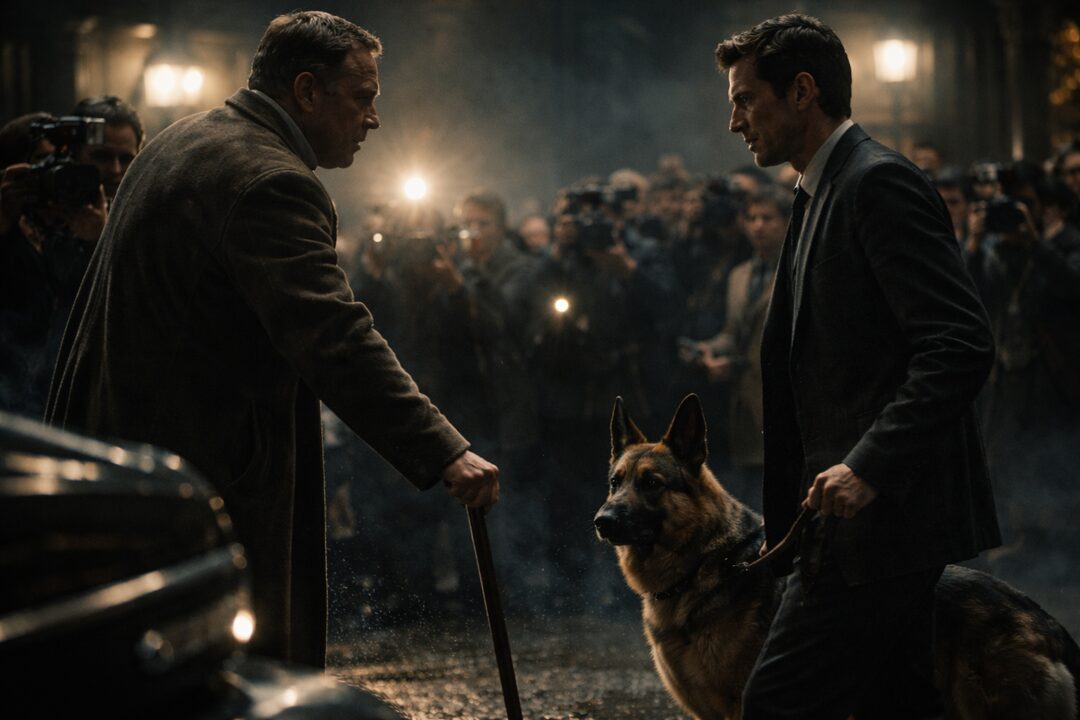
Flashbulbs burst around them.
“Look here!”
“Mercer!”
“The hero dog!”
Lee turned his body to shield the animal.
Too late.
By evening the city knew.
REAL WAR DOG SAVES ACTOR ON SET.
The legend sealed itself shut right there.
And in the crowd outside the studio gates, while reporters shouted questions and boys tried to touch the dog’s fur, Tom Sayer raised his voice and said the one thing no one in the studio had dared say aloud.
“You’re making money off a grave,” he shouted. “Tell them whose.”
Part V — What He Owed the Living
The studio moved fast after scandal. Faster than truth. Faster than grief.
By the next morning Lee was in a paneled office with three men from production, one lawyer, and Evelyn at the edge of the room with a pad she wasn’t writing on.
The contract was waiting on the desk.
Exclusive handling rights. National exhibition appearances. More money than Lee had seen in his life. A house allowance. Veterinary coverage. Percentage points on merchandise.
All he had to do was sign, deny the accusation, and keep the story clean.
“He’s bigger than a novelty now,” one executive said. “He’s hope.”
Lee looked at the papers. “Hope for who?”
The man smiled as if indulgent toward a child. “For the public.”
“There’s always money in public feeling,” Lee said.
The lawyer slid a fountain pen closer. “There’s stability in it too.”
Evelyn finally spoke. “If he signs this, you’ll separate them on tour.”
One of the men frowned. “The animal can travel with proper handlers.”
Lee did not touch the pen.
“He doesn’t go without me,” he said.
“That’s sentimental.”
“No,” Lee said. “That’s the arrangement.”
The room cooled.
An hour later he found Tom sitting on the curb outside the commissary, face gray with pain, stick across his knees.
“You’ll ruin yourself before you ruin me,” Lee said.
Tom looked up. “Maybe.”
“Then talk before you collapse.”
Tom almost smiled at that. Almost.
They went to the edge of the backlot where painted facades stood propped like lies between takes. A church with nothing behind it. A bank front that opened onto scaffolding. A whole town built from one side only.
It felt appropriate.
Tom took a long breath. “Captain ordered withdrawal at nineteen minutes past. You know that.”
Lee nodded.
“We were already losing the line.”
Another nod.
“And then the crying started.”
The memory hit not in sequence, but in pieces.
The sound beneath earth.
The trench mouth split open by shelling.
The corporal shouting leave it.
Rainwater running pink.
Tom said, “You turned back.”
Lee closed his eyes.
“I thought it was a signal child at first,” he said.
Tom’s voice was flat. “I know.”
“I thought if anything alive was still down there—”
“You thought you could pull one thing out.”
Lee opened his eyes. “I did pull one thing out.”
“And while you were in there, Miller doubled back for you.”
The words struck clean.
Tom looked away as soon as he said them, as if even now he could not bear the full shape of it.
“We never found enough of him,” he said. “That doesn’t mean your delay killed him. Maybe it doesn’t. Maybe the shell would have got him anyway. Maybe he was dead before he moved. I don’t know. You don’t know either. But he went back because you did.”
Lee felt the whole set around them tilt slightly, as if the false buildings had finally admitted they were false.
That was the part.
Not certainty. Never certainty.
Only the unbearable possibility, carried year after year until it shaped the spine.
Tom’s voice broke on the next words. “I’m tired of the dog being the only one who came home from that trench.”
For a long moment neither man spoke.
Then Lee said, quietly, “I didn’t mean to forget you carried him.”
Tom let out a rough breath that might have been laughter. “No. You meant to survive. Same as the rest of us.”
Back on the main stage, they were hanging banners for the premiere ceremony. There would be a speech. A medal-like commemorative collar. Reporters from New York. Military brass who had never stepped into the mud of the campaign being recreated in gilt and smoke.
Evelyn found Lee in wardrobe holding the contract he had not signed.
“You can still control this,” she said.
He looked at her. “That what you think this is?”
She did not answer right away. Then, very softly: “I thought shape could protect people.”
“And now?”
“Now I think shape protects institutions.”
That was the most honest thing she had given him.
He handed her the folded contract. “If I don’t sign, they’ll come for him.”
“They’ll try.”
“And you?”
She looked toward the stage where men were polishing the brass plate for Rin’s presentation.
“I wrote the speech,” she said. “I can misplace the second page.”
For the first time in months, Lee almost smiled.
That evening he sat with Rin alone in the dressing room while the noise of the premiere swelled outside like weather.
The dog lay with his head across Lee’s boot. Calm. Watchful. A star only when strangers required it.
Lee touched the scar along Rin’s flank where the fur thinned.
“I don’t know what you mean,” he said quietly. “You, or any of it.”
Rin opened one eye.
Lee lifted two fingers low.
“Find me.”
The dog rose at once and pressed into him, solid and warm and real enough to shame every poster ever printed.
“You were never the proof,” Lee whispered into his fur. “You were just the life that answered.”
A knock sounded at the door.
“Mr. Mercer,” a stagehand called. “They’re ready for the hero.”
Lee closed his eyes once.
Then he stood.
Part VI — The Names He Finally Spoke
The theater was full before he reached the wings.
Military uniforms. Studio men. Women in satin. Flashbulbs. The kind of applause that starts before a person appears because the crowd wants to feel generous to itself.
Onstage, a giant painted backdrop showed a sunrise over a battlefield no one could smell.
Rin stood beside Lee without strain, his coat brushed, the commemorative collar catching the light at his throat. He looked magnificent. Unimpressed, but magnificent.
The master of ceremonies finished his introduction with the line the papers loved most: “Born in war, risen into glory.”
The crowd cheered.
Lee stepped to the podium and found only one page waiting there.
Evelyn had kept her promise.
For a beat, the studio executives in the front row did not realize anything was wrong.
Lee looked out at them. At the crowd. At the waiting notebooks. At the polished hunger in the room.
Then he began.
“I’ve heard a great many stories told about this dog,” he said.
His voice carried farther than he expected. Soldier’s training. Stage acoustics. Maybe necessity.
“Some of them are true. He was found in a trench. He did survive the campaign. He is brave. Anyone who has worked with him knows that much.”
A warm murmur moved through the house.
Lee kept one hand resting lightly against Rin’s shoulder.
“But courage is not a clean thing,” he said. “And neither is survival.”
The room shifted.
In the front row, one executive sat forward sharply.
Lee went on.
“The night I found him, men were already dead. More were about to be. Orders were breaking down. Fear was everywhere. Luck was everywhere. Error was everywhere. I heard something alive under the dirt and I went back for it.”
Silence now.
Not the soft silence of attention. The harder kind. The kind that resists.
“I have let people tell that story as if it were simple. It was not simple.”
He felt the whole theater bracing.
“I do not know, and never will know, what my choice cost in full. I know only that others were there. Others carried more than I did. Others did not come home.”
He reached into his pocket and unfolded the scrap of paper he had written himself.
Not a speech.
Names.
“Miller,” he said.
The syllables landed like stones.
“Luis Ortega. Thomas Finch.”
He looked up.
“They deserve to be in this room too. So does Sergeant Tom Sayer, who came home carrying wounds the papers had no use for. So do the families who were left with telegrams instead of legends.”
There was movement near the aisle. Tom, standing in the back, rigid as a man being seen against his will.
Lee kept speaking.
“This dog is not a monument that wipes clean what happened. He is not proof that war was noble. He is not proof that I was. He is one life that came out of a night when not every life could.”
The air in the theater had gone thin.
Somewhere behind him, a studio man hissed his name.
Lee ignored it.
“He matters,” he said, and now his hand tightened slightly in Rin’s coat. “Not because the story is spotless. Because it isn’t. Because even out of confusion and fear and bad luck and broken orders, something living still asked to be carried. And because the dead are not honored by a lie polished bright enough to make them disappear.”
No applause.
Not yet.
Good.
He stepped back from the podium.
One executive rose half out of his seat. “Mercer, that will be enough—”
Lee unclipped the commemorative collar and let it hang from the podium hook.
Then he gave the low signal.
Two fingers. Palm in.
“Find me.”
Rin came instantly, leaving the staged spotlight for the man who had used that command first in mud and shell smoke and had meant, all along, come back to the living.
A sound moved through the theater then, but it was not outrage alone. Not admiration either. Something messier. The noise people make when the story they bought has been returned to them heavier than expected.
Lee stepped off the stage.
No one tried to stop him until he reached the aisle.
Then there were hands, voices, outrage, the lawyer’s pale face, a photographer backing up to capture it.
Evelyn appeared from nowhere and moved directly into the path of the first executive.
“You can sue him in daylight,” she said coolly. “Tonight you’ll only make him look right.”
That bought Lee the door.
Outside, the night air was cold and smelled nothing like a trench.
Tom was waiting under the marquee lights.
For a second neither man spoke.
Then Tom said, “You left my first name out.”
Lee looked at him.
Tom’s mouth twitched. “Sergeant was enough.”
It was not forgiveness. It was better than that. It was proportion.
Lee nodded once.
Reporters were already spilling onto the sidewalk behind them.
Tom glanced toward the dog. Rin stood between them, calm now, as if some long-held line had finally gone slack.
“You’ve made a hell of a mess,” Tom said.
“Yes.”
“Good.”
Then Tom touched two fingers to the brim of his hat and limped into the dark before Lee could answer.
Months later, the pictures still played.
Some theaters dropped the old heroic copy and sold a different wonder instead: the survivor dog, the war-born star, the animal whose story had become stranger and sadder and somehow more beloved once it was no longer polished into nonsense.
The studio kept less of the earnings than it had planned.
A portion of the rest went, quietly and without publicity, to addresses in Fresno, San Antonio, and a farm outside Tulsa where a mother still wrote letters to the Army.
Lee no longer worked under long contracts. He trained animals on his own terms for smaller productions, and if directors complained that he was difficult, they also admitted no one got more truth onto a screen.
Evelyn sent work his way sometimes, always by note, never by favor.
As for Rin, fame stayed on him like weather. Not constant. Not entirely avoidable. But less like ownership than before.
One rainy evening, long after the premieres and headlines had thinned, Lee sat in the doorway of a modest bungalow the work had finally afforded him. The yard smelled of wet earth. Somewhere beyond the fence, a radio played too softly to make out the tune.
Rin lay on the porch boards, watching the dark with that same grave intelligence that had first made strangers lean forward in theaters.
Lee lifted his hand.
Two fingers low. Palm in.
“Find me.”
Rin came at once.
Not out of panic. Not out of training alone.
He crossed the porch and pressed his weight into Lee’s side, steady and unquestioning, as if answering a call that no longer belonged to the worst night of either of their lives.
Lee rested a hand against the thick fur at the dog’s neck.
Inside the house, on a shelf by the door, the commemorative collar from the premiere sat unworn beside a stack of letters and three names written in a careful hand.
The rain went on.
The dog stayed.
And in the quiet, with no cameras left to please, the old command finally meant what Lee had wanted it to mean all along:
Not prove it.
Not redeem it.
Just come back.