The HOA President Brought a Fake Court Order, but the House Remembered Every Lie
Chapter 1: The Notice on the Blue Door
The pounding began hard enough to shake the framed family photograph beside the entryway.
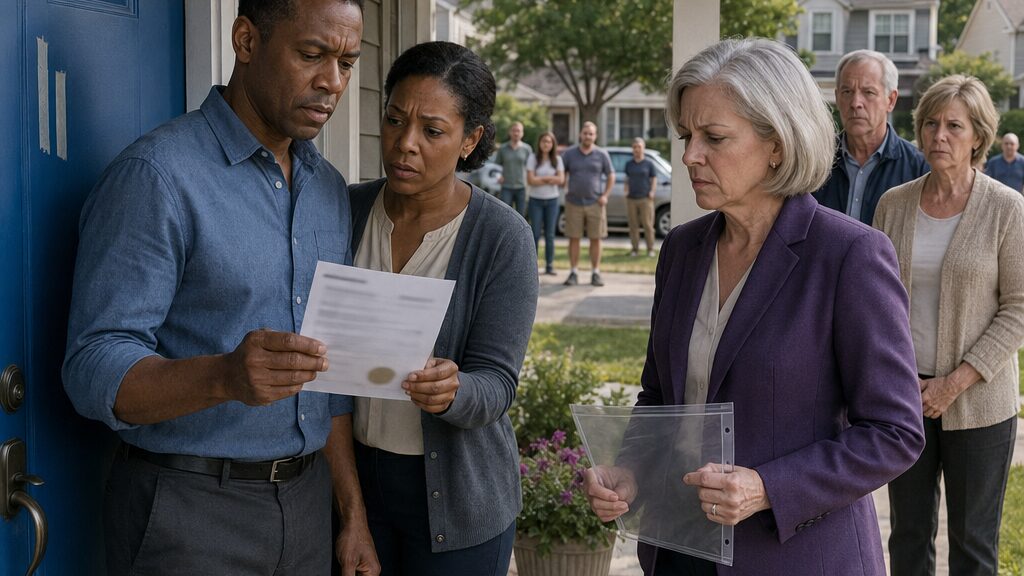
Michael Hall was halfway down the stairs when Barbara Miller struck the blue front door again, three clipped blows with the side of her fist. Through the narrow window, he saw her purple blazer, a clear document sleeve tucked beneath one arm, and two members of the homeowners association standing behind her on the walkway.
Across the street, a man had stopped washing his truck.
Melissa Clark stood at the edge of her yard with a bag of groceries hanging from one hand.
Barbara knocked a third time.
“Michael Hall,” she called. “Open this door.”
Sandra appeared behind him, still holding the dish towel she had been using in the kitchen.
“What does she want?”
Michael looked once at the neighbors, then unlocked the deadbolt.
Barbara stepped forward before the door had fully opened.
“This property is under an emergency possession order,” she said.
She pulled a sheet from the sleeve and held it inches from his chest. A raised seal caught the morning light. The top half was crowded with court language, case numbers, and references to occupancy violations.
“You and your household have forty-eight hours to vacate.”
Michael did not take the paper.
Behind Barbara, one board member looked down at the walkway. The other held a phone at waist height, not quite recording and not quite pretending otherwise.
Sandra moved beside Michael. “Vacate our own house?”
Barbara’s mouth tightened with professional patience.
“The association has documented unauthorized occupancy, repeated exterior noncompliance, and interference with enforcement access. The court has granted temporary possession pending review.”
“We own this house,” Michael said.
“And ownership does not exempt you from the covenants.”
Barbara peeled a strip of tape from the back of the notice. Before Michael could stop her, she pressed the paper flat against the blue door.
The white sheet looked obscene there.
For eight years, the door had been the first thing Michael repaired each spring. He had sanded it after the lower edge swelled in heavy rain. Sandra had chosen the color from six nearly identical paint cards because it reminded her of the apartment door her mother once painted when Sandra was a child. Their daughter’s height marks were penciled inside the frame beneath three layers of clear varnish.
Barbara smoothed the notice with her palm.
“Forty-eight hours,” she repeated, louder now.
Melissa had crossed halfway into the street. Two more residents had appeared near their mailboxes.
Michael felt the pressure building behind his ribs. Barbara was waiting for it. He could see that much in the slight lift of her chin.
She expected volume. She expected anger. She expected him to give the watching neighbors a reason to remember his temper instead of her paper.
He reached for the notice.
Barbara stepped back.
Michael loosened the top edge carefully, keeping the tape attached to the sheet. He worked down one side, then the other, until the paper came free without tearing.
“You can’t remove an official posting,” Barbara said.
“I’m preserving it.”
“For what?”
He looked at the seal.
It was embossed slightly off-center, crossing a printed border no county filing would place beneath it. At work, Michael handled municipal records requests every day. He was not an attorney, but he knew what government documents looked like after years of checking dates, retention codes, filing prefixes, and certification marks.
His eyes moved to the case number.
CV-26-1479-R.
The county used four-digit years in civil possession actions. The division code belonged before the sequence, not after it.
Michael read it again.
“Which hearing produced this order?”
Barbara blinked once. “The association’s counsel handled the filing.”
“That wasn’t my question.”
Her cheeks colored.
“This matter was reviewed by the proper authority.”
“What date was the hearing?”
“I don’t carry the court calendar in my purse.”
“You brought the order.”
One of the board members shifted his weight.
Barbara turned slightly, making sure the neighbors could still hear her. “Your refusal to cooperate has already made this more difficult than necessary.”
Michael slid the notice into the clear sleeve she had been carrying, then reconsidered and held it himself.
Sandra leaned closer.
Her hand closed around his wrist.
“Michael.”
He followed her gaze to the signature line.
Beneath a looping signature was a printed name.
Nancy Roberts.
Sandra’s mother had retired from the county housing bench three years earlier. She still received holiday cards from courthouse clerks and corrected legal dramas on television until everyone in the room asked her to stop. Her name had appeared on thousands of orders over twenty-two years.
But not this one.
Sandra looked at Barbara. “Where did you get this?”
“I’ve already explained that.”
“No,” Sandra said. “You said counsel handled it. Where did you get this exact document?”
Barbara’s expression hardened.
“You should spend less time interrogating the board and more time arranging temporary housing.”
Michael heard a small sound behind him. Their daughter had come to the bottom of the stairs, one hand gripping the railing.
He stepped sideways, blocking her view of Barbara.
“We’ll respond through the proper channels,” he said.
“You have forty-eight hours.”
“Then you should be able to tell us the case number without reading it.”
Barbara looked at the paper in his hand.
For the first time, uncertainty passed over her face.
It vanished quickly.
“You’ll receive further instructions.”
She turned and walked down the path. The two board members followed, one several steps behind the other.
Melissa remained near the curb. Her eyes moved from Barbara’s retreating figure to the notice Michael held.
“What happened?” she asked.
“Nothing you need to worry about,” Michael said.
Sandra looked at him sharply.
Melissa’s expression closed. “Right.”
She returned to her groceries.
Inside, Michael locked the blue door. The house seemed smaller than it had ten minutes earlier.
Sandra cleared the kitchen table. She brought out the plain brown accordion file from the cabinet above the refrigerator and began opening sections: deed, mortgage, assessments, repair approvals, payment confirmations, meeting notices.
Michael laid the order under the pendant light.
Sandra photographed the front and back.
Their daughter stood in the doorway. “Are we moving?”
“No,” Michael said too quickly.
Sandra’s eyes flicked toward him.
He lowered his voice. “Go finish getting dressed. We’re handling it.”
When she left, Sandra pointed at her mother’s printed name.
“We call her now.”
“We verify the docket first.”
“My mother’s name is on a fake eviction order taped to our house.”
“And if we call her before we know what this is, Barbara will say we used family influence to interfere.”
Sandra stared at him.
“You think that matters more than finding out whether someone forged Mom’s signature?”
“I think every step matters.”
“That is not what I asked.”
Michael opened his laptop and entered the case number into the county portal. No result appeared. He removed the final letter. Nothing. He changed the year format. Still nothing.
Sandra dialed anyway.
Nancy answered on the second ring.
“Sandra?”
“Mom, I need you to look at something.”
Sandra sent the photographs. Michael watched the typing indicator appear, disappear, then return.
The phone rang almost immediately.
Sandra put it on speaker.
Nancy’s voice had lost its usual warmth.
“Where did you get this?”
“The HOA president taped it to our door.”
A silence followed.
Michael could hear paper moving on Nancy’s end, though he knew she was looking at a screen.
“That seal is wrong,” she said. “The numbering is wrong. The certification language is from an old template.”
“Did you ever sign anything involving our property?” Michael asked.
“No.”
“Could this have been altered from a real order?”
Another pause.
“The signature resembles mine,” Nancy said. “But no order concerning your address ever crossed my court.”
Michael looked toward the blue door.
The tape had left two pale marks in the paint.
Chapter 2: The Rules Nobody Had Seen
At 6:12 the next morning, the HOA portal showed four violations that had not existed the night before.
Michael sat at the kitchen table in the dark, the laptop casting a cold square of light across the accordion file. He had downloaded their account history before bed. The saved copy showed no unresolved violations.
The live portal now listed unauthorized occupancy, obstruction of inspection access, prohibited exterior modification, and failure to respond to formal notice.
Three entries were dated weeks earlier.
One was dated the previous month, on a day Michael and Sandra had attended the regular board meeting. No violations had been mentioned.
He took screenshots, then printed both versions.
Sandra entered wearing her robe and carrying two mugs.
“You’ve been up long?”
“Long enough for the past to change.”
He turned the laptop toward her.
She read the dates twice.
“They added these overnight?”
“Or made them visible overnight.”
“What’s the difference?”
“One implies panic. The other implies preparation.”
Sandra set down his coffee. “Call Melissa.”
“No.”
“She watched Barbara post the notice.”
“She also walked away when I told her it was nothing.”
“Because you told her it was nothing.”
Michael opened the section of the accordion file marked HOA. “We need records, not neighborhood opinions.”
“We need both.”
“Not yet.”
Sandra folded her arms.
He knew the look. It meant she had reached the point where patience felt like permission.
“You keep saying ‘we,’” she said, “but you’ve decided every step by yourself.”
“I’m trying to keep this clean.”
“And I’m trying to keep us in our house.”
“We are staying in our house.”
“You don’t know that.”
The words landed harder because she said them quietly.
Michael looked down at the papers.
Their mortgage statements were clipped in order. Annual assessments were paid through the end of the year. The exterior modification accusation made no sense. The only visible work they had done was repainting the front door the same approved blue two summers earlier.
He pulled the architectural approval from the file.
Sandra tapped the newly posted violation. “There. That one is already dead.”
“Only if they follow their own records.”
By nine, Michael stood at the county records office with the alleged order inside a protective sleeve. Sandra had wanted to come, but one of them needed to stay with their daughter and answer any visit from the association.
The clerk behind the counter examined the page without touching it.
“You’re saying this was posted yesterday?”
“Yes.”
She entered the case number, frowned, and tried another screen.
“There’s no civil action under this number.”
“Could it be sealed?”
“Possession cases are not hidden from the named owners this way.”
She checked the property address, Michael’s name, Sandra’s name, and the association.
Nothing.
Michael slid Nancy’s note across the counter. It was brief and carefully worded: she had not issued the order, had no formal role in the dispute, and recommended independent verification through the clerk’s office.
The clerk read it and looked again at the seal.
“This is not a certified court copy.”
“Can you tell whether it came from a real template?”
“I can tell you some of the language resembles older emergency filing forms. I can’t tell you who changed it.”
“Who would have access?”
“Attorneys, associations, property managers. Anyone with an old sample, really.”
That answer gave him less comfort than he expected.
The clerk stamped a search certification confirming that no matching case or hearing could be found. Michael watched the ink dry before returning it to the sleeve.
At home, Sandra had spread photographs across the dining table: the blue door before and after painting, the mailbox repair, the fence inspection, the roof cleaning, and images from every annual walkthrough.
“Three years of repair records,” she said. “No unauthorized work. No denied inspection.”
Michael placed the county certification beside the order.
For the first time since Barbara’s knock, the document looked smaller.
Not harmless. Smaller.
Sandra read the certification.
“So we tell everyone.”
“We tell the board.”
“Barbara is the board right now.”
“She has two members who stood behind her.”
“And twenty houses that watched.”
Michael closed the file.
“If we start knocking on doors before we know who prepared this, it turns into gossip. Then Barbara says we’re intimidating residents.”
Sandra gave a short, disbelieving laugh. “She taped a fake court order to our home in front of the neighborhood.”
“Suspected fake.”
“My mother’s signature is on it.”
“And your mother being involved is exactly why we have to be careful.”
Sandra stepped back as if he had moved toward her.
“My mother is not involved. Her name was stolen.”
“I know.”
“Do you?”
Michael did not answer fast enough.
Her face changed.
“You think calling her made us look weak.”
“I think Barbara will use anything she can.”
“No. You think needing anyone makes you look weak.”
She gathered the photographs into a stack, no longer sorting them by date.
Michael wanted to tell her that he had spent half his childhood watching adults carry black trash bags down apartment stairs after notices appeared on doors. He wanted to explain that every time he asked someone for help back then, the answer came with pity, delay, or a condition.
Instead he said, “Let me finish the timeline.”
Sandra left the room.
At noon, an email arrived from the HOA office.
The subject line read: EMERGENCY ENFORCEMENT HEARING.
The body stated that the board would meet Monday evening to address the Halls’ “continued noncompliance, hostile interference, and refusal to honor lawful possession directives.”
Attached were the four newly visible violations.
Michael scrolled lower.
Residents were invited to attend.
At the bottom, Barbara had included a sentence in bold:
The Board will present evidence concerning risks to community safety and property values.
Michael printed the email and placed it in the accordion file.
The folder no longer closed flat.
Chapter 3: A Meeting Built Around One Version
Michael’s house filled the clubhouse wall before he and Sandra had found seats.
The projected photograph showed the blue front door from a low angle. The emergency notice was taped across its center, bright against the paint. Someone had taken the image before Michael removed it.
A caption beneath the photograph read: ACTIVE ENFORCEMENT SITE.
The folding chairs were nearly full. Neighbors who usually arrived late for budget meetings had come early. Melissa sat in the second row with her hands clasped around her phone.
Barbara stood beside the projector. She wore the same purple blazer.
“The board has called this hearing because ordinary procedures have failed,” she began.
Michael and Sandra sat near the back. The accordion file rested on Michael’s knees.
Barbara described months of noncompliance, repeated denied access, unauthorized occupants, and “escalating hostility toward volunteer representatives.”
She never mentioned that the violations had appeared online less than forty-eight hours earlier.
One board member nodded when she spoke. The other stared at his printed agenda.
Frank Davis sat at the end of the board table, rubbing the bridge of his nose.
Barbara advanced the slide.
The next image showed Michael standing in his doorway holding the order. His expression had been caught between questions, but from a distance it looked hard.
“This photograph,” Barbara said, “shows the homeowner removing a lawfully posted notice while refusing board instructions.”
Sandra leaned toward Michael. “Say something.”
“Not yet.”
Barbara continued.
She spoke about falling standards and delayed enforcement. She mentioned families who depended on stable property values. She described the board as reluctant but obligated.
By the time residents were invited to comment, the false order had become secondary. The issue, as Barbara presented it, was Michael’s behavior.
Melissa stood.
She looked back once, not quite meeting his eyes.
“I don’t know all the legal details,” she said, “but if there’s a safety concern, maybe temporary removal is better until it’s sorted out.”
Sandra inhaled sharply.
Melissa kept speaking.
“I’m not saying they did everything claimed. I’m saying the board shouldn’t have to wait for something worse.”
“What something?” Sandra asked.
Barbara raised a hand. “Comments must be directed to the chair.”
Michael felt the room turning toward them.
He opened the accordion file and removed the original architectural approval.
“When was the exterior modification violation entered?” he asked.
Barbara’s expression cooled. “You’ll have time to respond.”
“I’m responding now.”
A murmur moved through the room.
Barbara looked toward the board members. “Mr. Hall, please respect the process.”
“The violation is dated May fourteenth.”
“That is correct.”
Michael held up the approval.
“May fourteenth, I was in this room. The board approved the repainting of our front door. Same color. Same finish. Approval number 19-442.”
Frank looked down at the packet before him.
Michael continued. “The online violation says the unapproved modification was observed that morning. But this approval was signed that evening after the board reviewed photographs taken the week before.”
Barbara’s mouth tightened.
“That approval concerned paint only.”
“The violation says unauthorized exterior modification. No other work is listed.”
One resident asked, “So what was modified?”
Barbara turned from the question.
“The Halls’ record contains several issues. Isolating one does not invalidate the others.”
“It invalidates one,” Michael said.
The room shifted—not toward him, exactly, but away from certainty.
He placed the approval on the table beside the county certification.
“This confirms there was no court case under the number on the order.”
Barbara glanced at it. “The association’s counsel can address filing irregularities.”
Sandra whispered, “Tell them about Mom.”
Michael kept his eyes on Barbara.
Not yet.
If he said Nancy’s name now, Barbara would recast the dispute as a family connection challenging volunteer authority. He wanted the paperwork to stand without rescue.
But the silence cost him.
A resident near the aisle asked, “If the judge named on the order says it’s fake, why not tell us?”
Michael looked toward Sandra.
She had gone still.
Barbara answered before he could.
“No judge has provided a sworn statement to this board. What we have received are informal assertions through family channels.”
Several heads turned.
Michael realized Barbara already knew.
“How did you know there was a family connection?” he asked.
Barbara’s pause was brief, but Frank looked up.
“The board was informed that Mrs. Hall’s mother once served in housing court,” Barbara said.
“By whom?”
“This is not a cross-examination.”
“It matters if you knew whose name was on that paper.”
Barbara’s voice sharpened. “What matters is that the association retained counsel because your conduct created legal exposure.”
Frank shifted in his chair.
Michael saw it.
“You approved the legal expense?”
Frank cleared his throat. “The board approved consultation.”
“How much?”
“That isn’t relevant to your violations.”
“How much, Frank?”
Barbara struck the table once with her palm. “Mr. Hall.”
Frank looked at her, then at the residents.
“Four thousand eight hundred dollars was authorized,” he said.
The room quieted.
“For what work?” Michael asked.
Frank shuffled through his packet. “Demand preparation, filing review, enforcement consultation.”
“Did you see the final order?”
Frank’s fingers stopped moving.
“I reviewed an invoice.”
“That’s not what I asked.”
Barbara stepped between them verbally.
“The treasurer is not responsible for evaluating legal documents.”
“No,” Michael said. “But he is responsible for association money.”
Frank’s face reddened.
“I approved what was described to me,” he said. “I did not prepare anything.”
The admission did not clear him, but it changed the shape of the room. Barbara was no longer speaking as the board. She was speaking ahead of it.
Sandra touched Michael’s sleeve.
This time he understood what she was asking.
He stood.
“The name printed under the signature belongs to Nancy Roberts,” he said. “She is Sandra’s mother. She retired from the county housing bench three years ago. She has confirmed she never issued an order involving our property.”
The reaction was not the clean reversal Michael had imagined.
Some residents murmured in surprise. Others looked skeptical. One woman whispered to the man beside her.
Barbara folded her arms.
“And there it is,” she said. “The personal influence the board was concerned about.”
Sandra rose so quickly her chair scraped the floor.
“My mother’s name was put on that document.”
“And she was contacted before the association had an opportunity to respond.”
“You taped it to our home.”
Barbara faced the room.
“This is precisely why the board sought independent counsel. The Halls have access to former officials and municipal employees. Ordinary residents do not.”
Michael heard the sentence settle differently among different people.
To some, it sounded like proof of intimidation.
To others, it sounded like fear.
But Michael knew he had waited too long. By withholding the connection, he had allowed Barbara to reveal it in the frame she preferred.
Sandra sat down without looking at him.
Barbara returned to the board table.
“Counsel provided written guidance supporting immediate enforcement,” she said. “I have the letter here.”
She opened a folder and removed a page Michael had never seen.
The letterhead belonged to the community association attorney. The first paragraph referenced the Halls by name. The second advised the board that emergency action might be appropriate if documented violations continued.
Barbara held it high enough for the front row to see.
“The association did not invent its authority.”
Michael looked at the date.
It had been written twelve days before the order appeared.
Frank looked at it too.
His confusion was immediate and unguarded.
“That isn’t the document attached to the invoice,” he said.
Barbara’s hand lowered slightly.
Michael closed the accordion file.
The room had just been given another piece of proof.
The question was whether it proved the attorney’s involvement—or Barbara’s.
Chapter 4: The Draft That Became an Order
“The association’s attorney did not authorize that language.”
The statement came before Michael had fully settled into the chair across from the attorney’s desk.
The office was small, with framed certificates arranged in a precise row and a conference table that held only a yellow legal pad, two pens, and the letter Barbara had displayed at the meeting. Sandra sat beside Michael, her hands folded tightly in her lap.
The attorney placed the letter flat between them.
“This is mine,” he said. “The possession order is not.”
Michael took the copy from the accordion file and laid it beside the letter.
The resemblance was unmistakable now that both pages were visible. The same header. The same opening paragraph. The same description of “continued covenant noncompliance.” But where the attorney’s letter advised the board to document violations and consider formal remedies, the order declared emergency authority, imposed a forty-eight-hour deadline, and carried Nancy’s name beneath a false signature.
“Who received the draft?” Michael asked.
“The board president, the treasurer, and the property management account.”
“Anyone else?”
“Not from my office.”
Sandra leaned forward. “Did you send a court template?”
The attorney hesitated.
“I attached a sample petition from an old training packet so the board could understand what a formal filing would require.”
Michael felt the answer settle into place without completing the picture.
“Was Nancy Roberts’s name on that sample?”
“No. The sample was older and anonymized.”
“Then someone added it.”
“Yes.”
The attorney looked at the false order again. His professional distance had thinned.
“I told Barbara the association did not have authority to remove an owner without judicial process. I also told her the documented violations were not strong enough for emergency relief.”
“Did she argue?” Sandra asked.
“She said delay would cost the neighborhood.”
Michael opened the file and slid the county certification forward.
“No hearing. No case. No filing.”
The attorney nodded. “Then this document should never have existed.”
“Will you put that in writing?”
“I will confirm what my office did and did not prepare. I will also notify the board that my firm is suspending representation until the records are preserved.”
Sandra looked at Michael. “Preserved from whom?”
The attorney did not answer directly.
“From alteration or destruction.”
Outside, Michael stood beside the car while Sandra called Nancy with the update. He watched people enter and leave the office building carrying folders, coffee, umbrellas. Ordinary errands. Ordinary disputes.
Sandra ended the call.
“She said we should file a formal complaint.”
“We will.”
“You said that yesterday.”
“We needed this first.”
“We needed each other first.”
Michael looked at her.
She opened the passenger door but did not get in.
“At the meeting, you made me look like I was trying to use my mother’s name to win something,” she said. “Barbara did that, but you helped her by keeping quiet.”
“I was trying to keep the case clean.”
“You were trying to keep yourself untouched.”
The words stayed with him all the way home.
That evening, Michael spread the new letter across the kitchen table. The accordion file had grown thick enough that one elastic band no longer held it closed. He added a second band, then heard a car door shut outside.
Frank Davis stood at the curb.
He did not approach the blue door immediately. He looked toward Barbara’s house, then crossed the lawn and knocked once.
Michael opened the door but did not invite him in.
“I need to show you something,” Frank said.
“Show me.”
Frank glanced back toward the street. “Not here.”
Ten minutes later, they stood in Frank’s garage beside a workbench crowded with labeled jars, extension cords, and a disassembled lawn mower. The door remained half-open.
Frank placed three invoices on the bench.
“I approved these,” he said.
The first was for legal consultation. The second listed document preparation. The third contained only one line: expedited enforcement support.
“Four thousand eight hundred,” Michael said.
Frank nodded.
“You saw none of the final documents?”
“I saw the attorney’s draft letter. Barbara said the rest was procedural.”
“You signed payment authorization anyway.”
Frank rubbed a hand over his mouth.
“I trusted her.”
“That is not an answer.”
“It’s the only one I have.”
Michael looked at the invoices. Each bore Frank’s initials. Each carried a board expense code that required two approvals.
The second initials belonged to Barbara.
“She told us the reserve account was in trouble,” Frank said. “Insurance went up. Pool repairs. Drainage. She said we needed faster enforcement because delinquent properties were dragging down values.”
“Were we delinquent?”
“No.”
“Did you know the violations were added after the fact?”
“No.”
“Did you ask?”
Frank’s jaw tightened.
“You think I don’t know what I failed to do?”
Michael said nothing.
Frank opened a metal filing cabinet and removed a folder.
“This came with the first invoice.”
Inside was the attorney’s original demand letter, marked DRAFT. The language matched the opening half of the false order almost word for word. In the margins, someone had written notes in blue ink.
Remove conditional language.
Add immediate possession.
Use county seal.
The handwriting was neat, narrow, and familiar from every HOA newsletter Barbara had signed.
Frank watched Michael read.
“I didn’t see those notes before tonight,” he said. “The folder was in the locked cabinet at the office. Barbara gave it back after the meeting and told me to reconcile the expense.”
“Why bring it to me?”
“Because if I give it to the board, she controls the minutes. If I give it to the attorney, I admit I approved money without review.”
“You did.”
Frank flinched.
Michael closed the folder.
“You need to make copies and keep the original somewhere she cannot reach.”
Frank stared at him. “Are you helping me?”
“I’m preserving evidence.”
It was the same sentence Michael had used at the blue door, but now it sounded different.
Frank gave a humorless laugh.
“Fair enough.”
The next morning, a courier delivered an envelope addressed to Michael and Sandra jointly.
Inside was a settlement offer from a development company Michael had never heard of. The terms were simple: the developer would purchase the Hall property at a price well above market value. In exchange, the Halls would withdraw all complaints, waive claims against the association, and vacate within thirty days.
A separate page promised that all HOA violations would be rescinded immediately upon signature.
Sandra read the figure twice.
“That would clear the mortgage,” she said.
“And leave enough to buy somewhere else.”
“Somewhere without Barbara.”
Michael turned the page.
Attached to the property description was a map.
Their parcel had been outlined in red.
So had three neighboring lots.
Melissa’s house.
The small brick home beyond hers.
And the corner property owned by an older couple who rarely attended meetings.
Michael traced the connected line with his finger.
The offer was not about one difficult homeowner.
Someone needed the whole row.
Chapter 5: The Offer That Would Save Only Them
Melissa stood on the Halls’ porch holding a notice with the same crooked seal.
Sandra recognized it before Melissa spoke.
“I found it taped inside my storm door,” Melissa said. “Not outside. Inside.”
Her voice was thin and angry. She held the paper by its edges as though it might stain her hands.
Michael stepped aside to let her in.
Sandra remained near the blue door.
The notice accused Melissa of unauthorized commercial activity, excessive vehicle use, and failure to maintain approved landscaping. It ordered her to cure the violations within seventy-two hours or face emergency possession action.
The printed name beneath the signature was Nancy Roberts.
Melissa looked from Sandra to Michael.
“This is the same one, isn’t it?”
“Yes,” Sandra said.
Melissa lowered herself into a kitchen chair.
“I run billing from my dining room three days a week. Barbara knew that. She told me it was fine.”
“Do you have that in writing?” Michael asked.
Melissa’s mouth tightened. “Of course you’d ask that.”
“It matters.”
“I know it matters.”
Sandra placed a glass of water beside her.
Melissa did not touch it.
“I supported her at the meeting,” she said. “I thought your situation was different.”
“Different how?” Sandra asked.
Melissa looked toward the family photographs on the wall.
“I thought maybe there was something you weren’t telling us.”
“There was,” Sandra said. “But not what Barbara wanted you to think.”
Michael glanced at her.
Sandra went to the counter and retrieved the developer offer.
She placed the map in front of Melissa.
“Your parcel is included.”
Melissa stared at the red outline.
“So is the couple on the corner,” Sandra continued. “And the house between yours and theirs.”
Melissa’s breathing changed.
“Barbara asked me last month whether I had considered downsizing,” she said. “She said single parents sometimes wait too long and lose leverage.”
Michael pulled out a chair.
“Did she mention a developer?”
“No. She said she was trying to help.”
Sandra looked at Michael.
Help. Stability. Property values. Barbara had used each word as a cover for pressure.
Melissa finally lifted the glass.
“The older couple got a roof notice last week,” she said. “Their shingles are newer than mine.”
Michael’s eyes moved to the accordion file.
“We need copies of everything.”
Melissa nodded.
Then she looked at Sandra.
“I’m sorry.”
Sandra did not rescue her from the silence.
“You were scared,” she said at last. “So were we.”
“That doesn’t make it right.”
“No.”
The answer was not forgiveness, but it was honest enough to leave room for something later.
By noon, Sandra had three households at the kitchen table. The older couple brought inspection reports and photographs. The owner of the house between Melissa and the corner property produced a warning accusing him of maintaining an unapproved fence, though the same board had approved it five years earlier.
The papers spread across the table in uneven stacks.
Different violations.
Different deadlines.
The same crooked seal.
The same retired magistrate’s name.
The same language offering “voluntary resolution” through sale.
Michael stood near the doorway, listening as Sandra organized dates and addresses. She asked questions without making anyone feel examined. She marked common phrases with yellow tabs. She placed every original in a separate sleeve.
He had done this work alone for years at municipal offices—records, sequence, custody, proof. Watching Sandra do it, he understood how often he had confused competence with ownership.
His phone vibrated.
A message from Barbara.
We can resolve your matter today if you and Sandra sign before five.
Below it was the settlement amount.
Sandra saw the screen.
“You didn’t tell me she had already contacted you.”
“She hadn’t.”
“Not that message. The offer.”
Michael looked toward the other residents.
Sandra’s voice stayed low. “When did it arrive?”
“Yesterday.”
“And you said nothing?”
“I was trying to understand it first.”
Her face hardened.
“Again.”
Melissa stood. “We can give you privacy.”
“No,” Sandra said. “Stay.”
Michael felt the attention in the room. Not hostile. Worse. Waiting.
“The offer would pay off the house,” he said.
The older man at the table looked down at his hands.
“And what happens to ours?” Melissa asked.
“That’s what I was trying to determine.”
Sandra opened the file and took out the map.
“You already knew.”
“I knew the parcels were listed. I didn’t know the notices matched.”
“You knew enough to tell me.”
Michael could have defended himself. The words were ready: he had not signed, he had not agreed, he had spent the morning gathering proof. All true.
None answered the silence he had chosen.
“I should have told you,” he said.
Sandra waited.
“I thought if we had an exit, we should understand it before we risked losing it.”
“So you were considering it.”
“Yes.”
The room became still.
Michael looked at the people around the table.
The older couple had lived in their house for twenty-six years. Melissa’s son’s bicycle leaned against the fence outside. The neighboring owner had repaired his roof after a storm with money borrowed from his brother.
The developer’s offer would save the Halls cleanly.
It would leave everyone else inside the machinery Barbara had built.
“I was considering it,” Michael repeated. “Because I was afraid.”
The admission cost more than he expected.
Sandra’s shoulders lowered slightly.
“Afraid of what?”
“That this house could become another place we had to leave.”
No one spoke.
Michael looked toward the blue door. From inside, the tape marks were invisible. Only the old pencil lines remained along the frame where their daughter had grown.
“When I was a kid,” he said, “we moved whenever someone with a paper said we had to. I promised myself nobody would ever do that to my family again.”
Sandra’s voice softened but did not excuse him.
“You tried to keep that promise alone.”
“Yes.”
“And almost made the decision alone.”
“Yes.”
Melissa pushed the developer map back toward him.
“Then don’t.”
The words were simple. They changed the room.
Sandra placed every notice beside the settlement offer. For the first time, the papers formed one story instead of several private crises.
Michael called the attorney and requested an emergency preservation demand. Frank agreed to provide copies of the legal-expense ledger. Melissa contacted the other affected owners. The older couple volunteered to distribute notice of a resident hearing.
At four twenty, another email arrived.
Barbara had accelerated the developer vote to Thursday morning, less than forty-eight hours away. The agenda listed “strategic asset stabilization” and allowed remote attendance only for board members.
“She’s trying to finish before residents can organize,” Sandra said.
Michael printed the agenda.
The printer clicked and whirred while everyone watched.
He took the settlement agreement from the file and turned to the signature page.
Barbara’s deadline remained forty minutes away.
Sandra stood beside him.
“You sure?”
“No,” Michael said.
It was the first answer that felt completely honest.
He signed the rejection anyway.
Chapter 6: What Barbara Thought She Was Saving
Barbara’s message arrived at 7:03 the next morning.
Come to the HOA office alone. No attorneys. We should speak before this becomes irreversible.
Michael read it twice, then showed Sandra.
“You’re not going alone,” she said.
“She asked me to.”
“That is not a reason.”
“I’ll keep the door open.”
Sandra stared at him.
He almost said, I can handle it.
The old answer.
Instead he said, “Wait at the pool. If I’m not out in twenty minutes, come in.”
The HOA office occupied one end of the clubhouse, beside the locked gate to the community pool. The pool had been drained for repairs months earlier. Leaves gathered in the deep end, and a blue maintenance bucket sat beneath the diving-board rail.
Barbara was waiting behind the desk.
No purple blazer today. She wore a gray cardigan, sleeves pushed to her elbows. Without the formal clothes and the board members behind her, she looked older.
She closed the office door.
Michael opened it again.
Barbara’s mouth tightened, but she did not object.
“You rejected a generous offer,” she said.
“It was generous to us.”
“It was based on market projections.”
“It required four connected properties.”
Barbara looked down at the desk.
“So you have the map.”
“You sent it.”
“The developer sent it.”
“Through you.”
She moved a stack of invoices aside.
“You think this is about your family. It isn’t.”
“You taped a false possession order to my door.”
“I used language supplied by counsel.”
“Counsel says you altered it.”
“I adapted a draft because he refused to understand the urgency.”
The admission came so plainly that Michael needed a moment to absorb it.
“You added a county seal.”
“A seal was already on the sample.”
“You added Nancy Roberts’s name.”
Barbara’s eyes lifted.
“I needed a recognizable authority.”
Michael felt anger rise, but it no longer blurred the edges of the room.
“You chose a name.”
“I chose a retired official whose signature was publicly available.”
“She is my wife’s mother.”
“I did not know that.”
“But you knew it was not hers.”
Barbara stood.
“I knew the association had authority to act.”
“No. You believed it should.”
For a moment, neither spoke.
Outside, a gust moved dry leaves across the empty pool.
Barbara crossed to a metal cabinet and unlocked it. She removed a binder and set it on the desk.
Inside were reserve statements, insurance renewals, contractor estimates, and red-lined budget projections. The numbers fell month by month.
“The pool filtration system is failing,” she said. “The drainage easement needs replacement. Our insurance premium increased forty-one percent. Seven owners are behind on assessments.”
Michael turned a page.
The reserve balance was less than half what residents had been told at the previous annual meeting.
“Why wasn’t this disclosed?”
“Because panic lowers values faster than debt.”
“You hid the deficit.”
“I managed it.”
“You moved expenses between accounts.”
“I kept services running.”
She pointed through the open door toward the drained pool.
“My husband helped build this association. He spent twenty-five years keeping investors from buying half the neighborhood and turning it into rentals. After he died, everyone told me to let someone else handle things. No one volunteered.”
Her voice did not break. It became harder.
“Then roofs aged. People stopped attending meetings. Owners demanded lower dues and perfect landscaping. Every repair was too expensive until something failed.”
Michael looked at the binder again.
The fear beneath her decisions was real.
So was the false order.
“The developer offered to repair the pool,” Barbara said. “Replace the drainage. Eliminate the deficit. All they need is the row for access.”
“And the people living there?”
“They receive fair offers.”
“Or fake violations.”
“They receive pressure to make decisions they have postponed.”
Michael closed the binder.
“That is not stewardship.”
“It is survival.”
“For whom?”
Barbara looked toward the doorway.
Sandra stood beyond the pool gate, far enough away not to hear but close enough to be seen.
Barbara lowered her voice.
“Frank approved every legal expense.”
“He approved descriptions you gave him.”
“He signed.”
“You wrote the notes.”
“He failed his duty.”
“So did you.”
Her face changed then—not into shame, but calculation.
“I can resign,” she said. “Quietly. Frank can explain the accounting errors. The violations against your property disappear. The developer pauses the vote. No public hearing, no neighborhood spectacle.”
“And the other notices?”
“We review them individually.”
“You mean after ours goes away.”
Barbara did not answer.
Michael understood the offer. It was not bribery in the simple sense. It was something more familiar: a path that allowed every person to call the damage administrative, shared, unfortunate.
Frank would carry the accounting failure.
Barbara would leave before anyone saw the full record.
The Halls would keep their house.
The others would remain alone.
“You thought I wanted privacy more than truth,” Michael said.
“I thought you wanted your family protected.”
“I do.”
“Then protect them.”
Michael looked at the blue maintenance bucket outside. Paint had dried along its rim in a shade nearly identical to his front door.
He thought of Barbara’s hand smoothing the false notice against that paint. He thought of Melissa standing in his kitchen, holding the same seal. He thought of Sandra saying, You tried to keep that promise alone.
“I’m requesting a full resident hearing tonight,” he said.
Barbara’s expression became still.
“You don’t have authority to call one.”
“The bylaws give residents a special hearing if twenty percent sign.”
“You don’t have twenty percent.”
“We do.”
Barbara looked toward Sandra again.
Michael placed a copy of the petition on the desk. Signatures filled two pages.
“The developer vote is suspended pending records review,” he said. “The attorney’s notice went out this morning.”
“You have no idea what happens if the deal collapses.”
“The neighborhood sees the real numbers.”
“And when they see the dues increase? When they see the repairs? When people on fixed incomes blame you?”
“Then they get to decide with the truth.”
Barbara’s hand rested on the budget binder.
For the first time, Michael saw not the woman at his door but the woman who had spent years convincing herself that carrying everything alone gave her permission to choose for everyone else.
The resemblance unsettled him.
“You think they will thank you?” she asked.
“No.”
That answer seemed to surprise her.
Michael stepped into the hallway.
Sandra met him beside the empty pool.
“What did she say?”
“That she was trying to save the neighborhood.”
Sandra studied his face. “Did you believe her?”
“I believe she was afraid.”
“And the hearing?”
Michael handed her the signed request.
“Tonight. Open to every resident.”
Behind them, Barbara remained in the office doorway.
She did not call after him.
She only held the binder against her chest while Michael and Sandra walked toward the blue doors of the clubhouse, carrying the question Barbara had tried to answer for everyone: what would the neighborhood choose once silence was no longer available?
Chapter 7: The Hearing Behind the Clubhouse Doors
Barbara was already asking for a closed vote when Michael entered the clubhouse.
Residents filled the hallway outside the meeting room, holding copied notices, repair approvals, envelopes, and folded petitions. Inside, the board sat beneath fluorescent lights while the developer representative waited near the wall with a leather portfolio.
“This is a contractual matter,” Barbara said. “Public discussion could expose the association to liability.”
“The liability already exists,” Michael replied.
Every face turned toward him.
He carried the accordion file beneath one arm and the original possession notice in a clear sleeve. The page remained untorn. Its crooked seal caught the light as he placed it on the front table.
Sandra entered behind him with Melissa and the older couple from the corner property. Frank followed last, carrying a thick binder against his chest.
Barbara looked at the residents gathering in the doorway.
“This meeting has not been called to order.”
Michael set the signed hearing petition beside the notice.
“It was called under Section Eight of the bylaws. More than twenty percent of owners signed. Counsel confirmed receipt.”
The board member who had avoided Michael’s eyes at the earlier meeting opened his copy of the bylaws.
Barbara remained standing.
“The developer vote was scheduled first.”
“The attorney suspended it pending records preservation,” Michael said.
The representative near the wall closed his portfolio.
Barbara’s gaze moved toward him. “The association has obligations.”
“So do you.”
The room did not erupt. No one applauded. Chairs scraped as residents found places along the walls and between the folding rows. The quiet was less comforting than noise. It left every word exposed.
Frank placed his binder on the board table.
Barbara stared at it. “What are you doing?”
“My job late,” he said.
He opened to the first ledger page and turned it toward the room.
The figures showed payments to the community association attorney, transfers from reserve accounts, and expenses labeled as enforcement support. Frank had highlighted the entries tied to the Halls’ case and the three neighboring properties.
“I approved these amounts,” he said. “I relied on descriptions provided by the president. I did not review the final documents. That was a failure of my duty.”
Barbara’s voice sharpened. “You reviewed invoices.”
“I reviewed what you gave me.”
“You signed them.”
“Yes.”
Frank did not try to save himself from the admission.
Michael watched several residents sit straighter. Frank’s responsibility made the evidence heavier, not lighter. This was not one dishonest person surrounded by innocents. It was a system in which people had chosen not to look closely.
Michael opened the accordion file.
He laid out the county certification, the original architectural approval, the attorney’s unaltered draft, and the page bearing Barbara’s handwritten instructions.
The last item silenced the room.
Remove conditional language.
Add immediate possession.
Use county seal.
Barbara looked at the developer representative. He did not meet her eyes.
Michael held up the false order.
“This was taped to our front door in front of our neighbors. It said we had forty-eight hours to leave a house we own. It cited a court case that never existed and carried the name of a retired magistrate who never signed it.”
Barbara folded her arms. “You have made that point repeatedly.”
“No. I have defended my house repeatedly. Tonight I’m making a different point.”
He turned toward the residents.
“When this was only about us, I wanted to solve it privately. I thought that was strength. I thought if I kept every document in order and refused to react, nobody could take anything from my family.”
Sandra stood near the back. Her face did not soften, but she held his gaze.
Michael continued.
“Then the developer offered us enough money to leave quietly.”
A stir moved through the room.
Barbara sat down.
Michael placed the settlement offer beside the false order.
“The offer required us to withdraw every complaint and waive every claim against the association. It also listed four connected parcels.”
He unfolded the map.
Melissa stepped forward.
“My house is one of them,” she said.
The older couple identified theirs. The remaining owner raised a hand from the second row.
The developer representative finally spoke.
“The parcel configuration was preliminary.”
“Was control of all four properties required for access?” Michael asked.
The representative hesitated.
Barbara answered for him. “The row provides the only practical route for drainage reconstruction and future community improvements.”
“Was it required?” Michael repeated.
The representative looked at the residents.
“Yes.”
The single word changed the room.
Barbara stood again.
“You are hearing fragments without context. The association’s reserves are nearly depleted. Insurance has increased. The pool cannot reopen without major repairs. The drainage system is approaching failure. The developer offered a path that would protect the remaining homeowners.”
“By removing four of them,” Melissa said.
“By compensating them.”
“After frightening them.”
Barbara’s face tightened. “Some owners refuse necessary decisions until circumstances force clarity.”
Michael heard the phrase from the private meeting: pressure to make decisions they had postponed.
He looked at the residents who had stayed quiet while the notice remained on his door. Some avoided his eyes. Others held papers bearing their own warnings.
Barbara opened the reserve binder.
“You want truth?” she asked. “Here it is. The association cannot continue at current dues. Repairs have been deferred for years because every increase is voted down. People demand services but refuse their cost. I found an option.”
“You found control,” Michael said.
“I found survival.”
“And when the attorney said the violations were insufficient?”
“I acted before the opportunity disappeared.”
“You altered the draft.”
“I strengthened it.”
“You used a court seal.”
“I used the document structure counsel supplied.”
“You added a judge’s name.”
Barbara looked directly at him.
“Yes.”
No one moved.
“I believed the threat had to be credible,” she said.
The honesty did not redeem her. It removed the final place where doubt could hide.
Michael could have stopped there. The false order, the notes, the ledger, the map, and Barbara’s admission were enough to defeat the developer vote and likely enough to remove her.
But the deepest question was no longer what Barbara had done. It was what everyone else would do now that they knew.
He placed the settlement rejection on the table.
“My family could have left with money,” he said. “We rejected it because the notices did not end at our property line.”
He looked toward Frank.
“Frank gave us the records even though they show his failure.”
Then Melissa.
“Melissa admitted she supported our removal before she understood the pressure.”
Then Sandra.
“My wife kept asking me to speak to people. I kept saying documents were safer.”
Sandra’s eyes glistened, but she did not look away.
“I was wrong,” Michael said. “Records matter. So does refusing to let someone else stand alone under them.”
Barbara closed the reserve binder.
“You will still have to raise dues,” she said.
“Yes.”
“You will still have angry owners.”
“Yes.”
“The pool will remain closed.”
“For a while.”
“And when people lose patience, they will blame whoever replaces me.”
Michael nodded.
“That may happen.”
The answer unsettled the room more than a promise would have.
One board member requested a motion to suspend the developer agreement. The other seconded it. The motion passed without Barbara’s vote.
Frank then moved for an independent audit of legal expenses and reserve transfers.
That passed as well.
The recall petition came last.
Ballots were distributed and counted at the same table where Michael had laid the false order. Barbara remained seated through the count. She did not argue. She did not apologize.
The recall passed by a clear margin, though not unanimously.
Several residents had abstained. Three voted to keep her.
When the result was announced, nobody cheered.
Barbara gathered her papers carefully. At the door, she stopped beside Michael.
“They will discover what this neighborhood costs,” she said.
“They should have known before you decided for them.”
She looked at the notice in its sleeve.
“For what it’s worth, I never intended for anyone to lose everything.”
Michael thought of the forty-eight-hour deadline.
“Intent wasn’t what you posted on my door.”
Barbara left.
The developer representative followed soon after.
The remaining residents stayed while Frank explained the reserve deficit. The numbers were worse than most expected. Reopening the pool, repairing the drainage easement, and restoring minimum reserves would require higher dues and years of phased work.
The victory on the table felt narrow beside the cost.
Michael looked at the untorn order, the thick accordion file, and the faces around him.
They had kept four homes from being quietly absorbed.
Now they had to decide whether they were willing to pay to keep the neighborhood itself.
Chapter 8: The Door They Chose to Keep
The certified letter arrived six weeks later, and for one sharp second Michael was afraid to open it.
The envelope rested against the blue front door where the process server had left it. Unlike Barbara’s notice, it bore a verifiable tracking label, a county return address, and no tape.
Michael carried it to the kitchen.
Sandra stood beside him while he signed the receipt and opened the flap with a letter knife.
The county had referred the false filing, altered legal materials, and misuse of judicial identification for formal investigation. The letter promised no immediate outcome. It made no prediction about charges or penalties. It simply confirmed that the complaint had moved beyond the neighborhood.
Sandra read the final paragraph.
“So it’s real.”
“This one is.”
She placed the letter in the accordion file. It barely fit.
Outside, voices carried from the curb. Residents were gathering for the first community workday since the recall. The pool remained empty, but contractors had completed a drainage inspection. The board had approved phased dues increases, hardship payment plans, public monthly ledgers, and independent legal review for all enforcement actions.
Nobody liked the higher assessments.
The vote had still passed.
Michael stepped onto the porch with a paint tray in one hand.
The door needed attention. Barbara’s tape had lifted two narrow strips of finish, and months of heat had made them more visible. Michael had bought the same blue paint, though the new batch looked brighter in the can.
Melissa crossed the lawn carrying a ladder.
“You left this in my garage,” she said.
“I never borrowed your ladder.”
“You refused to borrow it. Sandra did.”
Sandra smiled from the porch.
Melissa set it against the wall.
Her own false notice had been withdrawn. So had the notices against the other three properties. She had joined the records committee and now asked too many questions at every meeting, which Frank claimed was exactly the correct number.
Michael climbed two steps and began sanding the damaged strip.
Across the street, residents cleared weeds near the common path. The older couple handed out bottled water. Their roof remained exactly as it had been before Barbara called it urgent.
A moving truck stopped near the clubhouse.
Barbara emerged from her house carrying a small box.
She had resigned from the board immediately after the recall and listed her property two weeks later. The sale sign had gone up without ceremony.
She approached the Hall house alone.
Michael stepped down from the ladder.
Barbara looked at the door.
“You matched the color.”
“Close enough.”
She held the box against her hip. “The new board sent the final records request.”
“They’re still missing two years of contractor bids.”
“They’re in the office storage cabinet, lower drawer.”
“I’ll tell Frank.”
Barbara nodded.
For a moment, neither spoke.
Children moved along the sidewalk carrying paper plates toward the clubhouse. Someone unfolded a table beneath the maple tree. The community meal had been Sandra’s idea: nothing formal, no speeches, no attempt to pretend everyone trusted each other again.
Barbara looked toward the activity.
“My husband painted the clubhouse doors that shade,” she said.
Michael glanced at them. They were a faded blue, darker than his.
“You told me that.”
“He believed matching details made people feel responsible for the whole place.”
“Did it?”
“Sometimes.”
She shifted the box.
“I should not have used the seal.”
Michael waited.
“I should not have used Nancy Roberts’s name.”
Still not an apology. Not fully.
Barbara seemed to know it.
“I thought if people were frightened enough, they would finally act.”
“They did.”
“Yes.”
Her eyes moved to the fresh county letter visible through the kitchen window.
“I suppose they’ll contact me.”
“Probably.”
She nodded once.
Then she walked toward the moving truck without asking forgiveness Michael was not ready to give.
Melissa watched from the lawn.
“That was almost human,” she said.
Michael picked up the paintbrush.
“It was human. That was part of the problem.”
He painted over the pale strips slowly. The new blue blended with the old after the second coat, though under certain angles he could still see where the notice had been.
He decided not to add a third.
By late afternoon, folding tables filled the yard between the Hall house and Melissa’s. Residents brought casseroles, fruit, store-bought cookies, and more chairs than anyone needed. Frank arrived with copies of the first public ledger and left them beside the napkins until Sandra made him move them away from the food.
Nancy came after sunset.
She stood before the blue door and examined the paint.
“You preserved the original paper?” she asked.
“In the file.”
“Good.”
“You could say it looks nice.”
“It looks properly documented.”
Sandra laughed.
Michael opened the door wider.
The house filled gradually—not with agreement, but with people learning where the kitchen was, where to leave empty plates, and how to speak to one another without a board table between them.
Melissa’s son found the pencil marks inside the doorframe and compared his height to Michael’s daughter’s. Frank admitted he had never noticed the marks before.
Most people had not.
They had known the house by its violations, its projected photograph, its disputed owner, its blue door under a white sheet of false authority.
Now they saw the ordinary evidence beneath it: shoes near the stairs, family photographs, a crowded refrigerator, repaired hinges, and the small marks of a child growing upward.
Michael stood at the threshold as evening settled over the street.
For years, he had believed protecting a home meant making it impossible for anyone else to enter his decisions. Locks, records, payments, silence. Proof kept in order.
Those things had mattered.
But the house had not survived because he closed it tightly enough.
It had survived because, at last, he opened the door before someone else had to knock.
The story has ended.