He Kept Moving the Property Stakes Until My Silence Cost Us Both More Than the Land
Chapter 1: The Stake Was Three Feet Closer Again
The wooden stake stood beside Jacob Harris’s sprinkler head.
It had never stood there before.
He stopped halfway across the patio, coffee cooling in his hand, and stared at the orange ribbon trembling from the splintered top. Beyond it, the grass was darker where the soil had been disturbed. A crescent of damp earth showed around the stake as neatly as a fingerprint.
Jacob set the mug on the patio wall and crossed the lawn.
The old drainage cover sat three feet away, half hidden beneath clover. For years, the stake had lined up with its left edge. He knew because he had designed a retaining wall around that relationship when he bought the house. He knew because he noticed alignments for a living. Doors, setbacks, load paths, sight lines—small errors became expensive when people pretended they were not there.
He crouched and pressed two fingers into the loose soil.
A shadow shifted on the other side of the hedge.
Charles Martin was coiling a garden hose near his garage. At sixty-eight, he still moved with the deliberate economy of a man accustomed to carrying lumber alone. His gray work shirt was tucked into old jeans. He did not look toward Jacob.
“Morning,” Jacob called.
Charles lifted one hand without turning. “Morning.”
Jacob waited for more. Nothing came.
He could have asked then. He could have pointed to the stake and said, You moved it again.
Instead, he returned to the patio, carried his coffee inside, and opened the folder on his laptop labeled BACK YARD.
The first photograph was four summers old. It showed a row of tomato cages, a rusted wheelbarrow, and the same wooden stake aligned almost perfectly with the drainage cover.
The next year, it was eight inches farther west.
The third photograph showed it near the edge of a patch of ornamental grass.
Last summer, it had shifted again.
Jacob enlarged each image until the pixels broke into blocks. The drainage cover did not move. The corner of his patio did not move. The trunk of the maple did not move.
Only the stake moved.
He arranged the photographs side by side on the screen. Four summers. Four positions.
His first reaction was relief. He had not imagined it.
His second was anger at how much relief he felt.
For years he had told himself the changes were too small to justify a fight. Charles had mowed the narrow strip along the hedge before Jacob moved in. The old fence had been gone for decades. The original survey pins were buried somewhere beneath roots and fill dirt. A few inches of grass did not seem worth transforming a neighbor into an enemy.
That was how Jacob framed it: peace, restraint, perspective.
Yet he had taken the photographs.
He heard a truck outside and returned to the window.
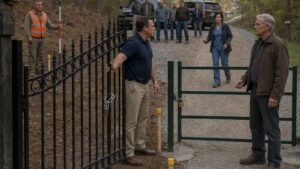
A white pickup had stopped in Charles’s driveway. Two men in work boots climbed out. One carried a bundle of fluorescent flags. The other unfolded a set of plans against the hood.
Charles met them with an energy Jacob had not seen in months. He pointed toward the rear yard, then swept both hands apart as if describing something large.
Jacob went outside.
The contractor had already crossed into the grass between the houses. He pushed a yellow flag into the ground ten feet beyond the moved stake.
“What are you marking?” Jacob asked.
The man glanced at Charles before answering. “Footings.”
“For what?”
“Pergola. Deck extension. Outdoor kitchen.”
Charles came down the slope, smiling as if Jacob had arrived for a tour. “Finally doing something with that dead corner.”
Jacob looked at the yellow flags. They formed a rectangle extending toward the maple and across the strip he had photographed for years.
“Where did you establish the property line?” he asked.
Charles tapped the wooden stake with the toe of his boot. “Same place it’s always been.”
Jacob looked at him.
Charles’s smile thinned. “You’ve seen it there.”
“I’ve seen it in several places.”
The contractor stopped measuring.
Charles folded his arms. “The old fence ran along here. I maintained this side before you owned your place.”
“That doesn’t make it the line.”
“It makes it more reliable than whatever memory you’re using.”
Jacob felt the familiar pressure rise beneath his ribs. It was not fear of Charles. It was fear of what happened after the first sharp sentence, when voices became louder and every word began serving the argument instead of the truth.
His father had believed every disagreement required a winner. Jacob had spent most of his adult life proving he was different.
“I’m asking whether you had it surveyed,” he said.
Charles gave a short laugh. “For a patio cover?”
“For the boundary.”
“The HOA approved the design.”
“That isn’t what I asked.”
The contractor rolled the plans closed. “Maybe we should hold off on layout.”
Charles turned on him. “You have the deposit.”
“I also need access without a dispute.”
“There is no dispute.” Charles faced Jacob again. “Is there?”
Jacob looked at the fresh stake, the yellow flags, and the disturbed soil. He had four years of photographs inside. He had the number of a surveyor saved in his phone. He had every tool except the willingness to use them.
“I’m saying the line should be confirmed before you build,” he said.
Charles studied him for a moment, then nodded as if Jacob had offered an opinion about paint color.
“Suggestion noted.”
He walked back to the contractor and opened the plans on the truck hood.
Jacob remained beside the stake. He could have called the surveyor before returning to work. He could have emailed the HOA and created a record. He could have taken one step that could not later be mistaken for politeness.
Instead, he pulled the stake from the soft earth, laid it beside the drainage cover, photographed both positions, and then put it back exactly where he had found it.
By noon, the contractor had marked the corners with white paint.
At four, Jacob heard the grind of an auger through his office window. He went outside and found Charles standing over the first dark hole.
The contractor pointed to a spot beyond the shifted stake. “Main footing here?”
Charles did not look at Jacob.
“Past the marker,” he said. “That’s where the corner goes.”
Chapter 2: The Pergola Rose Before the Truth Did
Concrete poured into the first footing before Jacob finished dialing the HOA.
The mixer groaned on Charles’s side of the hedge while gray slurry slid down a chute into a hole Jacob believed was partly on his land. A worker steadied the metal anchor bolt at the center. Charles watched with his hands on his hips.
Jacob stood inside his kitchen, phone pressed to his ear.
The HOA property manager answered on the fourth ring.
“I’m calling about an active boundary dispute,” Jacob said. “Construction is underway at the Martin property.”
There was a pause filled by keyboard clicks. “The architectural request was approved last month.”
“Was a survey included?”
“Let me check.”
Outside, the contractor lifted the chute and moved to the next hole.
“No current survey is attached,” the manager said. “There’s a site sketch.”
“A sketch prepared by whom?”
“It appears homeowner-provided.”
“Then the board approved a structure without confirming the lot line.”
“The architectural committee reviews appearance and covenant compliance. Ownership disputes are private civil matters.”
“They’re pouring concrete.”
“I understand that.”
“No, I don’t think you do.”
The sentence came out sharper than Jacob intended. He closed his eyes.
The manager’s tone cooled. “You can submit a written complaint. The board president may review it.”
Jacob looked through the glass. Charles had turned toward the house and was watching him.
“Send me the form,” Jacob said.
The form arrived eleven minutes later. Jacob opened it, typed his name, and stopped at the box labeled DESCRIPTION OF VIOLATION.
He wrote: Possible encroachment by proposed pergola.
Then deleted “possible.”
He wrote: Pergola footings appear to cross the recorded property line.
Then deleted “recorded.” He had not yet retrieved the subdivision plat.
The auger started again.
Jacob closed the form without submitting it.
That evening, four square concrete pads sat in the grass. Their surfaces were smooth and pale, each fitted with a steel bracket. The wooden stakes had disappeared.
He found one lying beneath Charles’s hedge, its orange ribbon torn.
Charles was on the deck examining a catalog.
“You removed the markers,” Jacob said.
“The crew needed room.”
“They need to go back.”
Charles kept turning pages. “They were temporary wood.”
“They marked something.”
“They marked where somebody guessed the line years ago.”
“You were using one as proof last week.”
Charles finally looked up. “You want to say something, say it.”
Jacob held the stake at his side.
“One of those footings may be across the boundary.”
“May be.”
“You should stop until it’s surveyed.”
“You paying the crew for the delay?”
“No.”
“Then you’re asking me to lose money because you have a feeling.”
“I’m asking you not to build on land that may not be yours.”
Charles’s face tightened, but his voice stayed level. “I’ve cut that grass for twenty-three years. I replaced the fence when the old owners let it rot. I cleared the drainage trench. You moved in and put up a maple where the fence used to run, and I didn’t make a problem out of it.”
“The maple is on my side.”
“According to you.”
“According to the closing survey.”
“Then show it to me.”
Jacob could have done that. A copy was somewhere in the box of documents from the purchase, stored above the garage. He had not looked at it in years.
“I’ll find it.”
Charles nodded. “Until then, I have an HOA approval and a contractor under contract.”
The next morning, timber posts rose from the concrete.
Within two weeks, beams connected them. By the fourth week, rafters cast striped shadows across a new deck. The structure was handsome despite everything—thick cedar, clean joints, black hardware. Charles had spent his career building additions and repairing roofs, and retirement had not taken the accuracy from his hands.
Jacob watched the pergola become harder to question because it looked as if it belonged.
He found the closing documents after midnight on a Thursday. The survey was folded behind a title-insurance form, its creases brittle and its ink faint. The dimensions were clear, but the drawing relied on pins he could not locate.
The next morning, he drove to the HOA management office.
Nicole Rivera met him in a conference room decorated with framed photographs of neighborhood holiday contests. She placed Charles’s approved rendering on the table. A red stamp crossed the lower corner.
“You understand this approval doesn’t certify property ownership,” she said.
“I understand that now.”
“It says so here.”
She tapped six-point text beneath the stamp.
“The board approved a structure without a survey.”
“We approved materials, height, lighting, and visible setbacks as represented by the homeowner.”
“Represented.”
Nicole folded her hands. “Mr. Harris, if you believe there is an encroachment, you need a licensed survey. Until then, we have two homeowners disagreeing about an old boundary.”
“You could pause the work.”
“We do not issue stop-work orders.”
“You could withdraw approval.”
“On what evidence?”
Jacob placed the old survey on the table.
Nicole examined it without touching it. “This is more than twenty years old.”
“Property lines don’t expire.”
“No, but surface conditions change. Fences change. Pins get disturbed.”
“So do stakes.”
Something shifted in her expression, but it disappeared quickly.
“The least damaging outcome,” she said, “would be for you and Charles to agree on a practical line and document a minor easement.”
“He moves the line, builds on it, and I reward him with an easement?”
“I’m asking you to consider neighborhood peace.”
Jacob looked through the conference-room window at the community pool. A maintenance worker was measuring the distance between two lounge chairs.
“Peace for whom?” he asked.
Nicole slid the rendering back toward him. “Get the survey.”
When Jacob returned home, a freight truck was unloading a built-in grill, a stone countertop, and boxes of low-voltage lighting.
He crossed into Charles’s yard without waiting to be invited.
“What did this cost?” he asked.
Charles signed the delivery receipt. “That’s not your concern.”
“It becomes my concern if it’s over the line.”
“Still using ‘if.’”
“I found the old survey.”
“And did it tell you where the pin is today?”
“It tells me the dimensions.”
Charles waved toward the half-built structure. “Then hire somebody. Until a professional says otherwise, I’m finishing.”
The delivery driver rolled the grill toward the deck.
Jacob lowered his voice. “I am warning you that the main post may be on my property.”
Charles glanced at the post, then at Jacob. “You’re warning me, or you’re stopping me?”
The distinction landed with humiliating precision.
Jacob said nothing.
Charles stepped closer. Fatigue showed beneath his eyes, along with something more urgent than pride.
“I have a date to meet,” he said. “The structure will be finished before then.”
“What date?”
Charles took the wooden stake from Jacob’s hand and tossed it onto a pile of scrap cedar.
“A date that isn’t your business.”
That night, the first strand of pergola lights came on. Warm bulbs traced the rafters above the disputed strip, and Jacob stood at his window watching them burn where the old stake had been.
Chapter 3: The Laser Line Crossed the Main Post
Charles carried the loose wooden stake into the HOA review as if it were an exhibit in his favor.
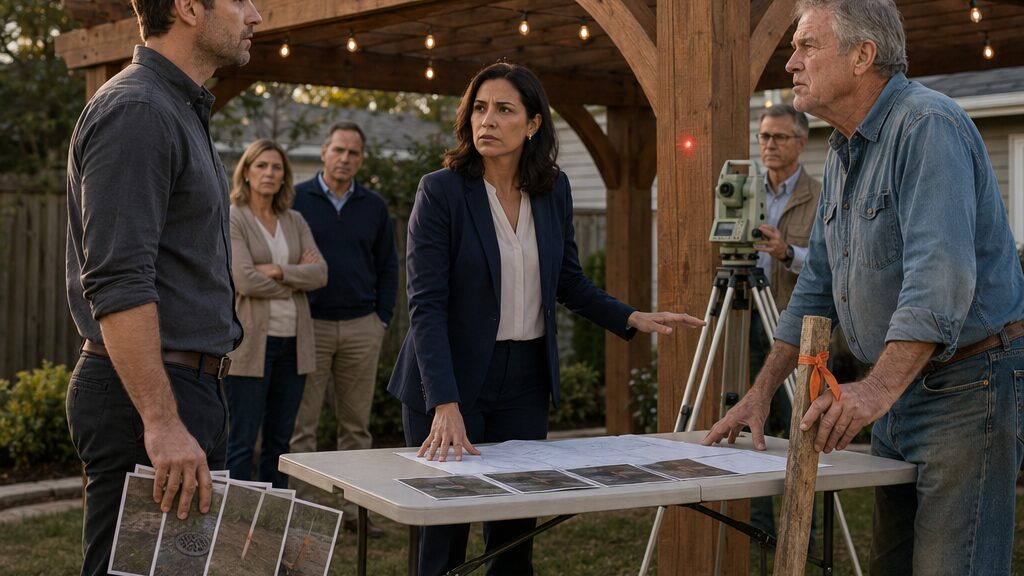
He laid it across the folding table beneath the pergola, orange ribbon frayed, dirt still packed into a split near the point.
“There,” he said. “That’s the marker. The post is inside it.”
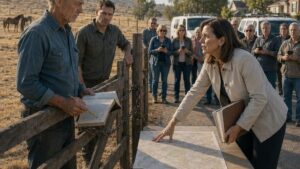
Nicole Rivera sat at one end of the table with two board members and the property manager. The finished pergola rose above them, cedar sealed to a golden brown. A stone counter wrapped around the grill. Warm bulbs hung beneath the rafters even though the afternoon sun had not yet dropped behind the houses.
Jacob stood beside George Adams’s tripod-mounted survey instrument.
George had spent the morning locating recorded monuments along the subdivision road, measuring angles, and checking the county plat against Jacob’s closing survey. He spoke little while he worked. Charles had followed him twice to ask whether old fence lines counted. George had given the same answer both times.
“They may be evidence of occupation,” he said. “They are not automatically the boundary.”
Now the board had gathered because Charles wanted his approval made retroactive and final before the county became involved.
Nicole touched the wooden stake with one finger. “Mr. Martin maintains this is the historically accepted line.”
“It is,” Charles said.
Jacob opened a thin folder.
Charles looked at him. “He never objected until the work was done.”
One board member shifted in her chair. The other studied the pergola as though craftsmanship might resolve ownership.
Nicole turned to Jacob. “You understand why that timing concerns us.”
“I understand.”
“If the difference is minor, the board would prefer a private easement rather than enforcement that damages both properties.”
“How minor?”
“We don’t know yet.”
George adjusted the instrument.
Charles pointed toward the hedge. “I’ve maintained that strip since before he lived here. The old fence ran exactly where that stake was. Jacob watched every step of construction. He came over once and said a post might be close. Might. Then he went home.”
Jacob felt the words enter the space between them and settle there.
Charles continued. “Now that it looks better than anything in his yard, suddenly it’s a crisis.”
One board member gave a small, uncomfortable cough.
Jacob placed four photographs on the table.
The first showed the stake beside the drainage cover four summers earlier. The second placed it eight inches farther away. In the third, it stood beyond the ornamental grass. The fourth showed it beside Jacob’s sprinkler head.
He aligned the pictures by the drainage cover.
Nicole leaned forward.
Charles did not.
“What are these supposed to prove?” he asked.
“That the drainage cover stayed in the same place,” Jacob said.
“And?”
“The stake didn’t.”
Charles’s jaw tightened. “Pictures can distort distance.”
“They can.”
Jacob looked at George. “Can you show us the recorded line?”
George checked the display on his instrument. “I can project a point along it.”
He positioned a small target near the rear monument, then rotated the instrument toward the pergola. A red laser point appeared on the grass near Jacob’s side of the hedge.
George moved the target rod forward.
The red point traveled in a perfectly straight path.
It crossed the deck edge.
Then it climbed the square cedar post holding the pergola’s southwest corner.
The point stopped in the middle of the timber.
Nobody spoke.
A delivery truck passed on the street beyond the houses. Its brakes hissed, then faded.
George checked the reading again. “The post center is approximately seven feet inside the Harris parcel at this station.”
Charles’s hand closed around the wooden stake.
George moved farther toward the rear. “The deck edge widens across the line. At the farthest point, the encroachment is eleven feet, four inches.”
Nicole rose from her chair. “Are you certain?”
George’s expression did not change. “I would not state it otherwise.”
The board members walked around the table to see the laser point. One crouched near the deck as if a lower angle might move it. The point remained fixed on the post.
Jacob had imagined this moment for months. In some versions, Charles went silent. In others, he apologized. In the least generous versions, the board turned toward Jacob with immediate recognition, and everything he had refused to say became unnecessary because the red light said it for him.
Instead, Charles lifted the stake from the table.
“This was the line,” he said.
“No,” George replied. “That was a piece of wood placed in the soil.”
“I didn’t put it there originally.”
George glanced at the photographs. “I can’t testify to who placed or moved it.”
Charles turned to Jacob. “You took these pictures?”
“Yes.”
“Over four years?”
“Yes.”
“And you never showed me?”
Jacob felt Nicole’s attention move from Charles to him.
“I asked you to get a survey.”
“After the footings were poured.”
“Before the structure was finished.”
Charles struck the stake against the tabletop. “You knew before the footings.”
“I suspected.”
“You photographed it every year.”
“I wanted to be certain.”
“You’re an architect.”
“That doesn’t make me a surveyor.”
“No. It makes you somebody who understands what happens when a footing is wrong.”
The accusation was not loud. That made it harder to dismiss.
Nicole gathered the photographs into a neat stack. “When did you first believe the markers had moved?”
Jacob looked at the earliest image.
The photograph showed the yard before resentment had entered it. His old wheelbarrow leaned against the maple. Charles’s fence boards lay in a repair pile beyond the hedge. The stake stood exactly where Jacob remembered.
“I noticed the first change three years ago,” he said.
Charles let out one breath through his nose. “Three years.”
“I didn’t know whether it was accidental.”
“And the second time?”
Jacob did not answer immediately.
The laser point remained on the cedar post. It no longer looked like vindication. It looked like a measurement of how long he had waited.
Nicole said, “Mr. Harris?”
“The second time, I knew it probably wasn’t accidental.”
Charles stepped away from the table. His face had gone pale beneath the tan.
“You watched me build.”
“I told you the post might cross the line.”
“You chose the softest words you could find.”
Jacob looked at him. “You chose not to check.”
Both statements were true. Neither canceled the other.
George powered down the laser. The red point disappeared from the post, but everyone continued looking at the place where it had been.
Nicole returned to her chair. Her voice had become formal.
“The HOA approval is suspended pending county review. No additional work, use, or alteration should occur until the property and permit status are verified.”
Charles laughed once, without humor. “It’s finished.”
“That does not change the board’s position.”
“It changed because the red dot embarrassed you.”
Nicole’s mouth tightened. “It changed because we now have professional evidence.”
“You had his photographs.”
“We received them today.”
Charles looked at Jacob again. “Exactly.”
He walked to the outdoor counter and turned off the string lights at the switch, though they had not been on. His hand remained there for a moment.
One board member asked whether the structure could simply be assigned to Charles through an easement.
Jacob answered before Nicole could.
“No.”
The word surprised him with its clarity.
Charles turned.
Jacob continued, “I will not transfer the land because he built on it.”
Nicole said, “There may be alternatives.”
“I’ll consider alternatives that restore the boundary. Not alternatives that reward changing it.”
Charles picked up the stake and held it upright between them.
“Then say what you want.”
“I want the line recognized.”
“You want this torn down.”
“I didn’t say that.”
“You didn’t have to.”
George began packing the tripod.
Nicole placed the four photographs inside a clear document sleeve. “I need copies of every image you have showing the marker positions, including original date information.”
Jacob looked at the sleeve in her hand.
“For the encroachment file?” he asked.
“For the full board record,” she said. “And because the timing may matter to liability.”
Charles stared at him across the table.
The survey had proven where the land belonged.
The photographs were about to prove how long Jacob had known it might.
Chapter 4: The Photographs Proved More Than Encroachment
Nicole Rivera placed Jacob’s earliest photograph beside the date printed on Charles’s HOA approval.
The two documents sat under the conference-room lights like parts of a calculation.
The photograph showed the wooden stake beside the drainage cover three years earlier. The approval had been issued less than two months ago.
“You knew the marker had moved before the application was submitted,” Nicole said.
Jacob kept his hands flat on the table. “I knew it had moved.”
“And you did not notify the board.”
“I didn’t know what the legal line was.”
“You suspected enough to document it.”
Across from him, Charles sat with his arms folded. He had not spoken since entering the room. The wooden stake lay in a clear evidence sleeve between them, dirt trapped against the plastic.
Nicole aligned the remaining photographs in order. Each image pushed the stake farther from the drainage cover.
“This is not about whether Mr. Martin’s structure crosses the boundary,” she said. “The survey answers that. This is about whether avoidable damages increased because you withheld a known concern.”
“Withheld from whom?”
“The HOA. Mr. Martin. His contractor.”
“I told Charles.”
Charles looked up. “You said a post might be close.”
“I said he should stop and get a survey.”
“You said it after concrete was poured.”
“Before the structure was finished.”
Nicole raised one hand. “We are not deciding fault today.”
Charles gave a dry laugh. “Seems like that’s exactly what we’re doing.”
The second board member shifted a legal pad closer. “The county still has to determine permit status.”
Nicole nodded toward Jacob. “You requested that search?”
“I requested the property file.”
“And if there is no permit?”
“Then the county handles it.”
Charles leaned back. “That easy.”
Jacob looked at him. “You could have applied for one.”
“You could have said stop.”
“I did.”
“No. You said maybe.”
The word struck harder in the conference room than it had beneath the pergola.
Nicole slid a form toward Jacob. “We need the original files, not screenshots. Dates, metadata, and any written communication with Mr. Martin.”
“There was no written communication.”
Her eyes lifted.
Jacob heard the admission as the others heard it: not innocence, but absence.
He had composed emails and deleted them. He had opened the complaint form and closed it. He had chosen words that could later be remembered as warnings without ever becoming a record.
The property manager entered with a printed email.
“The county clerk responded,” she said.
Nicole took the page and read it silently.
Charles watched her face. “What?”
She passed the paper across the table.
The heading read: NO BUILDING PERMIT FOUND.
For a moment, Jacob felt the clean click of leverage locking into place.
The feeling lasted less than a second.
Charles read the page twice. “That’s wrong.”
“The county searched the parcel number and owner name,” Nicole said.
“I was told anything under two hundred square feet didn’t need one.”
“The roofed area exceeds that. The electrical work and gas line would require separate permits regardless.”
“My contractor handled it.”
The property manager said, “The county has no applications from the contractor either.”
Charles pushed the paper away. “Then they lost something.”
Nicole’s voice hardened. “You signed the HOA application stating you were responsible for all required government approvals.”
“The HOA approved it.”
“For design compliance.”
“You people approved every drawing.”
Nicole did not answer immediately. Jacob saw the shift in her calculations. Until then, the board’s priority had been containing a dispute between neighbors. Now the missing permit threatened the HOA’s own process.
“We approved a homeowner representation,” she said carefully. “We did not verify ownership or county permits.”
Charles looked from her to Jacob. “So now everybody gets to say they believed somebody else.”
The county clerk met Jacob that afternoon in a records office that smelled faintly of dust and toner. She pulled the subdivision plat, Charles’s parcel history, and every permit associated with both addresses.
There were roof replacements, a water-heater inspection, and an old fence application. Nothing for the pergola, deck extension, gas line, or electrical work.
“The code office will likely inspect,” she said. “An encroaching structure complicates legalization.”
“Does it mean full removal?”
“That depends on setbacks, construction, utilities, and whether the owner has legal control of the land.”
“He doesn’t.”
“Then he cannot receive approval for the portion on your parcel.”
Jacob left with certified copies in a manila envelope.
Donna Martin was waiting beside his driveway.
He recognized her from occasional visits to Charles’s house. She had her father’s direct gaze but none of his practiced stillness. She stood with both hands gripping the strap of her purse.
“You got what you wanted,” she said.
Jacob stopped at the curb. “I wanted the boundary confirmed.”
“You had pictures for years.”
“So did the HOA.”
“Not until now.”
“My father says you watched the whole thing go up.”
“He knew there was a question.”
“He thought you were making noise because you didn’t like the design.”
“I told him to get a survey.”
Donna stepped closer. “Did you ever say, clearly, ‘Stop building because this is my land’?”
Jacob looked toward Charles’s backyard. The pergola roof rose above the hedge. The string lights were dark.
“No,” he said.
“Why not?”
Because certainty felt safer than confrontation. Because he had wanted Charles to discover that confidence could not change geometry. Because every new beam made the eventual proof harder to dismiss.
He did not say any of those things.
Donna’s voice lowered. “You let him get deep enough that he couldn’t laugh you off.”
Jacob held the manila envelope against his side.
“He chose not to verify.”
“I know what he chose.” Her eyes shone, but her voice remained controlled. “I’m asking what you chose.”
The question followed him into the kitchen.
He spread the records beside the photographs. The evidence formed a complete chain: shifting stake, construction approval, missing permit, official survey.
It should have felt like order.
Instead, he remembered Charles asking, You’re warning me, or you’re stopping me?
Jacob had heard the difference then. He had simply refused to answer.
A knock sounded at the back door.
Donna stood outside again. This time she held a cream envelope.
“I forgot why the date mattered,” she said.
She placed the envelope on the patio table. Inside was a wedding invitation bearing her name and a date three weeks away.
“My fiancé and I canceled the venue,” she said. “Dad said he could build us somewhere better.”
Jacob looked through the hedge at the pergola lights.
“He paid for most of it because we couldn’t,” Donna continued. “That doesn’t make the land his. It doesn’t make the permit disappear. But that is why he rushed.”
She left the invitation on the table.
Three weeks remained before guests were supposed to gather beneath a structure the county had not yet inspected.
Chapter 5: The Removal Order Arrived Before the Guests
The red notice appeared on the pergola before Donna mailed the final invitations.
It had been taped to the southwest post—the same post the survey laser had crossed. From Jacob’s kitchen, the paper looked like a small wound against the cedar.
Charles tore it down before noon.
The county code-enforcement officer returned twenty minutes later and fastened another copy inside a plastic sleeve.
“You remove that one,” the officer said, “and I document interference.”
Charles stood barefoot on the deck, the crumpled first notice in his fist. “You people could have called.”
“We did. Twice.”
“I was speaking with an attorney.”
“The inspection still proceeds.”
Jacob watched from his side of the hedge while the officer photographed the grill line, electrical boxes, deck footings, and roof structure. The pergola contractor arrived midway through and refused to step onto the deck until Charles confirmed in writing that he was not being asked to alter anything.
By late afternoon, the county had issued a sixty-day correction order.
Unpermitted structure. Encroachment onto adjacent parcel. Work prohibited. Use restricted pending compliance.
The officer handed copies to both homeowners.
“What does correction mean?” Charles asked.
“At minimum, removal of every component located on land you do not control. Additional portions may require alteration or removal depending on engineering and setbacks.”
“Minimum.”
“That is correct.”
Charles looked past him at Jacob. “He wants the whole thing gone.”
The officer folded his clipboard shut. “That is not what this notice says.”
“It’s what he filed for.”
“I filed an encroachment complaint,” Jacob said.
“You started this.”
“You built it.”
Donna arrived as the officer walked away. She read the notice without speaking, then pressed it flat against the outdoor counter.
“Can the wedding still happen here?” she asked.
Charles answered too quickly. “Yes.”
Jacob said nothing.
Donna looked at him. “Can it?”
“The notice restricts use.”
“That is temporary.”
“It’s a roofed structure with uninspected wiring and gas.”
Charles stepped between them. “The work is sound.”
“That isn’t the same as inspected.”
“I built houses before you learned to draw them.”
“And you knew permits existed.”
The words cut through the yard.
Charles’s face changed, not with anger at first, but recognition. Jacob had finally said the direct thing he had avoided for years.
Donna looked between them. “Did you know?”
Charles turned away.
“Dad.”
He walked to the far end of the deck and gripped the rail.
“I knew a survey could delay us,” he said.
“That isn’t what she asked,” Jacob said.
Charles looked back. “I knew a survey might put the line somewhere inconvenient.”
Donna’s shoulders lowered.
“How inconvenient?” she asked.
“I didn’t know.”
“You didn’t want to know.”
Charles released the rail. “The old fence had been there since before either of you cared about this place.”
“The old fence was gone,” Jacob said.
“I maintained the strip.”
“You moved the stakes.”
Charles’s gaze flicked toward the fresh survey markers George had installed. “Those little pieces of wood don’t decide what a man has taken care of for twenty years.”
“They don’t,” Jacob said. “The monuments and deed do.”
Donna walked off the deck and sat on the bottom step. The invitation envelopes in her bag were visible through the open zipper.
The following morning, Jacob met a contractor at his kitchen table to review removal options. Full demolition, including the kitchen and utilities, was estimated at just over $24,000. Partial removal might cost less, but only after an engineer determined whether the remaining frame could stand.
The contractor tapped the estimate.
“If the main post comes out, we’re rebuilding the load path. The outdoor kitchen also crosses the line. Gas needs to be capped and reinspected.”
Jacob looked at the total.
“Could it force a sale?”
“I don’t know his finances.”
Donna did.
She came to Jacob’s door that evening with a folder of loan statements Charles did not know she had copied. The pergola had been financed with a home-equity line. A full removal bill, county penalties, legal fees, and the remaining construction debt would leave him with little room.
“He helped me after my divorce,” Donna said. “Then he paid the deposits for the wedding. He kept saying the house was the only thing he had left that could still take care of us.”
Jacob did not open the folder.
“You shouldn’t show me those.”
“I need you to understand what full removal does.”
“I understand.”
“No, you understand a number.”
He looked across the yard. Charles was sitting beneath the dark pergola lights with the red notice folded on the table.
“I can request a delay,” Jacob said. “Long enough to move the wedding.”
Donna’s expression tightened. “And after?”
“The encroachment still has to be corrected.”
Charles appeared at the hedge before she could answer. He had heard enough.
“I’m not asking him for favors,” he said.
Donna stood. “You need one.”
“I need him to stop pretending this is only about dirt.”
Jacob stepped onto the patio. “Then tell me what you want.”
Charles pointed along the surveyed line. “A permanent easement for the deck and pergola. I pay for the paperwork. You keep your lot size on paper, I keep what’s built.”
“No.”
“You haven’t even considered it.”
“I have.”
“It costs you grass you never used.”
“It costs me the right to say no after you moved the line and built anyway.”
Charles’s face hardened. “So this is punishment.”
“It’s accountability.”
“Easy word when somebody else pays.”
Jacob almost answered that Charles had chosen the bill. He stopped because the sentence was true and insufficient.
“I’ll agree to postpone enforcement for the wedding if the county permits safe temporary use,” he said. “After that, the structure comes off my property.”
“No easement?”
“No.”
Charles turned to Donna. “You see?”
Donna looked down at the invitation envelopes in her bag.
“I see both of you,” she said.
The county denied temporary use the next day.
Charles spent the week calling engineers, attorneys, board members, and the permit office. Each conversation ended with the same surveyed line.
Then a certified envelope arrived at Jacob’s house.
Inside was notice that Charles had filed a claim asserting ownership of the strip through adverse possession, citing more than twenty years of mowing, maintenance, fencing, and exclusive use.
Attached were old photographs of Charles repairing the former fence.
In each picture, the wooden boundary stakes were nowhere to be seen.
Chapter 6: The Old Fence Could Not Carry His Claim
Charles swore the boundary had never moved.
He sat across from Jacob in the mediation office with one hand resting on the clear evidence sleeve that held the wooden stake.
“The fence marked the line when I bought the house,” he said. “I maintained everything up to it continuously. Openly. Nobody objected.”
The mediator looked toward George Adams.
George had brought the subdivision plat, his field notes, and enlarged copies of both men’s photographs. “The former fence did not follow the deed line consistently,” he said. “At the front, it was close. At the rear, it wandered several feet.”
“It was the accepted line,” Charles said.
“Accepted by whom?”
“The people who lived there.”
Jacob’s attorney began to respond, but Jacob raised a hand.
The room went still.
He had spent the previous month letting professionals carry every difficult sentence for him. They had spoken about title, notice, possession, setbacks, and remedies. Each word was accurate. None required him to explain why he had waited.
The mediator turned to him. “Mr. Harris?”
Jacob placed the earliest photograph on the table.
It showed the stake beside the drainage cover, years before construction. The timestamp was visible in the lower margin.
“This is when I first documented the position,” he said.
Charles’s attorney leaned forward. “You acknowledge observing the claimed boundary at that time?”
“I acknowledge observing the stake.”
“And you took no formal action.”
“That’s correct.”
Charles looked at him, surprised.
Jacob added the second photograph. “A year later, it had moved.”
The third followed.
“So you knew there was a dispute,” the attorney said.
“I knew Charles was changing the physical marker.”
“And remained silent.”
“I spoke to him before the structure was completed.”
“After construction began.”
“Yes.”
The mediator studied him. “Why did you not obtain a survey earlier?”
Jacob felt the old impulse to answer with something polished: cost, uncertainty, neighborly restraint. All were partly true.
He looked at Charles.
“Because I did not want a confrontation,” he said. “And later, because I wanted proof strong enough that he could not dismiss me.”
Charles’s mouth tightened.
Jacob continued. “By the time the concrete was poured, part of me wanted him committed. I thought if the mistake became expensive, he would finally have to admit the boundary mattered.”
Donna sat behind Charles. She lowered her eyes.
The mediator asked, “Did you intend to increase his loss?”
“I did not plan the construction. I did not approve it. But I understood that each step made the consequences worse, and I still chose not to put my warning in writing or call the county.”
The admission left no clean side of the table.
Charles’s attorney leaned back, satisfied, but George slid another photograph forward.
It showed Charles kneeling beside the drainage cover with the loose wooden stake in his hand. The image had been taken from Jacob’s upstairs window the previous summer.
Charles stared at it.
George pointed to the soil discoloration. “The stake was removed and reset. The sequence of photographs shows a progressive shift toward the Harris residence.”
Charles’s attorney said, “Maintenance remains relevant.”
“Maintenance may support a claim,” George replied. “Moving markers undermines the assertion that the occupied line remained fixed and openly understood.”
The mediator looked at Charles. “Did you relocate the stake?”
Charles rubbed one thumb over the plastic sleeve.
“I replaced it when it got loose.”
“Four times?”
“The soil shifts.”
“The drainage cover did not,” Jacob said.
Charles looked at him sharply.
For a moment, Jacob expected another denial. Instead, Charles’s shoulders sank by a fraction.
“I moved it away from the drainage channel,” he said. “The mower kept clipping it.”
“Three feet away?” the mediator asked.
“Not at once.”
The room held the phrase.
Not at once.
Donna closed her eyes.
Charles looked down at the stake. “I cut that grass. I rebuilt the fence. When the old owners let the back corner turn to weeds, I cleared it. Then Jacob moved in and acted like a paper line mattered more than twenty years of work.”
“It mattered because it was not yours,” Jacob said.
Charles looked up. “And your silence mattered because I believed you knew that.”
The mediator called a recess.
Outside, Jacob stood near a vending machine while Nicole Rivera approached with a folder.
“The HOA’s insurer has reviewed the application,” she said.
“And?”
“The board approved plans showing the structure close to the represented lot edge without requesting a survey. The covenants did not require one, but our review notes refer to setback compliance as if it had been verified.”
“So the HOA may share liability.”
“Potentially.”
Her voice carried no warmth, but the defensiveness had changed into fatigue.
“We are revising the process,” she said. “Structures within ten feet of a represented boundary will require a licensed survey.”
“That helps the next person.”
“Yes.”
“What does it do here?”
“The HOA may contribute to redesign costs if the parties settle without full litigation.”
Jacob looked through the glass wall into the mediation room. Charles sat alone now, the wooden stake on the table before him.
“Why tell me?”
“Because full demolition is not the only enforceable outcome.”
“It may be the cleanest.”
Nicole met his gaze. “Clean for the property record. Not necessarily for anyone else.”
When mediation resumed, George presented a partial-removal sketch. The southwest post, deck extension, part of the outdoor counter, and two rafters crossed the boundary. An engineer could redesign the remaining structure with a new beam and supports entirely on Charles’s parcel.
The solution would still be expensive. It would still leave the pergola visibly altered. But it would restore Jacob’s land without destroying every part of the project.
Charles pushed the sketch away. “I’m not signing something that says I took his land.”
“It would acknowledge the surveyed boundary and your responsibility for correcting the encroachment,” the mediator said.
“Same thing.”
Donna leaned forward. “Dad.”
He did not look at her.
“You knew the survey might stop the build,” she said. “You said it yourself.”
“I was trying to give you one decent day.”
“I did not ask you to risk the house.”
“You needed somewhere.”
“I needed you there.”
Charles’s face tightened as if she had touched an injury he had concealed even from himself.
Jacob looked at the removal sketch.
He could insist on full demolition. The county order and missing permits gave him leverage. Charles’s claim had weakened. The HOA wanted settlement badly enough to contribute.
For years Jacob had imagined an official line that would end the argument for him. Now the line was proven, and he still had to choose what kind of victory he wanted.
“I’ll accept partial removal,” he said.
Charles turned toward him.
Jacob kept his voice steady. “Everything crossing the surveyed line comes out. The remaining structure must be engineered, permitted, and inspected. Permanent monuments replace the wooden stakes. You sign an acknowledgment that the strip belongs to my parcel and that your maintenance created no ownership interest.”
Charles’s expression closed again. “And if I refuse?”
“I proceed with the full county order and defend the claim.”
Donna watched her father.
Jacob slid the sketch across the table.
“This restores the boundary,” he said. “It does not erase what you built beyond it.”
Charles did not touch the paper.
The mediator asked whether he needed time.
Charles looked at the stake inside the sleeve, then at the black line cutting through the pergola sketch.
“How long do I have?”
“Seven days,” Jacob said.
It was the first deadline between them that neither man could quietly move.
Chapter 7: We Set the Last Stake Together
The demolition crew arrived at seven with instructions to remove only one side of the pergola.
Jacob watched from his patio as two workers unloaded temporary braces, a compact saw, and lengths of new structural lumber. The foreman carried the approved engineering sketch in a clear plastic sleeve. A thick black line marked the surveyed boundary. Everything west of it was shaded for removal.
Charles stood beneath the pergola with the settlement papers folded in his back pocket.
He had signed on the seventh day.
The adverse-possession claim was withdrawn. The county had approved a correction plan. The HOA’s insurer would cover part of the engineering and reconstruction costs because the original review had treated represented setbacks as verified ones. Charles remained responsible for the removal, permit fees, penalties, and the larger share of rebuilding.
The agreement restored Jacob’s land without destroying the portion of the pergola that could legally remain.
It also contained a sentence Charles had resisted until the final hour:
The maintenance, use, or improvement of the disputed strip created no ownership interest in the Martin parcel.
Donna arrived carrying coffee for the crew. She handed one cup to her father. He accepted it without looking at her.
“The invitations?” Jacob asked quietly.
“Canceled,” she said.
“I’m sorry.”
“We postponed, not canceled.” She watched the workers measuring the southwest post. “We found a small community hall for winter.”
Charles heard her. “You didn’t need to do that.”
“Yes,” Donna said. “I did.”
The foreman called them over.
“We brace the roof first,” he said. “Then we remove the two crossing rafters, the deck section, the counter extension, and this post. New beam goes here, with both supports inside the Martin lot.”
He pointed to spray-painted marks that George had placed according to the final survey.
Charles examined the drawing. “That beam will look too heavy.”
“It has to carry the span.”
“I can laminate a narrower one.”
“The approved design calls for this.”
“I built for forty years.”
The foreman lowered the page. “Then you know why I’m not changing an engineered load path in the yard.”
Charles’s mouth tightened.
Jacob expected him to argue. Instead, Charles nodded once and stepped aside.
The string lights came down first.
Donna helped coil them, bulb by bulb, wrapping the wire around her forearm. Without the lights, the rafters looked less like a finished room and more like a frame interrupted halfway through construction.
The crew removed the outdoor-counter extension next. The stone cracked despite their care. A worker shut off and capped the gas line under the code officer’s supervision.
By midmorning, the southwest post stood alone beneath temporary bracing.
The foreman set the saw against its base.
“Wait,” Charles said.
Everyone stopped.
He walked into the garage and returned with his old tool belt. The leather was dark from years of use. He buckled it slowly, then took a pry bar from the crew’s equipment.
“I’ll separate the trim,” he said. “You cut after.”
The foreman glanced at Jacob.
Jacob said, “It’s his structure.”
Charles climbed onto the deck.
He worked without performing for anyone. He pulled nails, removed the black metal brackets, and pried loose the narrow cedar boards surrounding the post. His hands still knew where pressure would split wood and where it would release cleanly.
Donna stood near the steps, watching him.
When the trim was cleared, Charles rested one palm against the post. The pergola had been built to hold a wedding beneath warm lights. Now the support carried a red correction mark and a pencil line showing where the saw would pass.
“I knew the survey might stop it,” he said.
He was not looking at Jacob.
“I told myself the old fence was enough. Then I told myself the grass was enough. Every year I moved that stake, the next move felt smaller.”
Jacob looked toward the drainage cover.
“I did the same thing with saying nothing,” he said.
Charles finally faced him.
Jacob continued, “Every time I waited, the next delay felt easier to justify.”
The crew remained quiet, not from interest but from the practical courtesy of people waiting to resume difficult work.
Charles handed the pry bar to the foreman.
“Cut it.”
The saw entered the cedar with a hard mechanical whine. Fine dust blew across the deck and settled on Charles’s boots. When the cut was complete, two workers lowered the post and carried it away from the boundary.
The pergola did not collapse.
It remained under the temporary braces, visibly smaller and suddenly exposed on one side.
By afternoon, the encroaching deck boards were gone. Fresh soil showed where the concrete footing had been broken out. Jacob could stand on his property again without stepping beneath Charles’s roof.
The victory felt quieter than he had imagined.
There was no instant restoration. The grass was destroyed. The soil was scarred. The modified pergola looked unfinished, one side heavier than the other where the new beam waited to be installed.
The line had been corrected, but the yard still showed what correction cost.
George arrived near sunset with surveying equipment and two permanent metal monuments.
He located the recorded points once more, checked them against the county plat, and drove the first capped rod below grade near the front of the shared boundary. At the rear, beside the drainage cover, he marked the second location.
“No wood this time,” he said.
Charles stood several feet away holding the old stake. Nicole had released it from the HOA file after the settlement became final. The orange ribbon was faded nearly white.
George placed a brass-colored cap over the rear monument and stamped the survey reference into it.
“This is the legal point,” he said. “You may use a witness post nearby so it can be found, but nobody should treat a surface marker as the boundary itself.”
Jacob looked at Charles.
“We can put the witness post on my side,” he said. “Far enough that the mower won’t hit it.”
Charles rolled the wooden stake between his palms. “And if it leans?”
“We call George.”
“And if the grass grows over the cap?”
“We clear it together.”
Charles gave him a tired look. “You planning to put that in writing?”
“Yes.”
For the first time in months, the corner of Charles’s mouth moved without contempt.
“Probably should.”
They installed a new witness post eighteen inches inside Jacob’s parcel. George measured its offset and wrote the distance into the final report.
The wooden stake Charles had moved for years was no longer needed.
Donna came from the garage carrying the last coil of string lights. “I saved the ones that still work.”
Charles looked at the shortened pergola. “It won’t be the same.”
“No,” she said. “It won’t.”
She placed the lights on the deck rather than hanging them.
Nicole arrived with the county-stamped settlement and the HOA’s new survey policy. She handed copies to both men.
“Future applications near lot boundaries require licensed verification,” she said. “The board approved it unanimously.”
Charles took the document. “After approving mine.”
“Yes,” Nicole said. “After approving yours.”
She did not soften the admission or defend it.
When everyone left, Jacob and Charles remained beside the new monument.
The dismantled cedar post lay in the contractor’s trailer. Through the altered pergola, Jacob could see Charles’s house in a way the old structure had blocked. Charles could see the scarred strip of Jacob’s yard just as clearly.
“I thought you wanted to watch them take all of it,” Charles said.
“For a while, I did.”
“What changed?”
Jacob considered giving him the easy answer—that partial removal was cheaper, faster, and more reasonable.
Instead, he said, “I stopped pretending my delay was only patience.”
Charles looked down at the old stake in his hand.
“I’m not apologizing for taking care of that land,” he said.
“I’m not asking you to.”
“I am sorry I decided caring for it made it mine.”
Jacob nodded.
It was not enough to restore trust. It was enough to be true.
He held out his hand for the stake.
Charles gave it to him.
Jacob felt the old dirt hardened along its grain. He turned it once, then offered it back.
“You kept it longer,” he said.
Charles stared at the pointed end.
For a moment, Jacob thought he might drive it beside the new witness post, not as a claim but as a final act of stubbornness.
Instead, Charles carried it to the contractor’s scrap pile and laid it across the removed boards.
He did not put it back in the ground.
The story has ended.