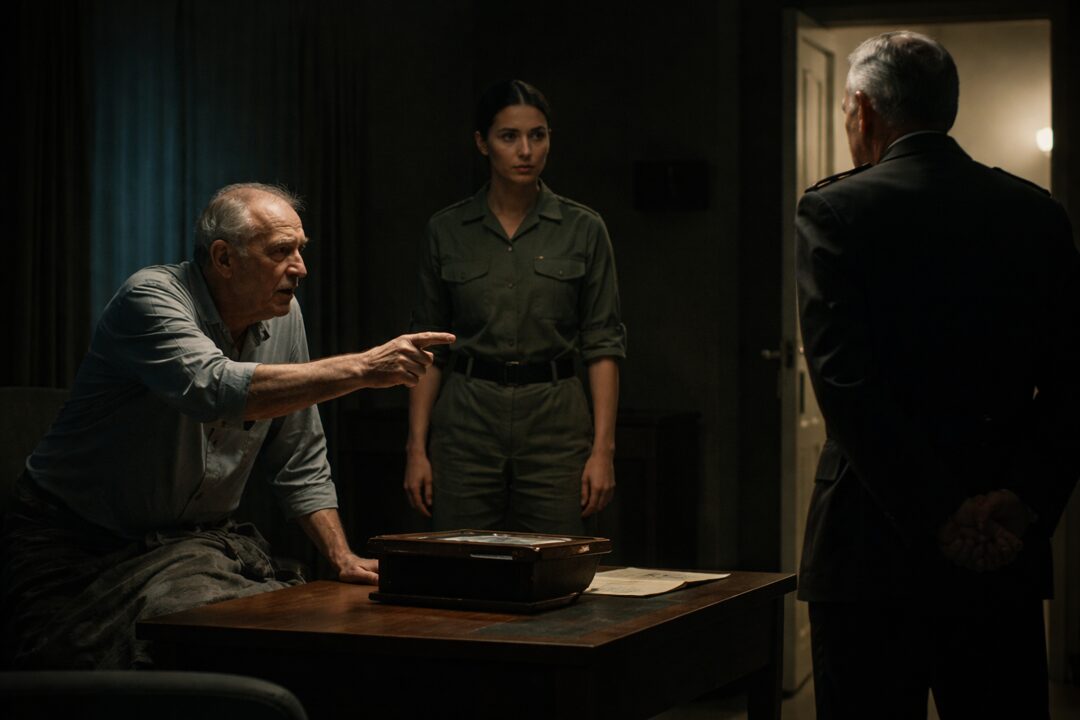
The Name He Kept
Part I — The Word No One Knew
The old man had not spoken in any language the ward recognized for as long as the nurses remembered, so when he opened his mouth during evening rounds and said a single cracked word, Captain Elina Varga stopped so abruptly that the medicine tray rattled in her hands.
Not a groan. Not the usual muttering.
A word.
The orderly beside her frowned. “What was that?”
Elina was already turning.
The man sat on the narrow iron bed under the window, shoulders curved inside a gray hospital shirt that had once belonged to someone larger. The card at the foot of his bed read ISTOMIN / UNKNOWN NATIONAL / CHRONIC CONFUSIONAL STATE in faded block letters. It had probably read that for decades.
He stared at the darkening glass and said the word again, thinner this time.
“Víz.”
Water.
Elina knew it because her grandfather had written it in the margins of his old letters when he tried to teach her little things from the front. Not grammar. Just scraps. Bread. Snow. Water. Home.
The orderly shrugged. “Nonsense.”
“It isn’t nonsense,” Elina said.
The old man heard the shift in her voice and turned, slowly, like a mechanism stiff with rust. His face was deeply lined, his skin stretched fine over the bones, but his eyes were not vacant now. They had sharpened.
Elina set the tray down and crossed to the bedside. The smell in the ward was always the same—disinfectant, iron radiators, old fabric, old men who had outlived the wars that put them here. Outside, the hospital grounds fell away toward a former border road that no longer mattered. Inside, time had settled in the corners and stayed.
She took the cup from the tray and held it out.
“Víz,” she said carefully.
The old man did not take it.
His fingers twitched over the blanket. The muscles in his jaw moved. He looked at her the way people look when they think they have misheard God.
Behind her, the orderly gave a short laugh. “What are you doing?”
Elina ignored him. In the old language of her grandfather’s letters, clumsy and badly accented, she said, “Do you understand me?”
The cup tipped in the man’s hand when he finally reached for it. Water spilled over his wrist. He did not drink. He kept staring at her, eyes widening, and then, with no warning at all, he bowed forward and began to shake.
It was not theatrical. It was worse than that.
He wept without sound.
The orderly moved first, alarmed. “Captain—”
“Get out,” Elina said.
He blinked. “What?”
“Out.”
When the door shut, the ward seemed to grow larger around them.
The old man pressed the heel of his hand hard against his mouth, as if ashamed of what had escaped him. Elina sat on the bed’s metal chair and waited. She had spent six years learning that waiting was sometimes the only honest form of mercy.
At last he lowered his hand.
She asked, “What is your name?”
His lips trembled once. Then he answered in halting syllables, the voice rough from disuse.
“István.”
The false card at the foot of the bed seemed to lean toward them like an insult.
“Elina,” she said. “My name is Elina.”
His gaze dropped to her sleeve, to the insignia of the army medical corps, then back to her face. He swallowed with visible pain.
“How long?” he asked.
It was the simplest question possible, and it landed like a wound.
Elina knew only what was on his file: admitted in the early 1950s from a processing facility that no longer existed; origin unknown; psychotic or severely disordered; no successful communication established; long-term institutional placement recommended.
But his hair was white. His hands were old. That was answer enough.
“A long time,” she said.
His mouth worked around something harder than speech. “War?”
“It ended.”
His eyes closed.
For one second, military bearing came back into him so sharply it frightened her. He sat straighter. His hand, all tendon and bone, flattened on the blanket as if on a map.
“Unit,” he whispered to himself, as though calling roll from the bottom of a well. “Retreat. Snow. Case.”
Then he looked at her and said, with sudden urgency, “Hungary?”
“You are Hungarian?”
He shut his eyes again. That was not an answer. It was grief.
By the time Elina rose from the chair, she knew three things. The old man on Bed Twelve was not mad in the way the file claimed. Someone had buried a living identity under a clerical grave. And if word of this reached the wrong ears first, the door that had just opened could close again.
It happened faster than she expected.
Colonel Sergei Antonov was waiting outside the ward, immaculate in his dark uniform, silver hair trimmed so precisely it made everyone around him look unfinished.
“I’m told,” he said, “that you have taken an unusual interest in Patient Twelve.”
The corridor was cold enough to sharpen breath. Elina stood at attention without thinking. Antonov had that effect on people. He filled silence the way some men filled a room.
“He spoke,” she said.
“He makes sounds.”
“In Hungarian.”
One beat. No more.
Antonov folded his hands behind his back. “This facility has housed displaced men from many fronts. Sound resembles language when people want it to.”
“He gave me a name.”
“Did he.”
Elina heard the flatness in that answer and felt the first clean edge of danger.
“Yes, Colonel.”
Antonov looked through the ward window at the old man, who now sat motionless on the bed with the cup untouched in his hand.
“Until records are reviewed,” Antonov said, “you will limit further contact to essential clinical matters.”
Elina held his gaze. “If he can identify himself, he has to be processed.”
“Captain, this hospital is full of men who once had names.” His tone did not rise. It chilled instead. “Do not confuse disturbance with miracle.”
Then he turned and walked away, his steps echoing down the corridor of the building that smelled like old plaster and survived secrets.
Elina went back into the ward anyway.
By then, István had set the cup aside. He watched her enter with a frightened patience she had only seen in animals that had once belonged to someone.
She closed the door softly.
At the foot of his bed, the wrong name still stood there.
Istomin.
A mistake repeated long enough to become a life.
Part II — Bed Twelve
The next morning Elina began with the card.
She took it out of its metal slot and turned it over in her hand. The ink had bled years ago, but the error was still clear: ISTOMIN. Not a surname. Not any proper identity. Just something a tired clerk must have thought he heard from a foreign mouth and then written down with the confidence of bureaucracy.
She slid the card into her pocket.
When István saw the empty slot, his gaze flickered with unease.
“I’m not erasing you,” she said in Hungarian. “I’m removing the wrong man.”
He looked at her for a long moment, then nodded once.
Speech came to him in broken pieces. Every phrase seemed to scrape against years of disuse. But the mind behind it was there, battered, interrupted, still stubbornly itself.
“István Farkas,” he said, tapping his chest. “Corporal. Second Army transport detail.” He stopped to breathe. “Winter forty-four.”
Elina wrote it down by hand because she did not trust the hospital typewriters, the clerks, the files, or the building itself.
“What happened?”
He pressed his fingers to his temple. “Road. Forest. Shelling. We carried case. Not mine. Sergeant dead. Lieutenant dead.” His mouth thinned. “I ran.”
Shame entered the room with that last sentence and stood beside him.
“You were captured?”
He gave a tiny nod.
“By whom?”
“Russians.”
It was strange how quickly one recovered language became many losses. Once she could ask one question, a hundred others crowded behind it.
“How did you come here?”
He gave her a look of pure incomprehension, not because he lacked the words now, but because the story was too broken to walk in a straight line.
“Camp,” he said. “Then another. Then…” He lifted one hand and let it fall. “No understand. I spoke. They looked.” His fingers curled. “I shouted. Worse.”
Elina knew enough institutional logic to fill in the rest and hated herself for how easy it was. Foreign prisoner. No interpreter. Agitation. Malnourishment. Trauma. A man who could not make himself understood quickly became a man no one tried to understand at all.
He looked away toward the window. “After war, I said name. Unit. Village. Mother’s name.” A pause. “Nothing.”
“Did no one ever speak Hungarian to you?”
He gave a small, almost embarrassed shrug. “No one who stayed.”
That line stayed in the room after he said it.
No one who stayed.
Elina spent the afternoon in records. The hospital archive occupied a former laundry room in the basement, and it smelled like dust and damp paper and resignation. She found his intake file in a box labeled FOREIGN TRANSFERS / NONRETURNED / 1952–1956.
The form had been completed by a debriefing officer from a dissolved frontier unit. The patient, male, elderly appearance uncertain, language unintelligible, signs of delusion, fixation on military ranks and place names, periods of aggression, poor adaptation. Long-term observation recommended.
Attached to the back was a smaller sheet listing possessions taken on admission.
One wool cap.
One belt.
One religious medallion.
One sealed dispatch case, transferred to secure storage.
Elina stared at the last line until the paper blurred.
When she carried the file upstairs, Antonov was waiting outside her office.
He glanced at the folder. “You’ve been busy.”
“He had a dispatch case.”
“Many prisoners had effects.”
“This file comes from a military debriefing unit.”
“Most things in this region once did.”
She had expected denial. What unsettled her was his precision. He did not ask what the file said. He already knew how such files were built.
“He should never have been placed here permanently,” she said.
Antonov stepped into the office uninvited and closed the door behind him. “Captain Varga, you are young enough to still believe archives are moral objects. They are not. They are debris with stamps.”
“He was trying to identify himself.”
“In those years, thousands were.”
“You’re saying that explains it?”
“I’m saying chaos is not innocence, but it is real.”
He moved to her desk and laid two fingers on the file as if claiming it.
“Do not romanticize him because he answered to his own language. Trauma can preserve some structures while destroying others.”
“Then let me assess him properly.”
His eyes settled on her face. Calm. Controlled. Too controlled.
“And if you find him competent enough to speak?” he asked. “To whom? The ministry? Foreign press? Families? What exactly do you think lives inside old mistakes, Captain?”
Before she could answer, he lifted the file and handed it back to her.
“Do your examination,” he said. “But no outside contact. Not yet.”
“Not yet?”
He did not blink. “Records first.”
When he left, Elina realized her hands had tightened on the folder hard enough to bend the corners.
That evening she returned to István with bread from the staff kitchen.
He took it in both hands and did not eat immediately. He lifted it first, almost imperceptibly, and inhaled.
Then his eyes filled.
“It smells right,” he said.
That one sentence hurt more than anything else so far.
He ate slowly, with care that seemed older than appetite. Between bites she asked about the case.
His face changed. Not fear. Weight.
“Brown leather?” he asked.
“Yes.”
“Locked?”
“In storage, I think.”
He stared at the crust in his hand. “Not map.”
“What is it?”
He took too long to answer.
“I thought orders,” he said. “Then village burned. We found people.” His voice thinned. “Not ours. Civilians. Dying. Priest wrote names. I carried cloth.”
Elina felt the floor under the bed tilt.
“Cloth?”
“Names. Who dead. Who saw.” He swallowed. “Lieutenant said if we reached command, there would be record.”
“A record of what?”
István looked at her as if she were asking him whether fire burned.
“Of what was done.”
The radiator hissed behind them. Somewhere farther down the ward, an old man coughed with the dry persistence of failing lungs. Everything ordinary kept going.
Elina said, “By whom?”
His mouth closed.
He shook his head once, either because he could not yet remember or because remembering had a cost.
That night she called the number listed in the registry for next of kin inquiry. The connection crackled all the way across the border. The woman who answered sounded as if she had expected bad news her whole life and had trained herself to absorb it standing up.
“This is Captain Elina Varga from the military hospital at Karsk,” she said. “I’m trying to locate family of one István Farkas.”
Silence.
Then: “My mother’s brother?”
The voice was older, practical, and suddenly unsteady under the practicality.
“You believe he may be alive?” the woman asked.
“I believe I am speaking to him.”
The woman on the line made a sound Elina would later hear again when she arrived at the hospital: not quite a sob, not yet joy, more like the body bracing against impossible hope.
“My name is Marta,” she said. “If this is a mistake, tell me now.”
Elina looked through the office window toward Ward C, where Bed Twelve stood under its missing card.
“It was a mistake,” she said softly. “But not the one you mean.”
Part III — The Things That Were Convenient
By the time Marta Farkas arrived two days later, the hospital had begun to change around István, though no one had officially admitted it.
Nurses who had ignored Bed Twelve for years now lowered their voices near him. Clerks suddenly wanted signatures. A ministry fax machine in administration spat out questions without names attached to them. A man from consular services called twice before noon. The wrong card remained off the bed, but no correct one had replaced it yet. Even restored identity had to wait for stamps.
Marta came in a brown coat shiny at the elbows, carrying a bag she held too tightly. She was broad-shouldered, plain-faced, and looked like a woman who had spent decades making herself useful because usefulness was steadier than grief.
She stopped outside the ward door.
“Which one is he?”
Elina almost answered with the bed number, then hated herself for the instinct.
“The one by the window,” she said.
Marta stepped inside as if entering a church where she had once been shamed. István was awake, sitting up straighter now than he had on the first night, the thin hospital blanket folded neatly over his knees.
He looked at her with polite uncertainty.
Marta stopped three feet from the bed. “Uncle István,” she said in Hungarian, and the title broke on the second word.
He searched her face. Not because he remembered it—how could he?—but because blood does some of its own work.
“Ilona’s girl?” he asked.
Marta let out a terrible laugh-sob at once. “Yes.”
He nodded, once, with grave effort, as if confirming a report.
Then she knelt beside the bed and put her forehead against his hand.
Elina turned away. The ward felt too small for that kind of return.
Later, in the corridor, Marta wiped her face hard and said, “He asked if the cherry tree still stands.”
“Elina,” Elina said, not knowing why that mattered.
Marta gave her a bewildered look. “What?”
“My name. In case you need to hate someone specific later.”
Something unexpectedly like humor moved through Marta’s exhaustion.
“I think I’ll have a longer list than one doctor.”
It did not last. She looked back through the glass at her uncle.
“My mother kept his room untouched for twelve years,” she said. “Then she died before she could forgive herself for letting it go.”
The sentence lodged under Elina’s ribs.
That afternoon Antonov summoned her.
His office was severe to the point of theater. No family photos. No books that had not been issued. No loose paper. Through the window the yard lay under old snowmelt and military mud.
“You contacted relatives without authorization,” he said.
“Yes.”
“And now consular officials are involved.”
“Yes.”
Antonov studied her for a long second. “Do you know what happens when the past becomes administratively visible, Captain? Everyone involved begins lying in complete sentences.”
“He has a family.”
“He has a story. Families are only the gentlest part of what stories attract.”
Elina set the copied inventory sheet on his desk. “What was in the dispatch case?”
His gaze dropped to it and returned.
“If you know,” she said, “say so.”
He leaned back. “You think I am your obstacle because I want silence. I am your obstacle because you still believe exposure and justice are cousins.”
“Then educate me.”
Something like fatigue crossed his face. It changed him more than anger would have.
“After the war,” he said, “there were camps inside camps. Men crossing borders that no longer existed, officers changing uniforms, allies discovering what their allies had done. Files were lost, yes. Files were also misplaced on purpose. Not always for villainy. Sometimes because a document in the wrong room could restart a firing squad.”
“That doesn’t answer my question.”
“No. It tells you why old answers rot strangely.”
He stood, walked to the cabinet by the wall, and drew out a narrow folder with no exterior marking.
“For your eyes only,” he said.
Inside was a personnel trace. One page. Brief postings. Debriefing unit assignments. Translation support, frontier processing command, 1953.
Name: Sergei Antonov.
Elina looked up sharply.
He gave the smallest nod. “Yes. I was there.”
“At his intake?”
“Not officially.”
“Did you speak to him?”
Antonov’s mouth tightened. “Enough to know he was foreign. Enough to know he was terrified. Enough to know everything was collapsing around us.”
That was not denial. It was not confession either.
“Did you understand him?”
The silence that followed was answer-shaped.
Finally he said, “You are asking a question as if memory were clean.”
She left his office with the folder in her hand and the first taste of moral nausea in her throat.
That evening István was worse. Not physically—though he was exhausted—but inwardly. Speech had opened rooms in him he had survived by keeping locked. Fragments broke loose without warning.
“Snow in boots,” he said once, staring at the wall.
A minute later: “Bread froze before morning.”
Then, after a long silence: “They were not our civilians. Still burned.”
Elina sat beside him, saying little. He did not need a witness who filled the air.
At last he said, “There was a young officer after. Interpreter. Not good. Enough.” He tapped his temple. “He understood pieces.”
Elina kept her face still.
“What happened?”
“He looked at me.” István’s voice had gone almost flat. “He knew I said my name.”
“And then?”
“He was called away.”
Something in that answer was wrong—not false, but incomplete, like a door left open just enough to make you afraid of what was behind it.
“Did you see him again?”
István frowned. Time moved strangely across his face. Then the frown deepened, sharpened.
“Later,” he said.
“Where?”
He lifted his hand and let it hover in the air as if tracing a room.
“Hallway. White tiles. Older. Same eyes.”
Elina felt the hospital contract around them.
“Did he know you?”
“I think.” A pause. “No. He knew enough.”
That line hit harder than accusation would have.
She went to the secure storage room before dawn.
The clerk on duty had known her since she was posted here and did not ask for written authorization when she said it was for psychiatric assessment. He unlocked Cage Three, muttering about old junk.
The dispatch case sat on a high shelf behind tagged uniforms and dented canteens. Brown leather gone dark with age. Strap broken. Brass lock sealed with wax that had long since cracked.
It was lighter than she expected.
She carried it to her office, closed the door, and stared at it for a full minute before opening it.
Inside lay no map, no coded orders, no tactical drawings.
A folded cloth. Browned almost black in places.
Pages wrapped inside it, covered in hurried names, place marks, witness statements, dates, all written in a priest’s cramped hand. Some lines had blurred where something wet had struck them before drying forever.
At the top of the first page was a phrase repeated twice, as if written under shellfire by someone who feared interruption.
So that no one can say this did not happen.
The room went still.
Convenience, Elina thought.
His disappearance had not merely been possible.
It had been convenient.
Part IV — The Man in the Hallway
By afternoon the pressure had become visible.
Two journalists waited beyond the hospital gates. A ministry car arrived and sat idling without anyone getting out. Consular staff asked for formal verification. Marta wanted to take her uncle home immediately. Antonov refused until medical transport could be arranged and paperwork completed.
“Paperwork,” Marta said in the corridor, voice low and savage. “He has already lost half a century to paperwork.”
Antonov met her anger without flinching. “If you want him moved alive, you will let the physicians do this properly.”
It was the first true thing he had said all day, which made it harder to hate him cleanly.
That night Elina brought the case to István.
He did not touch it at first. He only looked at the leather with an expression so bare it made her step back.
“I found it,” she said.
He closed his eyes.
“I did not read much,” she lied badly.
A ghost of irony touched his mouth. Even now. Even with everything.
“You read enough.”
“Yes.”
He laid his hand on the case as a man might lay a hand on a coffin.
“We thought if command had names, someone would answer,” he said. “The lieutenant said paper makes men responsible.”
“Did you believe him?”
“I was twenty.”
He opened the case and unfolded the cloth with reverence so careful it seemed to reorder the air. Names filled the fabric in faded brown script, crossing over one another where space had run out.
“Father Miklós wrote while they spoke,” he said. “Burned barn. Children outside. A woman with half a face. One man with both hands gone.” He swallowed. “I carried it because others were dead.”
“Who were they naming?”
István looked at her.
“Who do you think?”
She had no answer worth saying.
Before she could ask more, the office door opened without a knock.
Antonov stepped in, saw the case, and stopped.
No one moved. It was the purest silence Elina had heard in the hospital.
“You broke secure protocol,” Antonov said at last.
István was staring at him with terrible concentration.
Not at the rank. Not at the uniform. At the face beneath age.
Antonov seemed to understand it at the same moment Elina did.
The old soldier rose halfway from the chair, then gripped the desk for balance.
“You,” he said.
It was not loud. It did not need to be.
Antonov did not deny it.
Marta, who had followed Elina down the corridor and now stood in the doorway, looked from one man to the other with rising alarm.
István pointed a shaking finger. “Hallway. White tiles.”
Antonov’s expression did not crack, but it changed. Not weakness. Recognition of inevitability.
Elina said, “Leave the room if you can’t speak honestly.”
Antonov kept his eyes on István. “I was an interpreter,” he said.
“Bad one,” István whispered.
A pulse moved in Antonov’s jaw. “Yes.”
“You knew.”
“I knew enough.”
The repetition struck like a blow.
Marta’s hand flew to her mouth. Elina felt the room split into the living and the dead and the men who had served both.
Antonov stepped inside and shut the door behind him.
“In that period,” he said, and even now he spoke as if assembling a report, “our unit processed hundreds of transfers. Languages overlapped. Commands changed weekly. Men were mislabeled, traded, moved, buried in paper—”
“You knew my name,” István said.
Antonov stopped.
The old soldier’s voice was thin, but every word landed. “You heard it.”
Antonov looked at him for so long that Elina thought he might still choose evasion. Instead he said, almost quietly, “Yes.”
Marta made a sound of pure disgust.
Antonov did not look at her. “I heard your name. I heard your unit. I knew you were not incoherent.”
“Then why?”
No rhetoric survived that question.
Antonov’s shoulders remained squared. His voice did not.
“Because I was twenty-six,” he said. “Because I had already seen men disappear for less than asking the wrong question. Because your case”—his eyes flicked once to the cloth—“was not harmless. Because I thought if I did nothing, the matter would sink into the larger ruin. Because I intended to come back.”
“But you didn’t,” Elina said.
“No.”
“Then years later you recognized him here and still said nothing.”
Antonov looked at her now. “Yes.”
There it was. Not a system. A person.
He turned back to István.
“I told myself then that dragging you into review again would kill you. I told myself you had already become what this place made of abandoned men. I told myself many things.” His gaze dropped for the first time. “Most of them had my own comfort at the center.”
No one spoke.
Outside, somewhere down the corridor, a trolley squealed over cracked tiles. Ordinary life moved past the office door while the room held its breath around an old cowardice finally named.
István sat down slowly.
For a moment Elina feared he was folding back into himself. Then he said, “Say it.”
Antonov frowned. “What?”
“My name.”
The colonel’s throat worked once.
“István Farkas,” he said.
Not Istomin. Not unknown national. Not patient twelve.
The wrong life loosened in the room.
István closed his eyes. His hand unclenched over the folded cloth.
When he opened them again, he looked not at Antonov but at Elina.
“After I go home,” he said, “you release this.”
Marta turned sharply. “No. Now.”
He shook his head.
“No spectacle.” His breathing had roughened. “No first words for them.”
Elina understood at once. He would not let the first real use of his restored voice become a performance for cameras, ministries, or men eager to look righteous over old ash.
Antonov stood very still.
István looked at him one last time. “You will live with hearing it late.”
It was not forgiveness. It was worse.
Antonov inclined his head as if receiving sentence from someone whose authority he could no longer pretend not to recognize.
Then, without another word, he left the office.
Marta sank into the chair he had vacated and began to cry in anger instead of hope.
Elina touched the cloth very lightly, not on the names, just the corner.
“Are you sure?” she asked István.
He leaned back, spent.
“Yes,” he said. “A witness is not revenge.”
Part V — What Home Could Still Hold
The transfer papers came under his real name.
Elina stood at the nurses’ desk when the clerk brought them up for signature. She read the line twice before handing them over, just to feel the correction enter the world.
Farkas, István.
Such a small administrative act. Such a savage mercy.
The bed slot remained empty until the final morning. Then Elina wrote his name herself on a fresh card and set it in place.
He looked at it for a long time.
“I had begun to think,” he said, “perhaps the wrong one would outlive me.”
“It didn’t,” she said.
Marta packed what little he owned: the wool cap, the medallion, a clean shirt from consular supplies, the case wrapped again in protective cloth. The hospital provided an escort vehicle to the border. Antonov signed the release order personally and did not ask to see István again.
He came to Elina’s office instead.
She did not ask him to sit.
“I’ve submitted my resignation,” he said.
“That is neat.”
His mouth tightened. “You prefer punishment.”
“I prefer proportion. I don’t think the world offers it often.”
For the first time since she had known him, Antonov looked old in an ordinary way.
“I was not the only one,” he said.
“No,” Elina answered. “But you were one.”
That seemed to strike the center.
He nodded once, accepting the exact size of what language could and could not do for him now. At the door he paused.
“You were right about one thing, Captain,” he said. “Truth does not lead naturally to justice.”
“No,” she said. “But silence leads somewhere too.”
After he left, the office felt cleaner and emptier and not improved by either.
The drive to the border took three hours. Elina rode with them because that had somehow become inevitable.
István slept for part of it, head against the seat, one hand over the dispatch case on his lap. When he woke, he watched the passing land with the alertness of someone rereading a book he had once nearly memorized.
Fields. Poles. Villages with patched roofs. Children on bicycles.
At the crossing, formalities were quicker than the decades that preceded them had any right to allow. A young official stamped papers beneath fluorescent lights, glanced at the old man in the blanket, and said in polite bureaucratic Hungarian, “Welcome home.”
István stared at him as if the sentence were too expensive to trust.
On the other side, Marta had arranged for bread from her village bakery to be waiting in the car.
She broke off a piece and handed it to him.
He held it close first. Inhaled.
Then he smiled.
It was not broad. It barely lifted one corner of his mouth. But Elina saw, all at once, the young corporal he had once been—not restored, never that, but briefly visible through the damage.
“It smells right,” he said again.
They stopped in the village before sunset. The church bell rang the hour just as they pulled into the lane. The sound reached the car window and changed his face.
He touched the glass.
“I know that bell.”
Marta’s house was small, clean, over-warmed. Someone had placed flowers by the framed photograph of Marta’s mother. On a shelf near the stove stood an old black-and-white picture of a young man in uniform, serious and almost handsome in the way old military portraits made everyone look like someone history might spare.
István studied it.
“I did not know I looked so certain,” he said.
Marta laughed softly through tears. “None of us did.”
Elina stayed only one night. Long enough to see him sit at a table in a house where his language needed no witness. Long enough to hear neighborhood children arguing outside in the street and watch him close his eyes at the noise like a man warming frozen hands.
Long enough to understand that homecoming was not restoration. He woke disoriented. He asked once for men dead since 1945. He stared too long at unbarred windows. He thanked Marta for ordinary things with a formality that broke her heart.
But he was there.
That mattered in a way no clean narrative could improve.
Before Elina left, he asked for the case.
She brought it to him on the back step where the air smelled of damp earth and woodsmoke. He had a blanket over his knees. The late sun caught the lines in his face and made them gentler.
“You know what to do,” he said.
“Yes.”
“Not for scandal.”
“No.”
“For the names.”
She nodded.
He looked out toward the road. “I thought for many years that if I ever spoke again, I would use it to accuse someone.”
Elina waited.
He smiled without mirth. “Then I grew old in a room where no accusation could cross the walls. Strange thing. It teaches economy.”
He laid his hand over hers on the case.
“To be heard once,” he said, “is already more than silence wanted to allow.”
That was the last full sentence she heard him speak.
He died four months later, in winter, after a brief illness his body did not bother to fight hard. Marta wrote to Elina in a tight practical hand.
He liked the church bell. He sat by the stove. He ate bread every morning. On his last clear day, he corrected the priest’s pronunciation of his surname and laughed.
Elina read that line three times.
Then she opened the wrapped pages and sent copies where they had to go—consular offices, archives, a journalist she trusted, a legal historian who still believed witness mattered even when verdict did not. The names entered the record. Inquiries began. Statements were demanded. One retired official claimed failing memory. Another discovered sudden remorse. The story spread, then thickened, then resisted simplification the way all true stories do.
Colonel Sergei Antonov resigned before the review board finished its work.
The hospital at Karsk kept standing. It still housed men with half-broken histories and no one left to verify them. In Ward C, Bed Twelve took a new patient before spring. The building did not transform because one man had left it. If anything, it felt more haunted after.
Elina visited once, months later, and stood by the window where István had first said the word for water.
The room was occupied now by another veteran who slept through her rounds.
On the desk in administration, beneath fresh stacks of forms, she saw the old intake ledger waiting to be rebound. For a moment she imagined all the names inside it—real, false, partial, lost—pressing against the paper.
Not everyone would come back through language.
Not everyone had.
But one man had.
One man had crossed fifty years of institutional silence and still arrived at the end with a name, a witness, and the right to choose what his voice would be used for.
That was not justice.
It was smaller than justice, and in some ways more difficult.
It was dignity, restored too late and still worth restoring.
When Elina left the hospital, evening had already started to collect in the yard. The former border road beyond the fence was empty. Wind moved through the dead grass with the dry sound of pages turning.
She stood there a moment longer than necessary.
Then she said his name aloud, just once, to no one and to history both.
István Farkas.
And because the world had finally heard it, the silence that followed no longer felt like erasure.