The Delivery Van Blocked His Driveway Until His Own Records Exposed the Neighborhood’s Quiet Deal
Chapter 1: The Van Returned Before Michael Finished Writing the Time
Michael pressed the garage-door button and watched the bottom edge rise six inches before white metal filled the widening gap.
The delivery van was already across his driveway.
Its rear wheels sat beside the curb, but the long body angled over the concrete apron, blocking enough of the opening that Michael could not back out without climbing the lawn. Amber hazard lights blinked against the still-dark garage windows—on, off, on—as if repetition could turn obstruction into permission.
He stopped with one hand on the driver’s door of his sedan.
His appointment was in twenty-eight minutes.
Across the street, porch sprinklers clicked through their arcs. A dog barked once from behind a fence. The van’s rear doors stood open, revealing shelves of brown boxes arranged in tight columns. No driver was visible.
Michael looked at the dashboard clock, then at the yellow legal pad he had left on the workbench after Friday’s incident.
He had written only one line then.
Friday, 8:14 a.m. White van. Driveway blocked. Asked driver to move.
He picked up the pad and added beneath it:
Monday, 8:09 a.m.
Before he could finish the second digit, a man in a dark delivery uniform emerged from the side yard two houses down, carrying a narrow box beneath one arm. He moved quickly, chin lowered, handheld scanner in his other hand.
“Stephen,” Michael called.
The driver looked up, recognized him, and slowed without stopping.
“I need to leave.”
Stephen Lewis reached the van, placed the box on the rear step, and scanned another package. “I’ll be out in a minute.”
“You said that Friday.”
“I was out in two.”
“It was seven.”
Stephen exhaled through his nose. He was younger than Michael by perhaps ten years, with the tight shoulders of someone whose day had started before sunrise. “I’ve got three houses right here.”
“And my driveway is one driveway.”
Stephen glanced toward the open garage. “You can get around me.”
“Not without driving over the grass.”
“I’m not staying.”
Michael held up the legal pad. “You’re already here.”
That made Stephen look at the page. His expression changed—not to concern, exactly, but to irritation sharpened by caution.
“Are you timing me now?”
“I’m recording when my driveway is blocked.”
Stephen slid another package onto his shoulder. “The stop is on the route.”
Michael lowered the pad slightly. “What does that mean?”
“It means this is where the route tells me to stop.”
“The route tells you to block a driveway?”
“It gives me the location.” Stephen pointed toward the curb without looking. “This is the safest access point for this cluster.”
“Who decided that?”
Stephen was already moving away. “Not me.”
The answer followed Michael into the garage.
He watched Stephen cross the lawn toward the next porch, scanner chirping before he reached the steps. Michael could have backed around the van if he angled hard enough and put two tires over the edge of the grass. The ground was soft from overnight watering. He pictured the deep grooves, the mud on the driveway, the conversation with the association if a tire crossed the landscaped strip they had cited him for reseeding the year before.
He looked at the clock again.
8:13.
He wrote it down.
The hazard lights flashed in the garage window, their amber reflection passing over shelves, rakes, storage bins, and the old folding wheelchair Michael had never managed to give away after his father died.
His father had once waited forty minutes for a transport van because a contractor’s truck had blocked the curb ramp outside a rehabilitation clinic. Michael had stood beside him, embarrassed by the attention, while his father insisted it was fine.
It had not been fine.
Michael closed the legal pad.
At 8:17, Stephen returned carrying nothing. He climbed into the van and pulled forward without looking toward the garage.
Eight minutes.
Michael wrote the departure time beneath the arrival.
By the time he reached the medical office, the receptionist had already given his appointment to someone else. She offered him a slot in three weeks.
“I was delayed leaving my house,” he said.
She gave him the sympathetic expression people used when a reason was understandable but irrelevant. “I can put you on the cancellation list.”
Outside, Michael sat in his car and opened the neighborhood delivery notification on his phone. The system showed that a package had been delivered to a house three doors down at 8:12. Another at 8:15.
The pattern was visible even without his notes.
He returned home before nine. The street looked ordinary again. A landscaping crew worked near the entrance. A neighbor rolled a trash bin toward the side gate. There was no sign that a commercial vehicle had occupied his driveway or that he had missed anything because of it.
Inside, Michael placed the legal pad on the dining table and opened his laptop.
He had spent twenty-two years in the municipal records department before budget cuts moved half the staff into contract positions. He now processed records requests from home for a private compliance firm. The work had changed, but the habits had not. Dates mattered. Exact language mattered. A complaint without a timeline was an opinion. A timeline supported by independent records became something else.
He opened a blank spreadsheet, then closed it.
The legal pad felt more honest for now.
He drew columns with a ruler.
Date. Arrival. Departure. Duration. Vehicle. Driver. Effect.
Under Effect, he wrote: Missed medical appointment.
He hesitated, then added another column.
Statement.
Monday: “The stop is on the route.”
Michael called Crestline Logistics using the customer-service number from the delivery notification. After navigating a menu and waiting through a cheerful instrumental loop, a representative answered.
Michael gave his address and described the obstruction.
“I’m sorry for the inconvenience,” the representative said. “I can submit driver feedback.”
“This happened Friday and again this morning.”
“I understand.”
“The driver said the location is on his route.”
There was a brief pause. Keyboard clicks sounded through the line.
“Our drivers determine safe stopping positions based on road conditions.”
“He said the route told him where to stop.”
“I don’t have access to route-level instructions, sir.”
“Then who does?”
“I can escalate the concern to the local station.”
Michael wrote the time of the call in the margin.
“What happens after that?”
“The station reviews the feedback with the driver.”
“What if the instruction is coming from the route?”
Another pause.
“I can only document what you’ve reported.”
Michael almost laughed. Instead, he looked at his own handwritten columns.
“So can I,” he said.
After the call, he walked outside and examined the curb. Near the point where the van’s rear tire had rested, a pale crescent marked the asphalt. It might have been chalk from utility work or dried residue from a tire. Michael crouched and photographed it anyway, including his mailbox and driveway in the frame.
At 10:46, Crestline emailed a standard response thanking him for helping improve service quality.
At 11:03, the neighborhood association’s delivery discussion thread updated. Someone complained that vans had been idling near the clubhouse again. Angela Mitchell, the HOA president, replied within four minutes.
Management is coordinating with carriers to keep commercial traffic in appropriate service areas.
Michael read the sentence twice.
Appropriate service areas.
He searched the association website for delivery maps, service zones, traffic plans, and vendor instructions. Nothing appeared in the public documents. The most recent board minutes mentioned resident concerns about package traffic but recorded no action.
At noon, Michael began filling out Crestline’s formal complaint form. He entered Friday’s stop, Monday’s stop, and the missed appointment. When the form asked whether he had spoken with the driver, he checked yes.
In the explanation field, he typed:
Driver stated the stop was “on the route.”
Before he clicked submit, his phone chimed.
A Crestline notification had arrived for a package expected the next morning.
Estimated delivery window: 8:05 a.m.–8:25 a.m.
Michael looked toward the driveway, then down at the two entries in his new log.
The same twenty-minute window.
He saved the unfinished complaint instead of submitting it.
For the first time, he was no longer asking whether Stephen would block the driveway again.
He was asking who expected him to.
Chapter 2: Every Apology Ended When the Hazard Lights Returned
At 8:07 Tuesday morning, a different driver stopped on the same pale crescent beside Michael’s driveway.
The van was not the same vehicle. Its fleet number ended in 62 instead of 18, and the woman behind the wheel had never been to his house before. Yet she angled the front bumper toward the curb, swung the rear across the apron, and switched on the hazard lights with the practiced certainty of someone following a familiar instruction.
Michael was already standing at the end of the driveway.
The driver lowered her window. “Am I in your way?”
“Yes.”
She looked at the curb, then at the houses clustered around the corner. “The stop point is right here.”
“According to what?”
“My scanner.”
She held it up briefly. A map glowed on the screen, too small for Michael to read.
“Can you park farther down?”
“That’ll put me past the walk zone.” She checked her mirror. “I’ll be quick.”
She shut off the engine and stepped out.
Michael glanced at the asphalt. Her rear tire covered the same chalk-like curve he had photographed the day before.
He added the arrival time to his log.
The driver finished in six minutes. She apologized before leaving, but the apology ended at the moment the hazard lights went dark. The next morning, Stephen returned and stopped in the same place. Thursday brought another substitute. Friday, Stephen again.
Four weekdays. Three vehicles. Two drivers. One position.
By Friday afternoon, Michael’s legal pad no longer resembled casual notes. He had transferred every entry into a ruled ledger from his office cabinet. Each row included arrival and departure times, screenshots of delivery notifications, camera image numbers, vehicle identifiers, and what access had been prevented.
On Wednesday, he had delayed taking his car for a battery test.
On Thursday, a recycling truck had waited behind the delivery van, blocking half the street.
On Friday, Michael had remained in the garage while Stephen carried packages to four houses. Neither man spoke.
The silence irritated Michael more than an argument would have.
He called Crestline again.
The representative introduced himself, apologized, and asked Michael to wait while he reviewed the previous complaint.
“I see driver coaching was requested,” the representative said.
“The driver is not the only one doing it.”
“I understand.”
“No, I don’t think you do. Three vans have stopped in the exact same position.”
“We don’t instruct drivers to block private access.”
“Do you instruct them to stop at my address?”
“There is no delivery associated with your address today.”
“That wasn’t my question.”
A longer burst of keyboard tapping followed.
“I don’t see any location note for your property.”
“The drivers do.”
“Our customer-service system doesn’t show route navigation.”
“Then someone who can see it needs to call me.”
“I can resubmit the escalation.”
Michael looked at the ledger. In the Statement column, he had already written the substitute driver’s words: The stop point is right here.
“Your first escalation changed nothing.”
“I’m sorry you’re dissatisfied.”
“I’m not dissatisfied with a product. I’m being prevented from leaving my property.”
“I understand your concern.”
Michael leaned back and closed his eyes. The phrase had become meaningless through repetition, like the van’s blinking lights.
“Give me the complaint number.”
The representative read it aloud. Michael repeated it back, recorded the time, and ended the call.
He then searched the city code.
The municipal website was not designed for ordinary people. Its search bar returned planning agendas, archived amendments, and scanned PDFs with crooked margins. Michael knew how such systems were built. He narrowed the search from parking to obstruction, then from obstruction to access. A cross-reference led him to commercial loading restrictions, which led to a subsection on driveway aprons.
The language was dense but direct.
No vehicle may stand, stop, or remain in a position that obstructs lawful ingress to or egress from a private drive, except under direction of authorized personnel.
A second paragraph addressed loading.
The temporary loading of goods did not create an exemption.
Michael read it again.
Temporary did not create an exemption.
There was no grace period hidden in the language. No permission for hazard lights. No exception for a driver who intended to stay only two minutes.
He printed the page.
At the bottom of the section, a penalty table listed a minimum civil assessment of $85 for each verified occurrence. Additional administrative charges could be applied under a separate schedule.
Michael placed the ordinance beside the ledger.
For the first time that week, the neat rows gave him something close to satisfaction. He had not imagined the problem. He had not exaggerated it. The rule said plainly what Crestline’s apologies avoided saying: brief obstruction was still obstruction.
He opened the formal city complaint portal.
The form required a date, vehicle description, location, photographs, and responsible party. There was room for only one incident.
Michael completed Tuesday’s report first, attaching a still image from his exterior camera. The van’s rear quarter crossed the full width of the driveway. The time stamp appeared in the corner.
Under Responsible Party, he entered Crestline Logistics.
Under Driver, he typed Stephen Lewis.
He paused.
Tuesday’s driver had not been Stephen. He corrected the field, then opened Monday’s report.
There, he entered Stephen’s name.
The system asked for a narrative. Michael described the vehicle position, duration, missed appointment, and prior request to move. He copied the driver’s statement about the route.
Then he deleted that sentence.
The form was about obstruction, he told himself. Route instructions were Crestline’s internal matter. Including them might create uncertainty about responsibility. Stephen had still parked the van. Stephen had still left it there.
Michael submitted the complaint.
He filed separate reports for the other verified stops. Each one took nearly twenty minutes because the portal timed out after inactivity, forcing him to reattach images and reenter vehicle data. By the fourth submission, his irritation had hardened into method.
At 4:38 p.m., the parking enforcement clerk called.
“I’m reviewing several reports tied to the same address,” she said. “Are these duplicates?”
“No. Different dates and vehicles.”
“You’re saying your driveway was blocked each time?”
“Yes.”
“For how long?”
“Between five and eleven minutes.”
The clerk was quiet.
Michael imagined her deciding whether he was the kind of resident who measured grass height with a ruler.
“The carrier says these are active delivery stops,” he added.
“That doesn’t automatically exempt them.”
“I found the code.”
“I see you attached it.”
He waited.
The clerk continued, “We’ll need independent verification or clear images showing access was actually obstructed.”
“I provided camera stills.”
“Yes. The angle is useful.”
“Will the company receive one warning?”
“That depends on enforcement review.”
“Does each occurrence count separately?”
Another pause, this one shorter.
“If each occurrence is verified, each may be cited separately.”
Michael looked down at the five completed rows in his ledger.
“What about future occurrences?”
“Continue documenting them. Do not confront the drivers in a way that creates a safety issue.”
“I haven’t.”
“I’m required to say it.”
After the call, he drew a line beneath Friday’s entry and totaled the durations.
Thirty-eight minutes.
That was all. Less than an hour spread across a week. Angela Mitchell would have called it minor. Crestline called it inconvenience. Stephen called it a stop on the route.
Michael looked at the empty rows below.
Five documented incidents at a minimum of $85 each already meant $425 before administrative charges. Another week would double it.
His phone lit with Monday’s delivery estimate.
8:10 a.m.–8:30 a.m.
Michael placed the phone beside the ordinance and sharpened his pencil.
The company still thought it was repeating the same small mistake.
The city had just told him it could be five separate violations.
Chapter 3: The Fine Arrived, but the Wrong Man Paid First
The figure appeared halfway down the enforcement letter in bold type.
Total assessed: $1,045.
Michael read the amount once, then again more slowly.
The city had verified nine incidents from his exterior-camera footage and two observations by a parking officer. The assessment included individual obstruction penalties and administrative processing fees charged to Crestline’s fleet account.
Eleven stops.
Two weeks of arrival times, departure times, vehicle numbers, still images, and short descriptions had become a four-figure consequence.
Michael set the letter beside his ledger.
The pages now filled a thick black binder. Plastic sleeves held photographs. Tabs separated city reports from Crestline complaint numbers. The first handwritten entry—Friday, 8:14 a.m.—looked almost careless compared with the later rows.
He had expected satisfaction.
What he felt was steadier and colder: confirmation.
Someone had finally treated the obstruction as real.
At 9:16, he emailed a copy of the notice to Crestline’s regional complaint address. He included a single sentence.
Please confirm that the assigned stopping location will be corrected.
The reply came before noon from Robert Young, regional route supervisor.
Mr. Carter, we are reviewing the citations and driver compliance associated with your address. Fleet assessments remain subject to challenge. Please direct future concerns to my office.
Michael called the number in Robert’s signature.
“You have the notice?” Michael asked.
“I do.”
“Then you understand the issue.”
“I understand you filed eleven complaints.”
“I documented eleven obstructions.”
Robert’s voice was controlled, neither apologetic nor openly hostile. “Our drivers service more than two hundred residences on that route. They make temporary stops where conditions allow.”
“My driveway does not allow it.”
“We’re reviewing the stop.”
“You said you were reviewing it two weeks ago.”
“I didn’t speak with you two weeks ago.”
“Your company did.”
Robert let the distinction sit between them.
“The driver assigned to the route has been removed pending review,” he said.
Michael’s grip tightened around the phone. “Removed from my street?”
“From active route duty.”
“Why?”
“There are eleven verified citations tied to stops under his employee identification.”
“Not all eleven were his.”
“His route. His assigned cluster.”
Michael looked at the vehicle numbers in his binder. “Substitute drivers made four of those stops.”
“That will be included in the review.”
“Then why remove him?”
“Mr. Carter, internal discipline is not something I can discuss with you.”
“You just did.”
Robert’s tone hardened. “You asked what action had been taken.”
“I asked you to stop blocking my driveway.”
“And I’m telling you the matter is under review.”
Michael ended the call without thanking him.
For the rest of the afternoon, the $1,045 figure seemed to change depending on where he looked. On the city notice it was proof. Beside the binder it was leverage. In Robert’s voice it had become a disciplinary trigger attached to one man’s employee number.
Michael told himself Stephen had been warned.
Stephen had heard him ask directly. Stephen had watched him write times down. Stephen had kept parking there.
At 5:40, someone knocked.
Michael opened the door and found Stephen on the porch in jeans and a gray sweatshirt. Without the uniform, he looked less like the representative of a company and more like a tired man who had driven across town after a bad day.
He held a folded sheet of paper.
“You got what you wanted,” Stephen said.
Michael stayed behind the threshold. “I wanted access to my driveway.”
“They suspended me.”
“I heard you were under review.”
“Same thing until they decide otherwise.”
“Not all the citations were yours.”
“They’re charging them to my route.”
Michael folded his arms. “You knew you were blocking the driveway.”
“I knew the truck was over the apron.”
“That is blocking it.”
“I asked for another stop.”
Michael said nothing.
Stephen unfolded the paper and held it out. It was a screenshot printed from a handheld route system. A blue line curved through the neighborhood. One pin sat beside Michael’s property.
“I submitted two relocation requests,” Stephen said. “One after you talked to me Friday. One before that because the turn is bad when the street’s full.”
“Then why did you keep using it?”
“Because a rejected route change counts against me if I deviate and miss scan windows.”
“You could have parked legally.”
“And carried thirty packages from the entrance while the system says I’m late at every door?”
“That doesn’t make my driveway yours.”
“I didn’t say it did.”
For the first time, Stephen’s anger broke into something less certain.
“I get complaints all day,” he said. “People don’t want me near the mailbox. They don’t want me in front of the hydrant. They don’t want me turning around near their landscaping. Half of them tell me one thing, the association tells the company another, and the route keeps running.”
“You told me it was on the route as though that ended the conversation.”
“I told you because it was true.”
“You never said you requested a change.”
“You were standing there with a notepad like I was already a case number.”
The sentence landed harder than Michael expected.
Stephen pushed the paper toward him. “Look at the bottom.”
Michael took it.
Beneath the map, a status field read:
Relocation request denied.
Reason: Existing stop confirmed as community-approved access point.
Michael read the phrase twice.
“Who approved it?”
“That’s what I asked.”
“And?”
“My supervisor said the neighborhood management contact wanted commercial traffic kept off the clubhouse lane.”
Michael looked toward the end of the street. From his porch, the clubhouse roof was barely visible above a line of trimmed ornamental trees.
“You have anything showing that?”
“I have this. They took my scanner when they pulled me.”
The paper trembled slightly in Stephen’s hand before he let go of it.
Michael noticed then that Stephen was not only angry. He was frightened.
“How long can they suspend you?”
“As long as they want if they call it a safety investigation.”
“I didn’t ask them to suspend you.”
“You named me in the complaint.”
“You were driving.”
“So were two other people.”
“I documented the vehicles.”
“You documented me.”
Stephen stepped back from the porch.
Michael almost said the city required a driver name when known. It was true, but incomplete. The form had allowed him to describe what Stephen said about the route. Michael had deleted it because it complicated the clean line between violation and violator.
“I’ll ask the city to distinguish the incidents,” Michael said.
Stephen gave a humorless laugh. “The city isn’t paying my rent.”
He walked down the path without waiting for an answer.
At 8:12 the next morning, another white Crestline van turned onto the street.
Michael stood at the front window with Stephen’s printed route message in his hand. The vehicle slowed beside his house, angled toward the familiar curb, and stopped across the driveway.
The driver was someone Michael had never seen.
The hazard lights began blinking.
On, off, on.
Stephen was gone, and nothing had changed.
Michael opened the ledger to a clean row, but his pencil remained above the paper.
The driver’s name was no longer the most important blank.
At the bottom of Stephen’s page, under the denied relocation request, the same phrase waited for an explanation.
Community-approved access point.
Chapter 4: The Board Called It Convenience Until Michael Opened the Route Map
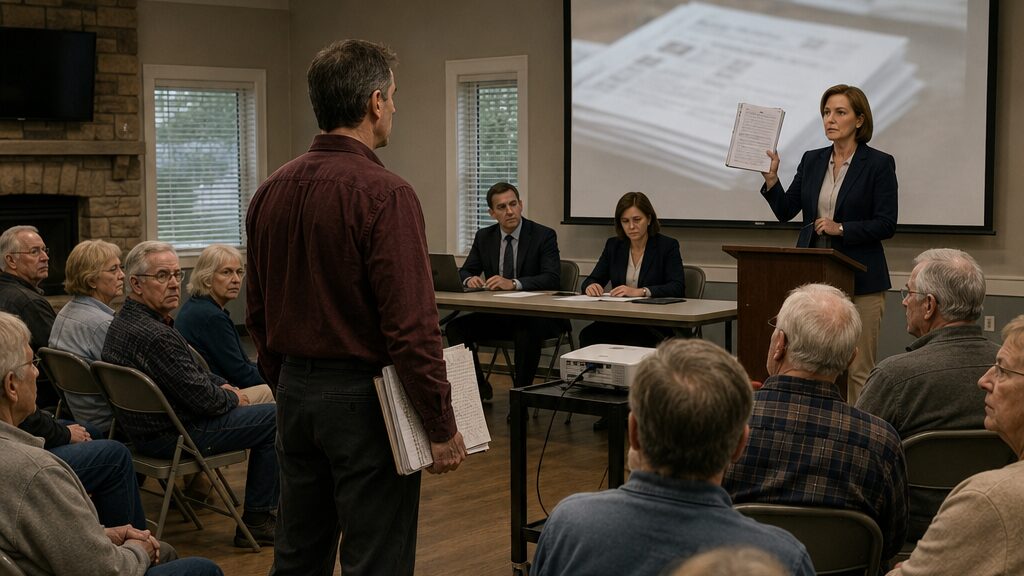
Michael entered the clubhouse and saw his complaint packet projected ten feet high on the wall.
The first page filled the screen: his address, the city case number, and the bold total of $1,045. Someone had enlarged the image until the paper grain showed.
A dozen residents sat in folding chairs facing it. Two board members occupied the long table beneath the screen. Angela Mitchell stood at the lectern with one hand resting beside a stack of meeting agendas.
She looked at Michael, then at the black binder under his arm.
“Good,” she said. “You’re here.”
He took a seat in the second row. “You could have told me this was on the agenda.”
“It became a neighborhood issue.”
“It started as access to my driveway.”
Angela’s smile was small and administrative. “That distinction is exactly what we need to discuss.”
The clubhouse smelled faintly of coffee and floor polish. Through the windows behind the board table, the narrow service lane curved past trimmed hedges and the rear entrance to the pool. No delivery vehicles were allowed there. A red-and-white sign made that clear.
Michael had never paid much attention to it before.
Angela called the meeting to order, approved the previous month’s minutes, and moved through landscaping repairs and pool access before reaching “commercial delivery concerns.”
The projector changed to a photograph from Michael’s camera. A Crestline van crossed his driveway, hazard lights bright in the still image.
Angela faced the room.
“Several residents have asked why delivery schedules have become less reliable and why drivers appear reluctant to service this section,” she said. “The board has learned that repeated complaints and municipal citations were submitted by one homeowner concerning temporary stops of a few minutes.”
Heads turned toward Michael.
Angela did not use his name. She did not need to.
A man in the back row said, “Is that why my packages came two days late?”
“We cannot confirm individual delays,” Angela replied. “But the carrier has informed management that route operations are under review.”
Michael opened his binder.
Angela continued. “Everyone has a right to access their property. At the same time, this community depends on drivers who work under difficult conditions. We should ask whether escalating a brief inconvenience into more than a thousand dollars in fines was proportionate.”
A woman near the aisle murmured agreement.
Michael felt the old urge to correct every imprecise phrase at once. Brief. Inconvenience. Proportionate. Each word tilted the room before he spoke.
He waited.
Angela turned toward him. “Michael, since these are your complaints, would you like to explain what outcome you’re seeking?”
“A clear driveway.”
“That seems simple enough.”
“It was.”
A few people shifted in their chairs.
Angela tapped the projected image with a pen. “Did you attempt to resolve this directly with the driver?”
“Yes.”
“And the company?”
“Multiple times.”
“Were you ever physically prevented from leaving?”
“Yes.”
“For how long?”
“Between five and eleven minutes per stop.”
The man in the back gave a quiet laugh. “Eleven minutes.”
Michael looked at him. “Would you like someone else deciding when you can leave your own house?”
The room tightened.
Angela raised one hand. “Let’s keep this constructive.”
Michael placed the binder on the empty chair beside him.
“I have no interest in discussing whether eleven minutes feels important to someone who wasn’t blocked,” he said. “I’m interested in why multiple drivers used the same exact location after being told not to.”
Angela glanced at the board members. “Delivery drivers make their own operational decisions.”
“That is not what Crestline’s route system says.”
For the first time, Angela’s expression changed.
Michael removed Stephen’s printed route message from the binder.
“The driver who was suspended gave me this,” he said. “His request to relocate the stop was denied because the existing location was listed as a community-approved access point.”
A low murmur moved through the chairs.
Angela held out her hand. “May I see that?”
Michael did not give it to her. “I brought copies.”
He passed a page to the nearest resident and let the stack move backward.
Angela watched each sheet change hands.
“This appears to be an internal company document,” she said.
“It is.”
“Then Crestline needs to explain its terminology.”
“They did.”
Michael opened the binder again and removed a route map Robert Young had emailed that afternoon after Michael forwarded the community-approved phrase and requested its source. Robert had not admitted responsibility. He had sent only a map and a short statement saying the route point reflected information received from neighborhood management during a traffic review.
Michael walked to the board table.
Angela said, “Michael, please remain in the public seating area.”
He stopped before the first row and laid the map on a small side table instead.
Then he placed his handwritten ledger beside it.
The two documents looked unrelated at first. The route map showed the neighborhood as a pale grid with a blue line and numbered stops. The ledger contained rows of times, durations, vehicle numbers, and clipped photographs.
Michael pointed to three entries.
“Monday, 8:09. Wednesday, 8:12. Friday, 8:16.”
He pointed to the route map.
“Each delivery cluster begins at the same assigned stop point.”
The room had gone quiet enough for the projector fan to be heard.
Michael turned a page.
“Tuesday, 8:07. Thursday, 8:11. The drivers were different. The vans were different. The position was the same.”
He looked at Angela.
“If the drivers chose the location independently, why did all of them choose the same six feet of curb?”
Angela folded her hands. “Because it may be the safest practical location.”
“Then why was Stephen’s relocation request denied as community-approved?”
“We do not approve carrier routes.”
“Neighborhood management provided the information.”
Angela’s gaze shifted briefly toward the HOA management representative seated at the end of the board table.
The representative leaned toward the microphone. “Our office communicates with vendors regarding access, parking, and traffic restrictions. That does not mean the board selected a private driveway.”
Michael slid the map closer.
“This point is not at the entrance. It is not beside a common area. It is directly in front of my property.”
One of the board members adjusted his glasses. “Angela, was there a traffic review?”
“There were discussions,” she said.
“When?”
“Last year, after residents complained about delivery trucks near the clubhouse and along the east cul-de-sac.”
Michael heard the phrase and marked it mentally.
The east cul-de-sac.
Angela continued before he could ask. “The lane behind the clubhouse is narrow, and service vehicles damaged the landscaping twice. Management contacted several carriers to discuss safer circulation.”
“That is not the same as authorizing my driveway,” Michael said.
“No one authorized your driveway.”
“Someone confirmed that stop.”
“According to Crestline.”
“According to the route instruction their drivers were disciplined for following.”
The man in the back row no longer looked amused.
Angela stepped away from the lectern. “What exactly are you implying?”
“I’m asking who told the company this location was approved.”
“You are treating a practical traffic conversation as though it were a conspiracy.”
“I didn’t use that word.”
“You didn’t need to.”
The room split into small movements—crossed arms, lowered eyes, papers being reread.
Michael noticed Emily Garcia near the side wall. She had arrived late, still wearing navy scrub pants beneath a long cardigan. She met his gaze but gave no sign of support.
Angela returned to the lectern.
“The board’s responsibility is to balance individual concerns with community needs,” she said. “Drivers cannot stop in the clubhouse lane. They cannot block fire access. They cannot damage common landscaping. If they use a wider curb area for a few minutes, that may be the least disruptive option.”
“My driveway is not a common area.”
“No one said it was.”
“You are describing it as the least disruptive place to transfer disruption.”
Angela’s jaw tightened.
A board member beside her turned through the printed agendas. “Do we have records of the carrier communications?”
The management representative answered. “I would need to check archived correspondence.”
Michael took out another page.
“I requested the public board records available on the resident portal. The minutes show complaints about trucks, but no vote approving a route change.”
Angela said, “Operational communications do not always require a board vote.”
“Using a homeowner’s access point should.”
A woman in the front row raised her hand. “Was Michael notified?”
“No,” Angela said. “Because there was no decision to designate his property.”
Michael looked at the projected photograph of the van across his driveway.
“Then the route point appeared by accident?”
“No one has established that the HOA created it.”
“But you have established that the HOA contacted carriers to redirect traffic.”
“That is not the same thing.”
“No. It’s the step before it.”
Angela’s face remained composed, but she began aligning the agenda pages in front of her, tapping their edges against the lectern.
The gesture reminded Michael of himself.
Precision used as shelter.
The board agreed to request archived communications from management and Crestline. Angela proposed closing the matter until records could be reviewed.
Michael returned to his chair, but Emily spoke before the next agenda item began.
“Can we also review where the trucks were told not to go?”
Angela looked toward her. “The lane restrictions are posted.”
“I mean all the areas residents complained about.”
“That may be part of the traffic correspondence.”
Emily nodded once. “It should be.”
Michael glanced at her, but she was already gathering her bag.
After the meeting, residents left in uneven groups. Some avoided Michael. Two asked whether the $1,045 had actually been paid. One told him he had made a good point but added that delivery drivers were under enough pressure already.
Angela remained near the board table speaking quietly with the management representative.
Michael packed the ledger and route map into his binder. On the floor beside his chair lay an abandoned agenda from an older meeting, its date nearly eleven months earlier. Someone had used the back for notes.
He picked it up to throw it away.
A line beneath Committee Reports caught his attention.
Commercial access liaison discussion—Angela Mitchell to coordinate with carriers following clubhouse lane complaints.
Only one name appeared beside the item.
Michael looked toward the front of the room.
Angela was watching him now.
He folded the agenda along its existing crease and slipped it into his binder.
The question was no longer whether the HOA had spoken to Crestline.
It was why Angela had decided the trucks should stop in front of his house.
Chapter 5: The Street Was Protected by Moving the Burden One House Down
Emily was waiting beside the red-and-white service-lane sign when Michael reached the clubhouse the next morning.
She stood with one hand on the hood of her compact car, still dressed for work. The lane behind her was empty, clean, and wide enough for one vehicle if no one opened a door.
“You wanted to show me something?” Michael asked.
Emily pointed past the sign.
“Drive through.”
“It says authorized vehicles only.”
“That’s part of the point.”
She moved the temporary chain aside. Michael followed in his sedan while she drove ahead. The lane curved behind the pool fence, passed a row of utility cabinets, and emerged near the east cul-de-sac.
At the narrowest turn, fresh shrubs filled a repaired section of landscaping. Concrete posts protected the irrigation equipment.
Emily stopped near the exit and got out.
“Last year, a delivery truck clipped that corner,” she said. “Before that, a moving van crushed two sprinkler heads.”
“So they banned trucks.”
“They redirected them.”
“To my block.”
“Not all of them. Mostly the large package carriers.”
Michael looked along the cul-de-sac. The homes were larger than those on his street, set farther back with circular planting beds and stone mailbox columns. There were no commercial vehicles parked anywhere.
“Who complained?” he asked.
Emily gave him a tired look. “You know I’m not going to hand you a list of neighbors.”
“I asked a question.”
“And I’m telling you the answer matters less than what happened next.”
She walked to the curb and pointed toward the exit.
“From here, the easiest place to serve both sections is your corner. Wide apron. Clear sightline. No hydrant. No common landscaping.”
“My driveway.”
“Yes.”
“You knew?”
“I knew trucks started using your street more often. I didn’t know the company had marked your curb as an approved stop.”
Michael looked again at the repaired shrubs.
Angela’s argument from the meeting sounded more coherent here. The lane was narrow. A truck could damage the common property. A stalled vehicle could block the pool entrance. Redirecting commercial traffic was not irrational.
Choosing one homeowner to absorb it without notice was something else.
Emily leaned against her car.
“There’s another reason I asked you here.”
She pulled out her phone and opened a photograph. It showed a white van positioned across the lower part of Michael’s street. Behind it, an SUV with a home-health agency logo waited at an angle.
“That’s my vehicle,” she said. “Three weeks ago.”
Michael enlarged the image.
“What happened?”
“I was trying to reach a patient on the next block. The delivery van blocked your driveway and narrowed the street enough that the sanitation truck couldn’t pass. We all sat there.”
“For how long?”
“Six minutes.”
“Did you report it?”
“No.”
“Why not?”
“Because I was late already, and I didn’t want to spend half an hour explaining six minutes to three different offices.”
Michael heard the criticism beneath the words.
Emily continued. “Another time, an ambulance had to approach from the other entrance because two delivery vehicles were staged near the corner.”
“Was anyone harmed?”
“No. But access isn’t just your car leaving your garage.”
He looked toward the service lane.
“You think I’m making this too personal.”
“I think it became personal before you understood the system.”
“It is my driveway.”
“And you were right to challenge it.”
“But?”
Emily locked her phone.
“But Stephen is suspended, and the trucks are still coming. That should tell you the problem was never one driver.”
Michael’s face tightened. “He kept parking there.”
“Under an assigned route.”
“He could have explained that clearly.”
“You could have listened when he tried.”
Michael said nothing.
Emily opened her car door, then stopped.
“I’ve sat in kitchens with people who apologize for needing help because every system around them treats inconvenience as a reason to delay them,” she said. “Your records matter. Just make sure they’re aimed at the people who made the decision.”
She drove away before he answered.
Michael remained beside the lane sign.
Authorized Vehicles Only.
The rule protected the clubhouse because the association had chosen to enforce it. His driveway had no sign, no chain, and no board vote. It had only his objections, which had been easier to dismiss.
At home, he spread the route map and ledger across the dining table.
He marked each documented stop with a small red dot. Then he added the homes served during those minutes using delivery timestamps from the neighborhood notifications he had saved. The dots formed two clusters: his block and the east cul-de-sac.
The route used his driveway as a hinge between them.
He added the clubhouse lane in pencil and drew a line through the prohibited section. The alternative route required an extra loop around the development entrance and roughly seven additional minutes.
Seven minutes.
The same amount of time the company repeatedly described as too minor to matter when it belonged to him.
Michael searched the HOA portal for traffic complaints from the previous year. Most details were hidden behind generic summaries, but the meeting records preserved phrases.
Repeated commercial noise near clubhouse.
Concerns regarding heavy vehicles near decorative paving.
Resident requests to protect newly completed landscaping.
One entry mentioned a proposed “carrier coordination solution” led by the board president and management.
Michael opened the agenda he had found after the meeting. Angela’s name remained beside the liaison item.
He called Robert Young.
Robert answered after four rings. “Mr. Carter.”
“I need the original carrier request from the HOA.”
“I’ve sent what I’m authorized to send.”
“You sent a route map.”
“And confirmation that neighborhood management participated in the traffic review.”
“Who requested my stop?”
“That is not stated in the route record I have.”
“Then send the correspondence behind it.”
“I cannot release internal client communications without legal review.”
“Crestline is appealing the citations.”
“Yes.”
“You’re blaming the drivers publicly while withholding the instruction privately.”
Robert’s silence confirmed more than his answer would have.
Michael continued. “Stephen said he requested relocation twice.”
“I’m not discussing personnel.”
“You suspended him for following the approved route.”
“He was responsible for safe vehicle placement regardless of route guidance.”
“That sounds like shared responsibility.”
“It sounds like a safety policy.”
“Did your company know the stop crossed a private driveway?”
Robert exhaled. “The mapping point identifies a curb segment. It does not authorize obstruction.”
“But you denied the relocation.”
“Because the neighborhood contact confirmed the existing access point remained preferred.”
There it was.
“Preferred by whom?”
“I’ve said all I can.”
Robert ended the call.
Michael wrote the sentence in his ledger.
Neighborhood contact confirmed existing access point remained preferred.
He stared at the word preferred.
Not safe. Not legal. Preferred.
That afternoon, an email arrived from the HOA management office announcing that archived traffic correspondence would be reviewed before the next municipal hearing. Angela was copied.
Michael drafted a reply requesting all communications naming his address, lot number, curb segment, or adjacent intersection.
Before sending it, he reopened his original city complaint.
The narrative field showed exactly what he had submitted.
Vehicle obstructed private driveway after prior direct warning. Driver continued stop despite being informed access was required.
No mention that Stephen had said the stop was on the route.
No mention that he had asked who chose it.
No mention that Stephen had answered, Not me.
Michael opened his ledger to the first Monday entry. In the Statement column, the words were still there in his own handwriting.
“The stop is on the route.”
He had preserved the sentence privately and removed it officially.
For weeks, he had treated that as focus. Now it looked like selection.
He printed the complaint and placed it beside the log.
The omission fit perfectly inside the case he had built. It made Stephen appear more independent, more defiant, and more responsible than Michael had known him to be.
At the bottom of the complaint, the municipal hearing date was printed in small type.
Seven days away.
Michael picked up his pencil and drew a box around the missing sentence in the ledger.
The next question was no longer whether Angela had shifted the burden onto his house.
It was whether Michael would admit that he had shifted part of it onto Stephen.
Chapter 6: Angela Changed the Minutes, and Michael Almost Used Them Anyway
Two versions of the same board minutes arrived in Michael’s inbox six minutes apart.
The first came from the HOA management representative in response to his records request. The second was circulated by Angela to the entire neighborhood under the subject line Clarification Regarding Commercial Access Discussion.
Michael opened them side by side.
The archived draft said:
President Angela Mitchell reported that carriers had been advised to avoid the clubhouse lane and east cul-de-sac where practical. Management will coordinate a preferred staging location near the central intersection.
The circulated version said:
The board discussed general carrier safety. No staging location was selected, approved, or communicated by the board or its officers.
The second document carried the same meeting date and the same approval notation as the first.
Michael printed both.
For several minutes, he simply looked at them. The difference was clean enough to explain in under thirty seconds. Angela had not merely forgotten. Someone had rewritten the record to deny the action now under scrutiny.
The hearing officer would understand that.
So would the city attorney.
Michael placed the documents in separate plastic sleeves and added a tab labeled MINUTES DISCREPANCY.
His phone rang before he closed the binder.
Robert Young.
“I understand you requested archived carrier correspondence,” Robert said.
“I did.”
“I may be able to provide selected emails before the hearing.”
“Selected by whom?”
“By our legal department.”
“What would they show?”
“That the neighborhood association requested route changes and confirmed the stop point.”
Michael looked at the two versions of the minutes.
“Send them.”
“There would need to be an understanding.”
Michael’s hand stopped above the binder.
“What understanding?”
“That your complaint distinguishes the association’s site instructions from Crestline’s compliance efforts.”
“You want me to limit the case to the HOA.”
“I want the record to reflect who chose the location.”
“Your company knew drivers were crossing my driveway.”
“We knew there were complaints.”
“You denied relocation requests.”
“Because the site contact repeatedly confirmed the assigned point.”
“And when the citations came, you suspended Stephen.”
Robert’s voice became quieter. “Personnel action is separate.”
“No, it isn’t.”
“It is under our policy.”
“Your policy let management keep the route and put the violations under his employee number.”
“We did not force him to obstruct access.”
“You made deviation punishable.”
Robert said nothing.
Michael leaned back.
“What exactly are you offering?”
“Emails showing Angela Mitchell approved the curb segment as the preferred commercial access point.”
“In exchange for what?”
“You present them as evidence that the route originated with neighborhood management.”
“That is true.”
“And you do not characterize Crestline as knowingly maintaining an illegal stop after the initial complaints.”
“That is also true.”
Robert’s pause was brief but sufficient.
Michael said, “How many complaints did your station receive before the city citations?”
“I don’t have that number in front of me.”
“You called me after the fine. Not before.”
“We receive high volumes of service feedback.”
“That isn’t an answer.”
“The emails are available if you want them.”
“I want the complete chain.”
“I cannot provide internal disciplinary or legal communications.”
“Then you’re not offering the truth. You’re offering the part that helps you.”
Robert’s patience thinned. “Mr. Carter, the HOA designated the location. That is the central issue.”
“It is one central issue.”
“If you spread responsibility across every party, you may weaken the enforcement case.”
Michael looked at his ledger.
That was precisely the kind of warning he would once have accepted. A clean case required a clean line. Too many causes created uncertainty. Too much context gave each party room to point elsewhere.
Angela’s altered minutes could provide the line he wanted.
HOA chose location. HOA denied it. HOA changed records.
He could let Crestline remain a secondary participant and still win.
“Send what you have,” Michael said.
The emails arrived twenty minutes later.
Angela’s first message to the carrier liaison described recurring resident complaints about truck noise, damaged planting beds, and visual obstruction near the clubhouse. She requested that drivers avoid the service lane and east cul-de-sac whenever possible.
A later message included a map with a circle drawn near Michael’s corner.
This central curb area provides the widest turning radius and least impact on common property.
Robert’s predecessor replied:
Please confirm no access restrictions at proposed stop.
Angela answered:
Confirmed. The curb area is suitable for temporary commercial loading.
Michael read the sentence again.
No mention of his driveway. No notice to him. No board vote.
But Crestline’s response did not end there.
Three weeks later, an operations employee wrote:
Drivers report driveway overlap at designated point during peak parking periods. Recommend shifting stop to entrance overflow area.
Robert’s predecessor answered:
Site contact prefers current point due to resident opposition at entrance.
A later email showed Stephen’s first relocation request attached to a route review. The recommendation was again denied.
The company had known.
Not merely that complaints existed, but that drivers reported driveway overlap.
Michael printed the entire chain Robert had sent. He suspected there were more messages withheld, but these were enough to prevent the simple version Robert wanted.
At the HOA management office that afternoon, Michael requested certification of the archived minutes. The representative met him in a small conference room and closed the door.
“I need to be careful,” she said.
“So do I.”
“The first document you received was a working draft.”
“It carries an approval notation.”
“That may have been applied during migration.”
“And the second?”
“Angela requested clarification because the wording overstated her authority.”
“Was the clarification voted on?”
“No.”
“Was the original wording approved at the meeting?”
The representative glanced at the recorder Michael had placed on the table.
“Are you recording?”
“Yes.”
She folded her hands. “The board approved the minutes as distributed at that time.”
“The first version.”
“I would need to review the distribution record.”
Michael pushed both copies toward her. “Which one is the official record?”
“The current portal version.”
“That isn’t what I asked.”
She looked toward the closed door.
“Angela believed the original language could be interpreted as formal route approval,” she said. “Her position is that she communicated traffic preferences, not authorization to block private access.”
“Then why remove the reference to a preferred staging location?”
“I cannot speak for her intent.”
“But you changed it.”
“At her direction.”
The sentence entered the room and stayed there.
Michael wrote it down.
When he returned home, his binder contained more evidence than he had expected to possess: altered minutes, Angela’s map, Crestline’s acknowledgment of driveway overlap, Stephen’s denied request, and the company’s attempt to narrow responsibility.
The case had become stronger.
It had also become harder to use.
If Michael presented only Angela’s messages, the HOA would absorb the blame and Crestline could describe itself as a carrier relying on site guidance. If he included Crestline’s internal warnings, the company would likely defend itself by emphasizing driver discretion. Stephen’s safety investigation could become permanent discipline.
Michael opened the ledger to the first page.
In the Statement column, he found Stephen’s words.
The stop is on the route.
Beneath that, Michael had written the effect on himself: Missed medical appointment.
He remembered his father waiting beside the curb outside the rehabilitation clinic, saying it was fine because he did not want the contractor blamed for being told where to park. Michael had remained silent then. Later, he had despised his own silence so thoroughly that he had mistaken the opposite behavior for courage.
He took a pencil and crossed out a sentence he had written at the top of his hearing summary:
Driver repeatedly ignored direct warning and independently continued unsafe placement.
Above it, he wrote:
Driver continued using assigned stop after direct warning; route changes were requested and denied.
The revised sentence was less useful as an accusation.
It was more accurate.
Michael added a new section to the hearing packet titled Complainant Correction. He attached his original city narrative and highlighted the missing route statement. Then he wrote a short explanation:
My first complaint omitted the driver’s statement that the stopping point was route-directed. The omission overstated individual discretion and should be corrected in evaluating responsibility.
He read it twice.
The words made him look less certain, less injured, and less cleanly right.
He kept them.
Before midnight, Michael reorganized the binder. Angela’s altered minutes remained. Crestline’s warnings remained. Stephen’s requests remained. Nothing was removed because it complicated the result.
On the final page, where the city form asked what remedy he sought, Michael left the line blank.
Maximum penalties would be easy to justify.
So would rescinding Stephen’s suspension.
Neither answered what should replace the route.
Michael closed the binder and placed the handwritten log on top.
At the hearing, the officer would ask whom he wanted punished.
For the first time since the van had blocked his garage, Michael did not yet know what he wanted the city to do.
Chapter 7: He Asked for Access, Not Another Person to Blame
The hearing officer looked over her glasses at Michael and asked, “Which party do you want sanctioned?”
The question came before anyone had described the route, the altered minutes, or the eleven blocked departures. Michael had expected procedure to begin with dates. Instead, the city wanted a target.
Angela sat at the opposite table with the HOA management representative and one board member. Robert Young sat behind Crestline’s attorney, his expression composed. Stephen was alone in the second row, out of uniform, his hands clasped between his knees.
Michael placed the black binder on the table.
“I want the obstruction stopped,” he said.
“That is the alleged violation,” the hearing officer replied. “I’m asking what enforcement remedy you are requesting.”
“Before I answer, responsibility needs to be clear.”
The officer glanced at the clock. “You may present your evidence.”
Michael opened to the first tab.
He began with the simplest facts: dates, arrival times, departure times, vehicle numbers. He showed photographs in which the vans crossed the driveway apron. He explained the missed medical appointment and the repeated requests to move.
The city’s access inspector confirmed that the photographs showed unlawful obstruction. The ordinance contained no loading exemption and no grace period.
Crestline’s attorney did not challenge the vehicle positions. Instead, she argued that individual drivers retained responsibility for legal parking regardless of route guidance.
Angela’s representative argued that the HOA had provided only general traffic preferences, not instructions to use private access.
Each side described itself as adjacent to the decision rather than part of it.
Michael turned to the handwritten ledger.
“These are the same times,” he said, “but reorganized by delivery cluster rather than by violation.”
He placed a new chart beside the original entries. The stops grouped themselves into weekday windows. Each began near his driveway, served the central block, then continued to the east cul-de-sac.
“The route was not random,” Michael said. “The location was used because it saved time after commercial vehicles were redirected away from the clubhouse lane.”
Angela leaned toward her microphone. “Redirecting trucks away from restricted common areas was a legitimate safety measure.”
“I agree.”
The answer appeared to surprise her.
Michael continued. “The lane is narrow. Landscaping was damaged. Residents complained. The problem was not protecting that area. The problem was choosing another household to carry the cost without notice or approval.”
Angela’s mouth tightened. “No one chose your household.”
Michael opened the email chain.
He read Angela’s description of his corner as the widest turning area with the least impact on common property. Then he read her confirmation that the curb was suitable for temporary commercial loading.
“That describes a curb,” Angela said. “Not a driveway.”
Robert’s attorney spoke next. “Crestline relied on the property manager’s representation that the point had no access restrictions.”
Michael turned another page.
“Three weeks later, Crestline’s own operations staff reported driveway overlap and recommended moving the stop.”
The attorney objected that the internal email lacked context.
The hearing officer accepted it provisionally.
Michael showed Stephen’s relocation request and the denial based on neighborhood preference. He showed the second request. Then he showed the altered minutes.
Angela stared at the two versions without touching them.
“The later version was a clarification,” she said.
“Was it voted on?” the hearing officer asked.
“No. It corrected language that overstated my authority.”
“Did you direct management to replace the approved record?”
“I directed management to prevent a false implication.”
The management representative shifted beside her.
The hearing officer asked, “Did the board approve the original minutes?”
The representative answered carefully. “Yes.”
Silence settled across the room.
Michael could have stopped there. Angela’s denial had weakened. Crestline’s knowledge was documented. The city already had enough to uphold the fines.
Instead, he opened the section labeled Complainant Correction.
“My first complaint was incomplete,” he said.
Stephen raised his head.
Michael passed the page to the clerk.
“The driver told me the stop was on his route. I recorded that in my private log, but I removed it from the formal narrative.”
Crestline’s attorney looked toward Robert.
The hearing officer asked, “Why?”
“Because I believed it distracted from the violation.”
“Did you know at that time that the driver had requested relocation?”
“No.”
“But you knew he said the stop was assigned.”
“Yes.”
Michael could feel Angela watching him, perhaps wondering why he had given away the cleanest version of his case.
He looked toward Stephen.
“My complaint made his conduct appear more independent than I knew it to be,” Michael said. “That should be corrected when the city considers driver responsibility.”
The hearing officer reviewed the page.
Crestline’s attorney said, “The company’s personnel process is outside this proceeding.”
“Then it should stay outside the city’s findings,” Michael replied. “The access violation came from a system maintained by both the company and the association. It should not be reduced to one employee’s judgment.”
Robert leaned toward his attorney and whispered something. She shook her head.
The officer returned to her first question.
“Mr. Carter, what remedy are you requesting?”
Michael opened the final section of the binder.
The pages were copies of his ledger, but the times no longer appeared as offenses. He had grouped them into delivery windows and marked three possible staging locations: the overflow area near the entrance, a common curb near the maintenance shed, and a limited stopping zone beside the clubhouse during non-pool hours. Emily had reviewed the routes for emergency access. None required a van to cross a private driveway.
“I’m asking for a temporary prohibition on commercial stopping at my corner until an approved plan exists,” he said. “I’m also asking that the HOA and carrier submit a joint route that preserves driveway, emergency, and sanitation access.”
The hearing officer studied the pages.
“And the existing penalties?”
“They should remain against the fleet account. Crestline continued after notice.”
Robert’s jaw shifted.
“And the association?”
“It should be required to correct its records and disclose any traffic instructions issued without board approval.”
Angela spoke before the officer could respond. “The board should not be punished for one officer communicating resident concerns.”
“You were the officer,” Michael said.
“I was acting for the community.”
“You acted without telling the household most affected.”
Angela looked toward the board member beside her. “The board benefited from reduced traffic complaints. Responsibility cannot be assigned to me alone.”
There was truth in that, though not enough to excuse her.
Michael said, “Then the board can share the correction.”
The hearing officer recessed for fifteen minutes.
No one spoke to Michael in the hallway. Stephen stood near the drinking fountain. Robert remained with counsel. Angela walked past Michael without looking at him.
When the hearing resumed, the officer upheld the verified fleet assessments. She ordered the HOA to preserve both versions of the minutes and provide its complete carrier correspondence. She referred the alteration issue for separate governance review.
Then she addressed the route.
“Effective immediately, commercial vehicles serving this development may not stop within twenty feet of the Carter driveway pending approval of a lawful loading plan. The association and carrier will submit a joint proposal within thirty days.”
Crestline’s attorney asked whether the order applied to individual drivers.
“It applies to the carrier and its assigned routes,” the officer said.
Stephen lowered his head briefly.
The officer added that driver discipline was not part of the municipal proceeding and that the findings would identify route assignment, site guidance, and management notice as contributing factors.
It was not an order restoring Stephen’s job. It was enough to keep Michael’s complaint from becoming proof that Stephen alone had caused the violations.
Outside, Angela stopped beside Michael.
“You understand what this will do,” she said. “Centralized loading will inconvenience dozens of residents.”
Michael closed the binder.
“For a few minutes?”
Her eyes narrowed at the returned phrase.
He did not wait for an answer.
By late afternoon, temporary no-stopping signs stood beside his driveway. Crestline suspended service to the interior streets until a new route could be reviewed.
For the first time in weeks, no hazard lights flashed against Michael’s garage window.
The driveway was clear.
Now the entire neighborhood would have to decide what that access was worth.
Chapter 8: The Final Entry Was the First Morning Nothing Blocked the Driveway
Six weeks later, a Crestline van slowed in front of Michael’s house.
He stood inside the garage with his keys in one hand and the ledger open on the workbench.
The van’s brake lights brightened. Its front wheel turned slightly toward the familiar curb.
Then the driver corrected the wheel and continued down the street.
No amber lights appeared in the garage window.
Michael looked at the blank final row.
At the neighborhood entrance, the old overflow parking area had been converted into a marked commercial loading zone. Drivers stopped there during two scheduled morning windows and one afternoon window. A smaller van carried packages to the interior blocks, while larger vehicles remained near the entrance.
Residents had complained immediately.
The new system required some packages to arrive later. Furniture deliveries needed appointments. During peak hours, homeowners sometimes walked to the loading zone to collect oversized items rather than asking drivers to bring the trucks deeper into the development.
The community email thread blamed “one resident’s enforcement campaign,” though no one used Michael’s name.
Angela’s formal censure had been posted with the revised meeting minutes. The notice stated that she had exceeded her authority by confirming a carrier staging location without board approval and by directing management to replace approved minutes without a recorded vote.
She had not resigned.
At the next election, residents could decide whether she remained president. Until then, she continued running meetings with the same controlled voice, though she no longer referred to traffic coordination as a minor operational matter.
Crestline paid the $1,045 assessment after withdrawing its appeal. The company accepted additional administrative costs for maintaining the route after receiving driveway-overlap warnings.
Stephen’s suspension lasted another eleven days.
Robert never told Michael whether the corrected complaint had changed the outcome. Stephen sent only a brief message after returning to active duty.
Back next month. Different route until training clears.
Michael had read the message several times without replying. Every response he drafted sounded like an attempt to make Stephen relieve him of guilt.
Sorry did not restore eleven days of wages.
I was trying to fix the problem made the apology about Michael’s intention.
He left the message unanswered.
Near nine that morning, Michael drove to the new loading zone. Emily stood beside a folding table reviewing a printed access schedule with the HOA management representative. She had helped separate commercial windows from sanitation collection and home-health peak hours.
A neighbor beside the package shelves complained that the arrangement looked like “a warehouse at the front gate.”
Emily replied, “It looks like a place designed for loading.”
The neighbor picked up two boxes and left without answering.
Michael parked outside the marked area.
The route plan posted on the information board used the same times from his ledger. What had once been a list of violations now determined when large vehicles could enter, which curbs had to remain clear, and where drivers could transfer packages without blocking homes.
Emily joined him.
“You’re early,” she said.
“I wanted to see whether it actually worked.”
“You’ve been watching it for six weeks.”
“I wanted to see it from here.”
She looked toward his car. “Your driveway stayed clear?”
“Yes.”
“And the sanitation truck made it through?”
“Seven minutes ago.”
“Then you can write a successful entry.”
Michael almost smiled. “The log was for violations.”
“That sounds like a rule you invented.”
A van entered the loading zone and stopped between the painted lines. Its hazards blinked, but here the amber lights meant what they had always claimed to mean: a temporary stop in a place prepared to receive it.
The driver stepped down.
Stephen Lewis wore the Crestline uniform again.
He saw Michael near the board and paused before opening the rear doors.
Michael had known Stephen might return that week. Robert’s office had circulated the revised assignments, but knowing was different from standing ten yards away from the person whose name he had placed on a complaint.
Stephen unloaded two bins onto a handcart.
Michael walked over.
“I heard you were back.”
Stephen kept working. “They put me through route-compliance training.”
“For following the route?”
“For not overriding it safely.”
Michael nodded once. “That sounds convenient.”
Stephen looked at him then. There was no humor in his face, but there was recognition.
“Company language usually is.”
Michael held out a folded document.
Stephen did not take it immediately. “What’s that?”
“The corrected route.”
“I have it on the scanner.”
“This copy includes the city restrictions, sanitation windows, and emergency lanes. Emily added the medical-access periods.”
Stephen accepted the page.
It was not the violation packet. No photographs showed his van. No total appeared in bold. Michael had removed the history and kept only what a driver needed to avoid repeating it.
Stephen unfolded the map.
“They finally approved the maintenance-shed curb?”
“Outside pool hours.”
“That saves the second loop.”
“Seven minutes.”
Stephen glanced up.
Michael said, “Apparently seven minutes matters.”
For a moment, neither spoke.
Then Stephen folded the map along its printed line and slipped it into his vest pocket.
“I should have explained the route better the first day,” he said.
“I should have included what you did explain.”
“That wouldn’t have moved the van.”
“No.”
“But it might have moved the blame.”
Michael looked toward the entrance. A line of package bins waited beneath the shelter. The system was slower. Less elegant. More visible. Every household could now see the space and time commercial convenience required.
“I’m sorry,” Michael said.
Stephen closed the rear doors. “I know.”
It was not forgiveness, but it was not refusal either.
A woman approached to complain that her package had been sent to the loading area despite instructions for porch delivery. Stephen listened, checked his scanner, and explained that the smaller van would complete residential distribution within the hour.
His voice had the same tired restraint Michael remembered. The difference was that the vehicle stood in an authorized space while he said it.
Michael returned home.
Near the clubhouse, Angela was speaking with two board members beside the revised traffic signs. She noticed him but did not wave. Michael did not expect her to. The correction had cost her public trust, though not her position. It had also forced the board to admit that many residents had preferred a solution as long as someone else carried its inconvenience.
At his driveway, Michael parked without angling around a van or checking the curb first.
He entered the garage and opened the ledger.
The first pages had grown soft at the corners. Every row named a stop, a duration, a vehicle, and an effect. The book had given him leverage when apologies failed. It had also allowed him to arrange people into columns until their explanations looked like distractions.
On the final line, he wrote the date and the time the Crestline van had slowed.
Under Duration, he placed a dash.
Under Effect, he wrote one word.
Clear.
He closed the ledger.
Through the garage window, sunlight lay across the full width of the driveway. No hazard lights interrupted it.
Michael set the corrected route copy on the workbench where the violation packet had once rested.
Then he backed his car into the street without waiting for anyone’s permission.
The story has ended.