After His Dog Broke Through Our Fence, the Survey Exposed What Both Neighbors Had Hidden
Chapter 1: The Dog Was Already Inside the Garden
Emily’s scream came through the kitchen glass before Michael saw what had caused it.
He dropped the dish towel and reached the patio door in three strides. Outside, Jeffrey Wilson’s brown dog stood between Emily and the house, its paws planted in the overturned soil of her sunflower bed. Behind it, three fence boards leaned inward around a jagged opening.
Emily was pressed against the raised planter. Mud streaked the front of her yellow shirt. One knee was scraped, and both hands were lifted beside her face as if she had forgotten what to do with them.
“Don’t run,” Michael said through the glass.
She looked at him, but the dog turned at the sound of his voice.
Michael opened the door just wide enough to step through and pulled it shut behind him. The dog was not growling. Its tail moved in a low, uncertain sweep, but Michael could see the muscles in Emily’s legs trembling.
“Back,” he said.
The dog took one step toward him.
Michael grabbed the aluminum watering wand from beside the door and held it across his body. “Back.”
A voice came from the other side of the broken fence.
“Buster!”
Jeffrey appeared through the gap wearing sandals and an old gray T-shirt, a white coffee mug still in his hand. He called the dog again, sharper this time. Buster turned, pushed through the hanging boards, and vanished into Jeffrey’s yard.
Michael crossed to Emily. She latched both arms around his neck before he had fully crouched.
“He came in,” she sobbed. “He knocked them down.”
“I know.”
“The flowers.”
“I know. Let me see your knee.”
She would not release him. Michael lifted her and carried her inside, keeping his body between her and the fence. At the kitchen table, he checked her arms, neck, and face. No bites. No deep cuts. The scrape on her knee was shallow, and the dirt on her cheek came away with a wet cloth.
The relief should have loosened something in him. Instead, it left room for anger.
Through the window, Jeffrey was pushing one of the loose boards back into place with his foot.
Michael settled Emily on the couch with a blanket and locked the patio door. “Stay right here.”
“Don’t go outside.”
“I’m only talking to him.”
“Daddy.”
He stopped with his hand on the doorknob.
Emily’s eyes moved toward the backyard. “Make him go away.”
“The dog is inside his house now.”
She shook her head as if that was not what she meant.
Michael went out anyway.
Jeffrey had set his mug on a fence post. He was attempting to wedge a scrap board across the opening without nails.
“That won’t hold,” Michael said.
Jeffrey glanced over. “It’ll hold long enough.”
“For what?”
“For us to figure out whose fence this actually is.”
Michael stared at him. “Your dog came through it.”
“And your kid was outside near the property line.”
“She was in her own garden.”
“I’m not saying she did anything wrong.”
“You just made it sound like she did.”
Jeffrey exhaled through his nose and crouched to lift another board. “Buster got excited. He saw movement through the slats. He’s never bitten anyone.”
“That is not the standard.”
“I know what the standard is.”
“Then secure him.”
“He’s secured.”
“He was standing over my six-year-old thirty seconds ago.”
Jeffrey straightened. He was heavier than Michael remembered, and the movement made him wince before he hid it by reaching for his mug.
“She got startled,” he said. “That’s not the same as an attack.”
Michael looked toward the patio door. Emily was visible behind the glass, wrapped in the blanket despite the warm room. Her face appeared small and pale in the reflection.
“She was screaming.”
“Kids scream.”
Michael’s hand tightened around the watering wand he had carried without noticing. He set it down before Jeffrey could see what the movement meant.
“The post has been leaning for weeks,” Michael said.
“So why didn’t you repair it?”
“Because it’s on your side.”
Jeffrey gave a dry laugh. “That fence was here before either of us bought these houses.”
“You’ve maintained it for years.”
“I replaced two boards. That doesn’t make it mine.”
“It sits behind your shrubs. The finished side faces my yard.”
“That’s not proof of ownership.”
Michael stepped closer to the gap. The bottom of the main post was dark and soft with rot. Fresh splinters marked where the dog had forced through, but the soil around the post had been eroding long before that morning. Michael had noticed the lean in spring. He had meant to photograph it. He had meant to send Jeffrey a message.
He had meant to do several things before Emily screamed.
Jeffrey picked up the mug again. “You work for the city, don’t you?”
“Procurement.”
“Then you know better than to make claims without records.”
“I know enough to expect you to keep your dog inside your yard.”
“And I do. The fence failed.”
“Your fence.”
“That’s what you keep saying.”
Jeffrey took a sip, watching Michael over the rim. His calmness felt practiced, almost ceremonial.
“Look,” he said, “if the boundary shows it’s mine, we’ll talk. If it shows it’s yours, you repair it. Until then, I’m not paying for a six-foot privacy fence because your daughter got scared.”
Michael’s anger sharpened into something cleaner.
“I didn’t ask for a six-foot fence.”
“Not yet.”
Jeffrey lowered the mug and nodded toward the houses beyond Michael’s yard. Curtains had shifted in two windows. Someone on the sidewalk had slowed beside the mailboxes.
“This neighborhood has rules,” Jeffrey said. “You can’t replace fencing without architectural approval. You can’t redirect drainage. You can’t just decide something is my responsibility because you’re upset.”
Michael looked again at the rotted post. Water had collected in a shallow channel beside it. He had never noticed the depression from this angle.
“What drainage?”
Jeffrey’s expression changed only slightly. “The landscaping you had done last summer.”
“The downspout extension ends ten feet from here.”
“If you say so.”
“You know it does.”
“I know water runs downhill.”
Michael took out his phone and photographed the gap, the broken boards, the post base, the muddy footprints, and the flattened sunflower seedlings. When the shutter sounded, Jeffrey’s jaw tightened.
“You taking pictures of my yard?”
“I’m documenting the entry point.”
“Keep the camera on your side.”
Michael took another photograph, this one of the temporary board balanced uselessly across the opening.
Jeffrey stepped closer. “You want to make this official, go ahead. Call the HOA. Call animal control. Pull the survey.”
“I will.”
“Good.”
Jeffrey lifted the mug as though offering a toast.
“The survey will show who pays.”
Michael returned to the house. Emily had moved from the couch to the kitchen doorway but would not cross the strip of sunlight falling from the patio glass.
“Is he fixing it?” she asked.
“Not yet.”
“Is the dog gone?”
“Yes.”
“Can it come back?”
Michael looked past her at the gap. Jeffrey’s scrap board had already slipped several inches.
He took a dining chair, wedged it beneath the patio-door handle, and closed the blinds.
“No,” he said.
The word came out too quickly, too firmly. Emily watched him as if she understood that promises could be made before they were true.
That afternoon, Michael screwed a sheet of plywood across his side of the opening. Emily stood in the kitchen and refused to come out, even after the drill stopped. He gathered the crushed sunflower seedlings alone and set the least damaged ones in a plastic tray.
Before dinner, an email arrived from Jeffrey.
It contained one sentence.
Check the recorded boundary before you send me a bill.
Michael read it twice, then opened the county property-records website.
The online map showed the two lots as clean rectangles. The fence line did not appear at all.
Chapter 2: The Boundary Line Cut Through Jeffrey’s Story
“The plat can tell you where the lots were drawn,” the county clerk said. “It cannot promise where somebody built a fence twenty-eight years ago.”
Michael stood beneath the fluorescent lights of the records office with his folder open on the counter. Inside were printed photographs of the broken boards, the dog’s paw prints, and Emily’s flattened sunflower bed.
“What can tell me?” he asked.
“A current survey.”
“I need something today.”
The clerk studied him, then turned to a row of metal cabinets. “I can give you the recorded subdivision plat and the corner references from the original filing. After that, you need a licensed surveyor.”
She returned with a large sheet folded into quarters. The paper smelled faintly of dust and warm toner. Thin lines divided the development into numbered lots. Michael found his address, then Jeffrey’s.
A note indicated an iron pin at the rear corner between them.
“Is that still there?”
“It may be. It may have been disturbed. It may be under six inches of mulch.”
Michael paid the copying fee and carried the plat to his truck. In the parking lot, he spread it across the steering wheel and traced the measurements with one finger.
The rear property line ran straight. The disputed fence did not, at least not according to the rough measurements he had taken before leaving home. Near the broken section, it appeared to bend toward Jeffrey’s yard.
Not by much. Possibly eighteen inches. Possibly less.
Enough to matter.
He called the first licensed surveyor whose office could send someone that morning. The rush fee made him pause, but only for a second.
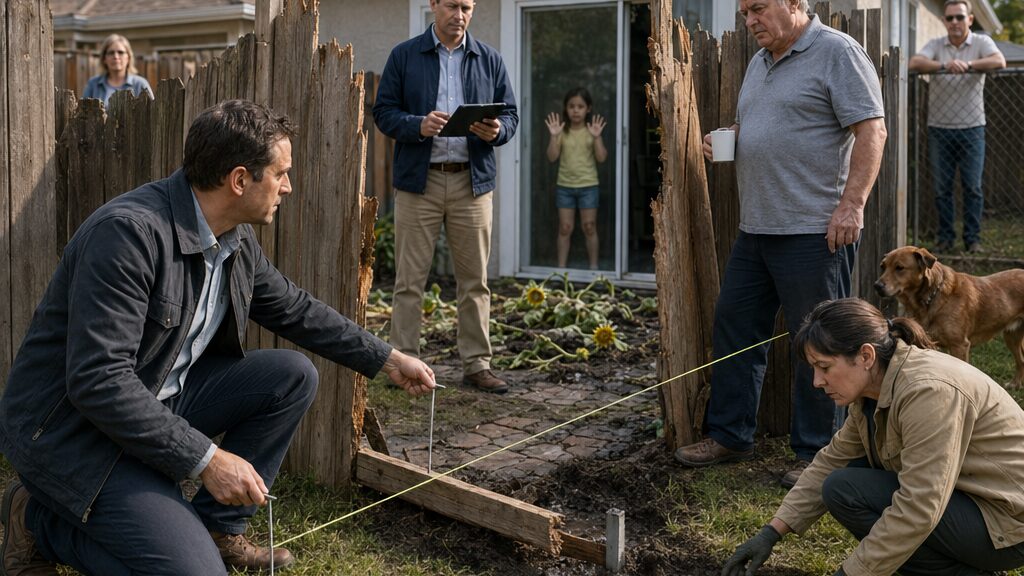
By ten-thirty, the surveyor was standing in the backyards with a metal detector and a narrow steel probe. Jeffrey watched from his patio with his coffee mug. Two neighboring homeowners had found reasons to tend plants close to the property line.
Emily remained behind the glass door.
The surveyor located the front marker easily. The rear corner took twenty minutes. The detector chirped beside a boxwood shrub on Jeffrey’s side, and the surveyor pushed the probe into the soil.
Metal clicked beneath it.
Jeffrey stepped down from his patio. “That could be irrigation hardware.”
The surveyor scraped away dirt with a hand trowel until the top of an iron pin appeared.
“It matches the recorded position,” he said.
Michael felt his breathing slow.
The surveyor set a thin pin at the front reference, then stretched a bright measuring line toward the rear marker. It passed through the grass in a clean diagonal and left the damaged fence well inside Jeffrey’s lot.
Jeffrey stared at it.
“How far?” Michael asked.
“Varies because the fence wanders,” the surveyor said. “At this post, nineteen inches. At the next, around fourteen.”
The property manager from the HOA arrived midway through the measurement, tablet in hand. Linda Hall had sent him after Michael reported the safety breach. Jeffrey greeted him first.
“This is being blown out of proportion,” Jeffrey said. “A child got startled, and now we’re turning it into a boundary trial.”
Michael saw Emily flinch behind the door, though she could not have heard the words through the glass.
The property manager looked at the plywood patch. “Where is the dog now?”
“Inside.”
“Leashed outside until this is secured?”
Jeffrey’s mouth tightened. “He’s trained.”
“That wasn’t my question.”
Michael photographed the survey line crossing the yard. He included the iron pin, the damaged post, and the measuring tape showing the offset. Jeffrey shifted his mug from one hand to the other.
“Record that the fence is inside his parcel,” Michael said to the manager.
The manager glanced at the surveyor. “Is that your finding?”
“My finding is the physical fence sits inside Mr. Wilson’s recorded boundary at this location. Ownership and maintenance responsibility may depend on deeds, agreements, or association rules.”
Jeffrey seized on the qualification. “Exactly.”
Michael crouched beside the broken post. “But it isn’t on my property.”
“Not at this point,” the surveyor said.
Jeffrey placed his mug on the top of an intact post. “So now what? He gets to demand a premium replacement?”
Michael stood.
“My demand is that your dog cannot reach my daughter again.”
For the first time that morning, Jeffrey looked toward the patio door. Emily had moved farther back into the kitchen.
Something passed across his face. It might have been discomfort. It might have been annoyance at being observed.
“I said the dog is inside,” he replied.
“And he stays restrained until the barrier is secure.”
The property manager entered the instruction into his tablet.
Jeffrey laughed once, without humor. “You’re all acting like Buster mauled someone.”
Michael stepped close enough that the survey line ran between their shoes.
“No,” he said. “We’re acting before he gets another chance.”
Silence settled over the yard. Even the neighboring homeowners stopped pretending to work.
The property manager directed Jeffrey to reinforce the opening with fixed plywood before noon. Michael expected satisfaction. Instead, he noticed the surveyor kneeling beside the post base, pressing two fingers into the dark soil.
“What is it?” Michael asked.
The surveyor pointed to a shallow groove running from Michael’s lawn toward the fence.
“Water has been moving through here for a while.”
Jeffrey folded his arms. “I told you.”
Michael ignored him. “From rain?”
“Rain. Irrigation. Downspout discharge. Hard to say without looking.”
The surveyor followed the groove toward Michael’s house. Ten feet away, a black extension carried water from the rear downspout beneath a bed of decorative stone. Michael had approved the work the previous summer when he replaced the cracked concrete beside the foundation.
The extension outlet was supposed to face the center of the lawn.
It faced the fence.
Michael remembered the installer asking whether he wanted the end buried out of sight. He had been on a work call. He had said yes without checking the final direction.
The surveyor crouched beside the outlet. “Who redirected this downspout?”
Michael looked at Jeffrey, who said nothing.
Behind the glass, Emily pressed both hands against the patio door. The bright survey line still proved the fence stood inside Jeffrey’s lot.
But the narrow channel in the soil began on Michael’s side.
Chapter 3: The Photographs Showed More Than Paw Prints
The contractor pushed a screwdriver into the fence post, and the shaft disappeared almost to the handle.
He withdrew it with dark wood clinging to the tip.
“This didn’t rot over a weekend,” he said.
Michael stood beside the plywood patch with his camera ready. “Could the dog have broken it without the rot?”
“Maybe a much larger dog. Not this one.” The contractor tapped the post. “The animal finished a job that water and neglect started.”
Jeffrey was not outside. Buster barked once from inside his house, and Emily retreated from the kitchen window.
Michael photographed the screwdriver hole, the softened base, and the water channel. He took close-ups from both sides of the property line, careful not to frame Jeffrey’s windows. Each image went into a folder labeled INCIDENT.
The contractor walked the length of the fence, testing posts with one gloved hand. Two more moved under light pressure.
“You’re not repairing one section,” he said. “You can brace it, but that only buys time.”
“How much for replacement?”
“For this run? Depends on material and access. I’ll give you two numbers—minimum code-compliant replacement and six-foot privacy.”
“I didn’t ask for privacy.”
“You might after this.”
Michael glanced toward Emily. She was sitting at the kitchen table with crayons arranged in a precise row, though the page in front of her remained blank.
“Give me both,” he said.
The contractor followed the drainage groove toward the outlet. “This needs correction too.”
“Is that what caused the failure?”
“It contributed. But somebody should have replaced that post before it got this bad.”
“Can you put that in writing?”
“I can state what I observed. I’m not assigning legal percentages.”
Michael almost smiled at the phrasing. It sounded like procurement language: exact enough to be useful, narrow enough to avoid ownership.
Inside, Emily was drawing by the time he returned. She covered the page when he approached.
“What are you making?”
“Nothing.”
He set the camera on the counter. “The fence man says we can make it strong.”
“Today?”
“Not today. Soon.”
Her eyes moved toward the blinds. “Is the dog still there?”
“In Jeffrey’s house.”
“Did I make him come in?”
Michael pulled out the chair beside her. “No.”
“I opened the little gate.”
The garden gate stood on the opposite side of the yard, nowhere near the broken fence. Emily sometimes used it to carry her watering can from the side path.
“That had nothing to do with it.”
“I opened it, and then he came.”
“Buster came through the broken boards.”
“But maybe he saw me because I opened it.”
Michael looked at the drawing she had covered. A brown shape filled most of the page. In one corner stood a small figure beside a black square.
“Emily, look at me.”
She did.
“You did not cause this.”
“Were you mad?”
“At Jeffrey.”
“You sounded mad at me.”
The words landed more quietly than accusation should have.
“When?”
“When you said don’t run. And when you said stay inside.”
“I was scared.”
Her expression changed. Adults were not supposed to use that word.
“I thought he might hurt you,” Michael continued. “I was not angry with you.”
She stared at the crayons. “You went outside.”
“I had to talk to Jeffrey.”
“You left me.”
Michael opened his mouth, then stopped.
He had checked her knee. He had locked the door. He had placed her on the couch and gone directly toward the argument because the anger had given him something clear to do.
“I should have stayed longer,” he said.
Emily slid the drawing toward him. The black square was the patio door. The small figure was inside it. The brown dog and the larger figure were both outside.
Michael folded the page once, carefully, and placed it in his folder beside the photographs.
That afternoon, the contractor emailed two estimates. The lower one covered replacement of the failing run with standard wood fencing. The higher included six-foot privacy panels and a locked maintenance gate. Both listed drainage correction separately.
Michael prepared a certified demand to Jeffrey. He attached the survey, photographs, animal-control incident number, temporary-security receipt, and lower fence estimate. He cited the HOA rule requiring owners to maintain structures within their lot.
He read the letter twice.
The contractor’s drainage observation sat in a separate PDF on his screen.
Michael moved the cursor over it.
Including it would give Jeffrey an argument before Jeffrey had admitted anything. Excluding it would keep the demand focused on the dog, the unsafe fence, and the recorded boundary. The drainage work had contributed to decay, but it had not excused Jeffrey from maintaining a structure inside his property.
Michael told himself the report was preliminary.
He removed it from the attachments.
The certified letter went out Monday evening. On Tuesday morning, the tracking page showed delivery.
At eleven-seventeen, an email from the HOA property manager arrived.
NOTICE OF CROSS-COMPLAINT, the subject line read.
Jeffrey alleged that Michael had completed unauthorized drainage modifications that discharged water toward an adjoining structure. He requested an inspection, reimbursement for fence deterioration, and enforcement against Michael’s lot.
Attached was a photograph of the black downspout extension.
The image had been taken before the dog entered Michael’s yard.
Michael enlarged it. The date stamp showed it was six weeks old.
Jeffrey had photographed the drainage problem long before claiming he knew nothing was wrong with the fence.
Chapter 4: The HOA File Was Missing One Complaint
The attachment number skipped from seven to nine.
Michael noticed it before Linda Hall finished explaining the association’s complaint process.
They sat across from each other in the HOA office, a converted model-home dining room with a printer against one wall and framed photographs of neighborhood landscaping on another. Linda had placed the case file between them and turned each page with careful, flattened fingers.
Attachment seven was Jeffrey’s photograph of Michael’s downspout outlet.
Attachment nine was the property manager’s inspection report.
“Where is eight?” Michael asked.
Linda kept her finger on the page. “There may not be an eight.”
“The index says there is.”
She looked at the first sheet. Her expression did not change, but her thumb covered the line Michael had pointed to.
“Old templates sometimes retain numbering,” she said.
“Then why does it say prior maintenance correspondence?”
Linda closed the file.
“We are not here to audit our internal records.”
“We’re here because a fence failed after somebody knew it was unsafe.”
“We are here to determine current compliance.”
Michael sat back. The sentence had the clean, polished quality of language designed to remove people from an event.
Linda was in her late fifties, with silver threaded through dark hair cut at her jaw. She had served as board president for four years and signed every community notice with the same final line: Thank you for helping preserve the safety and appearance of our neighborhood.
Michael had once admired the phrase. Now safety and appearance seemed to occupy unequal halves of it.
“May I see the electronic record?” he asked.
“No.”
“Why?”
“Because it contains association communications not relevant to your complaint.”
“The index says the missing attachment concerns maintenance.”
“It may concern another property.”
“Then show me the lot number.”
Linda folded her hands. “Mr. Garcia, your concern about your daughter is understandable. But this has become a dispute between two owners involving a private fence, a dog incident, and possible drainage violations on both properties. The board cannot take sides.”
“The board does not have to take sides to produce its own records.”
Her gaze hardened slightly. “You work in public procurement. You know records have retention policies.”
“I also know missing attachments do not disappear from an index by accident.”
For the first time, Linda looked toward the door.
The property manager was working at a desk in the adjoining room. Michael could hear the soft clicking of a keyboard, then silence.
Linda opened the file again and removed a single-page printout. “This is the relevant history currently available. Two architectural approvals, one paint notice, and no unresolved fence violation.”
Michael scanned the list. Jeffrey’s lot number appeared beside a hedge-height warning from three years earlier. Nothing about the fence.
“Who created this report?”
“The management system.”
“Who selected the date range?”
Linda did not answer.
Michael slid the page back. “I want the original complaint log.”
“You may submit a written records request.”
“I did. Two days ago.”
“And it is under review.”
“The hearing is Friday.”
“Then you may raise the issue there.”
The door opened behind him.
The property manager entered carrying a box of archived folders. He stopped when he saw the file closed on the table.
“Sorry,” he said. “I thought you wanted the old routing sheets.”
Linda’s face went still.
“I said I would review them,” she replied.
The manager looked from her to Michael. “Should I take these back?”
“No,” Michael said.
Linda’s chair scraped softly as she stood. “Those are internal materials.”
The manager hesitated. He held the box against his chest, uncertain which authority mattered more: the board president who signed his contract or the homeowner whose daughter had been standing beside the failed fence.
Michael rose but did not reach for the box.
“Is there a routing sheet for Jeffrey Wilson’s lot?” he asked.
Linda answered first. “That is not an appropriate question.”
The property manager looked down into the box.
“Yes,” he said.
The room became very quiet.
Linda closed her eyes briefly, then opened them. “Bring the relevant folder.”
The manager set the box on the table and removed a thin manila file. A white routing slip was clipped to the front. Most of the handwriting was administrative shorthand, but one line was clear.
LOT 47 — FENCE LEAN / POSSIBLE FAILURE — OWNER NOTIFIED.
Jeffrey’s address was Lot 47.
The date was eight months earlier.
Michael felt the first clean surge of vindication he had experienced since finding the survey pin. It lasted until Linda removed the sheet from his hand.
“This is not a formal violation,” she said. “It appears to be an informal maintenance inquiry.”
“Who made it?”
“The original complaint form is not here.”
“Convenient.”
Linda’s mouth tightened. “Be careful.”
“About what?”
“Accusing volunteers of misconduct because you dislike the pace of a process.”
Michael looked at the routing slip. A second notation appeared beneath the first.
PHOTO ATTACHED — CONTRACTOR ESTIMATE REQUESTED.
“Where is the photograph?”
Linda turned the sheet over as if the answer might be on the back.
The property manager began sorting through the folder. He found a printed email but no attachment. The email came from the association’s former manager and referred to “the attached image showing separation at the lower post.” It also stated that the owner had agreed to seek a repair estimate.
Michael read the final line twice.
Follow up in thirty days if no owner response.
There was no follow-up.
“You knew there had been a warning,” Michael said.
Linda’s tone lowered. “I knew there had been a conversation.”
“You told me there was no relevant history.”
“I told you there was no unresolved violation.”
“Because nobody opened one.”
Linda returned to her chair. Some of the authority had gone out of her posture, but not the calculation.
“The former manager handled many matters informally,” she said. “That was often appropriate. The board cannot issue violations every time a resident reports an aging board or leaning post.”
“This one fell into my yard.”
“Months later, after drainage changes on your lot.”
Michael looked at her.
There it was: the line the association intended to hold. Not that Jeffrey had no warning. Not that the board had no warning. Only that Michael’s contribution complicated the timeline enough to keep responsibility divided.
“Who removed the attachment from the active file?” he asked.
“I do not know that it was removed.”
“It is listed. It is referenced. It is gone.”
Linda closed the archived folder and placed it beside her chair.
“I am scheduling a compliance hearing for Friday at seven,” she said. “Both lots will be reviewed. The board may assess daily fines if the fence remains unsafe or if unauthorized drainage work caused damage to an adjoining structure.”
“You are fining both of us.”
“I said the board may.”
“The dog came through Jeffrey’s fence.”
“And water may have come from your property.”
Michael gathered his papers. “Will the missing complaint be included in the hearing packet?”
Linda hesitated.
“Yes.”
“The photograph too?”
“If it can be located.”
He left the office with a copy of the routing sheet and the former manager’s email. Outside, evening shadows had begun to stretch across the clubhouse parking lot. The proof he had wanted now existed, but it pointed beyond Jeffrey. The association had been given a warning and allowed it to dissolve into an informal conversation.
Someone was waiting beside Michael’s truck.
Rebecca Wilson stood with her arms folded tightly across a navy cardigan. Michael recognized her from brief visits to Jeffrey’s house, usually carrying grocery bags or guiding a small child out of the back seat.
“You found the old file,” she said.
Michael stopped several feet away. “How do you know?”
“My father called me.”
“Then he knows the hearing is Friday.”
“He knows.”
She glanced toward the clubhouse windows. Linda’s silhouette moved behind the blinds.
Rebecca lowered her voice.
“There’s an estimate attached to that complaint. Or there was.”
Michael said nothing.
“My father told them he never received one,” she continued. “That isn’t true.”
“Do you have it?”
Rebecca’s eyes filled with a conflict that did not resemble fear of Michael. It looked more like exhaustion from standing between two versions of the same person.
“I can get it,” she said.
“Then bring it to the hearing.”
She shook her head.
“Please don’t use it there.”
Chapter 5: Jeffrey Had Chosen Which Bill Not to Pay
Rebecca handed Michael the estimate folded inside an unmarked grocery envelope.
They stood at the edge of Jeffrey’s driveway the evening before the hearing. The broken fence was visible through the side yard, its plywood reinforcement now fixed with heavy screws. From this angle, Jeffrey’s side looked worse. Scrap boards had been nailed across two leaning posts, and a length of wire tied one section to an old metal stake.
The estimate was dated eight months earlier.
Replace seventy-two linear feet of deteriorated wood fencing. Reset compromised posts. Correct standing-water conditions before installation.
At the bottom, beneath the total, the signature line was blank.
Michael looked up. “He told the HOA he never received this.”
“I know.”
“And he photographed my downspout six weeks ago.”
“I know that too.”
“Why are you asking me to protect him?”
Rebecca pressed her lips together. “I’m asking you not to destroy him.”
“He concealed a safety warning.”
“He made a bad decision.”
“Emily was trapped in the yard with his dog.”
“I saw her afterward.”
“Then you understand.”
“I understand more than you think.”
The front door opened.
Jeffrey stepped onto the porch without his coffee mug. He wore a button-down shirt tucked into jeans, as though the meeting required a version of himself he had not yet decided how to present.
“Rebecca,” he said.
She did not turn. “I gave it to him.”
Jeffrey’s jaw moved once.
Michael held up the estimate. “You denied receiving this.”
“I didn’t sign it.”
“That is not the same thing.”
“The contractor wanted to replace the entire run.”
“Because three posts were failing.”
“One was failing.”
“You knew enough to photograph my drainage.”
Jeffrey came down the porch steps slowly. The wince Michael had noticed on the first morning returned, more visible now.
“I photographed it because water was coming through,” he said.
“And then you did nothing.”
“I called the association.”
“You accepted an estimate.”
“I asked for a number.”
“And chose not to pay it.”
Jeffrey looked toward the fence.
“Yes.”
The admission removed the argument so abruptly that Michael felt unbalanced.
Rebecca rubbed one hand over the other. “Tell him why.”
Jeffrey’s expression hardened. “This is not her business.”
“It became her business when you used her fear to hide your own.”
“Rebecca.”
She turned on him then. “You said the fence would last another year. You said the dog never pushed against it. You said there was no reason to spend money we didn’t have.”
Michael heard the word we.
Jeffrey looked older without the mug, without the fence between them, without the practiced irritation.
“My daughter and grandson moved in last fall,” he said. “Her lease ended after the owner sold the building. She needed first month, deposit, storage, school expenses. I had just finished paying hospital bills.”
Rebecca looked away.
Jeffrey continued, each sentence flatter than the one before. “The fence estimate was more than I had available. The contractor would not replace only the damaged post unless I waived the rest. I reinforced it. I believed it would hold.”
“You knew it might not,” Michael said.
“I knew everything might not hold.”
The words hung between them.
For a moment, Michael saw the structure beneath Jeffrey’s conduct. Not kindness. Not innocence. A man protecting the image of stability after stability had become expensive.
It did not make Emily’s terror smaller.
“You could have told me,” Michael said.
“And said what? That I couldn’t maintain my own property? That I needed the new neighbor to split a bill for a fence inside my lot?”
“You chose pride over warning me.”
“Yes.”
Jeffrey said it without defense.
Buster scratched once behind the front door. Jeffrey glanced back.
“I thought he couldn’t reach the weak section,” he said. “He usually stays near the patio. That morning a squirrel ran along your planter. He hit the boards before I got outside.”
“You knew the risk.”
“I knew there was a fence problem. I did not think your daughter was at risk.”
“That distinction exists only because she wasn’t hurt.”
Jeffrey’s face tightened, but he did not argue.
Rebecca stepped between them, not physically blocking either man, only refusing to let the silence become another excuse.
“The HOA can fine him every day,” she said. “His insurance has a deductible. If they place a lien—”
“They are not placing a lien tomorrow,” Michael said.
“You don’t know that.”
Neither did she. The fear in her voice had outrun the process.
Michael looked at the estimate again. The total was high but not catastrophic by itself. Added to fines, drainage correction, temporary fencing, and possible animal-control penalties, it could become something else. Enough pressure could force Jeffrey to refinance or sell.
A week earlier, that possibility would have felt like justice shaped into leverage.
Now Michael imagined strangers walking through Jeffrey’s house while Rebecca packed another set of boxes. He imagined Emily watching the moving truck and learning that safety meant making someone disappear.
“You still owe for the damage,” Michael said.
Jeffrey nodded.
“You still lied.”
“Yes.”
“You still left the dog unsecured after being warned.”
“I secured him after the incident.”
“After.”
Jeffrey looked toward the side yard. “I know.”
Michael folded the estimate along its existing crease. “I’m using this tomorrow.”
Rebecca inhaled sharply.
“But I’m not asking for maximum fines.”
Jeffrey studied him, suspicious even of restraint.
“What are you asking for?” he said.
“A fence that meets code. Immediate containment. Reimbursement for the temporary barrier and Emily’s medical visit. Primary responsibility for replacement.”
“And your drainage?”
Michael felt the report waiting in his briefcase in the truck.
“I’ll correct it.”
“That’s not what your demand says.”
“No.”
The single syllable carried more shame than Michael expected.
He had told himself the drainage report was preliminary. He had told himself the letter concerned Jeffrey’s duty, not his own. Those explanations now sounded too much like Jeffrey saying he had requested a number but never accepted the estimate.
Michael returned home after dark.
Emily was asleep, one hand tucked beneath her cheek. The drawing of the patio door remained in his incident folder. Michael took it out and placed it on the desk beside the survey, the old estimate, and the HOA routing sheet.
Then he opened the contractor’s drainage report.
He added it to the hearing packet and wrote a short cover statement.
This evidence may reduce or complicate my claim. It is included because the board cannot determine responsibility from an incomplete record.
He read the sentence until it no longer sounded like an admission and began to sound like a choice.
At 10:42 p.m., Michael emailed the revised packet to Linda, Jeffrey, and the property manager.
The delivery confirmations arrived within seconds.
Linda replied first.
This substantially changes the matter before the board.
Michael closed the laptop.
That was the point.
Chapter 6: At the Hearing, Michael Weakened His Own Case
Linda Hall called for fines before Michael was allowed to speak.
The clubhouse meeting room held twelve folding chairs, a long board table, and an easel displaying an enlarged photograph of the broken fence. The jagged gap dominated the image. Beneath it, Emily’s sunflower seedlings lay pressed into the mud.
Michael sat on one side of the aisle. Jeffrey and Rebecca sat on the other. Neither man looked across.
Linda adjusted the microphone.
“Given the continuing unsafe condition affecting Lots 46 and 47, I move that the board authorize daily compliance fines against both owners beginning Monday unless a repair agreement is submitted.”
One board member frowned. “Before testimony?”
“The immediate condition is not disputed.”
“Responsibility is.”
“The fines encourage resolution.”
Michael understood the design. Fine both lots, force both owners to settle privately, and prevent the association’s missing complaint from becoming the center of the record.
He stood.
“I object to a vote before the evidence is heard.”
Linda looked at him over the microphone. “You will have an opportunity.”
“After the board has framed both owners as equally noncompliant.”
Jeffrey shifted in his chair.
Linda’s expression cooled. “Sit down, Mr. Garcia.”
Michael sat, but the interruption had changed the room. The two neighboring homeowners in the back row leaned forward. The property manager stopped typing.
The board delayed the motion and began with the survey.
Michael placed the recorded plat beside the surveyor’s field sketch. The bright boundary line showed the fence inside Jeffrey’s property by fourteen to nineteen inches along the failed section.
Jeffrey did not dispute it.
Then Michael presented the prior routing sheet, the former manager’s email, and the unsigned contractor estimate Rebecca had given him. Linda stated for the record that the association had not located the original photograph.
“The absence of that image does not erase the written warning,” Michael said.
“No one has claimed it does,” Linda replied.
“You told me there was no relevant history.”
“I told you there was no formal violation.”
“That distinction is why the fence remained informal until it collapsed.”
A board member asked Jeffrey whether he had received the estimate.
Jeffrey leaned toward the microphone. “Yes.”
Rebecca lowered her eyes.
“Did you inform Mr. Garcia?”
“No.”
“Did you repair the fence?”
“I reinforced part of it.”
“Did you know the post at issue was compromised?”
Jeffrey paused.
“Yes.”
The admission moved through the room without sound. Michael felt the case settle into the shape he had wanted: warning, concealment, failure, consequence.
Then Linda lifted the packet Michael had submitted the night before.
“And now we have this.”
She held up the drainage report.
“This document states that runoff from Lot 46 contributed to soil erosion and prolonged moisture at the failed post. Mr. Garcia did not include it in his original certified demand.”
Every face turned toward Michael.
Linda’s voice remained neutral, but the emphasis was precise. “Would you like to explain why?”
Michael carried his copy to the easel. He placed the drainage report beside the survey map, covering part of the enlarged gap.
“When I sent the first demand, I believed the report was preliminary,” he said.
“Was that the only reason?”
“No.”
The word was harder in public.
“I also believed it would weaken my claim.”
Jeffrey looked at him for the first time.
Michael continued. “The extension on my downspout was installed last year. It was supposed to discharge toward the center of my lawn. It was installed incorrectly, and I failed to inspect it. Water moved toward the fence. That contributed to the post’s deterioration.”
Linda folded her hands. “So both owners bear responsibility.”
“For the post failure, yes. Not equally.”
“On what basis?”
“The fence stood inside Mr. Wilson’s lot. He received a warning and an estimate. He knew the structure was unsafe. His dog was not controlled by any second barrier. My drainage contributed to decay, but I did not know the fence had already been assessed as needing replacement.”
Jeffrey spoke before Linda could respond.
“I didn’t know the water was his until six weeks ago.”
Michael turned. “But you photographed it.”
“Yes.”
“And still did not warn me.”
“No.”
The board member nearest Linda removed his glasses. “Why not?”
Jeffrey looked toward Rebecca. She did not rescue him.
“Because I wanted evidence if the fence failed,” he said.
Michael felt his anger rise again, but this time it did not erase the rest of the room.
“You collected evidence instead of preventing the failure,” he said.
Jeffrey’s voice dropped. “So did you.”
The sentence struck cleanly.
Michael thought of the leaning post he had noticed in spring. The photograph he had meant to take. The message he had meant to send. The way he had left Emily on the couch because confronting Jeffrey felt more useful than sitting beside her fear.
“Yes,” Michael said. “I did.”
Linda looked between them, unsettled by an argument she could no longer divide into winning and losing sides.
The property manager summarized the insurance information. Jeffrey’s homeowner policy would cover a portion of the damage and medical costs, subject to a deductible and liability review. It would not cover full replacement of deteriorated fencing. Michael’s policy might address drainage-related damage but not routine maintenance.
The board could still fine both owners.
Michael looked at the enlarged photograph. The gap seemed smaller in memory than it did on the easel. In the picture, it was not merely a failed structure. It was a place every adult had looked toward and assumed someone else would close.
“I have a proposed resolution,” he said.
Linda gestured for him to proceed.
“Jeffrey accepts primary responsibility for replacing the fence because it is inside his property and because he had prior notice. He reimburses the temporary barrier, the urgent-care copay, and the animal-control fee. I pay to redirect the downspout and contribute the portion of post-base preparation attributed to drainage.”
“And the fines?” Linda asked.
“No fines if the agreement is signed and work begins by Monday.”
One of the neighboring homeowners spoke from the back. “Why would you waive them?”
Michael looked at Jeffrey.
“Because fines do not build a fence.”
Linda’s pen stopped moving.
Michael continued. “The association should also adopt a written escalation rule for safety complaints involving fences, retaining attachments and requiring documented follow-up. That addresses its part.”
Linda’s expression sharpened. “The association has not admitted liability.”
“I did not ask it to. I asked it to correct a process.”
The board recessed for ten minutes.
Michael waited in the hallway beside a bulletin board advertising a summer block party. Jeffrey came out but remained several feet away.
“You did not have to include the drainage report,” he said.
“Yes, I did.”
“You could have won without it.”
Michael thought of Emily’s drawing.
“No,” he said. “I could have collected money without it.”
Jeffrey absorbed the distinction.
When the meeting resumed, the board approved the settlement framework. The fines were suspended. Linda agreed to place the earlier complaint and the missing-attachment issue into the permanent record. A revised maintenance procedure would be drafted for the next meeting.
Jeffrey accepted primary responsibility aloud.
Then the contractor estimate became the next obstacle. Insurance would cover less than half. Jeffrey could not pay the remainder immediately.
“I can do the demolition,” he said. “Set posts too, if the contractor signs off. I built decks for twenty years before my hip got bad.”
Michael looked at him. The old wince, the reinforced boards, the unused competence hidden beneath the denial—all of it aligned into another uncomfortable truth.
“You want to build the fence you refused to replace,” Michael said.
“I want to pay what I owe in a way I can afford.”
The contractor, reached by phone, agreed to supervise and inspect Jeffrey’s labor. Michael would cover his drainage correction separately. Materials would be paid through insurance, Jeffrey’s savings, and a short payment schedule.
Linda asked whether both owners accepted.
Jeffrey said yes.
Michael looked at the photograph one last time, then at the survey line beneath it.
“Yes.”
Outside the clubhouse, Jeffrey stopped beside his truck.
“I’ll start removing the old boards Saturday,” he said. “You can be there or not.”
Michael unlocked his own door.
“I’ll be there.”
Jeffrey nodded, then added, “There’s one thing the contractor suggested. A narrow maintenance gate between the gardens. Locked from both sides.”
Michael turned.
After everything the gap had allowed through, Jeffrey was proposing that they preserve an opening.
Chapter 7: They Rebuilt the Boundary Without Erasing It
The drill started at eight-ten Saturday morning, and Emily dropped her cereal bowl.
It struck the table without breaking, but milk rushed over the rim and spread across the placemat. She clamped both hands over her ears.
Michael switched off the kitchen faucet and crossed to her.
“It’s Jeffrey,” he said. “He’s taking down the old boards.”
Another burst of drilling came through the patio glass.
Emily slid out of her chair and backed toward the hallway.
“Make him stop.”
Michael looked outside. Jeffrey stood on his side of the fence wearing work gloves and a canvas tool belt. The contractor was beside him, checking the first section before demolition. Buster was nowhere in sight.
Michael had spent the previous evening preparing the yard. He had moved Emily’s planters, marked the drainage trench, stacked lumber deliveries along the side path, and printed the agreement in duplicate. Every task had made the work feel controlled.
He had not planned for the sound.
“I’ll stop him,” he said.
He went outside and raised one hand. Jeffrey released the trigger immediately.
“What happened?” the contractor asked.
“Emily needs a few minutes.”
Jeffrey looked toward the house. “I can use the pry bar.”
“No work for a minute.”
The old irritation flashed across Jeffrey’s face, then disappeared. He removed the drill battery and set it on the ground.
Michael returned inside. Emily stood at the hallway entrance, still covering her ears.
“It stopped,” he said.
She lowered one hand.
“Is the dog there?”
“No.”
“Where is he?”
“Inside Jeffrey’s house. Rebecca took him for a walk earlier.”
Emily studied Michael as though checking whether he had verified every part of the answer.
He crouched. “You can stay inside with the blinds closed.”
“Are you going outside?”
“Yes.”
Her shoulders tightened.
Michael remembered the drawing of the small figure behind the patio door.
“Or I can stay in here until you’re ready,” he said.
Jeffrey and the contractor waited outside. Materials sat exposed. The schedule was tight. Rain was forecast for the following week.
None of that changed Emily’s face.
Michael pulled out the chair beside her and began wiping the spilled milk.
They sat together for fifteen minutes. No drill sounded. No hammer struck. The silence was not peaceful, but it belonged to her.
At last Emily asked, “Can I see what they’re doing?”
Michael opened one blind slat.
Jeffrey was removing screws by hand. The contractor held the first loose board steady. Beyond them, Rebecca stood with Buster at the far end of Jeffrey’s driveway. The dog wore a harness and leash.
“They’re making the fence new,” Michael said.
Emily watched Jeffrey carry the board away.
“He looks different.”
“He’s working.”
“No coffee.”
Michael almost smiled. “No coffee.”
She did not go outside that morning, but she remained at the window after the drill resumed at a lower speed.
By noon, three old panels were gone. The backyards opened into each other in a broad strip that made both men uneasy. Buster remained inside. Michael installed temporary construction mesh along his patio and checked each tie twice.
Jeffrey saw him testing the final knot.
“That dog isn’t coming out,” he said.
“The mesh is for Emily.”
“I know.”
They worked without further conversation.
The contractor corrected the post spacing and inspected each hole before concrete was poured. Michael dug a new drainage channel toward the center of his yard, removing the buried extension he had approved without checking. Jeffrey handled demolition and post setting, though his hip forced him to stop often.
On the third day, Michael found him sitting on an overturned bucket, pressing a hand against his side.
“You should let the contractor finish,” Michael said.
“I said I’d do the labor.”
“You said you’d do part.”
Jeffrey looked at the open boundary. “Part has a way of becoming whatever is left.”
Michael took the post level from him. “Then let it become less.”
Jeffrey did not thank him. He stood slowly and moved to sorting hardware.
The new fence rose one section at a time. Each completed panel closed the yards off again, but the final eight-foot section remained open while the contractor waited for a decision about the maintenance gate.
Michael had assumed Emily would want the gate removed from the plan.
When he asked her where the new sunflower bed should go, she surprised him by carrying the plastic tray to the unfinished section.
“Here,” she said.
“That’s next to Jeffrey’s yard.”
She nodded.
“We could put it by the porch.”
“The sun is better here.”
It was the same reason she had chosen the original bed.
Michael began measuring a rectangle several feet away from the fence.
Emily moved the tape closer.
“Right here.”
He looked through the remaining opening. Jeffrey was coiling an extension cord on his patio. Buster sat inside the closed sliding door behind him.
Michael set the first corner stake where Emily had pointed.
That afternoon, Jeffrey brought over the gate hardware. It was narrow, made from the same cedar as the panels, with a keyed lock on each side.
“It’s useful for maintenance,” he said. “If a post needs inspection, nobody has to climb around from the street.”
Michael tested the latch.
“A gap with a lock,” he said.
“A gate,” Jeffrey corrected.
Michael looked toward Emily’s new garden outline.
“No one uses it without both households agreeing.”
“Fine.”
“The dog never comes through.”
“Obviously.”
“Say it.”
Jeffrey’s face tightened.
Then he said, “Buster never comes through.”
The contractor installed the gate between the final two posts. When it closed, the latch made a small, solid click.
Emily heard it from the patio.
She came outside for the first time since the breach.
Michael did not call attention to the moment. He kept kneeling beside the garden bed, loosening soil with a hand fork. Emily crossed the patio slowly and stopped beside him.
Jeffrey froze on the other side of the fence.
Buster barked from inside his house.
Emily gripped Michael’s shoulder.
Jeffrey turned immediately and pulled the curtain across his sliding door. The barking faded.
“He can’t get here,” Michael said.
Emily looked at the new boards, then at the locked gate.
“I know.”
She knelt and pressed one sunflower seedling into the soil. Her hands shook enough to spill dirt over the leaves, but she did not go back inside.
That evening, after the contractor left, Jeffrey stood on his side of the gate with the final inspection sheet.
“The fence passed,” he said.
Michael unlocked his side, opened the gate a few inches, and took the paper without stepping through.
Emily watched from beside the flower bed.
“Is Buster home?” she asked.
Jeffrey turned toward her voice. “Yes.”
“Is he tied?”
“He’s inside.”
Emily considered that.
“Can he watch me from his window?”
Michael felt an immediate refusal rise in his throat.
Before he could speak, Jeffrey said, “Only if you want him to.”
Emily looked at Michael.
For once, he did not answer for her.
Chapter 8: Sunflowers Grew Where the Boards Had Broken
“Open the gate,” Emily said.
Michael stopped with the key halfway into the lock.
It was early June, several months after the fence had passed inspection. The cedar had faded from bright gold to a softer brown. Along its base, the sunflowers Emily had planted stood nearly as tall as her shoulders.
She had not asked to open the gate before.
“Why?” Michael said.
“I want to show Jeffrey the tallest one.”
Michael looked through the narrow space beside the latch. Jeffrey was waiting on the other side with Buster seated beside him. The dog wore a harness and a short leash held in both of Jeffrey’s hands.
Rebecca stood near the patio but did not approach.
Michael had agreed to this after Emily asked three times over two weeks. He had set the conditions himself: Buster leashed, Jeffrey present, gate open no more than halfway, Emily beside Michael, no touching.
Now that the moment had arrived, each condition felt insufficient.
“You don’t have to do this,” he said.
“I know.”
“We can take a picture.”
“I want him to see it.”
Michael turned the key.
The lock released with the same solid click it had made on installation day. He opened the gate eighteen inches and kept one hand around its edge.
Jeffrey did not move forward.
Buster looked through the opening. His ears lifted, but he remained seated.
Emily pressed against Michael’s leg.
“That’s him,” she whispered.
“Yes.”
“He looks smaller.”
From this distance, under Jeffrey’s grip and the rules of the moment, the dog was smaller. Not harmless. Not transformed. Simply contained.
Jeffrey kept his voice low. “He won’t come closer.”
Emily stared at Buster for several seconds.
Then she pointed to the flower bed.
“That one is tallest.”
Jeffrey followed her finger. “It is.”
“It grew where he broke the fence.”
“I know.”
Buster shifted one paw. Emily stepped backward, and Michael began closing the gate.
“Wait,” she said.
He stopped.
Emily looked at Jeffrey rather than the dog.
“Did you know it was broken?”
The question landed without ceremony.
Jeffrey’s hands tightened on the leash. Rebecca lowered her eyes.
“I knew it was getting weak,” he said.
“Why didn’t you fix it?”
“I thought I had more time.”
Emily frowned. “You didn’t.”
“No.”
Michael felt the old anger move through him, but it no longer demanded the whole space.
Emily touched one sunflower leaf with her fingertips.
“My dad didn’t fix the water either.”
Michael looked down at her.
“No,” he said. “I didn’t.”
She nodded as though the answer completed something adults had made unnecessarily difficult.
Buster lowered his head to the grass.
Emily did not move closer. She did not ask to touch him. She did not smile at Jeffrey or offer forgiveness. After another moment, she said, “You can close it now.”
Michael pulled the gate shut.
The latch clicked. Emily reached for the key.
“Can I?”
He placed it in her palm.
She turned it until the lock engaged, then tugged the gate twice to test it. Satisfied, she handed the key back.
Jeffrey remained visible through the narrow spaces between the boards.
“I’ve been checking the posts,” he said to Michael.
“I saw the inspection notes.”
“The drainage has stayed dry.”
“I check that too.”
Their conversations had become like that—specific, limited, and honest enough to function.
The HOA had adopted the new maintenance procedure in April. Safety complaints now required photographs, written acknowledgment, and a thirty-day follow-up. Linda had recorded the missing attachment in the minutes but had never apologized directly. Michael no longer expected her to.
Jeffrey had reimbursed the urgent-care copay, the temporary barrier, and the animal-control fee. His insurance payment had covered part of the materials. He was still making monthly payments to the contractor.
Nothing had vanished merely because the fence stood straight.
Emily returned to the garden bed and knelt beside a smaller seedling that had bent after a storm. Michael crouched with her.
“Should we stake it?” he asked.
“No. It can lean a little.”
“It might fall.”
“Then we help it if it does.”
She pressed soil around the stem with both hands.
On the other side of the fence, Jeffrey led Buster back toward the house. The leash remained short. Rebecca closed the patio door behind them.
Michael watched until the sound of the latch carried through the boards.
He had once believed safety meant eliminating every opening, every uncertainty, every person who could not be trusted to act correctly. He had built his first case that way: one fact at a time, stacked until nothing could enter from the other side.
But the strongest part of the new fence was not the height of the panels or the depth of the posts. It was the record of what each person had agreed to do, and the knowledge that Michael would no longer hide his own failure to make another man’s clearer.
Emily brushed dirt from her palms.
“Can I water them?”
Michael handed her the green watering can.
She walked to the spigot without looking toward the house. Months earlier, she had refused to cross the strip of sunlight at the patio door. Now she moved the length of the yard alone, filled the can, and returned to the flowers beside the boundary.
Water darkened the soil around the tallest sunflower.
A few drops ran toward the fence, but the corrected grade carried them back into the garden.
Emily noticed.
“It goes the right way now,” she said.
“Yes.”
She watered the remaining plants, then set the can down beside the locked gate.
For a moment, she rested one hand on the cedar boards. Michael waited, resisting the urge to ask what she was thinking.
Emily turned away on her own and went back to the sunflowers.
The gate stayed closed.
The garden did not.
The story has ended.