He Drew a Fence Through Their Summer Festival, Then Had to Face Who Else It Hurt
Chapter 1: The First Post Entered the Festival Lawn
The first steel post went into the ground between the children’s stage and the row of food tents.
The driver struck it once, twice, then a third time. Each blow rang across the lawn harder than the music coming through the festival speakers.
People turned before the post had settled six inches.
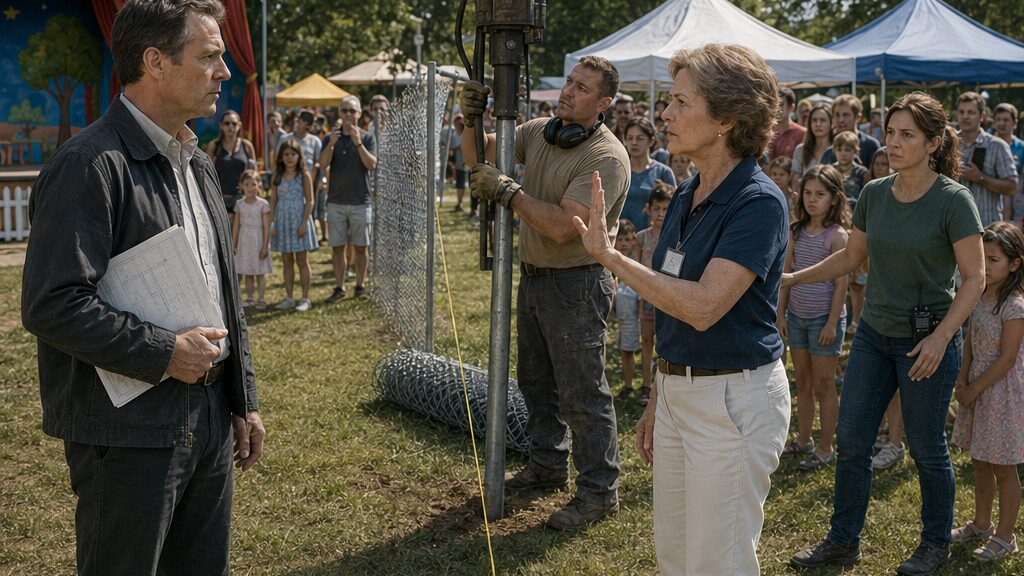
Paul Allen stood beside a taut yellow survey string with a folded county map under one arm. The string ran straight across the grass, passing beneath a paper banner, between two picnic tables, and less than ten feet from a plywood stage painted with suns and blue clouds.
A little girl in a bee costume stopped rehearsing and stared at the contractor.
“Sir,” Deborah Moore called from the registration tent. “Stop that right now.”
The contractor lifted his ear protection. “Ma’am?”
“I said stop. This is association property.”
Paul watched Deborah cross the grass. She wore white slacks and a navy festival polo, the same uniform she had chosen for the volunteer committee. Her laminated badge bounced against her chest as she walked faster.
The contractor looked at Paul.
Paul unfolded the top section of the survey. “Continue.”
A second worker rolled chain-link mesh from the truck. Metal scraped across the trailer bed. Parents began pulling children away from the string.
Deborah reached them breathing through her nose.
“You cannot build a fence through a community event.”
“I’m building it on my property.”
“This lawn is designated shared space.”
“Show him.”
Her eyes narrowed. “Show him what?”
“Your deed. Your easement. Anything that says you own this strip.”
Several people had gathered close enough to hear. Paul recognized most of them. They had borrowed folding chairs from him, waved from their cars, sent their children across his grass chasing balls. That morning they watched him as though he had arrived from somewhere else.
Deborah turned to the contractor. “The HOA president is instructing you to stop.”
The contractor rested both hands on the post driver. “I have a signed work order, a county survey, and marked pins. If you have competing documentation, I’ll call my office.”
Deborah looked toward the HOA clubhouse. Mark Clark stood near the entrance with a paper cup in his hand. He had been there since the truck arrived, but he had not come closer.
Paul noticed that.
“Paul.”
Michelle King pushed through the gathering crowd. A volunteer radio was clipped to her waistband. Her face was flushed.
“The children’s games are set up on this side,” she said. “The stage is over there. You’re cutting the whole area in half.”
“The line cuts it in half.”
“You scheduled this today.”
“Yes.”
“You knew where everything would be.”
He held her gaze. “The association knew where the property line was.”
“That isn’t what I asked.”
Behind her, another post rang into the soil.
The sound unsettled him less than the silence after it.
Michelle glanced toward the children. “There is no alternate space. The west lawn is still torn up from drainage work. We can’t move the stage, and the vendor permits are tied to the approved site map.”
Paul looked at the painted backdrop, at the children clustered near their parents, at the folding tables already arranged for lunch. For four summers, those tables had sat on his grass. He had carried extension cords from his garage and filled coolers from his outdoor faucet. Nobody had ever asked where the common lawn ended.
Until asking became inconvenient.
Deborah held out her hand. “Give me the survey.”
Paul passed it to her.
She scanned the stamped page without really reading it. He had once done the same thing with municipal drawings—looked first for the part that confirmed what he already believed.
“This is from 2019,” she said.
“That is when I purchased the parcel.”
“It doesn’t reflect the association’s established use.”
“Use is not ownership.”
“Four years of continuous community access matters.”
“Then show me where it was granted.”
Her expression changed, but only for a second.
Paul saw it.
The certainty in her voice had arrived before the certainty in her documents.
A month earlier, there had been no fence, no survey string, no crowd watching them. There had only been an envelope pressed beneath the brass lid of his mailbox.
Before that, there had been four summers when the line existed only on paper.
The first year, Deborah had come to his porch carrying a clipboard and two paper cups of lemonade. She had asked whether the festival could place several overflow tables beneath his maple trees.
“Just for Saturday,” she had said. “We’ll clean everything.”
Paul had said yes before the ice melted in his cup.
The second year, the tables became a craft tent and a portable sink. The third year, the children’s stage moved onto his parcel because the ground was flatter. By the fourth, volunteers stopped asking where they could place things. They arrived with stakes, painted lines, and laminated maps.
Paul noticed the change. He told himself it was harmless.
Being useful felt close enough to belonging.
He had lived in the neighborhood six years and still felt like the man who occupied the house at the edge. He attended meetings when drainage or road repairs were discussed, then left before refreshments. He helped neighbors measure fence setbacks and never stayed for dinner.
The festival had been different. For one day each year, people crossed his lawn without hesitation. Children climbed the low maple branches. Elderly residents sat in the shade. Paul opened his side gate and kept it open.
He had never charged the association. He had never asked for recognition.
That was why the letter had felt less like a legal mistake than an accusation.
On the festival lawn, Deborah folded his survey with sharp, uneven movements.
“You are making a serious error,” she said.
“Then identify it.”
“The HOA has a legal claim to continued access.”
Mark finally left the clubhouse steps.
He walked toward them slowly, still holding the coffee he had not drunk.
Paul watched him cross the grass, stepping over the survey string as though it were already a fence.
Chapter 2: The Favor That Became an Obligation
The certified letter gave Paul ten days to surrender control of land he had never agreed to share.
He read it standing beside the mailbox.
The first page was printed on HOA letterhead. The second contained a block of legal language beneath Deborah Moore’s signature. Certain phrases seemed designed to carry more weight than meaning: established communal use, reasonable reliance, community shared space, potential enforcement action.
Paul read the letter twice before he walked inside.
On the kitchen table, the envelope looked official enough to alter reality.
He set his keys beside it and read the final paragraph again.
Failure to preserve access, it said, could expose him to legal remedies and costs associated with disruption of association activities.
The festival was ten days away.
He called Deborah.
She answered after three rings. “Paul.”
“I received your letter.”
“Good. Then we can resolve this promptly.”
“What exactly am I being asked to do?”
A pause.
“Maintain the existing community arrangement.”
“There is no arrangement.”
“There has been annual use for four years.”
“With my permission.”
“Which the association has relied upon.”
“That does not make my property common land.”
“No one said common land.”
“The letter calls it community shared space.”
“It describes how the area functions.”
Paul looked through the kitchen window. Two orange festival stakes had already been driven into the lower part of his lawn.
“It functions that way because I allowed it.”
“And people have planned around that allowance.”
“So you sent a threat.”
“I sent formal notice. There is a difference.”
“Did the board approve this?”
Her answer came too quickly. “The board is aware.”
“That wasn’t my question.”
“Paul, the polite thing would be not to create a crisis ten days before the festival.”
He looked down at the letter.
Polite.
Four years of free use had apparently become the minimum acceptable level of courtesy.
“I’ll respond in writing,” he said.
“That may make this more expensive than it needs to be.”
“For whom?”
She ended the call without answering.
Paul left the letter on the table until evening. He tried to mow the back section of the parcel, but each time he reached the orange stakes he stopped the machine and stared at them.
The property line was not visible in the grass. That had always been part of the problem.
When he bought the house in 2019, the county surveyor had placed two iron pins near the road and two along the drainage easement at the rear. Paul had watched the surveyor stretch a line between them. The result surprised everyone. The parcel extended in a long strip beside the HOA lawn, wider near the street and narrowing toward the trees.
The seller had called it an awkward piece of land.
Paul had liked it for the same reason. It separated his home from the clubhouse parking lot and gave him room for the maples.
He went into the hall closet and pulled down a gray document box.
Inside were closing papers, tax statements, utility plans, and the original survey folded inside a clear sleeve. The plat carried the county seal. A thick line marked the boundary from the curb to the drainage channel.
Paul placed the HOA festival map beside it.
He had received the festival map by email three weeks earlier. He had barely glanced at it then. Now he saw pale green shading labeled OVERFLOW LAWN extending across nearly the entire lower half of his parcel.
The map did not show his property line.
It showed the association lawn as one uninterrupted space.
Paul found older festival maps in his email. The first-year version marked only the HOA parcel. The second added a dotted rectangle for borrowed tables. The third used the words overflow activity area. The newest map had dropped any indication that the land belonged to someone else.
The change had happened gradually enough to look accidental.
That did not make it harmless.
The next morning he visited the HOA office.
Deborah sat behind a white laminate desk with a stack of vendor forms arranged beside her. The room smelled faintly of coffee and copier toner. A poster for the summer festival covered half the bulletin board behind her.
“I came for the agreement,” Paul said.
“What agreement?”
“The one granting the association access to my land.”
She removed her glasses. “We’ve discussed this.”
“No. You have described continuous use. I’m asking for the document that created a right.”
“Rights can arise from conduct.”
“Which right?”
“You should speak to counsel.”
“I intend to.”
Deborah folded her hands. “This community has invested money based on the established site plan.”
“Without asking me.”
“You never objected.”
“I never transferred ownership.”
“No one is taking ownership.”
“Then remove my parcel from the plan.”
Her jaw tightened.
“The vendors are contracted. The stage permit is approved. The insurance certificate is based on that layout.”
“That sounds like a planning problem.”
“It becomes a community problem if you force us to relocate.”
Paul stood quietly.
He could see the appeal she was making. Not legal. Social.
If the festival failed, everyone would know whose land had been withheld. The letter merely gave that pressure official formatting.
Deborah opened a folder. “There may be a compromise. Sign a permanent access acknowledgment, and the association will maintain the grass along that section.”
Paul stared at her.
“You want permanent access in exchange for mowing?”
“I’m offering clarity.”
“No. You are offering me responsibility without control.”
Her voice cooled. “Then we will proceed under the notice.”
Back home, Paul spread the deed, plat, tax map, and festival layouts across the kitchen table.
He found no easement in his closing documents. No license. No memorandum. Nothing except his own repeated permission, given verbally and one year by email.
At the bottom of the newest festival map, in small print, he found a revision date from three months earlier.
Approved for permit submission.
He called the county records office and arranged to inspect the parcel file.
Before he could gather the papers, his phone vibrated.
A message from Mark Clark appeared on the screen.
Don’t answer Deborah yet. Can we talk privately tomorrow morning?
Paul read it twice.
Then he looked back at the map and noticed something else.
Mark’s initials appeared in the revision box.
Chapter 3: The Polite Warning Behind Mark’s Smile
“You’re going to become the man who canceled the festival.”
Mark said it with a tired smile, as though he were warning Paul about rain.
They stood on the sidewalk between Paul’s driveway and the community lawn. Mark wore a gray quarter-zip pullover despite the heat. His hands stayed in his pockets.
Paul held a copy of the certified notice beneath one arm.
“I didn’t plan the festival on land the HOA doesn’t own.”
“No, but you allowed it for years.”
“Allowed.”
“I understand the distinction.”
“Does Deborah?”
Mark looked toward the clubhouse.
“She understands that two hundred families expect this event.”
“That is not an answer.”
“She’s under pressure.”
“So she threatened me.”
“She formalized the association’s position.”
Paul almost laughed. “Did you write that phrase for her?”
Mark’s smile disappeared.
A landscaping crew moved along the far side of the common lawn. One worker dragged a hose across the grass, crossing the property line without noticing.
Paul pointed toward it. “Where does the HOA parcel end?”
Mark looked at the hose.
“You know where.”
“Then say it.”
“This doesn’t need to become hostile.”
“You already made it hostile.”
“I came here to prevent that.”
“Did the board vote on the notice?”
Mark lowered his eyes for a moment. “The board discussed access.”
“Was there a vote?”
“There was consensus that the festival needed protection.”
“That is not the same thing.”
“You know how these meetings work.”
Paul did. He had attended enough municipal sessions during his drafting years to recognize the language people used when they wanted the authority of a decision without the record of making one.
“Did you approve the festival map?” Paul asked.
“I reviewed it.”
“Your initials are on it.”
“That means I checked the logistics.”
“You checked a map showing my property as association space.”
“As overflow space.”
“Without a boundary.”
Mark exhaled. “Paul, nobody is trying to steal your yard.”
“Then remove it.”
“We can’t do that ten days out.”
“Why not?”
“Permits. Insurance. Vendor contracts.”
“All based on land you never secured.”
Mark stepped closer and lowered his voice. “If you make this formal, everyone loses. The board spends money. You spend money. Deborah digs in. The neighborhood blames you.”
“That sounds like the outcome the letter was designed to create.”
“It was designed to make you take the problem seriously.”
“I was serious before I opened it.”
For the first time, Mark looked irritated.
“You live next to the common lawn. There are practical expectations that come with that.”
“I pay taxes on 0.8 acres. Which practical expectation transfers it to you?”
“No one said transfer.”
“You keep avoiding the word because the word makes the claim sound as bad as it is.”
A car slowed as it passed them. The driver lifted two fingers from the steering wheel. Mark waved back automatically.
When the car was gone, he said, “Just give us this year.”
“And next year?”
“We put something in writing.”
“What?”
“We work that out.”
“Permanent access?”
Mark did not answer.
Paul folded the notice once, carefully. “I’ll verify the record.”
“You should.”
The relief in Mark’s face was immediate.
He thought verification would calm him.
At the county records office, the clerk entered Paul’s parcel number and turned the monitor so he could see. The chain of title was clean. The recorded survey matched his copy. Utility easements crossed the rear edge; a drainage easement touched one corner. No access easement benefited the HOA.
The clerk searched under the association’s legal name as well.
Nothing.
“So they have no recorded right to use the strip?” Paul asked.
“Not in this file.”
“Could four years of festival use create one?”
“I can’t give legal advice. But a recorded easement would be listed here.”
She printed a certified parcel report and stamped the final page.
Paul studied the map at a standing counter. He used a pencil to trace the boundary from the iron pin near the road to the rear drainage channel. The line passed directly through the current festival layout: between the stage and food tents, across the craft area, beside the portable sinks.
He felt the satisfaction of a drawing resolving into certainty.
Then the clerk handed him a copy of the temporary-event permit submitted by the HOA.
The approved site plan included his parcel.
The insurance certificate referred to the full event footprint.
The vendor appendix listed electrical service and seating areas located on his land.
Paul turned the pages.
“Who verifies ownership for these applications?”
“The applicant certifies that they have authority to use the site.”
The signature belonged to Deborah Moore.
Mark’s initials appeared beneath the site-plan revision.
Paul carried the certified documents home in a flat envelope.
At his kitchen table, he placed the HOA notice on the left and the county report on the right. He drafted a response stating that permission for festival use was withdrawn immediately. He attached the deed, survey, and parcel report. He requested removal of all stakes, planned installations, and references to his property from association materials.
He sent copies by certified mail and email.
By evening, Deborah replied.
The association disputes your interpretation and intends to proceed with the established festival plan pending legal review.
Paul read the sentence several times.
She was not confused.
She was betting he would not act in front of his neighbors.
He called a licensed fence contractor the next morning.
The contractor met him beside the road and located the visible survey pins. They walked the full length of the line. The contractor measured one hundred sixty feet to the point where the parcel narrowed near the trees.
“Chain-link?” the contractor asked.
“Four feet.”
“Gate?”
“No.”
The answer came too quickly.
The contractor looked toward the festival stakes. “When do you want it?”
Paul could have said Monday, after the festival.
He could have sent another warning.
He could have told Michelle so she could move the children’s program.
Instead, he thought of the phrase community shared space. He thought of Deborah’s signature beneath a certification that she had authority. He thought of Mark telling him everyone would blame him.
“Saturday,” Paul said.
“The event starts Saturday.”
“I know.”
“What time?”
“Eight in the morning.”
The contractor entered the date on the work order.
Paul signed beneath it.
That night, Michelle sent a neighborhood message asking volunteers to arrive early because the festival footprint was larger than ever.
Paul read it and set his phone facedown.
He did not warn her.
Chapter 4: A Straight Fence Through a Crooked Decision
The crew began unrolling the chain-link mesh while the festival announcer welcomed families to the lawn.
The loudspeaker crackled over the first metallic scrape.
“Please gather near the children’s stage for our opening—”
The contractor raised one end of the fencing. Sunlight flashed along the wire. On the opposite side of the survey string, volunteers carried trays of pastries toward tables that would soon be unreachable from the stage without walking around the block.
Paul stood near the first post with the certified parcel report in his hand.
He had imagined the morning many times during the previous week. In every version, Deborah arrived before the crowd, saw the contractor, and finally understood that he would not be pressured into surrender.
Instead, she had continued setting up.
Festival banners crossed his property line. Two food tents stood entirely on his parcel. Extension cords ran from the clubhouse to a portable sink beside his maple trees. Deborah had treated his written withdrawal of permission as another objection that could be managed after the event.
The contractor checked the level on the second post.
“Still good?” he asked.
Paul looked toward the stage.
A volunteer was kneeling beside a row of children, arranging paper crowns. Michelle stood behind them with a radio pressed to her ear. She had not spoken to Paul since arriving.
“Keep going,” he said.
The driver struck.
Parents began filming.
Deborah came down the center aisle between the tents, followed by Mark and two board members. Her face was pale beneath her festival visor.
“You received a cease-and-desist email from association counsel last night,” she said.
“I received an email saying you disputed the boundary.”
“You were instructed not to interfere with the event.”
“My contractor is inside my property.”
“This is deliberate disruption.”
“Yes.”
The directness stopped her.
Mark glanced at Paul. “You might want to reconsider how that sounds.”
“I considered it before I said it.”
The contractor paused beside a table stacked with boxed lunches. “This table has to move.”
A volunteer looked at Deborah.
“Do not move anything,” Deborah said.
The contractor removed his gloves. “Then I stop work until the path is clear.”
Paul folded the parcel report and slipped it into his shirt pocket. He walked to the table, lifted one end, and looked at the volunteer.
“Help me.”
The volunteer hesitated, then took the opposite side. Together they carried the lunches ten feet onto the common lawn.
As they set the table down, a vendor hurried toward them holding a laminated site plan.
“You can’t cut this section off,” the vendor said. “Our contract guarantees direct access to the seating area.”
“With whom?” Paul asked.
“The association.”
The vendor spread the map across the table. The entire festival footprint appeared as one green field. Vendor stalls were numbered across Paul’s parcel. A bold note near the bottom read UNRESTRICTED EVENT ACCESS.
Deborah reached for the map. “That is an operational document.”
“It is part of my agreement,” the vendor said. “You signed it.”
Paul looked at the signature.
Deborah Moore, HOA President.
“Did you tell them you didn’t own this land?” he asked.
“We had established access.”
“You had permission. I withdrew it.”
“After contracts were signed.”
“Contracts you signed without asking me.”
The vendor looked between them. “Who is paying me if I have to close?”
No one answered.
A child began crying near the stage. The opening music had stopped. The painted sun backdrop leaned at an angle because one of its support ropes crossed the survey line and had been removed.
Michelle handed her radio to another volunteer and walked toward Paul.
“Move the fence work to Monday,” she said.
“No.”
“You’ve proved your point.”
“The fence is the point.”
“No, the point was that they cannot treat your property as theirs. Everyone can see that now.”
“Then they can move off it.”
She stared at him. “The children cannot move a stage. The vendors cannot rewrite permits. The families standing here did not send your letter.”
“Deborah knew this was coming.”
“Did I?”
He did not answer.
Michelle stepped closer. Her voice stayed low, but the people around them listened.
“You had my number. You read the volunteer messages. You knew exactly where the activities would be, and you let us set up anyway.”
“I notified the HOA.”
“You notified the people you wanted to embarrass.”
“They are the ones responsible.”
“And the rest of us are what? Useful scenery?”
The question landed more cleanly than Deborah’s threats ever had.
Paul looked toward the fence line. The first section of mesh now stood between the children’s stage and the food area, fastened to three steel posts. It was straight, legal, and impossible to misunderstand.
A boy pressed both hands to the wire and peered through at the table where his parents had left their bags.
Paul had wanted a visible boundary.
He had not allowed himself to picture that.
Deborah stepped beside Michelle. For the first time that morning, her anger was quieter.
“If you stop now,” she said, “we can discuss compensation.”
“You had ten days.”
“And you chose the one hour that would cause the most damage.”
Paul faced her. “You certified authority you did not have.”
Her eyes moved toward the crowd.
“This festival costs more than people understand,” she said. “The stage, insurance, permits, deposits. We could not simply abandon the site because you changed your mind.”
“I did not change my mind. You changed the meaning of my permission.”
“There was no time.”
“There were four years.”
Mark touched Deborah’s arm. She pulled away.
Paul took the county report from his pocket and held it out.
“Show me the easement.”
She did not take the paper.
“Show me the board vote approving your notice.”
A board member turned to her. “There was a vote?”
Deborah looked at Mark.
He focused on the ground.
The contractor cleared his throat. “I need a decision.”
Paul looked along the taut survey string. It crossed the lawn with the indifferent precision he had always trusted in drawings. A line did not care who had been careless. It only separated one side from another.
“Continue,” he said.
By noon, one hundred sixty feet of chain-link divided the festival.
Families walked around the ends. Vendors served from whichever side they had landed on. The children’s performance was moved to a narrow patch near the clubhouse, without the painted backdrop. No one applauded Paul. No one confronted him again.
Deborah spent the afternoon speaking into her phone.
Mark disappeared before the closing announcements.
Paul remained near the fence until the contractor packed the final tool. He told himself he was protecting the installation.
When he went home, an email from his attorney was waiting.
The attorney had reviewed the certified notice, the parcel documents, and the HOA records Paul had forwarded. Attached was a preliminary request for board minutes.
One line had been highlighted.
No recorded motion, resolution, or vote authorizing the access claim or threatened enforcement could be located.
Paul read it once.
Then he read the next sentence.
The notice may have been issued outside the president’s authority, but its drafting history suggests additional participants.
Chapter 5: The Missing Vote and the Convenient Silence
The photograph covered half the newspaper’s front page.
From above, the fence looked like a dark seam stitched through the bright festival tents. Children and parents stood on both sides. Paul was visible near the center, holding the folded survey while Deborah faced him.
The headline did not call him a hero.
It read: PROPERTY FIGHT DIVIDES NEIGHBORHOOD FESTIVAL.
Paul stared at the image on his kitchen table.
The fence was proof that the land belonged to him.
In the photograph, it also looked like an accusation.
His phone had not stopped vibrating since dawn. Some messages praised him. Others called him petty, cruel, or brave in ways that felt equally careless. People who had never seen the deed had already decided what the story meant.
A local reporter had left two voicemails.
Paul did not return them.
At noon, he attended an emergency HOA meeting in the clubhouse. Every folding chair was occupied. Residents lined the back wall beneath the faded festival posters.
Deborah sat at the front table beside the HOA treasurer. Mark’s chair remained empty.
The board opened public comment before addressing the property dispute. The first questions were about money.
“Who authorized the legal notice?”
“Are our dues paying for counsel?”
“Why were vendors promised land the HOA does not own?”
The treasurer shuffled a stack of invoices.
Deborah kept her hands folded. “The association acted to protect a longstanding community use.”
A resident near the aisle raised the newspaper. “Did the board vote?”
“The board was informed of the issue.”
“That is not what he asked,” Paul said.
The room quieted.
Deborah looked at him. “You will have an opportunity to speak.”
“I am asking the same question I asked before the fence.”
A board member adjusted the microphone. “Our review has not identified a formal vote.”
A murmur moved through the room.
Deborah leaned forward. “Operational decisions are routinely delegated to the president.”
“Threatening a homeowner with legal action is not ordering extra trash cans,” the treasurer said.
Deborah’s head turned sharply.
The treasurer did not look away.
Paul’s attorney had advised him to say little. Let the records create the pressure, he had said. Do not turn the meeting into a personal argument.
Paul had always trusted records.
That afternoon, the board released a limited set of emails in response to his attorney’s request. Most concerned permits, vendor layouts, and insurance certificates. Several showed Deborah warning that a late site change could trigger cancellation fees.
One message was from Mark.
Paul opened it at his kitchen table.
Deborah,
I agree we should use stronger language. Calling the parcel private may invite him to withdraw access. Frame it as established shared use and give him a deadline. It may be pressure language, but he is unlikely to challenge the association publicly this close to the event.
Paul read the final sentence again.
Mark had stood on the sidewalk and presented himself as the reasonable one. He had warned Paul about blame while relying on that same fear to make him surrender.
Another email appeared beneath it.
If he pushes back, we can soften the position later and characterize the first notice as preliminary.
Paul leaned away from the screen.
The surprise was not that Mark knew the claim was weak.
It was how ordinary his words were.
No conspiracy. No hidden deed. Just two people deciding that official language could be used to corner someone who preferred not to make a scene.
Paul forwarded the emails to his attorney.
By evening, residents had circulated a petition demanding an independent review of the HOA’s legal spending, festival contracts, and insurance representations. Michelle’s name appeared near the top.
She came to Paul’s door after sunset.
He opened it but did not invite her inside.
“I signed the petition,” she said.
“I saw.”
“It isn’t a declaration that I agree with what you did.”
“I didn’t assume it was.”
She looked past him toward the kitchen table, where the newspaper still lay open.
“Mark helped write the notice?”
Paul nodded.
“I thought he was trying to calm Deborah down.”
“So did I.”
Michelle folded her arms. “Does knowing that make Saturday feel better?”
“It confirms they knew.”
“That was not my question.”
Paul looked toward the fence. Under the streetlights, the metal line seemed thinner than it had during the festival.
Michelle held out several printed pages.
“The treasurer gave these to the volunteer committee. The insurance company warned Deborah that changing the festival footprint could cancel coverage. Three vendors had nonrefundable deposits. The stage company would have charged almost the full amount if we moved within two weeks.”
Paul took the pages.
None excused the false claim. But the numbers explained the panic behind it. Deborah had committed the association to a layout it did not control, then tried to turn that mistake into Paul’s obligation.
“She could have asked for a temporary license,” he said.
“She should have.”
“She could have admitted the problem.”
“She should have.”
“She threatened me instead.”
“I know.”
Her agreement irritated him more than an argument would have.
Michelle looked toward the dark lawn. “She was wrong. Mark was wrong. The board failed. You own the land.”
Paul waited.
“But you knew the insurance and permits might collapse,” she continued. “Maybe not the exact numbers, but enough. You chose the morning when the damage would be public.”
“They chose to proceed.”
“You chose not to warn anyone else.”
“I was not required to.”
“No.”
The word hung between them.
Not required.
It was the same narrow shelter Deborah had built for herself from delegated powers and ambiguous customs. Paul had built his from property law.
Michelle pointed to the newspaper.
“The picture makes Deborah look furious. It makes you look calm. People are reading calm as innocent.”
“I was within my rights.”
“I said nothing about rights.”
She stepped off the porch, then turned back.
“Would you have installed that fence at eight on Saturday morning if there had been no crowd, no cameras, and no one there to watch Deborah lose control?”
Paul opened his mouth.
No answer came that he could respect.
Michelle walked away before he found one.
Chapter 6: What the Boundary Could Not Excuse
Deborah offered to reimburse Paul’s legal costs if he agreed never to discuss how the notice had been authorized.
The proposal arrived across a mediation table three weeks after the festival.
Her attorney called it a confidentiality provision. Paul’s attorney called it payment for silence.
Deborah sat opposite Paul with a legal pad aligned precisely in front of her. Mark occupied a chair near the wall, separate from both sides. He had resigned as vice president that morning but had not yet explained why.
The mediator summarized the offer.
“The association will acknowledge Mr. Allen’s ownership, cover documented survey and legal expenses, repair turf damage, and withdraw all claims of continuing access.”
“In exchange for confidentiality,” Paul said.
“And a mutual non-disparagement clause.”
“Mutual?”
Deborah looked at him. “You have made repeated public accusations.”
“I released records.”
“You allowed the press to turn an administrative disagreement into a spectacle.”
Paul almost answered that she had created the spectacle by ignoring his notice.
Then he remembered Michelle’s question.
The mediator placed both palms on the table. “The objective is resolution.”
Paul’s attorney slid the proposed agreement back across the polished surface.
“Recognition of ownership is not a concession,” he said. “It is the starting point.”
Deborah’s composure tightened.
“The association cannot absorb unlimited expense,” she said. “Our insurer has reserved rights. Vendors are demanding compensation. Residents are withholding dues.”
“Because you promised access you did not have,” Paul said.
“Because you erected a fence through an active event.”
“After you were notified.”
“And after you waited until the crowd arrived.”
The mediator glanced at him.
Paul felt the old instinct to become still. If he did not raise his voice, did not overstate, did not react, he could remain the reasonable person in the room.
That had worked for years.
It had also allowed him to hide from the part of the truth that was not written on the county map.
The mediator turned to Mark. “You asked to make a statement.”
Mark rubbed his thumb along the edge of a paper cup.
“I helped draft the notice.”
Deborah closed her eyes briefly.
Mark continued. “I suggested the phrase established shared use. I knew there was no recorded easement. I thought Paul would object, we would negotiate, and the festival would proceed.”
“You expected me to surrender quietly,” Paul said.
Mark looked at him. “Yes.”
The simplicity of the answer emptied the room.
“Why?” the mediator asked.
“Because Paul avoids public conflict. Because the event was close. Because Deborah had signed contracts before confirming access, and I did not want the board to know how exposed we were.”
Deborah turned toward him. “You approved every step.”
“I approved pressure. You refused the temporary license.”
Paul looked up. “What temporary license?”
Mark reached into his folder.
“Two months before the festival, the insurance representative suggested obtaining written permission from every property owner included in the footprint. I drafted a one-year license for Paul’s parcel.”
Deborah’s attorney whispered to her, but she did not respond.
“What happened to it?” Paul asked.
Mark answered. “Deborah said sending it would admit the HOA did not already control the land. She was worried vendors would ask whether earlier festivals had been improperly insured.”
Deborah’s voice sharpened. “I was worried the entire event would collapse.”
“You chose not to tell the board,” Mark said.
“You told me to solve it quietly.”
“And then I let you take the blame when it failed.”
There it was—the surprise no document had provided. Mark had not been a secret mastermind or a reluctant whistleblower. He had been what he had always seemed: pleasant, cautious, and unwilling to stand beside any decision once it became costly.
The mediator called a recess.
Outside, Paul walked along the completed fence. A temporary construction gate had been installed near the maple trees so contractors could move equipment during turf repairs. It was secured by a brass padlock.
Michelle stood on the common-lawn side.
“The board voted,” she said.
“On what?”
“Formal recognition of your parcel. Unanimous. The maps, rules, and planning documents have to be corrected.”
The small satisfaction came quietly.
No applause. No vindication large enough to erase the festival photograph. Only the thing that should have existed before the conflict: a clear record.
Michelle rested one hand on the gate.
“They also suspended future festivals until access and insurance are resolved.”
“That is their decision.”
“It is partly yours.”
“I offered no access.”
“I know.”
Paul touched the padlock through the wire.
Permanent exclusion had felt clean when he demanded it. No borrowed space. No ambiguous permission. No one crossing the line without asking.
But the fence did not distinguish Deborah from the children, Mark from the elderly residents beneath his trees, institutional entitlement from ordinary neighbors who had believed the maps they were given.
“I do not owe them my land,” he said.
“No.”
Again, Michelle’s agreement left him nowhere to hide.
“The old arrangement cannot continue,” he added.
“It should not.”
“I will not let them call it shared space.”
“They should never call it that.”
He looked at her.
“What do you want me to say?”
“The truth that does not appear on your survey.”
They returned to the mediation room.
Paul’s attorney leaned close. “The board recognition strengthens our position. We can insist on a sealed boundary and full reimbursement.”
Paul looked at Deborah. She appeared older than she had at the festival. Not defeated, exactly. Exposed.
He understood now that her fear had been real. She had been trying to preserve contracts, insurance, an election, and the appearance of competence. Then she had chosen deception because asking would have placed her power in someone else’s hands.
Paul had recognized that impulse because it belonged to him too.
He closed the settlement draft.
“I chose festival morning because it was legally effective,” he said.
No one interrupted.
“And because I wanted Deborah to be unable to hide what she had done.”
Deborah watched him without blinking.
“I wanted her to feel powerless in front of the people she had used to pressure me.”
His attorney shifted in his chair.
Paul continued. “The boundary was mine. The timing was mine too.”
The mediator waited.
“I will not sign confidentiality. I will not recognize permanent association access. I want reimbursement of documented costs, correction of every map, member approval for future land-use commitments, and a written rule requiring proof of permission and insurance before contracts are signed.”
Deborah’s attorney wrote rapidly.
“And the fence?” the mediator asked.
“It stays.”
Michelle’s face tightened.
Paul looked toward the temporary gate visible through the window.
“But I will consider a one-year revocable license for a defined section, with advance notice, insurance coverage, restoration terms, and a gate controlled by me.”
“Consider?” Deborah said.
“Yes.”
“That leaves the festival uncertain.”
“It leaves access dependent on permission.”
The distinction settled over the table.
Deborah pushed the confidentiality agreement away.
“What exactly are you proposing?”
Paul opened a blank legal pad and drew a straight line down the center.
On one side, he wrote ownership.
On the other, he wrote access by written consent.
He turned the pad toward the mediator.
“The board can decide whether it wants reform,” he said. “After that, I will decide whether the gate opens.”
Chapter 7: The Gate Opened Only by Permission
Mark’s emails filled the wall behind Deborah Moore.
The board had projected them in chronological order, each message enlarged until phrases like stronger language and pressure language appeared taller than the people seated beneath them.
Deborah sat alone at the front table.
Mark had taken a chair in the second row, no longer beside her and no longer introduced as vice president. His resignation letter rested in the board packet along with the certified survey, vendor contracts, insurance warnings, and the settlement proposal Paul had drafted during mediation.
The clubhouse was full. Residents stood along the walls and clustered near the open doors. No festival posters remained on the bulletin boards. Someone had removed them before the hearing.
Paul sat beside his attorney with a brass key in his pocket.
The temporary construction gate remained locked.
The board chair adjusted the microphone.
“This hearing concerns unauthorized representations regarding property access, associated financial commitments, and proposed corrective action.”
Deborah raised one hand. “I object to the word unauthorized.”
The board chair looked down at the minutes. “No motion or recorded vote authorized the legal notice sent to Mr. Allen.”
“The president has operational authority.”
“To secure contracts,” the treasurer said, “not to certify ownership rights that do not exist.”
A murmur moved through the room.
Deborah’s attorney leaned toward her, but she continued.
“The board knew the festival depended on that land.”
“Knowing dependence existed is not the same as approving your response to it,” the chair said.
Mark stared at the floor.
The first hour belonged to documents.
The insurance representative explained that the association had been warned to obtain written permission for every part of the event footprint. The treasurer confirmed that cancellation costs would have strained the operating budget but would not have bankrupted the HOA. A board member acknowledged seeing an early draft of the temporary license but assumed Deborah and Mark were negotiating it with Paul.
They had never shown it to him.
The local reporter sat near the back, writing quietly.
Paul had expected the evidence to feel satisfying when spoken aloud. Instead, each fact seemed smaller than it had on paper. A sentence in an email could identify a decision, but it could not reproduce the private calculations that made a person choose it.
Deborah finally addressed the board.
“I made a decision under a deadline,” she said. “I believed the festival protected something valuable in this neighborhood.”
She looked toward the residents rather than Paul.
“People meet there. Older residents who rarely leave their homes come outside. Children perform for their families. New neighbors are introduced. It is easy now to call it only an event, but when it was threatened, I believed protecting it was part of my responsibility.”
Paul listened.
This was the justification she had offered in pieces from the beginning, stripped now of legal phrasing.
The board chair asked, “Did you know Mr. Allen could lawfully withdraw permission?”
“Yes.”
“Did you know there was no easement?”
“Yes.”
“Did you authorize a notice describing his parcel as community shared space?”
Deborah paused.
“Yes.”
“Why?”
Her hands tightened around the edge of the table.
“Because if I had admitted we depended on his permission, then one person could cancel an event serving hundreds.”
“One person owned the land,” the treasurer said.
“I know that.”
The room went quiet.
For the first time, Deborah sounded less defensive than tired.
“I thought the practical need was larger than the technical line.”
Paul felt the brass key against his leg.
The technical line.
For weeks, he had used the same separation in reverse. Ownership was clear. Therefore everything done within it had seemed equally clear.
The board chair called Paul forward.
His attorney carried the proposed agreement, but Paul brought a single page of his own.
The microphone gave a soft burst of feedback when he adjusted it.
“I reject the private settlement offer,” he said.
Deborah looked up.
“I will not accept reimbursement in exchange for confidentiality. The records should remain available to association members.”
Several residents shifted. No one applauded.
“The HOA must reimburse documented legal, survey, and restoration expenses. Every map and planning record must identify my parcel as private property. Future contracts involving land outside the HOA’s ownership must require written permission, proof of insurance, and a recorded board vote.”
The board chair nodded. “Those terms are included in the proposed corrective resolution.”
Paul unfolded his page.
“There is one additional statement I want entered into the record.”
His attorney turned slightly toward him.
Paul had shown the statement to no one.
“The notice was improper,” he said. “The association had no easement. Deborah Moore and Mark Clark knew the legal claim was weak, and they expected me to avoid public conflict.”
Mark closed his eyes.
“Those facts do not excuse what I chose next.”
The room became still.
Paul kept his hands flat on the lectern.
“I scheduled the fence installation for the morning of the festival. I could have installed it earlier. I could have warned the volunteer coordinator. I could have waited until the event ended and still protected my ownership.”
Michelle stood near the side wall. Her expression did not change.
“I chose that morning because I wanted the violation to be visible. I wanted Deborah to lose control in front of the same neighbors whose expectations had been used against me.”
Deborah watched him carefully.
“I was entitled to close my property. I was not required to turn that right into a public punishment.”
The sentence cost him more than he had expected.
It did not weaken the deed. It did not create an easement. Yet admitting it felt like stepping away from the only ground he had trusted.
A resident near the back asked, “Are you saying the fence comes down?”
“No.”
The answer was immediate.
Paul looked across the room.
“The boundary remains. The association does not gain permanent access. But a boundary can protect ownership without ending every relationship across it.”
He presented the final proposal.
A one-year license would allow festival access through a defined section of his parcel. It could not renew automatically. The HOA would need to request it at least ninety days in advance, provide insurance naming Paul as an additional insured, obtain member approval, pay for restoration, and identify the land correctly on every map.
Paul retained the right to refuse.
The fence would remain, but one section would be replaced by a permanent gate.
“The gate stays locked except during approved access,” he said. “I keep the key.”
The board recessed to review the resolution.
Residents spilled onto the clubhouse lawn. Some approached Paul, but he kept conversations brief. A few thanked him for speaking honestly. Others asked whether the new process would make future festivals too expensive.
Michelle waited near the sidewalk.
“You did not tell me you were going to say that,” she said.
“I did not know until this morning.”
“Which part?”
“The part that was mine.”
She looked toward the fence.
“Will you sign the license?”
“If they accept the terms.”
“And next year?”
“They ask again.”
A small smile appeared and disappeared.
“That sounds inconvenient.”
“It should be a little inconvenient to use someone else’s land.”
The board reconvened after forty minutes.
The corrective resolution passed unanimously.
Paul’s ownership would be formally acknowledged in the HOA records. His documented costs would be reimbursed. The association would adopt written land-use and contract-approval procedures. Festival expenses and legal spending would undergo independent review.
Mark’s resignation was accepted immediately.
Deborah was removed as president and barred from serving as an officer for the remainder of the term. She would remain a homeowner and association member.
When the chair asked whether she wished to make a final statement, Deborah stood.
“I accept the board’s decision,” she said.
She gathered her papers.
Paul waited for her to look at him.
She did, but only briefly.
“I should have asked,” she said.
It was not an apology.
Then she left through the side door.
The absence of a cleaner ending bothered Paul less than it once would have. An apology demanded under public pressure would have been another performance arranged for the room.
Mark approached after the meeting.
“I am sorry,” he said. “I told myself I was keeping people calm.”
“You were keeping yourself out of the decision.”
Mark nodded.
There was nothing more to add.
The permanent gate was installed three weeks later near the maple trees. It was wide enough for equipment carts and vendor supplies, framed by reinforced posts and fitted with a new brass padlock.
The contractor handed Paul two keys.
Paul kept both.
The following summer, the festival returned on a smaller footprint.
The HOA submitted its request four months early. Michelle delivered the signed license in person, along with the insurance certificate and approved site plan. The map showed the property line as a solid black boundary. Paul’s section was labeled PRIVATE PARCEL—TEMPORARY LICENSED ACCESS.
He read every page before signing.
On festival morning, volunteers stopped at the locked gate rather than walking around it. Tents and supplies waited on the common-lawn side. No one crossed early.
Michelle stood beside a cart carrying folding tables.
“We are ready when you are,” she said.
Paul took the brass key from his pocket.
Across the fence, children gathered near the rebuilt stage. The painted sun backdrop had been repaired. Vendors arranged their signs within the marked spaces. Under the maples, the grass waited empty.
Paul fitted the key into the padlock.
For years, the open lawn had made permission invisible. Then the fence had made refusal impossible to ignore.
The gate allowed both to be seen.
He turned the key and lifted the chain.
Michelle pulled the gate inward, then stopped before crossing.
“May we?”
Paul looked along the straight fence line, then at the people waiting behind her.
“Yes,” he said. “For today.”
The volunteers rolled the tables through.
Paul closed the gate behind the final cart but did not lock it. The brass key remained in his hand.
The story has ended.