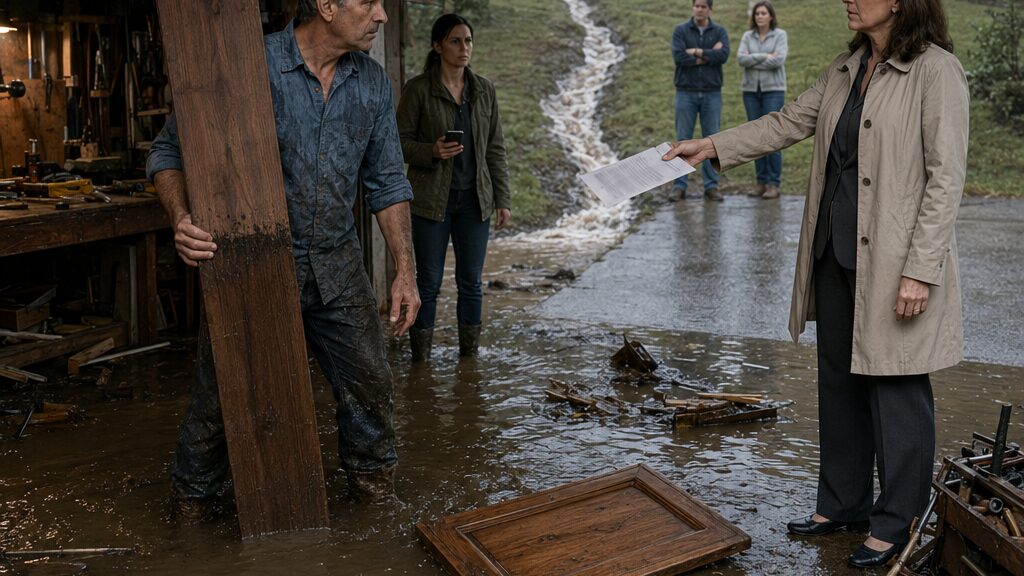
The HOA Called His Flooded Workshop Illegal Until the Old Drainage Map Exposed Their Choice
Chapter 1: The Notice Above the Muddy Waterline
A finished cabinet door floated past Charles Martinez’s workbench with the brass hinges still attached.
For several seconds, he watched it move through the muddy water as if it had somewhere to go.
The door belonged to a walnut display cabinet commissioned for a couple who had waited seven months for him to begin. He had fitted the panel the previous afternoon, checked the reveal with a folded business card, and left it clamped overnight. Now the panel bumped against the leg of his table, turned slowly, and drifted toward the open garage door.
Charles stepped into water above his ankles and caught it before it reached the driveway.
The weight surprised him. The wood had already begun to drink.
Across the workshop, hand tools lay beneath brown water. A cordless drill blinked once under the surface and went dark. Two drawers had swollen shut. A stack of milled maple rested against a wall where the water had climbed almost twelve inches, leaving a sharp muddy line across the pale boards.
Charles set the cabinet door on two sawhorses and listened.
The storm had passed before dawn. No rain struck the roof now. Yet water still entered along the back corner of the workshop in a narrow, forceful stream, pushing silt through the gap beneath the rear service door.
It had never come from there before.
His phone rang on the dry shelf beside the window.
“Dad?”
Ashley’s voice filled the shop before he could answer properly.
“I’m here.”
“That doesn’t tell me anything.”
Charles looked at the floating extension cord, the collapsed cardboard boxes, the dark stains spreading into the legs of his assembly table.
“There’s water.”
“How much?”
“Enough.”
“Enough for what?”
He did not reply.
Ashley inhaled sharply. “I’m coming over.”
“You don’t need to.”
“I wasn’t asking.”
She ended the call.
Charles put the phone down and moved toward the lumber rack. The lower half of his walnut stock had been submerged. He pulled one board free, nearly eight feet long and dark as coffee where the flood had reached it. The upper section remained warm brown. Between the two ran a hard, dirty boundary.
He had bought that walnut for a memorial cabinet the HOA planned to place in the clubhouse lobby. The board had been selected for its straight grain and quiet color. Now mud filled the pores.
Outside, the neighborhood looked insultingly clean.
Water shone along the curb. Leaves clung to driveways. Above Charles’s back fence, the HOA common green rose in a smooth slope toward a gazebo and walking path. The grass there was bright, trimmed, and almost untouched.
A stream cut down from it through the narrow strip beside his property.
Not a broad wash. Not scattered runoff.
A channel.
Charles carried the walnut board to the workshop threshold and stood it upright. The muddy line on the wood aligned almost exactly with the stain on the door frame.
A white SUV stopped in front of the house.
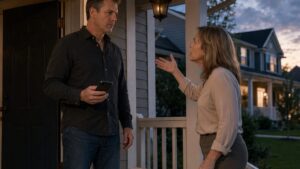
Katherine Mitchell stepped out holding a folder beneath one arm. She wore dark slacks, low heels, and a raincoat too clean for the morning. Behind her, two residents slowed on the sidewalk, looking toward the open garage.
Charles expected questions about damage.
Katherine crossed the driveway and stopped before the water.
“I received a report that you’re operating machinery during restricted emergency conditions.”
Charles stared at her.
She removed a sheet from the folder.
“This is a temporary suspension notice pending review of your home-business approval.”
He looked at the paper but did not take it.
“You came here to cite me?”
“I came because the board has responsibilities.”
“My workshop is under water.”
“I can see that.”
“Then look behind the house.”
Katherine followed his gesture toward the stream. Her expression did not change.
“The storm was severe throughout the county.”
“That water came off the common green.”
“The common green is uphill.”
“Yes.”
“Water follows gravity, Charles.”
The sentence was calm enough to sound rehearsed.
Ashley’s car pulled in hard behind the white SUV. She got out with her phone already in her hand, took one look through the open garage, and stopped.
“Oh, Dad.”
Charles felt the sympathy more sharply than the cold water around his boots.
Katherine held the notice toward him again. “You’ll need to suspend commercial activity until the architectural review committee confirms compliance.”
Ashley turned. “You’re delivering that now?”
“The timing is unfortunate.”
“The timing is deliberate.”
“Ashley,” Charles said.
She looked at him, angry because he had used the warning tone he had used when she was sixteen.
Charles took the notice.
Mud from his fingers marked the lower corner.
Katherine glanced toward the walnut board. “You should contact your insurer. Flood damage is generally a homeowner matter.”
Charles looked again at the concentrated stream behind the shop.
“Say that again.”
Katherine frowned. “What?”
“What you said about the water.”
She shifted her weight. “Water follows gravity.”
Charles nodded toward Ashley.
Ashley raised the phone.
He placed the notice flat against the walnut board, then turned the board so the muddy waterline remained visible. Behind it, through the open rear of the garage, the runoff channel could be seen cutting from the common green toward his door.
Ashley took three photographs.
Katherine’s mouth tightened. “I don’t consent to being recorded.”
“You’re not in the frame,” Ashley said.
Charles lifted the notice and folded it once.
The humiliation inside him changed shape. It became smaller, harder, more useful.
Katherine turned back toward her SUV. “The board hearing is Thursday. Bring any permits you believe apply.”
“Will the board bring the drainage plans?”
She stopped.
For the first time, her composure shifted—not enough for the two residents watching from the sidewalk to notice, but enough for Charles.
“What drainage plans?”
“The ones for whatever was done above my fence.”
“No board project caused this.”
“Then the plans should be easy to show.”
Katherine got into her vehicle without answering.
Ashley waited until the SUV disappeared around the corner.
“You knew she was coming?”
“No.”
“You knew there was a problem with the approval?”
Charles looked down at the suspension notice.
“It’s old paperwork.”
“That isn’t an answer.”
“We need to save what can be saved.”
They spent the next two hours lifting tools, opening drawers, moving lumber, and photographing everything before disturbing it. Ashley created folders on her phone: equipment, materials, client work, entry points, exterior flow.
Charles said little.
At the rear of the property, the channel narrowed near the fence. Fresh silt lay over the older ground. He followed it uphill through wet grass until he reached a shallow depression beneath the common green.
There, half hidden by ornamental shrubs, was the end of a black plastic pipe.
The opening had been packed with pale gravel.
Not washed-in stones. Not debris carried by the storm.
Clean, angular gravel, pressed tightly around the pipe and covered with a thin layer of new soil.
Charles crouched and touched it.
The stones were still loose beneath the surface.
Behind him, Ashley stopped walking.
“That wasn’t there last year,” she said.
Charles looked at the buried opening, then at the muddy line running straight from it toward his workshop.
“No,” he said. “It wasn’t.”
Chapter 2: The Board Says Nature Needs No Permission
The insurance adjuster asked the question before stepping out of the driveway.
“Was any common property altered recently?”
Charles stood beside the open garage with his arms folded. Industrial fans roared behind him, pushing the smell of wet wood and river mud into the morning air.
“I don’t know.”
The adjuster looked uphill.
“That’s not the same as no.”
He had spent forty minutes photographing the workshop, measuring the waterline, and marking damaged equipment on a tablet. He had not promised coverage. He had not used the word denied either.
Now he pointed toward the narrow channel behind the fence.
“Natural runoff usually spreads. That looks concentrated.”
“So the HOA caused it?”
“I didn’t say that. I said I’d want to know what changed.”
He handed Charles a card. “Your policy may cover contents depending on the classification. Structural flood damage is more complicated. Preserve everything. Don’t discard the boards.”
Charles glanced toward the walnut plank leaning beneath the window.
“I wasn’t going to.”
Two days after the flood, the workshop no longer held standing water, but it had not returned to being a workshop. Tools sat disassembled on towels. Cabinet parts had been stacked by damage level. The floor wore a film of reddish mud that reappeared whenever it dried.
Ashley had taped the HOA suspension notice to the wall above the desk.
Charles had taken it down twice.
She had put it back both times.
That evening, they carried a file box into the HOA clubhouse.
The hearing was held in a meeting room usually used for holiday potlucks and children’s craft events. Folding tables formed a shallow U. Katherine sat in the center with Daniel Lee on one side and an architectural review committee member on the other.
An attorney Charles had never seen before occupied the end seat.
On the wall behind them, a projector displayed Ashley’s photograph from the flooded workshop: the stained walnut board, the HOA notice, and the concentrated runoff visible through the rear opening.
The image was larger than Charles expected.
He disliked seeing his damage made public, especially the crooked shelf and overturned buckets in the background. He knew everyone else saw the flood. He saw disorder.
Katherine opened the hearing.
“This meeting concerns two separate matters. First, Mr. Martinez’s claim that association property contributed to damage at his residence. Second, his compliance with the home-occupation provisions.”
“They became separate after the flood?” Ashley asked.
The attorney looked over his glasses. “Comments should be directed through the chair.”
Charles placed one hand on Ashley’s folder before she could answer.
Katherine continued. “The association has reviewed the initial photographs. We find no evidence establishing that the common green caused the loss.”
Charles nodded toward the projected image.
“What do you call that channel?”
“Post-storm erosion.”
“It ends at my door.”
“Because your lot lies downhill.”
“Was work done on the green?”
Daniel looked down at the papers before him.
Katherine said, “Routine stabilization.”
“What kind?”
“Landscape maintenance.”
“By whom?”
“The association is not required to litigate vendor details in an architectural hearing.”
Charles heard the word litigate and understood why the attorney was there.
Ashley changed the projected image. The next photograph showed the pipe opening packed with pale gravel.
“This was taken the morning of the flood,” she said. “The soil over it was fresh.”
Katherine leaned back. “That pipe is part of an older landscape system. Its condition has not been shown to have any connection to your father’s property.”
“Then what does it connect to?” Charles asked.
The attorney answered this time. “Mr. Martinez, speculation presented as accusation may expose you to consequences beyond this hearing.”
The room became still.
Charles looked at Daniel.
“You’re treasurer. Did the board pay for work near that outlet?”
Daniel pressed his thumb along the edge of a document.
“There was an erosion stabilization expense.”
Katherine turned toward him.
Daniel kept his eyes on the table. “Late spring. The slope near the gazebo was losing soil.”
“What was installed?” Charles asked.
“I don’t have the project file here.”
“But contractors worked there.”
“Yes.”
The answer changed the room.
It was small. Careful. Not proof.
But it was the first fact the board had not chosen to provide.
Katherine brought the gavel down once, though no one had raised their voice.
“Water follows gravity,” she said. “The existence of landscaping work does not make the association responsible for a historic drainage pattern.”
Charles studied her face.
The sentence was almost identical to the one in his driveway.
Not similar. Identical.
He looked toward the attorney, then at the suspension notice enlarged beside the muddy board.
They were not merely unconvinced.
They were controlling the record.
Charles opened the file box and removed photographs, material invoices, and a diagram Ashley had drawn from measurements taken along the fence.
“I’m requesting the project invoices, scope of work, contractor correspondence, and any drainage plans associated with the stabilization.”
The attorney slid a letter across the table.
It was addressed to Charles.
The first paragraph rejected his claim for damages. The second instructed him to cease making unsupported allegations that could harm the association’s reputation or interfere with its insurer. The third warned that continued commercial activity in the workshop might result in daily fines.
Ashley read over Charles’s shoulder.
“This is intimidation.”
“This is notice,” the attorney said.
Charles folded the letter along the existing crease.
“What would satisfy the board?”
“Evidence,” Katherine said.
“You have photographs.”
“Photographs of water downhill from higher ground.”
“You have a blocked outlet.”
“An old pipe.”
“You have paid work on the slope.”
“Erosion control.”
“And you won’t show me what was done.”
Katherine’s expression hardened. “You are asking this board to accept liability for a storm while you may be operating a commercial shop outside the conditions approved for your property.”
There it was.
Not a denial. A trade.
Stop looking at the water, and perhaps they would stop looking at his business.
Charles felt Ashley turn toward him.
He did not meet her eyes.
The hearing ended with the board upholding the temporary suspension and giving him ten days to produce his original approval.
Outside, Daniel caught up with Charles beneath the clubhouse awning.
“I shouldn’t have said anything without the file.”
“But you did.”
Daniel looked toward the parking lot, where Katherine stood speaking with the attorney.
“It was supposed to stop erosion near the gazebo. That’s all most of us were told.”
“Most?”
Daniel’s jaw shifted. “Find the original plans before you decide what that means.”
“Will you give me the invoices?”
“I can’t release association records outside the request process.”
Charles stepped closer. “Can’t, or won’t?”
Daniel flinched at the question but did not answer.
At home, Ashley spread the business documents across the kitchen table while Charles went to rinse mud from a set of chisels.
When he returned, she had found the old county approval in a blue folder.
A yellow sticky note marked one page.
Charles recognized his late wife’s handwriting before he read the words.
Submit amendment when production increases.
Beneath it lay the amendment form Charles had filled out six years earlier and never signed.
Ashley looked from the paper to him.
“The approval limits customer orders to six per year.”
Charles remained standing.
She turned another page.
“And it prohibits regular deliveries from commercial carriers.”
“It was written when I was doing weekend work.”
“How many orders did you take last year?”
He said nothing.
“Dad.”
“Twenty-three.”
Ashley sat back slowly.
The fans in the workshop hummed through the wall.
On the table between them, the unsigned amendment seemed smaller than the damage it could cause.
Chapter 3: The Permit He Never Wanted Examined
Ashley placed the unsigned amendment beside the ruined invoices as though arranging evidence for a trial.
On one side were the jobs Charles had completed during the previous year: dining tables, built-ins, cabinet doors, a library desk, a church lectern. On the other was the form he had failed to submit.
“Six orders,” she said.
Charles poured coffee he did not want.
“The county approved the workshop.”
“The structure, maybe. Not what you turned it into.”
“I didn’t turn it into anything.”
Ashley looked toward the wall separating the kitchen from the garage.
“You have freight deliveries twice a month.”
“Not freight.”
“Plywood arrives on a truck with a lift gate.”
“That doesn’t make it freight.”
She closed her eyes briefly.
Charles hated the expression. It was the same one her mother had used when he defended a mistake by changing the definition of it.
“I filled out the amendment,” he said.
“You didn’t sign it.”
“I planned to.”
“Six years ago.”
“The work kept coming.”
“And you thought ignoring this would protect the house?”
He set the mug down too hard. Coffee moved over the rim.
“I thought earning enough to keep the mortgage paid would protect the house.”
The sentence silenced her.
Charles regretted it immediately, not because it was false, but because it used the years after his wife’s death as a weapon against their daughter.
Ashley gathered the invoices into a neat stack.
“I’m not trying to take this away from you.”
“I know.”
“You don’t act like you know.”
He wiped the coffee with his palm.
The walnut board stood in the corner near the back door, drying too quickly in the conditioned air. A thin split had appeared along the muddy boundary, following the grain for almost two feet.
Charles crossed to it and pressed his thumb against the crack.
Wet wood failed from the inside first. The surface often looked stable while stress gathered deeper in the fibers.
“I’ll go to the county,” he said.
Ashley studied him. “With everything?”
“With the approval.”
“And the amendment?”
He looked at the unsigned page.
“With everything.”
The county permit counter occupied the first floor of a building with fluorescent lights, gray tile, and rows of molded plastic chairs. Charles had always disliked offices where every problem became a number on a screen.
The clerk called him forward after forty minutes.
Charles placed the approval, floor plan, business description, and unsigned amendment beneath the glass partition.
The clerk read in silence.
“You’re still using the same detached garage?”
“Attached by a breezeway.”
“No structural expansion?”
“No.”
“No employees working on site?”
“My daughter handles books. Mostly from her own house.”
“Customer traffic?”
“By appointment.”
“How many?”
Charles hesitated.
The clerk looked up.
“Tell me the current operation, not the approved one.”
He did.
Twenty-three orders the previous year. Material deliveries. Occasional client visits. A finishing booth with upgraded ventilation. No employees. No exterior signage. Most pickups scheduled on weekdays.
The clerk separated the documents into two piles.
“The building itself is permitted. Electrical upgrades were inspected. Ventilation is on file.”
Charles waited.
“The home occupation is out of compliance with the original conditions.”
His mouth went dry.
“Can the county shut it down?”
“The county can require correction. The HOA may have separate enforcement authority under its covenants.”
“They’re using this to deny drainage damage.”
“That’s a different issue.”
“They say the workshop shouldn’t have been operating.”
The clerk folded her hands.
“Whether your business use complies does not give another party the right to redirect stormwater onto your property.”
Charles looked at her.
She continued. “Those matters can exist at the same time. You may have a violation. You may also have a valid drainage complaint.”
For the first time since the flood, he felt something loosen in his chest.
Not relief. Permission to face both facts without surrendering either.
“What do I need to correct the business approval?”
“A revised home-occupation application, updated site plan, delivery schedule, and possibly an administrative review. Until then, reduce activity to the original conditions.”
“I can’t finish current commissions under six orders a year.”
“You may request temporary terms. I can’t promise them.”
Charles nodded.
The clerk gave him a checklist and directed him upstairs to stormwater records.
By the time Ashley arrived from work, he had already submitted the first forms.
“You filed it?” she asked.
“I started it.”
She held up her phone. “Katherine sent a community email.”
The subject line read: NOTICE REGARDING UNAPPROVED COMMERCIAL ACTIVITY.
The message did not name Charles directly, but it referred to a residence recently affected by storm damage, warned residents about delivery traffic, and stated that association resources should not be diverted to compensate unauthorized businesses.
Charles read it twice.
The shame he had expected at the county counter had not come there.
It came now, in the hallway, beneath bright lights, imagining neighbors reading the email over dinner.
Ashley’s voice sharpened. “She’s making you sound like you built a factory in the backyard.”
“I should have filed the amendment.”
“That doesn’t make this acceptable.”
“No. It makes it useful to her.”
They went upstairs.
The stormwater office kept subdivision records in a combination of scanned files and rolled paper maps stored in horizontal drawers. A records clerk listened while Charles described the blocked pipe, the slope, the HOA green, and the concentrated channel.
“Do you have a parcel number?”
Ashley did.
The clerk searched the database and found the current subdivision map. It showed property boundaries, utility corridors, and a drainage note too faint to read clearly.
“This is a later revision,” the clerk said. “You need the original plat.”
“Is it here?”
“Possibly in archive storage.”
“How long?”
“Depends whether it was indexed correctly.”
Charles gave her the photograph of the walnut board and muddy waterline, along with the image of the blocked outlet.
She studied the second photograph.
“That pipe diameter looks older than the surface drainage system.”
“What does that mean?”
“It means I’d look for a recorded easement before assuming it was decorative.”
The clerk disappeared through a secured door.
Charles and Ashley sat beneath a wall clock that clicked louder than it should have. Ashley answered two client emails. Charles reviewed the permit checklist until the words blurred.
After nearly an hour, the clerk returned pushing a cart.
A long paper roll lay on top.
“The original filing was under the development company’s name,” she said. “Nineteen eighty-eight.”
She carried the map to a wide table and placed weights at the corners.
The paper smelled dry and old. Fine black lines marked lots that had once existed only as measurements. Charles found his property near the lower edge. Above it, where the common green now rose behind the fence, a faint blue pencil line crossed the subdivision.
The clerk bent closer.
“There,” she said.
The line passed beneath the future walking path, curved through the center of the common parcel, and ended at a circular symbol directly above Charles’s rear boundary.
Beside it, in small block letters, were the words:
PERMANENT DRAINAGE EASEMENT — KEEP OPEN.
Charles rested both hands on the table.
Ashley looked at him.
The clerk traced the blue line without touching the paper.
“This route was recorded before the HOA existed,” she said. “And unless there’s a later county-approved modification, it was never supposed to be buried.”
Chapter 4: A Blue Line Beneath the Common Green
The blue line on the original plat ended exactly behind Charles’s fence.
Not near it. Not somewhere within the same drainage basin. The hand-drawn route crossed the common green, curved beneath the future walking path, and terminated at the circular outlet symbol where Charles and Ashley had found the pipe packed with gravel.
The county records clerk placed a transparent ruler over the map.
“Your rear property line is here,” she said. “The easement continues through the common parcel and discharges along this corridor.”
Ashley leaned over the table. “Can we get a certified copy?”
“Yes. But this only proves the route existed when the subdivision was recorded. It doesn’t prove what caused your flood.”
Charles looked at the words KEEP OPEN printed beside the blue line.
“It proves someone wasn’t supposed to close it.”
“It proves any modification should have been reviewed.”
The distinction irritated him because it was careful and therefore useful.
The clerk scanned the plat and directed them to the stormwater engineering office, where Laura Brown met them in a small conference room with a rolled site plan beneath one arm. She was younger than Charles expected, with work boots under office slacks and a pencil pushed through her tied-back hair.
She studied the photographs without commenting.
First the blocked pipe.
Then the narrow channel.
Then the walnut board beside the threshold, its muddy line visible against the HOA notice.
“You measured this?” she asked.
Ashley opened a notebook. “Floor to waterline, threshold elevation, pipe opening, fence grade, and the distance between each point.”
Laura looked at Charles. “Who took the elevations?”
“I used a rotary laser.”
“You own surveying equipment?”
“I build fitted cabinetry. Floors and walls are rarely where people claim they are.”
Something close to approval crossed her face.
They drove back to the neighborhood that afternoon.
Laura walked the common green slowly, stopping every few yards to compare the original plat with the current grading. Charles followed with the walnut board wrapped in a moving blanket. Ashley carried the photographs and measurements.
The green looked harmless beneath a pale sky. Children’s chalk marks remained on the walking path. A maintenance crew had already smoothed the flood-cut channel with fresh topsoil, but its darker trace still showed through the grass.
Laura crouched beside the buried outlet and removed loose soil with a hand trowel.
The pale gravel appeared immediately.
“This aggregate is recent,” she said.
“How recent?” Charles asked.
“I can’t date stone by looking at it.”
“But it didn’t wash in.”
“No. It was placed.”
She uncovered the rim of the black pipe, then followed a shallow rise running across the slope. It was subtle, almost invisible unless viewed from the side.
“A berm,” Ashley said.
Laura stood and sighted along it.
“Low, but continuous.”
Charles had crossed that green hundreds of times. He had seen the rise without recognizing it, the way a person could look at a warped board and call it straight until light struck the edge.
Laura asked for the current site plans.
Katherine arrived before Charles could answer.
She came up the walking path with Daniel several steps behind her.
“I was informed county staff were inspecting association property,” she said.
Laura introduced herself and explained the complaint.
Katherine’s gaze moved to Charles. “We have not authorized invasive work.”
“I’m exposing an existing outlet,” Laura said. “Not altering it.”
“The association’s counsel should be present.”
“You may contact counsel. My inspection does not require counsel’s attendance.”
Katherine folded her arms. “The board maintains that the flooding resulted from an exceptional storm and the natural topography.”
Laura looked toward the berm.
“Was this grade installed as part of the erosion stabilization project?”
“I would need to review the files.”
Daniel spoke quietly. “The contractor added soil near the gazebo.”
Katherine turned. “Daniel.”
“We paid for grading,” he said. “That’s in the ledger.”
Laura wrote something on her clipboard.
Charles watched Katherine. Her expression remained controlled, but she no longer looked at the blocked pipe.
Laura requested the project permit number.
Katherine said the work had been routine landscaping.
“Routine landscaping can still require stormwater review if it alters a recorded drainage easement,” Laura said.
“We were protecting common property.”
“That doesn’t answer whether a permit was issued.”
Katherine’s silence carried farther than an argument.
Back at the county office, Laura searched the permit database while Charles and Ashley sat across from her desk. She checked the subdivision address, the common parcel number, the HOA name, and the contractor category.
“No drainage modification permit,” she said.
“Then that’s it,” Ashley replied.
Laura shook her head.
“It establishes that I cannot find an approved modification. It does not establish who performed the work, its exact scope, or whether the work caused this particular loss.”
Charles felt his brief hope collapse into impatience.
“You saw the pipe. You saw the berm. You saw where the water went.”
“I also saw a property downhill from a common slope after a major storm. Enforcement has to survive appeal.”
She turned the certified plat toward him.
“Your photographs are stronger than most complaints. The measured waterline appears consistent with discharge from this elevation. But I need a chain from the recorded route to the physical alteration, and from the alteration to the person or entity responsible.”
Charles unwrapped the walnut board and placed it on the table.
The muddy line had darkened as it dried. The split along the grain had widened.
Ashley laid their elevation notes beside it.
Laura compared the measurement from the stained line to the outlet height shown on the plat profile. She calculated twice.
“This is close,” she said.
“How close?”
“Within the margin I’d expect from surface flow and your measurement method.”
The board no longer looked like ruined lumber. On Laura’s desk, beside the map, it became a gauge.
A piece of the flood that had kept its own record.
Laura photographed it with a county scale and evidence tag.
“This supports concentrated discharge,” she said. “It does not identify authorization.”
“So we need the project file,” Charles said.
“You need invoices, scopes, correspondence, board minutes—anything showing who directed the grading or pipe work.”
The HOA had ten business days to respond to Charles’s formal records request. On the ninth day, the association’s management company uploaded hundreds of pages into a digital folder.
Most were useless: lawn service receipts, sprinkler repairs, mulch orders, meeting agendas with missing attachments.
Ashley searched by vendor name. Charles searched by date.
Near midnight, she found a four-page invoice categorized as gazebo landscaping.
The first line described erosion stabilization.
The second listed imported fill.
The third listed a buried drain extension and outlet concealment.
At the bottom, beneath PROJECT CONTACT, appeared one name.
Katherine Mitchell.
Charles read it twice.
The invoice proved she had been involved. It did not show what she had been told.
Ashley scrolled to the final page.
A note referred to “recommendations provided separately.”
The recommendation itself was missing.
Chapter 5: The Cost Katherine Chose to Move Downhill
Daniel opened his front door and said, “The association couldn’t afford the proper repair.”
Charles had not yet asked a question.
Daniel stood aside, allowing him into a living room where children’s school papers covered one end of the dining table and HOA budget binders covered the other. A calculator rested on top of a reserve-study report.
“How much?” Charles asked.
“The engineer’s first plan was just under two hundred thousand dollars.”
Charles stopped.
Daniel closed the door. “That included replacing the old drainage line, rebuilding the eroded section, and stabilizing the walking path.”
“And the board chose gravel in a pipe.”
“The board chose a twenty-eight-thousand-dollar alternative.”
“Katherine chose it.”
Daniel rubbed his forehead. “Katherine pushed it. The rest of us voted.”
“You voted yes?”
“I did.”
The admission was direct enough to prevent Charles from using the anger he had brought with him.
Daniel opened a reserve report. Red marks ran down several columns.
“The roofs on the clubhouse and pump building were already scheduled. Our insurer had warned that another slope failure could affect renewal. The reserve account was short. The full repair would have required a special assessment.”
“How much per house?”
“Between twenty-seven hundred and thirty-four hundred dollars, depending on the final bid.”
Charles looked around the room. A medication organizer sat beside the calculator. An envelope from a rehabilitation clinic lay partly beneath the budget report.
Daniel noticed where he was looking and turned the envelope facedown.
“My wife had been out of work for six months,” he said. “I knew what an assessment would do to us. I also knew we weren’t the only family living close to the edge.”
“So you moved the cost to me.”
“That wasn’t how it was presented.”
“How was it presented?”
“As temporary stabilization. The contractor said the slope could be protected until the reserve recovered.”
“The invoice says buried drain extension.”
“I didn’t see the final scope before the vote.”
Charles almost laughed, but there was nothing amusing in Daniel’s face.
“What did you see?”
“A summary prepared by Katherine.”
Daniel unlocked a file cabinet beside the dining table. “After the flood, I started checking what had been left out.”
He removed a flash drive.
“The management archive has the invoices. The board email account had more.”
Charles did not take it.
“You had this at the first hearing?”
“No.”
“When did you find it?”
“Three days ago.”
“And you waited.”
Daniel looked toward the hallway leading deeper into the house.
“I kept thinking there might be a version that didn’t destroy the association.”
“My shop is already destroyed.”
“I know.”
“No, you’ve looked at photographs.”
Daniel accepted the blow without defending himself.
Charles picked up the drive.
The HOA archive room occupied a windowless space behind the clubhouse kitchen. Daniel unlocked it that afternoon while Ashley waited with a laptop.
They found the missing contractor recommendation attached to an email thread under a shortened project code.
The first message proposed the full replacement.
Katherine’s reply asked for a less expensive option that would avoid excavation through the common green.
The contractor responded with two alternatives. One involved a temporary surface swale and loss of part of the lawn. The other involved extending the old outlet beneath fill and concealing it near the property boundary.
Beneath the second option was a warning.
Ashley read it aloud.
“Concentrated discharge may migrate toward the Martinez parcel during high-volume storms unless a downstream conveyance is established.”
Charles felt each word settle separately.
Daniel sat down.
“There’s more,” Ashley said.
Katherine had replied that the downstream area was already a natural low point and that the board’s responsibility ended at the common parcel boundary.
The contractor answered once more.
“Water will not recognize the ownership line.”
No further response appeared in the thread.
Charles walked to the archive-room door and stood with his hand against it.
For days, he had imagined Katherine as someone who saw his workshop and considered it unimportant. The emails showed something worse and more complicated.
She had not misunderstood the risk.
She had measured it against the assessment, the reserve deficit, the insurance warning, and the visible value of the common green.
Then she had chosen where the risk would land.
Daniel spoke behind him.
“She thought we could repair it properly the next year.”
“Did she tell you about this warning?”
“No.”
“Would you have voted differently?”
Daniel did not answer quickly enough.
Charles turned.
Daniel looked at the medication envelope he had brought with the budget papers.
“I want to say yes.”
“But?”
“I might have told myself the same thing she did. That the storm they were warning about probably wouldn’t happen before we fixed it.”
The honesty unsettled Charles more than denial would have.
Daniel had not hidden because he hated him. He had hidden because the truth came with a bill he feared he could not pay.
Charles placed the flash drive in Ashley’s evidence folder.
“This goes to the county.”
Daniel nodded.
“And the full board.”
Daniel’s face tightened. “Katherine will call an executive session as soon as she knows.”
“She can call whatever she wants.”
The closed board session took place the following evening.
Charles was invited for only the first portion. The attorney sat beside Katherine. Daniel occupied his usual chair but no longer kept his eyes on the table.
Katherine placed a settlement document in front of Charles.
“The association is prepared to offer forty-five thousand dollars toward documented property loss,” she said.
Ashley, seated beside him, did not touch the papers.
Charles read the first page. The amount would replace several machines, cover part of the ruined stock, and keep him current on the mortgage while he rebuilt.
The second page required dismissal of the county complaint.
The third prohibited public disclosure of the project correspondence.
The fourth stated that the association admitted no fault.
Charles looked up. “What about the outlet?”
Katherine’s hands remained folded.
“The association will evaluate drainage improvements in the next reserve cycle.”
“When?”
“Funding decisions are made annually.”
“So it stays buried.”
“For now, additional surface controls can be considered.”
“Surface controls where?”
“Within the common area.”
He thought of the contractor’s sentence: Water will not recognize the ownership line.
Katherine’s voice softened.
“Charles, this is more than the insurer may pay you. It avoids years of litigation. It allows you to repair your property without imposing an immediate assessment on every household.”
“You knew the water could shift toward my lot.”
“I knew there was a modeled risk during an extreme event.”
“You signed the work order.”
“I made a decision during an erosion emergency with limited funds.”
“And after my shop flooded?”
Her jaw tightened.
“Afterward, I had an obligation to protect the association while facts were established.”
“You cited my business.”
“Your permit issue is real.”
“Yes.”
The answer seemed to surprise her.
Charles looked down at the settlement amount.
Forty-five thousand dollars.
Enough to breathe.
Enough to make silence look practical.
Ashley did not advise him. She sat with both hands beneath the table, leaving the decision where it belonged.
Charles turned to the final page.
A diagram showed the proposed interim work. The buried outlet remained where it was. A shallow ridge redirected ordinary rain toward a landscaped basin, but during another severe storm the overflow path still ended above his fence.
He slid the document back.
“This pays for the first flood.”
Katherine said nothing.
“It leaves the second one aimed at my door.”
Chapter 6: He Submitted the Evidence Against Them and Himself
Katherine’s attorney placed Charles’s permit file on the hearing table before the county officer called the case.
The blue folder looked almost clean beside the stained walnut board Charles had carried into the room.
Ashley sat behind him with the evidence boxes. Daniel occupied a chair along the side wall, separated from the HOA delegation. Katherine sat beside her attorney, a reserve report and contractor correspondence arranged in front of her.
Laura Brown stood near a projection screen.
The administrative hearing room held only twenty chairs, but residents filled nearly all of them. No one spoke above a whisper. Charles recognized people who had borrowed his ladder, bought small tables from him, or waved while walking dogs past his driveway.
Now they watched the folder.
The hearing officer asked the parties to identify themselves. Katherine’s attorney rose first.
“This complaint concerns alleged stormwater diversion. Before causation is addressed, the association submits that the claimed commercial losses arose from an operation conducted beyond its approved residential use.”
He opened Charles’s permit file.
There was no surprise in the argument. Charles had expected it.
Still, hearing his work reduced to “the claimed commercial losses” made his shoulders tense.
The attorney displayed the original home-occupation conditions: six customer orders annually, limited deliveries, no regular commercial traffic.
“Mr. Martinez reported twenty-three orders in the prior year,” he said. “The association disputes any obligation to compensate losses connected to unapproved activity.”
The hearing officer turned toward Charles.
“Do you contest the permit documents?”
Charles stood.
Ashley had prepared a careful response separating structural legality, use conditions, and drainage liability. It was clipped inside the top evidence binder.
He left it there.
“No,” he said. “I exceeded the approved business limits.”
A murmur moved through the room.
Katherine looked at him directly.
Charles continued. “I expanded the work and failed to update the approval. I filed for correction last week. Until the county completes that review, I’ve reduced the business to the original conditions.”
The attorney began to rise.
Charles held up one hand, not toward him but toward the hearing officer.
“My permit violation is mine. I’m not asking the county to erase it. I’m asking whether the association was allowed to block a recorded drainage route and send concentrated water onto my property.”
The room quieted again.
The hearing officer looked at the attorney. “The permit issue will be noted. Proceed to drainage.”
Laura displayed the original subdivision plat.
The blue easement line crossed the screen, bright against the faded plan. She explained the recorded route, the outlet elevation, and the requirement that the corridor remain open.
Then she showed the current site photographs.
The low berm.
The concealed pipe.
The narrow flood channel.
Finally, Ashley’s photograph filled the screen: the walnut board, the sharp muddy waterline, the HOA suspension notice, and the stream visible behind the workshop.
Laura placed the actual board across the enlarged copy of the plat on the evidence table.
Its split had widened. Mud remained trapped deep in the grain.
“The measured waterline on this board aligns with the observed threshold elevation,” Laura said. “The elevation is consistent with concentrated discharge from the common-area outlet during the storm event.”
The HOA attorney questioned the precision of Charles’s measurements.
Laura agreed they were not a licensed survey.
“Then they cannot establish causation,” he said.
“Not alone,” she replied. “They are consistent with the county field measurements taken afterward, the visible erosion path, and the recorded outlet location.”
He asked whether the storm had been exceptional.
“Yes.”
“Could the property have flooded without the association’s work?”
“Broad surface runoff was possible. The concentrated path documented here was materially influenced by the berm and outlet modification.”
The attorney sat down.
Charles presented the vendor invoice naming Katherine as project contact. Then the email thread.
The contractor’s warning appeared on the screen.
Concentrated discharge may migrate toward the Martinez parcel during high-volume storms unless a downstream conveyance is established.
Katherine’s face did not change while the sentence was read aloud.
The hearing officer asked her to respond.
She rose without looking at Charles.
“The board faced an active erosion problem, a reserve deficit, and an insurance warning. The full corrective project would have required an immediate assessment of several thousand dollars per household. We selected work represented as temporary stabilization.”
“Were you aware of the warning regarding the Martinez parcel?”
“Yes.”
“Did the board obtain county approval to alter the recorded easement?”
“We understood the project to be landscape maintenance.”
“Did you provide the warning to the full board?”
A pause.
“No.”
Daniel lowered his head.
Katherine gripped the edge of the table.
“I believed the risk could be managed until permanent funding was available. The alternative would have placed severe financial pressure on residents, including retirees and families already struggling.”
A woman in the back row whispered something to her husband.
Katherine looked toward them.
“This is not an association with unlimited funds. Any restoration order will be paid by homeowners who did not make this decision.”
The statement was true.
Charles saw Daniel’s face and remembered the medication envelope. He thought of households receiving assessment notices because the board had tried to avoid issuing them before.
The hearing officer asked whether the parties had explored settlement.
Katherine’s attorney said yes.
Charles said, “The offer required me to withdraw the complaint and left the outlet buried.”
“Was the amount sufficient to address your claimed loss?”
“Some of it.”
“Why did you refuse?”
Charles looked at the walnut board stretched across the map.
“Because it would repair my machines and preserve the decision that flooded them.”
The hearing officer waited.
Charles added, “I wanted the money. I still need it. But another storm would follow the same route.”
Katherine’s voice came from across the table.
“And restoration may cost every household money they do not have.”
Charles faced her.
“You were right about gravity.”
Several residents shifted.
“Water does follow it,” he said. “That’s why changing the land matters.”
He did not raise his voice. He did not describe the lost hours, the smell of soaked walnut, or the cabinet door drifting through his shop. The board, the map, and the stained wood had already said enough.
Laura returned to the front of the room with a prepared field report.
“The county’s finding is that fill and grading were placed within a recorded drainage easement without documented approval. The work obstructed the historic route and created a concentrated overflow path toward the Martinez parcel.”
The hearing officer read the conclusion silently.
Charles felt Ashley’s hand close around the back of his chair.
Laura continued.
“The obstruction is unauthorized. Corrective work will be required to reopen or lawfully reconstruct the drainage conveyance.”
No one applauded.
Daniel covered his mouth with one hand.
Katherine sat very still, looking not defeated but older.
The hearing officer explained that compensation, HOA assessments, insurance coverage, and Charles’s business permit would proceed through separate processes. The county finding did not resolve every loss. It did not excuse Charles’s violation. It did not spare the association from the cost of correction.
But the drainage route had to be restored.
The hearing ended with paper gathering, chairs moving, and residents avoiding one another’s eyes.
Charles remained seated until the room had nearly emptied.
The walnut board lay across the old plat, its muddy line intersecting the blue easement route.
Ashley touched the split in the wood.
“You put everything on the table,” she said.
Charles looked at his permit folder beside the county finding.
“For once.”
Outside, residents clustered beneath the building awning, already discussing reserves, insurance, and assessments.
The rain had not begun, but the air carried its metallic smell.
Laura came through the doors holding the signed preliminary order.
“The correction deadline will be ninety days,” she said. “Engineering plans sooner.”
Charles accepted the document.
At the bottom of the first page, beneath the finding of unauthorized obstruction, was a sentence requiring the HOA to restore lawful drainage without transferring the hazard to another parcel.
Charles read it once.
Then he looked toward the residents waiting in the parking lot and understood that proving where the water belonged had been simpler than deciding who would pay to put it back.
Chapter 7: The Reopened Channel and the Rebuilt Workbench
The excavator’s bucket struck the old drainage pipe with a hollow crack that carried across the common green.
Work stopped.
Charles stood behind the temporary fence with Ashley, Daniel, Laura Brown, and several residents who had come outside despite the cold. The operator climbed down, brushed soil from the exposed concrete, and pointed toward a flattened section beneath the berm.
The original pipe had not merely been covered.
It had been crushed.
A newer black extension entered from above, angled toward Charles’s property, while the older line continued beneath the walking path exactly where the blue route on the subdivision plat said it should.
Laura stepped into the excavation with the project engineer. They examined the break, took photographs, and measured the depth.
Ashley looked at Charles. “That should end the arguments.”
“It ends one of them.”
The neighborhood still had to pay for the correction.
The county order had required the HOA to reopen or reconstruct the drainage route within ninety days. Insurance agreed to cover part of the emergency mitigation but disputed the board’s unauthorized grading. The reserve fund paid another portion. The balance became a special assessment of nine hundred and forty dollars per household, divided across six months.
It was far less than the original estimate Daniel had feared, but not small enough to feel abstract.
Some residents blamed Katherine. Some blamed the full board. A few blamed Charles for refusing the settlement. One note left beneath his windshield wiper asked whether his “illegal cabinet business” had been worth charging every family in the neighborhood.
Charles kept the note in the same folder as his permit correction.
Not because it was evidence.
Because part of it was a question he still had to answer.
The reconstruction took three weeks. Workers removed the berm, replaced the crushed section, installed a properly sized conveyance beneath the green, and built an overflow swale that remained within the recorded easement. The walking path was temporarily cut open. Half the lawn became raw earth and orange safety fencing.
For the first time, the common area displayed the cost that had once been hidden downhill.
Charles’s workshop changed more slowly.
The association’s insurer paid for part of the structural cleanup and documented equipment. The HOA approved a separate compensation plan for uninsured materials and completed client work, but the payment came in installments tied to available reserves.
It was not enough to replace everything.
Charles sold one damaged machine for parts. He canceled two commissions and returned deposits from his own savings. The couple waiting for the walnut cabinet agreed to postpone rather than withdraw, though he could hear disappointment beneath their kindness.
His corrected home-occupation approval allowed twelve annual commissions, scheduled deliveries, and limited client visits. Larger production would require moving to commercial space.
When the county notice arrived, Charles read the conditions twice.
Ashley waited across the kitchen table.
“Well?” she asked.
“I can keep working.”
“That isn’t what your face says.”
“I can keep working less.”
“You were working too much before the flood.”
“That was different.”
“It was profitable?”
“Sometimes.”
She smiled despite herself. “Then maybe this version will be honest in more than one way.”
Charles looked toward the workshop. The fans were gone. The floor had been cleaned and sealed. Empty spaces remained where machines once stood.
“I don’t know how to build a business backward.”
Ashley reached across the table and turned the approval toward herself.
“We build it smaller. Better scheduled. Fewer rushed jobs. No pretending the paperwork will fix itself.”
“We?”
She gave him a flat look.
Charles nodded. “We.”
The final HOA meeting was held after the county approved the drainage reconstruction.
Daniel presented the revised reserve plan. The board voted to withdraw the fines tied to Charles’s suspended operation because the notice had been issued during an unresolved liability dispute. They did not erase his permit violation; the corrected approval already addressed it.
Katherine sat at the far end of the table rather than in the chair at the center.
She had resigned as president but remained through the meeting to complete the transition. Residents asked sharp questions about the contractor warning, the missing attachments, and why the full board had not received the complete scope.
She answered without blaming staff or counsel.
When the meeting ended, she found Charles near the clubhouse doors.
“I thought the emergency justified a temporary risk,” she said.
He waited.
“That was the first decision.” Her eyes moved toward the dark windows overlooking the torn green. “After the flood, every decision was about protecting the one before it.”
Charles could have asked for an apology.
Instead, he asked, “When did you know the explanation about natural runoff wasn’t true?”
Katherine drew a slow breath.
“When I saw your photograph.”
“The board still sent the letter.”
“Yes.”
“And cited the workshop.”
“Yes.”
There was no defense in the word.
Only ownership arriving too late to prevent the damage.
“I’m sorry,” she said. “Not for making a difficult choice. For deciding you should carry its consequences without knowing.”
It was not the apology Charles had imagined during the first week. It did not repair the walnut, repay every loss, or remove the assessment notices from neighboring kitchens.
But it named what she had done.
Charles nodded once.
“That’s the part I needed you to understand.”
Back in the workshop, Ashley had arranged the salvaged walnut on sawhorses.
Most of the board had twisted during drying. The split along the muddy line had opened too far for a cabinet panel, but one long section remained usable.
Charles cut away the unstable wood.
He planed the section slowly, stopping before the dark stain disappeared. Ashley watched the muddy line emerge as a narrow shadow running through the grain.
“You’re leaving it?” she asked.
“Yes.”
“For what?”
Charles looked at the new workbench frame they had assembled from maple. It was smaller than the old bench and built on locking casters so the floor could remain accessible during inspections.
“The front rail.”
Ashley helped him fit the walnut section across it.
The stain remained visible at hand height. Anyone working at the bench would see where the water had reached.
A week later, rain began during the afternoon.
Not a storm like the one that flooded the shop, but steady enough to test the restored system.
Charles opened the rear service door.
Water moved down the common green in a broad sheet, entered the rebuilt swale, and disappeared into the reopened channel. He followed it with his eyes as it passed beneath the walking path and continued through the lawful outlet beyond his property.
Nothing struck the fence.
Nothing gathered at the threshold.
Behind him, Ashley set two mugs on the new workbench.
Charles stepped back inside and closed the door halfway. Rain sounded against the roof. The walnut rail beneath his hand was smooth except for the dark line the planer had not removed.
The floor stayed dry.
The story has ended.