They Tore Down David’s Fence for Two Inches, Then His Binder Exposed What the HOA Was Hiding
Chapter 1: The Two Inches Katherine Suddenly Needed
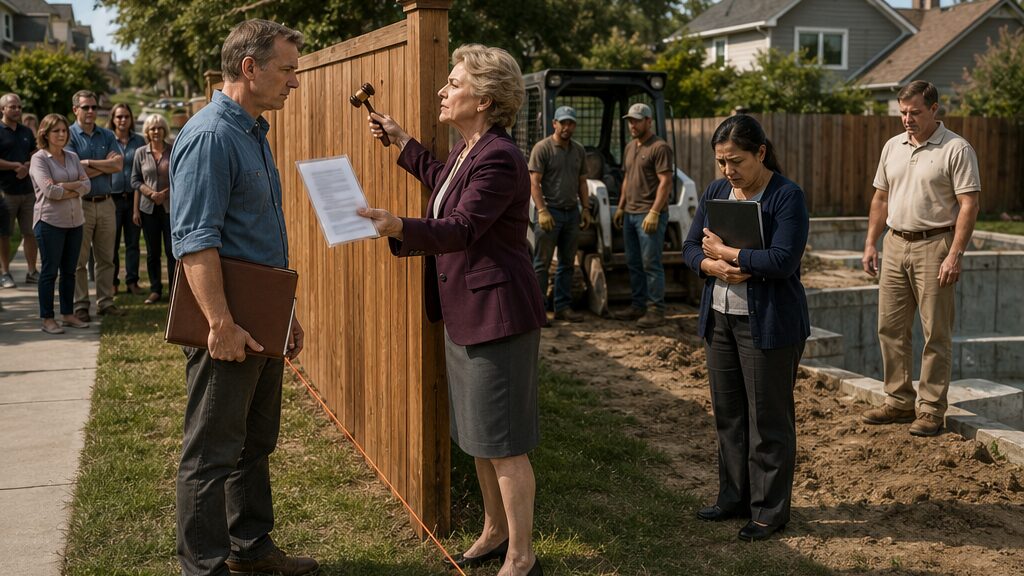
Katherine Wright struck the cedar fence post with a small wooden gavel and said, “Friday.”
The sound was not loud, but it carried across David Miller’s driveway and brought Paul Anderson’s pool crew to a stop on the other side of the property line.
David looked from the gavel to the laminated notice in Katherine’s other hand.
“Friday for what?”
“For removal.” She tapped the paper. “After that, the association will assess three hundred dollars per day.”
The fence had stood for eleven years.
David had replaced two warped boards, stained it three times, and tightened the gate after every winter. He and his wife had chosen the cedar together because she disliked the blank look of vinyl. Since her death, he had kept the fence exactly as they had built it.
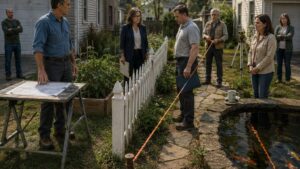
Now a bright orange survey string ran along its base, close enough to brush the grass.
Katherine wore a plum blazer despite the construction dust drifting from Paul’s yard. Her shoes were clean. Her expression suggested the conversation had ended before David opened his front door.
He took the notice but did not read it immediately.
“What changed?”
“The encroachment was identified during review of the neighboring construction application.”
Paul stood beside the unfinished pool excavation with his hands on his hips. Behind him, a compact loader waited on a trailer. Its operator watched the exchange without pretending not to.
David unfolded the notice.
The language was broad: unauthorized boundary obstruction, interference with approved improvements, failure to maintain required access. A covenant number appeared at the bottom.
“Which part says the fence has to be removed?”
Katherine pointed to the number.
“That section governs setbacks and association access.”
“It governs drainage easements.”
“It has been interpreted to include necessary construction access.”
“By whom?”
“The board.”
David raised his eyes from the page. “When?”
Katherine’s mouth tightened by a fraction. “At the last executive session.”
David knew the date of every regular board meeting because the notices went into a folder beside his desk. There had been no posted executive session concerning his property.
He looked toward Paul.
Paul shifted his weight. “My contractor said the machine would need a little more clearance.”
“How much?”
Paul glanced at the loader. “They said the existing route was tight.”
Katherine stepped between the question and the answer.
“The issue is not the contractor’s preference. The issue is compliance.”
David crouched beside the orange string. The fence post stood on his side of the original survey cap, though the string bowed slightly around a clump of grass. He fetched a steel ruler from the workbench in his garage.
Katherine watched him measure.
At the widest point, the distance between the string and the outer edge of the fence board was just under two inches.
David held the ruler upright so she could see it.
“This is the emergency?”
“It is an encroachment.”
“It may be a string pulled around weeds.”
“The surveyor established the line.”
“Where is the stamped survey?”
“The management office has the documentation.”
“Then I’ll review it before Friday.”
“You may submit a records request.”
He stood. “And the fence stays until I do.”
Katherine slid the gavel into the crook of her arm and took back the laminated notice long enough to point at a paragraph near the bottom.
“If the violation is not cured, the association may cure it on the owner’s behalf and charge all related costs to the account.”
David read the paragraph twice.
His old work had taught him that forceful language often concealed weak authority. The more certain a person sounded, the more carefully he examined the dates, signatures, and definitions surrounding the claim.
“Show me the approval for the original fence,” he said.
Katherine paused.
“It was installed before the current digital archive.”
“So there should be a paper file.”
“There may be.”
“Was it approved?”
“I cannot speak to what a board did eleven years ago.”
“But you can fine me for what they allowed eleven years ago.”
A neighbor slowed on the sidewalk. The pool subcontractor climbed down from the loader trailer and began checking straps that did not need checking.
Katherine lowered her voice.
“David, nobody wants this to become adversarial.”
“You brought a penalty notice to my driveway.”
“I brought an opportunity to resolve it voluntarily.”
He looked again at the two-inch gap.
The fence had always marked more than the edge of his yard. It kept Paul’s dogs from cutting through the garden. It hid the patio where his wife had spent her last summer wrapped in a gray blanket, insisting she was not cold. It allowed David to sit outside without answering questions he had no patience for.
Katherine saw boards and access.
He saw the last shape of a life he had managed not to disturb.
That recognition made him careful.
“Who is the authorized contractor if the association removes it?”
“That will be determined by management.”
“Who approved the expenditure?”
“The board authorized enforcement.”
“That is not the same thing.”
Katherine’s eyes moved briefly toward the pool crew. “You are making this more complicated than it needs to be.”
David went into the garage and returned with a brown folder and a legal pad.
He wrote the date at the top of the first page.
“What are you doing?” she asked.
“Keeping the issue simple.”
He numbered three lines.
“Date of the board vote. Exact covenant section. Name of the contractor authorized to enter my property.”
Katherine gave a short, humorless breath.
“You’ll receive the formal file through management.”
“Before any work begins?”
“The deadline remains Friday.”
Maria Flores had been standing near Katherine’s car, holding a narrow binder against her chest. David had not noticed her arrive. As treasurer, she rarely spoke during enforcement visits.
When Katherine mentioned the board vote again, Maria looked down at the driveway.
It was a small movement, but David saw it.
He wrote a fourth line.
Names of directors present.
Katherine reached for the legal pad as if she meant to read it, then stopped herself.
“You may document whatever you like.”
“I plan to.”
She tucked the laminated notice beneath her arm.
“The board will not allow one owner to delay an approved project.”
Paul stepped forward. “Katherine, I can ask the contractor about another route.”
“You already lost two weeks waiting for the design review,” she said. “The association is not responsible for further delay.”
Paul did not answer.
David watched the exchange. Paul looked uncomfortable, but not surprised.
That mattered.
Katherine turned toward her car. Maria followed, still carrying the binder close.
At the curb, Katherine stopped.
“For clarity,” she said, “if you interfere with association-authorized removal, additional enforcement may follow.”
David closed the brown folder.
“For clarity, I have not consented to anyone entering my property.”
Katherine smiled without warmth.
“Then put that in writing.”
By noon, David had emailed the management company a formal records request, a dispute of the violation, and notice that no contractor had permission to remove the fence before he reviewed the survey and vote.
At four seventeen, the management company replied with an automated acknowledgment.
At five forty-two, a second email arrived.
The subject line read: FENCE REMOVAL SCHEDULE.
David opened it standing at the kitchen counter.
The crew was not coming Friday.
They were scheduled for seven thirty Tuesday morning.
Chapter 2: The Crew Arrived Before David Could Appeal
The first post came out of the ground with a cracking sound that woke David before his alarm.
For half a second he lay still, confused by the noise.
Then the loader engine rose outside his bedroom window.
He reached the back door barefoot.
A worker had already chained the corner post to the machine. The cedar leaned away from the yard as concrete broke loose beneath it. Another worker carried boards toward Paul’s property.
David stepped onto the patio.
“Stop.”
The loader operator eased off the throttle, but the crew supervisor did not.
“We have an association work order.”
“You do not have my permission.”
The supervisor held up a clipboard. “You’ll need to take that up with management.”
Katherine stood near the driveway entrance with the laminated notice. Maria was beside her again, though this time she remained near the car.
David crossed the yard, forcing himself not to look at the empty space where the first post had stood.
“I appealed yesterday.”
Katherine nodded. “Your appeal was received.”
“And?”
“It does not automatically stay enforcement.”
“The notice gave me until Friday.”
“The board determined immediate access was necessary.”
“Last night?”
“The work had already been authorized.”
David turned to the supervisor. “Who hired you?”
“Bright Yard Services.”
The name meant nothing to him then.
He held out his hand for the work order.
The supervisor hesitated before passing over the clipboard.
The form listed David’s address, removal of forty-eight linear feet of cedar fencing, debris hauling, and site grading. A board authorization date appeared near the top.
David read it twice.
There had been no regular board meeting that day.
He photographed every page with his phone.
Katherine stepped closer. “You are not authorized to retain internal vendor documents.”
“I’m not retaining it.”
He photographed the signature line.
It was blank.
The supervisor took the clipboard back.
“We’ve got a schedule.”
David looked at the workers. None met his eyes. The loader idled with the broken post hanging from its chain.
If he stood in front of the machine, Katherine would call it interference. If he touched a worker, she would call it aggression. She had arrived prepared for the version of him that would make her paperwork easier.
He stepped aside.
“State for the record that I object.”
Katherine glanced at his phone.
“You have made that clear.”
“No. Say whether you are directing them to continue despite my written objection.”
Paul came through the temporary construction opening in his rear fence.
“What’s going on?”
David faced him. “You tell me.”
Paul stopped.
The pool excavation behind him was a raw rectangle of dirt and rebar. Wooden forms ran close to the property line. The compact loader waiting to cross into Paul’s yard would have had difficulty making the turn with David’s fence intact.
“I asked about temporary access,” Paul said.
Katherine’s head turned sharply.
Paul looked from her to David. “The pool company said they could remove two panels and reset them after the equipment came through.”
“You never asked for the whole fence?” David said.
“No.”
“Did you ask the board to demolish it?”
“No.”
Katherine folded the notice against her palm.
“The contractor determined partial removal would not provide safe clearance.”
Paul frowned. “That’s not what they told me.”
The loader operator cut the engine. The sudden quiet made the street feel crowded. Several neighbors had gathered at the sidewalk.
Katherine spoke carefully.
“The association is responsible for managing common-risk conditions. We cannot allow individual owners to dictate safe access.”
David looked at Maria.
“Did you vote for demolition?”
Maria’s fingers tightened around her binder.
“The board discussed enforcement options.”
“That was not my question.”
Katherine answered for her.
“The vote was valid.”
Maria said nothing.
The crew resumed work.
Board by board, the fence disappeared.
David photographed the tire tracks crossing his lawn, the splintered rail ends, the concrete torn from the ground, and the survey string crushed beneath a loader wheel. When one worker tossed the gate onto the debris pile, its brass latch struck a post and bent.
David picked up the latch after they left.
He stood in the open yard with it in his hand.
Paul remained on the other side of what was no longer a boundary.
“I didn’t know they were doing this today,” Paul said.
David looked at him.
“You knew they needed my property.”
“Yes.”
“You knew Katherine was pushing the violation.”
“I knew she said the fence was out of compliance.”
“And that was enough for you?”
Paul rubbed the back of his neck. “I assumed the board had the authority.”
David almost laughed, but the sound would have come out wrong.
“You assumed because it helped you.”
Paul did not deny it.
That was worse than an argument.
By evening, the crew had stacked the salvaged boards near David’s shed. Without the fence, Paul’s yard seemed to spill into his. Work lights from the pool site shone across the patio. Every private object now appeared displayed: the garden hose, the old metal chair, the ceramic planter his wife had painted blue.
David carried the bent latch into the kitchen and set it beside his laptop.
An email from the management company waited in his inbox.
ACCOUNT ADJUSTMENT NOTICE.
He opened the attached statement.
Fence removal and site restoration: $1,400.
The charge had already been placed on his association account. Payment was due within thirty days. Late fees would follow.
He printed the notice, then opened the digital packet Katherine had cited. It included the work order but not the underlying board resolution. The authorization date remained the same impossible date.
David went to the hall closet and pulled down the plastic archive box where he kept annual HOA packets. His wife used to tease him for saving them.
“Someday,” she had once said, “you’re going to win an argument nobody else remembers having.”
He had told her that records were not about winning.
They were about preventing people from changing what had happened.
At the kitchen table, he sorted eleven years of budgets, meeting summaries, insurance notices, and landscaping contracts. The fence boards outside cast striped shadows across the floor through the uncovered opening.
Near midnight, he found an old reserve-account summary from the previous spring.
One line had been highlighted in yellow during a community presentation:
Emergency drainage and grading.
Vendor: Bright Yard Services.
David placed Tuesday’s work order beside it.
Same company.
The fence crew had been billed as landscaping and site restoration. The older payment involved drainage work near the opposite entrance of the development.
Two unrelated jobs.
One vendor.
David opened a fresh legal pad and wrote the company name at the top.
Chapter 3: Eighteen Months Hidden Inside Ordinary Paperwork
The three invoices had different dates, different totals, and the same crooked black mark beneath the company logo.
David enlarged the scans until the pixels broke apart.
The mark sat below the word Services, no larger than a grain of rice. On the first invoice it looked like dust. On the second it might have been a printing flaw. On the third, it appeared in precisely the same place.
Different invoice numbers.
Same copied image.
He printed all three and laid them across his desk.
Bright Yard Services had billed the association for emergency drainage, slope stabilization, and stormwater correction over a period of eighteen months. The descriptions were broad enough to sound urgent and technical, but not specific enough to reveal what had actually been done.
The first payment was $13,600.
The second was $14,200.
The third was $13,350.
Together they totaled $41,150.
The annual report listed only one reserve expenditure under drainage improvements.
David checked the number twice, then a third time.
His old habits returned quickly. He did not begin with accusations. He began with columns.
Date requested.
Date approved.
Date paid.
Account charged.
Invoice signed.
Meeting authorization.
He built the spreadsheet slowly, resisting the excitement that came whenever two suspicious pieces appeared to fit. Excitement made people skip steps. Skipped steps gave other people room to dismiss everything.
On Wednesday morning, he submitted a formal request for eighteen months of bank statements, vendor invoices, meeting minutes, and reserve-account reconciliations.
The management company sent part of the packet by noon and warned that additional retrieval fees might apply.
David paid them.
By Thursday, his home office had become a landscape of paper. Colored tabs rose from a thick black binder. Yellow marked Bright Yard invoices. Blue marked board minutes. Red marked payments lacking clear authorization.
The tabs stood upright like the posts missing from his yard.
From his desk, he could see Paul’s pool crew crossing through the open property line. No one asked permission now. A wheelbarrow appeared beside David’s hydrangeas. Mud collected where the fence gate had once closed.
He shut the blinds and returned to the bank statements.
The annual report showed one payment.
The bank statements showed three separate withdrawals from the reserve account.
Each had cleared within days of a Bright Yard invoice.
The first contained Maria Flores’s approval.
The next two carried what appeared to be the same signature image, slightly blurred and positioned at identical angles.
David placed transparent paper over the signatures and traced the first. When he moved the tracing to the second invoice, every stroke aligned.
That did not prove Maria had not signed each document. People signed their names similarly. But scanned signatures reproduced imperfections too perfectly.
He wrote: possible reused approval.
Then he crossed out possible and replaced it with likely.
At three in the afternoon, he found the first clean proof.
The $1,400 demolition charge on his account had no corresponding authorization entry in the vendor ledger. The work order existed, but no approved purchase request, board resolution, or management authorization matched it.
The charge had been posted directly from Bright Yard’s invoice.
David leaned back.
For the first time since the fence came down, something inside him loosened.
The demolition might still have been defended under broad enforcement powers. The boundary dispute might still turn against him after a stamped survey. But the association could not charge an owner from an unsupported vendor document and pretend the paperwork was complete.
He added a green tab.
Verified discrepancy.
It was a small victory, but it changed the shape of the investigation. He no longer had only suspicion.
He had one fact he could prove.
That evening, Timothy Lewis stopped at the open edge of the yard. He was retired from commercial construction and had spent years complaining that newer contractors owned more software than tools.
“Heard they took the whole thing,” Timothy said.
David stood beside the stacked boards.
“You heard correctly.”
Timothy nudged one splintered post with his shoe. “Bright Yard?”
David looked at him. “You know them?”
“Used them once. Mulch, trimming, small cleanup. Guy had one pickup and a utility trailer.”
“Grading equipment?”
Timothy gave him a doubtful look. “Not unless he bought it recently.”
“Who is he?”
“Brian. Don’t remember the last name.”
David felt the dangerous satisfaction of another piece moving toward place.
“Did he have employees?”
“Two teenagers during summer. Why?”
David almost told him.
Instead he said, “I’m reviewing the invoice.”
Timothy looked toward the house, where the binder lay open beneath the desk lamp.
“You find something?”
“I’m not ready to say.”
Timothy’s expression hardened with disappointment. “People need to know what the board is doing.”
“They need to know what I can prove.”
“Same thing, eventually.”
“Not always.”
Timothy left without offering to help.
David watched him go and knew the silence had cost him an ally, at least for now. Still, he could not bring himself to share half-built conclusions. Facts belonged in order. People did not.
On Friday morning, the county business-records portal returned the company registration.
Bright Yard Services LLC.
Registered agent: Brian Wright.
Business address: 1847 Laurel Ridge Drive.
David stared at the surname first.
Then the address.
Katherine lived at 1847 Laurel Ridge Drive.
He checked the neighborhood directory, though he already knew. He had delivered a proxy form to that porch two years earlier. Plum-colored planters had stood beside the door.
He printed the filing and added it to the binder.
The explanation seemed obvious now.
Katherine’s relative owned the company. The company used her house. The HOA had paid it more than $41,000 through reserve withdrawals that did not match the annual report. The same company had removed David’s fence before his deadline and billed the charge without a supporting approval.
For four days he had warned himself not to run ahead of the evidence.
Now the evidence appeared to have caught up.
He drafted three pages for the monthly meeting.
At the top, he listed the verified points: three reserve withdrawals, one reported expenditure, repeated invoice image, unsupported demolition charge, shared residential address.
Then he turned to the opening sentence.
Katherine Wright owns the contractor receiving undisclosed HOA payments.
He read it.
The filing named Brian Wright, not Katherine.
David changed owns to controls.
He read it again.
The address was hers. The surname matched. The invoices passed through a system she supervised. Control felt reasonable.
But reasonable was not proof.
He removed controls and wrote is financially connected to.
That sounded cautious and weak.
By midnight, irritation overcame discipline.
He turned to the first page of his meeting notes and wrote in thick black ink:
KATHERINE OWNS BRIGHT YARD.
The words looked decisive.
They also looked better than the evidence he had.
Chapter 4: The House Number Was Not the Whole Truth
Katherine tried to remove David’s item from the agenda before the meeting began.
“The records matter is now under management review,” she said, looking past him toward the rows of folding chairs. “There is no benefit in discussing incomplete allegations in public.”
David stood beside the front table with the black binder under one arm.
“My account was charged in public records,” he said. “The reserve withdrawals belong to every homeowner in this room.”
A murmur moved through the clubhouse.
Katherine set the gavel beside her agenda packet. She had not brought it to his driveway as a joke. Here, beneath fluorescent lights and beside the association flag, it looked ordinary. That made it more unsettling.
“The board has discretion over agenda management.”
“Then vote to remove the item.”
One of the board members glanced at the other. Neither reached for a motion.
Katherine’s gaze settled on David.
“Five minutes.”
He placed the binder on the table and opened it toward the room rather than toward himself.
The top page carried the sentence he had written after midnight.
KATHERINE OWNS BRIGHT YARD.
For one moment, he considered turning it over.
Instead, he began.
“The association’s annual report lists one reserve expenditure for drainage work. The bank statements show three payments to Bright Yard Services totaling forty-one thousand one hundred fifty dollars.”
Katherine leaned back.
“That is a misreading of the report.”
David lifted copies of the statements.
“The dates are here. The amounts are here. The withdrawals cleared.”
“The annual report consolidates related work.”
“Then the supporting invoices should identify the related projects.”
“They do.”
He distributed three copies to the nearest row. Homeowners leaned toward one another, tracing the descriptions with their fingers.
“Emergency drainage,” David said. “Slope stabilization. Stormwater correction. Three different projects. Three payments. One reported line.”
“That is consolidation.”
“Were all three approved by the board?”
Katherine’s expression did not change.
“Yes.”
“On what dates?”
“You have the minutes.”
“I have minutes that mention one drainage inspection and no approval totaling forty-one thousand dollars.”
The room shifted again. Chairs scraped. Someone whispered that the reserve account had already been reduced the previous year.
Katherine placed both hands on the table.
“Mr. Miller’s fence dispute is under appeal. He is attempting to transform a private enforcement issue into an accusation of financial misconduct.”
David felt the old instinct to retreat into the binder. He knew how easy it would be to read every entry, every date, every inconsistency until the room surrendered from exhaustion.
Instead he held up the first invoice.
“These are not accusations. These are questions the records do not answer.”
Timothy Lewis raised his hand from the second row but spoke before Katherine recognized him.
“Bright Yard?”
Katherine’s jaw tightened.
Timothy stood. “I hired them two summers ago. They trimmed six maples and hauled mulch.”
“Please sit down,” Katherine said.
“They had one pickup,” Timothy continued. “One utility trailer. No excavator. No grading rig.”
“They may rent equipment,” Katherine said.
“Maybe. But forty-one thousand dollars of drainage work leaves something behind.”
A few homeowners turned toward Timothy.
David had not planned for him to speak. Part of him disliked the loss of control. Another part recognized what the room needed: not another page, but someone connecting the paper to the physical world.
Katherine struck the gavel once.
“This is not an evidentiary hearing.”
David slid the bank statements beside the invoices.
“No. It is a board meeting. That is where these payments should have been explained.”
Her face hardened.
“You have exceeded your five minutes.”
David reached for the county registration.
“One final document.”
He placed it under the meeting-room camera. The enlarged image appeared on the wall screen behind Katherine.
Bright Yard Services LLC.
Registered agent: Brian Wright.
Business address: 1847 Laurel Ridge Drive.
David highlighted the street number with his finger.
The room became quiet enough for the air conditioner to sound loud.
Timothy read the address aloud.
“Eighteen forty-seven.”
A homeowner near the aisle said, “Isn’t that Katherine’s house?”
Katherine turned toward the screen. For the first time that evening, her composure slipped.
“What number did you say?”
“Eighteen forty-seven,” David repeated.
Her eyes returned to him.
He opened the binder to the first page.
“This contractor is registered at Katherine Wright’s home. Katherine owns Bright Yard Services, and the association has paid her company more than forty-one thousand dollars without reporting the payments separately.”
The sentence landed harder spoken aloud than it had on paper.
Several people began talking at once.
Katherine did not raise the gavel.
Instead, she reached into her folder and removed another document.
“You should have read the entire filing.”
She handed it to the community management representative, who placed it beneath the camera.
The ownership section appeared below the registered-agent information.
Sole member: Brian Wright.
Katherine waited until the room quieted.
“Brian Wright is my brother,” she said. “He owns the company. I do not.”
David looked at the screen.
The words had been available in the same county file. He had stopped at the address and agent line because they confirmed what he already believed.
Katherine’s voice strengthened.
“My brother used my address temporarily after losing his commercial lease. That does not make the company mine. It does not establish theft, fraud, or any other term Mr. Miller is encouraging people to infer.”
A board member nodded slowly.
The power in the room moved back toward her.
David could feel the homeowners looking at him now, not with outrage but evaluation.
Timothy remained standing. “She still should have disclosed it.”
“That question is separate,” Katherine said. “The claim made tonight was that I owned the company. That claim is false.”
David’s fingers rested on the binder page.
He could defend himself by changing the subject. He could point to the invoices, the signatures, the withdrawals, the unsupported demolition charge. All of them still mattered.
But Katherine was right about the claim.
He had crossed the line between evidence and certainty because certainty felt better.
“I was wrong,” he said.
The words caused more silence than the accusation had.
Katherine blinked.
David removed the page that said KATHERINE OWNS BRIGHT YARD and folded it once.
“The filing does not show that you own the company. I should not have said it did.”
He placed the folded page inside the binder.
“It does show that the contractor is owned by your brother and registered at your address. Were those facts disclosed before the board approved the payments?”
Katherine reached for the gavel.
“My family relationships are not the business of this membership.”
“The vendor relationship is.”
“The company performed necessary work.”
“Then show the work, the bids, and the approvals.”
She struck the gavel.
“This discussion is concluded.”
The meeting dissolved into overlapping voices. Some homeowners approached David’s table. Others gathered around Katherine. Timothy argued with a board member about equipment rental. Paul remained near the back wall, avoiding David’s eyes.
David closed the binder.
His strongest moment had become his most visible mistake. The verified discrepancies remained, but Katherine had been given a simple answer to every future question: David had made a false accusation.
As he carried the binder toward the exit, Maria stepped into his path.
Her face had lost its color.
“You should not have said she owned it,” she whispered.
“I know.”
Maria glanced toward Katherine, who was speaking sharply to the management representative.
Then she touched the binder with two fingers.
“The first signature on those invoices is mine.”
Chapter 5: Maria’s Signature and Katherine’s Emergency
Maria placed the original invoice between them but kept one hand pressed over its lower corner.
They sat at her dining table the next morning. The blinds were half closed, though the nearest house faced the opposite direction.
David did not reach for the paper.
“You asked me to come,” he said.
“I asked you to listen.”
“I’m listening.”
Her thumb rested above the signature line.
The invoice was for $13,600 in emergency drainage work. Unlike the scanned copy, the original carried a blue-ink signature and a faint indentation where the pen had crossed the paper.
Maria’s name was clear.
“I approved this one,” she said.
“Why?”
“Because Katherine said we had forty-eight hours before the next storm.”
Maria removed her hand, but only after David nodded.
The description referred to erosion near the eastern drainage strip. David remembered orange cones there the previous spring and a shallow trench beside the sidewalk.
“Katherine had photographs,” Maria continued. “Standing water near two foundations. A contractor’s estimate. She said the association could face a claim if we waited for the next regular meeting.”
“Did you see competing bids?”
“No.”
“A written engineer’s recommendation?”
“She said it was coming.”
“Did it?”
Maria looked toward the blinds.
“Not that I saw.”
David examined the signature.
“You thought it was an emergency.”
“I thought one payment could be corrected later if the paperwork was incomplete.”
Her voice tightened on the last word.
David knew that kind of compromise. It did not begin as corruption. It began as a promise to fix the process after the urgent thing was finished.
“What happened after you signed?”
“Bright Yard cleared a section of the drainage strip. They dug out the swale, replaced some soil, added stone. Katherine sent pictures.”
“And the other two invoices?”
“I did not approve them.”
David looked at her.
“The signatures match.”
“I know.”
She withdrew two printed copies from a folder. The signature blocks were blurred, identical to the scanned image of the first invoice.
“I noticed after the second quarterly statement,” she said. “I asked Katherine. She said management had reused the approval because the work was part of the same emergency project.”
“And you accepted that?”
“I objected.”
“In writing?”
Maria’s silence answered.
David felt irritation rise, but the memory of the previous night checked it. He had turned incomplete evidence into certainty. Maria had turned uncertainty into silence.
Different mistakes. Same desire to avoid the harder moment.
“Why didn’t you tell the board?”
“I was the treasurer.”
“That is why you should have.”
“That is why I didn’t.”
She finally looked at him.
“If the payments were improper, then I had failed to stop them. If I raised the issue, every homeowner would ask why I signed the first one without a bid. Katherine said the work was real, the charges were reasonable, and public questions would damage property values before we had answers.”
“So you protected the association.”
“I told myself I was.”
The words settled between them.
David closed the folder.
“I need to see the work.”
Maria flinched. “I did not agree to give you the invoice.”
“I’m not asking to take it.”
He stood.
“Show me what thirteen thousand six hundred dollars bought.”
They walked to the eastern drainage strip near the community entrance. A narrow channel ran behind a row of ornamental trees, hidden from the road by shrubs. Fresh stone covered perhaps thirty feet. Beyond it, the swale returned to packed clay and weeds.
David crouched and pressed his fingers into the gravel.
“This is the first project?”
“As far as I know.”
“Where was the slope stabilization?”
Maria pointed toward a shallow bank. “Katherine said that was included later.”
The bank held no retaining material, erosion mat, or new planting. A thin washout scar ran down its center.
They followed the channel to the storm drain. Several feet of soil had been reshaped. The work was real, but small.
Timothy’s estimate echoed in David’s mind before Timothy had even made one: a pickup, a utility trailer, a few laborers, rented equipment for a day.
Not forty-one thousand dollars.
Maria stood with her arms folded.
“I’m not a contractor.”
“Neither am I.”
“You know what you think.”
“I know the invoices describe more work than I can see.”
A pickup slowed at the entrance, and Maria stepped behind one of the trees until it passed.
David watched her.
“You are afraid of Katherine.”
“I am afraid of what happens when this becomes public.”
“It became public last night.”
“Not all of it.”
She walked back toward the sidewalk.
David followed.
“What else is there?”
Maria stopped beside the open trench.
“The board discussed your fence in executive session.”
“So there was a vote.”
“There was a discussion.”
“Katherine said the vote authorized removal.”
Maria looked down at the gravel.
“We authorized an inspection of the line and temporary access options. One board member said management could take necessary enforcement steps after the survey was confirmed.”
“And the demolition?”
“It was not in the motion.”
David felt the story reorganize itself again. Katherine had not invented the meeting. She had enlarged its language until inspection became removal and temporary access became demolition.
“Do the minutes show that?”
“The final minutes show enforcement authority.”
“Who drafted them?”
“Katherine sent revisions to management after the meeting.”
“Do you have the original draft?”
Maria’s mouth tightened.
She began walking again.
Back at her house, she opened a laptop on the dining table and found an email thread. The first attachment was labeled DRAFT MINUTES. The second, sent the next morning by Katherine, was labeled PRESIDENT REVISIONS.
David read the original motion.
Authorize property-line inspection and evaluation of temporary access options.
The revised minutes stated:
Authorize enforcement action necessary to remove boundary obstruction and secure construction access.
The change was not a clarification. It was a new decision.
David looked at Maria.
“I need a copy.”
“No.”
“You called me because you wanted the truth known.”
“I called because you accused Katherine of owning the company. I needed you to understand this is not as simple as you made it sound.”
“It is not simple. The minutes were changed.”
“If I release these, I admit I knew.”
“You do know.”
Her face hardened.
“You think admitting your mistake last night makes this easy for everyone else?”
“No.”
“People will say I helped her.”
“Did you?”
Maria looked at the original invoice on the table.
“I signed one payment. I questioned the others too late. I let the revised minutes pass because I wanted to believe the wording was harmless.”
David waited.
She had expected either absolution or accusation. He offered neither.
At last she closed the laptop.
“I will speak to the association attorney privately.”
“That is not the same as releasing the record.”
“It is what I am willing to do.”
David gathered his notes.
At the door, Maria called his name.
He turned.
She had reopened the laptop. On the screen, the original draft minutes sat beside Katherine’s revisions.
“I have not deleted them,” she said.
David understood what she was offering and what she was withholding.
The proof existed.
Maria was not yet willing to stand beside it.
Chapter 6: The Vote Katherine Changed After Everyone Left
The association attorney closed David’s binder and pushed it back across the conference table.
“If you continue using the word fraud without evidence of intent, you may expose yourself personally.”
David kept his hands in his lap.
They were seated in the management office two days later. Katherine occupied the chair nearest the attorney. The community management representative sat between them with a yellow legal pad.
“I did not request a criminal finding,” David said.
“You stated publicly that Mrs. Wright owned a vendor receiving association funds.”
“I corrected that statement.”
“The correction does not erase the statement.”
Katherine watched him without satisfaction. She looked tired, but her voice remained precise.
“This is what happens when private records are interpreted by someone pursuing a grievance.”
“They are association records.”
“Your access does not make your interpretation accurate.”
David opened the binder again.
“The demolition invoice has no matching authorization.”
“The board granted enforcement authority.”
“The final minutes say that. The original motion did not.”
The management representative looked up.
“What original motion?”
David had no document to place on the table.
Maria had spoken privately with the attorney that morning, but whatever she had shared had not been released to him. She had declined to attend the meeting.
“I have been told the initial draft authorized inspection and temporary access evaluation.”
Katherine’s gaze sharpened.
“By whom?”
David did not answer.
The attorney folded his hands.
“Without the draft, we are discussing hearsay.”
David felt the familiar pull toward a broader accusation. He could mention Maria’s signature, Katherine’s revisions, the reused approval, the drainage work that did not match the billing. Each was connected. None was complete enough alone.
The management representative tapped the legal pad.
“The management company cannot suspend a sitting board president or reverse board action without formal authority. We can recommend an independent review if the board approves one.”
Katherine said, “There is no basis for that expense.”
“The bank records are a basis,” David said.
“They show payments for completed work.”
“Then provide the bids, scopes, equipment records, and inspection reports.”
“The board is compiling them.”
“After eighteen months?”
Katherine leaned forward.
“You worked in government accounts. You know emergencies are not always documented in perfect sequence.”
“I know missing sequence is how emergency authority becomes permanent authority.”
The attorney lifted one hand.
“We are not resolving intent today.”
That word again.
Intent protected Katherine because it was difficult to prove. Procedure exposed her because it was written down. David had allowed himself to chase the larger moral conclusion before securing the narrower administrative one.
He closed the binder.
“What can be resolved today?”
The attorney answered.
“Your fence appeal can proceed. The demolition charge can be reviewed. The membership may petition for a special meeting. A formal audit request can be presented to the board.”
“And Katherine votes on whether to audit decisions she approved.”
“She is a board member.”
“President,” Katherine corrected.
The door opened behind them.
Paul Anderson entered carrying his phone and an envelope.
“Sorry. The front desk said you were still meeting.”
Katherine’s expression changed before anyone spoke.
“This is a confidential session.”
Paul remained by the door.
“It’s about my pool access.”
David turned in his chair.
Paul placed the envelope on the table.
“I brought the messages from Katherine.”
Katherine did not touch them.
“What messages?”
“The ones where you told me not to worry about the fence.”
Paul unlocked his phone and scrolled.
The management representative read the first message silently, then passed the phone to the attorney.
David watched Katherine.
She had sent Paul a series of texts two weeks before the demolition.
The board will ensure unrestricted equipment access.
Do not agree to additional contractor charges caused by the neighboring obstruction.
We will handle compliance before excavation begins.
Paul rubbed his palm against his jeans.
“I asked whether we should delay. My pool contractor said they could come back after the fence issue was resolved. Katherine said the association would clear access.”
David looked at him.
“You knew that before Tuesday.”
“I knew she said it would be handled. I didn’t know that meant removing the whole fence.”
“You watched them do it.”
Paul’s face tightened.
“Yes.”
“Why didn’t you stop them?”
“My financing rate was locked through the end of the month. If the schedule slipped, the lender could reprice the project. My daughter’s graduation gathering is supposed to be there.”
He gestured vaguely toward the neighborhood, as though the unfinished pool were visible through the office wall.
“I told myself the board had authority. I wanted that to be true because it was convenient.”
The admission was plain and inadequate.
David believed it.
That made his anger harder to hold.
The attorney copied the messages.
“They establish that Mrs. Wright anticipated enforcement before the survey dispute was resolved.”
“They establish that I communicated the board’s intent,” Katherine said.
“Which intent?” David asked. “Inspection, temporary access, or demolition?”
Katherine looked at the attorney rather than him.
“The association faced project delay, potential damage claims, and an obstruction inside a disputed setback. I acted to protect the community.”
The justification was not invented. Pool delays could create claims. Drainage failures could damage homes. Inconsistent fences could produce years of enforcement problems.
But every pressure Katherine named had become permission to bypass someone else’s rights.
The management representative suggested a special board session that evening to consider the audit request and suspension of the demolition charge.
By seven, the clubhouse conference room was full.
Katherine presented the fence removal as an enforcement decision supported by the final minutes. David presented the missing purchase approval, Paul’s messages, and the difference between the stated survey deadline and the actual demolition date.
Maria sat in the last row.
When David referred to the original draft minutes, every face turned toward her.
The association attorney asked, “Mrs. Flores, are you willing to provide the draft to the board?”
Maria held her purse in both hands.
“I provided information to counsel.”
“That was a privileged consultation,” the attorney said. “The document itself has not been entered into the board record.”
Katherine did not look back at her.
Maria swallowed.
“I am not prepared to release it publicly.”
A murmur passed through the room.
David felt something inside him fall—not because Maria owed him courage, but because he had built part of his case around the belief that pressure would produce it.
He had treated her fear as another problem that could be solved by arranging facts in the correct order.
The board voted three to two against immediate suspension of Katherine’s authority. It agreed only to place the audit request before a special membership meeting.
The $1,400 charge remained on David’s account pending appeal.
Outside, Paul caught up with him beside the empty fence line.
“I’ll testify about the messages,” he said.
David nodded.
“You should.”
“I can also talk to the pool contractor about the damage.”
“Do that separately.”
Paul accepted the boundary in his voice and walked home through the opening his project had created.
David stood beside the first missing post. The orange survey string had been retied, but it sagged between two stakes and crossed the grass in an uneven line.
He returned to his office and removed every page that depended on Maria’s private statements.
The binder became thinner.
The case became smaller.
He kept the bank withdrawals, the unsupported demolition charge, Paul’s messages, the undisclosed family relationship, the absence of bids, and the visible mismatch between the invoiced work and the drainage strip.
At the top of a clean page, he wrote:
WHAT CAN BE PROVED WITHOUT ASKING ANYONE TO BE BRAVER THAN THEY ARE.
Then he began again.
Chapter 7: David Opened the Binder Without Hiding Behind It
David began the special membership meeting by telling the room he had been wrong.
The clubhouse was fuller than he had ever seen it. Folding chairs extended beyond the usual rows and into the hallway. Homeowners stood along the walls with printed packets in their hands. At the front table, Katherine sat beside the association attorney, her plum blazer buttoned high, the gavel placed squarely before her.
David stood at the opposite end with the black binder open.
“At the last meeting,” he said, “I stated that Katherine Wright owned Bright Yard Services. The business filing does not support that statement. Brian Wright owns the company. I should have verified that before speaking.”
No one interrupted.
Katherine’s face remained still, but David saw the small release in her shoulders. She had expected him to defend the mistake or bury it beneath a larger accusation.
He turned the first page.
“The correction matters because this meeting should not depend on whether you trust me. It should depend on records all of us can examine.”
Stacks of copies rested on the table. Instead of keeping them inside the binder, David began passing them down the rows.
The binder had protected him for weeks. It had given his hands something to hold and his anger somewhere to go. Now its pages moved away from him, carried from neighbor to neighbor.
“The documents show five things,” he said. “My fence was removed before the written deadline. The demolition charge has no matching purchase approval. The board report combines three reserve withdrawals into one line. Bright Yard Services is owned by the president’s brother and uses her residential address. That relationship was not disclosed in the records provided to homeowners.”
Katherine leaned toward her microphone.
“The last statement is misleading. My brother’s company performed legitimate work. A family relationship does not invalidate a contract.”
“No,” David said. “But it should have been disclosed before the president participated in approval or enforcement involving that vendor.”
A homeowner near the front raised a hand.
“Did she vote on the payments?”
The attorney answered before Katherine could.
“The available records are not complete enough to establish every individual vote.”
David nodded. “That is why I am asking for an independent audit.”
Not resignation. Not repayment. Not prosecution.
An audit.
The word took some air out of the room. Several homeowners lowered their voices. The request was less satisfying than a verdict, but harder to dismiss.
Katherine lifted a memorandum from her folder.
“The board acted under emergency authority,” she said. “Our counsel previously advised that officers may respond to conditions creating property risk, liability exposure, or obstruction of approved work.”
She passed the memorandum to the attorney, who confirmed that it had been issued the previous year.
David read the first page on the projected screen.
The language was broad. It allowed temporary action when delay could worsen damage or create significant liability. It mentioned drainage failures, fallen trees, utility access, and hazardous conditions.
It did not mention family vendors.
It did not mention fences.
But it was enough to divide the room.
Katherine stood.
“Leadership does not occur under perfect conditions,” she said. “We had drainage complaints affecting homes. We had a permitted pool project facing delay. We had a fence positioned inside a disputed setback. Waiting for every owner to agree would have exposed the association to claims and increased costs.”
A few homeowners nodded.
She continued, gaining strength.
“Bright Yard was available when larger contractors were booking months out. The work was completed. The drainage strip was improved. Access was secured. Mr. Miller’s disagreement with the process does not make every decision corrupt.”
David felt the room slipping.
Katherine was not denying the irregularities. She was arranging them into a story of urgency, imperfect administration, and necessary judgment. It was plausible because parts of it were true.
A drainage problem had existed.
Paul’s project had faced delay.
Bright Yard had performed some work.
David looked toward Maria. She sat in the third row, her purse on her lap, her eyes fixed on the packet.
He could call on her.
He could tell the room that she had admitted signing only one invoice. He could say she possessed the original draft minutes. The attention would force her to answer.
He closed his mouth.
He had promised himself he would not build the case on courage he had not been given.
Instead, he returned to the document on the screen.
“Emergency authority may explain why one payment happened quickly,” he said. “It does not explain why two later payments reused the same approval image. It does not explain why the annual report showed one reserve expense when the bank showed three. And it does not explain why an inspection motion became demolition authority.”
Katherine sat down.
“You do not have the original motion.”
“No,” David said. “I do not.”
The admission rippled through the room.
He lifted the unsupported demolition invoice.
“But I have this. It was charged directly to my account. There is no purchase request attached to it, no signed authorization, and no completed appeal review.”
He lifted Paul’s messages next.
“I have these. They show that Katherine promised unrestricted equipment access before the boundary question was resolved.”
Paul stood from the back row.
“They’re real,” he said. “I gave them to counsel. I benefited from what happened, and I didn’t ask enough questions because the delay would have cost me money.”
The room turned toward him.
Katherine’s expression hardened.
Paul did not look at David.
“I did not ask for the full fence to be removed,” he continued. “But when they took it down, I let the work continue. That part is on me.”
It was not absolution. It was better.
Timothy rose next, holding photographs of the drainage strip.
“I walked the billed locations,” he said. “The work shown in these invoices would require equipment and materials I did not find evidence of on site. That does not prove where the money went. It proves we should find out.”
The attorney looked through the photographs.
Katherine reached for the gavel.
David spoke before she struck it.
“I am not asking this room to declare anyone guilty tonight.”
Her hand paused.
“I am asking the membership to authorize an independent audit, suspend disputed charges until the review is complete, and require disclosure whenever a board officer’s relative receives association work.”
Someone near the aisle said, “That should already be a rule.”
Another homeowner replied, “Apparently it isn’t.”
The tension changed. The room was no longer deciding whether David had proven theft. It was deciding whether uncertainty itself justified review.
The management representative read the petition language aloud.
Katherine requested one final statement.
“If you authorize this audit, reserve funds will pay for it. Insurance premiums may increase. Vendors may refuse emergency work if every decision is treated as suspect. There are costs to mistrust.”
David looked at her.
“There were costs to trust, too.”
He did not say it loudly.
The vote proceeded by written ballot.
While the management staff counted, nobody applauded or argued. Papers rustled. The air conditioner cycled off. David stood beside the open binder, now nearly empty.
The audit passed by eleven votes.
The disputed demolition charge was suspended pending review.
A second motion required Katherine to recuse herself from vendor matters involving Bright Yard until the audit concluded. It also passed.
Katherine sat very still.
The results were not removal. They were not repayment. The fence remained broken beside David’s shed.
But for the first time, the process no longer belonged entirely to her.
The attorney began collecting exhibits for the auditor.
Maria stood.
Her chair scraped sharply against the floor.
Katherine turned.
Maria walked to the front carrying a thin folder. Her hands shook, but she did not stop.
“I need to correct the record,” she said.
She placed the folder in front of the attorney.
Inside were the original draft minutes and Katherine’s revised version.
“The board approved inspection and temporary access evaluation,” Maria said. “We did not approve demolition.”
Katherine stared at her.
Maria’s voice weakened but remained audible.
“I signed the first drainage invoice. I did not approve the next two. I saw the reused signature and did not report it because I was afraid of what it would say about me.”
The attorney opened the first document, then the second.
Across the room, homeowners began comparing the language.
David did not feel victory.
He watched Maria return to her seat without looking at anyone, and understood that the truth had finally entered the record carrying a cost of its own.
Chapter 8: The New Gate Did Not Erase the Old Line
The reimbursement check covered less than half the fence.
David stood at his kitchen counter reading the settlement letter while the pool pump hummed next door.
The association had voided the $1,400 demolition charge and offered $3,800 toward replacement costs under its liability policy. The estimate for new cedar, concrete, hardware, and labor was more than twice that.
The letter called the payment a compromise without admission.
Six weeks had passed since the special meeting.
Katherine had resigned three days after the auditor issued the preliminary report. The report found unsupported vendor payments, inadequate conflict disclosures, reused approval images, inconsistent minutes, and weak reserve-account controls.
It did not conclude that money had been stolen.
Bright Yard had performed some drainage and grading work. The auditor could not verify that the work justified the full amount, but missing records made deliberate theft difficult to establish.
The uncertainty disappointed people who had wanted a cleaner ending.
It did not disappoint David as much as he expected.
The facts were finally labeled according to what they proved.
He folded the settlement letter and carried it outside.
Paul was waiting beside a stack of new cedar boards.
“I brought the revised estimate,” he said.
David looked at the lumber.
“You bought materials.”
“I bought the portion for the damaged side.”
“The association is paying part.”
“The loader crossed your lawn for my project.”
“That was Bright Yard’s loader.”
“It crossed for my project.”
Paul held out an envelope.
Inside was a check covering the cracked irrigation line, damaged grass, and part of the labor the insurance payment excluded.
David did not take it immediately.
Paul’s pool was complete now. Blue water showed through the temporary mesh barrier. The graduation gathering had already happened, smaller than planned. David had heard music and voices through the open yard but had not gone over.
“I should have spoken Tuesday morning,” Paul said.
“Yes.”
“I kept waiting for someone with a title to tell me what was right.”
David took the envelope.
“That gets expensive.”
Paul gave a brief nod.
They began setting posts that afternoon.
Timothy helped mark the line but left before concrete work began, claiming he no longer worked for free after lunch. The property survey confirmed that one old fence board had crossed the line by just under two inches where the original post had shifted.
The rest of the fence had been within David’s property.
Two inches had been real.
The emergency had not.
At the clubhouse notice board, the new interim directors posted the audit recommendations: dual approval for reserve payments, mandatory conflict disclosures, member access to contracts, and separate board votes for enforcement involving physical removal of private property.
Maria’s removal as treasurer appeared in smaller print beneath them.
She had resigned first, but the board recorded the action as removal to satisfy the management company’s insurer.
David found her standing before the notice one evening.
“They could have accepted the resignation,” he said.
“They wanted a clean control change.”
“That is the kind of phrase Katherine used.”
Maria looked at him.
“I signed the first invoice without enough support.”
“You also released the minutes.”
“One does not erase the other.”
“No.”
She seemed relieved he had not tried to make it kinder than it was.
“Will you stay in the neighborhood?” he asked.
“I haven’t decided.”
She touched the edge of the posted audit summary.
“I spent years thinking protecting the association meant preventing embarrassment.”
David looked through the clubhouse windows at the empty meeting room.
“Embarrassment usually arrives before correction.”
Maria almost smiled.
“Spoken like an examiner.”
“Former examiner.”
“Not very former.”
She left before he could answer.
Katherine came to David’s yard two days later.
She wore no blazer. Without the meeting table or laminated notice between them, she looked smaller, though not defeated.
Paul was inside his house. David was fitting hinges to the new gate.
“I wanted to speak before the final report,” she said.
“You can speak now.”
She looked at the rebuilt fence line.
“My brother lost his lease after a divorce and a failed expansion. He was sleeping in the office behind his shop until the landlord locked him out.”
David waited.
“The first drainage job was real,” she continued. “The association needed someone quickly. Brian needed work. I believed I could solve both problems.”
“You should have disclosed it.”
“I knew how the board would react. They would assume I was helping him because he was family.”
“You were.”
“Yes.”
The answer came without defense.
“The first invoice kept his business alive,” she said. “After that, every correction would have exposed the first shortcut. So I kept extending it.”
“And my fence?”
“The pool delay was becoming a liability issue. Brian said the equipment needed clear access. I believed the board had given me enough authority.”
“You changed the minutes.”
“I clarified what I thought we intended.”
David set down the hinge.
“No. You changed what happened into what you needed to have happened.”
Katherine looked toward the boards stacked beside the shed. Several were too splintered to reuse.
“I am sorry your fence was removed.”
It was not a full apology. She did not mention the charge, the premature deadline, or the threat of fines. She did not ask forgiveness.
David found that he did not need to force more from her.
“Brian’s company may have to repay part of the money,” she said. “He will probably close.”
“That belongs in the audit.”
“You always know where everything belongs.”
He looked at the new gate between his yard and Paul’s.
“No,” he said. “That was part of the problem.”
Katherine left through the driveway.
David returned to the hinges.
He had originally planned to rebuild the fence exactly as it had been: six feet high, uninterrupted cedar from the rear corner to the house.
Instead, he had added a narrow gate facing Paul’s yard.
It was not an invitation without limits. It had a latch on both sides and could be locked. But it created a choice where the old fence had offered only separation.
Paul came out carrying the last salvaged board. The brass latch from the original gate was still attached, bent but usable.
“Keep it?” Paul asked.
David ran his thumb over the scratched metal.
The board had come from the section his wife had helped stain during their first summer in the house. For weeks, he had imagined placing it somewhere permanent, proof that the old boundary had existed before anyone revised it.
Instead, he lifted the other end.
Together they carried it toward the garage.
Behind them, the new gate swung inward in the breeze.
Paul turned back.
“You want me to latch that?”
David looked across the line where the orange survey string had once sagged through the grass.
The line remained. The survey had not changed. The records had not restored what was broken, and the audit had not made everyone innocent or guilty in equal measure.
But the boundary no longer had to decide everything for him.
“Leave it,” David said.
They carried the old board inside while the gate remained unlatched.
The story has ended.