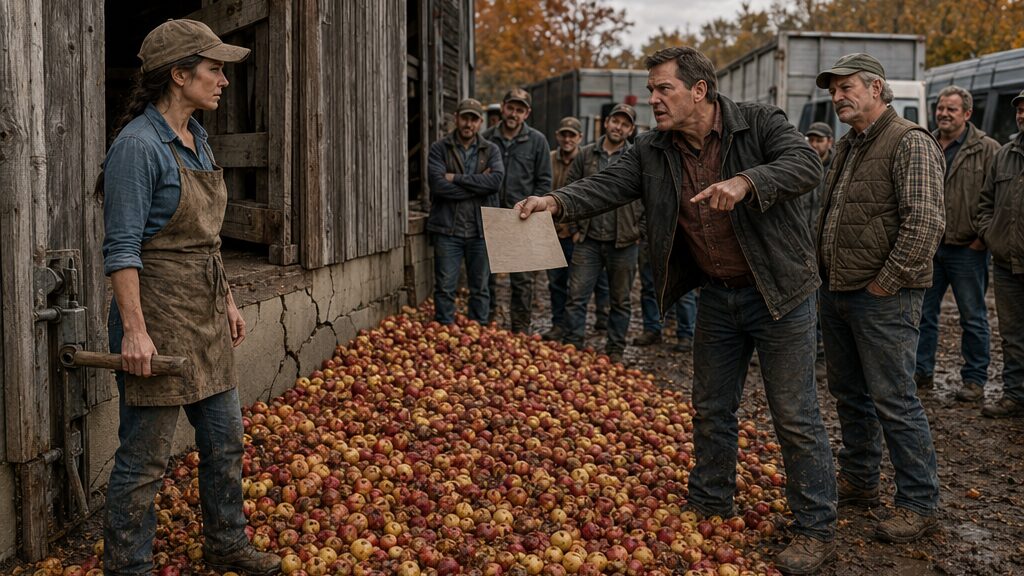
They Laughed When Kimberly Buried the Orchard in Apples, Until She Opened Her Father’s Last Ledger
Chapter 1: The Morning the Apples Covered the Yard
The first apples struck the gravel before Kimberly reached the release handle.
Three bright red Galas rolled beneath the loading tractor, followed by a thin stream of fruit squeezing through the warped seam at the bottom of the storage wall. Inside the barn, timber groaned under forty tons of harvest.
“Everybody out,” Kimberly shouted.
The conveyor kept rattling. Two seasonal pickers stared at her from the sorting platform, uncertain whether she meant them.
“Now. Leave the bins.”
She ran past the open bay, boots sliding on crushed fruit. Jack Green was already waving the crew toward the side door, but one worker had climbed onto the lower catwalk to free a jammed belt.
A sharp crack sounded above them.
Dust sifted from the rafters.
Kimberly looked at the western wall. The painted mark she had drawn beside the main support three weeks earlier had widened into a dark, crooked mouth. The post was no longer sitting squarely on its concrete footing. It leaned toward the workers.
“Jack, get him down.”
Jack followed her gaze. His face changed.
The worker jumped the last four feet from the ladder and landed hard. Kimberly counted heads as they spilled into the yard.
Six.
Seven.
“Where’s the driver?”
“In the cab,” Jack said.
Kimberly saw the truck beyond the barn doors, its engine idling beneath the loading chute. If the inner rack came down, it would carry the chute and half the roof with it.
She crossed to the exterior ratchet bolted beside the west bay. The release handle hung from a nail, its wooden grip darkened by decades of hands. Her father had shaped it from an old applewood branch, smoothing one side flat and fixing a curved steel jaw at the end.
Dennis had always called it one of their father’s unnecessary contraptions.
Kimberly fitted it into the ratchet.
Jack caught her arm. “You pull that, we lose the whole bay.”
Another crack came from inside, deeper than the first.
“We lose fruit,” she said. “Or we lose people.”
She drove the handle downward.
For half a second, nothing happened.
Then the lower gate tore open.
Apples surged from the barn in a red-and-gold wave. They hammered the loading platform, burst across the yard, and poured over the grass toward the road. Wooden bins tipped and vanished beneath the flood. The truck driver leaped from his cab as fruit bounced against the tires and piled under the axles.
The sound was enormous—thousands of dull impacts merging into a roar.
Kimberly held the handle until the ratchet stopped kicking in her hands. By then apples covered the yard from the barn to the drainage ditch. Some remained polished and whole. Others had split open, white flesh bright against the mud.
No one spoke.
Kimberly counted again.
Eight workers. Jack. The driver.
All outside.
A pickup turned through the gate too fast and braked at the edge of the fruit. Dennis stepped out before the dust settled. Two more trucks followed him, carrying George Miller and several cooperative growers who had been scheduled to inspect the Thompson delivery.
They had not come because Kimberly called for help. She had called Dennis first, and Dennis had brought witnesses.
He stood beside his truck, staring at the apples packed around its front tires.
“What did you do?”
Kimberly pulled the handle free of the ratchet.
Dennis walked toward her, lifting his boots high through the fruit. George came behind him, his hat pushed back as he surveyed the yard.
One of the growers let out a short, disbelieving laugh. “Looks like she harvested the barn.”
Another man pointed toward the road, where apples had reached the ditch. “County’s going to need a snowplow.”
George laughed once through his nose. The others joined him, not because anything was funny, Kimberly thought, but because the size of the loss was too frightening to stand beside in silence.
Dennis stopped within an arm’s length of her.
“You dumped the cooperative load.”
“The wall moved.”
“You dumped everything.”
“The workers are out.”
He looked past her at Jack and the crew. “Nobody told you to empty the bay.”
Kimberly turned toward the barn. “Don’t let anyone go inside.”
Dennis followed her gaze but did not look at the leaning post. His eyes returned to the handle in her hand.
“You’ve been waiting to do this.”
She looked at him.
“For what?”
“For one chance to prove I couldn’t run this place without Dad.”
The growers had formed a loose line behind him. Kimberly could feel their attention settling on her clothes, her muddy boots, the handle, the ruined fruit. George’s expression carried no amusement now. He was calculating tonnage.
Dennis unfolded a pale sheet of paper.
Kimberly recognized the cooperative letterhead.
“You brought that before you knew what happened,” she said.
His jaw tightened.
George spoke from behind him. “The board met by phone after Dennis reported interference with the delivery schedule.”
“Interference?”
Dennis pressed the paper toward her. “Effective immediately, you are suspended from orchard operations pending review. You don’t touch equipment, inventory, shipping records, or crew assignments.”
Kimberly did not take it.
Dennis pushed it against the wooden handle until she had to catch it or let it fall among the apples.
One of the growers murmured something. Another laughed quietly when Dennis turned away.
Kimberly read only the first line. Her name. The date. George’s signature.
The rest could wait.
She folded the notice once and put it in her back pocket.
“Jack,” she called, “keep everyone beyond the trucks.”
Dennis stopped. “You don’t give orders now.”
Kimberly stepped around him and crouched beside the barn’s foundation. A crack ran from the footing toward the drainage side. Fresh gray dust lay across the weeds. She placed two fingers against the concrete and felt a faint vibration.
“Get away from the building,” she said.
George glanced at Dennis. “Is there something moving?”
Dennis looked toward the open bay. From outside, the emptied storage rack appeared intact.
He gave Kimberly a hard smile. “You already made your point.”
Kimberly rose slowly. The humiliation burned less than it should have. Perhaps because the men believed the worst thing in the yard was visible.
She looked at the release handle in her hand, then at Dennis.
“No,” she said. “I prevented it.”
A long groan rolled through the barn.
The laughter stopped.
Metal bolts snapped in quick succession. The inner support frame folded sideways and struck the sorting platform with a crash that shook apples from the eaves. The loading chute dropped into the empty bay, crushing the exact stretch of floor where three workers had been standing minutes earlier.
Dust burst through the doorway and drifted across the fruit.
No one moved.
Dennis stared into the barn.
Kimberly closed her hand around the worn wooden grip.
The apples between them no longer looked like the disaster.
They looked like the reason everyone was still alive.
Chapter 2: The Warning Tag That Disappeared Overnight
The wire was still looped around the failed support post.
Kimberly found it after the county crew declared the outer wall stable enough for a brief inspection. A thin piece of copper, twisted twice around a bolt at shoulder height. She had fastened a yellow warning tag to it six days earlier.
The tag was gone.
She stood just inside the bay wearing a hard hat and dust mask, the wooden release handle tucked through her belt. Morning light entered through the torn roof, catching broken beams and suspended dust. The collapsed frame lay across the sorting platform like a rib cage.
Susan Clark, the county inspector, photographed the wire from three angles.
“You’re certain the tag was here?”
“I wrote ‘temporary load only—do not refill west rack.’”
“Who saw it?”
“Jack. Dennis.”
Susan lowered the camera. She was a compact woman with gray beginning at her temples and the patient expression of someone accustomed to people changing their stories around official paperwork.
“Anyone else?”
“Maybe two pickers.”
“Maybe won’t help much.”
Kimberly looked at the clean rectangle on the post where the tag had shielded the dust. Someone had removed it recently. The copper wire was not broken. It had been carefully untwisted and retied.
Susan followed her gaze. “That suggests a tag existed. It doesn’t prove what it said.”
Kimberly crouched beside the exterior ratchet. The release cable ran under the wall and split toward the lower gates. She fitted the handle into its steel socket.
Susan watched her test the first notch.
“My father built this after the original gravity doors jammed,” Kimberly said. “The handle gives enough leverage to release them from outside.”
“Is it listed in the equipment manual?”
“There is no manual. He built it in the shop.”
“Was it inspected?”
“Not separately.”
Susan wrote that down.
Kimberly wished she had said less. Then she hated herself for the wish.
The ratchet teeth were worn but unbroken. She moved the handle through the full arc, stopping before the cable tightened.
“It did what it was designed to do,” she said.
“It also emptied an entire commercial storage bay.”
“Because the bay was failing.”
Susan stood. “That is the question I’m here to answer.”
Outside, loaders pushed apples into long windrows. Whole fruit suitable for processing went into one set of bins. Split and mud-ground fruit went into dump trailers. Dennis had placed cooperative men in charge of the sorting, though Kimberly knew the orchard better than any of them.
She stepped through the doorway.
Dennis stood beside George near the office, speaking with the cider-plant manager. They stopped when she approached.
George folded his arms. “County find your smoking gun?”
“They found the emergency release.”
“We all saw you pull it.”
Kimberly looked at Dennis. “The warning tag is missing.”
His face remained still. “What warning tag?”
“The one on the west support.”
George glanced between them. “Was it filed?”
Kimberly did not answer quickly enough.
Dennis did.
“No.”
Susan emerged from the barn with her clipboard. “Ms. Thompson, I need your maintenance and hazard reports for the last ninety days.”
“They’re in the office.”
Dennis moved toward the door. “I’ll get them.”
Susan stopped him. “I asked her.”
For the first time since the spill, Dennis looked uncertain.
Kimberly unlocked the office and pulled the maintenance binder from the lower cabinet. She found inspection sheets, repair invoices, pest-control logs, and the handwritten list she kept beside the telephone.
There was no formal shutdown report.
Susan turned through the pages.
“You noted movement in the western footing three weeks ago.”
“Yes.”
“You requested brace pricing from two suppliers.”
“Yes.”
“You reduced the posted capacity?”
“For four days.”
“And then?”
Kimberly looked through the office window. Workers shoveled apples from the road while George spoke into his phone.
“We had rain coming,” she said. “The south storage was already full.”
“So the west rack was loaded again.”
“Temporarily.”
“Did you notify the county?”
“No.”
“Did you notify the cooperative in writing?”
“No.”
Susan rested her pen against the page. “Why not?”
Kimberly could have said Dennis controlled the contracts. She could have said the orchard had no room, no cash, no spare weeks in October. She could have said shutting down the bay would have exposed more than a damaged footing.
Instead she said, “I thought we could brace it before the main delivery.”
Susan’s expression hardened slightly. “Thinking you can repair a hazard is not the same as reporting one.”
A truck horn sounded from the yard.
George entered without knocking. He carried a single-page notice.
“The cooperative has frozen all remaining Thompson deliveries pending the county finding.”
Dennis came in behind him. “George, we have six trailers in the north block.”
“They won’t enter the packing line.”
“The fruit will soften.”
“I know what happens to apples, Dennis.”
George set the notice on the desk. “The board can’t accept product from a facility under structural investigation. Not with three member farms sharing the same distributor.”
Kimberly read the paper. The freeze covered packed fruit, field bins, and the late-season varieties still on the trees.
Dennis gripped the back of a chair. “You do this now, we miss quota.”
George’s voice dropped. “I’m trying to keep the rest of us from missing ours.”
There it was—not cruelty, exactly. Fear wearing business clothes.
Kimberly looked at the yard again. The spilled apples had already begun bruising wherever loaders rolled over them.
Susan closed the binder. “I’ll need copies.”
Dennis gave Kimberly a look that said the freeze belonged to her.
She turned to Susan. “The wall shifted yesterday morning. The release prevented the crew from being inside when the frame fell.”
Susan nodded toward the maintenance binder. “And your own notes show you knew the support was moving before yesterday.”
The small relief Kimberly had felt when the ratchet was confirmed as a safety device disappeared. The handle proved why she had acted. It also led directly to the question of why she had waited.
Dennis opened a second folder.
“I was hoping we wouldn’t need this,” he said.
He placed a maintenance form on the desk beside the cooperative notice.
Kimberly recognized the paper before she read it. She had filled out the top half in late September after measuring the footing gap.
At the bottom, beneath the line marked SAFE FOR TEMPORARY USE, were her initials.
Dennis tapped them once.
Susan turned the form toward herself.
Kimberly stared at the slant of the K and T. Her own hand. Her own decision.
Outside, another loader crushed a row of apples into the gravel.
Chapter 3: A Signature Made Before the Harvest
Susan placed Kimberly’s signed form beside six photographs of the collapsed storage frame.
The images had been printed in color. Bent bolts. Split timber. The west footing lifted clear of its base. In the final photograph, the empty sorting platform lay crushed beneath the fallen rack.
Across the county-office table, Dennis said nothing.
Susan tapped the temporary-use line. “Explain what you intended this approval to cover.”
Kimberly kept her hands beneath the table. “Half capacity. No workers on the west side during loading. Replacement braces were supposed to arrive within ten days.”
“Did they?”
“The supplier pushed delivery back.”
“And you continued using the rack.”
“At reduced load first.”
“Then full load,” Dennis said.
Kimberly looked at him. “You ordered the last bins stacked.”
“You signed the structure safe.”
“For temporary use under restrictions.”
Susan turned to Dennis. “Were those restrictions written anywhere besides her maintenance notes?”
He glanced at the form. “Not on what she signed.”
The answer was careful enough to be true and incomplete enough to cause harm.
Susan slid the photographs closer to Kimberly. “The release appears to have prevented injuries on the day of collapse. That does not erase the decisions before it.”
“I know.”
Dennis shifted in his chair, as though her agreement unsettled him more than denial would have.
Susan asked, “Why didn’t you file a shutdown request when the braces were delayed?”
Kimberly saw the orchard kitchen in her mind: invoices spread across the table, Dennis standing at the sink, their father’s old coffee mug between them though he had been dead seven months. Dennis had said one closed bay would cost them the cooperative quota. Kimberly had said she could reinforce the footing herself until the steel arrived.
Neither of them had said foreclosure.
“I believed the restrictions would hold,” she said.
“That’s not quite an answer.”
“It’s the one I have.”
Susan gathered the photographs. “I’m scheduling a formal hearing. Until then, the delivery freeze stays in place.”
Dennis stood. “How long?”
“Long enough to determine whether this was an unavoidable emergency, negligent operation, or both.”
In the parking lot, Dennis caught up with Kimberly beside her truck.
“You didn’t mention the tag.”
“She knows about it.”
“You didn’t say I saw it.”
Kimberly opened the driver’s door. “Did you?”
His mouth tightened.
“Careful,” he said. “You start making accusations, that form stops looking like a mistake and starts looking like proof.”
“Proof of what?”
“That you knew exactly how bad it was.”
He walked away before she could ask why that frightened him more than the collapse.
At the orchard, the sorting crew had moved beneath an open equipment shed. The fruit from the spill lay in three rough lines: whole apples for limited sale, bruised fruit for cider, and split or contaminated fruit for disposal.
Kimberly picked up a yellow apple from the middle pile. One side was smooth. The other had darkened beneath the skin where it struck the gravel.
Jack stood at the sorting table, favoring his left shoulder as he lifted a crate.
“You shouldn’t be doing that,” she said.
“Neither should half the people here.”
She set the apple down. “Susan needs statements from the crew.”
“I heard.”
“You saw the warning tag.”
Jack continued sorting.
“Jack.”
“I saw a yellow tag.”
“You know what it said.”
“I know what you told me it said.”
Kimberly waited.
He lowered the crate. “You want me to tell the county Dennis removed it?”
“Did he?”
“I didn’t see him take it.”
“But you saw it before the last load.”
“I saw plenty before the last load.”
His right hand went to his shoulder.
Kimberly noticed the movement. “What does that mean?”
Jack looked toward the workers. “Not here.”
His workshop sat behind a small rental house at the edge of town. Three days after the spill, Kimberly found him there repairing a hydraulic hose at a scarred bench. A space heater clicked near the wall.
He shut off the vise when she entered.
Without his work coat, the shape of his right shoulder looked wrong—slightly lower than the left.
“When did that happen?” she asked.
“June.”
“Here?”
“West rack.”
Kimberly went still.
Jack pulled a small bolt from a drawer. Its threads were flattened along one side.
“This dropped off the upper guide when the frame shifted. Hit the platform, bounced into me.”
“You told me you strained it unloading bins.”
“Dennis asked me not to make it a safety incident.”
The heater clicked again.
“Why didn’t you tell me?”
“You were sitting with your father every night, trying to keep him out of hospice. Dennis said the replacement braces were already ordered.”
“They weren’t ordered in June.”
“No.”
Kimberly looked at the bolt. “You kept working.”
“I have two kids and seasonal insurance. Don’t look at me like fear only belongs to your family.”
The words landed cleanly.
She sat on the edge of an overturned crate. Her emergency release had saved Jack in October, but her silence in September had not begun the danger. It had joined it.
“You’ll tell Susan?” she asked.
Jack leaned against the bench. “I’ll tell her what happened to me.”
Relief rose too quickly.
“But I won’t be your proof that Dennis is the only one who did wrong.”
Kimberly looked down.
“You signed that form,” he said. “You saw the footing. You kept the rack open.”
“I was waiting for braces.”
“So was I.”
His voice held no anger now, which made it harder to resist.
“If you tell the whole truth,” he said, “I’ll give my statement. If you use me to clear yourself, find somebody else.”
Kimberly nodded once.
Jack crossed to a cabinet and removed a cloth-wrapped book.
“I found this after your father died. Behind the old compressor in the pump shed.”
He placed it on the bench.
The ledger’s green cover was stained with oil and dark fingerprints. Kimberly recognized her father’s narrow block lettering along the spine: STORAGE—REPAIRS.
“Why didn’t you give it to us?”
“I gave it to Dennis.”
Kimberly looked up.
“He brought it back two days later and told me it was only old measurements. Said to throw it out.”
Jack opened the ledger.
Several pages listed cable tensions, load weights, and hand-drawn diagrams of the west rack. Farther in, the upper corners of six pages had been cut away with a blade. Dates and headings were missing, leaving only fragments of notes beneath them.
Kimberly ran her thumb along one sharp edge.
The cuts were deliberate.
On the last intact page, her father had drawn the wooden release handle in profile. Beside it he had written a single line:
Keep outside the bay. Someone may need it when there is no time left to ask.
Kimberly closed the ledger.
Jack watched her carefully.
“Your brother removed those page corners,” he said, “or your father did.”
Kimberly lifted the book and felt its weight settle into both hands.
Either answer meant the danger had started long before her signature.
Chapter 4: The Debt Behind the Full Barn
The equipment lender did not ask Kimberly to sit down.
He closed the office door, pulled a yellow folder from a steel cabinet, and placed it on the counter between them.
“If the Thompson account misses the cooperative payment this month,” he said, “the default clause activates automatically.”
Kimberly looked through the glass wall toward the machinery yard. A row of used tractors sat beneath faded price tags, their tires washed clean enough to disguise the years.
“How long have we been that close?”
The lender opened the folder to a page marked with red tabs. “Since spring.”
“That’s not possible.”
“It’s arithmetic.”
The figure at the bottom was larger than the orchard’s remaining crop was worth, even before the delivery freeze. It included the new sprayer, repairs to the north well, a line of credit Dennis had renewed twice, and interest that had begun climbing after their father’s illness.
Kimberly traced one entry with her finger.
“This loan was for storage improvements.”
“It was listed that way.”
“The west rack wasn’t improved.”
The lender’s expression stayed neutral. “Funds were moved within the operating account. That is permitted under your agreement.”
“To where?”
“You’ll need to ask your brother.”
She closed the folder.
“If we miss quota?”
“The cooperative payment drops below the required threshold. We call the note. You would have thirty days to refinance or sell enough secured acreage to satisfy it.”
The oldest orchard block was part of the security. So was the farmhouse.
Kimberly had come expecting evidence that Dennis had loaded the barn out of pride. Instead, she found a number that made his fear precise.
“How much land?”
“At current prices? Forty to sixty acres, depending on the parcel.”
Nearly half the original Thompson ground.
The lender softened his voice. “Dennis has been trying to bridge the account. He did not create all of this himself.”
“No,” Kimberly said. “He just kept filling a building that was moving.”
The orchard office smelled of old paper and bruised fruit when she returned. Dennis’s desk drawers were locked. The filing cabinet was not.
She found cancelled checks, cooperative projections, and three rejected refinancing proposals. Beneath them lay an invoice for steel braces dated June but stamped DEPOSIT NOT RECEIVED.
Dennis had told Jack the braces were ordered.
Kimberly turned the paper over. On the back, in Dennis’s handwriting, was a calculation of how many additional bins the west rack would need to hold for the orchard to reach quota.
The office door opened.
George Miller entered carrying a document folder.
“You break into every office you partly own?” he asked.
“The cabinet wasn’t locked.”
“That distinction won’t save the harvest.”
He set the folder beside the wooden release handle Kimberly had brought from Jack’s workshop.
George looked at it. “You carry that everywhere now?”
“It belongs to the investigation.”
“It belongs in a tool shed.”
“That’s where warnings go when nobody wants to see them.”
He did not rise to the remark. He opened the folder and removed an agreement.
“The cooperative can reinstate the Thompson delivery.”
Kimberly read the first paragraph. “Under Dennis’s management.”
“Under one operator acceptable to the board.”
“And I sign away my authority.”
“Temporarily.”
“There’s no end date.”
George leaned both hands on the desk. “You have fruit on trees and no buyer. I have six other farms whose distributor is asking whether our facilities are safe. This keeps your orchard in the system.”
“And keeps the spill described as operator misconduct.”
“It keeps the cooperative alive.”
Kimberly looked at him. “Did you know the barn had problems?”
“I knew every old barn in this county has problems.”
“That isn’t an answer.”
“It is the answer growers live with.”
For a moment his composure slipped. “If Susan starts treating every repaired beam like a county matter, half our storage closes before frost. Fruit rots. Crews go home. Families miss payments. You think I’m protecting Dennis? I’m protecting a season.”
Kimberly understood him more than she wanted to.
George tapped the agreement. “Sign this. Dennis keeps the quota. The board calls the spill an unauthorized release. You can contest the rest after harvest.”
The handle lay between them, its applewood grip cracked near the steel fitting.
Her father had taught both children to save what could still bear weight. Brace the leaning fence. Patch the belt. Shift the load. Never close a working line if a repair could carry it through another week.
George placed a pen on the agreement.
Kimberly pictured the oldest block cut into sale parcels. She pictured the workers sent home. She pictured Dennis walking through the orchard alone, knowing he had become the one who lost it.
Then she looked at the handle.
The bargain did not end the pattern. It rewarded it.
“I need until tomorrow,” she said.
George took back the pen but left the agreement. “By noon. After that, I can’t hold the board.”
When he was gone, Kimberly carried the ledger and handle to the farmhouse attic.
Dust coated the trunks beneath the rafters. Her father had stored farm photographs in shallow wooden boxes, each envelope labeled by year. She found one from twenty-three years earlier showing the west barn before its metal siding was replaced.
Her father stood beside the exterior wall, younger and broad-shouldered, one hand resting on the same wooden handle. Behind him, a section of storage rack had been emptied onto tarps.
Kimberly turned the photograph over.
Emergency gate test after west frame shifted. No injuries. Repair before county inspection.
She read the sentence twice.
There had been another near-collapse.
No report appeared in the county records Susan had shown her. No repair invoice in the office matched that year.
Kimberly searched the photograph box until she found a picture of Dennis at seventeen, standing beside their father while they reset the lower gate. Dennis held a wrench. Both were smiling.
The attic stair creaked.
Dennis stopped when he saw the photographs spread around her.
“You went to the lender,” he said.
“Yes.”
“You had no right.”
“I own half the debt.”
“You own half the land. I handled the financing.”
“And moved repair money into operations.”
“We needed payroll.”
“You told Jack the braces were ordered.”
“I thought I could cover the deposit after the early delivery.”
Kimberly held up the old photograph. “You knew the west frame had failed before.”
Dennis stared at it, then looked away.
“Dad fixed it.”
“Dad hid it.”
“He kept the farm open.”
“He built an emergency release because he knew it could happen again.”
Dennis stepped over a box and picked up George’s agreement. “Sign this and we still have a chance.”
“To do what? Fill another bad building?”
“To get through one season.”
“That’s what Dad wrote on every repair.”
Dennis folded the agreement along its center. “You think truth pays lenders? You think Susan’s report keeps thirty people working?”
“No.”
“Then stop acting like this is simple.”
Kimberly’s anger thinned. What remained was worse: recognition.
Dennis had spent months watching numbers close around the farm while she sat beside their father’s bed and promised the land would stay in the family. She had let Dennis carry the finances because she did not want to know what keeping that promise cost.
“You should have told me,” she said.
“You were busy being the good child.”
The words struck, but he looked ashamed as soon as he said them.
Kimberly lowered the photograph. “Did you remove the warning tag?”
Dennis’s eyes went to the attic window.
“Dennis.”
He sat on the edge of an old trunk.
“The cooperative tour was coming,” he said. “George would have frozen the load if he saw it.”
“So you took it down.”
“I was going to put it back after the trucks left.”
“You loaded the rack full.”
“We needed the weight ticket.”
“You could have killed them.”
His face hardened, not in denial but defense. “Dad taught us that losing land is permanent. Risk isn’t. Risk can be managed.”
Kimberly looked at the photograph of their father smiling beside the emptied rack.
Dennis had not invented the choice.
He had inherited it, believed it, and made it his own.
Chapter 5: What Their Father Called Protection
The cracked wooden grip came apart under Kimberly’s thumb.
She had carried the release handle to the old pump shed to clean the steel jaw before Susan collected it. When she loosened the corroded collar, the applewood split along a seam too straight to be accidental.
Inside the hollow grip was a roll of paper wrapped in waxed cloth.
Kimberly stopped breathing.
She eased it free and unrolled six narrow strips across the workbench. Each strip had the clipped upper corner of a ledger page. Dates, headings, and the first lines of her father’s notes ran beneath stains left by his hands.
The missing pieces fit.
She carried the ledger from the farmhouse and aligned the first strip against a cut page.
West frame shifted under full load. Emergency release worked. County visit postponed. Dennis helped reset base.
The next strip completed another entry.
Temporary brace holding. Kimberly says report it. Told her inspection could close entire barn.
She had been nineteen.
The memory came back without invitation: her father at the kitchen table, rubbing sawdust from his palms; Kimberly insisting the wall had moved; Dennis telling her to stop making trouble over a problem already fixed.
The third strip was dated twelve years later.
Credit renewal dependent on storage capacity. No formal defect report. Protect land first, repair after harvest.
Kimberly sat on the pump-shed stool.
The final page corner carried no repair heading. It had been written months before her father died.
If either of them finds this, I failed to end what I taught them. Dennis believes land must be kept at any cost. Kimberly believes family must be protected by carrying the cost herself. Both are ways of hiding damage.
Outside, boots crossed the gravel.
Dennis entered without knocking. His gaze moved from the open handle to the page strips.
“So that’s where he put them.”
“You knew they existed?”
“I knew he cut the ledger.”
“Did you know why?”
Dennis picked up one strip, read it, and set it down.
“He said records were dangerous without context.”
“He hid them inside the emergency handle.”
“He was sick.”
“He was clear enough to describe both of us.”
Dennis read the final note. His face did not change, but he placed one hand on the bench as though the floor had tilted.
Kimberly said, “He knew what we were becoming.”
“He knew how to leave guilt behind.”
“He left facts.”
“He left a farm.”
“A farm with a collapsing barn.”
Dennis turned toward her. “And without his choices, there might not have been a farm for us to argue over.”
There it was again—the defense that had carried them from one season to the next.
Kimberly fitted the page corners into the ledger. “Susan gets all of it.”
Dennis gave a short laugh. “You think admitting Dad hid defects helps you?”
“This isn’t only about helping me.”
“It becomes evidence of a pattern. The county condemns the barn. The cooperative cuts us loose. The lender calls the note.”
“They’re already doing that.”
“George’s agreement stops it.”
“For now.”
“For long enough.”
Kimberly looked at the split handle. “That sentence has cost us enough.”
Dennis paced to the door, then back. “You want to punish me because Dad trusted me with the money.”
“I want you to stop calling danger protection.”
“You delayed the shutdown too.”
“I know.”
His steps stopped.
Kimberly had never said it so plainly.
She touched the temporary-use form lying beside the ledger. “I measured the footing. I signed the restriction. When the braces were delayed, I should have closed the bay. I didn’t because I knew what it would do to the quota.”
Dennis studied her as if searching for the trap.
“You’ll tell Susan that?”
“Yes.”
“And then tell her I removed the tag.”
“Yes.”
His mouth flattened. “You always did know how to make confession look noble.”
Kimberly felt the old instinct rise—to take the insult, let him leave, spare them both the next wound.
She did not.
“I stayed quiet because I wanted you to be the one who crossed the line,” she said. “That way I could keep believing I hadn’t.”
Dennis looked toward the open orchard beyond the pump shed. The rows were nearly bare now. Wind moved the few remaining leaves without sound.
“You promised Dad we’d keep this together,” he said.
“I promised because he was dying.”
“You meant it.”
“I still do. I just don’t think together means covered.”
Dennis’s face closed.
“At the hearing,” he said, “I’ll tell them you were angry about the will.”
Kimberly stared at him.
“You resented that he made operations equal when I carried the debt.”
“You know that isn’t why I pulled the release.”
“I know. But the board doesn’t know what you felt.”
The threat was quiet, almost weary.
“That’s your choice,” she said.
“It’s the only leverage I have left.”
“No. It’s the leverage you’re choosing.”
He left the pump shed without looking back.
Kimberly remained at the bench until the cold reached her hands.
Then she repaired the handle.
She cleaned the hollow grip, returned the page strips to the ledger, and bound the split applewood with a narrow brass collar from the parts cabinet. The repair remained visible. A bright line around the old wood.
By dusk she carried the handle through the closed orchard rows. Fruit that had escaped picking hung high in the branches, dark against the sky. At the farmhouse kitchen table, she opened her laptop and began a statement for Susan.
The first version described the groan, the moving footing, and the emergency release.
Kimberly deleted it.
The second began with Dennis removing the warning tag.
She deleted that too.
On the third attempt, she wrote:
Three weeks before the collapse, I determined that the west support had shifted beyond its prior measurement. I authorized temporary use under restrictions. When replacement braces were delayed, I did not file the shutdown report I should have filed.
Her hands hovered over the keyboard.
Every sentence reduced the distance between her and the damage.
She added Jack’s injury, the missing tag, the old ledger, the loan pressure, and her father’s earlier concealment. She did not soften Dennis’s choices. She did not isolate them from her own.
Near midnight, she attached scans of the completed pages.
The cursor rested over SEND.
The farmhouse was quiet enough that she could hear the refrigerator cycle on and the wind pressing a branch against the siding. Her father’s coffee mug remained on the shelf above the sink. Dennis had never taken it.
Kimberly clicked.
Across the county, Susan Clark received a statement that did not begin with sabotage, mockery, or the apples covering the yard.
It began with Kimberly’s own decision not to stop the work.
Chapter 6: The Hearing Where No One Stayed Innocent
George Miller offered Kimberly the settlement nine minutes before the hearing began.
He caught her in the corridor outside the county agricultural room and guided her toward an empty alcove without touching her arm. Through the open doors, cooperative members filled the back rows. Dennis sat at the front table beside the board’s attorney.
George handed Kimberly a single sheet.
“Last chance,” he said.
The terms were narrower than before. Kimberly would accept a one-year operational suspension and withdraw claims that the cooperative ignored unsafe storage practices. In return, the board would restore the Thompson delivery contract under Dennis and ask the county to classify the spill as an isolated management failure.
Kimberly read the final paragraph.
“And the inspection of other farms?”
“Limited to voluntary reviews.”
“So no one has to find what they don’t want found.”
George lowered his voice. “If Susan orders emergency inspections now, fruit sits in trucks while buildings get checked. You know what that means.”
“I do.”
“Then be practical.”
Kimberly looked through the doorway. On the evidence table lay the repaired wooden handle and her father’s ledger.
“I was practical for three weeks,” she said. “That’s why we’re here.”
George took back the paper.
“You may save your conscience,” he said, “and lose everybody else’s season.”
The county clerk called the hearing to order.
Susan sat beneath the county seal with two agricultural officials. She began with photographs of the collapsed frame, then reviewed the release mechanism, the maintenance form, and Kimberly’s delayed report.
No one laughed.
When Kimberly was called, she carried the handle to the witness table and placed it beside the ledger. The brass repair band caught the fluorescent light.
Susan asked, “Why did you activate the release?”
“The west support moved. Workers were inside the collapse zone.”
“Did the release prevent injury?”
“Yes.”
“Did you know before that morning that the support was compromised?”
Kimberly heard a chair shift behind her.
“Yes.”
The room seemed to tighten.
She described the measurements, reduced capacity, delayed braces, and her decision not to file a shutdown. She did not blame Dennis until Susan asked who authorized the final full load.
“Dennis did.”
“Did he know about the warning tag?”
“Yes.”
Dennis’s attorney rose. “Basis?”
“I attached it in front of him.”
“Did you see him remove it?”
“No.”
The attorney sat with the satisfaction of a small opening gained.
Susan turned to the ledger. “What is this?”
“Our father’s storage record. It documents an earlier frame shift, the creation of the emergency release, and a pattern of unreported repairs.”
George’s face hardened in the second row.
Kimberly opened to the completed pages. “It also documents that I raised concerns years ago and later repeated his habit of keeping problems inside the family.”
Susan studied her. “Why submit material that increases your own liability?”
“Because a partial account is what kept the barn open.”
The answer moved through the room more quietly than any accusation.
Jack testified next. His shoulder injury had never been officially reported. He described the falling bolt and Dennis’s request to call it an unloading strain.
“Why did you agree?” Susan asked.
“I needed the work.”
“Why come forward now?”
Jack looked toward Kimberly. “Because she stopped asking me to make her the innocent one.”
The cooperative attorney objected to the phrasing. Susan allowed the answer to stand.
Then Dennis took the chair.
He began exactly as Kimberly expected.
“My sister’s emergency action was necessary once the frame began to fail,” he said.
The cooperative attorney turned sharply toward him.
Dennis kept his eyes on Susan. “The workers would likely have been injured if the bay remained loaded.”
A murmur passed through the back rows.
For one brief moment, he and Kimberly were telling the same truth.
Susan asked, “Did you remove the warning tag?”
Dennis gripped the edge of the table.
George leaned forward behind him.
“Yes.”
The word landed without drama.
“Why?”
“To prevent the cooperative tour from triggering a delivery suspension.”
“Did you intend to replace it?”
“Yes.”
“Did you order the rack loaded to full capacity?”
“Yes.”
“Knowing the support had shifted?”
Dennis looked toward the ledger.
“Knowing we would default if we missed quota.”
Susan waited.
Dennis added, “I believed the risk could be managed through harvest.”
Kimberly saw their father in the answer—not as an excuse, but as a voice they had both allowed to keep speaking.
The hearing widened after that.
Susan produced inspection photographs from two other cooperative facilities. Temporary welds. Braces without engineering approval. Capacity notices altered by hand. George objected that those farms were outside the Thompson matter.
“They became relevant,” Susan said, “when the cooperative requested that this event be classified as isolated.”
One grower stood from the back. “Those supports passed last year.”
“Then current inspection should confirm that,” Susan replied.
George’s fear became visible. County-wide checks could close storage during the final weeks of harvest.
Kimberly did not enjoy the reversal. She understood too well what it would cost.
The officials recessed for forty minutes.
In the corridor, Dennis stood by a vending machine, alone. Kimberly stopped several feet away.
“You didn’t have to admit the tag,” she said.
“Yes, I did.”
“Why now?”
He looked at the floor. “Because when Jack said you stopped trying to be innocent, I realized I was still trying to make you guilty enough for both of us.”
Kimberly held his gaze.
It was not an apology. It was closer to one than they had been.
The officials returned near dusk.
The county condemned the west barn and prohibited use of the adjoining sorting structure until engineered repairs were completed. Dennis was removed from operational control pending review. Kimberly received a formal violation for failing to report and shut down a known hazard.
The cooperative was ordered to inspect every member storage facility built or substantially repaired before current code requirements.
George sat motionless as the clerk read the order.
Then came the farm’s immediate future.
“The Thompson orchard may submit a safety-funded operating plan within thirty days,” Susan said. “The plan must demonstrate compliant storage, independent oversight, and sufficient financing. Without approval, all commercial operations remain suspended.”
Kimberly looked at Dennis.
Thirty days was not rescue. It was a narrow space in which they would have to decide what they were willing to lose.
Outside the hearing room, reporters waited near the steps, but Kimberly passed without stopping. The repaired handle remained in her hand, the ledger under her arm.
Behind her, cooperative members argued about inspectors, closed barns, and fruit still hanging in northern blocks.
The public judgment had reversed.
The debt had not.
At the bottom of the steps, Dennis said, “There isn’t enough collateral left to rebuild and keep every acre.”
Kimberly looked toward the dark line of orchard country beyond town.
For the first time, neither of them pretended otherwise.
Chapter 7: The Acres They Chose to Keep
The survey stakes appeared before sunrise.
Bright orange flags cut across the oldest orchard block in a straight line, ignoring the slope, the irrigation ditch, and the trees Kimberly’s grandfather had planted by hand. One stake stood beside the trunk where her father had carved the children’s heights into the bark.
Dennis was already there.
He stood with his coat open and both hands in his pockets while the survey crew measured toward the road. Frost whitened the fallen leaves around his boots.
“They’re taking the west forty-two,” he said.
Kimberly stopped beside the carved tree. “That was the lender’s minimum.”
“It was the only parcel the buyer wanted without the farmhouse.”
Beyond the flags, the oldest trees rose in uneven rows. Their branches were mostly bare, but a few hard apples still clung high where the pickers had missed them. Past the hill lay the damaged barn, now surrounded by a temporary fence and county warning signs.
Thirty days had become eleven.
The first rebuilding proposal had failed because the orchard lacked enough collateral. The second depended on another operating loan with terms neither sibling could meet without hiding risk inside optimistic projections. The third plan required selling the west acreage, replacing the barn with a smaller steel storage building, and cutting production nearly in half.
Dennis watched a surveyor hammer a stake near the boundary road.
“Dad bought twelve of those acres back after the bank took them in ’89,” he said.
“I know.”
“He worked twenty years to put the property line where it was.”
Kimberly touched the rough bark beside the carved marks. “And we almost lost all of it keeping the line there.”
Dennis said nothing.
The county required an answer by Friday.
At the cider shed, Jack and six workers waited around the sorting table. The shed had been cleaned after the spill, but the floor still carried the sweet, fermented smell of damaged fruit. Bins of bruised apples stood along the wall.
Kimberly placed the recovery plan on the table.
“The sale funds a new storage building,” she said. “No elevated rack system. Ground-level bins, engineered supports, annual county review.”
One picker turned the pages. “How many jobs?”
“Fourteen regular positions through the main season. Fewer than before.”
“And the rest?”
“I don’t have an answer that keeps everyone.”
No one looked surprised. That was worse than anger.
Jack leaned against the table, his injured shoulder stiff beneath his jacket. “Who controls safety?”
“Not just management.”
Kimberly opened the final section. “Inspection records stay available to the crew. Any worker can stop loading if a posted limit is exceeded or if a defect appears. An outside engineer signs reopening after major repairs.”
“And if the cooperative says the fruit has to move?”
“The line stops anyway.”
A worker near the bins gave a quiet laugh. “That’s easy to say after the barn comes down.”
“Yes,” Kimberly said. “It is.”
The room went still.
She did not defend herself. The silence that followed was not the old kind, not a shield. It left space for the truth to remain visible.
Jack looked at the others. “I’ll come back under that plan.”
The picker holding the papers asked, “Even with fewer hours?”
“If the records are open.”
Another worker nodded. Then two more.
Not everyone agreed. Three seasonal pickers said they could not wait for construction or trust a reduced operation. Kimberly gave them contact information for neighboring farms that had reopened after inspection. It was not enough, but she did not call it enough.
Afterward, Jack helped her move the bruised apples toward the press.
The cider-plant manager had refused the first load because too much fruit was split or contaminated. What remained could produce a limited batch if they sorted it by hand and pressed it locally.
Jack picked up an apple with a dark bruise on one side.
“Funny,” he said. “Everybody saw this pile and thought it was all waste.”
“Most of it was.”
“But not all.”
Kimberly rolled the apple in her palm. The unbruised side was firm.
“No,” she said. “Not all.”
They worked until the shed windows darkened. The press groaned steadily, releasing amber juice into stainless tanks. Nothing about the process erased the loss. Each usable crate sat beside two bins headed for compost.
By the end of the week, the cider shed held the first cases of a small community batch. The labels carried only the orchard name, the harvest year, and a line stating that proceeds would fund safety reconstruction.
No story about heroism. No photograph of the spill.
The cases sold through the local market and the cooperative’s reopened roadside shop. George had approved the shelf space without apology. His own storage buildings were undergoing repairs, and two member farms had already reduced capacity after inspections found unapproved braces.
The reversal had reached him, but it had not made him generous.
On Friday morning, Dennis met Kimberly at the county clerk’s office.
The sale documents covered the table between them. A map showed the west acreage shaded in blue.
Dennis read every page. When he reached the signature line, he stopped.
“You could take the other loan,” he said.
“It requires using the remaining land as security.”
“It keeps the boundary.”
“It keeps the same pressure.”
“We’d have three years before the first principal increase.”
“And one bad season before we start hiding things again.”
His eyes lifted. “You think I’d do that twice?”
Kimberly held his gaze. “I think both of us know how fear changes the meaning of temporary.”
He looked back at the map.
The clerk waited quietly.
Dennis signed.
His pen paused at the final letter of his name, then moved away. There was no speech. No final defense of their father. Only ink drying beneath his hand while forty-two acres ceased to belong to them.
Outside, they stood beside the courthouse steps.
“The buyer closes after winter,” Kimberly said. “You can help manage the remaining orchard when construction starts.”
Dennis gave a small shake of his head.
“We’d need someone who knows the finances,” she said.
“You need someone the crew trusts.”
“They could again.”
“Maybe.”
He looked toward the street rather than at her. “I don’t know how to work there without trying to put it back the way it was.”
Kimberly understood. The farm had been his measure of himself for too long. A smaller operation would feel to him like a daily accusation, even if no one spoke.
“So what will you do?”
“The equipment lender needs an account manager who understands growers.”
The answer surprised her, though it should not have. Dennis had always been better with numbers than trees.
“When do you start?”
“January.”
Kimberly nodded.
He adjusted the cuff of his coat. “I’m not asking you to forgive me.”
“I know.”
“I don’t know if I forgive you either.”
“I know that too.”
For a moment they stood close enough to resemble the siblings who had once packed apples side by side, but neither reached for the past.
Dennis walked toward his truck.
At the curb, he stopped.
“Keep Dad’s ledger,” he said. “Don’t lock it up.”
Then he left.
Six weeks after the hearing, the new storage building stood framed against the winter sky. It was smaller than the old barn and plain enough to disappoint anyone looking for history. The floor remained at ground level. Load markings were painted directly onto the steel supports. Inspection sheets hung in a clear case beside the entrance.
Kimberly mounted the repaired release handle beneath them.
The new building did not require it. Its bins could be opened with standard controls, and its emergency system had been engineered and tested.
Still, she fixed the applewood handle to the wall where every worker could see it.
The brass collar around the cracked grip gleamed against the dark wood.
On the first training morning, a new seasonal worker stood beside Kimberly while Jack demonstrated the loading controls. The young woman listened carefully, then glanced at the handle.
“What’s that for?”
Kimberly removed it from its hooks and placed it in her hands.
“It opened the old barn when the frame started coming down.”
The worker tested its weight. “Am I supposed to use it?”
“Not here. The new system has its own release.”
“Then why keep it?”
Kimberly looked through the open doors.
Beyond the construction yard, the remaining orchard followed the hill in shorter rows. The sold acreage lay past the survey line, quiet beneath winter pruning. The boundary hurt to see. It also no longer felt like a verdict.
“Because tools aren’t the dangerous part,” she said. “Waiting for permission can be.”
The worker looked uncertain.
Kimberly pointed to the posted stop-work procedure.
“If you see something unsafe, you stop the line. It does not matter who filled the order, who promised the delivery, or whose name is on the land.”
“What if I’m wrong?”
“Then we check it.”
“And if somebody gets mad?”
“They can be mad outside the building.”
Jack smiled without laughing.
Kimberly closed the worker’s fingers around the repaired grip.
“You do not need my permission to stop unsafe work.”
The young woman nodded and handed the handle back.
Kimberly returned it to the wall beside the open records.
Outside, workers rolled the first empty bins toward the new building. Their wheels crossed the concrete without shaking the supports. In the cider shed, the last cases from the spilled harvest waited for delivery.
The orchard was smaller.
The family was not repaired.
The lost trees would bloom for someone else in spring.
But no warning was hidden, no record locked away, and no worker had to guess whether preserving the land mattered more than walking safely out of the barn.
The story has ended.