He Dug a Drainage Trench Across Her Farm, Then Explained Gravity to the Engineer Who Owned It
Chapter 1: The White Pipe Beneath the Ruined Seed Rows
Nicole Harris’s right boot sank past the ankle before she understood that the field was moving.
She caught herself on a survey stake left from the previous fall, but the soaked earth pulled at her heel as if the seed row meant to keep it. Water filled the hole around her boot, brown and cold, carrying pale kernels of treated corn across the surface.
That row should have been dry.
The rain had ended before midnight. The upper field always shed water west toward the grassed swale, where it slowed before reaching the county ditch. Nicole had checked the forecast, the soil map, and the tile records before planting. She had walked the same ground four days earlier and pressed her thumb into firm soil.
Now muddy water moved through it in a steady, purposeful sheet.
She freed her boot with a wet sucking sound and followed the flow uphill.
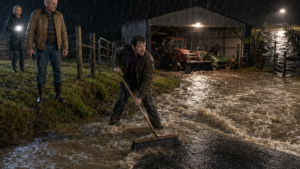
The field had been planted in narrow test strips for a regional seed contract, each variety marked with a small flag. Half the flags lay flattened. Mud covered the lowest leaves where the first shoots had broken through. A fresh trench sliced diagonally through three rows, its edges sharp beneath the slumped soil.
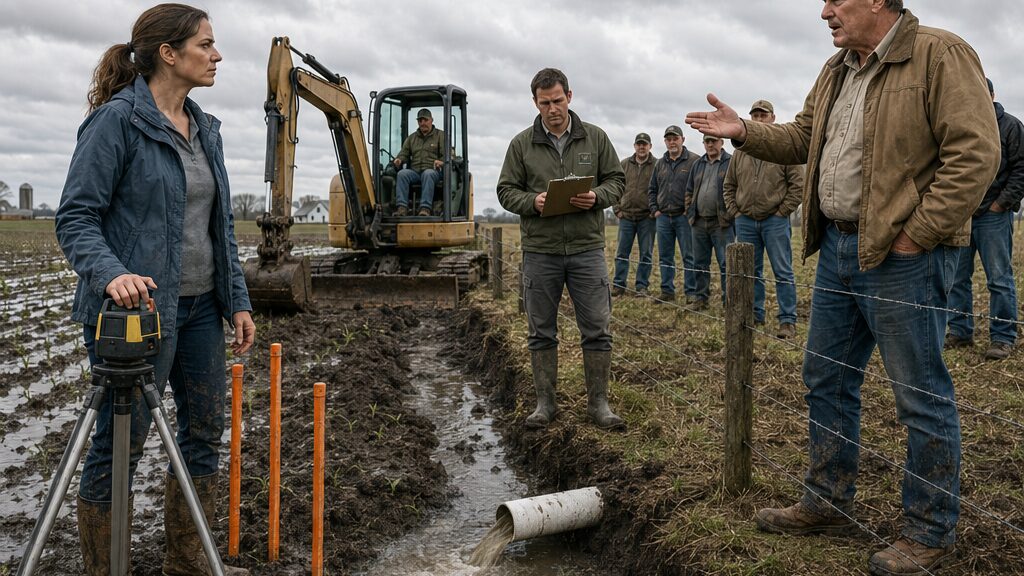
At the end of it, beneath the boundary fence, a white pipe protruded from the bank.
Water poured from its mouth.
Not rainwater wandering downhill. Not overflow finding the easiest hollow. A concentrated stream, nearly clear at the outlet, struck the trench and turned brown as it carried Harris soil toward the house.
Nicole stood still long enough to hear the difference.
Natural runoff spread and softened. This water had velocity. It arrived under pressure.
“Mom!”
Carolyn appeared on the back porch in an old canvas jacket, one hand shielding her eyes. “What happened?”
“Stay there.”
That made Carolyn come faster.
Nicole stepped into the trench and followed it downfield. The cut was recent; the excavator teeth had left parallel marks beneath the collapse. Whoever had dug it had worked from the fence toward the house, creating a clean fall where the field had once been nearly level.
Water slipped past Nicole’s calves and gathered near the edge of the yard. From there it curved around the equipment shed and spread toward the farmhouse’s north foundation.
Her father had repaired that wall twice.
Nicole crouched beside the concrete. The soil had drawn away in one place, leaving a dark seam beneath the sill plate. Muddy water disappeared into it a cupful at a time.
Carolyn stopped behind her. “Is it bad?”
Nicole reached into the flow and pressed two fingers against the soil. It collapsed around them.
“It isn’t good.”
“Dennis had a machine over there Tuesday.”
Nicole looked toward the Wright property. Beyond the fence, the roof of the cattle barn rose above a row of cottonwoods. “What machine?”
“One of those small excavators. I thought he was clearing brush.”
“You saw him digging at the boundary?”
“I saw the boom. Not where the bucket was.”
“And you didn’t call me?”
Carolyn’s face tightened. “You were in Des Moines closing out your apartment. I thought Dennis would tell us if it concerned us.”
The answer landed where most conversations about the farm eventually landed: on the years Nicole had not been there.
She stood and wiped mud onto her jeans. “Turn off the sump pump in the old cellar.”
“That makes no sense.”
“If this reaches the footing drains, I need to know what’s groundwater and what’s being pulled through the system. Please.”
Carolyn went without answering.
Nicole returned to the white pipe. Its outside diameter was large enough that she could nearly span it with both hands. Six inches, possibly eight. Too large for a simple yard drain, and far larger than anything used merely to control erosion at a fence line.
She took photographs: the pipe mouth, trench profile, fence posts, flattened seed rows, foundation seam. Then she opened the level application on her phone, disliked the imprecision, and walked to the equipment shed for her field case.
The hard black case had not been opened since she brought it from her consulting office. Her father had called it her suitcase full of reasons.
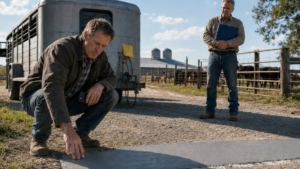
She carried it back, set a compact laser level on a tripod, and marked three elevations with orange flags. The original swale lay northwest. The trench ran southeast.
Someone had not followed the water.
Someone had told it where to go.
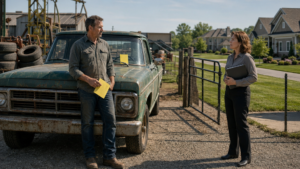
A pickup door slammed beyond the fence.
Dennis Wright approached in clean work boots and a tan jacket, stepping around the wet ground rather than through it. He was broad through the shoulders, silver beginning at his temples, his expression composed enough to suggest he had expected this meeting.
Nicole pointed at the pipe. “Shut it off.”
Dennis stopped on his side of the fence. “Morning to you, too.”
“You have a concentrated discharge entering our field.”
“I have drainage work on my own ground.”
“The outlet crosses the boundary.”
“It runs where the grade takes it.”
“The grade did not take it there. The trench does.”
Dennis glanced at the tripod and smiled without warmth. “You’ve been back what, three weeks?”
“Long enough to know our foundation wasn’t taking water from your barn lot before Tuesday.”
“It’s stormwater, Nicole. It has to go somewhere.”
“Not through a pipe onto somebody else’s property.”
“The district reviewed it.”
She looked at him. Dennis had chaired the local drainage board for more than a decade. Her father had complained about his certainty and trusted him with equipment in the same breath.
“Who reviewed it?” she asked.
“The proper people.”
“Were you one of them?”
His jaw shifted. “I didn’t vote on my own application.”
“That wasn’t my question.”
Behind them, the pipe continued pouring.
Dennis rested one hand on a fence post. “Your dad understood this ground. In a wet spring, water crosses that low side. Always has.”
“Sheet flow crossed the swale. You installed a pipe and cut a trench.”
“We made an erosion correction before the next storm.”
“You redirected runoff toward an occupied structure.”
“You make it sound intentional.”
Nicole looked down the trench, then back at him. “It required a machine.”
For the first time, his expression hardened.
She closed the field case. “I’m calling the county conservation office. Until they inspect it, stop the discharge.”
“You can call whoever you like.”
“I will.”
“The permit is already issued.”
Nicole waited.
Dennis glanced toward the farmhouse, where Carolyn stood on the porch watching them. When he spoke again, his voice was lower.
“You might want to ask your mother before you turn this into something bigger.”
“Ask her what?”
“Whether the Harris place agreed to it.”
Nicole felt the mud cooling inside her boot.
“I agreed to nothing.”
Dennis’s smile returned, faint and practiced.
“Then you should probably find out why the permit carries your consent.”
Chapter 2: He Explained Gravity Beside the Flooded Field
“Gravity does not need Nicole’s permission,” Dennis said, loud enough for everyone at the fence to hear.
Two days had passed since the pipe first flooded the seed rows. The water had slowed, but the trench remained full, and another storm was forecast for that night. Ryan Green from the county conservation office stood beside Nicole’s laser level with a clipboard under one arm. Two drainage-board members had arrived separately. So had three neighboring farmers who claimed they were only passing by.
Dennis had brought the excavator operator.
Nicole suspected he wanted witnesses more than help.
Ryan looked from Dennis to the trench. “We’re here to document conditions, not settle property history.”
“I’m only saying water runs downhill,” Dennis replied. “That field has always been lower.”
One of the farmers nodded slightly. Nicole noticed.
She had spent enough years in conference rooms to recognize an audience deciding whom it trusted before the evidence began. Here, trust had little to do with credentials. Dennis had shared machinery, attended funerals, and served on committees. Nicole had returned carrying a city address on her driver’s license and opinions about how the farm should operate.
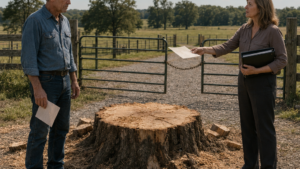
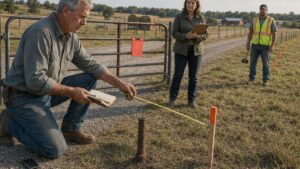
She planted the first survey stake beside the old grassed swale.
Dennis folded his arms. “You planning to turn this into a highway project?”
Nicole did not answer.
She placed the second stake at the boundary and the third beside the trench. Then she adjusted the laser until the red beam crossed the measuring rod.
Ryan read the elevations over her shoulder.
“The natural low point is northwest,” Nicole said.
Dennis gestured toward the water. “And yet there it is.”
“Because the cut creates a new fall.”
“You can make numbers say anything if you start in the right place.”
Nicole looked at the excavator operator. “Would you expose the upstream junction?”
The operator glanced at Dennis.
Ryan spoke before Dennis could. “County inspection. Carefully, please.”
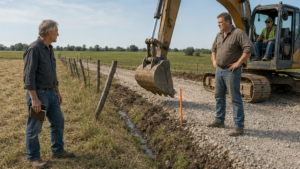
The machine started with a diesel shudder. Its bucket lowered on the Wright side of the fence, biting into damp soil above the white pipe. The gathering farmers stepped back. Carolyn watched from near the equipment shed, her hands buried in her jacket pockets.
Nicole focused on the pipe.
Each pass removed another layer. The white surface emerged beneath black soil, then an elbow joint, then a second section angling north toward Dennis’s property.
The operator paused.
“Keep going six feet,” Nicole said.
Dennis moved forward. “That’s enough to see what it is.”
“It’s enough to see a pipe,” she replied. “Not where it came from.”
Ryan gave the operator a nod.
The bucket scraped again. A junction appeared where the pipe crossed what had once been the edge of the natural swale. The original shallow channel continued northwest, choked now by packed clay. The pipe intercepted it and turned the water southeast, through the fence and into Nicole’s field.
Nobody spoke for several seconds.
Nicole set the measuring rod beside the exposed elbow. The red laser crossed it well below the natural swale elevation.
She read the difference aloud.
One of the board members stepped closer. “That much?”
Ryan checked it himself. “Within a tenth.”
Dennis pointed toward the upper ground. “That doesn’t change where the water wants to go.”
“It changes where you made it go,” Nicole said.
His face reddened. “The barn lot drains into that low ground. Your father knew it.”
“An open swale distributes flow. This pipe concentrates it. The new cut gives it a direct path toward my house.”
“You’ve been designing subdivisions too long. Farm water isn’t clean lines on paper.”
Nicole crouched beside the pipe. “No. It carries sediment, manure bacteria, fertilizer, and whatever else crosses the lot. That’s why you don’t discharge it at somebody’s foundation.”
The farmers shifted. The comment had reached beyond property lines now. It was no longer only about water.
Dennis turned to Ryan. “This was permitted as an erosion repair. Temporary outlet, minor grading. You have the file.”
“I have a scanned copy,” Ryan said. “I still need to compare the installed work.”
“The district approved it.”
One board member cleared his throat. “The application came through the usual packet.”
Nicole looked at him. “Did the packet include pipe dimensions?”
He hesitated. “A sketch.”
“Did anyone verify the outlet?”
“That isn’t always required for minor work.”
Dennis seized the opening. “There. Minor work. Exactly what I said.”
Nicole walked to her truck and returned with a caliper and tape. She measured the exposed pipe while Ryan watched.
“Eight-inch outside diameter,” she said. “What does the permit show?”
Ryan opened a folder clipped beneath his board. His eyes moved across the first page. “Four-inch flexible outlet.”
“This is rigid PVC.”
“Looks like it.”
“The permit calls for surface erosion control along the existing swale,” Nicole continued. “This installation blocks the swale, captures the flow, crosses the boundary, and creates a new grade.”
Dennis gave a short laugh. “Now we’re criminalizing better materials.”
“No. We’re identifying work that doesn’t match the application.”
Ryan raised a hand before Dennis answered. “I need both of you to stop. The county can issue a correction notice if the installation differs materially. But the file includes neighboring-landowner acknowledgment.”
Nicole felt the attention turn toward her.
“I never signed one.”
Dennis looked almost tired. “We’ve covered that.”
“No, you stated it. That isn’t the same thing.”
Ryan removed a page from the folder but did not hand it over. “There is a signature.”
“Mine?”
“Your printed name and a signature that appears to match it.”
Carolyn took one step forward, then stopped.
Nicole saw the movement.
“May I see it?” she asked.
“Not the original. This is the field copy.”
Ryan held the sheet where she could view it without taking it. The signature was compact, the N tilted forward, the final stroke of Harris drawn beneath the word.
It looked like hers.
That was the problem.
Nicole had signed thousands of reports, forms, and contracts. She knew the habits of her own hand—the pressure points, the way the second r narrowed when she wrote quickly, the sharp break before the final s.
The signature on the county sheet carried those habits.
Dennis watched her studying it. “Maybe city life made you forget paperwork.”
She ignored him.
The document was dated three weeks earlier, when she had been in Des Moines preparing to move. The acknowledgment stated that the adjoining owner accepted temporary discharge associated with erosion repair. Her name appeared beneath it.
The copied signature was too accurate to be guessed.
Ryan lowered the page. “I’m not making a finding today. The physical installation needs review, and the office will pull the complete permit record.”
“Until then?” Nicole asked.
“I can request that no additional work be done.”
“Request?”
“The district issued the permit. I’m county staff, not the drainage commissioner.”
“So the pipe stays open through tonight’s storm.”
Ryan’s expression tightened. “Unless there’s an immediate public-safety condition, yes.”
Dennis looked toward the darkening western sky. “Then we’re done here.”
Nicole packed the level without looking at him. She had proved the water had been redirected. Everyone had seen it. Yet the document had changed the balance again, turning her from injured landowner into a woman disputing her own name.
As the others began walking back toward their vehicles, one of the farmers passed close enough to speak quietly.
“Your dad and Dennis handled water between them for years.”
Nicole looked up. “What did they handle?”
But he kept walking.
Ryan waited until Dennis’s truck had pulled away. Then he opened the folder again and slid the field copy halfway toward her.
“Look at the bottom margin,” he said.
There was a faint gray line beneath the signature, cut off on the right side as if the image had been cropped from another page.
Nicole leaned closer.
Ryan tapped it with one finger. “This wasn’t signed on this form.”
Chapter 3: The Permit Carried a Name She Never Signed
The permit authorized a four-inch temporary outlet.
The pipe under Nicole’s fence measured eight inches.
She placed the permit sketch beside a photograph of the exposed junction on the county records table. In the drawing, a thin line followed the existing swale and ended before the property boundary. In her photograph, rigid white PVC blocked the swale, turned at a manufactured elbow, and continued straight into Harris soil.
Ryan stood across from her while the records clerk searched a cabinet for the original application packet.
“Who submitted it?” Nicole asked.
“The district office scanned it into the county system.”
“That isn’t what I asked.”
Ryan rubbed a thumb along the clipboard edge. “Dennis delivered the packet.”
“Was the neighboring-owner page already attached?”
“Yes.”
“Was it notarized?”
“No requirement for that type of acknowledgment.”
“Was the signature witnessed?”
“No.”
Nicole looked again at the cropped line beneath her name. “Then the page proves only that someone owned a copier.”
The clerk returned carrying a thin brown folder. Inside were six pages: application, parcel map, erosion-control sketch, board routing sheet, contractor estimate, and the adjoining-owner acknowledgment.
Nicole turned to the last page.
The signature was not ink. It was a printed image.
She tilted the sheet toward the overhead light. The density differed from the text around it, and the gray line beneath Harris extended three-quarters of an inch before vanishing under a white rectangular patch.
“Do you have the electronic file?” she asked.
The clerk opened the county scan on a monitor.
Nicole magnified the signature. Pixelation formed a faint box around it.
Ryan exhaled through his nose. “That’s not subtle.”
“It didn’t need to be. Nobody expected comparison.”
She searched her phone for documents signed near the same period. A farm insurance renewal. A seed contract. A utility easement request. Nothing matched the gray line.
Then she remembered the closing packet from her father’s estate.
At the farmhouse that afternoon, Nicole spread boxes across the dining-room table. Carolyn remained at the sink longer than necessary, rinsing a single coffee cup.
“Do you know where the estate inventory is?” Nicole asked.
“Bottom drawer of the file cabinet.”
“The blue cabinet or Dad’s metal one?”
“The metal one.”
Nicole found it beneath machinery receipts and property-tax statements. She carried the folder to the table and turned pages until her own signature appeared on a beneficiary acknowledgment.
The shape matched, but there was no gray line.
She kept searching.
Carolyn dried the cup and put it away. “You haven’t eaten.”
“I’m not hungry.”
“You said that yesterday.”
Nicole opened a folder marked ACCESS—NORTH FIELD. Inside was a utility company form from the previous summer, authorizing technicians to cross the property while replacing a pole. Her signature sat above a horizontal line that began beneath the final letters of Harris.
The county image was identical.
Same tilt. Same compressed second r. Same faint smudge where the pen had caught on cheap paper.
Someone had lifted it from the access form.
Nicole placed the two pages side by side and photographed them.
Carolyn came to the table. Her eyes moved from one signature to the other. “That’s yours.”
“The first one is mine. The second is an image of it.”
“Dennis did that?”
“Dennis submitted it.”
“That isn’t the same as knowing he made it.”
Nicole looked up. “Why are you protecting him?”
“I’m not.”
“You knew he’d been digging. You reacted when Ryan showed me the acknowledgment. And now you’re splitting hairs over who copied my signature.”
Carolyn folded the dish towel into smaller and smaller squares. “I’m asking you not to decide the whole truth before you have it.”
“The pipe is twice the permitted size.”
“I know.”
“It directs contaminated runoff toward the house.”
“I know.”
“He used my name.”
Carolyn set the towel down. “Your father let water cross that field.”
The words seemed to reduce the room.
Nicole closed the folder slowly. “What does that mean?”
“It means Dennis isn’t inventing all of it.”
“All of what?”
“The wet springs. The old swale. There were years his lower lot flooded and your father let him open the berm.”
“Open it how?”
“With the small backhoe. Just enough to let water spread through the grass before it reached the county ditch.”
“Across our property?”
“Along the low edge.”
“For how long?”
“A few weeks at a time.”
“How many years?”
Carolyn looked toward the dark window above the sink. “Two that I remember clearly. Maybe part of a third.”
Nicole stood. “And nobody thought to tell me this before I filed a complaint stating there had never been an agreement?”
“You said no easement existed. There isn’t one.”
“That is not the same statement.”
“You didn’t ask about a favor.”
“I asked whether Dennis had permission.”
“You asked whether anything was recorded.”
Nicole felt heat climb her neck. Her mother’s answer was careful because careful answers had kept peace in this house for decades.
“Did Dad give him permanent permission?”
“No.”
“Did he authorize a pipe?”
“Not that I ever saw.”
“Did he allow water toward the house?”
“Of course not.”
“Then why keep this from me?”
Carolyn pressed both palms to the table. “Because you came home looking for reasons to hate this place.”
Nicole went still.
“You opened every drawer as if you were auditing your father,” Carolyn continued. “You corrected the planting records, the fuel logs, the way I paid the machine shed insurance. You talk about selling the south eighty whenever something breaks. I thought if this could be settled quietly, maybe you wouldn’t use it as the final proof that staying was a mistake.”
“So you let me walk into a county inspection without the truth.”
“I thought Dennis would fix it.”
“He forged my consent.”
“I didn’t know that.”
“But you knew he believed he had some claim.”
Carolyn’s mouth trembled once, then steadied. “Your father and Dennis made arrangements. They did not bring every one of them into the kitchen.”
“That was convenient for them.”
“It kept both farms running.”
“Until one of them died and the other decided the arrangement belonged to him.”
The sentence struck harder than Nicole intended. Carolyn turned away.
For several minutes, only the refrigerator motor and the faint ticking of mud drying beneath Nicole’s boots disturbed the room.
Then Carolyn opened the lowest drawer of the sideboard. She removed a bundle of envelopes tied with baling twine.
“Your father saved letters when he thought they might matter,” she said.
Nicole took the bundle. Most were machinery quotes, feed invoices, and handwritten notes from neighbors. Near the bottom was an envelope with Dennis Wright’s name in the return corner.
The letter inside was brief.
It thanked her father for allowing runoff through the lower swale during “one more wet spring” and promised to close the temporary cut after planting conditions improved.
One more wet spring.
Not forever. Not a pipe. Not an easement.
But not nothing.
Nicole read it twice.
“Is there anything else?” she asked.
Carolyn sat down. “Dennis may have another letter.”
“What kind?”
“One your father wrote.”
“What did it say?”
“I never read it.”
“Then how do you know it exists?”
“Because your father told me Dennis wanted something in writing. He said he’d given him enough to prove they had an understanding.”
Nicole tightened her grip on the page.
“Enough for what?”
Carolyn looked at the copied signature on the table, then at the old thank-you letter.
“That,” she said quietly, “is what Dennis may be waiting to show everyone.”
Chapter 4: Her Father’s Promise Changed What the Evidence Meant
The letter from Dennis lay open on the farm-office desk, its final sentence underlined in Nicole’s pencil.
Thank you for giving us one more wet spring.
She had read the phrase so many times that the words had begun to separate from their meaning. One more implied a limit. Wet spring implied a condition. Giving implied permission.
None of it explained the eight-inch pipe.
Nicole opened another file drawer and found three years of her father’s handwritten field notes, each page crowded with seed varieties, fuel totals, planting depths, and weather observations. He had written in block capitals that leaned slightly to the right, as though every word were bracing into wind.
Carolyn stood in the doorway holding two mugs.
“You’ll ruin your eyes in here.”
“The light is fine.”
“It flickers.”
Nicole did not look up. “Did Dad keep drainage maps anywhere besides the county file?”
Carolyn set one mug near her elbow. “Maybe the equipment shed. There was a tube behind the workbench.”
Nicole closed the ledger. “Why didn’t you mention that yesterday?”
“I just remembered.”
“That is becoming a useful phrase.”
Carolyn’s hand remained on the mug. “You can be angry without making every silence deliberate.”
Nicole gathered the letter and field notes. “I can also be accurate.”
The equipment shed smelled of grease, mouse dust, and cold iron. Behind the workbench, she found a cardboard plan tube sealed with brittle masking tape. Inside were tile maps, an old aerial photograph, and a hand-drawn sketch of the lower boundary.
Her father had marked the natural swale in blue pencil. A shallow temporary cut crossed the Wright side of the fence, then stopped at the Harris boundary. Along the Harris field, arrows followed the grassed low ground northwest toward the county ditch.
In the margin he had written:
Open only during saturated conditions. Close after lower lot drains. No equipment east of fence.
Nicole laid Dennis’s thank-you letter beside the map.
The old arrangement had been real. So had its limits.
Her first complaint stated that no drainage permission had ever existed. Technically, no recorded easement existed. No permanent authorization existed. But the sentence she had submitted was broader than the truth.
She had written it before asking.
Outside, Carolyn waited near the shed door.
“Did you know about this map?”
“I knew your father drew things.”
“Did you know the cut stopped at the fence?”
Carolyn studied the page. “That sounds like him.”
“That isn’t an answer.”
“No. I didn’t know where he marked it.”
Nicole rolled the map halfway, then stopped. “Dennis has enough truth to make me look dishonest.”
“You are not dishonest.”
“I filed something incomplete because I assumed local arrangements were just excuses people used when they did not want records.”
Carolyn’s voice softened. “Sometimes they are.”
“And sometimes they are real.”
“Yes.”
Nicole looked across the field toward the white pipe. Its exposed curve caught sunlight beneath the fence, too clean against the black soil.
She had wanted a simple division: lawful and unlawful, evidence and story, her father’s mistakes and her own competence. The map refused to give it to her.
Her phone rang before she could roll it fully.
Ryan’s voice was clipped. “You need to see what was sent to the district board.”
“What was sent?”
“The letter Dennis has.”
Nicole looked at Carolyn. “Send it.”
A photograph arrived seconds later.
The document was on Harris farm letterhead, though her father had rarely used letterhead for anything except seed contracts. The date was six years earlier. In the first paragraph, he acknowledged that runoff from the Wright lower lot had historically crossed the low ground between the farms. In the second, he agreed that Dennis could continue using “the established drainage path when seasonal conditions require.”
The page ended there.
No map. No limits. No reference to closing the cut after the ground drained.
Ryan came back on the line. “Dennis distributed it to both board members and the commissioner this morning.”
“With what explanation?”
“That you knew or should have known the farms had an ongoing arrangement.”
“I didn’t know.”
“He is saying your complaint misrepresented the history.”
Nicole stared at her father’s signature. It was unquestionably real.
“Did he mention the altered acknowledgment?”
“He says the acknowledgment was assembled from existing authorization because the old agreement remained in effect.”
“That is not how signatures work.”
“I know.”
“But he has turned forgery into clerical shorthand.”
Ryan paused. “That’s close to how he framed it.”
Nicole looked down at the hand-drawn map. “The letter says established path. The pipe does not follow the established path.”
“Can you prove what the established path was?”
“Yes.”
“Then include it.”
“When is the board meeting?”
“Dennis requested an emergency review for Friday.”
“Friday is three days away.”
“He says another storm makes delay unreasonable.”
“He is the one causing the risk.”
“He is also still the chair.”
Nicole closed her eyes briefly. “Send me the agenda.”
After the call, she carried the map and letter back to the office. She scanned both at high resolution, then overlaid the old aerial photograph with current elevation data. The historic swale curved northwest. The new pipe cut southeast.
The distinction was measurable.
It was also vulnerable to people who preferred Dennis’s shorter version.
By noon, the thank-you letter had traveled beyond the board. A neighboring farmer stopped at the house to return a borrowed chain and mentioned, too casually, that he had heard Nicole’s father had “always handled water with Dennis.”
At the feed store, Carolyn’s phone rang twice with people asking whether the Harris family intended to sue the drainage district.
Nicole did not go into town. She revised her report instead.
She removed the sentence claiming no prior permission had existed. In its place, she wrote that limited, temporary seasonal cooperation had occurred along the natural swale, but no evidence supported a permanent concentrated discharge, boundary-crossing pipe, artificial grade, or use of Nicole’s signature.
The change made the report less absolute.
It also made it stronger.
Near evening, she returned to the old swale with a shovel and cleared grass from a low concrete marker. Her father had driven a steel pin beside it and painted the top blue. From that point, the fall toward the county ditch was obvious even without equipment.
Carolyn joined her carrying the folded map.
“Your father was afraid of paperwork,” she said.
Nicole brushed mud from the marker. “He was not afraid. He disliked being pinned down.”
“He thought written agreements made neighbors act like strangers.”
“And unwritten ones made daughters inherit arguments they never heard.”
Carolyn flinched but did not leave.
Nicole stood. “Did Dad ever regret the arrangement?”
“He regretted that Dennis stopped asking each year.”
That was new.
“When?”
“The last wet spring. Your father said Dennis had begun talking as if the low field belonged to the water, and because the water came from his side, he got to decide where it went.”
“Why didn’t Dad stop him?”
“He meant to.”
“Meaning to is not the same as doing it.”
“No.” Carolyn looked toward the Wright barn. “Your father was sick by then.”
Nicole’s anger shifted, not disappearing but losing its clean edge.
A truck slowed on the county road and turned into the Wright driveway. It was newer than most farm pickups, dark blue, with a small lender’s emblem on the door. A man in a pressed jacket stepped out carrying a leather portfolio.
Dennis came from the barn before the truck had fully stopped.
Even from the distance, Nicole saw the speed of his walk.
Her phone buzzed with a county scheduling notice. Beneath Friday’s drainage-board hearing was another entry copied to affected landowners:
Wright Agricultural Credit Compliance Inspection—Livestock Structure and Drainage Review.
Nicole looked from the notice to the barn.
Dennis had not cut the trench simply because he believed he could.
He had cut it before someone important arrived to see what the water had been doing to his own ground.
Chapter 5: The Barn Behind His Confidence Was Starting to Fail
A crack ran beneath the Wright barn’s loading wall wide enough to hold the edge of Nicole’s measuring tape.
She had not come to inspect the barn. The farm lender had asked the county to verify runoff conditions before completing his compliance review, and Ryan had requested Nicole’s presence because her complaint involved the same drainage system. Dennis had objected until the lender reminded him that continued financing required access.
Now six people stood in the narrow space between the barn and the cattle lot while wind pressed the smell of wet hay and manure against the metal siding.
Nicole crouched near the foundation. The concrete pad had settled toward the southeast corner. Fresh sealant covered older fractures, but new cracks had opened beyond it.
The lender looked at Dennis. “How long has this movement been active?”
“It’s seasonal.”
“That was not my question.”
Dennis’s jaw tightened. “A couple of years.”
Nicole rose and followed the grade with her eyes. The barn sat above the blocked natural swale. During heavy rain, water gathered against the lower pad before spreading toward the Harris boundary.
Before the pipe, the barn had been the vulnerable structure.
The diversion had exchanged Dennis’s risk for hers.
Ryan stepped near the white inlet pipe that began behind the barn. “This connects directly to the outlet at the Harris fence?”
The excavator operator nodded. “One run.”
Dennis shot him a look.
The operator stared at the ground. “That’s what I installed.”
“At whose direction?” Ryan asked.
Dennis answered. “Mine.”
The admission was plain, almost defiant.
Nicole measured the pad settlement while the lender photographed the wall. The numbers were bad enough to threaten loan conditions but not yet catastrophic. Dennis could have sought a shared drainage redesign months earlier. He could have disclosed the barn problem to the board, recused himself, and applied for cost-sharing assistance.
Instead, he had hidden the water underground and pushed it toward her house.
The lender moved to inspect the interior. Ryan and the others followed. Dennis caught Nicole by the elbow before she reached the door.
She pulled free.
“Walk with me,” he said.
“No.”
“Then stand there and listen.”
The wind rattled a loose sheet of siding above them.
Dennis glanced toward the barn entrance to make sure the others were out of hearing. “I’ll restore your field.”
Nicole said nothing.
“I’ll pay for the replanted rows, the foundation inspection, whatever the actual damage is. I’ll have the trench filled before the weekend.”
“In exchange for what?”
“You withdraw the board complaint.”
“The county review remains.”
“You tell them we settled the property issue.”
“And the permit?”
“Correct it.”
“The copied signature?”
His face hardened. “There was permission.”
“From my father, for a temporary open swale six years ago.”
“The understanding continued.”
“Then why use my signature?”
“Because the form required an adjoining owner.”
“That is not an answer.”
“It was paperwork standing in the way of work that had already been agreed to.”
“By a man who is dead.”
“He would have understood.”
Nicole stepped closer. “You do not get to turn what my father might have understood into my consent.”
Dennis looked toward the barn again. When he spoke, the confidence had thinned.
“The lender was coming.”
“I know.”
“If that lower wall failed inspection, they could freeze the operating line. No operating line means no feed contract. No feed contract means cattle sold into a bad market and three people without work.”
“Then you should have asked for help.”
“From you?”
“Yes.”
“You had been back three weeks. Every time someone mentioned a local arrangement, you looked at them like they were explaining indoor plumbing.”
The accusation landed because it contained enough truth.
Dennis continued. “You were already pricing the south eighty. Everyone knew it.”
“That did not make the field yours.”
“I did not say it did.”
“You acted as if it did.”
For a moment, neither spoke.
Inside the barn, a gate clanged and cattle shifted against one another.
Dennis rubbed a hand over his mouth. “Your father and I kept both places going through years you did not see.”
“And he died without telling me what you believed he owed you.”
“He did not owe me.”
“Then stop using him as permission.”
Dennis looked tired now, older than he had at the fence. “I thought the pipe would carry the water past your seed rows and into the ditch.”
“You cut the grade toward the house.”
“The operator followed the easiest line.”
“You approved it.”
“Yes.”
The single word settled between them.
“Did you know the permit showed a four-inch outlet?” Nicole asked.
“Yes.”
“Did you know the installed pipe was eight?”
“Yes.”
“Did you know the natural swale was being blocked?”
“Yes.”
“Did you direct the packet through the board without independent review?”
His gaze moved away.
“That is also a yes,” she said.
He turned back sharply. “I kept the meeting packet moving. I did not bribe anyone. I did not threaten anyone.”
“You used the chair to make your private project look routine.”
“I used a process built for getting work done before weather destroys something.”
“And when it threatened my foundation?”
“I said I would repair it.”
“Privately.”
“What do you want, Nicole? My name dragged through every coffee shop in the county? The lender calling the loan? The board pretending none of them ever handled a neighbor’s problem informally?”
“I want the pipe shut down, the damage documented, and the record corrected.”
“And if that closes this farm?”
She looked at the failing wall, then at the workers’ trucks near the feed shed.
“That consequence belongs to the decisions that created it.”
Dennis gave a bitter laugh. “That sounds clean when you say it.”
“It is not clean.”
For the first time, her voice rose.
“My mother hid the old agreement. My father left limits in a drawer instead of telling anyone. I filed a complaint before I asked the questions I should have asked. None of that gives you the right to copy my signature.”
Dennis’s expression changed at the admission. He had expected accusation, not shared blame.
Nicole lowered her voice. “I will correct my statement about the prior arrangement. I will include your barn risk in the report. I will also include every way you exceeded the arrangement and the permit.”
“You would rather be fair than win?”
“I would rather the record survive scrutiny.”
The lender emerged from the barn with Ryan behind him.
“We need photographs of the northeast footing,” he said.
Dennis did not move.
Nicole walked away from him and joined the inspection.
By late afternoon, Ryan had enough information to recommend temporary stabilization but not enough authority to close the pipe before the board hearing. Nicole returned to the Harris farm and worked on the report until the figures blurred.
Crop loss. Soil displacement. Foundation exposure. Pipe capacity. Grade alteration. Contaminant pathway. Historic swale. Temporary agreement. Misused signature.
At nine, headlights swept across the office window.
Dennis entered without knocking.
He placed an envelope on the desk.
“Estimate for your crop and soil work,” he said. “Full amount.”
Nicole did not touch it.
“Does it include the foundation?”
“When the contractor gives a figure.”
“And the public record?”
His mouth tightened. “Withdraw the complaint, and I will resign the chair after planting.”
“After planting gives you another month controlling the board.”
“I am offering you more than you will get if this turns into lawyers.”
“I am not asking for more.”
“Then what are you asking for?”
She tapped the twelve-page draft beneath her hand. “A process you cannot edit.”
Dennis stared at the report.
“The board meets tomorrow at eight,” he said. “I moved the vote forward.”
“My report is due at noon.”
“Then it will arrive after the decision.”
“You cannot hold a final vote before affected parties submit evidence.”
“We can affirm emergency drainage authority.”
“You have a conflict.”
“That will be for the board to decide.”
He turned toward the door.
“Dennis.”
He stopped.
“If you force a vote before the report is filed, I will make your use of the chair part of the complaint.”
He looked back at her, his face unreadable.
“That is the trouble with coming home late,” he said. “You think the rules are waiting exactly where you left them.”
The door closed behind him.
Nicole looked at the clock.
Ten hours remained before Dennis intended to make his version official.
Chapter 6: Twelve Pages Could Not Repair What Silence Had Broken
Dennis was already seated at the head of the drainage-board table when Nicole entered the county meeting room at seven forty-three.
The meeting was not scheduled to begin until eight.
One board member sat to his right with a closed folder. The other stood near the coffee urn, speaking quietly with the county drainage commissioner. Ryan had placed a projector cart beside the wall but had not turned it on.
Dennis wore a pressed work shirt instead of his usual jacket. In front of him lay copies of Nicole’s father’s letter.
Not the map.
Nicole set her field case on the public table and placed twelve stapled reports beside it.
Dennis looked at the stack. “You finished early.”
“You moved the meeting.”
“Rain moved the meeting.”
“The forecast changed yesterday. The storm is tracking south.”
“Then we can all be grateful.”
The commissioner called the meeting to order precisely at eight. He stated that Dennis would remain present as the applicant but should not preside over discussion involving his own drainage work.
Dennis’s hand tightened around his pen.
“I have chaired every emergency drainage review for eleven years,” he said.
“Not one concerning your property,” the commissioner replied.
The other board member moved into the chair.
It was a small correction, but the room felt different after it.
The commissioner summarized the dispute: permitted erosion repair, neighboring-property damage, claimed historic drainage arrangement, questions regarding installation dimensions and landowner acknowledgment.
Dennis spoke first.
He described two farms sharing a low drainage corridor for decades. He read from Nicole’s father’s letter and emphasized “established drainage path” and “when seasonal conditions require.” He acknowledged that the installed pipe was larger than the preliminary sketch but argued that the change improved capacity and reduced erosion.
“The Harris complaint initially denied any agreement,” he said. “The written record shows otherwise.”
One board member looked toward Nicole.
There it was—the weakness she had created herself.
Nicole stood and carried one report to each official.
“My initial statement was incomplete,” she said.
Dennis looked up.
“My father allowed temporary seasonal overflow through the natural swale during at least two wet springs. I filed before asking my mother about that history. I have corrected the statement in the report.”
The room remained quiet.
Dennis’s pen stopped moving.
Nicole continued. “The existence of that temporary arrangement does not authorize the installed system. I will show the difference.”
Ryan turned on the projector.
The first image displayed her father’s hand-drawn map. Blue arrows followed the shallow swale northwest toward the county ditch. A note limited opening to saturated conditions and prohibited equipment east of the fence.
Nicole placed the original beneath the document camera.
“This map was stored with Dennis Wright’s thank-you letter. It identifies the established path referenced in the later correspondence.”
Dennis leaned forward. “That map was never part of our agreement.”
“It was part of my father’s drainage records.”
“It is his private note.”
“Yes. Which is why I do not offer it as a contract. I offer it as evidence of what he believed he had permitted.”
She advanced to an aerial overlay. A blue line traced the natural swale. A red line showed the installed pipe and trench.
“The pipe does not use the established path. It intercepts it, blocks it with compacted clay, turns the flow southeast, crosses the property boundary, and directs concentrated discharge toward the Harris farmhouse.”
The next slide showed the field inspection stakes and elevation readings.
One board member compared the figures with the permit sketch. “This drop was excavated?”
“Yes.”
The excavator operator sat in the back row. At the commissioner’s request, he confirmed that Dennis had directed the alignment and approved the deeper cut when the first trench did not move water quickly enough.
Dennis turned toward him. “You said you followed grade.”
“I followed the grade you marked.”
The answer stayed in the room.
Nicole displayed the permit dimensions beside a photograph of the exposed eight-inch pipe.
“The application describes a four-inch temporary flexible outlet along the existing swale. The installed system is rigid PVC with roughly four times the cross-sectional flow area before slope and pressure are considered.”
Dennis interrupted. “Larger pipe means less backup and less erosion.”
“On your property,” Nicole said. “It also means greater concentrated discharge on mine.”
She showed photographs of the seed rows, sediment path, and foundation seam. The contractor’s estimate documented soil restoration, crop loss, and preliminary foundation stabilization. The total was lower than Dennis had feared and higher than he had offered before the contractor’s visit.
Then Nicole placed the adjoining-owner acknowledgment on the screen.
“My name appears here. I did not sign this document.”
Dennis spoke immediately. “The signature came from an access form already authorizing entry onto the property.”
“An access form for a utility company replacing a pole.”
“The farms had an existing understanding.”
“An understanding is not transferable consent.”
She displayed the original utility form beside the acknowledgment. The identical signature and cropped gray line were visible even from the back row.
The board member nearest Dennis shifted in his chair.
Dennis looked at the commissioner. “No one was trying to deceive anybody. The district needed confirmation that the adjoining owner had historically accepted the drainage.”
“Then the packet should have included the old letter,” Nicole said. “Instead, it included my signature beneath language I had never seen.”
“You were absent.”
“I was the owner.”
“You had left your mother managing the place.”
“Then you could have asked her.”
Carolyn sat in the second row. At the mention of her, she stood.
Dennis’s expression changed.
Carolyn did not look at Nicole when she spoke.
“If Dennis had asked me about a permanent pipe, I would have said no.”
The words were quiet, but they ended one of his defenses.
She continued. “I knew there had been temporary water through the low field. I did not tell Nicole soon enough. That was my mistake. But her father never agreed to send a buried line toward the house.”
Dennis looked down at the table.
Nicole had imagined this moment as vindication. Instead, it felt like watching several people place their failures in public one at a time.
She turned to the final section of the report.
“The Wright barn has a legitimate drainage problem. Closing the pipe without temporary controls may push water back against its lower foundation. I am not recommending that the county ignore that risk.”
Dennis looked up again.
Nicole projected two temporary measures: a shallow holding basin on the Wright side and a lined emergency overflow returning water to the natural swale without crossing the Harris boundary.
“This can protect the barn while a permanent design is reviewed.”
One board member frowned. “You designed a solution for his property?”
“I designed a way to stop the unlawful discharge without transferring immediate structural risk back to the barn.”
“After what he did?”
Nicole rested one hand on the report.
“The grade does not care which of us behaved better.”
No one laughed.
The commissioner asked Ryan for his findings. Ryan confirmed that the installed work materially differed from the permit, that the acknowledgment was unreliable, and that Dennis’s role in routing his own application created a procedural conflict requiring review.
Dennis finally spoke without looking at Nicole.
“I was trying to keep a farm operating.”
The commissioner folded his hands. “You were entitled to request emergency assistance.”
“I did not have months.”
“You had enough time to copy a signature.”
Dennis’s face closed.
The board voted to suspend the permit, refer the acknowledgment for administrative review, and remove Dennis from decisions concerning the project. His chairmanship would be considered separately under district rules.
There was no applause. Chairs creaked. Someone coughed near the door.
The commissioner issued the immediate order himself.
“The pipe crossing onto Harris property will be shut within forty-eight hours. No further excavation may occur without county supervision. Temporary protection for the Wright barn will follow the measures in the engineer’s report unless field conditions require modification.”
Dennis stared at the white cross-section diagram on the final page.
Nicole gathered her papers slowly. She had won the order she came for, but the problem had not disappeared. Water would still gather behind the barn. The next heavy storm would still arrive. Her father’s silence and Dennis’s deception had created a boundary no simple closure could repair.
As people filed out, Dennis remained seated.
“You got the pipe shut,” he said.
Nicole closed her field case. “Yes.”
“And when the water comes back against my barn?”
“We install the temporary controls.”
“Then what?”
“Then we design something lawful.”
He studied her as if the answer cost him more than the ruling.
Outside the meeting room, Ryan handed Nicole the signed order. Forty-eight hours had been written in block letters across the top.
At the bottom, beneath the enforcement language, the commissioner had added one condition:
Corrective work must protect both properties from transferred damage.
Nicole read the sentence twice.
The county had stopped Dennis from sending the water onto her farm.
Now she had to prove that justice could do more than send it back.
Chapter 7: The Water Finally Had a Lawful Place to Go
The excavator lifted the white pipe from beneath Nicole’s field in three mud-streaked sections.
The first length came free with a wet pull, shedding black soil and corn roots. Water trapped inside spilled from the open end and ran back into the trench Dennis had cut six weeks earlier. For a moment, the pipe hung above the ruined seed rows like a pale bone.
Nobody spoke.
Ryan stood beside the machine with the county order clipped to a board. The foundation and soil contractor waited near the farmhouse. Two loads of clean fill had already been delivered, and rolls of erosion-control matting lay beside the fence.
Dennis watched from his side of the boundary.
He was no longer drainage-board chair. The district had accepted his resignation before beginning its administrative review. A civil penalty, restoration costs, and Nicole’s documented crop losses had been included in the settlement. The lender had kept his operating line open under stricter conditions, provided the barn received temporary stabilization and a permanent drainage correction before fall.
The consequences were real.
So was the water still standing behind his barn after every hard rain.
The excavator operator lowered the pipe onto wooden blocks.
Ryan checked his list. “Cross-boundary discharge is removed. Next is trench restoration.”
“Not yet,” Nicole said.
Ryan looked at her.
She walked to the three survey stakes still marking the natural grade. Their orange tops had faded in the sun, but the elevations remained penciled on the sides. The same numbers that had exposed Dennis’s diversion now marked the centerline of the replacement plan rolled beneath her arm.
Dennis approached the fence. “You said the pipe was coming out.”
“It is out.”
“And the trench closes.”
“The illegal trench closes.”
She spread the design across the hood of Ryan’s truck.
The plan showed a shallow collection basin behind the Wright barn, a reinforced overflow channel following the historic swale, and a restricted underground crossing at the county ditch—not at the Harris boundary. The flow would remain open and visible until it reached a monitored control structure. No buried junction would allow either landowner to redirect it without review.
Ryan traced the blue line. “This is the revised option you sent Friday?”
“Yes.”
Dennis stayed on the other side of the hood. “That basin takes almost half an acre.”
“Three-tenths.”
“Productive ground.”
“Ground that is already saturated often enough to threaten your barn.”
“It also needs a wider outlet.”
“The width lowers velocity. That is the point.”
He looked toward the removed pipe. “And who maintains it?”
“Both farms inspect it twice a year. The district inspects after major alterations. Maintenance responsibilities are written into the easement.”
Dennis’s mouth tightened at the last word.
Nicole noticed. “Nothing moves without a record this time.”
The contractor leaned over the plan. “This protects the Harris foundation?”
Nicole pointed to the elevation line. “The swale stays northwest of the house. The basin releases gradually. Even at design storm capacity, the water surface remains below the foundation grade.”
“And the barn?”
“Protected if the inlet stays clear and the pad stabilization is completed.”
Dennis tapped the paper. “You designed this before the hearing.”
“I began it before the hearing.”
“Why?”
“Because closing your pipe did not make the water disappear.”
The answer left him without an easy reply.
Ryan looked from one property to the other. “The county can approve this as a joint corrective project. Cost share will be reduced because of the enforcement action. Wright pays the majority share and all Harris restoration expenses.”
Dennis gave a humorless breath. “That was never in doubt.”
“It was in doubt when you offered to settle privately,” Nicole said.
He met her eyes. “I was trying to keep the farm.”
“You were trying to keep the problem hidden.”
“Yes.”
The admission came without argument now.
The excavator idled behind them. Cattle called from the barn, and the sound carried over the field.
Dennis folded the corner of the plan between two fingers, then smoothed it flat again. “If I sign this, I cannot change the outlet when the lot floods.”
“You can request a modification.”
“Which takes time.”
“So does repairing somebody else’s foundation.”
His gaze moved toward the farmhouse. “I know.”
Nicole waited.
Finally, Dennis said, “Your father would have hated all these pages.”
“He might have.”
“He would have called me before bringing the county out.”
“He also would have expected you to ask before crossing the fence.”
Dennis looked at the old swale. “Maybe.”
“No. Not maybe.”
He nodded once.
It was not an apology. Nicole no longer expected one shaped the way she wanted.
Ryan placed the easement documents on the truck hood. Dennis signed first. Nicole read every page again before adding her name in fresh blue ink.
This time, no one copied it.
Work began that afternoon.
The illegal trench was filled in compacted layers. Damaged soil near the farmhouse was removed and replaced. The contractor sealed the exposed foundation seam and installed monitoring points along the north wall. In the lower field, the ruined seed rows were graded and replanted with a shorter-season variety.
Across the boundary, the excavator shaped the new basin. Dennis watched the first cut, then left before the overflow channel reached the old swale.
Nicole did not follow him.
Near sunset, the lawful outlet stood open between the farms: shallow enough to inspect, broad enough to slow the water, and marked at each bend with county stakes. The old white pipe remained on the blocks, waiting to be hauled away.
Carolyn walked out carrying two bottles of water.
She handed one to Nicole and looked across the repaired ground. “It resembles what your father drew.”
“Mostly.”
“He would have liked that.”
“He should have written it down.”
Carolyn nodded. “Yes.”
They stood beside the final survey stake. Beyond it, the new channel curved away from the farmhouse and toward the county ditch. Nothing about it was hidden.
Carolyn turned the bottle in her hands. “When the contractors finish, are you going back to Des Moines?”
Nicole had expected the question for weeks. She had answered it privately in different ways depending on the hour, the bill, or the argument.
The south eighty was still valuable. Her consulting firm had offered remote work. The farmhouse needed more repairs than the settlement covered. Staying would not restore the years she had lost with her father.
But leaving no longer felt like escape from his choices. It felt like abandoning her own.
Nicole picked up the steel driver and positioned it over the stake.
“I’ll be here through harvest,” she said.
Carolyn watched her drive the stake into the earth until the marked elevation sat level with the others.
“After harvest?” Carolyn asked.
Nicole rested both hands on the driver.
“Then we decide what the farm needs next.”
The first water entered the new basin three days later.
It spread slowly across the grassed bottom, rose to the marked control point, and moved through the open channel along the lawful grade. Nicole followed it past the boundary, beyond the repaired seed rows, and away from the farmhouse.
At the county ditch, the water released without force.
Behind her, the farms remained separate properties.
For the first time in years, their obligations were not.
The story has ended.