Faithful Service
Part I — Bronze Memory
Daniel Mercer stopped walking when he saw the statue.
It stood at the center of the memorial lawn, bronze darkened by old rain, a soldier kneeling before a German shepherd with both hands cupping the dog’s face. Their foreheads nearly touched. The posture was so exact that Daniel felt his chest tighten before he could stop it. For one second the neat Kentucky morning vanished, and mud came back. Heat came back. The smell of wet canvas came back.
Under the statue, cut into the stone, were two words:
Faithful Service
He stared at them too long.
Around him, people moved in respectful ceremony clothes—veterans in blazers, active-duty handlers in dress uniform, spouses holding programs, children too young to understand why adults lowered their voices near memorials. Somewhere to his left, a speaker tested a microphone. Somewhere behind him, a dog barked once and was hushed.
Daniel kept his face still. He had spent fifty years learning how.
“Mr. Mercer?”
He turned.
The woman approaching him was young enough to be his daughter, maybe younger. Army uniform. Crisp posture. Dark hair pulled back. A folder hugged to her chest like she was carrying something breakable.
“Lieutenant Rachel Velez,” she said. “Thank you for coming.”
He shook her hand. “Didn’t think I had much choice after three letters and a phone call.”
A quick smile touched her mouth, then disappeared. “We were hoping you’d accept. Your file made it clear you were one of the last scout dog handlers rotated out.”
“File,” Daniel repeated. The word had edges.
Rachel seemed to hear that. “I know that’s not always a comfortable way to be remembered.”
Daniel looked back at the statue. “Comfort isn’t what they built this thing for.”
She followed his gaze. “No,” she said quietly. “I don’t think it is.”
That made him look at her more carefully.
Most people at these events wanted one of two things from old men: clean pride or clean regret. They wanted a polished story they could carry home without getting blood on their hands. This lieutenant did not seem polished. She seemed alert.
“Your remarks are after the dedication,” she said. “Just a few minutes. Mostly recollection. Nothing difficult.”
Daniel almost laughed.
He had come carrying a framed citation in the passenger seat of his truck like a fragile lie. It praised courage under hostile conditions. It mentioned his dog only as part of a team designation, then ended with the number of men saved on patrol. It was the kind of language that made grief sound efficient.
“I’m not much for speeches,” he said.
“You don’t need to be.”
But she was already opening the folder.
“I wanted to ask you something before the ceremony starts,” she said. “Privately.”
That word made him tired. Private things had a way of becoming public at the worst time.
Rachel took out an old black-and-white photograph inside a plastic sleeve. The image was damaged around the edges. A runway. Men moving toward a transport plane. Heat warping the air above the tarmac. And in the foreground, almost turned away from the camera, a dog sitting alone.
Daniel’s fingers went cold.
“We’ve been digitizing withdrawal-period material,” Rachel said. “This one wasn’t labeled properly. I saw your dog’s name in your service record. Rex. I wondered if this might be him.”
Daniel did not take the photo.
He could feel his heartbeat in his throat. He hated that. Hated that a rectangle of old paper still had that kind of authority over him.
“I can’t tell you that.”
Rachel didn’t push the photo closer. “You won’t,” she corrected.
The distinction annoyed him because it was fair.
He looked at the dog anyway. Not straight on. In fragments. The shoulder line. The stillness. The way the head seemed too upright for rest.
“Some of the committee wants a straightforward ceremony,” Rachel said. “Heroism. Service. The official line.”
“Sounds like a ceremony.”
“I was hoping for something truer.”
Daniel finally looked at her.
“Lieutenant,” he said, “you don’t ask a man to come honor the dead and then hand him a ghost before coffee.”
“No,” she said. “But if I wait until after the speeches, the polished version wins again.”
That landed harder than he wanted it to.
From the stage, someone called for guests to begin taking seats. The crowd slowly shifted toward the rows of white folding chairs.
Rachel slid the photograph back into the folder but kept it in her hands.
Daniel glanced once more at the statue. Bronze soldier. Bronze dog. Foreheads almost touching. Whoever had sculpted it had understood intimacy, but not what came after.
He picked up the framed citation tucked under his arm.
“You should’ve left the inscription off,” he said.
Rachel frowned. “Which inscription?”
He looked down at the stone.
“Faithful Service,” he said. “That depends who you think failed who.”
Then he walked toward the chairs, and for the first time that morning, he knew the day was not going to let him leave clean.
Part II — The Safe Version
The first part of the ceremony went exactly the way Daniel had expected.
A chaplain spoke about loyalty.
A general spoke about sacrifice.
A civilian from the veterans’ foundation thanked donors by name.
The audience sat in clean morning light with programs folded on their laps, and every sentence came out smooth enough to frame. Daniel listened with the old expression veterans learned to wear when they didn’t want their mouths to tell the truth first.
Then Rachel found him again during the break before the remarks.
He had stepped into the shade near an exhibit tent, where blown-up photographs and laminated documents stood on easels. Young handlers moved through them with their dogs beside them—sleek animals with polished coats and modern harnesses, alert and disciplined and alive. Daniel watched one shepherd lean lightly against a corporal’s leg while the man spoke to a little boy. The gesture was small. Familiar. It hit harder than any speech.
Rachel came to stand beside him.
“I’m sorry about the timing earlier,” she said.
“You’re not.”
“No,” she admitted. “Not really.”
Daniel let that pass.
Inside the tent hung a large panel labeled Scouting the Jungle War. There were photographs of handlers half-hidden in wet foliage, dogs straining forward on leash, black trees, low helicopters, mud everywhere. Beneath them, clean blocks of text explained tactics and terrain in language so sterile it might have been describing irrigation.
Rachel said, “Would you tell me about him? Not the ending. Just him.”
Daniel almost refused. Then one of the young handlers outside laughed as his dog nudged his pocket for a treat, and something in Daniel’s chest shifted.
“Rex was smarter than half the men I served with,” he said.
Rachel waited.
“He was black-and-tan. About seventy pounds. Not the biggest dog in the kennel, but he had a long stride and he read the ground fast. Quiet dog. Didn’t waste motion.” Daniel kept his eyes on the exhibit panel. “On patrol you learned his body before you learned your own fear. Ears, tail, shoulders. A handler watches the dog and the dog watches the world.”
Rachel said nothing. She had the rare skill of not filling silence just because it existed.
“There was one patrol,” Daniel went on. “Monsoon season easing off. Still wet enough that the trail wouldn’t hold a shape for long. We were moving with a six-man element. Narrow game path, triple canopy overhead, heat sitting on your neck like a hand. Rex stopped.”
“Stopped how?”
Daniel glanced at her. Good question.
“Not afraid. Just final. There’s a difference. He went hard through the shoulders and locked. No bark. No jump. Just refused another inch.”
Rachel looked down at the folder in her hand, like she was taking notes without writing.
“The lieutenant behind me got irritated,” Daniel said. “Said the dog was blown or distracted. I told him if he wanted to test that theory, he could step in front of us himself.”
That earned the smallest smile.
Daniel went on. “I got down low. Started reading the brush line. There was a tripwire strung where a man’s eye wouldn’t catch it unless the light hit just right. Grenade rig. Probably secondary device too. We backed out. Called it in. Found more along the path.”
“How many men did that save?”
Daniel hated numbers when they got attached to a life.
“Enough.”
Rachel waited, but this time there was no answer coming.
Outside the tent, someone announced that the next sequence would begin in ten minutes.
Daniel adjusted the frame under his arm. “That’s the part people like,” he said. “Smart dog. Saved men. Everybody goes home feeling decent.”
Rachel’s voice stayed careful. “It’s not false.”
“No.” He looked at the photos again. “Just incomplete.”
She turned and gestured toward another display at the far end of the tent. “Will you walk through the archive section with me?”
He should have said no. Instead, maybe because he had already let Rex back into the air between them, he nodded.
The second display held reproductions of orders, shipping summaries, equipment inventories, redeployment notices. Paper after paper. Categories, quantities, routing language. The old war translated into clerical calm.
Daniel saw one heading and felt his jaw tighten before he was close enough to read the whole thing.
Redeployment of expendable operational assets.
Beneath it, typed lists.
Rachel said quietly, “This is where the official memory shifts tone.”
Daniel read without seeming to. Radios. Field generators. Medical surplus. Kennel units.
Dogs.
Not named. Tallied.
Something hot and ugly passed through him.
“Why show this at all?” he asked.
“Because it exists.”
“That’s not a reason.”
“It is if people keep honoring the story built to cover it.”
A heavy voice answered from behind them.
“That depends what you think honor is.”
Daniel turned and saw Frank Delaney approaching in a navy blazer with a regimental patch over the pocket. Frank had broadened with age. He carried himself the way certain men did when command had long ago become posture. His hair was the color of old paper. His expression was controlled and already tired of disagreement.
Rachel straightened. “Mr. Delaney.”
“Lieutenant.” Frank nodded at Daniel. “Mercer.”
Daniel hadn’t seen him in years. Not properly. A banquet once, maybe. Across a room. Never close enough to reopen anything.
Frank glanced at the display. “You’re not actually putting this tone in the program, are you?”
“The documents are part of the record,” Rachel said.
Frank gave a thin smile. “The record also includes chaos, collapse, impossible timelines, and men trying to get bodies home. You can’t drag one category out of the worst days of a war and pretend it tells the whole story.”
Rachel said, “I’m not pretending anything. I’m resisting the version that files pain under necessary.”
Frank turned to Daniel, as if appealing to a practical adult in the room. “We followed policy. It was chaos. There were no options.”
Daniel looked at the typed word assets.
He heard rotor wash.
He smelled burned paper and wet rope.
He saw Rex pacing near the kennel line in those final days, restless because routines were breaking faster than men could hide it.
“There are always options,” Daniel said.
Frank held his gaze. “Not always good ones.”
Outside, applause rose from the lawn, calling people back to their seats.
Rachel closed the folder a little harder than necessary.
Frank adjusted his cuff. “This ceremony is for remembrance, not self-indictment.”
Daniel almost answered. Instead he felt another memory move under his skin.
Late afternoon. Shrinking perimeter. A tin roof rattling under rain. Rex pressed against Daniel’s knee while the storm beat overhead.
Daniel had scratched behind the dog’s bent ear and said, half joking because joking made promises easier to survive, “You and me go home together.”
Rex had leaned harder against him, patient and warm and certain.
The memory struck so fast Daniel had to grip the edge of the display table.
Rachel saw it. Frank did too.
No one said a word.
Then Frank looked away first.
Part III — The Photograph
When the ceremony resumed, Daniel couldn’t hear much of it.
Words still reached him—valor, devotion, legacy—but they arrived already hollowed out. He sat through another speech, another introduction, another swell of respectful applause, all while that old promise kept repeating in his head with the stupidity of youth and the cruelty of hindsight.
You and me go home together.
During the next break, Rachel found him near the edge of the lawn where the crowd thinned toward the parking lot.
“I shouldn’t have let Delaney corner you in there,” she said.
“He didn’t corner me.”
“He tried.”
Daniel looked out at the highway beyond the trees. Cars slid past, ordinary and indifferent.
“What do you want from me, Lieutenant?”
Her answer came too quickly to be rehearsed. “Accuracy.”
He nearly smiled. “That’s the archivist’s word.”
“It’s also the only chance the dead get.”
That stopped him.
Rachel opened the folder again and took out the runway photograph. This time she held it between them without speaking.
Daniel forced himself to look properly.
The image was grainy. Damaged. The plane in the background swallowed half the frame. Men moved in blur and heat. But the dog in the foreground was still. Sitting. Waiting.
At first he saw only every dog he had tried not to remember.
Then he saw the ear.
The left ear tipped inward at the top, not enough to deform the line completely, just enough to break the symmetry. Field injury. Wire or branch or one bad moment in brush during the second month they worked together. It had healed crooked.
The world narrowed.
“That’s him,” Daniel said.
Rachel did not speak for several seconds. “You’re sure?”
“As sure as I’m ever going to be.”
She slid the photo back into its sleeve with almost ceremonial care. Then she reached deeper into the folder and removed a copied page from an old ledger, yellowed at the edges.
“I found this in a veterinary record box,” she said. “No signature.”
Daniel took it.
It was barely a note at all. One line, typed in uneven alignment, with a handwritten addition squeezed into the margin.
Handler requested voluntary retention in theater with assigned dog. Request denied.
Daniel read it twice.
Then a third time.
He had made a request. He remembered making requests. One to a captain who wouldn’t look him in the eye. One to a supply officer who told him to stand down and await transport orders. One spoken in anger. One spoken too late. Years had blurred them together until they barely counted as action.
But here, on paper, some clerk or medic or kennel officer had marked that a man had tried.
Something in Daniel’s chest shifted from numbness into pain.
“I thought…” He stopped.
Rachel waited.
“I thought none of it landed anywhere. That it was just words said into a machine.”
“Somebody wrote it down.”
Daniel handed the note back before his hand started shaking.
Rachel said, “If you don’t want to speak publicly, I understand. I mean that. But I need you to know this—if the truth stays in fragments, the ceremony will use the clean version forever.”
Daniel looked at her sharply. “And what do you use it for?”
She took the question without flinching. “Not spectacle.”
“Everybody says that.”
“My job is to keep the institution from confusing record with innocence.”
He gave a dry breath that wasn’t laughter. “Good luck with that.”
Before Rachel could answer, Frank’s voice came from behind them.
“She means well,” he said. “That doesn’t make this wise.”
Frank had no folder, no notes, no visible reason to be there except that men like him could feel disruption the way dogs felt weather.
Rachel said, “Mr. Delaney, with respect—”
“No, Lieutenant. Respect is exactly the issue.”
He looked at Daniel.
“You think telling this now honors the dog?” Frank asked. “In front of families, kids, handlers who still serve?”
Daniel said nothing.
Frank stepped closer. His voice stayed low, but the pressure in it sharpened. “I remember that day better than you think.”
Daniel’s spine went rigid.
Frank went on. “You were offered a local transfer option.”
Rachel frowned. “What?”
Frank didn’t look at her. “Not ideal. Not official enough for Mercer, maybe. But it existed. There were ARVN contacts willing to take some dogs off-record before final closure. Unstable arrangement. God knows what would’ve come of it. But it was an option.”
Daniel heard his own voice from years ago, angry and exhausted: I want authorization.
He had wanted a signature. A chain of responsibility. Something that would let him save the dog without becoming the man who broke rank in the middle of collapse.
Frank said, “You waited for permission that was never coming.”
The sentence landed clean because it was true.
Rachel looked between them. “You’re saying he could have acted?”
“I’m saying nobody in those final days had clean hands.” Frank’s eyes stayed on Daniel. “But men survive by making peace with what was possible.”
Daniel felt heat rise under his collar.
“Is that what you call it?” he asked. “Peace?”
Frank’s face changed, just slightly. Not guilt. Not quite defense. Something harder to name.
“I call it living long enough to carry the rest,” Frank said.
Then he turned and walked back toward the tents, leaving the air strained behind him.
Rachel spoke first. “Is it true?”
Daniel kept staring after Frank.
“Yes,” he said. “And no.”
“That’s not an answer.”
“It’s the only one I’ve got.”
He took the framed citation from under his arm and held it more tightly than he meant to.
Rachel looked at the frame. “What is that?”
“Commendation.”
“For you?”
“For the team.” His mouth tightened. “That’s how they wrote it.”
Rachel glanced at the stage where staff were resetting the podium.
“You still have time to decide,” she said.
Daniel nodded, but he wasn’t listening now.
Because Frank had torn open something Daniel had spent decades keeping stitched shut.
Not the fact of loss. That had never left.
The fact that in his mind, even now, he was still standing there waiting for somebody higher to tell him he was allowed to do the human thing.
Part IV — The Paper Behind the Glass
Daniel left the memorial grounds before the final sequence began.
Nobody stopped him. Old men in blazers could disappear at ceremonies without causing a scene. People assumed fatigue. Heat. Bad knees. Private tears. They were wrong often enough that it no longer mattered.
The motel was fifteen minutes away.
He sat on the edge of the bed with the air conditioner rattling in the window and the framed citation across his lap. For a long time he did nothing. Traffic moved outside. A television murmured through the wall from the next room.
The frame was cheap oak. He’d had it for years.
He told himself he kept it because Rex deserved to be remembered for what he had done.
That was true.
It just wasn’t the whole truth.
Daniel turned the frame over and worked the backing loose with a room key.
The paper inside had yellowed at the corners. The citation sat on top, formal and clean. He lifted it carefully.
There, pressed flat behind it, was the carbon copy.
He stared at it like it belonged to someone else.
Final transport roster. Typed columns. Unit material. Personnel. Equipment. Designations and quantities.
And midway down the page, under a category too bureaucratic to be obscene until you knew what it covered, was a serial entry that had once passed under his eyes without breaking him because the war had not yet given him time to feel it.
No name.
No “Rex.”
Just the designation.
Daniel sat very still.
He had carried this for years.
Not in a drawer. Not buried in a box. In the same frame as the commendation.
Honor in front. Erasure behind it.
His stomach turned.
It would have been easier if he had hidden it on purpose. Easier if he could call himself a coward in one clean direction. But the uglier truth was that he had built a life by refusing to look directly at the thing he had preserved. He had displayed the part he could survive and left the rest folded behind it like a shadow that behaved if you didn’t name it.
He remembered the last day more clearly now than he had allowed himself to in years.
The runway noise. The shouts. Men moving too fast because stillness meant feeling.
Rex had not wanted the kennel line. He kept breaking his focus to look for Daniel. One ear bent. Body taut. Confused, not panicked yet.
Daniel had gone from one officer to another asking for something official enough to stand on.
A captain said, “Not my authority.”
A supply man said, “Move, Sergeant.”
Someone else said, “We’re out of time.”
There had been a local option. Not safe. Not guaranteed. A handoff in chaos to men Daniel barely knew. It might have saved Rex. It might have doomed him differently. Daniel had wanted one thing the war was no longer capable of giving: permission without uncertainty.
He had waited.
The waiting was the worst part.
Not the order. Not the transport. Not even the moment he finally had to step back.
The waiting, because it let obedience dress itself as responsibility.
Daniel put the roster and citation side by side on the bedspread.
The contrast made him feel sick.
A knock came at the door.
He almost ignored it. Then it came again.
When he opened it, Rachel stood there in the corridor, still in uniform, still carrying the folder.
“I’m sorry,” she said. “The foundation office gave me your motel.”
He stepped aside.
Her eyes moved immediately to the bed and the two documents laid open there. She said nothing for a long moment.
“So that’s it,” she said at last.
Daniel sat back down. “I brought both and pretended I brought one.”
Rachel closed the door behind her. “Did you know?”
“I knew enough not to look.”
She absorbed that. No flinch. No pity.
“That’s worse,” Daniel said. “Isn’t it?”
“It’s sadder.”
He let out a bitter breath. “That’s a generous word.”
Rachel came closer to the bed but did not touch the papers.
“Mr. Mercer—Daniel—if you decide not to go back, I won’t chase you again.”
He looked up at her. “You came all the way here to say that?”
“I came because if you disappear now, the version they tell tonight hardens into stone. And because whatever you did or didn’t do then, you’ve been carrying it alone in a frame for fifty years.”
Daniel looked down at the serial designation.
“I used to think silence was respect,” he said.
Rachel’s answer was soft. “Sometimes it’s just survival wearing good manners.”
That line hit him harder than anything she had said all day.
He stood and crossed to the sink, bracing both hands on the counter.
In the spotted motel mirror, he saw an old man in a jacket that still fit him like a set of instructions. He thought of the statue. Bronze hands on a bronze muzzle. Faithful Service.
Whose, exactly?
He turned.
“If I speak,” he said, “I’m not doing it for their program.”
Rachel nodded.
“If I speak, I’m not letting them use him as a moral accessory.”
Another nod.
“And I’m not asking the room to forgive me.”
“I didn’t think you would.”
Daniel looked at the citation and the roster again.
“Good,” he said. “Because I don’t.”
Part V — The Name
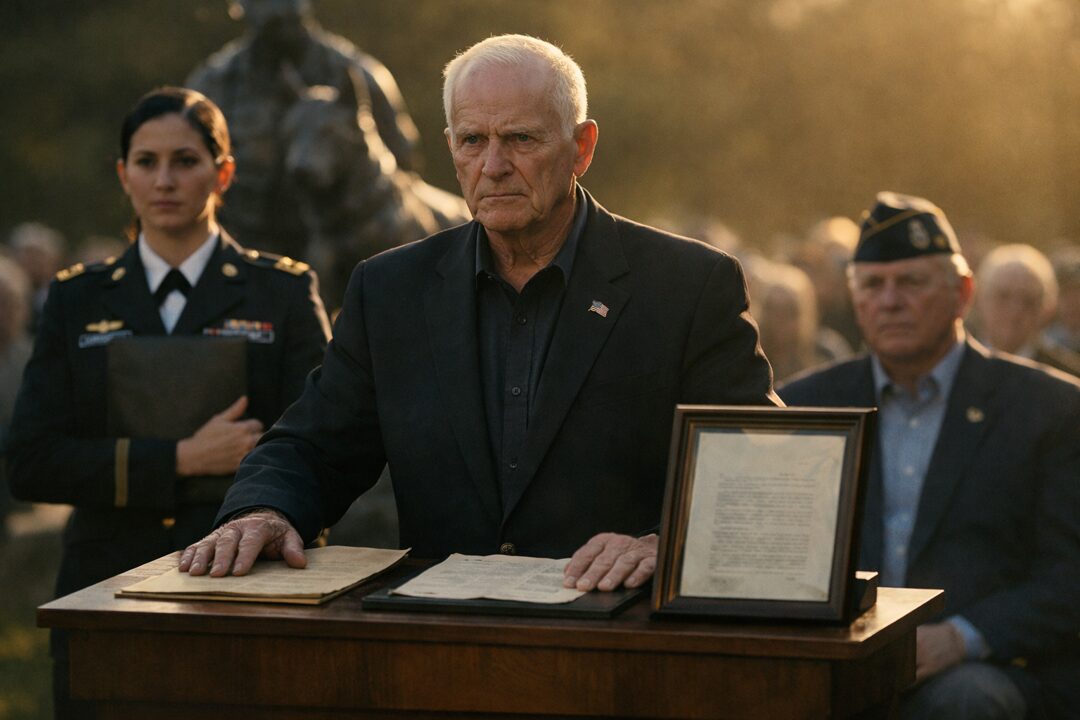
By the time Daniel returned to the memorial lawn, the sun had lowered enough to soften the white chairs into gold.
The final segment had begun.
Frank Delaney stood near the podium with his prepared remarks in hand. Families sat attentive. Handlers in dress uniform held their leashes with the unconscious steadiness of people whose hands had learned another living pulse. The memorial statue stood beyond the stage, dark and patient.
Rachel slipped back into her place near the side aisle as if she had never left. She did not look relieved. She only looked ready.
On the front row seat reserved for Daniel, she had placed two things:
the runway photograph
and the unsigned note from the ledger.
He picked them up, then sat.
At the podium, the master of ceremonies introduced the next speaker and praised “the invaluable service of canine assets in theater operations.”
The phrase moved through the loudspeakers and over the crowd like something clean.
Daniel felt the citation frame under his arm.
Assets.
Even now.
Frank gave his speech well. Of course he did. He spoke about courage under jungle conditions, about handlers trusting instinct where maps failed, about dogs whose vigilance saved untold lives. Every word was true enough to stand up. That was what made it dangerous.
The applause was warm.
Then Daniel’s name was called.
He walked to the podium carrying the frame, the photograph, and the note.
For one second, facing the crowd, he nearly used the prepared remarks. They sat folded in his jacket pocket. Three polite minutes. One patrol story. One grateful nod to history. He could still choose the safe version.
He unfolded the paper anyway, looked at it, then set it aside untouched.
The microphone caught the small sound of it landing.
The audience quieted.
Daniel began without introduction.
“My dog’s name was Rex.”
The line moved through the crowd differently than the speeches had. Smaller. Sharper.
“He was a scout dog,” Daniel said. “Black-and-tan shepherd. Bent left ear from an old field injury. Quiet dog. Serious at work. Better than me at knowing what fear meant.”
A few people smiled faintly. Daniel didn’t.
“He saved men. That part is true. We walked patrol in places where the jungle felt close enough to breathe on you. You learned to read his body before you trusted your own eyes. One day he stopped us cold on a narrow trail. Tripwire ahead. Grenades rigged in brush. Men behind me wanted to keep moving. Rex didn’t.”
Daniel let that sit for one beat.
“He was right. They lived because he was right.”
The audience was with him now. He could feel it. This was the lane they expected. Hero dog. Good war memory. A decent pain.
Then he placed the runway photograph on the podium where the front rows could see it.
“This picture was found in an archive box,” he said. “No proper label. Just a dog sitting near a runway while men board a plane.”
He touched the corner of the sleeve.
“That’s probably Rex. I know because of the ear.”
Stillness spread.
Daniel set the unsigned note beside it.
“This was found in a veterinary ledger. One line. Somebody wrote down that a handler requested to stay with his assigned dog. Request denied.”
He looked out across the audience.
“That handler was me.”
No one moved.
Daniel’s hands were steady now. Steadier than they had been all day.
“I came here carrying a citation praising our service.” He lifted the frame. “I also came carrying this.”
He opened the backing and drew out the carbon roster. Even from a distance, the gesture itself changed the air. He laid the roster beside the citation.
“Same frame,” he said. “Front and back.”
Rachel lowered her eyes for a second. Frank went utterly still.
Daniel looked at the crowd again.
“We’re good at ceremony in this country. We know how to praise service once it can’t interrupt us anymore.”
Nobody coughed. Nobody shifted.
“We also know how to hide behind language,” he said. “Operational asset. Redeployment. Disposition. Necessary. Policy.”
His voice did not rise. That made it worse.
“When the war was ending, dogs like mine were classified, counted, and left behind by the same institution that now honors them. Some were destroyed. Some were abandoned. And men like me”—he touched his chest once, briefly—“helped that happen by obeying when obedience had stopped being an honest word.”
A woman in the third row put a hand over her mouth.
Daniel went on. “I asked for permission. That’s the part I told myself mattered. I asked the right people in the right tones. I waited for authority. I waited so long I could still pretend I was doing my duty.”
His throat tightened, but the words held.
“I should have broken sooner.”
Silence answered him.
Then Daniel looked down at the roster and read the serial designation aloud.
The number sounded monstrous in the open air. Not because it was dramatic. Because it wasn’t.
He set one hand flat on the paper.
“They wrote him down like that,” he said.
Then he lifted his eyes and said, very clearly, “His name was Rex.”
The sentence hit the crowd like a bell.
Daniel drew one breath.
“He hated rain on tin roofs,” he said. “He’d lean against my knee before patrol if he thought I was taking too long. He trusted me more than I deserved. And one night, when things were already falling apart, I put my hand behind this bent ear and told him, ‘You and me go home together.’”
His voice roughened on the last word, but he did not stop.
“I did not keep that promise.”
No one clapped. Thank God.
“This isn’t an argument against remembering them,” Daniel said. “It’s an argument against remembering them in language that finishes the betrayal. Faithful service did not belong to the paperwork. It belonged to the dogs. It belonged to what they gave us without understanding the words we later used to erase them.”
He looked once toward the statue beyond the stage.
“If you honor them,” he said, “name what was done to them too.”
Then he stepped back.
For a moment no one moved.
The wind lifted the corner of the program on the podium. Somewhere at the edge of the lawn, a dog gave one short, confused bark.
Daniel gathered nothing. Not the papers. Not the frame. He left them there in plain sight and walked away from the microphone while the silence was still honest.
Part VI — What Remains
The response, when it came, was messy.
A few people stood because they didn’t know what else to do. A few stayed seated, stunned. One older man shook his head with open anger. Another wiped his eyes without embarrassment. The active-duty handlers looked stricken in a quieter way, like something they had felt without language had just been named in public.
Daniel stepped down from the stage and expected someone to stop him.
No one did.
Rachel met him near the aisle. She was holding herself very straight, as if posture were the only way to keep feeling from spilling.
“Do you want the photograph back?” she asked.
Daniel looked at it in her hands.
“No,” he said. “Archive it properly.”
“With the dog identified as Rex?”
He thought for a moment.
“With the note that identification is probable,” he said. “And why.”
Rachel nodded. It was the most respectful answer she could have hoped for.
“Thank you,” she said.
Daniel looked at her. “Don’t thank me.”
She understood that too.
Frank Delaney approached slowly, not because age had finally claimed him, but because certainty had.
For a second Daniel thought he might argue. Defend the old language one last time. Protect the frame that had protected him for years.
Frank stopped in front of him.
Neither man spoke.
Then Frank lifted his hand in a small, precise salute.
It was not apology.
It was not forgiveness.
It was only recognition, and maybe the beginning of an injury he had spent his own life refusing to examine.
Daniel returned no salute. He only held Frank’s gaze until the older man lowered his hand and walked away.
The crowd began to break into uneven knots of conversation. The ceremony would continue in some altered form or perhaps fail to continue at all. Daniel no longer felt responsible for that.
He walked across the lawn toward the statue.
Up close, the bronze dog’s face was smoother where weather had worn it. The soldier’s hands were careful, almost tender. Whoever designed it had understood one true thing: the bond had never been the sentimental part. The bond had been the work. The trust. The wordless agreement that one body would lead and another would follow into danger.
At the base, the engraved phrase looked different now.
Faithful Service
He read it again and this time it did not sound like accusation alone. It sounded incomplete. Human-made. Salvageable only if you said the rest out loud.
Daniel raised his hand.
For years he had avoided touching memorials. Stone and bronze made people too simple. They cleaned them before they cooled. But now he set his palm against the sculpted muzzle and left it there.
The metal held the day’s warmth.
He did not close his eyes.
He did not ask to be forgiven.
He stood that way long enough for the noise behind him to fade into something distant and ordinary, like traffic past a cemetery. The ache in him did not lift. It settled differently. Less like rot. More like a scar that had finally been cut open, cleaned, and left uncovered.
After a while he heard footsteps in the grass, then stop a respectful distance away. Rachel, probably. Maybe watching. Maybe not.
Daniel kept his hand where it was.
His name was Rex, he thought.
Not a designation. Not an asset. Not a line item hidden behind a commendation.
Rex.
The truth changed nothing that had happened.
It changed the language around it.
Sometimes that was the only dignity left.
Daniel stood before the statue until the bronze cooled under his hand and the light began to thin, and when he finally turned away, he did not feel lighter.
He only felt finished with hiding.