They Came to Remove the Stone, but the Farm Boundaries Began Moving With It
Chapter 1: The Excavator Arrived Before the Surveyor
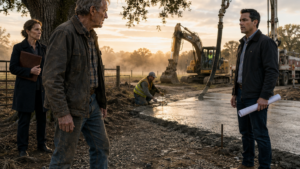
The excavator bucket dropped until its steel teeth hovered inches above the moss on the old stone.
James Harris drove his tractor sideways across the gravel lane and killed the engine.
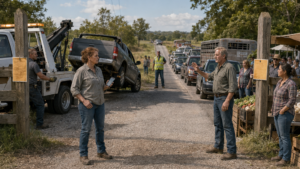
The sudden silence seemed larger than the machine. Dust drifted past the tractor’s hood. Beyond the lane, cattle raised their heads from the dry September pasture. Five road association members stood near the fence, watching as though James had arrived late to his own eviction.
Deborah Allen stepped away from the excavator. She wore work boots too clean for the lane and held a yellow folder against her side.
“You can’t block common access,” she said.
James removed the tractor key and closed his fist around it. “Then don’t change the common corner before the surveyor gets here.”
“The surveyor was supposed to come yesterday.”
“She rescheduled for ten.”
“It’s seven-thirty.” Deborah pointed toward the waiting equipment. “We have time.”
Frank Young sat in the excavator cab with one hand resting on the controls. He had gone to school with James, though they had not spoken socially in years. His grading business depended on county work, farm entrances, drainage cuts, and people like Deborah who organized several owners at once.
Frank opened the cab door. “I’m only widening the turn.”
“The stone is the turn.”
“That stone is why loaded trucks have to back halfway to the county road,” Deborah said. “We agreed the lane needed twelve more feet.”
“You agreed.”
“The association voted.”
“On a lane none of you surveyed.”
A neighbor shifted near the fence. Someone muttered that James always made simple things difficult.
James heard it. He kept his hand closed around the key.
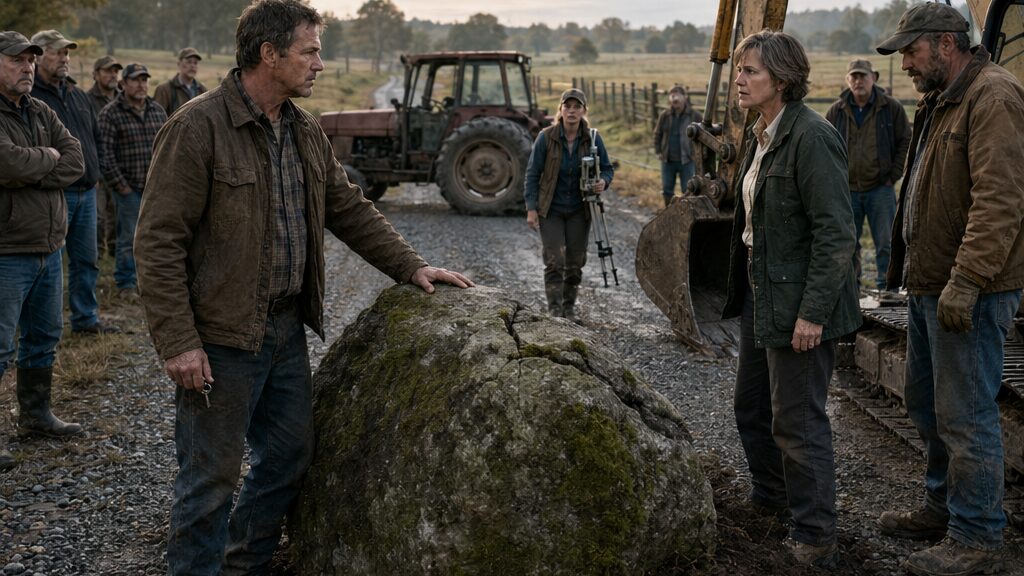
The stone stood shoulder-high at the narrowest point of the lane, broad at the base and flattened along one face as if someone had once chosen it rather than merely found it. Lichen filled a long crack down its center. His grandfather had cleared around it every spring. His father had done the same until arthritis bent his fingers.
Three nights before he died, James’s father had gripped his wrist hard enough to hurt.
Don’t let them erase the corner.
James had promised before asking what the words meant.
Deborah opened the yellow folder. “The road association has authority to maintain established access.”
“Maintenance isn’t moving a four-ton stone.”
“It may not be four tons.”
Frank looked at the rock, then at Deborah. “It’s more.”
Her mouth tightened. “You said you could handle it.”
“I said I could widen the lane.”
“Then widen it.”
James climbed down from the tractor. Gravel shifted under his boots. A few phones came out among the association members, held low but not hidden.
He walked to the stone and laid one hand against its cold upper edge.
“Put in writing that you accept responsibility for changing the original corner,” he said. “Sign it, and Frank can try.”
Deborah stared at him. “You don’t even know that it is the original corner.”
“Then it should be easy to sign.”
Her eyes moved toward the others. James recognized the calculation. She had brought witnesses expecting him to lose his temper or surrender. A signature would make the uncertainty hers.
“You’re holding up harvest preparation over a family story,” she said.
“No. I’m holding it up over your refusal to wait two and a half hours.”
One association member stepped forward. “My combine can’t make that turn.”
“It made it last year.”
“It scraped the ditch bank.”
“Then use the south entrance.”
“The culvert there is failing.”
James looked at Deborah. That was the first useful fact anyone had offered him.
She said, “This lane serves more than you now.”
“It always did.”
“Then stop treating it like a family monument.”
The word landed harder than it should have. James removed his hand from the stone.
“Frank,” Deborah said, “clear around the base. Don’t move it yet. Show him it isn’t a marker.”
Frank climbed down, pulled on gloves, and retrieved a shovel from his truck. “Hand work only,” he told James.
James did not answer.
Frank scraped weeds and packed gravel away from the eastern face. The first few inches exposed nothing but fieldstone and roots. Deborah stood with her arms crossed. The association members loosened as though the contest had already ended.
Then Frank’s shovel struck metal.
The sound was thin and sharp.
Everyone stopped.
Frank crouched and brushed away dirt with one gloved hand. A rust-darkened cap emerged near the base of the boulder, no wider than a jar lid. It had been set into a dressed block of limestone beneath the mossed stone.
Deborah stepped closer. “Old fence hardware.”
Frank cleared another few inches. Beneath the gravel lay a straight row of shaped stones extending under the lane.
“That’s not fence hardware,” James said.
Frank glanced at him. “No.”
One of the neighbors lowered his phone.
Deborah knelt without touching the cap. “Could be anything.”
“Then wait for Rebecca,” James said.
She rose too quickly. “We’ve already lost a morning.”
“You hired the equipment before the survey.”
“I hired it because every week you found another reason to delay.”
James felt the eyes on him. Deborah was not entirely wrong. He had ignored two messages from the association and refused to produce the old farm records she had requested. In the desk drawer at home lay his father’s black notebook, its pages full of fence repairs, water levels, feed figures, and entries James had not wanted anyone else to read.
He had told himself the notebook was private.
He had not told anyone that one page had been cut out.
Frank leaned closer to the metal and rubbed its surface with his thumb. Faint lines showed beneath the rust.
“There are letters,” he said.
Deborah’s face changed, though only for a moment. “Don’t scrape it.”
“You just ordered him to dig it out,” James said.
“I ordered him to identify it.”
A county pickup turned into the lane.
Rebecca Taylor parked behind the gathered trucks and stepped out carrying a survey case, tripod, and orange flagging. She took in the tractor blocking the lane, the excavator, the exposed stonework, and the people arranged around it.
“I said no ground disturbance until I arrived.”
Deborah lifted the folder. “We only cleared loose material.”
Rebecca set down her case. “With an excavator parked over it?”
“The excavator didn’t touch the stone,” Frank said.
“Yet,” James added.
Rebecca crouched at the exposed cap. She did not clean it immediately. First she photographed the area from three angles, then placed a scale beside the metal and took another picture. She used a soft brush to remove the last film of dirt.
A stamped cross appeared. Around it ran worn lettering and a date that began with eighteen.
Rebecca sat back on her heels.
“What is it?” one of the association members asked.
She looked toward the row of foundation stones disappearing beneath the gravel lane.
“It’s an original survey monument,” she said. “And until I locate the matching calls, nobody moves anything within fifty feet of it.”
Deborah’s folder lowered to her side.
James looked from the metal cap to the lane that had carried tractors, cattle trailers, school buses, and hearses for longer than anyone standing there could remember.
The stone had not moved.
But the ground around it no longer seemed to belong where everyone thought it did.
Chapter 2: The Fence Line Everyone Trusted Was Wrong
Rebecca drove an orange survey flag into the gravel seven yards inside the lane Deborah called hers.
The wire stem quivered between two tire tracks.
Deborah stood beside it with both hands on her hips. “Your equipment is off.”
Rebecca did not look up from the receiver mounted on her pole. “It checked against two county control points this morning.”
“The fence is over there.”
Rebecca followed Deborah’s gesture toward a sagging line of woven wire running beside the hay field.
“The fence is not a monument.”
“It has been the boundary since I was a child.”
James stood near the stone, watching a line appear where no line had existed the day before. Rebecca’s flags crossed the gravel diagonally, passed through the ditch, and continued into Deborah’s widened approach.
If the measurements held, the lane had drifted onto Harris acreage one repair at a time.
Rebecca moved another twenty yards, paused, and planted a second flag.
Deborah turned on James. “You knew.”
“I knew the stone mattered.”
“That isn’t what I asked.”
“No, I didn’t know the lane crossed.”
She searched his face as though uncertainty were another form of dishonesty. “But you suspected enough to block the work.”
“My father told me not to let anyone erase the corner.”
“And you never asked him why?”
“He was dying.”
The answer silenced her, but not kindly.
Rebecca marked the fence, then returned to the stone with a field tablet. “The original plat gives me a bearing from this monument to a creek oak that no longer exists. I’ll need deed calls from the surrounding parcels.”
“How long?” Deborah asked.
“A defensible answer? Several days.”
“We don’t have several days.”
“Then you should not have scheduled excavation before the survey.”
Deborah looked toward Frank, who was filling the shallow trench around the cap by hand. “Everyone enjoys saying that now.”
By noon, two neighboring farmers had driven over after hearing that the lane might cross James’s property. One wanted reassurance that his grain trucks would still pass. The other asked whether James intended to charge access fees.
James told them he had not decided anything because no one had finished measuring.
They heard only the last part.
At the county records office, the air smelled of old paper and copier heat. Rebecca spread plats and deed copies across a broad table while the county recorder brought out index books from storage.
James stood opposite Deborah. Between them lay a century of descriptions written around trees, creek bends, iron pins, and stones.
Rebecca traced a line with the capped end of her pen. “The Harris deed references the original northwest corner. Deborah’s deed begins from the same point but uses a later fence line as an occupation boundary.”
“Which controls?” Deborah asked.
“That depends on the age of the evidence, the intent of prior owners, and whether rights were established through use.”
“So the fence may control.”
“It may matter. That is not the same thing.”
James watched Rebecca turn another deed.
She stopped.
“What?” he asked.
“This parcel refers to a stone corner at the Harris lane.”
The recorder pulled another book. A neighboring deed contained the same phrase. Then a third.
All three relied on a monument that had disappeared from modern survey maps but had never actually left the ground.
Rebecca arranged the copies side by side. “Your stone anchors more than the Harris-Allen line.”
Deborah leaned over the table. “How much more?”
“At least three parcels. Possibly the old access tract as well.”
The room seemed to narrow.
James had expected the survey to prove Deborah wrong. Instead, each new page tied more people to the stone and made his own position heavier.
“If the lane is on my acreage,” he said, “what happens?”
Rebecca met his eyes. “That is a legal question.”
“You know what usually happens.”
“Usually is dangerous here.”
Deborah gave a short, humorless laugh. “He wants you to tell him he owns the road.”
James felt heat rise under his collar. “I want to know what was done.”
“You want leverage.”
“You brought an excavator.”
“And you brought a tractor to trap everyone behind a rock.”
Rebecca slid the deeds apart. “Both of you need to stop speaking as though the survey will prove motive. It measures land. It does not explain why people used it the way they did.”
The recorder found an older road petition. Its map showed a narrow access line bending around the stone, then crossing toward a spring branch on Allen land. A handwritten notation beside it had faded almost beyond reading.
Rebecca angled the page under the lamp.
“Shared passage,” she read. “No width given.”
Deborah pointed. “There. Established access.”
“From 1948,” Rebecca said. “And it bends around the monument. It does not authorize moving it.”
James looked at the spring branch drawn beyond the property line. His father’s notebook contained pages of water measurements from drought summers. He had seen the Allen name in the margins and shut the book before understanding why.
His silence now felt less like protection and more like a gate he had locked without knowing who stood outside.
When he returned to the farm that evening, trucks were parked at the feed store across from the county road. Deborah stood near the entrance speaking with three association members. One held a photocopy of the preliminary survey flags.
She had moved faster than Rebecca.
By the time James reached his mailbox, an association notice had been taped to the post. It accused him of obstructing established agricultural access and called for an emergency meeting.
He tore it down and carried it to the house.
The phone rang before he reached the kitchen.
He almost let it go. The display showed a number from two counties east.
“James?” a woman said when he answered.
He knew the voice before she gave her name.
Sarah Harris had not been back to the farm since his father’s funeral.
“I heard the disputed strip may belong to the estate,” she said.
“Where did you hear that?”
“From a title-company clerk who asked why my name was still attached to thirty-two acres.”
James sat slowly at the kitchen table.
Sarah continued, “Before you decide what belongs to you, you’d better find Dad’s black notebook.”
James looked toward the desk drawer across the room.
“What do you know about the boundary?” he asked.
There was a pause.
“I know why he never recorded the lane agreement,” Sarah said. “And I know that stone wasn’t the only thing he told you to protect.”
Chapter 3: His Father’s Notebook Left Out One Page
Sarah found the cut page before she had taken off her coat.
She stood at the kitchen table with the black notebook open beneath both hands. The jagged paper stub showed near the spine between entries from August and September of 1988.
“You knew this was missing,” she said.
James closed the front door. “I knew a page had been removed.”
“That is what missing means.”
“I didn’t remove it.”
“But you hid the notebook.”
“I put it away.”
“From the surveyor. From Deborah. From me.”
“You hadn’t asked about it in fourteen years.”
Sarah looked older than she had at the funeral, though not softer. She had their father’s narrow mouth and the same habit of pressing one thumb against the edge of a page when angry.
“I asked about selling my share,” she said. “You told me the title was clean.”
“The title is clean.”
“A road may be running through it.”
“We don’t know that yet.”
“And now three neighbors think they have access. That sounds clean to you?”
James took the notebook from her and turned back several pages. His father’s handwriting leaned forward in dark pencil, each line compressed to save space.
July 7—Allen tank, 1,200 gal.
July 12—water again. South pasture.
July 19—passage after dark.
He turned another page.
August 2—water for passage.
The phrase appeared four more times over the next three drought summers.
Sarah pulled out a chair. “He kept those notes because he didn’t trust memory.”
“Then why cut out a page?”
“Maybe because he trusted shame even less.”
James shut the notebook.
Sarah watched him. “You still do that.”
“Do what?”
“Close the thing when it says something you don’t like.”
Outside, a truck rattled over the cattle guard. James looked through the window and saw Rebecca’s county pickup stop near the machinery shed.
“She’s here for the records,” he said.
“Then give them to her.”
“No.”
Sarah’s chair scraped back. “That notebook may explain why the fence moved.”
“It may also turn a favor into a permanent claim.”
“A favor that kept our cattle alive.”
“We don’t know that.”
“I was there.”
James faced her.
Sarah’s anger thinned enough for something more tired to show through.
“The well dropped below the pump in eighty-eight,” she said. “Dad hauled water from the Allen spring for eleven days. Their father let him cross the lower field and fill the tank. In return, Dad stopped objecting when they used our side of the lane.”
“For eleven days?”
“At first.”
“And after?”
“He kept saying he would straighten it out after harvest.”
James looked at the notebook again.
After harvest was a phrase farm families used for everything they feared would become an argument.
Rebecca knocked once and entered through the mudroom after James called out. She carried a document sleeve and a measuring wheel.
“I need any family records referring to the lane, water access, fencing, or the stone,” she said.
Sarah pointed to the notebook.
James put his hand over it.
Rebecca’s expression hardened. “You told me there were no useful records.”
“I said I hadn’t found a deed.”
“That is not what I asked.”
Sarah folded her arms. “He knew this existed.”
James looked from one woman to the other. The kitchen suddenly felt arranged against him.
“It’s a private farm log,” he said.
Rebecca set down the sleeve. “Private logs can clarify possession and use. They can also complicate it. I don’t decide what rights they create.”
“But Deborah will use every line.”
“That is not a reason to conceal evidence from a county survey.”
“I hired you to locate the boundary.”
“The county assigned me to preserve the monument after unauthorized disturbance. And you are not the only owner affected.”
The word owner struck its mark. Sarah looked away first.
James carried the notebook into the machinery shed rather than continue in the kitchen. Rebecca and Sarah followed.
The shed held the smell of grease, hay dust, and old wood. His father’s workbench still stood against the north wall with coffee rings darkening one corner. James placed the notebook beneath the hanging task light.
Rebecca photographed each relevant page.
She paused at the repeated phrase.
“Water for passage,” she said.
Sarah nodded. “That was the arrangement.”
James said, “An arrangement is not an easement.”
Rebecca did not argue. “It establishes why use changed.”
“Use changed during a drought.”
“The entries continue for six years.”
James bent closer.
She was right. He had noticed the phrase but not the dates. After the drought entries ended, “passage” remained by itself beside notes about gravel, culverts, and fence repairs.
The small payoff he had wanted—the proof that his father had merely accepted emergency help—slipped away.
Rebecca turned to the cut page. “Do either of you know what was written here?”
“No,” James said.
Sarah answered at the same time. “I may.”
He looked at her.
She reached into her bag but did not remove anything. “Dad wrote a summary after Deborah’s father paid for the lane gravel. I saw him do it.”
“Why would he remove it?”
“I didn’t say he did.”
Rebecca glanced between them. “Who else had access to the notebook?”
“Anyone in the house,” Sarah said. “Back then.”
James heard the unfinished accusation. “You think I cut it out?”
“I think you’ve protected Dad’s memory harder than Dad protected the truth.”
The machinery shed door stood open to the lane. From there the boundary stone was visible beyond the tractor, its mossed crown rising above the gravel. Orange flags crossed the route toward Deborah’s fields.
James had spent years believing the stone represented the one thing his family had refused to yield.
The notebook suggested otherwise. The stone had stayed fixed while everything around it had been negotiated in pencil.
Rebecca closed the document sleeve. “I need to disclose that these records exist.”
“Not until we know what the missing page said.”
“I can note that the record is incomplete.”
James blocked the workbench. “Give me one day.”
“You already had two.”
Sarah reached into her bag and placed a folded photocopy on the bench.
James stared at it.
“Where did you get that?”
“I didn’t bring it for you,” she said. “I brought it because I knew Deborah would.”
Headlights swept across the open shed. A pickup stopped outside, followed by two more vehicles.
Deborah entered carrying the same yellow folder from the excavation morning. Road association members gathered behind her but remained outside.
She looked at the notebook, then at the paper beneath Sarah’s hand.
“I assume we’re finally discussing the whole record,” Deborah said.
Sarah did not move.
Deborah opened her folder and removed a handwritten copy of the missing page.
At the top, in James’s father’s unmistakable writing, were the words:
Lane passage accepted in exchange for continued water rights.
Deborah placed the copy beside the torn notebook.
“Your father gave us the road,” she said. “The question is whether your family kept the water.”
Chapter 4: The Agreement Neither Family Recorded
Deborah read the missing page aloud before anyone had agreed the meeting had started.
“Lane passage accepted in exchange for continued water rights.”
Her voice carried through the feed-store meeting room and into the front aisle, where the owner had stopped arranging mineral blocks to listen. Folding chairs filled the space between sacks of seed and a locked cabinet of veterinary supplies. The road association members sat together on one side. James, Sarah, and Rebecca faced them across a narrow table scarred by years of pocketknives and coffee cups.
Deborah held the photocopy by its upper corners.
“It is dated August twenty-third, 1988,” she said. “It is in James’s father’s hand. It states the agreement plainly.”
James looked at Sarah. “Where did the original copy come from?”
Sarah kept her eyes on the paper. “Deborah’s father kept carbon copies of business notes.”
“This wasn’t business.”
“It involved water, gravel, and land,” Deborah said. “What would you call it?”
“A private arrangement.”
“A private arrangement used by four farms for thirty-five years.”
Rebecca raised one hand before James answered. “The copy helps explain conduct. It does not, by itself, establish the width, duration, or exact location of a permanent easement.”
A road association member leaned forward. “But it proves there was permission.”
“It suggests reciprocal permission,” Rebecca said. “Passage in one direction. Water in the other.”
Deborah set the page on the table. “The Allen spring supplied the Harris cattle through the drought.”
James said, “And my father let your family use the lane.”
“Not just my family.”
“You widened it.”
“Because machinery changed.”
“Without asking.”
“We asked for six months.”
“You announced a vote.”
The feed-store owner moved farther down the aisle, though no one believed he had stopped listening.
Deborah opened the yellow folder. Inside were repair invoices, photographs of rutted gravel, and a loan notice she tried to cover too late.
James saw the bank logo.
She noticed him looking and closed the folder halfway.
“The first soybean trucks come in twelve days,” she said. “My south crossing cannot carry them. The county road entrance is blind from the west, and you know it.”
“That does not give you the right to excavate a survey monument.”
“No. It gives me a reason for believing we had to act.”
“Believing is not permission.”
“Neither is inheritance.”
The words quieted the room.
Sarah reached for the photocopy. “Dad accepted the water knowingly.”
James turned to her. “You said it began as an emergency.”
“It did.”
“And then?”
“He kept using it.”
“How long?”
Sarah pressed her thumb along the edge of the page. “The spring line fed the south tanks until the new well was drilled.”
“That was six years.”
“Seven.”
James leaned back.
He remembered the new well as a concrete ring, a pump truck, and his father standing beside it with mud to his knees. He had been thirteen. No one had explained why his father watched the Allen property instead of the drill rig when the first clear water surged from the pipe.
Sarah continued, “After the well came in, Dad never told them to stop using the lane. He said the arrangement had become neighbor custom.”
“Did he say they owned it?”
“No.”
“Did he record anything?”
“No.”
“Then he left us this.”
James tapped the photocopy.
Sarah looked directly at him. “He left us more than a clean version of himself.”
Rebecca shifted the old road petition beside the missing-page copy. “There are three separate questions. Where the deeded boundary lies. Whether access rights were created. Whether water rights continued after the spring was no longer used.”
Deborah said, “The water was available.”
“That is not the same as being taken,” Rebecca replied.
“It remained available because my family kept the spring box maintained.”
James looked at Deborah. “Why?”
Her answer came too fast. “Because that was our side of the agreement.”
“So you believed the exchange still existed.”
“I believed it could be needed again.”
“By whom?”
“Any of us.”
The hard edge in her voice slipped. For the first time, James heard the fear under it—not fear of losing an argument, but of being the person who failed several farms at once.
A phone rang near the back row. One of the farmers answered, listened, then stood.
“The creek crossing dropped,” he said.
Deborah’s head snapped toward him. “How bad?”
“East abutment washed under. Culvert’s split.”
“When?”
“About an hour ago. A loaded tandem went over it and the bank gave way behind him.”
The meeting broke apart at once.
They drove in a line toward the lower crossing. Dust climbed behind the pickups. James arrived to find the creek running through a fresh gap where the gravel approach had collapsed. One concrete pipe showed beneath the broken bank, cracked along its length. The crossing was passable on foot, not by a combine or grain truck.
Deborah climbed down the slope and stared at the damage.
“This was our alternate route,” she said.
Frank, who had followed in his work truck, crouched near the failed edge. “You won’t patch this before harvest. Not safely.”
“How long?”
“Permits, pipe, stone, compaction—three weeks if everything goes right.”
“We have twelve days.”
Frank looked toward James.
The disputed lane lay beyond the ridge, invisible from the creek but suddenly central to every person standing there.
James understood what the collapse had done. Before, Deborah’s urgency had been partly political, partly financial, and partly chosen. Now the lane beside the stone was the only practical route for two farms and the safest route for a third.
Deborah came up the slope, dirt on one knee.
“You see it now,” she said.
“I see the crossing failed.”
“You see why the lane matters.”
“I never said it didn’t matter.”
“You just wanted it to matter on your terms.”
James felt Sarah watching him.
He looked at the broken culvert, then at the trucks parked along the bank. Closing the lane would now be more than a defense of property. It would place the cost of his father’s silence on people who had not created it.
But allowing unrestricted passage would turn another unrecorded favor into the next generation’s dispute.
Rebecca walked to the edge and photographed the collapse.
“When I finish the boundary report,” she said, “you may have the right to enforce the surveyed line.”
Deborah exhaled as if that ended the matter.
Rebecca continued, “But if you enforce it immediately, the Allen farm and the parcel beyond it may lose machinery access during harvest.”
James stared at the water running through the broken bank.
The stone had given him a boundary.
The failed crossing had turned that boundary into a choice.
Chapter 5: A Legal Victory That Would Ruin the Harvest
The county attorney placed the closure order in front of James with a pen laid across the signature line.
“If you sign,” she said, “the sheriff can restrict all nonpermitted traffic across the disputed strip until title and access are resolved.”
Deborah sat three chairs away in the hearing room. Frank occupied the last seat near the door, his cap turning slowly between his hands. Rebecca had spread the preliminary survey on an easel, where a red line cut directly through the gravel lane.
James read the first paragraph twice.
The language was clean in a way the land was not.
Unauthorized entry. Risk of alteration. Preservation of monument. Immediate injunctive relief.
On paper, the decision looked simple.
The county commissioner cleared his throat. “The monument has already been disturbed.”
“Exposed,” Deborah said. “Not moved.”
Rebecca answered without turning from the map. “The soil around the supporting stones was removed. That qualifies as disturbance.”
Frank’s cap stopped rotating.
The attorney looked at him. “Who directed the work after metal was first observed?”
Deborah said, “No one knew what the metal was.”
“That was not the question.”
Frank kept his eyes on the floor.
James watched him. They had played on the same baseball team at fifteen. Frank had once taken blame for a broken equipment-room window because the coach was ready to suspend half the roster. He had been brave when the cost was detention. Adulthood had given him payroll, fuel bills, and reasons to look at his boots.
The attorney repeated the question.
Frank lifted his head. “I hit metal with the hand shovel.”
“And then?”
“I told Deborah there was some kind of cap.”
Deborah turned toward him. “You said it might be fence hardware.”
“I said it might be. I also said we should stop until Rebecca came.”
The room tightened.
Deborah’s voice lowered. “You continued.”
“You told me to clear the face so we could identify it.”
“I told you not to move the stone.”
“You told the operator to bring the bucket close enough to loosen the gravel.”
The equipment operator, seated against the wall, shifted but said nothing.
Deborah looked at Frank as though betrayal had a sound only she could hear.
Frank placed his cap on his knee. “I should’ve shut the machine down.”
The admission changed the room. Until then, responsibility had been spread thinly across urgency, custom, association votes, and old misunderstandings. Frank’s words gave it edges.
The attorney made a note. “Was the county survey appointment known?”
“Yes,” Frank said.
“By whom?”
“Everybody.”
Deborah leaned forward. “The appointment had already been delayed.”
“By one day,” Rebecca said.
Deborah turned on her. “One day matters when the bank wants payment before grain moves.”
No one answered.
She opened the yellow folder and removed the loan notice James had glimpsed at the feed store.
“My operating note resets October first,” she said. “If the crop sits because trucks cannot reach the bins, I lose the rate and probably the line. The association members knew that. Frank knew it. James knew harvest was coming.”
James said, “I did not know about the loan.”
“You did not ask.”
“You did not ask before digging.”
“No,” Deborah said. “I decided. That is what everyone expected me to do.”
There was no pride in it now.
The commissioner studied the survey. “Mrs. Allen, pressure explains the decision. It does not authorize it.”
“I understand that.”
James heard the change. She was no longer claiming innocence. She was arguing necessity.
The county attorney slid the order closer to him. “The evidence supports temporary closure. You are not required to permit use while the dispute is pending.”
James looked through the hearing-room window. Beyond the courthouse parking lot, the fields were turning from green to dull gold. In less than two weeks, combines would begin cutting.
He imagined the sheriff’s barricade at the lane. He imagined Deborah’s trucks stopped at the county road, the broken creek crossing behind them, grain drying past safe moisture while lawyers exchanged letters.
Part of him wanted the order.
It would prove that blocking the excavator had not been stubbornness. It would force every person who had called him difficult to admit the stone belonged where he said it did.
Rebecca tapped the red line on the map. “The preliminary survey supports the Harris deed boundary. But the old petition and usage records suggest access claims that require separate review.”
“How long?” James asked.
“Months, if contested.”
Deborah’s laugh held no humor. “Harvest will wait politely.”
The attorney said, “You may allow temporary licensed access without surrendering your claim.”
“Under what conditions?”
“Written limits. Defined equipment. Defined dates. Liability protection.”
Sarah, seated behind him, said, “And compensation to the estate.”
James turned.
She did not flinch. “If land owned partly in my name is being used, I will not be asked to donate it because the men before us avoided paperwork.”
Deborah looked at her. “You would charge us now?”
“I would require the value to be acknowledged.”
James felt the old instinct rise—to settle family matters privately, to keep Sarah from airing them before neighbors and officials.
Then he remembered the cut page.
Secrecy had already had its turn.
The attorney pointed to the order. “You need to decide whether you want immediate closure.”
James picked up the pen.
Deborah’s hands tightened around the loan notice. Frank stared at the survey map. Sarah sat rigid behind him, waiting to see whether he would act as though the estate belonged only to the person who had stayed.
James touched the pen to paper but did not sign.
“What happens to the monument if traffic continues?” he asked Rebecca.
“We can barricade the immediate area. The lane would need to shift several feet west temporarily.”
“Onto my field.”
“Yes.”
“And a permanent easement?”
“Could be designed around the stone. But someone would give acreage. Someone would pay for drainage and base work. Water obligations would need separate language.”
Deborah said, “We can discuss that after harvest.”
James looked at her. “That is how we got here.”
The room went still.
He pushed the unsigned closure order back toward the attorney.
“I’m not closing the lane today.”
Deborah exhaled.
“I’m not opening it without terms either,” he continued. “No traffic until the monument is barricaded. Limited loads after that. Frank repairs the disturbed ground. The association carries liability.”
Sarah said, “And the estate?”
“I’ll address it.”
“That is not an answer.”
“No,” James said. “It is a promise to stop pretending I can answer for everyone.”
She studied him, surprised enough to remain silent.
Deborah folded the loan notice. “When can trucks pass?”
“Not until tomorrow at the earliest.”
“We lose another day.”
“You nearly lost the corner.”
Her eyes hardened, but she did not argue.
James stood. “Give me tonight.”
“For what?” the commissioner asked.
“A proposal that does not depend on anyone forgetting what happened.”
The attorney removed the pen from the order.
James left the hearing room carrying a copy of the survey, the old road petition, and his father’s incomplete notebook. In the courthouse hallway, Deborah caught up with him.
“If your proposal is designed to punish me, say it now.”
He stopped.
“It will cost you,” he said.
“And you?”
He looked down at the red line crossing the lane.
“If it is honest,” he said, “it will cost me too.”
Chapter 6: What the Stone Was Meant to Protect
Sarah found their grandfather’s initials inside the spring box just after midnight.
She called James from the Allen property, her voice sharpened by cold and anger.
“You need to come see this.”
He drove across the lower field with the survey map folded on the passenger seat. Deborah’s yard light showed beyond the cottonwoods, but no one came from the house. Sarah stood beside the old spring enclosure holding a flashlight between her teeth.
The spring box was a low chamber of fitted limestone, half buried in the bank. Its iron cover had rusted at one hinge. Water moved beneath it with a steady sound, indifferent to deeds and harvest schedules.
Sarah aimed the light at the inner wall.
Two letters had been cut into the stone.
J.H.
Below them was a small crossed mark with one arm longer than the other.
James crouched. “That could be anybody.”
“It is the same mark Granddad used on tools.”
“He stamped tools. He didn’t chisel them.”
Sarah moved the beam to another stone. “Then explain that.”
A shallow arrow had been cut toward the outflow channel. Beside it were three numbers, worn but legible enough to suggest a distance.
James took out his phone and photographed the marks.
“When did you know this was here?” he asked.
“I didn’t. Dad mentioned that Granddad helped rebuild the spring after the flood. I came looking.”
“Without asking Deborah?”
“I knocked. She did not answer.”
A porch light came on across the field.
Deborah appeared at the edge of the yard in a coat pulled over her nightclothes. “What are you doing?”
Sarah stood. “Looking at family work on your spring.”
Deborah descended the slope carefully. “At midnight.”
“You said the water rights continued.”
“They did.”
“Then the structure matters.”
Deborah stopped beside James. When he showed her the initials, she did not look surprised.
“You knew,” he said.
“I knew your grandfather helped rebuild it.”
“You knew he marked it.”
“My father said the mark pointed toward the shared line.”
“What shared line?”
She looked toward the dark fields.
“Not here,” she said.
They returned to the Harris farm before dawn. Deborah followed in her pickup. In the machinery shed, James laid the spring-box photographs beside Rebecca’s close images of the survey cap and the exposed stones.
The crossed mark appeared on both.
On the monument, it had been dismissed as part of the survey stamp. But beneath the cap, carved into the supporting limestone, was the same uneven cross and a faint arrow.
Rebecca arrived before sunrise after James called her. She compared the images without speaking.
“This lower mark is not official survey notation,” she said at last.
“What is it?” James asked.
“Probably private reference work. Your grandfather may have tied the spring structure to the corner.”
Sarah opened the black notebook to its earliest pages. The handwriting there belonged not to James’s father but to his grandfather—larger, slower letters recording fence lengths, water flow, and stone counts.
One entry included the same three numbers carved into the spring box.
Rebecca used the old measurements, the survey line, and the map of the abandoned branch. By midmorning, they stood beside the boundary stone with a tape stretched toward the lower field.
The numbers did not describe acreage.
They described the distance from the corner to the spring outflow and from the outflow to the old lane bend.
James rested one hand on the stone.
All his life, he had understood it as a refusal: this point does not move.
Now the carved line beneath it suggested something else: from this fixed point, obligations can be found.
Sarah opened the notebook to a page they had overlooked because it contained no names.
Corner stone kept so water path and passage remain known.
James read the sentence twice.
His grandfather had not preserved the stone merely to defend the Harris property. He had used it as the fixed reference for both families’ rights—the route to water and the route across land.
Deborah stared across the lane. “My father said your family wanted the stone left because it proved ownership.”
“It did,” James said.
“And because it proved the spring obligation.”
“Yes.”
“So both fathers told half.”
Sarah closed the notebook. “Half was easier to inherit.”
James looked at her. The accusation no longer belonged only to the dead.
He had done the same thing. He had kept the notebook hidden because he wanted the stone to mean one clean thing. Protection. Loyalty. Family ground.
Instead, it marked a bargain his family had benefited from and later stopped acknowledging.
Deborah picked up one of Rebecca’s temporary flags. “What does this change legally?”
Rebecca answered, “It supports the history of reciprocal use. It still does not create modern terms by itself.”
“Then we need terms.”
James heard the impatience returning, but it no longer sounded like simple control. Harvest was close. Her loan remained close behind it.
He unfolded the preliminary easement sketch he had begun at the farmhouse.
The safest permanent route curved west of the stone, following the original petition. It required twelve feet from the Harris field at the narrowest section. Drainage improvements would require more during construction.
Sarah saw the measurements. “That strip is estate land.”
“I know.”
“You cannot give it away.”
“I’m not giving it away.”
Deborah leaned over the map. “The curve is too tight for the largest header trailer.”
“Then the association pays to widen the inside shoulder beyond the monument.”
“That takes more Harris ground.”
“And you contribute the triangle near the creek approach.”
Deborah’s jaw tightened. “That is productive land.”
“So is mine.”
Sarah pointed toward the spring. “And water?”
“A recorded emergency-use right,” James said. “Defined volume. Defined maintenance. Costs shared.”
Deborah looked at him. “Your cattle have not used our water in decades.”
“The next drought will not care.”
Frank arrived with a load of limestone for the temporary barricade. He stepped down from the truck and studied the group around the stone.
James handed him the site-repair plan. “Can you rebuild the shoulder without touching the supporting stones?”
Frank examined it. “Yes.”
“At your cost?”
Frank looked toward Deborah, then back to James. “Yes.”
Deborah said nothing.
Sarah folded her arms. “What about compensation for my share?”
James had expected the question. He still disliked hearing it.
“The easement payment is divided by ownership interest,” he said. “Not by who lives here.”
Sarah’s expression changed slightly.
“And the farm?” she asked.
“We deal with the title after harvest. In writing.”
She nodded once. It was not forgiveness, but it was the first agreement between them that did not rely on blood to fill missing terms.
Rebecca set new flags around the stone, defining a protected square. The bright markers made it look less ancient and more exposed.
James removed his father’s notebook from his jacket.
“I need to say something at the meeting,” he said.
Deborah watched him.
“I knew the record was incomplete. I hid it because I thought uncertainty weakened my claim.”
“It did,” she said.
“It weakened everyone’s.”
She looked toward the excavator scars Frank had begun filling.
“And what do you expect me to say?”
“That you ordered work after Frank warned you.”
Her face closed.
“If I say that publicly, the association removes me.”
“Maybe.”
“My bank already thinks the project is unstable.”
James folded the easement sketch.
“You asked whether my proposal would punish you,” he said. “It will not. But it will not protect your position from what you did.”
Deborah stared at the stone for a long moment.
“What if I refuse?”
“Then I sign the closure order.”
The answer hurt him more than it appeared to hurt her.
At noon, association trucks began arriving for the public boundary meeting. Neighbors gathered along the lane where the excavator had stood. The protected square around the stone forced everyone to walk around it.
James carried the proposed easement, water agreement, repair terms, and black notebook beneath one arm.
He stopped beside the stone and touched the cracked upper edge.
His father’s command had not been wrong.
James had simply mistaken the corner for something that belonged to one family.
He walked toward the waiting table, prepared to tell them what the notebook contained, what he had concealed, and what keeping the stone in place would now require from all of them.
Chapter 7: The Corner Stayed, but No One Kept Everything
James began by admitting what he had hidden.
The association members stood along the lane in a loose half-circle, leaving the protected square around the stone empty. Rebecca’s orange flags marked the ground. Frank’s fresh limestone filled the scars where the excavator had disturbed the base. On the folding table lay the black notebook, the missing-page copy, the preliminary survey, and James’s proposed easement.
“I knew the notebook was incomplete,” he said. “I knew it contained entries about Allen water and lane passage. I kept it from Rebecca because I wanted the survey finished before anyone used those entries against the Harris deed.”
No one moved.
James looked at Sarah before continuing.
“I also treated estate land as though staying here made it mine to decide.”
Sarah’s expression remained guarded, but she did not look away.
Deborah stood across the table with the yellow folder tucked under one arm. The road association members had positioned themselves behind her as they had on excavation morning, though not as closely.
James opened the notebook to the page describing the corner.
“My grandfather kept this stone because it fixed the property line. That part is true. But he also measured the route from this corner to the Allen spring and the old lane bend. The same mark is cut into the spring box and the supporting stone beneath the survey cap.”
He slid the photographs toward the center of the table.
“The corner protected two things. Our ownership and their water obligation. Passage went one direction. Water went the other.”
One farmer near the fence said, “That still doesn’t tell us whether the road is ours.”
“No,” James said. “It tells us why pretending one side gave everything is false.”
Deborah shifted the folder under her arm. “And your proposal?”
James unfolded the easement plan.
“The stone stays. The permanent lane curves west of it along the old route. The Harris estate contributes the narrow strip required for the turn. The Allen property contributes the triangle at the creek approach. The association pays for drainage, base stone, and future maintenance.”
A road association member stepped closer. “How much land are we talking about?”
Rebecca answered. “Less than half an acre in total, divided between the two properties. The final figure depends on drainage design.”
“And access during harvest?”
“Temporary licensed passage begins when the barricade and shoulder repairs pass inspection,” James said. “Loaded traffic is limited to agreed hours and equipment widths until construction is complete.”
Deborah scanned the plan. “You added a water clause.”
“Emergency agricultural use from the Allen spring during declared drought conditions. Metered volume. Shared pump and maintenance costs. No permanent pipeline without separate approval.”
“We have not supplied your farm in decades.”
“And my father never ordered your family off the lane. That did not erase the exchange.”
Deborah set the yellow folder on the table.
“What about the excavation damage?”
James looked toward Frank.
Frank removed his cap. “My company repairs the site and restores the ditch grade. I cover the immediate work.”
“And the rest?” James asked.
Deborah’s eyes narrowed.
Frank swallowed. “The association hired me, but Deborah told me to keep clearing after I found the cap.”
A murmur moved through the group.
Deborah turned toward them rather than Frank.
“Yes,” she said. “I did.”
The answer stopped the murmuring.
She placed both palms on the table. “I believed the cap was probably old fence hardware. I also knew Rebecca was due that morning. Frank recommended waiting. I told him to continue because I had equipment on-site, association members expecting progress, and a bank deadline I had not disclosed.”
One member said, “You told us the work was authorized.”
“I told you the association had maintenance authority.”
“That is not the same thing.”
“No,” Deborah said. “It is not.”
She straightened.
“I will accept responsibility for ordering the work after the warning. I will contribute the Allen land shown here, and I will pay the portion of repair costs not covered by Frank’s company.”
The member nearest her folded his arms. “You made that decision for all of us.”
“I did.”
“You may not remain chair after this.”
Deborah’s face tightened, but she nodded. “I understand.”
James had imagined this moment during the worst nights of the dispute. In those versions, Deborah’s authority collapsed and his own position became unquestioned.
The real thing brought no satisfaction. Her mistake had been hers, but the pressure behind it belonged to the farms, the failing crossing, the bank, and years of people relying on arrangements no one wanted to define.
Sarah drew the easement toward her.
“What compensation goes to the estate?” she asked.
James named the amount proposed by the title-company clerk, based on acreage and permanent access value.
Sarah read the figure twice. “That is for both ownership shares?”
“Yes.”
“And it is divided according to title?”
“Yes.”
“Not according to who worked the land?”
James met her eyes. “Not for the easement.”
The answer cost him. He had carried taxes, repaired fences, and stayed through years when Sarah had wanted the farm sold. But the deed did not measure devotion, and he could no longer condemn others for relying on unwritten beliefs while doing the same himself.
Sarah tapped the page. “I want the payment deposited before I sign the permanent easement.”
Deborah said, “That could delay construction.”
“Then the association should move quickly.”
James waited for Deborah to argue.
Instead, she opened the yellow folder, removed a blank association check request, and set it beside the plan.
“We can place the funds in escrow,” she said.
Sarah considered this, then nodded.
Rebecca stepped toward the stone.
“I need the parties to understand one more thing,” she said. “The new pins do not replace the monument. They reference it. If this stone is altered, the surrounding parcel descriptions become harder to defend again.”
She drove the first capped survey pin into the ground beyond the protected square. Then another went near the future lane edge and a third beside the Allen contribution.
Bright markers appeared around the old boulder, not fencing it away but making every new line answer to it.
The county commissioner passed signature pages down the table. The agreement required more initials than anyone expected. Access, drainage, repairs, water limits, insurance, compensation, and monument protection each had separate clauses.
No one could later say they had assumed.
James signed first.
Sarah signed after confirming the escrow language. Deborah signed with slow, deliberate strokes. Frank signed the repair acknowledgment. The road association members added their names one by one, some reluctantly, others with the tired relief of people who had learned that certainty was more expensive than gravel.
When the last page was complete, Deborah closed the yellow folder.
“The association will vote on leadership next week,” she said.
James nodded.
She looked toward the stone. “You were right to stop the machine.”
“I was wrong to hide the notebook.”
“Both can be true.”
It was the closest either had come to an apology.
At the county recorder’s office, the clerk stamped the easement, water agreement, corrected survey, and monument notice. Each heavy impression landed with a dull mechanical thud.
Sarah stood beside James at the counter.
“What happens to the farm title?” she asked.
“We settle it after harvest,” he said.
“In writing.”
“In writing.”
She gave him a brief smile that carried more warning than warmth, but it was enough.
Two days later, the barricades were shifted to open the temporary lane.
James stood beside the stone while Frank directed the first loaded grain truck through the widened turn. Its tires passed slowly between the orange flags. The driver watched both mirrors, cleared the boulder by several feet, and continued toward the county road.
No one applauded.
Deborah waited near the repaired shoulder with a clipboard, recording the load as required by the temporary agreement. She and James acknowledged each other with a small nod.
The truck’s dust settled over the new survey pins and the old moss.
The corner had not moved.
The fence line had changed. The lane had changed. The records had changed. James’s understanding of his father and grandfather had changed most of all.
He placed his palm against the cracked stone, as he had on the morning the excavator arrived.
This time it did not feel like a command to keep everyone out.
It felt like a point from which people could finally measure what they owed one another.
The story has ended.