The Weathered Bee Box Virginia Tried to Remove Was Holding the Farm Together
Chapter 1: The Box Beside the Farm Market Road
The skid-steer bucket stopped three inches from Larry Flores’s left hand.
Its steel edge hung over the weathered lid of the bee box, trembling with the engine’s idle. Dust shifted beneath the tires. Across the gravel lane, the white awning of Virginia Carter’s farm market snapped in the morning wind while early customers slowed beside crates of strawberries and stared.
Larry did not move his hand.
Joseph Allen leaned out from the skid-steer cab. “You want to step back?”
“No.”
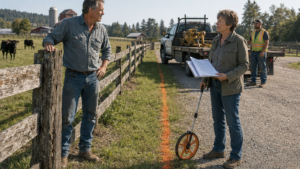
Virginia came down the lane in polished boots that had never touched the mud beyond her event barn. Behind her walked Sandra Green from county land use, carrying a clipboard against her gray jacket.
Virginia pointed at the box. “That thing has to be gone before noon.”
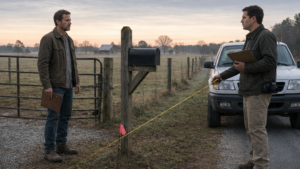
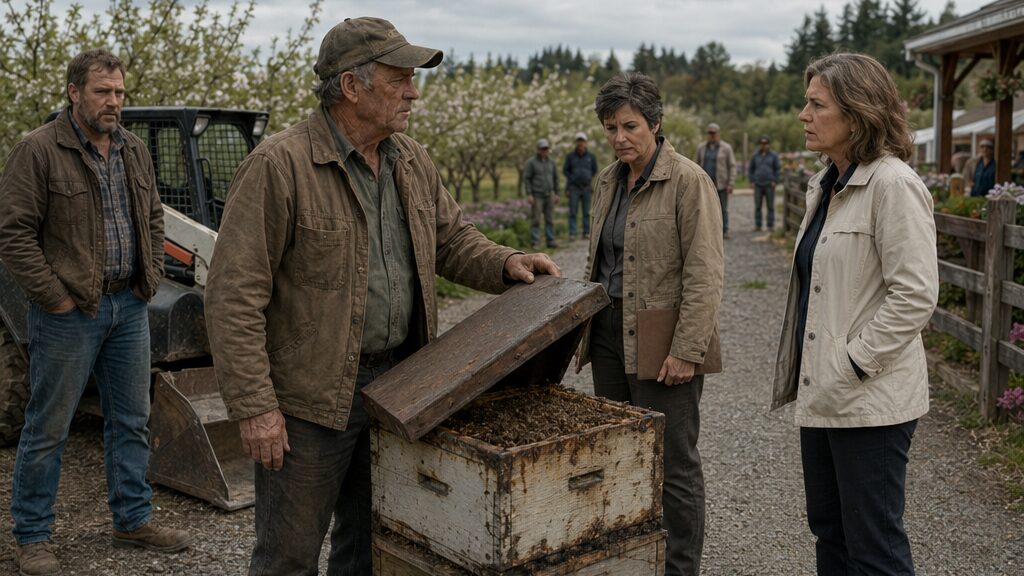
The box looked worse in full sunlight. Its boards were mismatched oak and pine, darkened by rain and sealed along the edges with nearly black propolis. One hinge had been replaced with a strip of galvanized metal. The iron lid bowed slightly in the center. It sat on concrete blocks near the line separating Larry’s old apple rows from the landscaped entrance to Virginia’s market.
To anyone passing on the road, it could have been a feed chest abandoned after a barn sale.
But Larry could feel the vibration through his palm.
Low. Uneven. Alive.
Sandra stopped beside Virginia. “Mr. Flores, the complaint says this structure is abandoned, unstable, and positioned beside a public-use entrance.”
“It isn’t abandoned.”
Virginia folded her arms. “Then tell her what it is.”
Larry looked at Sandra, not Virginia. “You came to inspect it. Inspect it.”
A pair of customers stood near the berry table pretending to compare prices. One of Virginia’s seasonal workers had paused with a flat of seedlings against his hip. Joseph shut down the skid-steer, and the sudden silence exposed the hum beneath Larry’s hand.
Sandra heard it. Her eyes narrowed.
Virginia heard it too, but her expression hardened rather than softened.
“We have children walking through here,” she said. “Wedding parties. School groups. My insurance carrier saw that box in the expansion photographs and asked what it was. I couldn’t tell them because Larry won’t tell anybody anything.”
“You didn’t ask,” Larry said.
“I asked you three times.”
“You told me to move it three times.”
Sandra stepped closer. “Is this an apiary structure?”
Larry lifted his hand from the lid. A few bees moved through the narrow entrance slot near the base, their bodies catching the sun before disappearing toward the orchard.
Virginia gave a short, disbelieving laugh. “He put bees beside my customer entrance?”
“They were here before your entrance.”
“My entrance is permitted.”
“So were they.”
Sandra glanced toward the skid-steer. “Nobody moves anything until I see inside.”
Virginia opened her mouth, but Sandra raised one finger.
“Inside first.”
Larry reached beneath the overhanging lip and found the iron latch by touch. The metal resisted. He pressed harder, and the seal released with a tacky crack.
The customers near the berries took two steps back.
Larry lifted the lid only six inches and waited. Warm air rolled out carrying wax, wood, and honey. The hum deepened. Then he raised the lid fully.
Rows of dark frames filled the box. Fresh comb curved between several of them, pale at the edges and amber toward the center. Thousands of bees moved in shifting bands across the surface, parting and closing around Larry’s gloved fingers as he eased one frame upward.
Virginia’s face changed.
Not surrender. Not yet.
But the certainty went out of it.
Sandra leaned forward without crossing the shadow of the lid. “Those frames are marked.”
Larry turned the nearest wooden bar toward her. Faded paint showed three symbols: an apple, a blackberry cane, and a small square representing the south pasture.
“Pollination route,” he said.
“For your orchard?” Sandra asked.
“And the farms around it.”
Virginia stared at the blackberry symbol. “You cannot possibly claim those bees are assigned to specific properties.”
“No,” Larry said. “They don’t read signs.”
Joseph covered a smile with his hand.
Larry lowered the frame carefully. Bees flowed back over the comb. One landed on the cuff of his shirt, cleaned its antennae, and flew toward Virginia’s berry rows.
Sandra wrote something on her clipboard. “This is clearly an active colony. That changes the removal procedure.”
Virginia turned on her. “So he wins because there are bees in it?”
“I didn’t say that.”
“You said it couldn’t be moved.”
“I said your employee cannot scoop it up with construction equipment.”
“He is my farm manager, not an employee with a shovel.”
Joseph looked at the bucket, then at the open colony. “Machine doesn’t care what my title is.”
Sandra ignored them. “Mr. Flores, active apiaries fall under county agricultural exemptions if they are registered and managed according to the state plan. I’ll need the registration number, last inspection record, and your current site-management document.”
Larry kept his face still.
Inside the box, the hum seemed to separate into layers. Workers moving. Wings ventilating. A queen hidden somewhere among the frames, alive because the rest knew their work.
He lowered the lid.
The iron edge met the propolis seam with a soft, final weight.
Virginia noticed the pause. “You do have those records.”
Larry fastened the latch.
Sandra looked up from the clipboard. “Mr. Flores?”
“They’re filed.”
“Current registration number?”
“At the house.”
Virginia’s mouth tightened with new attention. She had recognized the difference between an answer and an evasion.
Sandra tore a sheet from her pad and handed it to Larry. “You have forty-eight hours. Until then, no one touches the structure. I’m also marking the lane for temporary pedestrian separation.”
Virginia read over Sandra’s shoulder. “Forty-eight hours takes us into Monday. My market is open all weekend.”
“Then use the west entrance.”
“That entrance isn’t ready.”
Sandra’s voice remained flat. “Make it ready.”
Virginia looked at Larry. “You planned this.”
He slipped the notice into his jacket pocket. “I didn’t build your entrance.”
“No. You just left that box where you knew it would cause trouble.”
For the first time, anger pushed against Larry’s restraint. He wanted to tell her who had first measured that lane, who had marked the flight path, who had stood beside the box in winter with a red scarf knotted under her chin and said the farms would need each other before they admitted it.
Instead he said, “Move your customers west.”
Virginia stepped close enough that only he could hear her.
“If those papers are not current, I will have it removed properly.”
Larry met her eyes.
The words he should have spoken stayed behind his teeth.
Sandra returned to her county vehicle. Joseph climbed back into the skid-steer but left the bucket raised until Larry moved away. The customers drifted toward the market again, already talking about the bees as though the sight had settled everything.
Larry watched Sandra’s car disappear down the county road.
Then he put his hand back on the lid.
The hum felt steady now.
His own pulse did not.
At the farmhouse, inside a drawer he had not opened in months, the registration card carried an expiration date from eighteen months earlier.
Chapter 2: The Registration Number That No Longer Worked
The county website answered Larry with one word.
INACTIVE.
It appeared in a red box beneath the apiary number he had typed twice, then a third time more slowly. The old desktop monitor hummed on the kitchen table. A printer waited beside it with a sheet of yellowed paper still caught in the tray from tax season.
Larry pressed refresh.
The word remained.
Outside the open window, bees moved between the white clover and the orchard. Their flight made no sound at this distance, but he imagined the uneven vibration inside the box beside the market road.
He opened the drawer beneath the telephone.
Receipts. Tractor parts invoices. A folded seed catalog. His late wife’s reading glasses in a cloth case.
The registration card lay at the bottom.
He turned it over as though the other side might contain a different date.
It did not.
A truck door closed outside.
Larry returned the card to the drawer and shut it just as Emily Harris entered through the kitchen without knocking. She carried a county laptop under one arm and a rolled site map under the other.
“You didn’t answer your phone.”
“I was busy.”
“You were refreshing a dead registration.”
Larry looked at the monitor. “County system could be behind.”
“Eighteen months?”
He stood and moved toward the coffee pot. “You drive out here to be useful or to practice your tone?”
Emily set the laptop on the table. She had her mother’s way of going still when angry, which Larry found harder to face than shouting.
“Sandra called extension services because an unregistered colony is sitting beside a permitted public entrance. That makes it my work.”
“It was registered.”
“It is not registered now.”
He poured coffee he did not want.
Emily unrolled the map and weighted one corner with the sugar bowl. The boundary lane ran through the center in blue ink. Virginia’s market entrance appeared as a widened access point, approved two years earlier. A red semicircle spread from it across the property line.
“What’s that?” Larry asked.
“The recommended public-use setback.”
“Recommended.”
“Yes. Not automatically enforceable for an existing agricultural use.” Emily tapped the map. “But your box is inside it by thirty-two feet, and you never submitted a risk plan after the entrance permit was approved.”
“She built the entrance after the colony was there.”
“And you objected to the permit with one sentence written on the back of the notice.”
“I objected.”
“You wrote, ‘Bad place for a gate.’”
“It was.”
Emily closed her eyes briefly. “Did you attend the hearing?”
“No.”
“Did you explain the flight path?”
“They had the farm map.”
“They had a parcel map. Not the colony records.”
Larry took his coffee to the window. Along the orchard’s first row, several trees carried more leaves than blossoms. Last year had been thin. This year looked thinner.
Emily’s voice softened without becoming gentle. “There is a way to protect it.”
He turned.
“If the colony is part of an active recovery or research plan, Sandra can issue emergency protection while you renew. You need inspection records, treatment history, queen source, neighboring crop agreements, and a management plan covering barriers, signage, and emergency response.”
“I have records.”
“Where?”
“In the shed.”
“Then show me.”
Larry drank. The coffee had gone bitter on the burner.
They crossed the yard to the equipment shed, where dust lay thick across the workbench and mice had shredded the corner of an old feed sack. Larry opened two metal cabinets and removed binders filled with fuel receipts, orchard spray logs, and handwritten hive checks.
Emily reviewed them standing beneath a hanging light.
“These stop two years ago.”
“I kept notes after that.”
“Where?”
He pointed to a stack of narrow notebooks.
She opened one. The pages contained dates, temperatures, mite counts, and short marks only Larry understood.
“This can support an emergency application,” she said. “But it is not enough by itself.”
“It shows management.”
“It shows activity. Sandra needs a plan.”
Emily walked toward the far wall. A small oak drawer unit sat beneath the shelf holding Larry’s welding masks. Its top drawer had a brass lock.
She stopped.
Larry set down his cup.
“Leave that.”
She looked at the drawer, then at him. “Is that Mom’s field ledger?”
“Leave it.”
“She designed the original pollinator route.”
“She wrote down everything that crossed her mind.”
“And you locked it away.”
“It isn’t county property.”
“I didn’t say it was.”
Larry stepped between her and the drawer. “You came for inspection notes. Take the notes.”
Emily’s expression shifted. Something professional withdrew, leaving the daughter he had not known how to speak to since the funeral.
“You asked me to help with the farm after she got sick,” she said. “Then every time I found something she had started, you told me it was none of my business.”
“You left.”
“I took the extension job.”
“In another district.”
“Forty minutes away.”
“It was away.”
Emily stared at him. “That is exactly why Virginia can do this. You think everyone who asks a question is trying to take something from you.”
A bee struck the shed window and crawled along the glass, searching for the open section six inches away.
Larry turned the latch and pushed the pane wider. The bee lifted into the sunlight.
Behind him, paper snapped as Emily rolled the map.
“I’ll submit the emergency framework,” she said. “It may keep the box in place long enough for an inspection.”
“That’s all I need.”
“No. You need to fix the entrance seam. Bees are clustering around the crack instead of using the lower slot.”
“I saw it.”
“Then why haven’t you repaired it?”
“Because sealing it during heavy traffic can trap returning workers.”
“That is an answer,” Emily said. “You should try giving those before people bring machinery.”
She collected the notebooks and walked out.
At the door she stopped. “Sandra’s office closes at four-thirty. I need the ledger by three if it contains route agreements.”
“It doesn’t.”
“You did not even look.”
“I know what’s in my own shed.”
Emily left without another word.
By noon, Larry had replaced the temporary rope beside the box with two steel posts and a wider barrier. He watched bees cluster at the cracked seam, then rise toward Virginia’s blackberry rows.
At two, Sandra called.
“The emergency protection request is possible,” she said, “but the county has received a nuisance petition alleging foreseeable risk to visitors with severe allergies.”
“From Virginia.”
“Yes.”
“She never mentioned allergies Saturday.”
“She has now.”
Larry watched a bee settle on the iron hinge.
Sandra continued, “The petition asks for expedited relocation authority. You need a complete management plan before the review, not just old inspection notes.”
“When?”
“Tomorrow morning.”
Larry looked across the lane. Virginia stood beneath her market awning, speaking to a woman holding a folder. When she saw him, she did not look away.
At three-fifteen, a county truck delivered the formal petition.
The first page carried Virginia’s signature.
The second stated that a minor regularly present at the market had a documented history of severe anaphylactic reaction.
Larry read the line twice.
For the first time, the box beside the road seemed not only threatened, but badly placed.
Chapter 3: Virginia’s Fear Was Not Entirely Invented
“If the permit slips again, the bank will reevaluate the entire loan.”
The loan officer did not raise his voice. He did not need to.
Virginia stood at the end of a long table in the event barn while he closed the blue financing folder between them. Beyond the open doors, workers were hanging strings of lights beneath newly painted beams. Folding chairs stood in measured rows for a wedding scheduled in eleven days.
“How long is ‘revaluate’?” she asked.
“Long enough that your contractor walks to another project.”
“And the market expansion?”
“Frozen.”
Virginia pressed one hand against the table. The wood had been cut from oak removed when the berry fields were planted. She had told that story to guests so many times it had become part of the business.
The loan officer slid the folder into his briefcase. “The bank approved this based on your event permit, projected summer revenue, and documented control of visitor hazards. An active dispute involving stinging insects beside the primary entrance is not nothing.”
“It is being handled.”
“Then send me the county resolution by Friday.”
After he left, Virginia remained in the barn until the seasonal workers began glancing at her. She told them to continue with the lights.
Her granddaughter sat outside on the loading step, sorting price tags into piles. A red medical pouch lay beside her knee.
Virginia noticed it immediately.
“You’re supposed to keep that zipped.”
“It is zipped.”
“The injector needs to stay inside.”
“It is inside.”
Virginia picked up the pouch anyway and checked. Two epinephrine injectors. Antihistamine tablets. Emergency card. All present.
Her granddaughter watched her. “I’m not going near the box.”
“You should not have to think about it.”
“I don’t.”
Virginia set the pouch down. “Last summer you did not think about the wasp either.”
“It might not have been a wasp.”
The memory came without permission: swelling around the girl’s mouth, the volunteer fire chief kneeling in gravel, Virginia’s own fingers failing twice to remove the injector cap. The ambulance had taken twenty-three minutes.
Virginia stood.
“Work inside today.”
Her granddaughter sighed but gathered the tags.
Joseph entered from the berry rows with mud on his boots and a clear plastic sample bag in one hand. “You got a minute?”
“I have several problems competing for it.”
“This one is about the bees.”
Virginia’s shoulders tightened. “Sandra already has the petition.”
“I know.”
He placed the bag on the table. Inside were several pale pellets and a strip of adhesive card covered with tiny grains.
“What am I looking at?”
“Pollen samples.”
“You collect pollen now?”
“The extension office left traps along the berry rows last month. I forgot they were there until I saw one this morning.”
Virginia did not touch the bag.
Joseph opened a folded field sheet. “The marks match Larry’s frame symbols. Apple. Blackberry. South pasture.”
“He painted pictures on wood. That is not proof.”
“No. This is.”
He pointed to the sheet. The trap locations were listed by row. Beside them, handwritten percentages showed visitation estimates and fruit set comparisons.
Virginia read the numbers.
The rows closest to Larry’s boundary had produced the most consistent blossoms and the lowest rate of incomplete berries.
“Those could be wild bees.”
“Some are. Some aren’t. The marked pollen loads line up with his colony checks.”
Virginia looked toward the open barn doors. Beyond the parking field, Larry’s orchard rose in uneven green rows. The bee box itself was hidden behind the market building, but she could hear a faint mechanical hum.
Or thought she could.
“Why are you showing me this?” she asked.
“Because you called it useless in the petition.”
“I called it an unmanaged hazard.”
“You wrote that it provided no documented agricultural benefit.”
“There was no documentation.”
Joseph tapped the field sheet.
“There is now.”
Virginia folded the paper once. “Does Larry have this?”
“Extension does.”
“Does Sandra?”
“Not yet.”
Virginia placed the sheet on the table. “Then extension can decide whether it matters.”
Joseph did not move.
“What?” she asked.
“You want the box gone because it looks bad beside the entrance.”
“I want it gone because children walk there.”
“You moved the entrance.”
“With county approval.”
“And Larry should have challenged it properly. He did not. That does not make the bees worthless.”
Virginia lowered her voice. “Do you remember the ambulance?”
Joseph glanced toward the loading step where the red medical pouch had been.
“Yes.”
“I will not stand here and be told I am worried about appearances.”
“I didn’t say that was all you were worried about.”
“But you think it.”
“I think the loan is due. I think the wedding calendar is full. I think you are scared. I also think all three things are talking at once.”
Virginia’s hand tightened around the folded field sheet.
Joseph looked toward the berry rows. “Sandra mentioned temporary screening and a shifted pedestrian route. We could finish the west entrance in two days.”
“At what cost?”
“Less than losing the berries.”
“The west entrance requires drainage stone, railing, inspection, and new signs.”
“We have stone.”
“We have stone allocated to the event pad.”
Joseph gave a small nod. “Then it is a choice.”
Virginia hated the calmness of that sentence because it sounded like Larry.
She walked to the office at the back of the barn and shut the door. On her desk lay the nuisance petition, a copy of Larry’s expired registration, and the county officer’s preliminary email.
Temporary mitigation may include screened barriers, restricted access, warning signs, emergency response equipment, and use of an alternate entrance pending full review.
Virginia read it again.
The recommendation did not say immediate removal was necessary.
It said removal could be authorized if Larry failed to provide a plan.
She placed Joseph’s field sheet beside the email. The papers contradicted the clean version of the dispute she had given the bank: unmanaged bees, no proven benefit, noncompliant neighbor, straightforward correction.
The truth was less useful.
A knock sounded.
Her granddaughter opened the door a few inches. “Can I go help with the berries?”
“No.”
“I have my pouch.”
“No.”
The girl’s face closed. “I work here too.”
Virginia saw again the swelling, the ambulance lights, the useless stretch of road between the farm and the county station.
“You can price jars in the store.”
Her granddaughter withdrew.
Virginia sat alone.
At four, Sandra called.
“I have reviewed the petition,” she said. “The allergy documentation supports temporary conditions, but I am not ordering immediate destruction or unsupervised movement.”
“I requested relocation.”
“You requested expedited authority. I can issue a conditional abatement. If Mr. Flores fails to submit an acceptable plan by the deadline, the county may authorize relocation by a licensed apiary contractor.”
“When is the deadline?”
“Thursday at six in the evening.”
Virginia calculated. The loan officer wanted resolution Friday. The weekend market began Saturday. The wedding rehearsal followed Tuesday.
“Can the order specify the box cannot remain beside the entrance?”
“It can specify that the present placement requires correction.”
“That is not the same thing.”
“It is the legally supportable thing.”
Virginia looked at Joseph’s field sheet.
“Send it,” she said.
After the call, she scanned the pollination data into her computer. The file name appeared on the screen: BLACKBERRY VISITATION—EAST BOUNDARY.
She attached the expired registration to the bank update.
She attached the conditional abatement notice.
She did not attach the pollination report.
Near sunset, Sandra’s signed order arrived by email. If Larry missed the deadline, supervised relocation could begin.
Virginia printed two copies.
From outside came the faint hum beyond the fence, steady enough to be mistaken for machinery.
She placed Joseph’s report facedown beneath the financing folder and carried the removal order toward the road.
Chapter 4: The Ledger Emily Was Never Allowed to Read
The map was not in the locked drawer.
Emily found it behind a false panel in the abandoned packing shed, folded into a square no larger than her palm and wedged between two warped studs. She would have missed it if a mouse had not pulled shreds of yellow paper through the gap.
Her mother’s handwriting ran across the top in faded green ink.
POLLINATOR CORRIDOR—EAST RIDGE RECOVERY.
Emily stood beneath the broken skylight and unfolded the map across an old sorting table. Dust lifted around her wrists. The paper showed Larry’s orchard, Virginia’s berry rows, the south pasture, three smaller farms beyond the creek, and a series of arrows following bloom periods from early spring through late summer.
At the center of the route, beside the farm market road, her mother had drawn the weathered bee box.
Not as a destination.
As a transfer point.
Emily heard the packing-shed door scrape open behind her.
Larry stopped when he saw the map.
For several seconds, neither of them spoke. Wind pressed through the missing panes. Somewhere outside, a tractor changed gears on the county road.
“You knew it was here,” Emily said.
Larry looked at the false panel. “I knew she hid papers in this building.”
“That is not what I asked.”
He walked to the sorting table but did not touch the map. Up close, the lines showed more than colony routes. There were bloom dates, water sources, pesticide-risk zones, and notes beside each participating farm.
Virginia Carter’s acreage was marked with a shaded block extending through the blackberry and pumpkin fields.
Primary midseason forage. High mutual benefit.
Emily tapped the notation. “Her land was part of the plan.”
“Virginia never signed.”
“There are initials beside the boundary.”
“Those are your mother’s.”
“Then why is the farm included?”
Larry stared at the map as if it belonged to someone else. “Because bees cross lines whether people agree or not.”
Emily unfolded another crease. A cluster of red marks appeared near the western orchard.
Drift exposure reported.
Below it, in darker ink:
Larry says wait until harvest contract clears.
Emily read the line twice.
The shed seemed to shrink around them.
“What did she mean?”
Larry took the map by one corner. Emily held the other.
“What did she mean?” she repeated.
His grip loosened.
“Not here.”
“You have spent three days deciding where not to answer me.”
He released the paper and walked toward the door. Emily rolled the map before following him across the yard.
In the farmhouse kitchen, the county abatement order lay beside the cold coffee pot. Virginia had delivered it personally, sliding it under the screen door without knocking. The deadline was printed in bold near the bottom: Thursday, 6:00 p.m.
Less than twenty-four hours away.
Emily laid the map over the order.
Larry opened the refrigerator, looked inside, and shut it without taking anything.
“Mom reported drift damage,” Emily said. “From whose land?”
“South contractor.”
“The spraying crew?”
He nodded once.
“When?”
“Six years ago.”
“That was the season the first colonies collapsed.”
“Some of them.”
“All but one, according to the extension archive.”
Larry pulled out a chair and sat. His hands rested flat on his thighs.
The position reminded Emily of the hospital waiting room during her mother’s final month. He had sat the same way then, as if any movement might release something he could not contain.
“She saw dead workers along the irrigation ditch,” he said. “Disoriented bees at the entrances. She wanted me to stop the contractor before the last apple block was sprayed.”
“And you did not.”
“The contract required a clean harvest.”
Emily looked at the handwritten line again. “So you waited.”
“I told her we needed proof.”
“You had dying colonies.”
“I had a bank note, two workers who needed checks, and fruit already marked down for surface damage. If that last buyer walked, there would not have been an orchard left for bees or anybody else.”
His voice had not risen. That made the admission heavier.
“What happened?”
“The contractor sprayed the south block. Wind shifted toward the hives that evening.”
Emily pressed her fingers against the table.
Larry continued, “Your mother moved what she could. One queen survived. Some brood. A few frames. She built the first version of that box because the regular equipment was contaminated.”
“The box beside the road.”
He nodded.
“She kept it alive?”
“We did.”
The word did not sound like pride.
Emily studied the map. Her mother had drawn new routes outward from the surviving colony, linking farms by bloom season and forage. What Larry had defended as his private box had begun as a recovery nucleus for the whole ridge.
“Why did you let the registration expire?”
Larry looked toward the locked drawer in the adjoining room.
“After she died, the renewal packet came with a cooperative-use section. It required signatures from participating landowners.”
“You could have asked them.”
“She asked before. Most said they did not want liability.”
“And Virginia?”
“She had just started the market expansion. Said she could not have hives listed anywhere near customer areas.”
“So you kept the box active without the agreement.”
“I kept the colony alive.”
“You also kept it in a setback zone and let everyone believe it was only yours.”
“They were not lining up to help.”
Emily’s anger rose, but it no longer had a clean target. “You could have called me.”
“You had a job.”
“My job was literally agricultural extension.”
“You had left the farm.”
There it was again. Not accusation exactly. A wound shaped like one.
Emily pulled out the chair opposite him. “I left because every decision here had already been made before anyone spoke. Mom knew that.”
Larry’s eyes moved to the map.
“She told me you would come back when there was room for you,” he said.
Emily felt the sentence land somewhere she had kept guarded.
“Did you make room?”
“No.”
The answer came too quickly to be defensive.
Larry stood and went to the locked drawer. From his pocket he removed a small brass key. He opened the drawer and lifted out a thick field ledger bound in cracked brown cloth.
He placed it on the table but kept one hand over the cover.
“This is not a county exhibit.”
“It may have to be.”
“It has her medical notes in the back. Household things. Things that belong to us.”
“Then we separate those pages.”
His fingers tightened.
Emily waited.
At last Larry opened the ledger.
The first half held hive inspections, weather records, bloom charts, and diagrams of the bee box. Her mother had drawn the same rough structure again and again, adjusting vents, drainage slots, and frame spacing. Beside one sketch she had written:
Temporary shelter only. Move to shared corridor when trust catches up.
Emily read it aloud.
Larry looked away.
Farther in, the entries became sparse. Her mother’s handwriting shook. Larry’s appeared beneath it in block letters, recording feed levels and colony strength without commentary.
Near the end was a list of farms receiving pollination benefit. Virginia’s berry acreage appeared beside estimated yield increases over four seasons.
“This is what Joseph’s field report was showing,” Emily said.
Larry looked up. “What report?”
She told him about the trap data Joseph had mentioned to extension services that morning.
“Virginia has it?”
“She should.”
“Did she submit it with her complaint?”
Emily opened her laptop and searched the county file. The petition attachments appeared one by one: photographs of the box, the expired registration, an affidavit about the allergy risk, market entrance plans.
No pollination report.
“She did not,” Emily said.
Larry’s jaw hardened. “Then this is finished.”
“No.”
“She withheld relevant evidence.”
“And you withheld everything else.”
He pushed back from the table.
Emily closed the laptop. “Do not turn her mistake into permission to ignore yours.”
“She is trying to take the colony.”
“She is trying to save her permit, protect her granddaughter, and control the outcome. You are trying to save the colony, protect Mom’s memory, and control the outcome. You are not the same. But you are closer than either of you wants to admit.”
Larry stared at her.
The kitchen radio clicked as an emergency weather alert interrupted the farm report. Heavy rainfall was expected before dawn, with flash flooding possible along low crossings and drainage lanes.
Emily looked toward the window.
The bee box stood on the lowest part of the boundary lane.
Larry was already moving.
They reached it as the first hard drops struck the iron lid. He crouched beside the concrete supports and pushed his fingers into the drainage channel. Mud had packed beneath the eastern block. Water from Virginia’s newly graded entrance was running toward the box instead of around it.
“The ditch was clear last week,” he said.
“The event contractor changed the grade.”
Larry looked at the darkening sky, then at the box.
The colony’s hum remained steady, but water was already gathering in the wheel ruts beside it.
Emily held the ledger beneath her jacket.
“If the abatement becomes active tomorrow,” she said, “Joseph may arrive with the machine.”
Larry tested the lower support. It shifted under his hand.
“And if nobody moves it,” Emily continued, “the runoff could do it for them.”
A second weather alert sounded from the farmhouse radio behind them, thin through the rain.
Larry stood with mud on his fingers.
For the first time, leaving the box where it was no longer looked like protection.
Chapter 5: The Morning the Removal Order Became Dangerous
By dawn, muddy water covered the lowest concrete block.
Larry stepped into the lane and felt the current push against his boots. Rain struck the hood of his jacket and ran from the brim of his cap. The bee box stood above the brown water on three visible supports instead of four, its eastern corner lowered by nearly an inch.
The hum inside had changed.
It came in short, uneven waves, rising and breaking as water vibrated through the base.
Emily arrived behind him carrying a plastic tote, two bee veils, and the field ledger sealed in a clear bag.
“You cannot open it in this rain,” she said.
“I know.”
“Then stop touching the latch.”
Larry removed his hand.
Across the lane, headlights appeared through the downpour. Joseph drove the skid-steer slowly from Virginia’s equipment barn. Its bucket was raised, and a pallet fork attachment lay chained across the back.
Virginia followed in her truck.
Larry moved into the middle of the lane.
Joseph stopped twenty feet away and shut down the engine.
Virginia stepped from the truck under a black raincoat. “The order became active at six.”
“It authorizes supervised relocation,” Emily said. “Not this.”
Virginia looked at the water. “The box is sinking.”
“We can see that.”
“Then you agree it has to move.”
Larry watched the current circle the weakened block. “Not with that machine.”
Joseph climbed down from the cab. “I brought straps and a pallet.”
“You brought steel forks to an active colony during flood conditions.”
“I brought what I was told to bring.”
Virginia pointed toward the box. “We do not have time to debate equipment.”
“We have time not to kill it,” Larry said.
A sharp crack sounded beneath the water.
The eastern support tilted.
All four of them turned.
The box settled another fraction of an inch. Bees crowded the entrance slot, dark bodies forming a moving line above the floodwater.
Emily pulled on a veil. “The lower ventilation is blocked.”
Larry knelt, reached beneath the overhang, and cleared wet leaves from the entrance with a hive tool. A surge of bees spilled outward, circling his shoulders before lifting into the rain.
Virginia backed toward her truck.
Larry noticed.
Not disgust. Fear.
Her hand had gone to the pocket where she kept the red medical pouch when her granddaughter was present.
“She is not here,” Joseph said quietly.
Virginia’s eyes stayed on the bees. “I know.”
The words came too quickly.
Larry rose. “Keep your truck windows closed.”
“I know how to handle an emergency.”
“No one said you didn’t.”
“That is what everyone has been saying since Saturday.”
Emily stepped between them. “The colony is overheating because the lower entrance is flooding. We either stabilize the base and create temporary ventilation or move it under a licensed plan.”
Virginia gestured toward Joseph. “He can move it.”
Joseph looked at the dense cluster around the entrance, then at the skid-steer.
“No.”
Virginia turned. “What?”
“I am not putting forks under that box while the colony is active.”
“You said you had moved hives.”
“Empty equipment. Winter stacks. Not this.”
“The county order permits relocation.”
“It does not make me a bee contractor.”
Virginia’s face tightened. “You manage this farm.”
“I do. Which is why I am telling you the machine could split the box or roll it if the ground gives way.”
The current pushed a branch against the lower stand. Larry pulled it free.
Virginia faced Emily. “What is the alternative?”
Emily pointed uphill toward an unused strip between the orchards. “Temporary landing boards, a ventilated transport screen, manual cribbing, and a night move after the foragers return. We need the apiary inspector.”
“The water may reach the frames before tonight.”
“Then we raise it now without relocating.”
“With what?”
Larry looked toward his equipment shed.
“Railroad jacks.”
Virginia gave him a hard look. “You had equipment to stabilize it all along?”
“I have equipment to lift tractors. That does not mean I planned for your entrance to redirect half the hill.”
“My entrance passed inspection.”
“Before the final grading.”
Joseph looked at the runoff crossing the market road. “He is right about the grade.”
Virginia swung toward him. “You signed off on the contractor’s work.”
“I signed the material delivery. The drainage inspection is tomorrow.”
The rain seemed louder.
Virginia stared uphill at the water pouring from the new gravel apron. For a moment, the argument left her face. What remained was calculation edged with fear.
Then Sandra’s county vehicle appeared at the road.
She parked on high ground and approached beneath a yellow rain shell. The county apiary inspector followed in another truck, carrying a smoker and a hard equipment case.
Sandra surveyed the flooded lane. “Nobody moves the colony until the inspector assesses it.”
Virginia held out the abatement order. “The deadline passed.”
Sandra did not take the paper. “And current conditions have changed.”
“They have become more dangerous.”
“Yes. For everyone, including the colony.”
The inspector crouched near the entrance, watching the bees’ movement. “High stress. Ventilation compromised. Box is structurally sound, but the base is failing.”
“Can it remain?” Sandra asked.
“Not on those supports.”
Virginia crossed her arms. “Then relocate it.”
“Not with a skid-steer,” the inspector said.
Joseph looked toward the ground.
Larry felt no satisfaction. The box gave another faint shudder beneath his hand.
The inspector continued, “Raise it immediately. Relocate after sunset if we can prepare a suitable site. But I need authority, registered management, and a receiving agreement.”
Emily held up the sealed ledger. “We have the management history.”
Sandra looked at Larry. “Do you have a proposed receiving site?”
He pointed toward the strip between the two farms.
Virginia shook her head. “That crosses my boundary.”
“It was designed to,” Emily said.
Virginia stared at her. “What was?”
Emily removed the map from the tote but did not unfold it. “The recovery corridor.”
Larry wanted to stop her. The impulse rose automatically—the same reflex that had kept the ledger locked, the same belief that anything exposed could be taken or used against him.
Then water struck the underside of the box.
The hum broke into a ragged roar.
Larry turned toward the shed. “Joseph, bring oak cribbing from my equipment bay.”
Joseph hesitated only long enough to look at Virginia.
She said nothing.
He ran.
Larry and the inspector positioned two railroad jacks beneath the reinforced side beams. Emily cleared debris from the drainage path. Sandra photographed the failing supports and redirected traffic away from the lane.
Virginia remained near her truck until a surge of water carried one of her market signs into the ditch.
Then she waded after it, pulled it free, and dragged it across the runoff to form a temporary diversion.
Larry saw her do it but said nothing.
They raised the box half an inch at a time.
Each turn of the jack produced a shift in the hum. When the eastern side lifted clear of the water, bees began moving away from the entrance cluster. The inspector inserted a screened ventilation wedge beneath the lid.
Joseph returned with cribbing and worked beside Larry without waiting for instructions. Together they built a new temporary platform above the current.
By midmorning, the box stood level again.
The relief lasted less than a minute.
Sandra gathered them beside her vehicle.
“This cannot stay unresolved,” she said. “The county has an unregistered colony, disputed land use, a public-access hazard, altered drainage, and no signed receiving agreement.”
“The hearing is this afternoon,” Emily said.
Sandra nodded. “If neither property owner submits an acceptable joint plan, the county can place the colony under protective seizure and transfer it to a licensed operator.”
Larry looked at the box.
Virginia spoke first. “For how long?”
“Potentially permanently.”
The word cut through the rain.
Larry had fought to keep Virginia from controlling the colony. Now his refusal to share control could remove it from both farms.
Sandra turned to him. “You have records, Mr. Flores. You may also have a viable corridor. But the county needs more than proof that the bees matter. It needs proof that you can manage them lawfully.”
The apiary inspector closed his equipment case. “And the current location is finished. Even if the box survives today, it must move.”
Larry looked uphill at the strip his wife had marked years ago. It crossed the boundary in a shallow arc, away from Virginia’s entrance and closer to water, windbreak, and forage.
He had always told himself he kept the box where she left it because changing anything would break the promise.
But she had written temporary shelter only.
He had protected the object after forgetting the plan.
Emily stood beside him, the sealed ledger held against her chest.
Larry wiped rain from his face.
“Bring it to the hearing,” he said.
Emily searched his expression. “All of it?”
He looked at Virginia, then Sandra, then the box balanced on fresh cribbing above the flood.
“All the pages that matter.”
“And the drift report?”
Larry felt the old resistance rise once more.
Then he nodded.
Virginia watched him. “What drift report?”
Larry did not answer her.
Not yet.
He turned toward the farmhouse while the uneven hum followed him through the rain.
Chapter 6: Larry Finally Opened More Than the Lid
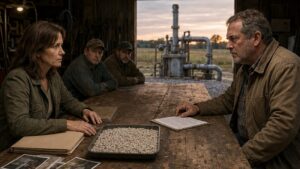
Virginia placed a photograph of the bee box on the county hearing table as if presenting evidence from an accident.
The image showed warped boards, blackened seams, the iron lid, and muddy water beneath the supports. It had been taken before the emergency cribbing was installed.
“This is what has been maintained beside my public entrance,” she said. “An unregistered colony in a deteriorating structure, without warning signs, current inspection documents, or an approved emergency plan.”
Larry sat across from her with Emily on one side and the sealed field ledger on the other.
Behind them, folding chairs held neighboring growers, two cooperative board members, Joseph, the apiary inspector, and several workers from Virginia’s market. No one spoke.
Sandra Green presided from the end of the table.
Virginia continued. “My granddaughter has a documented life-threatening allergy. My employees and customers were never informed. I asked for correction before machinery was brought in. Mr. Flores refused every attempt to discuss relocation.”
Larry looked at the photograph.
Nothing Virginia had said was entirely false.
That was the problem.
Sandra turned to him. “Mr. Flores, do you dispute the condition of the structure or the registration lapse?”
“No.”
Virginia’s attorney, seated beside her, stopped writing.
Sandra leaned forward. “You agree the registration expired?”
“Yes.”
“And that no current risk-management plan was filed after the market entrance was approved?”
“Yes.”
A murmur moved through the chairs.
Emily did not look at him, but her shoulders lowered slightly.
Virginia’s expression shifted. She had prepared to fight his denial. Agreement gave her nowhere to push.
Larry rested his hands on the table.
“The box should not stay where it is,” he said.
Joseph looked up.
Virginia blinked. “Then why are we here?”
“Because moving it is not the same as removing its purpose.”
He opened the clear bag around the ledger and placed the brown book beside Virginia’s photograph.
The cracked cover looked no more official than the box itself.
Larry turned to a marked page.
“My wife began recording pollinator decline six years ago. She documented dead workers, navigation failure, and drift exposure after a contractor treated our south orchard.”
Virginia’s attorney glanced at her.
Larry continued, “She asked me to stop the final application. I did not.”
The room went still.
“I had a harvest contract I believed would fail if we delayed. I said we needed more proof. The wind shifted after the treatment. Most of our colonies were lost.”
He did not look at Emily.
“The box in that photograph was built from clean lumber to hold the surviving queen, brood, and uncontaminated frames. It was meant to be temporary.”
He opened the ledger to the corridor sketch.
Emily unfolded the large map beside it.
Colored arrows spread across Larry’s orchard, Virginia’s fields, and the farms beyond the creek.
“The surviving colony became the center of a recovery route,” Larry said. “Early apple bloom here. Blackberries and pumpkins next door. Clover and pasture farther south. My wife’s plan was to place managed habitats along that corridor under shared agreements.”
A cooperative board member leaned closer. “Were agreements signed?”
“No.”
“Why not?”
“Some landowners declined. Virginia declined. After my wife died, I stopped asking.”
Virginia spoke. “I never saw that map.”
“You saw the proposal letter.”
“I saw a request to list my property in a bee program beside a customer business.”
“You saw what you expected to see.”
Sandra raised a hand before Virginia could answer. “Mr. Flores, stay with the record.”
Larry nodded.
“I let the registration lapse because renewal required cooperative signatures. I kept the colony operating under old records. I believed keeping it alive mattered more than explaining how I had failed.”
He looked at Emily then.
“That was wrong.”
The words were quiet. They carried farther than Virginia’s accusations had.
Larry turned several pages and showed the treatment history, queen line, mite counts, and seasonal forage notes. Then he placed a separate sheet beside the map.
“This is the original drift report I did not submit at the time.”
Sandra read the date. “Why was it withheld?”
“I was afraid the buyer would cancel the contract and the contractor would deny responsibility. By the time I filed a private claim, the evidence chain was weak.”
“So the report never entered the county record.”
“No.”
The apiary inspector crossed his arms. “Your delay likely prevented a full exposure investigation.”
“Yes.”
Emily’s face tightened, but she remained silent.
Larry turned toward Virginia.
“You were right about the current location. The entrance changed. The drainage changed. I should have filed a new plan and moved the colony before there was a public hazard.”
Virginia’s posture lost some of its rigidity. “But?”
“But you were not right that it had no agricultural value.”
Emily opened her laptop.
A projected chart appeared on the wall, showing blossom visitation and fruit-set results from Virginia’s berry rows.
Virginia’s attorney leaned toward her. “Were these included in the petition?”
Virginia looked at Joseph.
He held her gaze but did not rescue her.
Sandra asked again. “Ms. Carter, did you have access to this report before filing your final supplement?”
Virginia’s fingers rested on the edge of the table. “Joseph showed me preliminary field data.”
“Did you submit it?”
“No.”
“Why?”
“It did not remove the safety issue.”
“That was not the question.”
Virginia looked toward the audience. Her granddaughter was not present, but the red medical pouch sat on the empty chair beside Joseph. Virginia had placed it there when they arrived.
“I did not submit it,” she said, “because the bank required a clear resolution. Evidence that the colony benefited my crops would have complicated removal.”
No one murmured this time.
The admission settled without spectacle.
Larry understood the temptation better than he wanted to.
Sandra reviewed the documents for several minutes. The hearing room filled with the sound of pages turning and the building’s ventilation system.
At last she said, “The county has two separate failures before it. Mr. Flores maintained an active colony without current registration, adequate public safeguards, or updated site approval. Ms. Carter omitted materially relevant agricultural data while requesting expedited action.”
Virginia stared at the table.
Sandra continued. “Neither failure cancels the other.”
The apiary inspector placed a site photograph beside the corridor map. “The uphill strip can support relocation if drainage is corrected, barriers are installed, and the entrance faces away from public access. It would require participation from both property owners.”
Virginia shook her head. “I cannot accept open liability.”
Emily answered before Larry could. “A cooperative agreement can divide management, inspection, insurance, and emergency duties.”
Virginia looked at Larry. “Under his control?”
Larry closed the ledger.
“No.”
The single word surprised everyone, including him.
He slid a prepared document across the table. Emily had drafted it in the truck while they waited for the hearing to begin. The top line read: EAST RIDGE POLLINATOR COOPERATIVE—TEMPORARY TRANSFER AND SITE MANAGEMENT AGREEMENT.
“I will transfer the colony and equipment to cooperative stewardship,” Larry said. “The receiving site will be inspected. Emily can administer the records through extension until the cooperative appoints a manager. Joseph can supervise the physical relocation with the apiary contractor.”
Virginia read the first page. “And you?”
“I maintain the orchard access, assist with colony care, and hold one vote.”
“One vote,” she repeated.
“The same as any participating farm.”
Emily looked at him fully now.
Sandra turned to the cooperative board members. “Would your organization consider provisional custody?”
One of them asked, “With current inspection and signed land access?”
“Yes.”
The member glanced at the other, then nodded. “Provisionally.”
Virginia pushed the document back. “You expect me to dedicate land and assume cost after he ignored the rules for eighteen months?”
“No,” Larry said. “I expect you to choose whether the safety problem you described is more important than winning the boundary.”
Her face hardened again.
He continued, “The new site needs screening, emergency stations, drainage work, and a five-year access agreement. Your expansion caused part of the runoff. My failure left the colony exposed. The costs should reflect both.”
Virginia’s attorney whispered to her. She did not answer.
Sandra spoke. “The county will suspend seizure for seventy-two hours if the transfer is signed today and both landowners submit the site agreement. Without that, the inspector will remove the colony to an outside operator.”
Larry uncapped the pen.
Emily touched his wrist. Not to stop him. Only to make sure he understood.
Signing meant the box would no longer be his to guard alone. The inspection key would not remain in his pocket. The ledger would enter cooperative records. Other people would question treatments, placement, costs, and decisions.
His wife had written move to shared corridor when trust catches up.
Trust had not caught up.
Perhaps it never did on its own.
Larry signed anyway.
The scratch of the pen sounded louder than the rain against the windows.
He turned the agreement toward Virginia.
She looked at his signature, then at the photograph of the weathered box. Her own name waited beneath his.
“I need to review the liability section,” she said.
Sandra gathered the remaining papers. “You have until tomorrow at noon.”
Larry stood.
Virginia looked up at him. “You signed before knowing whether I would.”
“Yes.”
“Why?”
“Because my part stopped depending on yours.”
He picked up the ledger but left the corridor map on the table between them.
Then he walked out of the hearing room without knowing whether Virginia would sign, whether the county would seize the colony, or whether surrendering control had come one day too late.
Chapter 7: Where the Weathered Box Hummed Next
Virginia was waiting beside the relocated bee box when Larry arrived.
She stood beyond the new split-rail barrier with a county folder tucked beneath one arm and the red medical pouch hanging from her shoulder. The box rested twenty inches above the ground on a poured concrete base, its old boards unchanged except for a fresh entrance reducer and a screened ventilation panel beneath the iron lid.
Someone had scrubbed away the mud.
No one had sanded out the scars.
Larry stopped at the edge of the new pollinator strip. The site followed the rise between the two orchards, far enough from Virginia’s customer entrance to satisfy the setback and close enough to the windbreak for winter protection. Clover had been seeded along the slope. A shallow drainage swale curved below the base and carried the previous night’s rain toward the creek.
Joseph stood near the transport trailer, checking the empty straps. The county apiary inspector was closing his hard case. Emily knelt beside a weatherproof cabinet mounted inside the barrier, arranging inspection forms and emergency supplies.
The move had been completed before sunrise, after most of the foragers returned. Larry had helped carry the box from the flood-damaged lane, one slow step at a time, while Joseph kept the landing boards level and the inspector monitored the screened entrance.
Now bees traced thin lines over the property boundary as though it had never existed.
Virginia looked at Larry’s boots. “The county wants the final site acknowledgment signed before they leave.”
“You signed the land agreement.”
“For five years.”
“I read it.”
“That does not make us partners forever.”
Larry approached the cabinet. “Five years is longer than most people stay agreeable.”
Joseph gave a quiet laugh, then pretended to adjust a strap.
Virginia did not smile. “This is not friendship.”
“No.”
“It is not forgiveness either.”
“I did not ask for that.”
She studied him for a moment, perhaps expecting resistance beneath the answer. Finding none seemed to trouble her more.
Emily stood and handed Virginia a laminated card. “Emergency procedure. The market office keeps one copy, the event barn keeps another, and this one goes in the cabinet. The barrier gate stays locked during public hours.”
Virginia read the card. “The injector stations are installed?”
“One by the west entrance, one beside the event barn, and one here,” Emily said. “The county approved the locations.”
Virginia glanced at the red pouch on her shoulder. “My granddaughter knows.”
“She should still carry her own.”
“She does.”
The apiary inspector joined them. “Colony is stressed but stable. The queen was sighted during transfer. No major frame damage.”
Larry looked toward the box. The hum was low and continuous now, no longer broken by water or blocked ventilation.
“Entrance orientation?” he asked.
“Northeast. Away from the market, toward the orchard gap.”
“And the afternoon heat?”
“The windbreak will shade it after four.”
Larry nodded.
The inspector held out a clipboard. “Cooperative acknowledgment.”
Larry signed beneath Virginia’s name.
The board members arrived shortly afterward with two neighboring growers and Sandra Green. There was no ceremony, only folding chairs set on firm ground and a portable table holding copies of the agreement.
Sandra reviewed the final conditions.
The colony would remain under provisional cooperative custody for one year. Emily would maintain the master records through extension services. Larry would perform routine care under dual-signature inspection. Virginia would provide land access, maintain the public barrier, and fund the emergency stations and drainage corrections required by the settlement.
At the end of the year, the cooperative would decide whether to expand the corridor.
Sandra closed the folder. “There is one remaining matter.”
Virginia’s shoulders stiffened.
“The county record includes a public claim that the colony had no documented agricultural value. The filed yield data contradicts that statement.”
Virginia looked toward the workers and neighboring growers standing behind the chairs.
Her attorney was not present.
Neither was the loan officer.
She stepped to the table.
“The statement was incomplete,” she said.
Sandra waited.
Virginia’s jaw tightened. “It was wrong.”
The wind moved through the young clover. Bees crossed above the barrier, heading toward her blackberry rows.
Virginia continued without looking at Larry.
“Field data indicates that pollinators from this colony contributed to fruit set on my east boundary acreage. I had access to preliminary evidence before the final petition and did not include it.”
One of the neighboring growers shifted his weight. No one applauded. No one rescued her from the silence.
She looked toward the empty road leading to the market.
“I was concerned about my granddaughter, my permit, and the refinancing of the business. Those concerns were real. Leaving out the report was still my decision.”
Sandra made a note. “The correction will be attached to the county file.”
Virginia nodded once and returned to her chair.
Larry felt no triumph.
The admission did not return the lost colonies, erase the petition, or make the weeks ahead simple. It did something smaller and more useful: it placed the truth where other people could see it.
After the county group dispersed, Emily carried the field ledger from her truck.
The brown cover had been wrapped in a clear archival sleeve. She placed it inside the weatherproof cabinet beside a printed copy of the corridor map.
Larry watched her turn the cabinet key.
“You separated the back pages?” he asked.
“Medical notes and household records are at the farmhouse.”
“And the rest?”
“Cooperative record.”
He rested one hand on the cabinet door. “Your mother would have corrected the labels.”
“She corrected everybody’s labels.”
“She would have said this one was crooked.”
“It is crooked.”
He looked at the small white card Emily had mounted inside the cabinet. EAST RIDGE POLLINATOR CORRIDOR—SITE ONE.
The left edge sat slightly lower.
Larry reached to straighten it, then stopped.
Emily noticed. “You can fix it.”
“No. Somebody else may like it that way.”
She smiled, but only briefly.
Virginia approached from the far side of the barrier. She carried a set of invoices clipped together.
“The drainage contractor reduced the charge after Joseph showed him the original grading plan,” she said. “The market will cover the swale, barrier, and emergency stations. The cooperative can handle the colony equipment.”
Larry accepted the papers.
“That is more than the settlement requires.”
“The runoff came from my entrance.”
“Yes.”
Virginia looked toward the old market road. The muddy location where the box had stood was now marked by four empty impressions from the concrete blocks.
“My granddaughter asked whether the bees know they moved.”
Larry watched a worker return with yellow pollen packed against her legs.
“They know the entrance changed. They map from there.”
“Do they return to the old place?”
“For a while. Some will circle it.”
“And then?”
“They learn the new route.”
Virginia adjusted the strap of the medical pouch. “That sounds convenient.”
“It is not. Some do not make it.”
Her expression changed at the answer.
Larry folded the invoices. “But the colony does.”
She looked at him. “Five years.”
“I heard you the first time.”
“If the county changes the setback or the event business expands again, we review the agreement.”
“We review it.”
“And if management lapses—”
“Emily will file before you can start the machine.”
Emily, standing several feet away, said, “That is accurate.”
Joseph laughed openly this time.
Virginia almost smiled. Then she caught herself.
“I have work,” she said.
She crossed the strip toward her berry fields. At the boundary she paused, watching bees pass over her shoulder without noticing her fear or her signature.
Then she continued toward the market.
Larry remained beside the box until the apiary inspector’s truck disappeared down the road. He listened to the colony through the weathered boards.
For years, he had believed the promise was contained inside that sound. Keep the queen alive. Protect the frames. Do not let anyone disturb what remained.
But his wife had not drawn a circle around the box.
She had drawn arrows leading away from it.
Emily opened the cabinet again and removed a small brass key from the hook.
“You should keep one copy,” she said.
Larry looked at the key in her palm.
It was new, cut for the inspection cabinet and the barrier gate. The old iron key to the bee box still rested in his jacket pocket.
He took the brass key, weighed it for a moment, then closed Emily’s fingers around it.
“You administer the records,” he said.
“You still need access.”
“I know where to find you.”
She looked down at her closed hand.
“That is not the same as calling.”
“No.”
“Will you?”
Larry glanced toward the orchard. The first apple block had set unevenly, but small fruit held on several branches. Beyond it, bees moved toward Virginia’s berries and the south pasture, following a route no fence could keep.
“I will,” he said.
Emily slipped the key into her pocket.
They walked back toward the farmhouse together, leaving the gate locked behind them.
At the top of the rise, Larry stopped and looked back.
The weathered box stood on its new base between the farms. Its dark seams, bent hinge, and rain-stained boards remained visible beneath the clean barrier and county signs. Nothing about it looked new except the ground supporting it.
A steady hum crossed the clover.
Larry put his empty hand into his jacket pocket and walked on.
The story has ended.