The Farmer Everyone Blamed for the Noise Was Trying to Save the Valley’s Last Music Program
Chapter 1: The Note That Crossed Three Fields
Catherine Moore came through the orchard carrying a crying baby while Donald Campbell still had the horn against his mouth.
He saw her between the apple rows just as he reached the high note he had been missing all week. The sound left the bell bright and hard, cleared the nearest trees, and rolled across the irrigation road toward the dairy.
Catherine stopped beside a stack of empty produce crates. Her infant twisted against her shoulder beneath a thin blue blanket. She did not raise her voice. She did not need to.
Donald lowered the horn.
The last note continued without him, thinning over three fields until it disappeared behind the Moore barn.
“You woke him again,” Catherine said.
Donald set the dented brass horn on an overturned crate. His lips tingled from the mouthpiece. “I’m sorry.”
“You said that Monday.”
“I remember.”
“And Tuesday.”
He reached for the rag he used to wipe dust from the valves, then left it where it was. The child’s cries sharpened whenever Catherine shifted him.
The sun had dropped behind the western ridge, but the orchard still held the day’s heat. Donald had chosen the packing area because the trees softened the echo. He had faced the horn away from the dairy. He had shortened each session. None of it had been enough.
“I only need another twenty minutes,” he said.
Catherine stared at him as though she had expected a different man to answer.
“My husband is finishing milking alone,” she said. “I walked over because the truck would have taken longer around the ditch. I haven’t slept more than two hours together in six weeks, and you need twenty minutes.”
Donald looked down at the horn.
Twelve days remained before the regional audition. Twelve days to restore the steadiness he had once possessed without thinking. Twelve days to make the opening passage sound like music instead of a man forcing air through old metal.
He could have told her that much.
He could not tell her the rest.
“I practice at the same time every evening,” he said. “Half an hour. No more.”
“That’s supposed to make it better?”
“It means you know when it ends.”
The words sounded colder once they were outside him.
Catherine’s face tightened. She adjusted the baby and glanced toward the dairy. Beyond the irrigation road, the long roof of the milking barn showed above a windbreak of cottonwoods.
“The cows know when it starts too,” she said. “The young ones have begun kicking during evening milking. One caught my husband above the knee yesterday.”
Donald frowned. “Because of the horn?”
“Because they hear something they don’t understand.”
“They hear trucks. Compressors. Thunder.”
“They don’t hear a brass horn every evening at seven fifteen.”
Donald looked toward the road as if distance might answer for him. Sound traveled strangely in the valley. A tractor could disappear behind a rise and still seem close enough to touch. At dusk, voices from the dairy sometimes reached his porch in pieces.
The baby quieted for half a breath, then began again.
Donald picked up the horn and carried it farther from Catherine, placing it inside the top produce crate. The brass looked out of place among splinters and dried apple leaves.
“I’ll stop for tonight,” he said.
Catherine’s expression changed slightly. Not gratitude. Surprise, perhaps, that he had surrendered so quickly.
“Tonight isn’t the problem.”
“I heard you.”
“No, you heard the baby.”
Donald met her eyes.
“That ought to be enough,” she said.
He could not disagree. That was the worst part.
The screen door of the farmhouse slammed beyond the trees. Michelle had arrived from town; Donald recognized the cough of her car turning into the yard. He imagined her coming down the path and finding Catherine there, then asking questions Donald had spent months avoiding.
He stepped between Catherine and the farmhouse without meaning to.
She noticed.
“What is this really about?” she asked.
“Practice.”
“For what?”
He bent over the crate and folded the cleaning rag across the horn’s bell.
“Donald.”
“It’ll be finished soon.”
“That isn’t an answer.”
“It’s the one I have.”
Catherine gave a tired, humorless laugh. “You know what people are saying?”
“I don’t spend much time asking.”
“They think you’ve decided being alone out here means you don’t owe anybody anything.”
The accusation landed close enough to truth that he felt it physically.
Since his wife died, neighbors had stopped coming through the kitchen door without knocking. Invitations arrived less often. Donald had let the distance grow because distance required no explanation. He did not have to say why he had taken the old horn from its case after thirty years. He did not have to say whose handwriting was folded inside that case.
“You can tell them what they like,” he said.
Catherine’s eyes hardened. “That’s convenient.”
The baby’s cries faded to small, exhausted sounds. She rested her cheek against his hair.
Donald saw then how pale she looked beneath the dust along her forehead. Her work shirt was buttoned wrong at the bottom. One boot was streaked with manure nearly to the ankle.
He wanted to say he would change the hour. But daylight practice collided with harvest crews, truck loading, irrigation checks, and the county restriction on amplified sound near the road. Evening was the only time the orchard became still enough for him to hear his own mistakes.
He wanted to tell her twelve days.
He wanted to tell her what could happen if he passed.
Instead he said, “I won’t go past seven forty-five.”
Catherine took one step backward.
“That’s your compromise?”
“It’s what I can promise.”
“You could promise to stop.”
Donald said nothing.
From the farmhouse came the sound of Michelle closing her car door.
Catherine followed the noise, then looked back at the horn in the crate. “You’re making everybody guess why this matters more than they do.”
“It doesn’t.”
“Then act like it.”
She turned toward the road.
Donald watched her cross the orchard with the baby held close. At the edge of the packing area, she stopped. For a moment he thought she might come back.
Instead she shifted the child to one arm, pulled out her phone, and took a photograph.
The lens captured Donald, the orchard crates, and the dented horn resting inside the top box like something seized at an inspection.
“What are you doing?” he asked.
“Documenting the setup.”
“For who?”
Catherine lowered the phone.
“The county,” she said. “They can hear it next.”
Chapter 2: A Complaint Written in Livestock Terms
The baby woke at four thirteen in the morning, and Catherine knew before opening her eyes that she would not get back to sleep.
His cry came through the wall in short, frightened bursts. Beside her, her husband pushed himself upright, then winced and pressed a hand above his bruised knee.
“I’ve got him,” Catherine whispered.
“You’ve got morning milking.”
“So do you.”
“That’s my point.”
She found the baby standing unsteadily in his crib, both hands wrapped around the rail. His cheeks were wet. When she lifted him, he settled against her without becoming quiet.
Downstairs, the milk ledger lay open beside her phone on the kitchen table. She warmed a bottle with one hand and replayed the recording she had made the previous evening.
At first there was only the soft clink of equipment from the barn. Then Donald’s horn entered, distant but unmistakable. One sustained note, a pause, then the same phrase repeated. The sound was not wild or careless. It was measured.
That almost made Catherine angrier.
He was choosing each note.
By five, she was in the dairy barn with the baby asleep in a carrier strapped to her chest. Her husband worked the far side of the milking line, favoring one leg. The youngest cow shifted when a gate clanged, and Catherine saw him tense.
The horn had not caused every problem on the farm. She knew that.
It had merely arrived at the hour when everything already felt close to breaking.
Their lender was due in ten days for a review of the operating loan. Feed costs had risen again. Two cows had developed mastitis during the hottest week of the year. The infant refused sleep unless somebody held him. Her husband’s knee was swollen enough to show through his work pants.
By seven, Catherine had written three sentences in the complaint form and deleted each one.
At the feed store that afternoon, she mentioned the problem to the owner while waiting for mineral mix. She intended only to ask whether anyone else had heard the horn.
A neighboring grower answered from the coffee counter.
“Every night,” he said. “Carries clear past my south fence.”
“Does it bother your crew?”
“My crew goes home before then.”
Another grower folded a receipt into his shirt pocket. “Still isn’t good for property appeal.”
Catherine looked at him. “Property appeal?”
“People come out here for quiet. Somebody looking to buy ten acres hears that carrying over the valley, they start wondering what else goes on.”
The feed-store owner snorted. “Nobody’s refusing land because Donald Campbell plays half an hour of music.”
“You don’t know that.”
“Neither do you.”
The second grower lifted both hands. “I’m saying it affects perception.”
The phrase stayed with Catherine because it sounded official. Not true, exactly. But useful.
She told them the baby kept waking. She told them about the cow that had kicked her husband. She did not say the animal was young and already skittish. She did say Donald had continued after she asked him to stop.
“Did he keep playing while you were there?” the owner asked.
Catherine hesitated.
“No,” she said. “He stopped when he saw the baby.”
The first grower studied her over his paper cup.
“But he said he’d start again tonight,” she added.
That restored the shape of the story. The men nodded.
By the time she reached the county office, the complaint had become a packet. A sound recording. The photograph of Donald beside the crates. A copy of the dairy’s evening milking schedule. A note from one grower stating that the horn was audible from his property.
Emma Wright met her at a narrow counter beneath a bulletin board covered with drought notices and livestock vaccination dates. She wore a navy jacket and read each page without changing expression.
“This office handles agricultural-services conflicts,” Emma said. “Noise enforcement usually goes through land use.”
“They told me to start here because livestock are involved.”
“Are they?”
“My cows are reacting.”
“How many?”
Catherine thought of the young cow shifting at the gate. “Several.”
Emma looked up.
“The form says one injury.”
“My husband was kicked.”
“I’m not minimizing that. I’m asking whether a veterinarian has connected the behavior to the sound.”
“No.”
Emma turned to the next page. “And the property-value concern?”
“Two neighboring owners raised it.”
“Has anyone canceled a sale or appraisal?”
“Not yet.”
Emma set the papers down. “Then we should be careful with the wording.”
Catherine heard Donald’s voice in her memory: It means you know when it ends.
Her baby had fallen asleep in the stroller beside the counter. Even now, she watched the rise of his blanket as if sleep were something that could be taken from him by distance.
“People deserve some peace,” she said.
“They do.”
“And rules only work if they apply before someone proves financial damage.”
Emma’s mouth tightened in a way that suggested agreement without endorsement.
She played the recording from Catherine’s phone. The horn sounded smaller in the county office, almost lonely. A clerk at the far desk glanced over.
“How long does this continue?” Emma asked.
“Thirty minutes.”
“Every night?”
“Nearly.”
“Has Mr. Campbell explained why?”
“He calls it practice.”
“For an event?”
“He wouldn’t say.”
Emma replayed the first ten seconds, then stopped it. “I can issue an informal mediation notice. If he refuses, we schedule a hearing.”
“I already tried informal.”
“You spoke to him once.”
“I’ve spoken to him three times from the road. Yesterday I walked over.”
“And he stopped.”
“For that evening.”
Emma tapped the photograph. Donald stood stiffly beside the produce crates, one hand resting on the wood. The horn’s bell caught the low sunlight.
“He doesn’t look like he’s hiding the activity,” she said.
“He’s hiding the reason.”
“That isn’t necessarily a violation.”
“No. The noise is.”
Catherine heard how sharp she sounded. She lowered her voice before it woke the baby.
Emma slid the property-impact statement aside. “I’ll include livestock disturbance, household disruption, and repeated evening sound. I won’t state measurable property loss without evidence.”
Catherine looked at the paper.
“Can you say potential loss?”
Emma waited.
It was a small pause, but Catherine understood what it asked of her.
She could remove the claim. The complaint would remain legitimate without it. The baby was real. The broken sleep was real. Her husband’s bruised knee was real, even if the chain between horn and hoof could not be proved.
But Donald had refused to explain. He had made her stand in his orchard and argue for the value of quiet as though she were requesting a favor.
“Two landowners raised the concern,” she said. “That part is true.”
Emma wrote something in the margin.
“I’ll contact him today.”
“When would a hearing be?”
“If mediation fails, next week.”
Catherine gripped the stroller handle. “Before his twelve days are up?”
Emma looked at her. “What happens in twelve days?”
“I don’t know. He said it would be over soon.”
That evening, no horn sounded at seven fifteen.
Catherine stood in the dairy yard listening past the fans and pumps. At seven twenty, one low note crossed the fields. Then another.
Her phone rang before she could decide whether to record it.
“This is Emma Wright,” the voice said. “Mr. Campbell declined mediation unless the county allows his existing schedule.”
Catherine closed her eyes.
“So what happens now?”
“The land-use chair has approved a public hearing.”
“Where?”
“The fairgrounds sale barn. Thursday at six.”
Across the darkening fields, Donald began the phrase again.
This time Catherine held the phone toward the sound and let it record until the note ended.
Chapter 3: The Horn Inside the Produce Crate
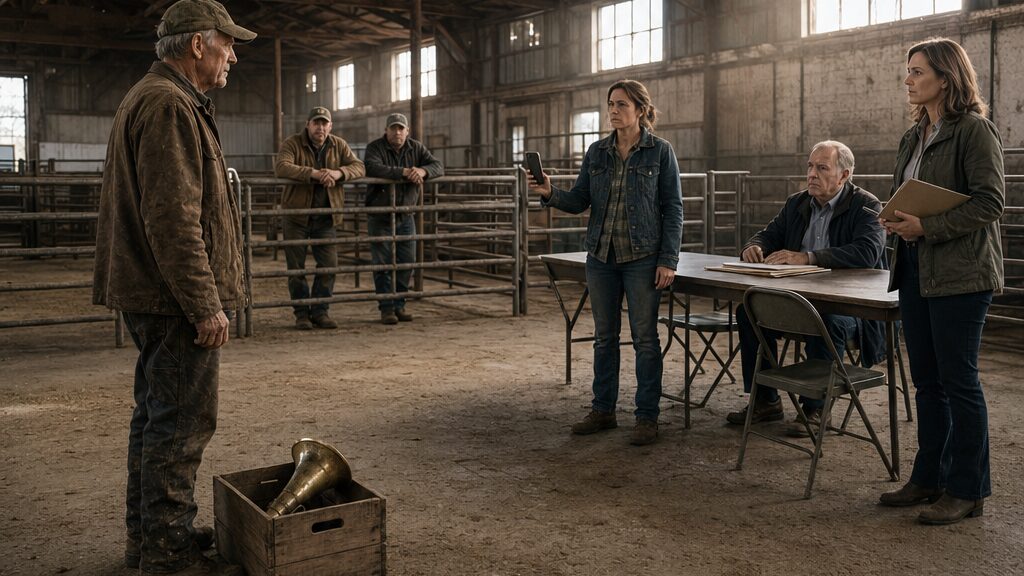
“Does that horn belong to you, Mr. Campbell?”
Donald looked down at the apple crate beside his boots.
The instrument lay inside on a folded feed sack, its dented bell facing the aisle. Under the fluorescent lights of the fairgrounds sale barn, the brass showed every fingerprint he had failed to polish away.
“Yes,” he said.
The county hearing chair leaned toward the microphone. “Please answer clearly for the record.”
“Yes. It belongs to me.”
Behind Donald, folding chairs scraped against concrete. The old sale ring still smelled faintly of straw, dust, and livestock disinfectant. Thirty people had come, more than he expected and fewer than he feared.
Catherine sat in the front row with her husband. The baby was not there.
Emma Wright occupied a table beneath the auctioneer’s booth, arranging complaint forms into a straight stack. She had told Donald he could leave the horn at home. He had brought it because the hearing notice referred to “the sound-producing instrument,” and he did not trust the county to discuss an object it had never seen.
Now it looked less like an instrument than evidence.
The chair summarized the complaint: repeated evening noise, disrupted household rest, alleged livestock agitation, possible effect on neighboring land use.
At the last phrase, Donald glanced toward the two growers seated behind Catherine.
One avoided his eyes.
The chair asked, “Do you dispute that you play between seven fifteen and seven forty-five most evenings?”
“No.”
“Do you dispute that the sound carries beyond your property?”
“No.”
A whisper passed through the chairs.
Donald rested both hands on his knees. He had prepared answers during the night, each one short enough to remain under control. He would not discuss the orchard accounts. He would not discuss his wife. He would not discuss the band room.
Facts only.
Catherine was called first.
She stood with her phone in one hand and described the baby waking, her husband’s injury, and the young cows shifting during milking. Her voice remained level until she repeated Donald’s offer to stop only for one evening.
“He said knowing when the noise ended should be enough,” she said.
Donald felt several faces turn toward him.
The chair asked whether she had a recording.
Catherine connected her phone to a small speaker on Emma’s table.
The first sound was the dairy’s ventilation fan. A metal latch struck somewhere close to the microphone. Then Donald’s horn filled the sale barn.
The recording flattened the tone and made it harsher than he remembered. The opening note held too long. The next entered slightly sharp. He heard the exact place where his breath had tightened.
No one moved.
In the orchard, the phrase had seemed private despite the distance it traveled. Here, surrounded by neighbors, it sounded like an intrusion forced into every chair.
Catherine stopped the recording.
The silence afterward was worse.
A grower rose and said the valley had always depended on neighbors exercising restraint. Another said agricultural land already faced pressure from residential buyers and could not afford new nuisances.
The feed-store owner, seated near the back, asked whether anyone had actually lost a sale.
The grower answered, “Perception becomes value.”
Donald nearly laughed, but the hearing chair was watching him.
Emma read the county guidance. Ordinary agricultural noise received broad protection. Recreational or musical activity did not. Repeated sound crossing property lines during household quiet periods could result in restricted hours and escalating fines.
“Mr. Campbell,” the chair said, “would you like to respond?”
Donald stood.
His right knee resisted after the long wait. He steadied himself against the crate, then moved his hand before anyone could mistake the gesture for weakness.
“The recording is accurate,” he said.
Catherine looked at him.
“The sound crossed my boundary. It woke the child. I didn’t intend either thing, but both happened.”
A few people shifted. He could feel the room waiting for the defense that should follow.
He gave them none.
The chair frowned. “Then why did you refuse mediation?”
“The proposed hours would prevent me from practicing.”
“Your ability to practice is not the only interest under review.”
“I understand.”
“Do you?”
Donald’s jaw tightened.
Emma spoke before he could answer. “Mr. Campbell indicated there was a fixed deadline.”
The chair looked at him. “What deadline?”
Donald reached inside his work jacket and removed the folded notice. The paper had softened at the creases from being opened too often.
He placed it on the table.
“I have an audition in twelve days.”
Someone behind him whispered, “For what?”
The chair read the first page. “Regional Valley Brass Ensemble.”
“Yes.”
“You are auditioning for employment?”
“For a position.”
“Paid?”
Donald paused. “Partly.”
The answer created more movement than the admission itself.
Catherine studied him with an expression he could not read. Her anger had not vanished, but it had lost its certainty.
The chair lifted the notice. “Why did you not disclose this during mediation?”
“It didn’t change the sound.”
“No, but it might have changed the conversation.”
“That wasn’t the complaint.”
Catherine stood without being called. “You let me think this was a hobby.”
Donald turned toward her. “It is.”
“Not if there’s a position.”
“It can be both.”
“And that made it impossible to say one sentence?”
The room had become too attentive.
Donald saw the closed school-band room as it had looked the last time he entered: dust across the music stands, chair legs stacked against the wall, his wife’s handwriting on a note inside the horn case.
He kept his eyes on Catherine.
“I wasn’t asking for permission to want it,” he said.
Her face changed, but not toward sympathy.
“You weren’t being asked to.”
The chair tapped the microphone. “We will maintain order.”
Donald sat.
For several minutes, the discussion shifted to possible restrictions. Daytime-only practice. Use of a vehicle or enclosed building. Temporary suspension until the audition. Donald rejected suspension. The orchard shed distorted the sound. The farmhouse walls were thin. Driving elsewhere would cost hours he did not have during harvest.
Emma suggested practice between eleven in the morning and three in the afternoon.
Donald looked at her. “That’s when the picking crew is working beside the packing shed.”
“Then use the barn.”
“The barn roof carries sound worse.”
“Soundproofing?”
“Not in twelve days.”
The chair removed her glasses. “Mr. Campbell, you are presenting inconvenience as impossibility.”
Donald thought of the irrigation line that needed replacing, the fruit that would soften if not packed before noon, and the passages he still could not finish without breaking tone.
“Yes,” he said. “I suppose I am.”
The hearing recessed for ten minutes.
Outside the sale barn, Catherine found him beside the livestock pens. Evening light showed through the rails in narrow bars.
“An audition,” she said.
Donald nodded.
“You could have told me.”
“I just did.”
“After I filed papers.”
“You asked why I practiced. I said practice.”
She folded her arms. “You make honesty sound like a technical requirement.”
He looked toward the parking lot. Michelle’s car had arrived late and now sat near the entrance. She remained behind the windshield, watching him.
Catherine followed his gaze.
“Does your daughter know?”
Donald did not answer.
“That’s what I thought,” she said.
When the hearing resumed, the chair issued a temporary order: no outdoor horn practice after five in the afternoon, no practice before ten in the morning, and immediate fines for violations. The order would remain until the audition date, then be reviewed.
It was not a ban. Several people seemed to consider that generous.
Donald signed the acknowledgment.
As he placed the horn back inside the apple crate, Catherine approached the table.
“For what it’s worth,” she said quietly, “I hope you play better there than you did on my recording.”
Donald looked at her.
There was no smile in it, but neither was there cruelty.
“I plan to,” he said.
He carried the crate toward the exit. Michelle waited beside his truck with a manila folder tucked beneath one arm.
“You brought the books?” Donald asked.
“I brought copies.”
“Of what?”
She opened the folder and held out a bank statement. One line had been marked in red: travel, application, and instrument repair charged against the orchard’s operating account.
Donald felt the crate grow heavier in his hands.
Michelle looked from the statement to the horn.
“You told me the repair was paid from your pension,” she said.
“It will be.”
“When?”
He set the crate on the truck bed.
Her voice dropped. “What else did you take out of the farm without telling me?”
Chapter 4: The Promise Behind the Closed Band Room
Michelle placed three receipts beside the foreclosure notice and waited for her father to deny all of them.
Donald remained standing at the kitchen counter, one hand braced against the edge. The horn case sat near the back door, still dusted with the pale grit of the fairgrounds parking lot.
The first receipt was for the application fee. The second covered two nights at a motel near the audition hall. The third came from an instrument repair shop forty miles away.
Together, they were not enough to ruin an orchard.
Taken from the wrong account, they were enough to leave the emergency irrigation reserve short.
“You moved the money in June,” Michelle said. “Before the pump started losing pressure.”
“I was going to replace it.”
“With what?”
“My pension deposit.”
“That covers the property tax.”
“I know what it covers.”
“Then why did you tell me the horn repair came from it?”
Donald looked at the foreclosure notice. The paper was not a final demand, but the lender’s language had grown less patient. One failed harvest, one major equipment breakdown, or one delayed payment could move the orchard into formal review.
“I did not want you involved,” he said.
Michelle gave a short laugh. “You used farm money. That involved me.”
“You handle the books.”
“I handle them because you asked me to keep this place alive.”
“I didn’t ask you to take ownership of every decision.”
“No. You just ask me to discover them afterward.”
Donald folded the receipts and returned them to the table. Michelle flattened them again.
She had come back to the valley four years earlier, first for her mother’s illness and then because Donald had begun missing invoices and renewal dates. She had never called herself his caregiver. Donald had never called her one either. They used terms like bookkeeping, rides into town, and helping through harvest.
The arrangement worked as long as neither admitted what it cost.
Michelle tapped the audition notice.
“What does ‘outreach residency’ mean?”
Donald’s eyes moved toward the horn case.
“A series of performances.”
“That isn’t what I asked.”
“It includes instruction.”
“For whom?”
“Schools. Rural communities.”
“And you’re being paid?”
“If I’m chosen.”
“How much?”
“Enough to return what I used.”
Michelle stared at him. “That was your plan?”
“It remains the plan.”
“You borrowed from a failing farm to compete for money you might not win.”
“It isn’t prize money.”
“What difference does that make to the pump?”
Donald pushed away from the counter. “You think I haven’t done the arithmetic?”
“I think you did it alone.”
He carried the horn case to the mudroom and set it beside his work boots. The movement ended the conversation in his mind. Michelle followed him.
“What aren’t you saying?”
“Plenty.”
“That hearing made you look foolish.”
“I noticed.”
“You let the whole county believe this was about getting into some brass group.”
“It is about getting into the group.”
“But not only that.”
Donald reached for his jacket.
Michelle stepped in front of the door. “Where are you going?”
“To practice.”
“The order says daytime only.”
“It is daytime.”
“It’s almost four.”
“Then I have nearly an hour.”
She did not move. “You can’t keep answering every question with a schedule.”
He looked at her long enough that she stepped aside, though anger remained in the set of her shoulders.
Donald drove instead of walking to the packing shed. He did not explain where he was going.
The consolidated high school stood eight miles away, beyond a row of grain silos and a shuttered equipment dealership. Its oldest wing had been closed after district cuts moved arts courses to the larger campus in town.
Donald parked near the service entrance. Michael Young waited beside the doors with a ring of keys and a look that made clear he had already heard about the hearing.
“You brought trouble,” Michael said.
“I brought a horn.”
“You’ve had both for years.”
Michael was older than Donald by three months and carried retirement badly. He still wore pressed shirts to unlock abandoned classrooms. The school district paid him a small stipend to inventory instruments and decide which could be sold.
He led Donald down a dim corridor.
The band-room doors had narrow windows coated with dust. Inside, chairs were stacked against one wall. Music stands lay folded in a metal cabinet. The acoustic panels had been removed, leaving pale rectangles where they had hung.
Donald set the horn case on a chair.
Michael locked the door behind them. “Your daughter called.”
Donald snapped the latches open. “You answered.”
“She asked whether the residency was real.”
“What did you tell her?”
“That it was.”
“You had no right.”
Michael’s expression did not change. “You asked me in April whether this room could be reopened.”
“That was private.”
“You asked the district for a usage estimate.”
“I asked you.”
“You asked me because I used to run the program.”
Donald lifted the horn.
Michael did not move aside. “You also asked how many children had signed up before the district cut transportation.”
Donald’s hand tightened around the valves.
“You told her that too?”
“No. But I will if you make her keep guessing.”
Donald turned toward the old conductor’s platform. “You always did like explaining other people.”
“And you always liked letting silence make you look noble.”
The words struck harder because Michael had known him before the orchard consumed every spare hour. Before marriage, before debt, before music became a thing stored under the bed.
Donald raised the horn and played one soft note.
The empty room returned it to him without warmth. The sound touched the bare walls and died.
Michael looked toward the closed instrument lockers.
“She would have hated this,” he said.
Donald lowered the horn. “Do not speak for her.”
“I taught your daughter. I knew your wife.”
“You knew her at concerts.”
“I knew she kept asking when you would play again.”
Donald opened the case pocket and removed a folded piece of paper. He did not hand it over.
His wife’s handwriting had faded at the creases.
When they cut the program, don’t let that be the end of it.
She had written the sentence during her final month, after Michelle told them the district planned to close the band room. At the time, Donald had promised too quickly. He had believed promises became easier once the person asking no longer had to watch them being kept.
Michael’s voice softened. “The residency isn’t only performances.”
Donald returned the note to the case.
“No.”
“It includes a rural teaching grant.”
“If the panel approves the local site.”
“And this was your site.”
Donald looked around the stripped room. “At first.”
“The district won’t reopen it.”
“I know.”
“So where?”
“The packing barn, once harvest ends.”
Michael let out a breath. “You planned free classes in an unsoundproofed barn beside a county road.”
“I planned to improve it.”
“With what money?”
Donald did not answer.
Michael understood anyway.
The door opened behind them.
Michelle stood in the hallway, holding the folder against her chest.
Neither man had heard her arrive.
“How long?” she asked.
Donald set the horn down.
“How long have you been planning classes?”
“Since spring.”
“Before Catherine complained?”
“Yes.”
Her anger shifted. It did not lessen. It found a deeper place.
“And the money?”
Donald looked toward Michael, but the older man had already stepped away.
“The application required travel,” Donald said. “The horn needed work. The residency pays a stipend if I’m selected.”
Michelle entered the room. Dust stirred around her boots.
“You took the irrigation reserve.”
“I intended to replace it before the dry weeks.”
“You intended.”
“The pump is still running.”
“It lost pressure twice yesterday.”
Donald’s gaze moved to the windows.
Michelle followed it. “Was this for Mom?”
He did not answer quickly enough.
Her face tightened. “You spent money we need because of something she wrote?”
“It was not because she wrote it.”
“Then why?”
“Because she was right.”
“About music?”
“About what disappears when everyone decides something is optional.”
Michelle’s eyes filled, though her voice remained steady. “She was talking about me.”
Donald said nothing.
“I nearly left school,” she continued. “Michael’s class was where I went instead. I know what it meant. But she also spent her last year worried you would lose this farm.”
“I remember.”
“Do you?”
Donald lifted the horn but did not play.
Michelle placed the folder on the conductor’s stand. “You don’t get to honor one part of her by risking the other.”
The empty room held the sentence between them.
Donald looked at the faded rectangles on the wall, at the chairs stacked where children once sat, at his daughter waiting for an answer he had avoided since June.
“I can repay it,” he said.
“How?”
“If I earn the residency.”
“And if you don’t?”
He had no answer that was not another promise.
Michelle took the car keys from the top of the horn case.
“The bus to the audition leaves from town,” she said. “Your motel and ticket are refundable until Friday.”
“Give those back.”
“When the irrigation reserve is restored.”
“You cannot cancel my trip.”
“I manage the account that paid for it.”
Donald stepped toward her. “Michelle.”
She closed her hand around the keys.
“Repay the farm by Friday,” she said, “or I cancel it myself.”
Chapter 5: The Reason Catherine Stopped Playing
Catherine found her daughter’s name written beneath eleven others on a sheet titled VALLEY MUSIC INTEREST LIST.
The paper lay on the dairy office desk under a stack of feed invoices. Her husband had apparently picked it up at the high school and forgotten to mention it.
Beside their daughter’s name, someone had written: beginner—woodwind.
Catherine read the line twice.
Her daughter had never touched a woodwind instrument.
At breakfast, Catherine placed the sheet beside her husband’s coffee.
“What is this?”
He looked down. “The school sent it home.”
“And you signed her up?”
“She signed herself.”
“She’s nine.”
“She can print her name.”
“That does not mean she understands what she agreed to.”
He tore a piece of toast. “It’s an interest list, not enlistment papers.”
Catherine glanced toward the living room, where their daughter sat on the floor beside the baby, keeping him occupied with wooden blocks.
“Who is teaching?”
“Donald, if he gets that position. Michael Young is helping.”
The name pulled something old and unwelcome through her.
Michael had taught the county’s school band when Catherine was fourteen. He had placed a used clarinet in her hands and shown her how to make a note without biting the reed. She had practiced for one semester before her father injured his back and the dairy began claiming every hour not spent in class.
She had told Michael she was quitting temporarily.
She had never returned.
Catherine folded the interest sheet and put it in her pocket.
That afternoon, she climbed the narrow stairs to the bedroom closet while the baby slept. Behind winter coats and a box of tax records sat a long black case powdered with dust.
The latch resisted.
Inside, the clarinet remained in five pieces, its keys darkened but intact. A yellowed cleaning cloth lay beneath it. Her name was written on a strip of masking tape near the handle in her mother’s handwriting.
She closed the case before touching the instrument.
A vehicle slowed on the irrigation road.
Through the window, she saw Donald’s truck stop beside the dairy entrance. Sheets of rigid insulation rose from the bed, tied down with rope.
Catherine carried the clarinet case back into the closet and went outside.
Donald stood near the gate with a tape measure clipped to his belt.
“If you are here about the complaint, Emma said all communication goes through her,” Catherine said.
“I’m here about the barn.”
“My barn?”
“Mine.”
He nodded toward the insulation.
Catherine crossed her arms. “What about it?”
“I can close off the north bay. Double the interior wall. Hang moving blankets until proper panels can be installed.”
“For practice?”
“And classes.”
The word sounded different when spoken beside calf pens and fuel tanks. Less sentimental. More difficult.
“You expect children in your packing barn?”
“After harvest. If the site passes inspection.”
“And you have money for an inspection?”
“No.”
“At least you’re consistent.”
Donald accepted the remark without reaction.
“I measured the sound line this morning,” he said. “With the north wall sealed and the doors shut, most of it should travel toward the ridge.”
“Should.”
“I can test it before anything begins.”
“Using the same horn that started this?”
“Yes.”
Catherine looked at the insulation. Several sheets were used, their foil backing torn at the corners.
“Where did you get those?”
“Old cold-storage panels.”
“Did you pay for them?”
“No.”
The answer carried more weight than it should have.
“You really planned the classes before I complained,” she said.
Donald rested one hand on the truck bed. “Yes.”
“For farm kids?”
“For whoever comes.”
“Free?”
“If the residency is approved.”
“And if it isn’t?”
His jaw shifted. “Then I find another way.”
Catherine almost laughed. “That answer is how people lose farms.”
Donald’s eyes sharpened. “You think I don’t know what losing land looks like?”
“I think you know and keep acting anyway.”
They stood with the irrigation ditch between them, water moving through weeds at the concrete edge.
Catherine pulled the folded interest list from her pocket.
“My daughter’s name is on this.”
Donald did not reach for it. “She put it there.”
“You spoke to her?”
“Michael visited the school. I wasn’t present.”
“She wrote woodwind.”
“That’s what she chose.”
Catherine looked back toward the house.
“What’s wrong with woodwind?” Donald asked.
“Nothing.”
He waited.
Catherine hated that his silence could now feel less like indifference and more like room deliberately left open.
“I played clarinet,” she said.
Donald’s expression changed only at the eyes. “I didn’t know.”
“Most people didn’t.”
“Were you good?”
“I was fourteen.”
“That wasn’t the question.”
She folded the paper smaller. “I quit.”
“Why?”
“My father couldn’t milk alone.”
Donald nodded once.
There was no pity in it, which made the acknowledgment harder to reject.
“You think that means I should support you,” Catherine said.
“No.”
“You think I’m standing between children and what I lost.”
“No.”
“What do you think?”
“I think you were right about the baby.”
The directness stopped her.
Donald looked toward the dairy barn. “I should have changed the schedule before the county forced it. The audition mattered. That did not make the sound harmless.”
Catherine searched his face for strategy.
“You didn’t say that at the hearing.”
“I’m saying it now.”
“Because you need community approval.”
“Yes.”
The honesty was so poorly timed that it almost became respectable.
Donald continued, “I need a site. I need parents willing to bring their children. I need someone to tell me when the plan interferes with actual farm work.”
“You need me to withdraw the complaint.”
“I need you not to lie about what happened.”
Catherine felt heat rise beneath her collar.
“I did not lie.”
“You listed property harm.”
“Two landowners raised it.”
“You listed livestock damage as ongoing.”
“My husband was kicked.”
“Once.”
The word landed precisely.
Catherine stepped closer to the ditch. “You don’t get to examine my wording after refusing every chance to explain yourself.”
“No. But the county does.”
“And if I correct it, you expect your restrictions lifted?”
“I expect the record corrected.”
He had given her no graceful way to agree.
A low rumble sounded from the road. A county inspection vehicle approached and stopped beside the dairy equipment shed.
The inspector climbed out carrying a clipboard.
Catherine’s husband emerged from the barn, wiping his hands on his jeans.
“I called about the generator,” he said.
Catherine looked at him. “What is wrong with it?”
“It hesitated during the last test.”
“You said it was the starter.”
“I thought it was.”
Donald moved toward his truck. “I’ll go.”
The inspector opened the generator housing. Catherine watched him trace a cable, test the transfer switch, and then shake his head.
“The control board is failing,” he said. “It might start under load. It might not.”
“When can you replace it?” Catherine asked.
“Part has to come from out of state.”
“How long?”
“Five days. Maybe seven.”
Her husband looked toward the sky. “There’s a storm system coming Friday.”
The inspector nodded. “That’s why I’d rent a backup.”
Catherine knew the cost before she asked. The number was more than they could spare before the loan review.
Donald stood beside his truck with one hand on the door.
He looked from the open generator housing to the dairy barn, where the milk-cooling compressors ran without pause.
“I have a portable unit,” he said.
Catherine turned. “Big enough?”
“Not for everything. Enough for the milk tank and part of the line.”
Her husband glanced at her.
Catherine remembered the county hearing, the photograph, the phrase potential property loss typed into the complaint.
“We’ll handle it,” she said.
Donald held her gaze.
“Suit yourself.”
He drove away with the insulation rattling softly in the truck bed.
The inspector finished the report and tore off the bottom copy. At the top, in block letters, he had written FAILED UNDER AUTOMATIC TRANSFER TEST.
Catherine’s phone vibrated before she could fold the paper.
A weather alert filled the screen.
Severe thunderstorms. Flash flooding possible. High wind beginning Friday evening.
She looked across the irrigation road toward Donald’s orchard, where the portable generator sat somewhere behind the equipment shed.
Chapter 6: The Night the Dairy Went Dark
The dairy’s emergency lights vanished at nine twenty-three, leaving a black rectangle across the fields.
Donald saw it from his equipment shed while securing the horn case inside his truck.
Lightning broke above the western ridge. For one white second, the Moore barn, silos, and farmhouse appeared in sharp outline. When darkness returned, only a flashlight moved near the milking entrance.
Donald checked his watch.
The bus for the audition left town at five thirty in the morning. Michelle planned to drive him to the station at four forty-five. His clothes were packed. The remote possibility she had threatened to cancel had ended when he sold an unused sprayer and returned the irrigation money that afternoon.
He had six hours before departure.
Across the field, the flashlight swung rapidly.
Donald took the portable generator key from its hook.
Rain hammered the shed roof before he reached the tractor.
He hitched the generator trailer beneath the eaves, then drove into the orchard lane. Mud formed almost immediately where the first water crossed the packed soil.
The horn case lay on the passenger floor of his truck behind him, untouched.
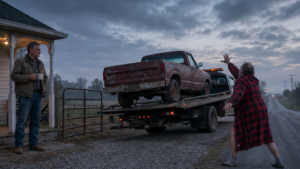
At the irrigation road, Catherine stood in the rain waving both arms.
“The automatic transfer failed,” she shouted over the tractor engine. “The milk tank is warming.”
“I know.”
“How?”
“Your lights went out.”
Her husband ran from the barn with a coil of cable. “The parlor controls are down too. Cows are still loaded.”
Donald pointed toward the portable unit. “Cooling tank first. Then the vacuum pump if it holds.”
Catherine grabbed the trailer tongue while Donald backed into the equipment bay. They worked without discussing the complaint, the hearing, or the insulation still stacked in his barn.
The generator coughed twice before starting.
Its engine settled into a rough roar. One row of emergency lights flickered on inside the dairy. A compressor began turning.
Catherine’s husband checked the panel. “Tank is drawing too much.”
“Cut the water heater,” Donald said.
“We need hot water for sanitation.”
“You need cold milk first.”
Catherine reached past him and threw the breaker.
The generator steadied.
For twenty minutes, they moved load from one system to another, keeping the tank cold while finishing the cows already in the line. Rain blew through the open bay. Water gathered around their boots.
Donald’s phone rang in his jacket.
Michelle.
He ignored it.
Catherine saw the screen light through the fabric. “You should answer.”
“I know who it is.”
“Then answer.”
He connected the final cable and stepped beneath the narrow overhang.
Michelle spoke before he could.
“Where are you?”
“Moore dairy.”
There was a pause. “The bus leaves in less than eight hours.”
“I’m aware.”
“The road at Miller’s crossing is already flooding. We may need to leave in forty minutes if it gets worse.”
Donald looked toward the orchard. Lightning showed water running brown across the lane.
“I’ll be back.”
“When?”
“When the system is stable.”
“Dad.”
The word came without anger, which made it harder to dismiss.
“You repaid the account,” Michelle said. “You did what I asked. Don’t miss this because you think you have to prove something else.”
“I’m not proving anything.”
“Then let them rent equipment.”
“There isn’t time.”
Catherine stood several feet away, holding a flashlight against the electrical panel. She had heard enough.
“Go,” she said.
Donald ended the call.
“The generator is running,” Catherine continued. “We can manage it.”
“The fuel line has to stay above the water. If the ditch rises, this bay floods.”
“My husband knows engines.”
“Not this one.”
Her husband did not argue.
Catherine wiped rain from her face. “You could lose the audition.”
Donald checked the oil pressure. “You could lose the milk.”
“That is not your responsibility.”
“No,” he said. “It is my generator.”
A sharp crack came from outside. The lights dimmed.
Donald ran into the rain.
A fallen branch had struck the trailer cable and dragged it toward the ditch. The generator still ran, but the trailer had shifted sideways in the mud.
He climbed onto the tractor and pulled forward.
The rear wheels spun.
Mud sprayed the fenders. The trailer moved six inches, then sank deeper.
Catherine came beside the cab. “Stop. You’re burying it.”
Donald shut down the engine.
Water rushed along the tire tracks. The ditch had already overflowed onto the road.
“We need the other tractor,” her husband said.
“It’s on the far side of the barn.”
“Can it reach us?”
“If the lower gate opens.”
Catherine went still. “The calves are in that lot.”
They would have to move them before opening the route.
Donald looked at his watch again.
Four hours and fifty-one minutes until the bus.
They moved the calves by flashlight.
The animals resisted the rain, bunching near the fence and turning back whenever thunder struck. Catherine pushed from behind while her husband worked the gate. Donald stood at the opening, guiding each animal through with one arm extended.
The last calf broke sideways and ran toward the flooded lane.
Donald caught its halter, twisted with the movement, and fell to one knee.
Pain shot through his hip.
Catherine reached him first. Together they pulled the calf back inside.
“You hurt?” she asked.
“No.”
“You’re limping.”
“I was limping before.”
For the first time that night, she almost smiled.
The second tractor freed the generator trailer. They repositioned it on higher gravel and restored the cables.
By midnight, the milk tank temperature had stabilized. The cows were out of the line. The storm continued, but the immediate danger had passed.
Donald stood beside the running generator, soaked through.
Catherine came from the office carrying two paper cups of coffee. She handed him one.
“I need to tell you something,” she said.
Donald waited.
“The complaint said your horn was causing property harm.”
“I remember.”
“There was no appraisal. No canceled sale.”
“I know.”
“And the livestock section made it sound like repeated injuries.”
Donald looked toward her husband, who was wrapping his knee with a dry bandage.
“One cow kicked once,” Catherine said. “She was already skittish.”
The generator’s engine filled the space between them.
“Why are you telling me now?” Donald asked.
“Because you came.”
“That doesn’t change what you wrote.”
“No.”
“Or what the sound did.”
“No.”
He drank the coffee. It was weak and too hot.
Catherine looked toward his orchard. “I was angry that your reason might matter more to people than my problem.”
“It shouldn’t.”
“But it will.”
“Probably.”
“So I made my problem larger.”
Donald rubbed mud from the cup rim with his thumb.
“At the hearing,” she said, “you made yours smaller.”
He looked at her.
“You could have told them about the classes.”
“I wasn’t chosen.”
“You planned them anyway.”
“Plans aren’t promises.”
“Yours are.”
Lightning flickered behind the barn.
Donald set the cup down. “I promised my wife.”
Catherine said nothing.
“When the school cut the music program, she asked me not to let it disappear. Michelle had nearly quit school years before. Band gave her somewhere to be until she found her footing.”
“And you thought you could fix all of that alone.”
“I thought I could begin.”
“That isn’t the same thing.”
“No.”
The admission came more easily than he expected.
His phone rang again.
Michelle’s message appeared instead of a call.
Miller’s crossing is closed. Last safe route leaves in twenty minutes.
Donald looked at the flooded lane.
Catherine read his face. “Take our truck. It’s on the north side.”
“The bridge beyond your pasture will close next.”
“You can still make it.”
He pictured leaving the generator under partial load, the rain still rising, the cables stretched across wet gravel. He pictured the audition hall, the panel, the opening passage he had practiced until Catherine’s child woke.
The horn case remained in his truck across the fields.
“Your husband can monitor the oil pressure,” he said.
“Yes.”
“He has to shut down before refueling.”
“We understand.”
“The tank compressor cannot run with the parlor pump.”
“Donald.”
He stopped.
Catherine held out the keys to her truck.
He did not take them.
A gust struck the barn hard enough to rattle the metal doors. One emergency light blinked off and back on.
Donald looked at the generator, then at the dairy tank gauge.
“No,” he said.
Catherine lowered the keys.
“The bus—”
“Will leave.”
“You may be disqualified.”
“Yes.”
“After all this?”
Donald looked toward the dark fields. “The point was not to become the kind of man who lets someone else lose what he could have protected.”
Catherine’s expression tightened. “Don’t make this noble.”
“I’m not.”
He picked up the fuel can. “I’m making it necessary.”
The storm weakened near dawn.
When the utility power returned, Donald shut down the generator and stood listening as the dairy systems transferred back one by one.
The bus had departed two hours earlier.
His truck waited at the orchard edge. The horn case lay where he had left it.
Michelle stood beside the open driver’s door, arms folded against the morning cold. She did not ask whether he had made the bus.
“You chose,” she said.
Donald climbed down from the tractor. “Yes.”
“Was it worth it?”
He looked across the road at Catherine, who was helping her husband secure the last gate.
“Yes.”
Michelle’s eyes moved toward the horn case. “Then what happens to Mom’s promise?”
Donald had no answer.
A county truck approached through the wet orchard lane. Emma Wright drove, with mud streaked along both doors.
She parked beside the equipment shed and stepped out holding her phone.
“I spent half the night receiving calls about road closures,” she said. “Then Catherine called me.”
Donald glanced across the road.
Catherine did not look up.
Emma continued, “She corrected the livestock and property statements in her complaint. She also explained why you missed the bus.”
“I didn’t ask her to.”
“I know.”
Donald reached for the horn case.
Emma held up the phone. “The audition panel has one opening at nine thirty. They have agreed to hear a remote submission from the sale barn.”
Donald stared at her.
“That is in two hours,” Michelle said.
Emma nodded. “The connection will be live. One performance. No editing.”
Donald looked down at his mud-covered clothes, his swollen hands, and the case he had not opened all night.
Emma turned toward the county truck.
“If you still want the position,” she said, “bring the horn.”
Chapter 7: No Applause Before the Agreement
Three weeks later, Donald carried the same apple crate into the sale barn, but this time the horn rested beside a signed practice schedule.
The folding chairs had been arranged in two rows instead of six. No one had come to punish him. That did not make the room easier to enter.
Emma stood beneath the auctioneer’s booth with a projector screen lowered behind her. Michelle occupied the end of the county table, a ledger open in front of her. Michael had placed a cardboard box of donated music stands near the wall.
Catherine sat in the first row.
Her husband was beside her, his injured leg stretched slightly forward. Their daughter held the printed interest sheet in both hands. The baby slept against Catherine’s shoulder beneath the same blue blanket Donald remembered from the orchard.
Donald set the crate beside the microphone.
The hearing chair looked at the horn, then at the schedule.
“We are not reopening the original complaint,” she said. “Today concerns the proposed residency site and community-use agreement.”
Donald nodded.
Emma switched on the projector. The screen displayed the decision from the regional ensemble.
Donald had passed the audition.
The words had arrived six days earlier, after his remote performance in the empty sale barn. He had stood in wet work clothes behind a borrowed microphone while three faces watched from a laptop screen. His hands had still smelled of generator fuel.
He had missed one entrance.
He had recovered without stopping.
The panel had offered him the position and the rural outreach residency on one condition: the valley needed to approve a viable teaching site, demonstrate local participation, and provide financial controls separate from Donald’s orchard.
The position had not solved anything. It had merely replaced one deadline with another.
Emma read the conditions aloud.
“Instructional activity must comply with county occupancy, safety, parking, and noise requirements. Residency funds cannot be deposited into an agricultural operating account. The site must have a governing committee of at least three residents.”
The hearing chair turned to Donald. “You proposed the north bay of your packing barn?”
“Yes.”
“And you understand that approval will require inspections and permanent sound treatment?”
“Yes.”
“You also understand that the program cannot be operated solely at your discretion?”
Donald glanced at the signed schedule inside the crate.
“That part has been explained to me several times.”
A few restrained smiles appeared.
Catherine did not smile.
Emma invited public comment.
The first neighboring grower stood and said traffic near the orchard could interfere with harvest trucks. Another asked who would be liable if a child was injured around farm equipment.
Donald answered each question briefly. Classes would begin after harvest hours. The north bay would be partitioned from machinery. Parents would sign children in. No student would enter working areas.
The feed-store owner offered surplus rubber flooring.
A volunteer musician offered two evenings a month.
Then Catherine stood.
The room became still in the same way it had when she played the phone recording at the first hearing.
Donald kept his hands away from the horn.
“I support the music program,” she said.
Her daughter looked up at her.
Catherine continued before anyone could treat the statement as forgiveness.
“I support it under enforceable conditions.”
She unfolded a page.
“No outdoor practice. No amplified sound. Doors closed before instruction begins. Classes end by seven thirty on school nights and seven on dairy-calving weeks if requested with notice. Sound tests should be repeated whenever the walls or doors are altered.”
Donald looked at Emma.
Emma’s expression told him the terms had already been discussed.
Catherine faced him directly.
“And no exceptions because an audition, concert, or promise feels more important than the agreement.”
The baby shifted against her shoulder. She steadied him without looking down.
Donald thought of the night she crossed the orchard asking for quiet. He thought of himself offering an ending time as though predictability excused the harm.
“I accept,” he said.
The hearing chair asked, “Without amendment?”
Donald looked at Catherine. “One amendment.”
Her jaw tightened.
“The dairy can request a temporary adjustment during any emergency, not only calving.”
Catherine lowered the page slightly.
“That includes your harvest emergencies too,” she said.
“If the committee agrees.”
The word committee felt strange in his mouth.
“Then yes,” she said.
Emma added the language to the draft.
Michelle stood next. She rotated the ledger so the room could see the columns.
“The residency stipend covers instructor compensation, insurance, and basic soundproofing,” she said. “Donated materials reduce the renovation cost. The orchard will provide the space under a written lease of one dollar per year.”
Donald had objected to the lease when she drafted it. One dollar seemed theatrical. Michelle explained that free use without written terms would leave both the farm and the program exposed.
Now the figure looked sensible on paper.
“No money enters the orchard operating account,” she continued. “No farm reserve pays program expenses. Any additional purchase requires two committee signatures.”
The hearing chair asked who would serve.
“Michael has agreed to handle instruction,” Michelle said. “Emma will serve as county liaison without voting authority. Catherine has agreed to represent participating families.”
Donald looked at Catherine.
She met his eyes without apology.
“And Mr. Campbell?” the chair asked.
Michelle closed the ledger. “Founding instructor. One vote.”
A single vote.
Donald felt the old resistance rise. He had found the audition. He had repaired the horn. He had stood in the closed band room and imagined chairs where dust had settled. He had risked his farm badly and then worked to correct it.
The promise had been his wife’s.
The work had been his.
But the children waiting outside the room would not belong to him. Neither would the teachers, the schedule, the money, or the sound once others began making it.
Michael came to stand beside the crate.
“You can say no,” he murmured.
Donald looked at him.
Michael’s face held no challenge. That made the choice cleaner.
Donald stepped to the microphone.
“I agree to the board.”
No applause followed.
Donald had asked Emma for that. The first meeting had already turned judgment into spectacle once. He did not want approval to replace accountability.
The hearing chair signed the conditional site authorization. Catherine signed the practice terms. Michelle signed the financial controls. Michael signed the instructional plan.
Emma placed the papers inside the apple crate beside the horn.
The instrument no longer looked seized.
It looked contained.
After the meeting, Donald drove the crate to the orchard. The north bay doors were open, and late sunlight reached the insulated wall Michael and the volunteers had begun building.
Rubber flooring covered half the concrete. Donated chairs stood in uneven rows. A whiteboard leaned against the partition.
Donald carried the crate to the first classroom table.
Catherine entered behind him holding a long black case.
Her daughter followed, carrying two folding music stands.
Donald recognized the case before Catherine set it down.
“You kept it,” he said.
“I forgot it carefully.”
She ran one hand over the dusty lid.
“Does it still play?” Donald asked.
“I don’t know.”
Her daughter reached for the latch.
Catherine stopped her gently.
“Not yet.”
She looked around the unfinished room, then at the schedule Donald had placed beside the horn.
“I’m not withdrawing what happened,” she said.
“I wouldn’t ask you to.”
“And supporting this does not mean your reason made you right.”
“I know.”
Catherine studied him as though deciding whether he truly did.
Then she moved the clarinet case to the first chair instead of the donation table.
Chapter 8: The First Note Everyone Chose to Hear
Donald raised the horn, but he did not play.
Across the sound-treated barn, children waited with borrowed instruments resting awkwardly in their laps. Parents lined the back wall. The north doors remained open, framing the orchard and the darkening fields beyond it.
Catherine stood at the entrance with one hand on each door.
Donald waited until she pulled them shut.
The latches settled into place.
Only then did he lift the mouthpiece.
One measured note filled the room. It touched the insulated walls and returned softer, contained within the space where everyone had chosen to hear it.
Donald’s breath wavered near the end.
Michelle noticed. So did Michael.
Donald lowered the horn before either could move toward him.
“You take the first lesson,” he told Michael.
Michael looked surprised.
“This was your idea.”
“It was never only mine.”
Donald stepped aside.
Michael faced the students and showed them how to sit without stiffening their shoulders. Donald moved among the chairs, adjusting a music stand here, a case there. He answered questions when asked and allowed silence when he was not needed.
Michelle watched from beside the ledger table.
Her father’s horn rested in the apple crate near the signed schedule. The promise in her mother’s handwriting remained inside its case, unseen.
It no longer needed to explain the room.
Near the back, Catherine opened the black clarinet case.
Her daughter leaned close as Catherine fitted the pieces together. The cork resisted. Her hands remembered more than her face admitted.
Donald saw her and stopped beside the chair.
Catherine looked up. “Do not make a moment out of it.”
“I wasn’t planning to.”
“You usually plan too much.”
“So I’m told.”
She wet the reed and fixed it to the mouthpiece. Her first breath produced only air.
The second made a thin, uncertain tone.
Several children turned.
Catherine almost lowered the instrument.
Donald lifted his horn but waited.
She gave the smallest nod.
His steady note began. A moment later, her clarinet entered beside it—unpolished, fragile, and chosen.
The story has ended.