They Gave the Orchard Family Eight Hours to Leave—Then One Crooked Seal Exposed the Land Grab
Chapter 1: The Order Arrived Before the Harvest Truck
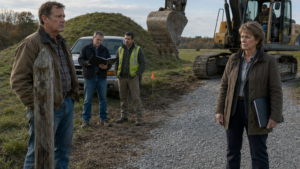
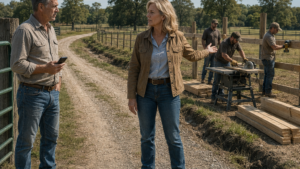
Patricia White stepped in front of the harvest truck before its headlights had gone dark.
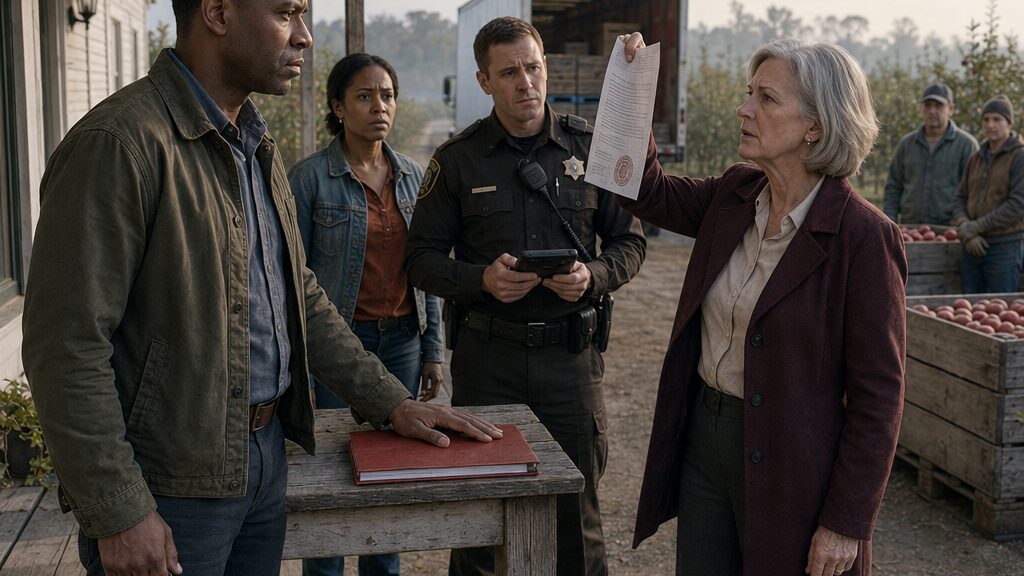
The driver braked hard enough to rock the stacked apple bins against their straps. Anthony Davis heard wood knock against wood, then the low hiss of the air brakes spreading through the dawn. Patricia stood in the center of the loading lane in polished boots unsuited for orchard mud, one hand raised and the other gripping a sheet of cream-colored paper.
Behind her waited a sheriff’s civil-process deputy.
Anthony came down from the farmhouse porch with his red harvest ledger tucked beneath his arm. Two seasonal workers had been guiding the first bins onto the truck. They stopped with their gloves hanging at their sides.
“What’s this?” Anthony asked.
Patricia held the paper toward him but did not release it.
“You have eight hours to remove yourselves and your personal property,” she said. “No more fruit leaves this land.”
Rachel stepped onto the porch behind Anthony. “Eight hours?”
Patricia lifted the document higher. A blue seal occupied the bottom corner, and a signature crossed a printed line beneath the name of a county judge.
“Emergency land-removal order,” Patricia said. “Signed yesterday.”
Anthony looked past her to the deputy. The man’s expression was guarded, neither agreeing nor contradicting her.
The truck engine idled. Its refrigeration unit throbbed behind the cab. By seven, those apples were supposed to be at the packing house. By eight, the sorting line would be full. Missing the slot would not merely delay them. It could cost the week’s contract.
Anthony opened the ledger on the truck’s hood and set one palm across the page containing the delivery tally. Patricia’s order flapped above it in the breeze.
“May I read it?” he asked.
“You may obey it.”
“Patricia.”
“You’ve ignored every other notice.”
Rachel came down the steps. “You sent complaints about grass height, a feed barrel, and a truck parked beside our own packing lane. None of those were removal notices.”
“They established a pattern.”
Anthony kept his voice level. “Let me see the order.”
The deputy cleared his throat. “Ma’am, he should be allowed to inspect a document affecting possession.”
Patricia’s jaw tightened. She passed it over.
Anthony knew little about court forms, but he knew numbers. For three years he had copied lease payments, delivery weights, payroll, fertilizer costs, and county reference codes into the red ledger because trusting his memory had once cost him an entire load of peaches.
The order listed a case number near the top. Beneath it was a filing code.
Anthony slid their lease from the ledger’s back pocket. The county reference on the lease began with AGR-LT. Patricia’s document used CLD-47.
“What does this code mean?” he asked the deputy.
“It identifies the filing division.”
“Which division?”
The deputy took the paper. Patricia’s fingers remained on one corner until he pulled it free.
He read the first page, then tapped at the terminal mounted in his palm. The glow from the screen sharpened the lines around his mouth.
Patricia looked toward the workers. “You two need to step away from those bins. Anyone removing property after service can be charged.”
One worker glanced at Anthony. “Boss?”
“Leave them strapped,” Anthony said.
The driver leaned from his window. “I can hold twenty minutes. After that I lose my route.”
“You will hold until the deputy confirms the order,” Rachel said.
Patricia gave a short laugh. “The county has confirmed it. That is what the seal means.”
The deputy entered the case number again. “I’m not locating an active matter under this number.”
Patricia answered too quickly. “The clerk said it might not upload until opening.”
“The courthouse opens at eight-thirty,” the deputy said. “Emergency orders still appear in the system.”
“It was processed late.”
Anthony studied the seal. The left edge was darker than the right, as if it had been pressed unevenly. Yet something about the blue looked flat. Printed rather than stamped.
“Read the filing code aloud,” he said.
Patricia stared at him. “This is not a spelling test.”
“I asked the deputy.”
The deputy looked at the line. “C-L-D, dash, forty-seven.”
Anthony turned his lease around. “Our lease filing is agricultural tenancy. AGR-LT. Why would an emergency agricultural removal come through a different division?”
“I don’t determine county abbreviations,” Patricia said.
“You seemed sure enough to bring law enforcement before sunrise.”
Her face reddened. “I brought him because you have made every simple instruction difficult.”
Rachel stepped close enough to read over Anthony’s shoulder. The order gave them until two that afternoon. It authorized removal of occupants, equipment, vehicles, livestock, and harvested goods. Harvested goods.
She looked toward the truck.
“This says she can take the apples,” Rachel said.
“They’re grown on my land,” Patricia replied.
“They’re ours under the crop clause.”
“Not after termination.”
The deputy raised a hand. “No one is taking or moving anything while I verify the order.”
Patricia turned on him. “You are here to enforce it.”
“I am here to serve valid process.”
The distinction hung in the cold air.
Anthony felt the first hard beat of fear beneath his ribs. The farmhouse was one thing. Their clothes, furniture, and photographs could be carried somewhere else if they had to. The orchard could not. Fruit did not wait for a hearing. Neither did buyers, weather, or payroll.
He closed the ledger.
“I’m not surrendering the truck keys,” he said.
Patricia’s eyes narrowed. “Then you’re interfering.”
“No. I am waiting for verification.”
“You always think calm makes you right.”
“No,” Anthony said. “It keeps me from doing something wrong while I find out.”
For a moment she looked less angry than insulted. Three years earlier, she had stood beside him in the same lane and shown him which apple rows held water after heavy rain. She had called him careful then.
Now she pointed at the two workers.
“If either of you loads another bin, I will report you for trespass.”
The workers stepped back.
The driver checked his watch. “Ten minutes.”
The deputy moved toward his vehicle to call the county dispatch office. Patricia followed, speaking low and urgently beside him.
Rachel took the order from Anthony and flattened it over the ledger. Her eyes moved from the seal to the code, then back again.
“What?” Anthony asked.
She did not answer immediately.
At the bottom of the page, beneath the judge’s printed name, was a smaller line of text: LAND RECORDS—FORM 18B. Next to it appeared a department code.
Rachel touched it with one finger.
“My mother used that code.”
Anthony looked at her.
“When she worked county records,” Rachel said. “Before they reorganized the office.”
“How long ago?”
“Eleven years.”
The truck’s refrigeration unit cycled off, leaving the loading lane suddenly quiet.
Rachel stared at the obsolete code printed beneath the crooked blue seal.
“This isn’t just the wrong division,” she said. “Somebody built this order from an old form.”
Chapter 2: The Seal Was Real, but the Filing Was Not
Barbara Moore held the order beneath the farmhouse kitchen light and said, “I recognize this for the wrong reason.”
Rachel stood across the table with both hands braced against its edge. Through the window, the harvest truck remained in the lane, its driver outside now, speaking into his phone. Patricia had moved her car across the gate. The deputy waited beside it while county dispatch tried to reach a filing clerk.
Barbara adjusted her glasses.
“This layout was retired when records and civil processing split offices,” she said. “Form 18B used to confirm a temporary land-access restriction. It was never an eviction form.”
Anthony placed the red ledger beside her. “Could the county have reused it?”
“Not with this code.”
She pointed to the number Rachel had recognized.
“That code belonged to my department. And this seal—”
“It looks real,” Rachel said.
“It is real. Or it started that way.” Barbara angled the page. “This image came from a scanned notice. See the gray edge around the county emblem? Someone copied the whole seal box.”
Anthony leaned closer. Once Barbara showed him, he saw the faint rectangle.
Rachel’s phone rang. The packing-house manager’s name appeared on the screen.
She answered.
“We are still loaded and waiting,” she said.
A pause.
“How long?”
Her face tightened.
Anthony knew the answer before she repeated it.
“Two hours before they release our slot.”
The packing house had already delayed another grower’s delivery for them. After that, the sorting line would be reassigned. Fruit left in the bins until afternoon would warm, soften, and lose grade.
“I’ll call back,” Rachel said.
Barbara lowered the order. “I still know people in the office.”
Anthony shook his head.
“I can ask one question,” she said. “That isn’t corruption.”
“I know. But Patricia already thinks we’re only protected because of who your family knows.”
“Patricia thinks whatever helps Patricia.”
“If you make the call, she’ll say the county bent for us.”
Rachel looked from her husband to her mother. “And if we lose the delivery while proving a point?”
Anthony’s hand closed around the back of a chair.
“It’s not a point,” he said. “We need a record nobody can call a favor.”
Barbara’s mouth drew into a thin line. “Then go to the records office and request written confirmation. Use the public counter. Ask for the case search to be stamped.”
Rachel gathered the order, lease, and ledger.
Outside, the deputy ended his call.
“Dispatch has no matching active order,” he told them. “I cannot enforce this document without confirmation from the court.”
Patricia stood beside her car, arms folded. “So you’re leaving them in possession?”
“I’m not removing anyone on an unverified paper.”
“I will call your supervisor.”
“You have that right.”
The deputy returned the order to Anthony rather than Patricia. That small movement changed her face.
Anthony looked toward the driver. “Can you take what’s already loaded?”
Patricia stepped between them. “Nothing leaves.”
The deputy faced her. “Without a valid order, their lease remains in effect unless you can show otherwise.”
“I can.”
She went to her car, removed a second envelope, and placed it on the hood.
“This is a breach complaint,” she said. “Filed properly.”
The words settled harder than her earlier shouting.
Anthony did not touch the envelope.
Rachel did.
Inside was a county intake receipt and a complaint alleging failure to maintain the main irrigation pump, deterioration of leased equipment, and unauthorized diversion of repair funds. Unlike the removal order, the receipt bore a current barcode.
Rachel read the allegation twice.
“Is this true?” she asked.
Anthony kept his eyes on Patricia. “The pump is running.”
“That is not what I asked.”
“We can deal with it after we confirm the order.”
Patricia’s expression sharpened. She had heard the gap between them.
The county records office occupied one wing of a low brick building beside the courthouse. Rachel and Anthony reached the public counter twenty-five minutes later with Barbara following at a distance she had chosen herself.
The filing clerk entered the case number from the false order.
“No result,” she said.
She searched by Anthony’s name, Rachel’s name, the property parcel, and Patricia’s name.
“There is no emergency possession case.”
“What about this seal?” Rachel asked.
The clerk studied it, then pulled an archived form onto her monitor. The old template appeared with the same blue emblem and identical faint shadow along its left side.
“That seal image is from the retired form library,” she said. “Public scans were available before the archive was restricted.”
She printed the search results, stamped the page, and signed the verification line.
Relief rose in Rachel so quickly it almost made her dizzy. The order was false. Patricia could not legally remove them that day. The truck could leave.
Then the clerk opened another screen.
“There is, however, a newly filed agricultural lease complaint.”
Anthony’s shoulders went still.
The clerk turned the monitor enough for them to see Patricia’s filing. The irrigation allegation was listed as pending review. No removal had been granted, but a mediation request had been accepted.
“So the fake order does not matter?” Rachel asked.
“It matters,” the clerk said. “I’m forwarding it for investigation. But it does not erase a separate lease dispute.”
Barbara spoke for the first time since entering the building.
“One wrong does not cancel another.”
Rachel wished her mother had said it more gently, though she knew Barbara rarely softened a sentence whose shape was already correct.
Anthony called the driver. The truck had left.
The manager had reassigned the slot.
They might be able to deliver late that afternoon, but only if another grower finished early.
Back at the farmhouse, Rachel opened the ledger to reconstruct the morning’s losses. She turned through pages of neat figures—rent paid early, payroll, fuel, crate repairs, pruning labor.
Near the back, several pages had been pressed so hard the pen marks showed through.
One entry had been erased and rewritten.
PUMP REPAIR DEPOSIT had become SEASONAL PAYROLL.
A folded invoice slipped from the binding and landed on the table.
The repair company’s red stamp read UNPAID.
Rachel looked toward the yard, where Anthony was speaking with the workers as if the morning’s crisis had already become another task to schedule.
The invoice was six weeks old.
Beneath the amount, the technician had written: Continued operation may result in total pump failure.
Chapter 3: The Debt Beneath the Red Ledger
Rachel laid the unpaid invoice beside Patricia’s false order.
Anthony entered the kitchen carrying dust on his boots and stopped before he reached the sink.
Neither paper required explanation.
“How long?” Rachel asked.
He removed his cap.
“Six weeks.”
“The technician said the pump could fail.”
“I read it.”
“And you changed the ledger entry.”
“I moved the money.”
“You erased what it was for.”
Anthony set his cap on the table. “Payroll came due.”
“So did the repair.”
“We had three workers who had already put in the hours.”
Rachel pointed toward the invoice. “You told me the noise was a loose housing.”
“It was, at first.”
“At first?”
“The bearing got worse.”
Her laugh held no humor. “Patricia hands us a forged order, and I find out she has a real complaint hidden underneath it.”
“She still forged the paper.”
“I know what she did. I am asking what you did.”
Anthony looked through the kitchen window. The workers were shifting bins into shade. Without the morning delivery, they had to protect the packed fruit until the packing house called.
He had imagined this conversation many times, always after the pump was fixed. In those versions, Rachel might be angry, but the problem would already be behind them. He would present the repair receipt, the balanced ledger, and the explanation together.
He had never imagined facing her with the orchard still thirsty.
“We came up short after the August market payment,” he said. “The packing house held part of the check for grade adjustments. I could repair the pump or cover wages.”
“You could have told me.”
“And then what?”
“We would have decided.”
“I knew what you would decide.”
Rachel’s eyes narrowed. “No. You knew what you wanted me to decide.”
Anthony sat, though nothing in him felt settled.
“The workers needed their money.”
“And the orchard needed water.”
“The pump was still moving enough.”
“You gambled that it would last.”
“I bought time.”
“You bought silence.”
The words landed because they were true.
A hard metallic knock came from the pump shed.
Anthony was on his feet before the second sound. He and Rachel crossed the yard at a run. One worker stood beside the shed with his hands raised away from the controls.
“It started shaking,” he said. “Then the pressure dropped.”
Anthony pulled the door open.
The pump filled the cramped shed with a grinding roar. The pressure needle trembled near zero. A burnt smell cut through the damp odor of soil and grease.
“Kill it,” Anthony said.
The worker threw the switch.
The motor shuddered to silence. Somewhere beneath the floor, water drained backward through the line.
Anthony crouched beside the housing. Heat radiated from the metal. When he touched the outer casing, he pulled his hand away.
Rachel stood in the doorway.
“How many rows still need it?” she asked.
“Fourteen.”
“And if we get no water?”
“The fruit won’t ruin today. But the young trees could stress before first frost.”
He removed the inspection cover. Metal dust glittered in the grease.
The bearing had not merely failed. It had broken apart.
The worker looked toward the orchard. “Can the repair company come?”
“They wanted a deposit before.”
“How much?”
Anthony named the amount.
The worker glanced away. It was more than the late delivery would earn after fees.
Rachel folded her arms. “The payroll you protected bought six weeks.”
“It bought six weeks for all of us.”
She stepped inside the shed. “Do you hear yourself? You keep saying protected as though nobody else is allowed to carry anything.”
“I wasn’t going to send people home unpaid.”
“I am not telling you that was wrong.”
“Then what are you telling me?”
“That you made me defend us this morning without telling me Patricia had something real.”
Anthony straightened.
“A maintenance breach does not justify an eight-hour eviction.”
“No. But I will not stand in a county room and pretend we did everything right because she did something worse.”
The worker moved toward the door. “I’ll check the bins.”
When they were alone, Anthony lowered his voice.
“You think I wanted this?”
“I think you wanted to solve it before I could see you failing.”
The orchard outside seemed suddenly too visible—the unfinished rows, the idle truck lane, the farmhouse that did not belong to them.
Anthony wiped grease onto a rag.
“My father lost our leased ground when I was sixteen,” he said. “One bad season. He told everybody it was handled until the owner came with a chain. My mother packed the kitchen while neighbors watched.”
Rachel’s expression changed, but not enough to release him.
“You promised me this place would be different,” she said.
“I meant it.”
“Then why did you do the same thing?”
He looked down at the grease on his hands.
Because he had mistaken silence for control. Because each week the pump survived had felt like proof that he had chosen correctly. Because Rachel had trusted him when they signed the lease, and he could not bear to hand that trust back damaged.
“The workers got paid,” he said.
Rachel’s face closed.
“That is the only part you are willing to admit.”
She left the shed.
By late afternoon, the packing house found them a reduced slot. The truck returned, but only half the bins could be accepted. The rest would wait until morning, if the fruit held grade.
Anthony spent the next two hours calling repair companies. One could come in three days. Another required full payment before dispatch. A farm-supply driver knew of a rebuilt motor, but the mounting plate would need modification.
At dusk, Rachel sat at the kitchen table with the ledger open.
Anthony placed the day’s reduced delivery receipt beside her.
She entered the figure without asking him for a pen. Her handwriting was smaller than his and more exact.
“I can list the repair as a payable,” he said.
“It already is.”
“I should have told you.”
“Yes.”
“I thought I could fix it before it became yours to worry about.”
“It was mine when you moved the money. It was mine when you erased the entry. It was mine when Patricia put our house in an envelope.”
Anthony sat across from her.
“What do you want me to do?”
“Stop asking that like I am another problem you need instructions for.”
Headlights swept across the kitchen wall.
A dark SUV turned into the lane and stopped near the porch. A man in a clean field jacket stepped out carrying a slim leather folder.
Patricia emerged from the passenger side.
She did not approach the door.
The man did.
“I’m Gregory Robinson,” he said when Anthony met him on the porch. “I represent the company holding an option on this property.”
Rachel came to stand beside Anthony.
Gregory opened the folder and removed a signed document. Unlike Patricia’s order, it carried no theatrical seal. It had dates, parcel numbers, lender references, and signatures on every required line.
“This is lawful,” Gregory said. “It is also time-sensitive.”
Anthony read the first page.
The option covered orchard access, packing rights, and eventual purchase. A lender deadline appeared near the bottom.
Five days.
“If the property is not vacant and transferable by then,” Gregory said, “the offer expires.”
Patricia stood by the SUV with her arms folded tightly against herself.
For the first time since dawn, she did not look powerful.
She looked afraid.
Chapter 4: Patricia’s Last Asset Was Already Mortgaged
The bank’s final warning was waiting on Patricia’s phone before she reached the orchard office.
She read it standing beside the dark window, the screen reflected over her face.
PAYMENT DEFAULT REMAINS UNCURED.
The message beneath it was plain. The lender would begin enforcement if the outstanding balance was not resolved by the end of the week. Gregory Robinson’s purchase option was the only transaction currently large enough to stop it.
Patricia locked the phone and placed it facedown.
Across the office, an old framed photograph showed her father beside the first row of mature apple trees. His hand rested on the shoulder of a much younger Patricia. Behind them stood a packing shed that had since collapsed beneath a winter storm.
Her father had called the orchard permanent.
The bank had never used that word.
Gregory entered without knocking. He set a paper cup on her desk and remained standing.
“You should have told me there was an active tenant dispute,” he said.
“You knew there were tenants.”
“I knew there was a lease ending next year. You said they had agreed to leave early.”
“They will.”
“That is not what I asked.”
Patricia looked at him. “They failed to maintain the pump.”
“I saw the complaint.”
“Then you understand.”
“I understand you may have grounds to pursue termination through mediation.”
His emphasis was deliberate.
Patricia’s hand tightened around the edge of the desk.
Gregory continued. “I also received a call from county counsel asking whether my company had any involvement in an emergency removal order.”
She said nothing.
“I had never heard of that order,” he said.
“It was an attempt to prevent loss.”
“It was not my attempt.”
“No one said it was.”
“You used my deadline to justify it.”
Patricia rose. “Your deadline is the reason any of this matters.”
“The lender’s deadline,” he corrected. “Our option only works if the property is legally transferable.”
“It will be.”
“Not if you keep creating new problems.”
His tone remained courteous, which made each sentence feel more final.
Patricia moved to the window. Beyond the office, Anthony and Rachel’s workers covered apple bins with canvas. The truck had returned once, then left half-empty. Anthony stood near the pump shed with grease across his sleeves.
Three years earlier, she had taught him how to judge fruit firmness by turning an apple at the stem instead of pulling. He had listened without interrupting. At the end of that first harvest, he had shown her his red ledger with every bin counted and every payment recorded.
She had told him the orchard needed someone who respected numbers.
Now those same numbers stood between her and the only offer that could save the land.
“The orchard was supposed to stay in my family,” she said.
Gregory glanced at the photograph.
“It may still.”
“No. Your company will remove half the trees and expand the packing lane.”
“We will keep the productive blocks.”
“You will keep what earns.”
“That is what makes the property financeable.”
Patricia turned from the window. “You say that as though finance is weather. Something nobody chooses.”
Gregory accepted the criticism without reacting.
“My company did not take the loans.”
Her face hardened.
The first loan had repaired storm damage. The second had covered medical bills during her husband’s final year. The third had refinanced both when interest rates rose. After he died, Patricia leased the farmhouse and orchard operation because she could no longer manage harvest labor alone.
Anthony’s rent had kept the lender patient.
His success had also made the place look easier to take from her.
Gregory opened his folder.
“Our option expires in five days,” he said. “I cannot extend it unless the orchard is legally vacant or the tenants sign a surrender agreement.”
“What if the county confirms the lease breach?”
“Then you proceed lawfully.”
“That could take months.”
“Yes.”
“The bank will not wait months.”
“No.”
He closed the folder.
“You seem very comfortable with that.”
“I am not comfortable. I am clear.”
Patricia looked again toward the pump shed. Anthony had removed the broken housing and placed it on a workbench. Rachel stood several feet away from him, writing something on a pad. They were together, but the distance between them was visible even from the office.
Patricia had not known about the hidden invoice until a farm-supply clerk mentioned Anthony asking for a rebuilt motor on credit. After that, she had checked the pump herself and photographed the corrosion around the housing.
The breach was genuine.
The order was not.
She had told herself the distinction mattered less because the outcome would eventually be the same. Anthony had failed a lease obligation. The county would terminate. The fabricated order merely moved the inevitable forward before Gregory’s deadline.
That reasoning had felt solid in the dark.
Under Gregory’s gaze, it sounded thin.
“You should leave,” she said.
“I will.”
He paused at the door.
“If the tenants challenge the option, we will suspend negotiations until the county resolves possession.”
“You told me the offer would prevent foreclosure.”
“It can. If you deliver what the agreement requires.”
He left the coffee untouched.
Patricia drove to a roadside café ten minutes from the orchard. She chose a booth facing the parking lot and called the bank loan officer.
The officer did not threaten her. That would have been easier.
He explained the balance, the missed cure date, and the next procedural step. His voice carried the practiced patience of someone describing a machine already in motion.
“If the Robinson option closes,” Patricia said, “everything is covered.”
“If it closes before enforcement begins.”
“And if the county delays possession?”
“I cannot advise you on the tenancy.”
“You know this orchard has been in my family for sixty-eight years.”
“I know.”
“Then give me another month.”
“I cannot.”
Patricia ended the call before her voice changed.
On the table, the sugar packets sat in a white ceramic holder. She arranged them into a straight line, then disturbed them with one finger.
Her father had once mortgaged a tractor rather than miss payroll. He had called that responsibility. Anthony had done nearly the same thing with the pump repair, but Patricia had called it breach.
The comparison angered her because it did not absolve him.
It also did not absolve her.
When she returned to her car, Gregory was leaning against his SUV in the bank parking lot. He had apparently come for a separate meeting.
“Did you follow me?” she asked.
“No.”
“You could extend the option if you wanted.”
“I would need approval.”
“Ask.”
“I already did.”
She waited.
“They refused,” he said. “Seasonal capital is committed. If we do not secure this orchard now, we move to another property.”
“So that is it.”
“That is the business reality.”
Patricia laughed once. “You call everything reality when it benefits you.”
“And you called a forged order an emergency when it benefited you.”
The words struck with more force because he did not raise his voice.
He opened his vehicle door.
“Do not involve my company in another unlawful action,” he said.
After he drove away, Patricia remained in the parking lot with the final default notice open on her phone.
There were lawful options. Mediation. A surrender payment. A temporary repair agreement. Each required time, money, or cooperation she no longer believed she possessed.
There was also the gate.
The lease gave Anthony access through the main entrance, but Patricia still held the original lock hardware in the equipment barn. If she secured the property before mediation, the county might order her to reopen it later. By then, Gregory’s inspection could be complete and Anthony’s harvest might be damaged enough to make continued operation impossible.
She knew exactly what that meant.
She called a locksmith.
“I need the orchard gate changed,” she said.
“When?”
Patricia looked toward the road leading back to the farm.
“Before sunrise,” she answered. “Before the county can tell me not to.”
Chapter 5: The Locks Changed While the Apples Waited
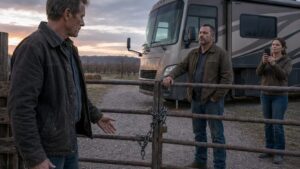
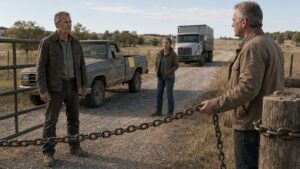
Anthony’s key entered the gate lock but would not turn.
He tried again, slower this time, as though patience could restore the shape of the metal. The key stopped halfway through the rotation.
Rachel watched him remove it.
A new brass cylinder gleamed inside the old iron gate.
Beyond the chain, stacked apple bins waited beneath canvas covers. The farmhouse stood less than a hundred yards away. Through the front window, the red ledger was visible on the kitchen table where they had left it the previous evening.
Patricia had locked them out of their home, their equipment, and the remaining harvest.
One worker arrived in a pickup and parked behind them. The second came minutes later. Neither asked what had happened. The new chain answered for itself.
Anthony gripped the gate and shook it once.
“Don’t,” Rachel said.
“I’m checking the hinge.”
“You’re checking how angry you are.”
He stepped back.
A paper had been wired to the gate. It stated that access was suspended because of unsafe equipment and pending lease enforcement. Unlike the fabricated removal order, it did not claim a judge’s authority. It carried only Patricia’s signature.
The first worker took bolt cutters from his truck bed.
“I can have that chain off in ten seconds.”
Anthony looked at the tool.
The orchard rows behind the gate held fruit already at picking maturity. A storm front was expected by late afternoon, with wind strong enough to strip the outer branches. If the apples hit the ground, the packing house would refuse them.
“Put it away,” Anthony said.
“She can’t lock you out.”
“That does not mean we cut our way in.”
“You got a lease.”
“And she wants a picture of me breaking her chain.”
The worker lowered the cutters but did not return them to the truck.
Rachel called Patricia.
The call went unanswered.
She tried again. On the third attempt, Patricia sent a message.
ACCESS SUSPENDED PENDING COUNTY REVIEW.
Rachel typed that self-help eviction was unlawful, then deleted the sentence. She called the sheriff’s office instead.
The dispatcher said a deputy could document the situation but could not decide possession without an active order. County agricultural mediation opened at eight-thirty.
It was not yet six.
Anthony walked along the fence line. The wire was too high to climb safely, and even if they crossed on foot, the tractors and bin trailers remained behind locked equipment doors. Every practical path led back to force.
The neighboring grower stopped his truck on the road and leaned across the passenger seat.
“Heard wind could hit forty miles an hour,” he said. “You need a hand?”
“We need a gate,” Rachel replied.
He looked at the chain. “Patricia do that?”
Anthony nodded.
The grower studied him, waiting to see whether Anthony would ask for bolt cutters, a tractor, or a witness. Anthony asked only whether the packing house had changed its storm intake schedule.
“They’ll close outside receiving at noon,” the grower said.
That gave them six hours.
The sheriff’s deputy arrived and photographed the gate, lock, posted paper, and Anthony’s key. He made no attempt to open anything.
“Can you tell her this is illegal?” Rachel asked.
“I can tell her the dispute has been documented.”
“That is not the same thing.”
“No, ma’am.”
Anthony looked through the fence at the ledger on the table.
“All our payment records are inside.”
Rachel said nothing.
The deputy followed Anthony’s gaze. “Do you have copies?”
Anthony had photographed some lease pages. Rachel kept bank statements. But the original ledger contained the complete operating history, including the unpaid invoice and the altered entry.
“No,” Anthony said.
Rachel turned toward him. “I do.”
He stared at her.
She removed her phone from her jacket pocket and opened a folder of images. Page after page of the red ledger appeared on the screen: rent payments, delivery totals, payroll, fuel, repair estimates, even the erased pump entry visible beneath Anthony’s rewritten line.
“I photographed every page after I found the invoice,” she said.
“When?”
“While you were talking to Gregory.”
“You thought I might change something.”
“I thought we might lose access to it.”
Anthony looked back at the locked farmhouse.
She had prepared for the danger he refused to imagine.
The storm alert sounded on all four phones at once.
The worker read the notification. “Wind advisory moved up. Gusts starting by ten.”
The second worker kicked dirt from his boot. “We can hand-pick the outside rows if we get in now.”
The first raised the bolt cutters again.
Anthony saw the choice as Patricia had intended it: preserve the crop by crossing the line, or preserve legal credibility while fruit fell.
He took the cutters from the worker.
Rachel held her breath.
Anthony folded the handles together and placed the tool in the pickup bed.
“We wait for the county,” he said.
“Those apples won’t,” the worker replied.
“I know.”
The worker’s frustration showed plainly. “Then what are we protecting?”
Anthony looked at Rachel.
Not the appearance of being right. Not his pride. Not even the lease by itself.
“We are protecting the chance to be believed when all of this is put in one room,” he said.
At eight-thirty, Rachel called county agricultural mediation. She sent the false order verification, the lease, photographs of the changed lock, the weather warning, and images from the ledger.
The intake clerk transferred her twice.
A third person asked whether harvested goods were at immediate risk.
“Yes,” Rachel said. “And unharvested fruit.”
“How much?”
She looked at Anthony.
“Fourteen rows,” he said. “About twenty-seven full bins if the wind holds.”
Rachel repeated it.
While they waited, a farm-supply driver arrived with the rebuilt motor Anthony had asked about. He parked outside the locked gate and looked from the motor to the chain.
“I can’t install through a fence,” he said.
“Can you hold it?” Anthony asked.
“Until tomorrow. After that another farm has first claim.”
Anthony nodded.
The driver lowered his voice. “Deposit is still required.”
“I understand.”
Rachel heard it. She did not ask whether Anthony had the money. His silence answered.
At nine-fifteen, the wind began moving the upper branches. Apples dropped one at a time at first, each landing with a muted thud in the grass.
The workers watched from the roadside.
Rachel’s phone rang.
“This is Susan Rivera with county agricultural mediation,” a woman said. “I have reviewed the emergency submission.”
Rachel put the call on speaker.
“I need both parties available this afternoon,” Susan continued. “The document issue is being referred separately. My concern is immediate possession, crop preservation, and the active lease complaint.”
“What time?” Anthony asked.
“Two o’clock.”
“The receiving line closes at noon.”
“I understand.”
“No,” the first worker muttered. “She doesn’t.”
Susan heard him.
“I cannot order access over the phone,” she said. “But I can issue notice that any change to the property after this call may be considered in the hearing.”
Rachel looked at the new chain.
“Patricia already changed it.”
“That will be addressed.”
“What do we bring?” Anthony asked.
“The lease. Payment records. Repair records. Harvest contracts. Any communication about access.”
Rachel glanced at the photographs on her phone.
Susan’s next words came carefully.
“And come prepared to discuss the irrigation maintenance allegation. The false order does not decide whether the lease was breached.”
Anthony watched another apple fall.
Rachel ended the call and turned toward him.
“You have until two,” she said.
“To do what?”
“To decide whether you are going into that room to win against Patricia or to tell the truth.”
He looked at the trapped ledger, the waiting motor, and the fruit striking the ground beyond the gate.
For the first time, he understood that saving the lease might require him to place his own mistake beside Patricia’s and leave both exposed.
Chapter 6: The Hearing Could Not Protect a Half-Truth
Susan Rivera placed Patricia’s false order on the left side of the table and the agricultural lease on the right.
“These are separate matters,” she said. “The first has been referred for investigation. The second remains active today.”
The mediation room held no judge’s bench and no audience waiting for a dramatic reversal. There was a rectangular table, a county clock, two pitchers of water, and a window overlooking the courthouse parking lot.
Anthony sat beside Rachel. Patricia sat opposite them with Gregory at the far end, present only because his company’s option affected the timetable.
Barbara occupied a chair against the wall.
Susan looked at her. “Mrs. Moore, you are here as a family support person?”
“Yes.”
“You will not participate unless asked.”
Barbara nodded once.
Patricia noticed the exchange. “She worked for the county.”
“For land records,” Susan said. “She has no role in my decision.”
“She made the calls that got us here.”
Barbara’s mouth tightened, but Anthony answered first.
“She did not.”
Patricia looked at him.
“She offered,” Anthony said. “I refused.”
“Why?”
“Because I wanted the filing checked through the public counter.”
Susan made a note.
Patricia gave a faint, disbelieving shake of her head. “You expect me to believe that?”
“I have the stamped search request.”
Rachel placed it on the table.
Susan reviewed the page.
“The county confirms no emergency removal order existed,” she said. “The seal image was copied from an archived form. Ms. White, did you create or direct the creation of this document?”
Patricia folded her hands. “I was trying to prevent further loss to my property.”
“That does not answer the question.”
“My attorney has advised me not to discuss the document.”
Susan’s expression did not change.
“Then we will proceed with possession and crop access. Your refusal will be noted only as a refusal.”
Patricia shifted in her chair.
Anthony had imagined this moment since the porch confrontation. He had imagined the false order lifted, exposed, and made powerless. He had imagined Patricia losing the certainty in her voice.
None of it reopened the gate.
Susan turned to him.
“Mr. Davis, you allege an unlawful lockout.”
“Yes.”
“Ms. White claims access was suspended because the irrigation system was unsafe and because you materially breached the maintenance clause.”
“The gate controls the farmhouse, equipment, and harvest. Not just the pump.”
“I understand. Did you receive notice before the lock was changed?”
“No.”
“Did you damage or attempt to remove the lock?”
“No.”
Patricia leaned forward. “His workers brought bolt cutters.”
“They remained in the truck,” Anthony said.
Susan looked to Rachel.
“I have photographs with timestamps,” Rachel said. “The chain remained intact.”
She passed her phone across the table.
The images showed Anthony’s key, the new lock, the posted notice, and the bolt cutters lying unused in the pickup bed.
Susan studied them.
“That supports restraint,” she said. “It does not resolve the maintenance allegation.”
Patricia opened a folder.
“I have the invoice.”
Anthony felt Rachel’s hand become still beside him.
Patricia slid the unpaid pump invoice into the center of the table. The technician’s warning was underlined in yellow.
“Six weeks ago,” Patricia said, “Mr. Davis was told continued operation could cause complete failure. He did not pay the repair deposit. He continued running the equipment until it broke.”
Susan read the document.
“Mr. Davis?”
Anthony could have begun with payroll. He could have explained the delayed packing-house payment, the workers’ families, the reduced market check, and the belief that the pump could survive.
Each explanation was true.
Together, they could still become a shield.
“I breached the maintenance requirement,” he said.
Patricia’s eyes lifted sharply.
Rachel turned toward him.
Susan set down the invoice. “You acknowledge that?”
“Yes. I knew the repair was needed. I moved the deposit money to payroll and did not notify Patricia in writing.”
Patricia sat back as though he had removed a weapon from her hand by accepting its edge himself.
“You also concealed it from your wife,” she said.
Anthony looked at Rachel.
“Yes.”
The room held silent for a moment.
Susan asked, “Why was payroll prioritized?”
“Three workers had completed the hours. The packing house withheld part of our August payment after grading adjustments. I believed the pump would last until the next delivery cleared.”
“Was that belief based on a second inspection?”
“No.”
“Then it was a risk you chose.”
“Yes.”
Susan’s tone remained neutral, but Anthony felt each answer strip away the cleaner version of himself he had wanted to carry into the room.
Patricia tapped the invoice.
“Then the lease is terminated.”
“No,” Susan said. “A breach is not self-executing termination. The lease requires notice and an opportunity to cure unless the equipment presents immediate danger. You did not follow that process.”
“The pump could have caused further damage.”
“Then you could restrict access to the pump shed, not the residence, harvest, and all equipment.”
Patricia’s face tightened.
Susan turned to Rachel. “You submitted ledger photographs?”
Rachel connected her phone to the room’s display. The red pages appeared on the wall.
At first they showed what Anthony wanted anyone to see: early rent payments, consistent payroll, delivery weights, careful expense totals. Then Rachel advanced to the altered line.
The erased words remained faintly visible beneath SEASONAL PAYROLL.
Anthony felt Barbara watching from behind him.
Rachel did not protect him from the image.
“The ledger records every operating payment,” she said. “It also shows where we failed to separate emergency maintenance funds from payroll.”
“Do you dispute the alteration?” Susan asked Anthony.
“No.”
“Why preserve that page?”
Rachel answered. “Because hiding it would make the rest of the ledger worthless.”
Anthony looked at her.
That was the truth he had avoided. A record mattered only if it contained what harmed the person keeping it.
Susan reviewed the remaining pages. Rachel showed the late packing-house payment, the payroll disbursements, the repair estimate, the current balance, and the projected revenue from fruit still in the orchard.
“How much can you pay toward immediate repair?” Susan asked.
Rachel named an amount.
It was less than half the required deposit.
Patricia gave a short breath of disbelief. “They cannot cure.”
“We can if the packing house accepts the remaining crop,” Anthony said.
“And if it does not?”
“Then we need a structured payment.”
“With whose money?”
Anthony did not answer immediately.
He had spent the morning building numbers with Rachel. They had three possible sources: the reduced delivery payment, a holdback from the next payroll period with worker consent, and a farm-supply installment agreement secured by the existing equipment.
None was comfortable. Together, they were possible.
He placed a one-page proposal before Susan.
“We request immediate access through harvest,” he said. “The rebuilt motor can be installed tomorrow if we pay forty percent. We can pay that amount after the packing house receives the remaining fruit.”
“The receiving line closed,” Patricia said.
“For today,” Rachel replied. “They will reopen after the storm if quality holds.”
Anthony continued. “We will put all orchard revenue into a controlled account until the repair is paid. Rachel will maintain the ledger and send weekly copies to Patricia and the county. No transfers without both our signatures.”
Rachel looked at him. They had discussed shared approval, but not the county copies. That part was his addition.
Susan asked, “And if the harvest revenue is insufficient?”
Anthony took a breath.
“Then I surrender the lease at the end of the protected season without contesting the maintenance breach.”
Patricia studied him.
“That gives you months on my land.”
“One season,” Anthony said. “Enough to repair what I damaged, finish the crop, and leave the orchard worth more than it is behind a locked gate.”
Gregory spoke for the first time.
“He is correct about productive value. If the fruit is lost and the young rows remain without water, our valuation changes.”
Patricia turned on him. “You said you would not interfere.”
“I am stating the commercial effect.”
“You could extend the option.”
“I cannot extend the current terms.”
Susan asked him, “Would your company maintain interest after a protected operating season?”
“Possibly. Subject to inspection, lender position, and crop performance.”
Patricia looked from Gregory to Anthony.
“You arranged this.”
“No,” Gregory said. “I learned about the proposed terms when he placed the page on the table.”
Susan lifted Patricia’s posted gate notice.
“Ms. White, you changed the lock after filing for mediation and before receiving a possession determination.”
“I was protecting the property.”
“You prevented repair access and increased the likelihood of crop loss. That action weakens your claim that immediate exclusion was necessary to prevent damage.”
Patricia’s hands separated.
“You are asking me to trust a man who altered his own ledger.”
“No,” Susan said. “I am asking whether you will accept a supervised agreement designed because neither side’s unsupported assurances are sufficient.”
The sentence settled over the room.
Anthony had expected Patricia’s misconduct to make him trustworthy by comparison. Instead, Susan had reduced both of them to what could be verified, repaired, and enforced.
It felt less satisfying than victory.
It felt more durable.
Susan outlined temporary terms: immediate restoration of access; no removal or sale activity during the protected harvest period; installation of the rebuilt pump under documented supervision; weekly ledger disclosure; controlled payment toward repairs; preservation of Patricia’s right to pursue lawful termination afterward; continued referral of the false order for investigation.
Patricia stared at the crooked seal.
“My father planted those trees,” she said.
Anthony did not answer.
“He borrowed against the land to keep it alive,” she continued. “Then my husband borrowed against it again. Every person says one more season. One more loan. One more chance.”
Her voice remained controlled, but the anger had worn away enough to show what had been beneath it.
“I am the one who gets left holding what is owed.”
Anthony looked at the red ledger projected on the wall.
“I know what it is to think keeping the debt hidden is the same as carrying it,” he said.
Rachel watched him carefully.
“It isn’t,” he added. “It only means everybody else finds out after their choices are gone.”
Patricia met his eyes.
For the first time, neither of them had a false paper, a clean ledger, or a family connection to hide behind.
Susan slid the temporary agreement toward Patricia.
“You have two options,” she said. “Accept one protected harvest season under supervised terms, or continue contesting possession while the crop deteriorates, the access dispute expands, and the property’s productive value falls.”
Patricia looked toward Gregory.
He did not rescue her.
She looked toward Barbara.
Barbara remained silent.
Finally, Patricia returned her attention to Anthony.
The choice before her would preserve the orchard but cost her control. Refusing might preserve her pride long enough to lose the sale, the crop, and perhaps the land itself.
Susan placed a pen beside the agreement.
“Which loss can you live with?” she asked.
Chapter 7: One More Season Under Honest Terms
Patricia returned the farmhouse keys inside a clear county evidence bag.
Susan Rivera stood beside her at the orchard gate while a deputy removed the new brass lock. The chain fell against the iron post with a hard metallic crack, and for a moment no one moved.
Anthony had imagined taking the keys from Patricia’s hand.
Instead, Susan opened the bag, recorded the transfer on a form, and passed them to Rachel.
“The temporary possession agreement is effective now,” she said. “Access remains protected through the close of the operating season, provided all terms are met.”
Rachel closed her fingers around the keys.
Patricia watched the gesture without speaking.
The agreement had taken another hour after Susan placed the pen beside her. Patricia had demanded limits, inspection rights, and proof that orchard revenue could not disappear into another unrecorded expense. Rachel had accepted each demand that could be measured. Anthony had accepted the provisions that would once have felt like an insult.
Weekly statements.
Two signatures on every transfer.
Photographs of the pump installation.
County notice before any nonroutine expense.
Patricia had signed only after Gregory confirmed in writing that his company would suspend, rather than permanently withdraw, its interest until the protected season ended.
No one had won enough to celebrate.
The workers entered first. They started the tractors while Anthony and the farm-supply driver moved the rebuilt motor through the gate. Rachel hurried to the farmhouse and found the red ledger exactly where they had left it.
The false order was gone. The county had retained it.
A pale rectangle remained on the table where the paper had covered the wood.
Rachel opened the ledger, checked that no pages were missing, then carried it to the pump shed.
Anthony had already removed the ruined motor. The replacement rested on blocks beside him.
“The mounting plate is wrong,” the driver said.
Anthony crouched to examine it. “By how much?”
“Half an inch.”
Under ordinary circumstances, that might have cost them another day. The wind had weakened after dropping enough fruit to fill the grass beneath the outer rows, but the packing house had announced a morning receiving window. If the pump was not operating before dark, the young trees would enter another cold night without sufficient water.
The neighboring grower brought a steel plate from his own equipment shed. One worker measured. The other drilled new holes.
Anthony started to reach for the tape measure, then stopped.
“What do you have?” he asked the worker.
The man called out the spacing.
Anthony checked it once and let him continue.
Rachel noticed.
She placed the ledger on the workbench and opened a new column beside the repair entries.
“Rebuilt motor deposit,” she said. “Forty percent paid from today’s accepted fruit.”
Anthony wiped his hands.
“How much remains after fuel?”
She told him.
It was lower than he had hoped.
He did not ask her to close the book.
“Put it all down,” he said.
“I intended to.”
“I know.”
By late afternoon, the motor was mounted. The workers returned to the orchard while Anthony aligned the coupling. Rachel managed the harvest list from the packing lane, marking damaged bins separately from fruit that might still grade high enough for market.
The first truck left just before sunset.
It carried less than a full load, but it carried enough.
Two days later, Gregory sent notice that his company’s current purchase option had expired. The letter also stated that the company might submit a revised offer after the season, depending on the orchard’s condition and the lender’s willingness to delay enforcement.
Patricia read the notice in the county office with Anthony and Rachel seated across from her.
“So the sale is gone,” she said.
“Suspended,” Susan corrected.
“That is a careful word for gone.”
Susan folded her hands. “The protected agreement was never a guarantee that the buyer would wait.”
Patricia looked at Anthony. “And if they come back with less?”
“I cannot answer for them.”
“But you benefit from the delay.”
“I benefit from finishing the season.”
She gave him a tired look. “You always know how to make your interest sound like duty.”
Anthony could have answered sharply. A week earlier, he would have defended every decision until the sentence became an argument.
Instead, he said, “Sometimes I cannot tell the difference soon enough.”
Rachel looked at him.
Patricia looked away first.
The false-order investigation continued outside the mediation process. Susan made that boundary clear whenever Patricia attempted to bargain around it. The protected season did not erase the forged document, and cooperation did not guarantee leniency.
Patricia stopped asking what the county intended to do.
She began arriving once a week to inspect the orchard with Susan’s authorization. At first, she photographed every repair and checked every entry Rachel provided. She questioned fuel receipts, replacement fittings, and the amount paid to the workers.
Rachel answered without apology.
Anthony remained nearby but did not take the ledger from her.
During the third inspection, Patricia stood at the edge of the youngest block while water darkened the soil around the roots.
“The pressure is steadier than before,” she said.
“The rebuilt motor draws less current,” Anthony replied.
“You should have replaced it in August.”
“Yes.”
The answer seemed to unsettle her more than an excuse would have.
They walked toward the farmhouse. Rachel had gone ahead to retrieve the week’s statement, leaving Anthony and Patricia alone beside the loading lane where she had once blocked the truck.
Patricia stopped near the porch.
“I expected you to call Barbara that first morning,” she said.
Anthony looked at her.
“I thought she would make one call, and every county door would open for you.”
“She offered to help us find the right office.”
“That is not what I mean.”
“I know.”
Patricia studied the lane. The tire marks from the delayed harvest had faded into the dirt.
“I expected you to use her name against me,” she said. “The way I used the county’s.”
Anthony rested one hand on the porch rail.
“I wanted to.”
She turned.
“For about ten minutes,” he continued. “Maybe longer. I wanted somebody important to say you had no right, so I would not have to explain anything else.”
“The pump.”
“The pump. The money. Rachel not knowing.”
Patricia’s mouth tightened. “You still refused.”
“That was the only part I got right alone.”
Rachel emerged carrying the ledger.
She heard the last sentence but did not ask what had come before it.
Patricia signed the inspection page. Her hand hesitated over the line, then completed the signature.
“I do not forgive what happened to the pump,” she said.
Anthony nodded.
“And I do not expect you to forgive the order.”
“No.”
There was no reconciliation in the answer. Only a boundary neither of them tried to disguise.
At first frost, the final marketable bins left the orchard before dawn.
The damaged fruit had reduced the season’s profit, but the controlled account covered the rebuilt motor, the overdue service bill, and the first portion of the remaining maintenance costs. The workers received every dollar owed to them, though two payments came later than usual and only after Rachel discussed the schedule with them directly.
Anthony had wanted to handle that conversation himself.
Rachel told him they would do it together.
They stood side by side in the packing shed and explained the numbers without promising what the account could not support. The workers accepted the delay because they were given a choice before the deadline passed, not an excuse afterward.
That difference stayed with Anthony.
The county approved the final weekly report in early November. Susan reminded them that their protection lasted only through the agreed season. Patricia could pursue lawful termination after that, negotiate a new lease, or revive a sale if the lender and buyer returned.
The future of the land remained outside their control.
Their conduct on it no longer did.
On the last cold afternoon before the irrigation lines were drained for winter, Rachel carried the ledger into the pump shed. Anthony stood beside the rebuilt motor with one hand on the switch.
“You ready?” he asked.
She listened to the pipes.
“Go.”
He turned the switch.
The motor caught at once. Its hum was lower than the old machine’s, even and controlled. The pressure needle climbed, trembled briefly, then settled.
Outside, water moved through the orchard lines.
Rachel opened the ledger on the workbench. The pages near the middle remained scarred by erasures and rewritten numbers. She did not remove them. She did not cover them.
She turned to a clean page.
At the top, she wrote NEXT SEASON.
Anthony watched the words appear.
She drew two signature lines beneath the opening balance.
One for her.
One for him.
Anthony took the pen only after she finished.
The repaired pump continued running as he signed beside her.
The story has ended.