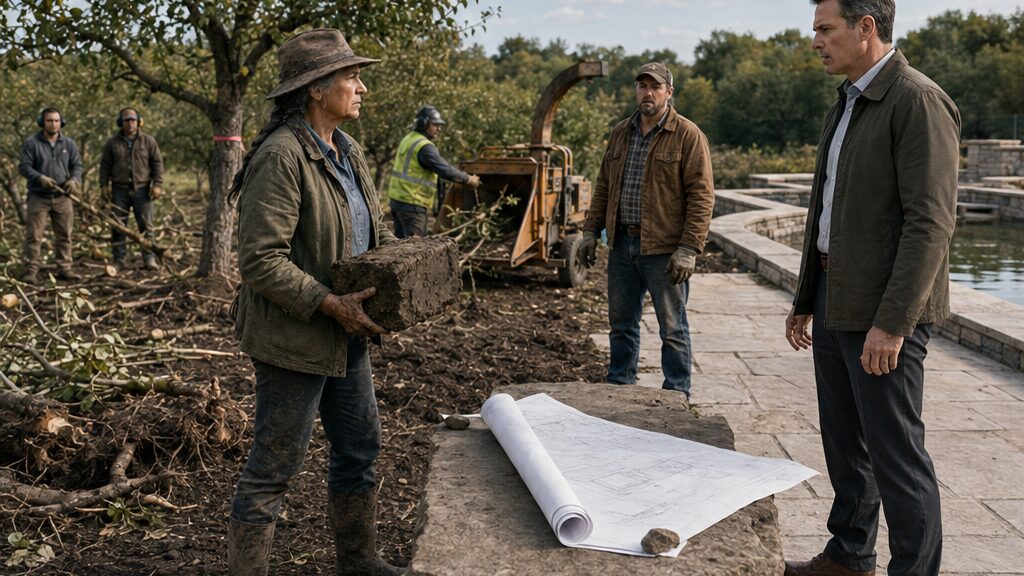
He Cut Down Her Orchard for a Better View, Then Learned Why She Had Kept the Old Boundary Stones
Chapter 1: The Trees Were Falling Before Carolyn Reached the Fence
The pear tree was already leaning when Carolyn heard the second crack.
She dropped the pruning shears beside the irrigation valve and ran between the rows, one hand holding her hat against her head. Branches whipped her sleeves. The ground dipped near the western edge, and for three steps she lost sight of the machinery beyond the windbreak.
Then the trunk came down.
It struck the earth with a weight she felt through her boots. Pears burst beneath the limbs. Dust lifted in a pale sheet, and beyond it a yellow chipper screamed as men dragged cut branches toward its mouth.
Carolyn stopped at the broken fence.
Six trees were already down.
For a moment she could not make sense of the open space where the old row had stood. Those trees had been planted before Jessica was born. One still carried a scar from the freeze of 1989, a black seam that had closed slowly over twenty years. Now its trunk lay in sections beside a stack of limestone pavers.
Matthew Johnson stood near the chipper in a reflective vest, shouting directions over the engine. Two workers fed in a limb thick as a man’s thigh. Behind them, a shallow basin had been dug for Nicholas Wilson’s koi pond. New palm trees waited in burlap-wrapped root balls, lined up like expensive cargo.
Carolyn climbed through the broken fence.
“Stop that machine.”
Matthew saw her but did not answer. His eyes moved toward Nicholas.
Nicholas stood on the unfinished terrace in a salmon-colored polo, holding a rolled site plan. He had bought the neighboring estate eight months earlier and spent most of that time replacing whatever had been there before. The brick walk became stone. The pasture became lawn. The old toolshed disappeared behind imported shrubs.
Now he raised one hand as if calming a nervous animal.
“Carolyn, take a breath.”
She crossed the dirt between them. “Who told you to cut my trees?”
Nicholas looked toward the fallen row. “Those trees were half dead.”
“They were producing.”
“They were blocking the western view from the house.”
The chipper pulled another branch inward. Leaves shook violently before vanishing into the steel throat.
Carolyn stepped close enough to smell Nicholas’s sharp cologne beneath the dust. “You cut them for a view?”
“We’re improving the entire strip. Drainage, landscaping, retaining wall. You’ll benefit too.”
She grabbed the front of his shirt.
The fabric tightened beneath her fist. Nicholas’s surprise lasted only a second, but it was enough to silence Matthew and the nearest workers. Even the man holding the next branch let it fall.
Carolyn saw herself reflected in Nicholas’s sunglasses: small, dust-covered, one hand twisted in a rich man’s shirt while men watched.
She released him.
Nicholas smoothed the fabric. “That was a mistake.”
“Yes,” she said. “One of several.”
Matthew moved toward the machine controls, but not to shut it down. He gestured for the worker to pick up the branch again.
Carolyn walked past him and struck the red emergency bar.
The chipper’s roar collapsed into a grinding silence.
No one moved.
Nicholas removed his sunglasses. “My attorney reviewed the boundary.”
“Your attorney didn’t survey it.”
“The fence line is obvious.”
“That fence is younger than my daughter.”
He gave a thin smile. “Then perhaps your family should have maintained its records better.”
The words landed harder than she expected. Not because they were true, but because part of them might be.
Carolyn looked beyond the terrace stakes toward the old drainage swale. Her father had taught her to find the property edge without a fence. Start at the north culvert, walk forty-seven paces south, then look for the flat-faced stones set low in the soil. She had not searched for them in years. There had been no need.
Until now.
Matthew unfolded a clean white site plan across a stack of pavers. “The line’s here,” he said, pointing with a carpenter’s pencil. “Everything west of this marker is Wilson property.”
Carolyn followed his pencil to a red dashed line. It cut along the remaining orchard row, leaving the removed trees on Nicholas’s side.
“Who marked that?”
“The landscape architect.”
“That isn’t an answer.”
“It’s the plan we were given.”
A worker shifted his weight near an uprooted stump. Something dark and rounded showed beneath a mat of torn roots.
Carolyn crossed to it and crouched.
Her knees protested. She ignored them and pulled away loose soil. The object was not part of the root crown. It was dense, gray-brown, and flat along one face. She worked her fingers beneath it and lifted.
The stone was heavier than she remembered.
Mud filled the shallow chisel mark across its top.
Nicholas watched her carry it back.
“What is that supposed to prove?”
Carolyn placed the stone directly on Matthew’s site plan. Dirt smeared the drawing of the patio extension.
“It proves somebody drew your line without looking at the ground.”
Matthew stared at the mark. “Could be fieldstone.”
“No.”
“You can’t know that from one rock.”
“I watched my father reset it after the flood of ’ seventy-eight.”
Nicholas folded his arms. “So this is based on memory.”
“It’s based on a marker.”
“It’s based on a story you were told forty years ago.”
Carolyn looked toward the cut stumps. Anger rose again, cleaner this time.
“You will not touch another tree.”
Nicholas stepped off the terrace. “I have a crew on contract, equipment rented by the day, and a project schedule tied to inspections. You don’t get to shut all that down because you found a rock.”
“No,” Carolyn said. “I get to shut it down because you crossed my fence and cut living trees before you knew whose ground held their roots.”
He came close enough that his voice no longer needed to carry.
“My lawyer deals with disputes like this every week.”
“Good. He won’t be surprised when I call one.”
Nicholas glanced at Matthew. “Finish clearing what’s already marked.”
Matthew hesitated.
Carolyn stood between him and the remaining pear tree, an old Bartlett with a strip of blue survey ribbon her husband had tied around it years ago to mark a grafting experiment. The ribbon had faded almost white.
“You start that machine,” she said, “and I call the sheriff before the blade turns.”
Nicholas’s face tightened. “You think this county will stop a permitted improvement because you’re upset?”
“I think they’ll stop cutting until someone can tell them which parcel they’re standing on.”
Matthew took off his work gloves. “We should pause.”
Nicholas turned on him. “You said the line was cleared.”
“I said the plan showed it cleared.”
“You’re the contractor.”
“And you’re the owner who provided the boundary.”
The workers looked away. The shift was small, but Carolyn felt it. Nicholas had expected her to be the only uncertain person there. Now uncertainty had entered his own crew.
He picked up the dirty site plan and shook it once, dislodging soil.
“You’ll hear from my attorney.”
Carolyn lifted the boundary stone before he could roll the paper closed.
“You’ll hear from a surveyor first.”
The crew shut down the excavator. Matthew told the workers to secure the site. Nicholas walked toward his house without looking back, his clean shoes darkened at the edges by orchard mud.
Carolyn remained beside the saved pear tree until the trucks began to leave.
Only then did she inspect the damage.
Seven stumps. Six fully removed trees and one split low enough that it might not survive. The fence cut in two places. Topsoil pushed toward the swale. A trench for electrical conduit crossed where the old stones should have run.
She carried the first stone along the disturbed edge, counting her father’s paces beneath her breath.
At forty-three, she saw fresh concrete forms for the koi pond wall.
At forty-seven, she knelt.
The soil beside the form had been scraped down nearly a foot. A squared gray surface showed beneath the wet clay, directly under the place where Nicholas’s workers intended to pour the foundation.
Carolyn brushed it clean.
A second chisel mark appeared.
The pond wall was not merely near the old boundary.
It sat on top of it.
Chapter 2: The County Map Did Not Match the New Fence
The county recorder placed the envelope on the counter as though it might crumble beneath her hand.
“Rivera parcel, west agricultural tract,” she said. “Original filing and later attachments.”
Carolyn stared at her father’s parcel number, typed on a yellowed label. She had come directly from the orchard without changing clothes. Dirt from the boundary stones had dried in the lines of her palms.
The recorder untied the cotton tape.
Inside were a deed, two folded plats, tax maps, and several pages of correspondence. The oldest plat opened with a dry whisper. Its ink had faded from black to brown.
Carolyn leaned over it.
The orchard road was narrower. The neighboring estate was listed under a family name she had not heard in decades. Along the western edge of the Rivera parcel, three small squares marked the boundary before the line angled toward the north culvert.
Stones.
She touched the first symbol lightly.
“Can I get certified copies?”
“Of the recorded pages, yes. Field notes may take longer.”
“Why?”
“They were indexed separately when the county transferred archives.”
Carolyn looked closer. The measurements between the stones were written in chains and links, with one corner reference tied to an oak that no longer existed. The boundary line favored her memory, but not cleanly enough to carry into court without interpretation.
The recorder unfolded a later sheet.
“This fence notation was added in 1996.”
Carolyn followed the pencil line. The present wire fence drifted east of the recorded parcel edge, narrowing the orchard by several feet along most of the disputed strip.
“Who requested the change?”
“It isn’t a boundary change. Just an improvement notation.”
“So the fence was never accepted as the property line?”
“Not according to this file.”
A small relief moved through Carolyn, but the recorder had already turned another page.
A handwritten sentence ran along the margin beside the drainage swale.
Shared maintenance access permitted along western drainage lane.
Carolyn read it twice.
The handwriting was not her father’s. The initials beside it might have belonged to the former neighboring owner or a county field technician. The date was smudged.
“Is that an easement?”
The recorder adjusted her glasses. “I can’t interpret it legally.”
“Is there a separate easement recorded?”
“Nothing under this parcel index. But older agreements were sometimes attached to deeds without being separately indexed.”
Carolyn knew that. Her father had trusted handshakes and paper kept in kitchen drawers. He believed records mattered, but he also believed neighbors remembered what they had promised.
Neighbors died. Houses sold. Memory did not transfer with title.
The recorder made the certified copies while Carolyn sketched the stone symbols onto the back of a farm-supply receipt. Three squares, a line, the swale, the old culvert.
When she left the courthouse, Nicholas’s attorney had already called twice.
She did not return the calls.
At home, the orchard kitchen smelled faintly of coffee and overripe pears. Carolyn spread the copies across the table and set the recovered boundary stone on the floor beside her chair. Its weight against the boards felt reassuring.
She filled her plain white mug and dialed Patrick Clark.
He answered on the fourth ring.
“I heard about the trees,” he said.
“News travels.”
“Equipment travels louder.”
“I need a boundary survey.”
Patrick was quiet. He had worked county field crews before opening his own practice. He had known her father, though not well enough to be sentimental about him.
“How fast?”
“Before someone pours a pond wall over a marker.”
“That fast costs more.”
“How much?”
He named the figure.
Carolyn tightened her hand around the mug. The amount was not impossible. It was merely one more expense in a year already built from them.
“I’ll pay half when you start.”
“You normally pay the whole retainer.”
“You normally don’t find your first monument before arriving.”
Another pause.
“Send me the deed and plat,” he said. “I’ll come Thursday.”
Carolyn hung up and slid the loan statement beneath a seed catalog before Jessica arrived.
She did it without thinking.
That was the part that troubled her.
Jessica came through the back door carrying grocery bags and a laptop case. At forty-one, she had her father’s direct walk and Carolyn’s habit of noticing what others wanted hidden.
“What happened to the west row?”
“Nicholas hired men who can’t read fences.”
“I passed the trucks. Half the county probably passed them.”
Carolyn poured coffee into a second mug.
Jessica set down the bags. “Did you call anyone?”
“A surveyor.”
“A lawyer?”
“Tomorrow.”
“The sheriff?”
“No point after the cutting stopped.”
Jessica looked at the papers covering the table. “Is the boundary wrong?”
“The fence is wrong.”
“That isn’t what I asked.”
Carolyn flattened the old plat. “The recorded line runs west of the fence.”
“How far?”
“Patrick will tell us.”
Jessica studied the map. “What’s this note?”
Carolyn knew which one without looking.
“Drainage access.”
“For who?”
“Previous owners.”
“Does Nicholas know?”
“He knows what his lawyer tells him.”
Jessica’s mouth tightened. “And what does your lawyer say?”
“I haven’t hired one yet.”
“You’re ordering surveys before knowing whether that note gives him rights?”
“It doesn’t give him the right to cut trees.”
“No, but it may give him something. We should know what before this turns into a lawsuit.”
“This turned into a lawsuit when his crew crossed the fence.”
Jessica opened her laptop. “Then let me see the farm accounts before you start spending.”
“I know what the farm can carry.”
“You know what it carried ten years ago.”
Carolyn lifted her mug, though the coffee had gone bitter. “I asked you to help with bookkeeping, not run the place.”
“You asked me because invoices were sitting unopened.”
“They were paid.”
“Some were.”
Carolyn turned away to gather the copied deed. The seed catalog shifted beneath her hand. A white corner of the loan notice appeared.
Jessica saw it.
She pulled the paper free before Carolyn could stop her.
The notice was marked past due in red. Below the balance, the collateral description listed the orchard, packing shed, equipment, and water rights.
Jessica read in silence.
Carolyn heard the refrigerator cycle on, then the faint rattle of a loose window latch above the sink.
“How long?” Jessica asked.
“It’s being handled.”
“How long has it been past due?”
“One payment.”
“This says the deficiency includes last quarter.”
“I moved money to cover irrigation repairs.”
“You told me those repairs came from the operating reserve.”
“They did.”
“There is no reserve left, is there?”
Carolyn stacked the plats, aligning the corners with unnecessary care.
Jessica turned the notice over as if another explanation might be printed on the back. “Does the survey money come from the same account?”
“I’ll manage it.”
“That means yes.”
“It means I don’t need permission to defend land I own.”
Jessica lowered the paper. Her anger did not rise. It settled.
“That orchard secures more debt than you told me.”
Carolyn looked toward the western window, where the missing trees had opened a bright, unfamiliar gap.
Jessica placed the notice on top of the 1962 plat.
“Why does the bank say the whole farm is collateral?”
Chapter 3: Eleven Feet Through the Pond and Patio
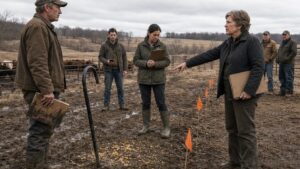
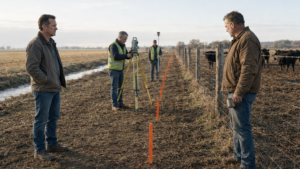
Patrick’s first wooden stake went into Nicholas’s flower bed.
The mallet struck twice. Fresh mulch jumped around the bright orange top.
Nicholas crossed the lawn before Patrick could take the next measurement.
“You can’t place that there.”
Patrick checked the display on his survey instrument. “I can place a temporary marker where the measurements put the line.”
“This is private property.”
“That is the question I was hired to answer.”
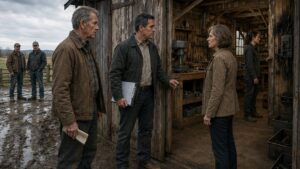
Carolyn stood inside the orchard with her arms folded, saying nothing. Three days had passed since the cutting. Nicholas’s crew had not returned, but plastic sheeting now covered the unfinished pond foundation, and security cameras had appeared along the terrace.
Nicholas looked at Carolyn. “You brought him onto my land without permission.”
Patrick adjusted the tripod. “I entered from the Rivera parcel.”
“You’re ten feet inside my yard.”
Patrick glanced at the stake. “Eleven feet, three inches from your current fence.”
The number seemed to change the air.
Nicholas gave a short laugh. “Then your equipment is wrong.”
Patrick did not argue. He moved north, following the instrument’s reading toward the pond.
Carolyn walked behind him. She had spent the previous two nights studying certified copies and avoiding Jessica’s questions. The bank notice remained on the kitchen table. So did the handwritten reference to shared maintenance access.
Jessica had gone back to town angry and returned that morning without apology. She now stood near the fence with a notebook, recording each stake position.
Patrick stopped at the first concrete form.
“Marker you found was here?”
Carolyn pointed beneath the plastic. “Under the east edge.”
He asked the equipment operator, hired only to expose disturbed soil, to scrape carefully beside the form. Nicholas objected again, but Patrick showed him the signed access notice from Carolyn’s attorney and the county parcel map supporting temporary entry for boundary verification.
The bucket removed six inches of clay.
A rectangular depression appeared.
Patrick climbed down and examined it with a hand tool. “Stone bed.”
“The stone was still in it,” Carolyn said.
He measured the hollow, then compared it to the boundary stone resting in a padded crate.
“Fits.”
Nicholas’s jaw tightened. “A moved rock proves nothing.”
“Correct,” Patrick said. “That’s why I’m not using one rock.”
The second stone bed lay beneath the pond wall. The third had been disturbed by the terrace trench, but Patrick found compacted gravel and the remains of an old iron reference pin beside it.
By noon, the orange stakes formed a line that cut through nearly everything Nicholas had built.
It crossed the new flower bed, clipped the burlap-wrapped palms, passed directly through the shallow end of the koi pond, and continued beneath the outer third of the limestone terrace.
Jessica stood at the far end and stared along the line.
“Eleven feet,” she said.
“Average encroachment is ten feet nine,” Patrick replied. “Largest point is eleven three.”
Nicholas walked the string from end to end. For the first time since Carolyn had known him, he looked less offended than uncertain.
“This can’t be right.”
Patrick turned the instrument toward the north culvert. “Recorded bearings close from the county monument. Stone beds align with the deed calls. The newer fence does not.”
“My title survey showed the fence.”
“A mortgage location sketch is not necessarily a boundary survey.”
“My attorney reviewed it.”
“I’m not evaluating your attorney.”
Nicholas looked at Carolyn. “You knew the fence was inside your line?”
“I knew my father set the stones.”
“That’s not what I asked.”
“No. I didn’t know how far the fence drifted.”
Matthew arrived in a white pickup while Patrick was marking the terrace. He stayed beside the truck until Nicholas called him over.
“Tell him where you got the line.”
Matthew removed his cap. “From the construction packet.”
“Which included the title drawing.”
“It included a site overlay.”
“Based on the fence.”
Matthew looked at Patrick’s string crossing the pond. “That’s what the architect used.”
Nicholas’s voice sharpened. “You assured me clearing was safe.”
“I said we had enough to price the work.”
“You began cutting.”
“You authorized mobilization.”
Carolyn watched the responsibility pass between them like a tool neither wanted to hold.
Patrick moved downhill toward the drainage swale. He drove a stake beside the oldest pear block, then studied the elevation through his instrument.
“What is it?” Carolyn asked.
He walked the swale twice before answering.
“The terrace wall raises the grade on this side.”
“That was the purpose,” Nicholas said. “The old ground held water.”
“It held water on your side before releasing through the swale.”
Patrick pointed toward Carolyn’s orchard. “Now runoff reaches the wall, turns south, and enters here.”
Carolyn looked down the oldest row. The trunks were thick and pale with lichen. Her husband had grafted three varieties onto those rootstocks during the years when they could not afford new trees.
“How much water?”
“That depends on the storm.”
“Enough to hurt them?”
Patrick crouched and pressed his thumb into the soil. “One hard event could saturate this block for days. Pear roots tolerate moisture. They don’t tolerate standing in it.”
The survey was no longer about missing ground.
Nicholas’s view, pond, and terrace had changed the way water moved through the orchard.
Carolyn felt the stone in her memory before she saw it—the flat face, the chisel mark, her father’s boots beside it after the flood. Boundaries had never been lines to him. They were instructions about who maintained which ditch, who repaired which culvert, who opened a channel before rain.
Patrick finished his field notes. “I’ll certify the survey after I verify the deed attachments.”
Nicholas looked toward the house. A woman and a child stood behind the glass doors, watching. He noticed Carolyn noticing them and turned away.
“There was an agreement,” he said.
Carolyn’s heartbeat changed.
Nicholas walked to the terrace table and removed a folder from beneath a stone sample. He drew out a photocopied page, protected in a clear sleeve.
“My attorney found this attached to the former owner’s closing records.”
He held it toward Patrick, but his eyes stayed on Carolyn.
The handwriting was faded. The signature at the bottom was not.
Rivera.
Her father’s hand had always leaned forward, each letter pressed hard enough to mark the next sheet beneath it.
Patrick read the heading aloud. “Maintenance agreement concerning western drainage lane.”
Jessica came closer.
Nicholas tapped the paragraph with one finger. “It gives the neighboring parcel shared access to the strip.”
“For drainage maintenance,” Carolyn said.
“So you have seen it.”
The words came too quickly. Carolyn heard the error as soon as she made it.
Jessica looked at her.
Patrick continued reading. “Temporary entry for clearing, repair, and unobstructed flow. No language here about landscaping.”
Nicholas turned the page. “It establishes use.”
“It may establish a limited license or agreement,” Patrick said. “That’s a legal question.”
“It establishes that her family allowed my parcel onto the strip.”
“Not to cut trees,” Jessica said.
Nicholas ignored her. “Carolyn told everyone I simply invaded land with no possible right to be there.”
“I said you cut my orchard.”
“You also knew there was an agreement.”
Carolyn looked at her father’s signature. She remembered the original page folded into the old canning ledger in the farm office, tucked behind harvest figures and notes in her husband’s handwriting. She had found it after his death and put it back.
The agreement did not give Nicholas what he claimed.
But it gave him enough to make her silence matter.
Later, in the agricultural attorney’s office, Carolyn placed the certified deed and Patrick’s preliminary measurements on the desk. She did not mention the original agreement in the ledger.
The attorney held up Nicholas’s copy. “Have you seen this document before today?”
Carolyn thought of Jessica at the boundary, watching her face when Nicholas produced it. She thought of the bank notice and the survey invoice. She thought of seven cut stumps and the water that would come downhill when autumn storms began.
“No,” she said.
The lie entered the room quietly.
The attorney made a note.
Carolyn watched the pen move and understood that she had just turned a strong boundary claim into something more dangerous.
Chapter 4: The Agreement Carolyn Hid in the Canning Ledger
Jessica found the original agreement before Carolyn could move it.
The old canning ledger lay open on the farm-office desk, its cloth spine split and its pages swollen from years of damp summers. Jessica had been searching for equipment depreciation records when a folded sheet slipped from behind the 1987 pear totals and landed at her feet.
Carolyn stopped in the doorway.
Jessica picked it up by the edges. “Is this what Nicholas showed us?”
The paper was more yellow than the photocopy, with her father’s signature pressed deeply into the bottom line. A charcoal rubbing of a boundary stone had been folded inside it. The shallow chisel mark appeared as a pale slash through black dust.
“Put it down,” Carolyn said.
Jessica looked at her instead. “You told the attorney you had never seen it.”
“I said put it down.”
“You lied.”
The packing shed machinery hummed through the wall, a belt running empty while two workers cleaned sorting trays. Carolyn crossed the office and closed the door.
Jessica spread the agreement flat. “How long have you known this was here?”
“Since after your father died.”
“That was nine years ago.”
“I know how long it’s been.”
“You knew Nicholas had a copy. You knew what it said. And you sat in that office and lied.”
Carolyn reached for the document. Jessica pulled it back.
“Read the whole thing,” Carolyn said.
“I intend to.”
The first paragraph described the western drainage lane in plain, cramped language. Each landowner could enter the strip temporarily to clear weeds, repair the culvert, or restore unobstructed flow. No permanent structure could interfere with the lane. No use transferred ownership. Damage caused during maintenance had to be repaired by the party who entered.
Jessica read the final sentence twice.
“This doesn’t let him build anything.”
“No.”
“It doesn’t let him cut trees unless they block the drainage.”
“No.”
“Then why hide it?”
Carolyn looked at the ledger. “Because the copy he has is enough to make noise before anyone reads the limits.”
“That’s not why you lied to your own attorney.”
The accusation was accurate enough to make anger easier than an answer.
“The claim is still ours,” Carolyn said. “Patrick’s line is sound.”
“That isn’t the point.”
“It is exactly the point.”
Jessica folded her arms. “You keep deciding what the point is so nobody can ask about anything else.”
Carolyn turned toward the small window. Beyond it, pallets of empty fruit boxes stood beneath the loading roof. The orchard had always looked larger from the packing shed than it did from the house. Work made land seem endless. Debt made it measurable.
Jessica lifted the charcoal rubbing. “What is this?”
“Your grandfather made it after the flood.”
“Why keep it with the agreement?”
“So nobody forgot which stone the paper referred to.”
A second page clung to the back of the original. Jessica separated it carefully.
Carolyn knew what was there.
Her late husband’s handwriting filled the reverse side with figures: slope percentages, runoff volume, root-depth estimates, and the number of hours the oldest pear block could tolerate saturation. At the bottom, beneath a boxed calculation, he had written:
If western grade is raised, water will turn into Row One. Do not allow permanent obstruction.
Jessica’s face changed.
“He knew.”
“He understood the ground.”
“This is what Patrick said.”
“Yes.”
“Then the terrace is not just over the line. It can damage the orchard.”
Carolyn sat in the wooden chair beside the desk. It creaked under her.
Jessica lowered the paper. “You had proof of the danger before the survey.”
“I had an old calculation.”
“From Dad.”
“Your father was not a hydrologist.”
“He ran this place for thirty years.”
“That does not make every note courtroom evidence.”
“No. But it makes your silence worse.”
Carolyn looked up.
Jessica’s eyes were wet, though her voice remained level. “You thought I would tell you to sell.”
“You have told me to consider it.”
“I told you to consider what happens when you cannot climb a ladder or lift a pump housing.”
“That is not the same thing?”
“No.” Jessica struck the ledger lightly with two fingers. “You hear ‘plan’ and think ‘abandon.’ You hear ‘help’ and think someone is trying to take the keys.”
“You left.”
“I got a job.”
“You moved away.”
“Twenty-eight miles.”
“You built a life that does not depend on frost dates.”
Jessica stepped back from the desk. “And you punished me for it by telling me nothing.”
The machinery stopped beyond the wall. The sudden quiet made the office feel smaller.
Carolyn had imagined this argument many times, always with Jessica demanding the farm be sold and Carolyn refusing. She had never imagined Jessica standing there angry because she had not been trusted with enough of it.
“The bank can call the loan if the arrears continue,” Jessica said. “The legal fees are coming from operating money. The west row is damaged. And now your attorney may have to explain why her client denied a document that was sitting in a ledger twenty yards from the house.”
“I will explain it.”
“When?”
“When it serves the case.”
Jessica laughed once without humor. “There. That. Everything is a tool to you until it becomes a consequence.”
Carolyn stood. “Do not speak to me as if I did this.”
“No. Nicholas did the cutting. But you are making sure he is not the only person who can hurt us.”
The word us held Carolyn still.
Jessica placed the original agreement inside a clear produce sleeve and carried it to the attorney’s office that afternoon.
Carolyn went with her.
The agricultural attorney read every line, then removed her glasses.
“You told me you had never seen this.”
“I did.”
“That answer is no longer usable.”
“The document does not authorize permanent construction.”
“That helps the boundary claim. Your denial hurts your credibility.”
“I was protecting context.”
“You were withholding evidence.”
Jessica sat beside Carolyn without looking at her.
The attorney turned over the second page. “These drainage calculations may support Patrick’s opinion, but they also show you understood the potential harm before the survey.”
“I did not know Nicholas would build across the swale.”
“But you knew an agreement existed.”
Carolyn’s hands rested on her knees. “My father made that arrangement when neighbors still cleared the ditch together. It was never meant to survive as permission for a patio.”
“I believe you. A judge may believe you. Nicholas’s attorney will still ask why you lied.”
The attorney slid the paper back.
“We disclose it now, with a complete explanation, or I cannot continue as though it appeared yesterday.”
Carolyn felt Jessica turn toward her.
“Not yet,” Carolyn said.
The attorney’s expression hardened. “Then understand the risk. If opposing counsel produces the original’s existence before we do, they will argue concealment. The narrow language may save your land and still damage your case.”
On the drive home, Jessica said nothing.
At the orchard gate, a black car waited beside the mailbox. Nicholas stood near it with an envelope in one hand.
Carolyn parked but did not get out.
He came to her window.
“I heard you found the original,” he said.
Jessica’s head turned sharply.
Nicholas held the envelope through the open glass. “My lender’s appraisal is in three weeks. I am offering a private solution before both of us spend more money pretending this is simple.”
Carolyn did not take it.
“What solution?”
“I pay the overdue farm balance. All of it. You sign the disputed strip over to me, subject to drainage work we agree on.”
Jessica looked from Nicholas to Carolyn.
Nicholas rested the envelope on the window frame. “No court. No public filing. Your orchard stays operating.”
Carolyn took the envelope only because the wind threatened to carry it.
Inside was a figure large enough to erase the past-due balance, the survey cost, and the next season’s operating shortage.
Nicholas stepped back.
“Think about what eleven feet is worth,” he said, “compared with everything behind it.”
Chapter 5: The Settlement That Would Save the Farm and Ruin the Soil
Nicholas slid the offer across the mediation table with two fingers.
The figure at the bottom was higher than the one in the envelope.
It would clear the loan, cover the legal fees, replace the cut trees, and leave enough cash to repair the packing-shed roof before winter. Carolyn read it once, then placed the page flat.
Across from her, Nicholas wore a dark jacket instead of the bright polo she remembered from the day of the cutting. His attorney sat beside him. The mediator occupied the head of the table. Jessica and the agricultural attorney sat with Carolyn.
Nicholas spoke first.
“The terrace remains. The pond remains. I fund a drainage upgrade designed by a neutral engineer. Carolyn receives the full payment and grants a recorded easement or transfers the strip. We stop burning money.”
“Transfer,” Carolyn said. “Not easement.”
His attorney answered. “The preferred structure is a boundary adjustment.”
“So he owns what he crossed into.”
“He pays for it.”
Carolyn looked at Nicholas. “After cutting first.”
His jaw tightened. “I relied on the fence, the title drawing, and my contractor.”
“You also relied on the idea that I would not fight.”
“I relied on visible conditions that had existed for years.”
Jessica shifted beside Carolyn, but did not interrupt.
The mediator asked Nicholas to explain why the timetable mattered.
He hesitated, then glanced at his attorney.
“My construction loan converts after appraisal,” he said. “The estate value assumes completion of the landscaping package.”
“And if the pond and terrace are removed?” Carolyn asked.
“The appraisal drops.”
“How much?”
“That is not relevant.”
“It is why you are here.”
Nicholas’s face changed, not into anger but exhaustion. “Enough to create a problem.”
The mediator waited.
Nicholas rubbed a thumb along the edge of the document. “My sister and her son are moving into the guest wing. Her husband died last year. I promised her the house would be stable before school started.”
Carolyn had seen the woman and child behind the glass during the survey. She had assumed they were visitors.
Nicholas continued. “I bought the estate because it could hold all of us without making her feel dependent. The appraisal and refinancing are part of that plan.”
Jessica’s eyes moved toward Carolyn.
The explanation did not excuse the trees. It did not change the survey line. But it made Nicholas’s urgency less ornamental than Carolyn had believed.
“You could have ordered a boundary survey,” she said.
“Yes.”
“You could have stopped when I warned you.”
“Yes.”
“You did neither.”
Nicholas looked directly at her. “No.”
The admission gave Carolyn no satisfaction.
The mediator proposed a recess while Patrick’s drainage materials were reviewed. They met him at the orchard two hours later, beside the western swale.
Clouds had gathered over the ridge. Patrick had placed elevation flags from the terrace wall to the oldest pear row. A shallow red line on his map showed where runoff would travel.
He handed Carolyn a soil probe. “Push it in here.”
The metal sank easily for six inches, then met dense clay.
“That layer slows drainage,” he said. “Before the grading, excess water spread west and moved through the swale. The new wall turns it south and east.”
Nicholas stood on the other side of the survey string. “The pond contractor installed drains.”
Patrick pointed toward a black pipe emerging below the terrace. “That outlet concentrates flow.”
“Can it be redirected?”
“Yes, if the wall is opened and the pond edge rebuilt.”
Nicholas’s attorney asked, “Without removing the whole terrace?”
“Most of the upper terrace can remain. The outer section cannot. It sits over the swale and blocks maintenance access.”
Patrick unfolded a second sheet showing storm projections.
“One major event at the current grade could hold water around the oldest pear roots for several days.”
Jessica looked down the row. “Would it kill them?”
“Maybe not at once. Root decline can take a season to show.”
Carolyn walked to the first tree. The bark carried the pale scar where her husband had once tested a new graft. She placed her palm against it.
Nicholas came closer but stayed beyond the string.
“I will pay for whatever drainage design is required.”
“You offered to pay me to own the problem,” Carolyn said.
“I offered to solve both problems.”
“No. You offered to make one invisible.”
The mediator called everyone back toward the packing shed, where the tables had been set up for documents. Matthew waited there with a binder of work logs.
His lawyer was not present. He looked as if he had slept badly.
The agricultural attorney opened the contractor packet. “Your log says boundary approval was received Tuesday at nine in the morning.”
Matthew nodded.
“The trees were cut Tuesday?”
“Yes.”
Patrick placed a dated photograph beside the log. It showed the first stump before eight-thirty, with the chipper already operating.
Matthew stared at it.
Carolyn remembered Jessica taking pictures from the road after passing the trucks. She had not known the phone had recorded the time.
The attorney tapped the log. “This approval entry was made after work began.”
Matthew’s mouth went dry. “The sequence may be wrong.”
“Who gave the approval?”
“Nicholas said his attorney had cleared the fence line.”
Nicholas stepped forward. “I said the title documents supported it.”
“You told me to enter it as approval.”
Silence spread through the shed.
Nicholas’s attorney closed his eyes briefly.
Matthew continued, each word slower than the last. “After Carolyn stopped the crew, Nicholas said the file needed to show we had relied on approval before mobilization. I changed the note.”
Nicholas’s face flushed. “You are protecting yourself.”
“I am trying not to lose my license.”
The mediator ended the session for the day.
Outside, the first drops of rain struck the metal loading roof.
Carolyn stood beneath it with the smallest recovered boundary stone in her coat pocket. She could feel its hard edge against her hip.
Jessica joined her.
“You could take the money,” Jessica said.
Carolyn looked at her.
“I’m not saying you should. I’m saying I understand why you might.”
“That would surprise me.”
Jessica let the remark pass. “It would save the farm now.”
“And leave the wall.”
“Patrick says part can stay.”
“The part that can stay is not the part Nicholas wants most.”
Rain darkened the orchard soil in scattered circles.
Jessica leaned against a post. “I used to think you kept everything secret because you didn’t trust my judgment.”
Carolyn said nothing.
“Now I think you don’t trust anyone to want this place for the same reasons you do.”
“Do you?”
Jessica looked toward the rows. “I don’t want to become you.”
The words struck cleanly.
Then Jessica continued. “I don’t want to spend every year pretending fear is discipline. I don’t want to hide bills in catalogs or agreements in ledgers. But that does not mean I want the orchard gone.”
Carolyn felt the stone in her pocket again.
“What do you want?”
“A say before there is nothing left but a promise you made to someone who is not here.”
Rain began to fall steadily.
Carolyn returned to the mediation table and placed Nicholas’s offer beside the original agreement.
Her attorney looked up. “Have you decided?”
“Yes.”
Nicholas entered from the opposite door.
Carolyn pushed the settlement back toward him.
“No sale. No hidden correction. No altered work record buried in a private agreement.”
His expression closed.
She turned to her attorney. “Disclose the original. All of it. Tell them I had it before the survey and that I denied seeing it.”
Jessica inhaled softly.
The attorney studied Carolyn for a long moment. “Once we do that, we cannot control how the court reads your conduct.”
“I know.”
“And Nicholas will use it.”
“I know.”
Carolyn removed the small boundary stone from her pocket and set it beside the agreement.
“He has been using my silence already,” she said. “We might as well give him the truth.”
Chapter 6: Carolyn Put the Whole Record on the Table
Carolyn handed the original agreement to Nicholas’s attorney before the judge entered.
Not a copy. Not a summary. The yellowed page, her father’s signature, the charcoal rubbing, and her husband’s drainage calculations were all inside the same clear sleeve.
The attorney looked at her, then at Carolyn’s counsel.
“You are producing this now?”
“We are correcting the record,” Carolyn’s attorney said.
Nicholas sat at the opposite table. He watched the document pass into his lawyer’s hands, his expression unreadable.
Carolyn took her seat beside Jessica.
The courtroom was smaller than she had imagined. No gallery crowd, no polished drama—only fluorescent light, scratched wood, and a clerk arranging files beneath the county seal.
When the judge entered, everyone stood.
The preliminary hearing began with deeds, survey methods, fence history, and photographs of the cut trees. Patrick explained how he closed the boundary from the county monument, matched the recorded bearings, and located three disturbed stone beds.
Nicholas’s attorney did not challenge the measurement first.
He held up the agreement.
“Mrs. Rivera, you testified in counsel’s office that you had never seen this document before Mr. Wilson produced a copy. Is that correct?”
Carolyn’s attorney rose. “She did not testify under oath in that office.”
The judge looked over her glasses. “She may answer the factual question.”
Carolyn stood.
“I said I had never seen it.”
“Was that true?”
“No.”
Jessica sat very still beside her.
Nicholas’s attorney stepped closer. “You had the original?”
“Yes.”
“For nine years?”
“Yes.”
“And you did not provide it to your surveyor, your attorney, or Mr. Wilson before filing your claim.”
“No.”
“Why?”
Carolyn could have said confusion. Grief. Poor memory. She had considered each answer and rejected it.
“Because I was afraid the first sentence would matter more than the rest.”
The attorney glanced at the page. “The first sentence grants shared maintenance access.”
“It grants temporary access to keep the drainage lane open.”
“You understood it could support my client’s belief that the neighboring parcel had rights in the strip.”
“I understood he would call those rights whatever he needed them to be.”
“That is not an answer.”
“Yes,” Carolyn said. “I knew he might use it.”
“So you concealed it.”
“I hid it.”
The word settled harder than the legal phrasing.
The attorney turned toward the judge. “Mrs. Rivera asks the court for equitable relief while admitting she withheld a material agreement.”
Carolyn’s attorney stood. “The document is now before the court, and its limiting terms are explicit.”
The judge raised one hand. “I will determine its weight.”
When Carolyn’s attorney questioned her, the room felt even quieter.
“Why was the agreement kept with a stone rubbing?”
“My father made the rubbing after a flood moved one marker. He wanted the shape preserved before resetting it.”
“And the calculations on the back?”
“My husband wrote them. The western lane carried overflow away from the oldest pear block. If someone raised the grade or blocked access, water would turn into the roots.”
“Why did you not disclose those calculations?”
Carolyn looked at Jessica before answering.
“Because the paper was not the only thing I was hiding.”
Nicholas shifted in his chair.
Carolyn continued. “The farm is behind on its loan. I did not tell my daughter how far. I believed if she knew, she would ask me to sell before I died.”
Jessica’s face tightened, but she did not look away.
“I treated every question as a threat,” Carolyn said. “Mr. Wilson cut my trees and crossed the line. That is true. It is also true that I made the case harder because I wanted to appear as though I had never failed to protect anything.”
Her attorney let the silence remain.
Nicholas’s counsel asked no further questions.
Matthew testified next.
He began defensively, describing the fence, site overlay, and verbal assurances. Then Carolyn’s attorney placed the dated photograph beside his work log.
“Did you alter this entry?”
Matthew looked at Nicholas.
The judge noticed. “Answer the question.”
“Yes.”
“At whose request?”
“Mr. Wilson told me the file needed to show approval before cutting.”
Nicholas stood halfway. His attorney pulled him back down.
Matthew rubbed his palms against his trousers. “He said the title review was the approval. I changed the sequence to match that.”
“Did you personally verify the boundary before removing the trees?”
“No.”
“Did Mrs. Rivera object before all marked trees were removed?”
“Yes.”
“Did work stop immediately?”
Matthew swallowed. “Not until she hit the emergency bar.”
Nicholas’s attorney argued that the alteration reflected poor wording, not fraud, and that Nicholas had relied on professionals. The judge listened without expression.
At the afternoon site inspection, the group followed the survey string from the flower bed to the orchard swale. The judge wore practical shoes and asked Patrick short questions about grade, flow, and access.
Patrick showed where the pond wall sat above the second stone bed.
Carolyn carried the recovered marker in both hands. At the judge’s direction, she lowered it into the exposed bed so Patrick could demonstrate the fit.
The stone settled with almost no movement.
Nicholas stood a few feet away. Without the courtroom table between them, he looked older.
“My family needs that house completed,” he said quietly.
Carolyn brushed soil from her palms. “My trees need water to leave.”
“I offered to fix the drainage.”
“You offered to own the lane.”
“I offered enough to save your farm.”
Jessica stepped forward. “The farm is not for sale because my mother owes money.”
Carolyn turned.
Jessica’s voice shook, but she continued. “And it is not hers to carry alone anymore.”
The judge looked between them. “Are you asserting an ownership interest?”
“No. I am saying there is a succession plan being prepared. I intend to work in the operation and assume part of the financial responsibility.”
Carolyn had not known Jessica would say it there.
“You told me you did not want to become me,” she said.
“I don’t,” Jessica replied. “I want to become someone you tell the truth to.”
The judge walked to the edge of the terrace and studied the survey stakes.
“Complete removal may exceed what is necessary to protect title and drainage,” she said. “But leaving the current structures is not acceptable. I am directing the parties to submit proposed remedies before I issue a final order.”
Nicholas’s attorney began outlining preservation options.
Carolyn listened, then stepped closer to the marked line.
“I have one.”
Her attorney murmured, “Carolyn.”
She kept her eyes on the pond wall.
“Remove every section that crosses the recorded boundary or blocks the drainage lane. Restore the original grade under Patrick’s inspection. Replace the trees that were cut and correct the contractor filing.”
Nicholas stared at her. “And the rest?”
“If it stands on your land and does not send water onto mine, it stays.”
His surprise was visible.
Carolyn pointed toward the swale. “I will grant one recorded access easement for drainage maintenance. Narrow width. Scheduled notice except during an emergency. No landscaping, no permanent structures, no claim of ownership.”
The judge asked, “Why offer access after what occurred?”
Carolyn looked at the stone resting in its old bed.
“Because the ditch still has to be cleared by someone,” she said. “A boundary is not a wall. It is where responsibility changes hands.”
Nicholas’s attorney requested time to confer.
The judge granted forty-eight hours.
As the parties separated, Nicholas remained beside the unfinished pond. Carolyn passed him without stopping.
“Mrs. Rivera,” he said.
She turned.
He looked toward his house, where his sister and the child stood behind the glass doors again.
“If I accept this, the outer terrace comes out.”
“Yes.”
“The appraisal will fall.”
“Yes.”
“And you still expect me to pay for the orchard restoration.”
“You ordered the cutting.”
His mouth tightened. “You could have taken the money.”
Carolyn looked at Jessica waiting near the first pear row.
“I almost did.”
Nicholas followed her gaze, then looked down at the reset stone.
For the first time, he did not argue that it was only a rock.
Chapter 7: The View Beyond the Reset Stones
The koi pond began draining before sunrise.
A dark hose ran from the shallow basin to a temporary tank on Nicholas’s side of the property. Water moved through it with a steady mechanical pulse while workers netted the last fish beneath portable lights. Their shadows stretched across the unfinished terrace and flickered against the trunks of the surviving pear trees.
Carolyn stood at the orchard fence with her white mug warming both hands.
Six weeks had passed since the site inspection. Nicholas had accepted the proposed remedy on the final afternoon before the judge’s deadline. The agreement preserved the upper terrace and most of the landscaping on his land, but everything crossing the recorded line had to come out. The drainage lane would be restored under Patrick’s supervision. Nicholas would pay for replacement trees, soil repair, legal costs tied to the encroachment, and the correction of Matthew’s work records.
In return, Carolyn granted a narrow recorded easement for drainage maintenance.
It was not the victory people in town had expected her to demand. Two neighboring growers had told her she should make Nicholas remove every stone he had placed within sight of the orchard.
Carolyn had asked whether either man intended to pay the extra legal fees.
Neither answered.
Matthew walked toward her from the work area, carrying a rolled restoration plan. He looked thinner than he had on the day of the cutting.
“We’re starting with the outer pond wall,” he said. “Then the patio section. Patrick wants the swale opened before we move soil.”
Carolyn set her mug on a fence post and unrolled the plan across the top wire.
A small ornamental maple stood near the edge of the removal zone. Its trunk was on Nicholas’s side, but the equipment path marked on Matthew’s drawing ran directly through it.
“This tree stays,” Carolyn said.
Matthew followed her finger. “It will be easier to bring the excavator through there.”
“Use the upper access.”
“That adds half a day.”
“It is not in the encroachment.”
Nicholas approached from the terrace, coat zipped against the morning cold. “The maple can be replaced.”
Carolyn looked at him. “So could my pears, according to you.”
His expression tightened, then eased.
Matthew waited.
Nicholas studied the tree. Its leaves had turned copper along the edges. “Use the upper access.”
Matthew made a note and walked back toward the crew.
Carolyn picked up her mug.
Nicholas watched the workers lower the pond level. “I assumed you would want all of it gone.”
“I wanted what crossed the line gone.”
“You could have asked for more.”
“I did ask for more. I asked for the soil to work again.”
The pump continued to throb between them.
Nicholas put his hands in his coat pockets. “My sister says I should thank you for not forcing removal of the entire terrace.”
“You should thank the survey.”
“She says that too.”
Carolyn looked toward his house. The child stood at an upstairs window, watching the fish tanks.
“The appraisal came in lower,” Nicholas said.
“I expected it would.”
“The lender still converted the loan.”
She turned toward him.
He gave a brief, tired smile. “The guest wing was enough. The landscaping mattered less than I thought.”
Carolyn did not say that most expensive mistakes began that way.
By midday, the limestone slabs from the outer patio lay stacked on pallets. Each one exposed a clean rectangle of compressed soil beneath it. The pond wall came apart more slowly. When the excavator lifted the first concrete section, trapped water spilled into the cut and carried gray silt toward the orchard.
Patrick raised one arm.
The operator stopped immediately.
Patrick crouched beside the flow, then directed the crew to install a temporary berm. He moved between stakes with his level rod while Jessica recorded elevations on a clipboard.
She had reduced her hours at the office in town but had not quit. Three days each week, she now handled orchard accounts, vendor contracts, and the loan restructuring. Carolyn still checked her figures after supper.
Jessica knew she did it.
She no longer pretended not to notice.
Patrick called them to the oldest pear row late that afternoon. The soil there had remained wet even without a major storm. He pushed the probe into the root zone and drew it out dark.
“This section took more water than I hoped,” he said.
“How many?” Carolyn asked.
“Four trees show decline. Two might recover. The other two probably will not.”
Jessica looked along the row. “Can we graft from them?”
“From healthy wood, yes,” Carolyn said.
The answer came automatically, but her throat tightened. One of the failing trees carried her husband’s three-variety graft. Another had produced the pears they used for the final harvest he had overseen.
Nicholas stood several yards away with Matthew. He heard Patrick’s assessment and came closer.
“The restoration agreement covers replacement.”
Carolyn looked at the tree.
“A replacement is not the same tree.”
“No,” Nicholas said.
It was the first time he had answered that truth without trying to reduce it to cost.
The damaged pair came out in January after the ground firmed. Carolyn kept sections of viable scion wood wrapped in damp paper inside the packing-shed refrigerator. Jessica ordered rootstock for spring and added the expense to the restoration account.
Matthew supervised the work under Patrick’s inspection. He corrected the original job log, submitted the amended sequence to the county planning office, and attached a signed statement explaining that boundary approval had not been obtained before clearing.
His business survived.
Nicholas paid another contractor to verify every remaining structure.
By early March, the western swale carried rain cleanly again. The water entered at the north culvert, spread through the shallow channel, and left the orchard without collecting around Row One.
Patrick returned on a clear morning to reset the boundary monuments permanently.
The first stone went near the flower bed, where Nicholas’s mulch now stopped several inches short of the surveyed line. The second returned beside the rebuilt pond edge. The third was set near the restored swale, its chisel mark level with the soil.
Patrick photographed each one with the survey rod visible and filed the locations with the county.
“No one should have to rely on memory next time,” he said.
Carolyn stood beside the third stone while Jessica held a young pear tree upright in the first prepared hole.
“Straight?” Jessica asked.
Carolyn stepped back.
“A little west.”
Jessica adjusted it.
“Now?”
Carolyn almost said she would take the trunk and do it herself. Instead she looked from the tree to the new boundary pin, then to the swale beyond it.
“Now it is right.”
They planted six replacement pears that morning. Two stood where the cut Bartletts had been. Two filled gaps in the oldest row. The final pair replaced trees lost to the redirected water.
Nicholas brought over a wheelbarrow of compost from his side. He stopped at the boundary stone and waited until Jessica waved him through the designated access point.
The gesture was small and deliberate.
He emptied the compost where Carolyn directed.
When the work was finished, Carolyn sat on the porch with the farm operating agreement open across her knees. Jessica had drafted it in plain language. Carolyn retained ownership and final authority while they refinanced the debt, but Jessica would assume increasing responsibility for accounts, planting decisions, and long-term succession.
Two signature lines waited at the bottom.
Carolyn signed first.
She passed the pen to Jessica.
“You understand this does not mean you can replace every ledger with a computer.”
Jessica signed her name. “It means I can make copies before you hide things in them.”
Carolyn closed the agreement.
On the porch rail sat the plain white mug she had carried through the survey, mediation, and removal. A thin crack had formed near the handle during winter.
She picked it up and handed it to Jessica.
Jessica turned it in her hands. “You know this leaks.”
“Only if you fill it too high.”
“That sounds familiar.”
Carolyn looked toward the western edge.
The luxury pond was smaller now, its stone border ending well before the reset markers. The terrace still caught the evening light. Beyond it, the young pear trees stood in dark circles of watered soil, each tied loosely to a stake.
The view was not what it had been before Nicholas arrived. Two old trees were gone for good. The restored ground carried fresh scars. Trust, once opened, had not closed neatly around the damage.
But the water moved where it should.
Jessica carried the mug inside to make coffee while Carolyn opened the shared ledger. She placed the charcoal rubbing of the old boundary stone between the newly signed operating agreement and Patrick’s recorded survey.
This time, she did not hide it.
The story has ended.