After My Daughter Crashed at the Irrigation Gate, I Followed the Farm Cooperative’s Missing Money
Chapter 1: The Fine Beside the Irrigation Gate
Ashley’s pink bicycle went sideways before Patrick Miller understood why.
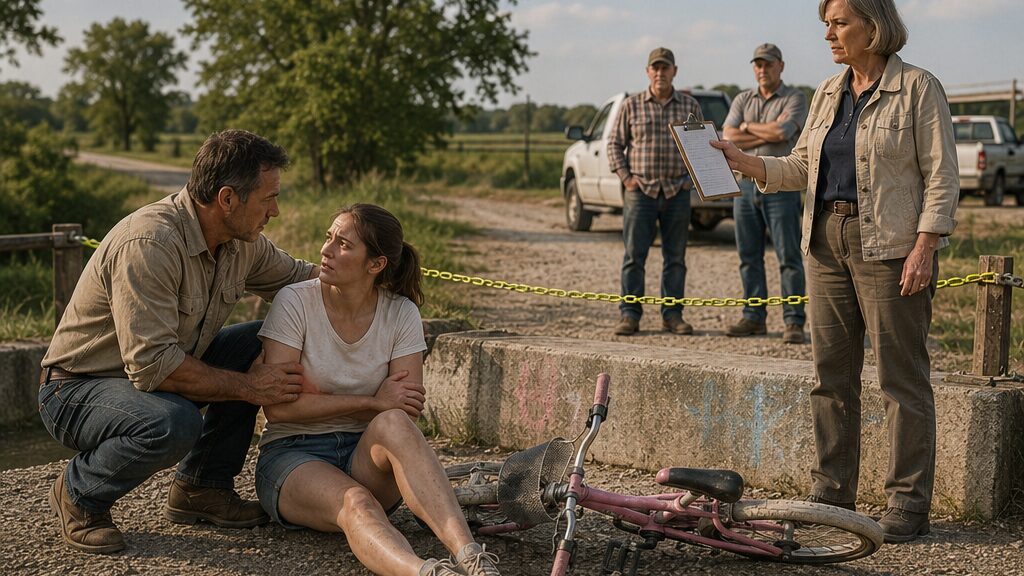
One second she was pedaling toward the irrigation crossing, the streamers on her handlebars flicking in the warm air. The next, her front tire caught beneath a bright plastic-coated chain stretched across the concrete approach.
The bicycle twisted.
Ashley hit the concrete on her right side.
“Dad!”
Patrick dropped the fencing pliers in his hand and ran.
By the time he reached her, Ashley had rolled onto her back. Her face had gone pale beneath the dust. One knee was scraped, but Patrick barely noticed it.
She was holding her right wrist against her chest.
“Don’t move it.”
“It hurts.”
“I know. Look at me.”
He crouched beside her and carefully supported her forearm without touching the wrist itself.
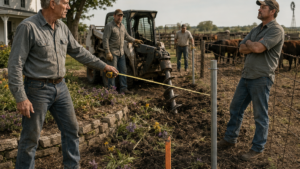
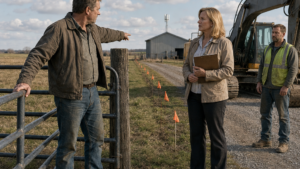
Twenty feet away, Linda Carter stood beside the irrigation gate with a clipboard tucked against her bright work jacket.
Patrick looked from her to the chain.
It had not been there that morning.
A yellow tag hung from the middle of it.
“Why was that across the lane?”
Linda glanced at Ashley, then at the concrete headwall.
Colored chalk covered one side of it. Ashley had drawn a crooked rainbow there the previous afternoon, along with three blue clouds and something she insisted was a horse.
“This crossing was temporarily closed for inspection,” Linda said.
“With a chain at bicycle height?”
“There’s a marker.”
Patrick looked at the small yellow tag.
Ashley whimpered.
That sound settled the argument for him.
He slid one arm beneath her knees and another behind her shoulders.
“Dad, my bike.”
“I’ll get it later.”
As he stood, Linda stepped closer.
“Patrick.”
He stopped.
She pulled a sheet from beneath the clipboard.
“I need you to acknowledge this.”
For a moment he thought it concerned the accident.
Then he saw the heading.
Rural Water and Road Cooperative.
Violation Notice.
Linda pointed toward the chalk.
“Shared infrastructure can’t be painted, marked, or defaced.”
Patrick stared at her.
“My daughter is hurt.”
“I can see that.”
“Then move.”
“The penalty is two hundred dollars. You have thirty days.”
Ashley was trembling against him.
Linda held out the paper.
Patrick had known Linda for years. He knew the clipped voice she used when somebody parked equipment too close to a cooperative ditch or failed to clear brush from a culvert. He also knew what she wanted now.
An argument.
Something she could call threatening.
Something that would turn Ashley’s injury into a dispute between two angry adults.
Patrick took the paper.
He folded it once.
Then he carried his daughter to the truck.
At the rural clinic, the nurse cut away the elastic cuff of Ashley’s sleeve. Patrick watched her face rather than her wrist.
When the X-ray came back, the orthopedic surgeon pulled a stool beside them.
“The fracture is displaced.”
Patrick’s stomach tightened.
“Can you set it here?”
The surgeon shook his head.
“I want this stabilized properly. She’ll need a procedure, and likely pins.”
Ashley looked at Patrick.
“Pins?”
“Little ones,” he said.
He had no idea how little.
She searched his face to decide whether she should be frightened.
Patrick forced his jaw loose.
“You’re going to be okay.”
She nodded because he had said it.
That was the part of being her father that frightened him most. Since her mother died, Ashley had developed a habit of believing Patrick’s certainty even when he was manufacturing it for her benefit.
He had promised her mother that farm trouble would never become Ashley’s childhood.
Land arguments. Money arguments. Neighbor grudges.
Adults could carry those.
Children should get bicycles and chalk.
That evening Patrick returned alone to the crossing.
Ashley’s bicycle was still there.
The front wheel was bent.
He lifted it into his pickup, then stood beside the gate.
The chalk rainbow remained on the concrete. Linda had attached another yellow notice to the chain.
Patrick photographed the chain, the crossing and the chalk.
Then he looked at the violation in his hand.
Two hundred dollars was not enough money to threaten his farm.
That was almost what bothered him.
It was small enough that paying would be easier than fighting.
He folded the paper along the same crease and put it in his shirt pocket.
Three days later Ashley underwent surgery.
Patrick sat beside her afterward while she slept with her arm elevated. He learned the rhythms of pain medicine, water cups and interrupted nights. He learned that at three in the morning a nine-year-old could become very small again.
A week after the accident, Ashley’s first medical statement arrived.
Patrick placed it unopened beside the coffee maker.
The next envelope required his signature.
Certified mail.
He opened it at the kitchen table.
The cooperative had formally upheld the $200 violation.
A second paragraph warned that unresolved violations and assessments could affect privileges involving cooperative-controlled access and shared infrastructure.
Patrick read that sentence twice.
Their cattle used the west lane during pasture rotation.
The irrigation crossing connected that lane to the county road.
He looked through the kitchen window.
Ashley sat on the porch with her cast propped on a cushion.
Her repaired bicycle was hidden in the machine shed because she had asked him not to leave it where she could see it.
Patrick laid the certified notice beside the first violation.
Then he pulled a legal pad from the drawer.
At the top, he wrote one question.
What exactly can Linda Carter control?
Chapter 2: The Receipt Patrick Did Not Throw Away
At 3:17 in the morning, Ashley stood in Patrick’s bedroom doorway holding her cast against her chest.
“I shouldn’t have drawn it.”
Patrick pushed himself upright.
“What?”
“The rainbow.”
Her voice was thick with sleep.
“If I hadn’t drawn on the gate, none of it would’ve happened.”
Patrick switched on the bedside lamp.
“No.”
“Mrs. Carter said it was against the rules.”
“The chalk didn’t put that chain across the lane.”
“But—”
“No, Ashley.”
He softened his voice.
“You drew a rainbow. That’s all you did.”
She looked unconvinced.
Patrick moved over and let her sit beside him until the medicine started working again.
The next morning he walked toward the irrigation crossing alone.
Ashley watched from the porch but did not follow.
That bothered him more than the fine.
Ten days earlier, the lane had belonged to her as naturally as the barn cats and the cottonwood beside the house. Now she treated the gate like a boundary around somebody else’s property.
Patrick spent the morning reading the cooperative bylaws.
He found the records provision shortly before lunch.
Members could inspect financial statements, vendor payments, assessment records and meeting minutes after submitting a written request and paying reasonable reproduction or processing costs.
By two o’clock, he was at the cooperative office.
Linda sat behind the front desk.
“What do you need?”
“The books.”
Her expression barely changed.
“Which books?”
“General ledger. Vendor disbursements. Fine collections. Assessments. Two years.”
Linda leaned back.
“This is about Ashley’s violation.”
“It’s a records request.”
“You can appeal the violation.”
“I know.”
“Then why do you need vendor records?”
Patrick set his written request on the counter.
“Because I’m a member.”
Linda read it.
The silence stretched.
Finally she said, “There’s a processing fee.”
“How much?”
“Sixty dollars.”
Patrick took three twenties from his wallet.
Linda looked at the bills.
“You carry that much cash?”
“I buy feed.”
That earned the faintest tightening around her mouth.
She took the money and wrote a receipt by hand.
Patrick watched her tear it from the book.
Linda slid it toward him.
“Records don’t explain how a cooperative works.”
“I didn’t ask them to.”
“You’ve farmed here long enough to know what happens when people decide every rule is optional.”
Patrick picked up the receipt.
Linda continued.
“Road gravel costs money. Pumps cost money. Culverts fail because somebody doesn’t clear debris when they’re supposed to. Then the same people complain when their lane washes out.”
Those were not foolish points.
Patrick knew that, which made it easier to remain quiet.
Linda tapped his request.
“And members who ignore unpaid fines can lose certain access privileges until their account is current.”
There it was again.
Not quite a threat.
Close enough to one.
Patrick put the receipt in his wallet.
“When will the records be ready?”
“Friday.”
He left.
Years earlier, before he returned full-time to the family farm, Patrick had handled books for an agricultural supplier serving several counties.
He had never loved accounting.
He loved things balancing.
Seed purchased had to become seed received. Freight had to match delivery. Credits had to belong to actual returns.
Most errors were boring.
The dangerous ones were often boring too.
On Friday, the cooperative secretary handed him two boxes and a digital copy of several statements.
Patrick spent that evening at the kitchen table.
Ashley colored with her left hand across from him.
“What are those?”
“Cooperative records.”
“Are you suing Mrs. Carter?”
Patrick looked up.
“Where’d you hear that?”
“Nobody.”
“Ashley.”
She shrugged.
“People talk.”
That was rural life compressed into two words.
Patrick closed the ledger.
“I’m checking numbers.”
“Because of me?”
“No.”
The answer came too quickly.
Ashley noticed.
Patrick leaned back.
“It started because I wanted to understand the ticket. That’s true. But grown-ups are responsible for what grown-ups do. You aren’t.”
She returned to coloring.
Patrick reopened the ledger.
He began with fine collections.
The entries were frequent but not enormous: seventy-five dollars, one hundred fifty, two hundred, three hundred. Brush violations. Road-edge obstruction. Culvert neglect. Unauthorized modification of shared infrastructure.
He found Ashley’s violation number.
The entry existed.
Two hundred dollars.
Unpaid.
Patrick marked it.
Then he moved to expenses.
Grading.
Pump servicing.
Drainage repair.
Pest control.
Snow and ice clearing.
His pencil stopped.
He looked at the date.
August 14.
He read it again.
Snow and ice clearing—north cooperative roads.
Patrick checked the year.
Then the amount.
Then the vendor.
He opened the corresponding bank statement.
A payment had cleared.
Not an estimate.
Not a reversed entry.
Paid.
Ashley had gone to bed an hour earlier. The farmhouse was quiet except for the refrigerator and the ticking wall clock.
Patrick reached for his wallet.
He removed Linda’s handwritten sixty-dollar receipt and placed it beside the ledger.
One strange invoice proved nothing.
He knew that better than most people.
But he also knew the difference between suspicion and a question worth answering.
Patrick wrote the invoice number beneath Ashley’s violation number.
Then he turned the page.
Chapter 3: Bills for Work Nobody Could Find
The invoice said three hundred feet of drainage channel had been cleared along the east road.
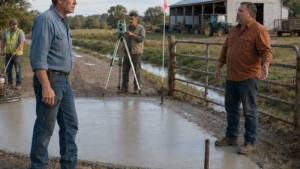
Patrick was standing beside that channel.
Nothing had been cleared.
Cattails crowded the ditch. Last year’s dead stalks lay matted beneath the new growth. Willow shoots had rooted along the bank thick enough that Patrick had to push branches aside to see the culvert.
He checked the invoice on his phone.
Date: six weeks earlier.
He photographed the ditch.
Then the culvert.
Then the invoice number written on his notepad.
This was the fourth site he had visited in two days.
The snow invoice could have been misclassified. Patrick had allowed for that.
A pest-control payment could cover buildings he did not use.
He allowed for that too.
But the more he compared paper to ground, the less cooperative the ground became.
A second drainage invoice listed gravel work near an elderly landowner’s entrance. Patrick drove there and found gravel, but the amount described would have resurfaced nearly the entire approach.
The landowner leaned on the fence while Patrick photographed it.
“Linda send you?”
“No.”
“Then I didn’t say anything.”
Patrick lowered the phone.
“I didn’t ask you to.”
The man looked toward the road.
“That’s the problem now. Everybody thinks asking is the same as picking a side.”
Patrick understood the warning.
He left without pressing.
Back at the farmhouse, he spread the invoices across the table.
Ashley sat nearby practicing writing with her left hand.
Patrick had created three columns on a legal pad.
Verified.
Questionable.
Unverified.
He refused to create a fourth labeled Fraud.
That word had consequences.
He checked duplicate pest-control payments next.
Same quarter.
Same amount.
Same vendor.
Six days apart.
Three months later, the pattern repeated.
Patrick called the number listed on one invoice.
Disconnected.
He searched the vendor registration through county records the next morning.
The clerk gave him an address.
Patrick recognized the road.
He drove there after picking up mineral blocks from the feed store.
The address belonged to a detached garage behind a modest farmhouse.
A mailbox at the road carried the surname Carter.
Patrick stayed inside his truck.
Linda’s family had lived in the county for generations. Carter was not an unusual name.
Still, the vendor address mattered.
He photographed the mailbox from the public road and drove away.
That afternoon he found the first item he could prove beyond interpretation.
The cooperative had paid for replacement of a rusted steel culvert beneath a side access road.
Patrick knew the crossing.
He parked and walked it.
The culvert was not steel.
It was old corrugated plastic, sun-faded at both exposed ends.
He crouched and brushed dirt from the edge.
No fresh excavation.
No replacement seams.
No new gravel.
He checked the invoice again.
Full replacement.
Materials and labor.
Paid.
Patrick took photographs from both sides.
For the first time since Ashley’s accident, something inside him loosened.
Not because the discovery was good.
Because it was solid.
He had spent days refusing his own anger as evidence.
Now he had something anger could not manufacture.
That evening he printed the photographs and clipped them to the invoice.
Ashley wandered into the farm office.
Her cast was covered in signatures and uneven drawings.
“Is that our gate?”
Patrick looked down.
Among the photographs was one from the day of her accident: the pink bicycle on its side, chalk rainbow behind it, bright chain across the crossing.
“Yes.”
She stopped in the doorway.
“Can you put it away?”
Patrick immediately turned the photograph facedown.
“Sorry.”
Ashley nodded.
She left.
Patrick stared at the back of the photograph.
He had told himself he was doing this for her.
Yet he had filled the room with the thing she was trying not to see.
His phone rang.
Jack Lewis.
Patrick considered letting it go.
He and Jack had once talked nearly every week. Since the accident, Jack had sent one message asking about Ashley and another saying cooperative matters were getting “heated.”
Patrick had answered neither properly.
He picked up.
“Yeah.”
“You’ve been driving around photographing culverts.”
“People notice things.”
“They do when you stop on their property.”
“I stayed on cooperative access.”
Jack exhaled.
“What are you trying to prove?”
“That depends on what happened.”
“That isn’t an answer.”
Patrick looked at the paid culvert invoice.
“Do you know a vendor using a Carter address?”
Silence.
Then Jack said, “Patrick.”
“That sounds like yes.”
“It sounds like you’re building a story before you understand the books.”
“I’ve got duplicate payments. Work I can’t find. A replacement culvert that was never replaced.”
“You’ve got invoices.”
“I’ve got photographs.”
“And you think that makes the rest obvious?”
Patrick’s grip tightened around the phone.
“You’re the treasurer.”
“I know exactly what I am.”
“Then explain it.”
Another silence.
Jack finally said, “Come by tomorrow.”
“Why?”
“Because there are records you don’t have.”
Patrick looked at the boxes Linda had provided.
“I requested two full years.”
“That’s your problem.”
“What is?”
“You’re looking at the wrong year.”
Patrick said nothing.
Jack’s voice dropped.
“If you want to understand why Linda runs that cooperative the way she does, bring your invoices to my equipment shed tomorrow morning.”
The line went dead.
Chapter 4: The Year the Road Washed Out
Jack had six photographs spread across the hood of an old grain truck when Patrick entered the equipment shed.
“Before you say anything,” Jack said, “look at those.”
Patrick set his folder down.
The first photograph showed the east road nearly cut in half.
Brown water had torn through the ditch, carried gravel into a soybean field, and left a section of culvert hanging in open air.
The second showed Linda Carter standing calf-deep in mud beside a backhoe.
The third showed Patrick’s irrigation crossing.
The gate was wide open.
Pickup trucks, a skid steer, and a contractor’s trailer were moving through it.
Patrick looked at the date printed on the photograph.
Four years earlier.
“The washout year,” Jack said.
“I remember the rain.”
“You remember your south pasture flooding. You didn’t see half of this.”
Patrick studied the photographs again.
At the time, he had been spending most of his days between the farm and the hospital where Ashley’s mother was being treated. Neighbors had handled things he normally would have watched himself.
Jack opened a dented file cabinet.
“The cooperative had twenty-eight thousand dollars in reserves before that spring. By June, nearly all of it was gone.”
He handed Patrick a stack of old invoices.
Emergency gravel.
Excavation.
Pipe.
Temporary bridge work.
Pump rental.
The numbers were ugly, but the work in the photographs was real.
Patrick found one invoice from the same vendor whose recent drainage work he had questioned.
“You’re telling me these explain the books now?”
“No. I’m telling you not everything that looks strange started as theft.”
Patrick’s jaw tightened.
“I never called it theft.”
“You’ve been driving around photographing Linda’s family mailbox.”
Patrick looked up.
“So people noticed that too.”
“Of course they did.”
Jack leaned against the truck.
“This place is twenty miles from a grocery store. You think people won’t notice a pickup sitting on a county road?”
Patrick put the invoice back down.
“Why didn’t Linda give me these records?”
“You asked for two years.”
“You told me I was looking at the wrong year.”
“You were.”
Jack pulled out another folder.
“Linda took over during that washout. The board couldn’t agree on anything. One man wanted to wait for bids while the road was disappearing under us.”
“And Linda?”
“She called contractors.”
“Without approval?”
“Yes.”
Patrick gave him a look.
Jack didn’t flinch.
“And if she hadn’t, the milk truck wouldn’t have reached two farms. The feed truck couldn’t get across. One elderly couple would’ve been trapped at their place for three days.”
Patrick turned another photograph over.
On the back, someone had written a date and the words TEMPORARY ACCESS OPEN.
The photograph showed his gate again.
No chain.
No warning tag.
No one standing there with a clipboard.
“What about the money?”
Jack rubbed a hand over his face.
“Linda covered some bills herself.”
Patrick looked at him.
“How much?”
“Several thousand until assessments came in.”
“From her personal account?”
“Yes.”
“You saw that?”
“I was treasurer.”
“Then why isn’t it recorded cleanly?”
“Because nothing that year was clean.”
Jack’s voice sharpened.
“We had contractors who wanted checks before they unloaded equipment. We had three board members arguing about whether emergency authority existed. We had landowners paying assessments late.”
Patrick knew what was coming before Jack said it.
“You were one of them.”
Patrick’s eyes dropped.
“How late?”
“Almost two months.”
The memory returned in fragments.
A hospital cafeteria.
Bills on the kitchen counter.
Ashley sleeping on a chair beside him.
An envelope from the cooperative shoved beneath seed invoices because he could not deal with one more demand for money.
“I paid it.”
“You did.”
“So what’s your point?”
“My point is that Linda remembers who paid late because she was the one calling contractors and telling them money was coming.”
Patrick felt irritation rise, but it no longer had the clean shape it had possessed that morning.
Jack walked to a shelf and brought down a binder.
“She got stricter after that.”
“Clearly.”
“She started deadlines. Penalties. Inspection schedules.”
“And chains across lanes?”
“No.”
Jack’s answer came immediately.
Patrick looked at him.
“No?”
“I’m not defending what happened to Ashley.”
For the first time since Patrick arrived, Jack’s voice softened.
“I saw the bicycle afterward.”
Patrick said nothing.
Jack continued.
“Linda thinks if she gives one person an exception, everyone wants one. That’s how she sees it.”
“That doesn’t explain billing for work that wasn’t done.”
“No.”
“Or duplicate payments.”
“No.”
“Or a vendor tied to her family.”
Jack looked toward the open shed door.
“That’s why I asked you here.”
Patrick waited.
But Jack did not offer another document.
Patrick felt the old frustration return.
“You know something.”
“I know enough to tell you the history matters.”
“That’s not the same thing.”
“No.”
Patrick gathered the invoices.
He had expected Jack to either confirm Linda’s dishonesty or expose himself as part of it.
Instead he had done something more inconvenient.
He had made Patrick’s strongest theory weaker.
Back home, Patrick reopened every questionable transaction.
He removed the emergency-year comparisons.
Two invoices he had marked in red moved into a separate folder labeled VERIFIED EMERGENCY WORK.
A third went back to UNRESOLVED.
He hated doing it.
That was exactly why he did it.
If he wanted Linda’s mistakes to matter, his own had to matter too.
Near sunset, Ashley came into the office.
She pointed at one of the old photographs.
“Is that our gate?”
“Yes.”
“It’s open.”
Patrick looked at the picture.
Men were moving equipment through the same crossing where Linda had later stretched the chain.
“People needed it open.”
Ashley considered that.
“Then why is it bad now?”
Patrick had no answer simple enough for a nine-year-old.
He turned back to the newer ledgers.
Once the emergency invoices were removed, the pattern changed.
The strange payments did not disappear.
They became easier to see.
The washout expenses declined over the following year.
Emergency contractor charges stopped.
But fine revenue rose.
Brush violations.
Late-payment penalties.
Unauthorized access charges.
Infrastructure marking.
Road-edge obstruction.
Patrick built a timeline.
Month by month.
The first sharp increase in penalties began almost exactly when the legitimate emergency costs ended.
He stared at the columns until the numbers stopped looking like separate transactions.
Linda had once needed emergency money.
Years later, the emergency was gone.
The collection system remained.
Patrick circled the point where the two lines crossed.
Then he wrote a new question in the margin.
If the emergency ended, what were all the fines paying for?
Chapter 5: The Money Hidden Inside Small Fines
Patrick totaled the fine collections three times.
The number refused to change.
He checked the cooperative bank summaries again.
Then he started over with a calculator instead of the spreadsheet.
Same result.
Money had been collected that did not appear where the annual statements said it should.
Not enough to make anyone rich.
Enough to matter.
That distinction bothered him.
Large fraud announced itself.
Small gaps could hide inside postage, repairs, reimbursements, cash deposits and adjustments for years.
Patrick spread the files across the dining table.
Ashley entered carrying a glass of milk.
“Are you still doing gate stuff?”
“Cooperative stuff.”
“That means gate stuff.”
Patrick almost smiled.
She sat across from him.
Her cast had been replaced by a removable brace, but she still held the wrist close when she forgot herself.
“Can I ask you something?”
“Sure.”
“When does it stop being off limits?”
Patrick knew what she meant without turning toward the window.
“The crossing?”
She nodded.
“It isn’t off limits to us.”
“It feels like it.”
The words landed harder than they should have.
Patrick looked at the paperwork.
He had spent weeks chasing numbers partly because Linda had made shared property feel privately controlled.
Now he had allowed the investigation itself to keep Ashley focused on that same boundary.
“Soon,” he said.
Ashley frowned.
“That’s what adults say when they don’t know.”
This time Patrick did smile.
“You’re getting troublesome.”
“I’m nine.”
“So I’ve noticed.”
After she left, he returned to the ledger.
He compared fines against monthly deposits.
Some months matched within a few dollars.
Others did not.
He flagged each discrepancy, then drove to the county records office the following morning to check vendor registrations and property addresses.
The clerk slid public filings across the counter without opinion.
Patrick preferred it that way.
One maintenance company shared an address connected to Linda’s extended family.
Another had existed legally for years but seemed to perform almost all its local work for the cooperative.
Neither fact proved wrongdoing.
Patrick wrote both down.
Back at the farm, he created a reconciliation that separated what he knew from what he suspected.
Fine collections.
Assessment income.
Bank deposits.
Vendor disbursements.
Transfers.
He refused to use estimates where a precise number existed.
By late afternoon, the difference was several thousand dollars over the period he could verify.
He called a local accountant and asked for one favor.
“Tell me where I’m wrong.”
The accountant came by after work and sat in Patrick’s office for nearly two hours.
He checked formulas.
Matched dates.
Rejected one assumption Patrick had made about a delayed deposit.
That reduced the gap.
Patrick felt strangely relieved.
Then the accountant pointed to the remaining figure.
“This part I can’t make disappear.”
“You sure?”
“If those source records are complete.”
“They’re what the cooperative gave me.”
The accountant tapped the paper.
“Then either there are records you don’t have or money is being classified somewhere you haven’t found.”
Patrick leaned back.
“Would you call it missing?”
“I’d call it unreconciled.”
Patrick nodded.
That was the word he needed.
Not stolen.
Not embezzled.
Unreconciled.
After the accountant left, Patrick reviewed every fine entry one more time.
He stopped at Ashley’s violation.
Two hundred dollars.
Date issued.
Status: unpaid.
Then he noticed a second appearance.
Not in receivables.
In a projected monthly income worksheet.
The entry had been added before Patrick had paid anything.
He checked the date.
Two days after Ashley’s accident.
Patrick sat still.
One violation could reasonably be expected to become revenue.
But the worksheet contained other unpaid penalties too, already included in projections used to cover maintenance expenses.
Linda was not merely enforcing rules.
The cooperative had begun counting on enforcement money before it was collected.
Patrick traced the projections backward.
The higher the expected vendor spending, the higher the assumed penalty revenue.
The relationship was not perfect.
It was close enough to make his stomach tighten.
His phone buzzed.
A message from Jack.
You requested a meeting?
Patrick typed back.
No.
Three dots appeared.
Then:
Linda did.
Five minutes later an email arrived from the cooperative.
SPECIAL MEMBER MEETING.
The notice described “recent challenges to lawful assessments, enforcement procedures, and cooperative obligations by certain members.”
Patrick read it twice.
No names.
No need.
Another paragraph warned that failure to maintain shared standards could threaten road quality, drainage, and equitable costs for everyone.
Linda had chosen her ground carefully.
She was not going to defend invoices first.
She was going to defend the cooperative.
Patrick closed the email.
His phone rang.
Jack.
“You need to tell me what you found,” Jack said.
Patrick looked at the binder growing on his desk.
“I’m not ready.”
“You’re never ready.”
“I have gaps.”
“Then say you have gaps.”
“You’re on the board.”
“That’s exactly why you need to stop treating me like I’m part of the file cabinet.”
Patrick’s silence answered for him.
Jack exhaled.
“You’ve been doing this alone since Ashley got hurt.”
“I’m keeping her out of it.”
“You think that’s what this is?”
Patrick looked toward the hallway.
Ashley was nowhere in sight.
Jack continued.
“Linda’s already telling people you’re refusing obligations because you’re angry about your daughter.”
“I am angry about my daughter.”
“That isn’t the same as being wrong.”
Patrick rubbed his eyes.
“What do you want?”
“Let somebody else see the work.”
“No.”
The answer came too quickly.
Jack went quiet.
Patrick knew he had heard it too.
Documents felt safe because documents did not betray confidence, distort motives or repeat conversations at the feed store.
People did.
Patrick had built his case around that assumption.
Jack said, “Then don’t complain when Linda gets to explain you before you explain yourself.”
The call ended.
Patrick remained at the desk.
After a long minute, he opened a new binder.
He placed the verified documents first.
Then the questionable invoices.
Then the photographs.
Then the reconciliation marked UNRESOLVED rather than MISSING.
On top he placed the sixty-dollar receipt Linda had written herself.
Ashley appeared in the doorway.
“Is that for the meeting?”
Patrick looked up.
“How do you know about the meeting?”
“It’s on the refrigerator.”
Of course it was.
Patrick had printed the notice and stuck it beneath a magnet without thinking.
Ashley stepped closer.
“Are they going to talk about me?”
“No.”
She glanced at the paper.
Patrick followed her eyes.
The agenda had been attached on the second page.
He had not read it carefully.
Item one:
Miller property compliance violation—unauthorized marking of shared irrigation structure.
Patrick felt something cold settle beneath his ribs.
Linda had not merely scheduled a meeting about enforcement.
She had placed Ashley’s chalk drawing first.
Before the ledgers.
Before the invoices.
Before Patrick could say one word about money.
Chapter 6: She Held Up Ashley’s Ticket First
Linda Carter held Ashley’s violation above the lectern before Patrick had even opened his binder.
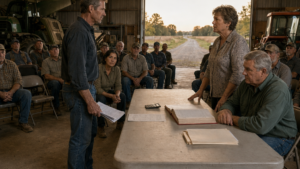
The volunteer fire hall was nearly full.
Farmers sat in folding chairs beside acreage owners, retirees, and people Patrick knew well enough to wave at but not well enough to trust with an unfinished accusation.
Linda waited until the room settled.
“This,” she said, “is why we are here.”
Patrick felt Jack shift beside the wall.
Linda continued.
“Shared infrastructure belongs to every member. When one family decides rules do not apply to them, everyone else pays.”
Patrick looked at the paper in her hand.
He had imagined this moment several ways during the drive over.
In most versions he interrupted.
In some he stood.
In none had he pictured himself remaining seated while Linda turned Ashley’s chalk into evidence of his character.
Then he remembered Ashley on the concrete.
He remembered Linda waiting for an argument.
Patrick kept his hands on the binder.
Linda described the marking violation, the unpaid fine, and Patrick’s records request.
She did not mention the chain.
She did not mention the fractured wrist.
When she finally stopped, Patrick raised his hand.
“May I ask one procedural question?”
Linda’s expression tightened.
“This is a member meeting.”
“That wasn’t my question.”
A few heads turned.
Patrick continued.
“Are financial records on tonight’s agenda?”
Linda looked toward the cooperative secretary.
“Yes.”
“Then I’d like to address those before anyone votes on enforcement.”
Linda hesitated.
“You requested this review.”
“I requested records. You called the meeting.”
That distinction mattered.
Patrick stood and carried the binder to a small table beside the lectern.
He did not begin with the missing money.
He began with his own mistakes.
“Two invoices I originally questioned were legitimate emergency expenses from the washout four years ago.”
The room changed slightly.
Not dramatically.
Just enough that Linda looked surprised.
Patrick held up copies.
“I was wrong about those.”
Someone in the back shifted a chair.
Patrick continued.
“A third payment I thought was duplicate work was a delayed contractor settlement. I removed it.”
Linda folded her arms.
“So your investigation found accounting practices you didn’t understand.”
“Some.”
“Exactly.”
Patrick nodded.
“Yes.”
That answer bothered her more than denial would have.
He opened the binder.
“Which is why I’m not asking anyone here to accept every concern I had when I started.”
He placed photographs of the unreplaced culvert beside its paid replacement invoice.
“This one is different.”
Linda leaned forward.
“The invoice may reference a different crossing.”
“It includes the access-road identifier.”
Jack stepped away from the wall.
“It does.”
Linda looked at him.
Patrick did too.
Jack’s face was unreadable.
Patrick moved to the duplicate pest-control payments.
Then the August snow invoice.
He made no claims about intent.
Only dates, amounts and physical verification.
A board member interrupted.
“Are you saying Linda stole money?”
“No.”
The answer came immediately.
Linda looked at Patrick for the first time as if she had expected another word.
Patrick continued.
“I’m saying the books don’t reconcile.”
Linda gripped the edge of the lectern.
“We move funds between categories when necessary.”
“Who approves the transfers?”
“The board has emergency authority.”
Jack spoke.
“During emergencies.”
Linda turned.
“You signed those reports.”
“I signed annual summaries.”
“You were treasurer.”
“I still am.”
The room grew still.
Patrick looked from one to the other.
Linda’s voice sharpened.
“You know what happened when nobody would make decisions. You know what the washout cost.”
“I do.”
“Then don’t act like procedure keeps roads open.”
Jack’s expression changed.
Not anger.
Weariness.
“I stayed because somebody had to tell you no sometimes.”
Linda stared at him.
Jack looked toward the members.
“There were three proposed access suspensions last year I refused to sign.”
Patrick felt the information settle.
One involved an elderly landowner behind on an assessment.
Another concerned a family whose culvert had failed inspection.
Jack had not been quietly protecting Linda.
He had been quietly limiting her.
Patrick understood suddenly why Jack had sounded compromised for weeks.
He had been.
Just not in the way Patrick assumed.
Linda said, “Those members were out of compliance.”
“And cutting access would’ve made things worse.”
“You don’t get to rewrite responsibility because Patrick brought a binder.”
Patrick almost spoke.
Stopped.
This was exactly the mistake he had been making.
Treating every person as either evidence or obstruction.
Jack’s reasons belonged to Jack.
Patrick returned to the numbers.
“I want to show the reconciliation.”
Linda’s attention snapped back to him.
Patrick placed copies where the board could see them.
“Fine collections for the period total this amount.”
He gave the figure.
“Deposits attributed to those collections total less.”
Linda said, “Because income is moved between accounts.”
“That should still appear somewhere.”
“It does.”
“Then show me.”
Silence.
Linda looked toward the secretary.
The secretary shook her head slightly.
Patrick continued.
“There may be records I was not provided. If there are, this can be resolved quickly.”
Linda’s jaw tightened.
“You’re implying misconduct.”
“I’m identifying an unreconciled difference.”
“You came here because your daughter broke her wrist.”
Patrick felt heat rise in his face.
Several people looked at him.
Linda had found the place where precision became difficult.
“Yes,” he said.
“She drew on cooperative property.”
“Yes.”
“You refused to pay the fine.”
“Yes.”
“And now you want this room to believe your financial review is objective?”
Patrick looked down at the binder.
For one second, he wanted to unload everything.
The chain.
The surgery.
Ashley waking at three in the morning.
The fear in her voice when she asked if chalk had caused it.
Instead he pulled out two pages.
“These are the accusations I removed.”
Linda frowned.
Patrick set them aside.
“I wanted you to be wrong about everything.”
The room stayed silent.
“You weren’t.”
He tapped the old emergency invoices.
“These were legitimate. The washout was real. You kept roads open when the board was slow.”
Linda’s face shifted.
Only slightly.
Patrick continued.
“That makes the rest more important, not less.”
He turned to the next page.
“Emergency spending continued to be classified loosely after the emergency ended. Fine revenue increased when those costs should have declined. Some vendor payments went to businesses connected to people you know. That may be lawful. Some services cannot be verified. That may have explanations.”
Linda said nothing.
Patrick pulled out the final reconciliation.
“But this does not balance.”
He placed it on the table between them.
One column showed collected penalties and assessments.
Another showed deposits and documented transfers.
A remaining figure sat at the bottom.
Not circled.
Not highlighted.
Just there.
Linda looked at it.
Patrick waited.
She looked again.
Then she said, “You don’t understand what it takes to keep this cooperative solvent.”
“Then explain that number.”
“We had obligations.”
“Which ones?”
“Contractor reserves. Pump contingencies. Road failures.”
“Where are they recorded?”
Linda’s lips pressed together.
Patrick heard a chair creak behind him.
No one interrupted.
Linda finally said, “Sometimes money had to be moved before approval because waiting would have cost more.”
Patrick nodded.
“How often?”
“That isn’t the point.”
“It is now.”
For the first time that evening, Linda had no paper in her hand.
Ashley’s violation lay facedown on the lectern.
Patrick slid the reconciliation toward the center of the table.
He did not accuse her of stealing.
He did not need to.
He asked the one question the binder had finally earned him the right to ask.
“Linda, where did this money go?”
Chapter 7: When the Gate Opened Again
“Are you accusing me of stealing?”
Linda’s question landed harder than anything Patrick had said.
No one moved.
The reconciliation sheet lay between them on the table. Linda’s hands were flat against the lectern now, Ashley’s violation still facedown beside one wrist.
Patrick could have said yes.
Part of him wanted to.
He had imagined Linda being forced to answer for the chain, the ticket, the weeks Ashley had avoided the lane. He had imagined the room finally seeing what he had seen.
But the binder did not prove theft.
It proved something narrower.
And narrower, Patrick had learned, was sometimes stronger.
“No,” he said.
Linda blinked.
Patrick rested one hand on the open binder.
“I’m saying money was moved without proper approval. I’m saying some expenses were classified in ways the records don’t support. I’m saying some vendor relationships weren’t disclosed clearly. And I’m saying the cooperative collected more in fines than I can reconcile to the records I was given.”
“That’s a careful way to say the same thing.”
“No. It isn’t.”
Patrick looked around the room.
“I spent weeks trying to prove things I was angry enough to believe. Some of them turned out not to be true.”
He touched the emergency invoices he had removed from his case.
“Linda did keep roads open during the washout. She did pay contractors herself when the cooperative was short. Those things matter.”
Linda’s shoulders lowered by a fraction.
Patrick continued.
“But emergency habits became normal habits. And once one person decides the rules can bend whenever that person thinks it’s necessary, nobody else gets to know where the line is.”
Jack stepped closer to the table.
Linda looked at him.
“You know what would have happened if I’d waited for approval every time.”
“I do,” Jack said.
“So why are you standing over there?”
“Because four years later, we’re still acting like the road is washing out.”
The sentence silenced the room.
Linda looked down at the reconciliation.
When she spoke again, her voice had lost its sharp edge.
“You think people remember the phone calls?”
Nobody answered.
“Two in the morning. Culvert gone. Water across the road. Contractor wants half up front. Board members won’t answer.”
She looked toward Patrick.
“I had people telling me to fix things and the same people refusing assessments six weeks later.”
Patrick thought of his own late payment.
Linda knew he remembered.
“I started moving money because there wasn’t time,” she said. “Then I started keeping reserve money where I knew I could reach it.”
“Without recording transfers correctly,” Patrick said.
“Sometimes.”
“And the vendors?”
Linda’s jaw tightened.
“My sister’s family had equipment available.”
“Were bids taken?”
“No.”
“Was the relationship disclosed?”
“I don’t remember.”
Jack said quietly, “It wasn’t.”
Linda closed her eyes for a moment.
Patrick saw something he had not expected to feel.
Not sympathy exactly.
Recognition.
This had not begun with somebody deciding to build a scheme.
It had begun with a crisis and a person discovering that breaking procedure sometimes produced faster results.
Then the crisis ended.
The power remained.
Linda opened her eyes.
“The fines covered shortages.”
Patrick looked at her.
“Say that again.”
“We had maintenance obligations and people behind on assessments. Penalties helped stabilize cash flow.”
“You budgeted expected fines.”
“Yes.”
“That means the cooperative needed members to violate rules.”
“No.”
“It means you planned on the money.”
Linda did not answer.
That was the deepest truth Patrick had found.
The fine issued beside Ashley’s broken wrist had not been an isolated piece of cruelty. It had entered a system that had learned to treat penalties as predictable income.
Patrick closed the binder.
Linda stared at him.
“What do you want?”
There it was.
Weeks earlier, Patrick would have answered immediately.
Cancel the fine.
Remove Linda.
Make her admit what she did.
Now those things seemed too small.
He looked toward the members.
“I want an independent audit.”
A board member shifted.
Patrick continued.
“Not my numbers. Not Linda’s. Someone outside the cooperative.”
He held up one finger.
“Until that’s done, no unilateral fines affecting access.”
A second.
“All vendor approvals above an agreed amount require two signatures.”
A third.
“Related-party vendors get disclosed before payment.”
Linda gave a humorless laugh.
“You think that will make emergencies wait politely?”
“No.”
“So what happens when a culvert goes at midnight?”
“Emergency authority stays.”
Patrick looked at Jack.
“But every emergency expenditure gets documented and reviewed afterward.”
Jack nodded once.
Patrick turned back to the room.
“And nobody loses water or road access because one person decided a fine wasn’t paid fast enough.”
The elderly landowner Patrick had spoken with weeks earlier raised his hand.
“Can we actually vote on that tonight?”
The secretary checked the bylaws.
“We can vote on interim procedures and authorize an audit.”
There was no dramatic swell.
No one stood.
People asked questions.
Some complained about cost.
One board member argued that an audit would embarrass the cooperative.
Another said embarrassment was cheaper than another year of guessing.
The vote passed.
Not unanimously.
Enough.
The independent audit was authorized.
Unilateral access suspensions were frozen.
Vendor approvals changed immediately.
Linda remained standing through all of it.
When the secretary finished recording the final motion, Linda removed a folder from beneath the lectern.
“I’ll resign as chair effective tomorrow.”
The room went still again.
Jack said, “You don’t have to decide that tonight.”
“Yes, I do.”
Linda looked at Patrick.
“You got what you wanted.”
Patrick shook his head.
“No.”
Her expression hardened.
He glanced at Ashley’s violation.
“I wanted my daughter to stop thinking she caused this.”
Linda followed his eyes.
For several seconds neither spoke.
Then Linda picked up the ticket.
She tore it once down the middle.
Not theatrically.
Almost tiredly.
“That violation is withdrawn.”
Patrick felt no triumph.
Only a quiet release he had not known he was waiting for.
Three weeks later, the cooperative sent every member a letter outlining temporary controls while the audit continued.
The preliminary review confirmed unauthorized transfers, poor classifications, incomplete vendor disclosures, and payments requiring further documentation.
It did not accuse Linda of theft.
Neither did Patrick.
Some neighbors thanked him.
Others stopped talking when he entered the feed store.
Linda still owned her land.
She still drove the same road.
Justice did not remove anyone from the map.
One Saturday morning, Patrick found Ashley standing beside her repaired bicycle at the end of the farm lane.
Her wrist was free of the brace.
She looked toward the irrigation crossing.
The compliance chain was gone.
Under the new rules, the gate stood open unless maintenance actually required closure.
“You coming?” Patrick asked.
Ashley gripped the handlebars.
“Maybe.”
He started walking beside her.
She pushed the bicycle at first.
At the concrete headwall, the old chalk had faded under sun and rain, but pieces of the rainbow remained—red near the bottom, blue along one cloud, a streak of yellow across the rough surface.
Ashley stopped.
Patrick waited.
“You didn’t wash it off,” she said.
“No.”
“Why?”
Patrick looked at the faint colors.
“Didn’t seem like it was hurting anything.”
Ashley smiled slightly.
Then she put one foot on the pedal.
Patrick felt the instinct to reach for the seat.
He stopped himself.
She pushed off.
Slowly at first.
The repaired wheel rolled across the same concrete where she had fallen.
Past the faded rainbow.
Past the place where Linda’s chain had been.
Through the open irrigation gate.
Ashley did not look back.
Patrick stood beside the crossing with his hands at his sides and watched her ride down the lane until the pink bicycle became small against the fields.
The gate remained open behind her.
The story has ended.