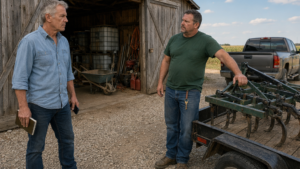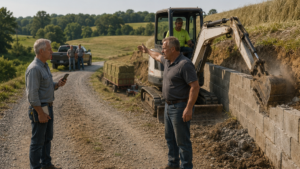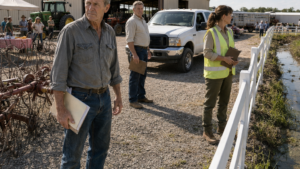
They Tore Down His Family Greenhouse, Then Learned Their Entire Development Needed Water From His Farm
Chapter 1: The Morning They Broke Forty-Two Greenhouse Panels
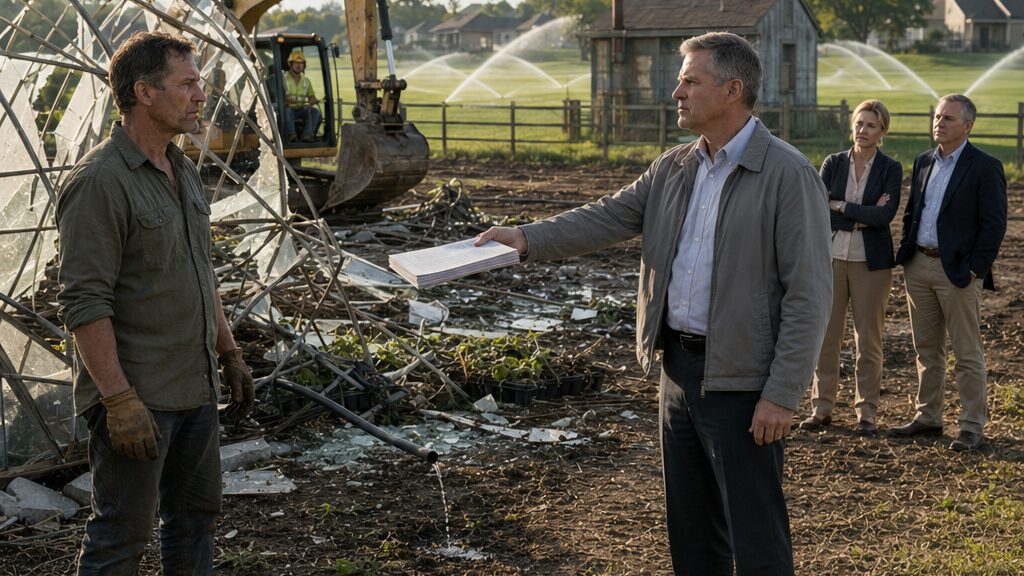
The excavator bucket came through the east wall before Jason Martin understood anyone had started the machine.
Glass burst inward above the potting bench. Jason threw both arms over his head and dropped behind a stack of seed trays as shards struck the concrete and skipped beneath the tables.
“Stop!”
The engine drowned him out.
He scrambled toward the center aisle. Beyond the broken wall, the excavator operator jerked backward at the sight of him. The bucket stopped with one steel tooth hooked through an aluminum greenhouse rib.
Jason ran for the opening.
“Shut it down!”
The machine finally went quiet.
For a moment all he heard was falling glass and the hard hiss of water.
A black irrigation hose had been torn from the wall manifold. It whipped against the floor, spraying a bright fan through the wreckage.
Jason stared at it.
Then at the bucket.
Then at the man standing beside the farm lane in khaki pants and a pale yellow polo.
Scott Campbell did not look surprised to see him.
That was when Jason knew this was not a mistake.
“What are you doing?” Jason demanded.
Scott held a folder under one arm. “Removing the structure.”
“This is my greenhouse.”
“We gave notice.”
“You sent complaints.”
“We sent enforcement notices.”
Jason stepped through broken glass. One pane cracked beneath his boot.
The greenhouse had stood on that patch of ground since before he was born. His grandmother had started tomato seedlings there when the frame was still bare galvanized pipe. Jason had replaced panels as money allowed, patched vents, rewired fans, and told himself every winter that next year he would replace the cloudy east wall.
He had never imagined seeing forty years of repairs hanging from an excavator bucket.
“You cannot bring equipment onto my farm.”
Scott’s jaw tightened.
“The association has an obligation to address nuisance structures affecting the development boundary.”
“The development boundary is the fence.”
“That’s disputed.”
“No, it isn’t.”
Scott looked toward the new houses beyond the cedar posts. “The board has documentation.”
“Then show me the documentation before you tear anything else down.”
The excavator operator climbed out of the cab.
“I didn’t know anybody was inside,” he said.
Scott turned sharply. “Stay with the equipment.”
Jason looked at the operator, then back at Scott.
“You started demolition without checking the building?”
“We were told the structure was unused.”
“By who?”
Scott did not answer.
Jason felt something warm inside his glove. He pulled it off. A narrow cut crossed the heel of his hand, bleeding just enough to slick the skin.
Scott noticed it and glanced away.
Jason wanted to hit him.
Instead, he bent and shut off the nearest irrigation branch. The torn hose still sprayed because the main greenhouse line had ruptured upstream.
The water pressure seemed suddenly obscene.
He walked through the rows.
Two benches were crushed.
A tray of pepper seedlings floated in muddy water. Clay pots lay broken beneath the excavator track. The old geraniums his mother had kept from his grandmother’s stock were flattened beneath one collapsed frame section.
He counted panels automatically.
Thirty-eight.
Forty.
Forty-two.
Forty-two damaged or destroyed.
He had spent nearly ten thousand dollars rebuilding the drip and mist system over the last six years, buying parts when the farm had a good month and waiting when it did not.
Scott followed him inside.
“You need to stay clear while the contractor finishes.”
Jason turned.
“Finishes?”
“The structure has been deemed noncompliant.”
“By an HOA that doesn’t own this parcel.”
“The board’s position is that the greenhouse sits within the controlled visual setback.”
“Your position.”
“The board’s.”
Scott opened the folder and removed a yellow sheet.
Jason did not take it.
Scott held it out anyway.
“What’s that?”
“Cleanup assessment.”
Jason almost laughed.
“How much?”
“Three thousand.”
Jason looked from the paper to the broken greenhouse around them.
“You hired a machine to tear up my property, and now you’re billing me for cleanup.”
“The charge covers removal of noncompliant material.”
Jason took the sheet then, not because he accepted it but because he wanted to see if Scott could actually stand there while he read it.
Scott could.
At the bottom, another paragraph warned of continuing penalties.
Jason tapped it with one bloody finger.
“Five hundred a day?”
“If you refuse compliance or interfere with completion.”
“You mean if I stop you from demolishing what’s left.”
“I mean the association has procedures.”
Jason folded the paper once.
Scott lowered his voice.
“Look, I know you’re upset. But those houses represent people’s savings. We’ve got buyers coming through the second phase this month. That greenhouse has been in every complaint packet for a year. Broken panes, rust, weeds along the back wall. It looks abandoned from the road.”
Jason stared at him.
For the first time he heard something beneath Scott’s certainty. Not regret. Pressure.
Scott needed this gone.
That did not make the destruction less real.
“You could have asked me to repair it.”
“We did.”
“You asked me to screen it from the subdivision.”
“And you didn’t.”
“Because your subdivision was built beside my farm.”
Scott exhaled.
“Jason, smart people don’t spend ten thousand dollars fighting a board over a structure worth less than that.”
Jason looked past him.
Across the fence, twelve houses sat along the curved development road. Fresh sod. White porch columns. Young maples tied to stakes.
Every lawn was being watered.
Sprinklers rose in synchronized arcs, glittering in the sun.
His own severed hose dripped beside his boot.
Jason watched one sprinkler head turn, pause, then sweep back.
Something about its rhythm bothered him.
Not the timing.
The pressure.
Those heads were running hard.
He walked out of the greenhouse.
Scott followed. “Where are you going?”
Jason did not answer.
At the fence he crouched near a patch where the soil had sunk slightly after last winter’s freeze.
There was an old blue marker half buried beside the cedar post.
Jason brushed dirt from it.
He had seen that color before.
His grandfather used blue paint on farm water lines.
Jason stood slowly.
Beyond the fence, all twelve lawns kept drinking.
Chapter 2: Twelve Green Lawns Beyond One Broken Fence
The pump-house door stuck halfway open.
Jason put his shoulder against it until swollen wood scraped over the concrete sill and released a smell of iron, dust, and old damp insulation.
He had not been inside in almost three years.
The building sat behind the equipment shed, low and square, with a corrugated roof his father had patched so many times that no two sections matched.
Jason switched on the light.
Nothing happened.
He used his phone instead.
Two pressure tanks stood against the rear wall. Old copper lines had been replaced in places with PVC, then replaced again with black polyethylene. Tags hung from several valves in his grandfather’s handwriting, faded nearly white.
North field.
House.
Greenhouse.
Then, lower on the main manifold:
East service.
Jason stared at it.
He remembered the words but not the purpose.
Outside, Scott was still talking to someone beside the excavator. Jason could hear his voice carrying across the yard.
He ignored it.
The east-service pipe left the pump house through the wall at knee height.
Jason followed it outside.
It ran underground toward the subdivision.
He crossed the yard, stepped over the torn greenhouse line, and returned to the fence.
The blue marker sat almost directly above where the old service pipe would pass.
Jason looked at the sprinklers again.
Then he went back inside.
A pressure gauge on the main line trembled just below sixty pounds.
He shut the greenhouse branch completely.
The needle barely moved.
He shut the north-field drip line.
The needle rose, then settled.
He opened it again.
Still the main pump cycled.
Jason crouched beside an old mechanical meter downstream from the east-service valve.
The glass was clouded. He wiped it with his shirt.
The tiny red triangle inside was turning.
Slowly.
Continuously.
Nobody on his farm was drawing through that branch.
But somebody was.
Jason stood.
Scott appeared in the doorway.
“Are we going to have a problem with access?”
Jason turned.
“You already have one.”
“I’m trying to keep this civil.”
“You brought an excavator through my greenhouse.”
“And I told you why.”
“No. You told me what you wanted.”
Scott glanced around the pump house.
His expression changed almost imperceptibly.
Recognition.
Jason noticed.
“You know this place.”
“I’ve seen the utility maps.”
“What utility maps?”
“Development infrastructure.”
Jason stepped between Scott and the manifold.
“This building isn’t development infrastructure.”
“The irrigation connection services common landscaping.”
“And twelve private lawns.”
Scott paused.
Jason pointed to the meter.
“That’s moving.”
Scott said nothing.
“Why is water leaving my pump house and feeding your subdivision?”
Scott folded his arms.
“There’s an easement.”
“Show it to me.”
“You should already have a copy.”
“I asked you to show me.”
“It was recorded when the first phase was approved.”
“When?”
“Before my time on the board.”
Jason gave a short laugh.
“So you know enough to bulldoze my greenhouse but not enough to tell me what gives you water rights across my property.”
“You’re trying to connect unrelated issues.”
“They’re both on my land.”
Scott’s face hardened.
“The irrigation agreement has been in place for years.”
“That’s not what I asked.”
Jason stepped outside and looked toward the houses.
The sprinklers had shifted zones. Four lawns had stopped while four more farther down the street began.
The pump cycled again behind him.
Scott followed.
“You’re not thinking about tampering with that connection, are you?”
Jason looked at him.
It was the first thing Scott had said all morning that sounded like concern.
Jason filed it away.
“I’m thinking about finding out what belongs to me.”
Scott’s voice dropped.
“Interfering with established service could expose you to liability.”
“Established by what?”
“The agreement.”
“Bring me the agreement.”
Jason walked away.
For the rest of the afternoon, he did the work Scott’s demolition had left him.
He shut the greenhouse supply, moved surviving plants into the packing shed, swept glass from the central aisle, and photographed everything before the excavator operator removed another piece.
He called the association office once.
No one sent the easement.
He called again.
A board member told him Scott handled property matters.
Near five, Jason went into the farmhouse office.
The room still looked more like his father’s than his own. Steel desk. Metal filing cabinets. Farm calendars pinned over old calendars. A calculator with oversized keys.
Jason opened the drawer marked WATER.
Pump receipts.
Well inspections.
Field irrigation plans.
Electric bills.
No easement.
He checked LAND.
Survey copies.
Tax maps.
A folder from when the subdivision developer purchased the acreage east of the farm.
No water agreement.
He found one unsigned sketch showing a proposed line from the farm well toward the development, but the page contained no dates and no terms.
Jason dropped it on the desk.
Barbara Martin was standing in the doorway.
At seventy-six, she still had the habit of moving quietly through rooms where other people were working.
She looked at the paper.
“You’ve been in the pump house.”
Jason leaned back.
“How’d you know?”
“You only make that face when you’ve found something your father should have explained.”
Jason slid the sketch toward her.
“What was east service?”
Barbara did not touch the paper.
“The development line.”
“You knew?”
“Of course I knew.”
“Why are twelve houses still running off our pump?”
“Because they always did.”
Jason stared at her.
“That is not an answer.”
“No.”
“Scott says there’s an easement.”
“There was paperwork.”
“Where?”
Barbara looked toward the cabinets.
Jason followed her eyes.
“I went through those.”
“I know.”
“You moved it?”
She folded her arms.
“Your father kept those papers somewhere else.”
Chapter 3: The Agreement Nobody Wanted Jason To Read
The county plat showed the water line ending at Jason’s parcel.
That was the first thing that made Eric Nelson stop clicking through records.
“Hold on,” Eric said.
Jason leaned closer to the monitor.
They were in the county land-records office the next morning, beneath fluorescent lights that made every old map look slightly green.
Eric enlarged the scanned plat.
A heavy line marked the original Martin farm boundary. East of it lay the subdivision parcels.
The water line crossed the Martin property, reached the boundary, and stopped.
Then a lighter line continued into the development.
Jason pointed.
“What’s the difference?”
“Recorded versus shown for reference, maybe. Let me check the instrument list.”
“Maybe?”
Eric looked at him.
“I locate records. I don’t interpret them.”
“Fair enough.”
Eric searched the parcel index.
Jason had brought the yellow demolition assessment, photographs of the greenhouse, and the hand-drawn sketch from his father’s filing cabinet. None of it mattered in that room unless it connected to a recorded number.
Eric found one.
“Utility easement. Nineteen years ago.”
Jason felt his shoulders loosen.
“There it is.”
“Don’t celebrate yet.”
Eric opened the scan.
The agreement was twelve pages long.
The first page named Jason’s father as grantor and the original development company as beneficiary. The easement permitted a buried irrigation supply across a defined strip of Martin land.
Jason read faster.
Access rights.
Repair obligations.
Metering.
Maintenance.
Damage restoration.
Then the term.
“Fifteen years.”
Eric nodded.
“Original execution date makes that expiration four years ago.”
“Renewal?”
“I’m looking.”
Jason stood very still.
Four years.
The development had been drawing water through his farm for four years after the written term ended.
Scott had walked into his greenhouse acting as if every rule flowed one direction.
Jason felt something cold and satisfying settle in his chest.
Eric clicked through later filings.
No extension.
No amended easement.
No replacement agreement.
“Nothing recorded,” Eric said.
“So they don’t have a right.”
“I did not say that.”
“The agreement expired.”
“The recorded agreement appears to have reached its stated term.”
“That sounds like the same thing.”
“It isn’t, if you plan on doing something expensive.”
Jason looked at him.
Eric turned back to the screen.
“Usage history matters. Notices can matter. Later agreements can matter even if somebody failed to record them properly. I’m not your lawyer.”
“I don’t have one.”
“Then don’t turn a valve because a county clerk found an old document.”
Jason’s jaw tightened.
“I haven’t turned anything.”
“Good.”
Eric scrolled down.
“Here.”
A clause required the development company to maintain the service line, repair farm damage caused by access, and contribute to major pump work according to usage.
Jason thought of invoices he had paid after his father died.
New pressure switch.
Pump motor rebuild.
Electrical service.
He had never billed anyone.
He had never known he could.
“That line has cost me money.”
“Possibly.”
“They never paid.”
“Possibly.”
Jason gave him a look.
Eric shrugged. “You came to the right office for paper, wrong office for conclusions.”
By noon, Jason had certified copies of the easement, plat, and parcel history.
He drove home with the folder on the passenger seat.
Scott called before Jason reached the farm.
“You were at county records.”
Jason kept his eyes on the road.
“You tracking me now?”
“Someone on the board saw you.”
“Then save me a trip. Send the current water easement.”
There was a pause.
“Our management company is locating it.”
“So you don’t have one.”
“I didn’t say that.”
“You demolished my greenhouse under rules you were sure about. Seems strange you can’t find the agreement feeding your lawns.”
Scott exhaled.
“Jason, the irrigation system has operated continuously for nearly two decades. Do not make a reckless decision because you’re angry.”
Jason nearly answered.
Instead, he hung up.
That afternoon he searched the farmhouse office again.
Not for the easement now.
For anything after it.
He found irrigation contractor invoices from eleven years earlier and a letter complaining that a trench crew had damaged a field entrance. Another note mentioned a pump repair contribution that had never been received.
Then, inside a property-tax folder that had nothing to do with water, Jason found a photocopy of a renewal notice.
The date was five years earlier.
One year before the easement expired.
The development management company had requested a ten-year extension.
Jason read it twice.
Someone in his family had been asked to renew.
His satisfaction vanished.
The bottom corner bore a handwritten notation.
Received.
Below it were two initials.
B.M.
Jason carried the page into the kitchen.
Barbara sat at the table sorting beans into a bowl, snapping the ends with the same small motion she had used since Jason was a child.
He placed the notice in front of her.
She stopped.
Jason did not sit.
“You told me Dad kept the papers somewhere else.”
Barbara looked at the initials.
“Yes.”
“You received this.”
“Yes.”
“Did he see it?”
Her fingers remained around one green bean.
“Yes.”
Jason waited.
She did not continue.
“Did he answer it?”
Barbara set the bean down.
“No.”
“Why?”
She looked up at him then.
Not confused.
Not embarrassed.
Afraid.
Jason had expected paperwork.
He had not expected fear.
“Mom.”
Barbara pushed the bowl away.
“If you want the answer,” she said, “you need to see what your father told me never to throw out.”
Chapter 4: What His Mother Hid In The Farm Ledger
Barbara stood before Jason could ask another question.
She crossed the kitchen, opened the narrow door beside the pantry, and disappeared into the small farm office where she had kept books for more than thirty years.
Jason followed.
She pulled a gray ledger from the shelf, set it on the desk, then reached behind the row where the binding had left a clean stripe in the dust.
From the gap she removed a long envelope.
It was yellowed at the edges and sealed with two strips of old transparent tape.
Jason recognized his father’s handwriting immediately.
DO NOT DISCARD.
Barbara laid it down between them.
“He made me promise.”
Jason stared at the envelope.
“You promised not to throw it away. You didn’t promise not to tell me it existed.”
“No.”
“Why didn’t you?”
Barbara sat.
For a few seconds she looked older than she had that morning.
“Open it.”
Jason tore through the tape.
Inside were copies of letters, invoices, photographs, and handwritten notes. The first letter was from the original development company, written six years before the easement expired.
It thanked his father for continued cooperation.
The next page was an invoice.
Pump motor repair.
Jason looked at the amount, then at the handwritten notation beside it.
Development share unpaid.
Another bill followed.
Trench repair after line access.
Unpaid.
Then photographs.
A muddy service truck had driven through the edge of a vegetable field. Deep ruts crossed planted rows. One photograph showed a fence section lying flat where equipment had entered.
Jason turned the picture over.
His father had written a date and one sentence.
Third time they entered without calling.
Jason’s anger shifted direction.
Not away from Scott.
Toward a history he had spent years refusing to learn.
Barbara opened the ledger.
She found a page marked with a strip of cloth.
Water-system expenses filled the left column. His father had written totals in the margins. Beside several entries were initials representing the development company.
Some had check marks.
Most did not.
“They owed him all this?”
“He said they did.”
“Did he ever collect?”
“Sometimes.”
“And the rest?”
“He stopped asking.”
“That doesn’t sound like Dad.”
Barbara gave him a tired look.
“You remember him after all of this had already gone bad.”
Jason said nothing.
He remembered his father arguing at the kitchen table, papers spread around him, coffee going cold while he circled legal language with a pencil. He remembered shutting doors so he would not have to hear about boundaries, access, drainage, easements.
He had told himself farming was work.
Paper was obsession.
Now he was standing inside the consequence of that distinction.
Barbara took a letter from the envelope.
“This is the one you need.”
Jason read it.
It was his father’s response to the development company’s renewal request.
The language was restrained.
Almost unnervingly so.
He listed the unpaid repair shares, repeated unannounced entries onto farm property, crop damage, and failure to restore disturbed ground as required.
Then came the final paragraph.
He would not extend the agreement unless the company first satisfied the maintenance obligations and negotiated new access conditions.
Jason lowered the paper.
“So he didn’t forget.”
“No.”
“He let it expire.”
“Yes.”
“And you knew.”
“Yes.”
The word landed harder each time.
Jason turned away and looked through the office window toward the ruined greenhouse.
“You let me pay for pump repairs.”
Barbara’s face tightened.
“I told you there were old accounts.”
“You never told me why.”
“You didn’t want to hear anything about your father’s disputes.”
“That was twenty years ago.”
“You still left every county envelope unopened until the last possible day.”
Jason turned back.
“That’s not the same thing.”
“It comes from the same place.”
He almost answered too quickly.
Barbara stopped him with a raised hand.
“You watched him become angry at every truck that slowed near that fence. Every phone call became another fight. Every repair was proof someone was taking advantage of him. He was right about some of it.”
“Some?”
“He was right about enough.”
Jason’s jaw tightened.
“And wrong about what?”
“Thinking the land had to win every argument.”
The office went quiet.
Barbara touched the ledger.
“After he died, notices still came. The development had changed hands. Different management. Different board. I thought if I kept the old dispute buried, you could farm without carrying it.”
“You hid a renewal notice.”
“Yes.”
“That might matter now.”
“I know.”
“You made it look like we ignored them.”
“I know.”
Jason’s voice sharpened.
“Scott demolished the greenhouse, Mom.”
“I know that too.”
The force went out of him.
Barbara did not defend herself.
That made being angry with her more difficult.
Jason sat opposite her.
“What else did you hide?”
“No agreement. No signed renewal.”
“You’re sure?”
“Yes.”
“Any letters from us after Dad’s refusal?”
“A few notices. I filed some. I put others away.”
“Why?”
“Because every time one came, you sounded exactly like him.”
Jason looked toward the envelope.
He wanted to reject that.
He could not.
The old pressure gauge in the pump house came back to him: needle holding steady while water moved toward people who did not know whose pump made it possible.
He had thought the records would give him a clean answer.
Instead, they had given him inheritance.
His phone buzzed on the desk.
Scott Campbell.
Jason let it ring once before answering.
“What?”
Scott’s voice was clipped.
“Our irrigation contractor needs access to the east service line tomorrow morning.”
“No.”
“There’s a reported pressure problem.”
“You don’t have an active access agreement.”
“That is not settled.”
“It’s settled enough that nobody comes through my gate without permission.”
“The board considers the service continuous.”
“The county records don’t.”
“County staff told you they don’t interpret agreements.”
Jason glanced at Barbara.
“So you’ve been asking around.”
“I’ve been doing my job.”
“You should have done it before the excavator showed up.”
A pause.
Then Scott said, “We are not going to allow one angry landowner to jeopardize an entire development.”
Jason felt the old instinct rise.
Push harder.
Make him feel it.
He heard his father in that instinct and hated recognizing it.
“What time?” Jason asked.
Scott hesitated.
“Eight.”
“I said no.”
“If access is denied, we’ll take whatever steps are necessary to restore service.”
The call ended.
Less than a minute later, an email arrived from the HOA management address.
Jason opened the attachment.
NOTICE OF SERVICE ACCESS.
The letter stated that association contractors intended to enter the Martin property the following morning to inspect and maintain irrigation infrastructure.
Barbara read over his shoulder.
Jason folded the printed page once.
Then again.
Outside, across the darkening field, the subdivision sprinklers clicked on.
Chapter 5: The Valve Scott Assumed Belonged To Everyone
The contractor truck stopped at Jason’s locked gate at 7:56 the next morning.
Jason was already there.
He stood beside the chain with his arms folded while the irrigation contractor climbed from the cab and looked through the bars toward the pump house.
Scott arrived four minutes later.
He parked partly on the shoulder and got out carrying a folder.
“Open the gate.”
Jason did not move.
“You gave notice,” he said. “That isn’t permission.”
Scott held up the folder.
“We have a service obligation.”
“To residents.”
“Yes.”
“That doesn’t create a right across my land.”
“The line has been maintained for years.”
Jason looked at the contractor.
“Did they show you a current easement?”
The contractor glanced at Scott.
“I was told there was access.”
Jason nodded.
“There used to be.”
Scott stepped closer.
“This is exactly why these agreements exist. Infrastructure can’t depend on somebody changing his mind overnight.”
Jason felt his hand close around the chain.
“Funny. My greenhouse depended on you not changing yours.”
Scott’s expression flickered.
“This isn’t about the greenhouse.”
“It became about more than the greenhouse when you drove equipment onto my property.”
“We acted under board authority.”
“Board authority stops at my fence unless you can prove otherwise.”
Scott opened the folder and withdrew a photocopy.
“The original easement.”
“Expired.”
“Continuous use matters.”
“Then take that argument somewhere that can decide it.”
Scott looked toward the contractor.
“We need to inspect the service line.”
Jason unlocked the gate.
For one second Scott looked satisfied.
Jason held the gate open only wide enough for himself.
“You can come with me,” he told Scott. “The truck stays here. So does the contractor.”
Scott frowned.
“Why?”
“Because I’m showing you something.”
They walked the farm lane in silence.
At the pump house Jason opened the door and switched on the portable work light he had hung from a nail that morning.
The main pressure gauge sat at fifty-eight pounds.
The east-service meter was moving.
Jason pointed to it.
“That’s your development.”
Scott said nothing.
Jason opened the greenhouse branch.
The gauge dipped.
He closed it again.
Then he opened the north-field valve. Water began moving toward the drip lines in the vegetable acreage.
The pressure stabilized.
Jason reached for a smaller isolation valve downstream of the farm branches.
Scott watched his hand.
“What are you doing?”
“Showing you the system.”
Jason turned the valve halfway.
The east-service meter slowed.
The north-field meter did not.
He opened it again.
The east-service meter returned to speed.
Scott’s face changed.
Not much.
Enough.
Jason had been waiting for that expression since the excavator bucket entered the greenhouse.
“You didn’t know,” Jason said.
“I knew there was a connection.”
“You didn’t know I could isolate it.”
Scott looked at the manifold.
Jason could almost see him rebuilding the development map in his head.
“That valve serves association irrigation.”
“That valve is inside my pump house, downstream of equipment I maintain.”
“The residents rely on it.”
“You rely on it.”
“Same thing.”
“No.”
Scott turned.
“You think shutting that line off makes you powerful?”
Jason’s pulse jumped.
Scott continued before he could answer.
“You’ll kill landscaping residents paid thousands to install. You’ll damage common areas. You’ll create claims against yourself.”
“You demolished my greenhouse.”
“And if the board acted improperly, there are processes for that.”
“You didn’t wait for a process.”
Scott looked away.
It was the first time Jason saw even a fraction of discomfort.
Then Scott said, “The second development phase closes on several properties this month.”
Jason stared at him.
There it was.
Not the entire truth, perhaps.
But enough.
“That’s why you rushed the greenhouse.”
“It was one factor.”
“You wanted the road clean before buyers came through.”
“I wanted an unresolved violation handled.”
“Before anybody checked whether it was actually yours to handle.”
Scott rubbed a hand across his mouth.
“The board has obligations to everyone in that development.”
“And I have obligations here.”
“Then act like it.”
The words hit Jason harder than Scott intended.
His father had probably heard some version of them.
Jason looked at the large steel valve wheel mounted on the east-service assembly.
The paint on its spokes was worn down where generations of hands had touched it.
He put one hand on the rim.
Scott went still.
“Don’t.”
Jason thought of forty-two panes.
His grandmother’s plants under mud.
The cleanup invoice.
Five hundred dollars a day.
The contractor waiting at his gate as if permission were an inconvenience.
He thought of every pump bill in the ledger marked unpaid.
Then he turned the wheel.
Metal groaned.
The east-service meter slowed.
Scott stepped forward.
“Jason.”
Another turn.
The meter almost stopped.
“Think about what you’re doing.”
Jason kept turning until the valve seated.
The little red triangle stopped completely.
The pump pressure rose.
For one sharp second, Jason felt something close to relief.
The system on his farm sounded healthier without the outside demand.
Scott stared at the motionless meter.
“You’re making a mistake.”
“Maybe.”
“You need to reopen that.”
“No.”
“I’m telling you—”
“You don’t get to tell me what to do in this building.”
Scott’s jaw flexed.
Then he left.
Jason stood alone with the steady hum of the pump.
He expected triumph to last longer.
It did not.
By noon, calls had started.
The HOA office.
A board member.
An insurance adjuster asking whether Jason had intentionally interrupted service.
Jason answered only factual questions.
Yes, he owned the pump house.
Yes, the line had been isolated.
No, he had not damaged anything.
No, he would not authorize entry.
That afternoon he walked the greenhouse rows.
Without the east-service demand, the farm gauge held pressure easily. The north field ran without its usual late-cycle drop.
The practical part of his mind noticed it immediately.
His farm had been carrying more of the load than he had realized.
He should have felt vindicated.
Instead, he kept seeing the houses.
Not Scott’s house.
All of them.
By the following morning, the first lawns had begun to dull.
By the second, strips of grass near the curbs looked gray-green.
The common flower beds drooped.
Jason avoided driving the development road.
He told himself that was because he had work.
On the fourth afternoon, a compact car stopped outside his gate.
A woman stepped out holding a square of sod.
She carried it with both hands like evidence.
Jason recognized her vaguely from the development.
Lisa Taylor.
She walked to the gate.
The grass she held had gone brown at the edges.
“Jason Martin?”
“Yes.”
She looked past him toward the pump house.
Then at the ruined greenhouse.
Her expression softened for half a second.
“I know what they did here.”
Jason waited.
Lisa lifted the dead sod.
“My family didn’t do it.”
He said nothing.
She came one step closer.
“Are we part of your fight anyway?”
Chapter 6: Brown Grass Was Not The Victory He Expected
The children’s play area had a brown crescent around the slide.
Jason saw it before he saw the people waiting for him.
Four days without irrigation had changed the development faster than he expected. The lawns were not dead, but their bright summer green had faded. Common shrubs sagged against fresh mulch. Dust showed along the edges of the walking path.
Lisa stood beside the community building.
“You came.”
“You asked me to.”
“I wasn’t sure you would.”
Jason looked toward the entrance.
“How many?”
“Enough.”
Inside, folding chairs had been arranged in rows.
Scott stood near the front with two board members. He looked tired.
Residents spoke in low clusters until Jason entered.
Then the room quieted.
He hated that more than anger.
Lisa took a seat near the aisle.
Scott stepped forward.
“We need to resolve service first.”
Jason remained standing.
“No. You want water first.”
“Yes.”
“And then you want to argue about everything else after your lawns recover.”
Scott’s voice stayed measured.
“People here did not authorize the greenhouse demolition personally.”
“I know.”
“Then restore service.”
A man in the second row said, “Is it true the line is on his property?”
Scott glanced at him.
“We’re reviewing the recorded rights.”
Lisa spoke without standing.
“That isn’t what you told us yesterday.”
Scott turned.
“What did I tell you?”
“That the farmer shut off association-owned infrastructure.”
Several residents began talking at once.
Jason looked at Lisa.
She held up a billing statement.
“This is what I wanted you to see.”
She walked to the front and handed it to him.
Jason read the line she had marked.
IRRIGATION INFRASTRUCTURE SURCHARGE.
Monthly.
It was not large individually.
Across the development, it added up.
Jason looked at Scott.
“What is this?”
“A maintenance assessment.”
“For what?”
“System upkeep.”
“Which system?”
Scott’s silence answered before he did.
Jason held up the page.
“You’ve been collecting money to maintain a connection you don’t have a current recorded agreement for?”
“That assessment covers internal lines, sprinkler heads, common-area repairs, management—”
“And the pump?”
Scott stopped.
Lisa said, “We were told it included source access.”
A board member spoke quietly.
“That was the understanding.”
Jason felt the room shift.
Not toward him exactly.
Away from certainty.
He placed the bill on the table.
“When did you tell residents the easement had expired?”
Scott’s eyes narrowed.
“We dispute that characterization.”
“When did you tell them there was no recorded renewal?”
No answer.
Lisa looked at Scott.
“You knew?”
“We knew there was a documentation issue.”
The room erupted.
Jason watched residents turn on Scott with the same heat he had carried for four days.
For a moment, it felt good.
Then a woman near the back said, “My husband and I moved here six months ago. I don’t care whose paperwork is wrong. I have two little kids and a yard turning to dirt.”
Jason looked at her.
The satisfaction disappeared.
Another resident said, “We paid what we were told to pay.”
Scott seized the opening.
“Exactly. Which is why service should be restored while legal issues are sorted out.”
Jason looked at him.
Scott was still trying to move the pressure off himself.
But he was not wrong about the residents.
That was the part Jason had not wanted to admit.
Lisa faced Jason.
“I saw your greenhouse.”
“I know.”
“What they did was wrong.”
Scott started to speak.
Lisa cut him off.
“But if you leave the water off until they admit it, you’re not only making Scott answer for it.”
Jason looked through the window toward the brown crescent around the playground.
His father’s letter came back to him.
Repeated trespass.
Unpaid repairs.
Refusal.
Then Barbara’s words.
The land had to win every argument.
Jason rubbed his thumb against a small cut still healing at the base of his palm.
“I can give temporary pressure.”
Scott straightened.
“Open the line.”
“Not permanently.”
“We need full service.”
“You need enough pressure to keep landscaping alive while this gets settled.”
“And who decides enough?”
“I do, until there’s a signed agreement.”
Scott almost laughed.
“That is not workable.”
Jason looked at the residents.
“Then stay dry.”
The room went silent again.
He regretted the line immediately.
Lisa’s face hardened.
Jason exhaled.
“That came out wrong.”
Nobody rescued him from it.
Good.
He continued.
“I shut the line because I was angry. I had reasons. That doesn’t mean every decision I made after that was a good one.”
Scott watched him carefully.
Jason turned toward the board table.
“Here’s what I’ll do. Twenty-four hours of temporary irrigation pressure. Enough to run scheduled zones. No contractor enters my farm. No work happens at the pump house.”
Scott said, “And after twenty-four hours?”
“The board signs a standstill agreement.”
“What does that mean?”
“No more fines against me. No access attempts. No further enforcement on the greenhouse parcel. No changes to the water system. Both sides preserve everything as it is while we negotiate.”
A board member whispered to Scott.
Scott ignored him.
“And if we don’t?”
Jason looked at the room.
“The temporary pressure ends.”
A resident near the back said, “Why should we trust either of you?”
Jason nodded.
“You shouldn’t have to.”
He pointed to Lisa’s billing statement.
“Put the terms in writing. Give every resident a copy.”
Scott’s expression tightened.
“You want to publicly frame this as board misconduct.”
“I want nobody finding out after the fact again.”
That landed.
Several residents murmured agreement.
Scott looked around the room.
For the first time, Jason saw what the man actually feared.
Not brown lawns.
Loss of control.
Jason understood it because he had felt the same thing when the excavator came through the glass.
Lisa stepped beside him.
“Twenty-four hours,” she said. “Written standstill. Then negotiation.”
Scott looked at her.
“You’re not on the board.”
“No.”
She held up the irrigation statement.
“But I’m one of the people paying you.”
One of the board members leaned toward Scott.
“We should sign something temporary.”
Scott’s face went pale with contained anger.
Jason waited.
Scott gathered his papers.
“I’ll have language drafted.”
“Tonight.”
“That’s unreasonable.”
“So was five hundred dollars a day.”
Scott looked at him.
Jason did not smile.
After a long moment, Scott said, “Tonight.”
Jason left before anyone could turn the moment into celebration.
At the pump house, he opened the east-service valve only partway.
The meter began moving.
The pressure gauge dipped, then steadied.
Across the fence, sprinkler heads coughed, rose, and began throwing narrow arcs over the browning lawns.
Jason watched them for one cycle.
Then his phone buzzed.
A new email.
Draft Standstill Agreement.
He opened it.
Scott had sent the document.
But the signature line was still blank.
Chapter 7: The New Water Line Had To Cross The Truth First
Scott arrived at Jason’s farm without the irrigation contractor.
That was the first thing Jason noticed.
The second was the folder in Scott’s hand.
The third was that Scott stopped outside the gate and waited.
Jason had been setting salvaged greenhouse rails into two piles beside the broken foundation when the truck pulled onto the shoulder. He wiped his hands on his jeans and walked down the lane.
Scott lifted the folder slightly.
“Revised terms.”
Jason unlocked the gate but did not open it.
“The standstill first.”
“It’s signed.”
Scott passed the document through the bars.
Jason checked the final page.
Scott’s signature was there. Two board members had signed beneath it.
The association agreed to suspend the cleanup assessment, daily penalties, enforcement activity, and any attempted access to the Martin property while negotiations continued.
Jason read the access clause twice.
Only then did he open the gate.
“You can come in.”
Scott followed him toward the packing shed.
The temporary irrigation arrangement had held for six days. Jason opened the east-service valve each morning to a marked position and closed it again after the scheduled watering window.
The subdivision lawns had stopped getting worse.
They had not recovered.
Neither had the greenhouse.
They sat at a folding table in the shade beside the shed. Lisa Taylor was already there with copies of the residents’ billing statements. Two board members joined them a few minutes later.
Jason put his father’s easement, the county plat, maintenance records, and the signed standstill in front of him.
Scott opened his folder.
“The board is willing to reimburse documented greenhouse damage beyond insurance coverage.”
Jason said nothing.
“We’ll withdraw the cleanup assessment and all related penalties.”
“Those were never legitimate.”
Scott’s mouth tightened.
“They’re being withdrawn.”
“And the demolition?”
“We’re reviewing the authorization process.”
Jason leaned back.
“No.”
Scott looked at him.
“You reviewed my greenhouse fast enough to put a machine through it. We’re not calling this finished until somebody says how that happened.”
One board member shifted in his chair.
Scott glanced at him.
The board member spoke.
“The enforcement file required a boundary review before physical removal.”
Jason waited.
Scott stared at the papers.
The board member continued.
“That review wasn’t completed.”
Lisa looked from him to Scott.
“Was it skipped?”
Scott answered.
“I authorized action based on the setback map we had.”
“That’s not what he asked,” Jason said.
Scott’s eyes met his.
For several seconds neither spoke.
Then Scott said, “Yes. I moved it forward.”
“Why?”
“You already know why.”
“I know what I think.”
Scott rubbed his thumb along the folder edge.
“The next group of houses was scheduled for buyer walk-throughs. We had complaints about the greenhouse. We had lenders asking whether unfinished boundary issues were going to affect common-area appearance.”
“So you made the problem disappear.”
“I thought the boundary question had been settled years ago.”
“You thought.”
“Yes.”
Jason looked at the broken greenhouse frame stacked twenty yards away.
That single word did not repair anything.
But it was the first time Scott had stopped hiding behind the board.
Lisa placed a billing statement on the table.
“And the water?”
Scott exhaled.
“The association operated under the assumption that continued use meant the original arrangement remained effective.”
“While charging us for source access,” Lisa said.
“For irrigation infrastructure.”
“You told residents source access was included.”
Scott did not argue.
Jason opened the old easement.
“I’m not renewing this.”
One board member looked alarmed.
“What happens to the water?”
“I said I’m not renewing this agreement. I didn’t say there can’t be another one.”
Scott looked up.
Jason slid a single-page proposal across the table.
“A new recorded agricultural easement. Defined route. Metered connection. No automatic entry rights. Written notice for nonemergency maintenance. Restoration for any damage. Shared pump expenses based on actual use.”
Scott scanned it.
“And an annual access fee.”
“Yes.”
“That number is high.”
“So was replacing a pump motor alone.”
“The residents already pay assessments.”
“Then the board can explain what those assessments actually cover.”
Lisa hid the beginning of a smile.
Scott continued reading.
“You also want a permanent farm-boundary acknowledgment.”
“Yes.”
“That has nothing to do with water.”
“It has everything to do with why we’re sitting here.”
Jason tapped the plat.
“The development recognizes the recorded Martin boundary. Any future setback or appearance enforcement stops at that line unless I voluntarily agree otherwise.”
Scott shook his head.
“The association can’t surrender legitimate nuisance remedies.”
“Then define legitimate.”
Jason pushed another page forward.
“No authority over farm structures solely because residents can see them. Health, runoff, actual encroachment—those are different. Appearance alone is not enough.”
One board member read silently.
Lisa said, “That seems reasonable.”
Scott gave her a tired look.
“You don’t negotiate these documents for a living.”
“No. I pay for the mistakes afterward.”
Nobody answered that.
Scott set the proposal down.
“What happens if the board refuses?”
A week earlier, Jason would have enjoyed the question.
He might have looked toward the pump house and let Scott imagine the valve closing.
Now he looked instead at the subdivision beyond the field.
Some lawns were still brown around their edges.
A child rode a bicycle along the sidewalk.
Jason said, “Then the temporary arrangement stays in place while we sort it out properly. I’m not shutting families off tonight to make you sign.”
Scott seemed surprised.
Jason noticed and disliked that he was pleased by it.
“But,” Jason continued, “you don’t get free permanent access because I decided not to punish people who weren’t standing in my greenhouse.”
Scott lowered his eyes to the proposal again.
The meeting took three hours.
They changed numbers.
They narrowed emergency-entry language.
The association agreed to reimburse the uncovered greenhouse loss, cancel every fine connected to the structure, and pay its share of documented pump repairs going forward.
The new easement would be recorded rather than left in private files.
Residents would receive annual accounting for irrigation charges.
The board accepted the farm-boundary language after adding county-code exceptions neither side disputed.
Scott resisted the annual water fee until Lisa asked him what alternative source would cost.
After that, the argument became arithmetic.
Near the end, Scott removed one sheet from his folder.
“There’s one more thing.”
He placed it before Jason.
A copy of the demolition authorization.
Scott’s signature was at the bottom.
Above it, a checklist included a line marked:
Boundary verification completed.
There was no verifying signature beside it.
Jason looked up.
“You signed anyway.”
Scott nodded once.
“I did.”
“Why show me this?”
“Because the board’s insurer is going to see it.”
“That’s not what I asked.”
Scott looked toward the greenhouse.
“Because I kept telling myself the greenhouse was the problem.”
Jason waited.
Scott added, “It wasn’t the only one.”
It was not an apology.
Jason did not need to pretend it was.
But it was enough truth to finish the negotiation.
The recorded documents took several more days.
The first new meter went into the east-service line the following week.
Jason stood in the pump house while the irrigation contractor installed it—this time after calling, scheduling access, and signing in at the farm gate.
When the work was finished, Jason opened the valve.
The new meter began turning.
The pressure gauge dipped, then settled exactly where it should.
Across the fence, sprinkler heads rose.
Water swept over the lawns in measured arcs.
Jason watched for a moment, then walked back toward the greenhouse.
The insurance payment and association reimbursement would cover most of the rebuild, but not the time. Not the old geranium stock. Not the years represented by bent aluminum and broken glass.
Barbara had helped him salvage what they could.
On the foundation, Jason set one cleaned section of the original frame upright.
Barbara steadied the opposite end.
“You’re keeping that piece?”
“It’s still straight.”
She smiled faintly.
“Your grandmother would approve.”
Jason tightened the first bolt.
Beyond the fence, water hissed over green and brown grass alike.
It no longer sounded like something being taken from him.
It sounded measured.
Accounted for.
Shared because he had chosen the terms.
Jason stepped back from the first standing greenhouse frame.
One salvaged pane leaned against it, cracked at one corner but intact enough to use.
He picked it up carefully.
Then he carried it toward the new opening.
The story has ended.