She Called Fourteen Inches Nothing Until the Concrete Crew Came Back to Tear It Out
Chapter 1: The Concrete Was Already Crossing the String
The concrete truck was already backing toward Kimberly Nelson’s yard when Eric Harris noticed the wooden form on his side of the fence.
He stopped halfway through his kitchen door, coffee still in his hand.
The truck’s reverse alarm pulsed through the quiet subdivision. Beyond the six-foot privacy fence separating the two properties, workers shouted directions over the grinding diesel engine. A gray chute swung toward a prepared section of Kimberly’s new pool deck.
Eric set his coffee down and walked toward the back corner of his yard.
For three weeks he had listened to excavators, saws, delivery trucks, and the steady clatter of a backyard being transformed. Kimberly had removed most of her old lawn and replaced it with a rectangular pool, broad concrete decking, a raised seating area, and black metal railing that would eventually run along the side nearest Eric’s property.
He had never objected.
It was her yard.
But now a form board appeared to be sitting several inches beyond the old fence line.
Eric crouched near the grass and looked through a gap where one fence picket had been temporarily removed.
A worker was adjusting reinforcing mesh.
“Hey,” Eric called.
The worker looked up.
“Is that edge supposed to follow the fence?”
The man glanced toward the form.
“That’s what we were given.”
Eric straightened. “Given by who?”
The worker pointed toward the other end of the yard. “Layout was already marked when we started this section.”
That answer bothered Eric more than he expected.
He walked to his shed, found a tape measure, and returned to the corner. The old fence had never been perfectly straight. Near the back, it leaned toward Kimberly’s property. Near the house, it seemed to bow slightly toward his.
Eric hooked the tape against a metal marker near a landscaping bed that he remembered from when he bought the house.
Or thought he remembered.
He measured toward the form board.
Twelve inches.
Then nearly fourteen farther up.
He measured again.
The numbers changed depending on where he started.
That should have reassured him.
Instead, it made the problem worse.
He did not actually know where the legal boundary was.
“Eric?”
Kimberly stood on the other side of the temporary fence opening.
She wore sunglasses and held her phone in one hand. Behind her, a worker guided the concrete chute into position.
“You okay?”
“I’m not sure.”
She followed his gaze toward the tape.
Eric tried to keep his voice casual. “I think your deck forms may be over the property line.”
Kimberly stared at him for a moment, then looked down.
“Over where?”
“Here.”
He pointed.
She stepped closer.
“That fence has been there forever.”
“I know.”
“So that’s the line.”
“I’m not sure it is.”
Kimberly gave a small laugh, not mocking exactly, but dismissive enough that Eric felt himself retreat half a step emotionally.
“How far are we talking?”
“Maybe a foot. Fourteen inches in one spot.”
She took off her sunglasses.
“Fourteen inches?”
“That’s what I’m getting, roughly.”
“Eric, that’s not even enough to walk through.”
“That’s not really the point.”
Her expression tightened.
Behind her, wet concrete began sliding from the chute.
Kimberly looked toward the crew, then back at him.
“I’ve got people standing here on the clock. If you have an actual survey showing something is wrong, show me.”
“I’m trying to figure that out.”
“Okay. Then figure it out.”
She turned toward the foreman.
Eric waited for her to tell them to stop.
She didn’t.
The concrete kept coming.
For the next ten minutes he stood beside his fence feeling ridiculous.
Fourteen inches.
It sounded petty even inside his own head.
He imagined explaining it to another neighbor. Kimberly is putting in a forty-thousand-dollar backyard and I’m worried about a strip of grass narrower than a kitchen cabinet.
Years earlier, at his previous house, a neighbor had widened a driveway and edged several inches onto what Eric believed was his side. He had noticed. He had said nothing. It seemed easier.
When Eric sold the house, the buyer’s inspector asked about the shared edge. Eric had spent weeks locating old documents and explaining an arrangement he had never formally agreed to.
He remembered promising himself he would never again confuse avoiding conflict with solving it.
Yet here he was watching wet concrete spread into forms while telling himself he should not make a scene.
By noon, the first section was finished.
Eric went inside and pulled open the bottom drawer of a filing cabinet in his home office.
Closing papers.
Tax records.
Old HOA notices.
A packet from when he had refinanced.
Near the bottom he found the recorded plat from his purchase.
The page showed both lots as clean rectangles with dimensions along each boundary.
No fence.
No pool.
No fourteen-inch strip.
Eric took the document outside.
The more he compared the drawing to the physical yard, the less comfortable he became.
The rear property corners were easy enough to approximate, but the side line between his house and Kimberly’s depended on markers he could not confidently locate.
He called the county records office and asked whether they could tell him where his boundary physically sat.
The clerk was polite.
“We can give you the recorded plat,” she said. “We can’t establish the line on the ground for you.”
“So who does?”
“A licensed surveyor.”
Eric thanked her and hung up.
By then the crew had gone to lunch.
He walked to Kimberly’s front door with the plat folded in his hand.
She opened it after the second knock.
“I found the recorded lot dimensions,” he said.
She looked at the paper but did not take it.
“And?”
“And I still think we should check before more gets poured.”
Her mouth tightened.
“You said yourself you don’t know where the line is.”
“That’s why I’m asking you to hold off.”
“For how long?”
“I don’t know. A day or two?”
She shook her head almost immediately.
“You don’t understand how this works. If I stop them, I lose the slot. Then I get rescheduled, I pay another mobilization fee, and everything else gets pushed.”
“I understand it costs money.”
“No, Eric, you understand that theoretically.”
He said nothing.
Kimberly looked toward the backyard.
“We’ve been planning this since winter. My family is coming in next month. This has already run over budget.”
“I’m not trying to stop your pool.”
“It feels like you are.”
“I’m asking you not to build on my property until we know where it is.”
The sentence came out firmer than he intended.
For the first time, Kimberly looked genuinely irritated.
“If there’s actually a problem, we’ll deal with it. But I am not shutting down an entire job because you walked outside with a tape measure.”
She closed the door gently rather than slamming it.
Somehow that bothered him more.
That afternoon Eric called three survey companies.
The first could come in two weeks.
The second did not handle residential boundary work.
The third put him through to Ryan Gonzalez.
Ryan listened without interruption.
“Existing fence?” he asked.
“Yes.”
“Any recent survey pins visible?”
“Maybe one in the back. I’m not sure.”
“Construction active right now?”
“They poured some today.”
Ryan paused.
“What are they pouring tomorrow?”
“From what I heard, the larger side section.”
“That’s the section near your line?”
“Yes.”
Another pause.
“I can move some things around and get there Wednesday morning.”
Eric looked through his office window.
Workers had returned.
One of them was stripping plastic from another bundle of reinforcing mesh.
“Tomorrow is Tuesday.”
“I know.”
“Can you come before then?”
“I can’t responsibly tell you where that boundary sits without doing the fieldwork.”
“I’m not asking you to guess.”
“I understand. But tomorrow morning isn’t possible.”
Eric rubbed the bridge of his nose.
Ryan added, “If you believe construction may be crossing your property, tell your neighbor and the contractor clearly that you dispute the location. Put it in writing. What they do after that is their decision.”
Clearly.
Eric looked at the plat lying beside his keyboard.
He had spoken to Kimberly twice.
Both times he had softened his words because he wanted to sound reasonable.
Maybe.
I think.
Roughly.
We should probably check.
Outside, the foreman stretched a chalk line beside the old fence.
Eric watched him for several seconds.
Then he opened his email.
Before he could type, a worker called across the yards.
“Mr. Harris?”
Eric stepped outside.
The foreman stood beside the fence opening.
“Just so you know,” he said, “we’re starting the main pour at seven tomorrow.”
Eric looked at the prepared forms.
They ran nearly the entire length of the future pool deck.
And in several places, they appeared to cross the same invisible line he could not yet prove existed.
Chapter 2: Fourteen Inches Became a Fact
The survey stake appeared on Kimberly’s side of the old fence.
Eric stared at it.
Ryan Gonzalez had driven the bright wooden marker into the ground less than two feet from where Eric was standing. The fence, which Eric had treated for years as the obvious division between the properties, sat several inches away at an angle.
“So the fence is wrong?” Eric asked.
Ryan adjusted the tripod supporting his surveying instrument.
“The fence is a fence.”
“That doesn’t answer the question.”
“It does, actually.”
Ryan looked through the instrument again.
“A fence can be on a boundary. It can be inside a boundary. It can cross one. Unless it was specifically placed from a survey, I don’t assume anything about it.”
The pool crew had already poured most of the large side section Tuesday morning.
Eric had emailed Kimberly Monday afternoon stating that he disputed the boundary location and was arranging a survey. He had copied the contractor’s general office address from the sign on their trailer.
No one replied.
At seven twelve Tuesday morning, the first concrete truck arrived.
Eric had stood at his kitchen window watching the gray surface spread.
He had considered walking outside and planting himself in front of the crew.
Instead, he had told himself that he had documented the dispute. Kimberly knew. The contractor knew.
Reasonable people, he thought, would understand the risk.
Now it was Wednesday morning, and Ryan was establishing what reasonable assumptions had failed to establish.
He walked toward the front corner with a handheld receiver, then returned to the backyard and set another marker.
Eric followed.
Ryan finally stretched a thin line between the located points.
It passed along Kimberly’s side of the old fence near the rear.
Then, as it approached the new pool deck, the fence shifted.
The concrete did not.
Eric felt his stomach tighten.
The new deck edge crossed the survey line.
Not by much.
That was almost worse.
Ryan crouched and placed a short ruler perpendicular to the line.
“Here,” he said.
Eric leaned closer.
Fourteen inches.
A little under in one spot. A little over thirteen in another. At the widest finished section, almost exactly fourteen.
Eric had spent two days wondering whether he had imagined the whole problem.
Now the answer looked absurdly small.
A strip of fresh concrete fourteen inches wide.
“You’re sure?” he asked.
Ryan stood.
“I’m sure where the record boundary falls based on the monuments and plat I located.”
“And the concrete is over it.”
Ryan gave him a careful look.
“The concrete appears to extend beyond that line onto your parcel.”
Eric almost laughed at the precision of the wording.
“You surveyors really don’t like saying more than you have to.”
“We get hired for facts. People add enough opinions on their own.”
That stayed with Eric.
Kimberly came outside ten minutes later.
She looked first at Ryan, then at the stakes, then at the string.
“What is all this?”
“The survey,” Eric said.
“I can see that.”
Ryan introduced himself and explained what he had located.
Kimberly listened with crossed arms.
When he reached the deck, she interrupted.
“How far?”
Ryan indicated the widest area.
“Approximately fourteen inches.”
Kimberly looked at Eric.
There it was again—that number.
Not four feet.
Not half her deck.
Fourteen inches.
“You called a surveyor for fourteen inches.”
Eric felt heat rise in his neck.
“I called a surveyor because we didn’t know where the line was.”
“And now we know.”
“Yes.”
She gestured toward the pool.
“So what exactly do you want?”
“I want the construction on your side.”
Kimberly looked toward Ryan as though expecting him to say something about reasonableness.
He didn’t.
She exhaled.
“The concrete is already down.”
“I asked you to pause.”
“You told me you thought there might be a problem.”
“I told you in writing that I disputed the line.”
“After you measured from a marker you weren’t even sure about.”
Eric had no answer that would make the previous forty-eight hours cleaner than they were.
Kimberly stepped closer to the string.
“It’s fourteen inches at the widest point?”
Ryan nodded. “Approximately.”
“And what does that actually affect in his yard?”
Ryan packed a prism pole into his case.
“That’s not a surveying question.”
Kimberly gave a humorless smile.
“Of course.”
After she went inside, Eric remained beside the line.
He expected satisfaction.
Instead, he imagined the sound of saws cutting into concrete that had barely cured.
Ryan handed him a card.
“I’ll send the signed survey drawing when I finish the office work.”
“How soon?”
“Tomorrow.”
Eric looked toward Kimberly’s windows.
“I need something sooner.”
Ryan studied him for a moment.
“You have enough to understand the situation. Don’t turn my field marks into a legal conclusion I haven’t made.”
“I won’t.”
“And don’t move the stakes.”
“I won’t.”
“People do.”
That afternoon Eric drove to the county records office.
He requested another copy of the recorded plat and asked whether any easements affected the strip between the properties.
The clerk found utility easements near the rear but nothing that gave Kimberly use of Eric’s side yard.
Back home, Eric spread the documents across his kitchen table.
The amount of paper seemed ridiculous compared with the amount of land involved.
Fourteen inches.
He laid his hand flat on the table and imagined the width.
Then he remembered Kimberly asking what the strip actually affected.
At present, almost nothing.
Grass.
A narrow maintenance path beside his landscaping.
Space he rarely walked through.
But if ownership only mattered when a person was actively using every inch, property lines would mean very little.
Thursday morning Ryan emailed the completed survey.
Eric printed two copies.
He put one in a large envelope with a short letter stating that the new deck appeared to cross the surveyed boundary and asking that further work near the line stop until they agreed on correction.
He sent it certified.
Then he walked next door with the second copy.
Kimberly answered wearing workout clothes, her phone pressed between her shoulder and ear.
When she saw the survey, she ended the call.
“You mailed me something too?”
“Yes.”
“Why?”
“So there’s a record.”
Her expression changed.
Until then, the dispute had still existed inside the social rules of neighbors—doorstep conversations, irritated glances, maybe an HOA complaint if things became ugly.
Certified mail belonged to another world.
“Are you threatening to sue me?”
“No.”
“It feels like you’re building a file.”
“I’m documenting what’s happening.”
“Same difference.”
Eric held out the survey.
“The line is confirmed.”
Kimberly took it this time.
She looked at the diagram for several seconds.
Then she tapped the page.
“This doesn’t mean the entire project is illegal.”
“I didn’t say it did.”
“The pool itself isn’t over.”
“No.”
“The retaining wall isn’t over.”
“Not according to this.”
“So we’re talking about one edge of the deck.”
“Yes.”
“Fourteen inches.”
“At the widest point.”
Kimberly closed her eyes briefly.
“My contractor is coming back Friday to finish the railing bases and the last section.”
“Then tell them to stop near the line.”
“I’ll talk to them.”
It was the first thing she had said that sounded like movement.
Eric went home feeling a cautious release in his chest.
Maybe the paper had done what conversation had not.
Maybe this was the point at which the problem stopped growing.
Friday morning, at eight seventeen, a truck turned into Kimberly’s driveway.
Eric recognized the company logo from the earlier concrete work.
A second truck followed carrying forms and finishing equipment.
He stepped onto his back patio.
Workers began unloading beside the surveyed stakes.
One of them lifted the thin boundary string so a wheelbarrow could pass underneath.
Eric stared across the fence opening.
Kimberly stood near the pool speaking to the foreman.
She saw him.
Their eyes met.
For a moment neither moved.
Then Kimberly turned back toward the crew.
The first fresh concrete began rolling toward the unfinished edge.
Chapter 3: The Mistake Was Older Than Their Argument
Nicole Flores laid the permit drawing on the HOA clubhouse table and pointed to a clean black line.
“If this drawing is accurate,” she said, “the deck was never supposed to cross onto your property.”
Eric looked from the plan to Kimberly.
Kimberly sat at the opposite end of the table with both hands wrapped around a paper cup she had not touched.
For almost a week, Eric had believed the encroachment had become simple.
Survey correct.
Construction wrong.
Kimberly warned.
Kimberly continued anyway.
But the approved site plan in front of them complicated everything.
The proposed pool deck stopped inside Kimberly’s parcel.
Not barely.
There was a visible planned buffer between the deck and the boundary.
Nicole turned the page toward the pool contractor, who had joined the meeting at Kimberly’s request.
“Is this what your company built from?”
The contractor studied it.
“This is the permit set.”
“That wasn’t my question.”
He looked uncomfortable.
“We use multiple references in the field.”
Eric leaned forward.
“What references?”
The contractor tapped the plan.
“House location. Existing improvements. Field measurements.”
“And the fence?”
The contractor glanced at Kimberly.
“The fence was one of the existing improvements.”
Nicole sat back.
“One of?”
He nodded.
Eric felt something shift.
“What did your crew use to lay out that side edge?”
The contractor took a breath.
“The existing fence line.”
Kimberly turned toward him sharply.
“You told me you measured from the plan.”
“We did.”
“No. You just said you measured from the fence.”
“We used the fence to establish the working side because it appeared consistent with the property separation.”
“Appeared?”
The contractor’s voice hardened slightly.
“There were no visible survey pins where we were working. Your fence was established, both yards were landscaped, and nothing suggested it was substantially off.”
Eric looked down at Ryan’s survey copy.
Fourteen inches.
Substantially.
Again the number seemed capable of changing meaning depending on who was paying for it.
Nicole folded her hands.
“So the permitted design wasn’t the problem.”
“No,” the contractor said.
“The placement was.”
“Yes.”
“And nobody ordered a boundary survey before construction?”
Silence answered her.
Kimberly looked toward Eric.
“You didn’t have one either.”
“No.”
“This fence has been here since before either of us bought these houses.”
“I know.”
“So everybody believed it was the boundary.”
Eric started to answer, then stopped.
She was right.
For years he had mowed to the fence.
Kimberly had landscaped to the fence.
Neither had questioned it.
The mistake was older than their argument.
That knowledge took some of the clean anger out of him.
After the meeting, Eric drove to the municipal permit office with Nicole’s copy of the plan.
A staff member confirmed that the approved drawing showed the deck within Kimberly’s lot, though the office did not certify private boundary locations.
The permit had approved a design.
It had not guaranteed that the contractor placed that design correctly on the ground.
Eric left with fewer villains than he had arrived with.
That should have made the situation easier.
Instead, it made him feel worse.
That evening Kimberly came to the fence opening.
No sunglasses. No phone.
“The contractor says they may have some responsibility,” she said.
Eric nodded.
“That sounds right.”
“They’re reviewing it with their insurer.”
“Good.”
She looked toward the pool.
Most of the project was finished now. The water was clean blue. Patio furniture remained wrapped in plastic near the house. Black railing posts stood along one side, including several bases near the disputed strip.
“It wasn’t me trying to take your property.”
“I know that now.”
Her eyes flicked toward him.
That answer seemed to surprise her.
Eric continued, “The original mistake may not have been yours.”
“May not?”
“You kept going after I raised it.”
“You raised a concern. Then you got the survey.”
“And after the survey?”
Kimberly looked away.
“We’ll get to that.”
It was not an answer.
But it was different from dismissal.
Two days later Nicole asked both of them back to the clubhouse.
This time the HOA president attended, though he made clear at the start that the association was not deciding ownership.
“We’re trying to prevent this from turning into litigation,” he said.
Nicole slid a single-page proposal across the table.
A permanent easement.
Eric read it twice.
The basic idea was simple. He would retain ownership of the fourteen-inch strip but grant Kimberly continuing use for the deck edge and future maintenance. Kimberly would pay the legal preparation and recording costs. The HOA would note the resolution in its architectural file.
Kimberly spoke first.
“This fixes it without destroying anything.”
Eric looked at the diagram attached to the proposal.
The disputed strip was shaded.
Fourteen inches, converted into a legal arrangement that might last longer than either of them owned their houses.
Nicole said, “It could be the least destructive solution.”
Eric did not answer immediately.
Kimberly leaned forward.
“I’ll pay to have the paperwork done properly. You don’t lose ownership.”
“I lose control of that part.”
“You’re not using it.”
“That keeps coming up.”
“Because it matters.”
“To you.”
“Yes, Eric. It matters to me that we don’t tear up new concrete over a strip of grass you didn’t even know was on your side until last week.”
The room went quiet.
The statement stung because it contained enough truth to resist an easy response.
Eric had not known.
Had Ryan’s stake landed differently, Eric would still have been mowing to the fence without thinking about it.
Nicole spoke carefully.
“This isn’t about who deserves what. It’s about whether there’s a practical solution both of you can live with.”
Eric took the proposal home.
For the first time since the conflict began, he seriously considered saying yes.
He imagined the alternative.
Lawyers.
Inspections.
Cutting equipment.
Dust blowing across both yards.
A ruined relationship with the person living twenty feet away.
An easement could reduce all of that to signatures.
The next morning Eric called his homeowner’s insurance company because one line in the proposed agreement bothered him: maintenance responsibility.
He explained the situation to a representative.
There was a pause after he described the permanent deck encroachment.
“Has the easement already been recorded?” the representative asked.
“No.”
“Don’t sign anything based on this phone call alone. You’ll want legal review.”
“I’m asking whether it affects coverage.”
“It can affect future claims depending on the language. If someone is injured on an improvement physically occupying your parcel but controlled by your neighbor, responsibility can become complicated.”
Eric looked at the easement draft.
“What about selling the house?”
“That’s another reason to have a real-estate attorney or title professional review it. Recorded encumbrances can matter to buyers and lenders.”
“So this isn’t just fourteen inches anymore.”
The representative gave a small, tired laugh.
“Property paperwork has a way of making small distances complicated.”
After the call, Eric sat at his kitchen table staring at the shaded strip.
The compromise had looked like peace.
Now he saw what it actually did.
It preserved Kimberly’s concrete by moving uncertainty into the future—onto insurance, maintenance, resale, and whoever owned the houses after them.
His phone buzzed.
A message from Nicole.
Kimberly had agreed to pay all drafting and recording costs if Eric would sign.
A second message followed.
Several neighbors had apparently heard about the dispute. Nicole wanted to resolve it before “people started taking sides.”
Eric placed the phone face down.
Outside, the thin survey string still ran beside the finished deck.
Concrete on one side.
Grass on the other.
And between them, fourteen inches that had started as a construction mistake and was becoming something neither homeowner could simply sign away without consequence.
Chapter 4: A Quiet Compromise Would Cost Them Later
The draft easement was waiting in Eric’s inbox before breakfast.
He opened it at the kitchen table, read the first page, then stopped halfway through the second.
The language sounded harmless at first: continued use, access for maintenance, successors and assigns.
Then he reached the paragraph stating that the agreement would run with the land.
Not Kimberly.
Not Eric.
The land.
Whoever owned either house years from now would inherit it.
He printed the document and carried it outside.
The survey string was still stretched between Ryan’s stakes. Kimberly’s landscaping crew had worked around it, leaving a narrow seam of untouched grass beside the polished concrete.
Eric stood over the line.
Fourteen inches.
If he signed, the concrete stayed.
The arguments stopped.
Kimberly could finish the railing, uncover the furniture, have her family gathering, and move on.
He could move on too.
Except the agreement would still exist after everyone stopped being angry.
His phone rang.
Nicole.
“I sent you the latest version,” she said.
“I’m reading it.”
“It’s pretty standard language.”
“Standard for what?”
“A recorded easement.”
“That’s exactly the problem.”
Nicole was quiet.
Eric continued. “It doesn’t disappear when Kimberly sells.”
“No.”
“It doesn’t disappear when I sell.”
“No.”
“And if the deck needs repair, whoever owns her house gets access across that strip.”
“That would depend on the final wording.”
“It says access for maintenance.”
Nicole exhaled. “Eric, I’m not telling you to sign without having someone review it.”
“But you want me to sign.”
“I want both of you to avoid spending ten thousand dollars solving something that’s fourteen inches wide.”
There it was again.
Eric looked at the concrete.
“Would you sign it?”
Nicole did not answer immediately.
“That’s not really fair.”
“Why?”
“Because it isn’t my property.”
“Exactly.”
The silence that followed was different from their earlier conversations.
Nicole finally said, “There’s a board meeting tonight. Come before everyone else arrives. We can talk privately.”
At six thirty, Eric walked into the clubhouse carrying the easement draft.
Nicole was arranging folding chairs.
Two neighbors were already there near the coffee station. They lowered their voices when he entered.
Eric recognized the change immediately.
The dispute had escaped the two backyards.
Nicole noticed where he was looking.
“That’s part of why I wanted to talk.”
“How much do people know?”
“Enough to have opinions.”
“Of course.”
She put down the stack of paper cups.
“One version is that Kimberly accidentally built a few inches over and you’re insisting she tear out half the pool.”
Eric stared at her.
“That’s not even close.”
“I know.”
“Does she?”
“I don’t know where it started.”
One of the neighbors glanced toward them and quickly looked away.
Nicole lowered her voice.
“Some people think you should sign the easement.”
“Do they know what it says?”
“They know demolition is expensive.”
“That wasn’t my question.”
Nicole rubbed her forehead.
“No. Probably not.”
Eric looked around the clubhouse.
He had attended cookouts here. Holiday events. An annual meeting where people argued for forty minutes about mailbox paint.
He suddenly understood the pressure differently.
Nobody wanted to study easement language.
They wanted the unpleasant thing to disappear.
Fourteen inches made Eric easier to judge than a page of future liability.
Kimberly arrived five minutes later.
She carried no paperwork.
“Did you read it?” she asked.
“Yes.”
“And?”
“I’m not signing it.”
Her face changed instantly.
Nicole stepped between the chairs as though physical distance might soften the conversation.
“Eric—”
“No.” He kept his voice even. “I’ve spent days saying maybe, probably, let me check, let me think. I’ve checked.”
Kimberly folded her arms.
“So that’s it?”
“The agreement gives permanent use of part of my property to your lot.”
“It lets the deck stay where it is.”
“For as long as the easement exists.”
“You keep saying that like I’m stealing your yard.”
“I’m saying exactly what the document does.”
Kimberly looked toward the two neighbors. Eric saw the movement and hated how much it affected him.
He could feel himself becoming the man in the neighborhood story.
The difficult one.
The technical one.
The person willing to destroy expensive work over fourteen inches.
His old instinct returned: soften it. Offer something. Make everyone comfortable.
Then he remembered the driveway at his previous house and the buyer asking him to explain an arrangement he had never had the courage to define.
Eric set the draft on the table.
“I won’t grant permanent use.”
Kimberly’s voice dropped.
“Then what do you expect me to do?”
“Move the improvement back onto your property.”
Her jaw tightened.
“You know what that costs.”
“I know.”
“No, you know what the survey cost. You don’t know what demolition costs. You don’t know what rebuilding costs. You don’t know what happens when a crew has to remobilize.”
Eric took the criticism without answering.
She was right about that too.
Nicole said, “Could we look at another temporary agreement?”
Kimberly shook her head.
“Temporary does nothing. The deck doesn’t become temporary.”
The HOA president arrived, ending the private conversation.
The formal meeting was shorter than Eric expected.
The board refused to determine ownership or order demolition. It acknowledged that the approved architectural request had assumed all work would remain within Kimberly’s parcel and stated that any private encroachment would need resolution between the owners and relevant municipal authorities.
No one applauded.
No one openly attacked Eric either.
That almost made the tension worse.
As people folded chairs afterward, one neighbor approached him.
“Fourteen inches, right?”
Eric nodded.
The neighbor gave a sympathetic shrug.
“Man, I’d hate to see all that concrete wasted.”
“So would I.”
The answer seemed to confuse him.
Eric walked home alone.
The next morning a municipal code inspector arrived.
Eric had submitted the survey, the approved site plan, photographs of the construction, and copies of his notices several days earlier. He had expected paperwork, not a person.
The inspector measured near the pool, compared Ryan’s markers with the approved drawing, photographed the railing bases, and spoke separately with Kimberly and the contractor.
Eric stayed out of the conversation unless asked.
Before leaving, the inspector said, “This office isn’t adjudicating your private title dispute. The survey gives us a basis to review whether the installed work matches the approved location and required setbacks.”
“So what happens now?”
“We finish the review.”
Two days passed.
Then an orange notice appeared on Kimberly’s front door.
Eric saw it from his driveway when he came home from work.
Kimberly was already standing outside holding a white envelope.
She crossed the lawn toward him.
“You filed another complaint.”
“I submitted the survey to the permit office.”
“They gave me thirty days.”
Eric looked at the notice in her hand.
“To correct the affected work?”
“To bring the installation into compliance or provide an approved resolution.”
Her eyes were bright with anger now, but beneath it he saw something else.
Fear.
“Thirty days, Eric.”
He said nothing.
Kimberly lifted the notice between them.
“You got your deadline.”
Then she turned and went back across the narrow strip of grass that neither of them could pretend was insignificant anymore.
Chapter 5: On Day Twenty-Nine She Asked Again
The demolition crew arrived on day twenty-nine.
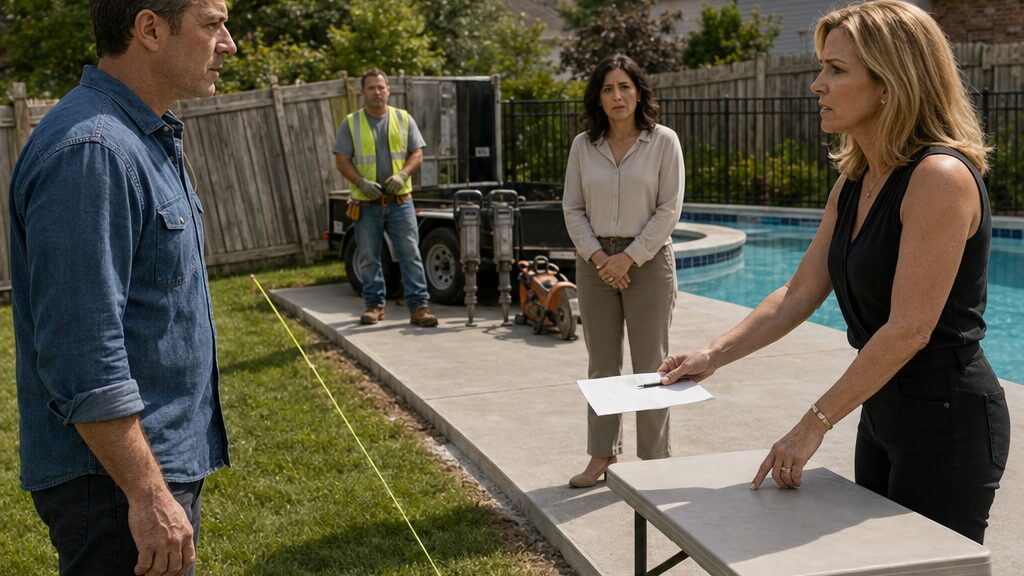
Two pickup trucks stopped along Kimberly’s curb shortly after seven. A trailer followed carrying a concrete saw, compressors, hoses, and two heavy jackhammers.
Eric watched from his kitchen.
No one unloaded the jackhammers.
Not yet.
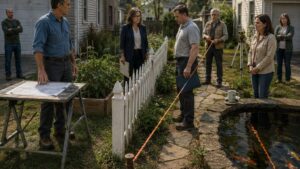
Kimberly stood beside the pool with the contractor and Nicole Flores. A folding table had been set near the patio doors. On it sat a stack of papers.
The survey string had been restrung the previous evening.
Thin.
Almost weightless.
It ran beside concrete that had taken trucks, forms, labor, steel, and thousands of pounds of material to create.
Fourteen inches separated the string from the outer edge of the finished deck.
Eric stepped outside.
Kimberly saw him immediately.
“Can we do this before they start?” she asked.
Eric walked through the opening in the fence.
Nicole looked tired.
The contractor looked worse.
The foreman stood near the trailer with his arms crossed, waiting for someone to make a decision that would determine whether his crew spent the day cutting concrete or driving away.
Kimberly pushed a document toward Eric.
It was another agreement.
Shorter this time.
“I had it revised,” she said. “No general maintenance access across your yard. No use beyond the exact existing footprint. I cover recording costs.”
Eric did not pick it up.
“Permanent?”
“Yes.”
“Then my answer is the same.”
Kimberly’s shoulders dropped.
“Read it.”
“I had the last one reviewed.”
“This isn’t the last one.”
“The basic thing hasn’t changed.”
Nicole spoke gently. “Eric, there are more limitations in this version.”
He looked at her.
“Does it let the concrete remain on my parcel?”
Nicole hesitated.
“Yes.”
“Then that’s the issue.”
Kimberly gave a short laugh.
Not amusement.
Exhaustion.
“You’re standing here with demolition equipment behind me over fourteen inches.”
Eric glanced toward the survey string.
“I’m standing here because the work crosses the line.”
“No reasonable person would look at that and say the right answer is tearing it apart.”
The foreman looked away.
Nicole lowered her eyes.
Eric felt every witness in the yard even though no crowd had gathered.
This was the moment Kimberly had been waiting for.
Not a legal argument.
A human one.
Fresh concrete. Finished railing. Wrapped furniture. A blue pool reflecting the morning light.
And one man willing to say it had to be cut because of a strip barely wider than his shoe.
His old instinct whispered again.
Give a little.
End it.
Be the reasonable one.
Kimberly pushed the pen toward him.
“You keep ownership. I pay everything. You never have to touch it.”
Eric looked at the unsigned agreement.
“No.”
The word landed harder than anything he had said during the previous month.
Kimberly stared at him.
Then something in her expression changed.
“Do you know what makes me furious?”
Eric waited.
“You act like I ignored you from the beginning.”
“I didn’t say that.”
“You think it.”
“I think you kept building after the survey.”
She shook her head.
“Before that.”
Eric frowned.
The contractor shifted his weight.
Kimberly pointed toward him.
“Ask him.”
The contractor looked uncomfortable.
“Kimberly.”
“No. Tell him.”
The foreman stopped pretending not to listen.
The contractor rubbed his jaw.
“There was a question about the fence before the second major pour.”
Eric felt the yard narrow.
“What kind of question?”
The contractor answered slowly. “One of the crew noticed the rear section didn’t line up cleanly with the dimensions we were pulling.”
Eric looked at Kimberly.
“When?”
She answered this time.
“The morning after you first talked to me.”
Before Ryan’s survey.
Before the large pour.
Eric stared at her.
“And you knew?”
“I knew they weren’t sure.”
“That’s different from what you told me.”
“I told you there wasn’t a confirmed problem.”
“You knew there might be.”
“Yes.”
The admission seemed to remove something from the air.
For weeks Eric had wondered why she kept going after his warnings.
Now he understood.
Kimberly’s voice tightened.
“The contractor told me stopping could push us back weeks. They’d already scheduled another job. I’d lose the concrete slot. There were change fees. My family was coming.”
“So you gambled.”
“I made a decision.”
“You gambled that the fence was close enough.”
She looked directly at him.
“No.”
Eric said nothing.
Kimberly continued.
“I gambled that if it was off by a few inches, you wouldn’t make me tear it out.”
The words were quieter than her earlier accusation.
That made them worse.
Nicole lifted her head.
The contractor stared at the ground.
Eric looked at the fourteen-inch strip.
The mistake had not started as theft.
It had started as an assumption.
Then it became a warning.
Then a choice.
Kimberly folded her arms tightly.
“I thought you’d be annoyed. I thought maybe I’d pay you something or we’d sign something. I did not believe you would take it this far.”
Eric felt a cold clarity.
For the first time, the conflict was not about whether she understood the boundary.
It was about what she believed his discomfort was worth.
She had mistaken his reluctance to fight for willingness to surrender.
Then Kimberly said, “But you knew too.”
He looked up.
“You watched them pour.”
“I told you to stop.”
“You asked me to stop.”
“I emailed you.”
“After the first section. And then when the big trucks came, you stood in your yard.”
Eric’s jaw tightened.
“I had no authority to order your contractor off your property.”
“You could have been clear.”
“I said there was a dispute.”
“You said you were getting it checked.”
“And you knew your own crew had concerns.”
“Yes. I did.”
Her voice broke slightly on the last word, but she kept going.
“And I made the wrong call. But don’t stand there acting like you did everything possible on day one.”
Eric wanted to reject that.
He wanted the clean version back.
He had measured.
He had warned.
He had hired Ryan.
He had sent certified mail.
He had followed procedures while Kimberly kept building.
All true.
But another truth sat underneath.
He remembered Monday afternoon.
The forms ready.
The next pour scheduled.
Ryan telling him: Tell them clearly.
Eric had written carefully instead.
He had chosen phrases designed to avoid sounding aggressive.
He had hoped documentation would do the confrontation for him.
“I should have said it stronger,” he admitted.
Kimberly blinked.
Eric continued. “I should have told you plainly that I objected to any further work near the line until it was surveyed.”
“You think that would have stopped me?”
“I don’t know.”
“Neither do I.”
They stood facing each other across a distance much wider than fourteen inches.
The contractor cleared his throat.
“We need a decision. If we’re cutting today, we need to start laying out the cuts.”
Kimberly closed her eyes.
When she opened them, she pushed the agreement toward Eric once more.
“Last time.”
Eric looked at it.
Then he folded the unsigned pages together and placed them back on the table.
“No permanent easement.”
Kimberly turned away.
The contractor walked toward the foreman.
Eric followed.
“Wait.”
The contractor stopped.
Eric pointed toward the survey string.
“What exactly are you removing?”
“We’ll cut back enough to rebuild the edge and make the finish continuous.”
“How far?”
The contractor explained that widening the demolition zone would make the patch less visible and allow them to replace a larger decorative section as one clean slab.
Kimberly gave Eric a bitter look.
“There. You want it perfect? Have them take the whole band.”
Eric studied the deck.
He could insist.
A wider replacement would look better from his side.
It might erase any visible reminder of the encroachment.
It would also cost Kimberly more.
He shook his head.
“No.”
Everyone looked at him.
“Remove what you need to restore the deck inside the surveyed line and make it structurally sound. Nothing extra for my benefit.”
The contractor frowned.
“You understand the color may not match exactly.”
“That’s her deck.”
Kimberly stared at him.
Eric pointed to the string.
“That’s the boundary. Stop there.”
The foreman finally opened the trailer.
Chapter 6: The Jackhammers Stopped at the Line
The first jackhammer strike fractured concrete that had not existed a month earlier.
Eric felt the vibration through the soles of his shoes.
The sound filled both backyards, sharp and mechanical, then settled into a relentless hammering that made conversation impossible.
A worker had scored the deck with the concrete saw before starting. White dust coated the wet cut line despite the hose spraying continuously along the blade.
Beside it, Ryan’s survey string remained untouched.
The difference between order and destruction was fourteen inches.
Eric stood near his patio for the first twenty minutes.
Then he went inside.
He had imagined this moment during the thirty-day deadline.
Not happily, exactly.
But clearly.
The concrete would come out. The boundary would be restored. The argument would finally become something measurable again.
Instead, every impact sounded expensive.
By midmorning, broken pieces of concrete filled a wheelbarrow.
Reinforcing mesh had to be cut.
One railing base came out with the surrounding section.
Workers moved carefully because the pool itself was not part of the violation and the remaining deck had to stay intact.
Kimberly stayed outside almost the entire time.
She never looked toward Eric’s windows.
At noon the contractor knocked on Eric’s back door.
Eric stepped outside.
“We need to show you something.”
He followed him to the pool.
The removal had exposed the edge clearly.
The old fence stood crooked beyond the survey string, proving in plain sight how easily it had misled everyone.
The contractor pointed toward a larger decorative seam.
“If we take this next section too, the replacement will look cleaner.”
“That’s beyond the boundary correction?”
“Yes.”
“How much beyond?”
“About three feet.”
Kimberly was standing ten yards away speaking to Nicole.
Eric looked at the concrete.
A month earlier he might have accepted the offer without thinking. A clean repair would look better. Nobody could accuse him of demanding it; the contractor was suggesting it.
But the three-foot section was entirely on Kimberly’s property.
“Leave it.”
The contractor raised an eyebrow.
“There may be a visible shade difference.”
“Still her deck.”
“You sure?”
“Yes.”
Kimberly had stopped talking.
She was listening.
The contractor nodded and returned to the crew.
Nicole walked toward Eric.
“That saves a decent amount of demolition.”
“I’m not trying to redesign her backyard.”
Nicole gave him a long look.
“I know that now.”
Eric almost smiled.
“That sounds like you didn’t before.”
“I thought you were right about the line.”
“That’s not the same thing.”
“No.”
Nicole watched a worker carry broken concrete toward the trailer.
“I thought you were letting being right become the whole point.”
Eric looked toward Kimberly.
“Maybe I was close to that.”
Nicole seemed surprised by the answer.
Eric rubbed dust from the top of the fence.
“I should’ve been more direct at the beginning.”
“You did warn her.”
“I warned her like someone who wanted credit for objecting without actually having the fight.”
Nicole said nothing.
“I kept thinking if I stayed calm and collected enough paperwork, everyone would eventually behave reasonably.”
“That’s not the worst instinct.”
“No. But sometimes it’s just fear wearing a tie.”
Nicole laughed once.
Then the jackhammer started again, ending the conversation.
By late afternoon the offending concrete was gone.
Not the pool.
Not half the patio.
A narrow, ugly channel beside the string.
Seeing it exposed made the entire dispute stranger.
Fourteen inches of missing deck looked both tiny and enormous.
Kimberly finally approached.
Her face was tired, and concrete dust had settled lightly on the black fabric of her shirt.
“The contractor told me you turned down the wider replacement.”
Eric nodded.
“You could’ve made them redo that whole section.”
“It wasn’t on my property.”
She looked at the cut edge.
“That never stopped this from becoming your problem.”
“No.”
For several seconds neither spoke.
Then Kimberly said, “I thought you wanted me punished.”
“I wanted it moved.”
“I didn’t believe that.”
“I know.”
She nodded slowly.
“I still think tearing this up was ridiculous.”
Eric looked at her.
Kimberly added, “And I know that doesn’t mean I had the right to leave it.”
It was not an apology.
Not quite.
But it was the first sentence she had offered that held both sides of the argument at once.
The next morning the crew began rebuilding the edge inside the surveyed line.
The new form followed Ryan’s string precisely.
The contractor asked Eric to inspect the location before pouring.
Eric refused.
“That’s not my job.”
The contractor looked irritated.
“You’re the one who complained.”
“I’m the one whose property was crossed. I’m not certifying your layout.”
The contractor stared at him, then nodded reluctantly.
They called Ryan.
He returned that afternoon.
Ryan checked the markers, measured the form, and made a small adjustment near the rear.
Less than an inch.
Nobody laughed about small measurements anymore.
Before the concrete was placed, the inspector also returned and photographed the corrected layout.
The new pour took less than an hour.
The damage around it would take longer.
A section of landscaping had been trampled.
The narrow drainage edge between the yards had been disturbed by equipment.
One of the fence posts leaned more noticeably after workers maneuvered material through the opening.
The contractor said the drainage swale would need minor reshaping.
“That crosses both sides,” he said.
Kimberly immediately looked at Eric.
A month earlier, that look would have started another argument.
Now Eric said, “Show me exactly where.”
They walked the strip together.
The work needed access from both yards.
Not permanent access.
Not an easement.
Just two neighbors allowing a crew to finish a practical repair.
Eric agreed, provided they marked the limits first.
Kimberly nodded.
No argument.
By the second evening, the heavy equipment was gone.
The survey string still remained.
Ryan had left it temporarily so the inspector could verify the final edge.
Eric stood beside it while the new concrete darkened as it cured.
Kimberly came through the fence opening.
“I want to ask you something.”
Eric waited.
“Not tonight.”
He looked at her.
She seemed almost embarrassed by the request.
“When all this is finished. No Nicole. No contractor. No HOA paperwork.”
“What about?”
“Everything we apparently couldn’t say while everyone was trying to solve it.”
Eric glanced at the new deck edge.
Exactly where it should have been from the beginning.
“When?”
“After the inspection.”
He nodded.
“All right.”
Kimberly started back toward her yard, then stopped at the string.
For a second she looked down at it.
“It’s strange.”
“What is?”
“How something that thin cost this much.”
Eric followed her gaze.
The string trembled slightly between the two stakes.
“It wasn’t the string.”
Kimberly looked at him.
Neither of them needed to say what had been.
She stepped over the boundary and went home.
Chapter 7: What Remained Between Two Backyards
The survey string was gone, but the concrete still remembered where it had been.
A pale seam ran along the rebuilt edge of Kimberly Nelson’s pool deck, newer concrete meeting older concrete in a line that would probably remain visible for years. The repaired section sat entirely inside her property now. Between it and Eric Harris’s grass was a narrow strip of open ground that looked almost too ordinary to have caused so much trouble.
Ryan Gonzalez stood over it with his equipment one final time.
Eric watched from his side while Kimberly waited near the pool.
Ryan checked the rear marker, moved forward, checked again, then entered something into his handheld unit.
Kimberly broke the silence first.
“Well?”
Ryan folded the pole down.
“The finished edge is inside your parcel.”
“How far?”
“Enough.”
Kimberly almost smiled.
Eric did.
Ryan caught it.
“That’s why I usually don’t give people extra numbers.”
He walked toward the front yard, leaving the two neighbors alone beside the place where the string had been.
Neither spoke until his truck door closed.
Then Kimberly said, “I guess that’s the official end of it.”
Eric looked at the repaired concrete.
“The inspection still has to close.”
“You know what I mean.”
He did.
Several weeks had passed since the jackhammers.
The municipal inspector had approved the corrected layout pending final verification. The contractor had reshaped the drainage edge and replaced the damaged landscaping. One leaning fence post had been reset.
There were no more trucks.
No orange notices.
No certified envelopes.
The neighborhood had grown bored enough to move on to another subject.
But Kimberly had asked him for a conversation without Nicole, without the contractor, and without paperwork.
Eric had not forgotten.
“Do you still want to talk?” he asked.
Kimberly nodded.
They stood rather than sit.
Perhaps both understood that sitting beside the pool would pretend a familiarity they did not have.
Kimberly folded her arms loosely.
“I got the final bill.”
Eric waited.
“I’m not telling you the number.”
“I wasn’t going to ask.”
“I know.”
She looked down at the concrete seam.
“The contractor’s insurance is covering part of it. Not all.”
“That seems fair.”
“Depends which day you ask me.”
Eric nodded.
Kimberly exhaled.
“For a while I wanted them to pay everything. I told myself they put it in the wrong place, so none of this was really mine.”
Eric said nothing.
She continued.
“They did make the first mistake.”
“Yes.”
“But when they raised the question about the fence, I told them to keep going.”
Her voice had none of the sharpness it carried on day twenty-nine.
“They said it might be nothing. I heard the part I wanted to hear.”
Eric looked toward the old fence.
It still ran slightly crooked between the yards, but now both of them knew it was not the boundary.
Kimberly rubbed one hand over the other.
“My family gathering was supposed to be the reason I couldn’t stop the job.”
“Was it?”
“Partly.”
She hesitated.
“I’d been talking about that pool for a year. I’d already spent more than I told people I was comfortable spending. Every delay made me feel like I’d made a stupid decision.”
Eric glanced at her.
“So stopping would’ve meant admitting it.”
“Something like that.”
A faint smile crossed her face and disappeared.
“And then you came over with a tape measure.”
Eric winced.
“You thought I was ridiculous.”
“I thought you were being Eric.”
“What does that mean?”
“You’re careful about everything. You measure before you hang a shelf. You keep receipts for things nobody keeps receipts for.”
“That sounds flattering.”
“It wasn’t meant to be.”
He laughed despite himself.
Kimberly did too, briefly.
Then she grew serious.
“I thought you’d complain, get irritated, maybe make me pay you something, and eventually decide it wasn’t worth fighting about.”
“I almost did.”
She looked at him.
Eric bent and picked a dry leaf from the grass.
“I didn’t tell you that part.”
“What part?”
“The first day. Ryan told me to make my objection clear.”
“You emailed me.”
“I did.”
“You told me you disputed the line.”
“I used careful words.”
Kimberly waited.
Eric looked toward the pool instead of at her.
“At my old house, a neighbor widened his driveway a little onto what I thought was my side. I let it go because I didn’t want a feud.”
“Did it become one?”
“No. That was the problem.”
She frowned.
“When I sold, the buyer started asking questions. There was nothing written down. No agreement. No survey. I’d spent years pretending it didn’t matter, then had to explain something I’d never actually resolved.”
Kimberly nodded slowly.
“So this time you weren’t letting anything go.”
“That’s what I told myself.”
“And that wasn’t true?”
“Not completely.”
Eric dropped the leaf.
“I still spent the first couple of days trying not to sound difficult. I wanted the paperwork to make the hard part unnecessary.”
Kimberly glanced toward the seam.
“It didn’t.”
“No.”
“You think if you’d been more direct, I would’ve stopped?”
Eric considered it.
“I don’t know.”
“I don’t either.”
That answer was more honest than blame.
A sprinkler clicked on somewhere down the street. The sound carried faintly between the houses.
Kimberly stepped closer to the boundary strip.
“I’m sorry I kept building.”
Eric looked at her.
She did not add a defense.
No mention of family.
No contractor.
No cost.
“I appreciate that,” he said.
Then, after a moment, “I’m sorry I let being calm become an excuse not to be clear sooner.”
Kimberly nodded.
Neither apology erased the concrete bill.
Neither restored the weeks of anger.
But Eric noticed that for the first time, they were not negotiating.
A few days later, the HOA held another meeting.
Nicole Flores sat with a revised construction-review procedure in front of her.
It did not pretend the association could determine private property ownership. Instead, projects close to recorded lot boundaries would require owners to acknowledge that HOA architectural approval did not establish boundary location and that professional verification might be necessary before work began.
The HOA president read the language twice.
One neighbor asked whether this meant everyone needed a survey to build a flower bed.
“No,” Nicole said patiently.
Another asked whether the new procedure existed because of “the pool thing.”
Nicole glanced once toward Eric and Kimberly.
“It exists because architectural approval and property boundaries are not the same thing.”
That was all.
No names.
No speeches.
No public apology.
Eric preferred it that way.
After the meeting, Kimberly caught him near the door.
“The drainage crew needs to get to that back corner again next month.”
Eric raised an eyebrow.
She immediately added, “One afternoon. I’ll send you the date. They stay inside the marked access area.”
He smiled.
“That sounds reasonable.”
“You want it in writing?”
“Yes.”
Kimberly shook her head.
“Of course you do.”
“So do you.”
She thought about that, then smiled back.
“Yeah. I guess I do.”
Later that week Eric found his old tape measure in the shed.
He carried it to the backyard without quite knowing why.
The pool was quiet next door. Kimberly’s furniture had finally been uncovered. The railing followed the corrected edge.
Eric hooked the tape at the place where the old encroachment had been widest.
He extended it across the grass.
Fourteen inches.
The distance looked smaller now than it had during the argument.
Or perhaps simply more accurate.
Fourteen inches had never been enough land to transform Eric’s yard.
It had been enough to expose every assumption surrounding it.
A contractor’s assumption that an old fence marked a legal line.
Kimberly’s assumption that inconvenience could make ownership negotiable.
Eric’s assumption that silence delivered politely was the same thing as speaking clearly.
He released the tape.
The metal blade snapped back into its case.
Across the boundary, Kimberly opened her patio door and noticed him standing there.
Her eyes dropped to the tape measure in his hand.
“You checking up on me?”
Eric looked at the concrete seam, then at the strip of grass between their yards.
“No.”
He closed the tape measure and slipped it into his pocket.
“I think we’re good.”
Kimberly nodded once.
Eric walked back toward his house without measuring the distance again.
The story has ended.