They Tried to Remove Him From the HOA Hearing Until His Old Property Notebook Changed Everything
Chapter 1: The Man They Put Behind the Folding Chairs
“You can’t sit there, Mr. Carter.”
Joseph had barely pulled the metal chair away from the long folding table when Brian Mitchell said it.
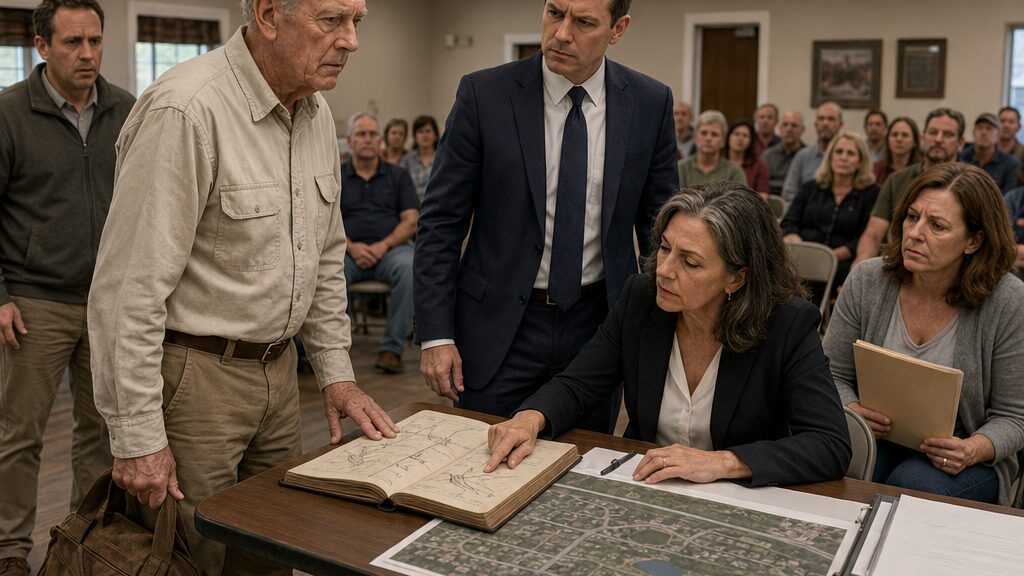
The clubhouse had been rearranged for the special hearing. Three board members sat beneath a blank projection screen, water bottles and binders lined neatly in front of them. The property manager had placed two rows of folding chairs behind a strip of blue painter’s tape for homeowners who wanted to observe.
Joseph looked at the empty chair in his hand.
“My property is the hearing.”
Brian glanced down at the agenda. His navy suit looked too formal for the room, especially beside the faded carpet and framed photographs of neighborhood holiday parties.
“You’re the homeowner involved,” he said. “You’re not counsel, and you’re not a board member. You’ll be called when it’s your turn.”
Joseph let go of the chair.
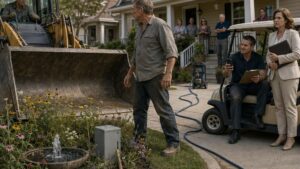
He was seventy years old, broad through the shoulders despite the slight stoop that had settled into him after retirement. He wore khaki pants, a pale work shirt, and shoes darkened at the edges from walking his side yard after the afternoon rain.
In his right hand hung a brown canvas bag.
Its leather handle had been repaired twice. One corner was stained almost black. The zipper no longer closed all the way.
Several people watched him carry it toward the second row.
Joseph chose the chair directly behind Brian.
On the front table sat a color printout showing his property from above. A red line circled the narrow depression between his house and Jennifer Wilson’s.
The caption beneath it was large enough for Joseph to read from where he sat.
UNAUTHORIZED DRAINAGE MODIFICATION.
He felt his jaw tighten.
Three weeks earlier, the HOA had ordered him to fill the depression, restore the grade, and pay accumulated fines. If he failed to comply, the association intended to hire a contractor and charge the cost against his account.
Joseph had answered each notice with the same sentence.
The swale was not unauthorized.
He had not explained further.
That had seemed reasonable at first.
Now it looked like stubbornness.
Patricia King, the board president, tapped her microphone.
“We’re going to keep this focused. The issue before us is drainage between Lots Forty-One and Forty-Two and the alleged alteration on Mr. Carter’s property.”
Alleged.
Joseph noticed the word.
It was the first useful thing he had heard all evening.
Jennifer sat at the opposite end of the front row. She wore a gray cardigan and held a folder against her knees. She had moved into the house next door less than three years earlier.
Joseph had once helped her replace a loose mailbox post.
They had not spoken like neighbors for months.
Patricia invited her forward first.
Jennifer stood.
“The water is getting closer to the house,” she said. “The last two storms, it reached the mulch under the dining-room window. I’ve got photographs.”
The property manager distributed them.
Joseph did not need to see them.
He had stood outside during the last storm and watched the water gather.
That was what bothered him.
Jennifer continued.
“When I bought the property, nobody told me the neighbor had a drainage ditch directing water along our boundary.”
Joseph looked up.
“It doesn’t direct water toward your house.”
Brian turned slightly.
“Mr. Carter, please wait until you’re recognized.”
Joseph pressed his tongue against the inside of his cheek.
Jennifer looked at him for only a second.
“What else am I supposed to think?”
That question hurt more than the accusation.
Because Joseph knew exactly what she was supposed to think.
She was supposed to think he had been there long enough to know better.
He lowered his eyes to the canvas bag.
Inside it lay a field notebook with a cracked brown cover and pages softened by decades of handling.
He had brought it because the association’s current map was wrong.
Not exactly wrong.
Incomplete.
Brian rose when Jennifer finished.
He spoke without drama, which somehow made his certainty harder to challenge.
“The association has reviewed the recorded plat, the current grading plan, and the architectural records available to management. There is no approved owner-installed drainage feature shown in that location.”
Joseph looked toward the enlarged property map.
“There wouldn’t be.”
Brian paused.
Joseph pointed.
“That sheet doesn’t show the overflow run.”
One board member leaned closer to the map.
“The what?”
“The overflow run.”
Brian exhaled.
“Mr. Carter.”
Joseph stood.
He did not raise his voice.
“The line you circled isn’t a ditch somebody dug after the houses were built. That low run was shaped before the back lots were finished. It carried stormwater past the common greenbelt.”
The room became quieter.
Patricia studied him.
“How would you know that?”
Joseph almost answered.
Then the old reflex stopped him.
He had spent thirty-eight years as a civil drafting technician. He had learned early that saying less was safer than saying something twice.
He lifted the canvas bag instead.
“I brought the measurements.”
Brian stepped between Joseph and the front table.
“The hearing packet closed Friday.”
“These aren’t comments.”
“What are they?”
“Field notes.”
Brian glanced at the bag.
Joseph saw the conclusion form before the attorney spoke.
Personal papers.
Old man’s records.
Not official.
Brian said, “If you want supplemental materials considered, they need to go through management.”
“They already should have.”
A few homeowners shifted in their seats.
Patricia frowned.
“What does that mean?”
Joseph looked directly at her.
“It means you’re trying to make me fill the part that still works because nobody looked at the part that disappeared.”
Brian’s expression hardened.
“This is exactly why we have procedures.”
“And the water doesn’t care about them.”
That drew a small sound from somewhere behind Joseph—not laughter exactly, but surprise.
Brian turned to the property manager.
“Would you please have Mr. Carter return to the seating area? We can continue with the scheduled presentation.”
Joseph did not move.
The property manager approached.
He was younger than Joseph, uncomfortable with the task.
“Mr. Carter.”
Joseph opened the canvas bag.
He removed the notebook.
Its cover looked even worse under the fluorescent lights.
He placed it on the edge of the front table.
Brian reached toward it but stopped short of touching it.
Joseph said, “One page.”
“No.”
“One page compared to the map.”
“Mr. Carter, you’ve been asked—”
Patricia held up her hand.
Brian stopped.
Joseph opened the notebook near the middle.
The paper was yellowed but clean. Pencil lines crossed the page in measured arcs. Small elevations appeared beside arrows. A narrow hand-drawn channel ran behind two rectangles representing the lots before the houses had landscaping, patios, or fences.
Joseph turned the book toward Patricia.
“Look at that line.”
She leaned closer.
For the first time that evening, Brian looked directly at the drawing instead of Joseph.
The property manager remained beside the chair, uncertain whether he was still supposed to escort anyone.
Patricia placed one finger near the top of the page.
“What date is this?”
Joseph did not answer.
She read it herself.
Then she looked at the current map.
Her eyes moved back to the notebook.
“Brian.”
He stepped closer.
Patricia turned another page.
Whatever she saw there changed her expression completely.
She looked past Brian toward the property manager.
“Don’t move Mr. Carter.”
Chapter 2: The Drainage Line Nobody Remembered Building
“June 18, 1998,” Patricia read aloud.
Nobody spoke.
Joseph remained standing beside the front table while Patricia studied the date written in the upper corner of the notebook page.
Jennifer had leaned forward in her chair.
Brian was the first to recover.
“A handwritten date doesn’t establish an approved easement.”
Joseph nodded.
“That’s true.”
The answer seemed to surprise him.
Joseph pointed at the drawing.
“But that isn’t an easement map. It’s a grading field sketch.”
He turned the notebook a few inches.
The pencil line ran behind what eventually became his lot and Jennifer’s. Small numbers marked changes in elevation.
Patricia compared it to the HOA’s current map.
“This channel continues through the greenbelt.”
“It used to.”
“Used to?”
Joseph tapped a spot on the modern printout.
“Right there.”
The current map showed shrubs, a decorative berm, and a walking path.
No drainage line.
Brian folded his arms.
“Again, the existence of historical notes does not establish that Mr. Carter is permitted to maintain an altered condition on his property today.”
Joseph looked at him.
“You keep calling it altered.”
“Because that is how management classified it.”
“Management was here in 1998?”
“No.”
“Then maybe classification isn’t the same thing as history.”
Patricia intervened before Brian answered.
She asked Joseph where the notebook came from.
He told her he had worked during the subdivision’s early construction phase, preparing field revisions and as-built markups for the civil contractor.
Jennifer stared.
“You worked on this neighborhood?”
Joseph looked at her.
“For part of it.”
“You never told me that.”
“You never asked.”
The words came out sharper than he intended.
Jennifer’s mouth closed.
Joseph immediately regretted it but did not apologize.
That was another habit he had carried too long: once embarrassed, he became precise instead of kind.
Patricia asked the property manager to retrieve the county plat files electronically.
For twenty minutes, the hearing became less orderly.
Pages were printed.
Maps were rotated.
Brian made several calls from the hallway.
Joseph stayed at the table now.
Nobody asked him to move.
That was a small victory, but it did not feel like one.
The county plat showed a drainage easement along the rear portion of several lots. It also showed a stormwater route entering the common area.
Then it stopped.
The section running between Joseph’s and Jennifer’s properties was missing.
Jennifer pointed at the gap.
“So his notebook shows a line the recorded plat doesn’t.”
“Yes,” Brian said quickly. “Which is exactly the problem.”
Joseph shook his head.
“No. The problem is you think one kind of drawing does every job.”
Brian looked annoyed.
“Explain.”
“The plat records property interests. It doesn’t necessarily show every temporary grade, field adjustment, or surface run.”
“Temporary,” Brian repeated.
Joseph wished he had chosen another word.
Patricia noticed.
“So the swale may have been temporary?”
Joseph looked at the notebook.
“It was built to move water.”
“That wasn’t my question.”
He hesitated.
“Some construction details change before final acceptance.”
Brian sat down slowly.
For the first time, Joseph could see calculation rather than dismissal in the attorney’s face.
At Patricia’s request, they agreed to inspect the site the next morning before any enforcement action continued.
At eight-thirty, Joseph stood in his side yard with Patricia, Jennifer, the property manager, and Brian.
The swale looked unimpressive in daylight.
It was only a shallow grass depression, perhaps three feet across at its widest point. Someone unfamiliar with drainage would have called it uneven landscaping.
Joseph walked along it.
“Water comes from the rear lots, enters here, then follows the low grade.”
Jennifer folded her arms.
“And then ends up beside my house.”
“Now it does.”
She frowned.
Joseph continued toward the common greenbelt.
At the property line, the depression became shallower.
Ten feet farther, it vanished beneath a landscaped rise planted with ornamental grasses and three young crepe myrtles.
Joseph stopped.
“That wasn’t there.”
Patricia looked toward the property manager.
“When was this installed?”
“Maybe six years ago. The common-area renovation.”
Jennifer stepped onto the edge of the berm.
“So where is the water supposed to go?”
Joseph pointed beyond it.
“Past that path, toward the collection basin.”
Brian looked at the notebook photocopy Patricia carried.
“Your sketch shows the run going through here.”
“Yes.”
“But the county record doesn’t.”
“No.”
Brian gave him a level look.
“You understand why that matters.”
Joseph did.
That was the part nobody in the room had wanted to hear the night before.
A notebook could establish memory.
It could establish knowledge.
It could even show what had physically existed.
It did not automatically establish who had legal responsibility for preserving it.
Patricia crouched near the edge of the berm.
“If this is the route, why wasn’t it captured in the association plans?”
Joseph did not answer.
He was looking at the photocopy.
Patricia had copied four notebook pages at the clubhouse.
The sequence numbers were still visible in Joseph’s handwriting.
Joseph felt the muscles between his shoulders tighten.
He reached for the copies.
Patricia handed them over.
“What?”
He checked again.
Page 119 was absent.
Not torn from the notebook.
Absent from the set he had chosen.
He remembered standing at his kitchen table before the hearing, selecting pages that showed the original grades clearly.
He remembered skipping one because the drawing on it was messy.
At least that was what he had told himself.
Brian noticed his expression.
“What is it?”
“Nothing.”
The word came too fast.
Jennifer heard it.
Patricia did too.
Joseph closed the photocopies against his palm.
Across the berm, morning sunlight caught standing water in a shallow patch of grass.
Brian said, “Mr. Carter, if there are additional field records relevant to this drainage route, we need them.”
Joseph looked toward his house.
The brown notebook was inside.
And suddenly he knew exactly what was written on page 119.
Chapter 3: The Page Joseph Never Wanted Them to See
Joseph found page 119 folded beneath the canvas lining of the bag.
He sat at his kitchen table with the notebook open in front of him and stared at the paper as if it had appeared there on its own.
It had not.
Years earlier, when the original binding loosened, he had tucked several fragile pages beneath the lining for safekeeping. Page 119 had separated from the rest sometime after retirement.
That explained why it was loose.
It did not explain why he had remembered enough about it to avoid looking for it.
The sketch showed the rear construction lane as it had existed during the subdivision’s second phase.
A pile of fill blocked the intended stormwater path.
Beside it, in Joseph’s handwriting, were three words:
TEMP. BYPASS EAST.
A line curved toward the future boundary between his lot and what would eventually become Jennifer’s.
At the bottom were two initials.
J.C.
Joseph leaned back.
He remembered the afternoon.
Not everything.
Memory at seventy was selective in strange ways. He could not recall what he had eaten for lunch that day, but he remembered the heat coming off the raw clay and the superintendent complaining that the next storm would wash half the site into the street.
The permanent route had been blocked by construction material.
Joseph had suggested a temporary shallow bypass.
It was supposed to move water for a few weeks.
Then crews would restore the original run.
He had initialed the field adjustment.
He had not been the project engineer. He had not possessed authority to redesign the subdivision.
But he had drawn the line.
And nobody had ever fully erased it.
Joseph rubbed his thumb across the faded pencil.
For weeks, he had told himself the HOA was wrong.
That remained true.
But the clean version of the truth—the version where everyone else had made mistakes while he merely remembered correctly—was gone.
His phone rang.
The property manager asked if he could come to the HOA office that afternoon.
“Brian found something in the archived contractor files.”
Joseph looked at page 119.
“What?”
“A personnel sheet. Your name is on it.”
Joseph almost laughed.
“Of course it is.”
There was a pause.
“You knew?”
“I worked there.”
“You didn’t put that in your response to the violation.”
“No.”
“Why not?”
Joseph folded the loose page once along an old crease.
“Because nobody asked who drew anything. You asked me to fill a swale.”
At the HOA office, Brian had removed his suit jacket. Without it, he looked less like the man who had ordered Joseph away from the hearing table and more like someone who had not slept well.
A photocopied contractor roster sat between them.
Joseph’s name was highlighted.
CIVIL DRAFTING TECHNICIAN.
Brian slid it forward.
“You worked on the development.”
“I told Patricia that yesterday.”
“After the hearing started.”
“Yes.”
“You responded to three notices without mentioning it.”
“Yes.”
Brian sat back.
“Do you understand what that looks like?”
Joseph did.
He looked at the highlighted line.
“It looks like I didn’t tell you.”
“It looks like you may have personal knowledge of an unrecorded modification and chose not to disclose it.”
Joseph’s face warmed.
Across the room, the property manager pretended to organize papers.
Brian continued.
“If you designed or authorized that drainage feature—”
“I didn’t design it.”
“You drew it?”
Joseph looked up.
Brian had guessed.
That bothered him more than if the attorney had known.
Joseph said nothing.
Brian’s expression changed.
There it was again: the moment silence stopped protecting Joseph and began speaking for him.
“You did.”
“I drew field revisions.”
“Including that swale?”
Joseph looked toward the window.
The office faced the clubhouse parking lot. Beyond the cars, the common greenbelt was visible between two houses.
“I drew a temporary bypass.”
The property manager stopped moving papers.
Brian leaned forward.
“Temporary.”
“Yes.”
“And that bypass is where the present swale sits?”
“Part of it.”
“Part of it?”
“The original drainage came through the rear. During construction, the main route was blocked. We moved surface water around it.”
“We.”
Joseph looked at him.
“The site crew.”
“And you documented it.”
“Yes.”
Brian was quiet.
Joseph expected satisfaction.
Instead, the attorney looked almost tired.
“Why didn’t you say this Monday?”
Joseph could have answered that the HOA never asked.
He could have said management classified the problem before investigating.
Both were true.
Neither was the real answer.
“Because it was supposed to be temporary.”
Brian waited.
Joseph kept his eyes on the table.
“I spent most of my working life telling people drawings mattered because somebody had to be accountable for what got built. Then I retired into a house beside something that was never cleaned up the way it should’ve been.”
“You think that makes you responsible for Jennifer Wilson’s flooding?”
“I don’t know yet.”
That answer cost him more than any denial would have.
Brian gathered the contractor roster.
“We’re going to issue a revised notice.”
Joseph looked up.
“You haven’t determined what happened.”
“We have new information.”
“You have half of it.”
“Then provide the other half.”
Joseph’s hand moved instinctively toward the canvas bag beside his chair.
The loose page was inside.
He did not take it out.
Not yet.
Brian saw the movement.
“You brought something.”
Joseph stood.
“I brought my notebook.”
“Then let us copy the rest.”
“No.”
The word sounded harsher in the small office.
Brian’s patience finally broke.
“You cannot keep insisting that everyone else investigate more thoroughly while you selectively disclose the records you possess.”
Joseph stopped.
The sentence landed because it was fair.
Not completely fair.
But fair enough.
He picked up the bag.
“Send whatever notice you think you need to send.”
By late afternoon, the revised notice arrived electronically and as a paper copy placed against his front door.
Joseph read it standing on the porch.
The association was no longer accusing him merely of maintaining an unauthorized drainage feature.
Now it alleged that he had knowingly preserved an obsolete construction-era bypass and failed to disclose relevant historical involvement while disputing enforcement.
The fines remained suspended temporarily.
The demand to correct the condition did not.
Joseph read the page twice.
Then he looked toward the narrow swale between the houses.
Jennifer was standing in her yard.
She held her phone but was not looking at it.
Their eyes met.
Joseph could not tell whether she had received a copy.
He suspected she had.
For the first time since the dispute began, he wondered whether the water beside her foundation might truly lead back, in part, to a pencil line he had drawn twenty-eight years earlier.
Inside the brown canvas bag, page 119 waited with his initials at the bottom.
Chapter 4: The New Landscaping Changed More Than Anyone Admitted
The water was standing where it should have been moving.
Joseph saw it before anyone else did.
A shallow brown sheet had gathered behind the landscaped berm at the edge of the common greenbelt, trapped against mulch and ornamental grass after a short morning shower. It was not deep enough to alarm anyone passing on the walking path.
But Joseph knew what still water meant on ground that had once been graded to carry it away.
He crouched and pressed two fingers into the wet soil.
Behind him, Jennifer said, “That’s the same direction it comes from before it reaches me.”
Joseph stood slowly.
Patricia, the property manager, Brian, and a community maintenance contractor were spread along the rear property line. The contractor carried a laser level and grade rod. Joseph carried the brown notebook.
He had almost left it home.
Page 119 remained folded inside the canvas bag, separate from the bound pages.
He had not shown it to anyone.
Not yet.
Brian had given Joseph forty-eight hours to provide additional records before the revised violation moved forward. Joseph had spent most of that time measuring.
Not arguing.
Measuring.
He opened the notebook to a page from 1998 and placed a small steel ruler across the old elevation marks.
“The original grade fell this way,” he said.
The contractor checked the laser level.
“Still does until the berm.”
Joseph nodded.
“And after it?”
The contractor moved the rod to the far side of the landscaped rise.
He took another reading.
Then another.
Patricia watched his expression.
“Well?”
“The berm is higher than the upstream grade.”
Jennifer stared at the planted rise.
“So it’s a dam.”
Brian answered before Joseph could.
“It’s landscaping.”
The contractor looked at him.
“Landscaping can be a dam.”
Nobody spoke for a moment.
Joseph walked along the berm.
The common-area renovation had been attractive when the HOA installed it. Curved beds softened the straight property lines. Ornamental grasses hid utility boxes. Three crepe myrtles gave the walking path shade.
It looked finished.
That had been the point.
Joseph stopped near the center.
“This is where the old overflow crossed.”
The property manager checked a landscape plan on his tablet.
“There’s no channel shown.”
Joseph gave him a tired look.
“That’s what I’ve been saying.”
Brian folded his arms.
“Your field notes still don’t establish that this remained the approved permanent drainage route.”
“No.”
Joseph surprised him again.
“But water needs somewhere to go whether a committee approves it or not.”
Jennifer walked around the edge of the berm and looked toward her house.
From there, the relationship was obvious.
Water came down the rear lots.
The shallow swale carried it along Joseph’s side yard.
The berm blocked the downstream path.
Once the ground saturated, excess water spread sideways.
Toward Jennifer.
She looked at Joseph.
“So when they put this in, that’s when it changed?”
“I don’t know yet.”
Her expression tightened.
“You always say that when you know more than you’re telling.”
Joseph felt the accusation land.
He glanced at the bag.
She was not wrong.
The contractor moved farther into the common greenbelt and took another elevation.
“This side drops again,” he said. “If there were an open run across this section, water would continue toward the collection basin.”
Patricia looked at the property manager.
“Who approved the renovation?”
“The board at the time.”
“Engineering review?”
“I’d have to check.”
Brian said, “Let’s not jump from grade readings to liability.”
Jennifer turned toward him.
“My yard has flooded four times.”
“And that matters,” Brian said. “But we still need to know whether the original drainage configuration was legally required to remain open.”
Joseph closed the notebook.
Brian’s reasoning irritated him because it was technically defensible.
A physical explanation was not yet the same as legal responsibility.
But the story had changed.
That mattered too.
Jennifer stepped closer to the berm.
She pulled aside a curtain of ornamental grass.
Underneath, dark soil showed where repeated runoff had cut a narrow groove through the mulch.
She stared at it.
“I thought Joseph was pushing water toward me.”
Joseph said nothing.
She looked back at his yard.
The shallow swale was almost invisible from this angle.
“I thought he dug it to save his foundation.”
“I didn’t.”
“I know that now.”
It was not an apology.
He did not need it to be.
The first thing between them that felt like progress was not kindness.
It was uncertainty.
Patricia asked the contractor what a repair might involve.
He walked the berm again.
“Depends how much of the original path you want restored. At minimum, remove part of this rise, regrade the channel, protect the walkway crossing. But if this serves more lots upstream, you’d want a proper drainage review before touching anything.”
“How many lots?” Patricia asked.
Joseph opened the notebook again.
His finger moved along the old line.
“Potentially six before it reaches the basin.”
Brian turned sharply.
“Six?”
“That’s what the old field layout suggests.”
“And you didn’t think to mention that?”
Joseph met his eyes.
“I was cited for my side yard.”
“That is not an answer.”
“No,” Joseph said. “It isn’t.”
The admission silenced Brian more effectively than argument would have.
Patricia took the notebook from Joseph and studied the broader sketch.
The drainage line did not begin at his property.
It passed through it.
That distinction was finally visible to everyone standing there.
The property manager received a call and stepped away.
When he returned, his face had changed.
“I found the renovation file.”
Patricia held out her hand.
He did not give her the tablet immediately.
“What?”
“There was no drainage study attached.”
Brian closed his eyes briefly.
Patricia took the tablet.
The common-area project had been approved as a landscape improvement. The plans showed plantings, edging, irrigation, and a reshaped berm intended to screen the path from neighboring yards.
No surface-flow review appeared in the file.
Jennifer let out a small breath.
“So nobody checked what the hill was blocking.”
Brian said, “We don’t know that.”
Patricia looked at him.
“We know there’s no review in the file.”
“That’s different.”
Joseph almost smiled.
It was exactly the distinction Brian had demanded from everyone else.
Patricia did not miss the irony.
Neither did Brian.
By noon, the board president had ordered the enforcement deadline extended again.
Joseph’s fines remained unresolved, but no contractor would fill the swale until the drainage review was complete.
It was the first practical relief he had received.
Still, nobody looked relieved.
The maintenance contractor estimated that a basic correction could cost several thousand dollars.
A full engineering review, reconstruction across common property, walkway work, and possible repairs to multiple lots would cost far more.
Patricia asked the property manager for the latest reserve figures.
He sent them before they left the greenbelt.
She read the number twice.
Brian moved closer.
“What is it?”
Patricia turned the screen toward him.
The reserve account had enough money for scheduled roof, pool, and pavement work.
It did not have enough to absorb a major drainage project without postponing something else or asking homeowners for additional money.
Jennifer looked from Patricia to Joseph.
The question had changed again.
Nobody was asking whether the swale was ugly anymore.
Nobody was even asking only who had caused the flooding.
Now the question was whether the association would admit a costly mistake after spending weeks insisting the problem belonged to one homeowner.
Patricia locked the tablet.
“We need a board work session.”
Brian nodded.
Joseph put the notebook back into the canvas bag.
As he zipped it, page 119 pressed against his knuckles from beneath the lining.
The HOA had finally found its mistake.
He was still carrying his.
Chapter 5: Brian Had a Reason to Keep Calling It Simple
“There are three other complaints.”
Patricia placed the folders on the conference table one at a time.
Joseph had expected the private work session to focus on his yard.
Instead, three photographs lay in front of him: standing water beside another patio, washed mulch behind a fence, and a strip of dead grass along a rear property line two streets away.
The board treasurer sat beside Patricia.
Brian occupied the opposite end of the table.
Jennifer had been invited because her property was directly affected.
Joseph stared at the folders.
“When were these filed?”
The property manager answered.
“Over the last four years.”
“And nobody connected them?”
“They were handled separately.”
Joseph leaned back.
That phrase stayed with him.
Handled separately.
The same way his swale had been classified separately from the greenbelt.
The same way the landscaping project had been reviewed separately from drainage.
The same way a temporary bypass had once been treated separately from whatever came after it.
Patricia opened Joseph’s notebook to the wide field sketch.
The old drainage line crossed behind several lots before reaching the collection basin.
One of the addresses from the complaint folders sat directly along that route.
Then another.
Brian rubbed his forehead.
“This is exactly why we need to be careful.”
Joseph looked at him.
“Careful about what?”
“About turning one disputed violation into an admission that the association has a system-wide defect.”
Jennifer said, “If it is one?”
Brian looked at her.
“Then we deal with it. But we establish that first.”
“You were ready to have Joseph’s yard dug up before establishing anything.”
His face tightened.
“Yes.”
The word came without defense.
Jennifer seemed surprised.
So was Joseph.
Brian pushed his chair back slightly.
“I was working from the recorded documents, the management history, and an owner complaint supported by photographs. The visible condition was on Mr. Carter’s lot. He disputed it without disclosing that he had worked on the original development.”
Joseph did not object.
Brian continued.
“Was I too aggressive about the hearing procedure? Probably.”
“Probably?” Jennifer asked.
Brian ignored that.
“But you all need to understand what happens if we tell two hundred and twelve homeowners that the association may have altered drainage serving six or more lots.”
The treasurer spoke quietly.
“Special assessment.”
Patricia nodded.
“Potentially.”
“How much?”
“No one knows yet.”
Brian looked toward Joseph.
“That uncertainty is not abstract. People in this community are on fixed incomes. Some bought recently. Some are already angry about dues. If we open a broad claim without knowing the scope, we can cause panic before we solve anything.”
Joseph watched him carefully.
At the hearing, Brian’s certainty had felt like arrogance.
Here, without the audience and polished presentation, it looked different.
Not better.
Different.
Fear wearing professional clothes.
The board treasurer opened a spreadsheet.
“If the drainage work comes in high and we preserve the planned pavement project, we don’t have enough reserves.”
“What gets delayed?” Jennifer asked.
“Possibly the pavement. Possibly pool mechanical work. Or there’s an assessment.”
Joseph looked down at the notebook.
He had spent weeks believing the HOA wanted the easiest person to blame.
Maybe that was partly true.
But institutions also preferred small problems because small problems fit inside budgets.
Brian tapped the complaint folders.
“If this expands, counsel has to advise the association about claims exposure. That includes prior boards, contractors, maintenance decisions, and potentially owner modifications.”
Joseph heard the last two words.
“Meaning me.”
“Meaning everyone whose actions matter.”
“That sounds broader than your revised notice.”
“It is.”
Patricia looked between them.
“Good. It should be.”
Brian’s jaw moved.
The room went quiet.
Then he reached into his folder and withdrew a single sheet.
“I have another option.”
He slid it toward Joseph.
Joseph did not touch it.
“What is it?”
“A settlement framework.”
Jennifer looked at Brian sharply.
“For him?”
“Yes.”
Brian kept his eyes on Joseph.
“The association withdraws the accumulated fines. We authorize a targeted drainage correction at the Carter-Wilson property line. Mr. Carter provides access. The association pays for the common-area connection. No admission of broader fault while the board separately evaluates other complaints.”
Joseph finally picked up the page.
The terms were simple.
Almost generous.
His fines disappeared.
Jennifer got relief.
His swale stayed until the repair.
The public dispute ended.
He could walk out with nearly everything he had originally wanted.
He set the paper down.
“What happens to the other three complaints?”
“They get investigated.”
“When?”
“As resources permit.”
Jennifer looked at him.
“Joseph.”
Her tone carried no accusation this time.
Only caution.
He knew what she meant.
Take the win.
The old version of Joseph would have.
The part of him that had sat behind the folding chairs wanted to sign the paper, carry the notebook home, and let Brian explain everything else to somebody else.
Then Joseph looked at the old drainage sketch.
The line did not stop at his property because the meeting did.
He said, “No.”
Brian leaned back.
“You haven’t read all of it.”
“I read enough.”
“Your fines go away.”
“That’s not the whole problem.”
“It solves your case.”
Joseph shook his head.
“No. It closes my case.”
Brian stared at him.
“That distinction could cost every homeowner in this community money.”
Joseph felt anger rise.
He nearly answered too quickly.
Then he remembered the page hidden in his bag.
His own line.
His own initials.
He had no right to demand institutional courage while preserving a private escape route.
So instead of attacking Brian, he asked, “Is that what you’re afraid of?”
Brian’s expression changed.
Patricia watched him.
For several seconds, the attorney said nothing.
Then he leaned forward and placed both hands flat on the table.
“Yes.”
No one moved.
Brian looked toward the treasurer’s spreadsheet.
“I’m afraid we identify a correction that costs hundreds of thousands of dollars. I’m afraid homeowners who had nothing to do with a landscape decision from six years ago get assessed for it. I’m afraid we open old records and discover five more problems. I’m afraid someone sells a house while we’re figuring it out and says we failed to disclose a known condition.”
He stopped.
His voice had never risen.
“That doesn’t excuse pushing Mr. Carter’s removal before reviewing his documents. But yes. I wanted this to be one homeowner with one bad ditch because one bad ditch is manageable.”
Joseph understood him then.
Not forgave him.
Understood him.
Brian had wanted a simple villain because budgets preferred one.
Joseph had wanted simple innocence for almost the same reason.
Patricia turned to Joseph.
“If you refuse this, what are you asking us to do?”
“Find the route.”
“All of it?”
“All of what still matters.”
“And if your old modification matters?”
Joseph looked at the canvas bag on the floor.
He could feel page 119 inside it without touching it.
“Yes.”
Brian noticed.
“You keep doing that.”
“Doing what?”
“Looking at that bag whenever someone asks about your role.”
Jennifer turned toward Joseph.
The room tightened.
Joseph placed one hand on the bag.
He did not open it.
Brian said, “Is there another record?”
Joseph looked at Patricia.
Then at Jennifer.
He thought of the way she had asked why he had never told her he worked on the subdivision.
He thought of his own answer.
You never asked.
It sounded smaller now.
He pushed the settlement paper back across the table.
“I won’t sign this.”
Brian’s face hardened again.
“Then understand what comes next.”
“I do.”
“I’m not sure you do.”
Joseph lifted the canvas bag onto the table.
The worn bottom landed with a dull thump.
“There’s another page.”
Patricia went still.
Jennifer whispered, “What page?”
Joseph rested his hand on the bag but did not unzip it.
“The one I should have shown you the first night.”
Brian stared at him.
“What does it say?”
Joseph met his eyes.
“It says you were wrong about some things.”
He paused.
“And right about one.”
Chapter 6: He Put His Own Initials Into the Record
“Brian was right about one thing.”
Joseph said it before anyone could introduce him.
The clubhouse was nearly as full as it had been during the first hearing, but the room felt different now.
Joseph was not behind the folding chairs.
He stood at the front table.
His brown canvas bag rested beside the microphone.
Patricia looked at him.
Brian did too.
Several homeowners had come because word had spread that the drainage dispute might involve more than two properties. The board had sent a notice describing the meeting as a special review of stormwater conditions and enforcement.
No one had promised an easy answer.
Joseph had decided he would not either.
He opened the bag.
“The first night I came here, Brian said I was giving the board incomplete information.”
Brian’s face remained unreadable.
Joseph took out the notebook.
“He was.”
A murmur moved through the room.
Patricia did not stop it.
Joseph opened the notebook, then removed the loose page from beneath the canvas lining.
Page 119.
He laid it flat.
Jennifer sat in the front row.
Her eyes went immediately to Joseph’s initials.
Joseph pointed at them.
“Those are mine.”
No one spoke.
“In 1998, during construction, the planned drainage path behind these lots was blocked by fill and equipment. I drew a temporary bypass to keep stormwater moving.”
He traced the pencil line.
“It ran partly along what later became the boundary between my property and Ms. Wilson’s.”
Brian leaned toward the page.
“And the swale that exists today follows that bypass?”
“Partly.”
Joseph looked around the table.
“This is the page I did not show you.”
Patricia asked, “Why?”
He had prepared several answers.
None survived the question.
“Because I was ashamed of it.”
The word sounded plain in the microphone.
Joseph continued before he could retreat from it.
“I spent my career telling people that drawings mattered. Records mattered. If something changed in the field, you marked it, reviewed it, corrected it. This was supposed to be temporary.”
He touched the old line.
“I assumed somebody restored the permanent route after the obstruction was gone.”
Brian asked, “Did you verify that?”
“No.”
“Did you live here at the time?”
“I bought the lot during the later phase.”
“And you knew the swale remained?”
“Yes.”
“Then why didn’t you report it?”
Joseph looked at him.
“Because it worked.”
That answer caused another ripple in the room.
Joseph nodded toward the notebook.
“For years, water entered from the rear, followed the low grade, crossed the common area, and drained toward the basin. It wasn’t elegant. But it moved water.”
Patricia said, “Until the landscaping project.”
Joseph turned to the second set of documents on the table.
The maintenance contractor’s grade readings were beside the common-area renovation plan.
“Yes.”
He placed the old sketch next to the newer landscape plan.
The contrast was simple enough for anyone to see.
The old line crossed the greenbelt.
The newer berm sat directly over it.
Joseph pointed.
“This is where the route used to continue.”
Then he pointed to the contractor measurements.
“This is where the grade rises now.”
Jennifer stood slowly.
“And when the water can’t cross, it spreads toward my foundation.”
“Yes.”
Joseph did not soften the answer.
Patricia asked the property manager to display the photographs.
Images appeared on the projection screen: standing water behind the berm, runoff marks through mulch, Jennifer’s saturated side yard, and two of the other complaint locations.
Joseph turned toward the room.
“The same route served more than my house.”
A homeowner near the back asked, “How many?”
“Probably several.”
Brian stood.
He did not challenge Joseph’s notebook this time.
Instead, he addressed the board.
“We need to separate three questions.”
Joseph glanced at him.
Brian continued.
“First, whether Mr. Carter violated the governing documents by creating a recent unauthorized drainage modification.”
He paused.
“Based on what we now know, I do not believe the association can support that original theory.”
Joseph felt something in his chest loosen.
No applause came.
He was grateful for that.
Brian continued.
“Second, whether Mr. Carter’s historical involvement contributed to the present condition.”
He looked at Joseph.
“That remains relevant.”
Joseph nodded.
“Agreed.”
“Third, whether the association’s later common-area work materially obstructed a functioning surface-drainage route.”
Brian looked toward Patricia.
“The evidence suggests it may have.”
May have.
A week earlier, Joseph would have hated the phrase.
Now he understood why Brian used it.
Precision was not always evasion.
Sometimes it was responsibility.
Patricia asked the maintenance contractor to summarize his findings.
The contractor explained that the berm raised the grade across the apparent historic flow path. Restoring drainage would likely require partial removal, regrading, and a controlled crossing beneath or beside the walkway.
Then came the harder part.
“It probably shouldn’t be fixed only at the Carter-Wilson line,” he said. “You want the whole contributing area reviewed.”
The board treasurer asked the question everyone had been avoiding.
“Cost?”
“Unknown until engineering.”
“Range?”
The contractor hesitated.
“Enough that I wouldn’t guess publicly.”
Several homeowners exchanged looks.
Patricia folded her hands.
Brian spoke again.
“If the board authorizes a system review, there may be reserve implications and potentially owner contributions depending on responsibility.”
A man in the second row called out, “So we’re paying because somebody landscaped wrong?”
Another voice answered, “Or because somebody kept a temporary ditch for thirty years.”
The room began to fracture.
Joseph looked at page 119.
For years, that page had embarrassed him because it suggested imperfection.
Now it did something more useful.
It kept him from pretending the room’s anger belonged entirely to someone else.
He stepped toward the microphone.
“I’ll participate in the cost of correcting the portion tied to the old bypass.”
Jennifer looked up.
Patricia said, “Joseph, we haven’t assigned responsibility.”
“I know.”
“Then don’t make commitments before—”
“I’m not assigning legal liability.”
Joseph glanced at Brian.
The attorney gave the smallest nod.
“I’m saying I had a hand in the history. If my old field change adds work now, I won’t pretend it belongs to everybody else.”
The room quieted.
Jennifer stared at him.
Joseph continued.
“But filling my swale would not have fixed this. It would have pushed the same water somewhere else. And fining one homeowner won’t repair a blocked route serving several properties.”
Patricia looked at the documents.
Then she looked at Brian.
“What is your recommendation on the current enforcement?”
Brian took a breath.
“Withdraw the original unauthorized-modification theory. Suspend corrective demands against Mr. Carter pending drainage review. Remove fines arising from that theory.”
Joseph heard Jennifer exhale.
Brian continued.
“Then commission a scoped engineering assessment of the common-area route and affected lots before assigning final costs.”
One of the board members asked, “And the other complaints?”
“Include them.”
Patricia turned to Joseph.
The first night, she had looked at his notebook as if it were an interruption.
Now it lay open at the center of the table.
Not proof that Joseph was innocent.
Proof that the story was larger than the violation notice.
Patricia called for a motion.
A board member moved to suspend enforcement, withdraw the fines tied to the original violation theory, and authorize the drainage assessment.
The second came quickly.
Before the vote, Patricia looked around the room.
“This may result in a repair expense the association did not plan for.”
Nobody answered.
“It may also require participation from affected homeowners.”
Joseph kept his hand beside page 119.
Patricia continued.
“But we cannot preserve a cheaper explanation simply because the accurate one costs more.”
Brian lowered his eyes.
Joseph did too.
The vote passed.
Not unanimously.
But it passed.
The property manager marked the decision in the meeting record.
Jennifer came to the front after the chairs began scraping back.
She stopped beside Joseph.
“You could have shown that page the first night.”
“Yes.”
“I was furious at you.”
“I know.”
“I might still be.”
Joseph gave a small nod.
“That’s fair.”
She looked at the old pencil line.
“Did you really think showing this would make everything you knew worthless?”
Joseph considered denying it.
Instead he said, “Something like that.”
Jennifer touched the edge of the notebook but did not turn the page.
“You were still the only person in the room who knew where the water was supposed to go.”
Joseph looked toward the projection screen, where the current landscape plan remained frozen beside the old drainage sketch.
“That didn’t mean I knew everything.”
“No,” she said. “Apparently not.”
There was no smile in it.
But there was no contempt either.
Patricia approached with the signed motion.
“The engineer will need access to both properties.”
Joseph nodded.
“You’ll have it.”
She looked at the notebook.
“And copies of everything?”
Joseph rested his palm on page 119.
For a moment, the old instinct returned.
Keep something back.
Keep one thing that belonged only to him.
Then he lifted his hand.
“Everything.”
Patricia gathered the copies.
The hearing room slowly emptied.
Brian remained near the table, stacking his papers.
Joseph picked up the canvas bag.
Brian said, “For what it’s worth, I should have read your material before asking management to move you.”
Joseph looked at him.
“That would’ve helped.”
Brian accepted the answer.
No handshake followed.
None was needed yet.
Outside, water still stood behind the landscaped berm, waiting for somewhere to go.
Now the board had voted to find it a path.
Chapter 7: The Ditch Between Their Homes Became a Shared Line
The first thing the contractor removed was the prettiest part.
A section of the common-area berm disappeared beneath the bucket of a compact excavator, taking with it ornamental grass, dark mulch, and one carefully shaped rise that had spent six years making the greenbelt look finished.
Joseph stood near the property line with his hands in his jacket pockets.
Jennifer watched from the other side of the swale.
Neither of them said much.
The engineering review had taken three weeks. By the end of it, the board had a drainage plan that looked less elegant than the landscaping plan it replaced and made far more sense.
The original flow route had not been preserved in any single document. Joseph’s notebook showed the early field condition. The county records showed the larger easement structure. The contractor’s measurements showed the present elevations. The renovation plans showed where the berm had been added.
Together, they told a story no one record could tell alone.
The restored route would pass along Joseph’s side yard, cross the common greenbelt through a shallow reinforced channel, and continue toward the collection basin. Two additional problem areas upstream would also be regraded.
Joseph’s temporary bypass would remain part of the system, but not in the informal shape it had taken over the years.
That part mattered.
The board had divided the cost.
The association would pay for the common-area work and engineering. Joseph agreed to contribute toward the portion needed to formalize the old bypass on his property. Jennifer’s yard would be repaired where repeated water had damaged the grade near her foundation, with no admission that she had caused any part of the problem.
No one got everything.
That was probably why the solution felt real.
The contractor waved Joseph over.
“We’re going to cut this section another inch and a half.”
Joseph looked at the grade.
“That should be enough.”
The contractor smiled slightly.
“You’re not signing off on it.”
Joseph understood the joke.
A month earlier, it might have bothered him.
Now he nodded.
“Good.”
Jennifer heard them.
She glanced toward Joseph but said nothing.
By noon, the landscape berm had a gap through it. The excavator was gone, replaced by hand tools, gravel, and a length of drainage fabric.
For the first time in years, Joseph could stand in his side yard and see the low path continue beyond his property instead of disappearing into a decorative hill.
It looked unfinished.
He liked it.
The notebook rested open on a folding chair near his porch.
The engineer had asked Joseph to bring it one final time so the contractor could compare two historical elevations.
After the measurements were confirmed, Joseph closed it.
Jennifer was standing nearby.
“You always carry that thing?”
He looked at the notebook.
“Not always.”
“It seems like always.”
Joseph picked it up.
The cracked cover had grown softer where his hand rested.
Jennifer looked toward the workers.
Then she asked, “Why didn’t you just tell me?”
Joseph knew what she meant.
Not the board.
Her.
He took a moment before answering.
“You were angry.”
“I had water against my house.”
“I know.”
“And you knew more than you said.”
“Yes.”
Jennifer waited.
Joseph looked toward the swale.
“For a while, I thought if I explained too much, I’d end up defending twenty-five years of decisions instead of the one thing they were accusing me of.”
“That’s not all of it.”
He looked at her.
She had stopped asking questions like someone building a case.
Now she sounded tired.
Joseph rubbed his thumb along the notebook’s spine.
“No.”
Jennifer folded her arms.
“You were embarrassed.”
He could have denied it.
Instead he said, “Yes.”
“About drawing that bypass?”
“About not making sure it got corrected.”
Jennifer nodded once.
Joseph continued.
“When I worked, people came to me because I remembered details. Where lines were supposed to run. Which revision was current. What somebody changed in the field and why. After a while, you start believing that being useful means being the person who didn’t miss things.”
Jennifer looked at him.
“And you missed this.”
“I let it become somebody else’s job.”
The words felt cleaner than excuses.
She watched a worker rake fresh soil along the restored route.
“So when the HOA accused you, you didn’t want to show them the part where you weren’t perfect.”
Joseph gave a faint smile.
“That sounds worse when somebody else says it.”
“It should.”
He accepted that.
A truck arrived with sod.
The conversation ended because the contractors needed access through Jennifer’s gate.
That afternoon, the engineering crew finished the low channel through the greenbelt and protected the walkway crossing with a shallow culvert beneath the path.
The route looked almost ordinary when they were done.
That surprised Joseph.
Weeks of meetings, accusations, maps, fines, and legal language had resolved into a strip of graded earth a person could step across without noticing.
The property manager walked the work with Patricia near sunset.
Brian was not there.
Joseph had seen him only once since the vote, during a brief conference about the final agreement.
The attorney had been professional.
Nothing more.
Joseph preferred it that way.
Patricia stopped beside him.
“Your account adjustment went through.”
Joseph nodded.
The original fines were gone.
Not forgiven.
Withdrawn.
That distinction mattered to him.
Patricia looked toward the workers packing equipment.
“The board approved the broader drainage review too.”
“So the other complaints?”
“Two are already being inspected.”
Joseph looked at her.
“Good.”
She gave him a tired expression.
“You know, I would have preferred one bad ditch.”
Joseph almost laughed.
“So would Brian.”
“So would everybody.”
Patricia walked back toward the greenbelt.
Jennifer came outside carrying two bottles of water.
She handed one to Joseph.
They stood near the line where their yards met.
For months, that line had felt like an accusation.
Now the repaired swale crossed it without caring whose grass it touched.
A week later, the contractors returned to finish planting.
The landscape plan called for low groundcover along the restored route.
One worker began placing shrubs near Jennifer’s side.
She stopped him.
“Not there.”
He checked the plan.
“They’ll soften the edge.”
Jennifer looked toward the swale.
“How tall do they get?”
“Three feet, maybe four.”
She shook her head.
“Move them back.”
The worker hesitated.
“The plan shows—”
“I know what the plan shows.”
Joseph heard her from his porch.
Jennifer pointed farther uphill.
“Put them where they won’t block the channel.”
The worker adjusted the layout.
Joseph said nothing.
He opened the brown notebook one last time and compared the completed grade to the old sketch.
The lines were not identical.
They did not need to be.
The system was finally serving the purpose the old drawing had tried to preserve.
He closed the notebook.
Jennifer looked across the yard.
“You checking our work?”
“Habit.”
She nodded toward the new shrubs.
“I left the ditch ugly.”
Joseph glanced at the clear grass channel.
“It’s a swale.”
She smiled despite herself.
“I knew you were going to say that.”
Then she turned back to the workers and made sure they kept the drainage line open.
Chapter 8: He Closed the Notebook After Telling the Whole Truth
The rain became heavy enough to test everything before Joseph finished his first cup of coffee.
He heard it against the roof, then against the kitchen windows, then rushing through the gutters with the steady force that used to send him outside with a flashlight.
He set the mug down.
For several seconds, he stayed where he was.
The old instinct told him to check immediately.
Not because the engineers had done anything wrong.
Because he had spent too many storms watching the wrong place fill with water.
He went to the back door.
The brown canvas bag sat on a chair beside it.
Joseph looked at it.
Then he left it there.
Outside, rain flattened the grass and darkened the new soil along the greenbelt.
The restored swale was already carrying water.
Not much at first.
A narrow moving ribbon entered from the rear lots and followed the low grade beside Joseph’s house.
He walked toward the property line.
Water crossed beneath the walkway through the new channel and continued toward the collection basin.
It did not spread sideways.
It did not stop behind the place where the berm had been.
It moved.
Joseph stood in the rain longer than necessary.
Jennifer’s back door opened.
She stepped onto her covered patio in a rain jacket and looked toward the side of her house.
For a moment, neither of them spoke.
Then she pointed.
“Nothing.”
Joseph followed her gesture.
The mulch beneath her dining-room window was wet from rain falling directly onto it.
There was no pooled runoff.
No brown sheet spreading toward the foundation.
He nodded.
“Looks right.”
Jennifer laughed once.
“Looks right?”
Joseph glanced at her.
“What do you want me to say?”
“I don’t know. Maybe something slightly more excited.”
“The water’s going downhill.”
“That’s your celebration?”
“It’s a good system.”
Jennifer shook her head.
The rain intensified.
Water moved faster through the swale but remained inside the graded path.
Joseph watched it cross their boundary.
There was something almost embarrassing about how simple the final proof looked.
No hearing room.
No microphone.
No binders.
Just water moving where it had room to move.
Jennifer walked closer to the edge of her patio.
“I got the final letter yesterday.”
“So did I.”
The board’s closing notice confirmed that the original violation had been withdrawn. It also recorded the completed drainage work, the division of costs, and the continuing maintenance requirement for the common route.
Joseph’s contribution was not insignificant.
He had paid it.
The association had paid far more.
Some homeowners were unhappy about the expense.
Two had complained at the last board meeting that the landscaping looked less polished now.
Joseph had not attended.
He did not need to hear every opinion about the ditch.
The swale.
Jennifer watched the water.
“I’m still mad at you.”
Joseph nodded.
“I know.”
“I don’t mean about the money.”
“I know.”
“You could have told me sooner.”
“Yes.”
She looked toward him.
“You keep agreeing with me now. It’s irritating.”
“That’ll pass.”
She almost smiled.
Joseph leaned against the porch post.
“I should have told you when the first flooding happened.”
“Yes.”
“I thought if I explained the history, I’d have to explain my part in it.”
“You would have.”
“That was the problem.”
Jennifer was quiet.
Joseph looked down at the moving water.
“I spent a lot of years thinking the worst thing that could happen was somebody finding out I’d made a mistake.”
“And now?”
He considered the question.
“The worst thing was letting other people make decisions without the part I knew.”
Jennifer nodded slowly.
“That sounds expensive.”
“It was.”
They both looked toward the restored greenbelt.
The common-area shrubs had been replanted farther back.
The open route was visible now as a gentle depression through the grass.
Not pretty in the way the old berm had been pretty.
Useful.
Later that afternoon, the rain eased.
Joseph returned inside and brought the canvas bag to the kitchen table.
He removed the notebook.
For decades, the book had been a tool first.
Then it had become proof.
During the dispute, it had become something closer to armor.
He had carried it to meetings even when no one asked him to.
Part of him had liked knowing that the answer might be inside it.
He opened to page 119.
The loose page still showed the temporary bypass and the small initials at the bottom.
J.C.
He no longer felt the same urge to explain them.
The initials did not mean he had ruined the neighborhood.
They did not mean he had been blameless either.
They meant he had been there.
He had made a decision with the information and pressure he had at the time.
Then he had failed to follow it far enough.
The page before it showed the original grade.
The page after it showed measurements from work that had long since disappeared beneath houses, fences, patios, and grass.
Joseph ran one finger along the old pencil marks.
Then he closed the notebook.
A knock sounded at the back door.
Jennifer stood outside holding an envelope.
Joseph opened the door.
“This came to me by mistake.”
It was from the HOA.
His address had been printed one digit off.
He took it.
“Thanks.”
Jennifer glanced past him toward the table.
“You putting the notebook away?”
“Yes.”
“For good?”
Joseph looked at the brown cover.
“No.”
He carried it to the hallway closet.
On the top shelf sat old tax folders, a toolbox, and several rolls of house plans.
Joseph placed the notebook flat between them.
Not hidden.
Not waiting beside the door.
Stored.
When he returned, Jennifer was still standing beneath the small porch roof.
The rain had nearly stopped.
Water continued moving through the swale.
She looked toward it.
“You think we need to check it again?”
Joseph followed her gaze.
The route was clear.
The culvert was flowing.
Nothing was backing up.
“No.”
Jennifer nodded.
They stood there for another moment anyway.
Across the property line, the water moved steadily toward the basin, carrying leaves and small bits of mulch with it.
No one applauded.
No one declared Joseph right.
The neighborhood still had repair bills, altered landscaping, and a board that would spend months reviewing old drainage complaints.
Jennifer still remembered the nights she had watched water approach her foundation.
Joseph still remembered the page he had kept folded away.
But the truth no longer belonged to whoever could make the cleanest accusation.
It belonged to all of them now, including the parts that were inconvenient.
Joseph watched the last heavy runoff pass between the two yards.
Then he went back inside without reaching for the notebook.
The story has ended.