The HOA Called Her an Obstruction Until Her Six-Foot Boundary File Stopped Their Entire Project
Chapter 1: The Gravel Stopped Three Feet From Her Door
The excavator bucket swung over Carol Davis’s lawn before she had finished pouring her coffee.
She saw it through the front window, a yellow steel jaw hanging above the narrow strip of grass beside her driveway. For half a second it hovered there, dripping damp soil. Then the operator rotated the machine and dumped the load onto a growing ridge of gravel that had not been there Friday.
Carol set the mug down.
By the time she reached the side door, the bucket was coming back.
“Hold it.”
The operator did not hear her over the engine.
Carol stepped onto the driveway and raised one arm. The machine slowed only when a construction worker nearer the curb noticed her and waved toward the cab.
The bucket stopped.
“What are you doing?” Carol called.
The worker glanced toward the clubhouse access lane running behind the row of homes. “Widening the base.”
“You’re on my side.”
He looked at the gravel, then at the orange stakes farther down the work area.
“Ma’am, we’re inside the project line.”
Carol disliked being called ma’am when it was being used to end a conversation.
She looked down.
The grass strip between her concrete driveway and the HOA’s construction area had always been narrow, but not this narrow. The project had started with excavation twenty or thirty feet away. Over the past week the edge had crept toward her property in small increments—loose soil one day, tire tracks the next, then a shallow drainage cut near the shrubs.
Now gravel sat close enough that she could have kicked it from the driveway.
A white utility pickup rolled up beside the construction trailer. Tyler Martin climbed out carrying a tablet under one arm.
Carol had met him at HOA meetings. He was forty-one, neat even at seven-thirty in the morning, with the permanently hurried expression of someone answering three problems while listening to a fourth.
“What’s going on?” he asked.
Carol pointed toward the excavator.
“The project is moving into my property.”
Tyler barely looked at the bucket. “The crew is working the approved alignment.”
“They weren’t this close last week.”
“We’re building out the base before the retaining work.”
“That doesn’t explain why you’re in my yard.”
Tyler exhaled through his nose, not quite a sigh.
“Carol, some movement is normal during grading. Dirt moves. Gravel moves. Once the finished edge is installed, the landscaping gets restored.”
Carol looked at him.
“Dirt doesn’t move itself.”
One of the workers turned away, pretending to check a shovel.
Tyler kept his voice level. “I’m saying the construction footprint is messy before it’s finished.”
“And I’m saying this grass is mine.”
“There are recorded project limits.”
“Good. Show me.”
For the first time, Tyler’s expression tightened.
“The plans are in the management office.”
“So you’ve checked them?”
“Yes.”
“And this is where they put the edge?”
“Yes.”
The answer came too quickly.
Carol had spent fourteen years asking people questions they thought required simple answers. The easiest mistake was believing confidence meant certainty.
She stepped off the driveway and walked toward the gravel.
“Please stay clear of the equipment,” Tyler said.
Carol ignored the warning until she reached the place where grass disappeared under pale crushed stone.
The construction edge ran unevenly beside her property. Near the front it sat perhaps four feet from the driveway. Farther back, where the lane narrowed, it looked closer.
She remembered a dimension.
Six feet.
She could not immediately remember whether it applied from the property line, the edge of pavement, or a particular retaining structure. Retirement had softened some details that once would have arrived without effort.
That irritated her more than Tyler did.
“You said you checked the plans this morning?” she asked.
“I know the plans.”
“That wasn’t my question.”
“Carol.”
A garage door opened across the street. Gary Hall stepped out carrying a trash bag and paused when he saw them.
He had lived next door to Carol for nine years. He was usually the person who brought over a socket wrench before she asked or rolled her trash cart up during vacations.
This morning he looked from Carol to the excavator with resignation.
“They finally getting the lane done?” he called.
Tyler nodded. “Trying to.”
Gary gave Carol a half-smile. “It’ll be nice when they’re finished.”
“They’re grading into my side,” she said.
Gary studied the gravel for two seconds.
“They’ll probably clean that up.”
Carol felt the conversation shifting around her. One worker restarted a compacting machine farther down the lane. Another neighbor slowed while walking a dog.
Tyler lowered his voice.
“We have a schedule. This access project has been discussed for almost a year. If there’s landscaping damage, the contractor restores it.”
“That isn’t the question.”
“What is the question?”
“Where is the approved limit?”
Tyler looked toward the trailer.
“Where the stakes indicate.”
Carol followed his gaze.
The stakes were not survey monuments. They were temporary construction markers.
She knew that much instantly.
She also knew that saying so now would only turn the argument into a contest over credentials.
So she stopped.
“All right,” she said.
Tyler seemed surprised.
Carol walked back toward the house.
“Carol,” Gary said, trying to lighten the moment, “I’m sure nobody’s stealing your yard.”
She almost answered.
Instead she went into the garage.
Her old tools were in the bottom drawer of a metal cabinet she had not opened in months. Beneath a level, chalk line, and box of masonry pencils lay a twenty-five-foot steel tape measure with a scratched yellow case.
She took it outside.
Tyler was speaking with the operator again. The excavator had resumed working, though the bucket now stayed farther from her lawn.
Carol started near the front corner of her lot.
No good.
She needed a fixed point.
She walked toward the shrubs beside the driveway and crouched. Mulch had washed across the area during spring rain. She brushed it aside with her fingers.
Nothing.
She moved six inches, then another six.
Gary wandered closer.
“What are you looking for?”
“Property pin.”
“You sure there’s one there?”
“There was.”
“When?”
“When the fence dispute three houses down forced half this block to get rechecked.”
That had been eleven years earlier.
Gary crouched reluctantly and pushed aside a clump of mulch with the toe of his sneaker.
“You think the contractor moved the line?”
“I think I don’t know yet.”
That answer seemed to disappoint him.
Carol kept searching.
A few minutes later her fingernail struck something hard.
She cleared away damp soil until a rust-dark metal pin appeared almost flush with the ground.
Gary stared at it.
“Huh.”
Carol hooked the tape against the pin.
Tyler noticed.
He walked over as she extended the blade toward the new gravel edge.
“Carol, those pins don’t necessarily correspond to construction setbacks.”
“I know.”
“It may not even be the controlling monument for this project.”
“I know that too.”
She pulled the tape taut.
The nearest edge of compacted gravel sat two feet eleven inches away.
Carol checked again.
Two feet eleven.
She looked farther down the disturbed strip where the machine tracks curved even closer.
Tyler folded his arms.
“The finished design may be different from the temporary work zone.”
“Maybe.”
“So this doesn’t prove anything.”
“No.”
That answer unsettled him more than an argument would have.
Carol retracted the tape slowly.
Gary looked at the small remaining strip of grass, then at Tyler.
“I thought there was supposed to be more space than that.”
Carol stood.
“So did I.”
She went inside carrying the tape measure and dirt from the property pin beneath her fingernails.
For the first time that morning, she was no longer angry about the gravel.
She was trying to remember exactly why six feet mattered.
Chapter 2: Six Feet on Paper, Less Than Three Outside
Carol found the notation at 4:17 that afternoon.
She had been sitting at the dining table for nearly two hours with a laptop, three printed HOA packets, and the old tape measure beside her elbow when the county-approved site plan finally opened in a high-resolution PDF.
She enlarged the southeast corner.
There it was.
A narrow band between the new access improvement and the residential lots, crosshatched and labeled with a dimension.
6′-0″.
Carol leaned closer.
The note referenced a protected residential buffer along the existing lot line.
She read the adjoining notes twice before allowing herself to feel anything.
The buffer was not decorative landscaping.
It was part of the approved separation between the widened access lane and the homes.
She printed the sheet.
Then she printed it again.
On Tuesday morning, the HOA held what Rachel King called an “informal construction walk-through.”
By nine o’clock, seven homeowners stood along the edge of the work area with coffee cups and folded arms. Rachel wore slacks and a navy cardigan despite the dust. Tyler stood beside the civil engineer and the landscaping contractor.
Carol arrived carrying one plan sheet and the tape measure.
Gary noticed both.
“You’ve been busy.”
“I checked the approval.”
“And?”
Carol looked toward Tyler.
“I’d rather ask him first.”
Gary frowned. “You could just tell me.”
“I could.”
That was the problem.
Carol had spent years learning not to expose her entire position before the responsible party committed to an answer. It had served her well professionally.
In a neighborhood, it only made her look secretive.
Rachel began by explaining that the access project remained on schedule and that temporary disturbance would be restored after construction.
“We know it’s inconvenient,” she said. “But the finished route improves maintenance access and gives larger emergency vehicles more room near the clubhouse.”
A few homeowners nodded.
Tyler took over.
“The contractor is finishing subgrade work today. After that we move into retaining and drainage.”
Carol looked at the excavator.
Its tracks were already positioned beside her lot.
When Rachel asked for questions, Carol raised one hand.
“Has the board approved a field revision changing the residential buffer along my property?”
Tyler’s jaw shifted.
Rachel looked at him.
“A what?”
“A revised alignment,” Tyler said. “We’ve made minor field adjustments based on conditions.”
“That wasn’t my question,” Carol said.
One neighbor glanced at another.
Rachel stepped between them conversationally.
“Carol, what specifically are you concerned about?”
Carol held up the plan.
“This sheet requires six feet between the project work and the residential boundary.”
Tyler shook his head.
“The final condition requires that separation.”
“Where does it say temporary grading can occupy it?”
“The contractor needs working room.”
“Then where is the approved temporary easement?”
Tyler looked toward the engineer.
The engineer did not answer immediately.
That silence changed the temperature of the group.
Carol walked to the property pin she had uncovered the previous morning.
Tyler followed.
“Carol, we’re not going to redesign a project during a neighborhood walk-through.”
“I’m not asking you to.”
She hooked the tape measure over the pin.
“I’m asking what was approved.”
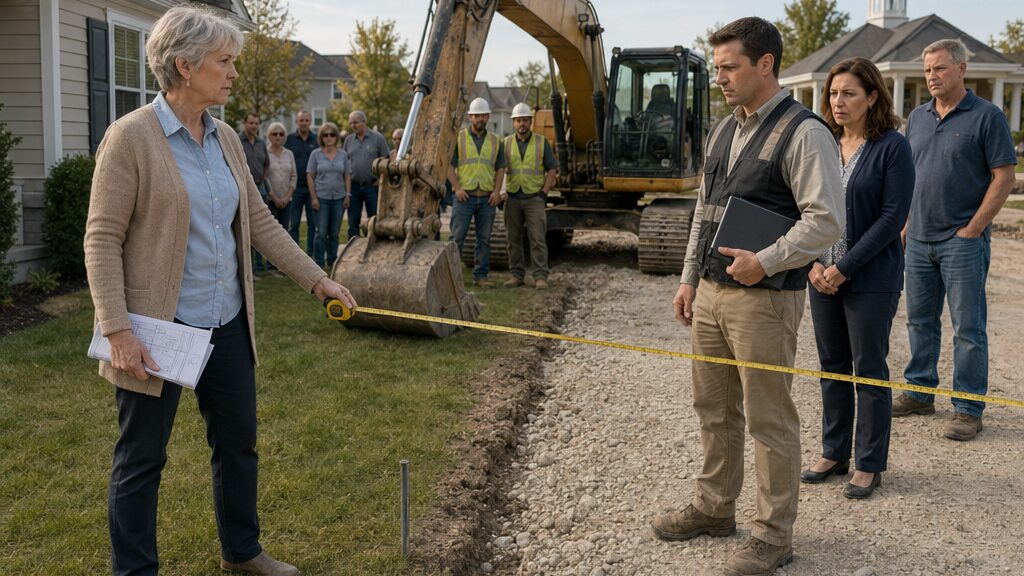
The blade slid across the remaining grass.
Several people moved closer.
Carol stopped at the gravel edge.
Two feet eleven inches.
She held the tape flat enough for anyone nearby to see.
Gary leaned forward.
Rachel stared at the distance, then at Tyler.
Carol moved six feet along the tape and planted the toe of her shoe where the approved buffer would end.
That point fell well inside the newly graded construction area.
No one laughed.
No one spoke for several seconds.
The excavator idled twenty yards away.
Tyler broke the silence.
“This is a temporary construction adjustment.”
Carol looked at him.
“Was it approved?”
“The contractor had to account for field conditions.”
“Was it approved?”
“We’re talking about temporary soil movement.”
Carol pointed to the gravel base.
“That’s compacted aggregate.”
The engineer looked down.
Tyler’s face hardened.
“You’re turning a routine construction issue into something bigger than it is.”
Carol kept her voice quiet.
“I’m asking for one piece of information.”
Rachel stepped closer.
“What exactly do you want from us?”
“The approved revision that changes the six-foot buffer.”
“If there is one?” Rachel asked.
“If there is one, I’ll read it.”
“And if there isn’t?”
Carol looked at the machine tracks inside the measured line.
“Then the work doesn’t match the approved plan.”
A worker standing beside the excavator shifted his weight.
Tyler raised one hand toward the operator.
“Go ahead.”
The bucket lowered.
Carol turned to him.
“You’re continuing?”
“Yes.”
“While the approval is disputed?”
“Because the project is not disputed. Your interpretation is.”
The excavator moved.
Its bucket bit into the soil near the edge of the graded lane.
Carol felt something old and unpleasant settle into place inside her—the sensation of watching a decision become harder to undo simply because someone did not want to stop long enough to verify it.
She looked at the engineer.
“Are you comfortable with that?”
The engineer cleared his throat.
“I’d need to review the approved drawings and field conditions.”
Tyler gave him a sharp look.
Carol noticed.
So did Rachel.
Gary stepped backward from the machinery.
“Tyler,” he said, “maybe they should hold that section until you check.”
Tyler turned.
“We lose a day every time somebody wants another review.”
“That’s not what I said.”
“No, but that’s where it goes.”
Rachel rubbed her forehead.
“We are not having this argument in the street.”
Carol retracted the tape.
The metallic blade snapped into its case.
“Then send me the revision.”
Tyler said nothing.
She waited.
Rachel looked from Tyler to Carol.
“Can you send it by tonight?”
Tyler glanced at his tablet.
“I’ll check the project file.”
Carol folded the plan.
“That wasn’t an answer either.”
His patience finally broke.
“I am not going to stand here and let a resident cross-examine me while a contractor burns hourly labor.”
The words landed harder than he intended.
Carol saw it in Rachel’s face.
Gary looked down.
Carol could have told them then.
She could have said she had spent fourteen years reviewing development compliance. She could have explained exactly how many projects she had seen go wrong because someone treated a temporary deviation as harmless until it became concrete, drainage, retaining walls, and cost.
Instead she said, “Then don’t treat it like an examination. Treat it like a request for a record.”
She walked home.
At 6:42 that evening, an email arrived from the HOA office.
It included the original plan, a contractor schedule, and several general construction notes.
No revised drawing.
Carol replied with one sentence.
Please provide any approved field revision affecting the six-foot residential buffer adjoining my lot.
Tyler responded fourteen minutes later.
Temporary construction conditions are being managed in the field in coordination with the project team.
Carol read the sentence twice.
She typed: Was a field revision approved?
Then deleted it.
She already knew he understood the question.
What she did not know was why he refused to answer it.
Chapter 3: The Complaint That Made Everyone Choose Sides
The HOA email went to every homeowner at 8:03 Wednesday morning.
Carol read it standing beside her kitchen counter.
Construction delays may occur due to resident obstruction and additional field-review requests.
It did not use her name.
It did not need to.
By nine, Gary had stopped waving from his driveway.
Carol printed the email and placed it beside the site plan.
For ten minutes she considered writing a response to the entire neighborhood.
She drafted three paragraphs.
Then deleted all three.
A defensive email would become the story.
She needed the facts to remain the story.
Carol walked outside with her phone.
The damage looked different when she photographed it systematically.
At the driveway corner, crushed aggregate had spread over the grass and chipped the edge of the concrete.
Near the shrubs, runoff from the disturbed work area had carved a shallow muddy path through mulch.
A drainage swale that had once carried rainwater toward the street was partly filled with construction soil.
Farther back, the six-foot strip was visible only in fragments, a narrowing green ribbon between her lot line and the new work.
She photographed each area with the tape measure visible where scale mattered.
Then she called a landscaping contractor and asked for an estimate to restore the lawn, mulch, drainage edge, and damaged concrete border.
By afternoon she had a written figure.
It was not enormous.
That helped.
The dispute was no longer “Carol is angry about dirt.”
There was measurable damage, a measurable boundary, and an approved plan.
She submitted a formal complaint through the county portal with photographs, the plan sheet, the HOA correspondence, and a concise explanation of the discrepancy.
No adjectives.
No accusation that anyone was corrupt.
No demand for punishment.
Just dates, measurements, and documents.
When she finished, someone knocked on her front door.
Gary stood outside.
He kept his hands in his pockets.
“You filed something with the county?”
Carol opened the storm door.
“I did.”
He looked toward the construction area.
“They stopped the machine near your side.”
“I noticed.”
“That because of you?”
“I asked them to check the approved buffer.”
Gary nodded slowly.
Then he said, “You know why they’re doing that lane, right?”
“For access.”
“No. I mean why now.”
Carol waited.
Gary looked uncomfortable.
“Last winter an ambulance had trouble getting around the clubhouse curve.”
Carol said nothing.
“There was ice. Cars were parked where they shouldn’t have been. They got through, but it took longer.”
“How much longer?”
“I don’t know.”
“You were there?”
“No.”
“Then how do you know?”
“It was discussed at a safety meeting.”
Carol remembered the meeting announcement. She had not attended.
Gary continued.
“And the maintenance truck clipped the old retaining edge twice this spring. That’s why people pushed the board to widen it.”
Something inside Carol shifted.
Not enough to change the facts.
Enough to change their weight.
“I’m not trying to stop emergency access.”
Gary gave her a tired look.
“That’s not how it looks.”
“I asked them to build what was approved.”
“Most people don’t know the difference.”
“That doesn’t make the difference disappear.”
“I know.”
But his tone said something else.
Carol folded her arms.
“What are you actually asking me?”
Gary took a breath.
“I’m asking whether three feet of grass is worth delaying something that might matter when somebody needs an ambulance.”
There it was.
The question Carol had been avoiding because nobody had framed it that way.
“It isn’t three feet of grass.”
“That’s what people see.”
“The six feet is a protected buffer.”
“I believe you.”
“Do you?”
Gary looked toward the torn edge of her lawn.
“I believe you know what you’re talking about. I also think you could’ve told us before making this into a county issue.”
Carol almost replied that Tyler had been given every opportunity to answer.
Almost.
Instead she remembered Rachel asking what she wanted and Tyler complaining about lost labor.
She had known more than everyone standing there.
She had chosen to reveal only enough to prove them wrong.
Professionally, that was defensible.
Neighbor to neighbor, it had consequences.
“I should have explained more,” she said.
Gary seemed surprised.
Carol disliked the surprise.
“But they still should have stopped and checked.”
“I didn’t say they shouldn’t.”
They stood quietly for a moment.
A dump truck passed at the far end of the street.
Gary finally said, “People are mad.”
“At me?”
“At everybody. Mostly whoever’s closest.”
“That sounds normal.”
He almost smiled.
Then the smile disappeared.
“If the county shuts the whole thing down, the board says they may miss the funding window.”
“What funding window?”
“I don’t know. Rachel said something about the project budget closing this quarter.”
Carol looked toward the clubhouse.
That was new.
She spent the rest of Wednesday assembling her file.
The deeper she went, the less satisfying the conflict became.
The access improvement had been recommended after multiple turning-radius concerns. The board had approved funding months earlier. The contract schedule was tight.
None of that erased the buffer.
But it meant that stopping the work would not simply punish Tyler.
It would affect every homeowner who relied on that access route.
Thursday morning, Rachel called.
“Carol, I’m asking you directly. Are you trying to stop the project?”
“No.”
“Because the contractor says another inspection could shut them down.”
“I’m trying to get them to work from the approved plan.”
Rachel was silent.
“Tyler says the field change is minor.”
“Then there should be no problem documenting and approving it.”
“And if the county disagrees?”
“Then it wasn’t minor.”
Rachel exhaled.
“You make everything sound simple.”
Carol looked at the photographs spread across her table.
“No. I make it sound specific.”
After the call, Carol added one final note to her complaint: she supported the emergency-access objective and requested only verification of the approved residential buffer and associated drainage protections.
At 3:26 Thursday afternoon, the county inspector called.
“I reviewed what you submitted,” the inspector said. “I need to see the site.”
Carol gripped the phone a little tighter.
“When?”
“Tomorrow morning.”
“Do you need me there?”
“Yes. I’d like you to show me the pin you measured from.”
Carol looked through the window toward the construction lane.
Workers were still moving equipment.
The remaining strip of grass looked smaller in the late light.
“What time?”
“Eight.”
Carol thanked the inspector and hung up.
She should have felt relieved.
Instead she thought about the ambulance Gary had mentioned, the funding deadline she did not understand, and the neighbors who believed she had turned three feet of grass into a neighborhood emergency.
At eight the next morning, someone with the authority to stop the project would stand beside her property pin.
Carol had wanted the line checked.
Now she had to live with what happened if she was right.
Chapter 4: The Stop Order Did Not Feel Like Winning
The county inspector asked the excavator operator to shut down the machine at 8:14 Friday morning.
The engine dropped from a hard mechanical growl to a low idle, then died.
The sudden quiet felt larger than the noise had.
Carol stood beside the exposed property pin with her old tape measure in one hand. Tyler Martin was ten feet away, jaw tight, tablet pressed flat against his side. Rachel King had arrived just before eight with a folder under her arm and the strained expression of someone who had spent the previous night answering emails.
The inspector crouched beside the pin.
“This is the point you measured from?”
“Yes,” Carol said.
“You have anything showing this is the recorded lot corner?”
Carol handed over a copy of the older boundary record she had found in her property documents.
The inspector compared it with the project plans.
Tyler spoke before being asked.
“The issue is the temporary construction footprint, not the final installed condition.”
The inspector straightened.
“I understand your position.”
“We haven’t built the retaining structure yet.”
“I understand that too.”
Tyler looked toward Rachel, as if the repetition itself was unreasonable.
The inspector walked the edge of the disturbed area with a measuring wheel and then called for the civil engineer.
Carol stayed where she was.
Neighbors had begun appearing at windows and driveways. Gary stood across the street with his arms folded. He did not come over.
The inspector stopped where gravel had been compacted closest to Carol’s lot and looked at the plan.
“Show me the approved field revision.”
Tyler glanced at the engineer.
The engineer shifted his folder from one hand to the other.
“There isn’t a stamped revision for this segment.”
Rachel turned sharply.
“What does that mean?”
“It means the approved alignment is the approved alignment,” the inspector said.
Tyler stepped forward.
“We adjusted temporarily around an existing utility condition.”
“Was that adjustment submitted?”
“It was being coordinated.”
“That isn’t what I asked.”
Carol heard her own phrasing in the inspector’s question.
Tyler heard it too.
His eyes flicked toward her.
“No,” he said. “It was not submitted yet.”
The inspector nodded once.
“Then I need work stopped in this section until the discrepancy is resolved.”
Rachel’s face lost color.
“Only this section?”
“For now.”
Tyler’s shoulders dropped, though only slightly.
The inspector continued.
“I also need confirmation that drainage and soil stabilization inside the residential buffer haven’t been compromised. If they have, the correction could extend beyond this segment.”
Rachel looked at Carol.
Not angrily.
That would have been easier.
She looked frightened.
The contractor began moving workers away from the excavation area. Tools were collected. The bucket of the excavator settled onto the ground like a hand forced open.
Carol had imagined this moment differently.
Not often, and never with pleasure, but somewhere in the back of her mind had been the simple satisfaction of being proven correct.
Instead she noticed the worker who had waved to her Monday loading shovels into a truck.
She noticed Rachel typing quickly on her phone.
She noticed Gary speaking with another neighbor, both looking toward the silent equipment.
The six-foot strip of grass was still there in pieces.
It looked less like a victory than a scar.
The inspector asked Carol several more questions, photographed the property pin, and measured from a second reference point provided by the engineer.
The numbers agreed.
By ten, there was no dispute left about the basic fact.
The field line did not match the approved plan.
That should have been the clean part.
It wasn’t.
As soon as the inspector left, Rachel walked straight to Carol.
“Do you know what this could cost?”
“No.”
“Neither do I.”
Tyler joined them.
“It could be significant.”
Rachel turned on him.
“You told me this was a temporary adjustment.”
“It was.”
“You told me it was covered.”
“I said it was being managed.”
“That is not the same thing.”
Carol almost stepped away.
This was not her argument.
Then Tyler said, “We did what we had to do to keep the lane width.”
Carol looked at him.
“What did you have to do?”
Tyler hesitated.
Rachel stared at him.
“Tyler.”
He rubbed one hand across the back of his neck.
“There’s a utility cabinet inside the original work envelope.”
“What cabinet?” Rachel asked.
“The electrical service cabinet near the clubhouse side.”
Carol pictured it immediately. A dull green box beyond the curve, easy to ignore unless you were looking at the site geometrically.
“The original design clears it,” Carol said.
“Barely,” Tyler replied. “Once they exposed the footing, it turned out the working clearance wasn’t enough.”
“So you moved toward the residences.”
“We shifted the temporary work line.”
“Into the protected buffer.”
“We had two choices. Relocate the cabinet and lose weeks, or shift the work area long enough to build the retaining section.”
Carol watched him.
“How long did you know?”
Tyler’s face changed.
Not much.
Enough.
“Since last Thursday.”
Before Carol had confronted him.
Before Monday morning.
Before he had told her the crew was exactly where the plans placed them.
Rachel stepped backward.
“You knew?”
“I knew there was a field conflict.”
“And you let them keep going.”
“I was trying to solve it.”
“You could have stopped.”
“And then what?” Tyler said, sharper now. “Tell the board the project is delayed again? Tell residents we’re paying another mobilization fee? Tell everyone the access lane they demanded is now waiting on a utility company that may not schedule us for a month?”
Rachel’s voice dropped.
“You should have told me.”
“I was trying to get a revised detail from the engineer.”
The engineer, standing several yards away, said nothing.
Carol understood then why Tyler had refused to answer the question about approval.
He had not been confused.
He had been buying time.
“You thought you could finish the section before anyone made you formalize it,” she said.
Tyler looked at her.
“I thought we could solve a field problem without turning it into a shutdown.”
“That’s not the same thing.”
“I know.”
His answer stopped her.
There was no sarcasm in it.
Only exhaustion.
By early afternoon, the HOA clubhouse was full.
Not for a formal meeting. Rachel insisted on that. But word had traveled, and residents wanted answers.
Carol stayed near the back.
A homeowner near the door complained that the project had already taken too long. Another asked whether assessments would increase. Someone else wanted to know why one property line could stop a safety improvement.
Rachel tried to explain that the county review involved more than Carol’s complaint.
It did not help.
A man Carol barely knew turned in his chair.
“You’re the one who filed it, right?”
Carol met his gaze.
“Yes.”
“So this is because of your yard.”
“It started because the work crossed the approved buffer.”
“That sounds like yes.”
A few people murmured.
Gary was seated against the wall.
He did not join them, but he did not defend her either.
Carol felt the old instinct rise: give them the plan, the dates, the measurements, make the facts so exact that nobody could twist them.
She resisted it.
“The access project matters,” she said. “I agree with that.”
The room quieted slightly.
“But if the project needs a different alignment, then the different alignment has to be reviewed before it’s built.”
The man shook his head.
“Easy to say when the dirt isn’t in front of your emergency vehicle.”
Carol almost replied.
Then she remembered Gary’s question.
Three feet of grass.
An ambulance.
She let the silence stand.
Later, when the clubhouse had emptied, Tyler found her outside beside the halted excavator.
The afternoon light had flattened the tire tracks into long gray shapes.
He stood without speaking for a while.
Then he said, “The utility relocation could kill the project.”
Carol looked at him.
“How?”
“The contractor price is locked through this phase. If we miss the schedule, the change order gets bigger. The board’s reserve allocation closes this quarter. We may not have enough left to rebid the whole section.”
“You should have thought about that before you moved the line.”
“I did.”
“That makes it worse.”
“I know.”
Again, that answer.
He looked toward the silent lane.
“I wasn’t trying to take your property.”
“I didn’t say you were.”
“You think I ignored the rules because I don’t care.”
Carol said nothing.
Tyler continued.
“I ignored one part because I thought the larger thing mattered more.”
The sentence stayed between them.
Carol looked at the six-foot strip.
For the first time, Tyler’s mistake felt uncomfortably familiar.
He put his hands in his pockets.
“If the county requires a full redesign, we may not get the access project back this year.”
Then he walked toward the clubhouse.
Carol remained beside the excavator.
The work had stopped.
She had been right.
And for the first time since Monday morning, being right felt like the beginning of the problem rather than the end of it.
Chapter 5: The Shortcut Carol Had Taken Once Before
The photograph fell faceup from an old records box on Saturday morning.
Carol recognized the building before she recognized the date.
A two-story brick apartment complex. New retaining wall. Narrow strip of drainage gravel. Three young maples planted too close to the lower units.
She sat down at the kitchen table.
The box had been in the hall closet since she retired.
She had opened it because Tyler’s words would not leave her alone.
I ignored one part because I thought the larger thing mattered more.
The photograph showed a project Carol had reviewed eight years earlier.
On paper, it had been compliant.
Barely.
The developer had been under pressure to open before winter. A drainage concern had surfaced late. The engineering response satisfied the written standard, but Carol had felt uneasy about how aggressively the design pushed water toward the lowest residential edge.
She had asked for an additional field check.
Then withdrawn the request when her supervisor reminded her that the submitted calculations met the requirement and the occupancy schedule was already slipping.
Nothing illegal.
Nothing hidden.
No bribe, no favor, no dramatic misconduct.
Just a decision to stop asking one more question.
Three months later, heavy rain had overwhelmed the lower drainage path.
Two ground-floor units flooded.
Carol remembered standing in one of them while a resident lifted wet family photographs from a cardboard box.
The project had been technically approved.
That had not made the water less real.
Carol turned the old photograph over.
Her handwriting was on the back.
Final field review complete.
She had retired earlier than planned the following year.
When friends asked why, she said she was tired of municipal work.
That was true.
It was not the whole truth.
She placed the photograph beside her tape measure.
For years she had told herself the lesson was simple: never accept “close enough” when the consequences belong to somebody else.
Tyler had made his own version of the same mistake.
The realization did not excuse him.
It made anger less comfortable.
By noon, Carol had spread the current project plans across the table.
She stopped looking for proof of failure.
Instead she looked for room.
The access lane needed width.
The six-foot residential buffer needed to remain.
The utility cabinet blocked the original working clearance.
Those three facts had been treated as if only two could survive.
Carol began sketching.
Nothing formal. She was not the engineer of record, and she had no intention of pretending otherwise.
She drew a narrower retaining profile, shifted the construction sequence, and marked where temporary shoring might reduce the amount of disturbed ground.
Then she stopped.
The solution would cost more.
Probably substantially more.
And if she handed it to Rachel, people could say Carol had forced a shutdown only to insert herself into the project.
She almost put the papers away.
Instead she called Gary.
He answered on the fourth ring.
“Hey.”
“Do you have five minutes?”
A pause.
“Sure.”
He came over wearing work gloves, as if he had been halfway through a garage chore and expected not to stay long.
Carol showed him the plan.
“I’m not designing this,” she said immediately. “An engineer would have to do that.”
Gary looked at the sketch.
“What am I looking at?”
“A way to preserve the buffer without moving the utility cabinet.”
“You figured that out?”
“I identified a possibility.”
“That sounds like a yes with extra words.”
Carol ignored it.
“The retaining section could possibly be narrower if they change the sequence and use temporary support differently.”
Gary studied the drawing.
“Would the lane still be wide enough?”
“If the engineer can make the numbers work.”
“And the ambulance?”
“The access objective stays.”
Gary looked at her.
“Why didn’t you say this at the beginning?”
“Because I didn’t know it at the beginning.”
“That’s not what I mean.”
Carol knew.
She sat across from him.
“I spent a long time in a job where you didn’t show people your conclusions until you could support them.”
“Okay.”
“That habit followed me home.”
Gary leaned back.
“You made Tyler look like he was hiding something.”
“He was hiding something.”
“I know that now.”
Carol looked at the photograph from the old apartment project.
Gary noticed it.
“What’s that?”
For several seconds, she considered saying it was nothing.
Then she turned the photograph toward him.
“A project I reviewed years ago.”
“What happened?”
“I accepted an answer because it met the standard on paper and because everyone wanted the project finished.”
Gary waited.
“It flooded.”
His expression changed.
“Bad?”
“Bad enough.”
“Was it your fault?”
Carol disliked the question because there was no clean answer.
“I wasn’t the engineer. I didn’t build it. I didn’t violate a rule.”
“That wasn’t my question.”
She looked at him.
“No. Not entirely.”
Gary nodded slowly.
“But part of you thinks it was.”
“Yes.”
For once, saying it aloud reduced its power instead of increasing it.
He looked back at the current sketch.
“So this isn’t really about six feet.”
“It is about six feet.”
“You know what I mean.”
Carol did.
By late afternoon, Rachel agreed to meet at the clubhouse.
Tyler was not there.
The room felt strange without the usual construction noise outside.
Rachel sat at the conference table with the HOA treasurer and several binders open in front of her.
“We have estimates coming Monday,” Rachel said. “None of them are going to be pleasant.”
“I didn’t come about the complaint.”
Rachel’s eyebrows lifted.
Carol placed her sketch on the table.
“I came because I think there may be another way to build it.”
The treasurer leaned forward.
Rachel did not touch the paper.
“Carol, are you proposing engineering changes now?”
“No.”
“Because after this week, I need us to be very careful about who is responsible for what.”
“I agree.”
Carol slid the page closer.
“This is not a design. It’s a question for the civil engineer.”
Rachel finally looked down.
Carol pointed to the utility cabinet, the buffer, and the retaining alignment.
“If they can reduce the retaining footprint here and change the temporary support method, they may be able to keep the full six feet and still preserve the lane width.”
The treasurer traced the line with one finger.
“That sounds expensive.”
“It probably is.”
Rachel looked up.
“And you’re suggesting this after filing the complaint?”
“Yes.”
“People are going to say you’re trying to control the project.”
“They already think that.”
“That doesn’t bother you?”
“It does.”
Rachel studied her.
That answer seemed to matter.
Carol continued.
“I don’t want the access improvement canceled.”
“You understand why that’s difficult for me to believe.”
“Yes.”
Rachel leaned back.
“Then why didn’t you say it clearly before?”
Carol looked at the blank section of tabletop between them.
“Because I thought if I gave people the facts, the facts would be enough.”
Rachel did not respond.
Carol added, “They weren’t.”
The treasurer closed one binder.
“What exactly are you asking us to do?”
“Have the engineer evaluate this before you decide the project is dead.”
Rachel tapped the paper.
“And if it doesn’t work?”
“Then it doesn’t work.”
“No second complaint?”
“If the next plan follows the approval process and protects the residential boundary, I don’t care whether it’s my idea.”
Rachel looked toward the window.
The excavator remained parked where it had been shut down.
“I’ll send it to the engineer.”
Carol nodded and stood.
At the door, Rachel spoke again.
“Tyler told us about the utility issue.”
Carol turned.
“All of it?”
“He admitted he knew the field line had moved before you confronted him Monday.”
Carol waited.
Rachel’s voice hardened.
“He also said he believed he could fix the paperwork after the retaining section was built.”
There it was.
Not confusion.
Not oversight.
A conscious choice.
Carol should have felt anger return cleanly.
Instead she thought of the old photograph sitting on her kitchen table.
Two different people.
Two different projects.
The same dangerous sentence in different words: fix it later.
Rachel touched Carol’s sketch.
“If the engineer says this can work, I want you at the meeting Monday.”
Carol’s first instinct was refusal.
She had spent years getting away from rooms where people argued over plans, cost, responsibility, and deadlines.
Then she looked through the window at the stopped lane.
“Send me the time,” she said.
Chapter 6: A Better Line Than the One They Crossed
Carol laid her alternative alignment beside the original plan before anyone else sat down Monday morning.
The two drawings looked almost identical until the lines reached the utility cabinet.
That was where one version crossed toward her property and the other bent away.
Tyler entered last.
He stopped when he saw Carol at the conference table.
Rachel pointed to an empty chair.
“We’re starting.”
The civil engineer had already reviewed Carol’s sketch.
He placed a revised concept sheet in the center of the table.
“Her idea is workable in principle,” he said.
Tyler looked at Carol.
She shook her head.
“His design. My question.”
The engineer gave a brief nod.
“We can preserve the six-foot residential buffer if we use a narrower retaining system through this segment and temporary shoring during construction. The access width stays within the emergency turning requirement.”
The HOA treasurer asked the question everyone expected.
“Cost?”
The engineer named a figure.
Silence followed.
It was significantly more than the original retaining section.
Rachel rubbed her thumb along the edge of her folder.
“Can we absorb that?”
The treasurer grimaced.
“Technically.”
“That doesn’t sound reassuring.”
“It means reserves cover it, but not without affecting other planned work.”
Tyler leaned forward.
“And schedule?”
“About two additional weeks if the contractor can remobilize quickly.”
“Two weeks,” Tyler repeated.
“Better than utility relocation.”
Carol watched his face.
He was not relieved.
He looked cornered.
Rachel turned to him.
“There’s one issue we have to resolve before we vote.”
Tyler knew what it was.
So did everyone else.
The room became very still.
Rachel said, “I need you to explain the field decision.”
Tyler looked at the civil engineer, then at the treasurer, then finally at Carol.
“The contractor exposed the utility footing Thursday before the resident complaint.”
Carol kept her hands folded.
“The working clearance was less than anticipated. We discussed stopping that section.”
“Who is we?” Rachel asked.
“Me, the superintendent, and later the engineer.”
The engineer spoke carefully.
“I told him a revision should be documented before permanent work proceeded.”
Tyler nodded.
“That’s accurate.”
Rachel’s expression tightened.
“And then?”
“I authorized temporary grading.”
“Inside the buffer.”
“Yes.”
“Knowing the revision had not been approved.”
Tyler took a breath.
“Yes.”
No one spoke.
There was no dramatic reaction.
No one shouted.
The admission simply changed the room.
Carol had spent much of the previous week imagining that if Tyler ever said the truth plainly, satisfaction would follow.
It did not.
He looked like a man who had finally stopped spending energy defending a decision he already knew was wrong.
Rachel asked, “Why?”
Tyler stared at the concept drawing.
“Because the project was already behind. Because I knew what another shutdown would mean. Because residents have been asking for this access fix for months. Because I thought we could make the field change, get the retaining section in, and submit the revision before final inspection.”
The treasurer said, “That isn’t how approval works.”
“I know.”
Carol looked at him.
The same answer again.
Rachel said, “Then why did you tell Carol the crew was exactly where the plans placed them?”
Tyler did not answer immediately.
“Because if I admitted the line had moved, I knew she’d ask the next question.”
“Whether it was approved,” Carol said.
“Yes.”
“And you knew the answer.”
“Yes.”
That was the responsible choice.
Not the grading.
Not the pressure.
Not the schedule.
The lie.
Carol felt something settle.
Tyler’s reasons could explain the shortcut.
They could not erase the moment he chose to hide it.
Rachel closed her folder.
“Thank you for finally saying it plainly.”
Tyler nodded once.
The meeting moved to cost.
That turned out to be uglier than the confession.
The HOA’s insurer would not cover part of the corrective work if the association proceeded after becoming aware of an unauthorized field deviation. The contractor agreed to absorb some remobilization expense but not all of it.
The reserve account would take the remainder.
A pool resurfacing project would likely be delayed.
Several residents would be angry.
Rachel listened to every number.
Then she said, “We correct it.”
The treasurer looked at her.
“You’re sure?”
“No.”
That surprised Carol.
Rachel continued.
“But I’m done pretending that being afraid of a bad reaction makes the cheaper choice responsible.”
Tyler looked down.
Carol wondered whether Rachel intended the sentence for him.
Or herself.
The board vote that evening was tense but brief.
Residents filled the clubhouse again. This time Carol sat near the side wall rather than the back.
Rachel explained the redesigned retaining section, the preserved six-foot buffer, the maintained emergency-access width, and the additional cost.
There were complaints.
One homeowner demanded to know why reserves should pay for a mistake made by management.
Another asked why the project could not simply move closer to Carol’s lot if she agreed.
Carol answered that one.
“Because the buffer isn’t a personal favor to me.”
The room quieted.
“It’s part of the approved separation between the project and residential property. If the board wants to change that permanently, there is a process for changing it. My permission doesn’t replace that process.”
A woman near the front asked, “Then what was the point of all this if we’re building the lane anyway?”
Carol looked at the revised plan.
“The point is that we can build it without pretending one goal requires sacrificing the other.”
Tyler spoke from the board table.
“That should have been the approach from the start.”
Heads turned toward him.
He did not look at Carol.
“I authorized work before the field change was approved. That was my decision.”
No excuse followed.
No mention of deadlines.
The room remained uncomfortable, but something in it became clearer.
The board approved the redesign.
After the vote, most residents left quickly.
Gary waited by the doorway.
“So,” he said, “you saved your grass and the ambulance lane.”
Carol gathered her papers.
“If the engineer’s calculations are right.”
“You really don’t know how to enjoy anything.”
She almost smiled.
Rachel approached holding the revised plan.
“There’s one condition.”
Carol looked up.
“The county wants field verification before the retaining section is closed.”
“That makes sense.”
“The board wants an independent resident present too.”
Carol immediately understood.
“No.”
Rachel blinked.
“You haven’t heard the question.”
“I know the question.”
“You started this.”
“That doesn’t mean I should become part of management.”
“I’m not asking you to join the board.”
“Good.”
Rachel lowered her voice.
“I’m asking you to stand there with the engineer and the inspector when the line is reestablished.”
Carol looked toward Tyler.
He was gathering his tablet and folders alone.
“You have professionals for that.”
“We do.”
“Then use them.”
Rachel did not move.
“Carol, everybody in this room has spent a week arguing about whether six feet matters. You’re the reason they understand it now.”
“That is not a qualification.”
“No. Fourteen years of compliance work is.”
Carol stared at her.
Rachel gave a small, tired shrug.
“Gary told me.”
Carol turned toward him.
He lifted both hands.
“You left that part out for almost a week.”
“That was intentional.”
“I figured.”
Rachel held out the plan.
“I don’t need you to run the project. I need you to help verify the line everyone crossed.”
Carol looked at the paper.
A week earlier she would have taken it immediately.
Not because she wanted power.
Because she trusted herself more than the system around her.
That was exactly what troubled her now.
“I’ll think about it.”
Rachel nodded.
The answer was not yes.
But it was no longer no.
Chapter 7: Six Feet of Grass Between Winning and Living Together
The first maintenance truck reached the rebuilt curve three weeks later, and Carol found herself watching its right rear tire.
Not the cab. Not the driver. The tire.
It followed the new pavement around the clubhouse, passed the retaining section, and cleared the residential edge without climbing the curb or drifting toward her lawn.
Carol kept one hand inside her jacket pocket, wrapped around the scratched yellow case of her tape measure.
The truck disappeared behind the clubhouse.
Nothing happened.
That was the point.
The construction site no longer looked like a dispute. The excavator was gone. The temporary piles of gravel had been removed. Fresh soil covered the torn ground beside Carol’s driveway, and a narrow strip of new sod followed the restored boundary.
Six feet.
The number had become so familiar that Carol could almost judge it by sight.
Almost.
“Don’t,” Gary Hall said.
He was kneeling near the driveway with a bag of grass seed.
Carol looked at him. “Don’t what?”
“Measure it before they even finish.”
“They finished yesterday.”
“Exactly.”
He shook seed into a patch where the contractor’s equipment had left the soil too loose for sod.
“You’re physically incapable of letting dirt be dirt.”
“That seems rich coming from a man reseeding somebody else’s lawn.”
Gary pressed the seed lightly into the soil with his glove.
“I’m doing this because their landscaping crew missed a spot.”
“That’s how it starts.”
He laughed.
It was the first easy laugh between them since the project had stopped.
The county inspector arrived ten minutes later with the civil engineer. Tyler Martin came from the clubhouse carrying the final field set.
Carol expected him to nod and keep moving.
Instead he walked directly toward her.
“You brought it?”
She knew what he meant.
Carol removed the tape measure from her pocket.
“I thought you had survey equipment.”
“We do.”
“Then why do you need mine?”
“I don’t.”
Tyler held out the revised plan.
“I’m asking you to verify the line before the inspector signs off.”
Carol looked at him.
Three weeks earlier, he had stood beside the same property edge and told her the work was exactly where the plans placed it.
Now he was asking her to check him.
That did not erase what had happened.
It mattered anyway.
“You know I’m not the surveyor,” she said.
“Yes.”
“And my measurement doesn’t replace theirs.”
“Yes.”
“And if I get something different—”
“We stop and find out why.”
Carol studied his face.
No impatience.
No attempt to hurry her.
“All right.”
The survey references had already been reset. Temporary stakes marked the approved edge of construction.
Carol hooked her tape onto the property reference and extended it toward the retaining line.
The metal blade crossed the new grass.
Gary stood up slowly.
Rachel King had arrived without Carol noticing and now watched from several yards away.
Six feet landed exactly where the revised retaining edge began.
Carol checked again.
Tyler did not complain.
She moved to the second point.
Six feet.
At the third, the tape read a fraction over.
Carol retracted the blade.
“It matches.”
Tyler nodded.
The inspector completed the formal measurements with the engineer and signed the field verification.
The simple act took less than fifteen minutes.
It had taken three weeks to reach it.
Rachel approached while the inspector spoke with Tyler.
“The county cleared the access lane.”
“I heard.”
“The fire district reviewed the turning radius too.”
Carol looked toward the curve the maintenance truck had just used.
“And?”
“No objection.”
That was the result Carol had wanted without knowing how to ask for it at the beginning.
Her property remained intact.
The safer access remained too.
Rachel glanced toward Gary, who had resumed working the grass seed into the soil.
“We’re going to delay the pool resurfacing until spring.”
“I’m sure that made everybody happy.”
“It did not.”
Carol smiled faintly.
Rachel continued, “But the reserve account can handle the correction without a special assessment.”
“That helps.”
“It does.”
For a moment they stood beside the restored strip without speaking.
Then Rachel said, “I have another question.”
Carol turned.
“No.”
“You don’t even know what it is.”
“I have a strong suspicion.”
Rachel smiled despite herself.
“The board wants to create a resident review group for major capital projects.”
Carol stared at her.
“No.”
“Not a committee with authority.”
“That sentence has never made anything better.”
“Carol.”
“No meetings every Tuesday. No binders in my house. No people calling me at dinner because a fence is four inches wrong.”
Rachel raised one hand.
“I wasn’t asking for any of that.”
“What were you asking?”
“For you to look at major project plans before construction starts and tell us which questions we should be asking.”
Carol hesitated.
“That sounds suspiciously like work.”
“It probably is.”
“I retired.”
“I know.”
Carol looked toward Tyler.
He was standing with the engineer over the final drawings, pointing to something near the utility cabinet.
This time the engineer was writing it down.
Rachel followed her gaze.
“We need people who know enough to slow us down before slowing down becomes expensive.”
“That sounds like something you should hire professionals for.”
“We will.”
“Then use them.”
“We did use professionals this time.”
Carol looked at her.
Rachel’s expression was sober.
“And we still let schedule pressure turn a problem into a bigger problem.”
That was harder to dismiss.
Carol had spent years believing systems failed because people ignored the rules.
Her old photograph had reminded her that systems could also fail when good people followed just enough of the rules to reassure themselves.
Maybe knowledge was not useful only when it caught mistakes afterward.
“I’ll review plans,” Carol said.
Rachel blinked.
“Really?”
“Twice a year.”
“Carol—”
“No emergency meetings unless something is actually an emergency. No board seat. No authority to approve anything.”
Rachel tried not to smile.
“And no binders?”
“Digital files.”
“Done.”
“That was too fast.”
“I learned something about answering direct questions.”
Carol looked toward Tyler.
He had heard that.
His mouth tightened into something that was not quite a smile.
Gary came over carrying the empty seed bag.
“You joining the HOA now?”
“No.”
“She absolutely is,” Rachel said.
“I absolutely am not.”
Gary looked between them.
“This should go well.”
Rachel left to speak with the inspector.
Gary stayed beside Carol.
After a moment, he said, “I owe you an apology.”
Carol looked at him.
“You reseeded my lawn.”
“That’s not an apology.”
“No.”
He rubbed dirt from his gloves.
“I thought you were trying to stop the project because it was happening beside your house.”
“I was trying to stop part of it.”
“You know what I mean.”
“I do.”
“I should’ve asked more before deciding what you were doing.”
Carol watched the newly seeded patch.
“I could’ve explained more before deciding everyone should simply understand.”
Gary nodded.
“That sounds almost like an apology.”
“Don’t get used to it.”
He smiled.
No grand reconciliation followed.
He went home because he had groceries in his car.
That felt more honest.
The contractor finished the last cleanup before noon. The damaged driveway edge had been patched. The drainage swale was reshaped and tested. Fresh mulch lay beneath Carol’s shrubs.
Tyler remained after everyone else left.
Carol was coiling a garden hose when he walked toward the boundary.
“I wanted to tell you something before I go.”
“You still work here.”
“I meant before I leave today.”
“Oh.”
He looked down at the grass.
“I kept thinking the whole issue was six feet.”
“It was.”
He nodded.
“Then I thought it was the schedule.”
“That was part of it.”
“Then the money.”
“That too.”
Tyler slid his hands into his pockets.
“But the thing I actually did wrong happened before any of that.”
Carol waited.
“I decided that because I believed the project was important, I had earned the right to decide which rule could wait.”
Carol felt the old apartment photograph in her memory.
The wet cardboard box.
The handwriting on the back.
Final field review complete.
“I know that reasoning,” she said.
Tyler looked at her.
She did not explain.
Not everything had to become evidence.
He glanced toward her hand.
“You still have the tape?”
Carol realized she was holding it.
“Yes.”
Tyler extended his hand.
“Can I borrow it?”
She gave it to him.
He walked to the property reference.
Carol said nothing.
Tyler hooked the blade against the marker and pulled the tape across the restored grass.
He crouched at the retaining edge.
Six feet.
He checked the number, then looked back at Carol.
“Six.”
“I can see that.”
He measured a second time anyway.
When he finished, he retracted the blade carefully and returned it.
Carol took the tape measure.
For years it had lived in a metal cabinet beneath tools she rarely used. Then it had become proof that somebody else was wrong.
Now the number on it meant something different.
Not victory.
Not ownership.
A line that had been kept because people finally agreed it was worth keeping.
Carol walked into the garage and opened the bottom drawer of the cabinet.
She placed the tape measure inside.
Then she stopped.
After a moment, she took it back out and set it on the workbench instead.
Outside, the maintenance truck returned along the new access lane.
It rounded the curve cleanly.
Gary’s grass seed waited in the dark soil beside the driveway.
Tyler stood at the far end of the six-foot strip, looking once more at the line before walking back toward the clubhouse.
Carol closed the garage door halfway, leaving enough space for the afternoon light to reach the workbench.
The tape measure remained there, visible and within reach.
The story has ended.