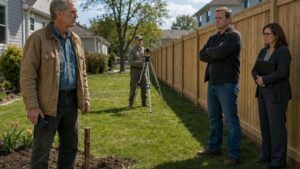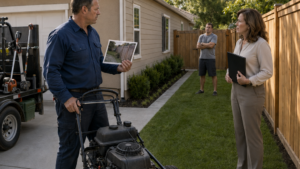
After Eleven Years of Keeping Their Basement Dry, the HOA Called Me “Just the Landscaper”
Chapter 1: The Day They Called It Just Landscaping
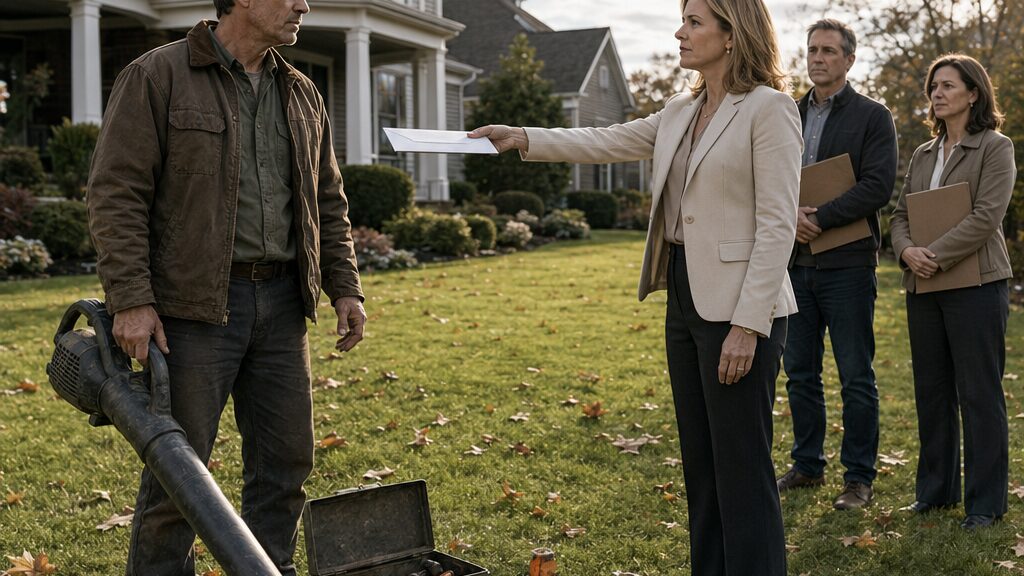
Christine Carter walked toward me with a white envelope while the leaf blower was still running.
I saw the envelope before I saw her expression.
That was enough.
I released the trigger, and the blower wound down with a long mechanical sigh. Dry maple leaves settled against the curb between us. Across the street, two HOA board members stood near Christine’s driveway with folders tucked against their chests, waiting for whatever came next.
“Frank,” Christine said, “do you have a minute?”
I set the blower beside my toolbox.
“I guess I do now.”
Her smile tightened.
We had known each other eleven years. I had watched her replace the roof, rebuild the back steps, plant three different kinds of hydrangeas, and complain every spring that the grass along the east side never came in evenly.
I had been there through droughts, ice storms, wet autumns, and the year groundwater came within inches of turning her basement into a swimming pool.
But that morning she held the envelope like we were strangers finishing a transaction.
“We’re consolidating the landscaping contracts,” she said. “The board approved a new vendor.”
I glanced past her toward the two board members.
“Board-approved for your house?”
“For several properties. Mine included.”
She handed me the envelope.
Inside was a short termination notice and payment through the end of the week.
I read it once.
Then again.
Christine filled the silence.
“The neighborhood is trying to establish a more consistent standard. More professional. More uniform.”
I folded the paper along the crease it had already been given.
“So this is about the lawn.”
“The whole exterior.”
I looked toward the side yard.
A row of hydrangeas hid the low corner where the ground dipped toward the rear property line.
Christine followed my eyes.
“What?”
“Who’s maintaining the drainage intake?”
She blinked.
“The what?”
“The rear intake. Behind the hydrangeas.”
Her shoulders shifted almost imperceptibly.
I pointed with two fingers, not dramatically, just enough to indicate the corner.
“The system that carries groundwater off the foundation.”
One of the board members took a step closer.
Christine lowered her voice.
“Frank, the new company handles landscaping.”
“That isn’t landscaping.”
“What is it, then?”
“Drainage maintenance.”
She gave a small exhale, the kind people make when they believe a conversation has become unnecessarily difficult.
“Frank, we’re not trying to diminish what you’ve done here.”
The sentence landed worse than if she had.
I looked down at the termination notice.
“Does their contract mention the rear intake?”
“I haven’t memorized their contract.”
“Does it mention clearing sediment? Checking the gravel bed? Opening the overflow junction before heavy rain?”
Her expression changed for the first time.
Not fear. Not yet.
Uncertainty.
Then the board member beside her shifted the folder under his arm, and whatever doubt had appeared in Christine’s face hardened into irritation.
“If there’s something unusual about the property, I’m sure they’ll identify it.”
“They won’t see most of it.”
She looked toward the hydrangeas again.
“It’s a drain, Frank.”
I nodded.
“That’s what it looks like from the top.”
For eleven years, I had learned not to argue with homeowners about things they could not see.
You showed them dead roots, they believed the tree was sick.
You showed them standing water, they believed the grading was wrong.
But buried pipe, hydraulic pressure, soil saturation, overflow routes—those things required people to trust what you told them before the failure became visible.
Trust was harder to invoice.
I bent and picked up one of the muddy orange markers I used when servicing the line. Most weeks it stayed behind the garage until I needed to trace the route.
I placed it beside my toolbox.
Christine watched me.
“What’s that supposed to mean?”
“Nothing.”
“It feels like something.”
“It marks the intake when the leaves get deep.”
She glanced at the two board members again.
“Frank, if this is an attempt to make us reconsider—”
“It isn’t.”
“Because the decision has already been made.”
“I heard you.”
My voice came out flatter than I intended.
That seemed to surprise her.
I had spent years solving problems before she knew they existed. Sprinkler head broken? Fixed. Erosion behind the retaining wall? Redirected. Snow drift blocking the heat pump? Cleared before sunrise.
There had always been another thing to do instead of talking about the thing I had done.
My father used to say if people noticed your drainage work, you had probably failed.
Water was supposed to disappear.
So was the work.
I had believed him for most of my life.
That morning, for the first time, I wondered whether he had been wrong.
Christine folded her arms.
“The new crew starts Monday.”
“Then make sure someone walks them through the back corner.”
“You can leave any relevant instructions.”
I almost laughed.
Not because it was funny.
Because there were eleven years of relevant instructions.
I picked up the marker and wiped the mud from its lower half with my glove.
“Drainage maintenance wasn’t in my original mowing agreement either.”
Christine’s mouth tightened.
“Then why were you doing it?”
That question told me more than anything else she had said.
She genuinely did not know.
I looked at the foundation wall, then at the side yard, then back at her.
“Because eleven years ago your basement almost flooded.”
She stared at me.
Behind her, one board member opened his folder.
Christine recovered quickly.
“Well, if there’s documentation, leave it with the office.”
There was documentation.
Just not where she thought.
I packed the blower, rake, hand tools, and markers into my truck. I emptied the small metal cabinet beside the garage where I kept spare sprinkler fittings and seasonal notes.
At the back of the cabinet sat a weathered black notebook with softened corners and a strip of duct tape along the spine.
Christine was speaking to the board members when I pulled it free.
She never looked over.
I did.
For eleven years, almost everything important about that yard had gone into that notebook.
Dates.
Rainfall.
Clogs.
Soil changes.
Repairs.
Measurements.
And one hand-drawn line that started behind Christine’s hydrangeas and did not stop at her property boundary.
I closed the cabinet door, put the notebook under my arm, and carried it to the truck.
Chapter 2: What Was Buried Behind the Hydrangeas
The first page of the notebook was stained brown around the edges from a flood that had never happened.
I sat at the workbench in my garage Saturday morning and flattened the book beneath my palm.
Across the top of the page, in my own handwriting from eleven years earlier, I had written one date and three measurements.
Below them was a rough drawing of Christine’s house.
A blue line ran behind it.
I had drawn that line before there was any pipe in the ground.
Back then, Christine and her husband had owned the house less than a year. After three days of rain, water had begun pushing through a seam near the basement floor.
She had called me because I was already mowing the property.
Not because I was a drainage contractor.
Not because I had credentials hanging on a wall.
Because I was there.
I remembered standing behind the hydrangeas with a shovel, watching water collect in the low ground.
My father had taught me to read land before I was old enough to drive.
“Water always tells you where it wants to go,” he used to say. “Your job is to stop arguing with it.”
So I had followed the slope.
The problem was simple in principle and miserable in practice. Groundwater came down from the higher lots behind Christine’s property, collected along the back corner, then pressed toward the foundation. The original shallow drain was nearly useless.
I dug a deeper trench.
Gravel first.
Then perforated pipe.
More stone.
Fabric.
A second branch at the lowest point.
The line carried water sideways, away from the basement, before feeding into an older overflow route near the rear boundary.
It had taken three weekends.
Christine had paid for materials and extra labor, but I had never written a separate long-term service contract.
At the time, that seemed reasonable.
I was already there every week.
Why create another piece of paperwork for something I could check while I mowed?
That was the part I kept returning to.
Why create another piece of paperwork?
Because one day somebody else might mow the lawn.
I turned the page.
October, ten years earlier: intake packed with maple leaves.
April, nine years earlier: gravel settled, topped off.
August, eight years earlier: root intrusion near bend.
October, seven years earlier: overflow slow after storm.
Every year contained some version of the same work.
Small things.
Invisible things.
The kind of maintenance nobody thinks about because nothing goes wrong.
I had spent years being proud of that.
Now the pride looked different on paper.
It looked like a system only one person fully understood.
I reached the center of the notebook and found the first detailed map.
The pipe ran behind the hydrangeas, angled toward the northwest corner, then crossed the rear line.
I leaned closer.
There it was.
Emily Wright’s property.
I had not thought about the easement in years.
Emily had bought the neighboring house about six years after I installed the line. The previous owner had shown both of us an old property document allowing stormwater access along the rear strip.
Emily never minded when I entered through her side gate to check the overflow junction.
Usually I texted first.
Sometimes I saw her gardening and asked in person.
Nothing formal.
Nothing complicated.
That had been the pattern for years.
But patterns were not contracts.
I pulled open the bottom drawer of the workbench.
Old invoices. Equipment manuals. Receipts for pipe fittings. A packet from the county marked with the subdivision name.
I found a photocopy of the original property sketch.
The easement was there, shaded in gray.
Drainage and utility access.
It did not name me.
It did not name Christine as sole controller.
It did not explain who was supposed to clean the overflow junction.
It simply established that the strip could be used for drainage and access related to it.
I sat back.
For two days after Christine fired me, I had told myself one thing:
She made the decision.
She could live with it.
That felt clean.
The notebook made it less clean.
Christine had undervalued my work. That part remained true.
But I had also allowed the work to become invisible.
Every autumn, I cleared leaves from the intake without mentioning it.
Every spring, I checked the discharge after thaw.
Every heavy storm, I drove past the property the next morning and made sure the line had kept up.
I never put “drainage inspection” on an invoice.
Never billed separately.
Never gave Christine a maintenance schedule.
Never made a diagram for the house records.
I had assumed I would always know what needed to be done.
I had also assumed I would always be the one doing it.
My phone lay on the bench.
Christine’s number was still in it.
I picked it up.
Typed:
The rear drainage system needs seasonal maintenance separate from lawn service. I have records if your new contractor needs them.
I read the message.
Then erased it.
I told myself she had already had her chance.
I had asked her directly who would maintain the intake.
She had dismissed the question.
The board had been standing there.
She had not wanted an explanation.
That was true.
It was also convenient.
I closed the notebook and walked outside.
The maple beside my garage had begun dropping leaves faster. A thin layer covered the driveway.
I imagined Christine’s rear corner.
The shallow grate.
The gravel throat beneath it.
Leaves flattening under rain.
I went back inside and opened the notebook again.
Near the final maintenance page, something caught against my thumb.
A folded sheet had been clipped behind it.
I pulled it free.
It was not a legal document.
It was a note Emily had written three years earlier after I had repaired the overflow junction near her fence.
Frank—
Gate sticks in wet weather. If I’m not home, lift before pushing. Fine for you to access the drainage strip whenever needed.
—Emily
I stared at the last three words.
Whenever needed.
That permission had been given to me.
Not Christine.
Not the HOA.
Not whoever arrived Monday with a mower and a leaf blower.
I looked again at the shaded easement on the county sketch.
The physical route still existed.
But the practical arrangement—the gate, the access, the person who knew where the junction sat beneath mulch and groundcover—had lived almost entirely in habit.
I folded Emily’s note and clipped it back into the notebook.
For the first time since Christine handed me the envelope, I did not feel angry.
I felt uneasy.
Chapter 3: The Crew Who Never Got the Map
On Monday morning, I watched a man I had never met blow a pile of maple leaves directly toward Christine’s drainage intake.
I was across the street servicing another property.
The blower operator was not careless. He was working exactly the way most crews worked: clear the beds, push debris into manageable rows, collect it afterward.
The problem was that the shallow depression behind Christine’s hydrangeas looked like nothing.
Unless you knew what was underneath.
I stopped raking.
The worker pushed another wave of leaves toward the back corner.
A second man came through with a mower.
Then a white landscaping truck rolled closer, and a man in a gray work shirt stepped out carrying a clipboard.
He noticed me looking.
“You Frank?”
I rested both hands on the rake handle.
“Depends who’s asking.”
He smiled slightly.
“Matthew Harris.”
He crossed the street and offered his hand.
I shook it.
“Christine said you handled the property before us.”
“Eleven years.”
“That’s what I heard.”
There was no arrogance in his voice.
That annoyed me more than arrogance would have.
It would have been easier if he were twenty-five, reckless, and convinced he knew everything.
Matthew looked closer to forty. Work boots worn at the toes. Pencil behind one ear. His truck was organized.
He glanced toward Christine’s backyard.
“Anything weird I should know about?”
I almost said no.
The word reached the back of my throat.
Instead, I asked, “What did they give you?”
He tapped the clipboard.
“Scope?”
I nodded.
He flipped through several pages and held them where I could see.
Mowing.
Edging.
Seasonal cleanup.
Shrub pruning.
Mulch.
Snow service.
There were notes on irrigation heads and a spring fertilizer schedule.
Nothing about drainage.
Matthew looked at me.
“What?”
“There’s no rear intake listed.”
He scanned the page again.
“What intake?”
I pointed toward the hydrangeas.
“Low corner behind those.”
He looked across the street.
“You mean a yard drain?”
“Part of a French-drain network.”
His expression changed.
“Where does it discharge?”
“Rear easement.”
“On her lot?”
“Not all of it.”
Matthew lowered the clipboard.
“No one told me that.”
For three days I had imagined the replacement crew as a group of men who would stomp over everything I had spent years learning.
Now Matthew was looking at me the way I had once looked at an electrician who showed me a buried junction box nobody had marked.
Not stupid.
Not defensive.
Concerned.
“Is there a plan?” he asked.
“Yes.”
“HOA have it?”
“No.”
“Christine?”
“No.”
“City?”
“Maybe part of it.”
Matthew waited.
“Who has the complete one?”
I did not answer.
His eyes dropped toward my truck.
“The notebook?”
I hated that he understood so quickly.
“Mostly.”
He looked back at his crew.
The man with the blower had moved on to another bed.
Matthew called across the street.
“Keep the leaves out of that back corner until I check it.”
The worker raised a hand.
Then Matthew turned back to me.
“Can you walk me through it?”
The right answer was yes.
I knew it.
Instead I said, “I don’t work there anymore.”
His face stayed neutral.
“I know.”
“It’s their property now.”
“It was their property before.”
I looked at him.
He lifted one hand.
“Not trying to get in the middle of anything. I just don’t want to damage something I wasn’t told about.”
That sentence landed harder than Christine’s termination letter.
Because it removed the excuse I had been carrying.
I had told myself the new company would not understand.
Matthew understood the moment he knew there was something to understand.
“What did your contract say?” I asked.
“Exactly what you saw.”
“No drainage clause?”
“No.”
“Nothing about easement access?”
“No.”
“Overflow junction?”
He shook his head.
I looked toward the rear of Christine’s property.
The orange marker I had used on Thursday was gone.
Probably tossed with the cleanup.
Matthew followed my stare.
“You warned her?”
“I asked who would maintain it.”
“What did she say?”
“That you handled landscaping.”
He breathed out through his nose.
“Yeah.”
That single word carried more judgment than anything else he said.
He did not judge Christine alone.
I could hear that.
“You should get the scope amended,” I said.
“I will.”
“Have them identify the easement.”
“I will.”
“And don’t dig until you know the route.”
He studied me.
“You could save everybody time and hand me the map.”
The old anger came back.
Not hot.
Dense.
“She fired me in front of the board because they wanted a more professional standard.”
Matthew nodded once.
“That was disrespectful.”
I had not expected him to say it.
Then he added, “Still doesn’t tell me where the pipe is.”
I looked away.
Across the street, Christine came out onto the porch carrying a coffee mug. She noticed Matthew talking to me.
Even from that distance, I could see her posture stiffen.
Matthew noticed too.
“This is between you two,” he said. “But the drainage isn’t.”
I did not answer.
Later that afternoon, I stopped at the HOA management office.
I told myself I was there to drop off an old sprinkler diagram.
The property manager pulled Christine’s landscaping packet while I waited.
I asked to see the site map attached to Matthew’s contract.
It showed beds, trees, irrigation zones, sidewalks, driveway edges, even the location of decorative lighting.
The rear drainage line was absent.
Not drawn incorrectly.
Absent.
Eleven years of maintenance reduced to blank paper.
I stood over the map longer than I needed to.
The property manager tapped the sheet.
“Something missing?”
I thought of my father.
Good work should speak for itself.
For the first time, I understood the flaw in that sentence.
Work could not speak.
People had to.
I still did not give her the notebook.
“I’d have the contractor inspect the back drainage before the leaves get heavy,” I said.
She wrote something on a sticky note.
That should have been enough to make me feel better.
It did not.
That evening, my phone buzzed while I was loading tools into the garage.
A weather alert filled the screen.
A slow-moving front was expected to stall over the county beginning Thursday night.
Heavy rain.
Multiple rounds.
Localized flooding possible.
I looked toward the workbench.
The black notebook sat exactly where I had left it.
Three days until the rain.
And for the first time, I could no longer pretend the decision belonged only to Christine.
Chapter 4: When the Water Found the Foundation
Christine called me at 6:17 Friday morning and said, “There’s water at the basement stairs.”
I was already awake.
Rain hammered the metal roof over my garage hard enough to blur everything else. The storm had arrived Thursday night and barely moved. By dawn, gutters were overflowing across half the neighborhood.
I looked at the black notebook on my workbench.
“How much water?”
“I don’t know. It wasn’t there twenty minutes ago.”
“Is it coming through the wall or up from the floor?”
“What difference does that make?”
“A lot.”
She went quiet.
Then, more carefully, “The back wall looks wet.”
I closed my eyes.
“Go outside if it’s safe. Look behind the hydrangeas. Tell me whether you can see the intake.”
“I don’t even know what I’m looking for.”
Three weeks earlier, that sentence would have satisfied something ugly in me.
Now it did not.
“I’ll come over.”
The road into the subdivision was striped with runoff. Water ran along curbs that normally stayed dry, carrying leaves and twigs into every low point.
Christine was standing beneath the garage overhang when I arrived.
No coat. Hair pulled back badly. Phone in one hand.
She did not say hello.
“It’s getting worse.”
I walked past her toward the backyard.
Matthew’s crew had done good fall cleanup. The beds were edged, shrubs trimmed, lawn clean.
Too clean in some places.
Not clean enough in one.
Water covered the rear corner in a shallow brown sheet.
The intake beneath the hydrangeas was invisible.
I stepped into the water.
Cold soaked through my boots immediately.
I reached down where I knew the grate should be and pulled up a compressed mat of wet leaves.
Water spun beneath my glove.
Christine stood several feet behind me.
“That’s it?”
“That’s the top of it.”
The intake gulped for three seconds, then slowed.
Not enough.
I cleared more leaves.
Still not enough.
The line below was restricted.
“Can you fix it?”
“Maybe.”
“Then fix it.”
I turned.
The words had come out like an order.
Christine heard it too.
Her face changed.
“I mean—please. Frank, there are boxes downstairs. The furnace room—”
“I know.”
I opened the maintenance notebook on the patio table beneath the covered section.
My finger moved over the old route.
Intake.
Main branch.
Rear bend.
Overflow junction.
Emily’s lot.
I looked through the fence.
Water stood against the bottom boards on the other side.
That was wrong.
Very wrong.
I called Emily.
She answered on the third ring.
“Frank?”
“Are you home?”
“Yes.”
“Look at the back corner near your side gate.”
“I already did.”
Something in her voice stopped me.
“How bad?”
“My flower bed is underwater.”
I stared at Christine.
Emily continued.
“And there’s water moving toward the patio.”
The flood was not Christine’s problem anymore.
“Don’t touch the junction,” I said.
“What junction?”
“The drainage overflow near your fence.”
A pause.
“The thing you used to clear?”
“Yes.”
“I thought Christine’s new people were handling that.”
Christine heard her through the phone.
So did I.
I climbed over the shallow swale and went toward Emily’s gate.
It stuck exactly the way her old note said it would.
Lift before pushing.
The moment it opened, I saw the problem.
Mulch had shifted downslope in the storm. Leaves were packed against the groundcover. Beneath them, the overflow junction was buried under a dense layer of debris.
I dropped to one knee.
Emily came out under an umbrella.
“Can you clear it?”
“I can clear what’s on top.”
“What does that mean?”
“It means I don’t know what’s happening inside the line yet.”
I removed handfuls of leaves and mulch.
Water immediately moved faster.
For one second, relief flashed through me.
Then I heard Christine shout from the other side of the fence.
“Frank!”
I ran back.
Water was entering beneath the basement door.
Not pouring.
Seeping steadily.
Enough.
Inside, Christine had already moved several boxes onto folding chairs. A dark line spread across the concrete floor.
The sound was what bothered me most.
Not rushing water.
A faint, constant trickle from the rear wall.
Christine stared at it.
“You told me.”
I said nothing.
“You actually told me.”
It should have been the moment I wanted.
The proof.
The recognition.
Instead, I saw a cardboard box at the edge of the water slowly darken from the bottom upward.
I grabbed it and moved it.
“Call a restoration company.”
“I already did.”
“Insurance?”
“On hold.”
“Get anything electrical off the floor.”
She nodded.
Then her phone rang.
It was Emily.
Christine answered.
I could hear Emily’s voice even without speakerphone.
“The water’s crossing my patio now.”
Christine looked at me.
“What do we do?”
Not what do you do.
What do we do.
I picked up the notebook.
“We trace the line.”
By midmorning, Matthew arrived with two workers.
He did not waste time defending himself.
He walked the rear yard with me while rain ran off the brim of his cap.
“You were right,” he said.
“That doesn’t help.”
“No.”
We found one cleanout buried beneath mulch and opened it.
Water stood high inside.
“The restriction’s farther down,” Matthew said.
“Near the easement bend.”
“We can excavate.”
“Not without knowing exactly where.”
“You have the map.”
“A hand-drawn one.”
Christine appeared behind us.
“I thought you knew where everything was.”
“I know roughly.”
“You built it.”
“Eleven years ago.”
The disappointment in her face caught me off guard.
As if I had just failed a standard she had never known existed.
Matthew looked between us.
“We should get the city involved before we open ground across a property line.”
Christine stiffened.
“Do we really need that?”
“Yes,” we both said.
By early afternoon, the municipal drainage inspector arrived.
He walked both yards slowly, asked questions, took measurements, and studied the visible flow.
Then he asked for every document anyone had relating to the easement.
Christine produced the HOA property packet.
Emily brought her closing documents.
Matthew had his work scope.
I had the notebook.
The inspector looked at all four stacks.
Then at us.
“No one digs another inch,” he said.
Christine folded her arms.
“Why?”
“Because you have a drainage system crossing two private parcels, an easement nobody here has fully reviewed, and conflicting assumptions about who maintains what.”
He pointed to the orange marker Matthew had placed beside the uncovered intake.
Until that moment, I had not noticed it was almost identical to the one I carried away three weeks earlier.
The inspector continued.
“I’m putting a temporary stop on alterations until I review the easement and original subdivision records.”
Christine stared at him.
“My basement is taking on water.”
“I understand.”
“So who is responsible for fixing this?”
The inspector looked at Christine.
Then Emily.
Then Matthew.
Finally at me.
“That,” he said, “is exactly what we need to determine.”
Chapter 5: The Easement Nobody Really Understood
The inspector put my notebook in the middle of the conference table and asked the question I had been avoiding since Christine fired me.
“Why is this the only complete maintenance history?”
Nobody answered for me.
Two days had passed since the flood.
Christine’s basement was stripped to exposed concrete along one wall. Dehumidifiers ran around the clock. Emily’s backyard was muddy but no longer underwater. Matthew’s crew had temporary barriers around the intake and cleanout.
Now six of us sat in a municipal meeting room under fluorescent lights while the inspector turned through pages written in my hand.
“I kept records,” I said.
“I can see that.”
He tapped an entry from eight years earlier.
“Root intrusion.”
“Yes.”
Another page.
“Overflow obstruction.”
“Yes.”
Another.
“Spring discharge test.”
“Yes.”
He looked at Christine.
“Were you receiving copies of these?”
“No.”
Then at Matthew.
“Were these included in the contractor transition?”
“No.”
Then back to me.
“Why not?”
My first instinct was to defend the quality of the system.
That was easier.
“The drainage worked for eleven years.”
“That isn’t what I asked.”
Christine sat very still beside the HOA property manager.
The inspector slid the notebook toward me.
“Mr. Lewis, I’m not questioning whether you maintained it. Clearly you did. I’m asking why critical maintenance information for infrastructure serving multiple parcels lived in your private notebook.”
I looked down at the duct-taped spine.
“Because nobody ever asked for it.”
Matthew shifted in his chair.
The inspector caught the movement.
“You disagree?”
Matthew hesitated.
“I think that’s technically true.”
Christine turned toward him.
“But?”
Matthew rested his forearms on the table.
“But I asked him for the map Monday.”
The room changed.
Not dramatically.
No one gasped.
Still, I felt every pair of eyes move to me.
The inspector said, “And?”
“I didn’t give it to him.”
Christine’s jaw tightened.
“Why?”
“He wasn’t my client.”
Matthew looked at me.
“That’s what you said.”
I nodded.
The inspector made a note.
My face felt hot.
For weeks I had imagined this meeting differently.
I had imagined documents proving I was right.
Christine being told she could not order me back.
The HOA being embarrassed.
Instead, the paper was doing something less satisfying.
It was drawing a line around everybody’s mistakes.
The inspector opened Emily’s closing packet.
“The recorded easement is valid,” he said. “It permits drainage and maintenance access through the rear strip of both parcels.”
Christine leaned forward.
“So Frank is responsible?”
“No.”
The answer came quickly.
Her shoulders fell slightly.
The inspector continued.
“The easement creates access rights. It does not appoint Mr. Lewis as permanent maintenance provider. It does not require him to perform unpaid work after termination. It does not transfer his service relationship to a future owner or contractor.”
For the first time all morning, I felt something loosen inside me.
Christine could not compel me to return.
The HOA could not turn eleven years of habit into a permanent obligation.
That part mattered.
Then the inspector added, “But that does not mean the current arrangement was adequate.”
The relief disappeared.
He turned the property diagram around.
“The physical drainage system is real. The maintenance need is real. The access arrangement is real. What was missing was a clearly assigned responsibility.”
The HOA property manager spoke.
“We assumed exterior drainage fell under landscaping.”
Matthew shook his head.
“My scope doesn’t say that.”
“It says seasonal cleanup.”
“It also lists irrigation separately. If drainage had been listed, we would have inspected it separately.”
Christine looked at him.
“You saw the low area.”
“I saw a landscaped depression.”
“Frank saw it.”
“Frank built it.”
Matthew’s reply was calm.
No defensiveness.
No blame.
Just fact.
“If you’d given me a map and a maintenance schedule,” he continued, “I would’ve priced it into the contract. I’m not saying I’d have done exactly what Frank did. But I wouldn’t have blown leaves toward the intake, and we would’ve checked the overflow before the storm.”
That was the moment the last easy version of the story disappeared.
Matthew had not been incompetent.
Christine had not hired fools.
The system failed because the system of responsibility had never existed.
Only I had.
The inspector spread several copied pages across the table.
One showed the original subdivision easement.
One showed Christine’s property.
One showed Emily’s.
Then he placed my hand-drawn map beside them.
“Mr. Lewis’s drawing appears to be the most useful representation of what is actually underground.”
Christine glanced at me.
I did not enjoy that either.
The inspector continued.
“We’ll need field verification before anyone relies on it formally. But for immediate purposes, it explains why the flooding affected both properties.”
Emily, who had been quiet most of the meeting, finally spoke.
“I thought Frank was still handling the overflow.”
Christine turned toward her.
“Why?”
“Because he always had.”
That sentence landed with more weight than accusation.
Emily looked at me.
“You texted when you needed the gate.”
“I did.”
“And after you stopped coming?”
“I didn’t.”
“You could have.”
There was no anger in her tone.
That made it worse.
“I know.”
The inspector closed Emily’s packet.
“For now, responsibility for emergency stabilization rests with the affected property owners under their respective policies and any HOA obligations that apply. Long-term maintenance needs to be formally assigned.”
Christine stared at the table.
“So I can’t require Frank to come back.”
“No.”
“Even though he built it.”
“No.”
“Even though he’s the only one who knows it.”
“That fact is the problem,” the inspector said, “not the solution.”
Nobody spoke for several seconds.
I looked at the black notebook again.
For years, I had treated every page as evidence of care.
Now I saw another meaning.
Every page was also evidence that I had kept knowledge close.
Not maliciously.
Not secretly.
But personally.
The meeting ended with temporary measures, survey work, insurance documentation, and a requirement that no permanent excavation cross the easement until the system was mapped.
Outside, the pavement was still damp.
Christine followed me toward my truck.
“Frank.”
I stopped.
She did not have the envelope now.
No board members.
No property manager.
Just Christine in a plain coat, looking more tired than I had ever seen her.
“The inspector was clear,” she said.
“About what?”
“That I can’t make you maintain it.”
“I never said you could.”
“I know.”
She looked toward the municipal building.
“I was wrong about that.”
I waited.
For a moment, I thought she might apologize.
Instead she said, “But he was also clear about the records.”
“Yes.”
“You knew Matthew didn’t have them.”
“Yes.”
“You knew I didn’t understand the system.”
I looked at her.
“I tried to tell you.”
“You asked one question after I fired you.”
“I asked the important one.”
“And when you realized I didn’t understand?”
There it was.
The part no easement document could answer.
I opened the truck door.
Christine did not move.
“Frank.”
I looked back.
Her voice was quieter now.
“Did you want my basement to flood?”
Chapter 6: The Answer He Did Not Want to Give
Christine asked me the question again that evening, standing in the basement where four inches of water had erased every clean line from the room.
“Did you know this could happen?”
The restoration crew had removed the bottom section of drywall along the rear wall. Fans pushed warm air across exposed studs. Cardboard boxes sat opened on plastic tables, their lower edges warped and stained.
My black notebook rested beside them.
It looked worse there than it had in the municipal office.
“I knew the drain needed maintenance,” I said.
“That isn’t what I asked.”
“No.”
She waited.
I could have given her a technical answer.
No one could predict precisely when debris would create enough restriction to cause basement intrusion.
Rain intensity mattered.
Ground saturation mattered.
The overflow mattered.
The condition of the pipe mattered.
All true.
All evasions.
“I knew neglect would eventually cause a problem,” I said.
Christine’s arms folded.
“How big a problem?”
“I didn’t know.”
“Could it have flooded?”
“Yes.”
The word barely carried over the fans.
Christine looked away.
For a moment, I saw the version of her I had worked for before the HOA title, before the vendor meetings and standards and folders.
Just a homeowner standing in a damaged room.
“You could have sent one email.”
“Yes.”
“Called me.”
“Yes.”
“Given Matthew the notebook.”
“Yes.”
Her eyes came back to me.
“Then why didn’t you?”
I looked toward the removed drywall.
The concrete behind it was still dark with moisture.
“Because you fired me.”
“I know that.”
“You fired me in front of the board like I was the guy who cut grass badly.”
“I never said badly.”
“That’s what you’re arguing?”
“No.”
She rubbed her forehead.
“No, it isn’t.”
I leaned against the workbench.
“For eleven years, I fixed things before you had to think about them.”
“I paid you.”
“Yes.”
“That matters.”
“It does.”
“You make it sound like I expected charity.”
“I’m saying you thought you were buying mowing.”
Her mouth tightened.
“I thought I was buying the services you invoiced me for.”
That stopped me.
She pointed toward the notebook.
“Did any invoice say French-drain inspection?”
“No.”
“Overflow maintenance?”
“No.”
“Easement access?”
“No.”
“No,” I said again.
Christine gave a tired laugh without humor.
“Then how exactly was I supposed to know those were separate services?”
“You could have listened when I told you.”
“And you could have told me before the day I terminated you.”
Both statements remained in the room.
Neither canceled the other.
I sat on the bottom basement step.
The fans filled the silence.
“My father taught me that if drainage is working, nobody should notice it.”
Christine looked at me, waiting.
“He hated people who bragged about work,” I continued. “Used to say the ground doesn’t care what you call yourself. Either the water goes where it should or it doesn’t.”
“That sounds like something you believe.”
“I did.”
“Past tense?”
I looked at the notebook.
“Maybe.”
I remembered Matthew asking for the map.
The easy opportunity.
One gesture.
Hand him the book.
Instead, I had held onto it because part of me wanted something.
Not money.
Not even the old job.
Recognition.
I wanted Christine to discover what she had thrown away without my help.
I wanted her to stand in the backyard one day and realize the grass had never been the important part.
The admission made my stomach tighten before I even spoke.
“Part of me wanted you to find out.”
Christine’s expression hardened.
“By flooding my house?”
“No.”
“You just said—”
“I wanted the drain to become a problem.”
The sentence sounded worse aloud.
I forced myself not to soften it.
“A small one. Standing water. A clogged intake. Something that made you call and ask what I had been doing all those years.”
Christine stared at me.
“I didn’t want this.”
“But you knew something could happen.”
“I knew eventually there would be consequences if nobody maintained it.”
“And you let that sit.”
“Yes.”
The fans kept running.
Christine turned away and looked at the line where the drywall had been cut.
When she spoke again, her voice was lower.
“I thought your warning was about money.”
“What?”
“The day I fired you.”
She faced me.
“You asked who would handle the drainage. I thought you were trying to make me nervous enough to keep your contract.”
“You never said that.”
“I didn’t want to accuse you in front of the board.”
“So you just ignored me.”
“Yes.”
There was no defense in the answer.
Only embarrassment.
She picked up a damp photograph from one of the boxes, checked it, then set it farther from the edge.
“I’d spent almost twelve thousand dollars on the house that year. Roof repair. Furnace. The retaining wall. Then the HOA had homeowners complaining that contractor rates were all over the place.”
“So you standardized everything.”
“I wanted predictable costs.”
“And a professional look.”
She winced slightly.
“I shouldn’t have said it that way.”
“No.”
“I was trying to justify the decision.”
“You made me sound like I’d been trimming hedges for eleven years.”
“I know.”
That was the closest she had come to the words I thought I wanted.
It felt smaller than expected.
More useful too.
She pulled out one of the folding chairs and sat across from me.
“The insurance adjuster says they’ll cover part of the basement restoration. The HOA is still reviewing whether drainage infrastructure falls under common maintenance because it affects more than one lot.”
“It does.”
“The inspector wants an engineered map.”
“He should.”
“And a maintenance agreement.”
I nodded.
Christine looked toward the notebook.
“Matthew said he can maintain it once somebody tells him what he’s maintaining.”
“He can.”
“You trust him?”
The question surprised me.
“Yes.”
“Even after he replaced you?”
“He didn’t fire me.”
A faint, exhausted smile appeared and vanished.
“No. He didn’t.”
She was quiet for another moment.
Then she said, “I’m not asking you to come back.”
I felt something tighten before I could stop it.
Christine noticed.
“I mean as my landscaper.”
“Oh.”
“I think that relationship is probably done.”
“That’s fair.”
“But somebody has to turn what’s in your head into something the next person can actually use.”
I looked at her.
“The inspector wants a transition plan. The HOA will pay for professional mapping. Emily is willing to sign a maintenance-access agreement if the terms are clear.”
“And?”
Christine nodded toward the notebook.
“And I’m asking whether you’ll design it.”
Not mow.
Not edge.
Not quietly keep the whole property functioning while pretending none of it required explanation.
Design the transition.
Put it on paper.
I ran my thumb along the worn edge of the notebook.
For years I had thought being indispensable was proof that I had done my job well.
Now the damaged basement around us suggested another possibility.
Maybe the best work was not the work nobody noticed.
Maybe it was the work somebody else could understand after you walked away.
Christine waited.
I did not answer immediately.
But for the first time since she handed me the envelope, the question in front of me was no longer whether she understood my value.
It was whether I was willing to make that value transferable.
Chapter 7: This Time the Work Went on Paper
Six weeks later, I walked back onto Christine Carter’s property carrying three copies of the drainage map and not a single landscaping tool.
Matthew noticed first.
His crew was finishing the last of the restoration work along the rear yard, where fresh sod covered the scar left by the inspection trench. New gravel had been placed around the intake. Small marker flags followed the buried line toward Emily’s property.
Matthew looked at the binder under my arm.
“No mower?”
“Retired from this yard.”
He smiled.
“Probably safer.”
Christine was waiting beside the patio table with Emily and the HOA property manager. A survey company had verified the pipe route the previous month, and the municipal inspector had approved a revised drainage plan.
For the first time in eleven years, the system beneath the ground existed somewhere other than my notebook and my memory.
I placed the copies on the table.
Christine opened hers.
The map was clean and simple.
Main intake.
French-drain branch.
Cleanout.
Overflow junction.
Easement boundary.
Access gate.
Every piece labeled.
Below the diagram was a maintenance schedule divided by season.
Spring inspection.
Late-summer sediment check.
Fall leaf clearing.
Post-storm inspection when rainfall crossed a defined threshold.
Matthew studied the schedule.
“You really checked this after every big storm?”
“Most of them.”
“For eleven years?”
“Pretty much.”
He shook his head.
“No wonder nobody knew it needed anything.”
I understood what he meant.
The system had worked so consistently that maintenance had become indistinguishable from luck.
Christine turned another page.
“You added photographs.”
“Of every access point.”
“And instructions for Emily’s gate.”
Emily laughed.
“Lift before pushing.”
“That deserved its own line.”
“It absolutely did.”
The exchange was small, but six weeks earlier the four of us could barely stand in the same backyard without assigning blame.
Now the argument had changed.
Not who had failed.
Who would do what next.
The HOA property manager tapped the proposed agreement.
“The board has one concern.”
Of course it did.
“What concern?”
“The annual cost.”
Christine’s expression tightened.
The new drainage service would cost more than nothing, which was effectively what the association had budgeted for it before the flood.
Matthew leaned back against the patio rail.
“That’s because it’s an actual service now.”
The property manager looked at him.
“I understand that.”
“Do they?”
She did not answer.
The HOA meeting began that evening in the community room near the entrance to the subdivision.
I had been invited to explain the maintenance plan, not the flood.
I made that distinction clear before I agreed to attend.
I had no interest in standing in front of twenty homeowners and turning Christine into the villain of a story that had become more complicated than that.
The drainage map was projected onto the wall.
The municipal inspector had provided a short written summary confirming that the system served two private parcels through an established easement and required regular maintenance.
Nothing dramatic.
No declaration that I had been right about everything.
Because I had not been.
Christine stood at the front beside the HOA property manager.
The board member who had watched her fire me six weeks earlier sat near the end of the table.
He recognized me.
Neither of us mentioned that morning.
The property manager reviewed the proposal.
Separate drainage-maintenance category.
Annual inspection schedule.
Storm-response procedure.
Shared access rules for Christine’s and Emily’s properties.
Written records retained by the HOA rather than an individual contractor.
Then came the number.
A board member frowned.
“That’s significantly higher than what we were paying before.”
Christine looked down at the papers.
“We weren’t paying for it before.”
“We were paying Frank.”
“For landscaping.”
The room went quiet.
The board member glanced toward me.
“So he was doing this for free?”
I answered before Christine could.
“Not exactly.”
That drew confused looks.
“I was being paid to maintain the property. Over time, drainage work became part of what I did while I was there. Some repairs were billed separately. Routine inspections usually weren’t.”
“Why not?”
Six weeks earlier, I would have heard accusation in the question.
Now I heard what it actually was.
A reasonable question.
“Because I never separated the service properly.”
The board member looked at Christine.
“And nobody knew?”
“She knew the drain existed,” I said. “She didn’t know how much maintenance went into it.”
Christine did not let me carry all of it.
“And when he warned me before his contract ended, I dismissed it.”
Several people shifted in their chairs.
She continued before anyone could turn the moment into spectacle.
“I thought he was trying to protect his landscaping contract. I was wrong.”
No speech.
No apology designed for an audience.
Just the fact.
Then she looked at the projected map.
“We spent years benefiting from something that wasn’t being managed like infrastructure. That needs to change.”
The vote was not unanimous.
One board member argued that the two homeowners should pay the full amount because the pipe crossed private lots.
Another pointed out that upstream runoff from several properties contributed to the system.
The property manager recommended a shared arrangement until a broader stormwater review could be completed.
The discussion lasted almost forty minutes.
That felt right.
Real solutions usually took longer than blame.
In the end, the board approved the maintenance agreement.
Christine would pay part.
Emily would pay part.
The HOA would cover the portion tied to common drainage impact and inspections.
Christine voted yes.
It would increase her costs.
Six weeks earlier, that would have felt like justice to me.
Watching her raise her hand, I understood that the cost was not the important part.
The important part was that everyone now knew what they were paying for.
Two days later, Matthew met me behind the hydrangeas.
He carried a rake, inspection camera, and a copy of the maintenance sheet sealed inside a plastic sleeve.
I carried nothing except the notebook.
“All right,” he said. “Show me the parts the map doesn’t show.”
“There shouldn’t be many.”
“There are always some.”
He was right.
I showed him how sediment tended to collect at the inside bend.
How the gravel sounded different under a probe when the voids were filling.
Where roots from the old maple tended to enter.
How water at the overflow junction should look after steady rain.
Not fast.
Not stagnant.
Moving.
Matthew asked good questions.
Better than some I had asked when I first built the thing.
At the rear fence, Emily came through her gate.
She lifted before pushing.
Matthew noticed.
“That really needs to be on the maintenance sheet.”
“It is,” I said.
He checked.
Then laughed.
By noon, we had completed the first official inspection.
Matthew signed the service record.
Then he handed the clipboard to me.
“You want to sign off too?”
I looked at the line.
Consultant verification.
For years, my signature had appeared on checks, invoices, supply receipts.
Never on the work that mattered most.
I signed.
Matthew closed the clipboard.
“You ever want the landscaping contract back?”
“No.”
“Thought I’d ask.”
“You doing all right with it?”
“Christine checks the edging like she’s inspecting an airport runway.”
“That means she likes you.”
He laughed.
I looked across the yard.
The hydrangeas had been cut back for winter. With the foliage gone, the intake was easier to see.
For eleven years I had preferred it hidden.
Now a small permanent marker stood beside it.
Nothing decorative.
Nothing dramatic.
Just enough that the next person would know where to look.
Before leaving, I stopped at Christine’s patio.
She came outside carrying two folders.
“One for me,” she said, lifting the first, “one for the HOA records.”
“Good.”
She looked at the black notebook under my arm.
“What happens to that?”
“I keep it.”
“I figured.”
I opened it.
The first drainage sketch was still where it had always been, the blue ink faded and the measurements crowded around the rough outline of her house.
My father’s method.
My handwriting.
Eleven years of learning what the ground did when nobody was watching.
I had made a clean copy for the official records.
But the original belonged somewhere too.
I opened the HOA binder Christine held.
Behind the new engineered map, I slipped in a photocopy of that first hand-drawn sketch.
Christine looked at it.
“The original?”
“Copy.”
“You’re learning.”
“Slowly.”
She smiled.
Then her expression settled.
“Frank.”
I waited.
“I am sorry.”
There was no board behind her this time.
No floodwater.
No contractor agreement waiting for approval.
“I know,” I said.
She nodded toward the binder.
“You were right that I didn’t understand what you were doing.”
I looked at the notebook in my hand.
“And you were right that I never made it easy to understand.”
Neither of us added anything.
We did not need to.
I walked toward my truck.
Behind me, Matthew’s crew was working on the winter cleanup. One worker pushed leaves away from the hydrangeas.
When he reached the drainage marker, he stopped, checked the maintenance sheet clipped to his cart, and cleared the intake separately.
Nobody called me over.
Nobody needed to.
I sat in the truck and looked once more at the black notebook before closing it.
My father had been right about one thing.
Water did not care who got credit.
It only cared whether someone understood where it needed to go.
This time, someone else did.
I put the notebook on the passenger seat, closed the door, and drove away while the drainage line remained buried beneath the yard—still invisible, but no longer unknown.
The story has ended.