What Everyone Saw as Trash
What Everyone Saw as Trash
Part I — The Alley Behind the Lights
“Stop digging in that trash.”
The voice cracked through the damp night air with the kind of sharpness that made people turn their heads even when they didn’t want to get involved.
Rowan didn’t look up right away.
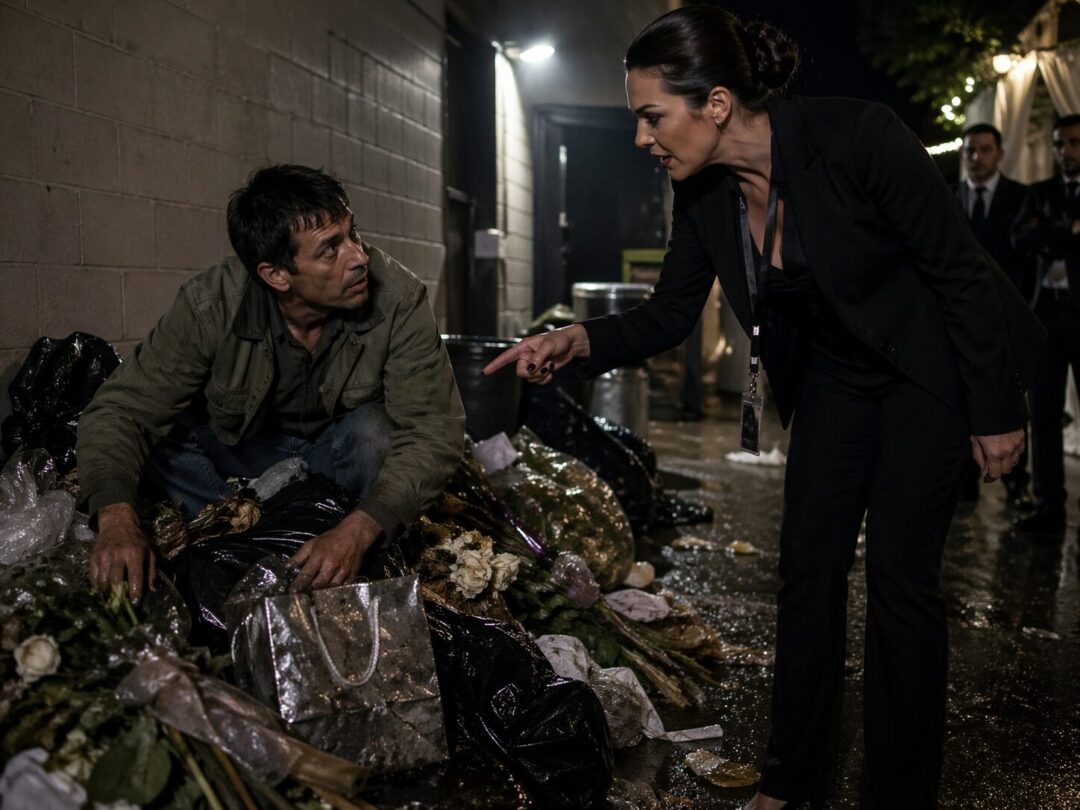
He was kneeling beside a torn black garbage bag behind the Willow Gate Event Hall, one hand braced against the wet pavement, the other pushing aside wilted white roses, bent silver ribbon, and crushed catering boxes slick with spilled cream. From the front of the building, the wedding still glowed. Music leaked faintly through the walls. Laughter rose now and then from the side entrance where the last guests were drifting out in heels and polished shoes.
Back here, under the yellow service light, it was a different world.
The flowers were dead. The champagne flutes were broken. Expensive gift boxes had been ripped open and flattened without care. Everything that had looked beautiful a few hours earlier had already become waste.
“Did you hear me?” the woman said.
This time Rowan lifted his head.
She stood a few feet away, one hand on her hip, her black blazer fitted so tightly it looked like it had been pressed onto her body. Her hair was pulled back in a severe knot, and a laminated venue badge swung against her chest. She had the smooth, armored face of someone who had spent her life learning how to control a room with a look.
He had seen her before that evening. She had been near the entrance all night, directing the florists, the servers, the photographers. The kind of woman people obeyed before she finished speaking.
Her eyes traveled over him in one quick sweep: worn jeans, old jacket, wet knees, hands buried in wedding trash.
There was judgment in that glance. But there was something worse too.
Certainty.
She had already decided who he was.
“There’s nothing in there worth taking,” she said. “If you’re looking for leftovers, the kitchen bins are on the other side.”
Rowan slowly rose from his crouch, not because he felt ashamed, but because standing sometimes made people less cruel.
“I’m not looking for leftovers,” he said.
“Then what are you doing?”
He glanced past her, toward the narrow service door. Two busboys had paused with a metal rack between them. A valet, still in his vest, lingered near the alley mouth with the watchful expression of someone who sensed embarrassment but hoped it belonged to someone else.
The woman followed his gaze and stiffened. An audience only sharpened her tone.
“You can’t just rummage through private disposal,” she said. “This is event property.”
“It’s already in the trash.”
“That doesn’t make it yours.”
Rowan looked back at the heap of bags and split cartons. Rain from earlier still clung to the pavement in dark patches. The smell of flowers gone sour mixed with old food and bleach. Somewhere under all that glittering wreckage, hidden beneath the thoughtless rush of cleanup, was the thing he had been trying not to lose sight of for the last fifteen minutes.
He had seen the mistake happen.
That was the problem.
He had seen too much.
At first, he had told himself to walk away. Men like him knew what happened when they looked too closely at other people’s carelessness. If the rich dropped something, they usually preferred to believe someone stole it rather than admit they had thrown it away themselves.
But he had watched one of the cleanup workers lift a silver gift bag by the handles, curse at how heavy it was, then toss it into the disposal pile without checking inside. Rowan had noticed the bag because of the ribbon tied around one handle—a cream ribbon with gold-edged stitching, too delicate and deliberate to belong on trash.
Then he had watched flowers and cardboard and ruined table decor bury it.
He had not imagined it.
And now, because he had not walked away, a woman in a perfect blazer was staring at him like he was filth.
“Go home,” she said. “Before I call security.”
Rowan wiped his hand on his jacket and let out a slow breath. “I’m looking for one bag.”
Her expression hardened. “You think that sounds better?”
One of the busboys snorted, then immediately looked guilty for doing it.
Heat crept up Rowan’s neck. He was used to being looked through, waved away, dismissed. He had worked loading docks, moving companies, warehouse nights, holiday setup crews. He knew the difference between invisibility and humiliation. Invisibility was a kind of peace. Humiliation was when people needed you to know exactly where you stood.
But he also knew what certainty felt like.
And he was certain.
He stepped back toward the pile.
The woman moved forward instantly. “Don’t.”
That one word did it.
Not because it frightened him. Because it confirmed something.
She wasn’t angry that he was dirtying his hands.
She was angry that he might be right.
Part II — The Weight of Being Wrong
Her name, he would learn later, was Maris, and she had built her life on preventing visible mistakes.
It showed in everything about her—the rigid posture, the clipped tone, the way she kept smoothing the front of her blazer even when it didn’t need smoothing. The wedding had been one of Willow Gate’s biggest events of the season: old family money, local business names, photographers everywhere, enough floral installations to fill a small church.
A smooth night could lead to another contract, another recommendation, another room full of wealthy people trusting her with their public perfection.
A scene in the alley behind the venue was not part of that plan.
And Rowan, with his wet clothes and stubborn silence, was becoming a scene.
“I said stop,” Maris snapped, stepping between him and the bags. “You want me to explain this to the bride’s family? That some man was digging through their things after the reception?”
“That’s exactly why I’m here,” Rowan said.
She gave a short, humorless laugh. “Sure.”
He looked at the heap again. The silver bag had disappeared entirely now. Someone had tossed two soggy centerpieces over the top, and a burst catering tray leaned against the mound like a shield. If he lost the spot, it would be gone before morning with the rest of the disposal pickup.
“I watched one of your workers throw it out by mistake,” he said.
“Throw what out?”
“A gift bag.”
Maris folded her arms. “Every gift was logged.”
“That one wasn’t.”
“You don’t know that.”
“I do.”
“How?”
He could have told her the truth: that when you spent years hauling boxes and furniture and debris, you developed an eye for weight. For what bent at the bottom, what dragged at the wrist, what made someone adjust their grip. The silver bag had looked decorative, but the worker had lifted it like it held something dense. Not tissue paper. Not candles. Something with real pull.
He could have told her that poor people survived by noticing what others threw away without thought.
Instead he said, “Because I saw it.”
Maris stared at him a long moment, as if deciding whether he was lying or just pathetic.
From the alley mouth came the soft click of shoes on wet pavement. Two women in formal dresses had emerged from the side entrance, wrapping shawls around themselves against the chill. They slowed when they saw the scene.
That was the moment Maris truly lost patience.
She took one step closer, dropping her voice into a colder register. “Listen carefully. You are not going to embarrass this venue by pretending there’s treasure in the trash. Whatever you think you saw, you didn’t. So leave.”
Rowan looked at the women near the door, then at the busboys, then back at Maris.
He had lived long enough to know how this looked.
A tired man behind a wedding hall insisting he knew something valuable was hiding in a garbage pile.
Desperation made everyone seem ridiculous before it made them seem tragic.
But the ribbon. The weight. The way the worker had muttered, Why is this one so heavy? right before tossing it aside.
He could still hear it.
“You’re sure there’s nothing there?” he asked.
Maris lifted her chin. “Positive.”
Rowan nodded once. “Then watch.”
He sidestepped her before she expected it—not aggressive, not rough, just fast enough to get one knee back to the pavement. Maris cursed under her breath and reached toward him, then stopped, perhaps because touching him would make the scene even uglier.
He tore through the top layer with controlled urgency. Wilted roses. Foam blocks. Torn lace runner. Empty champagne case. His hands moved faster now, but not wildly. He was not searching. He was remembering. Left side of the pile. Under the floral wrap. Beneath the silver paper box.
His fingers hit satin.
Not the bag itself first.
A ribbon.
Cream, gold-edged, wet but unmistakable.
Everything around him seemed to go still.
He pulled.
The silver gift bag slid from the debris with a sucking sound, half collapsed, one handle torn, its surface streaked with grime. It looked ruined, ordinary, almost laughable in his hands.
Maris folded her arms tighter. “Congratulations,” she said. “You found garbage.”
But her voice no longer carried the same certainty.
Rowan opened the bag.
Inside, there was tissue paper on top—crumpled, damp, pink from spilled wine. He peeled it back.
Then he stopped moving.
For one strange second, the whole alley seemed to hold its breath with him.
Maris took one involuntary step forward.
“What is that?” she said.
Rowan reached in and lifted out a dark velvet pouch, the kind jewelers used for pieces too expensive to box casually. Water beaded on the fabric. Even before he loosened the drawstring, everyone watching understood one thing:
No one used velvet like that for trash.
He opened it.
Gold flashed under the service light.
A bracelet first. Then a pair of earrings, heavy with stones that caught even the weak yellow bulb and threw it back sharp enough to sting the eye. Maris’s hand flew to her mouth. One of the women by the door whispered, “Oh my God.”
Rowan stared into the pouch again, then into the bag.
There was more.
A second velvet pouch.
A narrow lacquered case.
A stack of unopened envelopes bound with a cream ribbon.
The kind guests used for cash gifts.
For a moment no one moved. The alley, which had felt cramped and ugly and mean a minute earlier, now seemed to widen around the impossible thing lying open in Rowan’s hands.
Maris’s voice came out thin. “No. No, that can’t—”
“It can,” Rowan said quietly.
He did not sound triumphant. That was what unsettled her most.
He sounded like a man confirming a fact.
Part III — The Things People Throw Away
The next few minutes unraveled with the strange, dreamlike speed of disaster happening in reverse.
Maris lunged for her radio, nearly dropping it in her haste. Her voice, so clipped and commanding before, fractured as she called for the floor manager, then the bride’s aunt, then someone from gift handling. Behind her, the two women in shawls had come fully into the alley now, drawn by the sight of jewels in a trash bag and the deeper thrill of witnessing a social reversal they would later retell with delicious precision.
The busboys no longer pretended not to stare.
Rowan crouched again, but more carefully this time. He set the bag on an overturned crate and began removing the contents one by one. Not to claim them. Not to hide them. To make them undeniable.
A gold bracelet.
A velvet ring box.
Seven sealed cash envelopes.
A brooch wrapped in tissue.
Another pouch with a necklace so fine it looked almost liquid under the light.
Each item seemed to drain a little more color from Maris’s face.
“What happened?” one of the women asked.
Maris didn’t answer her. She was still trying to stitch together authority from the remains of embarrassment. “No one touch anything,” she said, though Rowan already wasn’t. “No one—just—”
But the command had lost its center. Everyone knew who had seen the truth first, and it had not been her.
The floor manager arrived breathless, then froze at the scene. Questions burst out. Whose gift bag? Which table? How had it ended up back here? Who had been on disposal duty? Had the family counted everything? Had anyone already noticed something missing?
The answers came in fragments. The bride’s cousin had moved gifts from the receiving table too quickly. A cleanup worker had mistaken the heavy bag for decorative packaging after someone removed the card. The silver exterior had been smeared with cake and crushed under centerpieces, making it look like just another ruined favor box.
It had been discarded because no one thought to look twice.
No one except Rowan.
A middle-aged woman in a lavender wrap appeared at the alley entrance and let out a broken sound when she saw the items laid out. She hurried forward, hand shaking over her chest.
“My mother’s bracelet,” she whispered. “That was my mother’s bracelet.”
It was the first time the valuables stopped being abstract.
They were not just expensive things. They were pieces of memory. Family jewelry passed down. Cash gifts tucked into envelopes with blessings inside. The practical and the sentimental, bound together and nearly crushed under wet roses and food waste because people had been in too much of a hurry to notice.
The woman looked from the jewelry to Rowan with tears filling her eyes. “You found this?”
He nodded.
“I—I don’t know what to say.”
Rowan glanced at Maris, not unkindly, then back at the woman. “Just make sure everything’s counted.”
Something in her face shifted then, as if his refusal to dramatize the moment made it land harder. She touched the bracelet again, more carefully this time, and began crying for real.
Behind her, Maris stood perfectly still.
It would have been easy, maybe even satisfying, for Rowan to punish her. To repeat her words back to her. To ask whether she was still positive there had been nothing worth taking. The lines were all there, waiting.
But humiliation was a shallow kind of power. It burned hot and fast, then left a bad taste.
And Rowan was tired.
Tired in the way men became tired after years of learning what contempt felt like in a hundred small forms. The clerk who watched his hands too closely. The restaurant hostess who said the kitchen was closed when it wasn’t. The manager who assumed he must have misunderstood. The polished people who confused neatness for character and disorder for failure.
Maris had not invented that look she gave him in the alley.
She had merely perfected it.
When the first shock passed, she stepped toward him, slower now, stripped of her earlier edge.
“I was wrong,” she said.
The apology seemed to cost her.
Rowan slid the last envelope back into the silver bag. “Yeah.”
It was not cruel. It was simply true.
She inhaled as if she might say more, then didn’t.
Perhaps there was nothing more to say.
Part IV — A Different Kind of Rich
The wedding party did not leave for another hour.
Someone insisted Rowan stay while the family checked the recovered items against their gift list. Someone else brought coffee in a paper cup, though it was too sweet and mostly gone cold by the time it reached him. The woman in the lavender wrap returned twice to thank him. A man in an expensive coat shook his hand with the grave intensity people used when money and relief arrived together.
The total value of what had nearly been hauled off with the trash turned out to be far beyond anything Rowan had imagined.
That fact mattered less to him than he thought it would.
It wasn’t because he didn’t understand money. He understood it too well. He knew what overdue rent felt like in the body. He knew the quiet arithmetic of deciding which bill could wait. He knew how one accident could tilt a whole month into panic.
But sitting there on an upturned crate in the alley, watching wealthy people rediscover the cost of carelessness, he felt something stranger than envy.
Recognition.
Not of the jewels. Not of the envelopes.
Of the principle underneath it all.
People threw away what they didn’t bother to see.
Objects. Chances. Other people.
Sometimes all it took to survive was noticing what everyone else had trained themselves to overlook.
Before midnight, the bride’s uncle tried to press cash into Rowan’s hand as a reward. Rowan refused it once. The man insisted. Rowan refused again. On the third attempt, the aunt with the lavender wrap intervened with wet eyes and a steadier voice.
“Please,” she said. “Let us thank you.”
So Rowan accepted a smaller amount than they wanted to give, enough to make an immediate difference and not so much that it felt like hush money for their shame. He tucked it into the inside pocket of his jacket and stood to leave.
Maris was waiting near the alley mouth.
Without the constant motion of the event around her, she looked older. Not weaker exactly. Just more human. Her hair had loosened slightly at the temples. Her badge hung crooked. One heel was streaked with grime from the pavement she had tried so hard not to belong to.
“I’m sorry,” she said again when he approached.
This time there was no audience.
Rowan stopped a few feet away.
She looked down at her own hands, then back at him. “I thought I knew what I was looking at.”
“That’s usually the problem,” he said.
The words landed, and he could see they landed.
She gave a brief nod, the kind people offered when a lesson hurt too much to argue with. Then she stepped aside.
Rowan walked past her into the parking lot, where the night air smelled cleaner and the music from inside had faded to a distant pulse. His knees were sore. His jacket still carried the scent of wet flowers and bleach. His hands were dirty beneath the nails.
He felt, absurdly, lighter.
At the edge of the lot he stopped and looked back once.
From the front, Willow Gate was all glass and warm gold light and elegant perfection. No one arriving there would ever think about the alley behind it, where the flowers rotted and the boxes split and the mistakes piled up out of sight.
That was where the truth had been.
Not in the ballroom.
In the discard.
Rowan turned and headed toward the bus stop at the corner. His shoes splashed through shallow rainwater. The envelope in his pocket was real. So was the ache in his legs. So was the memory of Maris’s face when the first flash of gold caught the service light.
By morning, the story would travel through the families and staff in whatever shape people needed it to take. Some would make him into a hero. Some would call him lucky. Some would probably say they would have noticed the bag too, if they’d been there.
They wouldn’t have.
Not because they were bad.
Because most people only saw value once it had already been named for them.
The bus arrived with a groan and a hiss of doors. Rowan climbed aboard and took a seat near the back. Across the aisle, a teenager slept against the window in a fast-food uniform. A woman in scrubs rubbed her temples and stared at nothing. The driver didn’t look up.
Ordinary people heading home.
Invisible to anyone who wasn’t one of them.
Rowan rested his head against the cool glass as the bus pulled away.
He thought about the silver bag under the flowers. About the bracelet that had belonged to a dead mother. About the envelopes tied with ribbon. About how close those things had come to vanishing because they had slipped, for one careless moment, into the category of things no one respected enough to inspect.
He had spent half his life living near that category.
Maybe that was why he had seen it.
Maybe that was why he always would.
Outside, the city rolled past in wet streaks of yellow and red. Inside the bus, no one knew what had happened behind the wedding hall. No one knew that a man in a faded jacket had knelt in the trash and pulled a family’s lost fortune back into the light while better-dressed people stood around learning the price of arrogance.
That was all right.
Not every truth needed a crowd.
Some truths were strongest in the quiet after, when the moment had passed and all that remained was its shape inside you.
Rowan slipped one hand into his jacket pocket and touched the folded reward envelope there, then let it go.
For the first time in a long while, he smiled.
Not because he had found money.
Not even because he had been right.
But because, for one clean moment in a narrow alley behind a room full of polished people, the world had turned and shown its hidden face.
And the thing everyone else had called trash had told the truth.