When the Basketball Broke His Window Again, the HOA Told Him to Change His House Instead
Chapter 1: The Ball Came Through the Glass Again
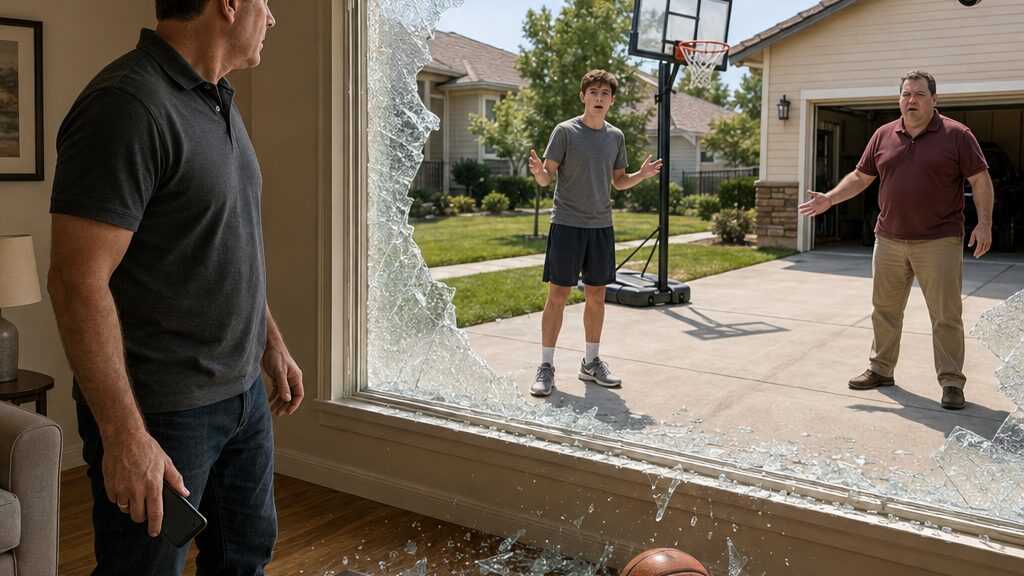
The basketball came through Matthew Harris’s front window hard enough to carry a sheet of glass six feet into the room.
Matthew had been standing near the dining table with a mug in one hand when the first crack snapped through the house. A fraction of a second later came the deeper crash, then the hollow thump of the orange ball striking the hardwood and rolling beneath a chair.
He did not move immediately.
Sunlight poured through the jagged opening where the lower pane had been. Tiny pieces of glass glittered across the floor. Outside, beyond the damaged window, Alexander Walker stood at the edge of his driveway with both hands raised halfway toward his face.
Matthew set his mug down.
“Jessica?”
“I’m fine,” Jessica called from the kitchen.
Only then did he look toward Alexander again.
The teenager had already stepped backward.
Across the driveway, Jason Walker emerged from his garage. He glanced first at his son, then at Matthew’s window.
Matthew felt something inside him go very still.
This was not the first time.
Three weeks earlier, when the Walkers had barely finished unpacking, the basketball hoop had seemed harmless.
It stood at the far side of their driveway on a portable black base filled with water. Alexander spent most afternoons outside after school. He was tall for his age, quick on his feet, and good enough that the sharp rhythm of dribbling rarely bothered Matthew.
At first, Matthew had even found the sound pleasant.
Bounce. Bounce. Sneakers on concrete. The metallic rattle of the rim.
It was ordinary neighborhood noise.
Then one Saturday, Alexander had taken a long shot from near the curb. The ball struck the rim, launched sideways, crossed the narrow strip between the properties and smashed into a smaller front window beside Matthew’s entryway.
Matthew remembered stepping outside with the ball under one arm and finding Alexander staring at the damage.
“Everybody okay?” Matthew had asked.
Alexander nodded quickly.
“Yeah. Sorry.”
Jason had walked over a minute later, phone still in his hand.
Matthew had expected embarrassment. Maybe an apology. Maybe a question about the repair.
Instead Jason had examined the cracked pane and said, “That thing broke pretty easy.”
Matthew had thought he misheard him.
“The basketball hit it.”
“I know. I’m just saying. That’s an older window, right?”
The repair technician charged Matthew two hundred sixty dollars to replace the pane and clean fragments from the frame.
Matthew kept the receipt.
Not because he planned a fight. Documentation was simply how he handled things. At work, he supervised warehouse operations, and unrecorded problems had a way of becoming arguments later.
He showed Jason the receipt the next afternoon.
Jason barely looked at it.
“You want me to cover all of that?”
“Your son broke the window.”
“It was an accident.”
“I know.”
“Then why are we treating it like he threw a brick through your house?”
Matthew stared at him. “I’m treating it like a window that cost two hundred sixty dollars.”
Jason exhaled through his nose.
“He said sorry.”
Matthew remembered the strange feeling that followed. Not anger exactly. More like discovering that the conversation he thought they were having was not the conversation Jason thought they were having.
Matthew had expected responsibility.
Jason was negotiating whether responsibility existed.
Now, three weeks later, another basketball rested beneath Matthew’s dining chair.
Jessica came into the room wearing socks and stopped when she saw the floor.
“Don’t move,” Matthew said.
She looked through the broken window. “Again?”
Outside, Jason was already crossing the lawn.
Matthew picked his way toward the front door.
By the time he stepped onto the porch, Alexander had moved behind his father.
Jason spread his hands.
“Before this gets crazy—”
“Crazy?”
“I’m saying nobody wanted this.”
Matthew pointed back toward his house.
“That’s the second window.”
“I can count.”
“Then we’re starting from the same place.”
Jason’s jaw tightened.
Alexander stared at the driveway.
Matthew noticed the boy was no longer holding another ball.
For some reason, that detail irritated him more than it should have.
Jason looked toward the broken pane.
“You ever have those windows inspected?”
Matthew blinked.
“What?”
“I asked around after the first one. There’s impact-resistant glass. Laminated glass. Stuff that doesn’t do that.”
Matthew almost laughed.
“You asked around?”
“I’m trying to find a solution.”
“A solution is moving the hoop.”
Jason’s expression changed.
“No.”
The answer came so quickly that Matthew felt his own temper rise.
“You have an entire driveway.”
“That hoop has been there since we moved in.”
“You moved in a month ago.”
“And my son uses it.”
Matthew looked at Alexander.
“Then turn it.”
Jason stepped slightly between them.
“He doesn’t need you talking to him like he’s done something criminal.”
“I said turn the hoop.”
“And I said there are ways to make your windows safer.”
For several seconds neither man spoke.
Somewhere down the street, a lawn mower shut off. Matthew became aware of how exposed they were, standing on adjoining lawns while afternoon traffic moved slowly through the subdivision.
He lowered his voice.
“You’re suggesting I replace my windows because your son keeps hitting them with a basketball.”
“I’m suggesting there might be more than one factor here.”
That sentence stayed with Matthew.
More than one factor.
As though the age of his glass and the direction of Alexander’s shots belonged in the same category.
Jessica appeared in the doorway behind him.
“Matthew.”
He knew her tone. Enough.
He turned away from Jason before saying what was already forming in his head.
Inside, he swept the largest pieces of glass while Jessica called the repair company.
The basketball remained beneath the dining chair.
Matthew eventually picked it up and carried it to the garage.
He did not throw it back.
That evening, after the opening had been temporarily covered with a sheet of plywood, he sat at the kitchen table with both repair receipts beside his laptop.
Jessica put a plate in front of him.
“You’re not eating.”
“I will.”
“You’ve been staring at the same receipt for twenty minutes.”
Matthew tapped the first invoice.
“He knew.”
“Knew what?”
“That it could happen again.”
Jessica leaned against the counter.
“He definitely should’ve moved the hoop.”
“That’s not what I mean.”
Matthew opened a blank email.
“He asked around about impact glass after the first break. Instead of stopping the problem, he researched how I could spend money adapting to it.”
Jessica folded her arms.
“Who are you emailing?”
“No one yet.”
“Matthew.”
He looked at her.
She nodded toward the screen.
“Don’t turn this into something bigger tonight.”
“It already is bigger.”
The email notification arrived before he could type another word.
The sender was the neighborhood management company.
Subject: Property Safety Inquiry.
Matthew opened it.
The message was polite. Almost aggressively polite.
The association had received a concern regarding potentially vulnerable exterior glazing at his residence. The property standards committee requested information about the approximate age of several front-facing windows and whether they met current safety specifications.
Matthew read the paragraph twice.
Then a third time.
Jessica leaned over his shoulder.
“What does that have to do with the basketball?”
Matthew scrolled to the bottom.
The message included Kimberly Roberts, chair of the HOA property standards committee.
He looked through the dark window above the sink toward the Walker house.
Jason’s garage light was still on.
Matthew closed the laptop.
“Apparently,” he said, “that’s what I’m about to find out.”
Chapter 2: The Notice Was Addressed to Matthew
The printed notice had Matthew’s name at the top.
Not Jason’s.
Not Alexander’s.
Matthew stood at the kitchen counter Monday morning reading it while the temporary plywood covering the broken window turned the front room dim.
Jessica came downstairs carrying her work bag.
“They mailed one too?”
“Apparently email wasn’t official enough.”
The notice did not accuse Matthew of violating anything. That almost made it worse.
It described an “informal compliance inquiry” into whether certain exterior windows created an avoidable safety risk due to age, placement, or material.
At the bottom was a request that Matthew contact Kimberly Roberts.
Jessica read it over his shoulder.
“This sounds like they’re asking questions.”
“They’re asking the wrong house.”
“Call her before you decide what it means.”
By nine-thirty, Matthew had Kimberly on speakerphone.
Her voice was calm and professional.
“This isn’t a citation, Mr. Harris.”
“Then why am I receiving a compliance inquiry?”
“Because a potential safety concern was raised.”
“My window was broken by a basketball.”
“I understand there was an incident.”
“Two incidents.”
A pause.
“Yes. We have reference to repeated incidents.”
Matthew looked toward the plywood.
“Then you understand what the safety concern is.”
Kimberly did not take the bait.
“Our role is limited. We generally cannot regulate ordinary conduct between residents unless it falls under a specific covenant provision.”
“But you can regulate my glass?”
“We can review exterior modifications and certain safety conditions.”
Outside, a basketball began bouncing.
Matthew closed his eyes.
Bounce.
Bounce.
Bounce.
Kimberly continued.
“One possible risk-reduction measure would be impact-resistant glazing on the exposed windows.”
Matthew opened his eyes.
“You’re serious.”
“I’m explaining an option.”
“The kid hits my house and your option is for me to rebuild it.”
“That is not what I said.”
The ball struck the Walker backboard with a metallic bang.
Matthew stepped toward the front window, forgetting for a second that plywood blocked the view.
Kimberly’s tone remained measured.
“If you’d like, obtain an estimate. That would at least give the committee concrete information.”
Matthew almost refused.
Instead, he wrote the request down.
Concrete information.
That was language he trusted.
Two days later, the window contractor stood in Matthew’s front room measuring frames.
Impact-resistant replacements were not simply thicker panes. Several openings would need new assemblies.
The contractor calculated quietly on a tablet.
Matthew waited.
Finally the man turned the screen.
$15,250.
Matthew stared at the number.
“For the front side?”
“For the units we discussed. Installed.”
Matthew gave a short, humorless laugh.
“So a basketball breaks a two-hundred-sixty-dollar pane, and the proposed solution is fifteen thousand dollars.”
The contractor looked uncomfortable.
“I’m not recommending anything. I’m just pricing what you asked for.”
That distinction mattered.
Matthew thanked him.
After he left, Matthew photographed the estimate beside the original repair receipt.
Two hundred sixty dollars.
Fifteen thousand two hundred fifty dollars.
He emailed both to Kimberly with a concise explanation.
Then he walked outside.
He had promised Jessica he would stop discussing the matter with Jason until the HOA responded.
He lasted less than a minute.
Jason was at the curb dragging a trash bin back toward his garage.
Matthew crossed the lawn with the estimate in his hand.
“Fifteen thousand two hundred fifty.”
Jason stopped.
“What?”
“That’s your impact-glass solution.”
“I never told you to replace every window.”
“You told me my windows were the problem.”
“I said they might be part of the problem.”
Matthew held up the estimate.
“You talked to the HOA.”
Jason looked down the street.
A neighbor across the road had paused beside a mailbox.
“I asked a question.”
“What question?”
“Whether there were safety standards.”
“For my house.”
“For everybody.”
“You didn’t ask everybody.”
Jason lowered his voice.
“Matthew, you came to my door with a repair bill like you were collecting a debt.”
“Because your son broke my window.”
“And you kept talking after I told you I’d deal with him.”
“You didn’t deal with him.”
Jason’s face tightened.
“You don’t know what I deal with.”
Matthew heard the words but not their meaning. His attention had narrowed to the estimate in his hand, the plywood behind him, the neighbor still pretending not to watch.
“You found a way to make this my violation.”
“That’s not what happened.”
“Then tell them you caused this.”
Jason gave a disbelieving shake of his head.
“I caused it?”
“You know what I mean.”
“No, actually, I don’t.”
The neighbor across the street walked slowly toward his front door.
Matthew realized too late how loud his voice had become.
Jason noticed too.
His expression changed from defensive to almost weary.
“You keep doing this.”
“Doing what?”
“Coming over here angry. Cornering me. Talking about my kid like he’s some neighborhood hazard.”
“He broke two windows.”
“He’s a teenager who missed two shots.”
“And somehow I’m the one getting compliance letters.”
Jason stepped closer, but his voice became quieter.
“You want some advice?”
Matthew said nothing.
“Stop giving them reasons to think the problem isn’t only the basketball.”
For the first time, Matthew felt something colder than anger.
“What have you told them?”
Jason picked up the trash bin handle again.
“I told them what happened.”
“What happened according to you?”
Jason started toward his garage.
Matthew followed one step.
“Jason.”
Jason stopped without turning around.
“You’re giving the board exactly what they need.”
Then he rolled the bin up the driveway and went inside.
Matthew remained at the curb holding the fifteen-thousand-dollar estimate.
Behind him, the plywood covering his broken window caught the afternoon sun like a blank sign.
For the first time, Matthew wondered whether Jason had been building a record too.
Chapter 3: One More Shot Changed the Argument
Matthew heard the bounce before he heard the glass.
He was in the hallway carrying a box of replacement hardware when the basketball struck pavement outside.
One bounce.
Then another.
Jessica had asked him the night before whether every bounce would bother him now.
He had said no.
The lie lasted until the third bounce.
Then came the crash.
Matthew froze.
The sound was sharper than the previous break, followed by a scatter of fragments striking the hardwood.
Jessica called from upstairs.
“What was that?”
Matthew set the box down.
For one dangerous second, he was already outside in his mind.
Across the lawn. Up Jason’s driveway. No measured tone this time. No receipt. No estimate.
Then he saw the small camera mounted beneath the porch eave.
Three days earlier, Jessica had found him drafting another message to the HOA after midnight.
The opening sentence alone ran six lines.
She had read it without asking.
“You sound furious.”
“I am furious.”
“That doesn’t mean you should send this.”
“Everything in it is true.”
“That’s not the same thing.”
Matthew had turned toward her.
“What exactly do you want me to do?”
“Stop trying to make Jason admit you’re right.”
“He is wrong.”
“I know.”
The answer had disarmed him.
Jessica continued.
“But every time he refuses to admit it, you get louder. And every time you get louder, he gets to talk about your behavior instead of his.”
Matthew had deleted the email.
The next morning he bought a camera.
Now, with another pane broken, the camera’s tiny indicator light was steady beneath the porch roof.
Matthew inhaled once.
Then he walked into the front room.
The orange ball rested near the wall.
Glass covered the floor.
On the side table, less than three feet away, lay the HOA envelope suggesting impact-resistant upgrades.
Ball.
Glass.
Notice.
Matthew stared at the arrangement.
It looked absurd enough to have been staged.
He pulled out his phone.
First he photographed the room.
Then the broken frame.
Then the ball.
Then the notice where it lay.
Only after that did he call upstairs.
“Stay where you are until I sweep this.”
Jessica appeared at the landing.
“Are you going outside?”
“No.”
She studied his face.
“Good.”
Matthew cleaned a path, retrieved the camera application on his laptop, and opened the recording.
The footage began with an empty driveway.
Alexander entered from the Walker garage with the basketball under his arm.
Matthew leaned closer.
The boy dribbled twice, took a shot, retrieved the rebound.
Nothing unusual.
Then Alexander stepped farther toward the curb.
Matthew recognized the position immediately.
It was the same angle he had complained about after the first window.
Alexander shot.
The ball struck the rim and ricocheted hard toward Matthew’s property.
It missed the house by several feet.
Alexander retrieved it.
Matthew’s hand tightened around the mouse.
The teenager returned to almost the same spot.
Another shot.
Another rebound.
Then the third.
The ball caught the front edge of the rim and launched sideways.
Straight toward Matthew’s window.
On the recording, the glass burst inward.
Alexander stopped.
He looked at the window.
Then, before doing anything else, he looked toward his own house.
Matthew paused the video.
Jessica had come downstairs quietly.
“He knew that was possible,” Matthew said.
“He knew after it happened.”
“No. Look.”
Matthew dragged the timeline backward.
He replayed the earlier miss.
The ball had already flown dangerously close to Matthew’s siding.
Then Alexander had returned to the same spot.
Jessica watched.
“That’s different.”
Matthew nodded.
The first break could have been dismissed as chance.
The second might have been careless repetition.
This footage showed something more specific: Alexander had received a warning from the ball itself and kept shooting from the same place.
Matthew exported the clip.
He created a folder.
First repair.
Second repair.
Impact-glass estimate.
HOA correspondence.
Video.
For the first time since the conflict began, the facts no longer depended on whether Jason agreed with them.
Matthew felt his shoulders loosen.
“This is done,” he said.
Jessica looked at him.
“Is it?”
He turned the laptop toward her.
“They asked for facts.”
“That doesn’t mean they’ll do what you want with them.”
He sent the video to Kimberly anyway.
Her reply came less than two hours later.
Thank you. The committee will review the submitted material.
Matthew smiled when he read it.
Then he read the next paragraph.
Because the camera appeared to be a newly installed exterior device visible from the common-facing frontage, the association also needed confirmation that its installation complied with architectural guidelines.
Matthew stared at the screen.
Jessica leaned over.
“Oh, come on.”
Matthew almost laughed.
Not because anything was funny.
Because anger had finally become too predictable.
He called Kimberly.
She answered late in the afternoon.
“I have the footage,” she said.
“Good. Then we agree the basketball caused the damage.”
“The footage appears consistent with what you described.”
“Appears?”
“I’m not disputing the video.”
“Then what are we doing?”
Kimberly sighed softly.
“Mr. Harris, I understand why you’re frustrated.”
“That sentence usually means I’m about to hear something frustrating.”
There was a brief silence.
“The association has two separate issues in front of it. One is your complaint regarding repeated property damage. The other is an exterior modification installed without prior architectural review.”
“It’s a camera.”
“I know.”
“To document the property damage.”
“I know that too.”
Matthew stood and walked toward the porch.
Across the street, the late afternoon was quiet.
No basketball.
No Jason.
Nothing to argue with.
“Was Jason the person who complained about the camera?”
Kimberly did not answer immediately.
“That isn’t the relevant question.”
“It is to me.”
“The camera review is administrative.”
“And the window review?”
Another pause.
Matthew felt something shift.
“Kimberly.”
“Yes?”
“When did Jason first contact you?”
Silence again.
This time it lasted long enough that Matthew stopped pacing.
Finally Kimberly said, “Before your second broken window.”
Matthew looked through the repaired section of glass toward the Walker house.
“How long before?”
“I’d have to check the notes.”
“What did he ask you?”
“I don’t want to answer from memory and give you inaccurate information.”
Matthew’s earlier satisfaction disappeared.
The camera had proved what happened in his driveway.
But suddenly that was no longer the biggest question.
Kimberly lowered her voice.
“I can tell you this much. Mr. Walker’s contact with the committee did not begin with your camera.”
Matthew said nothing.
She continued.
“And it did not begin with the most recent incident.”
Matthew looked at the folder open on his laptop.
He had been documenting broken windows.
Jason, apparently, had started documenting Matthew.
“What exactly did he tell you?” Matthew asked.
Kimberly hesitated.
“I think,” she said, “you should come to the next committee meeting and read the notes yourself.”
Chapter 4: The Complaint Started Before the Camera
The first line in the committee notes had a date beside it.
Matthew read the date twice.
It was four days before Alexander broke the second window.
Across the HOA meeting room, Kimberly Roberts waited without interrupting. Two other board members sat farther down the table with folders open in front of them. Through the glass wall behind them, children were using the community recreation area. A basketball rose briefly above the fence, dropped, then rose again.
Matthew looked back at the page.
Resident Jason Walker requested guidance regarding repeated hostile interaction from adjoining homeowner and potential safety concerns involving older residential glazing.
“Hostile interaction,” Matthew said.
Kimberly folded her hands.
“That was the language recorded by the management representative.”
“What interaction?”
“The conversation after the first damaged window.”
“The conversation where I showed him a two-hundred-sixty-dollar bill.”
“I wasn’t there.”
Matthew turned the page.
Jason had described the first break as accidental. He had told the association that Matthew’s reaction had been disproportionate and that Alexander was becoming uncomfortable using his own driveway.
Another note referenced “possible impact-resistant replacement options.”
Matthew looked up.
“He asked about forcing me to change the windows.”
Kimberly shook her head.
“He asked whether the association had authority to require a safety modification.”
“That’s the same thing with better grammar.”
One of the board members shifted in his chair.
Kimberly did not react.
“From his description at the time, we had one broken pane, a teenager playing basketball on his own property, and an escalating dispute between homeowners.”
“He left out that he refused to pay.”
“He said responsibility for the full repair amount was disputed.”
Matthew almost laughed.
“Of course he did.”
Kimberly slid another sheet toward him.
“You asked why anyone here considered his concern reasonable.”
Matthew read.
The notes said Jason had reported Matthew confronting him twice, once at his door and once near the property line. Jason claimed Matthew had spoken directly to Alexander in a manner that made the teenager feel unwelcome.
Matthew pushed the page away.
“I told him to turn the hoop.”
“I know what you say happened.”
“You have footage now.”
“Of the basketball.”
Matthew stared at her.
Kimberly continued carefully.
“The camera shows the property damage. It does not show the earlier conversations.”
“So we’re back to his word against mine.”
“On those conversations, yes.”
The basketball outside struck the recreation-center rim.
The sound traveled cleanly through the glass.
Matthew felt his jaw tighten.
Kimberly noticed.
“This is what I’m trying to explain. Associations handle physical conditions more easily than interpersonal behavior. We can verify a fence height. We can verify an exterior fixture. We can verify whether a modification was approved. We cannot always determine who was more reasonable during an argument between two neighbors.”
“So you went after the thing you could measure.”
“That is a fair criticism.”
The answer stopped him.
He had expected procedure. Maybe defensiveness.
Not that.
Kimberly leaned back.
“The window inquiry should not have been framed as though your property caused the damage. I can say that now. At the time, we were trying to identify a preventative option without adjudicating blame.”
Matthew looked down at the notes again.
The HOA had not secretly chosen Jason’s side.
It had chosen the easier problem.
Glass could be specified.
Behavior could not.
That did not make the outcome fair, but it made it less satisfying to hate.
Then Kimberly turned another page.
“There is something else.”
Matthew looked up.
She rotated a printed email toward him.
It was his.
The one he had sent at 12:43 a.m. after the second HOA notice, before Jessica persuaded him to stop.
He had forgotten he sent an earlier version.
The first paragraph accused the board of “rewarding negligence.”
The second called the impact-glass suggestion “an absurd attempt to transfer responsibility.”
By the fourth, he had written that if the association continued protecting “reckless conduct,” he would hold individual decision-makers responsible for whatever happened next.
Reading it now, Matthew felt heat move into his face.
He remembered typing it.
He did not remember how threatening the last sentence looked.
Kimberly tapped the page.
“This is part of why the committee became cautious.”
Matthew said nothing.
“You were angry,” she said.
“I was right.”
“Those are not mutually exclusive.”
He looked toward the recreation area.
The basketball had stopped.
For weeks, Matthew had imagined a clean line separating the reasonable side from the unreasonable one. His damaged windows on one side. Jason’s excuses on the other.
But his own words sat on the table between them.
He had given Jason something useful.
Not proof that Matthew was wrong about the damage.
Proof that Matthew could be described as angry.
“Did Jason see this?”
Kimberly nodded.
“Correspondence related to an open dispute was summarized for both parties.”
Matthew leaned back.
That explained Jason’s comment at the curb.
You’re giving the board exactly what they need.
For once, Jason had not been bluffing.
The meeting ended without a ruling.
Kimberly agreed to suspend any recommendation regarding impact-resistant glass until the property-damage complaint was reviewed alongside the newer footage. Matthew agreed to submit the camera application retroactively instead of arguing that he should never have needed one.
It felt less like victory than cleanup.
At home that evening, Jessica was at the kitchen island cutting vegetables when he placed the printed email beside her.
She read half the first page.
“You sent this?”
“Apparently.”
“You told me you deleted it.”
“I deleted the second one.”
Jessica looked at him.
Matthew pulled out a chair.
“I know.”
She set the knife down.
“What happened at the meeting?”
“They were wrong about the windows.”
“And?”
“And I made it easier for them to doubt me.”
Jessica’s expression softened, though not much.
“That’s different from saying you caused any of this.”
“I know.”
He looked toward the front room.
The repaired glass reflected the kitchen lights.
For weeks he had wanted someone official to say Jason was wrong.
Now Kimberly had nearly said it, and the satisfaction was smaller than he expected.
Jessica wiped her hands on a towel.
“There’s something else.”
Matthew looked at her.
“Alexander came by.”
“When?”
“About twenty minutes before you got home.”
Matthew straightened.
“What did he want?”
“He asked if you were here.”
“Did Jason send him?”
“I don’t think so.”
“Why?”
“Because he kept looking back at his house like he didn’t want his father to see him.”
Matthew stood.
Jessica caught his wrist before he could move toward the window.
“He said he wants to talk to you.”
“About what?”
“He wouldn’t tell me.”
A shadow moved beyond the front glass.
Both of them turned.
Alexander was standing at the edge of the driveway.
Alone.
And tucked against his hip was the orange basketball from the camera footage.
Chapter 5: Alexander Finally Said What His Father Wouldn’t
Alexander did not bounce the ball.
That was the first thing Matthew noticed when he opened the door.
For weeks, the sound of that basketball had announced the boy before Matthew saw him. Now Alexander stood on the porch holding it against his ribs with both hands, as if even letting it touch the concrete might be a mistake.
“Mrs. King said I could come back.”
Matthew stepped outside and closed the door behind him.
“What do you need?”
Alexander glanced toward his own house.
The Walker garage was closed.
“I wanted to explain something.”
Matthew leaned against the porch post.
“Okay.”
The boy did not speak.
Matthew had spent weeks imagining what he would say if Alexander ever admitted responsibility. In those imaginary conversations Matthew was calm, exact, devastatingly reasonable.
Now, with the teenager in front of him, every prepared sentence felt too large.
Alexander looked at the ball.
“I knew it was getting close.”
Matthew said nothing.
“The shots.”
“I saw the video.”
“I know.”
“You knew about the camera?”
“After.”
Alexander shifted his grip.
“That one before the window broke—the one that went by your house. I knew.”
Matthew felt the old anger rise.
“You knew and took the same shot again.”
“Yeah.”
“Why?”
Alexander’s shoulders lifted slightly.
“I didn’t think it would matter.”
“That answer doesn’t make sense.”
“My dad said you were making it into a bigger deal than it was.”
Matthew watched him.
Alexander spoke faster now, as if stopping would make it harder to restart.
“After the first window, he said accidents happen. Then you brought the bill over, and he said you were acting like I did it on purpose.”
“I never said you did it on purpose.”
“I know that now.”
“Why did you think that?”
Alexander looked toward his house again.
“Because that’s how he talked about it.”
Matthew folded his arms, then forced himself to unfold them.
The ball remained still between Alexander’s hands.
“He told you to keep shooting from there?”
“No.”
“Then what did he tell you?”
“That I didn’t have to stop using my driveway because you were mad.”
There it was.
Not an order.
Permission.
The difference mattered, and somehow made the whole thing worse.
Matthew sat on the porch step.
“Why is he so determined about the hoop?”
Alexander’s face closed.
Matthew nearly pushed.
Instead he waited.
Finally Alexander sat at the opposite end of the step, leaving several feet between them.
“I got suspended last year.”
Matthew looked at him.
“From school?”
“For fighting.”
The answer was quiet.
“My mom and dad had already been arguing a lot. Then she moved out. We moved here after that.”
Matthew had known none of this.
Alexander rolled the ball a few inches between his palms but still did not let it hit the ground.
“My dad kept saying this place was supposed to be a reset. New school. New neighborhood. Basketball instead of getting into stuff.”
“So when I complained—”
“He thought people were starting again.”
“Starting what?”
“Thinking I was trouble.”
Matthew looked at the boy.
Alexander gave a small shrug that did not look casual.
“At the old place, everybody knew about the suspension. Teachers. Parents. Kids. My dad said we weren’t bringing that here.”
Matthew thought about Jason saying, You don’t know what I deal with.
For the first time, the sentence had a shape.
It did not excuse anything.
But it had a shape.
“Your father thought admitting you were being careless would turn into something bigger.”
Alexander nodded.
“I think so.”
“And you?”
“I thought you hated me.”
Matthew blinked.
“Why would I hate you?”
“You kept coming outside every time I played.”
“Because balls were hitting my house.”
“I know.”
“Now.”
Alexander nodded.
The distinction hung between them.
Matthew looked at the repaired window.
He had spent weeks seeing Alexander mainly through glass—across a pane, beside a crack, frozen in camera footage.
Up close, he looked younger.
Not innocent.
Just younger.
“You still took the shot,” Matthew said.
“I know.”
“You had already missed toward my house.”
“I know.”
“And after two broken windows, you kept playing there.”
Alexander swallowed.
“Yeah.”
Matthew did not rescue him from the silence.
That mattered too.
After a while, Alexander said, “I’m sorry.”
It was the first apology Matthew believed because it was the first one that did not come attached to an argument about why the damage should not count.
Matthew nodded once.
“Thank you.”
Alexander looked surprised that he had not said more.
“There’s a board meeting next week, right?”
“Yes.”
“My dad said you’re trying to get us fined.”
“I’m trying to get my windows paid for and the hoop moved.”
“He said if the HOA says we’re causing problems, they can make things bad for us here.”
Matthew could hear Jason in the phrasing.
Not entirely false.
Not entirely true.
“What are you asking me?”
Alexander stared down at the ball.
“I could tell them.”
“Tell them what?”
“That I knew the shots were getting too close.”
Matthew’s heartbeat changed.
For weeks, he had wanted exactly that.
An admission.
Not a camera angle. Not a contractor estimate. Not administrative notes.
A person saying the thing plainly.
He could already imagine the board room. Jason sitting across from him. Alexander confirming everything Jason had minimized.
The clean victory Matthew had wanted was suddenly available.
And he disliked the feeling it gave him.
Alexander continued.
“But I don’t want my dad thinking I went behind his back.”
“You did come behind his back.”
“I know.”
“Why?”
The boy’s grip tightened around the basketball.
“Because I think this is getting worse because nobody says what actually happened.”
Matthew looked toward the Walker house.
That might have been the most adult sentence anyone involved had said.
He thought about bringing Alexander’s statement to Kimberly immediately.
He thought about what it would do to Jason.
Then he thought about the email he had written at 12:43 a.m., full of facts and anger, and how both could exist in the same document.
“Don’t decide tonight,” Matthew said.
Alexander looked up.
“What?”
“You don’t owe me a performance at the board meeting.”
“But I broke the windows.”
“Yes.”
“And my dad—”
“Your father’s choices are his.”
Matthew gestured toward the basketball.
“Yours are yours.”
Alexander was quiet.
“I still think you should tell the truth if they ask you. But I’m not going to use you to punish him.”
The boy looked at him for several seconds.
Matthew was not sure whether he understood.
Maybe Matthew was not entirely sure himself.
Alexander stood.
At the end of the porch, he stopped.
“If I tell them everything, are you trying to get us kicked out?”
Matthew had been asked dozens of versions of the wrong question during the dispute.
Whose fault was the glass?
Were the windows too old?
Was the camera approved?
Was Matthew too angry?
This one was harder because his answer would decide what kind of victory he actually wanted.
He looked at Alexander and realized he had not yet decided.
Chapter 6: Matthew Had Proof, but Not the Victory He Expected
Matthew placed three repair invoices on the HOA table.
Then he set down the impact-glass estimate.
Beside them he placed three still photographs from the camera footage.
In each photograph, the basketball occupied a different position.
In Alexander’s hands.
In flight.
Against broken glass.
Jason Walker sat across from him.
Kimberly Roberts sat at the end of the table with the two board members. Jessica had come but remained in the row of chairs behind Matthew.
Alexander sat beside his father.
He had not looked at Matthew since entering the room.
Kimberly opened the meeting.
“This is not a disciplinary hearing against a minor,” she said. “We are reviewing a recurring property-damage dispute, associated homeowner conduct, and the association’s earlier safety inquiry.”
Jason leaned back.
Matthew noticed immediately how tired he looked.
Not defeated.
Tired.
Kimberly asked Matthew to begin.
For once, he did not begin with Jason.
He walked through the dates.
First broken pane.
Two hundred sixty dollars.
Conversation about moving the hoop.
Second incident.
HOA inquiry.
Impact-resistant replacement estimate.
Camera installation.
Third damage incident.
He did not call Jason irresponsible.
He did not say the board had protected him.
He did not use the word absurd.
He simply stopped when the timeline ended.
Kimberly turned to Jason.
“Do you dispute that Alexander’s basketball caused the three incidents?”
Jason looked at his son.
“No.”
Matthew felt something unclench.
It was smaller than he expected.
Kimberly continued.
“Do you dispute that Mr. Harris asked you to change the hoop’s position after the first incident?”
Jason hesitated.
“No.”
“Why wasn’t it changed?”
Jason rubbed one hand over his mouth.
“Because I thought he was overreacting.”
Matthew stared at him.
Jason continued before anyone interrupted.
“I thought moving it meant admitting Alexander couldn’t handle being out there. And I wasn’t going to do that.”
One board member asked, “Why not?”
Jason looked toward Alexander.
The teenager stared at the tabletop.
Jason’s answer came slowly.
“We moved here because he had a rough year. School suspension. Problems at home. His mother and I separated.”
Alexander’s shoulders tightened.
Jason saw it.
“I’m not putting his business out there to excuse this.”
But he already had.
The room changed.
Matthew felt it immediately.
Not sympathy exactly.
Context.
Jason looked at Kimberly.
“I promised him this place would be different. Then the first month we’re here, a neighbor is at the door with a bill and telling me my kid has to stop doing the one thing he’s actually been focused on.”
“I told you to turn the hoop,” Matthew said.
Jason nodded.
“I know that now.”
“You knew it then.”
Jason looked at him.
“Yes.”
The word landed harder than denial would have.
Jason lowered his eyes.
“I just didn’t want to hear it.”
Silence filled the room.
Then Alexander spoke.
“I knew too.”
Jason turned sharply.
Alexander kept his eyes on the table.
“The third time. Before the window broke. I had already missed toward his house.”
Jason stared at him.
“You don’t need to—”
“Yes, I do.”
The teenager looked at Kimberly.
“My dad told me Mr. Harris was making it a big deal because he didn’t like me playing there.”
Jason closed his eyes.
Alexander continued.
“He didn’t tell me to break anything. He didn’t tell me to aim at the house. But he said I didn’t have to change what I was doing just because Mr. Harris was mad.”
Matthew heard Jessica shift behind him.
There it was.
The admission he had wanted.
Yet watching Jason absorb it, Matthew felt no urge to sharpen the moment.
Jason opened his eyes.
“I said that.”
Kimberly asked, “More than once?”
“Yes.”
“Even after the first damage?”
Jason nodded.
“Yes.”
The board member beside Kimberly looked down at the invoices.
“That seems significant.”
Jason gave a humorless laugh.
“Yeah. It does.”
Matthew had imagined this moment many times.
In those versions, Jason fought until the evidence cornered him. Then the truth came out and everyone saw Matthew had been right.
Reality was quieter.
Jason was not cornered.
He was embarrassed.
And Matthew was still right.
Both facts existed without canceling each other.
Kimberly moved to costs.
Jason accepted responsibility for the direct repair charges but objected to the fifteen-thousand-dollar estimate.
“I am not paying to upgrade his entire front elevation.”
Matthew almost answered automatically.
Then stopped.
The estimate had become symbolic in his mind.
Proof of how absurd the association’s response had been.
But Jason had not broken fifteen thousand dollars’ worth of windows.
Matthew looked at the document.
Then slid it away from the invoices.
“I’m not asking him to.”
Jason looked at him.
Kimberly paused.
Matthew pointed to the direct repair charges.
“These are actual damages.”
Then to the photographs.
“This is why the hoop needs to move.”
He touched the HOA inquiry last.
“And I want the recommendation that I replace my windows withdrawn.”
One board member asked, “Anything else?”
Matthew thought of his angry email.
The curb argument.
The weeks spent wanting Jason to say the exact words that would make everything feel balanced.
He thought of Alexander on the porch asking whether Matthew intended to get them removed.
“No.”
Jason looked genuinely confused.
Matthew continued.
“I want the repairs covered. I want the hoop moved so the same thing doesn’t happen again. And I want the association to stop treating my windows as the cause.”
Kimberly nodded slowly.
“That is workable.”
Jason leaned forward.
“The first repair was two-sixty. The later ones are higher.”
“Different glass sizes,” Matthew said.
“I want copies from the contractor.”
“You can have them.”
“And I can’t pay everything this week.”
Matthew felt the old instinct rise.
Not my problem.
The sentence was ready.
He let it pass.
Kimberly asked Jason, “Are you disputing the amount or asking for time?”
Jason stared at the invoices.
“Time.”
That was different.
Matthew looked at Jessica.
She did not nod or signal.
She left the choice with him.
“A payment schedule is fine,” Matthew said.
Jason looked up.
For a moment neither man spoke.
There was no gratitude in Jason’s expression.
But the defensiveness had weakened.
Kimberly gathered the papers.
“The committee can formalize three recommendations. Direct documented repair costs to be reimbursed under an agreed schedule. Relocation or reorientation of the basketball goal away from the adjoining residence. Withdrawal of the impact-resistant glazing recommendation as unnecessary to resolve this dispute.”
She paused.
“The camera application can be handled separately through normal architectural review.”
Matthew almost smiled.
Of course it could.
Kimberly added that the association would also draft a general procedure for future property-damage complaints so physical modifications were not proposed before responsibility had been investigated.
No one applauded.
No one apologized dramatically.
The fluorescent lights buzzed overhead.
Alexander stared at the basketball photographs.
Jason rubbed his thumb against the edge of the first invoice.
The whole conflict had shrunk back to its actual size.
Broken windows.
A badly positioned hoop.
Money owed.
Pride.
Matthew collected his copies.
Before standing, he looked directly at Kimberly.
“That’s all I’m asking for.”
Then he looked at Jason.
“Documented repairs. Move the hoop. We stop doing this.”
Jason’s jaw worked once.
He looked at Alexander, then back at Matthew.
“I need to look at the payment schedule.”
“That’s fine.”
Matthew stood.
It was not the victory he had pictured.
For the first time, he suspected that might be why it could actually end the problem.
Chapter 7: The Hoop Moved Before the Window Was Replaced
Matthew woke to the sound of metal scraping against concrete.
For one confused second, he thought something had struck the house again.
Then came the short burst of a power tool.
He got out of bed, crossed the hallway, and looked through the front window.
Jason Walker was kneeling beside the basketball hoop.
Alexander stood a few feet away holding the portable base steady while his father loosened the bolts connecting the pole assembly to its weighted platform.
Jessica came up behind Matthew.
“They’re moving it.”
He nodded.
Neither of them went outside.
For months, Matthew had imagined what it would look like when Jason finally gave in.
He had pictured irritation. Maybe some deliberate display of resentment. Jason dragging the hoop away while making sure Matthew could see how unfair he considered the whole thing.
Instead, father and son worked quietly.
They rotated the base, disconnected the upper section, and carried the pieces toward the far side of their backyard.
The new position faced away from Matthew’s house.
Alexander tested the angle by standing where the new shooting line would be.
There was no ball in his hands.
Not yet.
Matthew stepped away from the window.
“Coffee?” Jessica asked.
“Yeah.”
By the time he reached the kitchen, another notification had appeared on his phone.
The HOA.
He opened it while the coffee brewed.
The property standards committee had formally withdrawn the recommendation regarding impact-resistant glazing. The message stated that the repeated damage had been addressed through a behavioral and placement remedy rather than through modification of Matthew’s residence.
The language was dry.
Matthew read it twice anyway.
A second paragraph confirmed that his camera application had been approved with no changes required.
Jessica read the message over his shoulder.
“So you get to keep the windows and the camera.”
“Looks that way.”
“And the hoop is moving.”
He nodded.
She watched him.
“You don’t look happy.”
“I am.”
“You look like you’re waiting for another paragraph.”
Matthew smiled faintly.
Maybe he was.
For weeks, every apparent resolution had opened another problem. A repair bill became an argument. An HOA question became a compliance inquiry. Camera footage became an architectural review.
He had grown accustomed to consequences hiding beneath solutions.
The doorbell rang.
Matthew and Jessica looked at each other.
Jessica raised an eyebrow.
“There’s your next paragraph.”
Matthew opened the front door.
Jason stood on the porch holding an envelope.
No basketball. No papers from the HOA. No folder.
Just the envelope.
Matthew glanced toward the Walker property.
The hoop was gone from the driveway.
“We finished moving it,” Jason said.
“I saw.”
Jason held out the envelope.
“First payment.”
Matthew took it.
He did not open it immediately.
Jason shifted his weight.
“The schedule Kimberly sent works.”
“Okay.”
“I’ll have the rest by the dates listed.”
Matthew nodded.
For a few seconds neither of them spoke.
This was another scene Matthew had rehearsed in his head.
In his versions, Jason apologized clearly.
I should have listened after the first window.
I was wrong to involve the HOA.
I should never have told Alexander you were the problem.
Matthew had imagined himself accepting the apology without gloating.
He had imagined the satisfaction of hearing the right words.
Jason looked past him toward the repaired front window.
“They did a good job on that one.”
Matthew followed his gaze.
“The contractor was good.”
Jason nodded.
Another silence.
Matthew understood what was happening.
Jason was not going to give him the speech.
Maybe he could not.
Maybe the closest he could get was standing on the porch with money in his hand after moving the hoop.
Jason rubbed the back of his neck.
“I should’ve handled it earlier.”
There it was.
Smaller than Matthew had wanted.
Less precise.
But real.
Matthew waited.
Jason added, “I kept thinking if I gave in on one thing, everything would start again.”
“With Alexander?”
Jason looked toward his house.
“Yeah.”
Matthew said nothing.
Jason continued.
“I thought I was protecting him.”
“You were protecting the version of the situation you wanted to be true.”
Jason gave him a quick look.
“That sounds like something you practiced.”
Matthew almost denied it.
Then he laughed once.
“Maybe.”
Jason’s mouth moved slightly.
Not quite a smile.
He looked down at the envelope.
“I’m not saying you handled everything perfectly either.”
Matthew felt the familiar defensive response rise.
Then he remembered the 12:43 a.m. email.
The curb.
The neighbor across the street pretending not to watch.
“No,” he said. “I didn’t.”
Jason seemed surprised.
Matthew opened the envelope.
The payment amount matched the schedule.
He folded it closed again.
“That takes care of the first part.”
Jason nodded.
“I know.”
No handshake followed.
Neither man seemed to know whether one would fit.
Jason stepped backward.
“I’ll send the next one on Friday.”
“All right.”
He walked across the lawn.
Matthew closed the door.
Jessica was standing in the hallway.
“Well?”
“He paid.”
“That’s not what I meant.”
Matthew looked at the envelope.
“He said he should’ve handled it earlier.”
Jessica smiled.
“That might be all you get.”
Matthew slipped the envelope onto the kitchen counter.
A month earlier, that would have irritated him.
Now he found that it did not.
The new window was installed two days later.
When the technician removed the temporary pane and fitted the replacement, Matthew stayed nearby long enough to inspect the seal, then went back to work at the kitchen table.
He did not photograph every stage.
He did not save the technician’s arrival time.
When the invoice arrived, he filed it with the others and closed the folder.
Outside, the neighborhood gradually returned to ordinary noise.
Lawn equipment.
Delivery trucks.
Car doors.
And, eventually, a basketball.
The first time Matthew heard it, his entire body reacted before his mind did.
Bounce.
Pause.
Bounce.
He looked through the window.
Alexander was at the relocated hoop near the back side of the Walker property.
The angle faced away from Matthew’s house.
Alexander shot.
The ball struck the rim and rebounded toward his own yard.
He retrieved it.
Shot again.
Nothing crossed the property line.
Matthew stood there longer than necessary.
Jessica passed behind him carrying laundry.
“Everything okay?”
“Yeah.”
“You sure?”
Matthew watched Alexander take another shot.
“Yeah.”
This time he meant it.
The final payment arrived the following week.
Jason did not deliver it personally. He left it through the agreed management process.
No note.
No extra explanation.
Matthew deposited it.
The HOA circulated a short policy update later that month. Future complaints involving repeated property damage would first require documentation of incidents and communication between the involved homes before the association considered physical modifications to the affected property.
Matthew read the document once.
Then deleted the email.
He did not need to keep it.
On Saturday afternoon, he was trimming a shrub near the driveway when a basketball rolled slowly across the strip of grass separating the properties.
It stopped near his shoe.
Matthew looked toward the Walker yard.
Alexander stood several yards away.
The new hoop was visible behind him.
For an instant, the old pattern returned.
Ball.
Property line.
Matthew.
But Alexander did not walk over.
He stayed where he was.
“Mr. Harris?”
Matthew waited.
“Can I get that?”
The question was simple.
Almost absurdly simple.
Weeks earlier, Alexander would have crossed the lawn without thinking.
Matthew looked down at the ball.
The same orange surface. The same black seams. Maybe even the same ball that had once sat beneath his dining chair surrounded by broken glass.
He bent, picked it up, and tossed it underhand.
Alexander caught it against his chest.
“Thanks.”
Matthew nodded.
Alexander turned back toward the new hoop.
Then he stopped.
“For what it’s worth, I’m better from this side anyway.”
Matthew looked at the basket.
“Good.”
Alexander smiled briefly and jogged away.
Matthew returned to the shrub.
A few seconds later came the familiar sound.
Bounce.
Bounce.
A shot.
The rim rattled.
Then another bounce, moving away from Matthew’s house.
He kept working.
The story has ended.