They Called His Drainage Complaints Obsessive Until the Rain Exposed What Their HOA Had Buried
Chapter 1: The Third Letter They Would Not Read
The water had climbed three-eighths of an inch above Frank Miller’s pencil line.
He knew before he bent down with the flashlight. The block wall looked darker than it had the night before, and a wet sheen caught the beam near the floor. Still, he crouched, set a short steel ruler against the mortar joint, and checked.
Three-eighths.
Frank straightened slowly, one hand braced on his knee.
On the wall were two older pencil lines, each dated in small block numbers. The first sat barely above the baseboard. The second was higher. Now the dampness had crossed both.
Upstairs, rain tapped against the kitchen windows.
Frank took a photograph.
Then another with the ruler in frame.
Then a wider shot showing the corner where the concrete floor met the block foundation.
He did not photograph anything twice unless there was a reason.
At seventy, that habit had survived retirement better than most things.
By nine o’clock he had printed the new photograph and added it to a manila folder already thick enough to resist closing.
On the front, in black ink, he had written:
DRAINAGE EASEMENT — REQUESTS.
He carried it across the cul-de-sac after the rain weakened.
Patrick Clark answered his door in shirtsleeves, phone in one hand.
“Morning, Frank.”
“I have the third request.”
Patrick’s expression changed before he looked at the envelope.
“We answered the second one.”
“You classified it as owner maintenance.”
“That’s what management advised.”
“The water is coming from the common drainage side.”
Patrick glanced toward the street as if someone might rescue him from the conversation.
Frank held out the envelope.
“The wall rose another three-eighths last night.”
“The wall?”
“The water line.”
Patrick took the envelope with two fingers. “You understand I can’t personally inspect every moisture complaint.”
“I didn’t ask you to inspect every moisture complaint.”
There it was.
Frank heard the hardness in his own voice the moment it left him.
Patrick did too.
He tucked the envelope beneath his phone. “Then bring it to the meeting.”
“I’ve brought it twice.”
“And the board has responded twice.”
“No. The board has categorized it twice.”
Patrick stared at him.
Frank could have softened it. He knew that.
Instead he said, “Those are not the same thing.”
Patrick exhaled through his nose.
“We have fifty-eight homes, Frank. Everybody thinks their issue should be first.”
Frank looked past him through the open doorway. Clean entry tile. Dry baseboards. No buckets. No pencil marks climbing a wall.
“This isn’t about being first.”
Patrick stepped back.
“We’ll see you Thursday.”
Then he closed the door.
Frank remained on the porch a moment longer than he should have.
It irritated him that Patrick had never once asked to see the photographs.
It irritated him more that he cared.
Thursday evening, the clubhouse smelled faintly of burnt coffee and damp jackets.
Frank sat in the second row with his folder across his knees.
When drainage came up, Patrick did not look at him.
“Next item,” Patrick said, “Mr. Miller’s repeated request concerning alleged common-area runoff.”
One of the board members leaned toward another.
“Repeated is right.”
A few people smiled.
Frank stood.
Patrick lifted a hand. “You’ll have three minutes.”
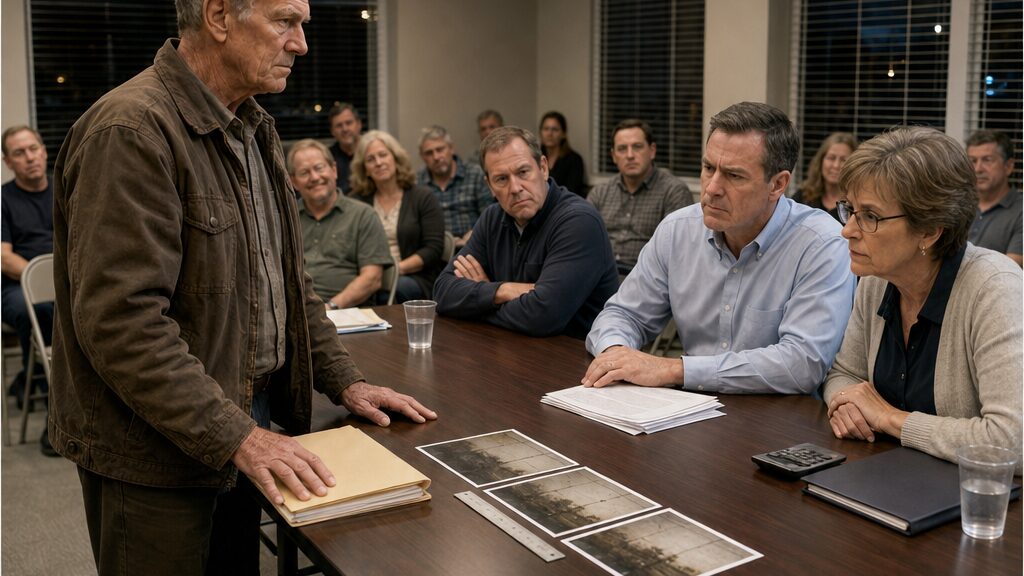
Frank walked to the front table and placed three photographs in a row.
Same wall.
Same ruler.
Three dates.
Three different water heights.
“The line has risen after each major storm,” Frank said.
A board member glanced at the pictures. “You measure this every time it rains?”
A low laugh moved through the room.
Frank looked at him.
“When it enters my foundation, yes.”
Another board member said, “Frank, with respect, you’ve been on this for months.”
“Because the water is still coming.”
“Maybe focus on your own drainage first.”
“My downspouts discharge to grade on the opposite side.”
The board member leaned back.
Someone behind Frank whispered something about obsession.
Another laugh.
Patrick shuffled papers.
“The board has reviewed this. Management’s position remains that visible moisture inside an individual unit is an owner maintenance issue unless there is evidence of failure originating in association-maintained property.”
Frank placed his fingertips on the three photographs.
“This is evidence.”
“No,” Patrick said. “It’s evidence that your basement gets wet.”
Frank felt heat rise into his neck.
He could have said it then.
Twenty-two years.
Senior inspector.
Hundreds of foundations, drainage systems, retaining walls, failed footings, bad backfill, blocked swales, improper outlets.
He could have listed qualifications until the room stopped smiling.
But something in him refused.
They should not need his résumé to look at water crossing a common easement.
So he asked, “Will the board enter the measured increase into the minutes?”
Patrick blinked.
“The what?”
“The documented rise. Three dates. Three measurements.”
Donna Walker, seated beside Patrick with a calculator and financial packet, looked up more sharply than before.
Frank tapped the newest photograph.
“The rise is consistent with restricted discharge, not isolated seepage. If the outlet were functioning at design capacity, you wouldn’t expect this pattern at that elevation.”
Silence replaced the laughter.
Donna looked from the photograph to Frank.
“How do you know that?”
Frank met her eyes.
“Does the board want the measurement entered into the minutes?”
Patrick’s mouth tightened.
“We’ll note that you submitted photographs.”
“That wasn’t my question.”
“Frank.”
“Measured rise. Yes or no?”
A chair scraped behind him.
Patrick finally said, “The secretary will note your materials.”
Frank gathered the photographs.
He understood the answer.
They wanted the complaint in the record without the substance of it.
Fine.
He slipped the photographs back into his folder.
“I won’t take more of the board’s time.”
A man near the rear muttered, “Finally.”
Frank heard it.
He walked back to his chair anyway.
He stayed through the rest of the meeting, although he could not have repeated one thing said about landscaping contracts or pool access.
When it ended, people moved around him in little clusters.
Frank waited until the aisle cleared.
Outside, the pavement still shone from rain.
“Frank?”
He turned.
Kimberly Lee stood under the clubhouse awning, keys in one hand.
She lived two houses downhill from him.
“I didn’t want to say anything in there.”
He waited.
She looked embarrassed.
“I thought maybe Patrick was right. That yours was just a basement thing.”
Frank said nothing.
Kimberly unlocked her phone.
“I found this yesterday.”
On the screen was a photograph of painted concrete block.
Across the bottom ran a dark horizontal band of moisture.
Kimberly enlarged it with two fingers.
“I put a tape measure beside it because of what you showed tonight.”
Frank stared.
The elevation was nearly the same as his.
Not exactly.
Close enough.
“When did this start?”
“I don’t know. I keep storage shelves against that wall.”
“Which side of the house?”
She pointed toward the back of the cul-de-sac.
Toward the easement.
Frank looked past her into the dark.
Water glimmered along the curb, moving where it should have been moving.
The trouble was what they could no longer see.
“Don’t throw anything away,” he said.
Kimberly frowned. “What?”
“Any photos. Any repair receipts. Anything showing when that wall was dry.”
Her expression shifted.
“Frank, what do you think this is?”
For the first time since his own wall had gone damp, Frank wished he could honestly say he did not know.
Chapter 2: The Water Was Crossing Property Lines
Kimberly sent him another photograph at 6:17 the next morning.
This one showed the lower corner of her basement after she had moved a metal shelving unit.
The damp line continued behind it.
Frank zoomed in until the pixels blurred.
Then he put his coffee down untouched.
By eight, they were standing in Kimberly’s backyard.
The two homes were separated by trimmed grass, a row of young maples, and an association-maintained strip that sloped toward the rear easement.
Kimberly folded her arms.
“I’m not trying to start anything.”
Frank crouched near the edge of the turf.
“You’re not.”
“I mean with the board.”
“I know what you mean.”
She glanced at him. “Do you?”
Frank looked up.
There was no accusation in her face. Only caution.
He understood it better than he wanted to.
He had become a kind of neighborhood weather system. People checked which direction he was moving before deciding whether to step outside.
He pushed a screwdriver into the soil near the easement edge. It sank deeper than it should have with almost no resistance.
Kimberly said, “Are you allowed to do that?”
“I’m not digging.”
“That sounds like the answer somebody gives right before an argument about digging.”
Frank pulled the screwdriver out.
Mud clung to six inches of steel.
He wiped it on a rag.
They followed the slope behind the houses until they reached the retaining wall.
From the sidewalk, it looked ordinary enough: stacked concrete block, mulch above it, ornamental grass planted at intervals.
Up close, Frank saw the joint.
One section had shifted outward.
Not much.
Enough.
He knelt and sighted along the face.
Kimberly stood behind him.
“What?”
“The courses aren’t aligned.”
“Couldn’t that just be settling?”
“Could be.”
“But you don’t think so.”
Frank moved three feet to the right.
There.
A narrow gap.
Then another.
A hairline opening where two blocks no longer met cleanly.
He followed it downward.
At the base, soil had washed from beneath the edge.
Frank felt something old and unwelcome settle into place inside him: recognition.
Not certainty.
Recognition.
He stood.
“We need the drawings.”
Kimberly’s face tightened. “Is it bad?”
“I said we need the drawings.”
“That isn’t what I asked.”
Frank looked at her.
He had spent years giving answers people did not like. In the field, directness had been useful. Sometimes necessary.
Retirement had not taught him a better language.
“I don’t think normal settling explains all of it.”
Her eyes moved to the wall.
“All of what?”
“The displacement. The saturated soil. Your moisture line. Mine.”
A car door shut behind them.
Patrick Clark walked across the grass carrying a folded sheet of paper.
His expression told Frank this was not a social visit.
“Morning.”
Kimberly stiffened.
Patrick held out the paper.
“This was emailed to both of you, but I thought I’d make sure you got it.”
Frank did not take it.
“What is it?”
“A reminder that residents are not authorized to alter, probe, excavate, or inspect association-maintained landscaping or structures.”
Kimberly said quickly, “We didn’t alter anything.”
Patrick looked at the screwdriver in Frank’s hand.
Frank said, “I tested soil moisture.”
“You inserted a tool into common property.”
“About three inches from the turf edge.”
Patrick’s jaw moved.
“This is exactly what I’m talking about.”
“What are you talking about?”
“You acting like you have authority here.”
Kimberly stepped back.
Frank noticed.
That bothered him more than Patrick’s tone.
Patrick lowered his voice.
“We’re trying to handle this through the proper channels.”
Frank almost laughed.
“Which proper channel would that be?”
“The board.”
“The board classified it as private.”
“Based on the information we had.”
“I gave you photographs.”
“You gave us photographs of your basement.”
“And now Kimberly has the same pattern.”
Patrick looked at her.
Kimberly hesitated.
Frank watched the hesitation happen.
Patrick saw it too.
“This is how things get blown out of proportion,” Patrick said. “People start connecting unrelated issues before anyone qualified has looked at them.”
Frank’s grip tightened around the screwdriver.
He could have ended that sentence in one breath.
Someone qualified has.
Instead he said, “Then authorize an inspection.”
Patrick’s eyes returned to him.
“We’re obtaining guidance.”
“From whom?”
“Our management company.”
“Property management isn’t structural engineering.”
“There. That.” Patrick pointed at him with the folded notice. “That’s the problem. Every conversation becomes a deposition.”
Frank felt the words land because they were partly true.
Kimberly looked away.
Patrick continued, “Nobody is saying ignore water damage. I’m saying stop treating every crack like proof of wrongdoing.”
“I didn’t say wrongdoing.”
“You don’t have to.”
Patrick handed the notice to Kimberly instead.
Then he left.
Frank watched him cross the grass.
Kimberly unfolded the paper.
“You could make it easier for people to agree with you.”
Frank looked at her.
“That wouldn’t change the wall.”
“No. But it might change whether they listen before it gets this far.”
He had no answer he liked.
So he walked back to the retaining wall.
This time he kept his hands in his pockets.
Later that afternoon, Kimberly invited him inside.
Her basement smelled faintly of cardboard and damp concrete.
Frank placed his steel ruler against the stain.
Kimberly stood beside him with the photograph from the night before open on her phone.
“Eight and a quarter,” he said.
She checked the image.
“That’s almost where yours was.”
“Almost.”
“Does almost matter?”
“It always matters.”
She sighed.
Frank heard himself.
He softened his voice.
“But not enough to make this coincidence.”
That was the first thing he had said all day that made her look relieved.
He photographed the wall.
Not as his evidence.
As hers.
Before leaving, Frank walked the back boundary one more time without touching anything.
Near the upper end of the retaining wall, the top course dipped slightly.
Below it, mulch had been freshly raked after the rain.
He studied the face of the wall.
Two years earlier, he remembered, trucks had occupied that strip for several days. The HOA newsletter had called it “retaining wall rehabilitation.”
At the time, Frank had barely noticed.
He had been six months into retirement and still trying not to inspect every construction project he passed.
Now he looked at the wall differently.
The drainage openings were wrong for what he remembered of the approved subdivision details.
The base course looked too shallow at the exposed end.
And one section appeared to have been rebuilt without the reinforcement he would have expected for that height.
Patrick’s warning notice suddenly seemed less important.
Frank went home, opened his folder, and wrote a new note on the top sheet.
ORIGINAL APPROVAL?
He sat there for a moment.
Then he pulled the laptop toward him and opened the county permit-records portal.
If the wall had been rebuilt properly, there would be a record.
If it had not, there should be a different kind of record.
Either way, Frank was done asking the HOA what it believed.
He wanted to know what had actually been approved.
Chapter 3: The Permit That Did Not Match the Wall
The clerk behind the county counter stared at Frank for three seconds before smiling.
“Well, I’ll be.”
Frank stopped.
The permit office had been remodeled since his last year with the county. The old fluorescent panels were gone. The counters were lower. Most of the paper files had disappeared behind computer screens.
The clerk had not.
“You look exactly the same,” she said.
“That’s an insult to both of us.”
She laughed.
Then her eyes narrowed with recognition.
“Miller. Inspections.”
Frank nodded.
“How long has it been?”
“Four years.”
“Feels longer.”
“It does from this side of the counter.”
She studied the folder under his arm.
“You working for somebody?”
“No.”
“That sounds dangerous.”
Frank almost smiled.
He gave her the subdivision address and the retaining-wall location.
“I’m looking for the approval history on a repair from about two years ago.”
The clerk typed.
Frank stood quietly.
He had deliberately avoided mentioning his old job to Patrick, Donna, Kimberly, or anyone else in the HOA.
At first it had been simple stubbornness.
If water was entering from a common drainage failure, the facts should matter whether he had inspected ten buildings or ten thousand.
Later, after the board meeting, saying it had begun to feel like surrender.
As if he needed to produce credentials before people would accept that wet concrete was wet.
The clerk turned her monitor slightly.
“Here.”
Frank leaned closer.
There was an application.
Scope: partial retaining-wall stabilization and drainage restoration.
There was a plan attachment.
A contractor name.
An engineering detail.
And a final entry showing administrative closure.
Frank frowned.
“Open the attachment.”
The clerk did.
He read it twice.
The approved detail called for excavation behind the affected wall segment, drainage aggregate, perforated collection pipe, reinforcement at specified intervals, and restoration of the outlet connection.
Frank’s eyes stopped on the reinforcement note.
Then the drainage note.
“What?”
The clerk had seen his face change.
Frank pointed.
“This isn’t what’s out there.”
“You sure?”
He looked at her.
She raised both hands.
“Forgot who I was talking to.”
Frank ignored that.
“Is there a revised field detail?”
She searched.
“No revised plan.”
“Inspection comments?”
Another screen.
“One intermediate.”
“What does it say?”
She read. “Existing conditions differ from submitted plan. Contractor to coordinate revised scope before continuation.”
Frank waited.
“And after that?”
She scrolled.
“Nothing until closure.”
“That doesn’t make sense.”
“Could have been uploaded under correspondence.”
They checked.
Nothing.
Frank felt his earlier certainty weaken rather than strengthen.
Missing paperwork did not automatically mean illegal work.
People made filing errors.
Documents got attached to wrong permits.
Inspectors forgot notes.
He knew that better than most.
“What closed it?”
The clerk examined the history.
“Final fee processed. Contractor affidavit. Administrative completion.”
“No final structural inspection?”
“Not showing here.”
Frank stared at the screen.
The clerk’s tone changed.
“You want copies?”
“Yes.”
“Personal use?”
“Yes.”
She looked at the address.
Then at him.
“Your neighborhood?”
“My house is downhill.”
Her expression became careful.
“Frank.”
“I know.”
“No, I mean—you know how this works. Don’t decide the case from the counter.”
He looked at her.
That was exactly what he used to tell people.
“I know.”
But as he drove home, the approved drawing sat on the passenger seat like an accusation.
At his kitchen table, he spread the county documents beside photographs of the existing wall.
Approved reinforcement locations.
Visible wall joints.
Approved drainage outlet.
Actual discharge location.
He measured proportions from known block dimensions in the photographs, wrote notes, crossed them out, started again.
By dusk, he had enough to know only one thing for certain:
The wall on paper and the wall behind his house were not the same wall.
He returned to the easement the next morning and stayed on the sidewalk.
No screwdriver.
No tape driven into the ground.
Just photographs.
He counted block courses.
Located the weep points.
Compared the visible outlet with the approved plan.
The more he looked, the less comfortable he became.
Not because the answer was obvious.
Because someone had changed the work.
That afternoon he called the HOA management office and requested the project file as a homeowner record.
The representative resisted at first.
Frank cited the governing document provision allowing owners to review association financial and contract records.
The representative became noticeably less conversational after that.
“Put the request in writing.”
“I will.”
“And there may be copying fees.”
“That’s fine.”
“Allow up to ten business days.”
Frank paused.
“The drainage issue is active.”
“Mr. Miller, I can only tell you the process.”
There it was again.
Process used as a wall.
Frank nearly told her he had spent half his adult life enforcing processes.
He stopped himself.
“Send me the form.”
Three days later, Patrick appeared at Frank’s driveway.
“You requested contractor records.”
Frank was rinsing mud from a garden spade.
“Yes.”
“Why?”
“To compare them with the county file.”
Patrick’s face changed just enough.
Frank noticed.
“So you went to the county.”
“I requested public records.”
“You could’ve asked us first.”
“I did. Three times.”
“That’s not what I mean.”
Frank shut off the hose.
“What do you mean?”
Patrick looked toward the neighboring houses.
“You’re making this bigger than it needs to be.”
Frank set the spade against the garage wall.
“I don’t know how big it is yet.”
“That’s exactly my point.”
“No. Your point is that you want me to stop before I know.”
Patrick shook his head.
“You always talk like somebody’s on trial.”
Frank was tired of hearing that.
“Maybe because nobody answers a direct question.”
“Fine. Direct question. What are you trying to prove?”
Frank opened his mouth.
That was when he realized he had two answers.
The first was the respectable one.
That the common drainage system was failing.
The second was less comfortable.
That Patrick had dismissed him, embarrassed him, and been wrong.
Frank chose the first.
“I’m trying to find out why the constructed wall doesn’t match the approved detail.”
Patrick went still.
Only for a second.
Then he said, “I don’t know anything about construction details.”
“You were president when it was rebuilt.”
“I’m president now too. That doesn’t make me the contractor.”
“No.”
Frank let the silence sit between them.
Patrick’s jaw tightened.
“The association acted on professional recommendations.”
“Then the records should show that.”
Patrick walked away without another word.
The contractor file arrived electronically the following afternoon.
Frank printed only the pages that mattered.
Proposal.
Original estimate.
Revised estimate.
Invoice.
Change description.
The revised scope removed several items from the original proposal and reduced the project cost sharply.
Frank compared the numbers twice.
Then he found the HOA expenditure ledger included with the records.
The original proposed work had been budgeted at a figure nearly double what the association ultimately paid.
The final payment matched the reduced proposal almost exactly.
Frank sat back.
For the first time since the water appeared in his basement, satisfaction was not what he felt.
Someone had not merely missed a stain.
Someone had made a decision.
And somewhere between the approved wall and the wall that had actually been built, that decision had become concrete.
Frank reached for the next page.
At the bottom of the revised estimate was a short notation:
Scope adjusted per association direction.
No name.
No explanation.
Frank stared at it until the words stopped looking like words.
Then he turned to the expenditure ledger and found the date of the board authorization.
If he wanted to know who had chosen the cheaper wall, he no longer needed to study concrete.
He needed to study the people who had voted for it.
Chapter 4: The Price of Keeping Dues Low
Donna Walker did not deny it.
That unsettled Frank more than an argument would have.
She stood in the doorway of the clubhouse records room with one hand still on the light switch while he held the revised estimate in front of her.
“Yes,” she said. “We knew the original number.”
Frank waited.
Donna looked past him into the empty hallway.
“It was more than the reserve fund could take.”
“That doesn’t explain changing the scope.”
“It explains why anyone was willing to discuss it.”
Frank laid the estimate on the table between them.
The room held old binders, meeting packets, tax records, insurance renewals. Two fluorescent tubes hummed overhead.
“The approved plan called for drainage aggregate, reinforcement, and restoration of the outlet.”
“I’m not an engineer.”
“You didn’t need to be.”
Donna’s mouth tightened.
Frank heard himself and stopped.
That tone again.
Not conversation.
Cross-examination.
He sat back.
“Tell me what happened.”
Donna remained standing for several seconds before pulling out a chair.
“Two years ago the reserve study came back worse than expected. Roofs were aging faster. The pool equipment was near replacement. Insurance had jumped. People were already furious about dues.”
Frank said nothing.
“The first wall estimate came in,” she continued. “If we paid it, we’d have drained most of the usable reserve.”
“So you assessed.”
“We discussed it.”
“And?”
“And half the room acted like we were stealing their retirement.”
Frank pictured the clubhouse full of the same folding chairs where they had laughed at his photographs.
Donna folded her hands.
“One couple had just put two kids through college. Another owner was on a fixed income. Somebody stood up and said a special assessment would make them sell.”
“That doesn’t make an incomplete repair safe.”
“I didn’t say it did.”
The answer came sharply.
For the first time, Frank saw anger in her rather than caution.
“We were told there might be a narrower option,” Donna said. “Stabilize the worst section. Improve discharge. Monitor the rest.”
“By whom?”
“The contractor said he could revise the scope.”
“After an engineer designed something else.”
“Patrick asked him to price alternatives.”
There it was.
Not proof of fraud.
Not a secret conspiracy.
A decision made in a room by people frightened of a number.
Frank looked at the expenditure date again.
“Did the board approve the reduced proposal?”
Donna looked down.
“Yes.”
“Unanimously?”
“No.”
Frank’s eyes lifted.
She met them.
“I voted for it.”
For a moment, neither spoke.
Frank had expected her to point toward Patrick.
Instead she had placed herself beside him.
“Why?”
“Because the original number would have forced an assessment we weren’t ready to defend.”
“Ready to defend isn’t the same as unnecessary.”
“I know that now.”
“You knew the permit scope was different.”
“I knew the price was different.”
“That’s not what I asked.”
Donna pushed back from the table.
“And that is why people stop talking to you.”
Frank stared at her.
“You ask a question when you’ve already decided which answer makes somebody guilty.”
The words landed cleanly.
Donna gathered the pages into a stack.
“You want Patrick to be the reason your basement is wet.”
“I want to know who made the decision.”
“No. You want a name.”
Frank almost answered.
Couldn’t.
Because she was close enough to the truth to make him angry.
Donna opened an old binder.
“Patrick pushed hard for the cheaper scope. I pushed hard not to raise dues. Two other members wanted the whole project deferred. Nobody in that room said, ‘Let’s damage Frank’s foundation someday.’”
“That doesn’t absolve anybody.”
“No.”
She turned the binder toward him.
“That’s my point.”
Inside were reserve projections from two years earlier.
Roof replacement.
Pavement sealing.
Pool mechanical equipment.
Stormwater maintenance.
Projected balance.
Frank ran a finger down the columns.
The numbers were worse than he expected.
Donna tapped one line.
“If we had done the original wall project and nothing else changed, we would have been below our minimum reserve target by fall.”
“That target isn’t a safety requirement.”
“It is if you’re the person who has to tell fifty-eight owners why the next broken thing needs cash they don’t have.”
Frank leaned back.
The wall still should have been built correctly.
Nothing Donna said changed that.
But Patrick’s resistance suddenly had shape.
It was still wrong.
It was no longer simple.
Donna pulled another folder from the cabinet.
“After your second request, Patrick asked management what would happen if we reopened the wall issue.”
Frank looked at her.
“And?”
“They said if it was common infrastructure, we might need engineering review. Possibly emergency work.”
“Which is why he kept calling it private.”
Donna did not answer.
She did not need to.
Frank’s anger returned, colder this time.
Financial fear might explain an old decision.
It did not explain a new refusal after water started appearing inside houses.
“He knew,” Frank said.
“He knew reopening it could cost the association a lot of money.”
“He knew there was enough doubt to investigate.”
Donna looked tired.
“Yes.”
Frank gathered his papers.
At the door, she said, “Before you go to the county, look at one more thing.”
She slid a newer reserve forecast across the table.
Frank read the projected emergency borrowing line.
Then the estimated owner assessment if immediate reconstruction were required.
The number was not half a million dollars, but the path toward it was obvious.
Spread across fifty-eight homes, it was still enough to hurt.
Enough to force decisions.
Enough that Kimberly’s careful silence at the meeting suddenly made sense.
Donna said quietly, “You may be right about every technical point.”
Frank folded the forecast and placed it on the table rather than taking it.
“But?”
“But if this becomes an emergency order, being right won’t keep people from losing sleep over how to pay for it.”
Frank walked home with the contractor file under his arm.
In his basement, the old water marks waited on the wall.
He had spent weeks seeing them as evidence of something the board refused to admit.
Now they seemed to point in two directions.
Toward negligence.
And toward fifty-eight front doors.
Chapter 5: The Inspection Nobody Could Control
The county reviewer closed Frank’s folder without opening the last section.
“Before I accept this,” he said, “you need to understand something.”
Frank sat across from him in a small conference room inside the building department.
“I understand the complaint process.”
“I know you do.”
The reviewer had already learned who Frank was. That had changed nothing in his tone.
Good.
“If we open a formal investigation into shared drainage and structural work,” he continued, “we don’t stop because the original complainant says his wall was the only concern.”
“I’m not asking you to.”
“You might later.”
Frank thought of Donna’s reserve forecast.
“I understand.”
“If we see connected violations, they become part of the inspection.”
“I understand.”
“If emergency correction is warranted, cost isn’t part of the safety determination.”
Frank paused.
That one sat differently.
The reviewer noticed.
“You still want to file?”
Frank looked at his evidence packet.
Three water-mark photographs.
Kimberly’s corresponding damage.
Approved retaining-wall plans.
Existing-condition photographs.
Contractor scope changes.
HOA correspondence.
He had wanted someone with authority to look at the facts.
Now someone was asking whether he was willing to live with the consequences.
“Yes,” Frank said.
The reviewer pulled the folder toward him.
“Then we’ll treat it like any other complaint.”
The inspection team arrived Tuesday morning.
Two county vehicles parked near the cul-de-sac entrance before eight.
By eight-fifteen, curtains were moving.
Patrick appeared outside before Frank reached the sidewalk.
“What did you do?”
Frank did not answer immediately.
Two inspectors were already walking toward the easement.
One carried a tablet. The other wore mud boots and held a measuring rod.
“I filed a complaint.”
“You filed against the HOA?”
“I filed on the drainage and wall.”
Patrick gave a short, humorless laugh.
“You know exactly what that means.”
“Yes.”
“Do you?”
Frank looked at him.
Patrick lowered his voice.
“Every owner here is going to pay for whatever they decide.”
“Then the board should have looked when the problem was smaller.”
Patrick stepped closer.
“Is that what this is about?”
“What?”
“Making sure everyone knows you were right?”
Frank felt the question like a hand against his chest.
He turned away before answering.
The inspectors began at Frank’s basement.
They photographed the water marks.
One asked who had made the pencil lines.
“I did.”
“Dates accurate?”
“Yes.”
“How?”
“Same evening as each event. Photos retain timestamps.”
The inspector glanced at him.
“You in construction?”
“Retired county inspector.”
That was the first time Frank had said it inside the neighborhood conflict without being forced.
The inspector only nodded.
No surprise.
No admiration.
Just information.
They moved to Kimberly’s house.
Then outside.
By late morning, the county drainage engineer had joined them.
They traced grade behind the properties and checked the outlet area.
Near the retaining wall, one inspector stopped.
“Where’s the discharge supposed to daylight?”
Frank pointed without stepping closer.
“According to the approved plan, farther east.”
The drainage engineer studied the grade.
“According to what’s here, part of that flow is being trapped.”
They exposed no soil and altered nothing, but measurements accumulated quickly.
Slope.
Wall displacement.
Outlet elevations.
Drainage path.
At noon, the engineer stood at the easement and looked downhill toward the homes.
“This isn’t just a wall problem.”
Patrick, who had remained nearby most of the morning, folded his arms.
“What does that mean?”
“It means runoff is not following the intended path.”
“Is that because of the wall?”
“Not only.”
The engineer pointed toward a landscaped area where fill had raised the grade.
“That obstruction pushes surface flow sideways. In a heavy event, water can migrate toward the lower foundations.”
Kimberly stood ten feet away.
Her face lost color.
“So his house and mine—”
“Could be connected to the same drainage failure,” the engineer said.
Frank should have felt relief.
For months, Patrick had insisted there was no evidence tying his basement to common property.
Now a county engineer had said it in front of him.
Instead Frank watched Kimberly.
She looked frightened.
By midafternoon the inspection widened.
Records showed other exterior alterations near drainage paths.
One homeowner had extended a patio into a setback area.
Another had installed landscaping that partially narrowed a swale.
Those were not equivalent to the retaining wall, but they were now part of the record.
Then an inspector walked toward Patrick’s house.
Patrick followed.
“What are you looking at?”
“The rear deck addition.”
“That has nothing to do with drainage.”
“No,” the inspector said. “Different issue.”
Patrick stopped.
Frank stayed near the sidewalk.
He could see the deck from there.
Newer lumber than the house.
Deep posts.
A roofed extension.
The inspector asked for the permit number.
Patrick said the contractor had handled it.
The inspector checked the database.
A long silence followed.
Frank felt no triumph.
The deck was almost beside the point.
By four-thirty, the county vehicles were still there.
People had begun gathering in driveways.
Nobody laughed.
Nobody thanked Frank either.
The next morning, preliminary notices appeared.
Some required documentation.
Some required correction.
The HOA received the largest one.
Shared drainage.
Retaining-wall structural review.
Blocked easement.
Engineered remediation plan.
At Frank’s mailbox, Patrick caught up with him.
“You happy?”
Frank looked at him.
“No.”
Patrick seemed prepared for a different answer.
Frank held up the notice.
“This could have been smaller.”
Patrick’s face hardened.
“Easy for you to say now.”
“It was easy for me to say three requests ago.”
That ended the conversation.
Two days later, the HOA circulated an emergency notice announcing a special meeting.
Attached was a preliminary contractor range for full correction.
Drainage reconstruction.
Wall demolition and rebuild.
Engineering.
Temporary stabilization.
Site restoration.
The highest scenario came close to five hundred thousand dollars.
Frank read it twice at his kitchen table.
The number did not feel like justice.
It felt like weight.
He looked toward the basement door.
For months he had wanted the board to be forced to acknowledge the truth.
Now the truth had an estimate attached to it.
And every homeowner on the cul-de-sac was about to see the bill.
Chapter 6: Winning Suddenly Looked Like Losing
The highest estimate was projected on the clubhouse wall before Frank entered.
$487,000.
Someone had circled the number in red on the printed handouts.
The room was already louder than any regular HOA meeting Frank had attended.
“You filed this?”
A homeowner near the aisle pointed at him before he reached his chair.
Frank stopped.
“I filed the county complaint.”
“So yes.”
“The drainage problem existed before the complaint.”
“That’s not what I asked.”
Patrick sat at the front table, looking older than he had a week earlier.
Donna was beside him with three stacks of financial papers.
Kimberly sat near the middle.
She did not look at Frank.
Patrick called the meeting to order twice before the room quieted.
“The figure on the screen is not an approved assessment,” he said. “It is the upper range of one preliminary remediation scenario.”
Someone called, “What’s the lower range?”
Donna answered.
Still high.
A murmur went through the room.
Patrick explained the county notice, the engineering requirement, and the need for immediate drainage correction.
He did not mention Frank by name.
He did not need to.
Everyone knew.
Then a homeowner asked about Patrick’s deck.
The room shifted.
Patrick’s expression closed.
“The deck is a separate permitting matter. I am addressing it personally.”
“So the HOA president has an unpermitted deck while telling us about compliance?”
The question came from the rear.
Frank watched Patrick grip the edge of the table.
There was a moment when Frank could have joined in.
He had imagined a version of this meeting during sleepless nights.
Patrick exposed.
The board cornered.
No more jokes.
No more private-maintenance classifications.
But standing there now, the deck seemed almost childish beside the drainage estimate.
Patrick’s permit problem might cost him money.
The shared failure could cost everyone.
Donna brought the room back to the numbers.
“If the county requires the most extensive option immediately, the reserve fund cannot cover it.”
“What does that mean per house?”
Nobody wanted to answer.
Donna finally did.
The room changed.
Not dramatically.
Just enough.
People sat differently.
One woman lowered her hand.
A man near the back whispered to his wife.
Someone began calculating on a phone.
Frank looked at Kimberly.
She was staring at the table.
During a recess, he found her outside beside the vending machines.
“You all right?”
“No.”
Her answer came too quickly.
Frank waited.
Kimberly folded the meeting packet in half.
“I talked to a real estate agent this morning.”
Frank frowned.
“Why?”
“Because if that assessment lands all at once, I need to know my options.”
“You’re thinking of selling?”
“I’m thinking of not pretending I have money I don’t have.”
Frank looked down.
Kimberly laughed once, without humor.
“I know the wall is bad. I know you were right.”
He hated hearing the word.
Right.
She continued.
“But my mortgage didn’t get cheaper because you were right.”
“I didn’t know the estimate would be this high.”
“I know.”
That was worse than blame.
She looked through the clubhouse doors.
“I didn’t speak up at the first meeting because I didn’t want Patrick thinking I was part of your fight.”
Frank nodded.
“I know.”
“No, you don’t. I thought you were making everything harder.”
“I probably was.”
Kimberly looked at him.
The admission surprised both of them.
Frank leaned against the wall.
“I spent a long time around people who had to follow code whether they liked me or not.”
“This isn’t your old job.”
“No.”
“I think sometimes you forget that.”
Frank looked back through the glass.
Patrick stood alone near the front table while homeowners clustered around Donna.
For the first time, he did not look powerful.
He looked trapped.
The meeting resumed.
Patrick asked Frank to stay afterward.
When the room finally emptied, only Donna remained.
Patrick removed his glasses and rubbed his eyes.
“I’ll resign.”
Frank said nothing.
Patrick looked at him.
“If that’s what this is.”
“It isn’t.”
“You want accountability. Fine. I’ll resign.”
“That doesn’t fix the drainage.”
“No, but maybe the county gives us time if the board shows we’re cooperating.”
Frank studied him.
“What are you asking?”
“Support a request to postpone the full reconstruction while we build reserves.”
“Postpone mandatory work?”
“Temporary stabilization. Whatever they’ll accept.”
“And if they won’t?”
Patrick’s voice hardened.
“Then people get assessed.”
Donna interrupted.
“Patrick.”
He stood.
“You wanted us to face it. We’re facing it.”
Frank felt the old impulse rise.
To remind Patrick of the letters.
The laughter.
The photographs.
To say that none of this would have happened if the board had listened when the cost was smaller.
Every sentence would have been true.
None would lower Kimberly’s assessment by a dollar.
Frank looked at Donna.
“What options did the county list?”
“Full reconstruction, engineered replacement, or an approved interim correction if the engineer determines immediate risk can be controlled.”
Frank held out his hand.
She gave him the notice.
He read the language carefully.
Approved interim correction.
Not delay.
Correction.
A distinction Patrick had blurred.
Frank read it again.
There might be room there.
Not to hide the failure.
Not to erase responsibility.
To sequence the work.
His mind began doing what it had done for twenty-two years.
Flow first.
Immediate hazard.
Temporary conveyance.
Monitoring points.
Then structural reconstruction under design review.
Patrick said, “Frank?”
He folded the notice.
“I’m not supporting postponement.”
Patrick’s face hardened.
Frank continued.
“But I’ll ask whether there’s a compliant phased approach.”
Donna looked up.
Patrick stared at him.
“Why?”
Frank thought of Kimberly’s basement.
The matching dark line.
The same evidence that had proved he was right.
“Because the goal is to stop the water.”
He left before Patrick could answer.
The next morning Frank called the county office.
When the drainage engineer came on the line, Frank said, “I want to discuss the interim-correction language in the notice.”
There was a pause.
“You representing the HOA now?”
“No.”
“Then what are you doing?”
Frank looked at the highest pencil mark on his basement wall.
For the first time, it did not look like evidence against someone.
It looked like a deadline.
“I’m trying to find out whether we can fix the immediate failure without pretending the rest of it doesn’t exist.”
Chapter 7: The Repair Plan That Changed the Fight
The county drainage engineer looked at Frank’s sketch for less than a minute before sliding it back across the conference table.
“This doesn’t solve the wall.”
“I know.”
“Then it isn’t a correction plan.”
“It’s the first phase of one.”
The engineer leaned back.
Frank had expected resistance. He had not expected how familiar it would feel.
Across from them, Patrick Clark sat with Donna Walker and the HOA management representative. Patrick had barely spoken since arriving.
Frank placed his hand on the sketch.
“The notice says an interim correction can be considered if immediate risk is controlled.”
“It can.”
“This controls the immediate water path.”
“You still have a compromised retaining system.”
“And the wall still gets engineered reconstruction.”
“When?”
Frank looked at Donna.
She opened the financing sheet.
“Under the schedule we brought, design begins immediately. Funding is committed over the next fiscal cycle. Construction starts after engineering and bidding.”
The county engineer shook his head.
“That sounds like financial scheduling, not risk mitigation.”
Frank felt Patrick watching him.
A month earlier, Frank would have responded by proving why the engineer’s wording was imprecise.
Instead he said, “Then tell me what you need to see.”
The engineer studied him.
Frank waited.
Finally, the engineer pulled the sketch back.
“The immediate problem is uncontrolled flow. You’re proposing temporary conveyance along the original drainage alignment.”
“Not temporary in the sense of improvised.”
“I understand.”
“Excavate only the blocked section. Restore positive grade. Install an approved surface and subsurface path into the existing outlet corridor. Leave the wall exposed enough for monitoring.”
“And if the wall moves?”
“Stop-work trigger. Emergency stabilization.”
“Who monitors it?”
“The association hires an independent engineer.”
Patrick shifted in his seat.
Frank continued before he could object.
“Not the contractor who did the previous work.”
Donna nodded.
The engineer tapped the sketch.
“And what proves this actually reduces immediate risk?”
Frank had been waiting for that.
He pulled three sets of photographs from his folder.
His basement.
Kimberly’s basement.
The easement.
Each photograph showed measurements and dates.
“These become the baseline.”
The engineer glanced through them.
“Interior water marks?”
“Yes.”
“You want foundation moisture as a performance measure?”
“Part of one. Exterior flow gets monitored too. But if the drainage correction works, the next major storm should not push these lines higher.”
Patrick spoke for the first time.
“And if it does?”
Frank turned toward him.
“Then the phased approach failed.”
“And we go straight to emergency reconstruction?”
“If that’s what the county requires.”
Patrick stared at the photographs.
Nobody had protected him from the answer.
Frank had not tried to.
The county engineer said, “I’ll walk the alignment again.”
That afternoon they returned to the easement.
The engineer carried a level and measuring equipment. Frank carried nothing.
Kimberly watched from her patio.
Other homeowners stood farther back.
No one approached.
At the upper end of the drainage corridor, Frank pointed to the landscaped rise that had been identified during inspection.
“The original surface path crossed here.”
The engineer checked elevation.
“And now?”
“Now the fill pushes water laterally.”
“Toward the lower lots.”
“Yes.”
They moved downhill.
Frank stopped near a narrow depression where the ground still held moisture days after rain.
“If you restore conveyance here and reconnect to the outlet alignment, you give the water somewhere to go before it loads the soil behind the wall.”
The engineer looked at the retaining blocks.
“You’re buying time.”
“Yes.”
“That’s all.”
“Yes.”
Patrick stood several yards away with his hands in his pockets.
Frank looked at him.
“No one gets to call it finished.”
The words were for Patrick as much as the county.
The engineer walked another twenty feet, then stopped.
“There may be a path.”
Donna exhaled audibly.
Patrick did not.
The engineer pointed downslope.
“You restore flow first. Independent engineer verifies wall movement limits. Full structural plans remain mandatory. County gets milestone dates. Miss one, interim approval ends.”
Donna asked, “Could that reduce the immediate assessment?”
“That’s not my department.”
“But it could let us finance the permanent work over time.”
“If you comply with every condition.”
Patrick finally said, “What about the other notices?”
“Separate corrections stay separate.”
Including his deck.
Frank saw Patrick accept that without argument.
It was a small thing.
But different.
The following week, the clubhouse filled again.
This time nobody laughed when Frank entered.
That did not make the room friendlier.
Some owners still blamed him.
Others blamed Patrick.
A few blamed the county, the contractor, the reserve study, previous boards, current dues, and one another in shifting combinations.
Donna presented the proposed financing plan.
Immediate drainage restoration would come from reserves and a smaller assessment.
Permanent retaining-wall reconstruction would be funded through increased dues, a reserve transfer, and staged collection rather than one severe payment.
The total cost had not vanished.
Only its timing had changed.
A homeowner raised a hand.
“So why didn’t we do this two years ago?”
Donna looked at Patrick.
The room followed.
Frank felt the atmosphere tighten.
Patrick had resisted this part.
The county had not required a confession.
Frank had.
Not as punishment.
Because the financing vote depended on residents understanding why they were paying twice for one wall.
Patrick opened an old meeting packet.
His hands were steady, but he took longer than necessary to find the page.
“Two years ago,” he said, “the board received an estimate for the full approved scope.”
No one moved.
“We believed the association could not absorb that cost without an immediate assessment.”
Someone called from the back, “So you changed it?”
Patrick looked down at the paper.
“I asked the contractor for a reduced scope.”
Donna said quietly, “And the board approved the reduced expenditure.”
Patrick continued.
“We believed we were stabilizing the immediate problem.”
Frank watched him.
Patrick could still have blamed the contractor.
Could still have hidden behind collective language.
Instead he said, “I pushed for the cheaper option.”
The room stirred.
“And when Frank later raised questions about the drainage,” Patrick said, “I treated reopening the issue as a financial threat before we had properly determined whether it was a safety problem.”
Frank had not expected that sentence.
Not from Patrick.
A homeowner asked, “Did you know the work didn’t match the permit?”
Patrick shook his head.
“No. I knew the scope had been reduced. I did not confirm whether the revised work had proper approval.”
“Isn’t that your job?”
Patrick looked toward Donna, then back to the room.
“It was my responsibility to make sure somebody did.”
The answer did not calm everyone.
It was not supposed to.
The meeting became difficult after that.
Arguments over reserves.
Questions about management.
Questions about the contractor.
One owner wanted Patrick removed immediately.
Another said the entire board should resign.
Kimberly finally stood.
“We can decide who sits in which chair after we stop water from reaching houses.”
The room quieted enough for her to continue.
“We spent months deciding whether this was Frank’s problem or the HOA’s problem. It’s our drainage system. It’s our bill. We should at least stop pretending those things belong to different people.”
Frank looked down at his folder.
For weeks it had felt like armor.
Now it was simply paperwork.
The financing motion passed narrowly.
Independent engineering oversight passed by a wider margin.
Patrick agreed to give up direct authority over infrastructure decisions while the board reviewed governance changes.
Afterward, people lingered in the parking lot.
Patrick approached Frank.
“I assume that wasn’t enough for you.”
Frank looked at him.
A month earlier, the remark would have started another argument.
“What do you mean?”
“The admission.”
Frank considered it.
“No.”
Patrick gave a tired nod, as if he had expected that.
Frank added, “But it wasn’t supposed to be.”
Patrick looked at him.
“The water stopping is enough?”
“No.”
Frank closed his folder.
“The wall getting rebuilt correctly is enough.”
For once, Patrick did not argue.
Behind them, contractors were scheduled to begin restoring the drainage corridor the following Monday.
But first they needed something the neighborhood had avoided for two years.
A record of what had actually happened.
Patrick returned to the front of the clubhouse, where Donna had left the old board minutes on the table.
Several residents were still waiting.
He picked them up.
And this time, when he faced the neighborhood with the old vote in his hand, nobody could pretend the cost-cutting decision belonged to somebody else.
Chapter 8: The Line on the Wall Finally Stopped Rising
The first heavy storm arrived at 2:11 in the morning.
Frank knew the time because he was awake.
Rain struck the bedroom window hard enough to pull him from sleep, and for several seconds he lay still, listening.
Then he got out of bed.
He did not go outside.
He went to the basement.
The new drainage work had been finished twelve days earlier.
The easement had been reopened along its original path, the blocked section corrected, the outlet restored, and monitoring points placed along the retaining wall.
Nothing about it looked dramatic.
A shallow graded corridor.
Fresh soil.
New stone in selected sections.
Temporary fencing around the wall.
The permanent structural work was still months away.
Frank switched on the basement light.
The old pencil marks remained on the concrete block.
Three dates.
Three heights.
The highest line was dark from where he had gone over it more than once.
He placed the steel ruler against the wall.
Dry.
Not perfectly dry.
Concrete never performed for an audience.
But the dark band had not climbed.
Frank crouched and touched the mortar joint.
Cool.
No sheen.
He checked the floor.
Then he stood and listened to the rain moving through the gutters.
His phone buzzed.
A message from Kimberly.
You downstairs?
Frank typed back.
Yes.
Three dots appeared.
Mine hasn’t moved.
He stared at the message.
Then wrote:
Check again after daylight.
Her reply came immediately.
Of course you’d say that.
Frank smiled despite himself.
By seven, the storm had weakened.
Kimberly knocked on his basement door carrying coffee in two paper cups.
“You know normal people wait until breakfast to inspect walls.”
“Normal people didn’t spend the last month paying engineers.”
She handed him a cup.
They stood together beside the pencil marks.
Kimberly touched the highest one.
“This was the last storm?”
“The worst one before correction.”
“And this morning?”
Frank showed her the new measurement.
Below it.
She nodded slowly.
“So it worked.”
“The first phase worked.”
Kimberly gave him a look.
“You’re physically incapable of saying something simple, aren’t you?”
“It’s a temporary correction under monitored conditions.”
“That was worse.”
He took a drink of coffee.
Outside, tires hissed along wet pavement.
For months, the sound of rain had tightened something in Frank’s chest.
Now he could hear water without immediately wondering where it was going.
They walked outside.
The drainage corridor carried a steady brown stream along the restored path.
No pooling behind the raised landscaping.
No sideways spread toward Kimberly’s lot.
At the lower end, water moved through the outlet and away from the foundations.
The retaining wall was still there behind temporary fencing.
Still imperfect.
Still waiting for reconstruction.
That mattered.
The neighborhood had not been magically repaired by one inspection or one clever plan.
The HOA had approved higher dues for several years.
Some residents were angry.
One house went on the market before summer.
The contractor dispute remained unresolved.
The county required quarterly reports until permanent work was complete.
Patrick corrected the permit problem at his own deck at his own expense.
Then, at the next annual meeting, he did not run for president again.
His resignation from the office came without a speech.
He simply told the room that infrastructure decisions needed someone who could make them without carrying the need to defend old ones.
Donna stayed.
That surprised Frank.
She helped create a reserve policy requiring independent review before major common-area repairs could be reduced from an engineered scope.
Every quarterly financial packet now included a separate infrastructure reserve line.
There were arguments about that too.
There were always arguments.
But they were arguments about numbers everyone could see.
Not stains people pretended belonged to somebody else.
Several months after the first drainage correction, permanent wall work began.
Frank did not supervise.
That took effort.
The independent engineer handled inspections. The county handled approvals. The contractor handled construction.
Frank occasionally stood at the edge of his driveway and watched.
Once, a worker noticed him studying the excavation.
“You with the association?”
Frank almost gave the old answer.
Retired county inspector.
Twenty-two years.
Instead he said, “I live downhill.”
That was enough.
Kimberly joined him one afternoon as reinforcement was being installed behind the rebuilt section.
“They doing it right?”
Frank looked at her.
“You really want to ask me that?”
“I want to watch you try not to walk over there.”
He put both hands into his jacket pockets.
“They have an engineer.”
“That wasn’t an answer.”
“It’s the answer I’m practicing.”
She laughed.
Frank did too.
The final project cost was still painful.
Less than the most severe emergency estimate, more than anyone wanted.
Residents paid through the smaller initial assessment and higher dues stretched across several years.
Nobody won financially.
That was the part the early meetings had failed to understand.
Ignoring infrastructure did not erase its price.
It moved the price forward.
Usually with interest.
Patrick and Frank did not become friends.
They nodded when they passed.
Sometimes Patrick stopped to talk about ordinary things: trash pickup, a loose mailbox door, whether the landscaper had changed crews.
They never discussed the night of the meeting when people laughed at Frank’s photographs.
Frank discovered he no longer needed them to.
One evening, Patrick paused near the driveway while Frank was sweeping leaves.
“I should have walked the easement when you brought the first request.”
Frank rested both hands on the broom handle.
“Yes.”
Patrick gave a short laugh.
“You could make that easier.”
“I could.”
Neither man said anything else.
Patrick continued home.
Frank watched him go, then returned to the leaves.
By autumn, grass had filled the disturbed drainage corridor.
The wall stood straight.
The monitoring reports showed no significant movement.
After one long storm, Frank went downstairs with his ruler from habit.
The wall was unchanged.
He stared at the pencil marks.
The first.
The second.
The highest.
Three little measurements that had once seemed like the only witnesses willing to agree with him.
He went upstairs for an eraser.
When he returned, he rubbed away the lowest line.
Then the second.
Gray crumbs collected on the concrete floor.
He paused at the highest mark.
That one he left.
Not because he needed evidence anymore.
The county had records.
The association had records.
The neighbors knew what had happened.
He left it because forgetting and forgiving were not the same thing, and neither required pretending nothing had gone wrong.
Below the old mark, Frank drew one small new line.
Lower.
He wrote the date beside it.
Then he stepped back.
For most of his career, measurements had told him when something failed.
This one meant something different.
It showed where the water had stopped.
Frank put the ruler back in his toolbox and closed the lid.
Upstairs, rain began tapping lightly against the windows again.
He listened for a moment.
Then he turned off the basement light and went upstairs without checking the wall a second time.
The story has ended.