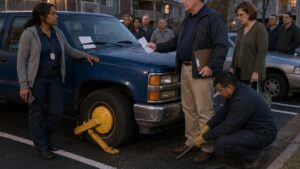
He Poured Concrete Six Feet Into My Yard, Then the Rain Exposed What the HOA Had Missed
Chapter 1: The Concrete Was Already Breaking Apart
The first strike of the jackhammer split the concrete almost exactly where Charles Moore had once stood and asked Daniel Thompson to stop pouring.
A white fracture shot through the gray slab. Dust lifted around the worker’s boots and drifted toward the cedar fence. Another worker waited beside a compact loader while broken chunks collected along the edge of what had been, only three weeks earlier, a smooth new patio.
Charles stood near his back steps with a coffee mug in one hand.
Daniel watched from his sliding door.
Neither man spoke.
The second strike broke away a piece large enough to expose dark soil beneath it.
Three weeks earlier, that same concrete had still been wet.
Charles had come home from work to the sound of a mixer truck idling beyond the houses. He worked as a facilities supervisor and had spent enough years around construction sites to recognize the rhythm: truck, chute, men with rakes, then floats moving across the surface before the material began to set.
He stepped through his back gate and stopped.
Daniel’s old patio had ended several feet behind the house. Charles remembered grilling beside it twice the previous summer.
Now wooden forms curved out from Daniel’s backyard and ran through what Charles had always considered part of his own side lawn.
A worker pulled concrete toward the form with a rake.
Daniel saw Charles and raised a hand.
“Finally getting it done.”
Charles looked at the slab, then at the narrow ribbon of grass still visible between the concrete and his planting bed.
“How far are you bringing it?”
“All the way around to the side door.”
Charles walked closer.
The new section widened as it curved past Daniel’s house. Something about the angle bothered him. The old mowing line between the two properties had never been especially clear—one homeowner would cut a little farther one week, the other the next—but Charles had always pictured the boundary running closer to Daniel’s wall.
This concrete seemed to claim the uncertainty permanently.
He pointed toward the form.
“Is that the property line?”
Daniel glanced where he was pointing.
“Close enough.”
“That isn’t really what I asked.”
Daniel smiled, but only briefly.
“The HOA approved the plan, Charles.”
One of the workers slowed his rake.
Charles noticed.
Daniel noticed too.
He stepped closer and lowered his voice.
“I submitted everything. Patio dimensions, drainage, setback. They approved it. We’re good.”
Charles looked again.
A narrow metal point, rust-colored and barely visible, protruded from the grass near the corner where the yards opened toward the street. He had seen it before while edging years ago. At the time, he had assumed it was an old landscaping stake or something left by the original builder.
The concrete form passed several feet beyond it.
Charles crouched and brushed grass aside with two fingers.
Daniel sighed.
“What are you doing?”
“I’m looking.”
“At what?”
“I don’t know yet.”
Daniel folded his arms.
The worker resumed pulling concrete.
Charles straightened.
“Can you hold this side until we know?”
Daniel stared at him.
“Hold the pour?”
“Just this section.”
“There’s a truck sitting here.”
“I see the truck.”
“And a crew I’m paying.”
“I see them too.”
Daniel’s jaw tightened.
“You’ve lived next to me nine years. You know where we mow.”
Charles did know.
That was the problem.
The line had never been exact. For years, that had made life easier. Neither man measured grass clippings. Nobody argued over six inches of mulch or where the kids had once placed a soccer goal.
Charles had even wondered, once or twice, whether the mow line was wrong.
He had never checked.
At the time, ordering a survey had seemed like the sort of thing people did when they wanted to start a fight.
Now a worker was smoothing concrete over the question.
“The mowing line isn’t a survey,” Charles said.
Daniel shook his head.
“Come on.”
“I’m not trying to stop your patio.”
“You’re literally asking me to stop my patio.”
“I’m asking you not to pour where the line might be.”
Daniel looked toward the truck, then back at Charles.
“I have HOA approval.”
The words were firmer now.
Final.
Charles felt the familiar impulse to let it go. He hated disputes that spilled into driveways and mailboxes and neighborhood meetings. His job already required him to spend forty hours a week resolving other people’s complaints about broken equipment, blocked exits, budgets and schedules.
Home was supposed to be where he did not have to document everything.
The contractor approached.
“We need to keep moving.”
Daniel nodded immediately.
“Keep going.”
Charles looked at him.
“Daniel.”
“It’s approved.”
The rake moved again.
Charles stepped away before his irritation became something louder.
For the next twenty minutes, he stood behind his own gate and watched the wet slab take shape.
There was nothing dramatic about it.
No shouting.
No threats.
Just concrete settling into a place where Charles suddenly wasn’t sure concrete belonged.
By evening the crew had gone. A faint shine remained on the surface. Charles walked the yard slowly, comparing the slab to his house, the fence corner, the old planting bed and the nearly hidden metal point.
The curve looked worse without the workers around it.
At the widest section, the concrete seemed to reach deep into the grass Charles had mowed every Saturday for years.
He took out his phone.
Then put it away.
Photographing his neighbor’s patio felt ridiculous.
He told himself he would talk to Daniel again in the morning.
Near midnight, rain tapped against the bedroom window.
At first Charles barely noticed.
Then it intensified.
Water rattled through the gutters. Wind pushed branches against the siding.
Charles got up for a glass of water and glanced through the rear window.
A shallow pool had formed along the edge of Daniel’s new slab.
He watched it rise until the water found the lowest place.
Then a thin stream slipped off the concrete, crossed the grass, and began running directly toward Charles’s planting bed.
Chapter 2: The Rain Found the Lowest Ground
By six in the morning, the stream had become a muddy channel.
Charles stepped outside in rubber boots and watched brown water cut between two shrubs his wife had planted years earlier. Mulch floated toward the foundation. Water pooled beside a downspout, then curled along the brick in a place that had always stayed dry.
Daniel’s new slab gleamed under the rain.
The concrete had changed the yard.
There was no other way to describe it.
Charles walked to the edge and followed the flow backward. Water collected across the broad surface, reached the curved border, then spilled toward his lower ground.
Before the patio extension, that section had been grass. Some water had soaked in. The rest had spread gradually downhill.
Now it moved as a sheet.
Charles took out his phone.
This time he photographed everything.
The corner of his house.
The planting bed.
The downspout.
The slab.
The distance between the concrete edge and fixed points on both homes.
He recorded a short video of the runoff crossing the grass.
Not because he had decided to file anything.
Because yesterday he had refused to document what felt like a neighbor problem, and this morning the neighbor problem was carrying his mulch away.
Around eight, the rain weakened.
Daniel came outside in a hooded sweatshirt and stared at the standing water near his patio.
Charles waited by the property edge.
Daniel saw him and immediately looked tired.
“Morning.”
Charles pointed to the muddy channel.
“This wasn’t here before.”
Daniel studied it.
“Big storm.”
“I’ve had bigger storms.”
“The ground’s torn up from construction.”
“The water is coming off the slab.”
Daniel stepped onto the concrete.
“They pitched it away from my foundation. That’s what they’re supposed to do.”
“Toward mine?”
“Not toward yours. Toward the yard.”
Charles let that sit between them.
“The yard happens to be mine.”
Daniel rubbed a hand over his face.
“The drainage was part of the approval.”
“Did someone inspect the grade?”
“I submitted the plans.”
“That isn’t what I asked.”
Daniel’s expression changed.
For the first time, Charles saw something underneath the confidence—less certainty than frustration.
“I paid for plans,” Daniel said. “I paid the HOA fee. I paid the contractor. I did what they told me to do.”
“I’m telling you water is running at my house.”
“And I’m telling you the concrete has been there one day. Give it time.”
Charles almost laughed.
“Concrete doesn’t move uphill after it cures.”
Daniel looked away.
The line was sharper than Charles intended.
He softened his voice.
“Listen. I don’t want this turning into some stupid neighborhood war. Have your contractor come back. Let’s check the grade and the line before anything else gets finished.”
“They’re already scheduled to seal it.”
“Then delay the seal.”
Daniel stared at the muddy bed.
For several seconds, Charles thought he might agree.
Then Daniel said, “No.”
Charles frowned.
“No?”
“The patio is staying.”
There it was.
Not anger.
Not even hostility.
Something worse: certainty.
Daniel pointed toward the concrete.
“I’m not tearing up a finished project because water moved during one storm.”
“I didn’t ask you to tear it up.”
“Not yet.”
Charles felt heat rise into his face.
He could see exactly where this conversation wanted to go. Two middle-aged men standing in wet grass, each repeating himself louder until one said something neither could take back.
At work, Charles stopped fights like that before they started.
At home, apparently, he was capable of walking directly into one.
He took a slow breath.
“Fine.”
Daniel looked suspicious.
“Fine?”
“I’m going to figure out where the line is.”
Daniel gave a small shrug.
“Go ahead.”
Charles turned away.
Behind him, Daniel called, “You’re going to spend money to find out what everybody already knows.”
Charles stopped.
For one second, he wanted to turn around and tell Daniel exactly what he thought of that sentence.
Instead, he kept walking.
Inside, he spread paper towels beneath his wet phone and transferred the photographs to his computer.
Then he opened the county property website.
The online parcel map was nearly useless at yard scale. Thick digital lines sat over aerial photography without enough precision to tell him whether Daniel’s slab crossed by two inches or several feet.
Charles searched his closing documents.
He found an old plat folded inside a file box.
The drawing showed lot dimensions but no recent field measurements. At the rear corner, a notation referenced an iron monument.
Charles looked through the kitchen window toward the patch of grass where he had brushed dirt away the day before.
The rust-colored point.
His stomach tightened.
He remembered seeing it years earlier.
He also remembered thinking, briefly, that if it really marked the property line, then the mowing pattern between the houses was wrong.
He had chosen not to investigate.
At the time, that choice had felt neighborly.
Now he wasn’t sure what it had been.
Avoidance, maybe.
By late morning the rain stopped.
Charles returned outside with a tape measure.
He did not pretend a household tape could establish a legal boundary. He used it only to compare permanent features against the old plat: foundation corners, fence lines, the width of the side yard.
His rough numbers made the concrete look worse.
Much worse.
At one point the slab appeared to sit several feet beyond where the deed dimensions seemed to place the line.
He measured again.
Then a third time.
Each result was close enough to make his chest tighten.
Daniel appeared at his side door.
Charles rolled up the tape before Daniel could ask what he was doing.
He realized the gesture made him look guilty.
Daniel noticed too.
“You measuring me now?”
“I’m checking my own yard.”
“You’re making this into something.”
“No. I think it already is something.”
Daniel shook his head and went back inside.
Charles stood alone beside the wet concrete.
He understood then that another conversation would accomplish nothing.
So he stopped trying to win the argument.
He searched for licensed surveyors in the county and made three calls.
The first could not come for two weeks.
The second quoted a price that made him hesitate.
The third call reached Sarah Campbell.
She asked for his subdivision name, lot number and reason for requesting the survey.
Charles glanced through the window at the muddy track left by the runoff.
“Possible encroachment,” he said.
Sarah’s tone became more precise.
“Existing structure?”
“New concrete.”
“Do you have a recorded plat?”
“Yes.”
“Any visible monuments?”
Charles looked toward the grass.
“Maybe.”
There was a short pause.
“I can be there Friday morning.”
Charles booked it before he could talk himself out of spending the money.
When the call ended, he looked again at Daniel’s patio.
For the first time since the concrete truck arrived, Charles no longer cared where either of them thought the boundary was.
By Friday, somebody would start finding out where it actually stood.
Chapter 3: The Iron Pin Under the Grass
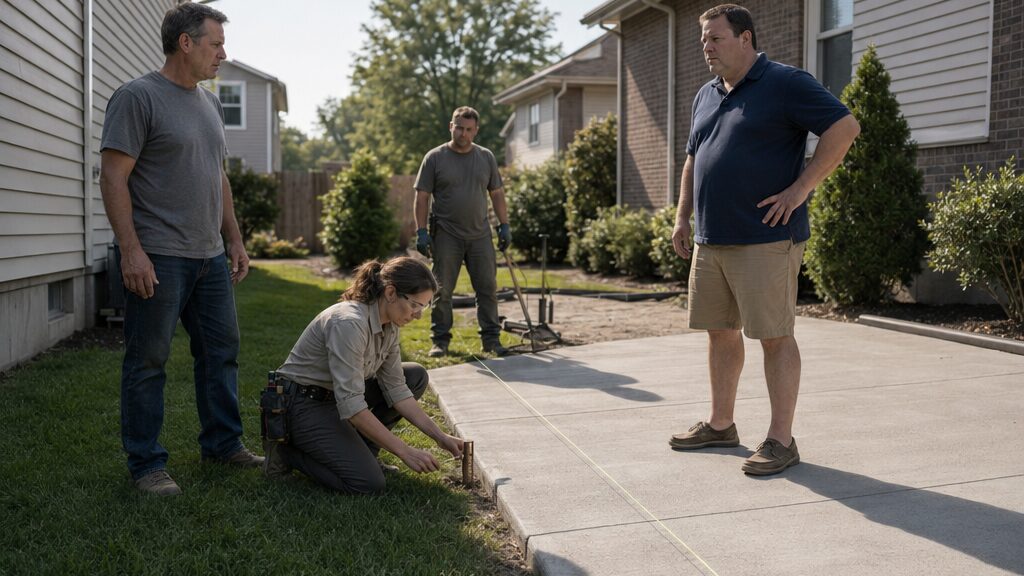
Sarah Campbell’s locator gave a sharp electronic chirp less than twelve inches from the concrete.
Charles looked down.
Daniel, standing on the finished slab with his arms folded, did the same.
Sarah moved the locator slowly over the grass.
Another chirp.
She marked the spot with the toe of her boot.
“Could be our monument.”
Daniel exhaled through his nose.
“Or buried junk.”
Sarah glanced at him.
“Could be.”
She knelt and opened a narrow probing tool.
Charles appreciated that answer more than he expected. He had spent four days imagining the satisfaction of someone arriving and instantly proving him right.
Sarah seemed determined to provide him no such satisfaction.
She worked carefully through the soil.
A few minutes later, metal appeared.
Not junk.
A weathered iron survey pin.
Charles recognized the rust-colored top immediately.
He had seen it for years.
Sarah cleaned around it without disturbing its position, then checked her records and moved to establish the remaining control points.
Daniel stayed outside.
So did Charles.
Two adjacent homeowners slowed while walking past the front of the houses. One looked down the side yard, saw the equipment and kept moving.
Charles suddenly felt self-conscious.
From a distance, he knew exactly how this looked.
A property-line fight.
The sort of dispute people joked about until somebody built a fence or hired a lawyer.
Daniel must have sensed it too.
He said quietly, “This is unnecessary.”
Charles kept his attention on Sarah.
“If it shows you’re right, I’ll know.”
“I already know.”
“That’s the difference.”
Daniel’s jaw shifted.
A contractor arrived while Sarah was setting equipment farther back on the lot. He had come to inspect the patio edges before sealing.
Daniel met him halfway down the slab.
Charles heard only pieces of their conversation.
“…survey thing…”
“…shouldn’t affect…”
Then the contractor approached Sarah.
“Need us out of the way?”
“For now, just don’t disturb any markers.”
Daniel looked at Charles.
“You called them before the work was even finished?”
“I called a surveyor after water ran into my foundation bed.”
“The contractor can fix drainage.”
“After we know whose ground he’s fixing.”
Daniel stepped down from the slab.
“Charles, you’re acting like I stole half your backyard.”
“I haven’t said what you did because we don’t know yet.”
Sarah looked up from her instrument.
“I do need you both clear of the sight line.”
They moved apart.
That small instruction changed the mood more effectively than anything Charles could have said.
For the next twenty minutes, neither man mattered very much.
There were measurements.
Coordinates.
Recorded dimensions.
Existing monuments.
Sarah checked one point, then another.
Finally she ran a bright survey line along the established boundary.
Charles stared at it.
At the front, it passed close to where he had expected.
Then the line continued toward the rear.
The concrete crossed it.
Not slightly.
The slab curved across the boundary and widened deeper into Charles’s parcel.
Sarah took additional measurements before speaking.
“At the widest point, I’m getting roughly six feet four inches of encroachment from the deeded line to the outside edge.”
Daniel gave a short laugh.
Nobody joined him.
“That can’t be right.”
Sarah checked her notes.
“I’ll finish the survey before I certify anything.”
“You just said six feet.”
“I said what I’m measuring here. My final work product will show the boundary and improvements.”
Daniel pointed toward the old mowing edge.
“The property line has always been over there.”
Sarah stood.
“What people maintain isn’t necessarily what they own.”
Daniel looked at Charles.
Charles felt the vindication arrive almost physically.
Six feet four inches.
For days Daniel had made him feel as if he were inventing a problem because a little water crossed some grass.
Now a taut line ran directly through the expensive slab.
Charles could have said something.
He could have reminded Daniel of the concrete truck. The refusal to pause. The repeated phrase about HOA approval.
He wanted to.
Instead he looked at the contractor.
“Please make sure nobody pulls that pin or changes anything around it.”
The contractor nodded.
Daniel said, “Nobody’s touching it.”
Charles turned toward him.
“Then we need to figure this out formally.”
Daniel’s face reddened.
“You think this means the patio comes out?”
“I think it means part of it is on my property.”
“No. It means your surveyor says it is.”
Sarah immediately corrected him.
“I’m not his surveyor in the sense you mean. I’m licensed to survey the parcel he hired me to survey. You’re free to have the work independently reviewed.”
Daniel stared at her, then looked toward his house.
His spouse stood behind the sliding door.
Charles saw Daniel notice.
Something in him changed.
The defensiveness hardened.
“I’m not tearing up thirty thousand dollars of work.”
Charles said nothing.
Daniel walked inside.
For several minutes, the contractor pretended to inspect a joint that clearly did not require that much attention.
Sarah finished her field measurements.
Before leaving, she showed Charles the location of the boundary on her preliminary sketch.
“Don’t use this for construction yet,” she said. “Wait for the signed survey.”
“But you’re confident?”
“I’m confident enough to tell you not to build anything based on assumptions.”
Charles nodded.
The phrase landed harder than she could know.
That afternoon Daniel knocked on Charles’s front door.
He carried a folder.
Charles expected anger.
Instead Daniel looked controlled, almost businesslike.
“You wanted formal.”
He handed Charles the folder.
Inside was an HOA architectural approval bearing Daniel’s address, project description and an approved diagram of the patio.
Charles looked from the paper to Daniel.
Daniel tapped the approval.
“I told you.”
Charles read it again.
There was the HOA name.
There was the project.
There was approval.
For the first time since Sarah exposed the iron pin, Charles felt the ground shift back under him.
“How did they approve this?”
“Because I submitted it.”
“Using what boundary?”
“The site plan they accepted.”
Charles looked at the survey line still visible through the side yard.
Then back at the approval.
One showed concrete six feet onto his property.
The other appeared to authorize the project.
They could not both mean what Daniel claimed they meant.
Before Charles could answer, his phone buzzed.
An email from the HOA had arrived.
The subject requested his attendance at an emergency architectural-review meeting concerning the Thompson patio and the disputed Moore-Thompson property boundary.
Charles looked up.
Daniel had already turned toward home.
For four days Charles had wanted proof.
Now he had proof.
What he no longer knew was who, exactly, had approved building over it.
Chapter 4: Approved Did Not Mean Owned
Debra Williams placed Daniel’s approval packet in the center of the conference table as if the paper itself might settle the room.
“There,” she said. “Signed, dated, and approved by the architectural committee.”
Charles looked at the page again.
Across from him, Daniel leaned back in his chair.
The meeting room in the HOA clubhouse was too small for the amount of tension inside it. Two board members sat along the wall with folders on their laps. Debra occupied the head of the table. Charles had brought Sarah Campbell’s preliminary field sketch and a copy of his recorded plat.
Daniel had brought the approval.
Debra tapped the packet.
“The board reviewed the patio extension in March. The submitted drawing showed the project inside Mr. Thompson’s lot and within the architectural guidelines.”
Charles kept his voice level.
“Did anyone verify the property line?”
Debra’s expression tightened.
“That is not normally the architectural committee’s function.”
Daniel looked at Charles as if that answered everything.
Charles did not look back.
“So no.”
Debra folded her hands.
“We review what the homeowner submits. Exterior appearance, materials, setbacks as represented, drainage notes, visibility from the street. We are not land surveyors.”
“But the approval says the project complied.”
“With HOA standards based on the information submitted.”
Charles slid Sarah’s sketch across the table.
“And this says the concrete is on my property.”
One of the board members leaned forward to study it.
Debra did not touch the page.
“Preliminary survey,” she said.
“Sarah will certify it.”
“When she does, we will review it.”
Daniel exhaled.
“This is exactly what I’ve been saying. The HOA approved my design.”
Charles turned toward him.
“Your design showed the wrong boundary.”
“No, it showed the boundary we’ve all used for years.”
“Used for mowing.”
“Used for everything.”
Charles almost answered too quickly.
Debra raised a hand.
“Let’s keep this factual.”
Charles sat back.
Factual.
That was what he had wanted.
He suddenly disliked how complicated facts could become.
Debra pulled Daniel’s original site sketch from the packet. It was not a survey. Charles could see that immediately. The houses were simple rectangles. The property line was drawn as a clean straight edge following the old maintenance line through the grass.
The patio fit neatly inside it.
Daniel pointed.
“That’s what I submitted.”
Charles stared at the line.
“Where did that measurement come from?”
Daniel hesitated.
“The old fence corner. The mow line. The house spacing.”
“So you estimated it.”
“I used what was there.”
Debra said, “The application states that property boundaries remain the owner’s responsibility.”
Daniel looked at her.
“What?”
She turned the packet toward him.
“It’s in the acknowledgment section.”
He read it.
The room changed.
Only slightly.
But Charles felt it.
Daniel’s certainty lost its clean edge.
“That’s standard language,” Daniel said.
“Yes,” Debra replied.
“But you approved it.”
“We approved the design you represented as being on your property.”
Daniel’s face reddened.
“So what exactly is the point of HOA approval?”
“To verify HOA requirements,” Debra said. “Not title.”
Charles should have felt vindicated.
Instead, he felt something closer to disappointment.
The approval had looked powerful in Daniel’s hand the day before. Now it looked narrower, almost ordinary.
It had not given Daniel land.
But neither had it stopped him from believing he had permission.
Charles thought about the crew, the concrete truck, his own hesitation.
A board member asked whether the county had been contacted.
“Not yet,” Charles said.
Debra nodded.
“That should be your next step.”
Daniel pushed his chair back an inch.
“So now we’re calling the county?”
“The drainage issue may already require that,” Charles said.
Daniel looked at him.
There was no anger in his face this time.
Only weariness.
“You really want to turn this into permits and inspectors?”
Charles almost said, You poured onto my property.
Instead, he heard another sentence in his head.
You knew the line might be wrong too.
That thought followed him to the county records office that afternoon.
The zoning clerk pulled the subdivision plat on a computer, then printed a full-size copy from the recorded file.
Charles spread it across the counter.
The dimensions were clearer than on his old closing copy.
The side boundary was tied to two recorded monuments.
One of them matched the iron pin Sarah had uncovered.
Charles felt a small, unpleasant certainty settle in him.
The line had been there all along.
The clerk compared Daniel’s HOA sketch with the plat.
“These numbers don’t correspond.”
“Could the HOA approval change the boundary?”
The clerk looked at him.
“No.”
“Could the county have approved a permit using their sketch?”
“Depends what permit was required and what was submitted. But permitting doesn’t transfer ownership either.”
Charles nodded.
He already knew the answer.
He wanted to hear it from someone who had no reason to take sides.
The clerk pointed to the setback table.
“If this patio extends into your parcel, that becomes a separate civil property issue. If it alters drainage or violates site requirements, then we may have enforcement jurisdiction.”
Charles took the documents home.
The county plat showed the iron monument in black ink.
Sarah’s field sketch showed the same location in red.
Daniel’s HOA drawing placed the boundary several feet away.
Three documents.
Three versions of the same narrow strip of grass.
Charles stood at his kitchen counter comparing them.
Then his phone rang.
Debra.
“We found something else,” she said.
“What?”
“The original email thread from Daniel’s application.”
Charles gripped the edge of the counter.
“Does it show where he got the boundary?”
“No. But it shows we asked whether the dimensions had been field verified.”
“And?”
“He replied that they matched existing property markers.”
Charles went quiet.
Debra continued.
“That doesn’t prove intent. I’m telling you now because the board should have requested more support before approving a project that close to a lot line.”
Charles looked through the window toward the iron pin.
“You missed it.”
“Yes.”
The admission surprised him.
Debra’s voice remained controlled.
“We made a procedural mistake. That does not mean we authorized construction on your property.”
Charles said nothing.
Then Debra added, “And I’m going to say something you may not like.”
He waited.
“You’ve owned your home how long?”
“Nine years.”
“If you suspected that maintenance line wasn’t accurate, why didn’t you resolve it earlier?”
The question hit harder than Daniel’s arguments had.
Charles looked down.
Because he had suspected.
Years ago, after replacing a sprinkler head, he had measured from the house and noticed that the mow line seemed too far over.
He had told himself it did not matter.
Daniel was a decent neighbor.
Their kids had played in the same yard.
Nobody cared who cut six extra feet of grass.
Charles had chosen peace over precision.
Now he wondered whether he had simply postponed the argument until concrete made it expensive.
“I didn’t want to be that neighbor,” he said.
Debra was quiet.
“The one who measures everything?”
“Yes.”
“And now?”
Charles looked at the survey pin.
“Now I wish I’d measured once.”
The next morning, Debra forwarded the recovered application thread and the contractor materials Daniel had originally submitted.
Most were ordinary: product sheets, a color sample, drainage notes.
One attachment was a site-preparation worksheet.
Charles scanned it.
Near the bottom, beside a date two days before the pour, someone had typed a brief notation.
Boundary marker conflict—owner advised to verify before final placement.
Charles read the line twice.
Then a third time.
The question was no longer whether the HOA had made a mistake.
It had.
The question now was whether Daniel had been warned before the concrete truck ever arrived.
Chapter 5: He Was Warned Before the Truck Arrived
The photograph showed a small orange flag planted in the grass almost exactly where Sarah had uncovered the iron pin.
Charles enlarged the image on his kitchen laptop until the pixels began to blur.
In the background, Daniel’s patio forms were already assembled.
In the foreground, the flag stood beside the line the concrete would later cross.
The contractor sat across from Charles at the kitchen table.
“That was our flag,” he said.
Charles looked up.
“You knew there was a problem?”
“I knew there was something we needed clarified.”
“Before the pour?”
“Yes.”
The contractor rubbed his hands together.
“We laid out from the dimensions we were given. One of my guys found metal where the owner’s sketch said there shouldn’t be a corner marker. We flagged it.”
“And told Daniel?”
“We told him to verify it.”
Charles stared at the photograph.
“What did he say?”
“That the HOA had approved the plan and the old property line was farther over.”
“You accepted that?”
The contractor’s expression tightened.
“We are concrete contractors, not surveyors. He owned the project. He provided the drawing. We documented the issue.”
Charles wanted to be angry at him.
Part of him was.
But the worksheet existed precisely because the contractor had noticed uncertainty and recorded it.
Charles had noticed uncertainty too.
He had simply done nothing until the truck was already there.
The contractor leaned toward the screen.
“We also gave him the option to stop before the second load.”
Charles looked at him.
“Second load?”
“The patio took more than one.”
“You could have stopped?”
“Yes.”
“And he said no?”
“He said continue.”
The words landed differently from everything else.
Not because they proved some elaborate deception.
Because they removed Daniel’s last clean excuse.
He had not known the exact boundary.
But he had known there was a question.
That afternoon Charles crossed the yard and knocked on Daniel’s side door.
Daniel opened it but did not invite him inside.
Charles held a printout of the site photograph.
“You knew.”
Daniel looked at the paper.
His face changed before he spoke.
“The contractor called me.”
“You told them to keep pouring.”
“I told them we had an approved plan.”
“That isn’t the same thing.”
“I know that now.”
Charles stared at him.
The answer was so plain it interrupted the anger Charles had prepared.
Daniel stepped outside and shut the door behind him.
“My wife wanted that patio for three years,” he said. “We saved for it. I put down deposits in January. Materials went up twice before we started. The crew was here. The truck was here.”
“And the marker was there.”
“I didn’t know what it was.”
“You were told to verify it.”
“Yes.”
The admission came quietly.
Charles felt his jaw tighten.
“So why didn’t you?”
Daniel looked toward the slab.
“Because I thought I already knew the answer.”
“No. You wanted the answer.”
Daniel flinched.
Charles heard how sharp his own voice had become.
He continued anyway.
“You wanted that mowing line to be the property line because moving the project would cost you money.”
Daniel’s expression hardened.
“You think I don’t know that?”
Charles stopped.
Daniel looked past him toward the side yard.
“If I moved the forms that morning, I lost the delivery slot. The crew had another job. The contractor told me I might eat the deposit. The HOA had stamped the plan. We’d been mowing to that line since before either of us replaced the back fences.”
He shook his head.
“I made a call.”
“You made the wrong one.”
“Yes.”
For the first time, Daniel said it without qualification.
Charles had imagined that admission for days.
It gave him almost no satisfaction.
Daniel looked at him.
“What happens now?”
“I’m talking to the city.”
Daniel laughed once, without humor.
“Of course you are.”
Charles nearly snapped back.
Instead he said, “The water changed this.”
Daniel’s expression shifted.
“The drainage?”
“Yes.”
“If it was just the boundary, maybe there’d be options. But the inspector needs to look at what the slab did to the runoff.”
Daniel rubbed the bridge of his nose.
“My contractor can cut back the edge.”
“Maybe.”
“You want the whole thing ripped out.”
Charles opened his mouth.
Then stopped.
Did he?
Part of him did.
Not because the whole thing necessarily needed to come out.
Because Daniel had ignored him.
Because he had made Charles feel petty in his own yard.
Because every time Charles saw that slab, he remembered standing beside a wet concrete form asking for one simple pause and being dismissed.
Charles folded the photograph.
“I want what’s necessary.”
Daniel looked skeptical.
Charles understood why.
At the municipal office two hours later, the drainage inspector studied photographs of the storm damage and Sarah’s survey.
The inspector traced the slab edge with one finger.
“If these grades are accurate, cutting only the encroaching section may not solve the runoff.”
Charles leaned closer.
“Why?”
“Because the remaining slab still pitches toward this low point.”
“So what does that mean?”
“It means correction could require removal farther back than the property line, regrading the base, then rebuilding whatever portion remains legally on his side.”
Charles stared at the drawing.
“How much farther?”
“I can’t determine that from photos.”
“Could be most of it?”
“Could be less. We inspect first.”
The inspector looked at him.
“Understand something. The property-line issue and drainage issue overlap, but they are not identical. Your survey doesn’t automatically dictate the drainage remedy.”
Charles nodded.
Another layer.
Another process.
Nothing solved everything.
When he returned home, Daniel was waiting near the driveway.
He held an envelope.
Charles slowed.
“What’s that?”
Daniel extended it.
“An option.”
Charles did not take it immediately.
“What kind?”
Daniel looked toward the concrete, then toward the narrow strip of land between their houses.
“I’ll buy the section.”
Charles frowned.
“What?”
“The part the survey says is yours.”
Daniel held the envelope out again.
“We redraw the line legally. I pay you for the strip, closing costs, recording, whatever needs to happen. The patio stays. You get paid. Nobody spends the next six months fighting inspectors and contractors.”
Charles took the envelope.
It was heavier than he expected.
Inside was a written offer.
The number at the bottom made him read it twice.
Daniel had put a real price on six feet of ground.
And for the first time since the concrete had crossed the line, Charles had an option that might let everyone walk away without breaking anything.
Chapter 6: The Offer That Would Make It Easier
Daniel’s purchase offer sat between them on Charles’s back porch table.
Neither man touched it.
Charles had spent the night thinking about the number.
It was enough to cover the survey, repair the damaged planting bed, and leave a substantial amount beyond that.
Enough to make saying yes feel practical.
Maybe even generous.
Daniel nodded toward the document.
“I’m not trying to cheat you.”
“I didn’t say you were.”
“I had the title company give me a rough process. Boundary adjustment, updated legal description, record it with the county.”
Charles looked at him.
“You already called a title company?”
“I’m trying to solve it.”
That was new.
Not the confidence.
Not the argument.
The attempt.
Charles looked across the yard.
The slab still crossed Sarah’s line. The old iron pin remained exposed inside a small protective circle Sarah had marked so nobody disturbed it.
“You’d pay everything?”
“Yes.”
“And the HOA?”
“They said they’d review the amended site plan if we both signed.”
Charles lifted the offer.
“What about drainage?”
Daniel hesitated.
“The contractor says they can install a channel drain.”
“That isn’t what the city inspector said.”
“He hasn’t inspected yet.”
“No.”
Daniel leaned back.
“So we wait for him.”
Charles studied his face.
A week earlier, Daniel would have told him the concrete was staying.
Now he was negotiating.
The change mattered.
Charles hated that he also liked the number.
At work that afternoon, he found himself calculating what the money could do. Replace the aging HVAC unit before winter. Rebuild the back steps. Put the rest away.
By five o’clock, selling six feet of side yard seemed almost reasonable.
Then the drainage inspector emailed him a preliminary note.
Charles read it twice in his truck before driving home.
Any boundary adjustment affecting the side-yard drainage route could leave responsibility for downstream runoff, access, and future correction attached to the altered parcel configuration. Additional setback review might also be required.
The offer suddenly looked different.
It was not only land.
It was a future obligation.
If Charles sold the strip and the concrete remained, he might be accepting the drainage condition that had started the dispute.
He brought the email to the HOA mediation meeting that evening.
Debra read it carefully.
Daniel sat across from him.
“So we write the agreement to make me responsible,” Daniel said.
Debra shook her head.
“You can allocate private costs between yourselves, but you cannot contract around every municipal requirement.”
Daniel’s shoulders dropped.
Charles looked at the offer again.
He had come into the room planning to accept if the paperwork could be made clean.
Now he understood there might not be a clean version.
Debra turned to Charles.
“You should also consider setbacks if the lot line moves.”
“What about them?”
“Daniel’s side-yard dimensions change. Yours do too. Future improvements could be affected.”
Daniel muttered, “This is unbelievable.”
Debra looked at him.
“No. This is what happens when legal boundaries are treated as landscaping.”
The room went quiet.
Charles felt the sentence land on both of them.
He looked at the table.
“I did that too.”
Daniel glanced at him.
Charles continued.
“I saw that iron point years ago. I measured once. Not professionally. Just from my wall. I knew the mowing line might be off.”
Daniel stared at him.
“You never said anything.”
“No.”
“Why?”
Charles almost answered defensively.
Instead he told the truth.
“Because it didn’t matter then. You mowed some of my grass. Maybe I mowed some of yours. Nobody cared.”
Daniel’s voice sharpened.
“So you knew and let me build?”
“No.”
“You knew there was a question.”
“Yes.”
“And you waited until concrete was going in.”
Charles felt the accusation because part of it was fair.
“I told you to stop.”
“When the truck was already there.”
“Yes.”
Daniel looked away.
Charles let the silence remain.
Then he said, “I should’ve dealt with the line years ago.”
Daniel looked back.
“That doesn’t make the patio legal.”
“No.”
“It doesn’t make me right.”
“No.”
Charles folded the purchase offer.
“But I’m not pretending I had nothing to do with how unclear this got.”
Daniel’s anger softened into something harder to read.
Debra closed the folder in front of her.
“What are you going to do?”
Charles looked at the offer one last time.
Then he slid it back across the table.
“I’m not selling.”
Daniel did not touch it.
Charles continued before the refusal could become an accusation.
“I’m also not asking the city to punish you beyond what has to be corrected.”
Daniel narrowed his eyes.
“What does that mean?”
“It means if they say twelve feet has to come out, I’m not demanding twenty because I’m angry.”
Debra watched him carefully.
“And the fence?”
Charles looked toward the clubhouse window, though his own yard was miles from sight.
“I want the actual boundary established. After that, I’ll decide what I need.”
The next morning, he went outside before work.
The iron pin had collected dirt from the previous night’s rain.
Charles crouched and brushed the soil away with his fingers.
Months earlier, he would have covered it again.
Now he left the rusted top exposed.
At noon, the municipal notice arrived by certified mail.
Charles opened his copy standing at the kitchen counter.
The order required correction of the encroachment and drainage condition within a fixed compliance period.
Daniel received the same notice.
Charles saw the mail carrier hand it to him across the lawn.
For several seconds, Daniel stood motionless, reading.
Then he looked toward Charles’s house.
The argument had become official.
And for the first time, whether the concrete stayed was no longer something either neighbor could decide alone.
Chapter 7: The Fence Followed the Real Line
The first strike of the jackhammer opened the same white crack Charles had watched from his back steps three weeks earlier.
This time he knew exactly why it was there.
The worker leaned into the machine, and the crack widened across Daniel’s patio until a section of concrete separated from the rest. Dust pushed outward in pale clouds. Another worker sprayed the surface with water to keep it down while the compact loader waited near the driveway.
Daniel stood beside his sliding door.
Charles stood on his own side of the yard.
No one needed to argue anymore.
The municipal drainage inspector had returned twice after issuing the correction order. Measurements had been taken. Grades had been checked. Sarah Campbell’s certified survey had been accepted into the file.
The final remedy was more complicated than Charles had expected.
Removing only the six-foot-four-inch encroachment would not solve the runoff problem. The base beneath part of Daniel’s remaining patio had been graded toward Charles’s lot. To correct the drainage, the contractor had to cut farther back, remove compacted material, rebuild the grade, and create a legal slope within Daniel’s property.
It meant losing more concrete than the survey alone required.
Daniel had appealed that portion once.
Not angrily.
Technically.
His contractor submitted an alternative drain proposal. The inspector reviewed it and rejected it because maintenance access would depend on Charles’s property.
After that, Daniel stopped fighting.
The demolition started on a Tuesday morning.
Charles had taken the day off.
He told himself it was because workers would need access near his planting bed.
That was partly true.
The other truth was less comfortable.
He wanted to see it.
For weeks, he had pictured the moment the concrete finally came out. During the worst arguments, he had imagined Daniel watching every expensive piece being carried away.
Now that it was happening, the feeling was flatter than he expected.
The jackhammer was simply loud.
The dust was simply dust.
And Daniel looked less like a defeated enemy than a man watching money disappear.
A worker pried up another section.
Beneath it, dark compacted soil appeared.
The drainage inspector crouched near the exposed base and pointed with a level rod.
“There.”
Charles stepped closer.
The original ground fell gently away from both foundations toward the rear drainage path.
The patio base had erased that slope.
For the first time, Charles could see what the rain had been trying to show him.
The old yard had known where the water belonged.
The new concrete had redirected it.
Daniel walked over.
“So that’s it?”
The inspector nodded.
“That’s the grade we need to restore.”
Daniel stared down.
His voice was quiet.
“The contractor said he pitched it away from my house.”
“He did.”
“Just too much.”
“And toward the wrong place.”
Daniel looked at Charles.
Neither man spoke.
The contractor had given Daniel an updated invoice that morning. Between demolition, hauling, base correction, drainage work, repouring the legal portion, survey verification and fees, the total landed just under seven thousand dollars beyond what Daniel had already spent.
Charles had seen the figure because a copy was attached to the compliance file.
He wished he hadn’t.
Numbers made consequences too easy to enjoy.
By afternoon, most of the disputed concrete was gone.
The ground looked wounded but honest—dark dirt, rough edges, exposed gravel, the straight survey line running through what had previously appeared to be one continuous patio.
Sarah returned before the fence installer began.
She checked both monuments.
The old iron pin was still where it had always been.
Charles crouched beside it.
“You’re sure nobody moved this during demolition?”
Sarah looked at her equipment.
“If someone did, they managed to move it away and put it back within tolerance.”
Charles smiled faintly.
Daniel did not.
Sarah marked the line again.
The fence installer stretched a string from the rear monument toward the front.
It passed directly through the space where Daniel’s concrete had crossed.
For a few minutes, Charles simply watched the string.
It was almost absurd how thin it was.
A piece of line no thicker than a shoelace had caused weeks of meetings, inspections, arguments and thousands of dollars in work.
Except the string had caused none of it.
It only showed where something already existed.
The installer approached Charles with a clipboard.
“We can run the privacy fence all the way to your approved endpoint.”
Charles followed his gesture.
The design called for six-foot cedar panels along most of the restored boundary. Near the side of Daniel’s house, the legal line came surprisingly close to the wall.
Charles walked toward it.
The installer held the string tight.
If Charles continued the full-height fence exactly as approved, Daniel would be left with a narrow corridor between the cedar boards and his siding.
Legal.
Clean.
Private.
And unpleasant.
Daniel stood several yards away talking to his contractor.
Charles imagined the completed wall.
He imagined never seeing Daniel when he stepped outside.
For a moment, that seemed attractive.
Then he remembered the mediation room.
I knew the mowing line might be off.
His own words.
Daniel had ignored a warning and poured anyway.
Charles had ignored a different warning for years because dealing with it had felt inconvenient.
The harm was not equal.
The responsibility was not equal.
But Charles had stopped wanting equality in punishment.
The installer pointed again.
“We continue from here?”
Charles stared at the line.
He could legally say yes.
The fence would protect his property.
It would also turn Daniel’s side access into a narrow wooden channel for no reason beyond Charles having the right to do it.
Daniel glanced over.
Their eyes met.
Charles saw him look at the stacked cedar panels.
He understood immediately what was being decided.
Charles turned to the installer.
“Stop the full-height section here.”
The installer looked down at the plan.
“You’re approved farther.”
“I know.”
“You want open boundary beyond this point?”
“Lower transition. Enough to mark the line without closing his access.”
The installer nodded.
Daniel said nothing.
Charles did not look for gratitude.
By evening, the main cedar fence stood straight along the corrected boundary. Near Daniel’s side passage, it stepped down instead of continuing as a solid wall.
The old iron pin remained visible at the base.
Daniel walked past it while inspecting the remaining work.
He stopped.
For a moment, Charles thought he might speak.
Instead, Daniel looked at the shorter section of fence, then at Charles.
A small nod.
Nothing more.
Charles returned it.
The concrete was gone.
The boundary was no longer uncertain.
What neither man knew yet was whether a clear line between their properties would become a permanent wall between them too.
Chapter 8: The Marker Stayed Where It Was
Several weeks later, Charles heard Daniel’s mower stop abruptly beside the property line.
He looked up from the back steps.
Daniel had cut a straight strip through his own side yard, turned carefully at the cedar fence, and stopped just before the exposed iron survey pin.
For nine years, neither man had mowed that precisely.
Daniel repositioned the mower and continued without crossing the line.
Charles watched for a few seconds, then went back to tightening a loose screw on the step railing.
The repaired yard no longer looked recently excavated.
Fresh grass had begun filling the disturbed soil. Daniel’s rebuilt patio ended well inside his parcel, smaller than before but level. A shallow drainage swale carried runoff toward the rear instead of across Charles’s planting bed.
The first heavy rain after the repairs had come the previous week.
Charles had stood at the window longer than necessary, watching.
Water flowed where the inspector said it should.
Nothing crossed toward the foundation.
That had been the real victory.
Not the fence.
Not the invoices.
Not watching concrete break apart.
Water simply went where it belonged.
The HOA sent a community notice soon afterward announcing revised architectural-review procedures. Projects proposed within a specified distance of property boundaries would now require stronger documentation, including a recent survey or other acceptable boundary verification.
Debra never wrote that the Thompson dispute had caused the change.
She did not need to.
At the next neighborhood meeting, Charles saw her across the room.
She nodded.
He nodded back.
That was enough.
Daniel did not attend.
Their own relationship remained harder to classify.
They no longer stood in the driveway talking about weekend plans. Daniel did not wander over when Charles was working outside. Charles no longer called across the yard when he saw a delivery left near Daniel’s garage.
But they also stopped watching each other.
The tension that had made every door opening feel like the start of another argument slowly drained away.
One Saturday morning, wind moved through the mature trees behind the houses.
A dead branch fell from one of Charles’s trees and landed partly across the boundary.
Charles heard it hit the grass.
Before he could get outside, Daniel appeared from his side door.
He walked toward the branch, then stopped.
The thicker end lay on Charles’s property.
Daniel could easily have stepped across, grabbed it, and dragged it back.
He did not.
Charles came through the gate carrying gloves.
Daniel pointed.
“That yours?”
“Tree is.”
Daniel looked at the branch.
“Mind if I grab the part on my side?”
Charles almost smiled.
“You can take the whole thing if you want it.”
“I just need to move it.”
“Go ahead.”
Daniel stepped across the line.
Not accidentally.
Not because they had both stopped caring.
Because he had asked.
Together they lifted the branch and carried it toward Charles’s brush pile.
Daniel held the heavier end.
They worked without conversation until they dropped it beside the fence.
Daniel wiped his hands on his shorts.
Then he looked toward the shortened fence section.
“You didn’t have to stop it there.”
Charles knew exactly what he meant.
“No.”
“Installer told me you were approved all the way.”
“I was.”
Daniel stared at the boards.
“Would’ve made getting my trash cans through here interesting.”
“That crossed my mind.”
Daniel gave a brief laugh.
It disappeared quickly.
Then he looked down toward the iron pin.
“I really thought that mowing line was right.”
Charles leaned against the fence post.
“I know.”
“I also should’ve stopped that truck.”
“Yes.”
Daniel nodded.
Charles expected the conversation to end there.
Instead Daniel said, “You should’ve told me years ago if you thought the line was wrong.”
Charles looked at him.
The old version of the argument was sitting there, waiting.
He could defend himself.
He could remind Daniel that suspicion was not knowledge.
He could explain again that nothing had mattered until construction turned informal space into permanent structure.
All of it would be true.
He chose the shorter answer.
“Yes.”
Daniel looked surprised.
Charles continued.
“I should’ve checked it then.”
A moment passed.
Neither man apologized.
Charles was glad.
An apology offered only because the story seemed to demand one would have meant less than the branch they had just carried together.
Daniel nodded toward his house.
“I should get back.”
“Sure.”
He walked to the property line.
Then stopped beside the pin.
Its rust-colored top remained visible just above the soil.
Daniel stepped over it deliberately and returned to his yard.
Charles watched him go.
Later that afternoon, Charles spread fresh soil across the repaired portion of lawn.
He reached the survey pin and paused.
The easiest thing would have been to cover it.
A thin layer of soil, a little seed, and within a month the grass would hide it again.
For years, that was essentially what both men had done.
Not literally.
They had simply allowed convenience to cover a fact neither wanted to examine too closely.
Charles brushed loose dirt away from the metal instead.
The pin was not attractive.
It was not dramatic.
Most visitors would never notice it.
He no longer needed it as proof against Daniel.
The survey was recorded. The fence stood where it belonged. The drainage was fixed. The concrete had been removed and rebuilt.
The dispute was finished.
But Charles left the marker visible.
Not as a warning.
As a reminder.
A boundary did not have to become a weapon to matter.
And keeping peace did not require pretending the line was not there.
The story has ended.