They Chained His Farm Road for Unpaid Fees, Then Learned the Road Was Never Theirs
Chapter 1: The Chain Across Walker Farm Road
The chain was stretched across Paul Walker’s only truck exit before he finished his first cup of coffee.
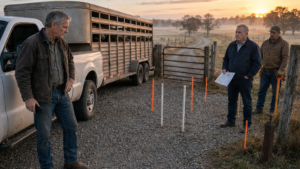
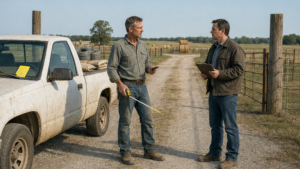
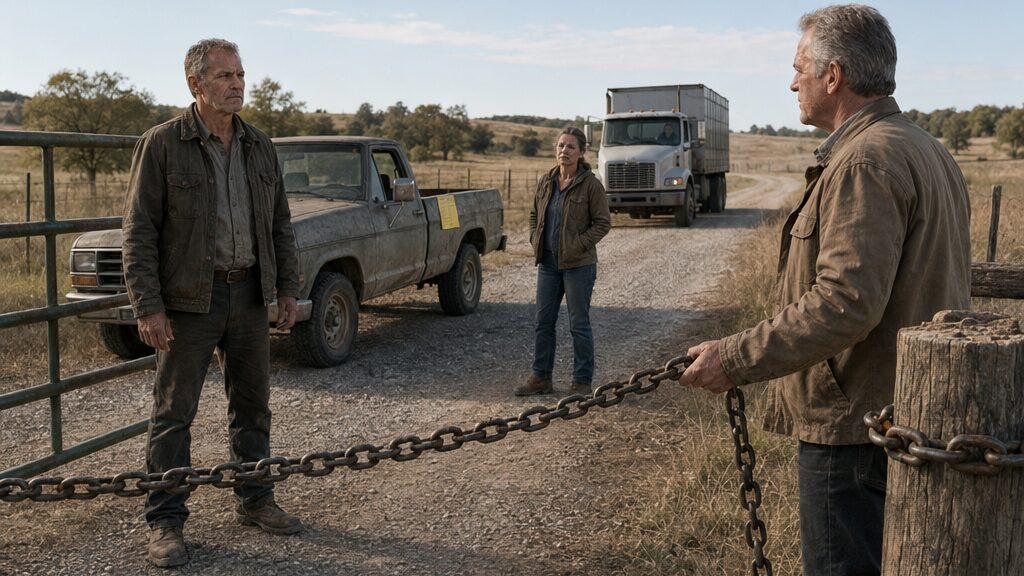
He saw it from the cab of his gray Ford as he rolled down the gravel drive toward the county road: a thick galvanized chain pulled chest-high between the cedar gatepost on one side and a steel fence post on the other. A bright padlock hung at the center.
Paul stopped twenty feet short of it.
Beyond the chain stood Stephen Taylor.
Stephen wore clean work boots, pressed jeans, and the navy polo he favored whenever he was acting as president of the Walker Ridge Road Association. He held a clipboard under one arm. Two pickup trucks sat along the shared gravel road behind him, and two neighboring landowners stood near them, watching.
Paul switched off the engine.
The silence afterward felt deliberate.
He climbed out.
“What’s this?”
Stephen lifted the clipboard. “You know what it is.”
Paul walked toward the chain but did not touch it.
“No,” he said. “I know what a chain is.”
One of the neighbors shifted his weight.
Stephen’s mouth tightened. “Your road assessment is overdue. So is the penalty.”
“My assessment is disputed.”
“It was disputed three months ago. Then two months ago. Then last month.”
“That doesn’t make it owed.”
“It makes it unpaid.”
Paul glanced at the chain again. It crossed the mouth of his own farm drive. Behind him were sixty acres of hay ground, twenty-three cows, a tractor with a hydraulic leak he planned to haul into town, and a feed bin that was nearly empty.
Stephen tapped the paper clipped to his board.
“Until the balance is settled, association access privileges are suspended.”
Paul looked at him.
“Access privileges.”
“That’s right.”
“To my farm.”
“To the association road.”
Paul felt the first surge of anger then, quick and hot enough that he imagined lifting the chain over the post and dropping it at Stephen’s boots. But he had spent most of his life learning that the first thing a man wanted to do angry was often the thing he would later have to explain.
So he kept his hands at his sides.
Stephen stepped closer to the truck and slid a yellow notice beneath the driver-side windshield wiper.
Paul watched him do it.
“Two hundred dollars in penalties,” Stephen said. “Plus the maintenance assessment.”
“Take that off my truck.”
“It’s notice.”
“Then hand it to me.”
“It stays where it is.”
Paul reached past him, removed the paper, folded it once, and put it in his jacket pocket.
Stephen laughed without much humor.
“You can make this harder if you want.”
“I haven’t done anything yet.”
“That’s the problem, Paul. You don’t answer letters. You don’t show up to meetings. You use the road every day, but when it’s time to pay for gravel or drainage work, suddenly none of it concerns you.”
One of the men behind Stephen looked away.
That part landed because it was not entirely false.
Paul had ignored the letters.
Some he had opened. Some he had left on the kitchen counter until they disappeared beneath seed catalogs and veterinary invoices. The association had graded the road twice the previous year, and Paul had driven over the fresh gravel without sending a check.
But that was not the same thing, in his mind, as Stephen possessing the right to chain him inside his own farm.
A diesel engine sounded from the county road.
Paul turned.
A feed truck rounded the bend, slowed, and stopped behind the pickups.
The driver climbed down, looked at the chain, then at Paul.
“Morning,” he called. “You still want that load in the north bin?”
“Yes.”
Stephen answered before Paul could say more.
“Road’s closed to Walker Farm.”
The driver frowned. “Closed?”
“Private access issue.”
Paul stared at Stephen.
“You don’t speak for me.”
“I speak for the association.”
The driver looked between them. He plainly wanted no part of it.
“I can’t sit here long,” he said. “Got three more drops.”
Paul walked to the chain.
Stephen shifted in front of it.
“Don’t.”
Paul ignored him and looked down instead.
The steel post on the west side had been driven just inside the ditch shoulder, a few feet from an old chunk of limestone half buried in grass.
Paul knew that stone.
Or thought he did.
He crouched.
Moss covered one edge, but a squared corner showed beneath the weeds.
When Paul was a boy, his father had once told him not to move stones like that, no matter how inconvenient they were.
Survey stone, he had said.
Paul had forgotten the remark for decades.
Stephen was still talking.
“If you cut that lock, we’ll add replacement costs. If you interfere with association property, we’ll document it.”
Paul straightened.
“Association property?”
“The road and its fixtures.”
Paul looked from the steel post to Stephen.
“You may want to check whose ground that post is standing in.”
For the first time that morning, Stephen hesitated.
Only for a second.
Then he smiled.
“That old argument?”
Paul said nothing.
“You think because your father farmed here before the other houses went up, every ditch and fence line still belongs to you?”
“I didn’t say that.”
“You implied it.”
“I told you to check.”
The feed driver approached Paul quietly.
“I can come back Thursday.”
Paul glanced toward the pasture. The cows had enough feed to make Thursday if nothing else went wrong.
“Come Thursday.”
The driver nodded and left.
Paul watched the truck disappear up the road.
That was when the embarrassment changed shape.
Until then, Stephen’s chain had been insulting.
Now it had cost him something.
Stephen held out his hand.
“Pay the balance and I’ll open it today.”
Paul looked at the hand and then at Stephen’s face.
“What happens if I don’t?”
“We proceed.”
“With what?”
“Collection.”
“You mean court?”
“If necessary.”
Stephen tucked the clipboard under his arm again. “You’ve been warned enough.”
Paul returned to the truck.
Behind him, Stephen called, “This is exactly why the association needs rules. One person decides they’re special, everybody else pays.”
Paul stopped with his hand on the door.
He nearly answered.
Instead, he got into the truck, backed slowly up the driveway, and returned to the house.
The old farmhouse office still held more of his father than any other room.
Not photographs. His father had hated having his picture taken.
It was in the practical things: coffee rings on the desk, pencil marks in the doorframe, old farm ledgers tied with string, county tax envelopes saved long after they mattered.
Paul opened the bottom drawer.
He had not gone looking there in years.
Under a stack of machinery manuals lay a folded parcel map, brittle at the creases.
He carried it to the desk and opened it carefully.
The road was there, drawn as a narrow line before the newer parcels had been divided around it.
Paul leaned closer.
Near the entrance to his farm, a boundary line cut across the road at an angle.
And beside it, in his father’s handwriting, were three words:
Not theirs yet.
Chapter 2: The Road Everyone Thought They Owned
Amanda Roberts arrived before lunch with dust on her boots and anger already in her face.
She did not knock.
Paul found her standing beside the porch steps, one hand on her hip.
“You planning to keep that road tied up all week?”
“I didn’t tie it up.”
“You know what I mean.”
Paul folded his arms.
Amanda’s cattle operation sat farther down the shared road, past two bends and a low crossing that washed gravel away every hard spring rain. She ran fewer animals than Paul, but she ran them tighter. Every delivery mattered.
“I’ve got a livestock trailer coming Thursday,” she said. “And feed Friday.”
“So do I.”
“Then fix it.”
“Tell Stephen.”
“I already did.”
“And?”
“He says you owe the association thirty-six hundred dollars with penalties.”
Paul stared at her.
“That number grows every time he says it.”
Amanda exhaled sharply. “Paul, I don’t care whether it’s thirty-six hundred or thirty-six dollars. I care that the rest of us have paid into that road for years.”
“So have I.”
“When?”
“Before Stephen started calling everything an assessment.”
“That isn’t an answer.”
She was right, which irritated him more than if she had been wrong.
Paul went inside and returned with the yellow notice.
Amanda read it.
Her expression changed slightly at the line authorizing suspension of road privileges.
“They actually chained your gate?”
“You drove past it.”
“I thought you locked it.”
Paul took the paper back.
“That’s the problem with people seeing a chain. They assume the man behind it agreed to be there.”
Amanda looked toward the road.
“I don’t like what Stephen did.”
“But.”
“But I also don’t like paying for gravel while somebody else uses it free.”
Paul’s jaw tightened.
“You think I’m freeloading.”
“I think you don’t tell anybody anything.”
That stopped him.
Amanda continued.
“My culvert washed out last March. I paid my assessment and then another seven hundred because the road fund was short. You drove over the replacement three days later.”
“I didn’t ask them to replace your culvert.”
“No. You just needed the road afterward.”
She left before he found an answer he liked.
That afternoon Paul drove his smaller utility tractor across the back field to an old fence gap that connected with a neighbor’s pasture, then walked from there to the association meeting shed.
Stephen was already inside with the treasurer and two landowners.
A metal fan rattled in the window.
Stephen looked surprised to see him.
“Well. We finally got you to a meeting.”
Paul ignored that.
“I want the membership records.”
The treasurer blinked. “Which records?”
“Mine.”
Stephen leaned back in his folding chair.
“You’ve been receiving statements for years.”
“That isn’t what I asked.”
The treasurer opened a filing box.
Paul stood at the end of the table while she sorted folders.
Stephen drummed his fingers.
“You think there’s some technicality here?”
“I think you put a chain across my farm.”
“Because you won’t pay.”
“You keep saying that like it answers every other question.”
The treasurer finally pulled a packet free.
“Walker parcel.”
Paul took it.
There were invoices. Meeting notices. Copies of returned certified-mail slips. A maintenance schedule. Two handwritten notes recording phone calls Paul barely remembered.
Then he found the membership agreement.
At the bottom were signature lines.
Stephen Taylor.
Amanda Roberts.
The two neighboring landowners.
Several others.
Paul Walker.
Blank.
Paul turned the page.
Another version from six years earlier.
Blank again.
Stephen saw where he was looking.
“That doesn’t mean you aren’t part of the association.”
“It means I didn’t sign this.”
“You accepted the services.”
“That’s different.”
“Not when everybody knows how the road works.”
Paul looked at him.
“Everybody knowing something isn’t the same as putting it on paper.”
Stephen’s chair scraped back.
“You’ve used every load of gravel we bought. You’ve driven over every repaired washout. Your hay trucks use the same lane as mine.”
Paul closed the folder.
That part, again, was true.
The satisfaction he had felt at seeing the blank signature weakened.
Stephen had overreached.
But Paul had also spent years letting uncertainty work in his favor.
The treasurer cleared her throat.
“The board still has to decide what to do about the delinquency.”
Stephen looked at the others.
“I move we continue enforcement until the balance is paid or resolved through counsel.”
One neighbor hesitated.
Then raised his hand.
Another followed.
The treasurer did too.
Paul watched the vote pass.
“You came here,” Stephen said, “and now you’ve seen the records. Nobody singled you out.”
Paul tucked the folder under his arm.
“You chained my road.”
“Our road.”
Paul looked at him for a long moment.
Then he left.
Back home, the chain still hung across the entrance.
He did not touch it.
Instead he took his father’s map to the kitchen table and laid the association papers beside it.
For nearly an hour he compared dates.
The newer road association had formed well after his father had already owned the farm. Before that, neighbors had apparently contributed money as needed—gravel, culvert pipe, grader work—without a formal organization.
Paul remembered men coming to the house when he was young and leaving cash envelopes on the refrigerator.
He had never understood what they were for.
He turned the old map over.
The back was covered in pencil notes: fence measurements, acreage figures, a phone number long disconnected.
Near the lower edge was a reference written more carefully than the rest.
Book 214.
Page 87.
Paul stared at it.
Below the numbers his father had written one more line.
Road strip retained with farm deed.
Paul read it twice.
Then he reached for the county recorder’s office number.
Chapter 3: The Deed Beneath the Gravel
Virginia Davis read the reference number Paul gave her, disappeared into the records room, and returned twenty minutes later with a look that immediately bothered him.
“It doesn’t say what you think it says,” she told him.
Paul had expected something simpler.
He sat across from her at a counter beneath fluorescent lights while she placed a scanned deed image beside his father’s folded map.
“What do you mean?”
Virginia pointed to the legal description.
“I mean property records are good at answering exactly what was recorded. They’re less good at answering what families remember.”
Paul leaned forward.
The deed was dated decades earlier, before several neighboring parcels existed in their current form.
Virginia traced a line with the capped end of a pen.
“Your family retained this strip here.”
Paul followed it.
The strip ran from the county road along what had once been the edge of the original farm. On the current parcel map, the private road occupied much of the same corridor.
Paul felt his heartbeat change.
“So the road is mine.”
Virginia looked at him over her glasses.
“I didn’t say that.”
“It runs across my deed.”
“Part of it appears to.”
“That sounds like mine.”
“It sounds like you hold title to a strip under at least some portion of the traveled way.”
Paul sat back.
“That’s a very county-office way of saying mine.”
“And that,” Virginia said, “is why people end up in lawsuits.”
She turned to another page.
“There is also an access clause.”
Paul leaned in again.
The language was old and narrow. It granted passage across part of the strip to two named parcels that had once belonged to neighboring farms.
“Those aren’t all the properties down there now,” Paul said.
“No.”
“There are eight.”
“According to the current tax map, yes.”
“And this only names two.”
“Yes.”
Paul looked at the old map.
For the first time since Stephen had hung the chain, he felt something close to victory.
Virginia must have seen it.
“Don’t get ahead of this.”
He looked up.
“Why?”
“Because there are later conveyances. Subdivisions. Road-maintenance agreements. Possibly easement rights created by later documents. Possibly rights claimed through long use. I can show you what’s recorded. I can’t tell you what a court would decide from this counter.”
Paul’s satisfaction cooled.
“Did my father ever transfer the strip?”
“I haven’t found that yet.”
“Then he kept it.”
“It appears so.”
“And I inherited it.”
“If it remained in the estate as described, yes.”
Paul looked down at his father’s map again.
For years he had thought of the road as something that simply existed, like the creek or the windbreak. Everyone used it. Everyone complained about potholes. Somebody eventually called a grader.
He had never asked what legal shape lay beneath the gravel.
Virginia pulled up another scanned document.
“This one matters too.”
It was an old maintenance agreement.
Paul recognized two surnames but not the rest.
His father’s name was listed in the body of the document, but there was no signature beside it.
“What is this?”
“A proposed shared maintenance arrangement from twenty-four years ago.”
“Proposed?”
“That’s how it looks.”
“Did it ever become binding?”
Virginia gave him the same careful look.
“That is a legal conclusion.”
Paul almost smiled despite himself.
“You practice that sentence?”
“Every day.”
She enlarged the map overlay on her monitor.
The modern road wandered.
That surprised him.
The original strip was straight enough, but decades of grading had widened curves, softened corners, and pushed drainage shoulders farther out.
In one place the traveled gravel appeared entirely within his deeded strip.
In another it drifted partly onto the neighboring parcel.
Near his own entrance, the western shoulder and ditch were clearly inside the old family boundary.
Paul thought of Stephen’s steel post.
“How accurate is that overlay?”
“Not accurate enough to move a fence.”
“What is?”
“A survey.”
He looked at her.
“A current boundary survey?”
“If you want to know where the deed lines sit on the ground.”
Paul took out his phone.
Virginia raised one hand.
“One more thing.”
He waited.
She turned the old access clause toward him.
“Even if the physical road is partly on your land, don’t assume that means you can wake up tomorrow and prevent every other owner from reaching their property.”
“I didn’t say I would.”
“You’re asking questions like a man thinking about it.”
Paul said nothing.
Virginia continued quietly.
“Long use matters. Reliance matters. Recorded easements matter. So do later deeds I haven’t pulled yet. Ownership and access aren’t always the same question.”
Paul looked through the glass doors toward the parking lot.
Stephen had chained him inside his farm and claimed authority as though it were obvious.
Now the records suggested the opposite might be true.
But not cleanly.
That irritated him.
A clean answer would have felt like justice.
A complicated one felt like work.
Virginia copied the relevant documents and handed them over.
At the bottom of the stack was the old deed.
Paul held it longer than the others.
His father had known.
Maybe not every consequence. Maybe not how the road would change after new houses and fences and cattle operations appeared.
But he had known enough to write road strip retained with farm deed on the back of a map and tuck it away.
Outside the courthouse, Paul called a licensed surveyor whose name the county office had provided.
The surveyor asked for parcel numbers, deed references, and the purpose of the work.
“Boundary verification,” Paul said.
“Any dispute?”
Paul looked at the copies in his hand.
“Yes.”
“How urgent?”
“Friday if you can.”
There was a pause while the surveyor checked his schedule.
“I can have a crew there Friday morning.”
Paul gave him the address.
Before hanging up, the surveyor asked, “Anything we should know before we arrive?”
Paul thought of Stephen, the chain, the association vote, Amanda’s accusation, and the road everyone had treated as settled for years.
“Yes,” he said. “Nobody agrees where the road stops being theirs.”
Friday morning, they were finally going to put stakes in the ground.
Chapter 4: The Survey Stakes Change Everything
The first orange flag appeared thirty feet beyond Paul Walker’s gate.
By eight Friday morning, there were nine of them.
They ran along the western edge of the gravel road in an uneven line, crossing the ditch, climbing back toward the traveled surface, then cutting inward near Paul’s entrance. A survey tripod stood beside the old limestone marker he had noticed under Stephen Taylor’s chain post.
Paul watched from the shoulder while the county-licensed surveyor checked numbers against a handheld receiver.
The chain still stretched across his drive.
Stephen had not removed it.
That morning, however, it looked different.
Not weaker.
Just less certain.
The surveyor drove another wooden stake into the ground and marked it with orange ribbon.
Paul pointed toward the gravel.
“How close are you to knowing?”
“We know where the deed line calculates,” the surveyor said. “Now we’re checking monuments and reconciling the old calls.”
“That means?”
“It means don’t move a fence yet.”
Paul almost laughed. Virginia Davis had apparently trained everyone in the county to answer land questions the same way.
A pickup came fast around the bend.
Stephen.
He braked hard enough to throw dust across the survey equipment.
He stepped out before the engine had stopped shaking.
“What is this?”
The surveyor straightened.
“A boundary survey.”
“I can see that. Who authorized you to put stakes in the association road?”
Paul answered.
“I hired him.”
Stephen looked at him.
“You hired somebody to survey our road?”
“My property.”
“There you go again.”
Paul stayed where he was.
Stephen walked toward the tripod. “You need to stop until the association’s attorney reviews this.”
The surveyor held up one hand.
“I’m not altering the road. I’m locating a boundary.”
“This is private association property.”
“That’s one of the things being checked,” Paul said.
Stephen ignored him.
“Are you aware there’s an access dispute?”
“Yes,” the surveyor said. “That’s why I’m being careful.”
Stephen turned back to Paul.
“You think planting flags changes anything?”
“No.”
“Good.”
“The deed might.”
Stephen’s face hardened.
A truck slowed behind them. Amanda Roberts was driving. She pulled onto the shoulder and got out, leaving her door open.
“What did you find?”
“Nothing final yet,” Paul said.
Stephen gave him a sharp look.
At least Paul had learned something from Virginia.
The surveyor walked toward the steel post where Stephen’s chain was anchored.
He took several measurements.
Then he moved to the limestone marker, brushed dirt from one edge, and called his assistant over.
They spoke quietly.
Stephen’s impatience grew visible.
“Well?”
The surveyor checked the screen again.
“This stone is consistent with the monument referenced in the older deed.”
Paul felt something settle inside him.
Stephen crossed his arms.
“Consistent.”
“Yes.”
“Not definitive.”
“It’s one piece.”
The surveyor extended a tape and took another measurement toward the road.
Then he walked onto the gravel itself.
He stopped near the wheel track used daily by trucks heading toward Amanda’s place and the other farms beyond.
Another orange stake went into the shoulder.
Then another.
By ten, the pattern could be seen without understanding survey numbers.
The old family strip did not merely touch the road.
The road had wandered onto it.
Decades of grading had pushed the traveled way west. The ditch and drainage shoulder were farther west still. Near Paul’s entrance, a substantial portion of the road sat inside the description carried by the Walker deed.
Stephen saw it too.
“That can’t be right.”
The surveyor did not answer the conclusion.
He pointed instead.
“The calculated boundary passes through here.”
He walked to the steel post.
“And this post appears approximately six feet inside that line.”
Nobody spoke.
Paul looked at the chain.
Stephen had used Paul’s ground to anchor the device blocking Paul from his own farm.
It was so neatly absurd that Paul almost wished someone would say it aloud.
Amanda did.
“So you chained his property from his property?”
Stephen turned on her.
“We didn’t know that.”
“You told him it was association property.”
“Because that’s how it has been maintained for twenty years.”
Paul finally stepped toward the post.
Stephen looked at him.
For the first time since Monday, there was no easy certainty in his face.
Paul put one hand on the steel post.
“You want to check whose ground it’s standing in now?”
Stephen’s clipboard lowered slightly.
It was not quite the dramatic collapse Paul had imagined during the sleepless parts of the week.
There was no apology.
No sudden surrender.
Instead Stephen looked toward the surveyor and said, “This will be challenged.”
“That’s your choice,” Paul said.
“The association has maintained this road continuously.”
“I know.”
“People rely on it.”
“I know that too.”
“You can’t just shut it.”
Paul glanced toward Amanda.
She had gone quiet.
Behind her farm were cattle. Beyond that, two more working properties. Propane trucks used the road. Feed trucks used it. A veterinarian had used it in February when one of Amanda’s heifers went down during calving.
The power Paul had wanted all week arrived carrying other people’s weight.
The surveyor continued down the lane.
By noon, the larger problem was clear.
The deeded strip under Paul’s control ran through the most important approach to the properties beyond his farm. Some portions of the roadway lay outside it, but no practical vehicle could reach the other parcels without crossing the disputed section.
Amanda stood beside Paul while Stephen spoke angrily into his phone.
“You really own it?” she asked.
“Part of the ground under it.”
“That isn’t what I asked.”
Paul looked at her.
“I don’t know what a judge would call every right involved.”
She nodded once.
“That’s a better answer.”
Stephen ended his call.
“Our attorney says any interference with established access will be met with immediate action.”
Paul felt the old instinct rise again: the desire to answer pressure with harder pressure.
He could picture the chain moved from his own entrance to the road itself.
He could picture Stephen driving up Monday morning and discovering that the rules had changed.
The image gave him satisfaction.
That bothered him.
Paul took the yellow penalty notice from his truck where he had left it on the seat.
“I’m not blocking anyone’s house,” he said.
Stephen gave a short laugh. “How generous.”
“But no new grading, widening, culvert work, or other nonessential road work crosses my parcel until we settle what rights actually exist.”
Stephen stared at him.
“You don’t have authority to order that.”
“Then show me who does.”
“We’ll take you to court.”
“You may have to.”
The surveyor pulled another orange ribbon tight around a stake.
Stephen looked from the stake to Paul.
“This is revenge.”
Monday morning, Paul might have agreed.
Now Amanda was standing ten feet away, listening.
Paul shook his head.
“No. Revenge would be using your chain.”
Stephen glanced toward the gate.
Paul continued.
“I’m leaving access open. But nobody changes another foot of ground until we know whose permission they need.”
Stephen picked up his clipboard and headed for his truck.
Before getting in, he turned.
“You think this makes you right about everything.”
Paul looked down the road at the orange stakes.
“No,” he said. “That’s the problem.”
After Stephen drove away, Amanda remained.
“So what happens now?”
Paul looked at the road everyone needed and the boundary his family had apparently allowed everyone to forget.
“I figure out what I can do.”
Amanda’s expression did not soften.
“That’s not the question.”
Paul knew it.
The harder question was what he ought to do.
Chapter 5: What Paul Had Been Leaving Unsaid
Amanda came to Paul’s farmhouse that afternoon and did not bother with the porch.
She found him in the workshop, staring at Stephen’s chain where it lay coiled on the workbench.
The surveyor had removed it from the steel post after documenting the location. Paul had brought it inside rather than leave it where anyone could use it again.
Amanda stopped in the doorway.
“So now that you proved him wrong, you going to strand everybody else?”
Paul looked at the chain.
“I told Stephen access stays open.”
“For now.”
“For as long as people don’t start tearing up my ground while this gets settled.”
“That sounds different from Monday.”
“It is.”
Amanda stepped inside.
“I’m trying to figure out which version of you I’m talking to.”
Paul’s patience thinned.
“What do you want me to say?”
“That you understand why people are nervous.”
“I’m the one who got chained inside his farm.”
“And that was wrong.”
“Then what are we arguing about?”
She pointed toward the chain.
“Whether getting wronged gives you permission to become the next person holding that.”
Paul looked at her.
Amanda’s voice dropped.
“My cattle go out in three weeks. If access turns into some court fight, the buyer isn’t waiting because two men are having an argument about what their fathers should’ve put on paper.”
Paul said nothing.
“Stephen acted like a bully,” she continued. “I told him so. But I paid nearly two thousand dollars into that road over the last two years. You used the same road.”
“I know.”
“Do you?”
The question irritated him because he did.
More now than Monday.
After Amanda left, Paul returned to his father’s desk.
This time he did not search for deeds.
He searched for money.
Old farm ledgers filled two drawers. Fuel. Seed. Machinery repairs. Vet bills. Handwritten calculations in margins.
Then he found a thin notebook dated twenty-seven years earlier.
Several entries carried the same description.
Road gravel — shared.
Grader — east bend.
Culvert pipe — Roberts side.
Beside each item was a list of initials and amounts.
His father had contributed.
So had neighboring landowners.
Sometimes the amounts differed.
One year his father had paid almost half the grader bill. Another year he had contributed nothing, with a note beside the entry:
Hay poor. Make up next season.
Paul sat down.
There had never been a formal association then.
Nobody had issued penalties.
Nobody had chained anyone out.
But neither had his father treated the road as free.
Near the back of the notebook, Paul found a sentence underlined once.
Keep the lane open. Everybody who uses it carries some of it.
He read the words until they became uncomfortable.
He had inherited the deed.
He had also inherited that sentence.
Paul thought about the association invoices he had ignored.
Stephen’s numbers were inflated by penalties, and Paul still disputed the board’s authority to impose them.
But the gravel had been real.
The grader operator had been paid.
The washed-out culvert had not repaired itself.
Paul closed the notebook.
At dusk, he drove his tractor across the field and walked down to the roadside culvert near Amanda’s property.
Recent gravel lay pale against the older roadbed. The drainage pipe below it was new enough that its galvanized surface still reflected light.
He had driven over that repair dozens of times.
He had never once asked what it cost.
A pickup approached slowly.
Stephen stopped beside him.
Neither man spoke at first.
Then Stephen shut off the engine and climbed out.
“No clipboard?” Paul asked.
Stephen ignored the jab.
“The attorney thinks we can establish access.”
“Maybe.”
“You sound disappointed.”
“I’m learning not to confuse what I want with what’s recorded.”
Stephen looked down at the culvert.
“That would’ve been useful five years ago.”
Paul turned.
“You came to lecture me?”
“No.”
Stephen leaned against the truck.
“The road fund has less than four thousand dollars.”
Paul waited.
“We spent almost twelve on washout repairs this year. Another section needs gravel before harvest traffic.”
“That explains the assessment.”
“It explains why I’ve been chasing people.”
“It doesn’t explain the chain.”
Stephen’s jaw moved.
“No.”
The admission was so plain that Paul did not immediately know what to do with it.
Stephen kicked a small stone into the ditch.
“I knew your paperwork was different.”
Paul stared at him.
“How different?”
“I knew we didn’t have your signature.”
“You told everybody we did.”
“I said everybody was subject to the road rules.”
“That isn’t the same thing.”
“I know.”
“Did you know about the deed?”
“No. Not that strip.”
Paul studied him.
“Then why didn’t you check before blocking me?”
Stephen looked toward the road.
“Because if I let one person say, ‘I never signed,’ three more start asking why they have to pay. Then nobody funds the road until it fails.”
“So you decided certainty mattered more than whether you actually had authority.”
Stephen’s face tightened.
“I decided the road had to survive.”
“And I was convenient.”
“You were behind.”
“I was silent.”
“That too.”
Paul almost objected.
Then he stopped.
Stephen was wrong about the chain.
Wrong about threatening him as though the legal question were already settled.
But he was not wrong about Paul’s silence.
Paul had let unopened envelopes substitute for disagreement.
He had accepted road work without demanding a written arrangement.
It was easier to resent the association than to enter the room and define what he believed was fair.
Stephen opened his truck door.
“I’ll send you our proposed easement Monday.”
“Your proposed easement?”
“If you own the strip, we need permanent access across it.”
Paul looked at him.
“And if I don’t like your terms?”
“Then we’ll see what a judge says.”
Stephen got in.
Paul watched him drive away.
Back in the farmhouse, he put his father’s maintenance notebook beside the deed and survey copy.
For the first time, he stopped asking how much power the documents gave him.
He took out a legal pad instead.
At the top he wrote:
Access stays open.
Below it:
No unilateral blockade.
Actual maintenance costs shared.
Ownership stays with recorded owner.
Changes require written consent.
He paused.
Then added:
Past use accounted for fairly.
Paul stared at that final line longer than the others.
He did not like it.
That was probably why it belonged there.
Stephen expected him to arrive Monday demanding surrender.
Paul intended to arrive with terms.
Just not the ones either of them had been expecting.
Chapter 6: The Meeting Where Nobody Owned the Whole Truth
Stephen Taylor’s proposed easement was already waiting on the table when Paul entered the machine shed Monday evening.
Eight pages.
Paul knew he disliked it before he finished the first.
The association wanted a permanent easement wide enough to cover the existing traveled road, both drainage shoulders, future grading, culvert replacement, utility access, and “such modifications as reasonably necessary.”
Paul tapped that phrase.
“Reasonably necessary according to who?”
Stephen sat across from him.
“The association.”
“No.”
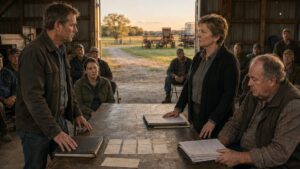
Around the folding tables sat Amanda, the treasurer, and the two neighboring landowners who had watched the original confrontation.
Nobody looked eager to begin.
Paul set his folder down.
Then he placed Stephen’s chain on the table beside it.
Unlocked.
The metal links made a heavy sound against the plywood.
Stephen stared at it.
“What’s that supposed to mean?”
“Nothing yet.”
Paul sat.
Stephen pushed the proposed agreement toward him.
“We need certainty. If the road crosses your property, future owners need guaranteed access.”
“Access and ownership aren’t the same thing.”
“We know that now.”
Paul looked up.
The words had come without sarcasm.
That was something.
He turned another page.
“This lets the association widen the road.”
“If necessary.”
“Without my consent.”
“With reasonable notice.”
“That’s not consent.”
Stephen leaned back.
“Paul, nobody can operate a road if every repair needs a separate negotiation.”
“And nobody should be able to take more of somebody’s land just because a committee thinks it’s easier.”
Amanda interrupted.
“He’s right about that.”
Stephen glanced toward her.
“So what happens when a culvert fails?”
“You fix the culvert,” Amanda said. “That doesn’t mean you get a blank check on everything else.”
The treasurer opened a folder.
“Before we argue over future work, we need to address the current account.”
Paul looked at her.
She slid a sheet across the table.
Road expenses.
The numbers were more detailed than the earlier invoices.
Grader bills. Gravel deliveries. Culvert work. Brush cutting. Ditch clearing.
Paul saw costs attached to years he remembered only as smoother drives home.
The treasurer pointed to the bottom.
“The fund is at thirty-eight hundred and twelve dollars.”
Amanda let out a low breath.
Stephen said, “That’s why this couldn’t keep going.”
Paul scanned the expenses.
“How much of the amount you billed me is penalties?”
The treasurer named the figure.
Nearly a third.
“And legal fees?”
“Not yet included.”
Paul slid the sheet back.
“I’m not paying penalties.”
Stephen’s eyes narrowed.
“Then we’re right back where we started.”
“No.”
Paul opened his folder.
“I’m willing to pay a fair share of documented maintenance I benefited from.”
The room went still.
Amanda looked at him first.
Stephen looked suspicious.
“You’re admitting the assessment was valid?”
“I’m admitting gravel costs money.”
“That isn’t the same thing.”
“No,” Paul said. “It isn’t.”
He took out his father’s notebook.
“My father paid toward this road before there was an association.”
He opened to the marked entries.
“Not equal every year. Not formal. But he paid when he could, and people made up shortages later.”
Amanda leaned over the table.
Paul continued.
“I stopped doing that.”
He could feel Stephen watching him.
“I told myself I never joined your association, so your bills weren’t my problem. That was convenient. I drove over the repairs anyway.”
Nobody interrupted.
Paul disliked saying it aloud.
That was precisely why he kept going.
“I should’ve dealt with the question years ago instead of ignoring letters.”
Stephen folded his arms.
“That’s what I’ve been telling you.”
Paul looked directly at him.
“You were right about that.”
Stephen’s expression changed.
Not triumph.
Something closer to surprise.
Paul put one hand on the chain.
“You were wrong about this.”
The surprise vanished.
“I’ve already said—”
“No. You said the road needed funding. You haven’t said you had no right to lock me inside my farm.”
Stephen looked down.
The treasurer spoke quietly.
“He’s right.”
Stephen turned toward her.
She did not retreat.
“You could’ve issued notice. You could’ve filed a claim if counsel advised it. The chain was too far.”
Stephen rubbed his jaw.
For several seconds, the only sound was the metal fan at the back of the shed.
Finally he said, “Fine.”
Paul waited.
“The chain was a mistake.”
It was not an apology.
But it was more than Paul had expected.
Amanda looked at Paul.
“And yours?”
Paul knew what she meant.
“I should’ve paid my share of actual road work.”
The room loosened slightly.
Then Stephen pushed the easement toward him again.
“So sign this and we can calculate the amount.”
Paul did not touch it.
“No.”
Stephen’s patience snapped back into place.
“Paul.”
“This gives you too much.”
“It gives everyone dependable access.”
“It also gives the board permanent authority over a strip wider than the road you use today.”
“We need room to maintain it.”
“Then define maintenance.”
Stephen shook his head.
“This is exactly why agreements fail. You want every possibility spelled out.”
“Yes.”
“You can’t predict everything.”
“No. But we can stop pretending vague language only hurts somebody else.”
Stephen stood.
“If we can’t get a functional easement, we’ll go to court.”
Amanda sighed.
The treasurer closed her folder.
Paul remained seated.
“Do what you need to do.”
Stephen stared at him.
“You think your deed guarantees you win?”
“No.”
“Then why are you willing to risk this?”
Paul looked at the chain.
“Because if I sign your version just to avoid court, we’re doing the same thing we did before. Assuming the problem is settled because nobody wants to deal with it.”
Stephen said nothing.
Paul pulled a second packet from his folder.
“I brought another proposal.”
Stephen did not sit immediately.
Paul placed copies around the table.
The first page separated four things that everyone had treated as one: ownership, access, maintenance, and enforcement.
Paul pointed to the first section.
“Ownership stays where the recorded deeds and survey put it.”
Second.
“Each existing parcel gets defined access over the traveled way.”
Third.
“Maintenance costs are shared by use and benefit under a schedule we all approve annually.”
Stephen scanned ahead.
“And this.”
He tapped a paragraph.
“No officer or board member may physically block access without a court order or an immediate safety emergency.”
Paul nodded.
“You don’t like that one?”
“It ties the association’s hands.”
“It ties everybody’s hands.”
Stephen read further.
“What about widening?”
“Requires owner consent unless legally required for emergency access.”
“Drainage?”
“Routine maintenance allowed inside a defined corridor. New construction requires notice and agreement.”
Stephen looked up.
“And you expect us to accept all that?”
“No.”
Paul gathered the chain and placed it beside his own copy.
“I expect you to negotiate it.”
Amanda was reading quietly.
She stopped at the maintenance section.
“This would make Paul pay?”
“Yes,” Paul said.
“A proportional share?”
“Yes.”
“Including past work?”
Paul hesitated.
Then nodded.
“Documented work I benefited from. Not penalties for refusing authority that wasn’t clear.”
Stephen sat again.
The fight had changed.
They were no longer arguing over whether Paul had to surrender or whether Stephen had to admit defeat.
They were arguing over numbers, widths, notice periods, voting thresholds, and what counted as an emergency.
Less satisfying than revenge.
Far more useful.
After nearly two hours, Stephen closed Paul’s proposal.
“I’m not agreeing tonight.”
“I didn’t expect you to.”
“Our attorney will review it.”
“So will mine if I need one.”
Stephen gave him a tired look.
“You really know how to make a simple road expensive.”
Paul almost answered with something sharp.
Instead he glanced at his father’s notebook.
“No,” he said. “We made it expensive by leaving it simple too long.”
Stephen looked at him for several seconds.
Then he picked up the proposal.
He did not leave it on the table.
That was not agreement.
But it was the first time since the chain went up that Paul watched Stephen carry away something Paul had written instead of something Stephen intended to enforce.
Chapter 7: The Gate Opens Under New Terms
The feed truck was already waiting when Paul Walker arrived at the gate with the unsigned agreement in his hand.
The driver had parked along the county road rather than risk turning into the disputed lane. He stood beside the cab drinking coffee from a paper cup while the engine idled.
“Am I going in today,” he asked, “or am I getting another education in rural property law?”
Paul looked at the gate.
The chain was gone.
He had removed it from the workshop that morning, carried it down in the bed of his pickup, and set it beneath the rear seat. He had not thrown it away. That would have felt too theatrical.
“I’m hoping you’re going in.”
“Hoping?”
Paul held up the folder.
“Depends on one signature.”
A second pickup approached from the shared road.
Stephen Taylor stopped near the gate and got out carrying his own copy of the agreement.
Two weeks had changed the way they stood around each other.
Neither man occupied the center of the road anymore.
They had spent those weeks exchanging revisions through an attorney and the association treasurer. Words that had once sounded simple—access, maintenance, emergency, improvement—had turned into paragraphs.
The final version was shorter than Stephen’s first proposal and longer than Paul’s.
Neither man liked all of it.
Paul considered that promising.
Stephen nodded toward the feed truck.
“You scheduled him before we signed?”
“He was supposed to come Monday.”
“That was optimistic.”
“He had an opening.”
Stephen looked toward the driver, then back at Paul.
“You read the final changes?”
“Twice.”
“The association gets routine maintenance access inside the defined corridor.”
“Yes.”
“Emergency repairs can proceed without prior consent if delay would threaten access or safety.”
“Yes.”
“Existing parcel owners get permanent passage.”
Paul nodded.
“And no expansion beyond the surveyed corridor without the affected owner’s written consent.”
Stephen’s mouth tightened slightly.
“That part’s still going to make future boards complain.”
“Then future boards can learn to ask.”
Stephen almost smiled.
Almost.
They opened their copies across the hood of Paul’s truck.
The agreement separated what everyone had spent years blending together.
Paul owned the deeded strip confirmed by the survey.
Existing farms and residences received a permanent limited easement across the established traveled way.
The association could grade, gravel, clear ditches, and repair existing culverts inside a defined maintenance corridor.
It could not widen the roadway or add new improvements across private land simply because a majority voted for them.
Annual maintenance expenses would be approved with supporting invoices.
Shares would be calculated under an agreed schedule based on parcels and regular use, with adjustments for unusually heavy commercial traffic.
And then there was the clause Paul had refused to remove.
No association officer, board member, contractor, or agent could physically block an owner’s established access as a collection measure without a court order.
Stephen stopped at that paragraph.
“Attorney still hates this.”
“Your attorney doesn’t have to live behind the chain.”
“He says it’s redundant.”
“Then it shouldn’t hurt anything.”
Stephen looked at him.
“You always this pleasant when you get what you want?”
Paul folded his arms.
“I’m not getting everything I wanted.”
That was true.
The permanent easement bothered him.
Once recorded, it would bind the land beyond both of them. Paul would no longer be able to rely on the ambiguity his father had preserved, intentionally or not.
For a few days after the survey, that ambiguity had felt like power.
Now he understood it had also been a debt handed forward.
Stephen tapped another page.
“The past maintenance amount.”
Paul knew the number.
The treasurer had rebuilt five years of expenses from receipts and bank records. Paul’s calculated share was less than Stephen’s original demand but not small.
The penalties were gone.
So were the collection charges.
Paul would pay only documented maintenance from which his property had materially benefited.
The total still irritated him.
He had stopped using irritation as a legal theory.
“I’ll pay it.”
“In two installments?”
“As written.”
Stephen nodded.
The feed driver called from the roadside.
“I hate to rush the peace process, gentlemen, but I’ve got a schedule.”
Paul glanced at his watch.
Stephen opened the folder to the signature page.
Then he stopped.
“One more thing.”
Paul waited.
“I’m stepping down as president at the end of the year.”
Paul had not expected that.
“You don’t have to do that because of me.”
“I’m not.”
Stephen rested both hands against the truck hood.
“I’ve been doing this seven years. At some point I started thinking keeping the road functioning meant I got to decide what was reasonable for everybody.”
Paul looked at him.
Stephen continued.
“I still think you were wrong to ignore us.”
“I was.”
“And I still think the association would’ve fallen apart if everyone handled it the way you did.”
“Maybe.”
“But the chain was mine.”
Paul said nothing.
Stephen looked toward the post where it had been anchored.
The steel post was gone now. The survey crew had marked the actual boundary with a permanent pin set lower in the ground.
“I knew the paperwork wasn’t clean,” Stephen said. “Not the deed. But I knew your membership file was different.”
“You told me that.”
“I didn’t tell you why I ignored it.”
Paul waited.
Stephen rubbed his thumb across the edge of the agreement.
“Because I thought if I admitted uncertainty, nobody would listen to me the next time I said something needed paying.”
There it was.
Not innocence.
Not an excuse.
Just the smaller fear underneath a larger mistake.
Paul understood it better than he wanted to.
He had done the opposite. Where Stephen had filled uncertainty with authority, Paul had filled it with silence.
Both had mistaken avoidance for control.
Stephen picked up the pen.
“Still want my signature?”
Paul looked at the waiting feed truck, the road beyond it, Amanda’s cattle pasture farther down, and the orange survey markers that had mostly been removed now that permanent references were recorded.
“Yes.”
Stephen signed.
Paul signed beneath him.
Later that morning they drove to the county recording office with the treasurer.
Virginia Davis was behind the counter.
She recognized Paul immediately.
“You found your answer?”
Paul set the agreement down.
“Several of them.”
Virginia looked over the recording cover sheet.
“And everybody survived?”
Stephen stood beside him.
“Depends who you ask.”
Virginia allowed herself a small smile.
She reviewed the acknowledgments, checked the parcel references, and accepted the agreement for recording.
When she stamped the intake copy, the sound was surprisingly ordinary.
Paul had expected something heavier.
The old ambiguity that had survived decades ended with a clerk pressing a stamp onto paper.
Outside, Stephen stopped beside his truck.
“We’ll send the revised maintenance invoice next week.”
Paul nodded.
“I’ll pay it.”
Stephen studied him as if waiting for an argument.
Paul added, “If the numbers match the agreement.”
“There he is.”
Paul almost smiled.
Stephen extended his hand.
Paul looked at it.
Two weeks earlier, he would have enjoyed making Stephen hold it there.
Instead he shook it once.
Not friendship.
Not forgiveness.
An agreement.
That afternoon, Paul returned to the farm gate.
The feed truck was still there, the driver having completed another delivery while they were at the courthouse.
“You people done?”
“For today.”
“That’s the best answer anybody’s given me all month.”
Paul opened the gate fully.
Before signaling the truck forward, he went to his pickup and reached beneath the rear seat.
The chain came out in a heavy coil.
He carried it to the workshop.
For a moment he considered hanging it on the wall where he would see it every day.
Instead he placed it on a lower shelf beside old tow straps and fence hardware.
A tool.
Nothing more.
When he returned outside, Amanda Roberts had pulled up behind the feed truck.
She lowered her window.
“Signed?”
Paul nodded.
“You paying your share?”
“Yes.”
She smiled.
“That may be the biggest surprise in the whole thing.”
“Careful.”
“What?”
“I still own part of your road.”
She laughed.
“No. You own part of the ground under the road.”
Paul stared at her.
Amanda lifted one shoulder.
“I listened to the surveyor.”
The feed driver sounded his horn once.
Paul stepped aside.
The truck rolled through the gate, tires crunching over the same gravel that had started the fight.
Nothing dramatic happened.
No crowd gathered.
Nobody applauded.
The road did what a road was supposed to do.
It carried somebody where they needed to go.
Paul watched the truck disappear toward his north feed bin.
His father’s old rule came back to him.
Keep the lane open. Everybody who uses it carries some of it.
For years Paul had heard only the first half.
Stephen, perhaps, had heard only the second.
Now both were written down.
Paul walked to the gate and rested his hand on the cedar post.
The old limestone boundary stone remained in the grass nearby, exactly where it had been before anyone argued about it.
Land could remember lines longer than people remembered agreements.
That was why the agreements mattered.
Paul swung the gate wider before Amanda drove through.
The story has ended.