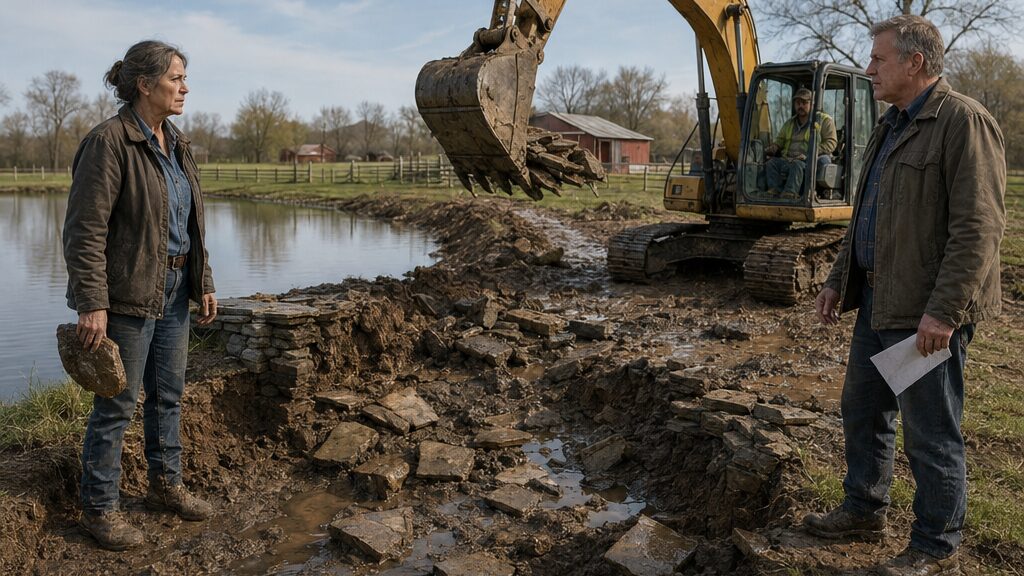
They Tore Out Virginia’s Farm Pond for Breaking the Rules—Then She Opened the County File They Had Forgotten
Chapter 1: The Excavator Was Already in Her Pond
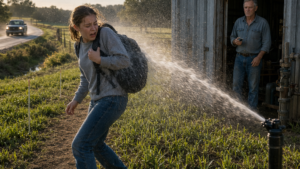
The excavator bucket was already under the crossing when Virginia Harris reached the gate.
She heard stone grind against steel, then watched the machine lift a slab of limestone that had not moved in nearly twenty years. Muddy water poured from beneath it in a brown sheet.
“Stop!”
Her voice carried across the pasture, but the engine swallowed most of it.
David Lewis, the contractor in the cab, looked toward her and eased off the controls. The bucket hung above the drainage strip with three flat stones balanced inside it.
Eric Martin stood beside the excavator in a clean canvas jacket and work boots that had somehow avoided the mud.
He raised one hand toward David.
“Keep going.”
Virginia walked faster.
The narrow crossing connected her hayfield to the back pasture. Beneath it, a stone-lined overflow carried excess water from the farm pond toward the cooperative drainage ditch. Virginia could still remember placing the first stones with her husband, arguing over which ones would sit flat enough for the tractor tires.
Now half of them lay in a heap beside the excavator tracks.
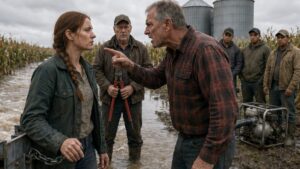
“Who authorized this?” she asked.
Eric turned.
“We did.”
“That isn’t an answer.”
“The cooperative board did.”
Virginia looked beyond him. Water seeped through the torn bank where the channel had been opened. The lower edge of the crossing had collapsed, leaving a muddy gap wide enough to stop a tractor.
Eric folded his arms.
“We’ve had three complaints since spring.”
“Complaints about what?”
“Runoff.”
“From my pond?”
“From this structure.”
He pointed at what was left of the overflow.
Virginia looked at him instead.
Eric had farmed two properties downstream for most of his life. He knew drainage mattered. He also knew the difference between inspecting a structure and sending an excavator into somebody else’s land.
“Did you measure it?”
“We had photographs.”
“That wasn’t my question.”
His jaw tightened.
“Virginia, the pasture below Brown’s place flooded twice. The cooperative couldn’t sit around waiting for another rain.”
David shifted in the cab. He had shut down the bucket but not the engine.
Virginia glanced at the spoil pile. One of the stones showed a pale stripe where mud had been scraped away. Near its edge was a shallow chisel mark, almost hidden beneath clay.
She knew that mark.
Her husband had made it when they set the original grade.
For a moment, the excavator, Eric, and the drainage ditch disappeared behind the memory of a hot August afternoon, both of them standing ankle-deep in water while he insisted the stone was level and she insisted his level was crooked.
Virginia bent, lifted the flat stone with both hands, and set it near the fence.
Eric watched her.
“You can save whatever you want after David finishes.”
She straightened slowly.
“You’re finishing today?”
“That’s the plan.”
“You haven’t even established whether this caused the flooding.”
“The board determined it was an obstruction.”
“The board isn’t the county.”
Eric let out a short breath.
“This isn’t one of your old office files.”
That stopped her.
Not because of the insult, but because of what it meant.
He knew where she had worked.
Maybe not what she had done there. But enough.
Virginia looked along the disturbed bank again.
There should have been a county disturbance marker on site if a regulated drainage feature was being altered under an approved notice. For work this close to the mapped agricultural drainage line, there should also have been a reference number on the contractor’s authorization.
She saw neither.
Eric pulled a folded sheet from a clipboard.
“Here.”
Virginia took it.
The cooperative letterhead sat at the top. Beneath it was a description of the structure as an unauthorized impediment to drainage flow.
At the bottom was a charge for excavation, disposal, and restoration.
Eleven hundred forty dollars.
Virginia read it twice.
“You tore it out and you’re billing me?”
“We wouldn’t have had the expense if the structure had complied.”
A laugh nearly escaped her, but it died before reaching her mouth.
“Which rule?”
Eric tapped the page.
“It’s cited there.”
The language referred broadly to interference with shared drainage infrastructure. It did not say the overflow had been built without approval. It did not say the cooperative had authority to enter private land without county review.
Virginia folded the paper once.
“Did Carol sign off on this?”
“The board did.”
“That isn’t what I asked.”
“Carol knows about it.”
That answer told her enough.
David climbed down from the excavator.
“Mr. Martin, you want me to pull the rest of the lower stone?”
Eric nodded.
Virginia stepped between them—not close to the machine, only far enough that both men had to look at her.
“Before you do anything else, I want the county disturbance authorization number.”
David’s hand stopped on the cab rail.
Eric stared at her.
“The what?”
“The authorization number.”
“This is cooperative maintenance.”
“No. Maintenance is clearing vegetation and sediment inside the existing channel. You’re removing a fixed crossing and changing the bank profile.”
Eric’s face hardened.
“You always did like making simple things complicated.”
Virginia ignored that.
“If the county approved this, there’ll be a disturbance notice attached to the work order. Give me the number.”
For the first time that morning, Eric did not answer immediately.
David looked from him to Virginia.
“I was given a cooperative work order,” he said carefully.
“With a county number on it?”
“I’d have to look.”
Eric turned toward him.
“David.”
“I’m just saying I’d have to check.”
Virginia felt something inside her shift.
The grief was still there. So was the anger. But both had moved behind something colder and more familiar.
Procedure.
Eric took a step closer.
“We had standing water across two neighboring pastures after the April storm. You’ve seen the photographs. We’ve got another wet front forecast. I wasn’t going to wait until somebody lost another cutting of hay because everyone was afraid to make a decision.”
That was the first thing he had said that sounded less like authority and more like fear.
Virginia knew the April storm. Water had stood along the lower fence for almost two days.
But fear did not create jurisdiction.
She looked toward the downstream ditch.
“Did anyone inspect my overflow before today?”
“We inspected the drainage path.”
“Who?”
“Board members.”
“County inspector?”
Eric’s silence answered.
Virginia held out the folded charge sheet.
“You can leave this with me.”
“It’s already yours.”
“And the authorization number?”
“I’ll get it to you.”
“When?”
Eric’s mouth tightened.
“Virginia—”
“If you had one, it would be on David’s paperwork.”
The excavator idled behind them, low and steady.
Eric looked toward the torn crossing, then at David.
“Secure the site. Don’t move anything else until I make a call.”
David nodded.
Eric walked toward his truck.
Virginia remained beside the heap of stones.
He opened the driver’s door, but she spoke before he climbed in.
“Eric.”
He turned.
“What county authorization number did you use?”
He rested one hand on the door.
For several seconds, neither of them moved.
Then Eric said, “I’ll have the office send you what you need.”
He got into the truck and drove away without giving her a number.
Chapter 2: Nineteen Years Behind the County Counter
The bottom drawer of Virginia’s filing cabinet stuck halfway open.
She pulled harder.
Dust lifted from the metal tracks, and the drawer came forward with a sound like something protesting after a long sleep.
Virginia had not opened it since retiring.
Inside were field notebooks, obsolete county maps, training manuals, copies of public forms, and a yellow measuring tape that no longer retracted properly.
She moved past most of it until she found a black notebook with softened corners.
On the inside cover, in her own handwriting, were the dates of inspections from her final year in land-use compliance.
Nineteen years.
That was how long she had sat behind the county counter, walked ditch lines in rubber boots, reviewed setbacks, answered angry landowners, returned incomplete applications, and told people things they did not want to hear.
She had learned early that most disputes became uglier when somebody relied on memory instead of paper.
Now half her own crossing was sitting in mud because someone else had decided paper could come later.
Virginia set Eric’s $1,140 charge beside the notebook.
Then she went looking for the pond file.
She remembered the year but not the file number.
Her husband had handled the stone deliveries. She had handled the approval.
The county records portal showed nothing useful from that far back, only an index notation indicating older agricultural drainage files had been moved to archives.
Virginia called the county office.
The clerk who answered sounded young enough that Virginia wondered whether she had been in grade school when the pond was built.
“I need an archived land-use file,” Virginia said.
“Property address?”
Virginia gave it.
“Approximate year?”
She did that too.
There was typing.
“I’ve got a reference to a pond and agricultural crossing, but the scan isn’t attached.”
“Can you pull the box?”
“We can request it.”
“How long?”
“Usually a few days.”
Virginia looked through the kitchen window toward the damaged bank.
“I’d appreciate sooner if possible.”
Another pause.
“I can see whether archives has already digitized the index packet.”
“Thank you.”
Virginia hung up and returned to her own records.
She found an old tax folder, then a stack of receipts from the stone yard. Under those sat a photocopy of a hand-drawn drainage sketch.
Her pulse quickened.
She spread it across the desk.
Farm pond.
Overflow channel.
Equipment crossing.
Stone apron.
Her husband’s handwriting appeared near the bottom: twelve loads, maybe thirteen.
Virginia smiled despite herself.
Then she saw the stamp.
APPROVED.
Below it was the date and the county’s old land-use division mark.
In the lower corner was a notation showing acknowledgment by the agricultural drainage cooperative that existed before the current board.
She sat down.
The original structure had been reviewed.
Not assumed. Not grandfathered. Reviewed.
She reached for the phone and stopped.
Calling Eric now would feel good.
That was exactly why she did not do it.
Instead, she copied the approval, the charge sheet, and the cooperative citation into separate piles.
At three-fifteen, the county clerk called back.
“We found the packet.”
Virginia straightened.
“Complete?”
“Mostly. There are three pages and a site sketch. The inspection notes were scanned separately.”
“Can I come in?”
“Yes.”
Thirty minutes later, Virginia stood at the same public counter where she had spent nearly two decades answering questions from the other side.
The building had changed. New flooring. New computers. Same fluorescent lights.
The clerk slid a printed packet toward her.
“You used to work here, didn’t you?”
Virginia looked up.
“Long time ago.”
“My supervisor recognized the name.”
Virginia nodded but did not elaborate.
She carried the packet to a side table.
The first page was the pond application. The second was the crossing approval. The third was an inspection sign-off.
The dimensions matched the photocopy she had found at home.
The stone-lined overflow was lawful.
Virginia felt the first clean sense of relief since seeing the excavator.
Then she looked at the site sketch.
Something bothered her.
She took the black notebook from her bag and opened to a blank page.
Original crossing width: nine feet.
She stared.
Nine.
Virginia closed her eyes.
Years after the pond had been approved, they had bought a wider hay wagon. Her husband had complained every time he eased it over the crossing.
One summer, after he caught a tire on the edge, they rebuilt the shoulders.
Not much, she had told herself.
A few stones on each side.
No change to the culvert.
No change to the pond.
No reason to bother the county with a revised sketch.
She had even joked that if she filed paperwork for every stone they moved, she’d never retire.
Virginia pulled a small ruler from her purse and measured the scale on the archived drawing.
Then she pictured the crossing as it had stood Sunday morning.
Nine feet originally.
Closer to twelve now.
The clerk passed nearby.
“Everything okay?”
“Yes,” Virginia said automatically.
Then she looked again.
No.
Not everything.
The original approval proved Eric was wrong to describe the entire structure as unauthorized.
But it also proved something else.
The structure David had torn apart Monday morning was not exactly the structure shown on the approval.
Virginia knew the distinction better than most people.
She returned home before dusk and walked directly to the pond.
The excavator was gone. Orange cones marked the torn bank.
She stood where the crossing had been and counted the exposed stones.
The oldest ones were broad, flat, and darkened with age.
The stones they had added later were smaller and lighter.
The difference was obvious now that the bank had been opened.
Virginia picked up her black notebook.
She wrote the original dimension.
Nine feet.
Then beneath it she wrote the width she remembered after the modification.
Twelve feet, approximately.
She stared at those two lines.
For nineteen years, she had told property owners that “approximately” was not a substitute for a filed measurement.
Now it was written in her own notebook.
Chapter 3: The Part Virginia Never Put on Paper
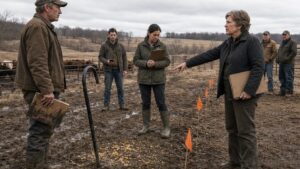
The county inspector stretched a tape across the broken crossing and called out, “Eleven feet, eight inches.”
Virginia felt the number land harder than she expected.
The inspector moved the tape to another point where two stones still sat in place.
“Original channel centerline looks unchanged,” he said. “But the crossing shoulders were definitely widened.”
Virginia nodded.
Tuesday morning had begun with her hoping the inspection would confirm Eric had simply been wrong.
Instead, each measurement was dividing the truth into smaller, less comfortable pieces.
“How much does that matter?” she asked.
The inspector crouched near the exposed bank.
“Depends what changed hydraulically.”
“The culvert wasn’t changed.”
“I can see that.”
“We added stone outside the original travel width. Mostly for a wagon.”
“Mostly?”
Virginia looked at him.
He had not asked accusingly. That almost made it worse.
“We moved some material along the downstream shoulder.”
“How much?”
“I don’t remember exactly.”
The inspector glanced toward her black notebook.
Virginia followed his eyes.
“I didn’t record it.”
“All right.”
No judgment. Just two words.
She had used that same tone hundreds of times with people sitting across from her at the county office.
All right.
Meaning: then we work with what exists.
He walked along the drainage strip.
Where the excavator had removed the crossing, the water moved freely through churned mud. Beyond it, the ditch bent toward Carol Brown’s lower pasture.
Virginia followed.
The inspector stopped beside a cut in the bank where roots hung exposed.
“This didn’t happen yesterday.”
Virginia looked down.
The erosion was old. The grass above it had collapsed in shelves, and silt had collected against the downstream fence.
“April storm?” she asked.
“Could be. Maybe earlier.”
He pointed toward debris caught several inches above the current waterline.
“This channel carried a lot more water than it is now.”
Virginia said nothing.
They continued toward the adjoining pasture.
A broad patch of grass lay flattened and yellowed. Fence posts had dark water stains several inches high.
Virginia had seen the flooding from the road in spring, but from there it had looked like the ordinary pooling that followed a heavy rain.
Standing inside it was different.
The inspector crouched again.
“Your crossing didn’t create all of this.”
Virginia looked at him.
“But?”
“But I wouldn’t tell you it had no effect until we run the grade and flow calculations.”
The small victory she had been waiting for disappeared.
“You think the widening restricted it?”
“Possibly at high flow. Could also be sediment buildup. Could be the downstream culvert. Could be several things working together.”
“So Eric wasn’t making it up.”
“I didn’t say he was right either.”
The inspector stood.
“Those are different questions.”
Virginia almost smiled.
That was exactly the sort of sentence she would once have used.
They returned to the pond.
The original approval packet lay on the hood of Virginia’s pickup.
The inspector reviewed it again.
“Original pond and crossing were approved.”
“Yes.”
“The later widening wasn’t documented.”
“No.”
“You should have filed an amendment.”
Virginia stared toward the broken bank.
“Yes.”
The word came out more easily than she expected.
He looked at her.
“You worked compliance?”
“Nineteen years.”
“Then I don’t need to explain why.”
“No.”
A tractor moved somewhere beyond the tree line.
Virginia rubbed mud from the corner of her field notebook.
“My husband had bought a wider wagon,” she said. “We caught a tire twice. We widened the top. I told myself the water opening hadn’t changed enough to matter.”
The inspector waited.
Virginia continued.
“I knew better than to make that decision myself.”
It was the first time she had said it aloud.
The inspector nodded once.
“We’ll document the modification and determine whether it required review at the time. That’s one issue.”
“And the demolition?”
“Separate issue.”
Virginia looked at him.
He walked toward the orange cones and studied the disturbed bank.
“Who authorized this work?”
“The drainage cooperative.”
“Who specifically?”
“Eric Martin signed the charge notice. David Lewis had the work order.”
“County office wasn’t contacted before excavation.”
It sounded like a statement.
Virginia said, “Eric told me he’d get me the authorization number.”
The inspector looked up.
“There’s no authorization number.”
She had expected that answer.
Hearing it still changed the air.
“No emergency notice?”
“Not from our office.”
“What about cooperative maintenance authority?”
“For routine clearing, maybe. Not for removing a fixed crossing and reshaping a bank inside a mapped drainage area.”
Virginia folded her arms.
“So what happens?”
“First, I document existing conditions. Then I’ll need the contractor’s work order and whatever board action authorized the excavation.”
He looked toward the disturbed water.
“If this had been an immediate hazard—collapsed culvert, blocked public drainage, imminent property damage—there are emergency procedures. But someone still has to notify us.”
Virginia thought about Eric standing beside the machine Monday morning.
We’ve got another wet front forecast.
She had heard arrogance in it.
Now she wondered what else had been underneath.
The inspector walked farther downstream and took more measurements.
Virginia stayed beside the pond.
A truck approached on the gravel road.
Carol Brown slowed near the gate but did not turn in. She raised a hand through the windshield. Virginia returned the gesture.
Carol’s lower pasture was among those that had flooded.
Virginia wondered what Eric had told her before the excavator arrived.
Maybe Carol had believed the crossing was illegal.
Maybe Eric had believed it too.
Or maybe legality had stopped mattering once he decided something had to be done.
The inspector returned around noon.
“I’ll send a preliminary finding after I get the paperwork.”
“When?”
“Depends how quickly the cooperative provides it.”
Virginia looked at the pond.
“What should I do meanwhile?”
“Nothing to the bank.”
“Even if it rains?”
“If conditions become unsafe, call us. Don’t rebuild anything.”
Virginia almost objected.
It was her land. Her crossing. Her cattle had to be shifted around the long way now.
But the objection died before she spoke.
Don’t rebuild anything.
The instruction irritated her because it was correct.
She had spent years telling people that fixing first and documenting later could turn one problem into three.
The inspector packed his tape.
Then he paused.
“One question.”
Virginia waited.
“You said the cooperative believed your structure was causing flooding.”
“Yes.”
“And they knew you disputed that?”
“Very much.”
“So why didn’t they request an inspection?”
Virginia looked toward the gravel road where Eric’s truck had disappeared the day before.
“I don’t know.”
The inspector closed his case.
“Because that’s what should have happened before anybody brought an excavator out here.”
Virginia glanced at the black notebook in her hand.
Yesterday she had wanted one answer: proof that Eric was wrong.
Now she had two separate problems.
Her unfiled modification.
His unauthorized demolition.
One did not erase the other.
The inspector opened his truck door.
“I’ll contact the cooperative this afternoon. I need the meeting record, the contractor authorization, and the emergency basis they relied on.”
“Emergency basis?”
“If that’s what they’re claiming.”
Virginia looked again toward the downstream pasture, at the old water marks and collapsed bank.
For the first time she considered that Eric might not have acted because he thought he could get away with it.
He might have acted because he believed waiting was more dangerous.
The distinction did not excuse him.
But it made the next question harder.
The inspector climbed into his truck, then lowered the window.
“One more thing, Ms. Harris.”
“Yes?”
“If Mr. Martin knew county review was required and ordered the excavation before requesting it, I’ll need to know why.”
Virginia watched the truck leave.
Behind her, the broken crossing stood open to the water.
She looked down at the two measurements in her notebook—nine feet and twelve—and then at Eric’s $1,140 charge folded in the back pocket.
By Tuesday afternoon, Virginia no longer wondered only whether Eric had broken the rules.
She wanted to know what had made him decide he could not afford to wait for them.
Chapter 4: Eric Martin Had a Deadline Too
Carol Brown was waiting beside the cooperative equipment shed with an envelope pressed flat against her coat.
“You need to see this before tonight,” she said.
Virginia had expected a call about the inspector. She had not expected Carol to wave her into the small board office behind the shed.
Inside, the room smelled faintly of diesel and old paper. A folding table occupied the center. Photographs had been spread across it in two rows.
Virginia recognized the lower pasture immediately.
Brown water covered the grass nearly to the fence braces. In one photograph, only the upper third of a gate remained above water.
Carol set the envelope down.
“These were taken after the April storm.”
“I saw the water from the road.”
“You didn’t see this.”
She slid one photograph forward.
A section of fence had folded toward the creek. Beyond it, hay lay flattened in a wide brown arc.
“Lost most of that cutting,” Carol said. “The cattle farmer below me had to move stock for four days.”
Virginia studied the photographs.
In several, runoff seemed to follow the drainage path from her direction. That did not prove her crossing caused the flooding, but it made Eric’s concern harder to dismiss.
Carol opened the envelope.
The letter inside carried the cooperative’s insurance information.
Virginia read slowly.
It referenced two recent drainage-related claims, increased exposure, and the possibility of higher premiums if corrective measures were not documented before the next renewal.
“How much higher?” Virginia asked.
Carol gave her a number.
Virginia looked up.
“For everyone?”
“For the cooperative.”
Which meant, eventually, everyone.
Carol pulled out a chair.
“Eric got that three weeks ago.”
Virginia remained standing.
“And that’s why he sent an excavator?”
“That’s part of why.”
“What was the other part?”
Carol hesitated.
“People were on him.”
“Who?”
“Members.”
“About my crossing specifically?”
“About drainage. Your place kept coming up.”
Virginia looked again at the photographs.
“You supported taking it out.”
Carol did not pretend otherwise.
“I supported fixing the problem.”
“That wasn’t what I asked.”
Carol’s mouth tightened.
“Yes. I voted to authorize corrective work.”
“Did you vote to demolish the crossing?”
“I voted on the motion Eric put in front of us.”
“What did it say?”
“Remove obstruction and restore flow.”
Virginia let the words settle.
“Did you see a county authorization?”
“No.”
“Did you ask for one?”
Carol looked toward the window.
“No.”
That answer carried less defiance than shame.
“Eric said the cooperative had maintenance authority,” she continued. “He’s dealt with ditch work before. I believed he knew where that authority stopped.”
Virginia pulled out a chair and sat across from her.
“So did David.”
“Apparently.”
“And that’s enough?”
“No.”
Carol rubbed one thumb over the envelope seam.
“But Virginia, you need to understand something. People weren’t sitting around looking for a reason to pick on you. They were looking at fields they couldn’t use.”
Virginia felt the old instinct rise—to separate relevant facts from emotional ones, to narrow the issue until it could fit cleanly into a regulation.
Instead, she looked at the photographs again.
“What did Eric think would happen if he waited?”
Carol answered immediately.
“More rain.”
“That isn’t enough to bypass county review.”
“I didn’t say it was.”
Virginia looked at her.
Carol exhaled.
“He thought if the county took a week and another storm came through, he’d be the one explaining why we did nothing.”
There it was.
Not malice.
Pressure.
Virginia disliked how much difference that made.
Carol rose and opened a metal file cabinet.
“The inspector called this afternoon. Asked for everything.”
She removed a thin folder.
“Minutes. Motions. Contractor paperwork.”
“Did you send it?”
“Secretary’s copying it now.”
Virginia held out her hand.
Carol did not give her the folder.
“These aren’t public until they’re entered with the meeting packet.”
Virginia almost smiled.
“You’ve learned something this week.”
“I’ve learned I should’ve asked more questions Monday morning.”
She carried the folder to the copier.
Virginia waited.
The machine fed pages slowly.
One photograph remained on the table, taken from the downstream fence. Virginia’s pond was barely visible in the distance.
Between it and Carol’s flooded pasture lay a long chain of land, ditch, culvert, and grade.
The photograph did not look like one person’s problem.
Carol placed the copies in front of her.
The first was the meeting motion.
The wording was broad enough to sound reasonable: immediate corrective maintenance where obstruction threatened shared drainage.
The second was David Lewis’s estimate.
The third was the work order.
Virginia stopped reading.
At the bottom was Eric Martin’s signature.
Above it was a certification paragraph.
Virginia read it once.
Then again.
The signer confirmed that any required governmental approvals had been obtained before ground disturbance.
Carol saw where her eyes had stopped.
“What?”
Virginia turned the paper toward her.
Carol read the paragraph.
Her face changed.
“That language is on every excavation order.”
“Yes.”
“Maybe he thought maintenance authority counted.”
“Then why certify approvals had been obtained?”
Carol looked down at the signature.
Virginia heard footsteps outside.
The door opened.
Eric entered carrying a binder under one arm.
He stopped when he saw them.
“What’s going on?”
Carol answered before Virginia could.
“We’re reviewing the inspector request.”
Eric set the binder down.
“You shouldn’t be giving documents out before the packet’s complete.”
Carol’s voice stayed level.
“She’ll receive them tonight anyway.”
Eric looked at Virginia.
“You’ve made your point.”
Virginia held the work order between two fingers.
“I haven’t made anything yet.”
His gaze dropped to his signature.
“You signed that Monday?”
“Friday.”
Virginia glanced toward Carol.
Before the board had formally received county review.
Possibly before anyone had even requested it.
Eric saw the calculation happening.
“We had a forecast.”
Virginia waited.
He continued.
“Two inches expected. Maybe more.”
“So you treated that as an emergency?”
“I treated it as a warning.”
“Did the county?”
Eric’s jaw tightened.
“They weren’t the ones getting calls from farmers.”
“No. They were the ones authorized to review the drainage work.”
He looked away.
For a moment he seemed older than he had beside the excavator.
“I’ve spent thirty years watching people wait until after water crosses a fence to decide something mattered.”
Virginia thought of the erosion below Carol’s pasture.
“You may have been right about the risk.”
Eric looked back at her.
“But?”
“You still signed that.”
She tapped the certification.
His shoulders settled.
“I know what I signed.”
Carol looked at him sharply.
The room became very still.
Virginia had expected him to argue that the language was boilerplate, that someone else handled permits, that David should have checked.
Instead he had admitted awareness.
“Then why?” Virginia asked.
Eric closed the binder.
“Because the insurer wanted corrective action documented before renewal. Because people had already lost hay. Because the county can take days to send somebody out, and because every person in this cooperative would have blamed me if we waited and flooded again.”
“That doesn’t give you authority.”
“No.”
The answer surprised both women.
Eric looked toward the photographs.
“But being right about procedure after another flood wouldn’t have put anybody’s hay back.”
Virginia felt her anger change shape.
He had done something reckless.
He knew it.
And he had done it because he believed delay carried its own cost.
That did not clear him.
It made the decision worse in a different way.
He had knowingly chosen which rule mattered.
Exactly what Virginia had done years earlier when she widened the crossing.
Only his choice had involved someone else’s land.
Eric picked up his binder.
“The inspector can cite me if he wants.”
“The cooperative,” Carol said quietly. “He’ll cite the cooperative.”
Eric stopped.
Carol held up the insurance letter.
“If there’s a penalty, it comes out of reserves.”
His face tightened.
Virginia watched him absorb the consequence.
Not his fine.
Everyone’s.
Carol looked at Virginia’s copy of the work order.
“Meeting starts at seven tomorrow.”
Virginia folded the document and slid it into her notebook.
As she stood, her own two measurements stared up from the page.
Nine feet.
Twelve.
Eric’s signature gave her exactly what she needed to challenge the demolition.
Her own notebook contained exactly what she could leave out.
On the way home, Virginia realized that winning had just become easier.
And telling the whole truth had become much harder.
Chapter 5: She Could Win by Leaving One Thing Out
The complaint was complete except for one paragraph.
Virginia sat at her kitchen table Wednesday morning with the cursor blinking beneath the sentence describing the original county approval.
Beside the laptop lay Eric’s signed work order.
Beside that lay her black notebook.
She had written the missing paragraph twice and deleted it twice.
In 20—, the crossing shoulders were widened approximately three feet beyond the original approved travel width. No amended site sketch was filed.
She typed it again.
Then highlighted the paragraph.
Without those two sentences, her complaint was clean.
The original pond had been approved.
The cooperative had entered her land.
Eric had certified approvals that did not exist.
David had demolished the crossing.
The county was now investigating.
Her own modification complicated those facts but did not erase them.
Virginia knew that.
She also knew exactly how an omitted fact could alter the way a reviewer understood everything around it.
For nineteen years, she had been on the other side of omissions like this.
People rarely lied outright.
They simply told the part that helped.
Virginia stared at the screen.
A truck pulled into the drive.
Carol appeared at the kitchen door five minutes later carrying another envelope.
“County called.”
Virginia opened the door.
Carol did not come inside immediately.
“How bad?”
“They issued a preliminary notice.”
Virginia stepped aside.
Carol placed the envelope on the table.
The county had identified unauthorized disturbance within the mapped drainage area and ordered the cooperative to suspend further work pending review.
Below that was a paragraph explaining possible daily penalties if corrective documentation and stabilization were not completed within the required period.
Virginia read the number twice.
“That can accrue?”
“Yes.”
“From when?”
“Potentially from the notice date. Maybe earlier depending on how they classify the work.”
Carol sat down.
“Our reserves aren’t built for this.”
Virginia looked at her.
“You supported the excavation.”
“I did.”
“And now?”
“Now I want to know what we’re paying for.”
There was no dramatic conversion in Carol’s voice. No sudden loyalty to Virginia.
Just arithmetic.
Virginia respected that more.
Carol noticed the complaint on the screen.
“You filing today?”
“Yes.”
She leaned closer, stopping before she could read the text.
“Are you including your modification?”
Virginia’s hand moved instinctively toward the black notebook.
Carol had seen the inspector at the pond. Maybe he had mentioned it. Maybe she was simply paying attention.
“I haven’t decided how much detail belongs in this complaint.”
Carol sat back.
“That sounds like something Eric would say.”
The words were not cruel.
That made them sharper.
Virginia looked at the highlighted paragraph.
Carol rubbed her palms together.
“I don’t mean they’re the same.”
“No?”
“No. He tore up your property.”
Virginia waited.
“But if you’re asking everybody to believe the record matters, they’re going to expect all of it.”
Virginia closed the laptop halfway.
“Your pasture flooded.”
“Yes.”
“Do you think my crossing caused it?”
“I think something in that drainage path isn’t working.”
“That isn’t an answer.”
Carol almost smiled.
“You really do hate incomplete answers.”
Virginia looked toward the kitchen window.
“Apparently not enough.”
Silence settled between them.
Carol stood.
“I need to get to the hall early. People are already calling.”
“About the notice?”
“About money.”
Virginia knew what that meant.
A dispute over one farm had become a cooperative liability.
By evening, people who had never seen her pond would have an opinion because their own assessment might rise.
Carol moved toward the door.
“Virginia.”
She turned.
“If you leave something out tonight and it comes out later, nobody will remember that Eric’s violation was bigger.”
Virginia said nothing.
“They’ll remember you knew.”
The door closed behind her.
Virginia returned to the table.
For a long moment, she looked at the stone she had carried up from the demolished crossing.
It was the one with her husband’s old chisel mark.
Mud had dried along one edge.
She remembered the day they widened the crossing.
Her husband had wanted to call the county.
Not because he loved paperwork. He had complained about every form they had ever filed.
But he had asked, “Don’t you need to update that map?”
Virginia had laughed.
“The culvert isn’t moving.”
“You sure?”
“I did this for a living.”
That had ended the discussion.
She could still hear the confidence in her own voice.
It sounded uncomfortably familiar now.
Virginia opened the laptop.
She restored the paragraph.
Then she added the approximate date of the widening and the reason they had done it.
She did not excuse it.
At six-thirty, she carried the complaint packet, notebook, and recovered stone into the cooperative meeting hall.
Members filled most of the folding chairs.
Some looked toward her.
Others deliberately did not.
Eric stood near the front table with the secretary and two board members. His face was tired.
The county notice had been copied for everyone.
Carol intercepted Virginia near the door.
“There’s more.”
She kept her voice low.
“What?”
“The insurer called again. If the county classifies this as unauthorized alteration rather than routine maintenance, they may not cover the penalty.”
Virginia looked around the room.
Farmers.
Landowners.
People who had paid cooperative assessments for years because water did not respect fence lines.
“How much exposure?”
“Don’t know yet.”
Virginia tightened her grip on the packet.
Her complaint could push the county process harder.
It could also deepen the cooperative’s financial problem.
For one brief second, she understood precisely why Eric had convinced himself that rules could be bent when consequences felt urgent.
The realization did not make her want to stop.
It made her want to be more careful.
Eric saw her.
“You filing that tonight?”
“Yes.”
“Against me?”
“Against the action.”
He gave a tired laugh.
“That’s a distinction only somebody from compliance would make.”
“It’s an important one.”
“Not when the bill comes.”
There was bitterness in his voice, but not the smugness of Monday morning.
Virginia placed the stone on the front table.
Eric stared at it.
“What’s that for?”
“To remind me what we’re talking about.”
The secretary called the meeting to order.
Murmurs faded.
Virginia’s complaint packet lay unopened in front of her.
Eric spoke first.
He summarized the flooding complaints, the board motion, and the need for corrective work. He did not call Virginia reckless. He did not pretend the county had approved the excavation.
When he finished, the secretary looked toward Virginia.
“Ms. Harris, you requested time to submit a response.”
Virginia stood.
She carried her packet to the front.
Every argument she had rehearsed was arranged in order.
Original approval.
Cooperative acknowledgment.
Work order.
Missing county review.
Certification.
She could begin there and probably control the room.
Instead she opened her black notebook.
“Before I discuss what the cooperative did Monday, there is something I need entered into the record about what I did years ago.”
Eric looked up.
Carol became very still.
Virginia placed the original site sketch beside the notebook.
“The crossing that existed Monday was wider than the crossing shown on this approved drawing.”
Murmurs moved through the chairs.
Virginia continued before they could grow.
“My husband and I widened the travel surface several years after approval. I believed the water opening itself had not changed enough to require an amendment.”
She paused.
“I did not file an amended sketch.”
One board member leaned toward the secretary.
Eric stared at Virginia as though he had expected many things from her, but not this.
The secretary lifted her pen.
“You want that included in the formal minutes?”
Virginia looked at Eric’s signed work order.
Then at the stone.
Then at her own handwriting.
“Yes.”
Her voice was steady.
“Put all of it in.”
Chapter 6: The Fine Print Belonged to Everyone
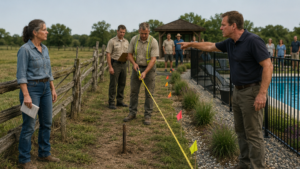
By the time the secretary finished writing Virginia’s admission into the minutes, nobody in the room could pretend the meeting was about one innocent farmer and one guilty chairman.
Virginia remained standing.
“The county inspector has already documented the widening,” she said. “The original pond and crossing were approved. My later alteration was not updated on the cooperative map, and the county will determine what corrective review that requires.”
Eric’s hands rested flat on the front table.
Virginia opened the second section of her packet.
“That is my responsibility.”
She let the words sit before continuing.
“What happened Monday is a separate responsibility.”
The room stayed quiet.
She placed David Lewis’s work order beside the approved site sketch.
A neighboring cattle farmer leaned forward.
Virginia pointed to Eric’s signature.
“This work order certifies that required governmental approvals had been obtained before ground disturbance.”
One of the board members asked, “Were they?”
“No.”
Virginia did not look at Eric when she answered.
“The county confirmed yesterday that no disturbance authorization or emergency notice had been issued before the excavation.”
Now she looked at him.
“If I’m wrong, say so.”
Eric’s jaw worked once.
“You’re not.”
Several people shifted.
The cattle farmer said, “Then why did we send a machine out there?”
Eric turned toward the chairs.
“Because we’d already had flooding.”
“We’ve had flooding before.”
“Not with two claims pending and an insurance renewal three weeks out.”
Carol placed the insurer’s letter on the table.
“I distributed copies.”
Paper rustled across the room.
Eric looked at Virginia.
“You wanted the reason. That’s the reason.”
Virginia said nothing.
He faced the members.
“The April storm put water over Brown’s lower pasture. We had erosion at the south fence and standing water near the cattle lot downstream. The insurer told us they expected documented corrective action.”
A board member interrupted.
“Corrective action isn’t the same as tearing out her crossing.”
“I know that now.”
“You knew county review was required.”
The question came from Carol.
Eric looked at her.
“Yes.”
The answer moved through the room differently than any accusation could have.
Virginia had already heard him admit it privately.
Most of the members had not.
Eric rubbed a hand across his face.
“I called the county Friday morning. Got voicemail. I sent an email with photographs.”
“Did you get approval?” Carol asked.
“No.”
“Then why sign the certification?”
Eric stared down at the paper.
“Because rain was forecast Tuesday.”
The cattle farmer shook his head.
“That storm barely gave us half an inch.”
“Forecast said more.”
“But it didn’t.”
Eric looked toward him.
“You know as well as anybody that forecast could’ve gone the other way.”
The man leaned back.
That, at least, nobody could dispute.
Eric continued.
“I was tired of telling people we’d look at it. Tired of watching that lower field fill. If we’d waited, and another three inches came down, everyone sitting here would be asking why the board did nothing.”
Virginia watched him.
On Monday, his confidence had looked like contempt.
Now she could see what was underneath it.
Fear of being blamed for delay.
Fear of the insurer.
Fear of appearing weak after months of complaints.
Those fears were real.
His choice was still his.
Virginia said, “You decided waiting was more dangerous than acting.”
“Yes.”
“And you decided that for my land.”
Eric met her eyes.
“Yes.”
There was no applause.
Virginia was glad.
The room did not need a winner yet.
Carol tapped the county notice.
“We have another problem.”
Members turned toward her.
“The county can assess penalties while the unauthorized disturbance remains unresolved. Insurance may not reimburse penalties arising from unapproved work.”
“How much?” someone asked.
“Unknown.”
“Give us a range.”
Carol hesitated.
“Enough that reserves matter.”
The room changed instantly.
People began asking questions over one another.
Could assessments rise?
Would drainage maintenance be delayed?
Would Virginia sue?
Who would pay to reconstruct the crossing?
The secretary raised her voice for order.
Virginia sat down.
This was the consequence Eric had created.
It was also the kind of moment when punishment could become easier than repair.
She looked at the recovered stone sitting between them.
The old chisel mark was visible under the hall lights.
Her husband had set that stone because water had to move somewhere.
The same was true of blame.
If it could not move toward something useful, it would simply collect.
Virginia stood again.
“I have a proposal.”
The room quieted by degrees.
Eric looked at her warily.
Virginia unfolded a preliminary sketch the county inspector had discussed with her that afternoon.
“I want the demolition charge withdrawn.”
Eric said nothing.
“I want the cooperative to cover the damage caused by entering my property and removing the crossing without approval.”
A few people nodded.
“And I will cover whatever portion of the redesign the county determines belongs to correcting my undocumented widening.”
That stopped the nodding.
Carol leaned forward.
Virginia continued.
“I don’t want the old crossing put back exactly as it was.”
Eric’s eyes narrowed.
“The inspector believes the downstream system needs to be evaluated as a whole. My crossing. Sediment. Grade. The lower culvert.”
She placed the sketch beside the stone.
“So evaluate all of it.”
One board member said, “Independent engineer?”
“Independent drainage review. County-approved design. Updated measurements filed with the cooperative.”
The cattle farmer asked, “Who’s paying?”
Virginia looked around the room.
“The cooperative pays for the damage it authorized. I pay for the correction tied to my own unfiled modification. Anything that benefits the shared drainage system gets handled under the cooperative rules we already have.”
Someone muttered that it would still cost money.
“Yes,” Virginia said.
“It will.”
She looked directly at Eric.
“That’s what happens after somebody makes a decision that can’t be undone.”
He did not look away.
Carol opened another folder.
“There’s also the chair issue.”
The room tightened again.
Under the cooperative rules, a chair could be suspended from authorization duties pending review if an action exposed the membership to avoidable regulatory liability.
Eric gave a small, humorless smile.
“Fine print.”
Virginia heard the echo of Monday.
She wondered if he heard it too.
Carol did not smile.
“It applies to all of us.”
One board member moved that Eric’s authority to approve field work be suspended until the county matter and internal review were complete.
Another seconded.
The secretary prepared the vote.
Before it began, Eric stood.
“I want one thing in the minutes.”
Virginia watched him.
“I made the call.”
He glanced at the other board members.
“They voted on corrective action. I chose the contractor, signed the order, and told David to proceed before county confirmation came back.”
Carol asked, “You’re accepting responsibility?”
“For my part.”
Eric looked at Virginia.
“I still think the drainage problem had to be fixed.”
“So do I,” she said.
That seemed to unsettle him more than anger would have.
Virginia touched the edge of the revised sketch.
“But not like that.”
Eric nodded once.
The vote passed.
His authority as chair was suspended pending review.
No one cheered.
The secretary moved immediately to the next motion: funding an independent drainage assessment covering Virginia’s crossing, Carol’s pasture, the lower ditch, and the downstream culvert.
That passed too.
After the meeting, people gathered in small groups.
Some spoke to Virginia.
Some spoke to Eric.
Several studied the county notice as if looking for a number that would tell them how angry to be.
Virginia packed her notebook.
Eric remained at the front table.
When most members had left, he picked up the recovered stone.
Virginia stiffened.
He turned it over, saw the chisel mark, and set it back exactly where it had been.
“Your husband mark that?”
“Yes.”
Eric nodded.
“He always marked everything.”
“Except apparently me.”
A faint expression crossed Eric’s face.
Not quite a smile.
Then it disappeared.
“I shouldn’t have sent the excavator.”
Virginia closed her folder.
“No.”
“I thought if I moved fast enough, I could keep the next problem from becoming worse.”
“And you made a different problem.”
“Yes.”
He looked toward the empty chairs.
“Now everybody pays for it.”
Virginia thought of her own three feet of undocumented stone.
“Not just you.”
Eric glanced at her notebook.
“No.”
Outside, the parking lot had emptied.
Carol locked the side door and joined them.
“The county wants the independent plan before they’ll close the disturbance case.”
“How long?” Virginia asked.
“Several weeks.”
“And the penalties?”
“Still being calculated.”
Eric looked toward the floor.
Carol added, “The cooperative will reimburse Virginia’s demolition cost from reserves. Assessment impact depends on the final penalty.”
Virginia had wanted that reimbursement from the moment Eric handed her the charge.
Now it felt less like victory than bookkeeping.
Necessary.
Not satisfying.
She placed the recovered stone into a canvas bag.
At the door, Eric said, “What are you going to do if the new plan says the crossing has to be wider?”
Virginia looked back.
“Build it wider.”
“And if it says your old design contributed to the flooding?”
“Then I’ll put that in the record too.”
Eric nodded slowly.
Virginia stepped outside.
For the first time since Monday, the question was no longer whether she could prove what Eric had done.
That part was finished.
The harder question waited downstream, where water, money, responsibility, and neighbors would still have to share the same ground.
Chapter 7: The Water Had to Go Somewhere
The first hard rain reached the rebuilt crossing just after dawn.
Virginia stood under the brim of her old field hat and watched brown water rush toward the new channel.
For a few seconds, she could not tell whether the design was working.
Then the flow narrowed between the graded banks, spread across the wider stone apron, and slipped beneath the tractor crossing without climbing over either shoulder.
Virginia did not move.
Six weeks earlier, the same place had been a torn strip of mud, excavator tracks, and broken limestone.
Now survey stakes marked the new grade. Fresh grass seed had begun to take along the upper bank. The crossing was wider than the one she and her husband had built, but the opening beneath it was larger too, shaped to carry high water without forcing it toward Carol Brown’s pasture.
The independent review had found no single cause for the spring flooding.
Virginia’s widening had reduced the margin at the crossing during heavy flow.
Sediment farther downstream had narrowed another section.
The lower culvert had been partially obstructed.
And the April storm had simply put more water into the system than anyone had planned for twenty years earlier.
Everyone had been partly right.
That had made the final report harder to argue with.
Virginia stepped closer to the water.
Several of the original flat stones had been reused along the new apron. The one with her husband’s chisel mark sat near the upstream edge.
She had objected when the contractor first suggested placing it there.
Not because the location was wrong.
Because it would stay underwater during every serious storm.
Then she realized that was exactly where it belonged.
The stone had never been important because she could see it.
It had been important because it did its job.
A pickup slowed on the gravel lane.
Carol pulled in and parked beside the fence.
“How high?” she called.
“Still below the marker.”
Carol joined her at the crossing, carrying a rain gauge in one hand.
“We’ve had nearly two inches since midnight.”
Virginia looked downstream.
“That should be enough to tell us something.”
They followed the ditch toward Carol’s pasture.
Water moved quickly but stayed within the banks.
At the low fence, the grass was wet but not submerged.
Carol stopped.
“Well.”
Virginia looked at her.
Carol gave a small nod.
“That is better.”
It was the closest thing either of them had offered to celebration.
They walked farther.
The rebuilt section fed into the cleaned lower ditch, then through the culvert the cooperative had finally excavated and reset.
No water stood in the pasture.
Virginia felt a pressure inside her loosen.
Not disappear.
Loosen.
Carol glanced back toward the crossing.
“County sent the final numbers yesterday.”
Virginia knew what she meant.
The cooperative had been cited for unauthorized ground disturbance and failure to obtain required review before excavation.
The penalty was smaller than members had feared, but large enough that everyone felt it.
Reserves covered most of it.
A modest assessment covered the rest.
Virginia’s demolition charge had been voided.
The cooperative reimbursed the cost of rebuilding the crossing beyond the corrections tied to her own unfiled widening.
Her portion had not been insignificant.
Neither had anyone else’s.
“People still mad?” Virginia asked.
“Of course.”
“That makes sense.”
“Some at Eric. Some at you. Some at the county. One fellow seems mad at rain in general.”
Virginia laughed once.
Carol smiled.
“That’s probably the healthiest choice.”
A truck appeared on the county road.
Virginia recognized it before it turned.
Eric parked on the shoulder and climbed out wearing a brown rain jacket.
He carried a long-handled shovel.
Carol raised an eyebrow.
Virginia said nothing.
Eric approached the culvert.
“Lower grate caught branches.”
He pointed.
A small cluster of sticks had collected against one side.
Carol looked at him.
“You’re not chair anymore.”
“I know.”
“Just checking.”
Eric set the shovel against the bank.
“I’m also not blind.”
He stepped carefully into the shallow ditch and pulled the branches loose.
Water surged through the cleared side.
Virginia watched.
Eric had lost the chair position after the internal review.
Not permanently, at least not officially.
But when the cooperative reorganized its field-authorization process, Carol had been asked to oversee financial approvals while all physical drainage work required two signatures and county confirmation where applicable.
Eric had remained a member.
And a farmer downstream.
He still had to live beside the same water.
When he climbed back onto the bank, his jeans were wet to the knee.
He looked toward Virginia.
“Crossing holding?”
“So far.”
“Pasture?”
“Dry.”
Eric nodded.
He wiped mud from the shovel blade.
“The old one would’ve backed up by now.”
Virginia felt the words catch.
Maybe he realized how they sounded.
He added, “Not because it was all your fault.”
“I know what you meant.”
They stood in the rain.
Six weeks earlier, Virginia would have heard any comment about the old crossing as an accusation.
Now she could hear the measurement inside it.
Eric looked toward the new stone apron.
“They used some of the originals.”
“Yes.”
“Your husband’s mark still there?”
Virginia pointed upstream.
“That one.”
Eric studied it.
“Underwater.”
“Mostly.”
He nodded.
For a moment, the three of them watched the channel.
Carol eventually said, “I’ve got cattle feed sitting in the truck getting wet.”
She walked back toward the road.
Eric started after her, then stopped.
“Virginia.”
She waited.
“The assessment letter went out.”
“I got mine.”
“I’m sorry everybody had to cover part of that.”
Virginia looked at him.
“You made the decision.”
“I know.”
“And I made mine years before.”
Eric shifted the shovel.
“Not the same thing.”
“No.”
She looked at the flowing water.
“But neither one improved because we were sure we were right.”
Eric stood quietly.
Then he nodded once.
“No.”
He followed Carol toward the trucks.
Virginia returned to the crossing alone.
By midmorning, the rain began to ease.
She opened the pickup door and took out the black county notebook.
The cover was soft from years of handling.
She walked to the survey marker and began writing.
Crossing width.
Channel opening.
Upstream grade.
Downstream grade.
Date of final inspection.
She paused before the last line.
For years, that notebook had been where Virginia kept the things she trusted herself to remember correctly.
Dates.
Measurements.
Signatures.
Evidence that she had paid attention.
Now the habit felt incomplete.
She finished the measurements and drove to the cooperative office.
Carol was already inside.
Virginia placed a photocopy of the notebook page on the desk.
Carol looked at it.
“What’s this?”
“Final measurements.”
“We have the engineer’s plan.”
“I know.”
“County has the as-built record.”
“I know that too.”
Carol picked up the page.
“Then why this?”
Virginia glanced at her notebook.
“Because somebody should have the record besides me.”
Carol studied her for a moment.
Then she placed the page in the drainage file.
“Anything else?”
Virginia considered it.
“No.”
Outside, the clouds had broken enough for light to reach the fields.
She drove home and stopped beside the pond before going up to the house.
Water still moved through the crossing, quieter now.
The marked stone was beginning to emerge.
Virginia stepped down from the truck.
She did not touch it.
She did not need to.
The channel carried water toward Carol’s pasture, through the cooperative ditch, and beyond the lower culvert.
No fence stopped it.
No property line changed where gravity wanted it to go.
The only choice people had was whether they dealt with that fact together or waited until the water forced them to.
Virginia closed the notebook and left it on the passenger seat.
For the first time in years, the copy mattered as much as the original.
The story has ended.