My Neighbor Cut Through My Fence for a Lake View, So I Made Him Respect the Property Line
Chapter 1: The Rectangle Cut Straight Through My Fence
I knew something was wrong before I reached the back steps.
There was blue water where cedar should have been.
For three years, the fence along the east side of my backyard had been six feet of uninterrupted reddish-brown boards. I had paid for the survey, the permit, the posts, the concrete, and the contractor who installed it two inches inside my property line so nobody could ever argue about whose fence it was.
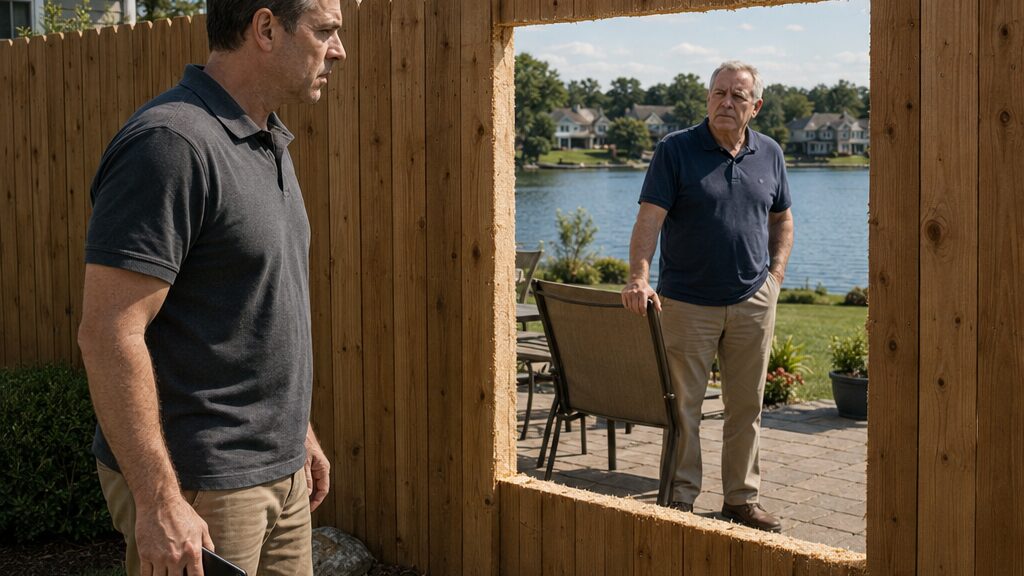
Now, halfway down the run, a clean rectangle had been cut through it.
Not cracked.
Not broken by a fallen branch.
Cut.
The opening was about three feet wide and two feet high, positioned almost perfectly at eye level for someone sitting on the patio next door. Through it, I could see a strip of afternoon lake shining between two maples.
I set my overnight bag on the grass.
Then I saw Raymond Moore.
He was standing on his patio with one hand resting on the back of a chair, looking directly through the opening.
He didn’t look surprised to see me.
“Raymond.”
He turned.
“Robert.”
I walked toward the fence.
Six cedar boards had been shortened with almost surgical neatness. Fresh sawdust still clung to the lower edges. Someone had even knocked down the roughest splinters.
For a moment, I couldn’t think of anything useful to say.
I had spent years renting houses where landlords decided whether I could paint a room, replace a faucet, or hang shelves. When I finally bought this place, I had promised myself I would never again live somewhere another person could casually decide what happened inside my boundary.
I pulled out my phone.
Raymond frowned. “What are you doing?”
“Taking pictures.”
“Oh, come on.”
I photographed the entire fence first. Then the opening. Then the cut ends of each board.
Raymond stepped closer on his side.
“You’ve been gone all weekend,” he said. “I didn’t think you’d even care.”
That sentence did more to steady me than an apology would have.
I opened the shed and took out a tape measure.
“Did you cut this yourself?”
He looked at the rectangle as if I had asked whether he had trimmed a hedge.
“Yes.”
“With what?”
“A reciprocating saw.”
I extended the tape across the opening.
Thirty-seven inches.
I took another photograph.
Raymond gave a short laugh. “Robert, seriously?”
I measured the height.
Twenty-six inches.
“What exactly are you planning to do with those numbers?”
“I don’t know yet.”
That was true.
What I did know was that if I started shouting, Raymond would remember the shouting. If I touched his fence, his patio, his tools, or him, then suddenly there would be two people explaining themselves.
So I kept measuring.
He shook his head.
“You’re making this into something it isn’t.”
I finally looked at him.
“What is it?”
“A view.”
I waited.
He gestured through the rectangle.
From where he stood, the opening framed the lake almost perfectly. A clean band of blue water sat beneath the far tree line.
“That’s all,” he said. “A view. You still have your fence.”
“I have a hole in my fence.”
“You have privacy everywhere else.”
“That wasn’t your decision to make.”
His jaw tightened.
“This neighborhood wasn’t designed to be boxed in.”
There it was.
Raymond had complained about the fence before. At a cookout two summers earlier, he had called it “a little aggressive.” Another time, while we were both dragging trash bins toward the street, he’d mentioned that the houses used to feel more open.
I had treated the comments as exactly that—comments.
Now six boards had been cut.
“Did Kathleen know you were doing this?”
His expression changed just enough for me to notice.
“Leave Kathleen out of it.”
“So that’s a no.”
“I said this is between you and me.”
“No. You made it between you and my property.”
He stepped off his patio.
For the first time, there was real irritation in his voice.
“You act like I took half your yard.”
“You cut something I own.”
“And you put up something that blocks the lake from my house.”
“My fence was permitted.”
“That doesn’t make it right.”
I stared at him.
Raymond pointed toward the water.
“When we bought here, this whole side of the neighborhood was sold as open lake living. People sat outside. People saw the water. Then everybody starts putting up walls and pretending the rules are the only thing that matters.”
“The rules mattered enough when I applied for the fence.”
“You applied for permission. That’s not the same as asking the people next to you.”
That landed harder than I wanted it to.
When I had installed the fence, I hadn’t asked Raymond.
I hadn’t needed to.
The survey showed my line. The HOA had approved the design. The county had issued the permit. I had taken those three facts as the end of the conversation.
Raymond saw my hesitation and mistook it for agreement.
“Exactly.”
“No,” I said. “Not exactly.”
I crouched near the base of the fence.
The surveyor had left one metal pin exposed near the rear corner. I brushed mulch away until I could see the cap.
The fence sat where it was supposed to sit.
Raymond watched me.
“You really want to turn this into some legal thing over six boards?”
“You’re the one who used a saw.”
“I improved the view.”
“For yourself.”
“For both of us.”
“My view wasn’t blocked.”
He went quiet.
I stood.
That was the simplest truth in the whole argument, and neither of us had anything useful to add to it.
I took photographs of the survey pin, the fence line, and the opening again from farther back.
Raymond went inside.
Ten minutes later, I called the non-emergency police number.
The responding officer arrived before sunset. He looked at the opening, asked whether Raymond had admitted cutting it, and wrote down what I told him. He didn’t march next door. He didn’t threaten anyone. He said property damage between neighbors was often better resolved before it became something larger, but documenting it now was sensible.
I agreed.
At least I thought I did.
After he left, I stood behind the fence one more time.
The lake through that rectangle was annoyingly beautiful.
Perfectly framed.
Which somehow made it worse.
My phone buzzed.
A message from Raymond.
You didn’t need to call the police.
I typed three different answers and erased all of them.
Then another message appeared.
Check the old neighborhood plan before you make yourself look ridiculous.
I read it twice.
The anger I’d been holding all afternoon shifted into something colder.
For the first time, I wondered whether Raymond knew something I didn’t.
Chapter 2: The Rules Said Something Different Than Raymond
The phrase was printed across the top of a twenty-year-old brochure in blue script:
OPEN LAKE LIVING.
I found it Monday morning in an online archive of old HOA documents.
Below the words was a photograph of the neighborhood when the trees were smaller and half the lots were still empty. Back patios flowed into lawns with almost no fences between them. The lake glittered behind everything.
For several uncomfortable seconds, Raymond’s argument looked less ridiculous.
I printed the brochure.
Then I printed my fence approval, the county permit, my property survey, and the architectural guidelines that had been in effect when I built it.
My kitchen table disappeared beneath paper.
At work, I estimated construction projects for a living. I was accustomed to resolving arguments with dimensions, specifications, dates, and written scope. Give me competing numbers and I could usually find the mistake.
People were harder.
By lunchtime, I had found three references in old promotional material to “open views,” “shared scenery,” and “uninterrupted lake living.”
I found zero recorded rules guaranteeing any homeowner a view across another person’s lot.
That distinction felt important.
I wanted someone besides me to say it.
Michelle Allen agreed to meet at the HOA office Tuesday evening.
She placed the brochure beside the current covenants and stared at them for a long moment.
“I know this piece,” she said.
“So Raymond isn’t making it up.”
“I didn’t say that.”
“He says the neighborhood was supposed to preserve lake views.”
Michelle tapped the brochure.
“This was marketing.”
Then she tapped the covenants.
“This is governance.”
“Meaning?”
“Meaning the developer wanted people to imagine open lake views when they were selling houses. That doesn’t automatically create an easement or a permanent view right.”
I felt some tension leave my shoulders.
Michelle noticed.
“Don’t look relieved yet.”
I sat back.
She pulled up the archived architectural approvals.
“Your fence was approved three years ago. Six-foot cedar privacy fence. Correct setback. Survey attached. County permit number included.”
“So it’s valid.”
“Yes.”
“And Raymond can’t cut through it because he doesn’t like the view.”
Michelle gave me a dry look.
“The HOA has no rule that lets a homeowner modify another homeowner’s fence with a power tool.”
For the first time since Saturday, I almost smiled.
Almost.
“But,” she continued, “Raymond did raise concerns when your application came through.”
I looked at her.
“What concerns?”
“He argued it would affect his lake sightline.”
“You approved it anyway.”
“The guidelines allowed it.”
“So why are we still talking about this?”
“Because you’re asking two different questions and pretending they’re one.”
I didn’t answer.
Michelle folded her hands.
“One question is whether your fence complies with the governing documents. It does. The other is whether Raymond believes something was taken from him. Apparently he does.”
“He cut my fence.”
“I know.”
“That should settle the second question.”
“No. It settles whether his response was acceptable.”
Her neutrality irritated me more than if she had disagreed outright.
I gathered the papers.
Michelle stopped me.
“Robert.”
“What?”
“Don’t use the HOA to finish a personal argument.”
“I didn’t start it.”
“That isn’t what I said.”
Outside, I sat in my truck for a minute before driving home.
I hated that she had managed to make me feel corrected at a meeting where I’d just learned I was right.
The surveyor came Wednesday morning.
I hadn’t technically needed another survey. The original was still valid. But I wanted the property-line pins located and flagged again before repairing anything.
He found the rear pin first, then the front one near the side gate. A taut line between them confirmed what the old drawing already showed: my cedar fence sat entirely on my property.
Raymond watched from his patio.
He didn’t speak.
The fence contractor arrived an hour later.
He inspected the six damaged boards, checked two rails, and explained that replacing only the shortened sections would look patched because the existing cedar had weathered.
“Structurally, six boards,” he said. “Visually, I’d replace eight so the section doesn’t look like somebody stitched it together.”
“Write both options.”
He did.
The cheaper repair was not a life-changing amount of money. It wasn’t even close.
That mattered because I still half expected Raymond to grumble, write a check, and let the embarrassment die.
I emailed him the smaller estimate.
Please reimburse this amount and I’ll schedule the repair. Police report number is available if your insurer requests it.
His response came eleven minutes later.
No.
I stared at the screen.
A second message followed.
I’m not paying to restore something that should never have blocked the view in the first place.
I called him.
He declined the call.
I called once more.
Declined again.
So I typed:
The fence is permitted and entirely on my property. HOA confirmed there is no protected view easement. You admitted cutting it. I’m asking only for the repair cost.
The typing bubbles appeared.
Stopped.
Appeared again.
Then:
You’re hiding behind paperwork.
I almost laughed.
Instead, I wrote:
The paperwork existed before you cut the fence.
His reply took longer this time.
You still don’t understand. This is bigger than six boards.
I read the sentence at my kitchen table with the old brochure beside my elbow.
For the first time, I believed him.
I just didn’t know what “bigger” meant.
Chapter 3: The Complaint Became More Expensive Than the Damage
The violation-review notice arrived three days after I repaired my own fence.
That was the part I couldn’t stop looking at.
My fence had been cut without permission. I had paid the contractor myself to replace the damaged boards. The repaired section now stood exactly where the approved fence had stood before.
And somehow I was the homeowner being called to an HOA hearing.
The notice said Raymond had requested formal review of a potential “view-obstructing architectural condition.”
I read that phrase twice.
Then I walked outside.
The new cedar boards were pale compared with the rest of the fence, eight clean vertical strips marking the place where Raymond’s rectangle had been. Near the rear corner, the surveyor’s flag still stood above the metal property pin.
The damage was gone.
The argument had become easier to see.
Raymond came outside while I was looking at it.
“You got the notice?”
“Yes.”
“Good.”
I turned toward him.
“You filed a complaint against the fence after admitting you cut it?”
“I filed a complaint about the condition that caused the problem.”
“You caused the problem.”
“That’s your version.”
“No. That’s your admission.”
His face hardened.
“You want everything reduced to one act because that makes you innocent.”
I took a step toward the fence, then stopped.
“And what makes you innocent?”
“I never said I was.”
It was the first useful thing he’d said since I came home.
Then he ruined it.
“But you created this situation.”
He gestured at the repaired boards.
I looked at him for another second.
“See you at the hearing.”
The HOA meeting room was not dramatic enough for the amount of anger people brought into it.
Beige walls. Stackable chairs. A folding table. A coffeemaker nobody had cleaned properly.
Michelle sat in the middle of three board members with copies of Raymond’s complaint, my original fence approval, and the old marketing brochure arranged in front of her.
Raymond had brought a folder twice as thick.
He began with photographs.
One showed his patio before my fence went up. The lake occupied almost a third of the image.
Another showed the same angle after construction. Cedar boards filled most of the lower view, trees the upper half, with only a narrow wedge of water visible beyond.
“I bought a lake property,” Raymond said. “Not a property beside a wooden wall.”
Michelle nodded.
“Was a view easement included in your deed?”
“No.”
“Any recorded covenant guaranteeing a particular sightline?”
“You’ve seen the sales material.”
“We have.”
He slid the brochure forward.
“It says open lake living.”
Michelle looked at him.
“Mr. Moore, promotional language is not the same thing as a recorded property right.”
Raymond’s jaw tightened.
“So the developer could sell people a view and then shrug afterward?”
“That isn’t what we’re deciding tonight.”
“It’s exactly what we’re deciding.”
“No,” Michelle said. “We’re deciding whether Mr. Hall’s fence violates the governing documents.”
She turned to me.
“Robert, do you have anything beyond the materials already submitted?”
I placed the current survey on the table.
“The fence is inside my property line. Same placement as the approved application.”
One board member examined it.
Michelle asked, “Any change in height?”
“No.”
“Materials?”
“Same cedar specification.”
“Footprint?”
“Same.”
She looked toward Raymond.
“Then there is no new architectural violation created by the repair.”
Raymond leaned back.
“So that’s it?”
“For this complaint, yes.”
“You’re rewarding him.”
Michelle’s expression changed slightly.
“No. We’re applying the documents.”
The wording was close enough to what I believed that I should have felt satisfied.
I did.
For about thirty seconds.
Then Raymond gathered his folder too quickly, and several papers slid onto the floor.
I bent automatically to help.
He reached for the same page I did.
It was an email printout.
I saw only part of it before he pulled it away, but one phrase stood out:
anticipated resale impact.
Below it was the name of a real-estate agency.
Raymond shoved the page back into his folder.
Our eyes met.
Neither of us said anything.
Outside, I found him beside his truck.
“You’re planning to sell?”
He froze with one hand on the door handle.
“That’s none of your business.”
“You made my fence your business.”
“Don’t.”
“Is that what this is about?”
His face went red.
“You think everything has one clean answer, don’t you?”
“No. I think you cut my fence because you wanted a view.”
“And I think you enjoy being technically right.”
The comment hit because I had just won.
Because Michelle had confirmed the fence was legal.
Because the survey was clean.
Because Raymond had lost his complaint.
And because part of me wanted him to feel every inch of that loss.
I stepped away.
“Pay for the boards.”
He opened the truck door.
“You still don’t get it.”
He drove off.
The next morning, instead of sending another repair demand, I went to the county zoning counter.
I told myself I was gathering information.
Nothing more.
The clerk pulled up my parcel, the setback map, and the zoning category.
“What are you looking to build?”
“A privacy screen.”
“You already have a fence.”
“I know.”
“How tall?”
I hadn’t decided until that moment.
“What is the maximum?”
The clerk looked at me over the monitor.
“That depends on whether you’re talking about a fence or an architectural screening structure.”
I felt my attention sharpen.
“What’s the difference?”
She turned the screen slightly and showed me the setback requirements.
“A standard fence has one height limit. A freestanding screen associated with outdoor living space can qualify differently if it meets structural requirements, stays within the buildable area, and receives architectural approval.”
“How differently?”
She pointed to a number.
Twelve feet.
I stared at it.
The repaired cedar fence outside my house was six.
The clerk kept talking about engineered footings, wind load, setbacks, and HOA review.
I barely heard half of it.
“Would something like that be allowed along the rear side of my property?”
“If the plans meet requirements.”
“Even beside an existing fence?”
“Potentially.”
I pictured Raymond’s carefully cut rectangle.
Then I pictured twelve feet of solid screening behind it.
The thought arrived so quickly, and felt so satisfying, that I knew immediately I should be suspicious of it.
Instead, I asked the clerk for the application packet.
Chapter 4: Twelve Feet Was Legal, but That Wasn’t the Whole Truth
The bright orange stakes appeared behind my cedar fence on a Thursday morning.
They ran in a straight line two feet inside the property boundary, each one topped with fluorescent tape that moved whenever the breeze came off the lake.
Raymond noticed them before I finished my coffee.
“What are those?”
I was standing near the rear corner with the application packet under one arm.
“Layout markers.”
“For what?”
“A privacy screen.”
He looked from me to the stakes.
“You already have a privacy fence.”
“I know.”
His eyes narrowed.
“How tall?”
I could have said I was still working through the design.
Instead, I said, “Twelve feet.”
For several seconds, Raymond simply stared at me.
Then he laughed once, without humor.
“You’re joking.”
“No.”
“You’re building a twelve-foot wall because I cut six boards?”
“I haven’t built anything yet.”
“That isn’t an answer.”
“It is the answer you’re getting.”
I walked toward the house before he could turn it into another argument.
That had become my method.
Documents instead of conversations.
Applications instead of explanations.
Every time Raymond pushed, I found another form to put between us.
By Friday afternoon, the structural drawings were complete. The screening panels would sit on engineered posts anchored in concrete footings, entirely on my side of the property line. The county requirements were clear. The HOA architectural committee had requested material samples and a rendering but had found no immediate rule prohibiting the height under the screening provision.
I chose a deep forest green.
It would blend with the trees.
That was what I wrote on the application.
The truth was less flattering.
I had seen the color sample against a photograph of Raymond’s patio, and I had imagined twelve feet of it swallowing the rectangular lake view he had carved for himself.
The thought still felt good.
Saturday morning, Kathleen Moore knocked on my back door.
She had never done that before.
I opened it but stayed in the doorway.
“Is Raymond with you?”
“No.”
She looked toward the fence.
“I saw the stakes.”
“So did he.”
“I know.”
There was a tiredness in her face I hadn’t noticed from across the yard.
“Can I talk to you for a minute?”
I stepped onto the patio.
Kathleen didn’t ask me to remove the fence. She didn’t tell me Raymond had been right.
Instead she said, “He shouldn’t have cut it.”
The sentence surprised me enough that I said nothing.
“He knows that,” she continued. “Even if he won’t say it properly.”
“He’s had plenty of chances.”
“I know.”
She looked toward their house.
“Raymond handles fear badly.”
I folded my arms.
“This isn’t about fear.”
“Yes, it is.”
She took a breath.
“We’ve been talking about downsizing.”
The real-estate email I’d seen on the hearing-room floor came back to me.
Kathleen noticed my expression.
“You saw something.”
“Enough.”
“We bought this place thinking we’d stay forever. That was the plan. But taxes went up. Insurance went up. Maintenance isn’t getting cheaper, and neither of us is getting younger.”
I glanced toward the lake.
“The view affects the price.”
“Yes.”
There it was.
Not an excuse.
An explanation.
Kathleen rubbed one hand over the other.
“Raymond talked to two agents. Both said the rear view matters. Then your fence went up, and he became convinced we’d lost something we paid for.”
“My fence went up three years ago.”
“He’s been angry about it for three years.”
“That doesn’t make cutting it less deliberate.”
“I didn’t say it did.”
Her voice sharpened for the first time.
“Please don’t turn what I’m telling you into permission for him.”
I looked at her.
She held my gaze.
“He was wrong.”
The words sat between us.
“But?”
“But I think you’re angry enough to build something you wouldn’t have wanted before this happened.”
That irritated me because it was true.
“I want privacy.”
“You already had privacy.”
“I want something he can’t put a saw through from his side without serious effort.”
“That I understand.”
“Then what are we discussing?”
“The difference between making sure he can’t do it again and making sure he suffers every morning when he looks outside.”
I felt my jaw tighten.
Kathleen nodded toward the fluorescent stakes.
“Twelve feet isn’t subtle, Robert.”
“Neither was a power saw.”
“No.”
She didn’t argue.
That made it harder.
For years, I’d moved from rental to rental, listening to other people’s rules about pets, paint, shelving, parking, deposits, inspections. Buying the house had felt like stepping across an invisible line.
Mine.
My walls.
My yard.
My decisions.
Raymond had crossed that line with a saw and then told me it shouldn’t matter.
I couldn’t make myself forget that because his retirement budget had become complicated.
“The plans are approved for construction review,” I said.
Kathleen looked disappointed, but not surprised.
“I’m not asking you to forgive him.”
“Good.”
“I’m asking you not to confuse understanding him with surrendering to him.”
“That works both ways.”
“Yes,” she said quietly. “It does.”
She left through the side gate.
For the rest of the weekend, I kept looking at the stakes.
On Sunday, I took the rendering out to the backyard and held it at arm’s length.
The proposed wall looked enormous.
Twelve feet on paper was a number.
Twelve feet beside an ordinary fence was something else.
I could still reduce it.
The county approval allowed a range up to the maximum. The contractor had told me changing the panel height before fabrication would be easy.
I opened the email draft to him.
Then I closed it.
Monday afternoon, Raymond caught me by the mailbox.
“Kathleen talked to you.”
“Yes.”
“She had no right.”
“She’s your wife.”
“That’s not an answer.”
I almost smiled at the borrowed phrase.
“She didn’t ask me to cancel anything.”
Raymond’s expression changed.
“What did she tell you?”
“That isn’t your business.”
His face went still.
I let him feel the sentence.
For a second, I enjoyed it.
Then I hated that I enjoyed it.
Raymond looked toward my backyard.
“You think the rules make you untouchable now.”
“No.”
“You’re building twelve feet of proof.”
I stepped closer.
“You had a legal way to challenge my fence. You had an HOA. You had the county. You had a lawyer if you wanted one. You chose a saw.”
His mouth tightened.
“You’d never have listened.”
“You never asked.”
That stopped him.
Not because it absolved me.
Because it was true.
He had complained around the issue for years. He had made remarks at cookouts, comments near the mailbox, little speeches about openness.
He had never once come to my door and asked me to change the fence.
And I had never once asked why it mattered so much.
We had both skipped the conversation and gone straight to what we trusted.
He trusted entitlement.
I trusted paperwork.
The contractor called at 4:17 Monday afternoon.
“We’re set,” he said. “Concrete crew Tuesday morning, seven-thirty.”
I looked through the kitchen window.
The orange stakes glowed behind the repaired cedar boards.
Raymond stood on the other side.
For a moment, neither of us moved.
“Keep the schedule,” I said.
Chapter 5: The Green Wall Rose Where the Lake Used to Be
The first auger bit into the ground at 7:42 Tuesday morning.
Raymond came outside before the second hole was finished.
He wore slippers, jeans, and a sweatshirt thrown over a T-shirt. For once, there was no folder in his hand and no prepared argument on his face.
“What are they doing?”
The contractor killed the auger.
I stepped away from the workers.
“They’re installing the footings.”
“Today?”
“Yes.”
Raymond looked along the line of orange stakes.
“You actually went through with it.”
I said nothing.
He walked to the fence and put both hands on the top rail from his side.
“This is insane.”
The contractor glanced at me.
“Want us to stop?”
“No.”
Raymond heard me.
“Robert.”
“The permit’s posted by the side gate.”
“I don’t care about the permit.”
“That seems to be a recurring problem.”
His face flushed.
One of the workers looked down quickly, pretending to inspect the auger.
Raymond pointed toward the first hole.
“That is practically on the property line.”
“No. It’s two feet inside.”
“Says who?”
“The surveyor.”
“I want it checked.”
“It was.”
“I want the county here.”
“Call them.”
He did.
By ten that morning, six deep holes ran behind the cedar fence. Steel reinforcement cages waited beside them. The concrete truck arrived shortly before noon.
Raymond stood on his patio for most of it.
Kathleen did not come outside.
The county inspector appeared Wednesday afternoon after Raymond requested verification.
I expected annoyance.
Instead, the inspector treated the situation like any other job.
He checked the permit card.
Measured from the property pins.
Verified footing dimensions.
Compared the structural drawings against the work.
Raymond followed him from one end of the yard to the other.
Finally he asked, “So you’re saying this is allowed?”
The inspector looked at the plans again.
“I’m saying the placement and footing work match the approved permit.”
“What about the height?”
“The approved design governs the height.”
“Twelve feet?”
“Yes.”
Raymond looked at me.
I should have felt nothing but satisfaction.
Instead, I noticed how old he suddenly looked.
Not defeated.
Just tired.
The inspector signed the card.
The next morning, the posts went up.
That was when the scale became real.
The cedar fence reached my shoulder line from certain angles. The steel posts behind it rose another six feet into open air.
Raymond stopped arguing.
By Thursday afternoon, the first green panel slid into place.
It was solid.
No lattice.
No decorative gap.
No accidental opening.
Just a broad vertical surface in deep forest green.
The workers added the second panel.
Then the third.
With every section, more of Raymond’s house disappeared from my yard.
And more of the lake disappeared from his.
At the center of the run, the panels passed directly behind the repaired section of cedar.
The eight newer boards had weathered slightly but were still lighter than the rest.
For weeks they had marked the rectangle Raymond cut.
Now the green wall erased even that evidence from his side.
I stood near the patio and watched the crew fasten the next section.
The contractor came over.
“You want the full run solid?”
I looked at him.
“That was the plan.”
“Just checking. Once we cap it, changing openings later is more work.”
“Full run.”
He nodded.
By Friday morning, it was finished.
From my yard, the wall didn’t look as brutal as I’d imagined. The green picked up tones from the trees. The cedar fence remained in front of it, giving the lower half some warmth.
From Raymond’s yard, it was another story.
I discovered that accidentally.
One of the workers had left a level near the rear post, and because the fence gate on Raymond’s side was open while the contractor spoke with him, I walked around instead of reaching awkwardly over.
I stopped three steps onto Raymond’s patio.
The lake was gone.
Not partly hidden.
Gone.
The green wall filled the view from left to right. Standing close to the house, even much of the sky had disappeared behind it.
The old cedar fence formed a lower band.
The new wall rose above it like a second horizon.
And I suddenly saw the whole thing from the place where Raymond drank his coffee.
Kathleen was standing inside the sliding glass door.
She didn’t glare at me.
That would have been easier.
She simply looked past me toward the wall.
Raymond came around the corner carrying the contractor’s level.
“This yours?”
I took it.
“Crew’s.”
He looked at the wall.
“Happy?”
The answer should have been yes.
Every inch was permitted.
Every footing had passed inspection.
Every panel sat inside my property.
He had cut my fence.
He had refused to pay for it.
He had filed a complaint against me after I repaired it.
I had won.
“Yes,” I said.
But the word sounded wrong.
Raymond gave a short nod.
“Good.”
He went inside.
I carried the level back around to my yard.
That evening, I sat outside after the crew left.
The cedar boards cast narrow shadows across the grass. Behind them, the green wall stood perfectly still.
I tried to remember what I had wanted before Raymond cut the hole.
Privacy.
Quiet.
A boundary nobody argued about.
I had all three now.
So why did it feel like Raymond was still controlling what I built?
At eight-thirteen, my phone buzzed.
HOA Architectural Review – Formal Challenge Received.
I opened the message.
Raymond had submitted one last complaint contesting the wall’s compatibility with community standards, despite its prior approval.
A hearing date was attached.
I looked up from the screen at twelve feet of forest green.
For the first time, I wasn’t worried that Raymond might succeed.
I was worried that he wouldn’t.
Chapter 6: Winning the Hearing Did Not Feel Like Winning
Michelle Allen began the hearing with the sentence Raymond least wanted to hear.
“Based on the documents before us, the structure appears fully compliant.”
Raymond shifted in his chair.
I felt the familiar tightening in my chest—the beginning of vindication.
Three weeks earlier, that feeling would have been enough.
Michelle continued.
“The county permit is valid. Required inspections have been completed. Placement is within Mr. Hall’s property. The architectural approval issued by this committee remains in effect.”
Raymond leaned forward.
“So why are we here?”
“Because you requested formal review.”
“And?”
“And we’re reviewing it.”
He pushed photographs across the table.
The green wall filled each one.
“This cannot possibly be what the rules intended.”
Michelle studied the first image.
“The committee doesn’t enforce what people imagine the rules intended. We enforce the documents as written.”
I recognized my own thinking in her words.
Raymond did too.
He looked at me.
“You like that, don’t you?”
Michelle cut in.
“Address the committee, please.”
Raymond sat back.
I had brought everything.
Permit.
Survey.
Structural plans.
Inspection signatures.
Architectural approval.
A copy of the contractor’s invoice for the original fence repair.
The stack was almost absurd.
It was also comforting.
Nothing inside it could raise its voice.
Nothing could twist a sentence halfway through an argument.
Michelle asked me whether the completed structure differed from the approved rendering.
“No.”
“Any change in placement?”
“No.”
“Height?”
“No.”
“Materials?”
“No.”
She nodded.
One board member whispered something to another.
The outcome was obvious.
Then Michelle turned toward Raymond.
“Mr. Moore, do you have new evidence that the structure violates a recorded restriction?”
Raymond stared at the table.
“No.”
“Then what specifically are you asking this committee to do?”
He didn’t answer immediately.
When he finally spoke, the anger had gone out of his voice.
“I’m asking you to look at what happened.”
Michelle waited.
Raymond rubbed both hands over his face.
“I know what the paperwork says.”
That was new.
He looked at me.
“I knew the original fence was probably legal too.”
The room became very quiet.
I leaned forward.
“You knew?”
“Not at first.”
“When?”
“Before I cut it.”
For a second, I forgot about the hearing.
“You checked?”
“Yes.”
“And you cut it anyway.”
“Yes.”
Michelle started to speak, but Raymond raised one hand.
“I thought if I asked Robert, he’d say no.”
“You never asked,” I said.
“I know.”
The answer was so simple it stopped me.
Raymond looked down.
“I’d already talked to an agent. Two, actually.”
The email from the floor flashed through my mind.
He continued.
“They both told us the same thing. Buyers pay for the lake. Not just the address. The view.”
Kathleen sat in the back row.
Raymond glanced at her, then away.
“We’re not broke,” he said. “I’m not saying that. But this house is most of what we worked for. We were planning to sell in a few years. Maybe sooner. I started thinking every board Robert put up was money disappearing.”
“You could have told me.”
“I didn’t want to tell anybody.”
There it was.
Not a hidden covenant.
Not a secret legal right.
Shame.
Raymond had spent three years dressing fear up as principle because “the neighborhood should stay open” sounded better than “I’m afraid my retirement isn’t worth what I thought.”
Michelle asked quietly, “And that led you to cut Mr. Hall’s fence?”
Raymond nodded once.
“I told myself he’d never notice much. Then when he did, I told myself he’d get over it.”
He looked at me.
“He didn’t.”
“No.”
“I was wrong.”
It wasn’t an apology.
Not quite.
But it was the first time he had stopped defending the act.
Michelle closed the folder in front of her.
“The committee’s role is narrow. The wall complies with the approval. Mr. Moore’s challenge is denied and the matter is closed.”
That was it.
I had won.
No applause.
No dramatic ruling.
Just a folder closing.
Outside, Raymond walked toward his truck.
I called after him.
He stopped.
For three years I had wanted him to admit the fence was mine.
For weeks I had wanted him to lose every complaint.
Now both things had happened, and the wall was still standing between our houses.
“Raymond.”
He turned.
“You still owe me for the repair.”
His expression tightened.
I took the contractor invoice from my folder.
“Every damaged board. Labor. Nothing for the new wall. Nothing else.”
He looked at the paper but didn’t take it.
“You’re serious?”
“Yes.”
“You just spent thousands putting that thing up.”
“That was my choice.”
“And this?”
“This was yours.”
He finally took the invoice.
For a moment I thought he’d argue again.
Instead, he folded it once.
“What happens if I pay it?”
“Then you’ve paid for what you damaged.”
“And the wall?”
I looked toward the back of the neighborhood, where its upper edge was barely visible between the houses.
“The wall stays.”
His mouth tightened.
I let the silence sit.
Then I added, “After that, if there’s anything else to discuss, you ask.”
Raymond studied me.
“No promises?”
“No.”
“No deal?”
“No.”
He nodded slowly.
For the first time since the fence had been cut, he seemed to understand why that mattered.
That evening, I went behind the cedar fence and stood close to the green panels.
Most of the original rectangle was hidden now, but from my side I could still identify the eight lighter replacement boards.
I rested my hand against one.
The wall had won every argument I built it to win.
Raymond could not touch my fence.
The HOA could not order the screen removed.
The county had signed off.
My property was unquestionably mine.
And yet, looking at those lighter boards, I understood something I hadn’t when I ordered twelve feet instead of eight.
A boundary protected what was mine.
Punishment required Raymond to keep occupying space in my head long after he stopped crossing the property line.
The next morning, I saw him at his mailbox.
He had the folded contractor invoice in his hand.
He didn’t come toward me.
He didn’t call across the street.
He simply held it up once, then went back inside.
For the first time, I wondered what I would do if the next thing Raymond offered me wasn’t another argument.
Chapter 7: The View Returned Only After the Boundary Did
Raymond’s check arrived in my mailbox on a Monday afternoon.
No note.
No argument.
No line about the lake.
Just the exact amount from the contractor’s invoice, written to me in Raymond’s careful block handwriting.
Behind it was a second folded sheet.
I opened that one standing at the curb.
It was the boundary agreement I had sent him after the hearing: neither household would alter, attach to, remove, cut, enter across, or otherwise modify anything on the other side of the surveyed property line without written permission.
Raymond had signed it.
So had Kathleen.
I looked toward their house.
Raymond was outside near the side gate. He saw the papers in my hand.
For a second, I expected him to walk over.
He didn’t.
He stayed where he was.
That mattered more than I expected.
I deposited the check the next morning.
Then I put the agreement in the same folder as the survey, the fence permit, the police report, and the wall approval.
For several weeks, nothing happened.
That should have been exactly what I wanted.
Raymond stopped commenting on the wall. He stopped finding reasons to stand near the fence. If we happened to reach our mailboxes at the same time, he nodded and kept a few feet of pavement between us.
Kathleen waved occasionally.
The green screen remained twelve feet high.
From my yard, it became ordinary faster than I would have guessed.
From theirs, I knew it couldn’t.
One Saturday morning, I was trimming along the lower cedar fence when I reached the eight replacement boards.
They were still lighter than the rest.
The shape wasn’t as obvious anymore, but I knew exactly where the rectangle had been.
I stopped the trimmer.
For weeks, I had told myself the wall was no longer about Raymond.
It was simply part of my property now.
Approved.
Inspected.
Paid for.
Permanent.
But permanence was exactly what bothered me.
Raymond had made one irreversible decision with a saw.
I had answered with concrete.
The difference was that I had permission.
That mattered.
It just wasn’t the only thing that mattered anymore.
On Monday, I called the contractor.
He remembered the wall immediately.
“What happened?” he asked. “Problem with a panel?”
“No.”
“Post movement?”
“No.”
“Then what are we fixing?”
I looked through the kitchen window toward the upper edge of the screen.
“I want to change one section.”
There was a pause.
“How much?”
“Not the lower part. Cedar fence stays untouched.”
“All right.”
“And not an opening someone can reach through.”
Another pause.
“You want a sightline.”
I smiled despite myself.
“A small one.”
He came out Wednesday afternoon.
We stood in my yard with a ladder and a tape measure while I explained what I wanted.
One upper section of the green screening would be shortened and reframed, leaving a narrow horizontal rectangle well above the cedar fence.
High enough that nobody could climb through it.
Small enough that my patio remained private.
Positioned so that, from Raymond’s usual chair, a piece of the lake would become visible again.
The contractor climbed the ladder and marked the panel.
“You sure?”
I looked through the temporary measurement gap.
Blue water appeared beyond the trees.
Not much.
Enough.
“Yes.”
He lowered the pencil.
“You know you paid us to close this.”
“I know.”
“And now you’re paying us to open it.”
“I know.”
He studied me for a second, then shrugged.
“Your wall.”
That phrase stayed with me.
Your wall.
Not Raymond’s punishment.
Not the HOA’s approval.
Not the county’s permit.
Mine.
Which meant I could decide what it was for.
The work took less than half a day.
The crew removed one upper panel, cut it, reinforced the surrounding frame, and finished the edges cleanly. By early afternoon, a precise rectangle of sky and water sat above the untouched cedar fence.
It resembled the opening Raymond had made only in shape.
Everything else about it was different.
His had been taken.
This one was given.
I was cleaning sawdust from my patio when I heard the Moores’ back door slide open.
Kathleen came outside first.
She saw the opening and stopped.
Raymond followed.
He looked up.
The lake was visible again.
A narrow blue strip framed by green.
He didn’t smile.
He didn’t thank me.
For several seconds he simply stood there with one hand on the back of his patio chair.
Then he walked toward the property line.
Halfway there, he stopped.
Exactly where the survey pins said he should.
“Robert?”
I set the broom down.
“Yeah?”
His eyes moved to the opening again.
“You didn’t have to do that.”
“No.”
A long pause followed.
“Why did you?”
I considered several answers.
Because Kathleen told me the truth.
Because the wall felt too much like anger set in concrete.
Because I’d spent years wanting a home nobody else could control, only to discover that I could become controlled by the need to prove I was in control.
Instead I said, “Because you paid for what you broke.”
Raymond nodded.
“And because you signed the agreement.”
Another nod.
“And because this time nobody took anything.”
He looked at me.
“No.”
The word was quiet.
“Nobody did.”
Kathleen sat down in the patio chair.
From there, the rectangle framed a section of lake between two trees.
It wasn’t the view they had before my original fence.
It wasn’t the broad open sweep from the old sales brochure.
But it was water.
Raymond remained at the boundary.
“I owe you an apology too,” he said.
I didn’t rescue him from the sentence.
He had spent months avoiding exactly this moment.
So I waited.
“I should’ve asked,” he said. “And when I figured you’d say no, I decided that meant I didn’t need to.”
I nodded.
“That was wrong.”
“Yes.”
He looked almost amused.
“You don’t make this easy.”
“I don’t think I’m supposed to.”
“Probably not.”
Another silence.
Then he glanced toward the new opening.
“Thank you.”
“You’re welcome.”
We didn’t shake hands.
We didn’t become friends.
A week later, Raymond and I passed each other near the mailboxes. He mentioned that one of the trees along the rear slope needed trimming before storm season.
Six months earlier, I would have heard an implied complaint about his view.
This time he said, “One branch is close to your side. I wanted to ask before I touch anything.”
I looked toward the tree.
“Show me which one.”
We walked around the houses together.
When we reached the backyard, Raymond stopped at the metal survey pin.
He waited.
I stepped across my yard to meet him.
The cedar fence still stood where it always had.
The eight replacement boards had begun darkening toward the color of the older ones. Behind them rose the green wall, solid and protective except for one deliberate rectangle near the top.
Through it, the lake caught the late-afternoon light.
Raymond pointed toward the branch but did not cross the line.
And that was when I understood what had actually changed.
The boundary had never been the problem.
The problem was believing respect meant getting what you wanted from the person on the other side of it.
Raymond had learned he had to ask.
I had learned that saying no was meaningful only if I was also free to say yes.
I looked at the branch, then at him.
“That one’s fine,” I said. “Take it back to the trunk.”
Raymond nodded.
He stayed on his side.
The lake remained exactly where it had always been.
The view was different.
So were we.
The story has ended.