They Fined Him for the Boat in His Driveway, So He Read the Rule They Never Expected Him to Read
Chapter 1: The Fine That Arrived After Four Quiet Summers
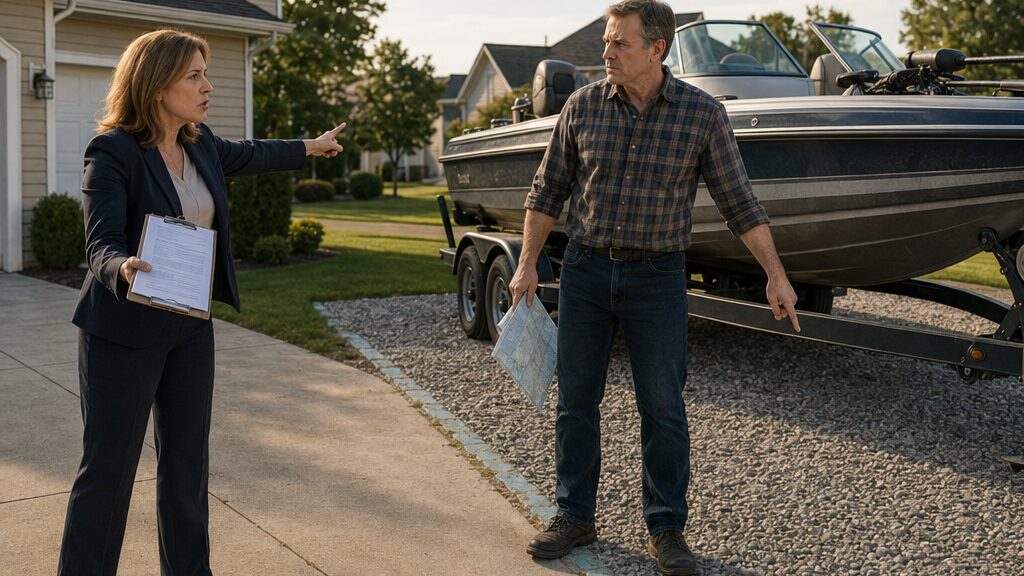
Christine Miller was standing beside John Carter’s boat when he came around the corner of his garage, a white envelope pressed flat against a clipboard.
For a moment, John thought she had come to ask him to move his truck.
Then he saw the red HOA logo in the corner of the envelope.
“You’ve got to be kidding.”
Christine did not smile. “I wanted to deliver it directly so there wouldn’t be any confusion about the deadline.”
Behind her, John’s twenty-two-foot fishing boat sat exactly where it had sat every summer since he bought it: centered on its trailer along the right side of the driveway, bow pointed toward the street, white hull cleaned after the last weekend on the lake.
One trailer tire rested inches from the faded painted edge of the concrete.
John looked from the boat to Christine.
“What deadline?”
She handed him the envelope.
The first line said NOTICE OF VIOLATION. The second referenced watercraft storage on residential driveways.
At the bottom, boxed in heavier print, was the amount.
Two hundred fifty dollars.
John read it twice.
“I’ve kept that boat there four years.”
“I know.”
“Four summers.”
“I know that too.”
“Then what exactly changed between last summer and Tuesday?”
Christine shifted the clipboard under her arm.
“The board is enforcing the covenants consistently now.”
John gave a short laugh that contained no amusement.
“That’s an answer to a different question.”
Christine’s jaw tightened.
“The restriction is in the documents you received when you purchased the house.”
John stepped closer to the boat and looked down at the concrete as though the driveway itself might explain what had happened.
The painted edge had faded almost completely near the garage. Years ago, he had marked it while lining up a landscaping project. It had never meant much beyond where he wanted gravel to stop and concrete to begin.
Now Christine stood beside it as though it were a border checkpoint.
“You’ve walked past this boat a hundred times,” he said.
“I’m not disputing that.”
“And the board?”
“The previous board didn’t enforce several provisions the way it should have.”
That phrase caught him.
“Several?”
Christine hesitated.
John noticed.
“So this isn’t just me.”
“I didn’t say that.”
“You didn’t have to.”
She looked toward the street. Two houses down, a garage door was open. A man John knew only well enough to wave at was pretending to rearrange something on a shelf while clearly watching them.
John lowered his voice.
“Who complained?”
“I’m not discussing individual complaints.”
“So someone did.”
“John.”
“No. If you’re standing in my driveway charging me two hundred fifty dollars for something you ignored for four years, I get to ask why today suddenly matters.”
Christine’s expression changed slightly. Not softer, exactly. More tired.
“We have homeowners asking why some rules apply and others don’t. We have people pointing to prior exceptions. We have residents saying the board is playing favorites. We can’t keep operating that way.”
For the first time, John heard something other than accusation in her voice.
Pressure.
He still didn’t like it.
He unfolded the second page.
If the violation remained uncorrected beyond the stated period, additional fines could accrue.
“How much?”
“That depends on the board schedule.”
“That’s convenient.”
“It’s in the enforcement policy.”
“Another document nobody cared about until this week?”
Christine’s eyes hardened.
“That kind of comment is exactly why we’re trying to make this process consistent.”
John almost answered, but movement across the street distracted him.
A pickup was backed into another driveway with a utility trailer beside it. Three years earlier, that trailer had held two personal watercraft for nearly an entire season.
John pointed.
“What about that house?”
Christine followed his finger.
“What about it?”
“He had two Jet Skis sitting there for months.”
“I wasn’t president then.”
“What about the travel trailer on Anderson Court last spring?”
“That was temporary.”
“Eleven weeks is temporary?”
“I’m not going through other owners’ histories with you.”
John stared at her.
There it was.
Not proof of some conspiracy. Something more irritating because it was ordinary: years of selective attention followed by a sudden claim of principle.
He looked again at the notice.
The fine was real.
The deadline was real.
And arguing in his driveway was not going to make either disappear.
Christine seemed to read the change in his face.
“You can request a hearing.”
“I’ll think about it.”
“You should also review the covenant section before the deadline.”
John folded the pages carefully and slid them back into the envelope.
“That advice would mean more if somebody had reviewed it sometime during the last four summers.”
Christine let that sit between them.
Then she nodded once and walked toward the sidewalk.
John remained beside the boat.
He put one hand on the trailer fender. The metal was cool.
The whole thing suddenly looked different.
Not like the boat he had spent Saturday mornings waxing. Not like the boat he took out before sunrise with coffee in a stainless mug and a tackle box rattling behind him.
It looked like a liability sitting on concrete.
That evening, John found his closing documents in a plastic file box at the back of a closet.
Christine had been right about one thing.
The language was there.
No boats, watercraft, recreational vehicles, or similar equipment were to be stored on residential driveways except for short periods associated with loading, unloading, cleaning, or maintenance.
John leaned back in his chair.
Four years, and nobody had said a word.
He searched old neighborhood emails next.
A summer reminder from three years earlier mentioned lawn maintenance and trash cans. Nothing about boats.
Another annual notice warned against leaving basketball hoops in the street.
Nothing.
He found meeting minutes referring to a camper parked on a side drive. The board had given the owner “additional time for accommodation.”
No fine amount appeared.
John read the phrase twice.
Additional time.
At ten that night he drafted an email to Christine.
He wrote three paragraphs about selective enforcement.
Deleted them.
Wrote another paragraph accusing the board of inventing urgency.
Deleted that too.
The deadline remained on the desk beside him.
That was the part his temper could not change.
The next morning he called a storage facility across town.
“Yes,” the manager told him. “We have an outdoor space that’ll fit twenty-two feet plus the trailer.”
“How much?”
“One eighty a month.”
John closed his eyes.
“When can I bring it?”
“Any time before six.”
He looked through the kitchen window toward the driveway.
The boat sat where it always had, one wheel near the faded painted edge.
Four quiet summers.
Then one envelope.
“I’ll be there Friday,” John said.
Chapter 2: The Price of Quietly Following Their Rule
The storage manager held out the payment terminal, and John watched the screen change from $0.00 to $180.00.
“For one month?” John asked, though he already knew the answer.
The manager nodded.
John inserted his card.
The machine chirped.
That tiny sound irritated him more than Christine’s entire driveway speech.
He had spent Friday afternoon towing the boat across town through traffic, past the lake road he normally used, and into a gravel storage yard surrounded by chain-link fencing. His assigned space sat between a faded camper and a covered utility trailer.
Nothing was wrong with the facility.
That almost made it worse.
It was secure. Organized. Reasonably priced by local standards.
And completely unnecessary until someone had decided to enforce a rule that had existed unnoticed for years.
John unhitched the trailer.
As he drove away, he looked in the rearview mirror out of habit.
For the first time in four summers, there was no boat behind him.
By December, the second charge appeared automatically.
Another $180.
John opened his banking app at the kitchen table and did the math.
Twelve months would be $2,160.
He stared at the number.
The original fine suddenly seemed almost cheap.
He could request a hearing. He could complain. He could hire somebody. Every option seemed to require time, money, or both.
So he did what he had always done when faced with something he considered stupid but technically legitimate.
He endured it.
That decision lasted six weeks.
At first he told himself he would keep the boat in storage until spring and reconsider then.
But the inconvenience accumulated in small ways.
One Saturday he wanted to replace a trailer light. Instead of walking outside with a screwdriver, he drove twenty minutes each way.
Another morning he realized his rain gear was still in a compartment under one of the seats.
Forty minutes of driving for a jacket.
When Margaret Hall saw him returning one afternoon with the empty pickup, she raised a hand from beside her mailbox.
“You get the boat winterized?”
John kept walking.
“Something like that.”
He regretted the answer immediately.
Margaret had lived next door for years. They borrowed tools occasionally. She once collected a package for him during a weekend trip. There had never been anything resembling a feud between them.
But lately every ordinary question sounded to John like surveillance.
At the next mailbox cluster, two neighbors were discussing a new reminder about trash cans being removed from the curb.
John passed without joining them.
One called after him.
“Board’s getting serious this year.”
John stopped.
“What does that mean?”
The neighbor shrugged. “Christine ran on consistency, right? No more exceptions.”
The phrase landed differently now.
Consistency.
John went home and opened the HOA website.
For the first time, he read the board election material instead of deleting it.
Christine’s candidate statement from months earlier was still archived.
One sentence appeared twice in different forms: rules should be predictable, uniformly applied, and understood by all residents.
John leaned closer to the screen.
So that was the shift.
Not a new boat rule.
A new board philosophy.
He opened recent meeting minutes.
There were warnings about sheds, fencing, work trailers, exterior paint colors, landscaping edges.
One line referenced “historically under-enforced provisions.”
Another referred to “restoring confidence through uniform standards.”
John sat back.
He had spent weeks thinking somebody had suddenly developed a personal problem with his boat.
Maybe that was wrong.
Maybe Christine had developed a problem with exceptions.
It did not make the storage bill any smaller.
January’s invoice arrived by email on a Monday morning.
John opened it while drinking coffee.
$180.00.
Paid automatically.
He printed it.
He wasn’t sure why.
Maybe he wanted something physical to be angry at.
He placed November, December, and January together on the table.
Five hundred forty dollars.
His original $250 violation notice lay in the same folder.
For several minutes he compared the papers like they were evidence of two different mistakes.
Then he opened a new email.
Christine,
I have now paid three months of off-site storage to comply with the driveway restriction. I am requesting clarification on whether the HOA prohibits boat storage anywhere on a residential lot or specifically on a driveway.
John stopped typing.
He imagined the response.
Probably a citation to another paragraph.
Probably a sentence about board authority.
Probably more documents.
His hands tightened over the keyboard.
He added:
Also, please provide a record of enforcement of this provision during the previous four years.
He read it.
It sounded like the beginning of a fight.
Part of him wanted exactly that.
Then he remembered Christine saying residents had accused the board of favoritism.
If she produced a stack of violation records, he would still be paying $180 every month.
John deleted the entire message.
Instead, he opened the county property website.
He had used it before to check tax assessments. The parcel page showed his lot boundaries, square footage, zoning category, assessed structures.
Nothing immediately useful.
He clicked deeper.
A land-use tab opened.
Then another map.
The labels were bureaucratic enough that he nearly closed the page.
Residential classification.
Setbacks.
Accessory-use references.
A note linked to county planning guidance.
John frowned.
He had spent weeks rereading the HOA documents because the HOA was the one fining him.
He had never bothered asking a more basic question.
What did the county say he could do with the land itself?
The next evening, he printed the parcel map.
The rectangle of his property appeared in heavy black lines. House near the center. Driveway along the right. Side yard. Front setback.
John laid a ruler across the page.
There was unused ground beside the driveway, partly lawn and partly an old flowerbed he had stopped maintaining years before.
He measured the actual area the next morning.
Roughly forty feet across one usable stretch.
Close to thirty feet deep before the setback became an issue.
Enough room for the boat.
He stood there with the tape measure extended between his boots and Margaret’s side of the property.
Her curtains moved.
John noticed and immediately felt annoyed.
There it was again—that reflex.
Someone watched, therefore someone judged.
He snapped the tape measure closed harder than necessary.
Back inside, he searched the county site again.
A sentence about secondary private storage uses caught his attention.
He read it once.
Then again.
The wording was vague enough that he did not trust himself.
At noon, he called the county planning office.
The clerk listened while he explained the property location.
“I’m not asking about commercial storage,” John said. “Just personal recreational equipment. My own boat.”
There was keyboard noise on the other end.
“You may want to pull the full parcel file.”
“Can I do that online?”
“Some of it. Not everything.”
“What am I looking for?”
“Potential accessory or flexible-use designation, depending on your parcel.”
John wrote the phrase down.
“Does mine have that?”
“I can’t interpret it over the phone. A planner can go through it with you.”
“When?”
“We take walk-ins Thursday mornings.”
John glanced toward the window.
His driveway looked strangely empty now.
Only the faded painted edge remained where the trailer tire had once sat.
Thursday morning, instead of writing another email to Christine, John folded the parcel map into his jacket pocket and drove to the county office.
Chapter 3: The Map Drew a Different Line
The county planner uncapped a blue pen and drew a rectangle on John Carter’s parcel map.
“Something like this,” she said.
John leaned across the desk.
The rectangle sat beside his driveway, over the patch of lawn he had measured two days earlier.
“That could actually be used for the boat?”
“I said potentially.”
John looked up.
The planner smiled faintly.
“People usually stop listening after the word they wanted.”
“I’m listening.”
“Good.”
She rotated the map so they could both see it.
The county office was quieter than John expected. No courtroom counters, no angry homeowners waving folders. Just gray carpet, low partitions, a printer humming somewhere behind them.
The planner tapped the parcel boundary.
“Your lot is primarily residential. But this section has enough usable area that you may qualify for an administrative accessory-use approval for private recreational-equipment storage.”
“On my own property.”
“Yes.”
“Not the driveway.”
“Correct.”
John pointed at the rectangle.
“And if approved, I can put the trailer there?”
“Subject to setbacks, surface requirements, drainage, and the conditions in the approval.”
For the first time in three months, John felt the problem become smaller.
Not solved.
Smaller.
“How complicated is the application?”
The planner reached into a tray and handed him a packet.
“It’s mostly dimensional information, parcel documentation, proposed use, and a basic site sketch.”
“Public hearing?”
“Not for this category if staff determines it meets the administrative criteria.”
John flipped the packet over.
“What’s the fee?”
“Seventy-five dollars.”
He looked at her.
“Seventy-five?”
“Yes.”
“I’ve paid five hundred forty dollars to store the boat since November.”
The planner gave him the practiced expression of someone who had learned not to comment on private disputes.
John laughed once under his breath.
“Sorry. Not your problem.”
“No.”
She pointed to the application.
“But this part is.”
They went through the requirements.
The proposed storage area could not interfere with required access. It had to remain within the allowed portion of the parcel. Depending on how he prepared the surface, he might need to demonstrate drainage would remain on his property.
John wrote everything down.
The more technical the conversation became, the calmer he felt.
Measurements he understood.
Setbacks he could check.
Slope he could correct.
A rule with dimensions was easier than a rule enforced according to somebody else’s interpretation of fairness.
Then the planner closed the packet.
“One thing you need to understand.”
John stopped writing.
“If your neighborhood has private covenants, this approval does not override them.”
His optimism stalled.
“The HOA.”
“If you have one.”
“I do.”
“County zoning and private restrictions are separate.”
John leaned back.
“So this could be approved and they could still tell me no.”
“They may have restrictions the county does not enforce.”
“That sounds like I’m paying seventy-five dollars for a maybe.”
“You’re paying seventy-five dollars for the county to determine whether the use is permitted under county rules.”
“That’s not the same thing.”
“No.”
John looked down at the blue rectangle.
For ten minutes it had felt like an answer.
Now it looked like another argument waiting to happen.
“What if their rule specifically says no boats on driveways?”
The planner paused.
“That’s a question about your covenant, not county land-use law.”
“But if I’m not on the driveway—”
“I’m not advising you on how a private covenant applies.”
The answer was careful enough to be frustrating.
John folded his arms.
“So you can tell me exactly where I can put the boat but not whether anyone else can stop me.”
“I can tell you what the county permits.”
She pushed the map toward him.
“What other parties can restrict is something you need to determine separately.”
John stared at the rectangle.
He thought of Christine standing beside the boat with the violation envelope.
No boats on residential driveways.
Those words had been specific.
He had read them himself.
Not yards.
Not approved accessory-storage pads.
Driveways.
“What happens if I apply?”
“Staff reviews the parcel and proposal.”
“How long?”
“Usually two to four weeks.”
“And if it meets the criteria?”
“You receive written approval with conditions.”
John picked up the packet.
The blue rectangle remained on the map underneath.
He could walk away.
Keep paying $180 a month.
Avoid another confrontation.
Maybe sell the boat eventually and tell himself it had become inconvenient anyway.
That thought irritated him more than the fee.
He had bought the boat used after saving for years. He maintained it himself. He knew every scuff in the hull and every stubborn bolt on the trailer.
Selling it because paperwork had become exhausting felt less like compromise than surrender through attrition.
“I’ll file.”
The planner nodded.
“Then measure carefully.”
At home, John spent the afternoon doing exactly that.
He drove stakes into the lawn at the corners of the proposed rectangle and ran mason’s line between them.
Forty feet along the usable width.
Thirty feet at the deepest section.
He checked the setback twice.
Then a third time.
Margaret came outside while he was crouched beside one stake.
“What are you building?”
John kept his eyes on the tape measure.
“Nothing yet.”
“That looks like something.”
“It’s a storage area.”
There was a pause.
“For the boat?”
John straightened.
He could have explained the application.
He could have told her he was checking setbacks.
Instead, irritation reached his mouth first.
“If the county approves it.”
Margaret looked toward the rectangle, then toward the street.
“That close to the front?”
“It’s my permitted area.”
“I didn’t say it wasn’t.”
“You didn’t have to.”
Her face changed.
John knew immediately he had put something into her words that had not been there.
But he was tired of feeling examined.
Margaret folded her arms.
“I was just asking.”
“Now you know.”
She went back inside without another word.
John watched her door close.
For several seconds he considered walking over and apologizing.
Instead, he pulled the next stake tighter.
By dusk, the outline was finished.
The new rectangle sat only a few feet from the old faded driveway edge.
Two different lines.
Two different sets of rules.
John photographed the measurements and drew a clean site sketch at the kitchen table.
The following morning he returned to the county office with the completed application.
The clerk checked the pages.
“Proposed use: private storage of personal recreational equipment.”
“Yes.”
“Boat and trailer?”
“Yes.”
She took his payment.
Seventy-five dollars.
John signed the final page.
Before handing it over, he read the certification twice.
He thought of the planner’s warning.
County permission did not erase private covenants.
He thought of Christine’s notice.
No storage on residential driveways.
Then he signed.
The clerk stamped the application and slid his copy back across the counter.
John folded it carefully beside the parcel map.
He had no idea yet whether the blue rectangle would bring his boat home.
But for the first time since Christine had appeared in his driveway, he was no longer waiting for someone else to tell him what the rules meant.
Chapter 4: Nineteen Days Later, the Boat Came Home
Nineteen days after John filed the application, the county approval arrived in a plain white envelope.
He opened it standing at the kitchen counter.
Approved accessory use.
Private storage of personal recreational equipment.
Subject to the dimensions and conditions shown on the submitted site plan.
John read the page once, then unfolded the parcel map attached behind it. The same rectangle the planner had drawn in blue was now reproduced as part of the approved record.
For several seconds he simply stood there.
Then he called the storage facility.
“I’m ending the space.”
The manager asked whether he wanted the cancellation effective immediately.
“Yes.”
“You already paid through the end of the month.”
“That’s fine.”
John drove across town that afternoon.
When the boat appeared behind him in the rearview mirror again, he felt something loosen in his chest.
He had not beaten anybody.
No judge had ruled in his favor. Christine had not apologized. The HOA had not changed a word.
But the boat was coming home.
Over the weekend John removed the old flowerbed and leveled the approved area. He laid landscape fabric, ordered gravel, checked the measurements twice, and compacted the surface until the trailer tires sat firm without sinking.
The new pad stopped several feet beyond the faded painted edge of the driveway.
John measured that distance too.
He knew somebody would.
On Sunday afternoon he backed the trailer carefully onto the gravel.
The boat settled inside the approved rectangle with less than a foot to spare at one corner.
John stepped back.
The concrete driveway remained empty.
The boat was plainly on his property.
Just not on the driveway.
Margaret came outside while he was lowering the trailer jack.
She looked at the boat, then at the gravel.
“So they approved it.”
John wiped his hands on his jeans.
“The county did.”
She nodded slowly.
He waited for something else.
Nothing came.
“Looks permanent,” she said.
“That’s the idea.”
Margaret looked toward the street.
John followed her gaze but saw nothing unusual.
Then she went back inside.
Three days later, Christine Miller appeared at the edge of the driveway holding another white envelope.
John saw her before she reached the boat.
He set down the wrench in his hand.
“You work fast.”
Christine stopped beside the painted driveway edge.
“So do you.”
She handed him the notice.
John opened it without inviting her farther onto the property.
The violation referenced recreational equipment storage.
He skimmed the first paragraph.
Then the second.
His jaw tightened.
“You’re citing the same boat.”
“We’re citing the continued storage.”
“Not on the driveway.”
“John.”
“No. That matters.”
Christine looked at the gravel pad.
“You moved it a few feet.”
“I moved it into an area the county approved for exactly this use.”
She folded her arms.
“The HOA restrictions still apply.”
John walked to the garage and returned with the county envelope.
He removed the approved parcel map and laid it flat against the trailer fender.
Christine watched him.
John pointed to the driveway.
“Here.”
Then to the gravel rectangle.
“And here.”
“I can see the difference.”
“Can you?”
Her expression hardened.
John opened the original covenant copy he had brought outside with the map.
He found the provision.
“No boats, watercraft, recreational vehicles, or similar equipment shall be stored on residential driveways.”
He tapped the sentence.
“Show me where this says yard.”
Christine did not look at the paper.
“There are other provisions.”
“Which one?”
“General exterior standards.”
“Which one?”
“John, I’m not going to conduct a covenant hearing in your front yard.”
“You came to my front yard with another fine.”
“This notice tells you what provision is being enforced.”
John looked again.
The second citation was different.
Not the driveway restriction.
The new notice referred to a broader section governing exterior appearance, visible recreational equipment, and uses inconsistent with neighborhood standards.
He read the paragraph more carefully.
The satisfaction he had felt five minutes earlier faded.
“This wasn’t on the first notice.”
“The first violation was simpler.”
“Because the boat was on the driveway.”
“Yes.”
“And now it isn’t.”
Christine looked directly at him.
“Which does not necessarily mean unrestricted storage is permitted elsewhere.”
John held the county approval between them.
“This says private recreational-equipment storage.”
“By the county.”
“The county controls land use.”
“The county does not rewrite our covenants.”
John nearly smiled.
It was the same warning the planner had given him.
The sentence sounded worse coming from Christine.
“I know that.”
“Then you understand why this isn’t over.”
John looked toward Margaret’s house.
One curtain shifted and became still.
He felt the familiar irritation rise.
Everybody looking.
Everybody deciding.
He forced his attention back to the paper.
“What are you actually asking me to do?”
“Remove the boat from visible residential storage until the board reviews the matter.”
“No.”
Christine blinked.
It was the first outright refusal he had given her.
“I’m not moving it again because you found a broader paragraph after the first one stopped working.”
“That isn’t what happened.”
“It looks exactly like what happened.”
“You assume everything the board does is directed at you personally.”
“You’ve handed me two violation notices in three months.”
“And I’ve handed other homeowners notices too.”
“For rules that nobody enforced before.”
“That is the problem I inherited.”
The anger in her voice appeared only for a second, but John caught it.
Christine lowered it again.
“We have owners asking why one person gets an exception and somebody else doesn’t. We have years of inconsistent decisions. Every time we try to enforce something, someone points backward and says, ‘But you let him do it.’”
John gestured toward the boat.
“So I’m your example.”
“No. You’re a current violation.”
“According to a rule that doesn’t mention where the boat is sitting.”
Christine’s face went still.
That silence interested him more than another argument would have.
“You’re not sure,” he said.
“I’m sure the board has authority to review it.”
“That isn’t what I asked.”
She picked up the notice John had lowered.
“The hearing date is on the second page.”
John kept the paper.
“I’ll be there.”
Christine turned toward the sidewalk.
“Additional fines may accrue if the board upholds the violation.”
That stopped him.
“How much?”
“It depends on the enforcement schedule.”
John looked down at the gravel pad.
Three months of storage payments. Seventy-five dollars for the county application. A weekend of labor and gravel.
Now another schedule of fines.
He called Anthony Harris that afternoon.
Anthony had handled a property-line issue for John years earlier. He listened without interrupting while John explained both notices and the county approval.
When John finished, Anthony asked, “Do you still have the full HOA declaration?”
“Yes.”
“Full means full. Amendments too.”
“I think so.”
“Send all of it.”
John emailed the files.
Anthony called back that evening.
“The good news is the driveway provision means what you think it means.”
John leaned back in his chair.
“And the bad news?”
“The bad news is you’re treating that sentence like it’s the only sentence in the document.”
John said nothing.
Anthony continued.
“The broader exterior-use language is vague. Vague doesn’t automatically mean unenforceable.”
“So Christine can just pick another paragraph?”
“I didn’t say that.”
“Sounds like it.”
“It means this is no longer a question of whether your boat is physically on the driveway.”
John looked through the window.
The concrete sat empty.
Beyond its faded painted edge, the boat rested squarely on gravel.
“What do I do?”
“First, don’t move the boat yet.”
John smiled despite himself.
“Finally.”
Anthony cut him off.
“But don’t assume you’ve won.”
The smile disappeared.
Anthony continued, “I want the board history, enforcement records if we can get them, and the original complaint if they’ll disclose the substance. Something caused this enforcement campaign. Until you know what that is, you’re arguing against only the part you can see.”
John looked at Margaret’s darkened window next door.
For the first time, he wondered whether the real line in this dispute had never been painted on his driveway at all.
Chapter 5: The Neighbor Complaint Was Never About the Boat Alone
Margaret Hall opened her front door before John reached the porch.
“You think it was me,” she said.
John stopped halfway up the walk.
He had spent ten minutes deciding how to ask the question without sounding accusatory.
Apparently he had failed before speaking.
“I was going to ask.”
Margaret stepped outside and closed the door behind her.
“Then ask.”
John glanced toward his boat.
From Margaret’s porch, the problem looked different.
The bow sat farther forward than he had realized. The boat did not cross the property line, but its height narrowed the view toward the curve where their street met the neighborhood entrance.
John looked back at her.
“Did you complain to the HOA?”
“Yes.”
The answer came so quickly that it hit harder than a denial would have.
John folded his arms.
“When?”
“Late summer.”
“So before Christine ever came to my driveway.”
“Yes.”
John felt heat rise into his face.
“You could have talked to me.”
“You could have asked what bothered me before deciding I wanted your boat gone.”
“You went to the board.”
“Because I had already mentioned it to you.”
John stared at her.
“No, you didn’t.”
Margaret gave him a tired look.
“Last August. You were washing it. I asked if you could avoid starting the engine before six-thirty.”
John remembered the morning.
Barely.
He had been flushing the motor after an early trip. Margaret had leaned over the hedge and said something about the noise.
John had apologized.
Then forgotten.
“That was once.”
“It wasn’t once.”
He opened his mouth.
Margaret pointed toward the street.
“Come here.”
She walked to the end of her driveway.
John followed.
“Stand where I stand when I back out.”
He did.
Margaret’s garage sat slightly farther back than his. From the driver’s side of an imaginary car, the boat’s bow and windshield blocked part of the view toward the curve.
John shifted to the side.
The street opened again.
Margaret said, “Now imagine somebody coming around there faster than they should.”
“It’s still inside my property.”
“I know.”
“That matters.”
“I didn’t say it didn’t.”
John looked at her.
It was almost the same sentence she had used when he was staking the gravel pad.
He heard his own answer from that afternoon.
It’s my permitted area.
As though she had accused him of something simply by asking.
Margaret continued.
“I asked the HOA whether there was a rule about visibility near driveways and about running engines early in the morning.”
“You asked about the boat.”
“Of course I asked about the boat. The boat was causing the problem.”
“You knew what would happen if you complained.”
“No, John. I thought someone would tell you to move it farther back.”
He gave a humorless laugh.
“They fined me two hundred fifty dollars and made me move it across town.”
“I never asked them to do that.”
“They said there were neighborhood complaints.”
“There were.”
“Plural?”
Margaret hesitated.
John noticed.
“Who else?”
“I don’t know everyone who contacted them.”
“But you were first.”
“As far as I know.”
There was the answer Anthony had told him to find.
It did not feel like victory.
John looked at the gravel pad.
He had built it where the county dimensions made the work easiest. Near enough to the driveway that backing the trailer in was simple. Far enough off the concrete that the distinction was obvious.
He had never once stood in Margaret’s driveway before placing it.
“You could still have come over,” he said, though there was less force behind it now.
“So could you.”
“For what?”
“To tell me you were putting a twenty-two-foot boat beside the part of the street I said I couldn’t see around.”
John’s irritation returned.
“I don’t need permission to use my yard.”
Margaret’s expression tightened.
“There. That.”
“What?”
“That’s why talking to you became difficult.”
John looked away.
She was not shouting. That made it worse.
“You hear permission when someone says consideration.”
“I’ve spent months being told what I can do on my own property.”
“I’m not the HOA.”
“You went to them.”
“Yes. Because I didn’t want another conversation where you acted like asking you to change something meant I was trying to control you.”
John almost answered.
Then he remembered the stakes in the lawn.
Margaret asking what he was building.
His answer before she had objected at all.
If the county approves it.
He rubbed the back of his neck.
“What did Christine tell you?”
Margaret took a moment.
“That the board had been getting more complaints about inconsistent enforcement.”
“About my boat?”
“Not just your boat. Sheds. Trailers. Landscaping. Somebody’s work van. She said the old board had let too much slide.”
John nodded slowly.
“So she turned your complaint into a campaign.”
“I wouldn’t put it that way.”
“How would you put it?”
“She thought if they handled one complaint informally, everyone would keep accusing the board of favoritism.”
That sounded exactly like Christine.
Margaret looked toward the boat.
“When I heard you had to put it in storage, I thought that was excessive.”
“You never said anything.”
“You weren’t exactly inviting conversation.”
That was fair enough that John disliked hearing it.
He walked to the edge of the gravel pad.
“What would fix your sightline?”
Margaret seemed surprised by the question.
“Move the bow back maybe six or eight feet.”
“That keeps it inside the approved rectangle.”
“And if you’re testing or flushing the motor, not before seven.”
John frowned.
“Seven?”
“Six-thirty on weekends would be nice, but I’m trying not to get greedy.”
Against his will, John smiled.
Margaret did too, briefly.
The tension eased, but it did not disappear.
“What if the HOA says none of that matters?” he asked.
“Then I’ll tell them it matters to me.”
John looked at her.
“You’d tell them you don’t want the boat removed?”
“I never wanted it removed.”
“You complained.”
“About two specific problems.”
The difference was becoming impossible to ignore.
John had spent months reducing everyone around him to one position: for the boat or against it.
Christine was the board.
Margaret was the neighbor who complained.
He was the homeowner being pushed around.
Clean lines.
Like the faded paint beside his driveway.
Reality was proving less convenient.
Margaret looked toward her house.
“I still should’ve come over again before calling them.”
John nodded.
“And I should’ve listened the first time.”
Neither apology was dramatic.
Neither erased what followed.
But something changed.
Before going inside, Margaret said, “When is your hearing?”
“Thursday.”
“If they ask about my complaint, I’ll tell them exactly what I asked for.”
John looked at her.
“They may not ask.”
“Then I will.”
She walked back across her lawn.
John remained beside the gravel pad.
He measured eight feet from the bow and marked the spot mentally.
Moving the boat would take ten minutes.
A week earlier, he would have refused simply because Christine wanted something changed.
Now he understood that moving it and surrendering it were not the same thing.
That evening Anthony emailed him a copy of the HOA meeting packet.
Buried near the end was a summary of the board’s enforcement discussion from months earlier.
One line caught John’s attention.
Board president recommends formal enforcement rather than informal accommodation to avoid further claims of unequal treatment.
John read it twice.
Margaret had not asked for a ban.
Christine had chosen the method.
Thursday’s hearing no longer looked like a fight about a boat.
It looked like a fight over whether Christine could admit that consistency and correctness were not always the same thing.
Chapter 6: The Rule Was Weaker Than the Fear Behind It
Christine Miller read the violation aloud even though everyone at the table already had a copy.
John sat across from her with the parcel map in front of him.
Beside it lay the county approval.
Beside that, the HOA declaration opened to the driveway provision.
The three documents barely fit on the folding table.
Christine finished.
“Exterior storage of recreational equipment inconsistent with community standards.”
John looked at Anthony.
Anthony gave the smallest possible shake of his head.
Wait.
The HOA treasurer spoke first.
“Before we discuss penalties, I want clarification on which section we’re actually relying on.”
Christine turned a page.
“The exterior-use provision cited in the notice.”
“Not the driveway provision?”
“No. Mr. Carter has established that the boat is no longer physically located on the driveway.”
John kept his face still.
It was the first time he had heard Christine say it in front of the board.
A small thing.
Still, it mattered.
One board member leaned toward the map.
“And the county approved this location?”
“Yes,” John said.
Christine added, “For county land-use purposes.”
Anthony finally spoke.
“Which we agree does not automatically override the declaration.”
John glanced at him.
He hated how cautious the sentence sounded.
That was why Anthony had insisted on coming.
Not to defeat Christine.
To keep John from saying something satisfying and useless.
Christine continued.
“The issue is whether visible storage of a boat in the front portion of a residential lot violates the association’s broader exterior standards.”
The treasurer looked at the open declaration.
“Counsel gave us an opinion on that, didn’t they?”
The room went quiet.
John turned toward Christine.
She did not answer immediately.
One of the other board members shuffled papers.
“There was an email,” he said.
Christine’s mouth tightened.
“It was not a formal opinion.”
“What did it say?” John asked.
Christine looked at him.
Anthony said, “That’s relevant.”
The treasurer turned to Christine again.
After a pause, she pulled a page from her packet.
“Association counsel advised that the driveway clause was unlikely to reach a separately approved storage area because it specifically references driveways.”
John felt something sharp and satisfying move through him.
Christine continued before he could speak.
“Counsel also said the general exterior provision might provide authority depending on consistent past interpretation and the reasonableness of enforcement.”
The satisfaction faded.
Anthony leaned forward.
“That second part is important.”
“So is the first,” John said.
“It is,” Anthony replied. “But don’t stop listening.”
Christine looked at John.
“We were told the broader provision was arguable.”
“Arguable,” John repeated.
“Yes.”
“And you still sent a violation notice.”
“Yes.”
There was no apology in her answer.
But there was no evasion either.
John asked, “Why?”
Christine looked around the table before replying.
“Because for three years this board has been criticized for arbitrary enforcement.”
The treasurer shifted.
Christine continued.
“One owner was told to remove a trailer while another was given extra time. One shed was cited and another wasn’t. A camper stayed eleven weeks because the former board called it temporary. Every enforcement letter now gets answered with another address.”
John recognized his own arguments in the list.
Christine folded her hands.
“When I ran for this position, I told people the standards would be consistent. If we withdraw a notice every time someone finds a distinction that previous boards ignored, then we are back where we started.”
John looked at the county map.
The blue boundary seemed less triumphant than it had three weeks earlier.
“You knew the driveway rule was weak.”
“I knew counsel believed it was narrow.”
“And you used another one.”
“I used a provision the declaration gives the board authority to interpret.”
“Because you couldn’t afford to look like you backed down.”
Christine’s eyes met his.
For a moment nobody moved.
Then she said, “That is not entirely wrong.”
The admission changed the room.
John had expected denial.
Christine looked down at the papers.
“I also have residents asking why rules exist if they can be avoided by moving something ten feet.”
John nearly answered with the obvious response.
Because ten feet can be the difference between permitted and prohibited.
Anthony’s hand shifted beside him.
Wait.
The meeting room door opened.
Margaret entered.
John had not been sure she would come.
Christine looked surprised too.
Margaret took an empty chair near the wall.
“I was told this discussion involved my complaint.”
Christine said, “It involves several concerns.”
“I can only speak for mine.”
The board allowed her to continue.
Margaret did not look at John at first.
“When I contacted the HOA, I complained about two things. Early engine noise and the view when backing out of my driveway.”
Christine said, “Your complaint referenced the boat.”
“Yes. Because the boat caused those things.”
“Did you ask that it be removed from the property?” the treasurer asked.
“No.”
Christine sat back slightly.
Margaret continued.
“I thought someone would ask John to move it farther from the street and stop running the motor so early.”
John looked down at his hands.
That simple request had somehow become three months of storage payments, two violation notices, a county application, gravel work, attorney time, and a board hearing.
Not all because of Christine.
Not all because of Margaret.
And, increasingly difficult to ignore, not all despite John.
The board member beside the treasurer asked Margaret, “Would moving the boat within the approved area address the visibility issue?”
“Yes.”
“And quiet hours?”
“Yes.”
Christine said, “That does not answer whether the association should permit front-lot boat storage generally.”
John finally spoke.
“No. It doesn’t.”
Everyone looked at him.
He had planned a different sentence.
Something about the exact language of the covenant.
Something about selective enforcement.
Something he could say while pointing at the map.
Instead he looked at Christine.
“You’re worried that if you withdraw this, every owner with an old violation will say the board folded.”
Christine said nothing.
John continued.
“I’m worried that if I give in, the board learns it can keep changing the reason until I quit.”
Anthony leaned back.
This time he did not stop him.
“Both of those can be true,” John said.
Christine’s expression shifted.
John turned the parcel map around so the board could see it.
“The county-approved rectangle gives me enough room to move the boat farther back. I can put screening along the street side without blocking the drainage. I can agree not to run the engine before seven in the morning.”
Margaret nodded.
John put one finger on the driveway clause.
“But I’m not removing the boat.”
Christine looked at the map.
“And you expect the board to create an exception.”
“No.”
John shook his head.
“I expect the board to stop calling something a driveway violation when it isn’t on the driveway. And if you want a rule about approved front-lot storage, write a clear rule and apply it going forward.”
The treasurer looked toward Christine.
One board member quietly said, “That’s probably where we should’ve started.”
Christine’s face tightened, but she did not snap back.
John recognized the look.
He had worn something similar when Margaret first admitted complaining.
The look of a person discovering that being partly right did not protect them from having handled something badly.
Christine closed the declaration.
“If we withdraw the citation,” she said, “we will have owners challenge other enforcement actions.”
Anthony replied, “Some may deserve review.”
“That’s exactly the problem.”
John shook his head.
“No. That’s the work.”
Christine looked at him.
The sentence surprised him too.
For months he had wanted her to admit the board was wrong.
Now that the possibility was sitting in front of him, humiliation seemed unnecessary.
John slid the map toward the center of the table.
“I’ll move the boat back inside this approved area. I’ll install screening. Quiet hours. Put it in writing if you want.”
“And if the board withdraws the notice?”
“I keep the boat.”
Christine looked toward Margaret.
“That solves your complaint?”
Margaret nodded.
“Yes.”
Christine looked at the other board members.
No one spoke for several seconds.
Then the treasurer said, “We should vote on the citation separately from any policy review.”
Christine exhaled through her nose.
Not agreement.
Not yet.
But the shape of the argument had changed.
John gathered the original $250 notice and placed it on top of the second violation.
The first had been about a driveway.
The second had been about authority.
Now the board would have to decide whether correcting one mistake weakened its authority—or proved it deserved some.
Christine looked at John’s proposed conditions one more time.
“We’ll reconvene for the vote after counsel reviews the language.”
“When?”
“Two weeks.”
John nodded.
He did not like waiting.
But this time he was not waiting helplessly.
As the meeting ended, Christine stopped him near the door.
“You understand I can’t promise the outcome.”
“I know.”
“And if we withdraw this, it won’t mean the county controls our covenants.”
“I know that too.”
She studied him.
“You’re less angry than you were in your driveway.”
John thought of Margaret standing beside the sightline he had never bothered to check.
“I had less information then.”
Christine almost smiled.
Almost.
John walked out carrying the parcel map under his arm.
Two weeks from now, the board would decide whether to defend its mistake or correct it.
For the first time, John was prepared for either answer.
Chapter 7: He Kept the Boat, but Changed the Boundary That Mattered
The board voted on John’s fine before anyone mentioned the boat.
Christine called the meeting to order, reviewed the agenda, and placed the citation as the first action item.
John sat in the same chair as before with the parcel map folded on his lap.
Margaret sat two rows behind him.
Anthony was not there.
That had been John’s decision.
The lawyer had already reviewed the proposed language, corrected two sentences, and warned John not to agree to anything that quietly turned a temporary compromise into a permanent surrender of rights.
After that, John told him he wanted to handle the meeting himself.
Christine looked down at the printed motion.
“The first item is whether to uphold or withdraw the current violation related to recreational-equipment storage on the Carter property.”
The treasurer raised a hand.
“Withdraw.”
One of the other board members seconded it.
John felt his shoulders tighten.
Christine looked around the table.
“All in favor?”
The treasurer said yes.
The first board member said yes.
The second hesitated, then said yes.
Christine remained silent.
For half a second John thought she might abstain.
Then she said, “Yes.”
The word was quiet.
No applause followed.
No one turned toward John.
The treasurer simply marked the vote and moved to the next item.
That ordinary lack of drama made the moment feel more real.
Three months earlier, John had imagined what winning might look like.
Christine forced to admit she had been wrong.
The board embarrassed in front of the neighborhood.
Maybe a refund check placed in his hand while everyone understood that he had outsmarted them.
Instead, there was a folding table, fluorescent light, four people voting, and a pen scratching across meeting minutes.
The citation was withdrawn.
That was enough.
Christine continued.
“The second item concerns future enforcement of historically under-enforced provisions.”
John listened.
The board had drafted a process requiring notice to residents before a dormant rule was broadly reactivated unless an immediate health, safety, or property concern required faster action.
The treasurer wanted written guidance for trailers, boats, sheds, and similar exterior uses.
Another board member suggested reviewing old exceptions before sending new fines.
Christine corrected the wording twice.
She did not resist the changes.
If anything, she seemed more precise than before.
John realized she was doing what she had always claimed she wanted to do.
Making the rules predictable.
Only now the process included admitting that consistency could not be created by pretending past inconsistency had never happened.
Then Christine reached the third item.
“Mr. Carter’s proposed accommodation.”
John unfolded the parcel map.
He stood and placed it on the table.
The blue rectangle remained visible beneath the county stamp.
“I can reposition the trailer six feet farther back,” he said. “That keeps the boat entirely inside the approved area.”
Margaret leaned forward slightly behind him.
“I’ll also add screening on the street-facing side. Nothing tall enough to create another sightline problem.”
Christine asked, “Permanent screening?”
“Shrubs or a low fence panel. I haven’t decided.”
The treasurer said, “And the engine?”
“No flushing or testing before seven in the morning.”
Margaret spoke from the back.
“That works for me.”
John looked toward her.
She nodded once.
Christine studied the map.
“What happens if the boat is replaced with something larger?”
“Then the county approval dimensions still control.”
“And HOA standards?”
John took a breath.
This was the part that would have irritated him a month ago.
“The board can enforce whatever actually applies.”
Christine looked at him.
“But not whatever is convenient,” he added.
A faint expression crossed her face.
Not quite amusement.
“Fair enough.”
They approved the arrangement as a written accommodation tied to the current use and subject to the existing declaration.
John did not love every phrase.
But he had learned to distinguish language he disliked from language that actually took something from him.
This did neither.
When the meeting ended, Margaret caught up with him in the parking lot.
“You really moving it back tonight?”
“Tomorrow.”
“I can help you line it up.”
John looked at her.
“You volunteering to direct a trailer?”
“I’m volunteering to make sure I can see around it.”
“That sounds more believable.”
She laughed.
It was the first easy sound between them in weeks.
Christine came through the door behind them carrying a stack of folders.
She stopped when she saw John.
“The office will send confirmation of the withdrawn citation.”
“Thank you.”
The words felt strange.
Christine seemed to hear that too.
She shifted the folders against her hip.
“For what it’s worth, I should have separated the complaint from the broader enforcement review.”
John considered that.
“And I should’ve asked what the complaint actually was before deciding everybody wanted the boat gone.”
Christine nodded.
Neither of them apologized further.
They did not need to.
The next morning John hooked the trailer to his pickup and moved the boat deeper onto the gravel pad.
Margaret stood in her driveway.
“Keep coming.”
John backed slowly.
“Another foot.”
He stopped.
She walked to the street, checked the angle, then raised a hand.
“That’s good.”
John climbed out.
From Margaret’s driveway, the curve of the street was visible again.
He had to admit the difference was obvious.
The boat remained where he wanted it.
Just not exactly where he had first insisted it had to stay.
Over the next week he installed modest screening along the street side of the pad. Nothing elaborate. Enough to break up the white hull without turning the yard into a wall.
He called the storage facility and confirmed the account was fully canceled.
The manager asked whether he needed the space held for spring.
“No.”
“You sure?”
John looked through the kitchen window at the boat.
“Yeah. I’m sure.”
He deleted the next automatic-payment reminder from his calendar.
Then he opened the folder where he had kept the invoices.
November.
December.
January.
Three pages, each carrying the same $180 charge.
He almost threw them away.
Instead, he placed them behind the original violation notice and the county approval.
Not as trophies.
As reminders.
The whole dispute had begun because he thought the only question was whether somebody had the right to tell him no.
It had taken him months to learn there were several different questions hiding inside that one.
Did the HOA have authority?
Had the board applied it fairly?
Had the county approved the use?
Was Margaret’s concern reasonable?
Was John willing to hear it?
Being right about one answer had never automatically settled the others.
A few weeks later, the HOA mailed a neighborhood-wide notice summarizing the new enforcement-review process.
John read it once and put it away.
No victory language.
No mention of him.
That suited him.
On Saturday morning, he went outside with a small can of white pavement paint.
The old driveway edge had nearly disappeared beneath tire marks and weather.
He cleaned the concrete and repainted the line slowly from the garage toward the sidewalk.
When he reached the point nearest the gravel pad, he stopped.
The old instinct would have been to make the line sharp and bright all the way around, a visible declaration of where one rule ended and another began.
Instead, he finished only the driveway.
He left the gravel boundary as it was.
The boat sat beyond it, tucked farther back now, partly screened from the street.
Margaret pulled out of her driveway and waved as she passed.
John raised the paintbrush.
Then he looked at the two boundaries.
One was painted.
One existed because people had learned where to give each other room.
The second had been harder to find.
It mattered more.
The story has ended.