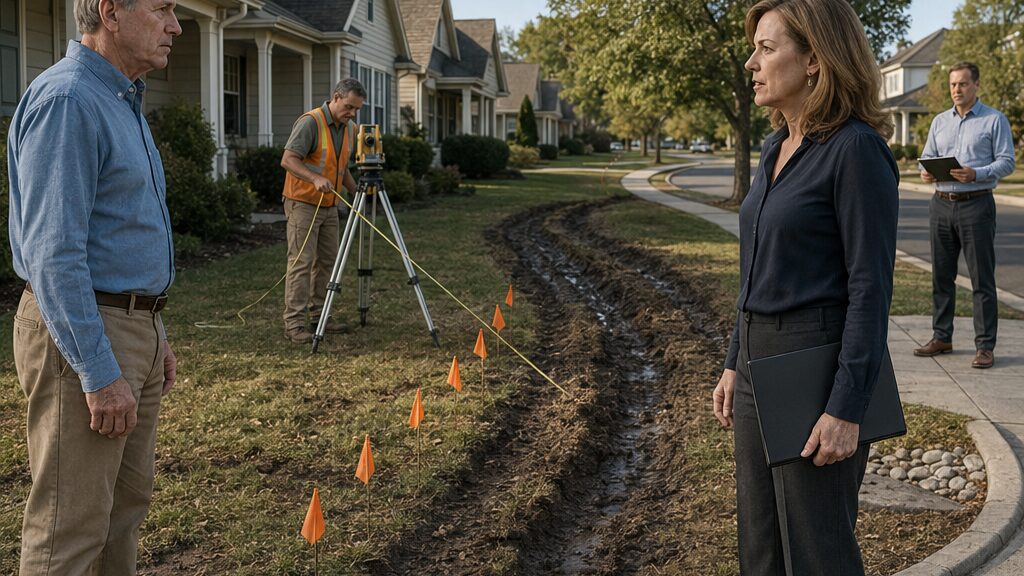
They Tore Across My Lawn to Reach the Drainage Line—Then the Survey Changed Who Needed Whose Permission
Chapter 1: The Tire Tracks Ended Far Inside My Lawn
The first tire rut began at the curb, crossed the sidewalk, and kept going until it was nearly halfway between the street and my front porch.
I stood at the edge of it with one shoe sinking into mud where there had been grass the night before.
For thirty-one years, I had known every low spot in that lawn. I knew which section browned first in August, which sprinkler head leaned after winter freezes, and where the roots of the maple near the corner had begun lifting the soil by half an inch. I had replaced sod there twice, adjusted the irrigation myself more times than I could count, and spent enough Saturday mornings behind a mower to recognize a change in grade simply by the way the wheels pulled.
I had never seen six-inch-deep equipment tracks through it.
A compact maintenance vehicle sat near the drainage swale at the northwest corner of my lot. Mud coated its tires. One of those tires was still pressed into what had been an irrigation line.
Water bubbled through the torn grass.
I walked toward it.
“Hold on.”
The equipment operator had climbed down and was waving me away from the machine.
“This is my yard,” I said.
“We’re clearing the drainage line.”
“You’re standing in my yard.”
He looked toward the swale, then back at me. “HOA authorized the access.”
There are sentences that make you angry because of what they mean, and sentences that make you angry because of how casually they are said.
Authorized the access.
As though those three words explained the trench his tires had carved through my lawn.
I took out my phone instead of answering.
The operator watched me photograph the rut.
I photographed the water rising around the broken sprinkler pipe. I photographed the track where the vehicle had crushed three heads in a row. I photographed the maple.
That stopped me.
The tree was twelve years old. Not ancient. Not irreplaceable in the technical sense. But I had planted it when the old Bradford pear finally split during a storm, and I had spent years pruning it into a shape that shaded the front windows without blocking the street.
Now a long strip of bark had been torn from one side of the trunk. The tire marks curved so close that a root had been exposed.
The operator followed my gaze.
“That was already leaning,” he said.
I turned around.
“It wasn’t.”
He lifted both hands. “I’m not arguing with you. I’m just telling you we were instructed where to go.”
“By whom?”
“The association.”
“That isn’t a person.”
He hesitated.
Then he looked away.
That told me enough for the moment.
By nine-thirty, the maintenance vehicle was gone. The drainage line had been cleared. The water in the swale moved freely again.
My lawn looked as though somebody had dragged a plow through it.
I spent the rest of the morning documenting damage.
Forty-seven feet of irrigation pipe had either been crushed or pulled loose according to the landscaping estimator who arrived after lunch. Four sprinkler heads were damaged. Turf would have to be stripped, the ruts filled and compacted, then resodded. The maple might survive, but he would not guarantee it.
He stood beside the trunk and ran a finger along the exposed wood.
“If this dries out badly or gets infected, you could lose it next season.”
“What would replacement cost?”
“For a tree that size? With removal, stump work, installation?” He exhaled. “Enough that you won’t like the estimate.”
I did not.
By the time he finished, the total came to eighty-four hundred dollars.
I submitted the claim that afternoon.
Photographs.
Estimate.
A short written description.
No accusations. No threats.
I had learned years ago that the more irritated you are, the shorter a formal letter should become.
The HOA property manager acknowledged receipt the next morning.
Then nothing happened.
Three days passed.
Then five.
On the seventh day, I sent a follow-up.
On the ninth, an envelope arrived.
I opened it standing at my kitchen counter.
The letter was one page.
My damage claim had been denied.
The association’s position was that the work had been conducted in connection with maintenance of an established drainage easement and therefore constituted authorized operational activity.
I read the sentence twice.
Then a third time.
They did not dispute that their contractor had crossed the lawn.
They did not dispute the broken irrigation.
They did not dispute the damage to the tree.
They simply believed the existence of an easement answered everything.
I carried the letter into the living room and looked through the front window at the brown scars cutting across the green.
The tracks did not look like a legal argument.
They looked like tracks.
I had owned the property since 1995. The subdivision itself was older. Somewhere in the closing papers I knew there were references to utility rights and drainage access, but I had never had a dispute over either.
Utility workers had used the strip along the rear fence several times.
Drainage crews had inspected the corner before.
Nobody had ever driven across the middle of the lawn.
I felt the familiar urge to call the management company and tell them exactly what I thought of their letter.
Instead, I set the phone down.
If they were relying on an easement, I needed to know what that easement actually said.
I went to the hall closet where I kept the property records in a gray metal file box.
The original deed was near the bottom.
Behind it was a folded subdivision plat I had not opened in years.
I spread it across the kitchen table and flattened the creases with both hands.
Thin black lines crossed the lot.
One ran along the back.
Another touched the northwest corner.
And for the first time since the truck had crossed my grass, I felt something more uncomfortable than anger.
The HOA had not invented the easement.
Chapter 2: The Old Plat Showed Two Different Rights
The deed proved something I did not want proved.
The association had a right to enter part of my property.
I sat at the kitchen table under the yellow light above the breakfast nook, with the denial letter on one side and the old plat on the other.
The rear easement was easy to understand. A utility strip followed the back fence line, wide enough for service access. I remembered cable crews using it years earlier.
The second was different.
A drainage easement crossed the northwest corner.
The printed measurements were faint, and the photocopy I had received at closing was not precise enough for me to tell where the recorded corridor ended relative to the tire tracks outside my window.
I leaned back.
Nine days earlier I had been certain of one thing: they had no right to drive onto my lawn.
That was no longer true.
They might have had a right to enter.
What I did not know was whether they had a right to enter where they had.
The difference mattered.
It also irritated me that it mattered.
The next morning I drove to the county records office.
A clerk helped me locate the recorded subdivision plat and the easement references attached to my parcel. The newer scan was cleaner than my old copy.
I stood at a public terminal enlarging the northwest corner until the lines filled the screen.
The drainage easement was narrower than I remembered.
It hugged the edge of the lot, following the swale before turning toward common property.
The maintenance tracks had not.
At least I did not think they had.
Memory is a dangerous measuring instrument when you’re angry.
So I printed the plat and took it home.
I placed it beside photographs from the morning of the damage.
In one picture, the deepest rut ran close to the maple. In the plat, the recorded corridor appeared much nearer the outer edge of the property.
But photographs taken at an angle can lie.
So can people who desperately want to be right.
That afternoon I called the property manager.
“I’ve reviewed the recorded plat,” I said. “I agree that there is a drainage easement.”
There was a short silence.
Perhaps he had expected a different opening.
“Then you understand why the work was permitted.”
“No. I understand why some access may have been permitted.”
“Mr. Davis—”
“I want the association to identify the exact recorded boundary it believes the contractor stayed within.”
He sighed quietly.
“The board’s position is already stated in the denial.”
“That isn’t what I asked.”
“The drainage work was necessary.”
“That isn’t what I asked either.”
Another pause.
“I’ll forward your concern.”
“Please do.”
I hung up before I said more than I needed to.
For the first time since the damage, I had corrected my own claim rather than just defending it.
The HOA did have access rights.
That fact did not weaken me as much as I had expected.
It made the actual question sharper.
Late Tuesday afternoon, another envelope arrived.
This one was not a claim response.
It was a warning.
Katherine Anderson’s name appeared beneath the board title.
I knew Katherine. Everyone in the neighborhood did.
She had been board president long enough that people often spoke about “Katherine’s rules” when they meant association rules. She was organized, punctual, and capable of remembering the exact month somebody had installed the wrong mailbox fixture.
I had disagreed with her before.
We had never been enemies.
The letter accused me of interfering with HOA operational activities and instructed me not to obstruct authorized maintenance personnel.
It added that continued interference could result in further association action.
I read it standing by the mailbox.
Then I looked at my lawn.
Nobody was there.
No equipment.
No workers.
I had not blocked anybody.
I had taken photographs and filed a claim.
Yet somehow I was now being warned as though I had placed myself in front of a truck.
I called Katherine.
She answered on the fourth ring.
“Richard.”
“You sent me a warning.”
“Yes.”
“What exactly did I interfere with?”
“You confronted the contractor during essential drainage work.”
“I asked why he was driving across my lawn.”
“The association has easement rights.”
“Along a recorded corridor.”
“Richard, we’ve had heavy rain, and that line serves more than your property.”
“I understand that.”
“Then I’m not sure why you’re turning this into a confrontation.”
I looked again at the photograph on my table.
“I don’t know yet whether the contractor stayed inside the easement.”
Katherine’s voice tightened.
“The association does not need every homeowner interpreting plats in the middle of maintenance.”
“No. But somebody needs to interpret them before equipment crosses private property.”
“We acted within our authority.”
“Then a survey should confirm that.”
There was a silence long enough to feel deliberate.
“You’re free to spend money on a survey if you want.”
“I am.”
“Just don’t interfere with the next maintenance visit.”
The next maintenance visit.
That phrase remained with me after the call ended.
I took the warning letter back to the kitchen and placed it beside the plat.
The old Richard—the version of myself from two days earlier—would have written Katherine a reply before dinner.
Probably three pages.
Probably every sentence technically defensible.
Probably none of it useful.
Instead, I searched for licensed land surveyors.
Anthony Clark answered his own phone.
I explained the recorded easement, the maintenance tracks, and the disagreement.
He listened without taking sides.
“What do you want me to establish?” he asked.
“The boundary of the drainage easement.”
“And the travel path?”
“Yes.”
“I can locate the recorded corridor. I can document visible evidence on the ground. I can’t tell you what legal rights follow from it.”
“I don’t need you to.”
That surprised me when I said it.
Two days earlier I had wanted somebody to tell me I was right.
Now I wanted a line.
Anthony said he could come Thursday morning.
After we hung up, I looked through the front window.
The tire tracks had begun drying at the edges.
Soon the grass would start lifting.
Rain would soften the ruts.
Repairs would blur what had happened.
But if Anthony could put the recorded line on the ground before that happened, memory would no longer matter.
Neither would Katherine’s confidence.
Chapter 3: The Flags Stopped Before the Tire Ruts Did
Anthony Clark drove the first survey flag into the ground at 8:17 Thursday morning.
It landed five paces short of the deepest tire rut.
Neither of us said anything.
He checked his equipment, looked through the instrument again, then walked toward the drainage corner with a measuring rod.
I stayed back.
“Don’t follow me yet,” he said.
That was probably for the best.
I had spent three days imagining this moment. In most versions, the survey proved the HOA had been completely wrong. In a few darker ones, the line ran straight through the tracks and left me with nothing except an expensive lesson in easements.
Anthony did not seem interested in either outcome.
He moved another few feet and placed a second flag.
Then a third.
A visible line began appearing across the corner of my property.
Bright orange markers.
Recorded rights made physical.
The maintenance rut crossed them and continued inward.
Anthony stretched a tape between two points and made another notation.
“How far?” I asked.
“Let me finish.”
I nodded.
The restraint cost me more than I wanted to admit.
By nine-thirty, there were enough flags that even I could see the shape of the recorded corridor.
The drainage easement followed the outer corner.
The truck path did not.
The worst of the equipment damage lay several feet inside the line.
Anthony finally walked back toward me.
“Based on the plat and the monuments I located, this is the recorded easement boundary.”
He pointed to the flags.
“And the rut?”
“At the widest deviation, roughly five feet beyond it.”
I looked at the grass.
Five feet.
It sounded small until you saw a tire track sitting on the wrong side of a legal boundary.
“How far onto the property did the vehicle travel?”
“Approximately fourteen feet from the outer reference point along this section. But don’t confuse that with the easement overage. The important measurement is where the recorded corridor ends.”
“Five feet.”
“Roughly.”
I let out a breath.
I expected triumph.
What I felt instead was relief.
I had not imagined it.
I had not become an old man confused by lines on a thirty-year-old plat.
The truck had gone beyond the recorded corridor.
A car door closed behind us.
Katherine Anderson had parked at the curb with the property manager.
She carried a folder.
The property manager carried a clipboard.
Neither looked pleased to see the survey equipment.
“Richard,” Katherine called. “We need to discuss access for the follow-up inspection.”
Anthony returned to his instrument.
I stayed where I was.
Katherine crossed the sidewalk carefully, stepping around the softest mud.
“We’ve been trying to resolve this without unnecessary escalation,” she said.
I almost laughed.
Instead I looked at the folder.
“What do you need me to sign?”
Her expression shifted slightly.
“It’s an acknowledgment that the association may continue necessary drainage maintenance.”
“While my damage claim remains denied?”
“The issues are separate.”
“They seem to overlap by about five feet.”
The property manager looked toward the flags.
Katherine did too.
“What are those?”
“The recorded easement boundary,” I said.
She turned toward Anthony.
“According to whom?”
Anthony looked up. “According to the recorded plat and the field evidence I located this morning.”
Katherine’s mouth tightened.
“The association has drainage rights.”
“Yes,” I said. “Along there.”
I pointed toward the orange flags.
Then I pointed toward the muddy track continuing toward my maple.
“And the truck went there.”
“The contractor used the practical route available.”
“That isn’t what your denial said.”
“The drainage line required immediate attention.”
I could hear something changing in her voice now. Not surrender. Adjustment.
She was no longer arguing that the truck had necessarily stayed inside the easement.
She was arguing that it did not matter.
I waited until Anthony finished stretching a measuring line between two flags.
Then I asked Katherine the question I had been holding since Tuesday.
“Which side of that line do you believe your contractor was entitled to use?”
She looked at me.
Then at the flags.
The property manager lowered his clipboard.
Katherine did not answer directly.
“Richard, there are circumstances where an association has to act to prevent damage to common systems and neighboring homes.”
“That’s a different argument.”
“It is the relevant argument.”
“It wasn’t the argument in the denial.”
She closed the folder.
For a moment, none of us spoke.
The scene in front of us did not require much explanation.
Orange flags stopped at the recorded corridor.
Brown tire tracks kept going.
The property manager finally said, “We’ll need to review the survey.”
“I’ll send you a copy.”
Katherine looked at me.
“We still need drainage access.”
“You have drainage access.”
“You know what I mean.”
“Yes,” I said. “I do now.”
That landed harder than I intended.
Her expression cooled.
“You’ve opposed access before.”
I frowned.
“What are you talking about?”
“We approached you months ago about temporary equipment access.”
I remembered an email.
Vaguely.
Something about using part of my lawn during drainage maintenance.
I had replied no.
One sentence.
No explanation.
No alternative.
At the time, it had seemed perfectly reasonable. My property was not a service road.
Katherine saw recognition in my face.
“You rejected it.”
“That didn’t give you permission to use it anyway.”
“No,” she said. “But it meant we had a drainage problem with limited workable access.”
It was the first thing she had said all morning that I could not dismiss.
Anthony began collecting measurements.
The property manager asked for his contact information.
Katherine handed me the unsigned acknowledgment.
“Think about it,” she said.
“I will.”
She and the manager walked back toward the curb.
I remained beside the flags.
Five feet outside the easement was still five feet outside the easement.
That fact had not changed.
But another fact had entered the argument.
The drainage work had not been invented simply to inconvenience me.
A voice came from the sidewalk.
“Richard?”
Nicole Garcia stood two houses downhill, one hand raised.
She had been watching from her driveway.
When I walked over, she did not ask about the survey.
She pointed toward her house.
“You should come see something before you decide nobody gets through there again.”
Ten minutes later I was standing beside her foundation, looking at a dark horizontal stain on the concrete wall.
It stopped only a few inches below the basement vent.
“That was the last storm,” Nicole said.
I stared at the water mark.
“If that drainage line had stayed blocked another hour,” she said, “I wasn’t worried about your lawn.”
She looked toward my house.
“I was worried about mine.”
Chapter 4: The Neighbor Downhill Changed the Argument
Nicole’s basement wall had a dark water mark less than four inches below the vent.
I bent down and looked at it again, as if the distance might grow if I measured it twice.
“It came up that high?”
“During the storm Saturday night.”
She stood beside me with her arms folded, not defensive exactly, but not relaxed either.
“What stopped it?”
“The line finally cleared enough to pull the water away.” She pointed past her backyard toward the drainage corridor running toward my corner lot. “The property manager had someone checking it every few hours.”
I straightened.
The concrete beneath the vent was still stained. A plastic storage shelf inside the basement had been moved away from the wall. Two cardboard boxes sat on top of a workbench rather than on the floor.
Nothing about it looked staged.
Nothing about it made the truck’s route across my lawn legal.
But it made the problem less convenient.
“I didn’t know it got that close,” I said.
Nicole gave me a tired look.
“I figured.”
There was enough accusation in those two words to make me bristle.
“I didn’t block the drainage line.”
“I didn’t say you did.”
“You implied it.”
“No, Richard. I’m saying everybody’s been arguing about whose rights matter while I’ve been watching water climb my foundation.”
That stopped me.
She had never spoken to me that way before.
Nicole and I had exchanged holiday cookies, borrowed tools, and waved from opposite driveways for more than a decade. She was not an HOA loyalist. I had heard her complain about dues increases more than once.
Which made her irritation harder to dismiss.
“The association had an easement,” I said.
“And they went outside it. I saw the flags.”
“Then you understand.”
“I understand your lawn got damaged. I also understand the drain needed work.”
Both things were true.
I disliked how much room that left between them.
Nicole turned toward the backyard.
“Katherine asked you months ago about temporary access, didn’t she?”
I looked at her.
“How do you know that?”
“Because she mentioned at a board meeting that they were trying to get equipment closer to the west side of the drain.”
There it was.
The email.
I remembered it more clearly now.
A short request had arrived in early spring asking whether I would permit temporary equipment access across a portion of the corner lawn during future maintenance. It had included no route sketch, no restoration terms, no dates, and no explanation of why the existing easement was insufficient.
I had replied within ten minutes.
No.
Nothing else.
At the time I had considered that efficient.
Now Nicole was looking at me as though the missing words mattered.
“They didn’t give me enough information,” I said.
“Did you ask for any?”
I opened my mouth.
Closed it.
“No.”
Nicole nodded once.
“That doesn’t give them the right to tear up your yard.”
“No.”
“But maybe it explains why everybody stopped trying to talk.”
I looked toward my house.
The orange survey flags were visible from here.
A straight, bright boundary.
For three days I had wanted that line because I thought it would simplify everything.
Instead it had divided the facts more cleanly than the blame.
That evening I found Katherine’s old email.
It was exactly as I remembered: vague, brief, and poorly framed.
Requesting temporary access for maintenance equipment.
No dimensions.
No conditions.
No restoration commitment.
I still believed saying no had been reasonable.
What bothered me was how quickly I had said it.
I had not asked why.
I had not asked whether another route existed.
I had not asked what happened if they could not reach the drain.
I had interpreted the request as another HOA intrusion before I understood the problem it was meant to solve.
That did not excuse what happened later.
But it was mine.
The next morning, a message from the property manager appeared in my inbox.
Katherine had apparently forwarded my old refusal to management as part of the association’s response to the survey.
The accompanying paragraph described me as having “consistently declined reasonable access necessary for drainage operations.”
I read that phrase twice.
Reasonable access.
Their original request had not defined what reasonable meant.
Their truck had then driven five feet outside the recorded easement.
And now my one-word refusal was being used to explain why.
I started writing a response.
Three paragraphs in, I stopped.
It sounded like an argument.
I deleted it.
Then I wrote:
Please provide the maintenance authorization, contractor work order, route instructions, and any documentation identifying the equipment path approved for the work performed on my property.
I sent that instead.
By Saturday afternoon, the property manager had provided a partial packet.
It contained the contractor’s invoice, a work order, and several maintenance notes.
Most of it was ordinary.
Drain clearing.
Debris removal.
Equipment time.
Labor.
Then I noticed one line beneath the equipment charge.
Alternate route approved by board due to restricted access.
I read it again.
Not selected by operator.
Not used as necessary.
Approved by board.
I carried the page to the window and looked across the lawn at the flags.
Katherine had told me the contractor used the practical route available.
The invoice suggested somebody had chosen that route before the truck ever arrived.
And if the board had approved the shortcut, then there was a question more important than whether I had been stubborn months earlier.
What exactly had they known when they approved it?
Chapter 5: Someone Approved the Shortcut Before the Truck Arrived
The contractor’s invoice contradicted Katherine in seven words.
Alternate route approved by board due to restricted access.
I laid the page beside Anthony’s survey.
On one sheet, a route had been approved.
On the other, the recorded boundary showed where that route should not have gone.
The question was whether anyone had connected those facts before the work began.
I sent the property manager a second request.
This time I asked specifically for communications between the board and contractor concerning route selection.
The response arrived two hours later.
“We have provided the documents relevant to your claim.”
I called.
The property manager sounded less patient than usual.
“Richard, you’ve received the work order and invoice.”
“The invoice references an approved alternate route.”
“Yes.”
“Approved by whom?”
“The board.”
“Which means there should be something showing what route they approved.”
“Not necessarily.”
“If a contractor asks whether it can drive somewhere outside its normal work area, nobody sends a map?”
He was silent.
That silence told me more than his answer did.
“I’ll see what else is available,” he said.
“Please do.”
I could have called Katherine.
I wanted to.
I imagined asking her directly whether she had known.
But I had finally learned the usefulness of not giving someone the question before I had the record.
So I waited.
Monday passed without anything.
Tuesday morning, I received three additional files.
The first was a scheduling email.
The second was a contractor note about ground conditions.
The third contained a forwarded email chain.
I opened it and immediately saw a small route sketch attached near the bottom.
The contractor supervisor had drawn two possible approaches.
One followed the recorded drainage corridor and required smaller equipment plus temporary hand work near a narrow turn.
The other cut inward across my corner lawn.
Beside the second route was a note.
Private lawn outside recorded easement—owner access recommended before use.
I stared at it.
The email beneath the attachment had been sent to Katherine and the property manager three days before the maintenance work.
The contractor estimated that the easement-compliant route would require an additional crew member and several more hours.
The alternate route would be faster.
Katherine’s reply was short.
Use alternate route. Drainage condition takes priority. We cannot delay another cycle.
No mention of contacting me.
No question about written permission.
No restoration plan.
No dispute over whether the route crossed private property.
She had been warned.
I leaned back in my chair.
For more than a week, I had been arguing over what happened.
Now I knew the more important part.
It had been foreseeable.
I forwarded the email chain to myself, printed it, and placed it beneath the survey.
My first impulse was satisfaction.
My second was anger.
The third surprised me.
Disappointment.
Katherine had sat at the edge of my lawn and told me the contractor had used the practical route available.
That was technically true.
But incomplete in exactly the way that benefited her.
She had chosen the route because the other option cost more time and money.
There had been urgency. Nicole’s water mark had proved that.
But urgency had not erased the decision.
That afternoon the HOA attorney called.
His voice was careful from the first sentence.
“I’ve reviewed the survey and the contractor communications.”
“I assume Katherine has too.”
“I can’t speak for individual board members.”
“That isn’t a no.”
He let that pass.
“The association maintains that drainage conditions required timely intervention.”
“And does timely intervention permit crossing outside the recorded easement?”
“That depends on circumstances. I’m not giving you a legal opinion against my client.”
“Fair enough.”
“But,” he continued, “the existence of urgency does not automatically eliminate responsibility for physical damage caused outside recorded access rights.”
It was the first sentence anyone connected to the HOA had spoken that acknowledged both halves of the problem.
I looked at the broken line in the lawn.
“So we’re no longer pretending the easement covered the whole route.”
“I think it’s more productive to discuss resolution than phrasing.”
“Resolution of the eighty-four hundred dollars?”
“Potentially more than that.”
That caught my attention.
He explained that the association’s liability insurer had been notified. The insurer wanted updated restoration documentation and confirmation of the surveyed route.
“The board also needs a practical plan for future drainage access,” he said.
“That sounds like the board’s problem.”
“It could remain the board’s problem.”
I heard something in the way he said it.
“And Nicole’s,” I said.
“And several other owners downhill.”
There it was again.
The part of the argument I could no longer ignore.
I could make Katherine’s life difficult.
I could refuse anything beyond the recorded corridor and force the association to use the slower, more expensive method every time.
Perhaps that would be justified.
But every delay would not land on Katherine alone.
It would land on basements and foundations downhill.
The attorney continued.
“The property manager would like to meet with you. The insurer is prepared to discuss documented restoration costs. The board also needs clarity regarding future temporary access.”
“Clarity.”
“Yes.”
I almost smiled.
That was a better word than authority.
“What does Katherine want?”
A pause.
“I think the relevant question is what you want.”
For the first time since the truck crossed my lawn, somebody from the association was asking rather than telling.
I looked at Anthony’s survey.
The orange line drawn across the paper seemed different now.
At first it had been proof of where they were not allowed to go.
Now it might become the starting point for deciding where they could go.
“I want the warning withdrawn,” I said.
“I expected that.”
“I want the damage restored properly, not patched.”
“Understood.”
“And I won’t sign anything giving unrestricted access.”
“I don’t think anyone expects you to.”
That surprised me.
“What do they expect?”
“That you’ll tell us what terms you would accept.”
After we hung up, I stood at the front window for a long time.
A week earlier, I would have had an answer immediately.
None.
Never again.
My property. My decision.
Now Nicole’s water mark was part of the answer too.
The property manager emailed before dinner.
Conference room. Following Tuesday.
Attached was a proposed access amendment.
At the bottom was a blank line.
Owner consent: Richard Davis.
I had wanted the HOA to understand that permission mattered.
Now I had exactly what I had asked for.
And I had to decide what to do with it.
Chapter 6: For Once, They Needed My Signature
The first document on the conference-room table required my consent instead of my compliance.
That changed the room before anyone spoke.
The property manager sat across from me.
The HOA attorney was at the end of the table with a legal pad.
Katherine sat beside him, straight-backed, a closed folder in front of her.
Between us lay Anthony’s survey and a proposed temporary-access amendment.
My signature line remained empty.
The attorney began.
“The insurer has reviewed the restoration estimate and supplemental tree assessment.”
I waited.
“They’re prepared to cover the documented property damage, subject to final invoices.”
“All of it?”
“The irrigation, turf restoration, soil repair, and tree treatment. If the tree fails within the specified period due to the documented trunk and root damage, replacement is included.”
Katherine looked down at the folder.
The attorney continued.
“The board will also withdraw the interference warning.”
“Not suspend it?”
“Withdraw.”
“From my account record?”
“Yes.”
That mattered almost as much as the money.
I nodded.
Then the property manager slid the access amendment toward me.
“The association is requesting a defined temporary equipment corridor for future drainage maintenance.”
I looked at the drawing.
It was wider than the recorded easement.
Not as wide as the route the truck had taken, but wide enough to cross part of my lawn.
I pushed it back.
“No.”
Katherine exhaled through her nose.
The property manager looked disappointed.
The attorney did not react.
Katherine finally spoke.
“So this was always about preventing access.”
“No.”
“Richard, we’re offering to restore everything.”
“You’re offering to restore damage you caused.”
“And we’re trying to prevent flooding.”
“So am I.”
She looked at me.
That was the moment I realized she had expected the old answer.
Never.
She had come prepared for refusal because refusal was what I had given her months earlier.
I opened the folder I had brought.
“I’ll allow temporary access.”
The room went quiet.
Katherine’s expression changed first.
Not relief.
Suspicion.
“Under what conditions?” the attorney asked.
I placed my own marked copy of the survey on the table.
Anthony and I had worked through the route two days earlier.
A narrow corridor curved from the street toward the drainage area while avoiding the maple and most of the irrigation network.
“Only this route.”
The property manager leaned forward.
“That’s tight.”
“Then use smaller equipment.”
Katherine started to speak.
I held up one hand.
“I’m not finished.”
She stopped.
“Forty-eight hours’ notice except in an actual emergency. Protective ground mats under equipment. No storage of materials on the lawn. Any damage photographed before the crew leaves. Restoration responsibility belongs to the association.”
The attorney wrote as I spoke.
“And,” I added, “the access expires after each maintenance event. You’re not getting a permanent general-use corridor.”
Katherine shook her head.
“That makes every maintenance visit an administrative process.”
“Yes.”
“That’s inefficient.”
“So was replacing forty-seven feet of irrigation.”
Her jaw tightened.
I did not enjoy the line as much as I expected to.
Maybe because I could see the fatigue under her irritation.
She had made a bad decision.
She had also been trying to keep water out of houses.
Those facts did not cancel each other.
The attorney looked at the route.
“This is workable in principle.”
Katherine turned toward him.
“With extra labor.”
“Yes.”
“With smaller equipment.”
“Yes.”
“And higher maintenance cost.”
“Likely.”
Katherine looked at me.
“That’s what you wanted.”
There was no anger in her voice now.
Just accusation.
Maybe disappointment.
I thought about denying it.
Instead I said, “Partly.”
The room went still.
“I wanted you to have to ask,” I continued. “Because you stopped asking.”
Katherine’s expression hardened.
“You told us no.”
“I did.”
“You didn’t offer conditions. You didn’t offer another route. You didn’t even ask why we needed it.”
“No.”
That seemed to surprise her more than any argument I had made.
I had not admitted that to her before.
“I was stubborn,” I said. “You were vague. I treated vague as a reason to refuse everything.”
Katherine looked at the table.
“And then we had two storms,” she said quietly.
“I know.”
“We had standing water behind three lots. Nicole’s was the worst.”
“I saw her basement wall.”
Katherine nodded.
“The contractor said the easement route would take longer. Another storm was forecast. I made the call.”
“You were told the alternate route crossed outside the easement.”
“Yes.”
There it was.
No document.
No carefully qualified sentence.
Just yes.
“Why didn’t you contact me again?”
Her fingers tightened around a pen.
“Because I thought I already knew your answer.”
That was the character truth I had been circling for two weeks.
She had been wrong to assume.
I had helped teach her what to assume.
Neither fact absolved the other.
“And after the damage?” I asked.
Her face changed.
That was the harder question.
“I thought admitting the route was unauthorized would expose the association to more than the repair claim.”
“So you denied it.”
“I relied on the drainage authority.”
“You knew that wasn’t the whole story.”
She did not answer.
She did not need to.
That was where her responsibility lived—not only in the shortcut, but in what she chose after she saw the damage.
The attorney broke the silence.
“If we can agree on the corridor and procedures, I believe we can finalize this.”
I looked at the proposed language again.
There was one thing missing.
“If the association damages the route, restoration begins within ten business days unless weather makes that impossible.”
The property manager nodded.
“Reasonable.”
Katherine said nothing.
“And if the association ignores the route without a documented emergency, the temporary access permission terminates until we sign a new agreement.”
The attorney looked at me.
“That is a significant condition.”
“It should be.”
He considered it.
Then turned to Katherine.
She stared at the survey for several seconds.
I could see the line she had once treated as an inconvenience.
Now everything depended on respecting it.
Finally she nodded.
“Add it.”
The attorney wrote the change.
The amended document would still need clean drafting and signatures, but the decision had been made.
When the meeting ended, Katherine remained seated while the others gathered their papers.
I stood.
“Richard.”
I looked at her.
“For what it’s worth,” she said, “I wasn’t trying to take your property.”
“I know.”
Her eyes lifted.
“I was trying to keep water out of people’s houses.”
“I know that too.”
She waited for something else.
An apology, perhaps.
Or forgiveness.
I was not ready to give either for free.
“You still had to ask,” I said.
She nodded once.
“Yes.”
I left the conference room with the unsigned draft in my folder.
For the first time since the truck crossed my lawn, nobody was pretending the boundary did not exist.
The association would pay for what it damaged.
The warning would disappear.
Future maintenance could happen.
But only inside conditions written clearly enough that nobody had to guess where authority ended.
And before I signed the final version, one last sentence would be added:
If the HOA crossed that agreed line without a documented emergency, permission stopped there.
Chapter 7: The New Line Left Room for Both Houses
The maintenance truck stopped at the curb.
That was the first difference.
Three weeks earlier, the old contractor vehicle had rolled directly across my grass before I understood what anyone thought they were entitled to do. This time the tires stayed on the street while the crew waited beside a stack of black ground-protection mats.
I watched from the front window for nearly a minute before opening the door.
The lawn looked different now.
The worst ruts had been filled and compacted. New sod covered the scars in long rectangular strips that had not yet blended completely with the older grass. The irrigation line had been repaired, the damaged heads replaced, and the maple had been treated and braced. Whether the tree would make it through another summer was still uncertain, but fresh growth had appeared along two upper branches.
Most of the orange survey flags were gone.
Anthony had returned after the agreement was signed and marked the temporary access corridor we had negotiated. It curved close to the outer property line, widened where the maintenance crew needed room to turn, then narrowed again before reaching the drainage structure.
It was not the route I would have chosen if the only thing that mattered were my lawn.
It was not the route Katherine had chosen when speed and cost were the only things that seemed to matter to her.
It was the route we could both live with.
The property manager stood beside the truck holding a copy of the access plan.
Katherine was there too.
That surprised me.
She had no operational reason to be present.
Maybe that was why she had come.
I walked down the driveway.
The crew supervisor waited until I reached them.
“Mr. Davis?”
“Yes.”
“We’re here for the scheduled drainage inspection. No excavation today unless we find an obstruction that requires it.”
He held out the route sheet.
I had already received the notice forty-eight hours earlier, exactly as required, but I checked the paper anyway.
The dates matched.
The purpose matched.
The equipment listed was smaller than the machine used the first time.
“Where are you entering?” I asked.
He pointed.
“Here, between these two markers. Mats down the whole turf section. We stay inside the flagged route.”
He did not sound irritated by the question.
He sounded like a man describing a work order.
That alone felt like progress.
“Go ahead.”
The crew began unloading the mats.
Each one landed with a dull rubber thump.
They built a temporary track across the grass, one section at a time, until there was a dark path leading toward the drainage corner.
The compact vehicle moved forward slowly.
When its front tires reached the first marker, the operator stopped.
He looked toward me.
It took me a second to understand.
He was waiting for acknowledgment.
I nodded.
Only then did he proceed.
The tires stayed on the mats.
More importantly, they stayed inside the agreed line.
I followed at a distance.
At the drainage structure, the crew opened the access grate and began inspecting the channel. Leaves and storm debris had collected against one side, but the water was moving.
Nicole appeared near the edge of her property.
She raised a hand.
I returned the gesture.
A month earlier, I might have resented the sight of her watching maintenance happen on my side of the neighborhood.
Now I knew what she was looking for.
Not whether I had surrendered.
Whether the water would keep moving away from her foundation.
The crew supervisor called me over.
“There’s some buildup downstream, but nothing urgent. We’d like to clear it by hand while we’re here.”
“Does that change the route?”
“No.”
“Any additional equipment?”
“No.”
“Then do it.”
He nodded and returned to work.
Katherine had been standing near the sidewalk without speaking.
Eventually she walked toward me.
“The smaller equipment adds about an hour,” she said.
I looked at the vehicle.
“An hour’s cheaper than a lawn.”
A faint smile touched one corner of her mouth and disappeared.
“Yes.”
That single word carried more weight than the argument would have.
We watched the crew pull wet leaves and branches from the channel.
After a while she said, “The insurer issued the restoration payment?”
“They did.”
“And the warning?”
“Gone.”
“The manager confirmed it was removed from your account history.”
“I checked.”
She nodded.
The old version of our conversations would have demanded one of us win the last sentence.
Neither of us seemed interested in that anymore.
Katherine looked toward Nicole’s property.
“When her water started rising that night, I thought if I waited for another round of approvals and another conversation about access, I’d be explaining flooded basements the next morning.”
“I understand.”
“I still should have called you.”
“Yes.”
She rubbed a thumb along the edge of the folder she carried.
“And after the damage, I should have handled the claim differently.”
That was as close to an apology as she had come.
I could have pressed her.
Made her say the words exactly.
Instead I said, “I should have asked more questions when you contacted me the first time.”
She looked at me.
“That would have helped.”
“I still might have said no.”
“I know.”
“But maybe not to everything.”
We both looked at the access corridor.
There was something oddly ordinary about it now.
Rubber mats.
Survey markers.
A small maintenance vehicle.
Nothing dramatic.
Nobody watching would have guessed how much anger had been required to make the procedure look boring.
And perhaps boring was the point.
Good rules should make conflict less interesting.
The crew finished before noon.
The supervisor asked me to walk the route with him before they removed the mats.
There were no torn sprinkler heads.
No exposed soil.
No new damage to the maple.
At one corner, a mat had pressed the grass flat, but the blades began lifting almost as soon as it was removed.
The vehicle backed out along the same route.
At the final marker, it stopped again before rolling onto the street.
Nicole crossed toward us after the crew left.
“They got the debris?”
“Yes.”
“Good.”
She glanced over the repaired lawn.
“Looks better.”
“Getting there.”
“And the tree?”
“Ask me next spring.”
She smiled.
Then she looked at the drainage corner.
“I’m glad you didn’t close it off completely.”
I knew what she meant.
A month earlier, I would have heard that as approval for giving something away.
Now it sounded different.
“I almost did,” I said.
“I know.”
That annoyed me just enough to make us both laugh.
Katherine left shortly afterward.
There was no handshake ceremony.
No board announcement.
No public admission that I had been right.
There were also no more warning letters, no unpaid repair bills, and no contractor driving wherever somebody found convenient.
That was enough.
Later that afternoon, I walked the temporary corridor by myself.
Anthony had left one last orange flag near the corner where the new access route met the recorded easement.
I had kept it there longer than necessary.
At first the flags had meant proof.
They had shown where the HOA’s authority ended.
Then they became negotiating marks—evidence that a boundary could be precise without being absolute.
Now the agreement was recorded, the route documented, and every future maintenance order would include the same site plan.
Nobody needed the flag anymore.
I bent down and pulled it from the soil.
The narrow metal stem came free with almost no resistance.
For a moment I stood with it in my hand, looking across the lawn.
The new sod still showed where the truck had crossed.
That would fade.
The maple might survive, or it might not.
Some consequences could be repaired exactly.
Others could only be managed honestly.
Beyond the corner, water moved quietly through the cleared drainage channel toward the lower lots.
Behind me, the irrigation system clicked on.
One repaired sprinkler head rose from the grass and began turning in its slow arc.
The spray stopped well before the property line, then swept back across my yard.
Exactly where it was supposed to.
I carried the last orange flag into the garage.
The boundary was still there.
It simply did not need to be invisible anymore.
The story has ended.