They Called the Quiet Homeowner a Handyman Until His Old Drainage Maps Exposed the HOA’s Costliest Mistake
Chapter 1: The Man Christine Asked to Wait Outside
“You can leave your tools by the utility closet.”
George Hall stopped two steps inside the clubhouse.
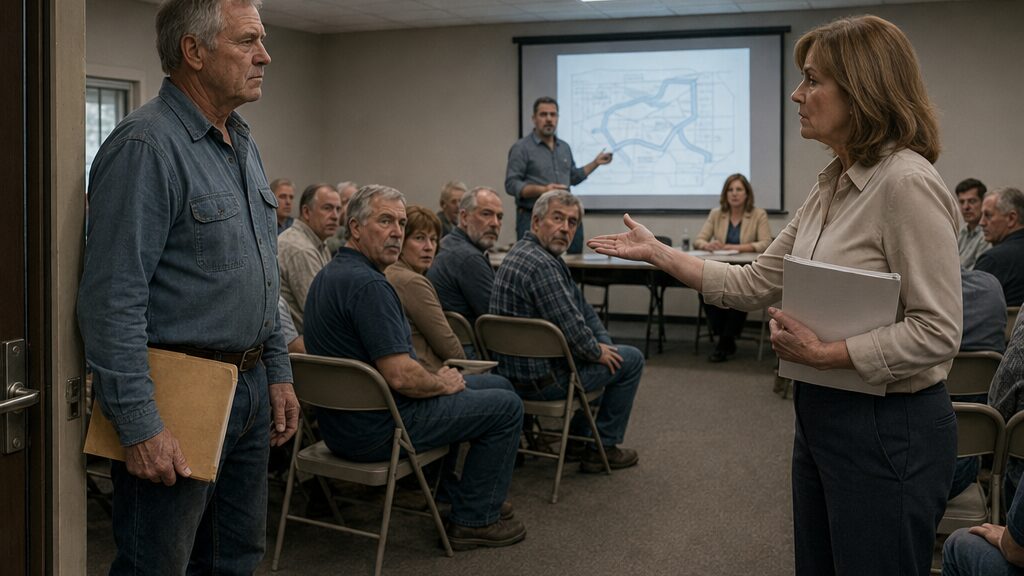
Christine Davis was already looking past him toward the doorway, one hand resting on a stack of assessment packets. Nearly every folding chair was occupied. Homeowners sat shoulder to shoulder beneath fluorescent lights, some holding printed estimates, others whispering over numbers highlighted in yellow.
George looked down at himself.
Faded blue work shirt. Dark jeans. Brown boots with dried mud along the seams. In his left hand, a worn manila folder whose corners had gone soft years ago.
He had come straight from replacing a loose section of fence behind his house.
Christine gave him a distracted smile.
“The board meeting is homeowners only,” she said. “We’re discussing finances. If you’re here for maintenance, the property manager can meet you afterward.”
A few people nearby turned.
Someone near the front gave a short laugh.
George felt the heat rise behind his ears, but he kept his voice level.
“Lot forty-seven.”
Christine blinked.
“My address,” he said. “I own lot forty-seven.”
The laugh stopped.
Christine’s expression tightened just enough for him to notice.
“Well. Then take a seat, Mr. Hall.”
George did.
He chose a chair near the back and set the folder beside his boot.
For the next twenty minutes, Christine moved briskly through slides projected onto the wall. She described recurring flooding along the southern end of the subdivision, water pooling behind three homes, and a contractor proposal to replace sections of the aging stormwater system.
The number came last.
A special assessment of several thousand dollars per household.
The room broke into overlapping voices.
“That’s on top of dues?”
“What happened to reserves?”
“Why are we voting tonight if we just got the packet?”
Christine raised her hand.
“We are not voting on whether there is a problem. There is a problem. We are voting on how to fund the approved solution.”
George looked up.
Approved.
On the wall, a drainage diagram showed a new underground line cutting along the eastern common strip before turning south toward an existing outlet.
He stared at the turn.
Something was wrong.
Not dramatically wrong. Not the kind of thing most people would catch from a simplified presentation.
But the line ended too neatly.
He opened his folder halfway, then stopped.
The contractor stood beside the screen, answering questions about pipe diameter and excavation depth. Christine repeatedly redirected concerns toward cost.
George waited until the room quieted.
“Where does the overflow go?”
The contractor looked toward him.
“Excuse me?”
“During a hundred-year storm. If that main line reaches capacity, where does the overflow discharge?”
The contractor glanced at the diagram.
“The system is sized to current standards.”
“That wasn’t my question.”
Several heads turned.
Christine folded her arms.
“Mr. Hall, the contractor has already explained the engineering.”
George kept his attention on the contractor.
“There used to be a surface overflow route on the east side. It crossed the common strip and dropped toward the county swale. Your drawing doesn’t show it.”
The contractor stepped closer to the screen.
For the first time that evening, he did not answer immediately.
“That may have been an older configuration.”
“It was.”
“And conditions change.”
“They do.”
George leaned back.
“So where does the water go now?”
A low murmur moved through the room.
Christine cut in.
“This is getting beyond the purpose of tonight’s meeting.”
George finally looked at her.
“If you’re asking people for several thousand dollars each, I’d say where the water goes is part of the purpose.”
Her jaw set.
“The engineering has been reviewed.”
“By the county?”
The contractor shifted his weight.
Christine’s eyes flicked toward him.
The pause lasted perhaps two seconds, but it changed the room.
Michael Nelson, seated at the board table with a calculator and a budget sheet, looked up sharply.
Christine answered first.
“The permit process is being handled.”
George nodded once.
That was not the same answer.
Kathleen Rivera, seated near the aisle, spoke from three rows ahead.
“My garage flooded twice last year. I don’t care whose feelings are hurt or who used to know what. I need the water fixed.”
George looked at her.
He recognized the exhaustion before the anger. She had stacked sandbags behind her garage during the spring storm. He remembered seeing them from the sidewalk.
“I agree,” he said.
Kathleen seemed almost annoyed by the answer.
“Then why are you trying to slow this down?”
“I’m trying to find out where the water goes.”
Christine tapped the table with a pen.
“We are moving on.”
She declared George’s technical question outside the scope of the meeting and returned to the financing schedule.
But something had changed.
People no longer watched only the projected numbers.
They watched the contractor.
They watched Christine.
And occasionally, they looked back at George.
He said nothing else.
By the time the meeting adjourned, the assessment had not been formally adopted, but Christine announced that contractor mobilization would begin under existing board authority while final financing was completed.
Residents filed out in tense clusters.
Michael remained at the table, running figures again.
Kathleen passed George without speaking.
Christine avoided his eyes.
George carried the manila folder home beneath one arm.
In his kitchen, he placed it on the table under the yellow cone of the pendant light.
He had not opened the bottom section in years.
Inside were old inspection sketches, field measurements, photocopied plats, handwritten drainage elevations, and pages browned along the edges.
He found the subdivision map after several minutes.
There was the eastern overflow corridor.
Exactly where he remembered it.
A thin easement line crossed the common area before continuing behind the lots south of Kathleen’s house.
George traced it with one finger.
Then he saw two small initials beside a handwritten field note.
G.H.
His own.
For several seconds he did not move.
The folder had not merely preserved the neighborhood’s drainage history.
It had preserved his place in it.
Chapter 2: The Map Beneath Thirty Years of Notes
George noticed the missing line before his coffee finished brewing.
He had spread three sheets across the kitchen table: the old subdivision plat, the HOA contractor diagram he had taken from the meeting packet, and a photocopy of a county drainage plan nearly thirty years old.
The new design crossed the eastern common strip.
The old design reserved it.
George moved the papers until the property lines aligned.
Then he sat very still.
The contractor’s proposed trench would occupy part of the surface overflow corridor.
Not cross it temporarily.
Occupy it.
He reached for a ruler from the kitchen drawer and compared the scale again.
Same result.
George had spent thirty-two years in municipal construction inspection before retiring, most of them walking sites rather than sitting behind a desk. He had inspected retaining walls, culverts, foundations, utility trenches, storm drains, and enough failed grading jobs to know that water did not care what a board resolution said.
It followed elevation.
It found weakness.
And when people blocked one route, it found another.
By eight-thirty he was outside.
The neighborhood looked ordinary in the clean morning light: trimmed lawns, brick mailboxes, dog walkers, sprinklers ticking over grass.
George followed the sidewalk toward the eastern common area.
Orange paint marked the ground.
Small wooden stakes carried fluorescent ribbons.
He crouched beside one and looked across the slope.
The land had changed.
A cedar privacy fence now ran behind two homes where the old plan had shown open grade. Decorative shrubs filled another section. A raised flower bed had been built close to the common strip.
None of those changes seemed important by themselves.
Together, they narrowed the space where stormwater had once been expected to spread safely during an extreme event.
George pulled his phone from his pocket and photographed the stakes.
Then he walked downhill.
At the southern end, the grass dipped toward Kathleen Rivera’s property. The soil near the curb remained dark from the previous week’s rain.
She was outside dragging two flattened cardboard boxes toward the recycling bin.
She saw him measuring the grade with his eyes.
“You checking my yard now?”
“No.”
“Looks like it.”
George pointed toward the common strip.
“I’m checking that.”
Kathleen followed his hand.
“So you can stop the project?”
“So I can understand it.”
She gave a tired laugh.
“Meanwhile, my garage gets another inch of water every time we have one of those summer storms.”
George looked toward the garage door. A faint brown line ran across the concrete near the bottom seal.
That mark did more to challenge him than Christine’s dismissal had.
He had spent the night thinking about plans.
Kathleen had spent storms moving belongings off the floor.
“I know it’s real,” he said.
“Do you?”
He did not answer quickly enough.
Kathleen shook her head and carried the boxes toward the curb.
George continued downhill.
Near the county swale, he stopped.
A row of newer landscaping stones had been installed along the edge of a property that did not exist when the original grading plan was approved. The stones redirected shallow runoff toward the same low area behind Kathleen’s house.
George took another photograph.
The old system had not simply aged.
The neighborhood had slowly grown over parts of its safety margin.
Back home, he returned to the folder.
This time he went deeper.
Inspection reports.
Punch lists.
Handwritten notes from field meetings.
A faded copy of a county memo.
He found his name repeatedly.
Not as a consultant.
Not as someone who happened to remember the neighborhood.
As the field inspector assigned to the original drainage work.
He had watched the first pipes go into the ground.
He had measured elevations.
He had signed inspection sheets.
The knowledge that had impressed the room the previous night suddenly felt heavier.
George turned another page.
A typed note had been stapled to a field sketch.
Phase One drainage improvements were acceptable for initial occupancy, subject to future extension of the eastern overflow corridor when county capital funding became available.
George read it twice.
Then he read the handwritten note below it.
Temporary condition acceptable pending Phase Two.
His initials appeared beside the line.
A memory returned with uncomfortable precision.
A muddy construction trailer.
A county engineer standing over rolled plans.
A developer complaining about delays.
A funding schedule that promised the second phase the following fiscal year.
George had believed the temporary arrangement would last twelve months, perhaps eighteen.
He had not thought about it in years.
A truck door slammed outside.
George stepped to the front window.
Across the common area, a flatbed had pulled in carrying sections of large black drainage pipe.
Two workers climbed down.
Another vehicle followed.
George checked the time.
9:17 a.m.
The board meeting had ended less than twelve hours earlier.
He picked up his folder and walked outside.
The work crew foreman was speaking with the property manager when George reached the common strip.
“Morning,” George said. “You starting today?”
“Layout today. Excavation tomorrow if everything clears.”
“Under what authorization?”
The property manager stepped forward.
“Mr. Hall, the board has approved mobilization.”
“Mobilization and excavation aren’t the same thing.”
The foreman looked between them.
“We were told permits are in process.”
George glanced down at the fresh orange markings.
One line ran almost exactly along the corridor shown on his old map.
He opened the folder.
For the first time in decades, the old paper lay directly above the ground it described.
George aligned the lot corners with the houses beyond.
The match was not perfect. Landscaping and fences had changed the view.
But the corridor was unmistakable.
The contractor was preparing to dig through the path once reserved to keep extraordinary runoff away from the lower homes.
The property manager frowned.
“What is that?”
“Original drainage plan.”
“You had that last night?”
“Not this sheet.”
That was technically true.
It also sounded evasive.
George knew it.
The property manager took out her phone.
“I need to call Christine.”
George barely heard her.
His attention had caught on a small county notation in the lower corner of the plan.
He wiped his thumb across the faded copy.
TEMPORARY PHASE ONE CONDITION.
Below it, in handwriting he recognized immediately, was a date and a reference to future extension.
George stared at his own initials beside the approval.
The question was no longer why the overflow route had disappeared from the HOA’s plan.
The question was how something he had approved as temporary had survived for nearly three decades.
Chapter 3: The Project Was Already Moving Without Them
The excavator started at 7:12 Thursday morning.
George heard the diesel engine through his bedroom window before he heard his coffee maker click on.
He dressed without breakfast, took the manila folder from the kitchen table, and walked toward the common strip.
The neighborhood was barely awake.
The machine sat on a trailer near the curb, its boom folded inward. Workers were unloading barriers and lengths of pipe. Orange paint now marked a wider path through the grass.
George found the work crew foreman beside a utility map.
“You said excavation started if everything cleared.”
The foreman nodded.
“It cleared enough for us to mobilize.”
“That isn’t what I asked.”
“We have preliminary authorization from the association, and we were told the permit amendment is being processed.”
“Processed or approved?”
The foreman exhaled.
“You need to talk to your board.”
“I intend to.”
The excavator rolled down from the trailer.
George stepped away from the machine.
He knew better than to interfere with a crew physically. His authority here was none. Retirement had stripped away the badge, the county radio, the ability to order a stop while paperwork was checked.
All he had was knowledge.
And, increasingly, questions about his own.
Kathleen Rivera came through her side gate wearing rubber boots.
“Are you stopping them again?”
“I haven’t stopped anybody.”
“You’re trying.”
Her voice was sharper than the previous morning.
George looked toward her backyard.
Near the garage, several plastic storage bins sat elevated on boards. A stained section of drywall had been removed inside the open side door.
“You had water inside?”
“Four inches in the corner last storm.”
George looked at the dark line along the concrete.
Kathleen crossed her arms.
“My insurance deductible is higher now. The adjuster told me another claim could become a problem. Christine finally gets something moving, and suddenly you show up with thirty-year-old maps.”
“They’re still relevant.”
“To you.”
“To the water.”
Kathleen’s expression hardened.
“That’s easy to say when it isn’t your garage.”
George almost told her he had inspected storm failures across the county for decades. Almost explained that he had seen retaining walls collapse because somebody treated drainage as an afterthought.
The words reached his throat and stopped.
Expertise would not dry her floor.
“I don’t want them to build something that pushes more water toward you.”
Kathleen studied him.
“Then show me what you want instead.”
George had no answer ready.
That irritated her more than argument would have.
“So there isn’t a plan.”
“There’s a problem with this one.”
“That’s not the same thing.”
She walked back toward her house.
George stayed beside the marked corridor.
Her words followed him longer than he wanted them to.
By noon, Christine had called an informal gathering near the clubhouse entrance.
Michael Nelson stood with her holding a folder of contractor documents. The property manager had printed several pages from the county permitting portal.
About a dozen homeowners gathered in a loose semicircle.
Christine did not waste time.
“Because there has been confusion,” she said, “I want to make clear that the contractor is operating under board authorization. We have also submitted the additional county documentation requested this morning.”
George raised a hand slightly.
“Requested because there wasn’t a final permit.”
Christine looked at him.
“We were already working through that.”
“After mobilization.”
“Yes, George. Because the flooding has not paused while everyone debates procedure.”
There was frustration in her voice, but also something else.
Fear.
George recognized it.
Christine had photos clipped inside her packet—yards under water, a garage threshold submerged, a retaining edge washed out.
She held them up.
“This is why we are moving quickly.”
Several homeowners nodded.
George felt the room—if a sidewalk gathering could be called a room—turn slightly against him.
Then Michael spoke.
“What about the overflow corridor George mentioned?”
Christine glanced at him.
“The contractor says the proposed system has sufficient capacity.”
“That’s not what I asked,” Michael said.
The same question, now coming from the treasurer, landed differently.
Christine’s mouth tightened.
George opened his folder.
“I can show you where the corridor was reserved.”
Before he could pull out the map, Christine reached into her own packet.
“I think we should show everyone something else first.”
She removed a photocopied inspection sheet.
George recognized the format from three feet away.
County header.
Project number.
Inspection line items.
His stomach tightened.
Christine held the page toward the homeowners.
“This is part of the original drainage approval.”
George said nothing.
Michael stepped closer to read it.
Christine continued.
“George has been asking why this system was built the way it was. That’s fair. But he hasn’t mentioned that he was involved in approving it.”
Kathleen, standing near the edge of the group, looked directly at George.
Christine turned the sheet.
At the bottom was a signature.
George Hall.
Not initials.
Not an ambiguous field notation.
His full signature.
A murmur passed through the homeowners.
George could have explained immediately.
Phase One.
Future extension.
Budget authorization.
Different engineering assumptions.
He knew every phrase that could soften what they were seeing.
But the paper was real.
His signature was real.
And he had stood in the clubhouse two nights earlier questioning everyone else’s process without telling them that his own name was buried in the history of the problem.
Kathleen spoke first.
“You approved it?”
George looked at her.
“I approved a phase of it.”
Christine gave a restrained shake of her head.
“That distinction would have been useful Tuesday.”
George felt the old reflex rise in him—the instinct to correct wording, define scope, separate inspection from design responsibility.
Instead he looked at the sheet.
“I should have told you.”
The admission quieted the group more effectively than denial would have.
Michael frowned.
“So what exactly did you approve?”
George opened his mouth.
The excavator engine started behind them.
For a moment no one spoke.
The machine turned toward the orange line across the grass.
Christine folded the photocopy and held it at her side.
“We can discuss history,” she said, “but people need a solution now.”
George looked from the machine to his own signature.
For the first time since the meeting began, stopping the project was no longer enough.
Before he could ask the neighborhood to trust his warning, he would have to explain why his name was already attached to the mistake.
Chapter 4: His Signature Changed the Meaning of Everything
Kathleen Rivera placed the photocopy on George’s kitchen table as if she were afraid he might try to slide it away.
His signature sat at the bottom in black ink.
GEORGE HALL.
The copy was grainy, but not grainy enough.
“You said you approved a phase,” Kathleen said. “What does that mean?”
Six homeowners had crowded into George’s kitchen and adjoining dining area. Michael Nelson stood near the counter with his arms folded. Christine had not come. Neither had the property manager.
George’s manila folder lay open beneath the pendant light.
For thirty years it had been something he kept because throwing old work away felt wrong.
Tonight it looked like evidence.
“I inspected the installed work,” George said.
Kathleen’s eyes narrowed. “That sounds like a distinction designed to get you out of something.”
“It’s a distinction because inspectors don’t design projects.”
“But you signed it.”
“Yes.”
He heard his own defensiveness and disliked it.
Michael leaned toward the photocopy.
“What exactly were you certifying?”
“That the work shown for Phase One matched the approved construction plans and met the requirements in place at that stage.”
“And Phase Two?”
George pulled a faded field sketch from the folder.
“This.”
He flattened it.
The drawing showed the eastern overflow corridor extending beyond the original pipe network. The line crossed what was now the landscaped common strip and descended toward the county swale.
George pointed to a notation.
“The county split the improvements because the money wasn’t available to do the full drainage work at once. Phase One handled normal runoff. Phase Two was supposed to preserve and improve the emergency overflow route.”
Kathleen looked at the drawing but did not soften.
“Supposed to.”
“Yes.”
“What happened?”
George sat back.
He had spent most of his life explaining failures in concrete terms. A pipe was too high. A trench lacked compaction. A wall had no drainage stone.
This was harder.
“The funding was deferred.”
“For how long?”
“A year at first.”
“And after that?”
George looked at the old paper.
“Another budget cycle.”
Michael spoke quietly. “And then?”
“Then the county priorities changed.”
The room stayed silent.
George could feel what they were waiting for.
He gave it to them.
“And I stopped following it.”
Kathleen’s face changed.
Not relief.
Recognition.
“You knew?”
“I knew the second phase hadn’t been built.”
“And you lived here all this time.”
George nodded.
“Why didn’t you say anything?”
“I thought the original surface route was still being kept open.”
“That isn’t what I asked.”
Her words landed because they were almost exactly what George had said to the contractor two nights earlier.
He looked at her.
“No,” he said. “It isn’t.”
The refrigerator hummed behind him.
George folded his hands.
“When I retired, I made a point of not being the former county guy who told everybody how to do their job. I’d spent decades being responsible for other people’s sites. I was done.”
Kathleen stared at him.
“So you were done, and the rest of us kept living on top of it.”
George felt the sting and did not push it away.
“That’s fair.”
Michael lifted one of the older sheets.
“Were there problems back then?”
“Not like this. The neighborhood had fewer houses finished, less landscaping, more open ground. The overflow corridor was still mostly clear.”
“And you assumed it would stay that way?”
“Yes.”
“Did you ever check?”
George hesitated.
That was answer enough.
Kathleen moved toward the window overlooking the common strip.
“My garage flooded the first time three years ago.”
“I remember.”
“You saw the sandbags.”
“Yes.”
She turned.
“And you still didn’t look at these?”
George glanced at the folder.
“No.”
He had expected the old papers to help him stop Christine.
Instead they were dismantling his preferred version of himself.
He had told himself retirement meant surrendering authority.
What he had actually surrendered was attention.
Michael broke the silence.
“I don’t trust Christine’s process right now.”
Kathleen gave him a sharp look.
“I don’t trust his either.”
“I didn’t say you should.”
Michael tapped the photocopy of George’s signature.
“But if both sides have been wrong about something, then we need to know what the current proposal actually does.”
One of the homeowners near the doorway asked, “Can it make the flooding worse?”
George answered carefully.
“If the proposed trench narrows the remaining overflow corridor and the main pipe reaches capacity, water will seek the next low path.”
Kathleen already knew the answer.
“My property.”
“Possibly.”
“Possibly?”
“I won’t tell you definitely without current elevations.”
She gave a humorless laugh.
“At least now you’re admitting when you don’t know.”
George accepted that too.
Michael pulled the HOA contractor plan from his binder and laid it beside George’s old map.
“Show me again.”
They aligned the property lines.
The newer plan was cleaner, computer-generated, full of precise dimensions.
The old one was faded and marked by hand.
For several minutes George traced the historic corridor while Michael compared the proposed trench.
Then Michael stopped him.
“Wait.”
He turned the new plan sideways.
“What’s this retaining edge?”
“Landscape wall,” George said.
“No. This line.”
George leaned closer.
The contractor had shown a reinforced trench section along the common strip. Beyond it, grading narrowed toward the properties below.
Michael placed his finger on the old map.
“That’s the reserved corridor.”
George looked at both sheets.
The contractor’s design did more than cross the old emergency path.
In one section, it effectively pinched it between the new drainage structure and existing landscaping.
Kathleen came back to the table.
“What does that mean?”
George did not answer immediately.
Michael did.
“It means if George is reading this right, the new project could make the old problem permanent.”
A homeowner near the door swore under his breath.
George studied the plans again.
The recognition brought no satisfaction.
If the corridor was still legally protected, the design had a problem.
If it was not, the neighborhood still had a hydraulic one.
Either way, the argument had moved beyond his signature.
Michael reached for his phone.
“I’m going to county records tomorrow.”
George looked up.
“I’ll come.”
Kathleen picked up the photocopy but did not hand it back.
“I’m coming too.”
George nodded.
Then Michael pointed to the lower edge of the HOA plan.
“There’s one more thing.”
A bold line labeled the proposed excavation limit.
It crossed directly over the same narrow strip once reserved for Phase Two.
The room went quiet again.
This time nobody was looking at George’s signature.
They were looking at where the new project intended to put theirs.
Chapter 5: The Easement the New Plan Could Not Erase
The county permit clerk found the easement before George found a comfortable way to ask for it.
“Original subdivision plat,” she said, sliding a digital record across her screen. “Recorded with stormwater access and drainage restrictions.”
George stood beside Michael at the counter Friday morning.
Kathleen waited a few feet behind them, arms folded.
“Can you enlarge the eastern section?” George asked.
The clerk did.
There it was.
A narrow drainage easement running behind several lots and through the common strip.
Still recorded.
Still active.
George felt a brief rush of vindication, followed immediately by caution.
A line on a plat was not a solution.
Michael leaned closer.
“That matches your map.”
“It should.”
Kathleen gave George a look.
He understood the warning in it.
Should was not good enough anymore.
The clerk printed the easement instrument and placed the pages on the counter.
George read them slowly.
Maintenance rights.
Access rights.
Restrictions against structures interfering with drainage function.
Then a paragraph near the end.
Any substantial modification affecting shared drainage facilities required county review and approval under applicable regulations, together with consent procedures established for the affected property interests.
Michael frowned.
“What does ‘consent procedures’ mean?”
The clerk turned the page.
“This recording references the association declaration.”
They requested that too.
Twenty minutes later, they had the older declaration spread across a small records-room table.
The relevant language was blunt.
Material alterations to common drainage facilities affecting multiple lots required approval from all directly affected owners, and in this subdivision’s original structure, the defined class included every homeowner served by the shared system.
Kathleen read it twice.
“All of us?”
“For a material alteration of this kind,” George said, “that’s how I read it.”
Michael sat back.
“So the board can approve maintenance, but not just redesign the shared system.”
“Not without following this.”
Kathleen looked at George.
“And the county permit?”
“Separate question.”
They carried the documents downstairs to the county engineering office.
A county engineer met them in a small conference room after Michael explained that contractor work had already mobilized.
George kept his hands off the plans while the engineer reviewed them.
That was harder than he expected.
For years, he had been the person leaning over drawings, pointing out grades and elevations while others waited.
Now he forced himself to wait.
The engineer compared the HOA proposal with the recorded plat.
“This alignment is tight.”
George nodded.
Kathleen looked between them.
“Tight means what?”
“It means I’d want to see how they’re preserving emergency overflow.”
“That’s what he’s been asking.”
The engineer looked at George.
“You worked on this subdivision?”
“Field inspection. Long time ago.”
“Original phase?”
“Yes.”
George added, before anyone else could, “And I signed the Phase One acceptance.”
The engineer nodded without visible judgment.
“Then you know how often temporary things become permanent.”
George looked down.
“Yes.”
The engineer traced the easement with a pencil.
“The county can review pipe capacity and construction standards. But county approval doesn’t erase a private drainage easement or association voting requirement.”
Michael tapped the contractor design.
“What if they get the permit amendment today?”
“They still have to comply with property restrictions.”
Kathleen exhaled.
For the first time since the meeting, George saw some of the tension leave her shoulders.
Not because the flooding was fixed.
Because somebody outside the argument had confirmed that the questions were real.
They returned to the subdivision shortly after noon.
Christine was waiting near the clubhouse.
She held a printed document in one hand.
The property manager stood beside her.
“You went to the county,” Christine said.
Michael answered.
“We did.”
Christine held up the document.
“So did we.”
George recognized the county formatting.
“Permit amendment?”
“Approved this morning.”
Michael stared at it.
“That fast?”
“We submitted what they requested.”
Christine’s voice carried something close to relief.
“The contractor can proceed.”
Kathleen stepped forward.
“No.”
Christine looked surprised.
Kathleen held out the easement copy.
“This says otherwise.”
Christine took the pages.
Her eyes moved over the first paragraph.
Then the second.
“This is old.”
“So is my mortgage,” Kathleen said. “That doesn’t make it imaginary.”
George almost smiled, but Christine looked too tired for the moment to feel satisfying.
She lowered the document.
“The county approved the work.”
“The county approved the construction details,” George said. “That doesn’t give the board authority to ignore a recorded easement or the association’s own consent requirement.”
Christine looked at him.
“You’ve been looking for a reason to stop this since Tuesday.”
“No.”
“That’s exactly what you’ve done.”
“I’ve been looking for where the water goes.”
“And meanwhile I have homeowners calling me every day asking if their insurance will renew.”
Her voice rose, then she caught herself.
For a moment George saw the pressure beneath the control.
Christine had not invented the flooded garages.
She had not invented the complaints.
She had simply decided that urgency gave her permission to shorten the path.
George spoke more quietly.
“The flooding is real.”
“Then help me fix it.”
“I’m trying.”
“No. You’re telling me what we can’t do.”
The accusation landed because Kathleen had said almost the same thing.
George had no satisfying reply.
Christine handed the easement pages back to Michael.
“I’m not stopping an approved project over a thirty-year-old interpretation without legal review.”
She turned to the property manager.
“Tell the contractor to continue layout.”
George watched her walk into the clubhouse.
Michael looked at him.
“What now?”
“County engineer.”
“We just talked to him.”
“I want it in writing.”
George called from the parking lot.
The engineer answered after several minutes.
George explained that Christine intended to proceed on the strength of the amended permit.
The engineer was silent for a moment.
Then he said, “Mr. Hall, make sure you understand something.”
George put the phone on speaker.
“The permit means the proposed work meets the county conditions we reviewed. It does not adjudicate private easement rights, and it does not replace whatever approval your association documents require.”
Michael nodded slowly.
Kathleen stared toward the construction strip.
George asked, “If they excavate inside the recorded easement before that’s resolved?”
“That becomes a different problem.”
A metallic clang sounded from the common area.
They turned.
Workers were unloading trench barriers.
Christine’s permit might have solved the county paperwork issue she was worried about.
It had not given the board permission to erase the line beneath their feet.
Chapter 6: The Permit Did Not Give the Board Permission
By eight Saturday morning, the work crew had painted a bright orange cut line straight across the recorded drainage corridor.
George stood at the edge of the grass with the manila folder under his arm.
The line was impossible to misunderstand.
It ran from the proposed trench toward the narrow section Michael had identified on the plans, crossing the area the old plat preserved for emergency overflow.
The work crew foreman approached.
“Mr. Hall.”
“You seen the easement?”
“I’ve seen what your property manager sent.”
“That include the recorded plat?”
The foreman hesitated.
“No.”
George handed him a copy.
The foreman studied it, then looked toward the excavator.
“I’m not making a property-rights call.”
“I wouldn’t ask you to.”
“What are you asking?”
“Don’t dig across that line until the association tells you it has authority to do it.”
The foreman rubbed his jaw.
“That could cost us a day.”
“It could save you from digging it twice.”
He looked at the paper again.
Then he raised one hand toward the operator.
The excavator engine stayed running, but the bucket did not move.
Christine arrived fifteen minutes later.
She did not approach George outside.
Instead she called an emergency board meeting in the clubhouse.
The same room where she had mistaken him for maintenance four days earlier filled quickly.
This time nobody laughed at George’s clothes.
Nobody asked him to wait outside.
He sat at the same rear table, but when the meeting began, he carried the folder to the front and placed it open between the board and the homeowners.
Christine held the amended permit.
“This document allows the contractor to proceed.”
George placed the recorded easement beside it.
“And this document says where the association may not proceed without the required consent.”
Christine looked toward Michael.
“You’re the treasurer. Are you now taking his position?”
Michael shook his head.
“I’m taking the position that spending association money on work we may have to undo is bad financial management.”
One of the board members muttered something under his breath.
Christine ignored him.
“The county reviewed the revised plans.”
“Yes,” George said.
“And approved them.”
“Yes.”
“Then why are we still here?”
George could have answered with statutes, plat language, drainage calculations.
Instead he looked toward Kathleen.
She was sitting near the aisle.
The brown waterline on her garage wall had been in his mind all morning.
“We’re here because I made the same mistake thirty years ago.”
The room changed.
Christine stopped moving.
George put one hand on the folder.
“I approved Phase One of the original drainage work. I believed the second phase would follow. When funding disappeared, I treated that as somebody else’s problem. Then I retired. Then I lived here while landscaping, fences, and grading slowly changed the overflow path.”
He glanced at Kathleen.
“I saw flooding and still didn’t open this folder.”
Nobody interrupted.
George continued.
“That doesn’t make the current plan wrong by itself. But it means I don’t get to stand here pretending everyone else created this problem.”
Kathleen’s expression shifted.
Not forgiveness.
Attention.
George pointed to the easement.
“What I can tell you is that the amended permit and the board’s authority are two different things. The county can approve how a pipe is installed. It cannot vote for the homeowners. It cannot erase a recorded easement.”
Christine’s fingers tightened around the permit.
“So what do you want?”
“A pause.”
“For how long?”
“Long enough to compare the proposed design with the easement and get the required homeowner approval.”
“And if a storm hits next week?”
George looked at her.
“I don’t know.”
Her frustration broke through.
“That’s the problem. Nobody who objects ever has to answer for doing nothing.”
George understood then why she had pushed so hard.
Christine was not afraid of losing the argument.
She was afraid of waking after another storm to photos from Kathleen and two other homeowners, knowing she had chaired meetings while water entered their homes.
She looked around the room.
“I requested a full membership vote two months ago.”
Michael frowned.
“You never brought that to us.”
“I didn’t put it on the final agenda.”
“Why?”
Christine’s silence lasted too long.
Finally she said, “Because counsel told me notice requirements could push a vote into next month. We had already lost six weeks on bids.”
Michael stared at her.
“So you decided board authorization was enough.”
“I decided maintenance authority gave us room to act.”
“On a redesign?”
Christine looked away.
“That was the judgment I made.”
George felt no pleasure in hearing it.
There it was.
Not corruption.
Not some hidden personal deal.
A pressured decision made by someone who had convinced herself that delay was the greater danger.
But it had still been her decision.
Kathleen stood.
“My garage flooded,” she said. “I want this fixed more than anybody in here.”
Christine looked at her.
Kathleen continued.
“But I also want to know where the water goes when that new pipe fills.”
George watched Christine absorb the words.
Michael opened the cost sheet.
“If we dig today and have to revise later, we pay mobilization twice.”
The property manager spoke from the wall.
“The contractor can hold excavation until Monday without a remobilization charge if the equipment stays staged.”
Christine turned.
“You checked?”
“This morning.”
A small silence followed.
Christine looked at the permit in her hands.
Then at George’s open folder.
“Monday,” she said.
George did not move.
“The contractor pauses through Monday. We get the easement interpretation and confirm the voting requirement.”
Michael nodded.
It was not a victory.
The flood risk remained.
The assessment remained.
The engineering problem remained.
But the excavator outside had stopped.
When the meeting began to break up, Kathleen approached George.
He started gathering the old maps.
“Leave that one open.”
He looked at her.
She pointed to the historic overflow sketch.
George flattened it again.
Kathleen studied the line running toward the county swale.
“If this plan is wrong,” she said, “what would you do instead?”
George started to answer with another warning.
Then stopped.
She was not asking him what he would block.
She was asking what he would build.
Kathleen tapped the map.
“Show me.”
Chapter 7: A Better Drainage Plan Cost Everyone Something
Kathleen did not let George begin at the clubhouse.
On Monday morning, when the homeowners gathered for the promised walk-through, she stood beside her open garage and pointed at the brown stain across the lower wall.
“Start here.”
George looked toward Christine, Michael, the property manager, and the dozen residents waiting behind them.
Then he nodded.
“That makes sense.”
The manila folder was tucked beneath his arm. Over the weekend, he had added several sheets of tracing paper over the old drainage map. New lines were drawn in pencil rather than ink. Beside each line he had written short notes: existing grade, proposed swale, pipe connection, access width.
Nothing was marked final.
That mattered to him now.
Kathleen stepped into the garage.
Two storage shelves had been raised on concrete blocks. Cardboard boxes had been replaced with plastic tubs. A strip of drywall near the floor was still missing.
“When it comes in,” she said, “it doesn’t come like a river. It pushes under the door, spreads, and keeps rising.”
George crouched near the threshold.
“Which corner first?”
Kathleen pointed.
He followed the slope outside.
From the garage, the group moved along the side yard toward the common strip. George stopped several times, not to lecture, but to ask where residents had seen water collect during storms.
One homeowner pointed toward a low section behind a hedge.
Another described water crossing a patio.
Michael took notes.
Christine remained mostly silent.
At the eastern common strip, George opened the folder on the hood of Michael’s parked car.
“This is the contractor’s current alignment.”
He traced the proposed underground pipe.
“This is the old emergency overflow corridor.”
His finger shifted.
“And this is what I think should be evaluated instead.”
The new pencil line stayed farther from the narrowest section of the easement. It used part of the existing pipe project but reopened a shallow surface overflow route before directing excess runoff toward the county swale.
Kathleen frowned.
“So you’re still replacing pipe?”
“Some of it.”
“Then why is this cheaper?”
“Less deep excavation. Shorter reinforced section. Fewer retaining changes.”
Christine leaned over the plan.
“You’re assuming the county accepts an open overflow channel.”
“I’m assuming nothing. I spoke with the engineer about whether it was worth submitting.”
“And?”
“He said it was worth submitting.”
That answer seemed to surprise her.
Not because George had consulted the county.
Because he had not presented the conversation as approval.
Michael tapped another area.
“What happens here?”
George looked toward a line of mature shrubs and decorative stonework running behind two homes.
“That’s the problem.”
One of the homeowners stiffened.
“What problem?”
“The overflow width is too narrow unless some of this comes out.”
The homeowner followed his gaze.
“My landscaping?”
“Part of it.”
“No.”
George closed his mouth.
The homeowner stepped toward the plan.
“Those shrubs have been there fifteen years.”
“I know.”
“They cost me a lot of money.”
“I believe you.”
“So your cheaper plan saves Kathleen’s garage by tearing up my yard?”
“No. The easement already crosses that area. But yes, reopening the full corridor would require removing some landscaping.”
The homeowner shook his head.
“That’s not happening.”
Another resident spoke.
“Then where is the water supposed to go?”
The question traveled through the group differently now.
No one laughed.
No one dismissed it as technical.
The homeowner looked around.
“That landscaping was approved.”
The property manager shifted uncomfortably.
“Architectural approval doesn’t necessarily supersede a recorded drainage easement.”
“You approved it.”
“The association approved the appearance.”
“Then the association can pay to replace it.”
Michael wrote something down.
Christine looked at him.
“What?”
“Cost exposure.”
The homeowner gave a bitter laugh.
“Good. Put that on the spreadsheet.”
George felt the mood changing again.
For several days, the conflict had seemed simple: Christine wanted to build; George wanted to stop her.
Now the cost of a better plan was becoming visible.
Not just dollars.
Trees.
Shrubs.
Convenience.
Time.
Land people had treated as private even when documents said otherwise.
They continued down the corridor.
At the lowest point, George showed where a shallow overflow channel could reconnect to the county swale.
Kathleen stood beside him.
“If this had been finished thirty years ago, would my garage have flooded?”
George looked at the grade.
“I can’t tell you that.”
She waited.
He forced himself not to fill the silence with qualifications.
“It probably would have reduced the risk,” he said. “But the neighborhood changed. Rainfall changed. Landscaping changed. Anyone who tells you one old project would have solved everything is guessing.”
Kathleen nodded slowly.
That answer seemed to satisfy her more than certainty would have.
Back at the clubhouse, Michael projected three cost columns onto the wall.
The contractor’s original plan.
A modified version preserving more overflow capacity.
George’s phased alternative, subject to engineering approval.
The alternative was cheaper than the original proposal, but not cheap.
A special assessment would still be necessary.
Groans moved through the room.
One homeowner raised his hand.
“After all this, you still want money from us?”
Michael answered.
“I want us to decide what problem we’re paying to solve.”
“I’m not paying anything until somebody explains why the board was allowed to get this far.”
Christine sat straighter.
“That review is happening.”
“Convenient.”
Another homeowner spoke.
“Why should we trust any of these numbers?”
George listened as anger spread.
He understood it.
Trust had become another line item.
Kathleen stood.
“My garage doesn’t care whether we trust each other.”
The room quieted.
She pointed toward the projected plans.
“I was mad at George because he kept saying no without showing us what yes looked like.”
George looked at her.
Kathleen continued.
“Now he’s shown one option. I don’t love it. I especially don’t love paying for it. But I want to know whether it keeps water out of my house.”
The homeowner with the shrubs folded his arms.
“And I want to know who pays when they tear up my yard.”
“You should,” George said.
The man stared at him.
George corrected himself.
“The association should pay reasonable restoration costs if association work requires removing improvements that were previously approved.”
Michael immediately wrote it down.
Christine looked at George.
“You’re adding expense.”
“Yes.”
“That could erase part of the savings.”
“Yes.”
He could see irritation rising in her again.
Then she stopped.
Perhaps she heard what had changed.
George was no longer presenting his plan as clean.
Christine looked toward the homeowners.
“We need engineering review on both alternatives.”
“And full costs,” Michael said.
“And the easement interpretation,” the property manager added.
Kathleen said, “And a real vote.”
A few people murmured agreement.
Christine rested both hands on the table.
George expected resistance.
Instead she said, “All right.”
Michael looked up.
Christine repeated it.
“We’ll circulate both engineering options, projected costs, the easement information, and the assessment range. Then we put it before the membership.”
One of the board members frowned.
“The whole membership?”
Christine looked at him.
“The whole membership.”
George felt something loosen in the room.
Not agreement.
Not forgiveness.
Simply the return of choice.
He began gathering the maps.
Christine stopped him.
“Leave me a copy of the alternative.”
George slid one across the table.
She studied the pencil lines.
“You know some people are going to hate this.”
“They should be allowed to.”
Her eyes lifted.
“That’s easy to say when you’re not president.”
George thought about the folder, about thirty years of telling himself responsibility ended when a job title did.
“No,” he said. “It isn’t.”
Christine held his gaze for a moment, then looked back at the plan.
The board scheduled the membership vote for the following week.
For the first time since the excavator arrived, nobody could promise the neighborhood a painless answer.
They could only promise that everyone would finally see the same choices before deciding which cost they were willing to carry.
Chapter 8: The Folder Stayed Closed When the Vote Was Over
Christine opened the final meeting by correcting the record about George.
She did it before the contractor spoke, before Michael displayed the revised costs, before anyone could turn the evening into another argument.
“Last week,” she said, “I presented Mr. Hall’s original inspection signature without explaining the full project history.”
George sat three rows back with the manila folder resting on his knees.
Christine continued.
“He approved the completed work for Phase One under the county plan then in effect. The planned second phase was not constructed.”
Several residents looked toward George.
He felt the old instinct to lower his eyes.
Instead he stood.
Christine paused.
George said, “That’s accurate, but it isn’t the whole record.”
A faint tension returned to the room.
He walked to the front.
The folder felt lighter than it had a week earlier, though nothing had been removed from it.
“I approved Phase One because I believed Phase Two would follow.”
Christine stepped aside.
George faced the homeowners.
“When it didn’t, I stopped checking. Years later, when I lived here and saw changes in the drainage path, I still didn’t go back through these records. When flooding started, I told myself I was retired.”
Kathleen sat near the aisle.
George glanced at her.
“That was my mistake.”
No one clapped.
He was grateful.
“I was right to question the current project. I was wrong to act as if I had no responsibility for how long the old problem sat unnoticed.”
He returned to his chair.
Christine looked at him for a moment before continuing the meeting.
The revised engineering presentation was less dramatic than the original one.
That made George trust it more.
The county-reviewed alternative preserved the emergency overflow corridor, reduced the deepest excavation, and included removal and restoration allowances for landscaping inside the easement.
It did not eliminate the special assessment.
It reduced it.
Not enough for everyone.
During homeowner comments, objections came quickly.
Some residents believed the HOA reserves should cover more.
Others wanted the original underground design because they disliked the idea of a visible overflow channel.
The homeowner whose shrubs would be removed argued for higher restoration compensation.
Kathleen asked three questions about protection at her garage and made the engineer explain exactly where runoff would travel during a severe storm.
George said almost nothing.
Several times people turned toward him as though expecting the retired inspector to settle a disagreement.
He did not.
When Michael projected the final comparison, the numbers showed what nobody had wanted to hear at the beginning.
There was no free option.
Doing nothing carried flood risk.
The original project carried higher cost and easement concerns.
The revised plan still required money, disruption, and maintenance.
Responsibility had not produced a perfect answer.
It had produced an honest one.
The ballots were distributed.
Christine sat at the board table while homeowners marked their choices.
George opened the manila folder once.
Inside was the old Phase One map.
His initials were still visible beside the temporary-condition notation.
He ran a thumb along the softened edge of the paper.
Then he closed the folder.
When the votes were counted, the revised phased plan passed.
Not unanimously.
Not overwhelmingly.
But with the required homeowner consent documented and the county review attached.
A few residents left unhappy.
The homeowner with the shrubs stayed behind to argue restoration details with the property manager.
Michael immediately began discussing reserve allocations.
Kathleen approached George while he stood near the door.
“So now what?”
“Now they build it.”
“You’re not supervising?”
“No.”
She raised an eyebrow.
“That may be harder for you than you think.”
George smiled.
“Probably.”
Across the room, Christine was stacking ballots.
George walked over.
She looked tired.
“You got what you wanted,” she said.
He looked around the clubhouse.
“No.”
Christine waited.
“I wanted to stop your project.”
“And you did.”
“We stopped one version.”
He glanced toward Kathleen.
“That wasn’t the same thing as fixing the problem.”
Christine looked down at the ballots.
“I should have brought the full vote months ago.”
“Yes.”
She gave him a dry look.
“You could soften that.”
“I could.”
She almost smiled.
Then her expression turned serious.
“I thought if I let the process slow down, nothing would happen. Every meeting was objections. Every bid was more money. Every storm meant another call.”
George nodded.
“I know.”
“I convinced myself moving was the responsible thing.”
“So did I, thirty years ago.”
Christine looked at him.
For the first time, neither of them seemed interested in proving which mistake was larger.
The first phase of the revised work began the following week.
George stayed away from the construction area the first morning.
On the second, he failed.
He walked the sidewalk, hands in his pockets, while the crew regraded the common strip.
The work crew foreman noticed him.
“You inspecting?”
“No.”
The foreman smiled.
“Good.”
George kept walking.
Several shrubs disappeared. A section of decorative stonework was removed. The new overflow channel looked raw at first, a shallow greenless depression through disturbed earth.
Kathleen hated it.
She said so.
Then the contractor restored the edges, installed erosion protection, and tied the channel toward the county swale.
The association completed the first phase before the next major storm.
For two weeks, nothing tested it.
George put the manila folder in the bottom drawer of his desk.
He did not throw it away.
He also did not leave it on the kitchen table.
Then, late one afternoon, the sky darkened.
Rain began hard enough to blur the houses across the street.
Within minutes, curb inlets filled.
George stood beneath his front porch and watched water race along the gutter.
Old habits pulled at him.
He put on his rain jacket and walked toward the southern end of the subdivision.
Kathleen was already standing inside her garage doorway.
Neither spoke.
Water moved down the street, gathering from driveways and side yards.
The new inlet swallowed most of it.
More came.
The pipe reached the point where George could hear the heavier rush beneath the grate.
Then water began spreading across the common strip.
For one second his stomach tightened.
The overflow reached the new shallow channel.
It turned.
Not toward Kathleen’s garage.
Away from it.
Water followed the restored corridor in a broad, controlled sheet toward the county swale.
Kathleen watched it pass.
The rain hammered the driveway between them.
She looked down at the garage threshold.
Dry.
George did too.
After several minutes, Kathleen stepped farther into the rain.
“It’s working.”
“For this storm.”
She looked at him.
“You really can’t just say yes, can you?”
George smiled.
“Yes.”
Kathleen laughed once.
Across the common strip, water continued along the route that had existed on paper for nearly thirty years and on the ground for only a few weeks.
George reached automatically for the folder that was no longer under his arm.
His hand found nothing.
That was all right.
The map had finally become less important than the place it was meant to protect.
The story has ended.