The Notice They Said Was Attached Never Existed, and His HOA Fine Kept Growing Anyway
Chapter 1: The Email That Accused Him Without Showing Him Why
The second email arrived at 6:17 on Monday evening and demanded that Michael Carter remove or modify a violation he still could not identify.
He read the first paragraph twice.
Then he opened the earlier message from the homeowners association and compared them side by side on his laptop.
Both referred to “the documented architectural condition shown in the attached evidence.”
Neither had an attachment.
Michael leaned closer to the screen as though the missing file might appear if he gave it another second.
It did not.
The new notice was more specific about only one thing: money.
If the condition remained uncorrected after Wednesday, a daily fine would begin accruing according to the association’s enforcement schedule.
Michael sat back in his kitchen chair.
Outside the window, the narrow side yard between his house and Amy Green’s was washed in the last flat light of the evening. His cedar screening panel stood near the rear corner, six feet of closely spaced boards he had installed two summers earlier to hide the trash bins and air-conditioning equipment from the street.
He had never thought of it as controversial.
There was also a shallow strip of bare soil along the boundary where water occasionally ran after heavy irrigation. He had been meaning to reshape it before summer.
Either one could conceivably be what the HOA meant.
That was the problem.
He clicked Reply.
Could you please resend the photograph and identify the specific condition requiring correction? No attachment was included with either notice.
He stopped there.
No accusation. No sarcasm.
That was how Michael handled things. Put the question in writing. Keep the temperature low. Give people room to correct a mistake.
He sent it and closed the laptop.
By Tuesday morning, there was no answer.
At lunch, he checked again.
Nothing.
After work he walked along the side yard with the first notice printed in his hand.
The language was broad enough to be useless: unauthorized alteration, exterior appearance, drainage impact, architectural compliance. It cited two sections of the community standards without explaining which one mattered.
Michael looked at the cedar boards. They were straight, weathered evenly, and matched the fence along the rear property line.
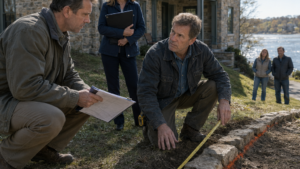
He crouched near the shallow drainage strip.
The dirt was dry.
“Which one?” he muttered.
He disliked even hearing irritation in his own voice.
Across the boundary, Amy’s side door opened and shut. Michael glanced toward it, then looked away before she came around the corner.
They were not close, but they had never had a real problem either. They waved when one of them brought in trash cans. Once, during a power outage, Amy had offered him an extension cord from her generator.
Michael did not want to turn a vague email into a neighbor dispute.
He went inside.
That evening he logged into the HOA management portal.
The case appeared immediately.
STATUS: OPEN.
He clicked the case number.
The page showed the date of the original notice, the category, a deadline, and a line that made him pause.
Evidence: 1 attachment.
“Okay.”
He clicked it.
Nothing happened.
He clicked again.
The cursor briefly changed, then returned to normal.
Michael tried another browser.
Same result.
He used his phone.
Same result.
He disabled the pop-up blocker, downloaded the association’s app, reset his password when the app refused the old one, and opened the case again.
Evidence: 1 attachment.
No image.
No document.
No error message.
Just a blank space where something was supposedly waiting for him.
Michael took screenshots.
That small act changed his mood more than he expected.
Until then, he had treated the problem as a technical inconvenience. Someone had forgotten an attachment. Someone would resend it. The notice would become understandable, and he would either fix the issue or explain why it was incorrect.
But the portal was not behaving as if evidence was missing.
It was behaving as if evidence existed and he simply had not complied.
On Wednesday morning, he called the management office.
A clerk answered.
Michael gave the case number.
“I’m trying to see the photo attached to the violation.”
There was keyboard clicking on the other end.
“I see the case.”
“Can you see the attachment?”
A pause.
“I see that there is one.”
“Can you open it?”
Another pause, longer this time.
“I don’t handle the inspection files directly.”
Michael closed his eyes.
“Could you ask whoever does to resend it?”
“I can add a note to the case.”
“I emailed Monday.”
“I see that.”
“And the deadline is today.”
“Yes.”
“So will the deadline be paused until I receive the evidence?”
The clerk hesitated.
“I’m not authorized to change enforcement dates.”
Michael looked through the kitchen window at the cedar panel.
“Who is?”
“The property manager would need to review it.”
“Thomas King?”
“Yes.”
“Can I speak with him?”
“He’s in inspections most of the afternoon.”
Michael waited.
The clerk added, “I’ll mark your message as urgent.”
“Thank you.”
He meant it. He also knew, by then, that gratitude was not the same thing as confidence.
At 4:42 that afternoon, his phone chimed.
For a moment Michael thought Thomas had answered.
Instead, the portal had generated a hearing notice.
Violation hearing scheduled for the following Tuesday at 7:00 p.m.
Michael stared at it.
He opened his sent email.
No reply.
He checked spam.
Nothing.
He returned to the case and found the same blank attachment field.
For the first time, he typed a longer response.
I am formally disputing enforcement until the referenced evidence is made available. I have requested the attachment by email and telephone. Please confirm what physical feature is alleged to violate the rules and provide the photograph before any fine is assessed.
He read it once, removed the word “formally,” then put it back.
He sent it.
That evening, he did something he had been avoiding.
He pulled his file box from the hall closet and found the paperwork from when he installed the cedar screen.
There was no dramatic discovery inside. No stamped approval that solved everything. Just a receipt, measurements, an old copy of the architectural guidelines, and his handwritten notes from a phone call with the management office two years earlier.
The lack of certainty irritated him.
He could no longer remember whether he had been told the screen required written approval or whether it fell under an exemption for equipment screening.
That was another reason he wanted the photograph.
If he was wrong, he wanted to know exactly how.
At 8:11, Michael refreshed the portal again.
A new line had appeared under his account balance.
Compliance fine: $50.
He stared at it for several seconds before touching anything.
The deadline had passed less than three hours earlier.
Nobody had answered his question.
Nobody had shown him the evidence.
Yet the system had already decided that he had failed to correct whatever it was accusing him of.
Michael printed the page.
Then he printed the unanswered email.
Then the screenshot showing “1 attachment” beside an empty box.
He placed all three sheets on the kitchen table.
For years, his solution to neighborhood bureaucracy had been simple: keep records, follow instructions, do not become the person everyone dreaded seeing at a meeting.
Now the records themselves were telling two different stories.
One said evidence existed.
The other was blank.
And the blank one had just cost him fifty dollars.
Chapter 2: His Neighbor Complained, but Not About What the HOA Claimed
“I never asked them to make you remove that.”
Amy Green said it before Michael had finished explaining why he was standing at the edge of her driveway Thursday afternoon.
His prepared opening vanished.
He looked toward the cedar screen between their properties.
“You didn’t?”
“No.”
Amy folded her arms, not defensively exactly, but as if she had been expecting this conversation since she saw him walking over with papers in his hand.
“I complained about the water.”
Michael held still.
“What water?”
“The runoff by the foundation.”
She pointed past him toward the narrow strip between the houses.
“After your sprinklers run, water comes through there and sits on my side. It was worse twice last month.”
Michael followed her gesture.
The shallow channel was visible from where they stood, a darker ribbon of soil near the boundary.
“You reported drainage.”
“Yes.”
“Not the screen.”
“No.”
His irritation shifted direction so quickly that he felt embarrassed by it.
Since the hearing notice arrived, he had built an explanation in his head. Amy had complained about the cedar panel. Maybe she disliked how it looked. Maybe she had decided it blocked her view. Maybe she had used the runoff as an excuse.
He had crossed the property line already half-convinced she had started the entire thing deliberately.
Amy looked at the pages in his hand.
“What did they tell you I said?”
“They didn’t.”
“That’s helpful.”
Despite himself, Michael almost laughed.
He showed her the printed violation notice.
Amy read the first paragraph, frowned, then moved closer to the page.
“Architectural condition?”
“That’s what I’m trying to identify.”
“And they’re fining you?”
“Fifty so far. More if it stays open.”
Amy handed the paper back.
“I submitted one complaint through the portal. I wrote that water was collecting near my foundation and asked them to check whether something on your side was redirecting it.”
Michael nodded toward the cedar panel.
“Did you mention that?”
“I don’t think so.”
“You don’t think so?”
Her expression tightened.
“I know what you’re asking.”
“I’m asking because they’re telling me there’s documented evidence.”
“And I’m telling you what I remember writing.”
Michael heard the sharpness in his own next breath and stopped before speaking.
This was exactly what he did not want to become: a man carrying an HOA letter across the lawn like a summons.
Amy pulled out her phone.
“Hold on.”
She scrolled for several seconds, then opened an email confirmation.
“There.”
Michael stepped closer.
Her complaint was only four sentences.
Water repeatedly collecting along shared side boundary after irrigation. Concerned about drainage toward foundation. Please inspect whether grading or an obstruction is redirecting runoff. Would appreciate advice before it gets worse.
That was all.
No cedar screen.
No architectural violation.
No demand that anything be removed.
Michael read it twice.
“I owe you an apology.”
Amy looked up.
“For what?”
“I came over thinking you had reported the screen and weren’t telling me.”
“You hadn’t actually accused me yet.”
“I was getting there.”
That earned a small, unwilling smile.
“Then your timing was good.”
Michael returned the phone.
“So someone inspected after this?”
“Yes. A man from management came by the next week.”
“Thomas?”
“I don’t know. Not the person I usually see at meetings.”
“What did he do?”
“He looked at the ground. Took a few pictures.”
Michael’s attention sharpened.
“Pictures of what?”
“The side yard. The channel. Your screen was probably in some of them because it’s right there.”
“Did he tell you there was an architectural violation?”
“No.”
“Did he talk to me?”
“I don’t know. You weren’t outside.”
Michael looked toward his house.
He remembered seeing a white management vehicle on the street one afternoon but had assumed someone was checking landscaping.
“When was this?”
Amy searched her messages.
“Let me see. The complaint was on the ninth. He came maybe three days later.”
Michael took out his own phone.
The original HOA violation notice was dated the tenth.
He looked from the screen to Amy.
“The day after you complained.”
“Okay.”
“The inspection was later than that.”
Amy’s face changed slightly.
“You’re sure?”
“The notice is dated the tenth.”
“That doesn’t make sense.”
“No.”
For a moment neither spoke.
A sprinkler clicked on somewhere farther down the street.
Water hissed against shrubs.
Amy looked toward the shallow drainage strip.
“I should have talked to you before I filed anything.”
Michael rubbed his thumb along the folded edge of the notice.
“You had a real problem.”
“I still could’ve knocked.”
“So could I, before assuming you wanted the fence gone.”
“It’s not a fence.”
“Screen.”
“Whatever they’re calling it this week.”
This time they both smiled, briefly.
The tension did not disappear, but it changed shape.
Michael walked with her toward the side yard.
Amy showed him where water had pooled near the corner of her foundation. There was a faint dried line on the soil and mulch.
“I’m not saying this is imaginary,” Michael said.
“I didn’t think you were.”
“I can adjust the sprinkler heads. Maybe cut the watering time.”
“That might help.”
He glanced at the cedar panel.
From this angle, it did sit near the runoff channel, but it did not touch the ground except at the posts.
Nothing obvious suggested it was redirecting water.
“Did the inspector photograph this specifically?”
Amy considered.
“He stood about there.”
She pointed near the rear walkway.
“He took one facing your house and another toward mine.”
“So there should be pictures.”
“I’d assume so.”
Michael let out a short breath.
“That’s what they keep saying.”
Amy turned toward him.
“You haven’t seen them?”
“Not one.”
He explained the missing attachment, the empty field in the portal, and the fine.
By the end, Amy was no longer looking at the screen. She was looking at him.
“That’s ridiculous.”
Michael did not answer immediately.
A day earlier, hearing those words would have felt like validation.
Now he was more interested in chronology.
“If you still have the confirmation email,” he said, “would you forward it to me?”
Amy hesitated.
Not because she seemed unwilling, but because she understood what it meant.
“You’re taking it to the hearing.”
“Yes.”
She nodded.
“Okay.”
His phone buzzed before he had reached his front steps.
Forwarded message: Drainage concern submission confirmation.
Michael opened it at the kitchen counter.
Again he read the four sentences.
He compared the timestamp with the HOA notice.
Amy had submitted her complaint at 3:48 p.m. on May 9.
The violation against Michael had been opened at 9:14 the next morning.
Whatever inspection photograph supposedly proved his architectural violation had been taken days later.
Michael printed Amy’s complaint and placed it beside the other records.
For the first time, the missing attachment seemed less like the beginning of the problem.
It looked like something that had been added after a decision was already made.
Chapter 3: At the Hearing, One Empty Box Changed the Entire Room
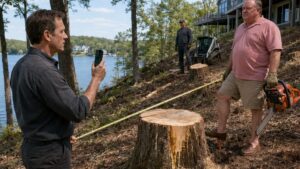
“The photograph is clear evidence of the condition,” Sharon Davis said.
Michael Carter looked at the projector screen behind her.
“Then please put the photograph up.”
The clubhouse went quiet enough that he heard the air conditioner cycle off.
Sharon remained seated at the folding table with the board president and two board members. Thomas King sat at the far end with a laptop open in front of him.
Behind them, the projector showed Michael’s violation case.
Case status: OPEN.
Architectural compliance.
Evidence: 1 attachment.
Michael had seen that page so many times during the previous week that he knew where every line would appear.
The attachment area beneath it was empty.
Sharon clasped her hands.
“Mr. Carter, this hearing is your opportunity to respond to the violation, not to debate the management software.”
“I’m not debating the software.”
“You’ve received two notices.”
“I received two messages referring to evidence I haven’t been allowed to see.”
Several homeowners sat in rows of stackable chairs behind him. Michael had almost changed his mind when he saw them coming in.
He hated public disputes.
He hated the particular neighborhood intimacy of them even more—the knowledge that the person watching you argue over a compliance letter might be standing beside you at the mailbox the next morning.
Sharon looked toward Thomas.
“Can we display the inspection photograph?”
Thomas tapped his trackpad.
Michael kept his eyes on the projected screen.
A small loading symbol appeared.
Then disappeared.
Nothing replaced it.
Thomas clicked again.
The screen flashed white for a fraction of a second and returned to the same case page.
Sharon said, “It may need to be opened from the inspection module.”
Thomas did not answer.
He was typing now.
Michael waited.
The waiting mattered.
He had spent the previous week trying to explain the absence. Tonight he had decided he would not explain anything the board could see for itself.
Thomas leaned toward his screen.
“There’s an attachment reference.”
“I know,” Michael said.
Sharon glanced at him.
Thomas continued.
“But the file itself isn’t opening.”
“Is that a connection issue?” one board member asked.
“I don’t think so.”
Thomas tried another menu.
A few seconds passed.
Behind Michael, someone shifted in a chair.
Sharon reached for the printed packet in front of her.
“The inspection notes identify the cedar screening structure as inconsistent with approved exterior modifications.”
Michael turned slightly.
“May I see those notes?”
“They’re summarized in the notice.”
“Not the summary. The inspection notes.”
Sharon’s mouth tightened.
Thomas spoke before she could.
“I have a case note.”
“Does it say the screen violates the rules?”
Thomas read silently.
“It says, ‘Site photographs uploaded for review. Possible obstruction or unapproved screening at side drainage area.’”
Michael looked at Sharon.
“Possible?”
“The board reviewed the matter,” she said.
“Using what photograph?”
“The one submitted by the inspector.”
“The one we cannot see?”
Her expression remained controlled.
“Mr. Carter, the inability to retrieve a file tonight does not establish that the inspection did not occur.”
“I didn’t say it did.”
“Then what exactly are you asking us to decide?”
Michael had prepared an answer.
He had written it on an index card in his kitchen.
He did not look at the card.
“I’m asking you not to fine me for refusing to correct evidence you cannot show me.”
A murmur began behind him and died almost immediately.
Sharon’s tone sharpened by half a degree.
“Homeowners cannot simply disregard notices because they disagree with the form in which documentation is provided.”
“I didn’t disregard it. I emailed Monday. I called Wednesday. I asked what condition I was supposed to correct. I asked for the attachment.”
Thomas looked down at his laptop.
Michael continued, “I also asked whether the deadline would be paused until I received it. Instead, the system fined me.”
The board president turned toward Thomas.
“Did we respond to those requests?”
Thomas clicked into another screen.
“The email is logged.”
“And?”
“I don’t see an outgoing response before the fine.”
Sharon exhaled through her nose.
“The failure to answer promptly is separate from whether the violation exists.”
Michael nodded.
“I agree.”
That seemed to surprise her.
He took one sheet from his folder.
“This is Amy Green’s original complaint.”
Amy was not present. Michael had asked her before the meeting whether she wanted to attend, and she had said no. She had already given him permission to show the message she forwarded.
“The complaint is about drainage,” he said. “It does not mention my cedar screen as a violation. It asks management to inspect whether grading or an obstruction is affecting runoff.”
Sharon glanced toward Thomas.
Thomas looked at the projected record.
Michael held the paper up.
“The association opened an architectural violation against me the next morning.”
One of the board members frowned.
“When was the inspection?”
“That’s another question I’d like answered.”
Thomas began clicking again.
Sharon said, “There may have been an initial drive-by inspection.”
“Was there?”
“I’m saying there are several ways compliance concerns reach management.”
Michael forced himself not to rush.
This was the moment he usually retreated from. The moment when a reasonable discussion started feeling personal and he became willing to accept an imperfect answer just to stop standing in the middle of it.
He looked at the blank attachment area on the wall.
“No one has shown me that,” he said. “If there was another inspection, I’d like the date and record.”
Thomas lifted a hand slightly.
“I have the field visit.”
Everyone looked at him.
“Date?” the board president asked.
Thomas read the screen.
“May thirteenth.”
Michael felt something settle into place.
He took out the original violation notice.
“What date was this case opened?”
Thomas answered without looking away from the laptop.
“May tenth.”
“And the inspection photograph was taken May thirteenth?”
Thomas hesitated.
“The field visit is dated May thirteenth.”
Sharon said, “That does not necessarily mean there was no earlier observation.”
Michael turned to her.
“Then show me the earlier observation.”
Silence again.
Not dramatic silence. No one gasped. No one applauded.
It was more uncomfortable than that.
People looked down at papers.
Thomas clicked through records.
The board president rubbed the side of his jaw.
Sharon’s confidence had not disappeared, but Michael noticed she had stopped referring to the photograph as clear evidence.
Thomas finally said, “I’m not finding another field visit.”
The board member beside the president leaned forward.
“So what opened the architectural case?”
Thomas stared at the screen.
“It appears to have been created from the complaint intake.”
Michael looked down at Amy’s four sentences.
Drainage concern.
Possible grading.
Possible obstruction.
No cedar screen.
No architectural accusation.
The first small relief he had felt when the attachment failed to appear was gone.
The board could see now that he had not ignored accessible evidence.
But the more they uncovered, the less accidental the situation seemed.
Sharon gathered the edges of her packet into a neat stack.
“I’m not comfortable dismissing an active compliance matter based solely on a retrieval issue and timestamp interpretation.”
Michael stared at her.
“A retrieval issue?”
“We need additional review.”
“You just heard that the case existed before the inspection.”
“We heard that the recorded field visit occurred after case creation. That is not necessarily the same thing.”
The board president looked between them.
“What are you proposing?”
Sharon answered immediately.
“Continue the matter. Suspend additional daily fines until management verifies the inspection record. Preserve the existing fine pending that review.”
Michael almost objected.
Fifty dollars still sat on his account. The violation still remained open. The hearing that was supposed to resolve the problem had only moved it sideways.
But he also knew what had changed.
A week earlier, the association had been asking why he had not complied.
Now the board was asking itself what it had actually relied on.
The president looked at Michael.
“Would that be acceptable temporarily?”
Michael closed his folder.
“I want the attachment.”
Thomas nodded faintly.
“We’ll look into it.”
“And the original case history.”
Sharon’s eyes moved to him.
“What do you mean?”
“The dates.”
“You have the dates we discussed.”
“Not all of them.”
Michael pointed toward the projected screen.
“When the complaint came in. When the case was created. When the inspection happened. When the photograph was supposedly uploaded. When the notice was generated.”
Thomas said, “Those should be in the audit history.”
Michael looked at him.
“Can I have that?”
Thomas glanced toward Sharon before answering.
That glance lasted less than a second.
Michael noticed it anyway.
Sharon said, “Management can provide records appropriate to the homeowner’s case.”
It was not a yes.
Michael had spent years accepting answers like that because pressing further felt impolite.
Tonight he did not.
“Please provide the audit history.”
The board president nodded.
“Thomas, provide what pertains to this case.”
Thomas made a note.
The hearing moved on.
Michael returned to his chair while another homeowner approached the table about a landscaping issue. He should have felt satisfied. The daily fines were paused. The missing attachment had become visible to everyone in the room.
Instead, he opened the photograph he had taken of the projected case screen.
May 10: violation created.
May 13: field inspection.
Michael enlarged the image until the dates filled his phone.
The sequence was unmistakable.
He had walked into the clubhouse wanting proof of what he had supposedly done wrong.
He walked out with a different question.
How had the HOA decided he was in violation three days before anyone documented the property?
Chapter 4: The Timeline Showed the Case Had Started Backward
Michael placed three sheets of paper across his kitchen table Thursday morning and immediately saw the problem.
Amy’s complaint: May 9.
Violation created: May 10.
Field inspection: May 13.
He moved them closer together, as though reducing the space between the pages might somehow make the dates less absurd.
It did not.
The association had opened an architectural violation against him three days before the inspection that supposedly documented it.
Michael had spent most of the previous week arguing about an invisible photograph. Now he wondered whether the photograph had ever been the foundation of the case at all.
He opened the email Thomas King had sent after the hearing.
Attached was a PDF labeled Case Activity History.
This time, there really was an attachment.
Michael almost laughed.
He printed it.
The record was not elegant. It looked like something exported from accounting software: timestamps, status changes, short notes, user initials, automated entries.
May 9, 3:48 p.m. — Resident concern received.
May 10, 9:14 a.m. — Compliance case created.
May 10, 9:15 a.m. — Initial notice generated.
May 13, 2:26 p.m. — Field visit completed.
May 13, 2:41 p.m. — Photos submitted.
May 13, 2:42 p.m. — Evidence status updated.
Michael put his finger on the May 10 entry.
The initial notice had not followed an inspection.
It had followed Amy’s complaint.
That did not necessarily prove bad faith. Someone could have opened a case for investigation and allowed the system to classify it badly.
But Michael’s first notice had not said investigation pending.
It had said violation.
At ten that morning, he called Thomas.
This time, Thomas returned the call before lunch.
“I sent everything I could export,” he said.
“I appreciate that.”
Michael meant it.
Then he asked, “Why was a violation notice generated before the field visit?”
A pause.
“The system can create a case from an owner complaint.”
“I understand that. Why did it create a violation?”
“There are templates attached to categories.”
“So someone chose an architectural category.”
“Possibly.”
“Who?”
Thomas exhaled.
“I’d have to look at the internal intake.”
“Can you?”
Another pause.
“Yes.”
Michael waited.
He had learned not to fill silence for people.
Thomas finally said, “The complaint was coded as drainage and exterior modification.”
“Amy didn’t report an exterior modification.”
“I know what the complaint says.”
“Then why was that added?”
“It may have been based on the location description.”
“The location description was ‘shared side boundary.’”
Thomas was quiet.
Michael looked again at the timeline.
“Thomas, I’m not trying to trap you.”
“I know.”
“I’m trying to understand what happened.”
“I know.”
That second answer sounded different.
Tired.
Michael leaned back in his chair.
“Was the photograph actually uploaded on May thirteenth?”
Thomas said, “There was an upload attempt.”
Michael sat forward.
“Attempt?”
“The field app shows an evidence submission event.”
“Is that the same as a successful upload?”
“No.”
Michael stared at the blank attachment line he had printed from the portal.
“So the system can say there’s an attachment even if there isn’t one.”
“In some cases.”
“How?”
“The mobile inspection app sends the record first and the media file separately. If the file fails during transfer, the database can retain the reference.”
Michael said nothing for a moment.
There it was.
Not the whole answer.
But finally an answer.
The missing photograph was not imaginary in the sense that nobody had tried to take one. An inspector could have photographed the side yard and tried to send it.
But the association’s system could display “1 attachment” even when the file itself had never arrived.
“Can you tell whether that happened here?”
“I’m checking.”
“Can the original file be recovered from the inspector’s device?”
“Probably not this long afterward. The field devices clear completed jobs.”
Michael looked toward the window.
The cedar screen stood where it had stood every day.
The system had treated an empty placeholder as evidence. Then everyone after that had treated the system as proof.
“I understand how the mistake could start,” Michael said.
Thomas did not respond.
Michael continued.
“What I don’t understand is why the case kept moving.”
“That’s a different question.”
“Yes.”
After the call, Michael drove to the management office.
He had resisted doing that earlier because he did not want to appear confrontational. Now he realized how much time he had spent managing other people’s impression of him while his account accumulated penalties.
Thomas met him in a small conference room near the front desk.
He looked different away from the board table. Younger somehow, despite the gray at his temples. Less certain.
Michael placed the timeline between them.
“Show me where anyone verified the photograph.”
Thomas looked at the page.
“It wasn’t verified.”
Michael felt his jaw tighten.
“Before the first notice?”
“No.”
“Before the second?”
Thomas hesitated.
“I don’t believe so.”
“Before the hearing?”
Thomas looked away.
That was the first moment Michael felt anger arrive without confusion underneath it.
Not explosive anger.
Something colder.
“Who knew?” he asked.
Thomas rubbed a hand over his mouth.
“I emailed the compliance chair when I couldn’t retrieve the file.”
“When?”
“I’d need to confirm.”
“Please do.”
Thomas turned his laptop toward himself and searched.
Michael watched the reflection of lines moving across Thomas’s glasses.
Outside the conference-room window, the management-office clerk carried a stack of envelopes past the door.
Thomas stopped scrolling.
His expression changed.
“What?”
Thomas looked at Michael.
“I sent Sharon a note about the missing media file.”
“When?”
Thomas read the date.
Michael already knew it would matter.
“Friday before the hearing.”
Michael did the calculation.
Four days.
Sharon Davis had described the photograph as clear evidence Tuesday night.
Four days earlier, Thomas had told her he could not retrieve it.
Michael rested both hands on the edge of the table.
“What exactly did you tell her?”
Thomas looked uncomfortable.
“That the inspection record existed, but the image file was not available in storage and might have failed during upload.”
“And what did she say?”
“She asked whether the case could still proceed based on the inspection note.”
“Could it?”
“That’s not a technical question.”
“No,” Michael said. “It isn’t.”
When he left the office, he did not drive home immediately.
He parked beside the subdivision entrance and opened the case history on his phone again.
For days he had wanted the HOA to admit that the photograph was missing.
Now he had that.
It no longer felt sufficient.
The case had started from a complaint that did not accuse him of an architectural violation. The notice had gone out before the field inspection. The photograph had failed to upload.
And Sharon had known before the hearing that the evidence she called clear could not be produced.
Michael opened his email.
He began a new message to the board.
This time, he did not ask for the attachment.
He asked for an explanation.
Chapter 5: She Was Afraid One Admission Would Undo Every Rule She Enforced
Sharon Davis offered to reduce Michael’s fine before he had asked her for anything.
They were standing in the clubhouse office Saturday morning, two days before the special board meeting Michael had requested.
“The board can probably resolve this without turning Monday into another full hearing,” she said.
Michael remained near the doorway.
“How?”
“We waive half the assessment. You correct the drainage concern, and we close the architectural case administratively.”
Michael looked at her.
“Half?”
“The fifty-dollar fine would become twenty-five.”
“That isn’t the part I’m asking about.”
“I understand.”
“No,” Michael said. “I don’t think you do.”
Sharon’s expression tightened, though her voice stayed even.
“You’ve made your position clear.”
Michael had received her message the previous afternoon asking whether they could speak privately before the meeting. For several hours he considered declining.
He came because he wanted to know why.
Not what the system had done.
Not when Thomas had discovered the missing file.
Why Sharon had stood in front of the board and called an unavailable photograph clear evidence.
She gestured toward the conference table.
Michael sat.
Sharon remained standing another moment, then took the chair opposite him.
Between them lay a single sheet of paper.
Settlement proposal.
Michael did not touch it.
“If I accept that,” he said, “does the violation stay on my record?”
“It would show as resolved.”
“That wasn’t my question.”
Her eyes shifted to the paper.
“Yes. The original case would remain.”
“So the record would still say the association was right.”
“It would say the matter was closed.”
“And I’d be paying a fine.”
“A reduced one.”
“For a violation you cannot document.”
Sharon leaned back.
“You keep treating the missing photograph as if it automatically proves the condition did not exist.”
“I’ve never said that.”
“Then we agree on something.”
“We agree that the photograph might once have existed.”
“Yes.”
“We also agree you knew it was unavailable before Tuesday’s hearing.”
The room became still.
Sharon looked at him for several seconds.
“Thomas told you.”
“He gave me the date.”
“I see.”
Michael waited.
Again, he refused to rescue the silence.
Sharon folded her hands.
“Yes. I knew there was a problem retrieving the image.”
The admission came so plainly that it almost disappointed him.
He had expected a denial.
“Then why did you call it clear evidence?”
“Because there was an inspection note.”
“That said possible obstruction or unapproved screening.”
“Yes.”
“Possible.”
“I know what it said.”
Michael leaned forward.
“Then why didn’t you pause the case?”
Sharon’s gaze moved toward the window.
Beyond it, the clubhouse parking lot was nearly empty.
“We’ve had complaints for two years that enforcement depends on who you are.”
Michael said nothing.
“Some owners get extensions. Some cases get dropped. Some board members know people personally. Every time we make an exception, someone pulls up an older violation and says, ‘Why was I fined when they weren’t?’”
“That has nothing to do with whether my case was supported.”
“It has everything to do with how a board functions.”
Michael felt his anger rise again.
He kept his voice low.
“No. It explains the pressure you were under. It doesn’t make an unsupported case supported.”
Sharon looked back at him.
“I didn’t say it did.”
That answer slowed him.
For the first time since the hearing, she sounded less defensive than tired.
She continued.
“Last year we dismissed several cases because inspections were incomplete. One homeowner accused the board publicly of protecting friends. Another demanded refunds going back three years. People started questioning every enforcement decision.”
“So you decided not to dismiss mine.”
“I decided not to make another ruling before management completed its review.”
“You fined me before the review.”
“The system assessed the fine.”
“And you left it there.”
Sharon did not answer.
Michael realized then that the system was becoming a shield for everyone.
The portal opened the case.
The template generated the notice.
The failed upload left the placeholder.
The account posted the fine.
Every individual action could be described as automatic.
But somewhere in the chain, a person had chosen not to stop it.
“You knew the evidence was unavailable,” Michael said.
“Yes.”
“And you let the hearing proceed as if I had ignored it.”
Sharon looked down.
“Yes.”
There was no triumph in hearing it.
Only weight.
Michael had wanted a villain because a villain would have made the story easier.
Amy had not been one.
Thomas was not one either. Careless, perhaps. Too trusting of software. But not malicious.
Now Sharon sat across from him, and even she did not fit the shape he had imagined.
She had been afraid.
Afraid that admitting uncertainty would look like favoritism.
Afraid that one correction would weaken every other decision she had defended.
Michael understood that fear.
He also knew what it had cost him.
“You could have told me.”
“I should have.”
“You could have said the photograph was missing.”
“Yes.”
“Instead you made me stand there and defend myself against it.”
Sharon’s mouth tightened.
“I handled that badly.”
Michael looked at the settlement paper.
It would be easy to sign.
Twenty-five dollars was nothing compared with another evening in the clubhouse.
The daily fines were already suspended.
He could adjust the irrigation. Let the case close. Avoid becoming the neighbor who turned one bad compliance notice into a community argument.
That was what he had wanted from the beginning.
Quiet.
But the price of the settlement was not twenty-five dollars.
The price was allowing the record to say the process had worked.
Michael slid the paper back across the table.
“No.”
Sharon did not touch it.
“You’re refusing the reduction?”
“I’m refusing the premise.”
Her eyes hardened slightly.
“So what do you want Monday?”
“I want the board to answer how a complaint about drainage became an architectural violation before the inspection happened.”
“We’ve discussed that.”
“Not publicly.”
“You want to embarrass the board?”
Michael almost reacted.
Instead he thought of Amy’s complaint. Thomas’s audit trail. The empty attachment box glowing on the clubhouse wall.
“No,” he said. “I want the record corrected.”
“The record can be corrected without turning this into a larger issue.”
“It is a larger issue.”
“You don’t know that.”
“Neither do you.”
That stopped her.
Michael stood.
“If mine is the only case where this happened, then the review proves that.”
“And if it isn’t?”
“Then people should know.”
Sharon remained seated.
For the first time, Michael saw what the special meeting meant to her.
Not humiliation.
Loss of control.
She had spent years believing consistency was what made rules legitimate.
Michael had spent years believing documentation made systems fair.
Both of them had trusted process until process asked them to ignore what they could see.
At the door, Sharon said, “You realize people are going to think you’re making a fifty-dollar fine into a crusade.”
Michael turned.
A week earlier, that sentence would have worked.
He would have imagined the mailbox conversations, the looks at the annual picnic, the silent label attaching itself to his name.
Difficult.
Argumentative.
One of those owners.
Now he thought about the missing photograph being called evidence because challenging it was inconvenient.
“Maybe they will.”
Sharon watched him.
Michael opened the door.
“Put the full case on Monday’s agenda.”
He left before she could offer him another way out.
Chapter 6: He Stopped Arguing About His Fence and Asked Who Had Verified Anything
“My fence is not the question anymore.”
Michael’s first sentence at the special board meeting produced exactly the reaction he expected.
Confusion.
The board president looked down at the agenda.
Sharon Davis looked straight at Michael.
Thomas King sat beside the projector laptop, hands folded.
Twenty-three homeowners filled the clubhouse chairs—more than had attended the original hearing.
Michael knew why.
Neighborhoods could ignore policy discussions for years.
They rarely ignored conflict.
The cedar screen appeared on the projector behind the board, photographed that afternoon specifically for the meeting.
The image showed the narrow side yard, the shallow runoff channel, and the weathered boards.
For the first time in the entire case, Michael could see an actual photograph.
It was almost funny.
The board president cleared his throat.
“Mr. Carter, the purpose of tonight’s review is to determine the status of your compliance case.”
“I understand.”
“Then what is the question?”
Michael placed one page on the table before him.
Not the whole folder.
One page.
“The question is who verified the evidence before the association began fining me.”
Sharon shifted in her chair.
The president looked toward Thomas.
Michael continued before anyone could redirect the discussion.
“Amy Green filed a drainage concern May ninth.”
Amy sat two rows behind him.
“She did not report my screen as an architectural violation.”
The president nodded.
“That has been established.”
“The architectural case was opened May tenth.”
Another nod.
“The field inspection happened May thirteenth.”
Thomas said quietly, “Correct.”
“The photograph from that inspection did not successfully upload.”
Thomas looked at the projector.
“That appears to be what happened.”
“And management knew before my first hearing that the file could not be retrieved.”
Nobody answered immediately.
Michael looked at Sharon.
She did not look away.
“Yes,” she said.
A few people behind him shifted.
Michael resisted the temptation to turn around.
He had no interest in winning the room.
He wanted the question answered.
“So who reviewed the actual evidence before the fines continued?”
The president looked toward the other board members.
One of them flipped through the packet.
“I reviewed the compliance summary.”
Michael nodded.
“Did you see the photograph?”
“No.”
The second board member shook her head before he asked.
“I didn’t.”
The president said, “I relied on the case file.”
“Did the case file include the image?”
“No.”
Michael looked at Sharon.
She spoke before he asked.
“I reviewed the inspection note.”
“Not the image.”
“No.”
The answer landed more heavily than Michael expected.
No one had verified it.
Not one board member.
For nearly two weeks, his account had carried an active violation supported by evidence everyone assumed someone else had seen.
The president turned toward Thomas.
“Can you explain how the case was created?”
Thomas drew a breath.
“The original resident complaint was entered through the portal. During intake it was categorized under drainage and exterior modification. That classification triggered the architectural compliance workflow.”
“Automatically?” a board member asked.
“The notice was automatically generated after the case was opened.”
“Who chose the category?”
Thomas looked uncomfortable.
“Management intake.”
“So not the inspector.”
“No.”
“And not the complaining homeowner.”
“No.”
Amy raised her hand.
The president recognized her.
She stood.
“I want to make something clear.”
Michael turned slightly.
Amy held a printed copy of her complaint.
“I reported water collecting near my foundation. I did not ask the HOA to remove Michael’s screen. I did not tell anyone the screen violated the rules. I asked for an inspection because I thought something might be affecting drainage.”
Sharon said, “No one is suggesting otherwise.”
Amy looked toward her.
“That’s not how it felt after the notice went out.”
The room became quiet.
Amy sat down.
Michael looked back at the photograph on the projector.
For weeks, the cedar screen had been treated as the center of everything.
Now it looked ordinary.
Some boards.
Two posts.
A physical object carrying the weight of an administrative assumption.
The board president asked, “Thomas, based on the current inspection, does the screen actually obstruct drainage?”
Thomas glanced at the new field report.
“The contractor’s assessment says no direct obstruction was observed. There may be grading and irrigation factors contributing to runoff.”
A small release moved through Michael’s chest.
There it was.
Not total victory.
A real problem still existed.
Just not the one he had been punished for.
The president turned toward Michael.
“So the drainage issue remains, but it appears separate from architectural compliance.”
“Yes,” Michael said. “That’s what I’ve been asking you to separate.”
Sharon rested her hands on the table.
“I think we can void the architectural case and handle drainage cooperatively.”
Michael looked at her.
It would have been easy to stop there.
The fine disappeared.
The fence stayed.
Amy’s concern got addressed.
But Michael remembered sitting in his kitchen, refreshing a blank attachment field while penalties appeared underneath it.
“What happens the next time?” he asked.
Sharon’s expression changed.
“Meaning?”
“What happens when another file fails to upload?”
Thomas looked toward him.
Michael continued.
“If the system still says ‘attachment,’ does the next homeowner get fined because everyone assumes somebody saw it?”
The president frowned.
“That is a fair question.”
Sharon was silent for several seconds.
When she spoke, her voice was quieter than before.
“I made a decision before the first hearing.”
Michael knew immediately what was coming.
She looked toward the board, not toward him.
“When Thomas told me the photograph could not be retrieved, I believed dismissing or pausing the case would look like inconsistent enforcement.”
No one interrupted.
“We had already been criticized for withdrawing other cases. I chose to continue based on the inspection note and the existing case record.”
Michael watched her hands.
They were perfectly still.
“I told myself we were preserving consistency until the technical issue was resolved.”
She finally looked at him.
“That was the wrong choice.”
There was no dramatic apology.
No performance.
Michael was grateful for that.
The president asked, “Were any other members informed that the photograph was unavailable?”
Sharon shook her head.
“No.”
One board member leaned back.
“So we were voting on a record you knew was incomplete.”
“Yes.”
Responsibility had finally found a person.
Not because Sharon had created the original mistake.
Because she had learned the process was uncertain and chose authority over verification.
Michael felt his anger loosen.
Not disappear.
Change.
The president called for a short recess.
When the meeting resumed, the board considered three motions.
The first voided Michael’s architectural violation and all associated fines.
It passed unanimously.
The second directed management to treat Amy’s runoff complaint as a separate maintenance matter requiring no presumption of fault.
It passed.
The third took longer.
No compliance case involving photographic or documentary evidence could advance to financial penalties unless the referenced material was accessible to management, the reviewing board members, and the homeowner.
If the evidence could not be produced, enforcement would pause pending verification.
One board member asked whether that would slow the process.
“It probably will,” Thomas said.
Michael expected Sharon to object.
Instead she said, “Then it slows down.”
The motion passed.
The president added a final instruction: management would review all currently open compliance cases containing inaccessible evidence references.
Not every old case.
Not years of penalties.
No sweeping undoing of association history.
Just the active cases still capable of causing harm.
It felt proportional.
Real.
As people began gathering their papers, Michael stayed seated.
He had imagined this moment during the previous week more times than he wanted to admit.
In some versions he delivered the perfect argument.
In others Sharon was humiliated.
Sometimes the room finally understood how unreasonable the whole thing had been.
Reality was quieter.
Amy approached him.
“I’ll call someone about the grading,” she said.
“I’ll adjust my sprinklers tomorrow.”
“That seems less expensive than another hearing.”
Michael smiled.
“By a lot.”
Thomas stopped beside them.
“I’m going to send you the corrected case record.”
Michael looked at him.
“With the attachment?”
Thomas almost smiled.
“With no imaginary one.”
Amy laughed softly.
Sharon remained at the board table, gathering papers.
Michael considered leaving.
Then he walked toward her.
She looked up.
“The case is closed,” she said.
“I heard.”
“I’ll make sure the record says withdrawn, not resolved by compliance.”
“Thank you.”
She nodded.
Michael could have left it there.
Instead he said, “I understand why you were worried about consistency.”
Sharon’s expression guarded itself.
“That doesn’t excuse it.”
“No.”
He let the word stand.
Neither of them needed more.
On the projector behind her, Michael’s old case was still open on the screen.
The blank evidence field sat beside the list of fines.
Thomas reached the laptop and changed the status.
OPEN disappeared.
VOIDED replaced it.
Michael looked at the empty attachment box one last time.
The thing that had never been there had finally forced everyone to look at what else had been missing.
Verification.
Responsibility.
And, in his own case, the willingness to speak before silence became agreement.
Chapter 7: The Fence Stayed, but the Thing Between the Neighbors Finally Changed
Michael found Amy Green kneeling beside the property line with a tape measure stretched across the drainage channel.
For half a second, the sight tightened something in him.
Three weeks earlier, a person measuring anything near that boundary would have meant another complaint, another photograph, another line appearing in a management portal.
Then Amy looked up.
“I think we’ve been fixing the wrong end.”
Michael stepped off his patio and walked toward her.
The cedar screen remained exactly where it had always been, its boards silvering slightly in the summer sun. Nothing about it looked victorious. It did not stand straighter because the HOA case had been voided.
It was simply still there.
Amy pointed toward the shallow channel.
“The landscaping contractor came yesterday.”
“I saw the truck.”
“He says the grade is mostly fine.”
“Mostly?”
“That’s contractor language for ‘I can still charge somebody for something.’”
Michael smiled.
Amy stood and brushed dirt from one knee.
“He thinks the bigger problem is where the downspout and your irrigation overlap during heavy watering. The soil gets saturated here, then the water takes the easiest route.”
Michael followed the line of her tape measure.
Across the boundary, the ground dipped only slightly, almost too little to notice unless someone was looking for it.
“So the screen has nothing to do with it.”
“Apparently the screen has been innocent all along.”
Michael looked at the cedar boards.
“Maybe we owe it an apology.”
“That would probably require a hearing.”
He laughed.
The ease of the exchange surprised him.
For years, he and Amy had maintained the kind of neighbor relationship built on small courtesies and careful distance. Then one complaint had nearly converted that distance into suspicion.
Now they were standing over the actual problem together.
Michael crouched near the channel.
“What did the contractor recommend?”
“A shallow extension here.”
Amy indicated a route that would move runoff toward the rear drainage swale.
“And maybe redirecting your downspout six feet.”
“That’s easy.”
“He also said reducing the irrigation cycle would probably solve half of it.”
“I already did.”
Amy looked at him.
“When?”
“The morning after the board meeting.”
“You could have told me.”
Michael straightened.
“I thought I’d see if it worked first.”
She gave him a look.
“That sounds familiar.”
He knew what she meant.
Waiting.
Handling things privately.
Assuming a reasonable action would explain itself without conversation.
Michael looked down at the channel.
“I’m working on that.”
Amy softened.
“So am I.”
They agreed to split the small cost of reshaping the channel rather than argue about which side contributed more water.
It was not reconciliation in the dramatic sense.
Neither apologized again.
Neither promised that they would never disagree.
They simply made a decision about six feet of dirt that both of them could live with.
Michael found that more reassuring than any speech would have been.
A car door closed near the street.
Amy glanced up.
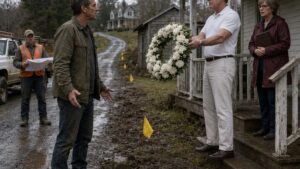
Sharon Davis was walking toward them carrying a thin folder.
Michael felt his shoulders tighten automatically.
Sharon noticed.
“This isn’t enforcement.”
“That’s an encouraging opening,” Amy said.
Sharon stopped several feet away.
“I’m delivering the revised compliance procedure to residents whose cases were part of the review.”
Michael looked at the folder.
“Were there others?”
“Three active cases had inaccessible supporting files.”
His expression changed.
“Three?”
“One was already resolved because the homeowner corrected the issue independently. Two were paused and reinspected.”
“So it wasn’t just mine.”
“No.”
Sharon did not try to soften the answer.
The old Michael would have wanted details immediately. Who had been fined? For how long? Who knew?
Instead he asked, “Were their records corrected?”
“Yes.”
“The fines?”
“One had a fine. It was reversed.”
Michael nodded.
The review had not uncovered a grand pattern of corruption.
It had uncovered something more believable and, in some ways, more unsettling.
A weak procedure had worked incorrectly more than once because people assumed the system’s labels meant someone else had already checked the substance underneath them.
Sharon handed him the folder.
The first page described the new rule.
Any compliance notice relying upon photographs, documents, inspection reports, or other supporting material had to provide the homeowner access to that evidence before financial penalties could begin.
Unavailable evidence meant the case paused.
No exceptions for convenience.
No presumption that a placeholder represented a file.
Michael read the paragraph twice.
“This is better.”
Sharon nodded.
“It should have been obvious.”
“Most rules are obvious after something goes wrong.”
She looked toward the cedar screen.
“I also reviewed the original inspection note again.”
Michael waited.
“The inspector wasn’t certain the screen was causing the drainage issue. That word—possible—should have kept the case investigative.”
“But it didn’t.”
“No.”
Amy folded her arms.
“Because my complaint got put into the wrong category.”
“That started it,” Sharon said.
Then she looked at Michael.
“But that isn’t why it continued.”
Michael knew what she was giving him.
Not another explanation.
Ownership.
Sharon continued.
“I chose not to stop the case when I learned the photograph was missing. I thought consistency mattered more than how it would look if we backed away again.”
Amy said nothing.
Michael closed the folder.
“I understand.”
Sharon’s expression tightened slightly.
“I’m not asking you to.”
“I mean I understand why you made the decision.”
He paused.
“I still think it was wrong.”
“It was.”
There was no defensiveness in her answer.
For a few seconds, the three of them stood beside the narrow drainage channel that had started everything.
No board table.
No projector.
No audience.
Sharon looked toward the street.
“I should get the rest of these delivered.”
Michael nodded.
Before she left, she said, “For what it’s worth, the board president wanted the new policy written more broadly. Not just attachments. Any evidence referenced by a notice has to be accessible before penalties.”
“That’s good.”
“You pushing past your individual case is why that happened.”
Michael felt the old discomfort rise—the instinct to deflect anything that made him sound like the center of a neighborhood cause.
He nearly said it was nothing.
Instead he said, “I’m glad they changed it.”
Sharon gave a small nod and walked back toward the street.
Amy watched her go.
“You know people still think you made a big deal out of fifty dollars.”
Michael looked at her.
“Do they?”
“Some.”
He waited for the old anxiety.
It came, but weakly.
“And what do you think?”
Amy reeled in the tape measure.
“I think I should’ve knocked on your door before I filed a complaint.”
“That wasn’t what I asked.”
“I know.”
She smiled slightly.
“I think you were right.”
Michael looked toward his house.
Being called right felt less satisfying than he once imagined it would.
Maybe because the story had stopped being about that.
He had been wrong about Amy.
Thomas had been careless without being malicious.
Sharon had caused harm while believing she was protecting something valuable.
Even Michael had helped the problem grow by waiting too long to challenge what he could already see was incomplete.
Justice, he had discovered, did not require everyone to become simple.
That afternoon, he redirected the downspout.
Amy held the extension while he fastened it.
The following weekend, the contractor cut the shallow drainage path and reshaped the soil. After the next irrigation cycle, Michael walked outside and watched the water follow the new channel toward the rear swale instead of pooling near Amy’s foundation.
The original problem had finally been addressed without anyone removing a single cedar board.
Three days later, Michael’s phone chimed while he was making coffee.
HOA notification.
For an instant, his stomach tightened.
Old reflex.
He opened it.
A new compliance advisory concerned a dead shrub near the front corner of his property.
Michael almost laughed.
The notice listed the location clearly.
It identified the applicable landscaping standard.
And above the description sat a small image thumbnail.
Michael touched it.
The photograph opened immediately.
There was his front yard.
There was the shrub.
Brown, dry, unmistakably dead.
He enlarged the picture.
No blank box.
No invisible evidence.
No accusation asking him to trust something he could not examine.
Michael looked out the kitchen window toward the front corner.
The HOA was right.
The shrub needed replacing.
He opened the response field and typed that he would handle it that weekend.
Then he stopped.
For a moment, he looked at the attached photograph again.
Three weeks earlier, an attachment had seemed like the smallest part of the problem.
A technical detail.
An inconvenience.
Now Michael understood that its absence had exposed something larger: rules did not become fair because they were written down, and records did not become true because a computer said they existed.
Somebody still had to look.
Somebody still had to ask.
And sometimes the reasonable person in the room had to be willing to make everyone uncomfortable long enough to get an answer.
Michael sent the response.
Outside, beyond the kitchen window, the cedar screen remained beside the newly shaped drainage channel.
The fence had never needed to move.
What had changed was everything around it.
The story has ended.