He Threw Jack’s Bridge Papers Into the Mud, Then Learned His Farm Road Crossed Jack’s Land
Chapter 1: The Folder Brandon Threw Into the Mud
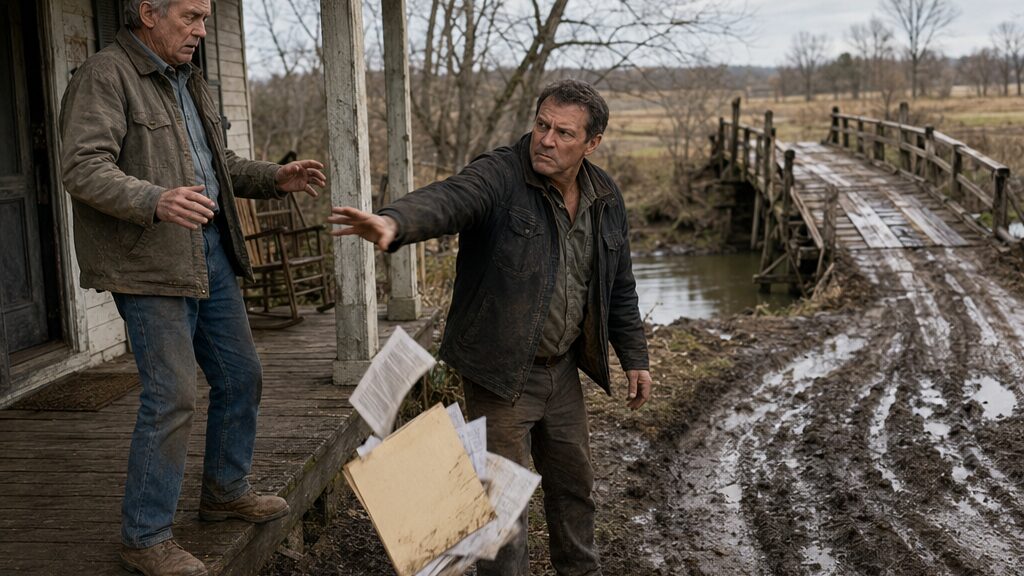
The folder hit the edge of the porch, opened in midair, and scattered twenty pages into the mud.
Jack Miller watched an engineer’s photograph land faceup in a wheel rut. Brown water spread across the image of the rotten bridge beam until the crack disappeared beneath the stain.
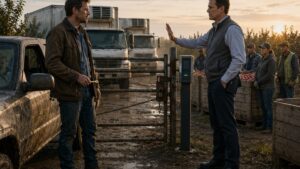
Brandon Davis looked down from the porch.
“There,” he said. “Now you can take your bridge problem home with you.”
Jack did not bend immediately.
Behind them, the timber bridge crossed the creek at a shallow angle between cottonwoods and fence posts. It had carried pickups, hay wagons, feed trucks, and farm equipment for decades. From a distance it still looked solid enough. Up close, one of the main support beams had softened dark around the bolts, and the bottom edge had begun to crumble.
Jack had noticed the sag two weeks earlier.
He had called a structural engineer instead of guessing.
That morning he had brought Brandon the report, photographs, and a repair estimate.
Eighteen thousand five hundred dollars.
Jack had expected an argument over the number.
He had not expected the papers in the mud.
“I’m not asking you to pay all of it,” Jack said.
Brandon folded his arms. At fifty-something, he was broader than Jack and still carried himself like a man accustomed to moving heavy things until they went where he wanted. Mud dried in pale streaks across his jeans and work boots.
“You’re asking me to pay for something sitting on your place.”
“I’m asking you to help repair the bridge your trucks use.”
“My trucks use a road that’s been used longer than either of us has owned these farms.”
“That doesn’t make the beam less rotten.”
Brandon gave a short laugh.
Jack looked toward the bridge.
The engineer had pressed a screwdriver into the timber and pushed the blade nearly an inch into wood that should have resisted it. He had used the phrase progressive section loss. Jack had asked him to put it in plain language.
The engineer had.
Heavy loads should stop until repairs were made.
Jack had highlighted that sentence.
Now the page containing it lay half submerged near Brandon’s boot.
Brandon nudged it with his toe.
“You inherited acreage your father held together with baling wire and favors,” he said. “If you can’t afford to maintain what came with it, sell something.”
Jack felt the remark land harder than the folder had.
His father had spent forty years repairing whatever broke before breakfast and apologizing to no one for doing it slowly. The bridge had always been one of those things everyone used and no one discussed. Jack remembered replacing deck boards with him when Jack was nineteen. Brandon had been a boy then, watching from the bank.
Jack crouched.
He picked up the first page.
Then the second.
Brandon waited, perhaps expecting Jack to answer.
Jack wiped mud from a photograph with the side of his hand.
“What are you doing?”
“Saving the report.”
“That thing’s ruined.”
“The numbers aren’t.”
Brandon shook his head. “You always did like paper.”
Jack looked up.
That was true, though Brandon probably did not know how true.
Before Jack returned to farming full-time, he had spent twelve years working with county plats, deed indexes, parcel descriptions, and easement references. He had learned that land rarely matched the simple stories people told about it. Fence lines wandered. Roads existed where no recorded road should have been. A sentence written by a lawyer fifty years earlier could matter more than a gate everyone had used since childhood.
But Jack had not looked at the bridge records in years.
He had never thought he would need to.
“I’ll give you a copy of the report when it’s dry,” Jack said.
“I don’t need one.”
“You should have one.”
“I’m not paying.”
Jack stood with the wet pages gathered against his chest.
“Half.”
“No.”
“Then at least stop the loaded trucks until we sort it out.”
Brandon’s expression changed.
That request bothered him more than the money had.
“I’ve got work scheduled.”
“The engineer says the beam may not take repeated heavy loads.”
“It took a dump truck Friday.”
“That doesn’t mean it takes the next one.”
Brandon stepped off the porch.
For a moment they stood almost shoulder to shoulder.
“You’re not closing that crossing,” Brandon said. “Not because you found one soft piece of lumber.”
Jack studied him.
There was something beneath the anger now. Not just contempt. Urgency.
“What’s coming across it?”
“None of your concern.”
“It becomes my concern when it’s on the bridge.”
Brandon pointed toward the creek.
“Your bridge. Your dirt. Your problem.”
The words hung between them.
Jack looked at the road on the far side. It climbed past Brandon’s lower field toward the equipment sheds and farmhouse beyond the ridge. There was another way into the Davis property, but not one that handled large trucks easily. The northern track was narrow, steep, and soft after rain.
Jack had always known Brandon depended on this crossing.
He had simply never thought of that dependence as leverage.
He did not like that the thought occurred to him now.
Jack tucked the muddy pages back into the bent folder.
“I’ll call the engineer again.”
“You do that.”
“And the county inspector.”
Brandon’s mouth tightened.
Then he shrugged.
“Call whoever makes you feel better.”
Jack carried the folder home.
At his kitchen table, he separated every sheet and laid them across old newspapers. He set ceramic mugs on the corners to keep the pages flat. Mud had streaked the estimate, but the total remained visible.
$18,500.
The inspection photographs were worse. One had dried with grit embedded across the cracked beam.
Jack should have felt angry.
Instead, he felt focused.
At 9:17 that night, his phone chimed.
An email from Brandon.
Jack read it once.
Then again.
The message repeated the refusal in writing. Brandon said Jack was solely responsible for maintaining anything located on Jack’s property. He demanded that the bridge remain open and told Jack not to interfere with access while repairs were considered.
The tone was harder than anything Brandon had said that morning.
Jack almost closed the message.
Then he noticed the signature block.
Brandon Davis.
Full legal name.
Business mailing address.
And beneath it, copied automatically from Brandon’s company footer, a parcel reference tied to the Davis farm.
Jack stared at the number.
He knew that format.
More importantly, he knew exactly which county index he would not trust when he went looking for it.
Chapter 2: The Name at the Bottom of the Email
Jack was at the county records office eight minutes after the doors opened, and the first thing he ignored was the computer terminal nearest the entrance.
The parcel database was useful for taxes.
It was not where he would start looking for a road that had existed before the database had.
He carried the mud-stained folder beneath his arm and walked past the public terminals toward the older deed books and archived plat references.
A voice behind the counter stopped him.
“You look like you came to ruin my morning.”
Jack turned.
Catherine Campbell stood with one hand on a stack of returned files. Her hair had gone almost entirely gray since Jack last worked there, but her expression had not changed.
“You still labeling things nobody reads?” he asked.
“You still assuming nobody reads them?”
Jack lifted the folder.
“I need an old parcel chain.”
Catherine looked at the stains.
“What happened to that?”
“Neighbor disagreed with engineering.”
“With mud?”
“Mostly.”
She came around the counter.
Jack gave her Brandon’s parcel reference and his own.
Catherine entered both numbers, then looked at him.
“What are you trying to prove?”
Jack disliked the wording.
“I’m trying to find where the bridge sits.”
“That’s not the same thing.”
“No.”
“What happened?”
He told her about the beam, the inspection, the estimate, and Brandon’s refusal.
He did not tell her how satisfying it had felt, briefly, to see Brandon’s parcel number at the bottom of the email.
Catherine listened without interrupting.
Then she slid a yellow legal pad toward him.
“Start with the parent tract.”
Jack smiled despite himself.
“That was going to be my second stop.”
“That’s why I’m still employed.”
For the next hour they worked backward.
Current GIS maps showed the creek, the bridge, and property boundaries with the smooth confidence of modern software. Jack distrusted smooth confidence. He had spent too many years finding quarter-acre errors hidden beneath clean lines.
They pulled a plat from the late 1990s.
Then another from the 1980s.
The second one changed everything.
Jack spread it beneath the fluorescent light.
The paper had yellowed at the edges. Survey lines crossed the sheet in black ink. Old owners’ names filled blocks that had since been divided.
Jack traced the creek.
Then the road.
Then the bridge symbol.
He leaned closer.
“That can’t be right.”
Catherine did not answer.
Jack checked the scale.
He found the original monument call and measured again.
The bridge footprint sat entirely on the Miller parcel.
Not half.
Not along the boundary.
All of it.
Jack checked the current plat again.
The same result.
A slow warmth rose through his chest.
Brandon’s words came back to him.
Your bridge. Your dirt. Your problem.
Jack almost laughed.
Catherine noticed.
“What?”
“He may have been right.”
“That usually doesn’t make people smile.”
“The bridge is on me.”
“The structure?”
“All of it.”
Catherine came around the table and studied the plat.
“Well.”
Jack tapped the road line on Brandon’s side.
“He uses it more than I do.”
“That still doesn’t answer what you came here for.”
“It answers ownership.”
“Ownership is one question.”
Jack looked at her.
She tapped the road.
“Access is another.”
He knew that.
Of course he knew it.
But for several seconds he had allowed himself not to.
Jack sat back.
Catherine began searching the marginal notes.
“Here.”
A small reference number had been handwritten near the road alignment.
Jack leaned in.
“Book 214.”
“Page?”
“Looks like 388. Maybe 383.”
The old indexing system had been converted badly during digitization. Some documents had been scanned under grantors, some under grantees, some under parcel numbers that no longer existed.
Jack felt the old part of his mind wake fully.
He remembered afternoons spent tracing land descriptions that began at fence stones nobody could find anymore. He remembered his father complaining that Jack knew everyone else’s acreage better than his own.
Catherine brought over a bound index.
Jack began turning pages.
Twenty minutes later, he found a reference to an instrument affecting the older Davis tract.
Not a deed.
Not a sale.
Access.
His pulse changed.
“Here.”
Catherine read over his shoulder.
The entry was incomplete.
An easement reference had been recorded decades earlier, before either current parcel configuration existed.
Jack stared at the notation.
“How did this not carry into the newer plat notes?”
“Could have been omitted. Could have been superseded. Could have been badly indexed.”
“Could have expired.”
“Could have.”
Jack heard what she did not say.
Could still be valid.
His brief sense of victory thinned.
Catherine folded her arms.
“What were you planning to do if the bridge was entirely yours?”
Jack looked at the mud-stained folder.
“Nothing.”
She waited.
“Not immediately.”
“That means something.”
“It means I wanted facts.”
“Jack.”
He met her eyes.
“You came in here angry.”
“I came in here because a man is running loaded trucks over a rotten beam.”
“That can be true at the same time.”
He looked back at the plat.
Catherine was not accusing him of lying. That made the observation worse.
Jack had spent most of his life believing that staying quiet was the same as staying reasonable. He had let Brandon talk. He had picked up the pages. He had gone home without shouting.
But somewhere between the kitchen table and the county office, restraint had become strategy.
He was not sure when.
Catherine copied the old reference number onto a request slip.
“We’ll need archive retrieval for this one.”
“How long?”
“If the box is where it’s supposed to be, this afternoon.”
Jack stood.
“I’m going to the bridge.”
“Why?”
“Inspector said he’d meet me there.”
Catherine held up the request slip before he could leave.
“Jack.”
He stopped.
“If you find the bridge belongs to you, that does not mean Brandon has no right to cross it.”
“I know.”
“And if there’s a recorded easement, closing access can become more complicated than closing a structure.”
“I know that too.”
“Then don’t do anything until we know what this says.”
Jack glanced toward the archive door.
The page that mattered was somewhere behind it, perhaps in a box that had not been opened in twenty years.
He nodded.
But when he returned the mud-stained folder beneath his arm, he realized something uncomfortable.
He had wanted the old plat to give him a clean answer.
Instead, it had given him leverage.
And the missing document might take it away.
Chapter 3: The Bridge Was His, the Crossing Was Not
The missing document did not take Jack’s leverage away.
It did something worse.
It made the truth complicated.
Catherine placed the copy in front of him just after lunch.
The original had been recorded decades earlier, when Jack’s father and Brandon’s grandfather owned larger versions of the same two properties. The language was old but recognizable: a right of ingress and egress over the existing farm lane for the benefit of the adjoining tract.
Jack read it twice.
Then a third time.
“The road stays.”
“The right may stay,” Catherine said.
“The bridge is part of the road.”
“Possibly.”
He looked up.
“That’s not an answer.”
“It’s the most accurate one I have.”
The document identified the route but barely mentioned maintenance. One sentence referred to reasonable upkeep by parties making use of the crossing, but it did not divide costs, specify structural replacement, or anticipate loaded construction trucks.
Jack rubbed his thumb along the edge of the copy.
“So I own the bridge.”
“Yes.”
“He may have a recorded right to cross it.”
“Yes.”
“And nobody bothered to say who pays when it starts falling apart.”
Catherine gave him a tired look.
“Congratulations. You have discovered why property lawyers own houses.”
Jack did not laugh.
He folded the copy and slid it into the cleanest section of the mud-stained folder.
At the bridge, the county inspector was already underneath the downstream side with a flashlight.
Jack climbed carefully down the bank.
The creek smelled of wet leaves and iron.
“What do you see?”
The inspector pointed.
Jack followed the beam line.
A fresh crush mark showed near one of the support points. The timber fibers had compressed since the engineer’s photographs were taken. A thin split traveled from the bolt hole outward.
“That wasn’t there Friday,” Jack said.
“No.”
“Could a loaded truck have done it?”
“Could have accelerated it.”
Jack looked up through the deck boards.
A vehicle crossed often enough that grit sifted through the gaps like sand.
“What happens if it keeps getting loaded?”
The inspector did not dramatize.
“That depends on the load, moisture, and how much good wood is left.”
“That’s not comforting.”
“It isn’t supposed to be.”
Jack climbed back to the road.
From there the bridge looked ordinary.
That bothered him more now.
Nothing warned a driver that the visible deck was resting on compromised timber.
He called Brandon.
No answer.
He called again.
Voicemail.
Jack typed a short message: Do not send heavy trucks over the bridge. Fresh structural damage. Inspector is here.
He stared at the screen before sending it.
For a moment he considered adding that he had found the easement.
He did not.
That omission felt small.
He knew it was not.
The inspector came up from the bank.
“You reach him?”
“Sent a message.”
“County can issue a safety closure on the structure if conditions warrant.”
“Even with an access easement?”
“We close unsafe structures. We don’t settle private access rights.”
Jack looked toward Brandon’s farm.
“So the road right can exist and the bridge can still be closed.”
“Correct.”
That distinction sounded almost too neat.
Jack knew real disputes never stayed neat once money entered them.
A diesel engine rumbled beyond the ridge.
Both men turned.
The sound grew louder.
A dump truck appeared on Brandon’s side of the lane carrying crushed stone high above the bed rails.
Jack felt his stomach tighten.
The driver slowed near the approach.
Then continued.
Jack stepped into the lane.
The inspector caught his sleeve.
“Don’t stand in front of a moving truck.”
“He can’t cross.”
“Then signal him.”
Jack raised both arms.
The truck braked.
Air hissed.
It stopped less than thirty feet from the bridge.
The driver leaned out the window.
“What’s the problem?”
“Bridge inspection.”
“I came across this morning.”
“That was before we found fresh damage.”
The driver looked toward the inspector.
“You closing it?”
“Not yet.”
Jack turned sharply.
Not yet.
The words seemed to open a door under his feet.
The driver pointed behind him.
“I’ve got another load waiting.”
Jack took out his phone and called Brandon again.
This time Brandon answered.
“What?”
“You sent a loaded truck.”
“I sent three.”
“The beam has moved.”
“It was fine yesterday.”
“It wasn’t fine yesterday. It’s worse today.”
A pause.
Then Brandon said, “You’re doing this because of the property records.”
Jack went still.
“How do you know I pulled records?”
“You think nobody at the courthouse talks?”
Jack looked toward the inspector.
“I pulled them because you told me the bridge was mine.”
“And?”
“And it is.”
Brandon exhaled through his nose.
“Then fix it.”
Jack nearly answered with the words Brandon deserved.
Instead he looked at the truck waiting beside the bridge.
“You may have an easement.”
Silence.
That was the first thing Jack had said that Brandon clearly had not expected.
“What?”
“An old one. Catherine found it.”
“So I have the right to cross.”
“Maybe.”
“Not maybe.”
“The right to use a route is not the right to drive over an unsafe structure.”
“That sounds convenient.”
“It’s what the record says.”
“No. That’s what you want it to say.”
Jack felt anger rise.
He had spent half the day confronting exactly that possibility in himself.
“You want the document? I’ll give you a copy.”
“I want my truck across.”
Jack looked at the beam.
“No.”
The single word surprised him.
Brandon went quiet.
Then: “You don’t get to decide that.”
“Maybe not.”
Jack turned toward the inspector.
“But he does.”
The inspector did not react to being handed the problem.
He walked to his county vehicle and retrieved a form.
Brandon heard the movement through the phone.
“What are you doing?”
Jack watched the inspector begin documenting the crack.
“I’m trying to keep somebody from putting twenty tons on rotten wood.”
“Jack.”
The anger in Brandon’s voice had changed.
There was something else in it now.
Fear, perhaps.
Or simply the realization that this had moved beyond an argument between neighbors.
“You close that bridge,” Brandon said, “you have no idea what you’re messing up.”
Jack looked at the dump truck, the stone piled above its bed, and the narrow road climbing toward Brandon’s property.
“Then tell me.”
Another pause.
Brandon did not.
Instead he said, “Move the truck.”
Jack’s jaw tightened.
“You mean let it cross?”
“I mean get out of the way.”
The line went dead.
The driver watched him.
“Well?”
Jack looked at the inspector.
The inspector looked at the beam, then at his form.
“No second trip,” he said. “And I wouldn’t send this one.”
The driver frowned.
“You issuing that officially?”
“I’m calling it in now.”
Jack stepped away from the lane.
The driver shifted the truck into reverse.
The backup alarm began to sound across the creek.
One beep after another.
The loaded truck slowly backed away from the bridge.
Jack should have felt victorious.
Instead, he imagined the beam giving way beneath a cab, a creek full of broken timber, someone trapped under machinery because two men had spent years pretending an old arrangement required no conversation.
His phone rang again.
Not Brandon.
Catherine.
“I’ve reviewed the easement language,” she said. “You need to be careful.”
“I know.”
“No, you need to hear me. Ownership gives you responsibilities too.”
Jack looked at the rotten beam.
“I know that now.”
The county inspector shut his door and raised the radio.
Jack watched him make the call.
By the time Brandon’s next truck appeared at the far ridge, the request for an official safety closure was already moving through the county.
And Jack understood that if the gate closed tomorrow, it would protect the bridge.
He no longer knew what it would do to everything else.
Chapter 4: The Night the Gate Finally Closed
The headlights stopped at the chain.
For a second Brandon’s pickup sat on the far side of the bridge with its high beams washing over the fresh county notice, the steel gate, and Jack standing beside the approach with his hands in his jacket pockets.
Then the driver’s door flew open.
Brandon came down hard onto the gravel.
“What did you do?”
Jack did not move.
The county inspector had left less than an hour earlier. The closure order was temporary but official: no vehicle traffic across the bridge until a structural engineer certified it safe or temporary supports were approved.
The chain was not Jack’s idea.
The county had required a physical barrier.
That distinction mattered to Jack.
He suspected it would matter very little to Brandon.
“You saw the notice,” Jack said.
“I saw your chain.”
“County’s chain.”
Brandon walked toward it.
The bridge behind him looked narrow under the headlights. Every bolt head cast a hard shadow.
“You couldn’t wait one day?”
“The inspector saw fresh damage.”
“I had three trucks scheduled tonight.”
“You told me that after the first one was already at the bridge.”
Brandon grabbed the gate and shook it once.
Metal clanged against metal.
Jack heard the old insult in his head.
Your bridge. Your dirt. Your problem.
For one sharp second, he wanted to hand it back exactly as Brandon had given it.
Instead he said, “The structure is closed. The easement question isn’t settled.”
Brandon stared at him.
“You found an easement and still locked me out.”
“I didn’t lock you out of your land.”
“My driveway is on the other side of this bridge.”
“Your northern entrance is open.”
“For a pickup.”
“Then use a pickup.”
“I’ve got a lowboy coming at four in the morning.”
Jack looked at him.
“A lowboy?”
Brandon seemed to realize he had said too much.
He turned away.
Jack watched the muscles in his jaw work.
“What are you moving?”
“Equipment.”
“How heavy?”
“It doesn’t matter now, does it?”
“It mattered yesterday.”
Brandon faced him again.
“I have an excavator coming in, stone after that, drainage pipe after that. I have crews booked. I have a permit clock running.”
Jack understood suddenly why Brandon had refused even a temporary pause.
It was not merely the inconvenience of going around.
Brandon had built a schedule around this crossing.
“You knew you were bringing that weight over a bridge the engineer told us was compromised.”
“You gave me one report and expected me to shut down a job.”
“I gave you photographs.”
“You gave me a bill.”
Jack’s hand tightened inside his pocket.
There it was again.
Money first.
Safety second.
But Brandon’s voice no longer carried the casual contempt from the porch.
It carried panic.
Jack glanced toward the bridge.
The mud-stained folder rested on the hood of his truck inside a clear plastic document sleeve. He had put it there because the inspector needed the original photographs.
Brandon noticed it too.
His eyes settled on the brown stains visible through the plastic.
“That your evidence now?”
Jack followed his gaze.
“No.”
“Looks like you saved it for something.”
“I saved it because it was mine.”
Brandon gave a bitter laugh.
“Exactly.”
Jack looked back at him.
“What’s that supposed to mean?”
“You like this.”
Jack felt the accusation before he understood it.
“You finally found a piece of paper that lets you stand there while my trucks sit.”
“The closure is about the beam.”
“Sure.”
“It is.”
“Then why didn’t you call me before you went to the county?”
Jack had no answer ready.
Because Brandon had thrown the report into the mud.
Because Brandon had ignored his messages.
Because Jack had wanted facts before another argument.
All of those were true.
None fully answered the question.
“I called you when the inspector was there.”
“After you’d already decided what you wanted.”
Jack stepped closer to the gate.
“I didn’t decide the beam was rotten.”
“No. You decided to make sure the county saw it before I could get through this week.”
“That’s not fair.”
Brandon pointed at the plastic-covered folder.
“You want to talk about fair?”
Jack almost reminded him who had put the papers in the mud.
He stopped himself.
The easy sentence would have felt good.
That was exactly why he did not use it.
“Your trucks can’t cross,” Jack said. “Not tonight.”
Brandon stared at him for several seconds.
Then he turned toward the bridge and looked beyond it toward his own farm.
From here, the lights of the equipment shed were visible above the ridge.
His shoulders dropped slightly.
“How long?”
“I don’t know.”
“Day?”
“I don’t know.”
“Week?”
“I don’t know.”
Brandon laughed once, but there was nothing amused in it.
“You have any idea what happens if I miss Friday?”
“No.”
“No, you don’t.”
He walked back toward the pickup.
Jack called after him.
“Then tell me.”
Brandon stopped without turning.
For a moment Jack thought he might.
Instead Brandon said, “You wanted the bridge to be my problem too. Congratulations.”
He climbed into the truck.
The tires spun briefly on the wet gravel before catching.
Jack stood alone beside the chain.
The satisfaction he had expected never arrived.
The next morning, two pieces of equipment were parked on Brandon’s side of the creek.
By late afternoon there were four.
A dump truck.
A flatbed.
A trailer carrying drainage pipe.
And the lowboy Brandon had mentioned, empty but unable to reach the job site where it was supposed to load machinery.
Jack could see them from his lower pasture.
He told himself he was only checking the gate.
That was not completely true.
At dusk, another vehicle came down the Davis road.
Not Brandon’s pickup.
A dark farm SUV stopped short of the gate.
Kathleen Davis stepped out.
Jack knew her well enough to nod at the grocery store and little more. She was older than Brandon by several years and usually handled the financial side of the family operation.
She walked straight to the notice.
Read it.
Then looked at Jack.
“Is this yours?”
“The county closure?”
“The bridge.”
“Yes.”
“And Brandon has an access easement.”
“Probably.”
Her expression sharpened.
“Probably?”
“The wording needs review.”
Kathleen looked across the creek toward the line of stranded equipment.
“He told me you were trying to take away the road.”
“I’m not.”
“He also told me the bridge was safe enough yesterday.”
“It wasn’t.”
“That sounds more like him.”
Jack almost smiled.
She did not.
“What did the engineer say?”
Jack retrieved the folder from his truck and handed her a clean photocopy.
She read the highlighted sentence about repeated heavy loads.
Her mouth tightened.
“So he knew.”
“Yes.”
“For how long?”
“Since Monday.”
Kathleen closed her eyes briefly.
When she opened them, some of the anger had moved away from Jack.
Not all of it.
“What does it cost?”
“Estimate was eighteen-five.”
“That estimate still good?”
“Probably not if they find more rot.”
She looked back at the stranded equipment.
“Of course.”
Jack waited.
Kathleen handed him the copy.
“Brandon should not have sent trucks over it.”
“No.”
“He also should not have thrown your papers in the mud.”
Jack said nothing.
She studied him.
“But if you think this is costing us eighteen thousand dollars, you’re wrong.”
Jack frowned.
“How much?”
Kathleen looked toward the farm road as though measuring all the machines that could no longer use it.
Then she said, “If we miss the schedule this week, the bridge may be the cheapest part of this.”
Chapter 5: What Brandon Never Said About the Money
The loaded stone truck sat fifty yards from the bridge the next morning, close enough that Jack could hear its diesel engine idling from across the creek.
It had nowhere to go.
The driver eventually shut it down.
Silence settled over the lane.
Jack found Kathleen near the northern field entrance, standing beside a rutted track that was wide enough for a pickup but too narrow for the lowboy.
She had asked him to come see it before they talked numbers.
“Brandon wanted to widen this last year,” she said.
Jack looked at the fence line.
“You didn’t.”
“We couldn’t afford both projects.”
“Both?”
“The drainage expansion and this.”
Jack looked toward the stranded equipment.
Kathleen rubbed mud from the toe of her boot.
“We got a contract tied to the lower field improvement. Grading, water control, new access pad. There are progress dates attached.”
Jack understood the words.
He did not yet understand the pressure behind them.
“How tight?”
“Tight enough.”
“That’s not a number.”
She looked at him.
“Neither was your bridge until Monday.”
Fair.
Jack waited.
Kathleen finally exhaled.
“Brandon financed the excavator last fall. The drainage job was supposed to cover a large part of the payments this year. Then permitting ran late. Then one supplier pushed delivery. We’re already carrying more than we planned.”
“And eighteen thousand five hundred breaks you?”
“No.”
Her answer came too quickly.
Jack heard what followed inside it.
“Then what does?”
“Missing the completion date.”
She looked at the north track.
“If the equipment can’t get in, we lose days. If we lose enough days, we lose part of the contract payment. Then the loan payment still comes due.”
Jack said nothing.
Kathleen gave him a tired smile.
“You’re thinking Brandon should’ve told you.”
“Yes.”
“He doesn’t tell anybody when money gets tight.”
“Why?”
“Because he thinks admitting pressure is the same as surrender.”
Jack looked away.
That sounded uncomfortably familiar.
A vehicle engine started beyond the creek.
The empty lowboy had pulled forward.
Jack saw Brandon walking beside it.
The driver leaned from the cab and pointed toward the bridge.
Brandon waved him on.
Jack’s stomach tightened.
“What is he doing?”
Kathleen turned.
The lowboy rolled slowly toward the closed approach.
“Brandon!”
Her voice carried across the creek.
Jack moved toward the bridge.
The driver stopped short of the county barrier.
Brandon climbed onto the approach and crouched near the damaged beam.
He was there only a few seconds.
Then he stood sharply.
The lowboy driver gestured as if asking whether to continue.
Brandon looked at the bridge.
Then at the trailer.
Then he raised both arms and waved the driver backward.
Jack stopped walking.
Kathleen did too.
The truck reversed.
Brandon remained beside the bridge.
When Jack reached the gate, Brandon did not look at him.
“It moved,” he said.
Jack followed his gaze to the support.
“What did?”
“The deck. When he rolled onto the approach.”
Jack looked at the beam.
“So you stopped him.”
“I’m not blind.”
There was no apology in his voice.
There was no defiance either.
For the first time since Monday, Jack saw Brandon looking at the bridge instead of at him.
“You believe the report now?” Jack asked.
Brandon’s jaw worked.
“I believe what I saw.”
It was not the answer Jack wanted.
But it was enough to change something.
Brandon turned toward Kathleen.
“We’ll have to stage from the north.”
“You can’t get the excavator through there.”
“I know.”
“Then what?”
“I don’t know.”
Kathleen folded her arms.
“You could’ve told him we were under a deadline.”
Brandon looked at her.
“You told him?”
“I told him enough.”
“That wasn’t yours to tell.”
“It became mine when you decided eighteen grand was worth risking the bridge.”
Brandon stepped toward her.
“Don’t.”
“No. You don’t get to make this about pride anymore.”
Jack shifted his weight.
“This is between you two.”
Kathleen turned on him.
“No, Jack. That’s the problem. Everybody keeps saying that.”
The sentence landed harder than he expected.
She pointed to the bridge.
“That crossing has connected these properties longer than any of us have been running them. Brandon acts like using it creates no obligation. You act like owning it means you can solve this without talking to us.”
Jack felt heat rise in his face.
“I tried talking.”
“Monday.”
“I brought the report.”
“And after he acted like an idiot, you went straight to the county.”
Brandon gave a short, humorless laugh.
“Thank you.”
Kathleen ignored him.
Jack looked at the mud by his boots.
She was not wrong.
That irritated him because Brandon had been more wrong first.
The order of wrongness should have mattered.
It did not matter as much as Jack wanted it to.
A white pickup stopped at the north entrance.
A man in a jacket got out carrying a leather folder.
Brandon’s expression changed.
“My attorney.”
Jack looked at him.
“You called a lawyer.”
“I have an easement.”
“You have a bridge that won’t hold your truck.”
“Those are separate questions. Remember?”
Jack heard Catherine’s words in Brandon’s mouth.
The attorney approached without greeting anyone warmly.
He inspected the county closure, asked for the easement copy, and spent several minutes reading.
Finally he said, “The county can close an unsafe structure. That doesn’t erase the access right.”
Jack nodded.
“I know.”
“If this is the only practical access for certain equipment, we may ask for emergency accommodation.”
“Across a condemned bridge?”
“Not necessarily. Temporary reinforcement, alternate route, temporary crossing. There are options.”
“And who pays?”
“That,” the attorney said, “is the part everyone should have discussed before now.”
Brandon looked away.
Jack nearly laughed.
Instead he asked, “What happens if we don’t agree?”
The attorney closed the folder.
“Then somebody asks a judge to decide what the easement requires, what reasonable access means, and who bears which costs.”
Kathleen’s shoulders sank.
“How long?”
“Longer than your contract wants.”
The attorney looked at Jack.
“And likely longer than you want an unresolved easement across your property.”
That was the first threat that did not sound like one.
It was simply true.
He handed Jack a business card.
“I’d rather meet before filing anything.”
“When?”
“Tomorrow morning.”
Jack looked at Brandon.
Brandon stared back.
Neither man looked pleased.
The attorney tucked the easement copy into his folder.
“If we can’t settle access and repair terms tomorrow, I’ll prepare the petition.”
Chapter 6: The Agreement Neither Man Wanted to Sign
Brandon’s attorney began the meeting by disappointing both men.
“You don’t have the clean win you think you have,” he told Brandon.
Then he turned to Jack.
“Neither do you.”
The county meeting room was small enough that nobody could pretend not to hear.
Jack sat on one side of the table with the mud-stained folder beside him.
Brandon sat opposite, Kathleen beside him.
Catherine occupied the end seat with copies of the recorded plat, the old easement, and the county closure order arranged in separate stacks.
No judge.
No audience.
No one to impress.
Jack found that more uncomfortable than he expected.
The attorney tapped the easement.
“The Davis parcel appears to have a continuing right of ingress and egress over the described route.”
Catherine nodded.
“That is the county’s reading of the recorded instrument. We are not issuing a legal opinion beyond the record.”
The attorney accepted the distinction.
“The Miller parcel owns the bridge structure.”
Jack said, “Yes.”
“And ownership brings maintenance responsibility.”
“Some.”
Brandon leaned forward.
“Exactly.”
The attorney lifted a hand.
“I said responsibility. Not exclusive responsibility.”
Brandon sat back.
The old instrument referred to reasonable upkeep by users of the crossing but gave no formula.
That sentence had become the center of everything.
Jack looked at Brandon.
“How many heavy trips did your trucks make last month?”
Brandon frowned.
“Why?”
“Because if usage matters, load matters.”
“We’ve used that bridge for decades.”
“So have I.”
“With a pickup and tractor.”
“And you’ve used it with dump trucks, lowboys, and loaded trailers.”
Brandon’s expression hardened.
“My family had access before you owned your farm.”
“My family owned the bridge before you owned yours.”
Catherine said quietly, “This is exactly how we got here.”
Both men stopped.
Jack looked down at the folder.
Mud had dried permanently along one corner.
He remembered bending to collect the pages while Brandon stood above him.
Part of him still wanted payment for that moment.
Not money.
Something harder to name.
Admission, perhaps.
But every attempt to collect it was making the bridge problem worse.
The attorney slid a proposed agreement across the table.
Jack read the first page.
Temporary access restoration after emergency shoring.
Full crossing rights for Brandon.
Repairs to be negotiated later.
Jack closed it.
“No.”
Brandon leaned forward.
“You didn’t even finish.”
“I finished enough.”
“We need access now.”
“And I need a bridge that doesn’t get destroyed while we argue about who pays.”
“The shoring would make it usable.”
“Temporarily.”
“That buys time.”
“For you.”
“For everybody.”
Jack shook his head.
“No more open-ended arrangements.”
The room went quiet.
He felt Catherine watching him.
This was the point where Jack usually would have stopped speaking.
Instead he continued.
“My father kept that bridge up because your grandfather needed it. Your grandfather helped when he could. Nobody wrote down who owed what because they trusted each other to show up.”
Brandon looked away.
“That worked until it didn’t,” Jack said.
Kathleen said, “So what do you want?”
Jack had spent most of the night asking himself that.
At first the answer had been simple.
Half the repair bill.
Then it had become more complicated.
“I want the bridge repaired properly. I want the access recorded clearly. I want maintenance tied to use, not whoever gets angry first.”
Brandon gave a dry laugh.
“And who decides use?”
“Truck counts. Weight classes. Something objective.”
The attorney began taking notes.
Jack continued.
“And I’ll allow a temporary route across the west field.”
Brandon looked up.
Kathleen did too.
“The west field?” she asked.
Jack nodded.
“It connects to your north track before the steep section.”
Brandon frowned.
“That ground’s soft.”
“Not all of it. There’s an old equipment lane along the fence.”
“It hasn’t been used in years.”
“It can be graded.”
“With whose equipment?”
Jack looked at Brandon.
“Yours.”
Silence.
Brandon leaned back.
“You want me to build my own detour across your field.”
“I want you to help build temporary access so you can keep working while the bridge is repaired.”
“And what do you want for it?”
“Cost share on gravel and restoration after.”
Kathleen looked toward Brandon.
“That would get the excavator in.”
“Maybe.”
“It’s better than court.”
Brandon did not answer.
The attorney asked Jack, “What about permanent repairs?”
Jack looked at the estimate.
“I own the structure. I’ll put more money in upfront.”
Brandon seemed surprised.
Jack did not enjoy saying it.
That made him trust the sentence.
“But Brandon’s heavier commercial use accelerates wear. So the long-term agreement reflects that.”
“How much more upfront?” Kathleen asked.
Jack named a percentage.
Brandon laughed.
Jack reduced it slightly.
Brandon countered.
For the next forty minutes, the meeting became less emotional and more difficult.
Actual numbers appeared.
Gravel costs.
Engineering review.
Temporary shoring.
Deck replacement.
Possible beam replacement.
Insurance requirements.
Restoration of Jack’s field after the detour closed.
Nothing felt like victory.
That was probably why it started to resemble a solution.
At one point Brandon pushed back from the table.
“This still has me paying more than I would if I just went to court.”
His attorney said, “You don’t know that.”
“I know what this costs.”
“You know what this agreement costs. Litigation has different numbers.”
Kathleen looked at her brother.
“And different weeks.”
Brandon rubbed both hands over his face.
Jack watched him.
Then Jack pulled the mud-stained folder closer.
“I should’ve told you what I found before the closure.”
Brandon lowered his hands.
Nobody spoke.
Jack continued before he lost the nerve.
“The bridge still needed closing. I’m not apologizing for that. But I knew there might be an easement and I didn’t tell you until the truck was sitting there.”
Brandon studied him.
“Why?”
Jack almost gave him the respectable answer.
I needed certainty.
Instead he said, “Because you threw my papers in the mud.”
Kathleen looked down.
Brandon’s mouth tightened.
Jack touched the stained corner.
“And because part of me wanted you to find out the hard way.”
The admission changed the room.
Not dramatically.
No one forgave anyone.
But Brandon’s posture shifted.
After a long silence he said, “I shouldn’t have done that.”
Jack waited.
“That’s all?”
Brandon looked directly at him.
“No. I shouldn’t have kept sending trucks either.”
It was not polished.
It sounded more believable because of that.
Catherine slid a revised draft toward the center.
“Then put the parts you can live with on paper.”
They worked another hour.
By the end, the clean draft sat beside Jack’s stained folder.
The terms were not generous to either man.
That was another reason they might hold.
Temporary detour across Jack’s west field, constructed and restored largely by Brandon.
Bridge repair funded by both parties, with Jack paying the larger initial structural share because he owned the bridge.
Future maintenance contributions adjusted for heavier commercial use.
Access rights recorded clearly.
No heavy crossing after an engineer-issued restriction.
Disputes required written notice before either party sought emergency court action, unless immediate safety was involved.
Brandon read the final page.
Kathleen had already signed the co-owner acknowledgment.
Jack signed his section.
The attorney turned the document around and placed the pen in front of Brandon.
Brandon picked it up.
He moved to the signature line.
Then stopped.
His eyes had landed on the final maintenance clause.
Jack saw his jaw tighten.
The pen hovered above the paper.
For several seconds, nobody in the room moved.
Chapter 7: The New Bridge Kept the Old Lesson
Brandon’s pen remained above the maintenance clause long enough for Jack to hear the wall clock click twice.
Then Brandon lowered it.
His signature was larger than Jack expected, the last stroke cutting hard beneath his name.
He pushed the agreement toward the attorney.
“There.”
Nobody congratulated him.
Kathleen released a breath. Catherine gathered the signed pages and checked each line before carrying them to the copier. Jack looked at the mud-stained folder beside the clean agreement and felt strangely empty.
He had imagined this moment more than once.
In some versions Brandon admitted Jack had been right from the beginning. In others he apologized properly for the papers, the trucks, the insults.
None of that happened.
Instead, two men had signed an agreement neither liked enough to call a victory.
That was probably why it had a chance of lasting.
Three days later, Brandon’s excavator cut a temporary lane along the edge of Jack’s west field.
Jack stood beside the fence while the machine peeled back sod.
“Stay another six feet east,” he called.
Brandon leaned from the cab.
“You want a road or a garden path?”
“I want my drainage swale left alone.”
Brandon looked at the ground, then adjusted the machine.
No argument.
That surprised Jack more than an apology might have.
The temporary route took two days to grade and gravel. It was rough, narrow, and expensive for something everyone planned to remove within weeks.
But the lowboy got through.
Then the drainage pipe.
Then the stone trucks.
Brandon’s project resumed late enough to hurt but not late enough to collapse the contract.
Jack never asked exactly how much money had been saved.
Kathleen never volunteered the figure.
Some things did not need to become ammunition simply because they could.
The bridge remained chained until the repair crew arrived.
The first replacement beam came on a flatbed that stopped at the very crossing it was meant to rebuild.
Jack stood with the structural engineer while workers rigged straps around the new timber.
Across the creek, Brandon watched from beside his pickup.
The engineer pointed beneath the deck.
“We remove the bad beam first. Then we see whether the adjacent one needs replacement too.”
Jack frowned.
“That wasn’t in the original estimate.”
“No.”
“Of course not.”
The engineer almost smiled.
Jack had already learned the final repair would cost more than eighteen thousand five hundred dollars.
The first estimate had been based on what could be seen.
The opened structure had revealed additional decay around two bolt connections and several deck supports.
The old number that had started the fight no longer mattered much.
Jack would still pay the larger share of the structural work under the agreement.
He did not enjoy that either.
Ownership, he had learned, was less satisfying once invoices started arriving.
The crew removed deck boards one section at a time.
By noon, the damaged beam was exposed completely.
Jack stared at it.
The deterioration looked worse in daylight.
The lower third had softened nearly black around the hardware. A split ran farther than anyone had seen during the initial inspection.
Brandon came closer.
“That thing was holding my trucks?”
“Partly.”
Brandon put a hand against the timber.
A chunk loosened beneath his glove.
He pulled his hand back.
Neither man spoke.
The crew attached lifting straps.
When the beam came free, one end dropped slightly before the machine took its weight.
The sound was small.
A dull wooden crack.
Brandon flinched.
Jack noticed.
They guided the beam toward the bank.
One worker called for another set of hands to steady it.
Before Jack moved, Brandon stepped forward.
He grabbed the timber near the sound end.
Jack took the opposite side.
Together they carried the last few feet while the machine held most of the load.
The beam was not heavy in their hands.
It was awkward.
Rot had left one end soft while the center remained solid, so the balance kept changing.
“Higher,” Brandon said.
“I am higher.”
“You’re letting your end drop.”
“My end is rotten.”
“So is mine.”
Jack looked across the beam at him.
For half a second Brandon looked like he might laugh.
He did not.
But something in his face loosened.
They set the old timber on blocks beside the creek.
Brandon brushed sawdust from his gloves.
“My grandfather probably drove across that.”
“My father repaired it twice.”
“Should’ve replaced it.”
Jack looked at him.
“So should we.”
Brandon nodded once.
That was as close as either man came to discussing the past.
The new bridge took nearly three weeks.
Jack watched enough of the work to make the contractor nervous.
Brandon watched even more.
Whenever a decision involved future heavy use, the engineer referred to the signed maintenance schedule.
Pickup traffic counted one way.
Farm tractors another.
Loaded commercial trucks another.
The formula was imperfect.
It was also written down.
That mattered.
One afternoon, Catherine came to the bridge with the recorded agreement.
She handed Jack a certified copy.
“County recorded it this morning.”
He looked at the stamp.
“So now future owners get to argue about better paperwork.”
“If they argue, at least they’ll know what they’re arguing about.”
Jack smiled.
Catherine glanced at the repaired structure.
“You satisfied?”
“That sounds dangerous.”
“It’s a simple question.”
Jack considered it.
“No.”
She raised an eyebrow.
“I’m relieved.”
“That’s different?”
“Very.”
Catherine nodded toward Brandon, who was measuring the shoulder where the temporary road would eventually be restored.
“You still angry?”
Jack looked at the creek.
“Some.”
“Good.”
He turned to her.
“Good?”
“Means you didn’t turn into a saint. I’d worry.”
Jack laughed.
The sound surprised him.
When the engineer finally removed the closure, there was no ceremony.
No ribbon.
No gathering of neighbors.
He drove his county truck across slowly, stopped on the far side, and returned.
Then he handed Jack the final certification.
“Open.”
Jack removed the chain.
Brandon’s pickup waited on the Davis side.
For several seconds neither man moved.
Jack stepped away.
Brandon drove forward.
The tires touched the new deck.
He crossed slowly.
At Jack’s side, he stopped and lowered the window.
“Feels different.”
“It is different.”
Brandon glanced back.
“Cost enough.”
Jack looked at him.
“You want to start again?”
“No.”
“Good.”
Brandon rested one hand on the steering wheel.
“I’ll send the first maintenance payment Monday.”
Jack nodded.
Then Brandon drove on.
Nothing dramatic had changed between them.
They did not become friends.
Brandon still irritated Jack.
Jack was fairly certain the feeling remained mutual.
But loaded trucks stopped when inspection restrictions required it.
Maintenance invoices were copied to both properties.
When the temporary west-field road was removed, Brandon restored the drainage line and reseeded the disturbed ground without Jack having to ask twice.
That small fact mattered more to Jack than he expected.
Several weeks later, Jack sat alone at his kitchen table.
Two folders lay in front of him.
The new one was clean.
Inside were the recorded access agreement, repair invoices, engineering certification, and maintenance schedule.
The old folder was warped permanently.
Mud stained its edges brown.
Some of the pages inside remained wrinkled despite weeks pressed beneath books.
Jack opened it.
The original estimate still read eighteen thousand five hundred dollars.
He ran his thumb over the number.
How much trouble could begin with a figure that was no longer even accurate?
He remembered Brandon knocking the folder from the porch.
He remembered kneeling in the mud.
He remembered the satisfaction of discovering the bridge sat entirely on Miller land.
That satisfaction embarrassed him now, though he did not deny it.
For a while he had wanted ownership to mean power.
It had turned out to mean responsibility too.
The bridge belonged to him.
The crossing did not belong only to him.
Those truths had existed together long before either man bothered to understand them.
Jack placed the clean agreement in the top drawer of the old oak filing cabinet his father had once used for seed receipts and tax statements.
He started to close the drawer.
Then he looked at the mud-stained folder.
He could throw it away.
The information inside had been replaced.
The photographs had been copied.
The estimate was obsolete.
Instead, Jack opened the drawer again.
He laid the old folder beneath the new agreement.
Not on top.
Beneath it.
Then he closed the drawer.
Outside, a truck approached the creek.
Jack heard its engine slow before reaching the bridge.
For one instinctive second he listened for the old groan of timber.
It never came.
The truck crossed.
Then the sound moved on toward the neighboring farm.
The story has ended.