She Bought the Quiet Farm, Then Found What the Fresh Gravel Was Hiding Beneath the Pump House
Chapter 1: The Gravel Was Newer Than Everything Else
Amy Mitchell’s right boot went through the gravel on her sixth morning as a farm owner.
Not deep—four inches, maybe five—but enough to pitch her forward against the pump-house door. She caught herself on the weathered frame and stared down.
The driveway gravel elsewhere on the property was gray-brown, packed hard by years of tires and Pennsylvania winters. This patch was pale and sharp-edged, almost white where the morning light struck it.
Underneath was something else entirely.
Dark stone. Black soil. A strip of old concrete.
Amy crouched and brushed the loose gravel aside with her glove.
The concrete held a rusty circular fitting about the width of a coffee mug. It had been cut off close to the slab and sealed with a cap that looked much older than the crushed stone covering it.
She sat back on her heels.
The pump house had bothered her during the inspection, though she had not known why. The walls were faded. The roof showed twenty years of patching. The electrical conduit was dusty. Yet the floor just inside the threshold had been replaced, and now she could see that the gravel outside had been spread recently too.
New work surrounded old equipment.
She pulled out her phone and photographed the fitting, then the gravel, then the wider pump-house entrance.
Thirty-eight acres stretched behind her: sloping ground, two berry fields that needed pruning, a greenhouse with three missing panels, and enough open soil for the produce operation she had spent two years planning.
She had wanted problems she could understand.
Fences. Drainage. Machinery.
Not a buried pipe someone had apparently preferred not to discuss.
A dog barked from the lane.
Amy looked up.
Pamela Scott stood beyond the fence with a brown-and-white dog at her side. Amy had met her twice since closing. Pamela owned the smaller farm uphill and had brought over a jar of applesauce on Amy’s first afternoon.
Pamela’s eyes dropped to Amy’s gloves, then to the exposed fitting.
Her expression changed.
“You digging that up?”
“Not intentionally.”
Amy stood.
“My boot did most of the investigative work.”
Pamela did not smile.
She came through the open gate and stopped several feet from the pump house.
“That gravel wasn’t like that before.”
Amy felt something tighten behind her ribs.
“You remember when they put it down?”
Pamela kept looking at the exposed concrete.
“Recently.”
“How recently?”
A pause.
“Before you came.”
Amy glanced toward the fields. “That narrows it to my entire lifetime.”
Pamela rubbed the dog’s ear without seeming to notice she was doing it.
Then she asked, “Have you been drinking the well water?”
Amy stopped.
The question was too precise.
“I’ve made coffee.”
Pamela looked at her.
“How much?”
“Why?”
The dog pulled toward a clump of grass. Pamela tightened the leash.
“Amy, I’m just asking.”
“No. You’re not.”
Amy heard the sharpness in her own voice and lowered it.
“What happened to the well?”
Pamela’s gaze moved toward the road.
An engine approached.
A dark farm pickup rounded the bend slowly, hauling a small empty livestock trailer. Thomas Baker was behind the wheel. Amy recognized him from closing week, when he’d introduced himself as chairman of the road-and-spring association and told her where to send the annual maintenance fee.
Thomas lifted two fingers from the steering wheel as he passed.
Pamela returned the gesture.
The moment the truck disappeared behind the trees, she stepped backward.
“I shouldn’t be the one talking about it.”
“About what?”
“You ought to ask the association.”
“You were the one who asked if I’d been drinking the water.”
Pamela’s mouth tightened.
“Then ask them before you use much more.”
She turned for the lane.
“Pamela.”
The older woman stopped but did not face her.
“Was there something wrong with this well?”
For several seconds, the only sound was the dog’s collar.
Finally Pamela said, “There was an old source here before the system you’re using now.”
“That fitting?”
Pamela looked back once.
“Ask Thomas.”
Then she left.
Amy watched her cross the lane and disappear behind a line of maple trees.
By nine, Amy had abandoned pruning.
She found the property inspection on her laptop, then the disclosure documents, closing packet, well certification and association papers. She spread printed copies across the kitchen table.
The inspection described the current pump as operational.
The seller’s disclosure listed the water supply as private/shared and functioning.
The association statement showed no unpaid assessments and no pending capital project affecting the parcel.
Nothing said abandoned well.
Nothing said unsafe.
Nothing explained new concrete or fresh gravel.
Amy returned outside with a flat shovel.
She did not excavate. She knew better than to disturb anything further. She only scraped enough loose stone aside to expose the edge of the old slab.
Near one corner, pressed into dried mud beneath the fresh layer, she found a torn white tag.
Most of the printing had washed away.
One line remained legible enough to make her take another photograph.
A date.
Three weeks before her property inspection.
That afternoon she called the county office and asked whether historic water records could be pulled by parcel.
The clerk told her some older material would not appear in the online property system.
“You’ll need to come in.”
“Anything involving well tests?”
“Possibly.”
Amy looked at the papers covering her table.
“How far back?”
“As far as we’ve got.”
After the call, she opened her closing packet again.
This time she stopped trusting the order in which the papers had been presented.
She checked page numbers.
Dates.
Referenced attachments.
At the bottom of an environmental acknowledgment was a line she had skimmed before because the box beside it was marked not applicable.
Prior water-quality evaluation: see supplemental record if required.
Amy searched every page.
There was no supplemental record.
But the reference number was there.
And now she knew exactly what to ask the county clerk for.
Chapter 2: Everyone Knew Something Except the Buyer
The county copy had one page Amy had never seen.
She noticed it before the clerk finished sliding the folder across the counter.
The reference number matched.
Amy sat at a laminate table beneath fluorescent lights and read the page twice.
The document was nearly four years old. It did not say the farm’s water had been permanently condemned. It did not say anyone had been poisoned. The language was more cautious than that.
A sample from the old source had returned results outside acceptable parameters, and further evaluation had been recommended before continued domestic use.
Amy stared at the phrase.
Further evaluation recommended.
She turned the page.
Nothing.
“No follow-up?”
The clerk looked over from the counter.
“Not in that file.”
“Could it have been submitted somewhere else?”
“It could.”
“Could it have disappeared?”
The clerk gave her a patient look.
“Records usually don’t disappear. They get filed somewhere nobody thinks to look.”
Amy almost smiled.
That sounded familiar.
For nine years, she had reviewed agricultural property and title-related claims, most of them born from phrases like nobody knew and must’ve been missed.
She had left that work because she was tired of spending her days reconstructing other people’s bad decisions.
Now she had bought thirty-eight acres of one.
She asked for copies of the testing record, the parcel history and anything referencing the road-and-spring association.
Back in her truck, she placed the new pages inside her closing folder.
A few grains of pale gravel fell from the folder’s bottom seam onto the passenger seat.
Amy rubbed one between her fingers.
Then she called Michael Rivera.
He answered on the fourth ring.
“Amy. How’s farm life?”
“I found an old water test.”
Silence.
Not long.
Long enough.
“What kind of test?”
“The kind referenced in county records and absent from my closing packet.”
Michael exhaled.
“Okay.”
“That’s an interesting answer.”
“I’m driving. Give me a second.”
She heard a turn signal clicking.
“Amy, I never saw an unresolved water report.”
“Did you see any report?”
“Not that one.”
“Any discussion of an old source?”
Another pause.
“The association said there’d been a problem years back.”
Her hand tightened around the phone.
“You knew there’d been a problem.”
“They said it was resolved.”
“Who is they?”
“The road association. Thomas handled most of the utility questions.”
“What exactly did he tell you?”
“That the old source had been taken out of service and the parcel was being supplied through the current shared setup. Your inspection showed running water. The seller disclosure said functional supply. There wasn’t anything in what I received showing an active issue.”
Amy stared through the windshield at the courthouse wall.
“Send me what you received.”
“I can check my file.”
“Today.”
“Amy—”
“Today, Michael.”
His voice cooled.
“I wasn’t hiding something from you.”
“I didn’t say you were.”
“You didn’t have to.”
That stopped her.
She knew that tone too. The instinct to defend oneself before the facts finished arriving.
For a moment she almost pushed harder.
Instead she said, “Send me the original version you were given. Not a new export. Not a reconstructed packet.”
“I’ll send it.”
“Thank you.”
She ended the call.
By late afternoon, the email arrived.
Michael’s copy and hers matched.
Same pagination.
Same missing supplemental record.
That mattered.
It did not prove who had withheld the older test, but it removed one possibility Amy had been tempted to settle on too quickly.
Michael had not simply removed the page before giving her the documents.
At home she placed both packets side by side.
The silence around the test now had shape.
The county knew.
Someone associated with the property had known enough to reference it.
The association had told Michael the matter was resolved.
Yet the old fitting had been covered only weeks before Amy arrived.
She was comparing dates when a vehicle door shut outside.
Thomas stood by her mailbox holding a cream-colored envelope.
Amy stepped onto the porch.
“Evening.”
He lifted the envelope.
“Association notice.”
“For what?”
“Pump-house maintenance area.”
Her eyes narrowed.
Thomas walked halfway up the path but did not approach the porch.
“You displaced gravel around shared infrastructure. We’re responsible for keeping that pad stable.”
“My boot went through it.”
“Then you dug around it.”
“I moved loose stone far enough to photograph what was underneath.”
“That’s still disturbing the maintenance bed.”
Amy descended one step.
“Why was that gravel installed?”
Thomas’s expression barely changed.
“Routine maintenance.”
“When?”
“Don’t know off the top of my head.”
“I do.”
A faint impatience entered his face.
“If you’ve got questions, come to Friday’s meeting.”
“I have a county test from four years ago.”
That reached him.
Not dramatically.
Just a tiny pause before he looked toward the pump house.
Amy saw it.
“Did you know about it?”
Thomas handed her the envelope.
“Friday. Seven o’clock. Equipment shed.”
Then he turned away.
“Thomas.”
He stopped.
“Was the water problem resolved?”
He looked back.
“You bought a working farm, didn’t you?”
It was not an answer.
Amy opened the envelope at the kitchen table.
The notice cited unauthorized disturbance of association-maintained gravel and assessed a maintenance charge.
She read it once, then again.
The amount irritated her less than the date.
She pulled her county copies closer and checked the calendar.
Pamela had warned her Tuesday morning.
Amy had called Michael Wednesday.
She had confronted Thomas at the mailbox Thursday.
But the violation notice had been prepared Monday.
Before Amy had asked Thomas a single question about the water.
She laid the page beside the missing test record.
For the first time, she stopped wondering whether the association merely disliked being challenged.
Someone had expected her to start digging before she even knew there was something to find.
Chapter 3: He Told Her She Should Have Read Everything
Thomas Baker put Amy’s fine in the center of the table before she had taken off her coat.
“This is first.”
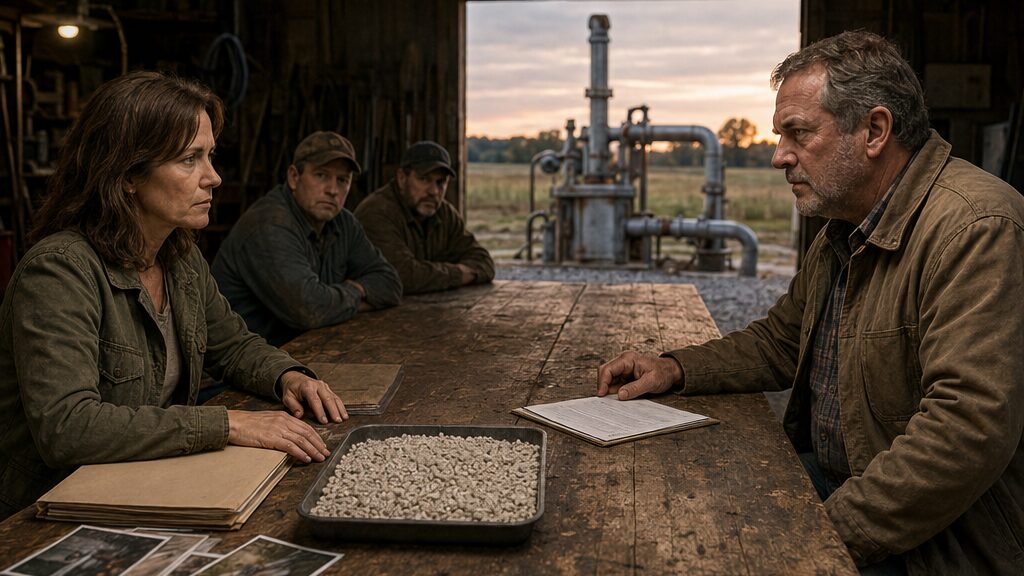
The equipment shed smelled of diesel, old wood and damp work gloves. A scarred rectangular table occupied the center beneath two harsh overhead fixtures. Along one wall sat ledgers, an old coffeemaker and a dusty monitor showing several small camera feeds from gates and shared equipment areas.
Two neighboring farmers sat without speaking. The association treasurer had a notebook open.
Pamela’s chair was empty.
Amy set her file folder down.
Beside it she placed a shallow metal tray.
Thomas looked at the pale stones inside.
“What is that?”
“The gravel I’m accused of disturbing.”
One farmer shifted in his chair.
Thomas leaned back.
“You thought bringing it in here would make a point?”
“I thought dates might.”
Amy opened the folder.
Thomas tapped the violation notice.
“You were told when you bought the place that the pump site is association-maintained.”
“I was told the current system was operational.”
“It is.”
“That wasn’t my question.”
Thomas’s jaw moved slightly.
“Amy, these farms have shared water infrastructure. It requires maintenance. You can’t start digging because something looks unfamiliar.”
“I didn’t start digging. I stepped on it.”
“Then you kept going.”
Amy looked at the notice.
“You prepared this Monday.”
“That’s the date it was entered.”
“I found the fitting Tuesday.”
No one spoke.
Thomas folded his arms.
“Then somebody saw you around the site earlier.”
“Who?”
“I don’t keep track of every call.”
“There’s a camera pointed at the pump road.”
The treasurer glanced at the monitor.
Thomas’s voice hardened.
“This isn’t a courtroom.”
“No.”
Amy opened another document.
“That’s why I’m only asking you to explain the timeline.”
She placed a photograph beside the gravel tray: pale crushed stone over dark compacted ground and the edge of old concrete.
“This material was delivered shortly before my inspection.”
Thomas looked at it without touching it.
Amy added the torn delivery tag photograph.
“Three weeks before.”
Then the county report.
“This test is four years old. It recommends further evaluation of the original source before domestic use.”
One of the farmers looked toward Thomas.
Thomas did not.
“Original source,” he said. “Which isn’t what supplies your house now.”
“Then why wasn’t its history included with the property records referenced in my disclosure?”
“You’d need to ask the seller.”
“I have.”
“You’d need to ask your broker.”
“I did.”
“Then ask your closing attorney.”
Amy almost laughed, but didn’t.
Thomas spread his hands.
“You signed the documents. Nobody forced you to buy that farm.”
There it was.
The sentence was quieter than she had expected.
More ordinary.
That somehow made it worse.
Thomas continued.
“You inspected the property. You had a due-diligence period. If your people didn’t ask the right questions, that’s not something this association can repair for you.”
Amy watched the others avoid her eyes.
A week earlier, that might have made her angry enough to fill the silence.
Tonight she let Thomas own it.
He mistook the pause for retreat.
“Read what you signed before accusing people who’ve kept that system running for thirty years.”
Amy opened the folder again.
“I did read it.”
Thomas gave a short breath through his nose.
“Apparently not closely enough.”
“I spent nine years reviewing agricultural property and title claims.”
The room changed.
Not much.
The treasurer’s pen stopped.
Thomas’s hands stopped moving.
Amy continued in the same voice.
“Failed disclosures. Boundary conflicts. easements. Water access. Agricultural-use exceptions. Title defects. The cases everybody swore were misunderstandings until the dates stopped matching.”
Thomas looked at her differently now.
She wished the shift felt better.
It didn’t.
It only confirmed how little attention he had given her before.
Amy placed three papers in a line.
“County test: four years ago.”
A second.
“Resurfacing delivery: three weeks before inspection.”
A third.
“My property disclosure: no unresolved condition identified.”
Then she put one finger on the violation notice.
“And this was entered the day before I exposed the old connection.”
Thomas’s face reddened slightly.
“So which document would you like me to believe?”
Nobody moved.
For several seconds, Amy could hear the coffeemaker ticking as it cooled.
Thomas finally leaned forward.
“You think gravel is evidence of some grand scheme?”
“I think new material was placed over an old water connection immediately before my inspection.”
“It’s maintenance.”
“Then show me the maintenance record.”
“You aren’t entitled to every scrap of association paperwork because you bought a farm last week.”
“I pay association assessments.”
“You pay your share of road and water maintenance.”
“Exactly.”
Thomas pushed the violation notice toward her.
“And right now your share includes fixing what you disturbed.”
Amy felt heat rise into her neck.
She had come wanting one factual answer.
Instead, the fine remained between them like a dare.
“You knew there was a bad test.”
Thomas’s eyes narrowed.
“Amy.”
“You knew the original source had a problem, you resurfaced that site right before my inspection, and then you prepared a fine before I even asked you about it.”
“Amy, stop.”
“No.”
One of the farmers finally spoke.
“You don’t have a current test.”
The words cut more effectively than Thomas’s dismissal because they were true.
Amy turned toward him.
“No. Not yet.”
“So you don’t know there’s anything wrong with what you’re using.”
“I know something was withheld.”
“That’s not the same thing.”
Thomas seized the opening.
“Exactly.”
Amy knew she had moved too soon.
She could feel it in the room. Facts she had carefully assembled were now being crowded by the accusation she could not yet prove.
Thomas stood.
“You came in here implying we sold you poisoned ground. You don’t have a current result. You don’t know what happened four years ago. And you don’t know why that pad was resurfaced.”
“Then tell me.”
His silence lasted one beat too long.
Amy pushed.
“What was under that gravel, Thomas?”
His palm flattened against the table.
“The old connection.”
“To what?”
“The previous well.”
“Why seal it now?”
“Because it wasn’t needed.”
“Why wasn’t it needed?”
Thomas looked toward the two farmers, then back at Amy.
When he answered, the anger had gone out of his voice.
That frightened her more.
“Because it was never your well.”
Amy stared at him.
Thomas pointed toward the dark window and the fields beyond it.
“That old source wasn’t exclusive to your parcel. It fed more than one property before the current arrangement.”
Amy’s anger stalled.
“How many?”
Thomas picked up the violation notice and slid it back toward her.
“Before you accuse this whole road of hiding something, you’d better understand what you’re actually looking at.”
Amy did not touch the paper.
Outside, somewhere behind the shed, a pump kicked on with a low mechanical thud.
For the first time since she found the buried fitting, the question was no longer what had been hidden beneath her farm.
It was how far the same line ran after it crossed her fence.
Chapter 4: The Water Line Did Not Stop at Her Fence
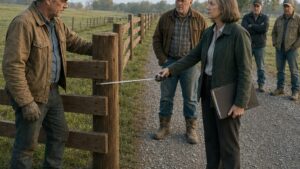
The inspector’s locating rod beeped three feet inside Amy’s pasture, then again beside the fence, then again on Thomas Baker’s side of the property line.
Amy stared at the spray-painted marks.
“That’s the same line?”
“Same run,” the independent well inspector said.
He crouched beside the shallow depression where the pipe crossed beneath the fence. “At least until the next junction.”
Amy looked toward Thomas’s lower field.
The land rose gently from her pump house, crossed the fence beneath a strip of grass, then disappeared toward two weathered outbuildings on Thomas’s property.
She had spent the weekend imagining a concealed defect beneath her own farm.
Now the buried line simply kept going.
“How many connections?”
“I can’t tell without tracing all of it.”
“Can you test mine?”
“I can sample your current supply. But if you’re asking whether the old source affected more than your parcel, that’s a different question.”
Amy folded her arms.
“That’s exactly what I’m asking.”
The inspector stood and brushed soil from his knee.
“Then you’ll want sampling points on the system, not just at your kitchen tap.”
He pointed toward the rise.
“And permission where the line crosses private ground.”
Permission.
Amy almost laughed.
By noon, word had traveled farther than the inspector had.
A pickup slowed as it passed her field. One of the farmers from Friday’s meeting stopped near the gate but did not get out.
“You really bringing outside testing in?”
Amy rested one hand on the fence post.
“I’m trying to find out what feeds my house.”
“Current water’s been fine.”
“How do you know?”
“We use it.”
“That’s not a test.”
He looked past her toward the inspector’s truck.
“You start generating bad paperwork on every parcel tied to that system, banks see it. Buyers see it. Insurance sees it.”
Amy felt the old instinct rise in her—the clean response, the procedural one.
If the water is safe, the paperwork will show it.
She almost said it.
Then she noticed the man’s hands gripping the steering wheel. Split knuckles. Dirt ground into the creases. A feed-store receipt curled on the dashboard beside him.
“What happens if the paperwork is bad?” she asked.
He gave a humorless smile.
“You just got here.”
Then he drove on.
The answer stayed with her.
That afternoon, the inspector traced another branch of the line toward Pamela Scott’s property.
At the second access point, Amy stopped walking.
Fresh gravel.
Not as bright as the patch beside her pump house, but recent enough that the crushed edges were still angular. A third patch appeared beyond the hedgerow near a concrete box.
Amy photographed both.
The inspector glanced at her phone.
“You documenting everything?”
“Habit.”
“Useful habit.”
She looked at the new stones.
“Sometimes.”
By three, they had enough mapping to establish that her farm’s current supply was part of a network, not an isolated well. The old source had once fed at least three parcels before later modifications redirected the system.
That did not prove contamination remained.
It did prove Thomas’s statement had not been a deflection.
The problem was bigger than her closing packet.
Amy was labeling photographs at her kitchen table when someone knocked hard enough to make her look up.
Pamela stood outside.
No dog this time.
Amy opened the door.
Pamela stepped in before being invited.
“You need to stop.”
Amy closed the door slowly.
“Stop what?”
“Dragging inspectors up and down the road.”
“I’m testing my water.”
“You’re testing everybody’s problem.”
There was something raw in Pamela’s voice that Amy had not heard before.
“Then everybody has a problem.”
“You don’t know that.”
“Neither do you.”
Pamela’s gaze moved to the spread of maps and photographs.
Amy saw the moment she recognized the access points.
“You knew the line went through your property.”
Pamela said nothing.
“You knew before I bought.”
“I knew there’d been an old issue.”
“That’s the same phrase Michael used.”
“Because that’s what we were told.”
“By Thomas?”
Pamela shook her head too quickly.
“It wasn’t Thomas at first.”
Amy stopped.
At first.
The words changed the room.
She pulled out a chair.
“Sit down.”
Pamela remained standing.
“When did it start?”
“A long time before you.”
“How long?”
Pamela looked at the photographs instead of Amy.
“The first bad sample I remember was years ago.”
“The county record is four years old.”
“That wasn’t the first concern.”
Amy’s fingers went still on the edge of the table.
“What was?”
“Changes in the spring after heavy rain. Taste. Sediment. Nothing consistent.”
“And what did the association do?”
“Tested.”
“And?”
Pamela’s mouth tightened.
“Talked.”
Amy felt anger return.
“That’s not an answer.”
“No, it’s what happened.”
Pamela finally sat.
“The farms were already hurting. Two families had refinanced. Thomas’s father was still alive then. The road needed work. The old water line needed work. Everything needed money.”
“And so nobody told buyers?”
“There weren’t buyers then.”
“There was eventually.”
Pamela looked at her.
“Yes.”
Amy waited.
Pamela rubbed both hands together as if cold.
“We thought we’d fix it first.”
The sentence landed harder than Amy expected because it sounded almost reasonable.
Not good.
Not enough.
But human.
Amy sat across from her.
“Who is we?”
Pamela closed her eyes for a moment.
“The board.”
“You were on it.”
Pamela nodded.
Amy had assumed Pamela was afraid because she had seen something.
Now she understood Pamela was afraid because she had done something.
“How long?”
“Six years.”
“You sat on the board six years.”
“Until last summer.”
“And you knew the old source had testing concerns.”
“Yes.”
Amy leaned back.
Every part of her wanted to turn the admission into a checklist.
Who knew. When. Which records. Which votes.
Instead she asked, “Why warn me?”
Pamela looked toward the window.
“Because I saw you standing over that fitting.”
“That’s not why.”
“No.”
Pamela swallowed.
“My husband drank from that system his whole adult life. So did I. We raised food with it. We watered animals with it. Every time somebody said the next test would tell us more, I wanted to believe them.”
“Was he sick?”
“No.”
The answer came quickly.
“This isn’t that kind of story, Amy.”
Amy held her gaze.
“Then what kind is it?”
Pamela looked older suddenly.
“The kind where scared people keep making temporary decisions until the temporary part disappears.”
Neither spoke for several seconds.
Outside, the inspector’s truck started.
Pamela stood.
Amy asked, “What did the board vote for?”
Pamela reached the door.
Her hand rested on the knob.
Then she turned back.
“I voted for it too.”
Chapter 5: The Vote They Said Was Temporary
Pamela put the minutes on her kitchen table with her own name visible beside the motion.
Amy did not need to search for it.
Pamela had already marked the page.
The farmhouse kitchen smelled faintly of coffee and onions. A stack of seed catalogs sat beneath the sugar bowl. Pamela remained standing while Amy read.
The motion was written in the dry language Amy knew too well.
Continue operation under interim management.
Seek financing for replacement infrastructure.
Defer broader notification pending confirmatory sampling and capital plan.
Amy read the final line again.
“Broader notification.”
Pamela nodded.
“That was the phrase.”
“Who were you not notifying?”
“Anyone who didn’t need operational details yet.”
“That’s not an answer.”
“Back then, there wasn’t a property for sale.”
Amy tapped the page.
“You voted to hold information.”
“We voted to keep the farms running while we figured out whether we had a lasting problem.”
“For how long?”
Pamela looked toward the sink.
“Supposed to be ninety days.”
Amy turned the page.
The next meeting extended the interim arrangement.
Then another.
Then six months.
Then a year.
The language changed slowly. What began as a temporary response became routine maintenance. References to contamination disappeared. Later minutes called it “source instability” and “seasonal variation.”
“Who wrote these?”
“Secretary at the time. Motions came from whoever made them.”
Amy moved backward through the records.
A surprise waited three pages earlier.
Thomas Baker’s name appeared beneath a dissent.
He had argued for shutting down the old source until additional testing could be completed.
Amy looked up.
“Thomas opposed this?”
“At first.”
Pamela sat across from her.
“His father still handled most of their farm then. Thomas was the one saying we’d regret pretending we knew more than we did.”
Amy felt something inside her resist the information.
Thomas had fined her.
Dismissed her.
Told her she should have read what she signed.
It was easier if he had always been the man she met in the equipment shed.
“Why did he change?”
Pamela looked down at her hands.
“His father died. The farm debt became his. Then one of the replacement-line estimates came in.”
“How much?”
“Enough.”
“That’s not a number.”
“It’s a number that would’ve put two places up for sale and maybe three.”
Amy sat back.
She did not like the sympathy creeping into the shape of the story.
Not because Thomas deserved none.
Because sympathy complicated anger, and anger had been useful.
Pamela pushed another box across the table.
“These are the association storage copies. I shouldn’t have kept them.”
“Why did you?”
“Because after I left the board, I started wondering whether ‘temporary’ had become something else.”
The box contained invoices, maintenance notes and handwritten index sheets.
Amy worked through them one by one.
Gravel deliveries appeared repeatedly.
Some ordinary: lane washout, culvert shoulders, equipment pad.
Others referred to pump access areas.
Three years ago.
Two.
Last autumn.
The gravel was not proof of contamination.
It was something more mundane and more troubling: evidence of repeated work at the same locations the board increasingly stopped describing in detail.
Pamela watched Amy build piles.
“You’re doing it again.”
Amy looked up.
“What?”
“Turning us into folders.”
Amy’s first reaction was annoyance.
“My folder didn’t vote.”
“No. People did.”
“People also sold me a farm without telling me this.”
“I know.”
“Do you?”
Pamela’s chair scraped backward.
“I put my name on that vote. What exactly do you think I’m doing here?”
Amy said nothing.
Pamela stood and walked to the counter.
“You came here looking for somebody clean enough to stand beside you.”
“I came for records.”
“That’s what I mean.”
The words struck deeper than Amy wanted them to.
She returned to the papers.
Halfway through the second box, she found the transition.
Older records showed Thomas asking for more testing.
Later records showed Thomas chairing meetings where disclosure language narrowed.
One note recommended that association responses to property inquiries address “current service condition only.”
Another authorized members to direct outside questions to standardized statements.
The contamination had not begun with Thomas.
The silence had not either.
But eventually he had stopped resisting it.
Then he had organized it.
Pamela lowered herself back into the chair.
“He kept saying replacement funding was close.”
“Was it?”
“Sometimes.”
“What does that mean?”
“A grant application. A loan. County money. Something always looked possible until it wasn’t.”
“And every time it failed?”
“We waited.”
Amy turned another page.
The pattern was painfully ordinary.
No grand conspiracy.
No secret payoff.
A series of people choosing another month.
Another season.
Another crop.
Another refinancing cycle.
Until somebody else’s money entered the system.
Hers.
Amy found the invoice near the bottom of the last folder.
Crushed limestone.
Pump access resurfacing.
Delivery location matching her parcel.
She checked the date.
Three days before her property inspection.
Her pulse accelerated.
“Pamela.”
Pamela leaned closer.
Amy pointed.
“Who authorized this?”
The invoice listed the association account but not the individual purchaser.
“Could’ve been the treasurer.”
“Could’ve been Thomas.”
“Yes.”
Amy photographed it.
Then she found a maintenance note clipped behind it.
Old fitting secured. Pad leveled before inspection access.
Amy stared at those final two words.
Pamela read them over her shoulder.
Neither spoke.
Before inspection access.
Amy closed her eyes briefly.
The contamination predated Thomas.
The policy predated Thomas.
But this work did not.
Someone had ordered the old connection covered and the pad leveled three days before Amy’s inspector walked the property.
She opened her phone and photographed the invoice again.
This time she included the account authorization line at the bottom.
The initials were small.
But she recognized them.
T.B.
Chapter 6: The Settlement Came With One Condition
Thomas arrived alone carrying a folder, and pale gravel dust clung to both of his work boots.
Amy noticed it before she noticed anything else.
He stood on her porch at seven-thirty on a Tuesday morning, hat in one hand, folder in the other.
“No meeting?” Amy asked.
“No meeting.”
She looked past him toward the lane.
His truck was parked beside the fence.
“Come in.”
Thomas stepped into the kitchen.
A few grains of crushed stone dropped from his soles onto the floor.
Amy almost smiled at the absurdity of it.
Instead she pulled out a chair.
Thomas remained standing.
“I know you found the invoice.”
Amy did not ask how.
“Then you know what it says.”
“It says I authorized resurfacing.”
“Three days before my inspection.”
“Yes.”
“And the maintenance note says the old fitting was secured before inspection access.”
“Yes.”
Thomas’s directness unsettled her more than another denial would have.
“Why?”
“Because it was a trip hazard and the pad was rutted.”
Amy stared at him.
“That’s your answer?”
“It’s part of it.”
He put the folder on her table.
“Open it.”
Inside was a proposed agreement between Amy and the association.
The association would contribute toward independent water testing, temporary supply costs and certain corrective work if required.
There was also language concerning her purchase dispute.
Amy read until she reached the confidentiality provision.
Then she stopped.
Thomas sat down.
“We can solve this without burning everybody on the road.”
Amy kept her finger on the paragraph.
“By pretending again.”
“By containing damage while we fix a problem.”
“That’s the same argument.”
“No. It isn’t.”
“It sounds exactly the same.”
Thomas’s face tightened.
“You think I’m proud of any of this?”
“I don’t know what you’re proud of.”
He looked at the table for several seconds.
Then he said, “The Baker place is leveraged against two bad years and one average one. The farm below Pamela’s has a note due in August. Another family used land as collateral to replace equipment after the flood.”
Amy said nothing.
Thomas continued.
“If a state notice lands before there’s a correction plan, lenders don’t wait around for the moral lesson. They protect themselves.”
“That doesn’t make my disclosure accurate.”
“I know.”
The words were quiet.
Amy looked up.
Thomas rubbed his thumb across the edge of his hat.
“I know.”
For the first time since she met him, there was no authority in his posture.
Only fatigue.
Amy pushed the agreement toward him.
“Did you know my farm was going on the market?”
“Yes.”
“Did you know the old water history wasn’t in the packet?”
He hesitated.
“Not the exact packet.”
“Did you know buyers were being told the issue was resolved?”
“I knew that was the association’s position.”
“Your position.”
“Eventually.”
There it was.
No performance.
No clever denial.
Just eventually.
Amy felt the clean satisfaction of confirmation—and then almost immediately, disappointment that it did not feel better.
“Why cover the fitting before inspection?”
Thomas looked toward the window.
“Because replacement funding looked real.”
“That’s not an answer.”
“We’d been told a financing package might close within weeks. If it had, the old connection would’ve been irrelevant. New line, new source management, done.”
“But it didn’t close.”
“No.”
“You still let me buy.”
Thomas’s mouth tightened.
“Yes.”
“Without telling me.”
“Yes.”
Amy looked down at the folder.
Years in claims work had taught her to wait for admissions people offered voluntarily.
She had imagined this one more than once.
It was supposed to feel like winning.
Instead she heard Pamela’s voice.
Temporary decisions.
Thomas leaned forward.
“You can have money toward the fix now. Not after a year of lawyers. Not after state notices and property holds. Now.”
Amy tapped the confidentiality clause.
“In exchange for this.”
“In exchange for not spreading unresolved testing history beyond what’s necessary to correct it.”
“That’s silence.”
“It’s control.”
“It’s the same word wearing a tie.”
Thomas almost smiled.
He didn’t.
“You want justice. Fine. But justice doesn’t pay a feed bill.”
Amy looked at him.
“And secrecy doesn’t clean water.”
“No.”
The answer came immediately.
That stopped her again.
Thomas stood and walked to the sink, then turned.
“I was the one who wanted the old source shut down years ago.”
“I saw the minutes.”
“So you know.”
“I know you changed your mind.”
“My father died. I inherited his debt. Then I watched what one bad appraisal did to another farm up the road.”
“So you decided buyers could carry the risk instead.”
His face hardened.
“I decided we’d fix it before anybody got hurt.”
“And when you didn’t?”
He had no answer.
Amy closed the folder.
Thomas nodded toward it.
“Think about the offer.”
She looked at the pale gravel dust on her floor.
The same clean stone.
The same instinct.
Cover the unstable ground now. Deal with what was underneath later.
“I already have.”
Thomas’s shoulders dropped slightly.
“Amy.”
“I won’t try to ruin you.”
He studied her.
“But I won’t sign this.”
She tore nothing up. Made no dramatic gesture.
She simply slid the folder back across the table.
Thomas did not touch it.
“If you send this to the state,” he said, “you can’t choose what happens after.”
“I know.”
“Do you?”
Amy looked at the stacks of documents she had collected.
For years she had believed a complete file produced a clean answer.
Now she understood that sometimes it only produced a choice no one else could make for you.
“I know enough.”
Thomas picked up the agreement.
At the door, he paused.
“The resurfacing was my call.”
Amy waited.
“I thought we’d have the new system approved before your inspection mattered.”
He looked down at his boots.
“I was wrong.”
Then he left.
Amy stood alone in the kitchen.
A track of pale dust crossed the floor from the door to the table.
She fetched a broom, then stopped.
Instead she took a photograph.
Not because the dust proved anything.
Because she finally understood the motif she had been following without naming it.
Fresh material did not erase old ground.
It only made people less likely to look underneath.
Amy opened her laptop.
The independent testing request was already drafted.
She attached the county report, the old association minutes, the resurfacing invoice, the system map and her purchase documentation.
Her cursor hovered over the final button.
For one second, she imagined accepting Thomas’s offer.
Money now.
Quiet repairs.
A chance to plant on schedule.
Then she thought of the next buyer.
The next refinance.
The next temporary decision.
Amy clicked send.
The confirmation appeared on the screen.
Outside, Thomas’s truck had already disappeared beyond the bend.
This time the question was no longer whether the truth would leave her farm.
It was what would happen when nobody on the road could keep it there.
Chapter 7: This Time Nothing Was Buried Underneath
The state field officer tied a red tag to the shared pump assembly before anyone on the road had finished arguing about who would pay for the bottled water.
“Normal domestic use stops now,” the officer said.
Thomas Baker stood with both hands hooked into his jacket pockets. Pamela Scott was beside him, arms folded against the morning chill. Two neighboring farmers waited near the equipment shed, saying almost nothing.
Amy stood closest to the pump house.
Six weeks earlier, she had wanted one answer about a patch of fresh gravel.
Now the old gravel had been scraped aside in a wide uneven ring, leaving the pipework exposed from the pump house to the first buried junction. The ground looked raw without its covering.
Amy preferred it that way.
The independent results had confirmed what the association had spent years refusing to define clearly: the shared source was vulnerable to contamination under certain conditions, and the current arrangement required corrective work before the state would consider it reliable for normal household use.
Nobody had been declared poisoned.
Nobody’s farm had been condemned.
But the problem was real.
That mattered.
The field officer turned toward the small group.
“You’ll receive the written order. Temporary storage and hauled water are acceptable while the replacement plan is reviewed. Any property transaction tied to this system will require accurate disclosure of the current condition.”
One of the farmers looked away.
Thomas nodded once.
“Understood.”
The officer looked at him.
“You’re the association chairman?”
“For now.”
Amy noticed the wording.
The officer continued through sampling requirements, temporary storage, and the documents the association would need to submit.
Thomas asked practical questions.
No arguing.
No minimizing.
When the officer drove away, the silence left behind felt heavier than the official conversation.
The farmer who had warned Amy about lenders kicked at the exposed dirt.
“So that’s it.”
Thomas looked at him.
“That’s the order.”
“We don’t have the cash sitting around.”
“I know.”
“You told us there was time.”
“I was wrong.”
The farmer stared at him.
Amy expected Thomas to explain.
Instead he took off his hat.
“The resurfacing before Amy’s inspection was my call,” he said.
Pamela looked at him.
Thomas kept his eyes on the others.
“I believed the replacement financing would close before the old system mattered. It didn’t. I let that become an excuse to keep treating a disclosure problem like a maintenance problem.”
Nobody answered.
He rubbed the brim of his hat between his fingers.
“I also authorized the response language we used on outside inquiries.”
The second farmer shifted.
“You weren’t the only vote.”
“No.”
Thomas glanced toward Pamela.
“But I was chairman.”
Pamela spoke quietly.
“And before that, I voted to keep the problem inside the board while we tried to fix it.”
Thomas looked at her.
Pamela did not look away.
“We all have portions of this,” she said. “Some larger than others.”
Amy felt no satisfaction watching them admit it.
That surprised her.
A month earlier she had imagined this scene as a correction to everything that had happened at the equipment-shed table. Thomas would finally be forced to acknowledge what she knew. The others would have to see that she had been right.
But standing beside an unusable water system, she understood how small being right could feel.
“What happens now?” one farmer asked.
Amy answered before Thomas could.
“We fix the water.”
Everyone looked at her.
She almost retreated into the safer language of permits and reports.
Instead she said, “And nobody sells, refinances, or answers another buyer’s question as if this doesn’t exist.”
Thomas nodded.
“Agreed.”
It was not forgiveness.
Amy was glad of that too.
By afternoon, Pamela had offered the flat ground beside her equipment barn for temporary water-storage tanks. It had the easiest access for delivery trucks and enough distance from livestock traffic to satisfy the field officer’s requirements.
“I’ve got more room than Thomas,” she told Amy.
Thomas heard her.
“For once.”
Pamela gave him a look.
The corner of Thomas’s mouth moved, then disappeared.
It was the closest the three of them came to laughter.
The corrective plan took weeks.
A replacement line would connect the affected properties to a more reliable source, with additional monitoring points and clearly assigned maintenance responsibility.
The association had to borrow part of the cost.
Nobody liked that.
One farmer reduced a planned equipment purchase. Another negotiated with his lender before the state notice reached the file through other channels.
The disaster Thomas had predicted did not arrive all at once.
Neither did rescue.
It came as paperwork, revised payments, temporary tanks, contractor schedules, uncomfortable phone calls, and mornings when everyone had to work around trenches cut through places where tractors normally passed.
Amy’s own purchase dispute entered mediation.
Michael Rivera provided his original transaction file and the association response he had relied upon. Amy’s closing attorney began reconstructing responsibility among the seller, association and other parties.
There was no check waiting for her.
No sudden cancellation of the sale.
She still owned the farm.
She still had money tied up in a property she would not have purchased on the same terms if she had known the complete history.
Some evenings, that fact sat heavily in her kitchen.
But it was no longer hidden.
That distinction had become important.
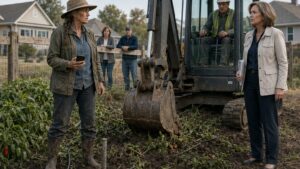
On the morning the contractor uncovered the old line for removal, Amy stood near the pump house with her phone in hand.
Thomas came up behind her.
“Taking more pictures?”
“Yes.”
“You trust us that much?”
Amy looked at him.
“More than before.”
He gave a short nod.
The excavator eased backward, revealing the sealed fitting that had first appeared beneath her boot.
For a moment Amy saw the whole chain again: fresh gravel, Pamela’s frightened question, the missing test, Thomas pushing the fine across the scarred table, Pamela’s name on the old vote, the settlement folder on Amy’s kitchen table.
Thomas looked down into the trench.
“My father used to say if you kept a farm long enough, every bad decision eventually came back up with a plow.”
Amy lowered her phone.
“You could’ve remembered that sooner.”
“Yes.”
No defense followed.
That was new.
Weeks later, when the replacement line passed inspection and normal use was restored, the association ordered fresh stone for the pump-house approach.
The truck arrived in the morning.
Pale gravel poured from the raised bed in a controlled stream.
Amy watched from the edge of the field.
It looked exactly like the stone that had started everything.
Bright.
Clean.
Convincing.
The difference was underneath.
The old connection was gone. The new line had been tested. The trench had been photographed and logged before it was filled. The state sign-off sat in Amy’s folder alongside the documents that had once made her feel powerful simply because they were documents.
Now the folder felt different.
Useful, but not complete.
Pamela came down the lane carrying two cups of coffee.
“Thought you might be out here.”
Amy accepted one.
Across the field, Thomas was helping the contractor rake the stone level by hand.
Pamela watched him for a moment.
“You think he’ll stay chairman?”
“No.”
“Me neither.”
They stood quietly.
Pamela nodded toward the pump house.
“You going to trust that gravel?”
Amy looked at the pale surface.
Then at the photograph on her phone showing the repaired line before the trench had been closed.
“I trust what’s under it.”
Pamela smiled faintly.
Amy put the phone away and picked up a rake.
She spread the last ridge of stone herself, smoothing it across the approach without hiding anything that had not already been seen.
The mediation could take months.
Money might return, or only part of it.
Some neighbors would probably resent her for years.
Others might never decide whether she had saved the road or endangered it.
Amy no longer needed all of them to agree.
The farm still required planting.
The berry rows still needed work.
Water ran clean through the new line.
When Amy walked back toward the house, the gravel held firm beneath her boots.
This time, nothing had been buried underneath.
The story has ended.