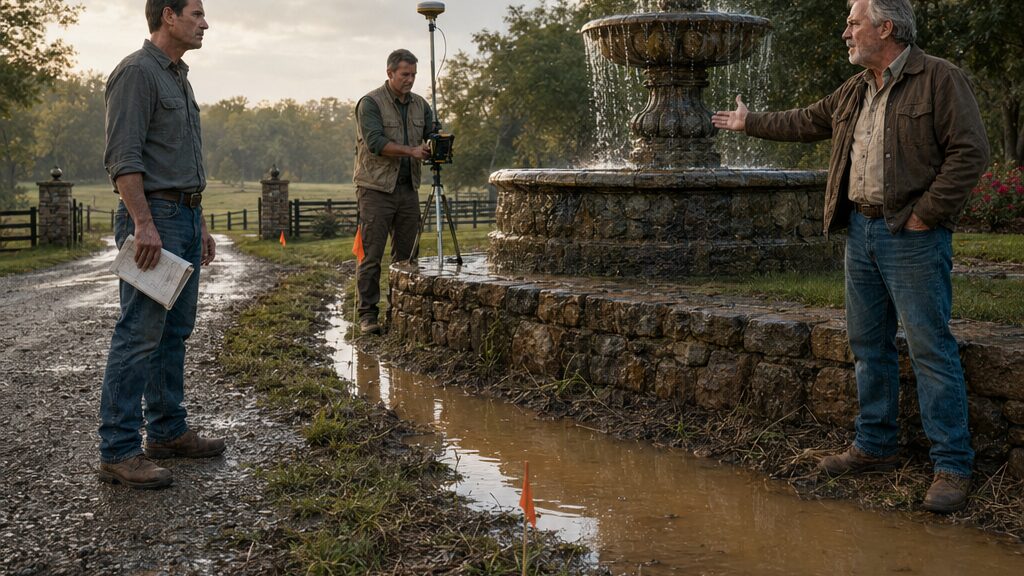
He Built a Stone Fountain Across the Farm Drainage Route—Then the Rain Exposed What Both Families Had Buried
Chapter 1: The Fountain Standing Where the Water Had Always Gone
Patrick Carter stopped the tractor so abruptly that the empty hay wagon behind him bumped the hitch and rocked once in the wet grass.
Two days earlier, he had driven across the same low strip without leaving more than a faint tire mark. Now brown water covered both ruts and spread toward the lower barn in a sheet broad enough to reflect the pale morning sky.
He killed the engine and climbed down.
The water reached the soles of his boots before he reached the old crossing.
That was wrong.
The Carter farm had low ground. It always had. After a hard rain, water came down from the Wilson place, crossed the shallow swale, and kept moving toward the creek beyond Patrick’s hayfield. His father had taught him where not to park equipment, where spring mud lasted longest, where the ground looked level but wasn’t.
But the water had always moved.
This water was standing.
Patrick walked uphill along the edge of the flooded grass until he could see the reason.
Across the property line, where Stephen Wilson had spent most of the summer rebuilding the entrance to his farm, a new limestone terrace rose across the natural low spot. In its center stood a three-tier stone fountain.
Clean water spilled from the top bowl to the second, then to the broad basin below with a soft, constant hiss.
Behind it, muddy storm runoff had nowhere to go.
Patrick stood there watching the two kinds of water: one moving in perfect circles because an electric pump told it to, the other spreading wider through the grass because a wall of stone told it to stop.
Stephen came out of the renovated barn wearing work boots and a clean tan shirt with the sleeves rolled neatly to his elbows.
“You admiring it?” he called.
Patrick looked at him. “I’m looking at the water behind it.”
Stephen followed his gaze but did not come closer. “We had three inches last night.”
“I know.”
“Then there’s your answer.”
Patrick stepped onto the gravel lane. “The answer used to be that it drained.”
Stephen gave a short laugh. “You came over here before breakfast to tell me it rained?”
Patrick had known Stephen most of his life, though knowing a man in the country often meant knowing the make of his truck, the sound of his tractor, and which gate he preferred to use more than knowing what he feared.
The Wilson farm had once been mostly pasture and corn. Now the old dairy barn had new windows, dark trim, and strings of warm bulbs beneath the eaves. A fresh gravel parking area spread along one side. The fountain stood where an entrance sign would eventually go.
Patrick nodded toward the limestone base.
“You raised that whole section.”
“Landscaping.”
“You raised it across the swale.”
“My side of the line.”
“The drainage easement crosses your side of the line.”
Stephen’s face changed just enough to show he had expected the words.
“That old thing again.”
“It’s recorded.”
“So are a lot of things that haven’t mattered in forty years.”
Patrick looked past him. Muddy water touched the upper edge of the terrace and curled toward the access road.
“It matters this morning.”
Stephen walked down the gravel until only the fountain separated them. “Patrick, I spent all summer fixing this place up. You think I’m ripping out a stone fountain because your hayfield got soggy after a storm?”
“My hayfield isn’t what I’m worried about.”
Patrick pointed downhill.
The lower barn sat beyond the field, its weathered siding dark near the ground. Water had not reached it yet, but the sheet in the crossing was already wider than Patrick had seen after heavier storms.
Stephen folded his arms.
“That barn’s been there seventy years.”
“Which is why I notice when water starts going somewhere it never went before.”
Stephen’s mouth tightened.
Then he smiled.
“The fountain’s permanent.”
Patrick let the sentence settle.
Stephen tapped the edge of the stone basin with two fingers. “Concrete footing. Underground electrical. Plumbing. The whole entrance was engineered.”
“Engineered for events.”
“For my property.”
Patrick felt the familiar urge to reach for facts before anger could get loose. “There’s an easement.”
“And there hasn’t been an open ditch where you’re pointing since we were young.”
“That doesn’t make the easement disappear.”
Stephen stepped closer.
“You want to go digging through county paper, go ahead. But nobody is tearing this out because you don’t like where rainwater sits for a morning.”
Patrick almost answered that he did not care about the fountain. He did not care about the new barn windows or the stone planters or the wedding lights Stephen had strung where milking equipment used to stand.
Instead, he looked again at the muddy water pressing against the limestone.
“I’m asking you to look at what changed.”
“I know what changed.” Stephen spread a hand toward the renovated property. “Something finally looks decent.”
Patrick turned away before that could become the argument Stephen wanted.
Back at the tractor, his phone rang.
A farmer farther downstream spoke without greeting.
“You got water backed up on your side?”
Patrick looked toward his lower barn. “Some.”
“I’ve got it coming under the machinery shed door.”
Patrick straightened. “Since when?”
“Twenty minutes ago, maybe. Never seen it come from that direction.”
Patrick glanced uphill.
The fountain glittered in the thin sunlight.
Stephen was already walking back toward the barn.
By midmorning, Patrick had moved two wagons and a stack of bagged mineral to higher ground. The water stopped rising, but it did not drain quickly. When he pushed a fiberglass post into the saturated ground near the crossing, dark water welled around the hole.
After lunch, he went into the farmhouse kitchen, cleared invoices from one end of the table, and opened the metal file box his father had kept under the desk.
The farm plat was folded inside a cracked plastic sleeve.
Patrick flattened it with both palms.
Property lines. Road frontage. Acreage notes.
And there, running diagonally from the Wilson parcel through the Carter low ground, was a marked drainage easement.
He traced it with one finger.
The line crossed almost exactly where Stephen’s new entrance stood.
For several seconds Patrick felt the clean relief of being right.
Then he noticed something else.
The easement line on the plat did not follow the shallow depression he had always thought of as the drainage path. Near the property line, the two diverged.
Not much.
But enough to bother him.
His father had always said water remembered its way downhill. Patrick had never thought to ask whether people had changed that way first.
He folded the plat once, stopped, then flattened it again.
Being sure from a kitchen table was not enough.
He found Andrew Davis’s number and called.
Andrew answered on the fourth ring.
“Davis Surveying.”
“Andrew, it’s Patrick Carter.”
A pause. “What’d somebody build?”
Patrick looked through the window toward the wet lower field.
“A fountain.”
Another pause.
“Where?”
“Right where I think the drainage easement runs.”
“You think?”
Patrick’s eyes returned to the line on the plat.
“That’s why I’m calling you.”
Chapter 2: The Survey Line Cut Straight Through the Stone
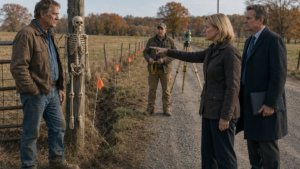
Andrew Davis pushed the first orange survey flag into the grass less than three feet from the fountain basin.
Stephen Wilson laughed from the gravel drive.
“You’re kidding.”
Andrew did not look up. He adjusted the receiver pole in his hands, waited for the reading, then moved six paces toward the limestone terrace.
Patrick stood near the road holding a copy of the recorded plat inside a clear plastic folder.
It had been two days since the floodwater filled his tractor crossing. Most of the field had drained, but a dark stain remained across the grass, marking the place where water had spread and stalled.
Stephen had not changed anything.
The fountain still ran from morning until dark.
Andrew planted another flag.
Stephen stepped off the drive. “You know he hired you, right?”
Andrew finally looked at him. “I know who sent the check.”
Stephen smirked.
“Good. Just making sure everybody understands what kind of survey this is.”
Andrew lifted the pole again. “The kind where the monuments don’t care who paid.”
Patrick looked away before Stephen could see the corner of his mouth move.
Stephen saw it anyway.
“You enjoying this?”
“No.”
“Could’ve fooled me.”
Patrick held up the plat. “I want to know where the easement is.”
“You want me told I’m wrong.”
“If that’s where it is, yes.”
Stephen pointed toward the shallow grassy depression that curved away from the entrance. “Water’s run over there since before either of us owned anything.”
Patrick’s answer came too quickly.
“That isn’t what the record shows.”
Andrew glanced at him.
It was only a glance, but Patrick recognized the warning in it.
A measurement was not an argument yet.
Andrew moved to a capped iron pin near the road, checked another point, then ran a thin bright line between two flagged positions. The line angled toward the fountain.
Stephen’s expression hardened.
Andrew continued across the grass, stepped onto the edge of the new terrace, and stopped.
The survey string passed directly across the limestone.
Not beside it.
Across it.
Patrick felt something unclench in his chest.
Stephen stared at the line.
“That can’t be right.”
Andrew checked his equipment again.
Stephen walked around the basin. “Your point’s off.”
“It isn’t.”
“There was never a ditch through here.”
“I’m locating the recorded easement. I’m not telling you what the ground looked like in 1985.”
Stephen pointed toward Patrick. “Exactly. That paper doesn’t show what actually happened out here.”
Patrick said, “Finish the measurement.”
Stephen turned on him. “You don’t get to stand there like a county judge.”
“I’m not.”
“You brought a surveyor to my front drive.”
“Because the water backed into mine.”
Andrew moved to the far side of the fountain and placed another flag.
Then he took a tape from his vest.
He measured from the recorded easement boundary to the outer edge of the raised terrace.
Once.
Then again.
“Eight feet, give or take a few inches depending on where you call the finished edge.”
Stephen’s face reddened.
Patrick looked at the fountain.
Eight feet.
There it was: a number instead of an argument.
The terrace had not merely brushed the corridor. It occupied it.
Muddy residue still clung to the grass on the uphill side, while clear fountain water spilled smoothly from bowl to bowl.
Stephen gave a sharp laugh that contained no amusement.
“Cute.”
Andrew began writing in his field book.
Stephen said, “You think that means somebody can come in here and knock this thing down?”
Patrick answered, “I think it means we stop pretending it’s nowhere near the easement.”
“I’m not pretending anything.”
“You just said the point was wrong.”
“Because the drainage doesn’t run there.”
Andrew closed his field book.
“That part may be worth looking at.”
Patrick turned.
Andrew pointed toward the old grassed depression Stephen had indicated.
“The recorded corridor is here. That’s clear enough. But the low ground doesn’t track it exactly.”
Stephen spread his hands. “Thank you.”
Andrew continued before he could claim victory.
“That doesn’t erase the easement.”
Stephen’s hands dropped.
“It does mean the site history is more complicated than a line on this sheet.”
Patrick stared at the old depression.
He had crossed it thousands of times. His father had called it the drain, as casually as he called the north pasture the north pasture.
Patrick had never questioned whether the recorded corridor and the visible one were the same thing.
“Could erosion move it?” he asked.
“Some,” Andrew said. “Grading could move it more. Tile work. Fill. Farm crossings.”
Stephen looked directly at Patrick. “Told you.”
Patrick ignored him. “Can you still certify where the recorded easement is?”
“Yes.”
“And the fountain?”
“Part of the terrace is inside it.”
Stephen kicked lightly at one of the orange flags.
Andrew’s voice sharpened.
“Don’t move those.”
“I’m on my land.”
“They mark my work.”
For the first time that morning, Stephen backed off.
Patrick watched the orange flags cross the landscaped entrance in a straight line. They looked almost absurd against the cut grass and fresh limestone, little plastic interruptions in a place designed to look finished.
Stephen walked to the fountain and rested one hand on the stone.
“My father drained cattle through here before Patrick’s father ever bought his second tractor. There was no open ditch under this fountain.”
Patrick said, “That doesn’t mean there wasn’t a drainage right.”
“I didn’t say right. I said ditch.”
“You keep changing the question.”
Stephen looked at him for a long moment.
“No. You keep acting like there’s only one.”
That landed harder than Patrick wanted it to.
Andrew packed the receiver into its case.
“I’ll send you the drawing tomorrow,” he told Patrick.
Then he nodded toward the field between the two farms.
“If you want to understand why the physical drain and the recorded corridor don’t match, find older aerials. County conservation office may have some. USDA imagery too.”
Patrick slid the plat back into its plastic folder.
“I know where the water runs.”
Andrew shut the truck tailgate.
“You know where it runs now.”
Stephen said nothing.
The fountain pump hummed steadily.
Patrick looked from the straight row of orange flags to the shallow older depression curving away through the grass.
For the first time since the flooding began, the evidence had given him exactly what he wanted.
And somehow he felt less certain than before.
Andrew opened the driver’s door, then paused.
“How long has your family had that lower crossing?”
Patrick frowned. “As long as I remember.”
“That’s not what I asked.”
Patrick looked toward his own farm.
The crossing was hidden by the rise, but he could picture it: compacted earth, gravel, grass at the edges, wide enough for hay equipment.
His father had widened it years ago.
Maybe more than once.
“I’ll find the aerials,” Patrick said.
Andrew nodded.
Behind them, one orange flag fluttered against the fountain’s stone base.
Chapter 3: Thirty Days on Paper, One Storm in the Forecast
Stephen taped Patrick’s certified removal notice to the fountain with two strips of clear packing tape.
Patrick saw it from the road before he even turned into the Wilson drive.
The cream envelope had been opened. The letter inside was folded beneath the tape, its corners lifting in the breeze while water spilled behind it from the fountain’s middle bowl.
Stephen stood nearby with a coffee mug.
“Wanted to make sure I didn’t lose it,” he said.
Patrick stopped several yards away.
“You signed for it yesterday.”
“I did.”
“So you read it.”
“Every thrilling paragraph.”
The survey drawing was attached to Patrick’s copy inside his truck. Andrew had certified the recorded corridor and noted the terrace encroachment. Patrick’s letter gave Stephen thirty days to remove or alter the obstruction before Patrick asked the county to intervene.
Patrick had expected anger.
The display bothered him more.
“You could’ve called.”
Stephen sipped his coffee. “You could’ve walked over instead of sending me certified mail.”
“I did walk over.”
“And then you hired somebody to put flags through my landscaping.”
“After my field flooded.”
Stephen looked toward the envelope taped to the fountain. “Thirty days.”
“That’s what it says.”
“Cute paperwork.”
Patrick felt heat rise under his collar.
He wanted to tell Stephen exactly what would happen next. County inspection. Written finding. Compliance order. Fines if necessary.
Instead he took out his phone and photographed the fountain, the notice, and the orange flags still marking the corridor.
Stephen shook his head.
“You documenting me now?”
“I’m documenting the condition.”
“Same thing to you, apparently.”
Patrick lowered the phone.
“You still have time to fix it without making this bigger.”
Stephen smiled.
“Do your worst.”
Patrick left before he answered.
At the county office that afternoon, a clerk pulled up the parcel records while Patrick waited beneath fluorescent lights that made every sheet of paper look older than it was.
The easement was there.
Recorded.
Never formally vacated.
Never relocated by amended instrument.
A county drainage engineer joined them after reviewing Andrew’s survey.
“If the structure is within the recorded corridor and it’s impeding flow, we can inspect,” the engineer said.
Patrick asked, “Does the old ditch being somewhere else change that?”
“It can change what remedy makes sense. It doesn’t make the recorded easement disappear.”
That was close enough to vindication that Patrick should have felt relieved.
He didn’t.
The engineer looked at the photographs from the flooded field.
“How often has this happened?”
“Not like this.”
“Any structure damage?”
“Not yet.”
“Then don’t wait for structure damage.”
The county scheduled a site visit.
Patrick drove home with the survey, plat, photographs, and complaint paperwork stacked on the passenger seat.
At the kitchen table that evening, rain marks from his wet hands had dried into faint brown-edged circles on the plastic sleeve protecting the old plat.
His phone buzzed with a weather alert.
A broad storm system was forming west of the county. Forecast confidence was still moderate, but the rainfall range had increased.
Patrick opened the radar, watched the colored band advance on the screen, then set the phone beside the plat.
Paper deadline: thirty days.
Rain: perhaps five.
The next morning he went to the conservation office to ask about historic aerial photographs.
A staff member brought up scanned imagery from several decades and showed Patrick how to compare years.
At first the differences seemed ordinary.
Fields changed crops. Fence lines shifted. Trees grew. Buildings appeared.
Then Patrick found the drainage.
In the oldest image, a darker line cut more directly from the Wilson side toward what was now his lower crossing.
In a later image, the channel bent.
Patrick leaned closer.
“What year is that?”
The staff member checked.
Patrick did the math without wanting to.
His father had owned the farm then.
They pulled another image.
The bend was clearer.
A pale rectangle sat near the crossing, too small to identify at first.
Patrick zoomed in.
The photograph was grainy, but the machine’s shape was familiar: squared rear housing, broad bucket, light-colored cab roof.
His father’s old loader.
Patrick sat back.
For years he had treated the recorded plat like a clean dividing line between what Stephen had done and what his own family had merely endured.
Now the land itself was telling a less comfortable story.
He requested copies.
On the drive home he remembered Stephen saying there had never been a ditch beneath the fountain.
Patrick had dismissed it because Stephen’s current construction was obviously new.
But new damage did not erase old changes.
At the farm he parked near the machine shed and carried the aerial prints inside.
Against the back wall stood a rusted grading blade his father had used behind the tractor. Patrick could still remember being sixteen and complaining about spending an August afternoon hauling stone to a muddy crossing.
His father had told him they were making the place usable.
Patrick had never asked what had been there before.
His phone rang.
The county engineer.
“We can inspect Thursday morning.”
Patrick looked at the photographs spread across the workbench.
“Good.”
“There’s one thing,” the engineer said. “If there have been historical alterations, I’ll need to see whatever records you have.”
Patrick was silent a moment.
“I found some.”
“Anything significant?”
He looked again at the pale shape of the loader beside the old drainage line.
“Yes.”
After the call, Patrick set the newest aerial beside the oldest.
The fountain did not exist in either, of course.
But the channel had moved long before Stephen poured a single footing.
Patrick took a pencil and traced the old route without touching the paper.
For the first time, the question was no longer only what Stephen had blocked.
It was what Patrick’s father had changed first.
Chapter 4: The Old Ditch His Father Never Mentioned
The shovel struck metal less than six inches below the packed gravel.
Patrick felt the impact through both hands.
He cleared away damp soil with the blade, dropped to one knee, and scraped at the exposed surface with his glove. Rust flaked beneath his thumb.
Not a rock.
Not discarded equipment.
A culvert.
He stood in the widened crossing behind the machine shed, exactly where the oldest aerial photograph showed the drainage line passing before it bent away toward the present swale.
Patrick had spent an hour probing the ground before finding it.
Now he wished he had not.
He fetched a spade and followed the curve of the metal until a section of corrugated pipe emerged beneath decades of compacted stone and soil. The opening had been crushed almost flat. Its lower half was packed with dirt.
Water had once passed through here.
He remembered driving across this spot as a teenager while his father graded gravel with the old loader. He remembered hauling stone. He remembered being told that the crossing was always soft and needed raising.
He did not remember anyone saying they were filling a drain.
Patrick pulled out his phone and called Andrew.
“I found something.”
“What?”
“Old culvert. Buried under the crossing.”
Andrew was quiet.
“Same line as the aerial?”
“Close enough.”
“And where does it point?”
Patrick looked uphill.
Straight toward the recorded easement.
“Toward Wilson’s.”
Andrew exhaled. “Photograph it before you disturb anything else.”
Patrick almost said he did not need instructions.
Instead he took photographs.
By noon he had exposed enough of the pipe to see what had happened. The culvert had not simply collapsed with age. Stone had been packed around it, then over it. The crossing had been widened until the original channel narrowed and shifted toward the depression Patrick had always considered the natural drain.
His father had changed it.
Maybe not dramatically. Maybe not illegally. Maybe with Stephen’s father standing nearby and agreeing that getting equipment through mattered more than keeping an old ditch straight.
But changed was changed.
Patrick stood with the shovel resting against his shoulder.
He heard his father’s voice as clearly as if the man had been behind him.
Make the place usable.
For years Patrick had treated that sentence as wisdom.
Now it sounded incomplete.
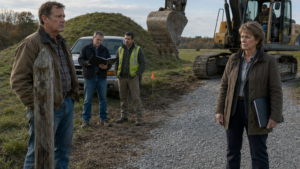
The county engineer arrived that afternoon for the scheduled inspection.
They started at Stephen’s entrance.
The engineer walked the orange flags Andrew had set, checked the fountain terrace, photographed pooled silt above the limestone edge, then followed the visible swale downhill.
Stephen stayed with them.
He was quieter than he had been during the survey.
When Patrick showed the engineer the aerial photographs, Stephen tapped the later image.
“There.”
Patrick looked at him.
“That bend,” Stephen said. “That’s what I’ve been telling you.”
“I heard you.”
“No, you didn’t.”
The engineer studied the photographs. “When was the crossing widened?”
Patrick answered before Stephen could.
“My father did it.”
Stephen’s eyes shifted to him.
Patrick continued. “I found the old culvert this morning.”
For a moment nobody spoke.
Stephen’s face did not soften, but some of the fight left his posture.
“So now we’re getting somewhere.”
Patrick disliked the satisfaction in his voice.
“The fountain is still inside the recorded easement.”
“I didn’t say it wasn’t.”
“You said Andrew’s point was wrong.”
“I said the drain didn’t run where your paper said it did.”
The engineer raised a hand.
“Both things can be true.”
Patrick looked at him.
“The recorded easement can remain valid,” the engineer said, “and the physical watercourse can have been altered over time. We need to separate those questions.”
Stephen nodded as though that settled everything.
Patrick said, “And the obstruction?”
The engineer looked toward the fountain.
“That’s a newer question.”
They walked downhill to Patrick’s crossing.
The engineer crouched beside the exposed culvert, ran a hand over the crushed metal, then followed the grade with his eyes.
“This likely redirected some flow.”
Stephen gave Patrick a look.
Patrick felt the old impulse to defend his father.
He swallowed it.
“How much?”
“Can’t tell from this alone. But enough that I wouldn’t ignore it.”
Patrick nodded.
Stephen said, “My father told me the Carters moved that ditch.”
Patrick turned sharply.
“You never said that.”
“I said it hadn’t run under the fountain in decades.”
“That isn’t the same thing.”
“You weren’t interested in the same thing.”
Patrick stepped toward him.
The engineer stood.
Patrick stopped himself.
Stephen looked away first.
“My father said yours wanted a wider crossing for hay equipment. They worked it out between them.”
“Worked what out?”
“I don’t know. I was in my twenties. They didn’t file meeting minutes over coffee.”
Patrick stared at the buried culvert.
That was exactly the kind of arrangement his father would have made. Two men, a loader, a handshake, and the assumption that whoever came after them would understand.
Nobody had.
The county engineer finished his inspection and said a written finding would follow. The recorded easement remained in force. The historic alterations would matter in determining a permanent correction.
Stephen walked home without another word.
Patrick stayed beside the culvert.
By late afternoon he had cleaned the mud from his tools and put them away. The old aerial photographs lay open on the workbench.
He found himself looking at the loader again.
The machine was long gone. His father too.
There was no one left to ask whether the drainage change had been temporary, agreed upon, careless, necessary, or all four.
A vehicle rolled slowly into the yard.
Patrick expected the county engineer had forgotten something.
Instead Carolyn Wilson stepped out.
She closed the door and remained beside the vehicle for a moment, as though crossing the gravel required a decision.
Patrick wiped his hands on a rag.
“Stephen send you?”
“No.”
That surprised him.
She glanced toward the exposed culvert.
“He told me what you found.”
Patrick waited.
Carolyn had known his family almost as long as Stephen had. She had never involved herself much in farm disputes. When men argued over fencing or hay access, she usually left them to tire themselves out.
Now she looked directly at him.
“I’m not asking you to pretend the fountain isn’t a problem.”
“All right.”
“And I know Stephen has made this harder than it needed to be.”
Patrick folded the rag once.
“But?”
Carolyn’s mouth tightened.
“But please don’t force them to tear it out yet.”
Patrick studied her.
“The county decides what gets forced.”
“You started the complaint.”
“Because water backed toward my barn.”
“I know.”
“Then why are you here?”
Carolyn looked past him toward the Wilson property. From the machine shed, the fountain itself was hidden, but its pump could be heard faintly in the distance.
“He isn’t protecting a fountain, Patrick.”
She hesitated.
“He’s protecting the last plan he has for keeping that farm.”
Chapter 5: What Stephen Was Really Trying to Save
The unpaid invoices were stacked beneath a centerpiece catalog on a folding table.
Patrick noticed them before he noticed the new chandeliers.
Carolyn had asked him to come across the road after supper. Now they stood inside the Wilsons’ old dairy barn, where polished concrete covered the former milking floor and black-framed windows replaced sections of weathered siding.
The place looked nearly finished from the outside.
Inside, extension cords ran across the floor. Trim leaned uninstalled against one wall. Boxes of light fixtures sat unopened beside rented chairs.
Patrick glanced at the invoices again.
Carolyn saw him.
“We were supposed to open six weeks ago.”
Patrick looked toward the high rafters.
“What happened?”
“Everything cost more.”
“Everything always does.”
She gave a tired smile. “Stephen said the same thing the first three times.”
Through the open barn doors came the faint mechanical hum of the fountain pump.
Carolyn lowered her voice.
“We refinanced the south acreage.”
Patrick looked at her.
“How much?”
“Enough.”
He did not ask again.
The Wilson farm had been shrinking in profitable usefulness for years. Stephen still leased some ground and kept a few cattle, but Patrick knew what the margins looked like. Everybody did.
The event venue had seemed vain to him.
He understood now that vanity was only part of it.
Carolyn touched the edge of an envelope.
“The fountain is the entrance piece. Photographs. Weddings. Everything was designed around that drive.”
“So move it.”
“Contractor says moving it means breaking the base, rerouting electrical, regrading, rebuilding the entrance.”
“That costs less than flooding three farms.”
“I know.”
Patrick looked at her.
She did not defend Stephen.
That made what came next harder.
“Did he know the terrace was affecting the runoff?”
Carolyn’s eyes shifted toward the barn doors.
“Before the storm?”
“Yes.”
She was silent too long.
Patrick felt his sympathy narrowing.
“Carolyn.”
“He saw water collecting there during two smaller rains.”
Patrick said nothing.
“He told the contractor to add stone along one side because he thought it would guide the water around.”
Patrick pictured the raised limestone edge.
The very feature that had made the backing worse.
“He knew.”
“He knew water was collecting.”
“He knew enough to know something had changed.”
“Yes.”
Patrick turned away.
For days he had been forced to reconsider his own certainty. His father had altered the original drainage route. Stephen’s claim that the ground no longer matched the plat was not invented.
But this was different.
An old informal change explained confusion.
It did not justify watching new water back up and adding more stone.
Stephen entered through a side door.
He stopped when he saw Patrick.
“What’s he doing here?”
Carolyn said, “I asked him.”
Stephen looked at the papers on the table, then at her.
“You had no right.”
“They’re our bills.”
“They’re not his business.”
Patrick said, “They still aren’t.”
Stephen faced him. “Then leave.”
Patrick took one step toward the doors.
Carolyn said, “Tell him about the appeal.”
Patrick stopped.
Stephen’s jaw tightened.
“What appeal?”
Stephen stared at his wife.
Then he looked at Patrick.
“I filed this afternoon.”
Patrick felt the answer before he heard the rest.
“With the county?”
“Administrative review. Historical alteration, inconsistent physical drainage, disputed remedy.”
“That delays enforcement.”
“It gives them time to look at the whole situation.”
“We have another storm coming.”
Stephen laughed once. “We had storms before you were born.”
“And before your terrace existed.”
“My terrace isn’t the only thing that changed.”
“No.”
Patrick met his eyes.
“My father changed part of it.”
Stephen seemed ready for an argument and did not know what to do with the admission.
Patrick continued.
“I found the culvert. I told the engineer. I’ll deal with what belongs to us.”
Carolyn looked down.
Stephen’s expression hardened again.
“Then maybe stop acting like mine is the only problem.”
“I just said it isn’t.”
“You filed against me.”
“Because your fountain is sitting in the recorded corridor and the new grade is backing water up.”
Stephen stepped closer.
“You know what happens if they make us rip that entrance apart now?”
Patrick glanced around the unfinished barn.
“I know more than I did yesterday.”
“No, you don’t.”
Stephen pointed toward the rafters, the new doors, the stacked chairs.
“This place was supposed to carry us. Cattle didn’t. Leasing ground barely covers taxes. I’m sixty-two years old, Patrick. I’m not starting over somewhere else.”
Patrick heard the fear beneath the anger.
For the first time, Stephen did not sound like a man defending ownership.
He sounded like a man defending his last workable idea of himself.
Patrick said quietly, “Then you should’ve dealt with the water when you first saw it backing up.”
Stephen’s face changed.
Carolyn closed her eyes.
That was the line neither of them could cross back over.
Stephen had known enough to investigate.
He had chosen not to.
“You think I wanted this?” Stephen asked.
“I think you wanted opening day more.”
Stephen looked toward the fountain.
The pump hummed steadily outside.
Patrick said, “I can understand why you’re scared of tearing it up. I can’t agree to gamble my barn on it.”
“No one asked you to.”
“The water did.”
Stephen turned away.
Patrick’s phone vibrated.
A weather alert filled the screen.
He opened it.
The expected storm had strengthened. Rainfall totals had been revised upward, with localized amounts high enough to cause flash flooding.
Carolyn read his face.
“How bad?”
Patrick showed her.
Stephen did not look.
“The appeal is filed,” he said.
Patrick stared at him.
“So the county can’t enforce before the hearing?”
“Not the removal order.”
Carolyn said, “Stephen.”
“It’s our legal right.”
Patrick put his phone away.
The thing that angered him most was that Stephen was correct.
A right to appeal.
A recorded easement.
An old informal drainage change.
Each piece of paper could be valid while the water still rose.
Patrick walked toward the doors.
Stephen said, “Where are you going?”
“To move equipment.”
“You’re overreacting.”
Patrick stopped beneath the new barn lights.
“No. That’s what I was doing when I thought the county order meant this was finished.”
Outside, the fountain water fell in smooth, measured sheets.
Patrick crossed the gravel without looking back.
Before he reached his truck, another alert sounded.
The storm warning had been upgraded.
Chapter 6: When Being Right Was No Longer Enough
The first blow against the barn foundation sounded like someone dropping a bucket of gravel in the dark.
Patrick sat upright in the tractor cab.
Then it came again.
Water.
Not rain striking the roof.
Water hitting the concrete wall.
He swung the door open and stepped down into ankle-deep runoff.
His flashlight beam caught brown water moving across the barnyard where no current should have been.
The cattle were already moved to higher pasture. The wagons were uphill. He had spent the afternoon preparing.
It had not been enough.
Rain hammered the metal roof so loudly that he could barely hear his phone.
A downstream neighbor had sent a message: water across the lane.
Another: shed flooding again.
Patrick turned the flashlight uphill.
The drainage swale had disappeared beneath a broad, dark sheet.
And above it, through the rain, the Wilson fountain was still running.
Its underwater lights glowed against the storm. Pumped water spilled neatly from tier to tier while storm runoff piled behind the terrace.
Patrick climbed into the tractor and drove toward the property line.
His headlights revealed orange survey flags bent almost flat by the current.
He stopped near the fountain and called Stephen.
No answer.
He called again.
On the third attempt, Stephen picked up.
“What?”
“The water’s against my barn.”
“I know it’s raining.”
“I need to open a cut through the terrace.”
“No.”
Patrick stared through the windshield.
“I’m not talking about the whole fountain. Give me permission to pull stone from the low side and make a temporary channel.”
“You touch that entrance with your tractor and I’ll hold you responsible.”
“Stephen, listen to me.”
“I am listening.”
“The county can argue about the permanent route later. Right now the water needs somewhere to go.”
“And what happens when you undermine the fountain?”
Patrick gripped the phone.
“What happens when this reaches the machinery sheds downhill?”
“Use your old ditch.”
“My old ditch can’t take this.”
“That’s not my problem.”
The words hung between them.
Patrick closed his eyes for one second.
When he opened them, he could see the water pushing across the field in the headlights.
“You know it’s backing up.”
Stephen said nothing.
“You knew before tonight.”
Still nothing.
Patrick’s voice dropped.
“If you say no now, you’re not protecting yourself from a bad survey. You’re choosing where this water goes.”
Stephen finally answered.
“Stay off my property.”
The call ended.
Patrick sat in the cab with the phone in his hand.
For weeks he had done everything in order.
Plat.
Survey.
Notice.
Complaint.
Inspection.
He had believed restraint meant waiting for each process to finish before taking the next step.
Now the county office was closed, the appeal had frozen enforcement, and water was hitting his barn.
He backed the tractor away from the Wilson line.
His headlights swept across his own hayfield.
The field had been reseeded earlier that month.
The stand was coming in evenly.
Losing it would cost him.
He knew the grade.
If he cut a temporary spillway diagonally across the lower section, he could intercept the backed-up water and send part of it toward the older drainage depression below the crossing.
It would tear through the new seeding.
It might scour several inches of topsoil.
It might save the barn.
Patrick hesitated.
Then he thought of the buried culvert.
His father had changed the water once to make the farm more usable.
Patrick had spent days deciding what that meant about the dead.
The storm did not care.
He started the tractor.
The loader bucket bit into his own field.
Wet soil rolled forward in a heavy black wave.
Patrick made one pass, then another, shaving a shallow trench along the fall of the ground.
Water began entering it almost immediately.
Not enough.
He lowered the bucket again.
The tractor wheels slipped. Mud slapped the undercarriage. He corrected and continued.
At the field edge, the trench reached the old depression.
The first rush of water moved through it.
Patrick stopped.
For a moment the flow seemed too weak to matter.
Then the upstream pool found the lower path.
Water poured into the cut.
The channel widened on its own.
Brown runoff rushed across the newly seeded field, carrying grass, soil, and bits of straw toward the depression.
Patrick watched several weeks of work disappear beneath it.
His phone rang.
The downstream neighbor.
“It’s dropping here.”
Patrick looked toward the barn.
The waterline against the concrete had stopped climbing.
“Keep watching it.”
“What’d you do?”
“Gave it somewhere else to go.”
He ended the call and drove farther along the emergency channel, knocking down one high spot that was slowing the current.
Headlights appeared near the Wilson entrance.
Stephen’s truck stopped on the gravel.
Stephen got out wearing a raincoat and walked to the property line.
He shone a light over Patrick’s field.
“You cut your hay.”
Patrick climbed down.
“Seeded field.”
“You could’ve waited.”
“For what?”
“The rain to ease.”
Patrick stared at him through the rain.
“Is that what you were waiting for when you added stone after the first puddling?”
Stephen’s flashlight lowered.
Patrick had no desire to win the exchange.
He pointed at the water now running through his field.
“My father helped move the old drain.”
Stephen looked at him.
“I know that now. I’ll say it to the county. I’ll pay for whatever part of the permanent fix belongs to this farm.”
Stephen said nothing.
Patrick continued.
“But that doesn’t make what you built harmless.”
“I never said harmless.”
“You spent three weeks saying there was no problem.”
Stephen looked toward the fountain.
The pump was still running.
Patrick almost laughed at the absurdity of it.
“You should shut that off.”
Stephen followed his gaze.
After a moment he walked to the control box.
The lights went dark.
The pump stopped.
For the first time since the dispute began, the fountain was silent.
Rain struck the empty bowls.
Patrick returned to the tractor.
The water in the emergency cut was moving fast now, muddy and uncontrolled but moving.
That was all he had wanted from the beginning.
Not victory.
Movement.
By early morning the worst of the storm had passed.
Patrick stood beside the lower barn with a flashlight and marked the high-water line with his thumb.
Six inches below the wooden sill.
Close enough.
His field looked wounded in the first gray light. A raw channel crossed the new grass, widening toward the old depression. Seed and topsoil had piled along one edge.
The downstream neighbor called again.
“No more water coming in the shed.”
Patrick nodded though the man could not see him.
“Good.”
“You save the barn?”
“Looks like.”
After the call, Patrick walked uphill.
At the property line, one orange survey flag had survived. It leaned almost flat over the flowing water.
Beyond it, Stephen stood beside the silent fountain.
Neither man waved.
Neither spoke.
Between them, water rushed through Patrick’s torn field toward the creek.
For the first time in weeks, it was going somewhere.
Chapter 7: The Water Found Its Way, and So Did the Truth
The excavator bucket slid beneath the fountain’s lowest stone and lifted.
For a moment the whole structure seemed to resist, its weight settling back into the terrace as if it had grown there.
Then the mortar cracked.
Stephen Wilson stood beside the gravel drive with both hands in his jacket pockets.
Patrick watched from the opposite side of the marked corridor.
No one cheered.
No one needed to.
The county engineer had returned three days after the storm with revised drainage plans, Andrew Davis’s survey, the historic aerial photographs, and measurements taken from Patrick’s emergency spillway.
The permanent solution was not the old ditch exactly.
It was not the newer swale either.
It followed the recorded easement where practical, widened near the Carter crossing, and connected to the lower depression where the storm water had finally found enough fall to move.
The engineer called it a corrected drainage corridor.
Patrick thought of it as the first version that admitted what everyone had done to the land.
Orange flags marked the route from the Wilson entrance across the low ground.
The same kind of flags Stephen had mocked weeks earlier.
Now Andrew walked between them with a measuring rod while the excavation contractor waited for his signal.
Stephen looked at the fountain stone hanging from the bucket.
“They can reuse that.”
The contractor nodded. “Most of it.”
“Not here,” the engineer said.
Stephen’s mouth tightened.
Carolyn stood several yards behind him near the unfinished event barn.
Patrick could tell Stephen wanted to argue.
Instead, he asked, “Where can it go?”
The engineer pointed uphill, beyond the drainage grade.
“If the new base stays outside the corridor and you keep clear access along this side, there’s room.”
Stephen looked at Patrick.
Patrick did not say anything.
That seemed to irritate him more than an answer would have.
“You satisfied?”
Patrick glanced toward his lower field.
The emergency spillway still cut through the reseeded ground like a raw seam. Rain had carried away several inches of topsoil in places. Repairing it would take money and time.
“No.”
Stephen frowned.
Patrick said, “Satisfied would’ve been fixing it before the storm.”
Carolyn looked down.
Stephen’s jaw worked once.
Patrick continued, “But I don’t need satisfied.”
“What do you need?”
“A drain that works.”
The excavator set the stone on wooden blocking.
The fountain pump, disconnected now, lay beside the terrace with a coil of electrical line.
For weeks the sound of circulating water had followed every argument.
Without it, the entrance felt strangely larger.
The county engineer unfolded the final cost allocation sheet on the hood of his truck.
“The current obstruction and terrace removal fall primarily on the Wilson parcel,” he said. “Historic crossing correction on the Carter side is separate.”
Stephen looked toward Patrick.
Patrick had already decided what he was going to say.
“I’ll cover part of the crossing work.”
Stephen stared at him.
The engineer paused.
Patrick pointed toward the old culvert area.
“My father widened it. Maybe everybody agreed back then. Maybe they didn’t. But the fill is ours now.”
Stephen said, “You don’t have to do that for me.”
“I’m not.”
The answer came out harder than Patrick intended.
He softened it.
“I’m doing it because it belongs to us.”
Stephen looked at the marked ground.
For several seconds only the excavator idled.
Then he said, “I can put my skid steer on the restoration once the contractor opens the main cut.”
Patrick nodded.
“That would help.”
It was not an apology.
Patrick was surprised to realize he did not require one.
By midday the fountain terrace was half gone.
Under the decorative stone they found layers of compacted gravel and fill laid tightly across the low area. The engineer pointed out where storm water had been forced sideways during the heavy rain.
Stephen stared at the exposed soil.
Carolyn stood beside him.
“You saw this before?” Patrick asked.
Stephen did not pretend to misunderstand.
“Not like this.”
“But you saw the ponding.”
“Yes.”
Patrick waited.
Stephen rubbed a hand over the back of his neck.
“I thought the contractor could push it around the side.”
“You didn’t ask anybody who knew drainage.”
“No.”
“Why?”
Stephen looked toward the barn.
The black-framed windows reflected the excavator moving back and forth.
“Because every answer I was getting that summer cost money.”
Patrick said nothing.
Stephen gave a short, tired laugh.
“So I stopped asking.”
There it was.
Not a conspiracy.
Not ignorance.
Just a frightened man narrowing the number of truths he was willing to hear.
Patrick understood that better than he wanted to.
He had done something similar with his father.
For years, every memory had been sorted into the version he could live with: hardworking, careful, responsible, the man who taught him how to keep the farm going.
Finding the buried culvert had not erased any of that.
It had only made the picture larger.
Andrew returned in the afternoon and reset several orange flags after the excavator disturbed them.
Patrick helped him near the old crossing.
“You all right with this grade?” Andrew asked.
Patrick looked down the newly cut channel.
Water from a hose test slipped through the shallow trench, crossed the property line, and continued without pooling.
“Looks right.”
Andrew smiled faintly. “That’s different from being right.”
Patrick looked at him.
“Don’t start.”
Andrew laughed and moved to the next flag.
By the end of the week, the corridor was open.
Stephen’s skid steer moved stone from the Carter crossing while Patrick spread topsoil along the banks. Neither man worked on the other’s land without asking.
It was slower that way.
It was also clear.
The fountain stones were stacked uphill beside the Wilson barn, waiting for a new base.
Stephen had not abandoned the event venue.
Carolyn told Patrick they would open later than planned.
Smaller at first.
No grand entrance.
Patrick suspected that hurt Stephen more than he admitted.
But he had withdrawn the appeal.
The county recorded the corrected drainage plan with both parcels.
No handshake agreement hidden in somebody’s memory.
No assumption that the next generation would know what the last one meant.
The first autumn rain came on a cool afternoon.
Patrick stood under the lower barn overhang and watched water collect along the shallow corridor.
For an instant it slowed near the old crossing.
Then it passed through.
No broad sheet entered the hayfield.
No current struck the barn wall.
The water crossed beneath the orange markers, followed the restored grade, and disappeared toward the creek.
Patrick heard a vehicle stop on the Wilson side.
Stephen got out and stood near the place where the fountain had been.
The entrance looked bare without it.
Patrick expected him to go inside.
Instead Stephen watched the water.
After a while he looked across the field.
Patrick raised one hand.
Stephen hesitated.
Then he raised his.
That was all.
Patrick turned back toward the barn.
Rain darkened the roof and tapped against the metal gutter. Behind him, water continued through the swale, not in circles, not according to anybody’s pride or memory, but downhill.
His father had not been completely right.
Stephen had not been completely wrong.
And neither fact changed what had to be done once the water began rising.
Patrick watched the restored channel carry the rain safely past the barn.
For the first time since the fountain went up, nothing stood in its way.
The story has ended.