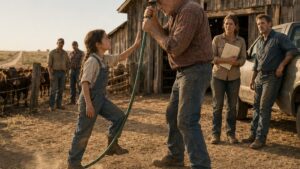
They Fined Her for Holding Her Mother’s Memorial, Then Learned Who Controlled the Farm Road to Their Biggest Sale
Chapter 1: The Fines Arrived Before the Funeral Flowers Wilted
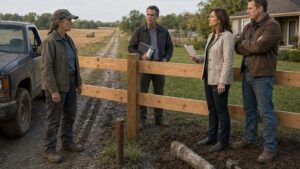
Pamela Davis had parked her pickup sideways across the Carter farm gate.
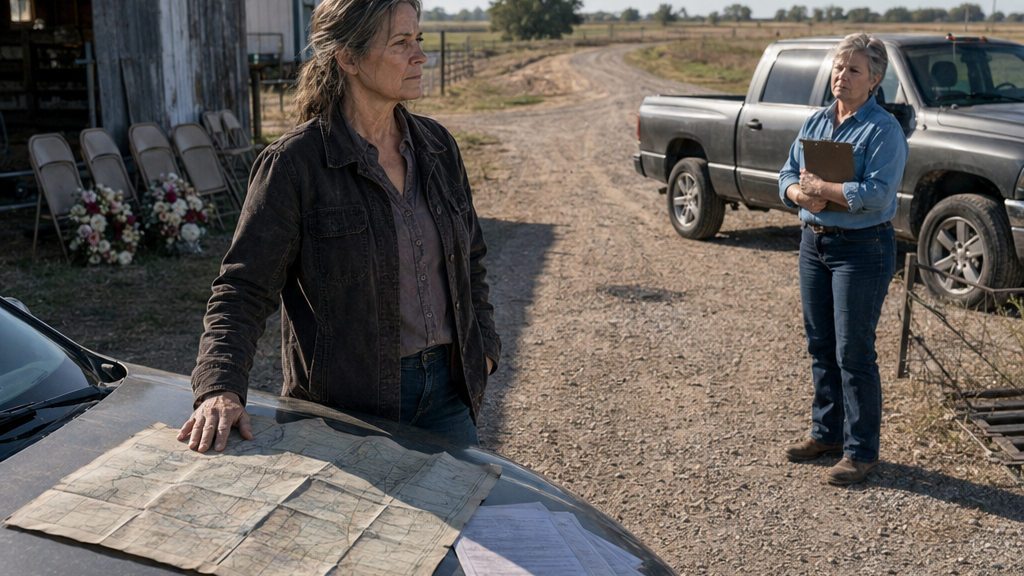
Amy saw it before she saw Pamela herself: the silver truck angled over the gravel entrance as if somebody had decided the farm needed permission to breathe. Beyond it, twelve folding chairs were still stacked against the machine-shed wall, and two white funeral arrangements leaned in their stands where the family had left them after the memorial meal.
The lilies had begun browning at the edges.
Amy stopped ten feet from the gate with a cardboard box of her mother’s papers against her hip.
Pamela climbed out of the pickup carrying a clipboard.
That nearly made Amy laugh.
Two days earlier, Amy had watched the last casserole dish leave the house. She had collected paper plates from beneath the maple tree and folded chairs until her back ached. She had slept badly in her mother’s room because every other room contained something she still needed to sort.
And now there was Pamela, crisp work shirt tucked into jeans, clipboard held against her ribs like a badge of office.
“I was going to leave these at the house,” Pamela said.
“You blocked the gate instead.”
“I’ll only be a minute.”
Amy set the box on the hood of her own car.
Pamela removed three sheets.
“The association received complaints about vehicles parked along the shared lane during Saturday’s gathering.”
“My mother’s memorial.”
Pamela’s eyes flicked toward the funeral flowers but did not stay there.
“Whatever the purpose, the lane has to remain clear for agricultural traffic.”
“It was clear.”
“There were also temporary directional signs at the junction.”
“Two pieces of cardboard so people could find the farm.”
“Signs aren’t allowed without approval.”
Pamela handed her the first notice.
The second concerned vehicles exceeding the permitted gathering threshold. The third concerned chairs, flowers, and temporary use of the roadside verge.
Amy looked at the total.
For three seconds, grief gave way to something simpler.
Anger was easier.
“You denied us the equipment shed,” she said.
“The board did.”
“You chaired the meeting.”
“The vote was unanimous.”
Samuel Allen had looked at the floor during that vote. Amy remembered that much.
She also remembered Pamela saying the association could not establish a precedent for private memorial functions when the shed was needed for cooperative business.
There had been no cooperative business that Saturday.
The building had stayed locked.
Amy folded the notices once.
Pamela’s mouth tightened.
“Please don’t crease those. You may need the reference numbers.”
That did make Amy laugh, though there was no humor in it.
Pamela waited.
Amy had spent thirty-two years examining numbers other people hoped would be accepted without questions. Hospital systems. Manufacturing firms. A nonprofit whose treasurer had rounded every suspicious withdrawal to a number ending in eighty-five.
She knew the heat that came just before accusation.
She also knew what it cost to accuse before the facts were ready.
So she laid the notices on the cardboard box instead.
“I’ll read them.”
“I’d encourage you to pay before the late period starts.”
“When is that?”
“Ten days.”
“And after that?”
“Daily penalties can apply.”
The answer was too quick.
Amy looked past Pamela.
The shared lane curved from the county road along the Carter boundary, widening near the machine shed into a broad gravel turnout before continuing toward three other farms. Her mother had complained about the dust from cattle trailers for as long as Amy could remember.
But something about the turnout bothered her now.
Maybe because she had spent the previous evening sorting old property papers.
Maybe because she had seen a hand-drawn road plat among them.
Or maybe because Pamela had arrived with rules before the funeral flowers had wilted, and Amy suddenly wanted to know whether every line Pamela enforced so confidently was actually where she claimed it was.
“How long has that turnout been that wide?”
Pamela glanced over her shoulder.
“The turnout?”
“The gravel section by the ditch.”
“A long time.”
“That isn’t what I asked.”
Pamela shifted the clipboard.
“It was improved several years ago. Trailers were having trouble making the corner.”
“Who authorized the widening?”
“The association.”
“I mean the land use.”
Pamela looked at her now.
Amy pointed.
“The original road is narrower.”
“You’ve been back here less than a week.”
“I grew up here.”
“You haven’t managed this property in years.”
“No. But I can still see twenty feet of gravel.”
Pamela’s expression hardened.
“This has nothing to do with your citations.”
“Probably not.”
That seemed to bother her more than an argument would have.
Pamela opened the truck door.
“If you have questions about the road, bring them to a board meeting.”
“When’s the next one?”
“After the livestock sale.”
“Convenient.”
Pamela stopped with one hand on the door.
“Amy, everybody here understood your family was grieving. People made allowances Saturday that they normally wouldn’t. But the road serves working farms. Rules have to apply even when the circumstances are difficult.”
Amy thought of the empty equipment shed.
She thought of her mother’s photograph propped above the pie table in the machine shed because the cooperative building with heat, bathrooms, and forty folding tables had been considered inappropriate.
She nearly said all of that.
Instead she picked up the fines.
“I understand rules.”
Pamela drove away.
The tires crossed the broad turnout, and gravel snapped under them.
Amy watched until the truck disappeared around the bend.
Then she carried the box into the machine shed.
Her mother’s old desk stood against the wall beneath a row of rusted wrenches. Amy had spent the morning making three piles: keep, estate, discard.
Her mother had apparently believed nothing concerning land belonged in the discard pile.
There were tax bills from 1998, feed receipts from a business that had closed twenty years ago, drainage sketches, fencing agreements, handwritten notes about culverts and snowplowing.
Amy found the folded plat under a packet labeled ROAD.
She opened it across the desk.
Blue survey lines. Black property boundaries. A narrow access strip drawn along the eastern edge of the Carter parcel.
Amy took the fines from her pocket and set them beside it.
Then she looked through the open shed door.
The difference was obvious.
The lane shown on the plat followed the same line as the road outside, but near the turnout it remained narrow. There was no broad sweep of gravel reaching toward the ditch. No generous turning radius for forty-foot livestock trailers.
Amy carried the plat outside.
She stood near the edge of the road, looking from paper to ground.
The gravel extended beyond the old line by several yards.
Not inches.
Yards.
Her first instinct was to photograph it.
Her second was to call Pamela.
She did neither.
Instead she went back inside and searched the ROAD folder more carefully.
Near the bottom was a narrow envelope containing several pages in her mother’s handwriting.
Dates ran down the left side.
Each date had a check mark beside it.
At the top her mother had written one word:
RENEWAL.
Below 2021 was another line.
No date.
No check mark.
Just an empty space waiting for something that had never been written.
Amy sat down slowly.
Outside, a truck changed gears on the shared lane.
For the first time since Pamela had placed the fines in her hand, Amy forgot about the money.
She stared at the blank line instead.
Chapter 2: Her Mother Kept Records Nobody Thought Mattered
The county map showed the road ending six yards before the gravel did.
Amy had expected a minor drafting difference.
Instead, the digital parcel layer on the recorder’s computer showed a clean, narrow access strip running beside the Carter property, while the current aerial image displayed the broad turnaround plainly outside it.
The clerk leaned closer to the screen.
“Maps aren’t surveys,” she said.
“I know.”
Amy did.
That was what made the discrepancy interesting.
She wrote down the instrument numbers attached to the Carter parcel and spent the next hour requesting copies.
By noon she had three deeds, two easements, an old road-maintenance agreement, and nothing that clearly explained the widened turnout.
She drove back to the farmhouse with the papers on the passenger seat.
Her mother’s kitchen had become Amy’s temporary audit room.
The dining table held the old plat beneath glass salt and pepper shakers. A legal pad sat beside a calculator. Her laptop occupied the place where her mother used to keep a bowl of apples.
Amy overlaid the county printout on the plat.
The old boundaries aligned.
The widened gravel did not.
She made a list.
Original road agreement.
Later amendments.
Capital improvements.
Contractor approvals.
Assessment records.
The process calmed her.
It always had.
People changed tone. Numbers did not.
The association’s equipment shed sat half a mile down the lane. Pamela’s pickup was gone when Amy arrived that afternoon, but Samuel Allen was inside repairing a broken latch on one of the storage cabinets.
He looked surprised to see her.
“Amy.”
“Samuel.”
His gaze dropped to the folder in her hand.
That was enough.
“I need the road-maintenance records.”
His screwdriver stopped.
“For what period?”
“Six years.”
“Six?”
“For now.”
Samuel set the tool down.
“You planning to contest the fines?”
“I’m reading what I inherited.”
“That’s not an answer.”
“It’s the one I have.”
He wiped his hands on his jeans.
The shed smelled of grease, dry hay, and the faint mineral scent of fertilizer stored somewhere behind the partition.
“Pamela told me you were asking about the turnout.”
“I asked one question.”
“She says you’re looking at boundary issues.”
“I am now.”
Samuel exhaled.
“Amy, if this is about Saturday—”
“It started because of Saturday.”
“That’s different.”
“Is it?”
He stared at her for a moment.
Then he walked toward a gray metal cabinet.
“Members can review annual statements.”
“And invoices?”
“By request.”
“I’m requesting.”
“Board approval may be needed.”
“For invoices paid from assessments I’m now responsible for?”
Samuel rubbed his forehead.
“I’m not trying to fight you.”
“Good.”
“That sounded like you thought I was.”
Amy regretted it immediately.
Samuel had brought food to the house the morning after her mother died. He had stood near the back door during the memorial and taken folding chairs from elderly neighbors before they could carry them themselves.
But evidence was easier than kindness. Kindness always seemed to come with obligations she did not know how to repay.
Samuel opened the cabinet.
“I can give you the annual summaries.”
“Today?”
“Today.”
“What about the detailed ledger?”
He hesitated.
“Talk to Pamela.”
Amy said nothing.
Samuel noticed.
“You think that hesitation means something.”
“I didn’t say that.”
“You didn’t have to.”
He pulled out three binders.
That evening Amy built a spreadsheet.
The annual road assessments were straightforward. Each participating farm paid according to frontage and usage category. Additional fees were collected for snow removal, culvert replacement, and major resurfacing.
The totals were not.
One year showed nearly thirty-two thousand dollars collected for resurfacing and drainage work. The expense summary listed twenty-one thousand four hundred.
Another year contained a special assessment for ditch stabilization, but the project line items did not consume the full amount.
The differences might have had ordinary explanations.
Carryover reserves.
Fuel.
Emergency repairs.
Late invoices.
Bad bookkeeping.
Amy wrote each possibility down.
Then she noticed transfers into a general operating category immediately after several special assessments.
No explanation appeared beside them.
She leaned back.
Her mother’s filing cabinet stood in the corner.
Amy had spent years teasing her about it.
“You keep paper like the courthouse is coming tomorrow.”
Her mother always answered the same way.
“Paper remembers when people don’t.”
Amy opened another folder.
Inside were association newsletters, assessment notices, receipts, even photocopies of checks.
Not random clutter.
A parallel record.
Her mother had written notes beside several assessments: paid, questioned, called Samuel, culvert unfinished.
Amy found one marked turnout widening.
The amount collected was significant.
Beside it her mother had written:
Ask what land this is on.
Amy stared at the sentence.
The phone rang.
Pamela.
Amy let it ring twice before answering.
“I hear you’ve been requesting association records.”
“Yes.”
“You’re entitled to annual financial statements.”
“I know.”
“Detailed contractor material contains business information.”
“Paid with member assessments.”
“There’s still a process.”
“Send me the process.”
A pause.
Pamela’s voice cooled.
“I also want to be clear about something. Several neighbors are concerned you intend to challenge access to the road.”
Amy sat straighter.
“I haven’t told anyone that.”
“You’ve been asking boundary questions.”
“That isn’t the same thing.”
“People have livestock. Deliveries. Feed trucks. Nobody needs uncertainty because you’re upset about a memorial decision.”
There it was.
Not grief.
Not records.
Upset.
Amy looked at the fines on the table.
“You’re the one creating uncertainty, Pamela.”
“How?”
“By telling people what I intend before you’ve asked me.”
“I’m trying to keep the road functioning.”
“So am I.”
“You don’t even live here anymore.”
The sentence was quiet.
That made it sharper.
Amy looked toward the darkened living room, where her mother’s reading lamp still sat beside the chair.
“No,” she said. “But I own the questions now.”
She ended the call.
The next morning, two neighbors slowed as they passed the Carter mailbox.
One lifted a hand but did not stop.
Amy understood exactly what Pamela had done.
By afternoon, she had stopped feeling embarrassed about the investigation.
She requested every public filing she could lawfully obtain and reconstructed the association’s expenditures from summaries, her mother’s receipts, and county project records.
A recurring vendor appeared over and over.
Thompson Grading.
Road shaping.
Emergency washout.
Culvert work.
Turnout improvements.
Snow berm removal.
Some amounts were small.
Others were not.
The payments did not prove wrongdoing.
But when Amy searched the business registration, she froze.
The owner was Larry Thompson.
Pamela Davis’s son.
Chapter 3: The Contractor Connection Looked Worse Than It Was
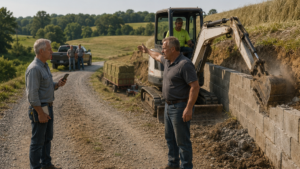
The excavator was sitting exactly where the invoice said it should have been.
Amy stopped her car on the shoulder and read the copied line item again.
Emergency culvert repair, north drainage crossing.
The date was two years earlier.
Thirty-eight hundred dollars.
She had marked it in red because the association summary provided almost no supporting detail and because the vendor was Larry Thompson.
Yet twenty feet from her stood a patched culvert with newer galvanized pipe, regraded banks, and riprap set into the ditch.
Orange survey flags from a recent utility marking trembled beside it.
Someone had done the work.
Amy photographed the site anyway.
By eleven she had checked four other questionable invoices.
Three corresponded to visible repairs.
One could not be verified.
Her certainty had begun to irritate her.
She had liked the cleaner theory.
Pamela punished grieving families while funneling association money to her son.
Simple.
Ugly.
Provable.
Reality was refusing to cooperate.
Larry found her near the second culvert.
His work truck pulled in behind her, towing a small equipment trailer. He climbed out before Amy had decided whether to leave.
“You taking pictures of my work?”
Amy lowered her phone.
“I’m reviewing association expenditures.”
“That wasn’t what I asked.”
“Yes.”
Larry was broad-shouldered, sunburned across the nose, with mud dried on his boots. He glanced toward the culvert.
“That one held through the spring flood.”
“I can see that.”
“Then what’s the problem?”
“Documentation.”
He gave a short laugh.
“My mother said you were an accountant.”
“Forensic accountant.”
“Sounds worse.”
“Usually for somebody.”
Larry folded his arms.
“You think I stole money?”
“I think your company received repeated contracts from an association chaired by your mother without documentation showing competitive bids or conflict review.”
“That’s not the same answer.”
“No.”
He stepped closer, not threatening, but angry enough that Amy noticed.
“You know who came out here when that bank washed out at two in the morning?”
“No.”
“Me.”
“Were you paid?”
“Eventually.”
“That doesn’t answer the procurement question.”
“It answers why there wasn’t a three-week bidding process while six farms couldn’t move equipment down the road.”
Amy looked at the repaired bank.
Larry pointed toward it.
“The first contractor Pamela called wanted twice what I charged and couldn’t start for four days. Another wouldn’t bring equipment because the ground was too soft. I had a machine ten miles away.”
“And the other invoices?”
“Some were scheduled. Some were emergencies.”
“Do you have records?”
“Yes.”
“May I see them?”
He stared at her.
“Pamela told me not to give you anything.”
Amy almost smiled.
“That helps.”
“It shouldn’t.”
“It tells me she’s deciding what I’m allowed to verify.”
Larry swore under his breath, then opened the truck.
He brought out his phone.
The photographs were not organized well. Some had dates. Others were screenshots from text messages. There were washed-out ditches, buried pipes, loaders pushing snow, gravel spread along the lane.
One showed water running nearly axle-deep across the road.
Another showed Pamela herself in a raincoat holding a flashlight while Larry’s excavator worked behind her.
“That was the flood three years ago,” he said. “Road was gone right there.”
Amy studied the image.
“You billed fourteen hours.”
“Worked seventeen.”
“Why?”
“Because the association was short that month.”
“Why was it short?”
Larry’s face changed.
“You’d have to ask Samuel.”
“I did.”
“And?”
“He gave me annual summaries.”
Larry looked away.
Amy caught it.
“What?”
“Nothing.”
“Larry.”
“Don’t do that.”
“Do what?”
“That courtroom voice.”
“I’m asking.”
“You’re asking like you already know the answer you want.”
Amy felt the sting because it was accurate.
Larry took the phone back.
“My mother’s not perfect.”
“I didn’t say she was a criminal.”
“You didn’t have to.”
“She fined my family for parking at my mother’s memorial.”
“I told her that was stupid.”
Amy blinked.
Larry shrugged.
“She said if she waived it, somebody would bring up every other time she’d enforced the lane rules.”
“So she knew it was unreasonable.”
“She thought being consistent mattered.”
“Consistently unreasonable isn’t better.”
“No argument there.”
For the first time, Amy almost liked him.
Almost.
“But the contracts still went to you,” she said.
“Sometimes.”
“Without bids.”
“Sometimes.”
“Approved by a board your mother chairs.”
Larry’s jaw tightened again.
“I didn’t hide who I was.”
“That isn’t the standard.”
“What standard? The one where we wait while the road washes into the creek?”
“The one where nobody gets to decide that rules matter only when they’re inconvenient for somebody else.”
He stared at her.
That landed.
Larry looked back toward the culvert.
After a moment he said, “Come by the records room this afternoon.”
“Why?”
“I’ve got old job folders in storage there. If you’re going to accuse me, at least accuse me after you look.”
“I haven’t accused you.”
“Then you need to work on your face.”
At three, Samuel unlocked the cooperative records room.
Larry arrived with two plastic totes.
Pamela did not.
“She know we’re doing this?” Amy asked.
Samuel’s expression answered.
Larry set the first tote on the table.
Inside were receipts, handwritten time sheets, fuel tickets, photographs, and invoices. The records were sloppy.
They were also real.
Amy worked for nearly two hours.
Several charges reconciled cleanly.
Two did not.
One invoice included labor that appeared to overlap another project day. Larry admitted he sometimes reconstructed hours at the end of the month.
“That has to stop,” Amy said.
“I know that now.”
“You knew it then.”
“I knew it was bad paperwork. I didn’t think anybody cared as long as the road got fixed.”
Samuel, sitting across the room, said quietly, “That was the problem with a lot of things.”
Amy looked up.
“What does that mean?”
He rubbed a hand across his mouth.
“Pamela handled most of the operational decisions. We’d approve totals. She’d manage details.”
“You’re treasurer.”
“I know what my title says.”
“Then why didn’t you have these?”
Samuel’s face reddened.
“Because for fifteen years, when a bridge approach washed out or somebody couldn’t pay an assessment or snow buried the south bend, Pamela solved it before the rest of us got our boots on.”
“That isn’t bookkeeping.”
“No.”
“Then why are you defending it?”
“I’m explaining it.”
Amy pushed back from the table.
There it was again.
People.
Messy motives.
Unpaid favors.
Half-documented emergencies.
The kind of facts she could not put into a neat debit-and-credit column.
She hated how relieved part of her had been when Larry’s name appeared.
A family relationship. Large payments. Missing documentation.
She had wanted the easy shape of wrongdoing.
Instead she had found bad controls wrapped around useful work.
Not innocent.
Not clean.
But not the theft story she had already begun telling herself.
Larry pulled out the last folder.
“Capital work.”
Amy opened it.
Most pages concerned resurfacing and culvert replacement.
Then she found an invoice for the widened livestock turnaround.
Grading.
Base stone.
Drainage adjustment.
Compaction.
The total matched an assessment her mother had questioned.
Amy turned the page.
A handwritten notation at the bottom referenced supporting authorization:
Per access easement exhibit B.
Amy read it twice.
“Where’s Exhibit B?”
Samuel looked over.
“What?”
“The easement exhibit supporting the widening.”
Larry shook his head.
“I never saw one. Pamela gave me the staking limits.”
“Who marked them?”
“Orange flags were already there.”
“Surveyor?”
“Don’t know.”
Amy looked at Samuel.
He had gone still.
“You’ve seen this reference before.”
Samuel stood.
“I need to check something.”
“Samuel.”
He walked to the filing cabinet and opened the bottom drawer.
There were three hanging folders labeled ROAD AGREEMENTS.
He searched the first.
Then the second.
The third contained amendments, insurance papers, and old correspondence.
No Exhibit B.
Samuel searched again.
“It should be here.”
Amy closed the capital invoice.
“Should?”
He looked at her.
For the first time since she had begun asking questions, Samuel did not look defensive.
He looked worried.
Amy tapped the notation with one finger.
“If the widened turnout was authorized by an easement exhibit, somebody relied on it before spending association money on my mother’s boundary.”
Larry leaned against the table.
“And if there isn’t one?”
Amy looked toward the window.
Beyond the equipment shed, the shared gravel lane widened in a pale arc built to swing loaded cattle trailers around the corner.
“Then I want to know what everybody has been driving across.”
Chapter 4: The Missing Exhibit Changed Who Controlled the Road
The county recorder’s clerk laid a forty-year-old agreement on the counter and said, “This may be what you’re looking for.”
Amy did not touch it at first.
The paper had been copied from microfilm, the type faint along one edge, but the legal description was readable. She found the Carter parcel number, then the narrow strip of land running beside the shared farm road.
And then she found the attachment.
EXHIBIT B.
The missing exhibit was not missing at the courthouse.
Only at the cooperative.
Amy pulled the old folded plat from her bag and placed it beside the recorded copy. The shapes matched almost exactly: fence corner, drainage ditch, original lane.
Then Exhibit B showed something the plat did not.
A widened section near the Carter machine shed.
The trailer turnaround.
Amy felt the first clean snap of satisfaction she had experienced since the investigation began.
There it was.
Not an unauthorized encroachment.
Not quite.
The clerk leaned against the counter.
“You’ll want the whole instrument.”
“I do.”
“There are later filings tied to that number.”
Amy looked up.
“How many?”
“Depends whether you count renewals.”
That word tightened something in her chest.
“Show me.”
The clerk returned with a sequence of short recorded documents.
Amy recognized the dates before she finished reading them.
Her mother’s handwritten list.
Each filing extended the access arrangement for five years. The language was simple: the Carter property granted the cooperative continued use of the widened turnaround for agricultural vehicles, subject to renewal by written agreement.
Amy turned back to the original document.
There.
A clause halfway down the second page.
The right was temporary.
Renewable.
Not permanent.
She traced the provision with one finger.
The 2021 renewal did not run another five years from the date Amy had assumed. It referred back to the original seasonal term and required written confirmation before the next defined renewal deadline.
Amy checked the calendar dates.
The confirmation had been due months ago.
She searched the remaining documents.
Nothing.
“Is there another filing?” she asked.
The clerk checked.
“Not under this instrument number.”
“Could there be one elsewhere?”
“Possible. Different indexing, amended parcel reference, something like that.”
Amy spent another hour searching.
Nothing appeared.
By the time she walked into the courthouse parking lot, the satisfaction was gone.
She sat behind the wheel without starting the car.
Pamela had been enforcing fines against funeral traffic while the cooperative itself was using land under an agreement that had expired.
It was exactly the kind of contradiction Amy understood.
It was also more dangerous than the fines.
The widened turnaround was not decorative gravel. Loaded livestock trailers needed it to make the bend without dropping wheels into the ditch or swinging across the opposite fence line. Feed trucks used it. Equipment haulers used it. During the annual livestock sale, the traffic multiplied.
Amy drove directly to the farmhouse.
On the kitchen table she laid out four things: the old plat, Exhibit B, the last renewal, and her mother’s handwritten list.
Blank.
The empty line no longer looked mysterious.
It looked unfinished.
Amy searched the ROAD folder again.
Behind an insurance notice she found a photocopy of the 2021 renewal bearing her mother’s signature. A yellow sticky note was attached.
Ask Pam about next term before spring meeting.
Amy sat down.
Her mother had known.
Not necessarily that the agreement would expire—only that it needed attention.
Why had nothing happened?
Amy called the local attorney whose number the clerk had given her. She described the recorded instrument without embellishment.
He was careful.
“You need a title review before you take any irreversible action.”
“I’m not asking whether I should barricade the road.”
“Good.”
“I’m asking what the document means on its face.”
“On its face? The expanded use appears contractual and time-limited. If the renewal condition wasn’t satisfied, the cooperative may not have the same right to use that additional area.”
“May not.”
“I don’t give certainty from a telephone summary.”
Amy almost smiled.
Finally, somebody who respected uncertainty.
“What about the original lane?”
“That’s separate. Don’t confuse the underlying access with the expanded turnaround.”
“I’m not.”
That mattered.
Amy did not own the road.
She could not close neighboring farms off from the county highway.
But the cooperative’s most useful turning space—the broad arc Pamela treated as though it had always belonged to everyone—was different.
Amy photographed every document, then sent Samuel one message.
I found Exhibit B. We need to talk.
He called within three minutes.
“Where?”
“County records.”
A long silence.
“Is it bad?”
“It expired.”
“What expired?”
“The widened-turnaround agreement.”
Samuel said nothing.
Amy continued.
“The original road easement still exists. The expanded area does not appear to have been renewed.”
“When?”
“Months ago.”
“That can’t be right.”
“I have every recorded renewal on my table.”
“Pamela handles that.”
“Yes.”
Another silence.
Samuel lowered his voice.
“The sale is in twelve days.”
“I know.”
“You’re not thinking of stopping trailers.”
Amy looked at the old plat.
“I’m thinking about why nobody told me this existed.”
“Amy.”
“Did you know?”
“No.”
“Did the board?”
“Not that I remember.”
“Then you have a governance problem.”
“We have a road problem.”
“You have both.”
Samuel exhaled sharply.
“Give me until tomorrow.”
“For what?”
“To talk to Pamela.”
Amy should have agreed.
Instead she heard herself say, “I’ve spent a week being told to wait for Pamela’s process.”
“That’s not what I’m doing.”
“It feels familiar.”
“You want me to help or not?”
The question landed harder than she expected.
Amy looked at the numbers spread across the table, all the clean evidence she had arranged without telling Samuel what she intended to do with it.
“Yes,” she said finally. “But I want answers.”
The following afternoon, Samuel arrived alone.
Pamela had declined to come.
“She says the agreement renewed automatically through continued use.”
“It doesn’t say that.”
“I know.”
Amy studied him.
“You read it.”
“Twice.”
“Did Pamela?”
Samuel did not answer immediately.
“She knew it existed.”
“That isn’t what I asked.”
“I asked whether she remembered the renewal deadline. She said those agreements had been handled the same way for decades.”
“By my mother signing them.”
Samuel looked toward the kitchen window.
“Yes.”
Amy felt the sharp return of anger.
“Then she knew a signature was required.”
Samuel rubbed the edge of the table.
“She says everyone understood the turnaround was permanent in practice.”
“Practice isn’t the document.”
“I know.”
There was something in his voice now that had not been there before.
Embarrassment.
Not for Amy.
For himself.
Samuel opened his folder.
“The board has already published the livestock-sale schedule.”
He pushed a flyer toward her.
Sale day.
Delivery windows.
Trailer check-in.
Turnaround instructions.
The Carter bend was marked as the primary route for loaded trailers.
Amy read the date.
Twelve days.
No call from Pamela.
No request to renew.
No acknowledgment that the agreement had expired.
Just a schedule assuming continued use.
Amy looked at Samuel.
“Does she think I won’t do anything?”
“I don’t know what she thinks.”
Amy folded the flyer once and placed it beside the blank line on her mother’s renewal list.
For the first time, she understood the real question.
It was no longer whether Pamela had forgotten.
It was whether she had decided Amy’s permission was unnecessary.
Chapter 5: The Woman Amy Blamed Had Once Kept Every Farm Moving
“Pamela knew the renewal was missing.”
Samuel said it before he sat down.
They were alone in the cooperative equipment shed, the same building Amy had been told was unavailable for her mother’s memorial.
For a moment she heard nothing but the buzz of the fluorescent lights.
“How long?”
Samuel removed his cap.
“She found the old agreement during the insurance review in late spring.”
“And?”
“She said she’d handle it.”
Amy’s jaw tightened.
“She handled it by fining me.”
“I’m not defending that.”
“You defended a lot before this.”
Samuel accepted the blow without looking away.
“Yes.”
That stopped her.
He pulled a folding chair away from the wall.
“Sit down.”
“I’m fine.”
“Amy.”
“I said I’m fine.”
Samuel sat anyway.
“Your mother used to do that.”
Amy looked at him.
“Do what?”
“Stand when she was angry because sitting made it harder to leave.”
Despite herself, Amy pulled out a chair.
Samuel rested his forearms on his knees.
“You want to know why nobody challenged Pamela?”
“I already know. Everybody got used to her doing everything.”
“That’s part of it.”
He told her about the flood three years earlier.
Amy had seen Larry’s photographs, but Samuel supplied what the pictures did not. Water had cut across the shared lane shortly after midnight. One farm had cattle scheduled for pickup before dawn. Another had a milk tanker that could not get through.
Pamela called contractors until somebody answered.
Larry came with equipment.
Pamela spent the night directing traffic with a flashlight.
When the association account came up short, she paid for stone herself and waited months for reimbursement.
Two winters earlier, three farms had fallen behind on assessments.
“She covered them,” Samuel said.
“Personally?”
“For nearly a year.”
“Why?”
“Because one family had medical bills. One had lost a crop. The other was too proud to admit how bad things were.”
Amy leaned back.
“That doesn’t excuse any of this.”
“No.”
“Then why are you telling me?”
“Because you’re building a version of her where everything she ever did was about control.”
Amy said nothing.
Samuel continued.
“She earned that control first. That’s the trouble.”
The sentence settled between them.
Pamela had not arrived as a tyrant.
She had become indispensable.
Then indispensability had hardened into authority.
Amy looked around the empty shed.
“That makes the memorial decision worse.”
Samuel nodded.
“I think so.”
“Because she knew when exceptions mattered.”
“Yes.”
“And decided mine didn’t.”
“Yes.”
He did not soften it.
Amy appreciated that more than she wanted to.
Samuel handed her a thin folder.
“I found these in an older board box.”
Inside were copies of correspondence between Pamela and Amy’s mother.
The tone was restrained, almost painfully civil.
Arguments about gravel depth.
Drainage.
Assessment formulas.
Snow removal.
One note from her mother began: Pamela, you cannot keep treating emergency judgment as permanent authority.
Amy read it twice.
“Sounds like her.”
Samuel gave a faint smile.
“There were days they couldn’t stand each other.”
Then Amy found another page.
It was attached to the 2016 access renewal.
Her mother had written by hand in the margin:
I still object to how the board handled the widening. But pulling this permission now would hurt families who had no part in that decision. Renew five years. Revisit terms properly next time.
Amy stopped breathing for a moment.
There was another note attached to 2021.
Same argument, shorter.
Keep access. Fix process later.
Amy pressed her thumb against the edge of the page.
All week she had imagined the renewals as administrative habit.
They had not been.
Her mother had renewed deliberately.
While angry.
While disagreeing with Pamela.
While knowing she possessed leverage.
Amy suddenly remembered a phone call from the previous year.
Her mother had complained about “those road people” for twenty minutes. Amy had half listened while working through a report on her laptop.
At the end, her mother had said, “People confuse being right with being useful.”
Amy had answered something forgettable.
Probably, “Mm-hmm.”
Now the sentence felt like an accusation.
Samuel watched her.
“She cared about keeping this place working.”
“I know.”
“Do you?”
Amy looked up sharply.
He raised both hands.
“Not meant cruelly.”
“It got there anyway.”
“I know.”
She closed the folder.
The easiest move was obvious.
Mark the expired boundary.
Refuse expanded access.
Force the sale organizers to reroute trailers.
Let Pamela explain why the association had failed to renew.
Amy could picture it with terrible clarity.
Pamela standing in front of angry farmers.
Pamela discovering what it felt like to have an important event constrained by technical rules.
The symmetry was almost perfect.
That was what frightened Amy.
She had begun wanting accountability.
Somewhere along the way, she had started wanting the scene.
“I offered her a private meeting,” Amy said.
Samuel nodded.
“She won’t come.”
“Why?”
“She thinks meeting privately makes it look like she did something wrong.”
“She did.”
“She thinks the board should handle it.”
“After the sale.”
“Yes.”
Amy laughed once.
Pamela still wanted the benefit first and scrutiny later.
Samuel stood.
“What are you going to do?”
Amy gathered the letters.
“I don’t know.”
“That’s not comforting.”
“It’s more honest than pretending.”
Outside, she drove slowly along the shared lane.
At each farm entrance she noticed things she had ignored before: feed bins, patched fencing, machinery parked under lean-tos, hay wagons waiting for repair.
Working places.
Not abstractions.
If she blocked the turnout entirely, Pamela would suffer embarrassment.
But so would people who had done nothing to her.
At the Carter farm, Amy spread her mother’s plat across the kitchen table again.
Beside it she placed the expired agreement.
Then she opened a fresh legal pad.
She wrote three headings.
ACCESS.
ACCOUNTING.
GOVERNANCE.
Under access she wrote: temporary license possible.
Under accounting: independent review.
Under governance: conflict disclosures, bids, documented votes.
She stared at the page.
Then she wrote one more line.
Withdraw memorial fines and return deposit.
That mattered too.
Not because of the money.
Because rules should be capable of admitting when they had been used badly.
Amy called Pamela.
Voicemail.
“This is Amy Carter. I’m offering one more chance to meet before sale day. I’m not asking you to concede anything by meeting. But the expired access has to be addressed.”
She left her number, though Pamela had it.
No response came that evening.
None came the following morning.
By noon Samuel called.
“She says any proposal can be presented at the next board meeting.”
“After the sale.”
“Yes.”
Amy looked at the calendar.
Three days.
“Then she’s made her choice.”
“What does that mean?”
Amy did not answer immediately.
On the table, the old plat lay open to the widened turnout.
Her mother had spent years choosing access over victory.
Amy could do the same.
But not under terms that rewarded concealment.
She called the survey company whose card she had received at the recorder’s office.
“I need an existing recorded boundary marked,” she said. “No new survey opinion. Just the limits shown in an exhibit.”
“When?”
“Before Saturday morning.”
The survey crew could come Friday afternoon.
Amy authorized the work.
“What markers do you want?”
She looked through the kitchen window toward the pale sweep of gravel.
“Orange flags,” she said.
Chapter 6: Orange Flags Appeared Before the First Cattle Trailer
The cattle trailer stopped with its front tire inches from the first orange flag.
Its driver leaned out the window.
“What is this?”
Amy stood beside the Carter mailbox holding the old road plat under one arm.
Behind the trailer, another truck slowed.
Then another.
It was not yet seven in the morning, and already the shared lane had begun filling with sale traffic.
Amy pointed toward the original roadway.
“You can continue straight. Don’t swing into the flagged area yet.”
The driver looked at the corner, then at his trailer.
“I can’t make that turn loaded.”
“I know.”
“That’s the turnaround.”
“Not this morning.”
His expression changed.
“You closing the road?”
“No.”
Before he could answer, Pamela’s pickup came fast around the bend.
She stopped beside the trailer and got out.
Her gaze moved from Amy to the line of orange flags tracing a clean arc through the gravel.
For the first time since Amy had returned to the farm, Pamela looked genuinely uncertain.
“What did you do?”
Amy held out a copy of Exhibit B.
“I marked the expired access area.”
Pamela did not take it.
“You cannot obstruct a cooperative road.”
“I haven’t.”
“There’s a trailer stopped in it.”
“The underlying road is open.”
“You know perfectly well these trailers require the turnout.”
“Yes.”
More vehicles were arriving.
Amy could feel attention collecting around them. Doors opened. Boots hit gravel.
This was the scene she had once imagined wanting.
Pamela publicly cornered.
Neighbors watching.
A major event depending on a rule Pamela had ignored.
And now that it existed, Amy wanted it over as quickly as possible.
Pamela lowered her voice.
“Move the flags.”
“Read the document.”
“I know the document.”
That was the answer Amy had been waiting for.
Not forgot.
Not misunderstood.
Knew.
“You knew it expired.”
Pamela’s eyes hardened.
“The usage has continued uninterrupted for decades.”
“Through signed renewals.”
“Your mother never intended to interfere with access.”
“Neither do I.”
“Then move the flags.”
Amy took a second document from her folder.
“No.”
Pamela stared at it.
“What is that?”
“A one-day license.”
Samuel arrived from the cooperative shed on foot, breathing hard.
Pamela turned on him.
“You knew about this?”
“I knew she was marking the boundary.”
“You let her stop sale traffic?”
Samuel’s face tightened.
“She isn’t stopping the road.”
“That distinction is going to be very comforting when buyers turn around.”
Amy handed Samuel the document.
“You’ve read the terms?”
“I have.”
Pamela looked between them.
“Terms.”
“Temporary use of the expanded turnaround through six tonight,” Amy said. “No interruption to the sale. After that, no expanded use until the association addresses the agreement.”
Pamela held out her hand.
Amy gave her the license.
Pamela read the first page.
Her face changed at the conditions.
“Independent financial review?”
“Yes.”
“Conflict-of-interest policy?”
“Yes.”
“Competitive bidding requirements?”
“For non-emergency work above the threshold listed there.”
Pamela looked up.
“And you want the memorial citations voided.”
“Yes.”
“This is blackmail.”
“No.”
“You’re using access to force unrelated demands.”
“They’re related by governance.”
The stopped driver called from his cab.
“Folks, I’ve got cattle standing in here.”
Amy stepped toward him.
“Give us five minutes.”
Pamela moved in front of her.
“You planned this for maximum damage.”
Amy looked at the trucks gathering behind them.
The accusation struck because part of it had once been true.
She could have told Pamela about the temporary license earlier.
She could have circulated the expiration to the full board.
Instead, she had kept her leverage close while hoping Pamela would finally agree to meet.
Numbers were safer than people.
Silence was safer than admitting what she wanted.
Now that silence had helped create a line of livestock trailers on a narrow farm road.
Amy looked at Samuel.
“Call the drivers. Tell them access will resume shortly.”
Pamela laughed without humor.
“You assume I’m signing.”
“No.”
Amy met her eyes.
“I’m giving you a choice I should have made clearer before this morning.”
Pamela glanced at the watching farmers.
Amy lowered her voice.
“I’m not going to discuss the contractor payments out here.”
Pamela went very still.
“You’ve been digging through Larry’s business.”
“I reviewed payments made with association assessments.”
“You found emergency work.”
“I found real work. I also found inadequate documentation, overlapping time entries, family conflicts that weren’t disclosed, and transfers Samuel couldn’t fully reconcile.”
Samuel looked uncomfortable but did not object.
Amy continued.
“I am not telling these people you stole money, because I don’t know that you did.”
Pamela’s face shifted.
Just slightly.
She had expected accusation.
Amy knew that because Amy had expected to make one.
“I’m asking for an independent review precisely because I’m not going to pretend uncertainty is proof.”
For several seconds Pamela said nothing.
Then: “You think that makes this fair?”
“No.”
Amy looked toward the machine shed.
“My mother’s memorial wasn’t fair either.”
Pamela’s mouth tightened.
“I applied the rules.”
“You applied them where you knew the consequences would fall on me.”
“That lane was blocked.”
“It was passable.”
“Barely.”
“And you knew the equipment shed was empty.”
Pamela glanced away.
There it was.
Not denial.
Amy felt the old anger rise.
But she did not need to spend it publicly.
“I wanted to embarrass you,” she said quietly.
Pamela looked back.
Samuel did too.
Amy continued.
“For a while, I wanted you standing exactly where you are now, with everybody waiting and a piece of paper controlling your day.”
Pamela’s fingers tightened around the license.
“That’s what this is.”
“It would be if I hadn’t brought a way to keep the sale open.”
Amy pointed to the document.
“You sign for today. The trailers move. The board meets within two weeks. The accounts get reviewed. The fines are suspended until the board votes on them.”
“Withdrawn.”
“That’s what I’m asking.”
Pamela read again.
A truck farther back sounded its horn once.
Not impatiently.
A reminder.
Time was moving.
Pamela looked at Samuel.
“If I sign, you’ll support this?”
“I’ll support the review.”
“And the bidding rules?”
“Yes.”
“You’ve approved every budget I put in front of you for years.”
Samuel absorbed that.
“I know.”
Pamela’s voice sharpened.
“So this all becomes mine now?”
“No,” he said. “That’s part of what needs fixing.”
Pamela looked suddenly tired.
For the first time Amy saw the woman Larry’s photographs had shown in the rain, flashlight in hand, solving problems before anyone else arrived.
That woman had been useful.
Necessary, even.
But somewhere along the way she had mistaken necessity for exemption.
Pamela turned to Amy.
“Your mother would never have done this on sale morning.”
Amy felt the words land.
“No,” she said.
Pamela seemed surprised by the agreement.
“She would have renewed.”
“Yes.”
“Then why didn’t you?”
“Because she also wrote that the process needed fixing.”
Amy unfolded the old plat.
A breeze caught one corner.
“She kept access open even when she disagreed with you. I understand that now. That’s why there’s a license in your hand instead of a locked gate.”
Pamela stared at the plat.
Her expression lost some of its certainty.
“She kept copies of those letters?”
“All of them.”
“That sounds like her.”
It was the closest either woman had come to speaking about Amy’s mother without using her as evidence.
Pamela took Samuel’s pen.
She signed.
Amy countersigned.
Then she walked to the first orange flag and pulled it from the gravel.
Samuel took another.
Within minutes, the turning arc was open.
The first trailer moved slowly through, its rear wheels crossing the ground Amy now knew had never belonged permanently to the association.
No one applauded.
No one needed to.
Farmers climbed back into trucks. Engines restarted. The line began moving.
Work resumed.
Pamela handed Amy the signed copy.
“This gets you today,” Amy said.
Pamela folded her copy once.
“And after today?”
“The board decides what kind of association it wants to be.”
Pamela looked toward the trailers filing toward the sale grounds.
Then back at Amy.
“No,” she said. “The board decides what it thinks of your terms.”
She opened her truck door.
“Two weeks.”
Amy held the old plat against the wind.
“Two weeks.”
Pamela climbed in, then paused.
“You had leverage this morning.”
“I still do.”
“Less by tonight.”
Amy understood the warning.
Once the sale succeeded, urgency would fade. Neighbors who supported reform in the morning might prefer convenience by the next meeting.
Pamela closed the door.
“The road staying open doesn’t mean you won.”
Amy watched the next cattle trailer swing through the temporarily restored turnaround.
“I know.”
And for the first time, she meant it.
Chapter 7: The Road Stayed Open, but the Old Rules Did Not
Pamela left the chair’s seat empty.
When Amy entered the cooperative shed, the folding tables had already been arranged in a shallow U, with board members seated behind paper packets and Styrofoam cups. Pamela stood near the wall instead, arms folded, her usual place at the center conspicuously vacant.
No one commented on it.
That made the gesture louder.
Samuel motioned Amy toward an open chair.
On the table in front of each board member sat the same three documents: the independent accountant’s review, the expired access agreement, and Amy’s proposed long-term license for the widened turnaround.
Two weeks had passed since the livestock sale.
Two weeks without orange flags.
Two weeks in which every truck using the Carter bend had done so under the temporary extension Amy signed after the sale, while the board tried to decide whether the association could keep operating the way it always had.
Samuel cleared his throat.
“We should start.”
Pamela remained standing.
One of the board members looked at her.
“You’re not chairing?”
“No.”
“Why?”
Pamela’s answer came without hesitation.
“Because several items concern decisions I made.”
Amy had expected resistance.
She had expected Pamela to argue that stepping aside implied guilt.
Instead, she had done it before Amy arrived.
Samuel took the center seat.
The independent review began with what it had not found.
There was no evidence that every payment to Larry Thompson represented fictitious work.
There was no proof that Pamela had simply transferred association money into her family’s pockets.
Most questioned road projects had occurred.
Several were emergency repairs. Some had been priced below comparable estimates the reviewer could reconstruct.
Amy watched Pamela while Samuel read.
Pamela’s expression did not change.
Then came the rest.
Invoices lacked consistent supporting records.
Competitive bids had been skipped even when emergencies did not justify it.
Family relationships had not been formally disclosed in meeting minutes.
Assessment money had sometimes been shifted between project categories without written board authorization.
Two transfers Amy had flagged were eventually traced to legitimate road expenses, but only after reconstructing bank records, handwritten notes, and vendor receipts that should have been maintained from the beginning.
The conclusion was not theft.
It was something less dramatic and, in Amy’s view, nearly as dangerous.
A system built on trust had become a system without checks.
Samuel set down the review.
One board member rubbed his chin.
“So nobody stole twenty thousand dollars.”
Amy answered before Samuel could.
“That isn’t what the review says.”
The man looked at her.
“It says the money was accounted for.”
“Most of it was reconstructed after the fact. That is different from having controls in place when the money is spent.”
Pamela spoke from the wall.
“She’s right.”
Several heads turned.
Amy’s did too.
Pamela unfolded her arms.
“I spent years telling everybody there wasn’t time for paperwork when something needed fixing. Sometimes that was true.”
She looked at Samuel.
“Sometimes I just didn’t want the delay.”
No speech followed.
No apology designed to soften the room.
Just the admission.
Samuel opened the next packet.
“Governance changes.”
The proposed rules required written conflict disclosures, recorded votes on major contracts, multiple estimates for non-emergency work over an agreed threshold, separate tracking for special assessments, and annual review of recorded access agreements.
Larry’s company could still bid.
That mattered to Amy.
Punishment disguised as reform would have been easy.
The board discussed the threshold for nearly twenty minutes. Farmers who hated paperwork pushed for flexibility. Others, newly aware of how little documentation existed, wanted tighter controls.
Amy listened.
She did not dominate the discussion.
Six weeks earlier, she would have regarded half the objections as excuses.
Now she heard the practical difference between a washed-out culvert at midnight and a planned gravel project scheduled three months ahead.
Rules needed room for judgment.
They also needed records proving when judgment had been used.
Eventually Samuel turned to the memorial fines.
Pamela’s face tightened.
Amy felt her own shoulders stiffen.
Samuel read the recommendation.
All citations connected with the memorial gathering were withdrawn. The association would return the facility deposit.
One board member asked whether that created precedent.
Pamela answered.
“Yes.”
The room went quiet.
She continued.
“It creates precedent that the board can correct a bad decision.”
Amy looked at her.
Pamela did not look back.
Samuel marked the motion.
It passed.
There was no satisfaction in Amy as sharp as she had imagined.
Only a loosening.
Three hundred dollars returned.
Fines erased.
Small things compared with losing her mother.
But small injuries did not become meaningless because a larger grief existed.
They still deserved correction.
Samuel moved to the final issue.
“The access agreement.”
Now everyone looked at Amy.
She had expected that too.
The cooperative could improve its accounting without her permission.
It could rewrite procurement rules without her.
But the widened turnaround crossed Carter land.
That decision was hers.
Samuel pushed the proposed agreement toward her.
Ten-year term.
Renewal review every five years.
Agricultural and cooperative use preserved.
No expansion beyond the surveyed limits without written consent.
Maintenance responsibilities clearly divided.
Insurance requirements documented.
Amy read the final page although she already knew every line.
One board member spoke carefully.
“If you don’t sign, we can still use the original lane.”
“Yes.”
“But not the turnaround.”
“Correct.”
“Which makes sale traffic difficult.”
“Yes.”
Nobody accused her.
That almost made the choice harder.
Amy looked toward Pamela.
“You knew my mother kept renewing it.”
Pamela nodded.
“She complained every time.”
A few people smiled faintly.
Amy did not.
“Why didn’t you renew this time?”
Pamela looked down at the concrete floor.
“When your mother got sick, I told myself I’d wait.”
Amy’s hand tightened around the pen.
Pamela continued.
“Then she died. You came back. I thought asking you about road access while you were settling the estate would look opportunistic.”
“So you said nothing.”
“Yes.”
“And then?”
“The sale got closer.”
“And then it became easier to act like nothing had changed.”
Pamela finally met her eyes.
“Yes.”
Amy understood that kind of mistake better than she wanted to.
Delay became avoidance.
Avoidance became assumption.
Then assumption became something a person defended because admitting the original mistake cost more with every passing day.
Amy unfolded her mother’s old road plat.
The creases had softened after weeks of use.
Near the margin were the notes Amy once thought were clutter: dates, initials, reminders, brief arguments preserved in pencil.
Keep access. Fix process later.
Amy touched the line with one finger.
Her mother had spent years doing both imperfectly.
Keeping access.
Trying to fix process.
Amy had spent years believing distance protected her from obligations like these.
Her mother’s final year had proved otherwise.
There was no clean separation between land and people, between records and relationships, between being right and being responsible for what happened after.
Amy signed the agreement.
Samuel signed for the cooperative.
The board approved it.
Pamela remained by the wall until the meeting ended.
Outside, the gravel lane was quiet.
Amy carried the signed agreement back toward the farm with the old plat tucked beneath it.
At the entrance, she stopped where the orange flags had stood on sale morning.
The holes were gone now, pressed flat by tires.
A feed truck approached from the far bend.
Amy stepped aside.
The driver slowed through the widened turnaround, lifted two fingers from the steering wheel, and continued toward the neighboring farms.
Nothing dramatic happened.
That was the point.
At the farmhouse, Amy went to the kitchen table.
For weeks, the old plat had remained open there like an accusation.
She folded it along its original creases.
Once.
Twice.
Carefully.
Then she placed it beside the newly signed access agreement.
Not back in the filing cabinet.
Not under a stack of forgotten papers.
Beside it.
Where anyone responsible for the land would see both.
The old lines.
And the new terms built from them.
The story has ended.