They Poured a New Farm Cooperative Yard Over His Family’s Mineral Line, Then Laughed When He Brought the Old Deed
Chapter 1: The Orange Flags Across the New Yard
The loader stopped so abruptly that its bucket tipped a ribbon of crushed limestone onto the fresh yard.
Nicholas Martin had been standing beside his pickup with one boot on the running board when the operator leaned out of the cab and pointed toward the ground.
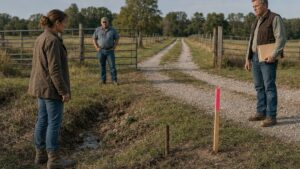
A line of orange survey flags crossed the compacted base in front of him.
They had not been there the day before.
The flags began near the west fence, ran diagonally through the new machinery yard, and disappeared beneath the graded approach to the grain-transfer pad. Their plastic ribbons snapped in the hot wind, bright against gray rock.
Nicholas straightened slowly.
He knew that line.
Not from the cooperative’s new plans. From something much older.
Brian Harris came striding from the equipment shed with a rolled set of construction drawings tucked under one arm.
“What’s the hold-up?”
The operator pointed again.
“Survey crew put these in. I’m not crossing them until somebody tells me whose they are.”
Brian looked down as though the flags were weeds.
“They’re probably marking utilities.”
“They aren’t,” Nicholas said.
Brian turned. “You know that from ten yards away?”
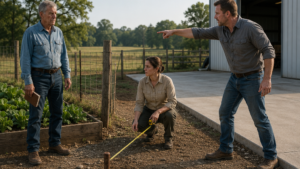
Nicholas walked over, crouched, and pinched one ribbon between two fingers. The stake had a surveyor’s cap and a small number written in grease pencil.
“I know it because there’s no utility on this bearing.”
Brian’s mouth tightened.
Nicholas had spent thirty-two years reading land descriptions for oil and gas companies before returning full-time to cattle and hay. He had traced boundaries across courthouse maps, lease plats, railroad strips, dry creek beds, abandoned fences, and legal descriptions written when survey chains were more common than GPS units.
Most people around the cooperative knew he had worked in the petroleum business.
Few understood what he had actually done.
Brian glanced toward the loader.
“We’ve got trucks coming tomorrow. Move around it.”
Nicholas stood.
“Who ordered the survey?”
“Co-op attorney wanted final boundary confirmation.”
“After grading?”
Brian let out a short breath. “Nicholas, we already had the tract surveyed when we bought it.”
“That was a surface survey.”
Brian stared at him.
Nicholas looked past him toward the new loading apron. Steel forms waited along the edge. A concrete crew was scheduled to start before sunrise two days from now.
Beyond the yard, the cooperative’s grain bins rose over the flat country. Combines would begin moving within weeks. The expansion had been discussed for more than a year: wider turning space, a new transfer lane, safer separation between grain trucks and farm pickups.
Nicholas had voted for it.
That was what bothered him most.
He walked along the orange line.
The bearing continued exactly where memory told him it should.
Across the old Martin tract.
Not the surface tract. Something beneath it.
Brian followed far enough to show irritation but not concern.
“You’re looking at this like one of your old lease maps.”
“That may be exactly what it is.”
“It’s a cooperative yard.”
“On top.”
Brian gave him a humorless smile. “Everything’s on top, Nicholas.”
Nicholas did not answer.
Thirty years earlier, his father had kept a metal file box beneath the workbench in their old barn office. Deeds, tax receipts, grazing leases, pipeline letters. Nicholas remembered one document because his father had folded it separately and told him never to throw it away.
Minerals.
The family had sold surface acreage years ago, then later portions of the surrounding land changed hands again before the cooperative acquired the parcel.
Nicholas had always assumed the mineral interest had little practical value. Nobody had drilled close enough to make it matter.
But ownership did not disappear because nobody used it.
A pickup rolled into the yard carrying two cooperative members. They slowed when they saw the loader stopped.
Brian noticed them.
“We’re not shutting down over a row of flags.”
“I didn’t tell you to shut down.”
“You’re thinking it.”
“I’m thinking somebody needs to find out what they mark.”
Brian lowered his voice.
“We have a contractor mobilized, a completion schedule, and grant money tied to that schedule. If the surveyor has a question, the attorney can deal with it.”
Nicholas looked at him.
“That’s not the same as answering it.”
Brian’s face changed slightly. Not anger. Pressure.
Then it hardened again.
He turned toward the loader.
“Go around the stakes. Keep spreading base on the east half.”
The operator hesitated.
Brian pointed.
“You heard me.”
The loader rumbled forward.
Nicholas watched its tires pass within a few feet of the nearest flag.
He could have argued. He could have told Brian exactly what he suspected.
Instead, he said nothing.
That silence would bother him later.
At the time, it felt useful.
If Brian wanted to move before knowing what the line meant, Nicholas wanted to know whether that confidence came from ignorance or from something already sitting in the cooperative’s title file.
He drove home at noon.
His cattle stood in the shade along the tank. A baler sat under the open-sided shed with one tire low. Ordinarily he would have noticed both things before anything else.
Instead, he went straight to the farmhouse.
The fireproof box was in the bottom of a hall closet behind tax folders and an old insurance binder. He carried it to the kitchen table and opened it.
Most of the papers meant nothing to the question in his head.
Then he found the folded document.
Cream-colored paper, brittle along the creases.
His father’s handwriting ran across the top margin.
KEEP WITH MINERALS.
Nicholas unfolded it carefully.
A dark thumbprint stained one corner, the old permanent mark of grease from hands that had repaired tractors before signing papers at the kitchen table.
Nicholas read the first page once.
Then again.
The legal description named a tract he had not heard spoken aloud in decades.
He pulled a county map from a drawer and placed it beside the deed.
The old bearing ran toward the cooperative yard.
Nicholas sat very still.
The orange flags had not created a problem.
They had uncovered one.
Chapter 2: The Deed Everyone Called Worthless
The final call in the old legal description ended beneath the cooperative’s expansion.
Nicholas knew it before he finished drawing the line.
He had taped a modern county parcel map to the kitchen table and laid tracing paper over it. The deed sat beside his ruler, its folds refusing to lie flat. His father’s thumbprint remained visible near the lower margin.
Nicholas marked each call from the old description.
North along a fence that no longer existed.
East to a survey corner that had been replaced by a county road.
Southwest along an acreage line later divided among three owners.
The language was old, but it was not meaningless.
By midnight, the traced polygon overlapped the western portion of the cooperative tract.
Including part of the new loading apron.
Nicholas leaned back.
That should have satisfied him.
Instead, it created another problem.
Mineral ownership and surface access were not the same thing. He had spent enough years negotiating leases to know that confidently stating half a rule could be more dangerous than knowing none of it.
The deed reserved “all oil, gas and other minerals,” followed by language concerning reasonable use of the surface.
Reasonable.
That one word could support an argument or destroy one.
He slept badly and drove to the county records office when it opened.
The clerk recognized him by face but not by name.
“Old records?”
“Old enough.”
She directed him to the index terminals.
Nicholas worked backward through conveyances, comparing instrument numbers and grantor names. The original tract had been divided, sold, mortgaged, released, and replatted more than once.
The surface moved.
The mineral reservation kept appearing as an exception.
Sometimes clearly.
Sometimes buried in references to prior instruments.
He found no recorded release.
No mineral deed transferring the interest away from the Martin family.
No instrument merging it back into the surface estate.
He asked for certified copies.
The clerk looked at the stack.
“Title dispute?”
“Not yet.”
She glanced at him over her glasses.
“That usually means yes.”
Nicholas almost smiled.
While the copies were being prepared, he pulled the cooperative’s more recent deed.
There it was.
A mineral exception.
Not prominent. Not explained. But present.
Subject to prior reservations of oil, gas, and other minerals of record.
Nicholas read it twice.
Brian’s board had not purchased a clean mineral estate.
Whether they understood what they had purchased was another question.
When the certified copies arrived, Nicholas carried them outside in a plain envelope.
His first feeling was satisfaction.
His second was caution.
He had proof of ownership continuity. That did not automatically give him the right to tear through a cooperative yard.
The distinction mattered, especially because people who wanted simple answers usually hated distinctions.
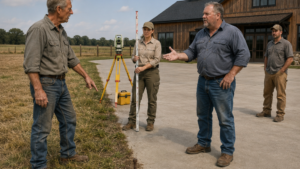
By late morning, a licensed surveyor met him near the edge of his hay field.
Nicholas handed over copies of the old mineral deed, modern parcel maps, and the survey information he had copied from the cooperative flags.
The surveyor studied the pages against the hood of a truck.
“You know these old calls aren’t going to close perfectly.”
“I know.”
“And the cooperative’s surface boundary isn’t the same question as your mineral tract.”
“I know that too.”
The surveyor looked up.
“Then what are you asking me?”
“Tell me where the old mineral boundary most likely falls in relation to what they built.”
The surveyor nodded once.
“That I can do.”
They walked the edge of Nicholas’s field where the soil had gone hard after weeks without rain. The surveyor located existing monuments, checked bearings, and compared them with county data.
By afternoon, he began placing new orange flags.
Nicholas watched each one go in.
The line extended out of the hay ground, crossed the ditch, and pointed directly toward the cooperative.
The same color as the stakes Nicholas had seen the day before.
For years, orange flagging had meant ordinary work to him: pipeline routes, utility markings, temporary limits, survey control.
Now each flag seemed to pull something old toward the surface.
He remembered his father sitting at the kitchen table with the mineral deed.
At the time, Nicholas had been younger and impatient.
“They’re never going to drill here,” he had said.
His father had folded the document.
“That’s not the point.”
Nicholas had forgotten the rest of the conversation.
Or perhaps he had decided it was unimportant.
By three o’clock, the surveyor returned to the truck and opened a field notebook.
“There’s overlap.”
“How much?”
“I need to finish calculations before I give you a final exhibit.”
“Does it cross the cooperative parcel?”
“Yes.”
“The new yard?”
“Yes.”
Nicholas looked toward the bins in the distance.
“Loading apron?”
The surveyor paused.
“Based on what I have right now, the old mineral tract boundary runs through it.”
Nicholas felt the satisfaction again, stronger this time.
And immediately disliked it.
He had been right.
But being right did not tell him what he could reasonably demand.
The surveyor tapped the deed.
“This surface-use language is broad, but broad isn’t unlimited. If development ever became real, there’d be questions about accommodation, existing uses, alternate access, all of that.”
Nicholas nodded.
“I’m not planning to put a rig in their yard.”
“Good.”
The answer came too quickly.
Nicholas looked at him.
The surveyor shrugged.
“I’ve seen property fights get expensive because somebody falls in love with the strongest version of their own argument.”
Nicholas folded the deed.
That sentence stayed with him.
Back at the farmhouse, he spread the certified instruments beside his father’s paper.
There was enough evidence to force a serious title review.
Not enough to guarantee the outcome Nicholas had imagined while standing beside those flags.
His phone rang near supper.
It was Brian.
“You’ve got a survey crew working along our west boundary?”
“Along mine.”
“I heard they’re extending those flags.”
“They are.”
Brian was silent for a moment.
“What are you trying to prove?”
“I’m trying to find out what your survey already found.”
“Our attorney says the project is fine.”
“Did your attorney review the mineral exception?”
Another silence.
Then Brian said, “We’re having a member walkthrough Friday. Come if you want to raise it formally.”
Nicholas looked at the old deed.
“Fine.”
“Concrete starts before then.”
Nicholas’s grip tightened on the phone.
“You might want to wait.”
“We’re not waiting on a theory.”
Brian hung up.
Nicholas stood at the kitchen table, staring at the intersecting lines.
An hour later the surveyor emailed the preliminary exhibit.
Nicholas opened it on his laptop.
The orange boundary crossed the cooperative’s western yard, clipped the grain-transfer route, and continued through the new loading apron.
The concrete Brian intended to pour before Friday would sit almost exactly on top of it.
Chapter 3: Brian Laughed Beside the Fresh Concrete
By the time Nicholas arrived for the cooperative walkthrough, the concrete had already been poured.
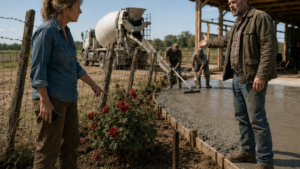
The new apron shone pale against the older gravel, still curing under strips of wet burlap near one edge. Members stood in small groups around the yard while Brian Harris explained how trucks would enter, swing wide, unload, and exit without backing toward the county road.
Nicholas parked away from the crowd.
He carried the folded mineral deed in one hand.
The surveyor’s preliminary exhibit stayed inside a plain folder beneath his arm.
Orange flags ran along the western edge of the yard.
Three had been removed where the concrete crossed them.
The remaining line resumed on the other side.
Heather Lewis noticed Nicholas first.
She stepped away from two cooperative members.
“You came.”
“Brian invited me.”
Her eyes moved to the folder.
“I figured you might bring something.”
“I brought enough to ask the question properly.”
Heather lowered her voice.
“The board knows there’s a mineral exception.”
Nicholas stopped.
“How long?”
“It was in the title commitment.”
“That wasn’t my question.”
She hesitated.
“Since acquisition.”
There it was.
Not proof of wrongdoing.
But not ignorance either.
Nicholas looked toward Brian.
The chairman was pointing out the new traffic pattern with the confidence of a man describing a finished fact.
Heather said, “The attorney’s position was that the exception didn’t prevent surface development.”
“That may be true.”
She seemed surprised.
Nicholas continued, “It also doesn’t mean you ignore the mineral owner.”
Before Heather could answer, Brian called the group toward the loading apron.
Nicholas followed.
The new concrete sat directly across the line shown on his survey exhibit.
Brian talked about harvest capacity, grant reimbursement, and safety improvements. All of it was reasonable.
That made what came next harder.
When Brian asked for questions, Nicholas raised his hand.
Several heads turned.
Brian saw the deed.
His expression changed before Nicholas said a word.
“Yes?”
Nicholas stepped closer.
“I want the cooperative to pause work on the west portion until the mineral title is reviewed.”
A few members exchanged glances.
Brian’s jaw shifted.
“We’ve already reviewed title.”
“Then you know the purchase was subject to a prior mineral reservation.”
Brian gave a small shrug.
“We know there’s an old exception.”
“Do you know who owns it?”
Brian looked at him.
Nicholas waited.
“No,” Brian said.
“I do.”
The yard went quiet enough that Nicholas could hear a diesel engine idling near the bins.
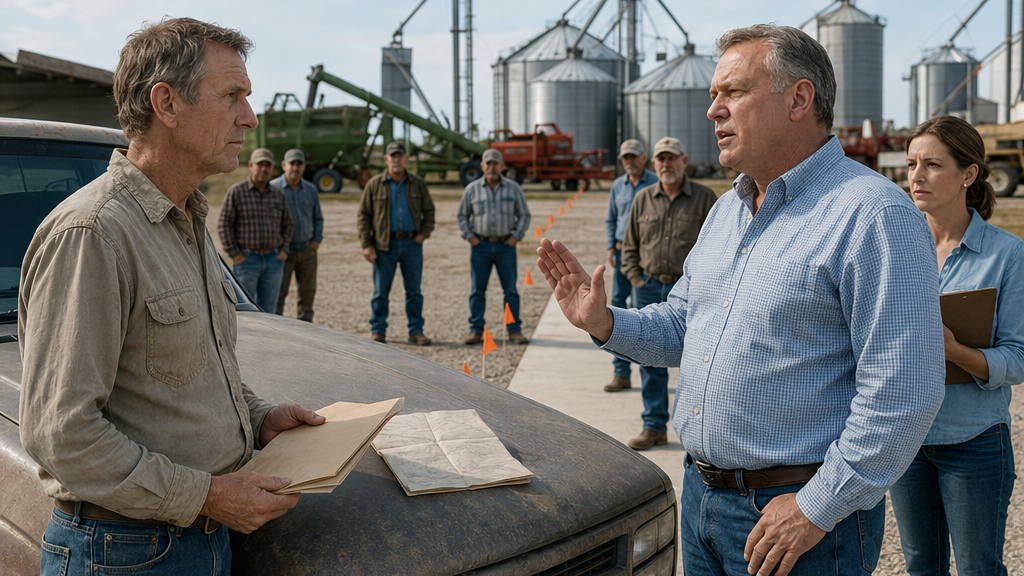
He opened the folder and placed the survey exhibit on the hood of his pickup.
The orange line on paper matched the flags cutting across the yard.
Brian walked over.
Nicholas unfolded the deed beside it.
“This reservation stayed with my family.”
Brian looked down at the paper, then at Nicholas.
“How old is that?”
“Old enough to have survived every surface sale since.”
Someone behind them gave a low whistle.
Nicholas ignored it.
“The cooperative owns the surface. I’m not disputing that. But the mineral estate under part of this tract was severed.”
Brian’s face tightened.
“You’re saying because your father kept some mineral paper fifty years ago, we can’t pour concrete?”
“I’m saying you should stop long enough to understand what you bought.”
Brian glanced around at the members.
Nicholas could see the pressure enter his posture.
The new yard was his project. His promise.
Public uncertainty cost more than private uncertainty.
Brian put both hands on his hips.
“We’ve spent months on this.”
“That doesn’t change the record.”
“Our attorney says the exception is commercially meaningless.”
Nicholas looked at Heather.
She did not contradict him.
There was the admission.
Not that the mineral interest belonged to Nicholas.
But that the cooperative knew the exception existed and had chosen to treat it as harmless.
Nicholas pointed to the survey.
“The old mineral tract crosses your loading apron.”
Brian laughed.
It was not a loud laugh.
That almost made it worse.
He looked toward the other farmers as though Nicholas had just produced an antique wagon wheel and asked everyone to reorganize the harvest around it.
“You spent your career reading oil leases,” Brian said. “I understand that. But this is a farm cooperative, Nicholas. Nobody’s drilling under the grain bins.”
A few members smiled uncertainly.
Nicholas felt heat rise under his collar.
He had expected resistance.
He had not expected amusement.
Brian touched one corner of the deed.
“This paper predates half the roads around here.”
“So?”
“So sometimes old paperwork is just old paperwork.”
Nicholas stared at him.
For one second he imagined giving Brian everything.
The certified chain of title.
The original reservation language.
The historical instrument Nicholas had found that morning confirming how the mineral interest had passed within the Martin family.
He could have put it all on the hood and forced Brian to stop smiling.
He did not.
Pride made the decision before caution could.
Nicholas folded the strongest copy back into his folder.
Brian noticed.
“What’s that?”
“Another record.”
“If it matters, show it.”
“It’ll matter more when you decide this one doesn’t.”
Heather looked sharply at Nicholas.
That was the moment he could have prevented what followed.
He knew it even then.
But he was tired of explaining land records to men who treated expertise as stubbornness.
He turned to Heather.
“I want my objection entered in the cooperative minutes. Mineral ownership is disputed, the surveyed mineral tract overlaps the west yard, and I requested a pause before additional permanent improvements.”
Heather nodded.
“I’ll record it.”
Brian’s smile faded.
“Nicholas, don’t turn this into something it isn’t.”
“I’m trying to find out what it is.”
“You’re threatening a harvest project over a dormant mineral reservation.”
“No. I’m telling you the reservation isn’t yours.”
Brian stepped closer.
“And what do you expect us to do? Tear the apron out?”
Nicholas looked down at the concrete.
“Not today.”
The answer landed badly.
Several members shifted.
Brian’s face hardened.
“You hear how that sounds?”
Nicholas did.
That was another truth he did not want.
He gathered the deed and survey.
Behind him, Brian resumed the walkthrough.
His voice was louder than before.
Nicholas crossed the yard alone.
At the edge of the concrete, one orange flag had been bent nearly flat by a tire. He pulled it upright and pressed the stake back into the crushed stone.
Heather caught up with him.
“You made your point.”
“No.”
She frowned.
“I made an objection.”
“What’s the difference?”
“A point is something they believe.”
He started toward his pickup.
Heather touched his arm.
“What was the other record?”
Nicholas looked back toward Brian.
“I’ll show it when somebody is ready to read it.”
“That sounds like punishment.”
Nicholas said nothing.
He left before the walkthrough ended.
At home that evening, he set the deed and certified copies on the kitchen table and tried to convince himself that waiting was strategy.
The phone rang after dark.
He nearly ignored it.
The caller identified himself as David Baker.
Nicholas knew the name from years earlier, though they had never worked closely together.
“I heard you may control minerals west of the cooperative tract,” David said.
Nicholas looked toward the documents.
“Where’d you hear that?”
“County records. Then a surveyor mentioned somebody had reopened an old description.”
Nicholas’s expression hardened.
“He shouldn’t have discussed my work.”
“He didn’t give me your file. I’ve been looking at acreage in that area for months.”
Nicholas leaned back in his chair.
“Why?”
“Because the minerals may not be as dormant as your cooperative chairman thinks.”
Nicholas said nothing.
David continued.
“If your title is what I think it is, I’d like to talk about a lease.”
The room seemed to get quieter around him.
All afternoon, Nicholas had wanted Brian to understand that old paperwork could still have weight.
Now someone had called offering to put money, equipment, and legal consequences behind it.
David asked, “Are you interested?”
Nicholas looked at his father’s thumbprint on the folded deed.
“I’m interested in hearing what you think I own.”
Chapter 4: The Lease That Made the Argument Real
David Baker arrived the following Tuesday with a folded map large enough to cover most of Nicholas’s kitchen table.
He did not begin with a lease.
He began with a red pencil.
“Your minerals are here,” David said, drawing a loose boundary around the old Martin tract. “At least, based on the records I’ve pulled and the survey information you sent.”
Nicholas stood opposite him with both palms on the table.
“And the cooperative?”
David marked the western edge of the machinery yard.
“Right across this corner.”
He drew another line through Nicholas’s hay ground, past the drainage ditch, and toward the county road.
“This is what interests me more.”
Nicholas followed the pencil.
“A surface corridor.”
“Possible surface corridor.”
“Across my field.”
David nodded.
“Your field is the cleanest way in.”
Nicholas almost laughed at the irony.
For days he had imagined the cooperative discovering that the mineral reservation had teeth. Now the first practical consequence landed on his own land.
David leaned back.
“We’re not talking about a drilling crew tomorrow. First we secure leasehold. Then engineering. Then permitting. Then we find out whether there’s enough value to justify anything.”
“But you think there might be.”
“I wouldn’t be sitting here otherwise.”
Nicholas looked at the map.
The mineral interest had been part of his family for decades without producing a dime. It had been a legal fact, nothing more.
Now the fact had a dollar value.
That changed the room.
David opened a folder.
“Signing consideration. Royalty terms. Primary term. Standard protections.”
Nicholas did not touch it.
“Surface location?”
“We negotiate that later.”
“No.”
David looked up.
Nicholas tapped the cooperative yard on the map.
“If you lease from me, surface placement gets addressed now.”
“We don’t even know what development would look like.”
“Then you don’t know what I’m willing to sign.”
David studied him for several seconds.
“You worried about your own pasture?”
“I’m worried about everybody assuming the mineral owner is supposed to decide last.”
That afternoon they walked the hay field.
Orange survey flags now extended from Nicholas’s property toward the cooperative tract. Their ribbon flickered above grass beginning to brown in the late-summer heat.
David paced distances and photographed access points.
At the ditch, he stopped.
“Could build a crossing here.”
Nicholas said nothing.
David pointed toward the cooperative.
“Or we could approach from their side if access rights support it.”
“That yard handles grain trucks.”
“I noticed.”
“And cattle trailers. Fertilizer deliveries. Seed trucks.”
“I noticed those too.”
David looked at Nicholas.
“You called me back because you wanted leverage.”
Nicholas met his eyes.
“I called you back because you said the minerals might be worth something.”
“Those can be the same reason.”
They kept walking.
Near the cooperative fence, David stopped at one of the orange flags and looked through the wire toward the new loading apron.
“If a surface location had to be near that corner, it’s technically workable.”
Nicholas turned.
“Near the yard?”
“Potentially.”
“How near?”
David pointed.
A location beyond the fence line, close enough that any construction traffic would affect the cooperative’s western circulation.
Nicholas imagined heavy trucks there.
Mud.
Temporary fencing.
Service equipment.
Men in hard hats.
The image produced a pulse of satisfaction so quick he was ashamed of it.
Brian laughing beside the concrete.
Old paperwork is just old paperwork.
David was still speaking.
Nicholas had missed part of it.
“What?”
“I said this would create pressure on them.”
Nicholas looked through the fence.
“I know.”
“Is that a problem?”
Nicholas bent and straightened one of the flags.
“It might be.”
At the regional land office two days later, David placed a revised lease in front of him.
The financial terms were better than Nicholas expected.
He barely looked at them.
Instead, he read the surface-use provisions.
Two pages had been changed.
No permanent surface installation without Nicholas’s written approval of location.
Reasonable accommodation of existing agricultural operations.
Defined access planning before mobilization.
David tapped the signature page.
“You asked for control. That’s more control than most lessors get.”
Nicholas read the clause again.
“If you decide the cooperative-side location is cheapest?”
“We ask you.”
“And if I say no?”
“We find another location or we don’t develop from there.”
Nicholas finally looked at the payment figure.
Years ago, that number would have dominated the conversation.
Now it felt strangely secondary.
David smiled faintly.
“You’re making this harder than most people.”
“I used to work your side of the table.”
“I know.”
“That’s why I’m making it harder.”
David slid a pen toward him.
Nicholas did not pick it up.
“What happens after I sign?”
“We continue title work. Technical evaluation. If it holds together, we file what needs filing and start planning access.”
“And the cooperative hears about it when?”
“That depends on whether their surface is affected.”
Nicholas thought about Heather entering his objection into the minutes.
He thought about Brian’s hand on the hood of his pickup.
Sometimes old paperwork is just old paperwork.
Nicholas signed.
For the first time since finding the deed, he possessed something Brian could not dismiss as an academic argument.
That should have felt good.
Instead, when David closed the folder, Nicholas felt as though he had opened a gate without knowing exactly what might come through.
He drove home by way of the cooperative.
The new apron was finished.
Fresh tire marks curved across it.
A grain trailer was testing the wider turn.
The orange survey flags remained along the edge.
One had disappeared beneath the new gravel.
Nicholas sat in his pickup across the road and watched the trailer clear the turn easily.
The project worked.
That was the inconvenient truth.
His phone buzzed.
Heather.
“Can you meet me at the equipment shed?”
“When?”
“Now, if you’re close.”
He looked toward the cooperative buildings.
“I’m across the road.”
There was a pause.
“Good,” she said. “Because I found the title material from before construction.”
Nicholas gripped the phone.
Heather continued.
“And before you show me whatever you kept back at the walkthrough, I need you to answer something.”
“What?”
“Why did you wait so long to show us any of it?”
Chapter 5: The Mistake Nicholas Did Not Admit
Heather had the title exception highlighted in yellow before Nicholas sat down.
The cooperative office was empty except for the two of them. Through the window, trucks moved across the new yard in slow practice turns.
She pushed the paper toward him.
“This was in the acquisition file.”
Nicholas read the paragraph.
He had already seen the same language at the county office.
Heather tapped a second page.
“And this was in the attorney’s summary.”
A short note described the prior mineral reservation as an exception of record with no identified active development.
Nicholas looked up.
“Who saw this?”
“The board.”
“All of you?”
“Yes.”
“Before you bought?”
“Yes.”
Heather sat back.
“We were told it probably didn’t affect the planned surface use.”
“Probably.”
“I know what it says.”
Nicholas folded his hands.
“You proceeded anyway.”
Heather’s expression tightened.
“So did you.”
He stared at her.
She opened another file.
Inside was an email chain from months earlier concerning preliminary parcel descriptions.
Nicholas recognized one of the attachments.
A public planning exhibit.
He had seen it before construction began.
Heather said, “You called me after this went out.”
Nicholas remembered.
He had asked whether the west line was final.
Heather had said she believed it was.
He had noticed then that the legal description did not look right.
Not enough to prove anything.
Enough to make him curious.
“You already suspected the mineral tract overlapped,” she said.
Nicholas said nothing.
“How long?”
“A few months.”
Heather’s face went still.
“And you didn’t tell us?”
“I didn’t know.”
“You knew enough to ask.”
“I knew enough to think the description deserved checking.”
“That sounds a lot like what you’re accusing us of.”
The words struck harder because they were quiet.
Nicholas glanced through the window.
An equipment operator crossed the yard where the orange line had been.
“I thought if I raised it without proof, Brian would wave me off.”
Heather gave a short, tired laugh.
“And when you had proof?”
“I raised it.”
“After the base was down.”
Nicholas looked back at her.
“I told Brian to stop before concrete.”
“You could have brought the deed months earlier.”
“I could have brought an old document I hadn’t verified.”
“You worked title for thirty years.”
“That’s exactly why I don’t make claims before I verify them.”
Heather held his gaze.
Neither of them spoke.
Then she said, “That isn’t the whole answer.”
Nicholas felt the old defensive instinct rise.
He wanted to tell her that the cooperative had lawyers. That Brian had a board. That the mineral exception was in their own file.
All true.
None complete.
“I expected him to ignore me,” Nicholas said.
“So you waited until ignoring you would cost more.”
Nicholas looked down at his hands.
Heather did not need him to answer.
The silence did it for him.
She closed the folder.
“I’m not saying Brian was right.”
“What are you saying?”
“I’m saying you wanted him to learn it the hard way.”
Nicholas thought of the satisfaction he had felt when David pointed toward the technically feasible surface location beside the cooperative yard.
“Yes,” he said.
It was the first admission that made him feel worse than being laughed at.
Heather stood and walked to a metal cabinet.
“There’s something else you should see.”
She returned with financial papers.
Grant documents. Contractor schedules. Reimbursement deadlines.
Nicholas skimmed them.
The expansion had depended on completing certain improvements before harvest. Missing the deadline would have threatened a substantial portion of outside funding.
“How tight was it?” he asked.
Heather pointed to a date.
“Tight enough that stopping for a month could have killed the grant.”
“Brian knew?”
“He knew.”
“And that’s why he pushed.”
“That’s part of why.”
Heather rubbed her forehead.
“The cooperative lost two large members last year. They started hauling to the commercial elevator north of town because our truck line took too long.”
Nicholas knew that.
He had not connected it to the expansion.
“If more followed,” Heather continued, “we would have had to raise fees on everybody who stayed. Brian thought this project was the only way to keep the place competitive.”
“That doesn’t excuse ignoring title.”
“No.”
“Or laughing at me.”
“No.”
Her answer came immediately.
Nicholas looked at her.
Heather said, “He made that choice. I’m not defending it. I’m telling you why he was afraid to stop.”
Outside, a loaded grain trailer entered the test lane.
Harvest had begun early on a few fields south of town.
Nicholas watched it turn through the yard.
A younger farmer stood near the scale house, signaling the driver through.
The cooperative was not Brian’s private kingdom.
It belonged to people Nicholas had known most of his life.
That fact had been present from the beginning.
He simply had not wanted to look directly at it.
Heather said, “What did you sign?”
Nicholas turned.
She had noticed his hesitation.
“A lease.”
Her face drained.
“With who?”
“David Baker’s company.”
“When?”
“Two days ago.”
Heather sat down again.
“Does Brian know?”
“Not from me.”
“What does it allow?”
Nicholas chose his words carefully.
“Potential mineral development, subject to title, regulatory requirements, and surface-use planning.”
“That’s not what I asked.”
“I retained approval over permanent surface location.”
Heather stared at him.
“So you could put them beside the cooperative.”
“I could approve a location there if it’s otherwise workable.”
“And you could refuse another location.”
“Yes.”
She looked through the window toward the yard.
For the first time since Nicholas had known her, Heather seemed genuinely frightened of a piece of land.
“What happens if equipment comes during harvest?”
Nicholas did not answer.
He had spent the last week thinking about rights.
Heather had just changed the question to consequences.
A truck entered from the county road. Another waited behind it.
In two weeks there would be dozens more.
If part of the yard became restricted or congested at the wrong time, grain trucks could stack beyond the entrance. Farm traffic would slow. The road itself could become dangerous.
Nicholas pictured men who had never laughed at him losing hours while crops sat ready in the field.
Heather gathered the documents.
“You wanted Brian to have to listen.”
“Yes.”
“He may have to now.”
Her phone rang.
She checked the screen and answered.
Nicholas watched her expression change.
“What?”
She listened.
Then looked directly at him.
“When did that arrive?”
Another pause.
“All right. Don’t do anything until I get there.”
She ended the call.
Nicholas already knew.
“What is it?”
Heather stood.
“Brian just received formal notice from the mineral company.”
Nicholas felt his stomach tighten.
“What kind of notice?”
“Proposed operations planning. Survey access. Surface-location discussion.”
She grabbed the cooperative files.
“Apparently they want to start field work within three weeks.”
Outside, one of the orange flags had been flattened beneath a truck tire.
Neither of them moved to straighten it.
Chapter 6: The Trucks Came Before Harvest
The first service truck turned onto the cooperative road before sunrise.
Nicholas saw its headlights from half a mile away.
Then came another.
A survey vehicle followed, then a flatbed carrying mats and temporary fencing.
By the time Nicholas reached the cooperative entrance, Brian Harris was standing in the road waving both arms at the lead driver.
“Stop right there.”
The truck stopped.
Behind it, the small convoy stretched back toward the highway.
Orange flags lined both sides of the entrance.
Some marked the old mineral boundary.
Others, newer and brighter, marked a possible access corridor David’s company had surveyed across Nicholas’s hay field.
Brian turned when he heard Nicholas’s pickup.
His face looked exhausted.
“You knew they were coming.”
“I knew field crews were scheduled.”
“You didn’t think to call?”
“You got notice.”
“Three weeks ago.”
“That’s what notice is for.”
Brian walked toward him.
For a moment Nicholas expected another public dismissal.
It did not come.
Brian held a folder instead.
“We need to talk.”
The difference should have satisfied Nicholas.
It did not.
A grain truck appeared behind the service vehicles.
Its driver slowed, found the entrance blocked, and stopped partly on the county road.
Another grain truck arrived two minutes later.
David stepped out of the lead pickup.
“We’re not here to drill,” he said before Brian could speak. “Survey confirmation and preliminary site preparation only.”
Brian pointed at the flatbed.
“That looks like preparation.”
“It is.”
“On cooperative property?”
“Not unless the approved route requires it.”
Brian looked at Nicholas.
“Approved by who?”
Nicholas said, “Surface placement requires my approval under the lease.”
Brian stared at him.
For the first time, he seemed to understand the full shape of what Nicholas had done.
“You control where they go.”
“Within the rights I actually have, yes.”
“And you can refuse the west option?”
“Yes.”
Brian looked toward the cooperative yard.
The technically easiest location sat near its western edge.
Nicholas had seen the engineering sketch.
It was cheaper.
Shorter access.
Less grading.
More pressure on the cooperative.
Brian lowered his voice.
“You planned this.”
Nicholas could have denied it.
Instead he said, “I planned not to lose control of the surface decision.”
“That’s not the same thing.”
“No.”
Brian laughed once, but there was no humor in it.
“You wanted me standing here asking permission.”
Nicholas looked at him.
“Part of me did.”
Brian’s expression changed.
The admission disarmed him more effectively than an argument would have.
Behind them, a horn sounded.
The second grain truck had stopped behind the first.
David walked over.
“We need to clear the entrance. I can send the convoy around to Nicholas’s south gate.”
“That route isn’t improved,” Nicholas said.
“We brought mats.”
Brian said, “Then use it.”
David looked at Nicholas.
Not Brian.
That small movement made the new power arrangement visible.
Nicholas nodded.
“Use the south gate for survey access. No permanent work.”
David signaled the trucks.
One by one, they began reversing and turning out.
The grain driver waited impatiently.
Brian watched the convoy leave.
“You could make this ugly.”
Nicholas said nothing.
“I know what the lawyer told us now,” Brian continued. “Mineral owner has rights. Surface owner has rights. Everybody gets to spend money arguing about what reasonable means.”
“Pretty good summary.”
Brian rubbed his jaw.
“So what do you want?”
Three weeks earlier, Nicholas would have had an answer ready.
Recognition.
A pause.
Maybe an apology.
Now a loaded grain truck was still sitting partly on the county road because the conflict had occupied the entrance for fifteen minutes.
Another truck approached from the south.
The first driver finally pulled into the yard.
The second had to stop on the shoulder.
Nicholas watched both.
Harvest was no longer a future problem.
It had started.
David returned from redirecting the convoy.
“We can stake the west option today and the south alternative tomorrow.”
Brian turned sharply.
“There is no west option.”
David said, “That isn’t your decision.”
Brian looked at Nicholas.
Nicholas felt the moment he had imagined since the walkthrough.
Brian could no longer dismiss him.
Could no longer order construction forward and expect Nicholas to absorb it.
The balance had shifted completely.
And it felt worse than Nicholas had expected.
He walked toward the western edge of the yard.
Brian and David followed.
Orange flags marked the potential pad near the cooperative boundary.
A second flagged path continued farther south through Nicholas’s hay ground. Longer. More expensive. Less disruptive to cooperative traffic.
David pointed.
“West location saves access work.”
Brian said, “And puts industrial traffic beside our busiest lane.”
“Yes.”
“You know what harvest looks like here?”
“I know what the map looks like.”
Nicholas looked at David.
“That’s the problem.”
David frowned.
Nicholas walked between the two flagged options.
His father’s voice came back unexpectedly.
Not the words about keeping the deed.
Something earlier.
A memory of repairing a fence after a neighboring rancher’s cattle got through.
Nicholas had wanted to make the neighbor pay for every broken post.
His father had said, You can settle a fence two ways. Decide whether you want a boundary or an enemy.
He had forgotten that too.
Brian said, “If you put it here, you’ll cost people who had nothing to do with this.”
Nicholas turned.
“And if I give up the right because it inconveniences the cooperative, what happens the next time somebody decides my deed is an inconvenience?”
Brian did not answer.
That was the real argument.
Not drilling.
Not concrete.
Whether rights mattered only when exercising them was easy for everyone else.
David unfolded a field map on the hood of his truck.
“We need a location direction today or I move crews to another tract.”
Brian looked at Nicholas.
The choice was finally his.
Exactly as he had wanted.
A grain truck came around the corner too fast, saw vehicles near the entrance, and braked hard.
Dust lifted from the shoulder.
The driver corrected, then eased into the cooperative lane.
Nicholas watched him pass.
Inside the cab was a farmer he recognized by face, not name.
No board position.
No title dispute.
Just grain to deliver.
Nicholas looked at the west-site flags.
Then the southern line.
“David.”
“Yes?”
“Do not mobilize the west pad.”
Brian exhaled.
Nicholas held up a hand.
“I didn’t say we’re done.”
He pointed toward the south alternative.
“Finish the survey. Give me the narrowest workable access corridor from my side. Include turning radius, temporary matting, restoration, and what you actually need instead of what is cheapest.”
David studied him.
“That adds cost.”
“I know.”
Brian said, “And what happens to the cooperative?”
Nicholas looked at the new concrete, the orange boundary running beside it, and the trucks beginning to queue for the morning.
“That depends on whether you’re finally ready to negotiate the line you poured over.”
Chapter 7: The Line They Finally Agreed to Respect
Nicholas rejected Brian’s buyout offer before Heather finished setting the coffee on the table.
“No.”
Brian sat across from him in the cooperative office with a legal pad, a calculator, and an expression that suggested he had expected an argument, not a one-word answer.
“You haven’t heard the number.”
“I heard what you’re buying.”
Brian leaned back.
“What am I buying?”
“The right to pretend this never happened.”
Heather placed the coffee between them and sat at the end of the table.
David Baker stood near the window with a rolled engineering map under one arm. The cooperative attorney had joined by phone, his voice occasionally crackling through the speaker.
Outside, grain trucks crossed the yard in steady intervals.
Harvest had found its rhythm.
That was exactly why Nicholas had called the meeting early.
Brian pushed the written offer toward him.
“It’s not nothing.”
Nicholas left it untouched.
“I’m not selling the mineral estate.”
“Then let us buy enough surface protection that nobody can interfere with the yard.”
“That would amount to the same thing.”
David unrolled his map.
“And before anybody asks, the west location is still cheaper.”
Nicholas looked at it.
“No.”
David tapped the southern alternative.
“This one costs more road work, more matting, a longer utility run, and more restoration.”
“I know.”
“You asked me to show you the narrowest workable corridor. That’s it.”
A penciled route began on Nicholas’s side of the county road, crossed a portion of his hay field, skirted the drainage area, then approached the mineral tract from the south.
It avoided the heart of the cooperative yard.
Mostly.
A short segment still intersected the western edge of the new loading apron.
Brian saw it.
“You’re still crossing us.”
“For access at one point, not permanent occupation.”
“You can go farther south.”
David shook his head.
“Not without creating a turning problem for heavy equipment and adding a creek crossing.”
Brian looked at Nicholas.
“You said you weren’t trying to cripple us.”
“I’m not.”
“Then move the line.”
Nicholas stared at him.
“That’s what started this.”
Brian’s jaw tightened.
Heather closed her eyes briefly.
The cooperative attorney’s voice came through the speaker.
“We need to separate emotion from use rights.”
Nicholas said, “That would have been useful advice before they poured concrete.”
Brian looked away.
The room settled into silence.
Nicholas opened the old deed.
He had brought the original, not because anyone needed it legally but because he wanted it in front of him when he made the decision.
His father’s grease-smudged thumbprint sat beside the fold.
Heather noticed.
“You always carry that now?”
“Lately.”
Brian glanced at the page.
“What did your father think those minerals were worth?”
Nicholas almost answered with money.
Then another memory surfaced.
He had been twenty-three, standing with his father beside a pasture gate after a buyer had offered to purchase the remaining mineral interest along with some surface acreage.
Nicholas had called the reservation useless.
His father had disagreed.
Not because he expected a well.
Because once rights were gone, future owners no longer had to ask.
At the time, Nicholas had understood that as stubbornness.
Now he understood it differently.
“He didn’t keep them because he thought we’d get rich,” Nicholas said.
Brian waited.
“He kept them because he didn’t want somebody else deciding everything that happened on land tied to us without having to sit down first.”
Heather looked at the deed.
“So leverage.”
Nicholas nodded.
“Leverage to negotiate. Not leverage to burn the place down.”
David folded his arms.
“That distinction matters now.”
Nicholas slid the southern-corridor map toward Brian.
“This is what I want.”
Brian did not touch it.
Nicholas continued.
“A recorded surface-use agreement. Defined corridor. No permanent drilling pad in the cooperative’s active traffic area. Temporary crossing at the western edge only when required, scheduled outside peak delivery hours.”
Heather began taking notes.
“Restoration?” she asked.
“Full restoration on my ground. Any damage to cooperative pavement repaired by the operator.”
David nodded once.
“Reasonable.”
Brian gave him a look.
“Easy for you to say.”
Nicholas went on.
“The cooperative recognizes the mineral reservation and agrees not to build additional permanent structures over the defined tract without notice and consultation.”
Brian said, “Consultation isn’t approval.”
“No.”
That surprised him.
Nicholas added, “I’m not asking for control over your whole surface. I’m asking you to stop treating the mineral estate like it isn’t there.”
The attorney’s voice came through the speaker.
“That distinction is workable.”
Brian leaned over the map.
“What happens to this section?”
He pointed to the western corner of the loading apron.
David answered.
“Part of it needs to be narrowed. Enough to maintain the access corridor and turning clearance.”
“How much?”
David gave the measurement.
Brian muttered something under his breath.
Heather looked at him.
“We can still run trucks.”
“We lose concrete we just paid for.”
“Yes.”
“We may lose grant reimbursement on that piece.”
“Maybe.”
Brian stood and walked to the window.
Outside, a grain truck rolled across the exact apron they were discussing.
Nicholas watched his shoulders.
For the first time, Brian did not look like a chairman defending authority.
He looked like a farmer calculating how much one bad decision was going to cost everyone.
“I thought the exception was cleanup work,” Brian said.
Nobody answered.
He turned.
“The attorney said it probably wouldn’t interfere with the project. The contractor was mobilized. If we paused, we risked the grant. Members were already threatening to haul elsewhere.”
Nicholas said, “You still knew there was a question.”
“Yes.”
“And you decided the question was cheaper than stopping.”
Brian looked at him.
“Yes.”
It was the closest thing to an apology Nicholas expected.
Brian returned to the table.
“And then I laughed at you.”
Heather stopped writing.
Brian’s expression tightened.
“That was mine. Not the grant. Not the attorney. Mine.”
Nicholas felt no triumph.
Only the strange easing that came when someone finally named the part that had hurt.
“I should’ve brought everything earlier,” Nicholas said.
Brian frowned.
“You did bring the deed.”
“Not everything. I had enough months earlier to start asking harder questions. I waited because I figured you’d ignore me.”
“You were right.”
“That doesn’t make waiting right.”
Heather looked between them.
“Good. Now that everybody’s admitted being stubborn, can we save the harvest yard?”
Brian almost smiled.
Almost.
They spent the next three hours reducing the disagreement to measurements.
Feet of corridor.
Hours of permitted access.
Notice periods.
Restoration standards.
Insurance.
Compensation.
When Brian tried to narrow Nicholas’s notice provision, Nicholas refused.
When David asked for broader emergency access, Nicholas allowed it only for defined safety conditions.
When Nicholas demanded compensation for disruption beyond the draft amount, Heather did not object.
The cost of removing part of the new apron remained the hardest issue.
Finally Brian put down his pen.
“We take it out.”
Heather looked at him.
“You’re sure?”
“No.”
He looked at Nicholas.
“But we should’ve stopped before we poured it.”
Two days later, a saw crew cut a straight line through the western edge of the concrete.
Nobody gathered to watch.
There was no public apology, no meeting, no applause.
Sections of the new apron were lifted and hauled away while cooperative trucks continued using the remaining lane.
Nicholas preferred it that way.
The surveyor returned that afternoon.
He removed the temporary orange flags that had wandered through the construction zone and reset a clean line along the negotiated corridor.
Nicholas walked behind him.
One flag went beside the cooperative fence.
Another near the ditch.
Then another across the edge of his hay field.
This time the flags did not look like a warning.
They looked like instructions.
Weeks later, harvest traffic moved steadily through the preserved yard. The cooperative’s new turn still worked, though the western apron was narrower than Brian had intended.
Nicholas stood at his gate as a pair of grain trucks passed.
Farther out, orange flags continued across the hay ground toward the south corridor.
Brian pulled his pickup onto the shoulder nearby.
He lowered the window.
“Line looks different from here.”
Nicholas glanced toward the flags.
“No. Same line.”
Brian considered that.
Then nodded.
“Fair enough.”
He drove on.
Nicholas remained at the gate.
The old deed was back in the fireproof box now.
He no longer needed to carry it.
The mineral right had survived.
So had the cooperative.
Neither outcome was as satisfying as defeating Brian completely would have been.
That was how Nicholas knew it was probably the better one.
A grain truck crossed the new yard in the distance while the orange flags moved lightly in the wind, marking not what one man had won from another, but the place where both sides had finally agreed they had to ask.
The story has ended.