They Fined Her for Using the Farm Road Too Often, So She Built Another Way In
Chapter 1: The Morning Her Farm Access Became Excessive
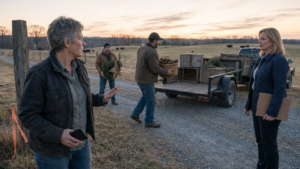
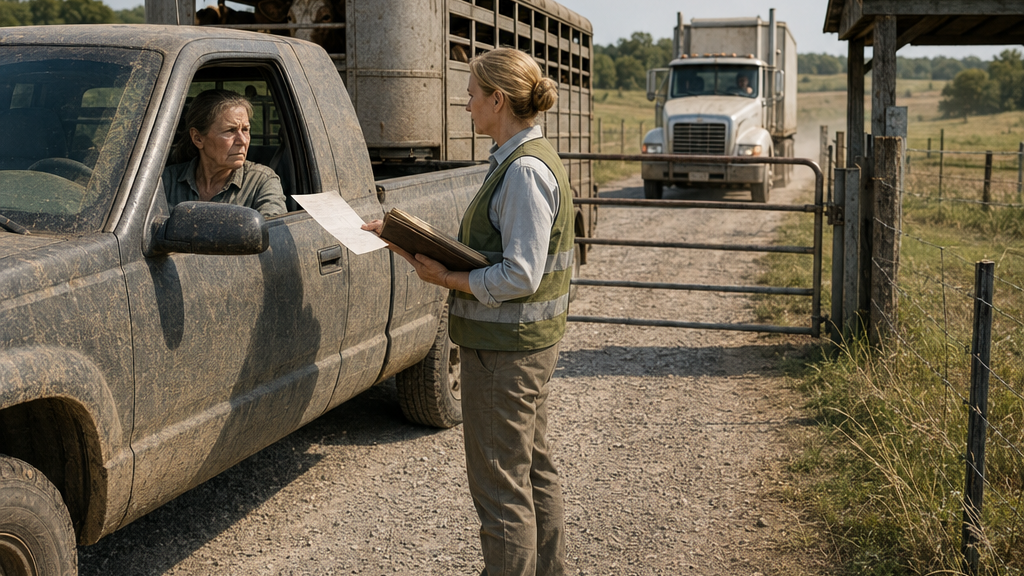
Cynthia Roberts stood in the middle of the cooperative lane with one hand raised while Janet Green’s livestock trailer idled twenty yards away.
Janet hit the brake.
Six steers shifted behind her, hooves knocking against the trailer floor. The sun had barely cleared the tree line, but heat was already collecting under the aluminum roof.
Janet lowered the window.
“You need to move.”
Cynthia did not.
She wore work slacks, boots too clean for the gravel, and a yellow safety vest over a pale shirt. Under one arm she carried the cooperative’s weathered access ledger. In her other hand was a single sheet of paper.
“You have an assessment due.”
“I’ll deal with it this afternoon.”
“It has to be acknowledged before you use the lane again.”
Janet stared at her.
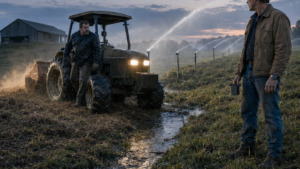
The cooperative road ran behind the grain shed, crossed a drainage culvert, and reached the livestock-loading apron used by a dozen farms. Janet had paid membership dues for fourteen years. She had hauled cattle through that gate in drought years, flood years, and once during an ice storm when the county road had been barely passable.
“What kind of assessment?”
Cynthia stepped closer and held the paper toward the window.
Across the top, in plain black print, were the words EXCESSIVE ACCESS MAINTENANCE SURCHARGE.
The amount beneath them was three hundred forty dollars.
Janet read it twice.
Then she looked at Cynthia.
“You’re charging me for using the farm road.”
“For excessive use of shared infrastructure.”
A steer kicked the side panel behind Janet.
She glanced at the mirror.
“How many trips am I allowed?”
Cynthia’s mouth tightened.
“It isn’t about one number.”
“Then what makes it excessive?”
“You’ve made twenty-three logged trips through here since the first of the month.”
Janet looked toward the gatehouse. The ledger usually sat on a shelf beside the radio, a thick green book with grease-darkened corners. Every member had been expected to write down arrivals and departures for years, supposedly so the board could estimate traffic when planning gravel work.
Until now, Janet had thought of it as bookkeeping.
Now it felt like someone had been counting her footsteps.
“It’s hay season,” she said. “I move equipment in the morning and cattle when the buyers can take them. Twenty-three trips doesn’t mean twenty-three pleasure drives.”
Cynthia gave a practiced nod.
“The lane is deteriorating faster than projected. Heavy users have to contribute proportionally.”
“Show me the proportion.”
“What?”
“In the agreement. Show me how many trips are included in my dues and what I owe after that.”
Cynthia shifted the ledger against her hip.
“The operating agreement allows extraordinary maintenance assessments.”
“That wasn’t my question.”
A feed truck appeared at the far end of the county road and slowed, its driver waiting for Janet’s trailer to clear the entrance.
Cynthia glanced toward it.
Janet could see the pressure in the movement. Cynthia was not enjoying standing there. That made the situation worse, somehow. This was not temper. It was procedure.
“How many trips?” Janet asked again.
“There isn’t a fixed limit.”
“Then how did I cross it?”
“We evaluate use based on weight, frequency, and road conditions.”
“Who is ‘we’?”
“The management office.”
“Meaning you?”
“Meaning the cooperative.”
The steers shifted again.
Janet could feel sweat gathering beneath her hat.
She could argue for another ten minutes. She could back up, call the buyer, explain why six animals would arrive late because the road she had paid to maintain was unavailable until she admitted she had used it too much.
Instead, she reached for the paper.
“What happens if I don’t sign?”
Cynthia hesitated.
“Access can be suspended until the assessment is resolved.”
There it was.
Not shouted. Not threatened.
Simply delivered.
Janet took the pen Cynthia offered and signed the line marked Receipt Acknowledged.
“I’m acknowledging that you handed it to me,” Janet said. “Nothing else.”
“That’s fine.”
Cynthia stepped aside.
Janet put the truck in gear.
As she passed the gatehouse, she saw the ledger lying open under Cynthia’s arm. Columns of dates, member initials, vehicle types, and hand-drawn tick marks filled the page.
Her own initials appeared over and over.
JG.
JG.
JG.
For the first time in fourteen years, Janet drove the lane feeling as though every trip needed defending.
By nine-thirty, the cattle were unloaded and Janet was back at her farm.
She laid the assessment on the kitchen table beside a mug of coffee gone cold.
There were three paragraphs beneath the amount.
One referred to increased aggregate costs. Another referred to “accelerated degradation associated with disproportionate member utilization.” A third warned that unpaid extraordinary assessments could result in temporary suspension of access privileges.
Janet read the page from top to bottom.
Then again.
No trip allowance.
No rate per mile.
No weight formula.
No dates showing when her use had become excessive.
No calculation at all.
She pulled her cooperative binder from the cabinet above the refrigerator. She kept land leases, livestock records, insurance papers, and the cooperative agreement in separate plastic sleeves. She found the operating agreement and began turning pages.
Maintenance responsibility.
Voting rights.
Equipment storage.
Emergency repairs.
Shared access.
She found language authorizing the board to recover extraordinary costs from members whose actions caused unusual damage.
That made sense.
If someone dragged a broken implement down the lane and tore up half a mile of gravel, the rest of the membership should not have to absorb it.
But nothing on the page mentioned ordinary traffic.
Nothing defined excessive use.
Nothing said twenty-three trips.
Janet looked back at the surcharge.
She had spent most of her life believing that if she paid what she owed and stayed out of other people’s business, other people would mostly stay out of hers.
The paper on the table made that belief look childish.
She picked up her phone and called the cooperative office.
Cynthia answered on the fourth ring.
“I’m looking at the invoice.”
“All right.”
“There’s no calculation attached.”
“The amount reflects your usage.”
“I understand what you’re calling it. I’m asking how you calculated three hundred forty dollars.”
A pause.
“It’s based on the maintenance burden.”
“What maintenance burden?”
Another pause.
“Janet, we can discuss this at the board meeting Thursday.”
“Bring the formula.”
“I’ll bring the relevant agreement.”
“No. Bring the formula.”
Janet ended the call before Cynthia could answer.
She sat down again and turned the surcharge over.
The back was blank.
For the first time that morning, she felt less angry than curious.
Somebody had decided what her ordinary work was worth.
Somebody had put a price on it.
And nowhere on the page had they explained how.
Chapter 2: The Rule Everyone Quoted but Nobody Could Define
Janet found the assessment clause at six-fifteen the next morning and spent nearly an hour trying to make it say what Cynthia claimed it said.
It would not.
The wording allowed the cooperative to recover extraordinary maintenance costs tied to “unusual damage, misuse, or exceptional burden attributable to a member’s operations.”
Janet underlined exceptional burden.
Then she underlined misuse.
Nothing defined either phrase.
She opened the surcharge beside it.
EXCESSIVE ACCESS.
Different words entirely.
By eight, she had copied the relevant pages and placed them in a folder.
At ten-thirty, a pickup rolled into her yard.
Heather Allen climbed out carrying a thermos.
“You busy?”
“Yes.”
“Good. Means I don’t have to feel guilty.”
Janet gave her a look.
Heather had a small cattle operation three miles east and rented hay ground near the cooperative lane. She was younger than Janet by perhaps fifteen years, though farm work had erased some of the difference.
Her eyes went directly to the papers on the kitchen table.
“So you got one too.”
Janet stopped.
“One what?”
Heather pulled a folded sheet from her back pocket.
Her surcharge was two hundred ten dollars.
“For what?”
“Excessive access.”
Janet read it.
“How many trips?”
“Eighteen, according to Cynthia.”
Janet looked at her own invoice.
“Mine was twenty-three.”
Heather poured coffee into the lid of her thermos.
“Retired dairy farmer got one for a hundred sixty.”
“How many trips?”
“Don’t know.”
“Why didn’t anybody say anything?”
Heather shrugged.
“Same reason you didn’t.”
That landed harder than Janet expected.
She folded the paper.
Thursday evening, the cooperative meeting room smelled faintly of dust, fertilizer, and stale coffee. Folding chairs faced a long table where Cynthia sat beside the board chair and the cooperative bookkeeper.
The access ledger rested near Cynthia’s right hand.
Janet noticed it immediately.
When public comments opened, she stood.
“I want the board to explain my surcharge.”
Cynthia leaned toward the microphone.
“The assessment is authorized by the operating agreement.”
Janet opened her folder.
“Which part?”
Cynthia cited the section.
Janet nodded.
“I have it here. It allows extraordinary maintenance recovery for unusual damage or exceptional burden.”
“That’s correct.”
“What did I damage?”
Cynthia looked toward the board chair before answering.
“This isn’t limited to a single damaged section. The issue is cumulative wear.”
“How many trips make my use exceptional?”
“We’ve already discussed that there is no single threshold.”
“Then what standard did you use?”
“Frequency, vehicle weight, seasonal conditions—”
“What formula?”
A few chairs creaked behind Janet.
Cynthia’s jaw tightened.
“We don’t reduce every management decision to a mathematical formula.”
Janet held up the invoice.
“You reduced mine to three hundred forty dollars.”
Silence.
The board chair leaned forward.
“The lane does need work, Janet.”
“I’m not disputing that.”
“We’ve had washboarding, potholes, shoulder loss.”
“I drive it. I know.”
“Then surely you understand why heavier users may have to bear more cost.”
“I understand paying more if we have a rule saying how much more. I don’t understand being told afterward that ordinary trips became excessive at a number nobody will name.”
Cynthia opened the ledger.
“Your usage is materially above average.”
Heather spoke from the second row.
“Mine isn’t.”
Every head turned.
Heather held up her invoice.
“I got charged too.”
The bookkeeper looked down.
Cynthia did not.
Heather continued.
“I made eighteen trips. The retired dairy farmer told me he made twenty-six last month and got charged less than I did.”
A murmur moved through the room.
The board chair raised a hand.
“Let’s keep this orderly.”
Janet looked at Cynthia.
“What determined the amount?”
Cynthia closed the ledger.
“Road impact varies.”
“Then show us the impact calculation.”
“We don’t have an engineering model for each member.”
“Do you have any model?”
The answer took too long.
“No formal one.”
Something inside Janet settled.
Not satisfaction.
Clarity.
The board chair rubbed his forehead.
“We are facing real repair costs. The lane needs fresh aggregate. The loading apron is breaking along the south edge. We can’t pretend those expenses don’t exist.”
Janet turned toward him.
“Then assess us openly.”
“We’re trying to.”
“No. You’re handing different people different bills after counting their trips.”
Cynthia’s voice sharpened.
“Because some members use the system more than others.”
“So write a rule.”
“That takes time.”
“You found time to send invoices.”
The room went still again.
Janet hated meetings like this. She hated the attention, hated the sensation of everyone waiting for her next sentence.
Her instinct was to stop.
Instead, she opened the agreement.
“If the board wants a per-trip fee, pass one according to the agreement. If it wants a weight schedule, publish one. If it wants a seasonal surcharge, vote on it. But don’t call twenty-three ordinary farm trips excessive because somebody decided afterward that they felt like too many.”
The board chair looked down the table.
Cynthia’s face had gone pale around the mouth.
Finally the chair said, “Until we review this, the existing assessments will remain in effect.”
Janet had expected resistance.
She had not expected that.
“You’re keeping them?”
“For now.”
“Even though nobody can explain the calculation?”
“We cannot suspend funding while the road continues deteriorating.”
Janet gathered her papers.
There was the larger truth she had not wanted to see.
The board was not necessarily convinced Cynthia was right.
They were afraid to lose the money.
The next morning, Janet wrote a check for three hundred forty dollars.
She stared at it before signing.
Paying felt like surrender.
Not paying meant risking access during the busiest part of her year.
Pride was cheap until cattle were waiting.
She mailed the check.
Then she drafted a written request.
She asked for every extraordinary maintenance assessment issued during the previous twenty-four months, the amounts collected, the repair invoices connected to those assessments, and the minutes of any board meeting authorizing the method.
At the cooperative office, Cynthia accepted the envelope without opening it.
“You didn’t need to make this adversarial.”
Janet looked at her.
“I asked for a number.”
“You know the road needs money.”
“That’s not the same question.”
Cynthia’s expression softened, unexpectedly.
“You think I enjoy chasing members for repairs?”
“No.”
“Then maybe consider that there are things you don’t see.”
Janet almost answered.
Instead, she watched Cynthia place the request on top of the ledger.
For one second, the anger slipped.
Cynthia looked tired.
Not guilty.
Tired.
Janet walked back to her truck.
By the time she reached home, one question had replaced all the others.
If the board was willing to defend charges nobody could explain, how bad were the numbers they were trying not to show?
Chapter 3: The Numbers Behind the Locked Gate
David Martin read the surcharge twice before he looked up.
“The wording is vague.”
Janet sat across from his desk with her arms folded.
“That’s what I said.”
“That doesn’t mean the cooperative has no authority to assess maintenance.”
“I didn’t say that.”
“You’re saying it with your face.”
Janet leaned back.
David had handled a lease dispute for her six years earlier. She trusted him because he disliked certainty unless paperwork earned it.
He placed the operating agreement beside the invoice.
“They clearly have authority to recover extraordinary costs. The problem is connecting that authority to this particular charge.”
“They counted my trips.”
“Counting is not the same as establishing causation.”
“So I can get the money back.”
“Maybe.”
Janet frowned.
David tapped the agreement.
“But if you came here because you want me to tell you Cynthia invented the road problem, I can’t.”
He slid another document across the desk.
It was a contractor estimate Janet had not seen.
Grading.
Drainage correction.
Aggregate replacement.
Loading-apron repair.
The total made her sit forward.
“Where did you get this?”
“Attached to minutes from a meeting last fall.”
“I never saw those.”
“You missed that meeting.”
“I was cutting hay.”
David gave her a look that was not quite accusation.
Janet said nothing.
The estimate was much larger than the annual maintenance line she remembered from the cooperative budget.
“How much do they have in reserve?”
“That’s the important question.”
Two days later, the answer came partly from the cooperative’s document response and partly from public filings Janet pulled with the county records clerk.
Membership had declined for three consecutive years.
Insurance had risen.
Fuel and contractor costs had risen.
Two planned repairs had been deferred.
The cooperative had replaced culvert work one year, postponed resurfacing the next, then used a portion of its maintenance reserve to cover operating expenses.
Janet sat in David’s office with the figures spread across the table.
“So Cynthia wasn’t lying.”
“About the road needing money? No.”
“About me causing the problem?”
“That is much harder to support.”
Janet looked down at a copy of the access ledger.
For days she had seen the tick marks as evidence of surveillance.
Now she saw something else.
Traffic.
Axle weight.
Frequency.
Wear.
Not enough money.
A crude attempt to translate all of that into individual blame.
“They should have raised dues.”
“Possibly.”
“They should have told us.”
“Yes.”
“They should have voted.”
“Depending on the amount and the agreement, probably.”
Janet ran a thumb along the edge of the paper.
“Why wouldn’t they?”
David shrugged.
“You’d have to ask them.”
She already knew part of the answer.
Nobody liked telling farmers that a road they had used for years suddenly cost twice as much to keep open.
Nobody liked admitting money had been moved from one line to another.
And nobody wanted to be the person at the front of a cooperative meeting proposing higher dues.
A private invoice was easier.
Janet disliked the thought because it made Cynthia’s decision more understandable.
Not right.
Understandable.
David gathered the papers into two piles.
“There’s something else.”
Janet looked up.
“If your goal is only to challenge the surcharge, we can write a demand letter.”
“And if that isn’t my goal?”
“What is your goal?”
She did not answer immediately.
For a week, she had been thinking only about the gate.
The feeling of sitting behind a loaded trailer while someone decided whether she deserved to use a road she helped pay for.
“I don’t want anybody deciding next year that thirty trips is too many.”
David nodded once.
“Then you need to think beyond three hundred forty dollars.”
He opened the operating agreement again.
“I checked the membership provisions. There’s no exclusivity requirement.”
“For what?”
“You are not obligated to use the cooperative loading site.”
“I know that.”
“No. I mean there is nothing here preventing you from arranging independent agricultural access or operating a separate loading facility, assuming the land rights, permits, insurance, and road access all work.”
Janet stared at him.
“You’re telling me I can leave.”
“I’m telling you the agreement doesn’t trap you.”
“That’s different.”
“Very.”
She drove home slowly.
At the east pasture, she stopped where the county road crossed a rise above her leased hay ground.
Beyond the fence sat an old concrete apron half covered by weeds.
Janet had barely noticed it in years.
It had once served a small produce-packing operation before the building beside it was removed. The gravel spur connecting it to the road was washed out in places, but the base remained visible beneath grass and volunteer cedar.
She shut off the truck.
The silence felt different from the cooperative lane.
No gatehouse.
No ledger.
No one counting.
Janet climbed the fence and walked toward the apron.
Cracks crossed the concrete. One corner had settled. The turnaround was too narrow for modern trailers, and the drainage ditch would need a proper crossing.
This was not a solution.
It was a repair bill with weeds growing through it.
She paced the perimeter anyway.
A contractor could widen the entrance.
The ditch could be piped.
The apron might hold if the weak corner was cut out and replaced.
Then she stopped herself.
She had spent three days criticizing Cynthia for solving a cooperative problem without asking the cooperative.
Now she was standing alone in an abandoned loading yard designing another system in her head without speaking to anyone.
Janet almost laughed.
Instead, she took out her phone and photographed the site.
That evening, she called David.
“How much trouble is it to leave the cooperative?”
“Financial trouble or legal trouble?”
“Both.”
“Legal, probably manageable. Financial depends on what you plan to do after.”
Janet looked through the kitchen window toward the road.
“I found an old loading apron.”
There was a silence on the line.
David finally said, “Janet.”
“What?”
“You called me about a three-hundred-forty-dollar invoice.”
“I know.”
“And now you’re talking about building infrastructure.”
“I said I found concrete.”
“That is not the same thing.”
“No.”
She looked at the surcharge still sitting on the table.
For the first time, it seemed very small.
“I want to know what it would cost to make that place usable.”
David exhaled.
“Then get estimates before you make promises.”
“I haven’t promised anybody anything.”
“That,” he said, “is exactly what worries me.”
After they hung up, Janet opened a fresh notebook.
On the first page she wrote three headings.
Entrance.
Drainage.
Loading apron.
Then, almost without thinking, she drew a fourth.
Trips and costs.
She stared at the words.
The cooperative ledger had been used to decide who had taken too much.
If she built another way in, she would need a ledger too.
The difference would depend on who was allowed to see what the numbers meant.
Chapter 4: She Quit the Cooperative Before She Had a Replacement
Cynthia Roberts read Janet’s resignation once, placed it face down on her desk, and said, “Effective at the end of the month is fine.”
Janet had expected resistance.
She had prepared for questions about dues already paid, access dates, equipment storage, even the possibility that Cynthia would remind her how inconvenient independent hauling could become.
Instead, Cynthia reached for a rubber stamp.
“That’s it?”
Cynthia looked up. “You’re resigning voluntarily.”
“I know what I’m doing.”
“I didn’t say you didn’t.”
The stamp landed on the paper with a dry thud.
Janet disliked how quickly the moment became administrative.
For fourteen years she had paid dues, attended enough meetings to avoid being called absent, hauled cattle down the cooperative lane, helped pull another member’s truck from mud beside the loading apron, and once spent half a Saturday replacing fence where a trailer had clipped a corner post.
Now her membership fit into a folder.
Cynthia slid a copy toward her.
“You’ll retain access until the effective date. After that, use will require the same arrangements as a nonmember.”
“What arrangements?”
“Scheduled access, if available. Commercial rate.”
Janet picked up the paper.
“You seem prepared.”
Cynthia’s eyes held hers.
“I have to be.”
For a second Janet almost asked what that meant.
Instead, she tucked the resignation into her folder.
Outside, two cooperative members stood near the equipment shed talking beside a flatbed. They stopped when Janet came through the door. Neither asked why she had been inside.
That was how things traveled in the county. Nobody asked until they already knew half the answer.
By the next afternoon, Janet was standing on the abandoned loading apron with an excavation contractor.
He kicked at the cracked concrete near the settled corner.
“This part’s done.”
“How done?”
“Cut it out. Pour again.”
Janet looked toward the washed-out gravel spur.
“And the entrance?”
“Needs widening. Culvert needs replacing. You’ll want enough radius for a loaded gooseneck without dropping a wheel into the ditch.”
He walked twenty feet, studying the grade.
“If you want feed trucks in here, not just your own trailers, you’ll need more base than what’s left.”
Janet had brought a notebook.
She wrote each item down.
Concrete repair.
Culvert.
Aggregate.
Grading.
Insurance.
Gate.
Drainage.
When he told her the estimate, she stopped writing.
“That includes everything?”
“That includes what I can see.”
“That’s not comforting.”
“It wasn’t meant to be.”
The number was nearly three times what she had hoped.
Janet stood with one boot on the concrete edge and looked across the hay ground.
She had enough savings to begin.
Beginning was not the same as finishing.
The contractor pointed toward the county road.
“You planning this for your own operation?”
“Maybe.”
His eyebrows rose.
“That’s a lot of money for maybe.”
After he left, Janet stayed at the site.
She walked the turning radius twice. She measured the narrow entrance with an old tape. She took photographs of the ditch and marked a rough drainage line in her notebook.
She did not call anyone.
For three days she worked that way.
Quietly.
She asked for an insurance quote. She checked the lease language on the hay ground. David reviewed the access rights connected to the parcel and told her the county entrance would need approval if she significantly altered it.
She began a spreadsheet at her kitchen table and then abandoned it for a paper ledger because she trusted pencil more when numbers were still changing.
On the first page she wrote every projected cost.
On the second, she estimated what she would have to charge if five farmers used the site.
Then ten.
Then fifteen.
The amount dropped quickly as users increased.
That was the first thing that worried her.
The second was how much she wanted the plan to work before anyone else had even heard it.
Heather Allen arrived Friday evening carrying a sack of tomatoes.
“I hear you quit.”
Janet kept sorting invoices.
“You hear fast.”
“I hear slow. Everybody else knew yesterday.”
Heather put the tomatoes on the counter.
“So what are you doing?”
“Working.”
“About access.”
Janet hesitated.
That was enough.
Heather pulled out a chair.
“You are doing something.”
Janet turned the ledger around.
Heather read the page.
Her expression changed as she reached the bottom.
“You’re building another loading site?”
“I’m pricing one.”
“You already called contractors.”
“Yes.”
“You talked to insurance.”
“Yes.”
“You figured user fees.”
“Rough ones.”
Heather looked up.
“Were you planning to tell anybody?”
“When I knew if it was possible.”
“Possible for who?”
Janet felt irritation rise.
“For people who need somewhere to load.”
“That isn’t what I asked.”
Janet closed the ledger.
Heather leaned back.
“If I use it, what do I pay?”
“I’m working that out.”
“Who decides?”
“I own the site arrangement.”
“That wasn’t what I asked either.”
Janet stared at her.
Heather’s voice stayed level.
“I don’t want Cynthia deciding one morning that eighteen trips cost me two hundred ten dollars. But I don’t want you deciding next spring that twelve trips cost me something else because your gravel bill went up.”
“I wouldn’t do that.”
“You think Cynthia thought she would?”
The kitchen seemed suddenly smaller.
Janet pushed back her chair.
“That’s not fair.”
“No. It isn’t.”
Heather stood.
“That’s why I’m saying it before I put money into anything.”
She pointed at the ledger.
“You’ve got numbers. Good. Show them. Show the contractor bid. Show the insurance. Show what you’re putting in yourself. Then tell people how the fee changes if diesel goes up or the culvert washes out.”
“I haven’t even built it.”
“Then this is the easiest time to decide whether people get to see the math.”
Heather picked up her empty thermos.
At the door she stopped.
“I’d rather pay a fair fee than a cheap mystery.”
After she left, Janet sat at the table without opening the ledger.
She had spent weeks telling herself Cynthia’s real offense was the undefined charge.
But there had been another offense underneath it.
Cynthia had decided people could not be trusted with the problem.
Janet looked at the pages she had been keeping to herself.
Entrance estimate.
Concrete repair.
Insurance.
Reserve amount.
Proposed per-trip fee.
She had told herself she was protecting an unfinished idea.
From the outside, secrecy did not look much different just because Janet believed her reasons were better.
Monday morning, she called the contractor and asked him to divide the estimate into required work, optional work, and future expansion.
Then she called the insurance office and requested the premium quote in writing.
Finally, she called Heather.
“I’m going to send you everything.”
A pause.
“Everything?”
“Everything I’ve got.”
“Even the ugly numbers?”
“Especially those.”
That evening Janet scanned every estimate and copied every projected cost into a clean sheet.
At the bottom she added one sentence:
No fee schedule will be set until prospective users have seen the actual costs.
She sent it to Heather and six other farmers she knew used the cooperative lane regularly.
Only after the messages were gone did Janet realize what she had done.
She had asked for help without calling it help.
And now the idea no longer belonged safely inside her notebook.
Chapter 5: The New Lane Had No Hidden Number
The first feed truck arrived while the excavation contractor still had his grader parked sideways across half the turnaround.
Janet saw the truck crest the county-road rise and said, “You’ve got to be kidding.”
The contractor looked over.
“You schedule him?”
“Not for another hour.”
The feed-truck driver eased onto the new entrance, stopped before the fresh aggregate, and climbed down.
“Dispatch said this was open.”
“It will be.”
He looked at the grader.
“When?”
Janet looked at the contractor.
The contractor looked at Janet.
“Forty minutes if nobody talks to me.”
The driver laughed once.
“I’ve got two more stops.”
Janet waved him toward the shoulder.
“Give us twenty-five.”
For the next half hour, the new loading site looked nothing like the alternative Janet had imagined.
Dust hung over the turnaround. The culvert pipe still showed raw soil at both ends. Orange marking flags leaned along the ditch. One corner of the repaired apron remained roped off, and Janet had set up a folding table beneath the old metal shelter because there was nowhere else to keep paperwork dry.
The feed truck finally rolled through without dropping a wheel off the new base.
That felt like a victory for exactly four minutes.
Then a cattle producer arrived early with a trailer.
Then Heather pulled in.
Then the retired dairy farmer came only to look.
By noon, Janet had three trucks parked where she had planned space for two.
“This is why people have schedules,” Heather said.
Janet gave her a look.
Heather smiled. “Just making sure you stay humble.”
The new site had been operating informally for twelve days.
Janet charged only enough to cover immediate maintenance and insurance while they tested traffic patterns. Every user signed in at the folding table.
But unlike the cooperative ledger, Janet’s book had columns beside each trip.
Vehicle type.
Estimated weight class.
Fee collected.
Maintenance expense.
Reserve balance.
She left it open.
Anyone could read it.
At first, most people did not.
They signed, drove on, and left.
Then the gravel invoice arrived.
Janet added it to the clipboard.
The next morning Heather picked it up.
“This is higher than your estimate.”
“Fuel surcharge.”
“So the reserve fee goes up?”
“Maybe.”
“By how much?”
Janet had already done the calculation.
She pulled a page from beneath the ledger.
“If traffic stays where it is, four dollars per trip.”
Heather read it.
The retired dairy farmer, standing nearby, heard them.
“Four dollars starting when?”
Janet looked from one to the other.
She could have said Monday.
The site was hers. The insurance was in her name. The contractor expected payment from her.
Instead she said, “That’s what we need to decide.”
Heather folded her arms.
Janet pointed at the invoice.
“That is what the stone cost. That is what we have in reserve. That is the average traffic so far. If we add four dollars, we cover the increase without draining the reserve.”
“What if we add two?” the dairy farmer asked.
“Then we accept a smaller reserve.”
“What if nobody wants a reserve?”
“Then the first washed-out culvert becomes an emergency collection.”
Heather looked at the numbers.
“So we vote?”
Janet almost said, It’s my site.
The thought arrived so quickly it embarrassed her.
“Yes,” she said. “Regular users vote.”
“Define regular.”
Janet stared at Heather.
Heather’s mouth twitched.
“See how this works?”
By the end of the afternoon, they had agreed on a basic rule: anyone who had used the site at least twice in the previous month could participate in maintenance decisions affecting user fees. The reserve increase was set at three dollars rather than four, with a review after sixty days.
It was slower than Janet deciding by herself.
It was also harder to resent.
Word spread.
Not because Janet advertised.
The county did it for her.
A farmer mentioned the published gravel invoice at the feed store. Someone else told a neighbor that Janet’s fee sheet listed the insurance premium down to the dollar. A cattle producer who had not spoken to Janet in two years called and asked whether the site could accommodate his longer trailer.
Within three weeks, the sign-in pages began filling faster.
With more users came more problems.
Someone cut a corner too tight and left deep ruts beside the entrance.
A delivery driver arrived after dark despite the site having no proper lighting.
Two farmers wanted Saturday morning at the same time.
Janet spent more hours coordinating traffic than she had planned, and one evening she found herself snapping at Heather over a trailer left too close to the apron.
Heather waited until Janet finished.
“You want to charge me for excessive parking?”
Janet looked at her.
Then both women laughed, though Janet’s lasted only a second.
The joke bothered her because it was close enough to hurt.
At the cooperative, membership departures had begun.
Not a flood.
A trickle.
One cattle producer resigned.
Then another.
The retired dairy farmer let his membership lapse.
Heather remained a cooperative member because she still needed equipment storage there, but she stopped using the old loading apron almost entirely.
Janet heard that Cynthia had reduced gatehouse hours.
She also heard the board had postponed another section of lane resurfacing.
Neither piece of news pleased her.
One evening she drove past the cooperative entrance on the county road.
The gravel lane looked worse than it had a month before. Washboarding had deepened near the culvert, and one pothole held muddy water from a brief storm.
Cynthia had been right about that.
Janet kept driving.
The next morning there was an envelope clipped beneath the wiper of her truck.
No stamp.
No mailing label.
Just her name.
Inside was a formal notice on cooperative letterhead.
Janet read the first paragraph standing beside the new loading shed.
The cooperative alleged that her operation was interfering with contractual member obligations and improperly soliciting cooperative members for a competing access service.
She read the page again.
Heather came up behind her carrying the ledger.
“What is it?”
Janet handed it over.
Heather reached the second paragraph.
“Can they do this?”
“I don’t know.”
“They’re telling you to stop?”
“They’re telling me to cease providing services to cooperative members until the board reviews the matter.”
Heather lowered the paper.
Behind them, a truck rolled onto Janet’s lane and stopped at the sign-in table.
The driver opened the ledger, wrote down his trip, and placed his fee in the lockbox exactly as the posted schedule required.
Everything about the ordinary act suddenly felt fragile.
Janet took the notice back.
At the bottom, Cynthia Roberts had signed her name.
Chapter 6: Show Me Where the Agreement Says I Cannot
Cynthia arrived at Janet’s loading site carrying the cooperative agreement under one arm while two livestock trailers waited behind Janet’s gate.
Janet saw her step out of the sedan and knew the conversation was not going to happen inside an office.
Heather was at the folding table checking the morning sign-in sheet. The feed-truck driver stood near his cab drinking coffee.
Cynthia walked directly toward Janet.
“We need to resolve this today.”
Janet wiped dust from her hands.
“All right.”
Cynthia glanced toward the waiting trailers.
“Privately.”
“No.”
Cynthia stopped.
Janet kept her voice low.
“You put a notice on my windshield accusing this operation of violating member obligations. Members use this place. They’re affected.”
“I’m not discussing cooperative business in front of nonmembers.”
“Then discuss my business.”
Cynthia placed the agreement on the table.
“You are actively drawing traffic away from cooperative facilities.”
“Yes.”
“You are accepting payment from cooperative members.”
“Yes.”
“You understand why that creates a problem.”
“For you. I understand that.”
Cynthia opened the agreement.
Janet noticed slips of paper marking several sections.
For a moment she remembered the gate, the heat inside her trailer, and Cynthia holding the access ledger like it contained an answer Janet was not entitled to understand.
The memory made her want to enjoy what came next.
She resisted it.
“Show me where the agreement says I cannot.”
Cynthia looked up.
Janet pointed to the pages.
“The clause. Show me.”
Cynthia turned to one marked section.
“This establishes the cooperative’s purpose in providing shared agricultural access and loading services.”
“I know.”
“And members agree to support cooperative operations.”
“Where does it prohibit using another road?”
“It doesn’t use those words.”
“Where does it prohibit paying somebody else for loading access?”
Cynthia turned another page.
“The agreement imposes duties of good faith on members.”
“I resigned.”
“You were a member when you began planning this.”
“Planning isn’t prohibited either.”
Cynthia’s fingers stopped on the paper.
Heather remained behind the table without speaking.
Janet could feel everyone listening.
She wished suddenly that they were not.
Humiliation had been easy to recognize when she was the one trapped behind a gate.
It looked different from this side.
Cynthia closed the agreement.
“You had David Martin review this.”
“Yes.”
“So you already know there is no explicit exclusivity clause.”
“Yes.”
Cynthia’s eyes flashed.
“Then what is this performance for?”
“It isn’t a performance. You delivered a notice telling me to stop.”
“Because you are damaging an institution you depended on for fourteen years.”
There was no polished managerial tone now.
Janet heard fear underneath it.
Cynthia continued.
“We lose members, we lose dues. We lose dues, repairs get deferred again. Repairs get deferred, eventually the lane is unusable. There are members who cannot simply build another entrance because they are angry.”
Janet said nothing.
Cynthia tapped the table.
“You think you proved something because the agreement doesn’t contain one sentence.”
“I proved you threatened me with a restriction that isn’t there.”
“I’m trying to keep the cooperative alive.”
“By charging people different amounts under a rule you couldn’t define.”
“Because the reserve was disappearing.”
The sentence came out too quickly.
Cynthia went still.
Janet looked at her.
“How far?”
Cynthia’s face closed again.
“What?”
“How far was the reserve disappearing?”
“That isn’t relevant to this notice.”
“It is exactly relevant.”
Cynthia picked up the agreement.
Janet put one hand on it.
Not forcefully.
Enough to stop the movement.
“You told us the road needed repairs. You never told us the reserve was failing.”
“The board received reports.”
“Members didn’t.”
“The board represents the members.”
“Then why did you need private surcharges?”
Cynthia pulled her hand away.
For several seconds the only sound was a trailer engine idling beyond the gate.
Finally she said, “Because a general increase would have required a full vote.”
Janet felt the answer settle into place.
“And you thought it would fail.”
“I thought people would panic.”
“So you picked frequent users.”
“We identified members contributing disproportionately to wear.”
“With no formula.”
“We needed revenue before the next repair cycle.”
“How much?”
Cynthia looked toward Heather, then toward the trucks.
“Janet.”
“How much is left?”
Cynthia’s voice dropped.
“Not enough.”
That was not the answer Janet wanted.
It was worse.
The satisfaction she had expected from cornering Cynthia vanished.
She pictured the old lane. The deteriorated culvert. Members with no alternate entrance. Equipment stored behind the cooperative gate. Farmers who could not put twenty thousand dollars into a private turnaround because they did not have twenty thousand dollars.
Cynthia seemed to read something in her face.
Her tone changed.
“If you stop accepting cooperative members for sixty days, I can recommend that the board withdraw the notice against you.”
Janet stared at her.
“You want me to shut this down.”
“Temporarily.”
“So your membership losses slow down.”
“So we have time to stabilize.”
“What happens to the people using this place?”
“They use the cooperative.”
“At whatever fee you decide next?”
“We can review the assessment method.”
“Privately?”
Cynthia’s mouth tightened.
“That isn’t what I said.”
“It’s what you’re offering.”
Janet released the agreement.
“Withdraw the notice because it has no basis. Then tell the members what the reserve balance is.”
Cynthia stared at her.
“That would create exactly the run on membership I’m trying to prevent.”
“Maybe.”
“You could collapse the cooperative.”
“No. I could tell people what it costs.”
“You think those are different things?”
Janet glanced at the open ledger on the table.
Beside it lay the gravel invoice, the insurance statement, and the sheet showing the current reserve.
Every number at Janet’s site was visible because Heather had made her understand something she had resisted from the beginning.
People could make bad decisions with the truth.
That did not justify giving them a lie.
“I’m not asking you to resign,” Janet said.
Cynthia looked surprised.
“I’m not asking the board to shut down. I’m not asking anybody here to leave the cooperative.”
“Then what are you asking?”
“Put the reserve number in front of them. Put the deferred repairs in front of them. Put every surcharge beside the method you used to calculate it.”
“There was no fixed method.”
“Then say that too.”
Cynthia looked away.
Janet continued.
“You don’t get to call this a cooperative when the members only cooperate after you’ve decided what they’re allowed to know.”
Cynthia’s face reddened, but she did not answer.
Heather moved quietly beside them and closed Janet’s ledger.
For the first time, Cynthia looked at it closely.
“What is that?”
“Our costs.”
“You publish those?”
“They sit here.”
“All of them?”
Janet nodded.
“People argue about them.”
Heather said, “A lot.”
The feed-truck driver laughed under his breath.
Janet ignored him.
Cynthia ran one finger along the edge of the ledger without opening it.
“You know this model doesn’t scale neatly.”
“No.”
“You’ll have late payments. Emergency repairs. People who use the site once and still want a vote. People who complain when insurance doubles.”
“I know.”
“You’ll end up making decisions somebody hates.”
“I know that too.”
Cynthia looked at her then, and Janet saw not defeat but exhaustion.
It would have been simpler if Cynthia had been cruel.
Simple people were easier to beat.
Instead Janet saw a woman who had watched numbers get worse, chosen secrecy as a shortcut, then defended the shortcut until it became a system.
Janet could imagine doing a smaller version of the same thing.
That frightened her more than Cynthia did.
A trailer horn sounded once from the gate.
Janet stepped aside.
“I have work.”
Cynthia gathered the agreement.
“What do you intend to do about the notice?”
“Nothing.”
“You’re ignoring it?”
“I’m continuing to operate.”
“That forces the board’s hand.”
“No. This does.”
Janet touched the cooperative agreement.
“There’s no restriction.”
Cynthia’s shoulders lowered.
“And if we lose another ten members?”
“Then you need to tell the remaining ones why.”
Cynthia started toward her car.
Janet called after her.
“One more thing.”
Cynthia turned.
“If you want me at the next board meeting, I’ll come.”
Cynthia waited.
“But I won’t discuss a settlement in a closed room.”
Janet pointed toward the old cooperative road beyond the fields, though it was hidden from view.
“You put the real reserve balance in front of the full membership, along with the deferred repair bills and the assessments.”
“And if I refuse?”
“Then the people paying those bills can keep deciding with half the information.”
“That sounds like a threat.”
“No.”
Janet looked at the open loading site behind her.
“It’s a choice.”
Cynthia stood beside her car for several seconds.
Then she opened the door.
Before getting in, she said, “You may not like what happens when everyone sees the number.”
Janet watched her leave.
She believed Cynthia.
That was exactly why the number needed to be shown.
Chapter 7: What the Road Cost When Everyone Could See It
Cynthia Roberts placed the reserve balance on the table before anyone had finished taking their seats.
No introduction.
No explanation.
Just one printed page beneath the fluorescent lights of the cooperative shed.
Janet stood near the back wall beside Heather Allen and watched people lean forward.
The room went quiet in pieces.
First the board chair stopped arranging his papers.
Then the retired dairy farmer removed his glasses, wiped them, and put them back on as though the number might improve.
Someone near the door said, “That can’t be right.”
Cynthia remained standing.
“It’s right.”
The figure was lower than Janet had expected.
Not empty.
Close enough that one major culvert failure or another season of delayed resurfacing could push the cooperative into a choice between borrowing money and shutting part of the lane.
On the table beside the balance were the deferred contractor estimates, insurance increases, aggregate invoices, and a list of extraordinary assessments collected from individual members.
Janet recognized her own three hundred forty dollars immediately.
The board chair cleared his throat.
“We should probably begin with some context.”
Cynthia shook her head.
“They need the numbers first.”
Janet looked at her.
That was new.
Cynthia placed one hand on the table.
“The cooperative has postponed resurfacing twice. We used reserve funds for operating costs when dues declined. I authorized individual maintenance surcharges because I believed a general increase would fail and because I believed frequent users should carry more of the burden.”
A cattle producer in the front row spoke.
“Believed?”
“Yes.”
“What formula did you use?”
Cynthia did not look away.
“There was no fixed formula.”
The reaction was immediate but restrained: chairs moved, people muttered, someone gave a short disbelieving laugh.
Cynthia let it happen.
Janet remembered the first meeting, when every question had been met with wording from the operating agreement.
Now Cynthia had nowhere to hide except the truth.
“We considered trip frequency, vehicle type, and conditions,” she continued. “But the amounts were discretionary.”
Heather murmured beside Janet, “That’s the sentence she should’ve said two months ago.”
Janet said nothing.
The board chair raised his hand.
“We still have to solve the road problem.”
That changed the room.
Anger could survive an undefined rule.
It had more trouble surviving a contractor estimate.
The board spread the numbers across the table.
Fresh aggregate.
Drainage correction.
Apron repair.
Insurance.
Equipment maintenance.
The same things Janet had learned to list in her own ledger.
A neighboring cattle producer pointed at the resurfacing estimate.
“If we don’t do that this year?”
The cooperative bookkeeper answered.
“Then the base keeps deteriorating. Next year will likely cost more.”
“And if half the people leave?”
“Then the remaining members carry more.”
Someone looked toward Janet.
The movement traveled around the room.
Janet felt it before anyone spoke.
The retired dairy farmer finally did.
“Janet already built an alternative.”
She almost winced at the word built.
Her site still had temporary lighting and a patched section of concrete.
But nobody else seemed interested in the distinction.
Another member said, “Why don’t we move the loading traffic there?”
Heather turned toward Janet.
Janet kept her face still.
The board chair asked, “Would you consider taking additional cooperative traffic under contract?”
There it was.
Two months earlier, Janet might have heard victory.
Now she heard trucks arriving early, reserve calculations, arguments over gravel, drainage inspections, insurance renewals, and Heather asking who got to decide.
“How much traffic?” Janet asked.
“Potentially most of the heavy loading.”
Janet shook her head.
“No.”
Several people spoke at once.
The board chair leaned forward.
“Janet, that could stabilize both operations.”
“No. It could move your problem onto my lane.”
“We would pay.”
“That isn’t the only issue.”
A man near the front said, “Your place is working.”
“For the traffic it has.”
Janet stepped away from the wall.
“If I take every heavy truck that currently uses the cooperative, I need more base, more insurance, more turnaround space, probably another entrance improvement. Then my users become dependent on one site again.”
The last sentence quieted the room.
Janet looked toward Cynthia.
“That is exactly what I was trying to get away from.”
Cynthia’s expression did not change, but she gave one small nod.
The board chair sat back.
“So what do you suggest?”
Janet had promised herself she would not walk into the meeting with a plan already decided.
For once, she had kept that promise.
Heather opened a folder.
“We have one proposal.”
Janet glanced at her.
Heather added, “Proposal. Not decision.”
A few people smiled.
They spread a simple fee model on the table.
The cooperative would separate ordinary dues from road-maintenance charges.
Heavy vehicle classes would have published rates.
Any extraordinary assessment would require a stated calculation and member notice.
Repair reserves would appear on quarterly statements.
Members could inspect invoices supporting maintenance increases.
No manager could invent an individual surcharge without applying a preapproved rule.
A cattle producer tapped the page.
“What happens if one person really does tear something up?”
“Actual damage is different,” Janet said. “Document it. Estimate it. Charge the responsible party under the agreement.”
“And if traffic rises?”
“Review the rates at a fixed date.”
“Who reviews them?”
Heather answered.
“Users elect two members to sit with management and the board on maintenance decisions.”
Cynthia looked down at the proposal.
“You’ll get people arguing over every invoice.”
Heather shrugged.
“We already argue.”
A few people laughed.
This time the sound loosened something rather than sharpening it.
The discussion lasted nearly two hours.
There was no grand reversal.
Some members wanted lower fees.
Others wanted the lane repaired immediately, whatever it cost.
One farmer said he would leave anyway because Janet’s site was closer to his lease ground.
Another said he could not use Janet’s site because his equipment was stored at the cooperative.
The board chair wanted Cynthia removed from all fee decisions.
The bookkeeper warned that replacing management in the middle of the repair season could create another kind of disruption.
Janet listened more than she spoke.
That, too, felt unfamiliar.
Eventually the board reached a compromise.
Cynthia would remain through the repair cycle.
She would lose unilateral authority to issue extraordinary access surcharges.
The cooperative would adopt written vehicle classes, published maintenance rates, quarterly reserve reports, and member review of major repair spending.
The existing discretionary assessments would be audited against the new standard.
Janet’s three hundred forty dollars might not all come back.
Strangely, she no longer cared much about that.
Near the end of the meeting, Cynthia approached her while people were gathering papers.
“You could have pushed for my dismissal.”
Janet closed Heather’s folder.
“I could have.”
“Why didn’t you?”
Janet looked across the room at the repair estimates.
“Because the road still needs fixing tomorrow.”
Cynthia gave a tired smile.
“That isn’t forgiveness.”
“No.”
“I didn’t ask for it.”
“I know.”
Cynthia glanced toward the proposal.
“You think publishing everything will keep people reasonable?”
“No.”
“Good.”
Janet almost smiled.
Cynthia continued.
“Your site will have the same problems eventually.”
“I know.”
“Someone will accuse you of charging too much.”
“Probably.”
“Someone will use more than everyone else and insist it’s normal.”
“Probably.”
Cynthia looked at her.
“What will you do?”
Janet thought about the first morning at the gate.
The open ledger.
Twenty-three trips.
A number that had meant guilt because nobody was allowed to see how guilt had been calculated.
“I’ll show them the math.”
Weeks later, the cooperative lane finally received fresh aggregate.
The south edge of the loading apron was repaired. The culvert work was scheduled before winter.
Some members stayed.
Some left.
Some, like Heather, used both facilities depending on what they were hauling.
Janet’s independent site did not become an empire.
It became something more useful.
A second option.
On the last hauling morning of the season, Janet needed to retrieve equipment still stored near the cooperative shed.
She turned onto the old gravel lane.
The gate was open.
Beside it stood a new weatherproof board.
Janet slowed.
A laminated sheet displayed the current maintenance rates, reserve balance, next scheduled review date, and the formula for heavy-vehicle charges.
Nothing about it was elegant.
Nothing about it was especially friendly.
It was simply readable.
Near the gatehouse, the old green access ledger still sat on its shelf.
Janet parked and went inside.
She opened it to the current page.
Trips were still recorded.
Vehicle types were still recorded.
But beside the columns was a printed reference showing exactly how each category connected to maintenance costs.
Janet took the pen.
She wrote the date.
JG.
Truck and equipment trailer.
One trip.
Then she closed the ledger.
Years earlier, she would have considered the act too small to matter.
Now she understood that systems were built from small acts people stopped questioning.
Outside, her tires pressed into fresh gravel as she drove toward the shed.
No one stepped into the lane to stop her.
No one had to.
The road still cost money.
Heavy trucks still wore it down.
Arguments would return.
So would repairs.
The difference was that the numbers no longer belonged to whoever held the ledger.
They belonged to everyone who used the road.
The story has ended.