My Neighbor Built His Shed Eight Feet Into My Yard—Then the HOA Discovered Who Approved It
Chapter 1: The Shed That Wasn’t There Six Weeks Ago
Linda King saw the roof before she saw the rest of it.
She had one hand wrapped around the handle of her suitcase and the other pushing open the wooden side gate when a dark green metal roof appeared above the hydrangeas at the back of her yard.
She stopped with the gate half open.
There had never been a roof there.
For six weeks she had been staying with her sister two states away, helping after a hip replacement and telling herself that her own house would manage perfectly well without her. She had arranged for the mail to be held, set the irrigation timer, asked a neighbor across the street to bring in anything left on the porch, and checked her security cameras every few days.
Nothing in those preparations included returning home to a building.
Linda left the suitcase beside the gate and walked across the lawn.
The structure was not small. It was a finished wooden storage shed, painted tan with white trim, tall enough for double doors and topped with the dark roof she had seen from the gate. Beneath it stretched a fresh rectangle of pale gravel. The grass that should have occupied that corner was gone.
She stood beside the nearest wall and tried to orient herself.
Brian Hall’s backyard began somewhere beyond the shed.
Somewhere.
That was the problem.
The old property line had never needed much attention. No fence separated their lots. Years ago there had been a small metal marker near the rear corner, but Linda could not remember the last time she had actually seen it. Grass had thickened around the area. Brian sometimes mowed a little farther over than she did. She had sometimes let leaves pile there without worrying whose rake should collect them.
None of that explained a building.
She walked around the gravel pad and found that the shed’s entire western side sat well into what she understood to be her yard.
“Brian,” she said under her breath.
His house was quiet.
Linda took out her phone and photographed the shed from three angles. Then she went inside, leaving her suitcase in the kitchen, and opened the security-camera application.
The backyard camera did not point directly at the property corner. She had installed it to cover the rear door and patio. Still, the edge of its view included enough of the lawn.
She dragged backward through six weeks of footage.
At first she saw only ordinary fragments: sprinklers turning on before sunrise, a delivery driver leaving a package at the wrong door, two rabbits appearing repeatedly under the same shrub.
Then she reached the fifth week before her return.
A pickup truck appeared behind Brian’s house.
Linda leaned closer to the screen.
The next clip showed two workers carrying stakes and a measuring tape. They crossed from Brian’s yard into the corner she had just inspected.
She stopped the video.
Restarted it.
Watched again.
One worker pushed a stake into the ground. Brian stood nearby with his hands on his hips.
In the following recordings, the work accelerated. Sod disappeared. A rectangular area was leveled. Wooden forms appeared. Gravel was spread and compacted. The crew moved freely back and forth across the area for most of two days.
This was not a delivery that had landed in the wrong place.
The location had been chosen.
Prepared.
Measured.
Linda sat at the kitchen table with her phone in both hands until the screen went dark.
She had spent most of her adult life avoiding unnecessary fights. It was a habit she had once considered maturity. When a contractor blocked her driveway for an afternoon, she moved her car. When Brian’s landscaper blew clippings onto her walkway, she swept them up. When Brian started mowing the strip between their houses because his mower naturally turned that way, she had never corrected him.
People had to live beside one another.
That had always been her rule.
Now she wondered whether Brian had mistaken that rule for something else.
She found him twenty minutes later washing his truck in the driveway.
“Brian.”
He looked over, shut off the hose, and smiled.
“You’re back.”
“Yes.”
“How’s your sister?”
“Better.”
Linda waited a moment.
Brian seemed perfectly relaxed.
She pointed toward the back of the houses.
“We need to talk about the shed.”
His expression changed only slightly.
“What about it?”
“It’s in my yard.”
Brian set the hose nozzle on the driveway.
“No, it isn’t.”
“Yes, it is.”
He exhaled through his nose as if they had already discussed this and she had forgotten the conclusion.
“It’s right along the side.”
“It’s not along the side. It’s over the line.”
“What line?”
Linda stared at him.
“The property line.”
Brian glanced toward the backyard.
“That corner hasn’t been used in years.”
“That doesn’t make it yours.”
“I didn’t say it did.”
“You built a shed on it.”
He rubbed one wet hand against his shorts.
“Linda, you were gone. The crew had an opening. I’d been waiting months.”
She felt something tighten in her chest.
“That has nothing to do with where you put it.”
“It’s not like you were using that corner.”
There it was.
Not a denial.
Not exactly.
Linda folded her arms.
“How far into my yard do you think it is?”
“I don’t think it’s in your yard.”
“You just said I wasn’t using the corner.”
“I’m saying this is getting turned into something bigger than it is.”
She almost raised her voice.
Instead she heard herself say, “Then it should be easy to settle.”
Brian gave a brief, humorless laugh.
“Sure.”
“I’m going to pull my plat.”
“Go ahead.”
“And if the shed is over the line?”
He looked toward his backyard again.
“We’ll talk about it.”
Linda disliked the answer, mostly because she recognized the language. She had used versions of it herself for years whenever she wanted a disagreement to disappear without requiring anyone to say no.
We’ll talk about it.
Later.
Not now.
Probably never.
She turned to leave.
“Linda.”
She stopped.
Brian had picked up the hose again but had not turned it on.
“I didn’t just throw that thing back there.”
She waited.
He said, “The HOA approved it.”
For the first time since she had stepped through her gate and seen the roof, Linda felt something colder than anger.
“What exactly did they approve?”
Brian looked at her for a second.
Then he bent, picked up the hose, and said, “The whole project.”
Chapter 2: The Approval That Changed the Argument
Brian placed the HOA approval sheet on Linda’s kitchen counter the next afternoon as if the paper itself could settle the property line.
“There,” he said.
Linda did not touch it immediately.
The page carried the subdivision’s name at the top, an architectural review heading, a project description, and a marked box showing approval. Beneath it was a simple drawing of Brian’s lot with a rectangle labeled as a proposed accessory structure near the side and rear portions of the property.
At the bottom was Janet Moore’s name.
Linda finally picked it up.
“This isn’t a survey.”
Brian leaned against the counter.
“It’s an approval.”
“For a shed.”
“For that shed.”
“That isn’t the same thing.”
“It shows where it goes.”
Linda looked closer.
The drawing was cleaner than a homeowner’s sketch but less precise than a recorded plat. The house footprint was shown. So was the driveway. There were broad property shapes, landscaping areas, and measurements related to setbacks.
What Linda did not see was a surveyor’s seal.
She put the paper beside the copy of her recorded plat she had taken from a folder that morning.
The two documents did not agree.
On her plat, the side boundary angled slightly as it moved toward the rear of the lots. On Brian’s HOA sheet, the same division looked nearly straight.
“The line is different,” Linda said.
Brian looked from one page to the other.
“Those maps never look exactly the same.”
“That is exactly the problem.”
“No. The problem is you came home and decided I built something on your property.”
“I came home and found something on my property.”
Brian pushed away from the counter.
“You don’t know that yet.”
Linda looked at the approval page again.
For a moment she felt less certain than she had the day before.
Not because she believed Brian’s shed belonged where it stood. Her memory of the lot was too clear for that.
But the paper meant he had not necessarily acted alone.
That changed the argument.
By Monday morning, Linda was sitting across from Janet Moore in the small HOA office near the neighborhood entrance.
Carolyn Rivera, the professional community manager, sat at the end of the table with a laptop open.
Janet had already seen Linda’s email photographs.
She tapped Brian’s approved application with one fingernail.
“The committee reviewed his project in May.”
Linda said, “Did the committee verify the property boundary?”
Janet frowned slightly.
“We reviewed the site plan submitted with the application.”
“That isn’t what I asked.”
Carolyn looked up from her laptop.
Janet said, “Architectural committees don’t survey private lots.”
“Then why did you approve a location?”
“We approved compliance with the architectural guidelines.”
Linda placed her recorded plat on the table.
“The approved location appears to be on my land.”
Janet leaned forward.
“The submitted plan showed adequate setback.”
“From which line?”
“The side property line.”
Linda kept her voice even.
“Which line?”
That silence lasted longer.
Carolyn reached for the HOA drawing.
“Janet, where did this base map come from?”
“It’s one of the neighborhood planning maps.”
“From the developer?”
“I believe so.”
Linda watched Carolyn’s face.
Something had changed there.
Not alarm. Not yet.
Attention.
Carolyn rotated the sheet and compared it to Linda’s recorded plat.
“These documents aren’t meant for the same purpose,” she said.
Brian, who had been sitting two chairs down from Linda, leaned forward.
“But you approved it.”
Carolyn looked at him.
“The association approved the architectural application. That does not certify ownership or establish a legal boundary.”
“So what was I supposed to do with the approval?”
“Comply with it.”
“I did.”
Linda said, “Not if the structure is on my lot.”
Brian turned toward her.
“We don’t know that.”
“We know enough to stop pretending the papers match.”
Janet’s mouth tightened.
“The committee saw nothing improper in the application.”
Linda looked at her.
“You saw a drawing.”
“We saw what applicants are required to submit.”
“Was he required to show the actual property line?”
“Yes.”
“And did he?”
Brian answered before Janet could.
“I showed what was on the HOA map.”
Carolyn raised one hand.
“All right.”
Her tone had changed from conversational to managerial.
“Until the boundary is documented, neither homeowner should alter, move, dismantle, or interfere with the structure.”
Linda stared at her.
“You’re telling me I can’t touch a building sitting in my backyard.”
“I’m telling both of you not to make the situation worse until we establish the facts.”
Brian leaned back.
“That’s reasonable.”
Linda looked at him, then at Carolyn.
“It may be reasonable for you. I’m the one losing part of my yard.”
Carolyn closed the laptop halfway.
“And if you move his structure without documentation and the boundary later turns out differently than you expect, you create another problem.”
Linda disliked the warning because it made sense.
That afternoon she walked the side yard with a small garden trowel, looking for the old metal marker.
She remembered seeing it years ago, shortly after buying the house. A surveyor had pointed out a small piece of metal near the rear corner and told her not to disturb it.
Now she found nothing.
She scraped gently through grass near the place she remembered.
Soil.
Roots.
A stone.
No marker.
Brian was mowing his front yard when she came around the side of the house.
He shut off the mower.
“You digging for treasure?”
“The corner pin.”
He wiped his forehead with his sleeve.
“If it was there, the landscapers probably buried it years ago.”
“Maybe.”
He glanced toward the shed.
“Linda, I followed the process.”
She stood with the trowel hanging loosely in one hand.
“You followed one process.”
“What’s that supposed to mean?”
“It means approval to build something doesn’t tell you where your property ends.”
Brian’s face hardened.
“I paid for the shed after they said yes.”
“And I didn’t say yes.”
“You never said anything about that strip before.”
Linda felt the words land harder than she expected.
He was wrong about the shed.
But not entirely wrong about the strip.
She had watched him mow it.
She had once allowed a stack of bagged mulch to sit there for a weekend because his driveway was full.
She had never imagined those small courtesies were establishing anything.
But she had also never said, This part is mine.
“I’m saying something now,” she replied.
Brian shook his head and restarted the mower.
Inside, Linda called the number Carolyn had given her for an independent licensed surveyor.
Edward Adams answered on the third ring.
She explained the situation briefly.
“How soon can you come?”
There was a pause while he checked his schedule.
“Next Thursday morning.”
Linda looked through her kitchen window at the shed.
The afternoon sun threw its shadow across the grass she still believed belonged to her.
“I’ll be here,” she said.
Chapter 3: Eight and a Half Feet of Certainty
Edward Adams’s measuring pole stopped on Linda’s side of the shed.
Not beside the wall.
Not under the roof overhang.
Several feet beyond it.
Linda watched from the patio while Edward checked the reading, shifted his equipment, and checked again.
Brian stood in his own yard with both hands in his pockets.
No one spoke.
Edward had been working for nearly an hour. He had begun at the front corners of the lots, located recorded control points, measured along the side, and worked his way toward the rear boundary. He moved with the deliberate patience of someone accustomed to people hoping his instruments would confirm what they already believed.
At last he walked toward the shed.
Linda stepped off the patio.
“Well?”
Edward looked first at Linda, then at Brian.
“I’ve located the boundary according to the recorded plat and the control points I could verify.”
Brian said, “And?”
Edward pointed to the place where his pole had stopped.
“The line runs through here.”
Linda stared.
The shed was not merely over it.
Most of the structure was on her side.
“How far?” she asked.
Edward took another measurement.
“At the nearest point, approximately eight and a half feet of encroachment.”
Brian let out a short breath.
“No.”
Edward did not react.
Brian stepped closer.
“That can’t be right.”
“I can show you the measurements.”
“The HOA map puts the line over there.”
He pointed toward a strip of grass closer to Linda’s house.
Edward said, “I’m not surveying from an HOA map.”
“It was approved from that map.”
“I can’t speak to the approval.”
Brian’s jaw tightened.
“I paid for a permitted structure based on paperwork.”
Edward corrected him carefully.
“I’m not discussing permits or HOA authorization. I’m showing you the property boundary.”
He opened a small case, removed a marker, and returned to the line.
Linda watched him drive a bright survey stake into the earth.
The sound was surprisingly small.
Tap.
Tap.
Tap.
For six weeks, trucks, gravel, lumber, and labor had transformed that corner of her yard.
Three taps made the mistake visible.
Edward placed another marker farther along the boundary and stretched a temporary line between the points.
The result was unmistakable.
The shed sat deeply inside Linda’s parcel.
For one brief moment she experienced exactly the vindication she had expected.
Then Brian said, “Fine. The number looks bad.”
Linda turned toward him.
“Bad?”
“Yes, bad.”
“It’s eight and a half feet.”
“I heard him.”
“So now you’ll move it.”
Brian looked at the shed.
“No.”
The answer stunned her more than his first dismissal had.
“What do you mean, no?”
“I mean I’m not agreeing to eat the whole cost because your surveyor says the HOA drawing was wrong.”
“My surveyor?”
Edward looked up.
Brian held out one hand.
“You hired him.”
Edward said, “If you want another licensed survey, you’re free to obtain one.”
Brian ignored him.
“I submitted what they asked for. Janet looked at it. The committee approved it. Nobody told me I needed another survey.”
Linda said, “You knew there wasn’t a visible property marker.”
Brian looked at her.
“So did you.”
That stopped her.
He continued.
“You never knew exactly where that line was either.”
“I knew enough not to build on your yard.”
“But you let me use that strip for years.”
“I let you mow grass.”
“You let me put mulch there.”
“For two days.”
“You never said it was a problem.”
“Because mulch is not a building.”
Brian rubbed both hands over his face.
“I’m not saying the shed stays forever if this is correct.”
“If?”
He glanced at Edward’s equipment.
“All right. If it’s correct, the location is wrong. But that doesn’t mean I’m paying thousands of dollars to fix a mistake the association signed off on.”
It was the first time Linda heard uncertainty beneath his defensiveness.
He was no longer claiming the land.
He was claiming the mistake was shared.
Edward finished setting the markers and handed Linda a preliminary field sketch.
“The formal report will follow,” he said. “I’d recommend nobody disturb the stakes.”
Linda nodded.
Brian said nothing.
By late afternoon, Carolyn and Janet were standing in Linda’s backyard looking at the newly marked line.
Carolyn walked from one stake to the next without speaking.
Janet carried a folder beneath one arm.
Finally she said, “This is significantly different from the site plan.”
Linda almost laughed.
“Yes.”
Janet ignored the tone.
“I want to be clear that the architectural committee does not warrant survey accuracy.”
Brian said, “You approved the placement.”
“We approved your submitted application.”
“Using your map.”
Janet looked at him.
“You prepared the drawing.”
“On the base sheet you gave me.”
Carolyn stepped between the argument before it gained momentum.
“Where did that base sheet come from?”
Janet opened the folder and removed a larger landscaping diagram.
“This is the version we’ve used for years.”
Carolyn spread it across Linda’s patio table.
The diagram showed house footprints, shrub beds, utility areas, drainage features, and simplified lot separations.
Linda placed her recorded plat beside it.
The disagreement was obvious now that they knew where to look.
The HOA diagram flattened the subtle angle between the Hall and King lots.
Carolyn pointed to the lower corner.
“Was this ever verified against the county plats?”
Janet’s hesitation answered first.
“It came from the original community files.”
“That isn’t what I asked.”
Janet’s voice sharpened.
“We’ve used these maps for landscaping and architectural review since before I chaired the committee.”
Brian said, “And that’s the one you gave me.”
“Yes.”
“So why am I suddenly the idiot for using it?”
“Nobody called you an idiot.”
“You’re acting like I wandered into Linda’s yard with a tape measure and picked a spot.”
Linda looked at him.
“The camera shows you measuring.”
Brian turned toward her.
“I measured setbacks from the line on the drawing.”
That detail changed something.
Until then, Linda had assumed the workers’ measuring proved Brian knowingly ignored the boundary.
Now she understood that the same footage could mean something slightly different.
He had measured.
He had simply measured from the wrong line.
It did not excuse what happened.
But it made the story less clean.
Carolyn studied the landscaping sheet again.
“What exactly did you tell Brian when he submitted this?”
Janet stiffened.
“That his proposed location met the committee guidelines based on what he provided.”
“Did you tell him to locate his survey pins?”
“I told him applicants are responsible for property boundaries.”
Brian shook his head.
“You said, ‘That corner should be fine.’”
Janet looked directly at him.
“I said it appeared fine.”
“That’s not how you said it.”
Linda could see the argument becoming something larger than her yard.
Carolyn closed the folder.
“I want copies of every architectural approval involving a side-yard structure.”
Janet frowned.
“How far back?”
“Ten years.”
“That’s hundreds of files.”
“Then we’ll start with sheds, fences, patios, and detached structures.”
Brian looked at Carolyn.
“What does that have to do with mine?”
Carolyn’s eyes remained on the inaccurate map.
“Maybe nothing.”
She folded the landscaping sheet carefully.
“Or maybe your shed is the first time anyone has measured one of these assumptions.”
Linda looked at the bright survey stake beside the building.
That morning she had wanted a single answer.
Now she had one.
The shed was on her land.
But the answer had opened a much more troubling question.
If Brian had built from the wrong map because the HOA told him the map was good enough, how many other lines in the neighborhood existed only because nobody had challenged them yet?
Chapter 4: The Map Nobody Was Supposed to Trust
Carolyn Rivera found the sentence in eight-point gray type at the bottom of a landscaping map nobody in the room had bothered to read closely for years.
She slid the sheet toward the center of the HOA conference table and tapped the line with the capped end of a pen.
“Here.”
Linda leaned forward.
Brian Hall was seated across from her, arms folded. Janet Moore stood rather than sat, sorting through a stack of old architectural files Carolyn had pulled from storage.
The sentence was short enough to fit beneath the map legend.
For general planning purposes only. Not intended to establish legal property boundaries.
Linda read it twice.
Brian read it once and looked immediately at Janet.
“You gave me that map.”
Janet’s shoulders stiffened.
“I gave you the same base sheet applicants have used for years.”
“You told me where the side line was.”
“I told you what appeared to be the side line.”
“No. You pointed at it.”
Carolyn lifted a hand.
“We’re not going to improve anything by arguing over wording from two months ago.”
Brian laughed without humor.
“Easy to say when the building isn’t yours.”
Linda looked through the glass wall of the conference room toward the front office. Beyond it, ordinary HOA business continued: a maintenance invoice, a resident waiting with a pool-access form, a delivery driver setting down a box.
The small normality of it irritated her.
Eight and a half feet of her property had disappeared beneath gravel and a shed because people had used a picture that specifically said not to use it for the thing they had used it for.
Carolyn turned another archived sheet toward Janet.
“How long has the committee been using these?”
“Before I took over.”
“How long?”
Janet hesitated.
“Seven years. Maybe longer.”
“And applicants are told these aren’t surveys?”
“They’re told they’re responsible for their property lines.”
Brian leaned forward.
“Not the same thing.”
Janet looked at him.
“The application says it.”
“You know what the application says? It says submit a site plan. I asked what to use for one, and you emailed me that.”
He pointed at the disclaimer.
“You didn’t email me a survey.”
“You own your lot, Brian. The association cannot survey every property every time somebody wants a shed.”
“I didn’t ask you to.”
“You asked for approval.”
“And you gave it.”
Linda finally spoke.
“And neither of you checked where my yard started.”
Both of them stopped.
Linda had expected the sentence to feel satisfying.
It did not.
Carolyn opened another folder.
“The legal issue is becoming clearer,” she said. “The committee approved architectural compliance. It did not grant Brian rights to Linda’s land. The approval cannot do that.”
Brian looked at Linda.
“So that’s it? I lose?”
“No,” Carolyn said. “That’s not what I said.”
“What else is there?”
“Responsibility for the correction.”
Janet sat down at last.
Carolyn continued.
“The association may have exposure because an association-provided diagram was used in a way it expressly says it should not be used. Brian may have exposure because he was responsible for verifying his lot. Linda has the right to her property regardless.”
Linda heard the careful divisions.
Right.
Exposure.
Responsibility.
Three different things.
She had thought the survey would collapse them into one.
It had not.
After the meeting, Brian caught up with her beside the mail kiosk.
“Can we talk without them?”
Linda stopped.
He looked tired rather than angry.
“Fine.”
They walked toward their houses without speaking until they reached the stretch of sidewalk between their driveways.
Brian stared ahead.
“I believe the survey.”
Linda said nothing.
He shoved his hands into his pockets.
“I’m not saying I like it.”
“That isn’t the same as fixing it.”
“I know.”
The admission surprised her enough that she looked at him.
Brian kept his eyes on the sidewalk.
“You think I’m refusing because I still believe that ground is mine.”
“Aren’t you?”
“No.”
He exhaled.
“I’m refusing because I spent almost eleven thousand dollars on the shed, the pad, delivery, electrical work. If they lift it and move it, I have to prepare another base. Maybe redo the permit. Maybe repair the roof or frame if something shifts.”
“You should have surveyed.”
“I know that now.”
“You knew there wasn’t a pin.”
“So did you.”
Linda’s expression hardened.
Brian shook his head.
“I’m not trying to make this your fault. I’m saying I asked the HOA what I needed. Janet showed me the map. I measured from the line she pointed to. I thought I was doing it right.”
“And when I came home?”
His mouth tightened.
“That part I handled badly.”
“You told me I wasn’t using the corner.”
“I was angry.”
“You said it before there was a survey.”
“I’d already paid for everything.”
Linda looked toward the back of their houses, though the shed was hidden from the street.
“So because it was expensive, I was supposed to accept it?”
“No.”
“Then what?”
Brian was quiet.
Finally he said, “I can’t afford to pay for it twice.”
The sentence took some of the shape out of Linda’s anger.
Not all of it.
But enough.
She had imagined his refusal as entitlement: a man planting an expensive object on somebody else’s ground and assuming stubbornness would make it permanent.
Now she saw something less flattering but more human.
Fear.
He had made a costly mistake. The HOA had helped him make it. Admitting Linda was right did not magically produce the money needed to correct it.
“You still have to move it,” she said.
“I know what you want.”
“That isn’t what I said.”
Brian looked at her.
Linda held his gaze.
“It has to move.”
The following HOA meeting was smaller and less polite.
Carolyn had brought two board members into the discussion. Janet brought copies of the architectural guidelines. Brian brought invoices. Linda brought Edward Adams’s completed survey.
For forty minutes they circled responsibility.
Then Janet said, “There’s another issue.”
Linda looked at her.
Janet folded her hands.
“Brian’s use of that side area didn’t begin with the shed.”
Linda felt the change in the room before anyone explained it.
Brian looked down.
Janet continued.
“Several residents have seen him maintain that strip for years.”
Carolyn frowned.
“Maintain how?”
“Mowing. Leaf cleanup. Temporary landscaping materials.”
Linda said, “That does not change the recorded boundary.”
“No,” Carolyn said quickly. “It does not.”
Janet looked at Linda.
“But it helps explain why nobody thought the placement was controversial.”
Linda felt heat rise into her face.
“You mean because I didn’t complain when he cut some grass.”
“I mean the area functioned informally for a long time.”
“Informally?”
Brian spoke quietly.
“Linda.”
She turned on him.
“Did you bring this up?”
He did not answer immediately.
That was answer enough.
“You did.”
“I told them the history.”
“The history is that I was trying to be neighborly.”
“I know.”
“You stored mulch there one weekend.”
“I know.”
“You turned your mower around there.”
“I know.”
“And now that’s evidence?”
Carolyn leaned forward.
“It is not evidence of ownership.”
“But you’re discussing it.”
“Because intent and reliance matter when we decide how to resolve the cost.”
Linda sat back.
For the first time since finding the shed, she saw her own silence as something other people could interpret.
She hated that.
She hated it because some part of it was fair.
Years of trying not to be difficult had created a blank space into which other people had placed their own assumptions.
Carolyn slid a page across the table.
“Brian has proposed purchasing the encroached strip.”
Linda stared at the number.
It was not insulting.
That almost made it worse.
“You want me to sell it.”
Brian said, “I’m asking.”
“It would avoid moving the shed,” Janet added.
Linda looked at the survey map.
Eight and a half feet.
A narrow shape on paper.
A corner she had not used for anything important.
She imagined accepting the check. No crane. No litigation. No neighborhood argument. No more meetings.
It was exactly the kind of solution she had accepted in smaller forms for years.
Keep the peace.
Move over.
Let it go.
Linda pushed the page back across the table.
“No.”
Brian looked at her.
She rested one finger beside Edward’s marked boundary.
“I’m willing to discuss how the cost gets divided. I’m willing to give you time to arrange the work. I’m not selling my yard because everyone found out where the line was after you built across it.”
No one answered immediately.
Linda looked at Carolyn.
“The structure moves.”
Carolyn nodded once.
Brian did not.
But he did not argue either.
For the first time, the room had run out of easier alternatives.
Chapter 5: Thirty Days Without Another Argument
Linda signed the certified removal demand at the post-office counter instead of walking twenty yards to Brian’s front door.
The clerk slid the receipt beneath the glass.
“Keep this.”
Linda folded it into her document folder.
On the passenger seat of her car lay a contractor estimate Carolyn had requested: lifting, rigging, temporary traffic control, relocation to a new prepared pad, and minor stabilization if needed.
The number at the bottom made Linda wince even though she was not proposing to pay all of it.
The letter gave Brian thirty days.
Not thirty days to agree that the shed was misplaced.
That had already happened.
Thirty days to enter a relocation agreement or remove it.
When the postal tracking showed Brian had signed for the envelope, Linda expected something to happen.
For three days, nothing did.
On the fourth, she found him standing near the survey stake while mowing.
He stopped the mower before reaching it, walked around the stake, and resumed on the other side.
That tiny detour mattered to her more than she wanted it to.
He no longer treated the line as imaginary.
A week later, the grass grew high around the marker. Linda trimmed it carefully by hand.
Rain softened the gravel pad’s edges.
The shed stayed exactly where it was.
Carolyn called twice with updates.
The board had notified the association’s insurer. The insurer had asked for the survey, architectural application, base map, committee emails, and contractor estimates.
“They’re not determining ownership,” Carolyn told Linda. “That part is straightforward now.”
“What are they determining?”
“How much risk the association has if this turns into litigation.”
Linda stood at her kitchen window looking at the shed.
“And?”
“They strongly prefer a negotiated relocation.”
“That makes two of us.”
Carolyn paused.
“They’re also asking why the committee distributed a planning map without emphasizing the disclaimer.”
“Three of us.”
Carolyn almost laughed.
Almost.
By day fourteen, the HOA board had agreed in principle that the association should contribute to the correction.
That was Linda’s first real institutional victory.
It was also not enough.
“How much?” she asked.
Carolyn named a percentage.
Linda stared at the phone.
“And Brian?”
“He has not accepted it.”
“Why?”
“He believes the association should pay more.”
“So everyone agrees the building has to move, and it’s still sitting in my yard because they’re arguing over who writes which check.”
“That is essentially where we are.”
Linda closed her eyes.
Her old instinct whispered that perhaps she should contribute something simply to end it.
The thought made her angry with herself.
She had already paid Edward.
She had spent hours locating records, attending meetings, photographing the property, writing letters.
More importantly, she had not approved any part of the mistake.
“No,” she said.
Carolyn was silent.
“I wasn’t asking you to contribute.”
“I know. I was telling myself.”
On day twenty-one, Brian approached her while she was taking a trash bin to the curb.
“If you bring anybody onto my property to touch that shed without my signature, I’ll stop them.”
Linda kept one hand on the bin handle.
“They wouldn’t be on your property for most of it.”
“You know what I mean.”
“Yes.”
“I’m serious.”
“So am I.”
“You can’t just hire a crane and take my building.”
“I haven’t.”
“But you got estimates.”
“Because we need to know what correction costs.”
Brian looked toward her house.
“My attorney says unilateral removal could create a liability mess.”
Linda felt the word attorney land like an object between them.
“Then sign an agreement.”
“Not with the split they proposed.”
“So this is about money.”
“It has always been about money.”
“No. At the beginning it was about you telling me I wasn’t using my own yard.”
Brian looked away.
“That was stupid.”
“Yes.”
“I’ve said that.”
“You’ve said you handled it badly.”
“Fine. I was wrong.”
Linda had wanted those words weeks earlier.
Now, standing beside two trash bins, she found they did not fix anything.
Brian continued.
“But being wrong doesn’t mean the HOA gets to walk away from what they did.”
“I agree.”
He looked surprised.
“I do,” Linda said. “That’s why I haven’t filed yet.”
His expression tightened.
“Yet.”
“The deadline is real, Brian.”
“So is the cost.”
“Then argue about the cost while scheduling the move.”
He shook his head.
“If I sign first, I lose leverage.”
Linda stared at him.
There it was.
Not uncertainty anymore.
A decision.
He knew the boundary. He knew the shed had to move. But he was leaving it on her land because doing so strengthened his negotiating position with the HOA.
“That shed is your leverage,” she said.
Brian said nothing.
“And my yard is what you’re using to hold it.”
“That’s not fair.”
“It’s exactly what you just told me.”
She rolled the bin to the curb and went inside.
On day twenty-seven, Carolyn emailed a draft agreement.
The association would pay a substantial portion of the crane and rigging cost because its committee had supplied and relied upon the incorrect diagram. Brian would pay the remaining relocation expense, the new pad on his own property, and a share of restoring Linda’s lawn. Linda would release claims related solely to the temporary encroachment once the structure was moved and the property repaired.
It was imperfect.
Which made it believable.
Linda approved the framework that evening.
Brian did not.
Day twenty-eight passed.
Then twenty-nine.
On day thirty, Linda placed Edward’s survey, the certified-mail receipt, photographs, and contractor estimate into a folder for an attorney consultation scheduled the following morning.
She hated the folder.
It represented exactly the kind of escalation she had spent years avoiding.
At 4:47 that afternoon, her phone rang.
Carolyn.
Linda answered.
“I’m assuming he didn’t sign.”
“Not yet.”
Linda looked at the clock.
“Then tomorrow I move forward.”
“Wait.”
Linda said nothing.
Carolyn continued.
“The insurer authorized a larger association contribution this afternoon.”
“How much larger?”
Carolyn told her.
Linda sat down.
It was enough to change the arithmetic.
“What does Brian say?”
“He hasn’t seen the revised split.”
“Why not?”
“Because I wanted to know whether you would accept the other condition first.”
Linda’s hand tightened around the phone.
“What condition?”
“The relocation has to be performed by a mutually approved contractor. Nobody touches the structure until all three parties sign. The new pad must be completely inside Brian’s surveyed boundary. And the agreement closes the property dispute after restoration.”
“That sounds reasonable.”
“There’s one more part.”
Linda waited.
Carolyn said, “Brian has until nine tomorrow morning to sign.”
“And if he doesn’t?”
“Then the association withdraws the cost-sharing offer and prepares for the claim.”
Linda looked through the window.
The bright survey stake stood beside the shed, still marking the same line it had marked for a month.
Nothing about the ground had changed.
Everything else had.
“Send it,” Linda said.
Chapter 6: The Morning the Shed Left the Ground
The crane turned into the subdivision at 7:12 Tuesday morning.
Linda heard the diesel engine before she saw the boom rising above the maples.
She stood behind her front window with a cup of coffee she had forgotten to drink and watched the truck make the careful turn between parked cars.
Two smaller work vehicles followed.
By 7:20, orange cones marked part of the street.
By 7:30, three neighbors had found reasons to be outside.
Linda stepped onto her porch with the signed agreement in a folder beneath her arm.
Brian had signed at 8:43 on the final morning of the offer.
No dramatic surrender.
No apology.
Carolyn had emailed the completed document nine minutes later.
The final arrangement divided the relocation costs between Brian and the HOA. Brian would pay for preparation of the new pad and part of the lawn restoration. The association’s insurer-approved contribution covered much of the crane and rigging expense.
Linda paid nothing toward moving the shed.
She had agreed, however, to something that surprised Brian.
The shed would not be demolished.
The first contractor estimate had included dismantling as the cheapest guaranteed option if relocation proved difficult. Linda could have insisted on it.
Instead she approved the more complicated intact move.
She wanted the structure off her land.
She did not need to see it destroyed.
The crane foreman met her near the side gate.
“You’re Ms. King?”
“Yes.”
He reviewed the relocation sketch with her.
“Old location here. New pad is fully on the Hall parcel. Survey markers are flagged. Nobody crosses the safety line once we start the lift.”
Linda glanced toward Brian’s backyard.
A new gravel base had been prepared several feet beyond the surveyed boundary.
For the first time, the shed had somewhere legitimate to go.
“Brian signed off on the placement?”
The foreman held up his own copy.
“Everybody signed.”
Linda nodded.
“Then do what you came to do.”
The crew began by removing small exterior attachments and checking the shed’s frame. Heavy lifting straps were fed beneath structural points. A worker crawled low beside the gravel base to inspect clearances.
The sounds carried strangely through the quiet subdivision: metal hooks, shouted measurements, the low idle of the crane.
A child’s bicycle stopped on the sidewalk across the street.
Two neighbors stood beside a mailbox pretending to have a conversation.
Linda stayed behind the marked line.
She did not photograph them.
She did not call anyone.
She did not post anything.
The spectacle did not need help becoming visible.
Carolyn arrived shortly before eight and parked away from the equipment. She approached Linda carrying another copy of the agreement.
“Everything okay?”
“So far.”
“Brian?”
“Haven’t seen him.”
Carolyn looked toward his house.
“He confirmed with the contractor yesterday.”
“I know.”
Janet did not come.
Linda was relieved.
The crane operator extended the boom.
The rigging straps tightened.
For weeks the shed had looked immovable, almost absurdly permanent. Its gravel pad, squared walls, and roof gave it the authority of something that belonged where it stood.
Then a gap appeared beneath one corner.
Linda stopped breathing for a second.
A worker signaled.
The cable tightened again.
The shed lifted another inch.
Gravel fell from beneath one support.
And then the entire building rose.
No argument had made the boundary feel as real as that moment.
Below the suspended floor, pale gravel marked the rectangle where Linda’s grass had once grown.
Beyond it stood Edward Adams’s bright survey stake.
The shed rose above both.
One of the neighbors whispered something Linda could not hear.
Carolyn looked at her.
“You all right?”
Linda nodded.
She had imagined this scene many times during the thirty-day deadline.
In some versions, she had felt triumphant.
In others, Brian had stood furious while everyone finally saw what he had done.
The reality was quieter.
A wooden building hung from straps over an ordinary suburban yard while a diesel engine hummed and men in work gloves watched hand signals.
It looked less like revenge than correction.
That surprised her.
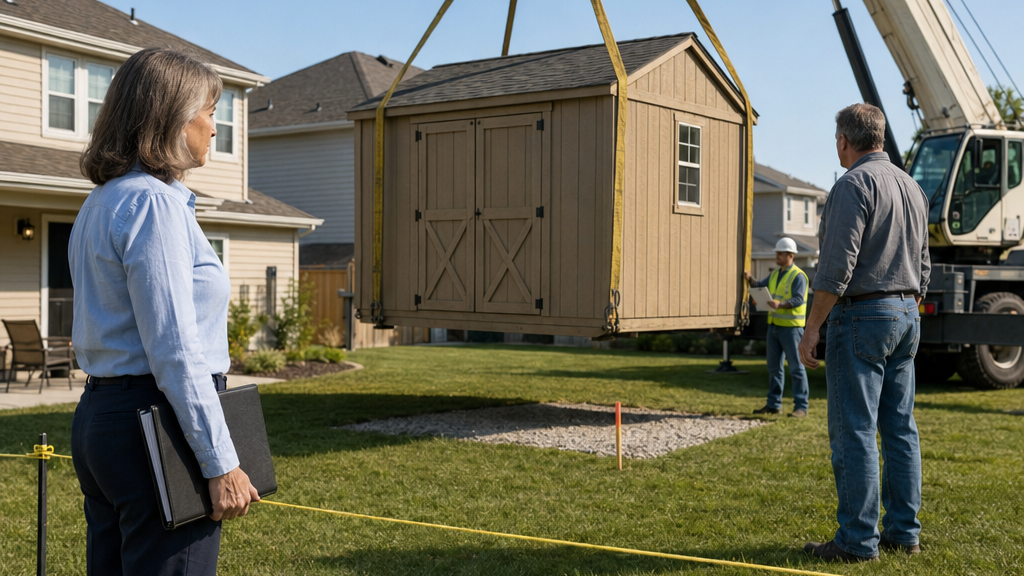
The crane began its slow swing toward Brian’s new pad.
That was when his back door opened.
Brian stepped onto the patio.
He wore jeans and an old gray shirt. His spouse stood briefly behind him, then disappeared back inside.
Brian walked to the edge of the marked work zone and stopped.
For several seconds he watched his shed hanging in the air.
Linda watched him watching it.
He looked older than he had during their first argument.
Not defeated.
Just tired.
The shed moved over the property line.
For an instant it hovered almost directly above the stake.
The image fixed itself in Linda’s mind: thousands of pounds of lumber and roofing suspended over one thin marker that everyone had ignored until it became expensive.
Brian glanced toward her.
Linda gave no smile.
No nod.
Nothing that could be mistaken for victory over him.
He looked back at the shed.
The crew rotated it slightly, guiding it toward the new pad.
One worker called for six inches to the right.
Another raised his palm.
The crane lowered.
The shed settled gradually until its weight transferred onto the prepared base entirely within Brian’s lot.
The straps slackened.
A worker crouched to check alignment.
“That’s down,” the foreman called.
Just like that, the part of the dispute everyone could see was over.
Linda turned toward the empty rectangle in her yard.
The damage looked worse without the shed covering it.
The grass was gone. The gravel pad had left a compacted scar. There were shallow impressions where equipment had worked during construction.
Carolyn came beside her.
“The restoration contractor is scheduled Thursday.”
Linda nodded.
“The board approved it?”
“Yes.”
“Fully?”
“According to the agreement.”
That phrase had become strangely comforting.
According to the agreement.
Not according to memory.
Not according to a friendly assumption.
Not according to a map someone thought was close enough.
The crew spent another hour removing temporary rigging and clearing equipment.
The neighbors gradually went inside.
Nobody applauded.
Nobody confronted Brian.
Linda was grateful for that too.
As the crane folded its boom, Brian approached her.
Carolyn remained several steps away.
For a moment neither neighbor spoke.
Brian looked at the bare patch.
“I guess it looks bigger without the shed.”
Linda followed his gaze.
“Yes.”
He rubbed the back of his neck.
“They got it down okay.”
“They did.”
“I thought the roof might twist.”
“So did I.”
Brian glanced toward his new pad.
“It’s actually straighter there.”
Linda almost smiled.
Almost.
He looked toward the survey stake.
“I should’ve had that done first.”
“Yes.”
No softness in the answer.
No cruelty either.
Brian accepted it.
After a moment he said, “I still think the HOA should’ve caught it.”
“They should have.”
“And I shouldn’t have said what I said when you came home.”
Linda waited.
He did not produce a formal apology.
Maybe he could not.
Maybe he was not ready.
She found that she no longer needed to drag one out of him.
“You knew the survey was right before you signed,” she said.
Brian looked at the ground.
“Yes.”
“And you left it there because it helped with the money fight.”
He looked back at her.
“Yes.”
That answer mattered more than an apology would have.
Linda nodded once.
“Don’t do that to me again.”
“I won’t.”
The crane truck rolled slowly toward the street.
Its engine faded as it passed the houses.
Brian started back toward his yard, then stopped.
“Linda.”
She looked at him.
He pointed to the pale rectangle where the shed had stood.
“Who’s replacing the grass?”
For a second she thought he was trying to reopen the argument.
Then she saw his expression.
It was not defiance.
It was a practical question.
Linda glanced at Carolyn.
Carolyn lifted the agreement slightly.
“Thursday. The restoration crew is handling removal of the remaining gravel, soil preparation, and sod.”
Brian nodded.
“Okay.”
He looked at the damaged lawn one more time.
“I’ll make sure they can get through my side if they need access.”
Then he walked away.
Linda remained beside the survey stake after the last work truck left.
The shed was gone.
The line was visible.
But the yard was not restored yet, and neither were the people living on either side of it.
For the first time, that did not feel like failure.
Chapter 7: The Line They Could Finally See
Fresh sod covered the rectangle where the shed had stood, but the yard still looked wrong.
Not damaged anymore.
Wrong.
The new grass was brighter than everything around it, a clean green patch laid over soil that had spent weeks buried beneath compacted gravel. Along one edge, the ground remained slightly lower where the restoration crew had removed the last of the stone.
Linda stood with her hands on her hips, looking at it.
The shed was now visible beyond the property line on Brian’s side, sitting squarely on its new base.
The survey stake still stood between them.
That was what caught her eye most.
A narrow wooden marker with bright flagging, ordinary enough that anyone passing through the yard might ignore it.
She no longer could.
Two days earlier, Carolyn had sent the notice for the next HOA meeting.
Boundary verification requirements for structures placed near property lines.
The wording was dry.
Linda read it three times anyway.
At the meeting, Janet Moore arrived early and placed a stack of revised forms on the table.
She looked different without the folder she had carried through every earlier discussion, as though removing the paperwork had taken away some of the certainty she used to wear.
Carolyn opened the meeting.
The proposed change was simple.
Any shed, detached structure, fence, patio extension, or other improvement within a defined distance of a side or rear boundary would require the homeowner to provide either visible verified survey markers or documentation from a licensed surveyor.
Association planning maps could still be used for landscaping review.
They could not be used to establish property ownership.
One board member asked about cost.
Another asked whether the requirement was excessive for small projects.
Janet answered before Carolyn did.
“No.”
Everyone looked at her.
She straightened the form in front of her.
“We thought our process was clear because we had used it for years without a formal dispute.”
Linda watched her.
Janet continued.
“That was not the same thing as the process being correct.”
There was no dramatic apology.
Linda had not expected one.
Janet’s voice remained controlled, almost administrative.
Still, the sentence mattered.
The board approved the revision.
When the meeting ended, Carolyn stopped Linda near the door.
“Your restoration sign-off is ready whenever you’re satisfied with the yard.”
“I’ll check it again this week.”
“Take your time.”
Linda glanced back toward Janet.
“She surprised me.”
Carolyn followed her gaze.
“I think she surprised herself.”
Outside, Linda found Brian waiting beside his truck.
For a second she thought he wanted to discuss the meeting.
Instead he said, “One of the markers is loose.”
Linda looked at him.
“What?”
“The rear one. The restoration crew must have bumped it.”
Her stomach tightened.
“Did they move it?”
“I don’t think so.”
“You don’t think?”
Brian held up both hands.
“I didn’t touch it.”
That detail would once have irritated her.
Now it almost made her smile.
They walked around the houses together.
The rear marker leaned slightly toward the new sod.
Brian stopped several feet away from it.
“See?”
Linda crouched.
The stake was loose at the surface, but the permanent metal marker Edward had referenced beneath it appeared undisturbed.
“I’m calling Edward before I reset anything.”
Brian nodded.
“Probably smart.”
He stayed where he was.
Linda looked up.
“You can go.”
“I know.”
He rubbed his jaw.
“I was going to offer to help.”
“With what?”
“Whatever he says needs doing.”
Linda stood.
“You don’t have to.”
“I know that too.”
There was no apology hidden inside the offer.
No attempt to make the previous weeks disappear.
That made it easier to accept.
“All right,” she said. “If he says it’s just the wooden witness stake, you can hold it straight.”
Brian nodded once.
“Okay.”
Edward confirmed by phone that the visible wooden stake could be reset as long as the underlying monument had not shifted.
Ten minutes later, Linda knelt beside the marker while Brian held it upright.
“A little toward you,” she said.
He adjusted it.
“Too much.”
He shifted it back.
“There.”
Linda pressed soil around the base.
Neither of them mentioned the first day she had searched the grass with a trowel for a marker she could not find.
Neither mentioned the crane.
Brian let go.
The stake remained upright.
“Looks good,” he said.
Linda brushed dirt from her hands.
For several seconds they stood side by side facing the line.
Brian spoke first.
“You putting a fence in?”
The question had been waiting for her.
She had three estimates inside her house.
One was for a six-foot privacy fence running nearly the entire side yard.
When the contractor had described it—solid panels, capped posts, full visual separation—Linda had felt immediate relief.
No uncertainty.
No Brian crossing over with a mower.
No borrowed corners.
No arguments about what anyone had meant.
Then she had pictured looking out her kitchen window at a wall built because one bad summer had convinced her she could never trust anyone again.
“I thought about it,” she said.
Brian waited.
“I’m not doing the tall one.”
He looked at her.
“What are you doing?”
“Low planting along most of the line. A few permanent markers where it turns.”
Brian nodded slowly.
“So we can still see each other.”
Linda glanced at him.
“That wasn’t the reason.”
A faint smile moved across his face.
“Didn’t think it was.”
She nearly smiled back.
Nearly.
The planting crew came the following week.
They installed a modest line of low shrubs beginning several feet behind the houses, leaving enough open space near the front that the yards still felt connected without appearing shared.
At the rear corner, Linda had a simple permanent marker set where Edward’s survey showed the turn.
Nothing decorative.
Nothing aggressive.
Just visible.
Brian stopped mowing at it.
The first time Linda noticed, she was standing at the kitchen sink.
His mower approached the new planting line, slowed, turned neatly inside his side, and moved away.
A small thing.
Years earlier she might not have noticed.
Now she did.
The fresh sod gradually lost its artificial brightness and began matching the older lawn around it.
The rectangle disappeared.
The shed remained on Brian’s side.
Some evenings Linda could hear him opening its doors, moving tools, closing them again.
They did not become friends.
Not the way people sometimes wanted stories like theirs to end.
Brian did not come over with a bottle of wine.
Linda did not invite him to dinner.
There was no conversation in which each confessed every mistake and promised to start over.
But he waved when she collected her mail.
She waved back.
When his landscaper once left a bag of clippings beside the shrubs, Brian moved it before Linda had to say anything.
And when Linda’s sprinkler threw water a few feet across the line one afternoon, she adjusted the head rather than deciding it was too small a thing to mention.
The difference was almost embarrassingly simple.
They stopped relying on what the other person would probably tolerate.
Late one afternoon, Linda walked to the rear of the yard and paused beside the permanent corner marker.
The grass had fully recovered.
From there she could see Brian’s shed, the low shrubs, both houses, and the narrow line between the properties.
For years she had thought a good neighbor was someone who made boundaries invisible.
Someone who did not complain.
Someone who moved over when necessary.
Someone who let small things go.
She understood now that invisible boundaries were easy to cross precisely because nobody had to admit they were crossing them.
The marker beside her was not hostile.
It did not accuse anyone.
It simply remained where it was supposed to be.
Linda looked toward Brian’s yard.
He was closing the shed doors.
He noticed her and raised one hand.
She raised hers.
Then she turned back toward the house, leaving the line behind her plainly visible.
The story has ended.