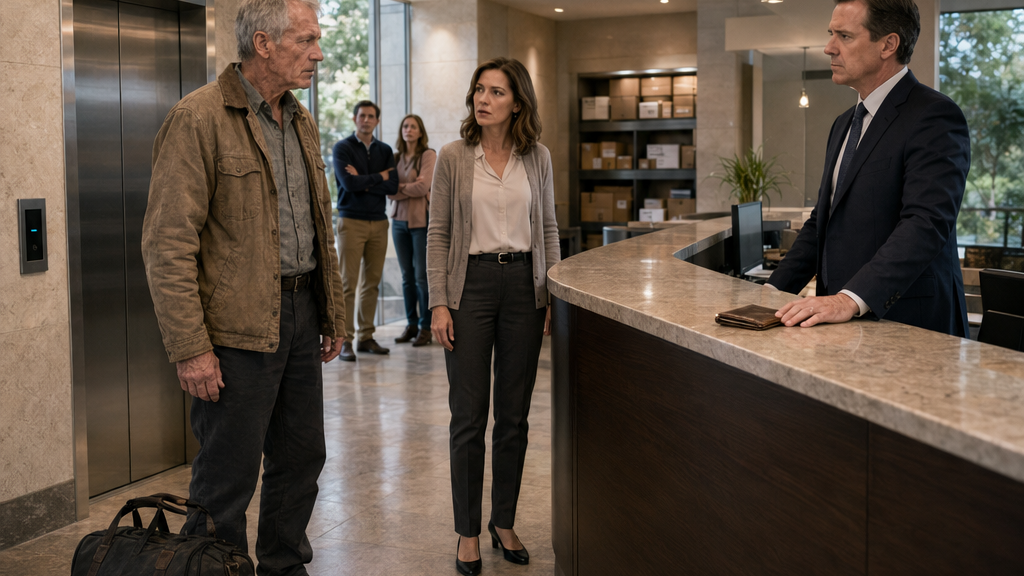
The HOA Manager Treated an Older Resident Like a Trespasser—Then One Missing Report Changed the Promotion Decision
Chapter 1: The Wallet Behind the Management Desk
“That’s mine.”
The older man pointed across the polished stone counter at a worn brown wallet lying beside Edward Nelson’s keyboard.
Edward did not touch it.
“Sir, I need you to step away from the resident elevator.”
Rachel Walker stopped halfway through the lobby doors.
The man standing at the management desk wore faded work pants, a wrinkled gray shirt, and an old canvas jacket despite the warm morning. A small overnight bag rested beside his shoes. His hair looked as if he had slept somewhere without a mirror.
Two residents waiting for packages had gone quiet.
The elevator behind him gave a soft electronic chime, but its doors stayed locked.
The man looked from Edward to the wallet.
“My driver’s license is in there.”
“And once we verify your identity, you can have it back.”
“How am I supposed to verify my identity when you’re holding my identification?”
Edward’s jaw tightened.
Rachel knew that expression. It meant he had already chosen a position and now considered changing it more dangerous than being wrong.
She set her bag behind the desk.
“What happened?”
Edward answered before the older man could.
“He tried a disabled fob at the resident elevator. Concierge didn’t recognize him. He said he lives here, but we have no confirmation yet.”
The older man looked at Rachel.
“I told him my name.”
Edward lowered his voice.
“And I’m checking it.”
Rachel glanced at the wallet. The leather was cracked at the fold and darker along the edges from years of handling.
“How did you get the wallet?”
“It was on the counter.”
“I put it there,” the man said. “I took it out to show him my license.”
Edward gave Rachel a pointed look.
“We had an unauthorized-entry complaint Friday. We’re supposed to verify people, not wave them through because they know a unit number.”
Rachel understood the policy. She had helped draft the reminder after a resident let a delivery driver follow her into the garage.
But the policy did not say anything about keeping someone’s wallet beyond arm’s reach.
She turned toward the man.
“What’s your name?”
“William Hill.”
“Unit?”
“Four-C.”
Rachel logged into the resident database.
Edward folded his arms.
“Anyone can read a directory.”
William said nothing.
That silence bothered Rachel more than anger would have. He stared at his wallet as though the room had shrunk until that was the only object in it.
Rachel typed HILL.
The record appeared immediately.
WILLIAM HILL — OWNER — UNIT 4C.
She clicked the profile.
Resident since eleven years earlier.
No lease expiration. No delinquent ownership status. No restriction on entry.
Rachel rotated the screen slightly toward Edward.
“He owns Four-C.”
Edward leaned closer.
“Photo?”
“The database doesn’t require resident photos.”
“Then we still need secondary verification.”
William let out a dry breath.
“My license.”
Rachel reached for the wallet.
Edward put his hand over it.
For one second, neither of them moved.
It was not a dramatic gesture. He did not slam the counter or raise his voice.
That made it worse.
Rachel looked at his hand.
“Edward.”
“We need to follow procedure.”
“Yes.”
She kept her voice level.
“And his identification is inside his property.”
The two residents by the package shelves were pretending not to watch.
Edward noticed them too.
Rachel could almost see the calculation behind his face: if he backed down now, everyone would remember that he had backed down.
She understood the fear because she carried a version of it herself.
But William had already been standing there long enough.
Rachel slid the wallet free.
She walked around the desk instead of tossing it across.
“Mr. Hill.”
She placed it in his hand.
His fingers closed around it quickly.
He opened it, checked the card slots, then pulled out his license and handed it to her.
Rachel compared the name and address.
Four-C.
“Thank you.”
William returned the license to the wallet.
Edward said, “His fob still came up inactive.”
Rachel turned back to the computer.
“That’s what I want to check.”
She opened access-control records and entered William’s unit.
The screen gave her an answer she had not expected.
STATUS: DISABLED.
Reason: UNIT TEMPORARILY UNINHABITABLE.
Rachel frowned.
“Your access was turned off intentionally.”
William’s eyes narrowed.
“I know it stopped working. Nobody told me they turned it off.”
“When was the last time you were in your unit?”
“Thursday.”
Edward spoke from behind the desk.
“If the unit’s uninhabitable, he shouldn’t be entering without clearance.”
William looked at him.
“I need my blood-pressure medication and some clean clothes. I’m not moving back in.”
Rachel clicked deeper into the record.
There was an emergency maintenance notation, then a plumbing claim number.
The overnight bag suddenly made sense.
“Mr. Hill, where are you staying?”
William hesitated.
It was the first question that made him look away.
“A hotel.”
“Which one?”
He named a budget hotel a few miles away.
Rachel saw Edward’s expression change, only slightly. Not regret. Recognition.
She filed that away.
“Were you placed there by the association?”
“That’s what I was told.”
William rubbed his thumb along the cracked edge of the wallet.
“The first two nights were handled. After that, the desk said the authorization hadn’t come through.”
“When did that happen?”
“Saturday.”
Today was Monday.
Rachel opened the plumbing claim.
A status banner read PENDING REVIEW.
She felt the familiar tightening behind her ribs—the sensation she got when a small resident problem turned out not to be small at all.
“Did anyone contact you over the weekend?”
“No.”
“Do you have somewhere to stay tonight?”
William looked down at his overnight bag.
“For now.”
The answer was too careful.
Rachel printed a temporary access authorization allowing escorted entry to Four-C.
“I’ll have security take you upstairs so you can get what you need. I’m also going to find out what happened with the hotel authorization.”
William accepted the paper.
“Thank you.”
Edward shifted beside her.
“We still need to log the access incident.”
Rachel looked at him.
“Yes. We do.”
His expression told her they did not mean the same thing by that sentence.
William started toward the elevator, then stopped.
He turned back, wallet still in his hand.
“One more thing.”
Rachel waited.
He glanced at Edward before looking at her.
“The hotel says they need the rest of the deposit today.”
“How much?”
“Four hundred dollars.”
Rachel stared at him.
William’s voice stayed steady.
“I was told management had already approved it.”
He slipped the wallet into his jacket pocket.
“So why didn’t the money ever arrive?”
Chapter 2: Four Hundred Dollars for One Night
The approval email was sitting in William Hill’s file.
Rachel read it twice.
Temporary lodging approved pending claim classification.
Sent Friday at 3:17 p.m.
Below it, the reimbursement portal still showed one word.
PENDING.
Rachel clicked through the workflow.
Board review pending.
Insurance classification pending.
Management authorization incomplete.
Three different labels for the same practical result: William had been told the hotel would be covered, and the hotel had not been paid.
She called the regional accounting line.
No answer.
She emailed the insurance adjuster.
Automatic reply.
Out of office until Tuesday.
The board treasurer returned her call but said he did not have authority to release emergency housing funds without confirmation that the failed pipe was a common element.
“The contractor hasn’t classified it yet,” Rachel said.
“Then we wait.”
“He may lose the room tonight.”
A pause.
“I understand. But if we pay before responsibility is determined, we create a precedent.”
Rachel looked through the glass wall of the management office.
William sat alone in the lobby, his overnight bag between his shoes.
Edward was helping another resident as though the morning confrontation had never happened.
Rachel lowered her voice.
“He was told it was approved.”
“Then whoever told him that spoke too soon.”
The call ended.
Rachel sat back.
This was the kind of problem she had always been good at fixing.
Not officially.
Practically.
She called the hotel.
The clerk confirmed that William’s room would be released at six if the remaining deposit was not paid.
“Can we guarantee it by company card?”
“Only if you send the authorization form.”
Rachel opened the company card procedure.
Emergency lodging required either regional approval or written HOA officer authorization.
She had neither.
At four-thirty, William stepped into the office doorway.
“I can go somewhere else.”
Rachel looked up.
“Where?”
He shrugged.
“A cheaper place.”
“Do you have one?”
“No.”
He said it without self-pity, which somehow made it land harder.
Rachel closed the policy document.
“Give me ten minutes.”
He frowned.
“For what?”
“Ten minutes.”
At 4:52, Rachel stood across the front desk of the hotel with her personal debit card in her hand.
William stared at it.
“No.”
“It’s a deposit, not a gift.”
“No.”
“You need the room.”
“And you work for the people who are supposed to be paying for it.”
“That’s exactly why I’m doing this.”
William’s expression sharpened.
“No. That’s exactly why you shouldn’t.”
The clerk looked down at the computer, politely disappearing into the screen.
Rachel understood what he meant.
If she paid, the emergency would disappear for the night.
The file would still say pending, but William would no longer be standing in front of anyone demanding an answer.
She knew that.
She slid the card across anyway.
“Charge four hundred.”
William shook his head.
“You’re making this too easy for them.”
“I’m making sure you have a room.”
“They aren’t the same thing.”
The payment went through.
The clerk printed the receipt.
Rachel handed it to William.
He held it for a moment, then folded it twice and tucked it into the brown wallet.
“You keep receipts like that?” Rachel asked.
“I keep every receipt.”
His mouth moved almost into a smile.
“Old habit.”
Rachel smiled back, but the discomfort remained.
William put the wallet away.
“I’ll pay you back.”
“You don’t need to worry about that tonight.”
“I didn’t say tonight.”
Upstairs, the elevator doors opened and released a family carrying pool bags. Rachel stepped aside.
William remained where he was.
“Did you write down what happened this morning?”
Rachel’s hand tightened around the strap of her work bag.
“I started the incident report.”
“Started.”
“I’ll finish it.”
He nodded once.
Not accusation. Not gratitude either.
Just acknowledgment.
Rachel drove back to the condominium as evening traffic thickened.
Edward was still in the office.
A printed incident form sat on her chair.
“You went to the hotel?” he asked.
“Yes.”
“Company card?”
“No.”
He looked up sharply.
“Rachel.”
“I used mine.”
“That was a mistake.”
“He was about to lose the room.”
“I’m not saying he should sleep outside. I’m saying you just turned a disputed association expense into a personal arrangement.”
“It’s temporary.”
“That’s what every exception is called.”
She placed her bag down.
Edward’s tie was loosened now. Without the polished morning posture, he looked more tired than arrogant.
“We had a fraudulent relocation claim three months ago,” he said. “You remember what the board did to us over that.”
“I remember.”
“They want controls.”
“Controls aren’t the same as holding a man’s wallet.”
Edward’s face hardened.
“I did not steal his wallet.”
“I didn’t say you did.”
“You’re implying it.”
“No. I’m saying once he told you his ID was inside it, you could have handed it back.”
“He could have walked.”
“With his own wallet.”
Edward exhaled through his nose.
“Fine. I could have handled that part differently.”
It was the closest he had come to admitting fault.
Rachel waited.
“But the report needs to describe what actually happened, not turn this into some morality play.”
He tapped the form.
She looked down.
The first section had already been filled in.
Unauthorized access attempt.
Identity verification.
Resident status confirmed.
Access restored under escort.
The language was clean.
Professional.
Almost bloodless.
“What do you want me to write?” she asked.
“Routine verification misunderstanding.”
Rachel looked at him.
“That’s what you think happened?”
“I think a disabled credential triggered verification, the resident was confirmed, and the issue was resolved.”
“The issue wasn’t resolved.”
“The access issue was.”
Rachel thought about William folding the hotel receipt and pushing it into the wallet that had been kept from him that morning.
Edward stood.
“Donna reviews incident volume before she comes onsite. The board reviews it too. There’s no reason to inflate this.”
Rachel picked up the form.
At the bottom was a blank line for her signature.
Edward put on his jacket.
“Just keep it factual.”
Then he left her alone with the report and the sentence he wanted her to use.
Routine verification misunderstanding.
Rachel read it again.
For the first time all day, four hundred dollars felt like the easiest part of the problem.
Chapter 3: The Report Rachel Did Not Finish
Donna Adams announced the promotion interviews at 8:06 Tuesday morning.
Rachel had not yet signed the incident report.
The regional supervisor appeared on a video call from the company’s downtown office, framed by a gray wall and a glass door behind her.
“I’ll be onsite Friday,” Donna said. “The board wants the permanent community-manager decision made before month-end.”
Edward sat across from Rachel at the conference table.
Neither of them moved.
Donna continued.
“You are both finalists.”
Rachel felt a quick, involuntary lift in her chest.
She had spent six years in property management, four at this building. She knew which residents needed phone calls instead of emails, which vendors showed up when they said they would, which board members needed numbers before opinions.
She wanted the job.
Not as a consolation prize for being helpful.
She wanted the authority to run the building well.
Donna smiled slightly.
“Try not to make this awkward for the next three days.”
Edward gave a short laugh.
Rachel managed one too.
After the call ended, Edward closed his laptop.
“Congratulations.”
“You too.”
He stood.
“Finish the incident report today. Donna will probably pull the weekly log.”
Rachel looked at the paper beside her notebook.
“Right.”
Edward left.
The room suddenly felt much quieter.
Rachel returned to her desk and opened the electronic form.
She had written a fuller version the night before.
Resident stated wallet containing identification was being withheld during verification.
Management confirmed ownership and returned property.
She read the first sentence four times.
It was accurate.
It was also the sentence most likely to turn an uncomfortable interaction into a formal conduct issue.
Rachel highlighted it.
Her finger hovered over the keyboard.
She remembered another manager from years earlier—a careful woman who had challenged a board over repeated vendor exceptions. She had been right on the facts and terrible at surviving the politics. Within six months she was gone.
Rachel had told herself she had learned something useful from watching that happen.
Pick the fights that change something.
Do not burn authority on wording.
Keep the building moving.
She deleted the sentence.
In its place she typed:
Resident identification was verified following an access-control concern.
She leaned back.
Nothing in it was false.
That was the problem.
A knock sounded against her open door.
The front-desk concierge held up a yellow message slip.
“William Hill called.”
Rachel took it.
“He wants a copy of yesterday’s incident report when it’s complete.”
Her stomach tightened.
“Did he say why?”
“No.”
Rachel folded the slip once.
“Thanks.”
The concierge left.
Rachel looked back at the screen.
Resident identification was verified following an access-control concern.
If William read it, he would know immediately what was missing.
She finished the remaining fields anyway.
Resident confirmed.
Temporary escorted access issued.
No injury.
No property loss reported.
Resolved.
Her cursor stopped over the final checkbox.
Resolved.
William still did not have reimbursement.
His unit still showed uninhabitable.
The hotel deposit was still on Rachel’s personal card.
She changed the field to Follow-up required.
It felt like a compromise.
She signed electronically.
For ten minutes, she felt relieved.
Then she opened William’s housing file.
If she could fix the underlying reimbursement issue before he received the report, perhaps the report itself would matter less.
The thought arrived so naturally that Rachel did not recognize it as avoidance until much later.
She started with the plumbing claim.
The emergency notation said water intrusion discovered Thursday.
But below it was an attached maintenance email with an earlier date.
Twelve days earlier.
Rachel opened it.
Resident reports recurring moisture behind bathroom wall. Baseboard swelling. Requests inspection.
She frowned.
The inspection note beneath it was three days later.
Possible supply-line leak. Recommend access behind wall.
Then another note.
Owner unavailable during proposed vendor window.
Rachel remembered William mentioning a medical appointment.
The next inspection had been postponed again because maintenance needed board authorization to open part of the shared service wall.
What had looked like a sudden Thursday emergency had actually been developing for nearly two weeks.
Rachel began arranging the records chronologically.
First complaint.
Inspection.
Board authorization request.
Delay.
Second moisture report.
Vendor scheduling.
Pipe failure.
Unit deemed temporarily uninhabitable.
Hotel placement.
Then nothing clear.
She called the plumber.
He was on another job but remembered Four-C.
“That line wasn’t inside his unit only,” he said.
“What do you mean?”
“It runs the stack.”
Rachel straightened.
“The common stack?”
“I’d have to look at the drawings before I put that in writing.”
“Can you meet me there tomorrow?”
A pause.
“Morning.”
“Please.”
She hung up.
Edward appeared at her doorway.
“You submitted the report?”
“Yes.”
He nodded.
“Good.”
Rachel watched him.
“Did you know Four-C had an open plumbing issue before yesterday?”
His face changed by less than a second.
Enough.
“I knew there was a claim.”
“You knew William Hill was the resident?”
“I see dozens of unit numbers every week.”
“That wasn’t my question.”
Edward stepped into the office.
“What are you looking for?”
“I’m trying to understand why his hotel approval never finished.”
“Because responsibility isn’t classified.”
“And why wasn’t it classified?”
“Ask maintenance.”
“I am.”
He gave her a tired look.
“Rachel, do not turn one ugly lobby interaction into an investigation of every delay attached to that unit.”
“It may be the same problem.”
“It may also be exactly what it looks like: a disputed pipe, a delayed reimbursement, and a man whose fob was disabled because his unit wasn’t cleared for occupancy.”
Rachel said nothing.
Edward glanced at her screen.
“You changed the report to follow-up required.”
“Yes.”
“Fine. Follow up.”
He left.
Rachel stared at the open file.
Near the bottom was the earliest emergency message, timestamped twelve days before William stood in the lobby asking for his own wallet.
She clicked it open.
The message had been forwarded twice.
Once to maintenance.
Once to management.
Rachel read the recipient line again.
Edward Nelson.
For twelve days, the problem had not been invisible.
Someone had seen it.
And tomorrow morning, Rachel intended to find out what they had decided not to see.
Chapter 4: The Leak Was Never Just His Problem
“You can stop calling it his pipe.”
The plumber’s voice came from inside the open wall of Unit 4C.
Rachel stood in William Hill’s bathroom doorway while the plumber aimed a flashlight through the narrow opening where damp drywall had been removed.
“What should I call it?” she asked.
“The vertical supply line.”
“The building line?”
He shifted the flashlight higher.
“It feeds more than this unit. I want to check the plans before I write anything formal, but this isn’t a little branch line serving one sink.”
Rachel looked at the exposed copper disappearing through the ceiling.
For nearly two weeks, every message in William’s file had been written as though the problem belonged neatly inside the boundaries of Four-C.
Owner leak.
Owner access.
Owner remediation pending.
The words had shaped the response before anyone settled the facts.
The plumber stepped backward.
“See that coupling?”
Rachel leaned closer.
Dark staining ran beneath it.
“That’s where it failed?”
“Part of it. But the corrosion isn’t new.”
“How old?”
“I’m not dating pipe from a flashlight.”
He lowered his arm.
“But I wouldn’t write that this started Thursday.”
William stood in the bedroom doorway holding two folded shirts against his chest.
He had come with Rachel to collect medication, clothes, and a few documents. His overnight bag sat open on the bed.
“So I wasn’t imagining it twelve days ago,” he said.
“No,” the plumber replied.
William nodded once.
He did not look satisfied.
Rachel understood why.
Being proved right about water inside your walls was not much of a victory.
She followed the plumber into the service corridor, where he removed a utility panel and traced the line vertically.
“It serves at least this stack,” he said. “Possibly the unit above and below depending on how they split it.”
“So common infrastructure.”
“Probably.”
“Probably enough for emergency lodging?”
“That’s not my decision.”
“Is it enough for you to put in writing?”
He gave her a look.
“After I see the plans.”
Rachel checked the time.
“When?”
“By this afternoon.”
It was the clearest answer she had received since Monday.
When she returned to Four-C, William was seated on the edge of his bed.
His brown wallet lay beside him.
The hotel receipt Rachel had paid for was sticking slightly from the fold.
He noticed her looking and pushed it deeper inside.
“I told you I keep receipts.”
“I remember.”
He slid the wallet into his jacket.
“Did he say whose pipe it is?”
“He said it appears to serve multiple units.”
William looked around the room.
A section of baseboard had been removed. Towels were stuffed against the bathroom threshold. An industrial fan sat silent in the corner because the drying company had taken the equipment back after the initial emergency period.
“So what happens now?”
“I’m going to reconstruct the approval timeline.”
“You mean figure out who was supposed to do something.”
Rachel met his eyes.
“Yes.”
He stood.
“Then don’t start with Monday.”
“I’m not.”
That landed harder than she expected.
Back in the management office, Rachel opened the archived board correspondence.
The first several messages were routine.
Vendor scheduling.
Access permission.
Request for photographs.
Then she found a thread dated the day before the pipe failure.
The board treasurer had asked whether temporary lodging would be reimbursable before responsibility was determined.
Edward had replied that management could authorize short-term emergency placement, but continuation beyond forty-eight hours might create an expectation of association responsibility.
The board president answered twenty minutes later.
Hold further reimbursement until classification. We cannot establish precedent before insurance weighs in.
Rachel read the sentence twice.
It did not say leave William without lodging.
It did not say deny the claim.
But it explained why everyone had stopped moving.
Nobody wanted to be the person whose decision became the example cited by the next resident.
Rachel opened William’s emergency placement record.
The first two hotel nights had been booked immediately after the unit was declared uninhabitable.
The third night required extension.
That request had reached Edward Friday afternoon.
He had forwarded it to the treasurer.
No answer came before the office closed.
Rachel searched for a follow-up from Edward.
There wasn’t one.
At noon, the plumber emailed his written assessment.
Rachel opened the attachment.
The failed section was part of a shared vertical supply system and not an exclusive fixture line serving Unit 4C.
She let out a slow breath.
It did not settle insurance liability. It did not automatically settle every reimbursement question.
But it destroyed the simplest version of the dispute.
William had not been displaced by a problem that was plainly his alone.
Rachel forwarded the assessment to Donna, the treasurer, and the insurance adjuster.
Then she hesitated over Edward’s name.
He was sitting fifteen feet away.
She added him.
Within two minutes, his chair rolled back.
He appeared in her doorway.
“You sent this to Donna?”
“Yes.”
“Before the board reviewed it?”
“It’s a vendor assessment.”
“It’s preliminary.”
“He put it in writing.”
Edward stepped inside and shut the door halfway.
“You’re escalating everything now.”
“I’m updating the file.”
“You copied regional.”
“Regional should know why the reimbursement stalled.”
Edward looked at her screen.
“Do you think I made the pipe fail?”
“No.”
“Do you think I wrote the board’s reimbursement directive?”
“No.”
“Then what exactly are you trying to prove?”
Rachel turned toward him.
“That we treated three separate things like they were one.”
He frowned.
“The plumbing classification, William’s hotel, and what happened in the lobby.”
“They are connected.”
“Only because you’re connecting them.”
“He was standing in that lobby with an overnight bag because this file stalled.”
“He was standing in the lobby because his fob was disabled.”
“Because his unit was marked uninhabitable.”
“Correct.”
“And you knew Four-C had an open displacement claim.”
Edward’s expression changed.
Rachel continued before she lost momentum.
“The email from twelve days ago went to you.”
“I receive hundreds of emails.”
“The hotel extension request went to you Friday.”
“And I sent it to the treasurer.”
“Then Monday morning, when William said Four-C, you knew that unit number meant something.”
Edward looked toward the glass wall.
Outside, the concierge was sorting packages.
“Keep your voice down.”
Rachel almost laughed.
Not because anything was funny.
Because that sentence captured too much.
“I’m not raising my voice.”
“No, you’re constructing intent.”
“I’m asking what you knew.”
Edward put both hands on the back of the empty chair across from her desk.
“I knew Four-C had a plumbing claim.”
“When?”
“When he said the unit number.”
“In the lobby?”
“Yes.”
“And you still kept his wallet.”
“I was verifying him.”
“You had a resident record.”
“I had a name and unit number from a man with a disabled credential.”
“And an ID inside the wallet.”
Edward’s face flushed.
“You keep saying that as though I confiscated his passport.”
“You kept his property after he asked for it back.”
“For minutes.”
“Minutes matter when you’re the one being told you don’t belong.”
Edward stared at her.
Then some of the anger left his face.
What remained looked closer to exhaustion.
“You want the truth?”
“Yes.”
“I recognized the unit.”
Rachel said nothing.
“I remembered the hotel issue. I remembered the fraud discussion. I remembered the board chewing us apart three months ago because staff approved expenses before verification.”
“So you knew he might be legitimate.”
“I knew he might be.”
“And you kept pushing.”
Edward’s grip tightened on the chair.
“There were people watching.”
Rachel thought of the two residents by the package shelves.
“That’s your explanation?”
“It’s part of it.”
He looked embarrassed now, which was almost worse than defensiveness.
“I had already told him to step away from the elevator. I had already said we needed verification. If I suddenly handed everything over because he challenged me, what does that tell everyone standing there?”
“That you got new information.”
“That staff decisions change if someone argues hard enough.”
Rachel stared at him.
Edward looked toward the lobby.
“You think authority is just being right. It isn’t. Sometimes it’s not looking uncertain while you’re responsible for a building full of people.”
Rachel felt anger rise, but it tangled with recognition.
She knew the fear beneath his words.
She had felt a quieter version of it every time she softened a report or solved something privately before a board member could complain.
“You were more worried about looking wrong than being wrong,” she said.
Edward’s jaw tightened again.
“Maybe.”
The admission hung between them.
Then he added, “And you’re more worried about looking kind than admitting your fixes create their own problems.”
Rachel went still.
Edward released the chair.
“Donna’s here Friday. You want to turn this into a leadership test? Fine.”
He opened the door.
“But don’t pretend I’m the only person in this office who’s been protecting the way things look.”
He walked out.
Rachel stayed at her desk with the plumber’s report open on one screen and her own sanitized incident report on the other.
For the first time, she could see both failures at once.
One had happened in the lobby.
The other was sitting under her electronic signature.
Chapter 5: The Reason Edward Would Not Back Down
Edward laid a three-page board directive on the conference table Thursday morning.
“Read the second paragraph.”
Rachel did not sit.
The document was dated three months earlier, after a relocation claim that had turned into weeks of argument between the board, management, and an insurer.
She read the highlighted section.
Emergency access and temporary-housing requests must be independently verified before extensions, reimbursements, or credential changes are approved. Staff are instructed to avoid discretionary exceptions without written authorization.
Rachel looked up.
“This doesn’t say keep somebody’s wallet.”
“I know.”
“It doesn’t say refuse ID that would verify them.”
“I know that too.”
Edward pulled out a chair.
“Sit down.”
Rachel remained standing for another second, then sat across from him.
He had brought the directive, the incident report, and a copy of William’s reimbursement record.
They looked less like evidence than pieces from the same machine.
“The fraudulent claim wasn’t theoretical,” Edward said. “A renter said a leak displaced her. Staff approved ten hotel nights. Turned out the leak was from her own washing machine, and half the receipts weren’t hers.”
“I remember.”
“You remember the result. I was the one in the board meeting.”
Rachel did remember that part.
Edward had come back afterward pale and furious. The board had accused management of being careless with association money and weak on resident verification.
“They threatened the contract,” he said.
“They threaten the contract every budget season.”
“Not like that.”
Rachel said nothing.
Edward tapped the directive.
“I tightened things because they told us to tighten things.”
“And then William happened.”
“Yes.”
The bluntness surprised her.
Edward leaned back.
“I handled him badly.”
Rachel waited.
“I should have given back the wallet. I should have pulled him away from the lobby instead of making him stand there. And once Four-C clicked in my head, I should have slowed down.”
It was more than he had admitted before.
“But,” he said, “you keep treating your part like it was clean.”
Rachel’s shoulders stiffened.
“I never said that.”
“You paid his hotel deposit.”
“Yes.”
“With your personal debit card.”
“Yes.”
“Did you tell Donna?”
“Not yet.”
“The board?”
“No.”
“Did you file an emergency authorization failure?”
Rachel looked at the table.
“No.”
Edward nodded.
“So regional still saw a pending reimbursement file, not a resident who was hours from losing lodging.”
“I was going to fix it.”
“When?”
“When I had the classification.”
“Exactly.”
Rachel looked up sharply.
Edward’s voice stayed calm.
“You did the same thing I did in a different direction. I protected the building from a visible problem.”
“I made sure he had a room.”
“And because you did, nobody above us had to confront the fact that the process had failed.”
The words struck because they were true.
Rachel thought of William at the hotel desk.
You’re making this too easy for them.
She had heard it as pride then.
Now it sounded like diagnosis.
Edward slid the incident report toward her.
“And this.”
Her abbreviated language stared back at her.
Resident identification was verified following an access-control concern.
“You wrote that,” Edward said.
“Yes.”
“You could have written that I held his wallet.”
Rachel did not answer.
“You could have written that he asked for it back.”
“I know.”
“But you didn’t.”
“No.”
“Why?”
The answer was sitting in the room with them: Friday’s interview, years of work, board politics, the memory of watching another manager become professionally expendable after being too correct too publicly.
Rachel folded her hands.
“I thought I could fix the underlying problem without turning Monday into a personnel fight.”
Edward gave a small, humorless smile.
“That sounds familiar.”
She disliked him for being right.
Worse, she disliked herself for needing him to say it.
Edward reached into his folder and removed a single-page statement.
“I drafted something.”
Rachel read the first lines.
Joint clarification regarding resident access incident.
The document acknowledged delayed verification, communication errors, and unauthorized personal payment of temporary lodging expenses.
It described both problems as well-intentioned procedural deviations with no lasting resident harm.
Rachel stopped.
“No lasting harm?”
“He got his wallet. He got the room.”
“His unit is still damaged.”
“That’s the plumbing claim, not Monday’s incident.”
“You’re splitting things apart again.”
“And you’re combining them because it strengthens your case.”
“My case?”
“You copied Donna yesterday.”
“Because the pipe assessment changed the reimbursement issue.”
“And Friday we’re competing for the same job.”
Rachel pushed the paper back.
“If you think that’s why I did it, why ask me to sign this?”
“Because this keeps the focus where it belongs.”
“Where you want it.”
“Where neither of us gets destroyed over mistakes we’ve already corrected.”
Rachel looked at him.
“You think we corrected them?”
“We’re correcting them.”
“William still hasn’t been reimbursed.”
“The classification went out yesterday.”
“And the incident report still doesn’t say what happened.”
Edward tapped the joint statement.
“This does.”
“No. It says no lasting harm.”
“That’s not the same as saying no mistake.”
“It minimizes it.”
“So did your report.”
The room fell silent.
Rachel stared at her own signature near the bottom of the old form.
Edward softened his voice.
“Look, I know what you think of me right now.”
“I’m not sure I know what I think.”
“Good.”
He folded his hands.
“Because I’m not asking you to lie.”
Rachel looked at the joint statement again.
That was what made it difficult.
Almost every sentence was technically defensible.
The security directive existed.
Her personal payment had bypassed procedure.
William had recovered his wallet.
No one had been physically harmed.
The plumbing responsibility was still undergoing formal insurance review.
A person could sign the document and tell herself she had told the truth.
Rachel knew because she had already done something similar.
She stood.
“I’m not signing it.”
Edward’s face closed.
“Why?”
“Because it makes our mistakes sound symmetrical.”
“They are.”
“No.”
She gathered her copy of the incident report.
“You got new information and doubled down because people were watching. I got new information and tried to solve it quietly because I didn’t want people watching.”
Edward stared at her.
“Both were wrong. They weren’t the same.”
“And your solution is what? Walk into Friday’s interview and confess everything?”
Rachel did not answer.
He saw enough in her face.
“Rachel.”
She opened the conference-room door.
“You understand Donna may decide neither of us should manage this property.”
“Yes.”
“You could lose the job.”
“Yes.”
“And for what? William isn’t asking for anyone’s head.”
“This isn’t about what punishment he wants.”
Edward looked down at the unsigned statement.
“Then what is it about?”
Rachel thought of the wallet behind the desk.
Then the hotel receipt inside it.
Then her own careful sentence that told no outright lie and still hid what mattered.
“I’m trying to figure that out.”
Back at her desk, she opened Monday’s incident report.
She read every line.
The document was clean enough to survive review.
That no longer reassured her.
At the bottom, beneath her electronic signature, was an option she had ignored the first time.
Submit corrected report.
Rachel moved the cursor over it.
Friday’s interview was less than twenty-four hours away.
She did not click.
Not yet.
But for the first time, she stopped asking whether correcting the report would cost her the promotion.
She started asking what it would mean if she got the promotion without correcting it.
Chapter 6: The Interview Became an Incident Review
William Hill’s reimbursement file was already on the conference table when Rachel walked in Friday morning.
Her interview folder suddenly felt ridiculous in her hand.
Donna Adams sat at the far end of the table beside the HOA board president and treasurer. Edward occupied a chair on the opposite side.
And William sat near the window.
He wore the same canvas jacket he had worn Monday, though the shirt beneath it was clean and neatly pressed.
His brown wallet rested in his jacket pocket.
Rachel could see the worn top edge.
Donna pointed to the empty chair.
“Rachel. Have a seat.”
Rachel sat.
No one mentioned the promotion.
Donna folded her hands.
“I came here expecting two management interviews and a routine discussion of one resident-access incident.”
Her eyes moved between Rachel and Edward.
“That is no longer what this meeting is.”
Edward’s expression was controlled.
Rachel’s corrected report was inside her folder.
Unsigned in print, but electronically completed on her laptop forty minutes earlier.
All she had to do was submit it.
Donna continued.
“The plumbing assessment indicates the failed line serves common infrastructure. Insurance is still reviewing allocation, but the association has authorized Mr. Hill’s temporary housing reimbursement while that continues.”
William gave a small nod.
The board treasurer looked uncomfortable.
Donna glanced at him before returning to Rachel and Edward.
“That resolves one immediate issue. It does not resolve how we got here.”
Edward spoke first.
“I’ve prepared a chronology.”
“So have I,” Donna said.
That stopped him.
She opened a file.
“Monday morning, Mr. Hill attempted access with a disabled credential. His identity was verified. He was issued escorted access. The incident report characterizes it as an access-control concern.”
Rachel felt heat rise beneath her collar.
Donna looked at her.
“You submitted that report.”
“Yes.”
“Is it complete?”
There it was.
Rachel could answer the question narrowly.
The report contained facts.
No fabricated event.
No invented statement.
She opened her folder.
“No.”
Edward turned toward her.
Donna’s expression did not change.
“What is missing?”
Rachel removed the corrected report.
“Before we do that, I need to give you this.”
She slid it across the table.
Her signature was at the bottom.
Donna did not pick it up immediately.
“What is it?”
“A corrected incident report.”
The board president leaned forward.
Edward went still.
Rachel continued because stopping now would make every word harder.
“The first report omitted that Edward retained Mr. Hill’s wallet during verification after Mr. Hill asked for it back and explained that his identification was inside.”
Donna looked at Edward.
He said nothing.
Rachel forced herself to continue.
“It also did not explain that Edward recognized Four-C as a unit with an open displacement issue during the interaction.”
Edward’s chair shifted.
“That part is disputed.”
Rachel looked at him.
“You told me Wednesday you recognized the unit.”
“I said it became familiar.”
“You said you remembered the hotel issue.”
Donna raised one hand.
“I’ll speak to both of you separately if necessary. Rachel, finish.”
Rachel swallowed.
“My original report also failed to document the severity of the unresolved lodging problem.”
William watched her without expression.
“I knew by Monday afternoon that Mr. Hill might lose his hotel room because the authorization process had stalled.”
Donna’s eyes narrowed slightly.
“And what did you do?”
Rachel felt the board members watching her.
“I paid the four-hundred-dollar deposit myself.”
The treasurer sat back.
Donna stared at her.
“With company funds?”
“No. Personal funds.”
“Was that reported?”
“No.”
“Why not?”
Rachel looked at William.
He did not rescue her.
Good.
She turned back to Donna.
“Because I thought I could solve the immediate problem and sort out the paperwork afterward.”
Donna’s voice remained even.
“You bypassed procedure.”
“Yes.”
“You also prevented the failed authorization from becoming visible to regional management.”
“Yes.”
The word hurt more because nobody had forced it from her.
Edward looked at the table.
Donna picked up the corrected report.
“You understand this raises concerns about both judgment and reporting.”
“I do.”
“And you chose to submit this immediately before a promotion interview.”
“Yes.”
“Why?”
Rachel had imagined answers Thursday night.
Leadership.
Transparency.
Resident trust.
They all sounded polished in her head.
In the room, she could only tell the truth.
“Because I realized my first report was written to make the problem easier to manage.”
Donna waited.
Rachel continued.
“Not more accurate. Easier.”
William’s eyes dropped briefly.
Rachel looked toward him.
“I thought helping him privately made up for not escalating publicly.”
William spoke for the first time.
“It helped me that night.”
Rachel nodded.
“I know.”
“It did.”
His voice was quiet.
“But it didn’t fix the reason I needed you.”
The room held still.
Rachel felt the statement settle deeper than any accusation could have.
Donna turned to Edward.
“Do you dispute retaining the wallet?”
“No.”
“Do you believe that complied with policy?”
Edward inhaled slowly.
“No.”
“Why did you do it?”
He glanced once toward Rachel, then toward William.
“We’d been instructed to tighten verification after a fraudulent displacement claim.”
“That explains verification.”
“Yes.”
“Not the wallet.”
“No.”
Edward rubbed his thumb against the edge of his folder.
“I made the wrong call.”
Donna waited.
He looked toward William.
“And once I realized Four-C was familiar, I should have changed course.”
William’s face remained neutral.
“Why didn’t you?” Donna asked.
Edward answered after several seconds.
“Because I had already challenged him in front of residents.”
The board president frowned.
Edward continued.
“I thought reversing myself would make staff look weak.”
Donna leaned back.
“So you understood the possibility that he was a legitimate resident and continued because of appearances.”
Edward’s jaw tightened.
“Yes.”
No one spoke for a moment.
Rachel had expected satisfaction.
Instead, she felt tired.
The plumber’s report, the emails, the wallet, the hotel authorization—none of them had produced a clean villain and a clean hero.
They had produced people protecting different things until William became the cost.
Donna closed the file.
“Mr. Hill, I want to be clear. The management company will conduct an employment review separately. The board will address the reimbursement procedure separately. You do not need to recommend a personnel outcome.”
William nodded.
“I wasn’t planning to.”
The treasurer seemed surprised.
“You don’t want action taken?”
“I want action taken.”
William rested both hands on the table.
“I just don’t know why everyone keeps assuming action means somebody has to be publicly ruined.”
Edward looked at him.
William met his eyes.
“What happened Monday was wrong.”
“Yes,” Edward said.
“You made me prove I belonged here while holding the thing I needed to prove it.”
Edward lowered his gaze.
William turned toward Rachel.
“And you helped me.”
Rachel said nothing.
“You got me a room. You got me upstairs. You started looking at the pipe.”
His voice remained calm.
“But you also wrote a report that made Monday sound cleaner than it was.”
“Yes.”
William nodded.
“That hurt differently.”
The sentence was not sharp.
Rachel wished it had been.
She looked down at her hands.
“I’m sorry.”
“I know.”
William reached into his jacket.
For an instant Rachel thought he might take out the wallet.
He did not.
His hand rested against the pocket instead.
“I’ve lived here eleven years. I know most of the staff. I know residents complain. I know people sneak guests into the pool and prop doors and blame management when something happens.”
The board president shifted.
William looked at him.
“I’m not asking you to get rid of verification.”
Donna leaned forward slightly.
“Then what are you asking for?”
William thought for a moment.
“A way to verify somebody who’s displaced without treating them like they stopped being a resident.”
The treasurer said, “We can review the access policy.”
“Not just access.”
William looked around the table.
“My fob was disabled because my unit was uninhabitable. Fine. But nobody gave me another credential. Nobody told the front desk what to do if I came back for medication. Nobody made sure hotel approval followed the same file.”
Rachel could see the pattern now.
Each step had its own procedure.
None of the procedures had been designed around the person moving between them.
William continued.
“If you shut off somebody’s access because you told them they can’t safely live in their home, then management should know how that person comes back in.”
The board president nodded slowly.
“That seems reasonable.”
William looked toward Edward.
“And if somebody says their identification is inside the wallet on your desk, maybe the procedure shouldn’t require them to prove who they are before they can touch their own property.”
Edward did not defend himself.
Donna wrote something down.
Rachel felt the tension in the room shift.
Not disappear.
Change direction.
The meeting was no longer about whether Monday had happened.
It was about what Monday meant.
Donna looked at Rachel.
“The corrected report will be entered into the incident record. Your original report will remain attached to show the revision history.”
Rachel nodded.
“That’s appropriate.”
“The personal payment will also be documented.”
“Yes.”
“And your promotion interview is postponed.”
Her stomach tightened despite everything.
“For how long?”
“Until the incident review is complete.”
Rachel nodded again.
Edward asked, “Mine too?”
Donna looked at him.
“Yes.”
The answer gave Rachel no relief.
She had not submitted the report to win by making Edward lose.
Donna gathered the papers.
“We’ll meet again once regional completes its review.”
The board president began discussing temporary reimbursement authorization with the treasurer.
Chairs shifted.
The formal meeting seemed finished.
William remained seated.
Rachel waited until the others began standing.
Then William looked at the board president.
“There’s one thing I want written down before everybody leaves.”
The room quieted again.
William finally removed the brown wallet from his pocket.
He placed it on the table between the reimbursement file and Rachel’s corrected report.
The worn leather looked strangely small among the neat folders.
He touched it once with two fingers.
“What happens to the next resident,” he asked, “whose ID is inside the wallet you won’t give back?”
Chapter 7: The Next Resident Will Not Have to Prove It Twice
Three weeks later, Rachel found the new procedure before she found out whether she still had a promotion to compete for.
A laminated sheet sat behind the management desk beside the visitor log.
TEMPORARILY DISPLACED RESIDENT ACCESS.
The heading was plain. No dramatic language. No reference to William, the wallet, or the meeting that had forced the issue.
Rachel read the steps anyway.
Residents whose units had been marked temporarily uninhabitable would keep a separate active access credential unless a specific safety restriction required otherwise. The front desk would receive a daily displacement list. Emergency lodging approvals would be linked to the same incident file as access changes. If identity needed to be verified, personal property containing identification would remain with the resident.
Rachel stopped at that last sentence.
The front-desk concierge glanced over.
“Board approved it last night.”
“All of it?”
“Regional added two pieces.”
Rachel ran a finger along the edge of the laminated page.
“Has anyone used it yet?”
“Not yet.”
“Good.”
The concierge smiled.
“That’s an odd thing to say.”
Rachel looked toward the resident elevator.
“I’d rather the first test not happen because somebody else’s ceiling collapses.”
Her phone buzzed.
An email from Donna.
Meeting room. 10:00.
No subject beyond FOLLOW-UP.
Rachel checked the time.
9:41.
She had spent three weeks working under an uncomfortable kind of normal.
William’s hotel expenses had been reimbursed, including the four hundred dollars Rachel had paid. Repairs to Four-C were underway after the insurer and board stopped arguing about whether the damaged supply line could be treated as William’s private responsibility.
Edward had been moved off resident-facing duties while regional completed its review.
He had not been fired.
Rachel had heard enough office speculation to know some employees thought that meant nothing had happened. Others thought the review was taking too long because the company was trying to protect him.
Rachel had stopped guessing.
Her own record was under review too.
The personal payment.
The incomplete report.
The delayed correction.
Every morning she arrived wondering whether Donna would call her into the conference room and explain that good intentions did not erase poor judgment.
Rachel agreed with that.
That did not make waiting easier.
At 9:56, she entered the meeting room.
Donna was alone.
No board members.
No folder of interview questions.
Rachel sat.
Donna closed the laptop in front of her.
“The external review is complete.”
Rachel nodded.
“Okay.”
“Edward has received formal discipline.”
Rachel said nothing.
“He will remain with the company, but not at this property.”
Rachel looked up.
Donna continued.
“He’s also been removed from consideration for the community-manager position.”
Rachel felt something shift inside her, but it was not victory.
“What happens to him?”
“He’ll be reassigned after completing corrective training.”
“That’s probably better than firing him.”
Donna studied her.
“You mean that?”
“Yes.”
“Why?”
Rachel thought of Edward in the conference room admitting that he had been afraid of looking weak.
“Because what he did was wrong. But I don’t think one bad decision is the only thing he is.”
Donna gave a small nod.
“That was William’s position too.”
Rachel looked toward the closed door.
“And me?”
Donna did not answer immediately.
“You were easier and harder.”
Rachel almost smiled.
“That sounds promising.”
“It isn’t meant to.”
Donna opened a thin folder.
“You bypassed expense controls. You failed to escalate a resident who was about to lose approved temporary housing. Then you filed an incident report that omitted material context.”
Rachel felt each sentence land cleanly.
“Yes.”
“You corrected the record without being ordered to.”
“Yes.”
“After several days.”
“Yes.”
“You understand why that distinction matters.”
“I do.”
Donna leaned back.
“The board still wants you considered for manager.”
Rachel blinked.
“Still?”
“They were split.”
“That sounds healthy.”
This time Donna did smile.
“Regional was split too.”
Rachel waited.
Donna slid a letter across the table.
“We’re offering you the community-manager position.”
Rachel did not pick up the paper.
Donna raised one eyebrow.
“There’s more.”
“I assumed there was.”
“Six-month performance review. Monthly compliance check-ins. No discretionary resident expenditures from personal funds under any circumstances.”
“That last one seems fair.”
“And your first quarter goals include implementing the displaced-resident procedure and auditing open emergency reimbursement files.”
Rachel looked at the letter.
This was not the moment she had imagined during the years she had wanted the job.
No congratulations around a conference table.
No clean proof that she had been the better candidate.
Instead there was a corrective plan attached to the promotion.
Oddly, she trusted it more.
“What if I say no?”
Donna folded her arms.
“Then I’ll be irritated because I spent two weeks defending the idea that accountability and advancement are not mutually exclusive.”
Rachel looked up.
“You defended me?”
“I defended the decision.”
“That sounds more like you.”
“It is.”
Rachel picked up the letter.
“Can I have until tomorrow?”
Donna’s expression softened.
“Yes.”
Rachel folded the page once.
Then she unfolded it.
“No.”
Donna waited.
“I’ll take it.”
“You’re sure?”
“No.”
Donna laughed quietly.
“Good enough.”
When Rachel returned to the lobby, William was standing at the management desk.
For half a second, the scene looked so much like Monday morning that Rachel stopped walking.
Same older man.
Same canvas jacket.
Same brown wallet in his hand.
But the wallet was not behind the counter.
It was open in William’s palm while he pulled out a folded piece of paper.
The concierge handed him an envelope.
William turned and noticed Rachel.
“I was looking for you.”
Rachel walked over.
“How’s Four-C?”
“Loud.”
“Repairs?”
“Apparently every contractor in the county owns a drill.”
“That means progress.”
“So they tell me.”
He held out the folded paper.
Rachel took it.
A check.
Four hundred dollars.
She looked at him.
“No.”
William’s mouth tightened.
“We’ve done this conversation already.”
“The association reimbursed me.”
“I know.”
“So you don’t owe me anything.”
“I owe you four hundred dollars.”
“They reimbursed the expense.”
“They reimbursed you because you paid it.”
“That means we’re even.”
“No. It means the association finally did what it was supposed to do.”
Rachel held the check toward him.
William did not take it.
“You told me it wasn’t a gift.”
“I was trying to get you to accept the room.”
“And I told you I’d pay you back.”
Rachel looked at the check again.
“You could use this while your unit’s being repaired.”
“I could.”
“Then keep it.”
William shook his head.
“If I keep it, every time I see you I’m the old man you rescued at a hotel.”
“That’s not how I see you.”
“I know.”
His voice softened.
“That’s why I want you to take it.”
Rachel looked at him.
Around them, the lobby continued its ordinary morning rhythm. A delivery driver rolled boxes toward the service desk. Someone’s dog scratched at the tile. The elevator opened and closed.
No one was watching closely.
That mattered too.
Rachel folded the check and slipped it into her pocket.
“Thank you.”
William nodded.
“You get the job?”
“How do you know there was a decision?”
“People in this building know when a lightbulb gets changed before management sends the email.”
Rachel smiled.
“Yes.”
His eyebrows rose.
“With conditions.”
“Good.”
“You think conditions are good?”
“At my age, I’ve learned that anybody giving you responsibility without conditions either hasn’t thought about it or wants you to fail.”
Rachel laughed.
“That’s comforting.”
William tucked his wallet into his jacket.
Rachel glanced toward the laminated procedure.
“Did you see that?”
He followed her gaze.
“I did.”
“What do you think?”
“I think it’s paper.”
Rachel waited.
He looked at her.
“Paper matters when people follow it.”
“That sounds less enthusiastic.”
“It’s more enthusiastic than you think.”
He walked over to the management desk and read the sheet again.
“The hotel part is there.”
“Yes.”
“Temporary credential.”
“Yes.”
“And this.”
He tapped the line about personal property containing identification.
Rachel felt something tighten in her throat.
William looked at her.
“I didn’t ask them to put the wallet in.”
“I know.”
“Who did?”
“I did.”
He considered that.
“Good.”
Rachel leaned against the counter.
“I used the incident as the example during the procedure review.”
“Did you use my name?”
“No.”
“Better.”
The resident elevator chimed.
William glanced toward it.
His replacement access fob hung from a plain plastic tag on his key ring.
He held it to the reader.
The light turned green immediately.
Rachel watched his face.
Nothing dramatic changed.
That was the point.
He did not have to explain himself.
He did not have to give a unit number.
He did not have to wait while someone decided whether his clothes matched the address he gave.
The doors opened.
William started toward them, then stopped.
“Rachel.”
“Yes?”
“You know what bothered me most that morning?”
She had several guesses.
“The wallet?”
“No.”
“Edward?”
“Not exactly.”
He looked down at the worn leather in his hand.
“I started wondering if I looked like somebody who didn’t belong here.”
Rachel said nothing.
William rubbed his thumb across the cracked fold.
“I went back over the morning in my head. The old jacket. The bag. I hadn’t shaved. I thought maybe if I’d come in wearing something nicer, none of it would have happened.”
Rachel felt the words settle between them.
“That’s what I don’t want the next person doing.”
He looked at her.
“Going home afterward and asking what they should have worn.”
Rachel swallowed.
“I understand.”
“No.”
William’s expression was gentle.
“You understand now.”
The elevator doors began to close.
Rachel reached out and pressed the open button.
They slid apart again.
William smiled faintly.
“That one’s actually your job.”
“I’m learning.”
He stepped inside.
Before the doors closed, he tapped the brown wallet once against his palm.
Not as evidence.
Not as proof.
Just something that belonged to him.
Rachel released the button.
“Welcome home, Mr. Hill.”
William looked at her.
Then he glanced toward the unfinished hallway leading to Four-C and the contractors working somewhere above.
“Almost.”
The doors closed.
Rachel stood beside the management desk for another moment.
Behind her, the new procedure remained clipped in its clear plastic holder.
On her desk upstairs waited a promotion letter with a six-month review attached.
Neither felt like a reward.
That was all right.
The next resident who came through the lobby with a disabled fob would still have to be verified.
The next damaged unit would still create arguments about money, insurance, responsibility, and precedent.
Someone would still complain that management was too strict.
Someone else would complain it was not strict enough.
Rachel could not make those contradictions disappear.
She could only stop solving them in ways that made the person standing in front of her disappear instead.
The elevator returned.
Its doors opened on an empty car.
Rachel stepped forward, pressed Four, and held the doors for a resident hurrying across the lobby.
This time, nobody had to prove twice that they belonged.
The story has ended.