When the Creek Went Dry, the Rancher Across the Fence Knew Exactly Which Rule They Had Broken
Chapter 1: The Morning the Old Trough Stopped Filling
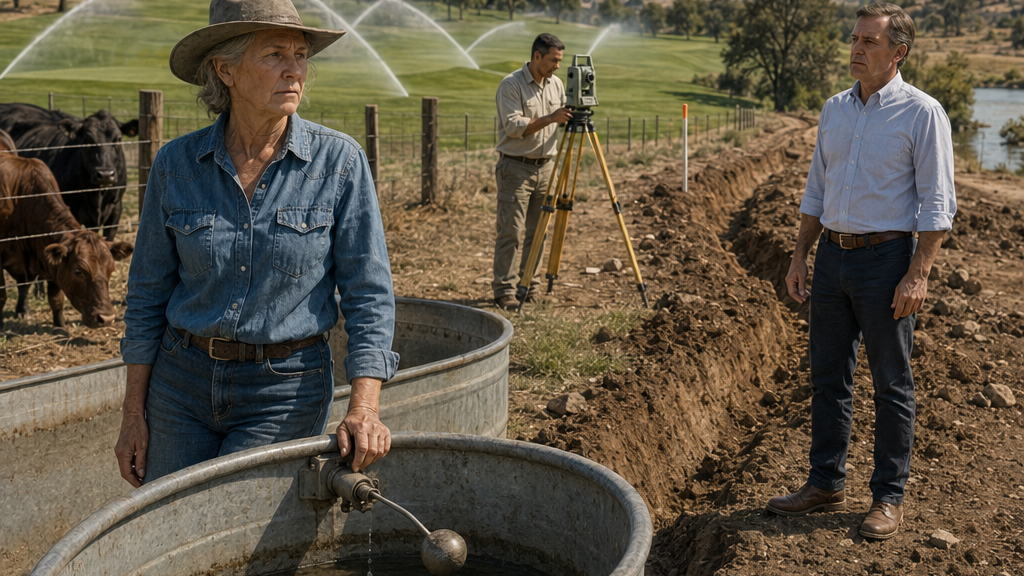
The cattle were already crowded around the galvanized trough when Sandra Nelson realized something was wrong.
Not empty. Not yet.
But the water sat six inches below the pale mineral line that had ringed the steel for years.
One cow pushed her muzzle against the float valve. Another shouldered in beside her. The valve gave a weak metallic click and released a thread of water no thicker than a pencil.
Sandra stood with one hand on the gate.
Across the fence, beyond a strip of sage and cottonwood, three sprinklers swept bright arcs over the seventh fairway of the private golf club.
Tick.
Hiss.
Tick.
Hiss.
The grass there was so green it looked painted.
Sandra looked back at the trough.
The ranch hand came up behind her carrying a salt block.
“Float stuck?”
“No.”
She reached into the trough and lifted the brass arm. Water dribbled through the inlet, then weakened again.
He watched her face. “Pump?”
“Gravity line.”
“You think the spring dropped?”
Sandra shook her head.
The trough was fed from a small branch of Cottonwood Creek through an old diversion box upstream. It had run low before. She had seen dry summers, bad snowpack years, clogged screens, broken pipe, beaver dams and one memorable mess involving a calf that somehow got its head through a fence panel and tore loose half the plumbing.
This was different.
The previous evening, the trough had been nearly full.
She crouched and pressed two fingers into the mud near the overflow pipe. Still damp.
Something had changed fast.
“Move the lower herd to the north trough,” she said.
“That’ll crowd them.”
“For today.”
He nodded and went without asking more.
Sandra stayed.
She had spent thirty-one years making a living from water that people rarely noticed until it stopped arriving where they expected. She had modeled flood plains, irrigation returns, seepage losses and drought allocations for the state. Retirement had been supposed to reduce water to something simpler: creek, ditch, trough, cattle.
No hearings.
No maps under fluorescent lights.
No angry farmers accusing her of choosing which families survived a dry year.
She had kept that promise to herself for nearly seven years.
Sandra climbed over the low creek fence and followed the supply line upstream.
Cottonwood Creek should have been ankle-deep in the shaded stretches. Instead, water crawled between exposed stones. Small pockets remained under roots, but the current had lost its voice.
She stopped beside a cedar post.
Yesterday’s high-water stain was still visible on it.
That made no sense.
A natural drop would not have taken the creek from muddy and high to nearly starved in less than a day unless something upstream had failed—or been changed.
She walked faster.
The golf course appeared through the trees whenever the land opened: clipped grass, white bunker sand, a line of carts moving near the clubhouse. The property had expanded over the years, but Sandra had never objected simply because she disliked what it represented. People used land differently. That was their business.
Water, however, had rules.
About a quarter mile upstream, she smelled fresh dirt before she saw it.
Diesel.
Turned clay.
Crushed grass.
Sandra stepped through a break in the willows and stopped.
A trench cut across the shallow swale ahead of her.
It was too straight to be erosion and too fresh to have been there more than a few days. Excavator tracks pressed deep rectangles into the soil. A pile of roots and sod lay beside the cut. The trench ran from near the creek toward the property line.
Sandra took off her hat.
For several seconds she did nothing.
Then she walked to the edge.
Water moved through the bottom.
Not much, but enough.
She knelt and touched it.
Cold.
Cottonwood Creek.
Someone had intercepted part of the flow.
A metal sign had been driven into the disturbed ground. The lettering identified the area as a private drainage easement serving the neighboring golf property.
Sandra read it twice.
The first reading made her angry.
The second made her careful.
There had been an old drainage easement along this boundary for as long as she could remember. Her grandfather had talked about it as if it were a nuisance inherited with the land, a narrow corridor allowing seasonal runoff to cross one corner of the ranch.
But Sandra remembered it following the natural swale.
Not this.
She took out her phone and photographed the sign, the excavator tracks, and the trench from three angles.
Then she paced from the nearest cedar post.
Twenty strides.
She stopped.
Looked back.
Paced again.
The number meant little without a survey, but the direction bothered her more than the distance.
The ranch hand called from below.
“Sandra?”
“Up here.”
He came through the willows, breathing hard. “North trough’s running normal.”
She nodded.
“So just this line?”
“Just this reach.”
He stared at the trench. “Golf course?”
“The sign says drainage.”
“That drainage taking our water?”
Sandra looked at him.
“I didn’t say that.”
“You didn’t have to.”
Beyond the cottonwoods came the faint mechanical pulse of sprinklers.
Sandra walked to the upper end of the trench.
The cut did not simply cross the creek. It intercepted a shallow side channel, then angled toward the club property.
She could see where the contractor had reshaped the bank.
A clean notch.
A grade.
A deliberate fall.
It was designed to make water choose the new path.
The old part of Sandra—the engineer—began assembling the geometry automatically.
Slope.
Head difference.
Channel roughness.
Return elevation.
She disliked how quickly it all came back.
She had retired because she was tired of looking at landscapes and seeing equations where other people saw land.
Yet the equations had never really left.
Sandra crouched and picked up a fist-sized stone. The underside was wet and dark. She placed it at the edge of the old channel as a crude reference.
“If somebody asks,” she told the ranch hand, “we didn’t touch anything.”
“You calling the club?”
“Not yet.”
He frowned. “Why not?”
Because she already knew the answer she would get.
Because if she called and used the wrong words, they would hear former state engineer instead of neighbor.
Because once that door opened, she was not sure she could close it.
Instead she walked another hundred yards toward the boundary.
There the trench made a turn.
Sandra stopped so abruptly the ranch hand nearly walked into her.
The natural creek continued left, downhill toward her pasture.
The new trench bent right.
Toward the golf course.
Toward the low ground where the club’s irrigation pond sat behind a line of cottonwoods.
Sandra put her hat back on.
Her anger was gone now.
That worried her more.
“Call Daniel Rivera,” she said.
“The surveyor?”
“Yes.”
“What do I tell him?”
Sandra watched a thin ribbon of creek water disappear around the artificial bend.
“Tell him I need to know where my land ends.”
Chapter 2: Twenty-Three Feet Beyond the Recorded Line
Daniel Rivera’s first survey pin landed in dry grass.
The trench was twenty-three feet away.
Sandra stared from the orange-topped pin to the cut in the earth, then back again.
Daniel checked the instrument a second time.
“Want me to shoot it again?”
“No.”
“I was asking because people usually do.”
“I believe your equipment.”
Daniel gave her a brief smile and turned back to the tripod.
He had surveyed fence replacements and an access road on the Nelson property before. Sandra liked him because he treated property lines as facts rather than arguments. He did not dramatize them.
That morning he had been especially cautious.
“The recorded easement is real,” he said. “I pulled the plat before I came.”
“I know.”
“You’ve seen it?”
“Years ago.”
He glanced at her. “Then you know this doesn’t automatically mean the club did anything wrong.”
“I know that too.”
Daniel moved the prism pole to a second point.
The ranch trough was visible downhill through the fence. Its water had fallen another inch since sunrise. Beyond it, sprinklers continued washing the golf course.
A dark sedan turned from the club’s service road and stopped near the cattle gate.
Frank King stepped out.
Sandra had spoken to him perhaps six times in five years. Christmas charity auction. County planning meeting. One conversation about stray golf balls in her hayfield. He was always courteous in the polished way of someone accustomed to resolving discomfort before it became public.
Today he wore slacks, boots that had never seen manure, and a pale button-down shirt with the sleeves rolled precisely twice.
He looked at the survey equipment.
Then at Sandra.
“I was told there was a concern.”
“There is.”
Frank walked toward the trench.
Daniel remained behind his instrument.
Frank nodded toward the sign. “That’s an existing drainage easement.”
Sandra said nothing.
“We had standing water affecting the lower fairway and maintenance road. The contractor corrected the drainage.”
Sandra pointed at Daniel’s nearest pin.
“That’s the recorded edge.”
Frank’s eyes followed her finger.
“The contractor had the survey information.”
“Then he should recognize it.”
Frank looked at Daniel.
Daniel said, “I’m only locating the recorded boundary and easement corridor. I’m not making a determination about authorization.”
Sandra almost smiled.
Daniel had found the narrowest possible bridge between truth and employment.
Frank stepped closer to the trench.
“This is exactly why I didn’t want this turning into a county dispute before anybody had a conversation.”
“I haven’t called the county.”
“Good.”
Sandra looked past him at the bright fairway.
One sprinkler rotated toward them and sent a silver sheet across the grass.
Frank followed her gaze.
“This isn’t about irrigation.”
“What is it about?”
“Drainage. We had runoff backing into infrastructure. The club has had that easement for decades.”
Sandra walked to the trough.
Frank and Daniel followed.
The cattle had moved away from it after the ranch hand shifted most of the herd, but two cows remained near the fence.
Sandra knelt beside the inlet.
The pipe released three slow drops.
Then stopped.
Frank looked uncomfortable for the first time.
Sandra did not mention the cattle.
She did not mention senior rights.
She did not mention that the grade of the trench bothered her more than its location.
Instead she asked Daniel, “Would you set one more pin at the last bend?”
He repositioned the equipment.
Frank exhaled.
“Sandra, I understand you care about the creek. But I’d appreciate it if we didn’t turn a drainage correction into a county fight in the middle of our busiest month.”
Sandra looked at him.
“Where did your contractor get authority for the last bend?”
Frank’s expression changed by less than an inch.
It was enough.
“The easement allows necessary drainage work.”
“That wasn’t my question.”
“I’d have to see the contractor’s plan.”
“So you haven’t?”
“I’ve seen the project summary.”
Daniel called from uphill. “Sandra.”
They walked back.
He had driven the second pin into undisturbed soil.
The trench lay beyond it.
Twenty-three feet beyond the recorded corridor at the widest point.
Daniel pulled a folded print from his case and laid it across the hood of his truck. The old easement appeared as a narrow shaded strip following the swale.
Frank leaned over it.
For the first time, Sandra saw genuine confusion rather than irritation.
Then he straightened.
“I have a copy of the recorded instrument at the clubhouse.”
“Bring it.”
“I can have counsel send it.”
“Bring it.”
Frank studied her.
“You think we fabricated an easement?”
“No.”
That answer seemed to unsettle him more than accusation would have.
Sandra pointed at the map.
“I think you have one.”
Daniel looked between them.
Frank said, “Then what are we doing?”
“Finding out what your contractor did with it.”
An hour later Frank returned with a photocopy in a blue folder.
The document was legitimate.
Sandra recognized the legal description. It granted drainage access through a narrow corridor across the ranch’s northeast corner, originally intended to move seasonal runoff from higher ground.
She read every line.
Nothing authorized widening the corridor toward Cottonwood Creek.
Nothing authorized redirecting creek flow.
Nothing described the sharp bend Daniel had marked.
Frank tapped the page. “There. Existing right.”
Sandra handed it back.
“Yes.”
Frank blinked.
“Yes?”
“You have an easement.”
“So this can stop becoming a confrontation?”
Sandra looked at the trench.
“No.”
His jaw tightened.
“You just said—”
“I said the easement is real. I didn’t say this trench follows it.”
For several seconds, only the sprinklers spoke.
Frank rubbed a thumb across the folder’s edge.
“We’re in a drought year. The course has drainage problems, irrigation problems, soil problems. I have a superintendent trying to keep eighteen holes alive and a board that thinks every delay is incompetence.”
Sandra heard the pressure in his voice.
It was real.
So was the trough.
“Shut the trench until you verify it.”
“I can’t do that based on a disagreement in the field.”
“You can.”
“I won’t.”
The words landed quietly.
Frank seemed to recognize that he had crossed some line, because his tone softened.
“I’ll have our attorney review it today.”
Sandra nodded.
“But operations continue until then.”
There it was.
Not ignorance.
A choice.
Frank left with the easement folder under his arm.
Daniel packed his tripod.
“You want a certified drawing?”
“Yes.”
“County filing?”
“Not yet.”
He hesitated. “Sandra, you’ve got more on your mind than twenty-three feet.”
She looked toward the upper bend.
Daniel had known her long enough not to ask twice.
When he drove away, Sandra walked alone along the new trench.
At the bend she stepped over the spoil pile and followed the cut toward the club boundary.
The land dipped.
Then the trees opened.
Below her, behind a chain-link maintenance fence, lay the golf course’s irrigation pond.
The pond was higher than she remembered.
A fresh stream entered from a culvert on Sandra’s side of the boundary.
She followed the line backward with her eyes.
The culvert connected directly to the new trench.
Cottonwood Creek was not simply being crossed.
It was being captured.
Sandra stood there until one of the irrigation pumps kicked on with a low mechanical hum.
Across the water, sprinkler heads rose from the fairway one after another.
Chapter 3: The Date Nobody at the Club Checked
“Sandra Nelson?”
The woman behind the regional water-office counter said her name before Sandra had given it.
Sandra stopped with one hand on the strap of her document case.
The woman came around the counter.
“Carolyn White.”
Sandra searched the face.
Then she found it: a younger engineer at basin meetings years ago, usually seated two rows back with a yellow legal pad and a habit of asking the question everyone else had avoided.
“Upper Snake working group,” Sandra said.
Carolyn smiled once. “Twice.”
“That long ago?”
“Long enough that you’ve forgotten me.”
“I forget people who don’t cause trouble.”
“I caused plenty.”
The smile disappeared when Carolyn saw the case in Sandra’s hand.
“You’re here as a water user.”
“Yes.”
That changed everything.
Carolyn stepped back behind the counter.
The professional distance came down so visibly Sandra almost respected it.
“Then let’s do this properly.”
They moved to a small meeting room.
Sandra laid out Daniel’s certified survey, photographs of the trench, the drainage easement and her own notes on creek levels.
Carolyn read without interrupting.
When she finished, she folded her hands.
“You’ve already formed an opinion.”
“I formed questions.”
“You were never good at pretending those were different things.”
Sandra looked at her.
Carolyn met the look calmly.
“I’m saying this because of your former position. I need the record to show that I made the determination independently.”
“That is exactly what I want.”
Carolyn nodded and turned to her computer.
“What is the ranch right number?”
Sandra gave it from memory.
Carolyn paused before typing.
“You still know it.”
“I know my phone number too.”
“That wasn’t criticism.”
Sandra said nothing.
Carolyn pulled up the basin records.
A scanned entry appeared on the monitor.
Priority date: 1908.
Sandra had known the year all her life. It was written in the old family ledger, copied into deeds, mentioned in conversations around kitchen tables. Her grandfather had spoken of it as though the number itself were a fence post.
But seeing it inside the current state database felt different.
Official.
Alive.
Carolyn opened the club’s rights next.
Several were newer appropriations and groundwater authorizations. One surface-related irrigation authorization dated only from the modern redevelopment of the property.
Carolyn leaned closer.
“That’s a problem for them.”
Sandra heard no satisfaction in her voice.
“Explain.”
“You know what it means.”
“I want you to say it as watermaster.”
Carolyn looked at her.
Then she did.
“If the creek is short and your beneficial use is being materially injured, your senior right is entitled to satisfaction before junior diversions in the affected system, subject to administration and verification.”
Sandra looked again at 1908.
For two days she had wanted certainty.
Now that she had it, she felt something colder.
Carolyn opened another screen.
“You can make a formal call.”
Sandra did not answer.
Carolyn waited.
“What gets curtailed?”
“That depends on the hydraulic connection and administration area.”
“Not just the trench.”
“Possibly not.”
“The club’s pumps?”
“If they’re determined junior and connected, yes.”
“Other users?”
“Potentially.”
Sandra leaned back.
There it was.
The old shape of the problem.
Not a clean line between wrongdoer and victim.
A system.
Pull one lever and consequences moved somewhere else.
Carolyn closed the screen halfway.
“Sandra.”
“What?”
“You came here knowing this.”
“I came here to verify it.”
“No. You came here because you wanted someone else to tell you whether you should use it.”
Sandra’s eyes hardened.
“That isn’t your job.”
“No.”
Carolyn sat back.
“My job is to administer the right if you invoke it. Your decision is yours.”
Sandra gathered the photographs.
Carolyn slid the survey back across the table.
“You can file today.”
“I won’t.”
Carolyn did not react.
“Then I need you to understand something. If your cattle use is impaired, waiting doesn’t make the conflict more neighborly. It only makes the facts messier.”
Sandra stood.
“I understand.”
“I think you understand the law.”
Sandra stopped.
Carolyn’s voice was softer.
“I’m not sure you understand why you’re hesitating.”
Sandra left without answering.
At home, she set the document case on the kitchen table and washed dust from her hands.
The house was quiet.
She opened the bottom drawer of the old oak desk near the window.
Beneath tax records and machinery receipts lay a weathered ledger with a cracked brown cover.
Her grandfather’s handwriting filled the earliest pages. Flow notes. Ditch repairs. Calving dates mixed inexplicably with diversion measurements.
On one page, beside the year 1908, someone had drawn a small line beneath the entry twice.
Sandra ran her thumb over it.
She had spent her career insisting that priority dates were not sentimental objects.
They were administrative facts.
Now the oldest fact in her family’s possession might shut down an irrigation system across the fence.
She closed the ledger.
Then opened it again.
On the kitchen counter lay the letter she had drafted to Frank the previous afternoon.
She had written that continued diversion appeared inconsistent with the recorded easement and was impairing ranch water delivery.
She had not written that she held senior priority.
She had not written that she intended to make a formal call.
She had deliberately left both out.
A truck came up the ranch road.
The ranch hand entered through the mudroom.
“Lower herd’s restless.”
“How much water?”
He did not answer immediately.
Sandra looked at him.
“None.”
She was already moving.
They drove to the pasture in silence.
The cattle had gathered around the galvanized trough again.
This time there was no weak thread from the inlet.
No drip.
The float valve hung uselessly against bare metal.
Sandra reached inside and turned it by hand.
Nothing.
A cow licked the damp mineral line.
Across the fence, the golf-course sprinklers continued their slow rotation, catching the late sun.
Sandra stood beside the empty trough with Carolyn’s words still in her head.
Waiting doesn’t make the conflict more neighborly.
The ranch hand said, “Want me to haul water?”
“For tonight.”
“And tomorrow?”
Sandra looked toward the creek.
Then toward the green fairway beyond it.
Tomorrow was no longer a question about water.
It was a question about whether she was willing to use what she knew.
Chapter 4: When Two Hundred Sprinklers Went Quiet
Sandra signed the water call at 8:17 Thursday morning.
She had spent most of Wednesday evening refusing to do it.
The form had sat on her kitchen table beside the old ledger while a tank trailer hauled water to the lower pasture. Each time its pump started outside, Sandra heard another reason to sign.
Each time she looked at the line marked Applicant Signature, she remembered what happened after signatures like hers entered the system.
At the regional office, Carolyn White watched from the other side of the counter.
“Once I accept this,” Carolyn said, “administration begins.”
“I know.”
“You can still withdraw before I stamp it.”
Sandra picked up the pen.
“If I withdraw, my cattle still need water.”
Carolyn said nothing.
Sandra signed.
The stamp came down with a flat mechanical sound.
By noon, inspectors had verified the impaired ranch diversion. By midafternoon, the first curtailment notices went out to junior users connected to the affected reach.
The golf club received one.
So did two other users farther downstream.
Sandra learned that part from Carolyn over the phone.
“You should know before rumors get ahead of facts,” Carolyn said.
Sandra stood beside the empty trough while the ranch hand tightened a hose from the water trailer.
“What other users?”
“One commercial landscape parcel and a cooperative well system with a surface-water supplement. Their primary supply isn’t being shut off, but the supplement is restricted.”
Sandra closed her eyes briefly.
“This is why I asked.”
“And this is why administration isn’t retaliation.”
“Tell that to them.”
“I probably will.”
Sandra hung up.
Across the fence the golf course still gleamed.
The sprinklers ran Thursday evening.
They ran Friday morning.
Sandra called Frank once.
He did not answer.
At eleven, Benjamin Lewis returned the call.
“This is Benjamin Lewis, counsel for the club.”
“I know who you are.”
“We’re evaluating the order.”
“Your pumps are still running.”
“We have questions regarding hydraulic connection and the scope of the call.”
“The state order doesn’t say evaluate.”
A pause.
Then Benjamin said, “The club had already begun reviewing your objection before the call was filed.”
Sandra looked down at the dry trough.
“You received my written objection Tuesday.”
“Yes.”
“And kept pumping Wednesday.”
“The board believed the drainage work was authorized.”
“That wasn’t what I asked.”
Benjamin’s silence told her enough.
The club had known there was a dispute.
It had chosen operation over verification.
Late Friday afternoon, a state vehicle pulled onto the golf-course service road.
Sandra watched from her pasture.
The irrigation superintendent met the official beside the pump house. Frank arrived ten minutes later.
No one shouted.
No one needed to.
The official inspected the controls, checked a meter, and handed Frank a document.
At 4:42, the first pump stopped.
The sound did not vanish all at once. It wound down, a deep mechanical hum collapsing into silence.
Then another pump shut off.
On the fairway nearest Sandra, a sprinkler completed half an arc and sank into the turf.
A second stopped.
Then a third.
Farther across the course, lines of silver spray disappeared one section at a time.
For three days the green property had seemed untouchable.
Now two hundred sprinkler heads across eighteen holes sat motionless in the afternoon heat.
The ranch hand stood beside Sandra.
“Well.”
She gave him a look.
He put both hands in his pockets. “Didn’t say anything.”
“You were about to.”
“I was about to say the cattle trailer needs a tire.”
“Good recovery.”
He smiled, but Sandra did not.
She expected satisfaction.
Instead she saw a maintenance employee shut the pump-house door and walk toward the parking lot with his lunch cooler in one hand.
By Saturday morning, a few greens had already lost their polished brightness. Nothing dramatic. Just the first dull patches where relentless summer sun found grass accustomed to constant irrigation.
At the ranch, something else had changed.
Sandra stepped into Cottonwood Creek and felt water press against both boots.
Not much.
But enough to move.
She followed it downstream.
At the diversion box, water finally spilled into the ranch feeder again.
The ranch hand had already cleared the screen.
They stood at the trough and waited.
At first, the pipe coughed air.
Then muddy water spat from the inlet.
A thin stream followed.
Sandra reached into the trough and guided the float arm.
The stream strengthened.
The sound of water striking galvanized steel should have felt like victory.
Instead Sandra thought about Carolyn’s list of affected users.
She thought about the maintenance employee.
She thought about Frank ignoring the objection.
And she thought about herself waiting one full day after she had known exactly what the trench was doing.
By noon the trough held four inches.
One cow drank until water ran from her muzzle.
The ranch hand leaned on the fence.
“You got your water back.”
“Some.”
“Enough?”
“For now.”
A pickup slowed on the county road. The driver stared toward the course, then toward Sandra’s place before moving on.
News traveled quickly in agricultural country, especially when it involved water.
Before lunch, the veterinarian called to ask whether the cattle were all right.
Before two, a neighboring landowner asked whether Sandra intended to “keep the whole basin shut down.”
She corrected him twice.
The second time, he said, “Same thing if you’re on the wrong end of it.”
That sentence stayed with her.
At three-thirty, Carolyn called.
“The club requested expedited review.”
“Expected.”
“They’re also asking for temporary relief.”
“Expected that too.”
Carolyn hesitated.
“They’re saying reduced operations may affect seasonal staffing.”
Sandra looked across the fence. A grounds crew cart moved slowly along a brown-edged fairway.
“That’s not a water-right standard.”
“No.”
“But you wanted me to know.”
“Yes.”
Sandra leaned against the trough.
The water had climbed another inch.
“What happens next?”
“We verify continuing injury. If your senior right is satisfied, administration can be adjusted.”
“So it doesn’t have to stay all or nothing.”
“It never did.”
Sandra listened to water running into the trough.
That evening, near sunset, a white envelope appeared beneath the ranch-house door.
The ranch hand had found it wedged there after checking the gate.
Inside was a single sheet on club letterhead.
Frank King requested a face-to-face meeting at Sandra’s ranch Saturday afternoon.
No board.
No public session.
No demand that she come to the clubhouse.
Just Frank, his attorney, and the original easement documents.
At the bottom he had written one sentence by hand.
We need to determine whether there is a way to fix this before the damage spreads to both sides of the fence.
Sandra read it twice.
Then she looked out the kitchen window at the trough filling in the distance.
For the first time since she filed the call, she could not tell whether Frank was coming to challenge her authority or admit why he had ignored it.
Chapter 5: The Easement Was Real, but the Shortcut Was Not
Frank arrived carrying the original easement map under his arm.
Not a copy.
Not a legal summary.
The old folded document itself.
Benjamin Lewis came with him, but there were no club board members and no polished sedan this time. Frank drove a dusty utility vehicle with grass seed bags in the back and parked beside Sandra’s barn.
Before either man reached the house, Sandra noticed Frank looking toward the cattle trough.
It was half full.
He looked away first.
Sandra met them on the porch.
“Kitchen’s cooler.”
Frank nodded.
Inside, Sandra had cleared the table except for Daniel Rivera’s certified survey and her grandfather’s ledger.
Benjamin noticed the ledger but said nothing.
Frank placed the old easement map between them.
“We pulled this from the title file.”
Sandra unfolded it carefully.
The paper showed the same corridor Daniel had surveyed: narrow, irregular, following a natural drainage swale across the northeast corner.
Nothing resembled the new trench’s hard turn.
Benjamin opened a second folder.
“The club’s position is that the easement grants enough discretion for reasonable maintenance and correction.”
Sandra looked at him.
“And your position?”
He adjusted his glasses.
“My position is that reasonable maintenance does not necessarily include moving the functional drainage channel twenty-three feet outside the described corridor.”
Frank stared at him.
Sandra did not.
She had expected Benjamin to defend the strongest possible interpretation.
Instead he had just conceded the fact that mattered.
Frank said, “You told the board—”
“I told the board the easement exists,” Benjamin said. “I also told the board the field alignment needs verification.”
“When?”
“Tuesday afternoon.”
The room went still.
Sandra looked at Frank.
He rubbed one hand over his jaw.
“There was disagreement about the survey.”
“There was no survey yet,” Sandra said.
“Exactly.”
Sandra leaned back.
“You knew I objected.”
“Yes.”
“You knew your own attorney wanted verification.”
“Yes.”
“And you kept the diversion operating.”
Frank looked toward the window.
Outside, a cow lowered its head into the half-filled trough.
“Yes.”
No excuse came after it.
That made Sandra angrier than an excuse might have.
“Why?”
Frank’s chair scraped slightly as he shifted.
“Because three weeks ago the board got updated numbers from the bank.”
Sandra waited.
“We financed the irrigation upgrade and clubhouse renovation together. Membership is down. We reseeded six greens after winter damage. If we lose peak-season play, we violate a revenue covenant.”
Benjamin said quietly, “Frank.”
“He asked why.”
Sandra corrected him. “She.”
Frank looked at her.
“Sorry.”
He continued.
“The superintendent told us the lower fairway drainage was undermining the service road. The contractor said he could correct the swale and improve pond recharge under the existing easement. We approved it.”
“Pond recharge.”
Frank’s mouth tightened.
“That was his phrase.”
“And yours?”
“I knew more water in the pond wouldn’t hurt us.”
There it was.
Not a secret plan.
Not a forged document.
Something smaller and more ordinary.
A man under pressure hearing the answer he wanted and deciding not to examine it too closely.
Sandra said, “When I told you the trench was wrong, what did you think?”
Frank looked directly at her.
“That you were upset about your grandfather’s boundary.”
For a moment Sandra said nothing.
Benjamin glanced toward the old ledger.
Frank realized what he had said.
“I didn’t mean—”
“You thought I was sentimental.”
“I thought it was a property disagreement.”
“You thought I didn’t understand the work.”
Frank did not answer.
Sandra pushed Daniel’s survey across the table.
“The last bend changes the grade. It doesn’t just cross the swale. It captures the side flow before it reaches my diversion.”
Benjamin studied the drawing.
“You’ve modeled it?”
“No.”
His eyebrows rose.
“I didn’t need to.”
Frank looked between them.
Benjamin tapped the survey.
“The state will.”
“Yes.”
“And if they confirm this—”
“They already confirmed material injury.”
Benjamin sat back.
The room was quiet except for the refrigerator motor.
Frank finally said, “So what do you want?”
Sandra opened her mouth.
Nothing came.
She had spent four days knowing what had been taken.
Water.
Pasture use.
Time.
Tank-hauling costs.
Potential cattle stress.
She knew what the club had done wrong.
She had not actually decided what making it right should look like.
Frank mistook her silence.
“If this is about damages, give Benjamin the number.”
Benjamin frowned but did not interrupt.
Sandra said, “You think that’s what this is?”
“I think your water is coming back and mine is shut off.”
“Yours?”
“Our course.”
“That’s not the same thing.”
“No,” Frank said. “It isn’t. There are forty-three seasonal employees over there. Maintenance, kitchen, grounds, carts. If the course closes portions for the rest of the month, hours get cut.”
Sandra felt the clean edge of anger dull.
Frank continued.
“I’m not saying that gives us your water.”
“Good.”
“I’m telling you why the board made a bad decision quickly.”
Benjamin closed his folder.
“The contractor overstepped the mapped corridor. The club approved work without independent field verification. Those are facts we can address.”
Sandra looked at him. “And the diversion?”
“If the hydraulic review confirms causation, restoration becomes part of any rational settlement.”
Frank’s face changed.
“You’re already negotiating.”
“I’m trying to stop you from losing a fight you don’t need to continue.”
Sandra almost smiled.
Almost.
They walked to the creek.
Daniel’s pins still marked the recorded edge.
Frank stood beside the trench and looked from the original map to the cut itself.
Seen on paper, the error might have looked technical.
Seen from the ground, it looked absurd.
The trench left the natural swale, crossed undisturbed grass, and bent toward the irrigation pond.
Frank said, “I should’ve come out here Tuesday.”
Sandra did not rescue him from the admission.
At the cattle trough, water lapped halfway up the galvanized side.
Frank touched the rim but did not look inside.
“When does the call end?”
“When my right is satisfied.”
“And then?”
“That depends what happens to the creek.”
Frank nodded.
He looked older than he had four days earlier.
Not defeated.
Just less polished.
“My board thinks you’re trying to make an example of us.”
Sandra turned toward him.
“And what do you think?”
“I think if you wanted to destroy the club, you wouldn’t have asked me to shut the trench first.”
That surprised her.
Benjamin waited several yards away, deliberately giving them space.
Frank looked across the fence at the silent sprinkler heads.
“Tell me something honestly.”
Sandra waited.
“If you don’t want the course destroyed, what do you actually want?”
The question followed her all the way back to the house.
Chapter 6: The Rule Sandra Had Once Regretted Enforcing
The old letter was behind the ledger.
Sandra had not looked for it in years.
She found it Sunday morning when she opened the desk drawer to assemble receipts for hauled water, veterinary checks and damaged pasture.
The envelope was thin and yellowed at the edges.
No government seal remained visible on the front.
She knew what was inside before she unfolded it.
A farmer’s handwriting covered two pages.
He had written to her during the drought seventeen years earlier after a senior call forced his family’s small diversion off for nearly six weeks.
He had not insulted her.
That had made the letter worse.
He had explained what happened when water stopped: alfalfa failed, calves were sold early, his son took a second job in town. He acknowledged that Sandra had administered the priorities correctly.
Then he wrote one sentence she still remembered without reading it.
A rule can be right on paper and still land on somebody who had no hand in making the problem.
Sandra sat at the desk.
Outside, water ran steadily into the cattle trough.
The sound reached the house faintly through the open kitchen window.
She had received dozens of angry letters during her career.
Most had gone into records boxes.
This one came home.
After that drought, she became more cautious. Then more rigid about keeping personal judgment out of enforcement. By retirement, caution had hardened into a private rule of its own: never use former authority to make neighbors afraid of her.
It had sounded honorable.
Until Tuesday.
Sandra folded the letter and put it beside Frank’s handwritten meeting request.
The ranch hand came through the kitchen carrying a box of mineral blocks.
“You eat?”
“Yes.”
He looked at the untouched toast on her plate.
“Sure.”
“Put those in the shed.”
He did, then returned.
Sandra was still at the table.
He nodded toward the paperwork. “Damages?”
“Some.”
“Club paying?”
“They should.”
“That wasn’t what I asked.”
Sandra looked at him.
Apparently everyone had chosen this week to become precise.
“I don’t know yet.”
He poured coffee.
After a moment he said, “You knew that trench was taking the creek the first morning, didn’t you?”
Sandra’s eyes lifted.
He seemed to regret asking.
But not enough to withdraw it.
“I suspected.”
“That means yes.”
“It means I needed proof.”
“You called Daniel Tuesday afternoon.”
“Yes.”
“But when we found it, you already knew what that bend did.”
Sandra looked through the window.
The trough was nearly two-thirds full now. A chalky mineral ring showed where the normal water level had stood for years.
“Yes.”
The ranch hand sat across from her.
“Why didn’t you say so?”
Sandra did not answer immediately.
Because she had been afraid of being wrong.
That was true.
Because she wanted an independent survey.
Also true.
Because Frank would have heard former state engineer and accused her of using an old title to control him.
Possible.
But beneath all of those answers was the one she had avoided.
“I didn’t want to be that person again.”
“What person?”
“The person who tells somebody their water stops because a line in a record says somebody else comes first.”
He frowned.
“But that’s what happened anyway.”
“Yes.”
“Only later.”
Sandra looked at him.
Only later.
The phrase struck harder than accusation.
Had she filed Tuesday after finding the trench and verifying the immediate impairment, the curtailment might have begun while the creek still carried more residual flow. The ranch might have suffered less damage. The club’s shutdown might have been shorter.
Waiting had not removed harm.
It had redistributed it.
Sandra folded the old letter once more.
“I thought I was giving them room to fix it.”
“You did.”
“They used the room to keep pumping.”
He shrugged carefully.
“That part’s theirs.”
“And the delay is mine.”
The ranch hand stared into his coffee.
He had no comforting answer.
Sandra was grateful.
After he left, she carried a stiff brush to the trough.
The cattle moved aside reluctantly.
Water had climbed high enough to reach the old mineral line.
Sandra leaned over and scrubbed at the white crust marking years of normal flow.
It did not come off easily.
The brush rasped against galvanized metal while cold water splashed her sleeves.
For years that line had meant reliability.
Now it looked like a record of what she had assumed would always return without being defended.
A truck stopped at the gate.
For one second Sandra expected Frank.
Instead it was the veterinarian, checking a cow that had shown signs of dehydration Friday.
The examination was brief.
“No lasting problem,” the veterinarian said. “You caught it.”
Sandra looked at the trough.
“Late.”
“Not too late.”
Those were not the same thing.
By noon, Sandra returned to the kitchen table and spread out the settlement draft she had begun the night before.
Her first version was severe.
Full reimbursement for pasture damage.
Full restoration costs.
Independent monitoring paid by the club.
No golf-course withdrawal from the affected system until the end of the irrigation season.
Penalty provisions for any future encroachment.
It was defensible.
Every line.
Sandra read it while the old farmer’s letter sat beside her.
Then she took out a pencil.
She crossed out the seasonal prohibition.
Replaced it with a condition: no junior irrigation until the ranch’s senior flow was physically satisfied and independently measured.
After that, limited temporary irrigation could resume under a defined schedule.
She reduced nothing connected to actual damage.
The club would pay for what it had harmed.
It would restore the original creek alignment.
It would fund survey markers and monitoring.
It would not get free water because jobs were involved.
But neither would Sandra demand dry greens merely because she now had the power to produce them.
She worked for two hours.
Near the bottom of the document, she added a requirement that any future channel work affecting the shared drainage corridor be jointly reviewed before excavation.
Then she stopped.
There was still one page she had not touched.
A proposed additional punitive payment Benjamin had suggested might be negotiated away in exchange for quick settlement.
Sandra stared at it.
A week earlier she might have regarded removing it as weakness.
Now she saw something else.
Punishment was easy when it could be translated into a number.
Repair was harder because it required deciding what enough looked like.
She removed the page.
The telephone rang.
Carolyn.
“We have Sunday’s flow readings.”
Sandra sat straighter.
“And?”
“Your diversion is recovering. Not fully satisfied yet, but close.”
“What about the cooperative users?”
“Still under restriction.”
Sandra looked at her revised draft.
“If we reach full satisfaction tomorrow, how quickly can you adjust administration?”
“Quickly.”
“Hours?”
“If measurements support it.”
Sandra nodded though Carolyn could not see her.
“Good.”
There was a pause.
Carolyn said, “You sound different.”
“I’ve been accused of that before.”
“Are you settling?”
“I’m trying.”
“Don’t confuse compromise with administration.”
“I won’t.”
“And don’t confuse administration with revenge.”
Sandra looked at the old letter.
“I won’t do that either.”
After the call, she placed two versions of the settlement side by side.
The first demanded maximum leverage.
The second demanded restoration, accountability and measurable protection.
Sandra tore the first one in half.
Not because Frank deserved mercy.
Not because the club deserved saving.
Because she finally understood that knowing the rule was the easy part.
The harder part was deciding what responsibility required after the rule had done its work.
She clipped the revised agreement into a plain folder and set it beside the door for Monday morning.
Outside, water reached the old mineral line in the trough and stopped the float with a quiet metallic click.
Chapter 7: A Creek Restored Without Burning the Neighbor Down
Sandra removed the punitive settlement page from the folder twelve minutes before Frank King’s truck came through the ranch gate.
She stood at the kitchen table with both versions in front of her, though there was no longer any real choice between them.
The first version could hurt the club.
The second could fix what it had done.
She slid the harsher draft into the desk drawer, closed it, and carried the revised agreement outside.
Frank arrived with Benjamin Lewis just after nine.
Daniel Rivera’s truck followed five minutes later. Carolyn White was not coming to negotiate; she had made that clear. Her office would administer whatever water conditions remained in effect. The neighbors themselves would have to decide whether they could live beside each other after that.
They met at the cattle gate.
No one suggested the clubhouse.
Frank looked toward the trough before he said anything.
The water sat exactly at the old mineral line.
The float had closed.
Sandra noticed him notice.
Benjamin opened his briefcase on the hood of Frank’s truck.
“I’ve reviewed your revised terms.”
Frank turned toward him. “Revised?”
Sandra handed Frank a copy.
He read the first page slowly.
Creek restoration at the club’s expense.
Reimbursement for documented livestock-water hauling, pasture damage, veterinary costs and survey work.
Permanent boundary markers.
Independent monitoring through the remainder of the irrigation season.
No junior withdrawal until Sandra’s senior flow was physically satisfied.
After that, a limited irrigation schedule subject to verified creek conditions.
Frank reached the last page.
“That seasonal prohibition’s gone.”
“Yes.”
He looked up.
“Why?”
Sandra leaned one arm against the gate.
“Because I need my water. I don’t need your grass dead.”
Benjamin glanced down at the document again.
Frank did not answer immediately.
Sandra continued.
“If my diversion drops below the agreed measurement, your pumping stops. No debate first. No board meeting first. No contractor interpretation.”
Frank nodded once.
“And if your right is satisfied?”
“Carolyn’s office verifies it. Then the club gets the temporary schedule listed there.”
Frank read the schedule.
“Four-hour windows?”
“On days the flow supports them.”
“Our superintendent asked for six.”
“He isn’t negotiating my water right.”
Frank’s mouth tightened, but there was no anger in it.
Only the reflex of a man accustomed to asking for more.
Benjamin turned a page.
“The restoration language requires returning the channel to the surveyed alignment.”
“Yes.”
“With Daniel establishing the reconstruction stakes.”
“Yes.”
“And monitoring paid by the club for two years.”
“One year.”
Benjamin looked up.
Sandra pointed.
“I changed it.”
He found the revision.
Frank gave her a searching look.
“You keep changing this in our favor.”
“No.”
Sandra nodded toward the creek.
“I keep changing it toward enough.”
That silenced him.
They walked to the trench.
Daniel had already placed temporary flags along the old drainage corridor. The difference between the legal route and the contractor’s shortcut was obvious now that all four of them stood above it.
The artificial bend cut sharply toward the irrigation pond.
Daniel pointed with the end of his measuring rod.
“The restoration contractor can close this section here, regrade the bank, and put the low flow back into the original channel.”
Frank asked, “How long?”
“Three working days if the soil holds.”
“And the pond?”
“It loses this inflow.”
Frank exhaled.
Sandra said nothing.
Finally he nodded.
“That’s the consequence.”
It was the first time he had said something like that without following it with an explanation.
Benjamin drew Frank aside.
They spoke quietly for several minutes.
Sandra stood beside Daniel.
“You think it’ll hold?”
“If they rebuild it properly.”
“And if they don’t?”
He looked at her.
“You’ll know.”
Sandra almost laughed.
That had been the problem all along.
She had known.
The question had been what she would do with knowing.
Frank returned carrying the agreement.
“The board authorized me to settle within certain limits.”
Sandra waited.
“This exceeds two of them.”
Benjamin said, “Which is why I’m recommending he sign anyway.”
Frank gave him a tired look.
“You enjoy this part?”
“No.”
“You hide it well.”
Benjamin handed him a pen.
Frank did not take it.
Instead he looked at Sandra.
“If I sign, you support adjustment of the call once your flow is satisfied?”
“I support administration according to the measurements.”
“That’s not what I asked.”
“It is what I’m offering.”
Frank studied her for a few seconds.
Then he took the pen.
He signed on the hood of his own truck.
There was no applause.
No handshake.
Not yet.
Benjamin signed the acknowledgment beside him.
Sandra signed last.
The agreement felt almost disappointingly ordinary in her hands.
Paper.
Ink.
Dates.
A week of anger reduced to clauses people would either obey or violate.
Frank capped the pen.
“I owe you an apology.”
Sandra looked at him.
He continued before she could stop him.
“Not for having a drainage easement. Not for trying to keep the course operating. For deciding your objection was probably sentimental before I verified it.”
Sandra nodded.
“Yes.”
Frank seemed surprised.
“You could let a man finish.”
“You finished.”
He gave a short, unwilling laugh.
Then his expression settled.
“I should have come out Tuesday.”
Sandra looked toward the old trench.
“I should have filed sooner.”
Frank frowned.
Benjamin looked at her.
Sandra did not explain.
She did not owe them the whole history of the old farmer’s letter or the years she had spent trying to keep authority at arm’s length.
But she owed herself the truth.
“I knew the bend was affecting my flow before the survey was finished,” she said. “I waited because I didn’t want to become the former state engineer threatening the neighbor across the fence.”
Frank said, “You wanted proof.”
“I had enough to ask for emergency verification sooner.”
Daniel remained silent.
Sandra appreciated that.
Frank looked toward the trough.
“So we both waited for reasons that sounded better in our own heads.”
“Your waiting kept the pumps running.”
“Yes.”
“Mine kept the cattle on hauled water longer than necessary.”
Frank nodded.
Neither man nor woman offered forgiveness.
They did not need it for the agreement to work.
Three days later, an excavator returned to the creek.
This time Daniel’s markers were already in the ground before the bucket touched soil.
Sandra watched from the fence while the restoration crew filled the unauthorized cut in layers and rebuilt the original bank. Straw wattles went down along the disturbed soil. The outlet to the irrigation pond was sealed.
Frank came once during the work.
He stood beside Sandra without speaking for several minutes.
Finally he said, “The board hates the monitoring provision.”
“Good.”
He glanced at her.
Sandra added, “Means they read it.”
That earned the closest thing to a smile she had seen from him all week.
By Friday, Carolyn’s office confirmed Sandra’s diversion was fully satisfied.
The cooperative users’ supplemental restriction was lifted first.
Later that afternoon the golf course received permission to resume limited irrigation under the settlement schedule.
At four o’clock, a handful of sprinkler heads rose on two fairways.
Not two hundred.
Not even fifty.
Just enough to protect the most vulnerable turf while the creek continued carrying Sandra’s senior flow.
Sandra watched them from the pasture.
The sight did not bother her.
That surprised her.
The ranch hand stood beside the trough.
“Thought you’d enjoy seeing them stay off.”
“So did I.”
“You disappointed?”
“No.”
He looked at her skeptically.
Sandra checked the water level.
“Grass wasn’t the problem.”
Weeks passed.
The scars from the trench remained visible long after the machinery left, a lighter strip through the pasture where soil had been disturbed twice.
The club paid the verified damage claim without another fight.
Frank disputed one invoice for fencing.
Sandra showed him the broken posts.
He paid it.
Sandra disputed one monitoring charge Benjamin said belonged to the ranch.
Benjamin showed her the agreement.
She paid that one herself.
That, more than anything, told Sandra the arrangement might survive.
Not because they trusted each other.
Because both sides had learned that being wrong did not become less wrong simply because the mistake was inconvenient.
Near the end of summer, Daniel returned to inspect the restoration stakes.
Sandra walked the creek with him.
Water followed the natural bend again, slipping beneath cottonwood roots and over stones polished dark by current.
At the place where the unauthorized trench had once turned toward the golf pond, new grass had begun pushing through the straw.
Daniel checked the elevation.
“Looks good.”
Sandra nodded.
“You want the temporary markers removed?”
“Leave the corner stakes.”
“For how long?”
Sandra looked across the fence.
“Long enough.”
Daniel laughed softly.
At the lower pasture, the cattle trough was full.
One cow drank while another waited behind her, tail switching lazily against flies.
The float valve closed with the familiar metallic click Sandra had heard thousands of times without noticing.
She ran a finger along the pale mineral line.
For years she had thought of it as nothing more than a stain.
Then it became evidence of what was missing.
Now it meant something else.
A limit.
A measure.
Enough.
Across the fence, one irrigation cycle started.
A few sprinklers rose, sending controlled arcs over the fairway.
The creek kept moving toward Sandra’s pasture.
Neither side took all of it.
Frank’s utility vehicle appeared on the service road.
He slowed as he passed the boundary.
Sandra raised one hand.
After a moment, Frank raised his.
Then he drove on.
They were not friends.
Sandra suspected they never would be.
But the trench was gone. The club knew where its easement ended. The state knew what measurements to watch. Frank knew Sandra would use her rights if she had to.
And Sandra knew something about herself she had resisted for years.
Authority was not made cruel simply because it had consequences.
Silence was not made kind simply because it avoided confrontation.
The difference was what you were trying to protect, how carefully you acted, and whether you knew when enough had been restored.
Sandra rested both hands on the galvanized rim.
Cold water touched her fingertips.
Behind her, the creek followed its old channel home.
The story has ended.