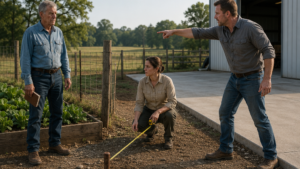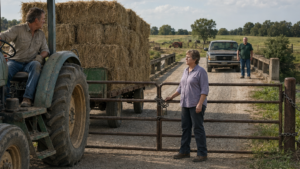
The Resort Said Her Farm Boundary Was Flexible—Then One Survey Pin Stopped the Expansion
Chapter 1: The Concrete Was Already Against Her Fence
The concrete had not been there the night before.
Margaret Lewis stopped halfway down the orchard row with one pruning glove still tucked into her back pocket and stared through the cedar fence.
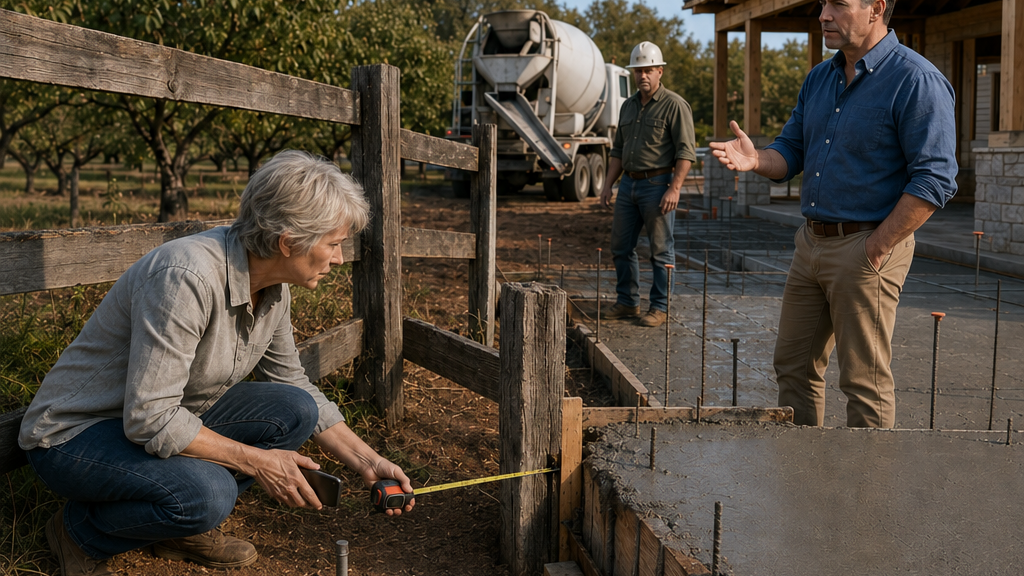
On the resort side, a pale gray footing ran beside the fence where bare soil had been visible at sunset. Steel reinforcing bars rose from it in regular intervals. Wooden forms boxed the fresh pour. One of Margaret’s cedar posts seemed almost swallowed by the construction, with barely enough space between wood and concrete to slide two fingers.
A worker stepped over a coil of hose and shouted toward a skid steer.
Margaret did not move.
She had owned the ten acres long enough to know the boundary without thinking about it. The northern line began near the road, followed a slight bend behind the old pear trees, then ran straight past the orchard before disappearing into a stand of oaks. The fence had been installed from a recorded survey years earlier. It was not approximate.
She walked closer.
The smell of wet cement mixed with crushed grass. Fresh tire marks crossed the resort side of the strip. Soil had been scraped away from the bottom of the fence, exposing roots, stones, and a small rust-colored piece of metal near the third cedar post.
Margaret crouched.
There it was.
The survey pin.
Only the rounded top showed above the dirt.
She brushed soil away with two fingers.
“Ma’am?”
Margaret looked up.
A man in a faded work shirt and hard hat approached from the construction site. She had seen him before directing crews around the new cabins. He stopped on the other side of the fence.
“You need something?”
Margaret pointed down.
“I need to know where your foundation line came from.”
The man glanced at the concrete.
“I’m Ryan Clark. I’m running the site.”
“Margaret Lewis.”
“I know.”
That surprised her slightly.
Ryan followed her gaze toward the footing.
“The poolhouse plans were revised.”
“That wasn’t my question.”
He gave a tired half-smile, the expression of someone who had already solved six problems before breakfast.
Margaret stood.
“My fence was installed from a recorded boundary survey. Your concrete is against it.”
Ryan looked toward the forms.
“It’s close.”
“Close isn’t a measurement.”
His expression tightened.
“No, ma’am.”
Behind him, a carpenter lifted a sheet of plywood while another worker checked a chalk line.
Margaret pointed at the exposed metal pin.
“Do you know what that is?”
Ryan stepped nearer and looked down.
“Yes.”
“Then why is your foundation on this alignment?”
He rubbed the back of his neck.
“There’s a setback variance.”
The answer stopped Margaret more effectively than an argument would have.
“A variance?”
“For the poolhouse.”
“Approved by the county?”
“That’s what I was given.”
Margaret looked back at the fresh concrete.
A setback variance could explain why the resort had built closer than normal to her property. It could not, as far as she understood, make private land disappear. But she had spent enough years in engineering offices to know that certainty was dangerous when you had not seen the actual paperwork.
“What exactly does the variance allow?”
“You’d have to ask Gregory.”
“Gregory Anderson?”
Ryan nodded.
Margaret had met Gregory twice. Both times had been brief. He managed Vineyard Pines as though every conversation were something he could convert into a deadline. He was polite when convenience allowed it.
“Is he here?”
“Not yet.”
Margaret looked at the footing again.
“When is the next pour?”
Ryan hesitated.
“This afternoon.”
That changed the weight of the scene.
The concrete already in place could be chipped out, though not cheaply. Once the next section tied into it, the project would become harder to correct with every passing hour.
Margaret crouched again and cleared more dirt from around the survey pin. The metal cap was scarred but intact.
Ryan watched her.
“You’re sure that’s the corner reference?”
“I’m sure it’s one of the recorded monuments on this line.”
“You have the survey?”
“Yes.”
“Recent?”
“The boundary doesn’t expire because the paper gets older.”
“I didn’t mean it that way.”
“I know.”
She did know, but her voice remained sharper than necessary.
Ryan looked away toward his crew.
Margaret noticed it and felt a small prickle of annoyance with herself. He had not poured the footing by hand in the dark. She was already treating him like an opponent because he happened to be standing closest to the problem.
That was one of her worse habits. Once something became technical, she expected everyone else to become technical with her.
She straightened.
“I’ll bring the plat.”
Ryan nodded.
“That would help.”
Margaret walked back toward the farmhouse, passing the pear trees with their first small leaves opening along the branches.
Inside, she went directly to the narrow room she still called her office, though she had been retired for six years.
Old project binders filled one shelf. County maps occupied another. She opened a flat drawer beneath the drafting table and removed a rolled survey in a protective sleeve.
The paper crackled as she spread it under the lamp.
Parcel line.
Bearing.
Distance.
Monument callout.
Fence alignment.
She traced the northern boundary with one finger.
Nothing about it surprised her.
What bothered her was how badly she wanted the drawing to end the conversation.
In her working life, a stamped plan had meant something. Not everything, but something. Measurements could be checked. Assumptions could be challenged. A mistake could be identified without making the mistake personal.
Neighbors were harder.
Margaret carried the survey back outside.
Ryan was waiting near the fence.
She held the drawing against a scrap of plywood while he leaned across far enough to see.
“There,” she said. “That monument.”
Ryan studied the callout.
“And your fence was set from this?”
“Yes.”
He looked at the concrete, then at the pin.
Margaret saw the moment he stopped merely listening and began calculating.
“How far do you think we are over?”
“I don’t know yet.”
He looked almost relieved by that answer.
Margaret rolled the plan.
“I measure before I accuse.”
Ryan nodded slowly.
Then he glanced over his shoulder toward the poolhouse framing.
“There’s something else you should know.”
Margaret waited.
“The form line wasn’t where we first staked it.”
Her grip tightened slightly around the rolled survey.
“Why was it moved?”
Ryan lowered his voice.
“Gregory approved the field adjustment himself.”
Chapter 2: He Called the Property Line Flexible
The concrete truck arrived before Gregory did.
Its diesel engine growled up the resort service lane just after noon, tires grinding over gravel as it backed toward the poolhouse forms. Margaret heard the warning beeps from her orchard and walked quickly toward the fence.
Ryan was already waving the driver to stop.
For a few seconds, Margaret thought he had delayed the pour for her.
Then Gregory Anderson came around the side of the half-framed building.
He wore khaki pants, work boots that had never seen much mud, and a blue shirt with the sleeves rolled neatly to his forearms. He smiled when he saw Margaret, as if she had arrived for a scheduled tour.
“Margaret.”
“You’re pouring again?”
“That’s generally what concrete trucks are for.”
Ryan looked down.
Margaret ignored the remark.
“I want to show you the boundary before you continue.”
Gregory glanced toward the fence.
“Ryan told me you were concerned.”
“Concerned is not the word I’d use.”
“Then what word would you use?”
“Uncertain.”
That seemed to amuse him.
“About your own property?”
“About whether you understand where it ends.”
The smile remained, but something behind it cooled.
Margaret stepped through her gate and walked along her side of the fence until she reached the exposed survey pin.
She had brought a tape measure, a small hand trowel, her phone, and a photocopy of the recorded plat.
Gregory looked at the tools.
“You came prepared.”
“I usually do.”
She knelt and scraped away the loose soil surrounding the pin until several inches of metal were visible.
Then she hooked the tape at the monument reference point and extended it toward the edge of the new concrete.
Ryan crouched on the resort side to see the number.
Gregory remained standing.
Margaret checked the distance twice.
Then she photographed it.
She shifted the tape to the fence line and checked the offset again.
The number did not improve.
Ryan exhaled through his nose.
Gregory said, “What exactly are you trying to demonstrate?”
“That the built line doesn’t match the recorded boundary relationship shown here.”
She handed him the copy of the survey.
Gregory glanced at it.
“We have approved plans.”
“Approved plans don’t change ownership.”
“We have a setback variance.”
“Then I’d like to read it.”
“You’re welcome to request it from the county.”
Margaret looked up at him.
“Do you have a copy?”
“Of course.”
“Here?”
“Not in my pocket.”
The concrete truck idled behind them.
The driver leaned one arm out the window.
Gregory looked toward the truck and then back to Margaret.
“This project has been reviewed. Engineers looked at it. Attorneys looked at it. The county looked at it.”
Margaret folded her arms.
“I was an engineer for thirty-four years.”
Gregory blinked.
It was small, but she saw it.
His gaze shifted from her face to the tape measure, then to the survey pin.
“What kind?”
“Civil.”
Ryan looked away, perhaps to hide a reaction.
Gregory recovered quickly.
“Then you know field conditions aren’t always identical to drawings.”
“I also know the difference between a setback and a property line.”
“There’s flexibility in construction.”
“Not in ownership.”
“That’s not what I said.”
“What did you say?”
Gregory’s jaw moved once before he answered.
“The variance gives us flexibility near the boundary.”
Margaret stood.
“Near the boundary.”
“Yes.”
“Not across it.”
He held up one hand.
“We don’t agree that we’re across it.”
“Then check the plat before you pour.”
The diesel engine behind them seemed suddenly louder.
Gregory looked toward Ryan.
“Are the forms ready?”
Ryan hesitated.
“Yes.”
“Inspection passed?”
“For reinforcement.”
“Then pour.”
Margaret stared at him.
“Gregory.”
He turned back.
“Five minutes,” she said. “That’s all I’m asking. Take five minutes, compare the field measurement with the recorded plat, and if you still think I’m wrong, say so after you’ve looked.”
For the first time, his friendliness disappeared completely.
“We’re already behind.”
“That’s not my land’s problem.”
“No, but it is the problem of twenty people trying to finish this project before summer bookings.”
There it was.
Not greed exactly. Not even contempt.
Pressure.
Margaret understood pressure. She had spent decades watching project schedules turn assumptions into facts simply because nobody wanted to be the person who stopped the work.
That did not make the assumption true.
Gregory pointed toward the resort.
“We’ve got guests booked into new units, lenders expecting completion, subcontractors scheduled back-to-back. Every day matters.”
“So does every inch.”
“You’re reducing this to inches.”
“No. You are.”
He stared at her.
Ryan stepped closer to the forms.
“Gregory, we could hold this truck while you pull the file.”
Gregory turned sharply.
“We are not holding a loaded truck because a neighbor doesn’t like the location of a fence.”
Margaret felt the insult settle before she responded.
“This isn’t about whether I like the fence.”
“I didn’t say it was.”
“You’re treating it that way.”
His face hardened.
“What would satisfy you?”
“Verification.”
“We’ve verified it.”
“With what?”
“Our approved plan set.”
“Show me.”
“I don’t have to conduct a plan review at the fence.”
“No. You don’t.”
Margaret gathered the tape.
“But you do have to live with what you pour.”
For a moment none of them spoke.
Then Gregory motioned toward the truck.
The driver engaged the transmission.
Ryan did not immediately move.
Gregory said his name.
Ryan lifted both hands and began directing the truck toward the pump setup.
Margaret stood beside the exposed survey pin as the chute was positioned.
She could have shouted. She could have stepped toward the forms, demanded that the crew stop, or threatened Gregory with every consequence she could imagine.
Instead, she photographed the pin again.
Then the formwork.
Then the distance between the cedar post and the concrete.
Gregory watched her.
“You plan to document the whole afternoon?”
“If necessary.”
“You really think the county is going to shut down a permitted project over a few inches?”
Margaret slipped her phone into her pocket.
“I think you should be more interested in whether the inches belong to you.”
Concrete began moving through the pump line.
The first wet load dropped into the forms with a heavy slap.
Margaret flinched despite herself.
Not because of the noise.
Because until that moment, part of her had believed Gregory would stop.
He had not.
She returned to the farmhouse while the pump continued behind her.
At her office table, she laid out the recorded survey, her field measurements, and photographs from that morning.
The old instincts came back quickly.
Do not assume.
Establish control points.
Compare approved geometry to actual conditions.
Separate what you know from what you believe.
She called the county planning desk and asked for the variance file number associated with the Vineyard Pines poolhouse.
The clerk located it.
Margaret wrote the number down.
“Can I get the approved exhibit and findings?”
“Yes. They’re public.”
“Was the neighboring property owner notified?”
A pause.
“That depends on the variance type. You’ll need to review the file.”
Margaret thanked the clerk and hung up.
At four-thirty, someone knocked on her back door.
Gregory stood outside holding a slim folder.
“I thought I’d save you a trip,” he said.
Margaret opened the door but did not invite him in.
He handed her a copy of the variance.
She looked at the first page.
“Thank you.”
He stayed where he was.
“My attorney reviewed this before construction started.”
Margaret looked up.
“Your attorney reviewed the variance?”
“The whole project.”
“Including my recorded survey?”
Gregory’s expression shifted only slightly.
“He reviewed everything relevant.”
It was a careful answer.
Margaret held the folder against her side.
“Then tomorrow I’ll find out what ‘relevant’ meant.”
Chapter 3: The Variance Never Moved the Boundary
The word Margaret expected to find was not there.
She read the variance twice before breakfast and a third time standing at the kitchen counter with a pencil in her hand.
Reduced setback.
Architectural compatibility.
Fire access.
Drainage.
Screening.
Nothing in the findings granted Vineyard Pines ownership of any land outside its recorded parcel. Nothing relocated a boundary. Nothing authorized the poolhouse foundation to cross onto the neighboring property.
Margaret sat down.
For the first time since seeing the concrete, she felt something close to relief.
It lasted less than a minute.
A variance could be perfectly valid and the project could still be built in the wrong place.
She spread Gregory’s folder beside her own survey.
The variance included a reduced-size site exhibit. The poolhouse was shown close to the parcel edge but still within the resort property.
Margaret found the dimension.
She read it again.
Then she picked up her field notebook.
The approved plan showed a separation that did not exist at the fence.
By nine o’clock she was at the county records counter.
The clerk slid a large plan set across the laminate surface.
“These are the approved sheets.”
“Are there revisions?”
“One.”
The clerk pulled another sheet.
Margaret examined the title block, revision date, and approval stamp.
The poolhouse had moved slightly during review.
Not much.
Enough to matter.
She traced the parcel line.
The drawing assumed the cedar fence roughly followed the boundary, but the construction offset was dimensioned from a survey line rather than from the fence itself.
That was proper.
Then she found the field staking note.
Margaret frowned.
“Do you have the survey referenced here?”
The clerk searched the electronic file.
“This one?”
A separate exhibit appeared on the screen.
Margaret leaned closer.
The resort’s consultant had used an older base map for preliminary layout. It showed the same general parcel shape, but one boundary call had been simplified.
Not necessarily wrong.
Not precise enough for construction.
Margaret felt her earlier satisfaction drain away.
The problem was no longer simply Gregory ignoring her fence. The approved design appeared to be legal on paper. Somewhere between approval and field layout, somebody had treated approximate information as if it were exact.
“Can I get copies of these sheets?”
The clerk nodded.
While the printer worked, Margaret stared through the glass doors toward the parking lot.
She had wanted a clean answer.
She had wanted the county file to contain one obvious mistake she could point to and say, There. Fix that.
Instead she had something more troublesome: an approval that seemed lawful, a field installation that did not match it, and an old mapping assumption that might explain how people had become confident enough to build in the wrong place.
Back at the farm, she pinned the county sheets to her drafting wall.
For nearly two hours she reconstructed the geometry.
Recorded survey.
Approved poolhouse footprint.
Variance setback.
Field measurement.
Fence position.
Survey pin.
She used a scale ruler she had owned since before retirement.
At one point she stopped, went outside, and measured the monument again.
The pin had not moved.
The concrete had.
Margaret photographed the relationship from three angles and returned inside.
By midafternoon, she had a simple conclusion written on a yellow pad:
VARIANCE REDUCES SETBACK. DOES NOT ALTER PROPERTY LINE.
Below it, she wrote:
BUILT LOCATION ≠ APPROVED LOCATION.
She stared at the second line.
The county had not approved what was sitting beside her orchard.
But that did not yet answer the most important question.
Had Gregory known?
A vehicle door closed outside.
Margaret looked through the office window.
Ryan Clark stood near the farm gate.
He was alone.
No hard hat. No crew truck.
Margaret walked out.
Ryan kept both hands visible at his sides as she approached, almost as though he expected her to order him off the property.
“You working today?” she asked.
“Not right now.”
She waited.
He glanced toward the resort, though the buildings were mostly hidden by trees from this angle.
“I need to ask you something.”
“What?”
“If you file anything with the county, can you leave my name out of it?”
Margaret studied him.
“That depends on what you’re about to tell me.”
Ryan pressed his lips together.
“I figured you’d say that.”
He looked down the fence line toward the poolhouse.
Margaret could hear distant saws from the construction site.
“You told me Gregory approved a field adjustment,” she said.
Ryan nodded.
“Was the original staking different?”
“Yes.”
“How different?”
He looked at her then.
Enough that Margaret stopped thinking about drawings.
Enough that she understood, before he said another word, that Ryan had not come to discuss a harmless surveying error.
“I think you should see where we had it the first time,” he said.
Margaret waited.
Ryan lowered his voice.
“But I don’t want Gregory here when I show you.”
Chapter 4: The Foreman Had Warned Him Before
Ryan led Margaret along the outside of the fence before the construction crew arrived.
He moved quickly, glancing twice toward the resort road as though Gregory might appear simply because they were speaking without him.
Near the poolhouse, Ryan stopped beside a patch of scraped earth several feet back from the new concrete.
“This was the first line,” he said.
Margaret looked down.
At first she saw nothing but compacted dirt and boot marks. Then Ryan pointed to two faded spots of orange paint and a short wooden stake snapped nearly level with the ground.
She crouched.
“That was your original form edge?”
“Yes.”
“How was it established?”
“Layout crew came off the control points on the plan.”
Margaret looked from the faded paint to the concrete now sitting near her fence.
The difference was not subtle.
“If you had built from this line,” she said, “you would have been inside the approved footprint.”
Ryan nodded.
“So why didn’t you?”
He shoved his hands into his jacket pockets.
“That’s the part I don’t want my name attached to.”
Margaret stood.
“Ryan, you came to my property before sunrise to show me evidence that your crew changed a foundation location. You’re already attached to it.”
“I didn’t make the decision.”
“You carried it out.”
His eyes hardened.
“Yeah. I did.”
The answer surprised her because he did not soften it.
He looked toward the half-built poolhouse.
“We were losing room on the other side.”
“For what?”
“Equipment access at first. Then they changed a utility run. Then the patio layout got wider.”
Margaret waited.
Ryan kicked gently at the broken stake.
“The revised field position solved three problems at once.”
“And created mine.”
“Yes.”
The simple admission took some anger out of her before she wanted it gone.
She had expected excuses.
Ryan gave her none.
“When did you know it was a boundary problem?”
“I didn’t know for certain.”
“When did you suspect it?”
He took longer to answer.
“The day we restaked.”
Margaret folded her arms.
“You said something.”
“I told Gregory the move put us too close to the fence. I asked for the surveyor to come back.”
“What did he say?”
“That the setback had already been approved and the boundary was flexible enough for field conditions.”
Margaret stared at him.
There was the word again.
Flexible.
As though land could stretch when a schedule tightened.
“You believed him?”
Ryan shook his head.
“Not exactly.”
“But you kept building.”
“I’ve got twelve guys on this site. Subs stacked behind me. Concrete booked. Framing booked. Electrical booked. Every time I stop a job because I don’t like something, I’d better be right.”
“You were right.”
“I didn’t know that then.”
Margaret looked at the old paint line again.
She had spent two days thinking of Ryan as the man who had helped pour concrete against her fence.
Now she saw something less comfortable.
He had noticed the danger. He had raised it. Then he had let pressure outrank judgment.
That did not absolve him.
But it made him familiar.
She thought of meetings decades earlier when a schedule had been slipping and someone had said a drainage concern could wait until the next phase. She had always told herself engineering was clean because numbers were clean.
People never were.
“Why tell me now?” she asked.
Ryan rubbed his thumb along the seam of his pocket.
“Because yesterday Gregory told us to keep going even if you complained.”
Margaret said nothing.
“And because,” Ryan continued, “if the county comes out, I don’t want them thinking the crew invented that line.”
“You want protection.”
“I want the truth separated from blame.”
“That’s not always possible.”
“No.”
A truck engine sounded from the resort road.
Ryan stiffened.
“Is that him?”
Margaret listened.
“No. Delivery truck.”
He relaxed slightly.
She looked toward the concrete.
“How much delay would moving the foundation have caused before the pour?”
Ryan gave a humorless laugh.
“Depends when.”
“When you first raised the issue.”
“Maybe three weeks.”
“And now?”
He looked at her.
“A lot more.”
“How much more?”
“Forms, rebar, concrete removal, redesign, inspections. Could be six weeks. Could be longer.”
“Peak season.”
He nodded.
“That’s why he wouldn’t stop.”
Margaret felt something unpleasant settle into place.
Gregory had not simply misunderstood a line on a plan. At some point, uncertainty had become a financial calculation.
She turned toward the farmhouse.
“Thank you for telling me.”
Ryan caught up with her.
“One thing.”
She stopped.
“If you file a complaint, don’t say I gave you internal information.”
Margaret looked at him.
“You want me to protect you.”
“I’ve got a mortgage.”
“So do a lot of people.”
“I know.”
His face tightened, but he did not argue.
Margaret realized she was doing it again—turning a complicated person into a clean category because clean categories were easier to manage.
“You should have stopped the work,” she said.
Ryan nodded.
“I know that too.”
That answer stayed with her longer than she expected.
By late morning, Gregory’s assistant called and asked Margaret to come to the resort office.
Gregory was waiting behind a polished wood desk with a folder positioned squarely in front of him.
No smile this time.
“Sit down.”
Margaret remained standing.
“I’m fine.”
Gregory slid the folder toward her.
“I’d rather solve this without involving the county.”
Margaret opened it.
Inside was a proposed easement agreement.
She read the first page, then the compensation figure.
Her eyes returned to it.
The amount was substantial.
Not insulting money. Not nuisance money.
Enough to replace aging irrigation equipment, reroof the equipment shed, and leave plenty over.
“What is this?” she asked.
“A permanent narrow easement along the existing construction edge.”
“You mean the part you already built over.”
“I mean an agreement that removes the dispute.”
Margaret kept reading.
The strip was small.
Measured in inches at one point, slightly more farther down.
On paper, it looked almost ridiculous.
A sliver.
Gregory leaned back.
“This is a practical solution.”
“For you.”
“For both of us.”
“I didn’t offer to sell.”
“You also said you wanted the issue resolved.”
“I want the boundary respected.”
“And I’m offering to compensate you well above the value of the land.”
Margaret closed the folder.
“The value isn’t the point.”
Gregory sighed.
“With respect, Margaret, land has a value.”
“So does consent.”
Something changed in his expression.
Not anger yet.
Fatigue.
“We have reservations tied to this expansion. A construction loan with completion dates. Seasonal employees who were hired because these facilities were supposed to open.”
“I understand pressure.”
“Do you?”
“Yes.”
He looked at her survey folder.
“Then understand what six weeks does to this project.”
Margaret thought of Ryan’s first layout line.
Three weeks then.
Six or more now.
The difference had been created by Gregory’s decision to continue.
“You could have stopped before the pour.”
Gregory’s eyes sharpened.
“Based on what? A fence that may or may not be exactly on the recorded line?”
“You had a concern from your own foreman.”
For the first time, Gregory went completely still.
Margaret wished immediately that she had not said it that way.
His gaze stayed on her.
“Ryan talked to you.”
She did not answer.
Gregory’s mouth tightened.
“That’s interesting.”
“This isn’t about Ryan.”
“It is if my employee is sharing internal project discussions.”
Margaret closed the folder more firmly.
“You’re changing the subject.”
“No. I’m trying to understand how far this is going.”
“So am I.”
He pushed the agreement closer.
“The offer stays open until tomorrow at five.”
“Why tomorrow?”
“Because after that we proceed through counsel.”
Margaret looked at the signature line.
“And county review?”
Gregory’s pause told her enough.
“You want this signed before I ask the county to inspect.”
“I want it resolved before everyone spends money proving something we can settle now.”
Margaret picked up the folder.
For one unsettling moment, she imagined signing it.
The land involved was tiny.
The money was not.
Then she remembered the survey pin half buried in loose soil and the old orange stake Ryan had shown her.
The problem had never been the size of the strip.
The problem was that someone else had decided when it became negotiable.
At the door, Gregory spoke again.
“Margaret.”
She turned.
“If you involve the county, this gets bigger than you think.”
She held the agreement against her side.
“That depends on what they find.”
His expression darkened.
“No. It depends on what you’re willing to start.”
Chapter 5: She Refused to Sell the Inches Away
Margaret read the compensation figure again at her kitchen table and disliked the fact that it still tempted her.
The easement agreement lay beside the recorded survey.
One document offered money.
The other offered a line.
The amount Gregory had proposed was enough to solve several problems she had postponed because orchard income had been uneven. The west irrigation manifold needed replacement. The equipment shed roof leaked during hard rain. One of the older rows would need replanting within two years.
She made coffee and left it untouched.
At ten, Gregory called.
“I can have our attorney available this afternoon.”
“For what?”
“To answer questions.”
“I don’t have legal questions yet.”
“You have an agreement in front of you.”
“I have your agreement.”
“That’s usually how settlement works.”
Margaret looked through the window toward the orchard.
She could see the upper framing of the poolhouse above the fence now.
“You keep calling it settlement.”
“What would you call it?”
“Permission after the fact.”
Silence.
Then Gregory said, “You’ve allowed access before.”
Margaret’s grip tightened on the phone.
“What?”
“Our landscaping crew used the farm lane last year when the service road washed out. You didn’t object.”
“That was temporary.”
“You let delivery vehicles turn around near the south gate too.”
“Twice.”
“You never said it was a problem.”
“Because it wasn’t. Until it became one.”
“That’s my point.”
“No. Your point is that because I didn’t object before, you believed I wouldn’t object now.”
Gregory said nothing.
Margaret closed her eyes.
The truth landed unpleasantly because part of it belonged to her.
When Vineyard Pines had first expanded its service area, she had watched vans turn across the edge of her lane and told herself it was easier not to complain. When landscapers had used the gate after heavy rain, she had waved them through. A maintenance cart had once clipped a sprinkler riser, and she had repaired it herself rather than call anyone.
She had called that being reasonable.
Maybe Gregory had learned a different lesson.
“Margaret?”
“I’m here.”
“I’m not saying you gave us the land.”
“You’re saying my silence looked like permission.”
“I’m saying we’ve always had a cooperative relationship.”
“No. We’ve had an undefined one.”
He exhaled.
“If that’s how you want to characterize it.”
“It is.”
After they hung up, Margaret sat with the phone in her hand.
For years she had disliked people who turned every inconvenience into a boundary dispute. She had watched rural neighbors fight over gates, access roads, tree limbs, drainage ditches. She had promised herself she would never become one of them.
So she had waited.
She had assumed a reasonable person would recognize the difference between kindness and consent without being told.
That assumption had cost her.
At noon she drove to the resort office.
Gregory was standing near the reception desk speaking with a contractor. He finished quickly and led her into his office.
Margaret placed the easement agreement on his desk.
Unsigned.
Gregory looked at it.
“That’s your answer?”
“Yes.”
He sat down.
“You didn’t even counter.”
“I’m not selling the strip.”
“It’s a strip of dirt beside a fence.”
“It’s mine.”
“I know it’s yours. That is why I offered to pay for it.”
“You offered after you built on it.”
Gregory leaned back and rubbed both hands over his face.
When he lowered them, the polished confidence was gone.
“Do you know what happens if we stop now?”
Margaret stayed silent.
“I miss the opening date. We push reservations. We refund deposits. I trigger another review with the lender. Contractors walk to other jobs because I can’t hold them indefinitely.”
“You should have considered that when Ryan questioned the layout.”
His eyes narrowed.
“Leave Ryan out of this.”
“You made him part of it.”
“I made a project decision.”
“Yes.”
“And now I’m trying to correct it.”
“By making your decision permanent.”
“By compensating you.”
Margaret looked toward the window.
Outside, two employees were carrying folded patio chairs toward the lawn. One stopped to help the other when a stack slipped.
Ordinary people.
That was what made Gregory’s pressure real.
The resort was not only him.
But neither was her property only dirt.
“You said the county wouldn’t care about a few inches,” she said.
“I said these things can often be resolved.”
“No. You treated the line like it could adjust around your schedule.”
Gregory stood.
“Because sometimes projects do require practical adjustments.”
“Inside your property.”
He looked away.
That was the first time she saw him fail to produce an answer.
Margaret softened her voice.
“I understand what stopping costs you.”
“Then sign.”
“No.”
His head turned back.
“I understand it,” she said. “I’m not responsible for it.”
Gregory’s face changed.
Not fury.
Something closer to disappointment, as if he had believed reason would eventually bring her to his definition of reasonable.
“So what do you want?”
“I want the construction put where the approved plan says it belongs.”
“You know what that costs.”
“Yes.”
“And you’re comfortable doing that to us?”
Margaret felt the question strike where he intended.
For a second she almost answered defensively.
Then she stopped herself.
“This is exactly the problem.”
“What is?”
“You keep describing the correction as something I’m doing to you.”
Gregory stared at her.
“You moved the line in the field. You poured after I asked you to verify it. Now you’re asking me to carry the cost of your choice by giving up land.”
His jaw tightened.
“There are two sides to this.”
“There are. But there aren’t two property lines.”
The room went quiet.
Gregory walked behind his desk and placed both hands on the back of the chair.
“Construction continues tomorrow.”
Margaret had not expected him to say it so plainly.
“You’re serious.”
“We have valid permits.”
“Not for what you built.”
“That is your interpretation.”
“And if the county disagrees?”
“Then the county can tell us to stop.”
The words hung there.
Margaret studied him.
This was not bluffing anymore.
He was placing the burden on her to escalate.
He knew she disliked escalation.
Perhaps that was why he was willing to risk it.
Margaret picked up the unsigned agreement.
For a moment Gregory seemed to think she might reconsider.
Instead she tore her handwritten notes from the back page and left the packet on his desk.
“I’m not signing.”
“Then what?”
“I’m going home.”
He gave a short, incredulous laugh.
“That’s it?”
“For today.”
She walked out.
Back at the farmhouse, Margaret placed the recorded survey in the center of her drafting table.
Beside it she set the photographs, county plan sheets, variance, field measurements, and a clean summary of the discrepancy.
Then she added one final page.
She wrote what she had seen, what she had measured, and what she did not know.
No accusation.
No speculation.
Only facts.
At the bottom, she wrote:
REQUEST FOR FIELD VERIFICATION.
Margaret stared at the words.
She had spent most of the week hoping paper would force someone else to make the difficult decision.
Now the decision was hers.
She picked up the phone and called county enforcement.
A clerk answered.
“I need to request an inspection regarding possible construction outside an approved building location.”
“Do you have the permit number?”
“Yes.”
“Property address?”
Margaret gave it.
“Nature of complaint?”
She looked through the office window at the cedar fence.
“Possible encroachment across a recorded parcel boundary.”
The clerk’s tone changed slightly.
“Do you have supporting documentation?”
“Yes.”
“How much?”
Margaret looked at the organized stack.
“Enough.”
Chapter 6: The Red Notices Reached Past the Poolhouse
The county truck arrived while three couples were checking into Vineyard Pines.
Margaret saw it from the orchard lane.
A white utility vehicle turned beneath the resort entrance sign and rolled toward the main lodge at a speed too slow to be mistaken for a delivery.
She had known an inspector was scheduled.
She had not known when.
For two days, the resort had kept working.
Saws, compressors, trucks, voices.
Gregory had apparently decided that until an official told him otherwise, time still belonged to him.
Margaret walked toward the boundary with her evidence folder tucked under one arm.
The truck stopped beside the lodge.
A woman stepped out carrying a clipboard and a hard hat.
Elizabeth Hill.
She had called Margaret the afternoon before to confirm the complaint and request copies of the survey and approved plan set.
Now she looked first at the resort, then toward the poolhouse framing rising near the orchard.
Gregory reached her before Margaret did.
Margaret could not hear the first exchange.
Gregory gestured toward the office.
Elizabeth shook her head and pointed toward the construction site.
By the time Margaret arrived, Ryan had gathered the crew away from the forms.
Elizabeth greeted her with a brief handshake.
“Ms. Lewis.”
“Margaret is fine.”
“Thank you for sending the documents.”
Gregory stood beside them.
“I’d like to be clear,” he said, “this is a permitted project with an approved variance.”
Elizabeth looked at him.
“That’s what I’m here to verify.”
“I have the full plan set inside.”
“I have the county set.”
That ended the argument before it began.
Elizabeth walked to the fence.
Margaret showed her the survey pin.
The inspector crouched, brushed away a little loose dirt, then compared its location with the recorded survey.
“Has this monument been disturbed?”
“Not that I’m aware of.”
“Any recent survey?”
“The fence was established from the recorded survey. I’ve requested a new field survey, but it hasn’t been completed yet.”
Elizabeth nodded.
Good, Margaret thought.
She did not pretend to know more than she knew.
Elizabeth measured from the pin.
Then from the approved reference line.
Then to the foundation.
Ryan stood nearby without speaking.
Gregory watched every movement.
After several minutes, Elizabeth straightened.
“The built location doesn’t match the approved site plan.”
Gregory stepped forward.
“There was a field adjustment.”
“Approved by whom?”
“The project team.”
“I mean approved by the county.”
Gregory’s mouth closed.
Elizabeth turned to Ryan.
“Who directed the change?”
Ryan glanced at Margaret.
Then at Gregory.
“The owner’s side approved the shift.”
“Was a revised site plan submitted?”
“No.”
Gregory cut in.
“It was a minor adjustment within the variance.”
Elizabeth looked at him.
“The variance reduces the required setback. It does not authorize a structure outside the approved footprint.”
Margaret felt the first real release of tension in days.
It lasted perhaps five seconds.
Elizabeth opened her clipboard case and removed a red notice.
Gregory saw it.
“Hold on.”
“I’m issuing a stop-work order for the poolhouse pending verification of the property line and approved location.”
“You haven’t established encroachment.”
“I don’t need to establish ownership today. I have established that the structure is not where the approved county plan shows it.”
Gregory’s face flushed.
“We can correct the drawing.”
“If the construction is legally located, you can submit whatever revision process applies. Until then, work stops.”
Elizabeth walked to the temporary construction door and attached the notice where it was plainly visible.
The red paper looked almost unnaturally bright against unfinished wood.
Workers stood in silence.
Margaret had imagined this moment more than once.
In those imagined versions, she had felt vindicated.
Instead she felt watched.
Two resort guests had paused on the walkway. A staff member carrying towels slowed near the patio.
Gregory noticed them too.
“This could have been handled privately,” he said.
Margaret looked at him.
“I tried.”
Elizabeth turned away from the poolhouse.
“Mr. Anderson, I need to look at the other active work listed under this expansion permit.”
Gregory stiffened.
“That’s unrelated.”
“Not anymore.”
They walked toward a second structure beyond the lodge.
Margaret stayed where she was.
Ryan came closer.
“That was enough,” he said quietly.
“What?”
“The poolhouse. That was enough.”
Margaret looked toward Elizabeth.
“She decides that.”
“No. Your complaint brought her here.”
The words were not accusing, exactly.
But they carried weight.
Margaret watched Gregory and Elizabeth disappear around the side of the lodge.
A few minutes later, Elizabeth stopped beside a newly enclosed service building.
She opened the county plan set.
Gregory spoke rapidly.
Elizabeth shook her head.
Then she made a phone call.
Margaret’s stomach tightened.
This had become something else.
She had wanted verification of one line.
Twenty minutes later, Elizabeth returned to her truck, retrieved additional red notices, and walked back toward the service building.
Gregory followed.
“What are you doing?”
“This structure is not consistent with the approved revision I have.”
“It was changed during construction.”
“Was the revision submitted?”
“We were preparing it.”
“Before or after it was built?”
Gregory did not answer.
Elizabeth posted another notice.
Then another on an active addition near the lodge.
The resort seemed to go quiet in sections.
A saw stopped.
Then a compressor.
Then a nail gun farther uphill.
Margaret stood beside the fence with the evidence folder pressed against her ribs.
This was the ending the dispute had promised.
It did not feel like an ending.
An employee came out of the service building carrying a tool bag and asked Ryan whether they should load equipment.
“Wait,” Ryan said.
“For what?”
“I don’t know yet.”
The employee looked toward the red notice.
Margaret turned away.
She had not asked Elizabeth to inspect the entire resort. But once the county saw discrepancies, Margaret understood why the inspector could not simply ignore them.
That did not make the consequences weightless.
By midafternoon, three active work areas had been stopped.
Elizabeth returned to the poolhouse and spoke privately with Margaret near the survey pin.
“Your complaint was well documented.”
“Is the foundation on my property?”
“I can’t make a final ownership determination from this inspection alone. But the built location conflicts with the approved plans, and the field measurements are enough to require correction or further verification.”
Margaret nodded.
“And the other buildings?”
“Separate compliance issues.”
“I didn’t know about those.”
“I didn’t assume you did.”
Margaret looked toward the resort.
Gregory stood alone near the lodge steps while two contractors spoke beside their trucks.
“This is going to hurt them.”
Elizabeth followed her gaze.
“My job isn’t to decide whether compliance is convenient.”
The sentence was factual, not comforting.
Margaret appreciated that.
“What happens now?”
“They can submit corrected plans, documentation, survey information, or whatever is required for each issue. For the poolhouse, the boundary question has to be resolved before work resumes.”
Elizabeth closed her clipboard.
“You did the right thing by giving us measurements rather than conclusions.”
Margaret almost laughed.
That was exactly how she had tried to live her entire life.
Measurements rather than conclusions.
Yet she was beginning to understand that facts did not remove responsibility for what happened after you presented them.
The inspector left shortly before four.
Guests continued moving through the property, but the construction crews did not.
The red notices remained.
Margaret walked back toward her gate.
“Margaret.”
Gregory’s voice stopped her.
He came across the gravel alone.
His shirt sleeves were still rolled neatly, but the rest of him looked different. Tired. Older.
“You got what you wanted.”
“No.”
He gave her a hard look.
“The work is stopped.”
“I wanted the boundary corrected.”
“Well, congratulations. You stopped more than that.”
“I didn’t inspect your other projects.”
“You brought the inspector.”
“Yes.”
“Same result.”
Margaret felt anger rise, then forced herself not to use it.
“Did those projects match their permits?”
Gregory looked away.
“That isn’t the point.”
“It seems to be exactly the point.”
“You think this is clean because you handed over a folder.”
“I don’t think it’s clean at all.”
That made him look back.
Margaret glanced toward the workers loading tools.
“I know people are losing hours.”
Gregory’s expression shifted, but only slightly.
“Then maybe you understand what this costs.”
“I understand more than you think.”
“Do you?”
“Yes.”
She stepped closer to the fence.
“I also understand you could have stopped this before the foundation was poured.”
His face hardened again.
“We are not tearing it out because you think one pin settles everything.”
“There’s an approved plan.”
“There’s also a dispute now.”
Margaret studied him.
The stop-work order had changed his circumstances.
It had not changed his position.
“You still think you can keep the foundation there.”
“I think we have options.”
“Such as?”
“Survey review. Revised approvals. Easement. Legal determination.”
“Anything except moving it.”
“If moving it is unnecessary, yes.”
Margaret looked down.
The survey pin sat between them, still exposed where she had cleared the soil days earlier.
The red notice on the poolhouse fluttered in a light breeze behind Gregory.
For the first time, she understood that stopping construction had only given her leverage.
It had not decided what she would do with it.
Gregory followed her gaze to the pin.
“Stopping work doesn’t mean I’m moving that foundation.”
Margaret looked up at him.
“Then I suppose we finally know what the next argument is.”
Chapter 7: Winning the Complaint Was Not Enough
Gregory arrived at Margaret’s farmhouse carrying no folder.
That unsettled her more than the legal documents had.
He stood on the porch with both hands empty and waited after knocking, looking toward the orchard instead of through the glass.
When Margaret opened the door, he said, “I need twenty minutes.”
“About the foundation?”
“About what happens next.”
She let him inside.
They sat at the kitchen table where the unsigned easement agreement had rested days earlier. Margaret had cleared it away, leaving only a ceramic bowl of apples and a folded county notice Elizabeth had mailed after the inspection.
Gregory looked at the notice.
“Three work areas stopped,” he said.
“I know.”
“One contractor moved to another job yesterday.”
Margaret said nothing.
“Two seasonal employees are being reassigned because the opening date is gone.”
“You came here to tell me that?”
“No.”
He rubbed his thumb across the edge of the table.
“I came because the attorney says we have options.”
Margaret waited.
“We can challenge the county’s interpretation of the poolhouse approval. We can commission another survey. We can apply for a revised plan. We can pursue the easement.”
“You already know my answer to the easement.”
“Yes.”
“And?”
Gregory looked directly at her.
“And none of those options gets the project moving quickly.”
There was no edge in his voice now.
Only exhaustion.
Margaret had seen that expression on project managers before. It came when the schedule stopped being a chart and became a series of phone calls to people who had believed you.
“What are you proposing?”
“A settlement that doesn’t require tearing out the entire foundation.”
She shook her head.
“You’re still starting with what you want to preserve.”
“What would you start with?”
“The approved line.”
He leaned back.
“That could cost more than the original poolhouse structure.”
“I know.”
“You keep saying that.”
“Because I do.”
“No, Margaret. You know numbers. You don’t know what those numbers mean to this business.”
She felt her shoulders stiffen.
Gregory saw it and stopped.
After a moment, he said, “That came out wrong.”
“It came out clearly.”
He looked toward the window.
“The resort isn’t some giant corporation. The expansion loan is tied to revenue projections. We expected the new cabins and poolhouse to carry part of the debt by midsummer. If we lose the season, I have to go back to the lender and explain why.”
“Tell them the truth.”
He laughed once without humor.
“You think that fixes financing?”
“No.”
“That’s the problem.”
Margaret folded her hands.
Gregory continued.
“When Ryan raised the first layout concern, moving the foundation would have cost us maybe three weeks. Maybe less if everyone stayed available.”
Margaret’s fingers tightened together.
“So you did know.”
“I knew there was a discrepancy.”
“You knew enough to stop.”
“I knew enough to ask questions.”
“But you didn’t.”
“I asked the project consultant. I was told the variance gave us room and the fence might not be exact.”
“Did you ask for the surveyor to return?”
Gregory looked down.
“No.”
“Why?”
He did not answer immediately.
Margaret could hear the refrigerator humming behind them.
Finally he said, “Because I knew what would happen if the surveyor came back and Ryan was right.”
There it was.
Not corruption.
Not confusion.
A choice.
Gregory’s voice dropped.
“We’d already missed one milestone. The framing crew had another job waiting. The pool equipment delivery was booked. Guests had reservations tied to the opening package. If I stopped everything over a line that might turn out to be fine, I would have lost weeks for nothing.”
“And if the line wasn’t fine?”
“I told myself we could solve it.”
“Later.”
“Yes.”
“With my land.”
He looked at her.
“Yes.”
The admission did not feel satisfying.
Margaret had imagined wanting it.
Instead it made the room seem smaller.
Gregory pressed both palms flat on the table.
“I’m not asking you to forgive that.”
“Good.”
“I’m asking you to consider whether correcting the project has to mean destroying what’s already there.”
Margaret studied him.
“What does your engineer propose?”
“A redesigned wall line inside the existing foundation footprint where possible. Partial demolition along the north edge. New structural work farther back.”
“Would every part be inside your parcel?”
“If the final survey confirms your line, yes.”
“And the section already across it?”
“Removed.”
Margaret let out a slow breath.
That was different.
Not enough yet, but different.
“What about the other stopped work?”
“Separate corrections. Those are mine.”
He said it without looking for sympathy.
For the first time since the conflict began, Margaret believed he understood that distinction.
They walked outside.
At the boundary, the poolhouse stood silent. No saws. No compressors. Red paper remained fixed to the temporary door.
The exposed survey pin was still visible near the cedar post.
Gregory stopped beside it.
“I hate that thing,” he said.
Margaret almost smiled.
“It hasn’t done anything to you.”
“It has become very expensive.”
“It was here before your project.”
“I know.”
They stood on opposite sides of the fence.
Gregory pointed toward the foundation.
“If we correct it, we’ll need temporary access from your side for demolition equipment. The resort side is too tight in two places.”
Margaret’s first instinct was immediate.
No.
The word rose before he finished speaking.
Then she remembered the service vehicles she had waved through in past years. The landscapers. The delivery vans. All those informal permissions that had existed only because everyone assumed the other person understood the limits.
She looked at Gregory.
“How much access?”
“A strip along the fence. Maybe twelve feet at the widest point.”
“For how long?”
“Two weeks if nothing goes wrong.”
“And if something goes wrong?”
“We stop and ask.”
Margaret looked at him sharply.
He nodded.
“Yes. I heard it.”
She walked to the survey pin and crouched.
The dirt around it had been disturbed repeatedly now, but the metal remained fixed.
“What happens if I say no?”
Gregory took his time.
“We can approach from the resort side. It will cost more and take longer.”
“So you can do it without my land.”
“Yes.”
That mattered.
He was asking now.
Not deciding.
Margaret stood.
“I want the corrected plan first.”
“Of course.”
“I want the access width marked physically before anyone enters.”
“Fine.”
“Hours of work. Equipment list. Restoration requirements. No storage. No vehicles beyond the marked strip.”
Gregory nodded.
“And if the crew needs something outside that?”
“They ask me.”
“Yes.”
Margaret looked toward the poolhouse.
“I’m not agreeing yet.”
“I understand.”
“No, Gregory. I need you to actually understand this part.”
He waited.
“I’m willing to make correction possible. I’m not willing to make the boundary vague again.”
His expression changed slightly.
Not defeat.
Recognition.
“All right.”
Margaret tapped the top of the cedar post with two fingers.
“Bring me a plan that treats this line like it exists.”
Gregory looked down at the survey pin.
Then back at her.
“I will.”
Chapter 8: This Time the Line Stayed Where It Was
The workers returned with orange stakes before they brought machinery.
Margaret noticed that first.
Not the excavator waiting on the resort road. Not the demolition saw secured in the back of Ryan’s truck. Not the temporary fencing stacked near the poolhouse.
The stakes.
They ran in a clean line along Margaret’s side of the cedar fence, marking the exact temporary access strip she had approved in writing.
Twelve feet at the widest point.
Less everywhere else.
At the southern end, a second row of stakes closed the work area before it reached the orchard irrigation manifold.
Ryan stood beside the gate holding a laminated copy of the access sketch.
“No equipment outside orange,” he said.
Margaret looked at him.
“Your crew understands?”
“I made them walk it before we unloaded anything.”
“And storage?”
“Resort side only.”
“Hours?”
“Seven-thirty to four-thirty.”
She nodded.
Ryan waited.
Margaret realized he expected an explicit answer.
Months earlier, she might have simply opened the gate.
Instead she said, “You have access under those conditions.”
“Understood.”
Then she unlocked it.
The first machine came through slowly.
Margaret stood beside the lane while Ryan guided it past the pear trees and into the marked strip.
The excavator’s track approached the orange line near the fence.
“Stop.”
Ryan’s voice cut through the engine noise.
The operator stopped immediately.
Ryan walked forward, checked the track position, then pointed two feet to the right.
“Reset.”
The machine backed up and corrected.
Margaret said nothing.
She did not need to.
That small stop meant more to her than Gregory’s settlement figure ever had.
The corrected plan had taken nearly three weeks to complete.
A licensed survey crew had confirmed the recorded boundary. The disputed foundation edge crossed it in one section and violated the approved building location in another. Gregory’s engineer had redesigned the north wall, reducing the poolhouse slightly and shifting structural support inward.
The solution was expensive.
But it was possible.
The county had accepted the correction plan subject to inspection.
The other resort projects remained under separate review.
Gregory had not discussed those with Margaret again.
She was grateful.
This was enough.
The crew began by cutting the portion of concrete closest to her fence.
The noise was harsh, mechanical, final.
Dust rose and settled against the temporary barriers.
Margaret watched from the orchard for several minutes before returning to pruning.
She did not need to supervise every movement.
That surprised her.
Before work resumed, she had imagined herself standing there constantly, measuring every track and watching every worker.
But the limits were visible.
Everyone had a copy.
The responsibility no longer depended on unspoken understanding.
At noon, Ryan found her near the irrigation shed.
“We hit something unexpected.”
Margaret set down her pruning shears.
“What?”
“Old buried drain line near the north corner.”
“On my side?”
“Right at the access edge.”
She followed him.
The excavator sat silent.
A shallow trench exposed a narrow length of aging pipe.
Ryan pointed.
“We can work around it, but it would be easier if we widened the access about three feet here.”
Margaret looked at the orange stakes.
Three feet.
A small adjustment.
Reasonable, perhaps.
Familiar.
Ryan did not move them.
He waited.
Margaret crouched and examined the drain.
“Can you protect it and stay inside the existing strip?”
“Yes. Slower.”
“How much slower?”
“Maybe half a day.”
She stood.
“Then stay inside.”
Ryan nodded once.
“No problem.”
No argument.
No sigh.
No reminder of costs.
He walked back to the operator.
“Keep the line.”
The phrase reached Margaret across the dirt.
Keep the line.
She looked toward the old survey pin.
For weeks it had been exposed to sun and dust, an unimpressive piece of metal carrying more meaning than it should have needed to.
The correction work continued.
Two days later, part of the offending foundation was gone.
A week after that, new forms appeared farther inside the resort parcel.
Elizabeth Hill returned for an inspection.
She checked the survey markings, reviewed the revised footprint, and measured the new form line.
Gregory stood nearby but did not interrupt.
Elizabeth wrote something on her clipboard.
“This matches the corrected plan.”
Margaret felt relief move through her quietly.
Not triumph.
Relief.
Gregory looked toward her.
“That what you wanted to hear?”
“Yes.”
He nodded.
“So did I.”
She believed him.
Not because the conflict had made him better overnight.
Because consequences had finally forced him to stop treating uncertainty as permission.
When the county released the poolhouse correction work, the red notice came down.
Margaret happened to see Ryan remove it.
He folded it once and carried it toward the construction trailer.
“Keeping a souvenir?” she asked.
He glanced at the red paper.
“Absolutely not.”
She laughed before she could stop herself.
Ryan smiled.
It was the first easy moment they had shared.
By the end of the second week, the temporary access was no longer needed.
The crew removed the orange stakes, cleaned the lane, repaired two shallow track impressions, and reseeded the disturbed strip.
Gregory came over during the final walkthrough.
Margaret carried the written access agreement.
He carried nothing.
Again.
They inspected the lane together.
“Any damage you want corrected?” he asked.
Margaret pointed to a small rut near the gate.
“That.”
Gregory called Ryan over.
Ryan looked.
“We’ll fill it.”
Margaret nodded.
No resentment.
No apology ritual.
Just correction.
At the boundary, the cedar post that had been pressed against construction was leaning slightly from the earlier disturbance.
Margaret put one hand on it.
“I’m replacing this.”
Gregory looked at the post.
“We can have the crew do it.”
“No.”
“You sure?”
“Yes.”
He seemed to understand that too.
The next morning, Margaret brought a new cedar post from the equipment shed.
She dug carefully beside the old one, staying clear of the survey pin.
The metal monument had been cleaned during the final survey and now sat inside a small protective sleeve set flush with the ground, visible but protected from equipment.
Margaret lowered the new post into place.
She checked it with a level.
Adjusted.
Checked again.
When she packed soil around the base, Gregory appeared on the resort side of the fence.
He did not cross.
“Looks straight.”
“It is.”
He smiled faintly.
“I should know better than to comment.”
“Probably.”
For a moment they stood without speaking.
Behind Gregory, construction had resumed on the redesigned poolhouse. The building was smaller along the north edge than originally planned, but from Margaret’s orchard the difference was hardly noticeable.
That had always been the strange part.
The resort could survive without those inches.
The conflict had happened because someone decided it should not have to.
Gregory looked down at the protected survey pin.
“I was wrong about something.”
Margaret rested both hands on the top of the cedar post.
“Only one thing?”
He ignored that.
“I thought being flexible meant keeping a project moving.”
Margaret waited.
“It turns out there’s a difference between flexibility and assuming someone else will absorb the change.”
She considered the sentence.
“That’s a useful difference.”
He nodded.
Then he walked back toward the resort.
Margaret finished packing the soil.
She attached the fence rails to the new cedar post and checked the alignment one final time.
Straight from the road.
Straight past the pear trees.
Straight beside the survey pin.
Nothing dramatic marked the spot now.
No county truck.
No red notice.
No concrete pressed against wood.
Only a fence, a small metal marker, and two properties continuing beside each other.
Margaret stood there for another moment.
In the past, she had believed avoiding conflict was a form of generosity.
Sometimes it had been.
Other times, it had only postponed the moment when she would have to say what she meant.
She put away the level and shovel.
At the gate, she looked back once.
The new cedar post stood beside the protected survey pin exactly where the recorded line said it belonged.
This time, no one had to guess what her silence meant.
There was no silence to interpret.
The story has ended.