They Tore Down Robert’s Farm Wall Before Hay Season—Then the Hill Started Moving
Chapter 1: The Excavator Reached the Wall Before Sunrise
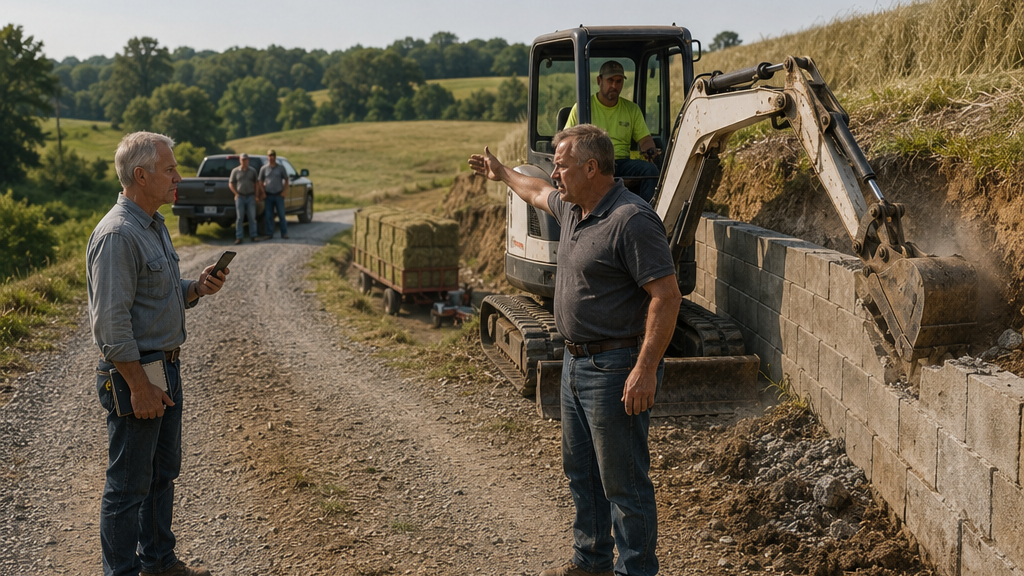
The excavator bucket touched the top block of Robert Martin’s retaining wall before the sun cleared the ridge.
It did not strike. Not yet.
The steel teeth rested against the gray concrete like a hand placed on somebody’s shoulder before a fight.
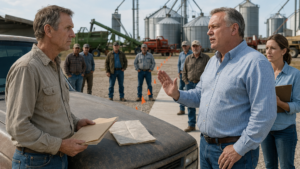
Robert stood twenty feet away in the gravel lane with his phone in one hand and his weatherproof field notebook in the other. Beyond the wall, his upper hay field rose in a long green slope still wet with dew. Below it, Gregory Wilson’s equipment yard sat in shadow, crowded with a baler, two wagons, and the new high-sided hay trailer that had caused most of this.
Gregory raised one arm toward the excavator operator.
“Hold up.”
The engine stayed running.
Gregory walked toward Robert, boots grinding into the lane. He carried a folded sheet of paper under one arm.
“You’ve got one more chance,” he said. “We can settle the turn today, or I have him take it down.”
Robert looked past him at the excavator.
“You already hired him.”
“I hired him because you stopped answering.”
“I answered in writing.”
Gregory’s mouth tightened.
“That’s the problem with you. Everything comes in an envelope.”
Robert felt the old impulse rise—to explain exactly why written notices mattered, why measurements mattered, why a slope did not care whether either man liked the other. Instead, he opened his notebook.
“Six forty-eight,” he said quietly, writing the time.
Gregory stared at him.
“You’re logging this?”
“I told you I would.”
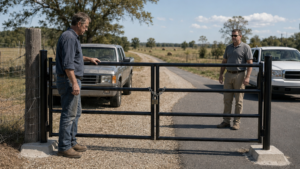
One of the neighboring landowners stood beside a pickup farther down the lane. Another watched from the fence. Nobody said much. They had all seen Gregory’s new trailer try the turn three weeks earlier. Its rear tire had climbed the ditch bank while the opposite corner missed Robert’s wall by less than a foot.
The lane was tight. Robert had never denied that.
The trouble was that Gregory kept treating the wall as if it were the reason the hill existed.
Gregory unfolded the paper.
“County sketch from twenty-seven years ago.”
Robert glanced at it.
The drawing showed the shared agricultural lane sweeping wider near the property line. The dimensions were rough. No engineering stamp. No construction notes.
Gregory tapped the bend with one finger.
“That turn was supposed to be wider.”
“Supposed to be isn’t the same as built.”
“It was left that way because your father put that wall in.”
“My father didn’t build this wall.”
“You rebuilt it on the same line.”
“Yes.”
“And made it taller.”
Robert looked at the concrete blocks. At their highest point the wall rose a little over five feet from the lower grade, though the exposed face varied with the slope. Gregory had repeated that number to anyone willing to listen as if height itself proved wrongdoing.
“I made it strong enough for the cut,” Robert said.
“There. That.” Gregory gave a short, humorless laugh. “Every time somebody asks about access, you turn it into an engineering lecture.”
Robert closed the notebook.
“You came to my porch last month and told me you were widening this lane whether I agreed or not.”
“I asked you to sit down with me and Jonathan.”
“After you told two neighbors I’d built the wall to steal turning room.”
“I said you used the boundary to your advantage.”
“That’s not the same sentence?”
Gregory looked toward the idling machine.
For a moment neither man spoke.
The exhaust hung low in the cool air.
Then Gregory extended the sketch.
“We can still talk through a new corner. Move the face back, rebuild lower, give me another six feet through the turn.”
Robert could have taken the paper.
He could have walked the bend with him, measured the trailer, discussed reinforcement, moved the upper drainage outlet, and perhaps found a solution before anybody touched the wall.
Instead he heard the word steal again, though Gregory had not repeated it.
Robert slid his phone into camera mode.
“You should have asked before bringing the excavator.”
Gregory’s face changed.
Not much. Just enough.
“All right,” he said.
He turned and lifted his arm.
The first strike cracked the upper block.
Concrete dust puffed into the lane.
Robert’s grip tightened around the phone, but he did not move forward.
The operator pulled again. A block rolled loose, hit the gravel, and split along one corner. Soil behind it was darker than the dry surface above.
Gregory stood with his hands on his hips.
Robert filmed the machine, the wall, the date on his phone screen, then slowly panned toward the upper slope.
“You ought to get that trailer through now,” one of the neighbors called.
Gregory gave no answer.
The excavator stripped off another block.
Robert stepped closer to the remaining face.
“Stop for a minute.”
Gregory looked over.
“You said you weren’t stopping us.”
“I’m not. I want a photograph before he reaches the lower course.”
Gregory laughed once.
“Photograph whatever you want.”
Robert crouched near the end of the wall and pushed two fingers into the exposed fill. It was damp several inches below the surface.
Too damp for early June.
He smelled wet clay.
Behind the concrete face, the ground climbed sharply toward a shallow swale crossing his pasture. Years earlier, when he had rebuilt the failing timber wall his father had left behind, Robert had cut into that slope and found seepage even during dry weather.
He had not guessed at the replacement.
He had calculated it.
But none of that mattered to the men watching unless he could make them understand before the hill answered for itself.
The excavator operator lowered the bucket again.
Robert stood.
“Gregory.”
“What?”
“When you get to the base, don’t crush anything that comes out of the gravel.”
Gregory shook his head.
“More warnings?”
“One warning.”
“Let me guess. The whole hill’s going to collapse.”
“No.”
Robert looked downhill toward the equipment shed.
“That would almost be simpler.”
Gregory stared at him for a second, then motioned for the operator to continue.
By eight o’clock, enough of the upper wall was gone that the lane already looked wider. Robert hated admitting it, but from the approach the difference was obvious. Gregory backed his pickup through the corner and made the turn without brushing the ditch.
He stopped beside Robert and lowered the window.
“See?”
Robert looked at the open space.
“Yes.”
Gregory seemed almost surprised.
“Yes?”
“The lane was too tight for your new trailer.”
Gregory waited.
Robert added, “That doesn’t make this safe.”
The window went back up.
Work resumed.
The excavator pulled one block from the lower course, and a stream of clean gray stone spilled out from behind it instead of packed earth.
The operator paused.
Something black appeared inside the gravel.
A pipe.
Perforated, four inches wide, running lengthwise behind the wall.
Gregory walked closer.
“What’s that?”
Robert lowered his phone.
The anger that had been sitting hot behind his ribs changed shape.
He looked at the wet gravel surrounding the pipe, then at the slope above them.
“That,” he said, “is what I was trying to get you to leave alone.”
Chapter 2: What the Broken Blocks Exposed Beneath the Lane
Robert found the iron survey pin six inches from the broken footing.
The excavator had already been shut down for lunch when sunlight caught a thin streak of rust in the disturbed soil. At first it looked like scrap metal. Robert knelt, brushed loose clay away with the edge of his glove, and felt the round top of an old iron rod driven deep into the ground.
He took out his tape measure.
Gregory watched from across the lane.
“You planting evidence now?”
Robert did not look up.
“Come here.”
“I’ve seen enough measuring for one morning.”
“Then stay there.”
Robert stretched the tape from the center of the pin to the remaining wall face. He checked it twice, then opened his notebook and wrote the distance.
Gregory walked over despite himself.
“What?”
Robert pointed.
“That’s the corner monument from the old survey.”
Gregory crouched.
The iron pin had been hidden beneath grass and gravel for years, almost level with the original shoulder of the lane.
Robert measured again.
“The wall face is inside my line.”
“How far?”
“Four inches at this point.”
Gregory frowned.
“That doesn’t settle the access.”
“No.”
Robert stood.
“But it settles the story that I built it across your ground.”
The neighboring landowner near the pickup had moved closer. Gregory noticed him and straightened immediately.
“This was never just about four inches.”
“I know.”
“It’s about getting equipment through.”
“I know that too.”
Gregory looked irritated by the agreement.
Robert photographed the pin, the broken footing, and the black perforated pipe exposed in the gravel. The pipe pitched gently downhill toward a buried outlet near the lower end of the wall.
Gregory followed the line with his eyes.
“You put that in?”
“When I rebuilt the wall.”
“Without telling me?”
“It drained my cut.”
“Onto my side.”
Robert paused.
“It discharged into the ditch.”
“Which runs where?”
Robert did not answer quickly enough.
Gregory gave a short nod.
“Exactly.”
That afternoon Robert sat in the small office behind his farmhouse kitchen with rolled plans across the desk and dust still ground into the knees of his jeans.
He had designed bridges, retaining systems, commercial slabs, and farm structures before leaving full-time engineering work. Most of those projects lived in electronic folders and old binders he rarely opened.
The farm wall was different.
It had begun as family work, which meant half the useful information was formal and half of it had been inherited by conversation.
He found the calculations first.
The retaining wall was not particularly complicated by engineering standards. Reinforced block. Compacted stone. Perforated drain. Filter fabric. But the soil behind it was the problem.
Robert ran one finger down a yellowed page.
Seasonal seepage.
Silty clay.
Elevated lateral pressure under saturation.
He had written the numbers himself fourteen years earlier.
The original timber wall had leaned outward because water accumulated behind it. When Robert rebuilt it, he had increased the height at the deepest portion of the cut and added drainage along the base.
He had also written a note in the margin:
Maintain outlet. Do not remove retention without temporary slope support.
Robert sat back.
His phone rang.
Gregory.
Robert let it ring twice before answering.
“What?”
“I talked to the county road supervisor.”
“This isn’t a county road.”
“I know what it is. He said they don’t enforce private wall setbacks.”
“Correct.”
“So quit acting like that pin ends the argument.”
“I never said it did.”
“You implied it.”
Robert looked at the calculations spread across his desk.
“The wall is on my property. That matters.”
“What matters to me is I still have a loaded trailer that can’t turn safely.”
“Then we design a wider turn.”
There was silence.
Gregory said, “Funny. That offer would’ve sounded better yesterday.”
Robert had no answer to that.
He heard Gregory breathe into the phone.
“Listen,” Gregory said. “You keep talking about drainage like I tore out a dam.”
“You removed part of a retaining system.”
“It’s a farm wall.”
“It’s holding a cut slope.”
“You engineers always make a simple thing sound expensive.”
Robert almost laughed, but there was nothing funny in it.
“You want the simple version?”
“Please.”
“If enough water gets behind that cut now, the soil moves.”
“How much?”
“I don’t know.”
“When?”
“I don’t know.”
“So you don’t know anything.”
“I know the condition that makes it dangerous.”
Gregory’s voice hardened.
“And I know where the water comes from. Your hill.”
The call ended.
The next morning Kimberly Roberts arrived in a county truck just after nine. She wore work boots, carried a soil probe, and listened without interrupting while both men explained the dispute from opposite sides of the lane.
When they finished, she looked at the exposed pin first.
Then the drain.
Then the slope.
“Boundary and drainage are two different questions,” she said.
Gregory folded his arms.
“Finally.”
Robert ignored him.
Kimberly probed the soil behind the demolished section. She pulled the steel rod out and rubbed the dark clay between gloved fingers.
“This stays wet?”
“Usually below the surface,” Robert said.
“Even in summer?”
“Yes.”
She examined the plans Robert had brought.
“You designed this?”
“Yes.”
She looked at him more closely.
“You still licensed?”
“Not practicing.”
“That wasn’t what I asked.”
“Yes.”
She nodded once and returned to the sheet.
Gregory made a faint sound through his nose.
Kimberly traced the drainage line with her finger.
“The wall being inside the survey line means the encroachment issue looks different than described. But the pin doesn’t answer who’s responsible for water moving through here.”
Gregory pointed uphill.
“That’s what I told him.”
Kimberly looked at Robert.
“Where does surface runoff from the upper pasture go during a hard storm?”
“Most of it follows the swale east.”
“Most?”
Robert knew the weakness before she said another word.
Some water crossed toward the cut.
He had always regarded it as manageable because the wall drain intercepted the seepage.
Kimberly walked uphill fifty yards, stopped at the shallow depression in Robert’s field, and studied the contour.
When she returned, she said, “I wouldn’t want this wall removed without a drainage plan.”
Gregory’s expression tightened.
“But?”
“But I also wouldn’t tell you the wall makes his water entirely his problem or your problem. Not from what I can see today.”
Robert closed the plan set.
His first satisfaction—the iron pin, the clean measurement, the proof that Gregory had been wrong about encroachment—was already fading.
Kimberly looked toward the western sky.
“You two need temporary stabilization before the next significant rain.”
Gregory glanced at his phone.
“It’s June.”
Kimberly held his gaze.
“Rain still falls in June.”
That evening Robert checked the forecast.
One storm icon had become three.
The updated system showed rain beginning Friday, continuing through the weekend, with heavier bands possible Sunday night.
He took his notebook outside and stood beside the torn wall.
The exposed pipe lay among loose gravel. Above it, the unsupported cut seemed unchanged.
Robert pressed his thumb into the soil.
Moisture darkened his skin.
For the first time since the excavator arrived, proving Gregory wrong no longer felt like the thing he wanted most.
Chapter 3: The First Rain Opened a Crack by the Equipment Shed
The crack began at the corner of Gregory’s equipment shed and crossed nearly seven feet of concrete before either man noticed it.
Robert saw it first because Gregory had called him down to look at mud in the lane.
Two weeks had passed since the demolition. Temporary plastic sheeting had been placed over part of the cut, but no real shoring had gone in. The first storm dropped steady rain for nearly a day. A second came four nights later. Neither was extraordinary.
They did not need to be.
Robert stepped onto Gregory’s concrete apron and stopped.
“Don’t drive across this.”
Gregory, standing near the shed door, looked down.
“What now?”
Robert pointed.
A thin dark line ran from beneath a stack of pallets toward the open yard.
Gregory stared at it.
“That wasn’t there.”
“When did you last sweep this?”
“Yesterday.”
Robert crouched and ran one finger beside the crack without touching it.
The opening was small near the center, wider at the slab edge closest to the slope.
Gregory’s jaw tightened.
“You’re enjoying this?”
Robert looked up.
“No.”
“Could’ve fooled me.”
Robert took the tape measure from his truck.
Gregory stepped between him and the crack.
“I know what you’re going to do. Photograph it, date it, put it in one of those books.”
“I’m going to measure it.”
“And then tell me you predicted the future.”
Robert waited.
Gregory moved aside.
At the slab edge, the separation measured a little over half an inch. Robert wrote it down.
Gregory watched his pencil.
“There. Feel better?”
Robert closed the notebook.
“No.”
The answer seemed to unsettle Gregory more than an argument would have.
Kimberly arrived that afternoon after Robert sent photographs of the cut. She brought a hand auger and walked the slope before she examined the concrete.
The soil behind the former wall had slumped only a few inches, but the surface told a larger story. Fine cracks curved through the bank. Mud had pushed into what remained of the drainage stone. Watermarks showed where runoff had crossed the disturbed area.
Kimberly drove the auger into the upper slope and pulled out dark, sticky soil.
“Saturated,” she said.
Gregory looked at Robert.
“So he was right.”
Kimberly wiped the auger clean.
“About removing the wall without stabilizing the cut? Yes.”
Robert felt the sentence land with a satisfaction he had expected for days.
It lasted perhaps three seconds.
Kimberly pointed uphill.
“But that’s not the whole problem.”
Gregory turned.
“What is?”
She walked beyond the demolished section and followed a narrow wash through the grass. Robert knew exactly where she was going before she reached the shallow swale in his pasture.
Recent rain had cut a brown channel through it.
Kimberly pointed to a place where the natural grade turned.
“Water’s leaving his field here.”
Gregory looked at Robert.
Robert said nothing.
Kimberly continued down the line. The runoff crossed toward the cut, where the old retaining system had previously intercepted some of it.
“How long has this drained this way?” she asked.
Robert stared at the wash.
“Years.”
“You have a diversion farther uphill?”
“Not a formal one.”
Gregory laughed, but there was no amusement in it.
“You’ve spent two weeks telling me about engineering, and you’ve got water coming off your field onto mine?”
“It was being collected.”
“By the wall I tore down.”
“Yes.”
Gregory spread both hands.
“Then why didn’t you say that the first morning?”
“I said the wall handled drainage.”
“That is not the same thing.”
Robert looked toward the broken blocks.
Gregory was right.
Not completely. But enough.
Robert had wanted him to understand the structural consequence. He had not wanted to say, in front of the neighbors, that part of the water pressing against the system began on Robert’s own farm.
It would have sounded like weakness.
Or liability.
Or an admission Gregory could use before hearing the rest.
So Robert had chosen the cleaner truth and left out the messier one.
Kimberly crouched beside the slab.
“Do you have any written drainage easement between the properties?”
Gregory answered first.
“No.”
Robert said, “Not that I know of.”
“Agreement?”
“My father handled it.”
Gregory shook his head.
“Your father handled everything with a handshake.”
“So did yours.”
“My father didn’t send certified letters afterward.”
Robert felt the sting and deserved part of it.
Kimberly stood.
“This isn’t going to be solved by deciding which one of you gets to say ‘I told you so.’ The wall removal changed the support condition. The runoff from Robert’s side contributes water to the area. I’d document the damage, protect the slope, and find whatever records exist about how this drainage was supposed to work.”
Gregory looked at the crack again.
“What if it gets worse?”
“It can.”
“How much worse?”
“I’m not giving you a number from one site visit.”
Gregory glanced toward the shed. The building held tools, spare parts, and the baler he had recently financed with Jonathan.
Robert recognized that look. Engineers saw it when a technical problem stopped being theoretical and became a question of what somebody could afford to lose.
Robert opened the notebook again.
Gregory noticed.
“For once, could you leave that thing shut?”
Robert almost did.
Then he looked at the crack.
“Measurements matter.”
“Of course they do.”
Robert placed the tape across the widest part.
Seven-tenths of an inch.
Larger than it had been that morning.
Gregory’s face went still.
Robert wrote the number.
This time there was no satisfaction in it at all.
Kimberly walked to the lane and examined the remaining lower section of wall. She pointed at the exposed drainpipe.
“That system was doing work.”
Gregory said nothing.
Robert said, “I warned you.”
Kimberly turned toward him.
“And now I’m warning you.”
Robert frowned.
She pointed uphill.
“Your field needs better runoff control whether the wall is rebuilt or not. If all you do is prove Gregory shouldn’t have removed it, you still haven’t fixed your half.”
Your half.
Robert looked at the muddy channel coming out of his pasture.
For fourteen years he had treated the retaining wall as his structure.
His design.
His maintenance problem.
Now, with the wall gone, the land showed something the paperwork had hidden: the water did not recognize the property line.
Gregory leaned against the shed door.
“So what happens next?”
Kimberly looked from one man to the other.
“You find out what your families agreed to.”
Robert shook his head.
“There may not be anything.”
“Then find out why this system was built the way it was.”
She packed the auger into her truck.
Before leaving, she stopped beside Robert.
“The county records may show old grading permits, but private arrangements usually don’t. Check your father’s papers.”
Robert’s attention returned to the exposed survey pin near the lane.
For days it had felt like the cleanest fact in the entire dispute.
A fixed point.
A line nobody could argue with.
Now it seemed almost irrelevant beside the water crossing underneath everything.
Kimberly opened her truck door.
“One more thing.”
Robert waited.
“If your father and Gregory’s family shared drainage through that cut, somebody probably knew it.”
Gregory’s expression changed.
Robert saw it.
Not surprise exactly.
Recognition.
“Gregory?”
Gregory looked away.
Robert stepped toward him.
“What do you know?”
“Nothing I can prove.”
“That wasn’t my question.”
Gregory rubbed a hand across his mouth.
“My father used to say your dad promised that ditch would stay open.”
Robert felt something tighten in his chest.
“What ditch?”
Gregory looked toward the upper pasture.
“The one that was supposed to carry the water before it ever reached this wall.”
Kimberly closed the truck door again.
Robert stared at Gregory.
“You never told me that.”
“You never asked.”
Robert thought of the metal cabinet in his farmhouse office, the boxes he had not opened since his father died.
Kimberly looked at him.
“Find the original agreement.”
Robert glanced at the crack, then uphill toward the field his family had worked for generations.
For the first time, he was no longer sure whether he was looking for evidence against Gregory.
He might be looking for evidence against himself.
Chapter 4: The Agreement Their Fathers Never Put on Paper
Robert found the sketch folded inside his father’s old cattle ledger, between vaccination records from nineteen years ago and a page listing the sale weights of calves that had been dead longer than some neighboring farms had existed.
He almost missed it.
The paper was no larger than a grocery receipt when folded, yellowed at the edges and soft from being handled. Robert opened it carefully on the desk beneath the window.
Two property lines had been drawn in pencil.
A narrow lane curved between them.
Above the lane, a ditch ran diagonally across what was now Robert’s upper pasture. Beside it, his father had written three words.
Keep water east.
Robert sat down.
The retaining wall did not appear on the sketch.
That mattered.
The ditch did.
He pulled the county survey from his cabinet and laid it beside the page. The iron pin exposed during demolition matched the corner shown on both documents. The old sketch then extended beyond the surveyed boundary, showing something the official record did not: the lane opening wider near Gregory’s side before narrowing again below the slope.
Robert stared at that shape.
He had seen it before.
Not on paper.
In dirt.
When he was young, the turn had been wider. His father had parked a grain wagon there during repairs. Gregory’s father had crossed the same ground with an old square baler that looked tiny compared with the equipment now running the farms.
Robert had always assumed the lane narrowed after fence repairs.
The sketch suggested otherwise.
He took it outside.
The exposed survey pin still sat in the disturbed shoulder, orange-brown against the gravel. Robert stood over it and held the drawing so that the pencil lines aligned with the land.
The unfinished widening would have pushed the turning radius partly across Robert’s present slope.
And the ditch marked Keep water east would have intercepted runoff before it reached that same slope.
Two projects.
Neither completed.
Robert looked uphill at the shallow wash Kimberly had traced after the storms.
If his father had finished the diversion ditch, less water would have reached the retaining wall.
If the families had finished the widening, Gregory might never have needed the wall removed.
The arrangement they had inherited was not a design.
It was a postponement.
Robert found Gregory repairing a hydraulic hose near his equipment shed.
The crack across the concrete apron had been marked with chalk at both ends. It had not widened since Kimberly’s visit, but it remained visible enough that neither man could pretend it was cosmetic.
Robert held up the sketch.
“Recognize this?”
Gregory wiped his hands and took it.
His expression changed almost immediately.
“Where’d you get this?”
“My father’s ledger.”
Gregory ran a thumb along the pencil line.
“My dad had one like it.”
Robert looked at him.
“You knew?”
“I knew there’d been talk.”
“That’s not what you said.”
“I said my father told me your dad promised the ditch would stay open.”
“This shows more than a ditch.”
Gregory’s eyes stayed on the paper.
The widened turn was obvious.
“So it does.”
Robert felt irritation sharpen.
“You’ve been saying for months that I narrowed your access.”
“You did.”
“No. We inherited a turn that was never finished.”
“And then you rebuilt the wall exactly where it was.”
“Inside my boundary.”
Gregory folded the paper once, then stopped before creasing it further.
“There you go again.”
“What?”
“Boundary first. Everything else second.”
Robert looked toward the iron pin.
For weeks that pin had felt like his strongest piece of evidence. Four inches inside the line. Clean. Measurable. Defensible.
But the pencil sketch made the truth harder.
The families had known the turn was inadequate long before either of them became responsible for the farms.
“Why didn’t your father finish it?” Robert asked.
Gregory gave him a tired look.
“Why didn’t yours finish the ditch?”
Neither man answered.
Robert took the sketch back.
A memory surfaced, unwelcome and exact.
Three years earlier Gregory had come to Robert’s machine shed with Jonathan. They had brought dimensions for a larger trailer and asked about widening the turn.
Gregory had suggested cutting back part of the slope, shifting the fence, and rebuilding the wall farther uphill.
Robert had barely looked at the measurements.
At the time, Gregory had been in the middle of another boundary argument over mowing along the lane. Robert had assumed the widening request was simply another attempt to gain ground.
He had said, “The line stays where it is.”
Gregory had replied, “I’m talking about the turn, not the deed.”
Robert had ended the conversation anyway.
Standing beside the cracked apron now, he could hear his own voice more clearly than he wanted.
Gregory seemed to know what he was thinking.
“You remember.”
“Yes.”
“You wouldn’t even walk it with us.”
Robert folded the sketch.
“You also told people I was using the wall to squeeze the lane.”
“After you shut the door on me.”
“That doesn’t make it true.”
“No.”
The admission came without argument.
Gregory looked toward the slope.
“But you didn’t make it easy to believe anything else.”
Robert could have answered that Gregory had ordered demolition after receiving written warning. He could have listed dates.
Instead he said, “No. I didn’t.”
For the first time since the excavator arrived, Gregory seemed to have no prepared response.
That evening Robert returned to the farmhouse and spread every available record across the dining table.
There was no signed easement.
No drainage agreement.
No construction contract.
Only fragments: the sketch, old receipts for stone, a note about cleaning a ditch, and an entry in his father’s handwriting mentioning “Wilson turn after harvest.”
After harvest.
Robert read it three times.
The project had always been meant to happen later.
Later had become years.
Years had become two sons inheriting the argument without inheriting the conversation.
Headlights swept across the front window.
Robert looked outside.
Jonathan Baker stepped from a pickup and stood for a moment at the porch, cap in both hands.
Robert opened the door before he knocked.
“Gregory send you?”
“No.”
Jonathan glanced past him toward the papers on the table.
“You finding things?”
“Some.”
Jonathan swallowed.
Then he said, “Before you send anything to insurance or an attorney, I need to ask you something.”
Robert’s expression hardened.
“Ask.”
Jonathan looked at him directly.
“Don’t file the claim yet.”
Chapter 5: Jonathan Finally Explained Why Gregory Could Not Wait
“I’m the reason he bought the trailers.”
Jonathan said it before Robert could ask why a formal claim frightened him.
They stood in Robert’s empty hay barn, where the air still carried last season’s dry sweetness and dust floated through the light from the open doors.
Robert had brought him there because he did not want the conversation inside the farmhouse with his father’s papers spread across the table.
Jonathan leaned against a post.
“I told Gregory we were losing money doing small loads. I ran the numbers. Bigger trailer, fewer trips, faster turnaround. We could pick up two more hay contracts.”
Robert waited.
Jonathan rubbed his palms against his jeans.
“He said the lane wouldn’t handle it.”
“That was correct.”
“I told him we could fix the lane.”
“That was less certain.”
Jonathan gave a small nod.
“I know that now.”
Robert’s weatherproof notebook was in his shirt pocket.
He did not take it out.
That alone felt strange.
“How much did he borrow?”
Jonathan looked toward the barn doors.
“Enough.”
“That isn’t a number.”
“You want me to tell you his loan balance?”
“No.”
“Then enough.”
Robert accepted it.
Jonathan continued.
“The baler, the trailer, some handling equipment. We expected to make the payments out of the new contracts. But if we can’t haul on schedule, those customers call somebody else.”
“And Gregory thought removing my wall solved that.”
“He thought talking had failed.”
Robert’s jaw tightened.
“Talking failed because he brought an excavator.”
“No. That was later.”
Jonathan’s tone was quiet, but the words landed harder for it.
“He came here three years ago.”
Robert looked at him.
“I remember.”
“Do you?”
“Yes.”
“We had trailer drawings. I had turning dimensions. Gregory asked if we could move the wall back when you rebuilt the corner.”
“I told him the property line wasn’t moving.”
“He wasn’t asking to move the property line.”
Robert looked away.
Jonathan did not press immediately.
Outside, a tractor crossed a distant field, engine rising and falling behind the barn wall.
Finally Jonathan said, “Gregory can be hardheaded. You know that better than I do. He takes being told no like somebody’s trying to make him small.”
Robert almost smiled.
“That sounds familiar.”
“Yeah.”
Jonathan looked at him.
“That’s sort of my point.”
Robert pulled the notebook halfway from his pocket, then stopped.
He slid it back in.
Jonathan noticed.
“What’s in that thing?”
“Dates.”
“Of course.”
“Measurements. What happened. What was said.”
“You write down what you said?”
Robert looked at him.
Jonathan shrugged.
“Just wondering.”
The question stayed between them.
Robert remembered telling Gregory the wall was structural. Remembered the written notice. Remembered warning him about saturation.
He also remembered refusing to walk the proposed turn.
That had not gone into the notebook.
Not because he had forgotten.
Because he had not considered it evidence.
“Why ask me not to file?” Robert said.
Jonathan breathed out.
“Because if Gregory gets a formal demand right now, he’ll quit talking.”
“That’s his choice.”
“I know.”
“And the wall removal was his choice.”
“I know that too.”
Robert studied him.
Jonathan was not asking him to pretend nothing had happened. He looked embarrassed enough to resent having come.
“What are you asking for?”
“Two days.”
“For what?”
“To get him to sit down.”
Robert laughed softly.
“I tried warning him before the machine showed up.”
“You warned him. That isn’t the same as sitting down.”
Again, the words found their mark.
Jonathan pushed away from the post.
“There’s something else.”
Robert waited.
“The weather service has another system coming through.”
“I saw it.”
“The shed foundation?”
“Could move more.”
Jonathan’s face tightened.
“The baler’s still inside.”
“Move it.”
“Where?”
Robert gestured toward the upper barn.
“You can put it here temporarily.”
Jonathan blinked.
“You’d let us?”
“It’s a building.”
“That isn’t what I asked.”
Robert looked at him for a long moment.
“You have equipment at risk. I have empty floor space.”
Jonathan gave one slow nod.
“Thank you.”
Robert did not say anything.
They walked out together.
At the lane, Jonathan stopped near the exposed survey pin.
“My grandfather used to talk about this corner.”
Robert turned.
“What did he say?”
“That he and your father were going to fix it right after one good season.”
Robert looked down at the pin.
“Apparently they kept waiting for one.”
Jonathan smiled faintly.
“Farmers do that.”
The smile disappeared.
“My dad thinks your father changed his mind because he didn’t trust the Wilsons.”
“My father thought Gregory’s father always wanted another foot.”
“Gregory says the Martins measured every foot twice because they thought somebody was coming for it.”
Robert could not argue.
The old insult felt less insulting now that he could see how efficiently both families had carried it forward.
That night another band of rain appeared on the forecast, heavier than the first.
Robert sat at his kitchen table with the hand-drawn sketch beside a blank sheet of engineering paper.
He could file a claim.
He could send Gregory copies of every warning and wait for an adjuster to assign blame.
Some part of him still wanted that clean sequence.
Warning.
Decision.
Damage.
Responsibility.
But the water coming off his pasture did not fit neatly inside it.
Neither did the unfinished widening.
Neither did the memory of Gregory and Jonathan standing in his machine shed three years earlier while Robert refused to walk fifty yards with them.
He picked up a pencil.
On the blank sheet he drew the property line first.
Then he stopped.
He erased part of it.
Not the legal line.
Only the heavy way he had drawn it.
Next came the slope, the lane, the existing ditch, and the location of the demolished wall.
He marked a widened turning radius.
Then a diversion swale across his own pasture.
A rebuilt retaining system farther upslope could preserve stability while opening the lane.
It would cost money.
It would require both farms.
It was also possible.
Robert stared at the drawing until the paper stopped looking like a case and began looking like work.
Before sunrise the next morning, he put the blank-backed preliminary sheet on the passenger seat of his truck.
He drove past the exposed survey pin, past the cracked apron, and up Gregory’s drive.
Gregory stepped onto his porch before Robert reached the steps.
His expression closed immediately.
“If you brought papers, leave them in the mailbox.”
Robert held up the sheet.
“I did bring paper.”
Gregory started to turn away.
Robert said, “It isn’t a claim.”
Gregory stopped.
Robert unfolded the drawing.
“It’s a redesign.”
Chapter 6: Robert Put His Own Liability on the Drawing
Robert placed the drawing on Gregory’s kitchen table and marked his own pasture in red pencil first.
Gregory noticed.
He did not sit.
“What’s that?”
“My runoff.”
Robert drew an arrow from the upper swale toward the damaged cut.
“Some of the water entering this slope starts on my ground. The old wall handled part of it, but that doesn’t mean the drainage arrangement was good.”
Gregory leaned over the table.
“You admitting fault?”
“I’m identifying a condition.”
“Sounds like an engineer’s way of saying yes without saying yes.”
Robert put the pencil down.
“All right. Yes. My farm contributes runoff to the problem.”
Gregory stared at him.
Robert continued.
“And you removed a retaining structure after I warned you not to do it without support.”
“There it is.”
“There what is?”
“The second half.”
“There are two halves.”
Gregory finally pulled out a chair.
“Then sit.”
Robert sat across from him.
For several seconds, neither man touched the drawing.
The kitchen was quiet except for the refrigerator cycling on.
Gregory tapped the red arrows.
“What do you propose?”
Robert rotated the sheet.
“First, divert more surface flow east before it reaches the cut. That part is on me.”
Gregory looked up.
“On you financially?”
“Yes.”
Robert pointed to the slope.
“Second, rebuild retention here, but farther upslope. Reinforced base, drainage stone, proper outlet.”
“That gives me what?”
“About five and a half feet more turning room at the tightest point.”
Gregory frowned.
“You said moving the wall wasn’t safe.”
“I said removing it without a plan wasn’t safe.”
“That sounds convenient.”
“It sounds different because it is different.”
Robert sketched the footing.
“If we cut back the slope in stages, support it during construction, control the water, and rebuild before opening the lane fully, the wall can move.”
Gregory studied the page.
“And the property line?”
“Doesn’t move.”
Gregory leaned back.
“So I still hear about the iron pin forever.”
Robert almost answered defensively.
Instead he said, “The pin isn’t the problem.”
Gregory’s eyebrows lifted.
Robert looked at the drawing.
“It tells us where the line is. Fine. We know that now. We don’t need to keep arguing about it.”
For the first time in years, perhaps ever, Gregory let a property-line statement from Robert pass without countering it.
They met Kimberly at the lane an hour later.
She reviewed the preliminary plan while Robert explained the sequence. Jonathan stood nearby, listening. The damaged slope had dried enough to walk but still showed shallow movement.
Kimberly pointed to Robert’s proposed diversion.
“You can spread this discharge instead of concentrating it?”
“Yes.”
“Vegetated outlet?”
“That’s what I’m thinking.”
She looked at Gregory.
“And you’d give construction access from this side?”
“If it gets the turn.”
“It will,” Robert said.
Gregory glanced at him but did not challenge it.
Kimberly traced the new wall line.
“This is better than rebuilding what was there.”
Robert nodded.
“That’s the point.”
“And better than leaving it open.”
Gregory nodded this time.
Jonathan walked the proposed trailer path with a measuring wheel. Robert placed temporary stakes along the inside curve.
At the old corner, the rusted survey pin remained visible.
Robert set one stake three feet uphill from it.
Gregory looked down.
“So that little piece of iron stays.”
“It was here before either of us started arguing.”
“That long?”
“Probably longer.”
Gregory nudged the gravel beside it with his boot.
“Funny thing to build a feud around.”
“We managed.”
That earned the smallest trace of a smile.
By afternoon, the practical question became money.
The equipment contractor stood at the lane with a calculator and worked through excavation, base preparation, drainage stone, block, labor, and temporary stabilization.
The number was high enough that nobody spoke for several seconds.
Gregory finally said, “Insurance?”
The field adjuster who had already inspected the crack had warned them separately that coverage would be complicated. Gregory’s policy might address some resulting damage but not necessarily voluntary demolition or correction of preexisting site conditions. Robert’s farm coverage was no guarantee for long-term drainage improvements on his own land.
Robert shook his head.
“We shouldn’t design around what we hope they pay.”
Gregory gave him a look.
“Easy to say when you didn’t just finance half an equipment yard.”
Jonathan stiffened.
Robert let the remark pass.
He took out his notebook.
For once, he opened it not to record an argument but to divide work.
“I pay for the upper diversion and my share of the redesigned drainage.”
Gregory folded his arms.
“And the wall?”
Robert hesitated.
The old reflex told him Gregory should pay all of it. He had ordered the demolition.
But the new wall would also correct flaws in Robert’s runoff system and improve his slope permanently.
“I’ll pay for the portion that improves drainage beyond the old condition.”
Gregory stared at him.
“And I pay the rest?”
“You ordered the wall removed.”
“That wall needed changing.”
“Yes.”
The word stopped Gregory.
Robert continued.
“You were right about the access. You were wrong about how you fixed it.”
Gregory looked down the lane.
Jonathan said nothing.
Kimberly had stepped away, deliberately leaving the negotiation to them.
Gregory finally asked, “You saying you were wrong too?”
Robert looked at the red arrows on the drawing.
“Yes.”
It was not difficult to say once he decided to say it plainly.
“I should have dealt with the runoff years ago. And I should have walked the widening plan with you when you brought it.”
Gregory rubbed his jaw.
“I still shouldn’t have brought the excavator.”
“No.”
“I thought if I waited another month, we’d lose the contracts.”
“I know.”
Gregory looked toward Jonathan.
Then back to Robert.
“My insurance doesn’t cover the demolition, I pay that part.”
Robert waited.
Gregory pointed toward the broken wall.
“I ordered it. I don’t want you paying for me tearing it out.”
“That isn’t the entire reconstruction cost.”
“I know.”
“We still need to separate replacement from improvement.”
“Then separate it.”
The words were sharp, but not hostile.
They were work now.
That evening Robert revised the drawing in his office.
He marked the iron survey pin as the fixed reference point. Not as proof against Gregory. Not as the beginning of an accusation.
Simply as the point from which both farms would measure the new work.
The field notebook lay open beside him.
For years it had been filled with dates, distances, weather, disagreements, warnings.
Robert turned to a clean page.
At the top he wrote:
Shared drainage and lane reconstruction.
Below it he listed the first inspection date.
Then he drew two columns.
Martin.
Wilson.
For the first time since the excavator touched the wall, the next line between their farms was being written by both of them.
Chapter 7: The New Line Was Built for Both Farms
The first loaded hay trailer reached the rebuilt turn at seven fourteen on a Tuesday morning, and every person standing beside the lane stopped talking.
Jonathan drove.
The trailer behind him carried tightly packed square bales stacked above the cab of the pickup. It was exactly the kind of load that had started the argument months earlier—long, heavy, and unforgiving when the rear axle entered a tight corner.
Robert stood beside the new retaining wall with his field notebook tucked under one arm.
Gregory stood twenty feet farther downhill.
Nobody waved Jonathan through.
They had measured the turn three times. Robert had checked the constructed dimensions against the redesign. Gregory had driven it empty. The equipment contractor had walked the inside radius.
None of that mattered as much as the loaded trailer approaching now.
Jonathan slowed.
The front tires entered the bend.
The trailer followed.
Robert watched the inside rear wheel.
It passed the permanent boundary marker with nearly two feet to spare.
The outside corner cleared the rebuilt wall without touching the gravel shoulder.
Jonathan straightened the truck and continued down the lane.
Gregory let out a breath.
“Well.”
Robert looked at him.
“Well what?”
“It works.”
Robert glanced toward the new wall.
“Looks that way.”
Gregory almost smiled.
The rebuilt structure was shorter where the lane needed room and stronger where the slope carried the most pressure. Behind it, washed stone surrounded a new perforated drain. Farther uphill, the shallow diversion Robert had paid to construct redirected surface runoff eastward into a broad vegetated outlet instead of concentrating it above the cut.
The old iron survey pin had not been moved.
They had protected it during construction and placed a permanent marker beside it, high enough that no one would have to dig through gravel to find the line again.
For most of his life, Robert had believed fixed things prevented arguments.
Pins.
Measurements.
Boundaries.
Numbers.
Now he understood that fixed points only told people where to begin.
Jonathan stopped near the equipment shed and climbed down.
“Want me to try it again?”
Gregory shook his head.
“If you missed the wall with that load, I believe you.”
Jonathan looked toward Robert.
“Your dimensions were right.”
Robert said, “The dimensions were everybody’s by the time we finished.”
Gregory glanced at him.
Six weeks earlier, that sentence would have sounded impossible.
The repairs had not been easy.
Gregory’s insurance covered part of the damage to the concrete apron but not the decision to remove the wall. Robert’s policy contributed nothing toward improvements on his own drainage system.
So they divided the work.
Gregory paid the demolition-related reconstruction costs.
Robert paid for the upper diversion and the improvements necessary to control runoff from his pasture.
They split the portions of the new drainage system that served both properties.
Every invoice was copied.
Every change was discussed before equipment moved.
It was slower than either man preferred.
It was also the first time in decades that the two farms had worked from the same set of plans.
Kimberly arrived later that morning for a final walk-through.
She inspected the stabilized slope, checked the new outlet, and walked the lane from the survey marker to the equipment yard.
At the cracked concrete apron, repairs were visible but sound.
She stopped beside Gregory.
“You keeping heavy equipment off the patched section another few days?”
Gregory nodded.
“That’s what the contractor said.”
“Good.”
Then she looked uphill.
“And the diversion?”
Robert answered.
“I’ll inspect it after every major storm this year.”
Gregory said, “We’ll inspect it.”
Robert turned slightly.
Gregory shrugged.
“If it plugs, water doesn’t care whose boots are standing there.”
Kimberly gave them both a look that was almost amused.
“That may be the smartest thing either of you has said since I got involved.”
Gregory muttered, “Don’t write it down.”
Robert tapped the notebook under his arm.
“Too late.”
That got a short laugh from Jonathan.
Gregory did not laugh, but he did not object either.
By noon, Kimberly had gone and Jonathan had returned to hauling.
Robert and Gregory remained near the marker, checking the final construction invoice against the cost allocation they had agreed on.
One line item had been placed under the wrong column.
Gregory pointed at it.
“That excavation was for your diversion.”
“Half of it was for the wall outlet.”
“Not half.”
Robert looked at the invoice.
A familiar irritation stirred.
For one brief second he could feel the old argument waiting for them: his number against Gregory’s, one foot becoming another foot, one receipt becoming ten years of resentment.
Robert took out a pencil.
“Let’s measure it.”
Gregory looked at him.
Then he shook his head.
“No.”
Robert frowned.
Gregory pointed toward the contractor’s notes.
“It says twenty-eight feet for the outlet trench and forty-one for the diversion. Split it by footage.”
Robert calculated it.
Gregory was right.
Robert crossed out the original allocation and changed the amount.
“There.”
“That easy?”
“It can be.”
Gregory folded the invoice.
Neither man said anything for a while.
A loaded trailer came through the turn again.
This time neither of them watched every inch.
Gregory finally said, “I should not have had that wall torn out.”
Robert looked at him.
The statement stopped there.
No apology followed.
No explanation about pressure, contracts, or what Gregory had believed Robert was trying to do.
Robert waited, then realized that was all he was going to get.
Months earlier, it would not have been enough.
Now Robert looked at the rebuilt slope, the widened lane, and the drainage line they would both have to maintain.
“No,” he said. “You shouldn’t have.”
Gregory nodded.
Robert added, “I should have walked the turn with you three years ago.”
Gregory looked toward the marker.
“No. You should have.”
It was not reconciliation in any polished sense.
It was two men refusing to improve the truth to make themselves more comfortable.
Robert found that he preferred it.
Later, when the last hay load had cleared the lane, he returned to his farmhouse office.
On the shelf were years of field notebooks.
They contained rainfall totals, fence repairs, cattle counts, measurements, dates of disagreements, certified-mail numbers, and exact words Robert had believed he might someday need to prove.
He took down the current notebook.
On the first page of the reconstruction section were the two columns he had drawn weeks earlier.
Martin.
Wilson.
Robert copied the final drainage inspection schedule beneath them.
Then he took a second waterproof notebook from the cabinet.
The next morning he found Gregory beside the equipment shed.
Robert handed it to him.
Gregory turned it over.
“What’s this?”
“Duplicate inspection log.”
“You’re giving me homework?”
“Apparently.”
Gregory opened the cover.
Robert had written the same schedule inside.
Check diversion after major storms.
Clear outlet each spring.
Inspect wall drainage before winter.
Record movement at repaired apron.
Gregory read the list.
“You could’ve just kept the records.”
“I could.”
“Probably would’ve preferred that.”
Robert looked toward the iron marker beside the lane.
“Yes.”
Gregory closed the notebook.
Then he slipped it into the toolbox on his truck instead of handing it back.
A few minutes later, another loaded trailer came down from the upper field.
It rounded the new wall cleanly, crossed the shared lane, and continued toward the road without either farmer stepping aside to argue about where the line was.
The iron pin stayed exactly where it had always been.
For once, that was not the most important thing about it.
The story has ended.